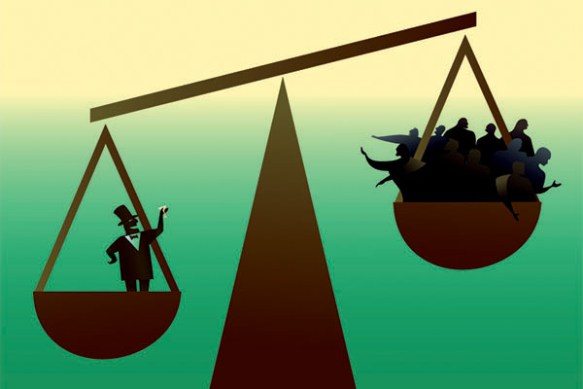
Prices, plutocrats, and corporate concentration

Would less corporate concentration – and a weaker corporate capacity to raise prices – mean less inequality?

By Sam Pizzigati

Source: Nation of Change

Andrew Leigh, a member of the Australian parliament, has a side gig. He just happens to be a working economist. Other lawmakers may spend their spare hours making cold calls for campaign cash. Leigh spends his doing research – on why our modern economies are leaving their populations ever more unequal.

Leigh’s latest research is making some global waves. Working with a team of Australian, Canadian, and American analysts, he’s been studying how much the prices corporate monopolies charge impact inequality.

The conventional wisdom has a simple answer: not much. Yes, the reasoning goes, prices do go up when a few large corporations start to dominate an economic sector. But those same higher prices translate into higher returns for corporate shareholders.

Thanks to 401(k)s and the like, the argument continues, the ranks of these corporate shareholders include millions of average families. So we end up with a wash. As consumers, families pay more in prices. As shareholders, they pocket higher dividends.

But this nonchalance about the impact of monopolies, Andrew Leigh and his colleagues counter, obscures “the relative distribution of consumption and corporate equity ownership.” Average families do hold some shares of stock, but not many. In the United States, for instance, the most affluent 20 percent of households own 13 times more stock than the bottom 60 percent.

These bottom 60 percent households, as a result, get precious little return from the few shares of stock they do hold, not nearly enough to offset the higher prices they pay on corporate monopoly products.

“On net, that means it’s nearly impossible for the typical U.S. family to make up for higher prices via the performance of their stock portfolio,” notes a Washington Post analysis of the Leigh team research. “When prices rise, low- and middle-class families pay. Wealthy families profit.”

By how much do these affluents profit? Leigh and his colleagues have done the math. The higher prices – and profits – that corporate concentration has generated have shifted 3 percent of national income out of the pockets of poor and middle-class families into the wallets of the affluent.

The larger our corporations become, in other words, the more unequal our societies become.

Now corporations don’t grow larger in the same way as people grow larger. Corporations have no adolescent growth spurts. They don’t mature. They have no real personhood. Corporations only become larger when the executives who run them make them larger, most typically by wheeling and dealing their way through ever grander mergers and acquisitions.

This wheeling and dealing takes up a huge chunk of modern corporate executive time and energy. Why do execs devote so much of their time and energy to getting bigger? Getting bigger pays – for execs.

Indeed, firm size determines how much executives make more than any other factor, as research has shown repeatedly over the years. Executives don’t have to “perform” – make their enterprises more efficient and effective – to make bigger bucks. They just to need to make their enterprises bigger.

Executives, in short, have a powerful incentive to grow their companies, and that powerful incentive, as the latest research from Andrew Leigh and his colleagues shows, isn’t just making these executives richer. It’s leaving our societies much more unequal.

So what can we do to ease the damage? Tougher antitrust enforcement could certainly slow our rates of corporate concentration. But the legislative activities of Andrew Leigh in Australia suggest another promising approach as well.

Leigh serves as a “shadow” minister for the Australian parliament’s Labor Party opposition. This past fall, he announced that his party, if elected to power, will require all major corporations to publicly disclose the ratio between their CEO and worker pay.

A similar disclosure mandate went into effect in the United States last year. As of January 1, 2019, the UK now has a pay-ratio disclosure mandate in effect as well.

Forcing Australian corporations to reveal their CEO-worker pay ratios, Leigh notes, would encourage these corporations “to think about how they are serving all their workers, and society as a whole.” But a growing number of progressives in the United States and the U.K. believe that pay ratios can do more than just “encourage” corporations to better serve their societies.

These progressives are pushing for consequences on CEO-pay ratios, proposing legislation that would deny government contracts and subsidies to corporations with wide gaps between their CEO and worker pay. They’re also calling for higher tax rates on companies with wider CEO-worker pay ratios, and one American city, Oregon’s Portland, already has such an “inequality tax” in effect.

More moves in this direction could significantly reduce the incentive for the executive wheeling and dealing that’s concentrating corporate power in fewer and fewer corporate hands. That wheeling and dealing – in nations with consequences on pay ratios in effect – would no longer guarantee grand windfalls to our corporate executive class.

Less wheeling and dealing, in turn, would mean less corporate concentration – and a weaker corporate capacity to raise prices. And that would mean, as the new Leigh gang’s research so clearly shows, less inequality.

What Are We Working For? The Economic System is a Labyrinthine Trap

By Edward Curtin

Source: Global Research

One also knows from his letters that nothing appeared more sacred to Van Gogh than work.” – John Berger, “Vincent Van Gogh,” Portraits

Ever since I was a young boy, I have wondered why people do the kinds of work they do.  I sensed early on that the economic system was a labyrinthine trap devised to imprison people in work they hated but needed for survival.  It seemed like common sense to a child when you simply looked and listened to the adults around you.  Karl Marx wasn’t necessary for understanding the nature of alienated labor; hearing adults declaim “Thank God It’s Friday” spoke volumes.

In my Bronx working class neighborhood I saw people streaming to the subway in the mornings for their rides “into the city” and their forlorn trundles home in the evenings. It depressed me.  Yet I knew the goal was to “make it” and move away as one moved “up,” something that many did.  I wondered why, when some people had options, they rarely considered the moral nature of the jobs they pursued.  And why did they not also consider the cost in life (time) lost in their occupations?  Were money, status, and security the deciding factors in their choices?  Was living reserved for weekends and vacations?

I gradually realized that some people, by dint of family encouragement and schooling, had opportunities that others never received.  For the unlucky ones, work would remain a life of toil and woe in which the search for meaning in their jobs was often elusive.  Studs Terkel, in the introduction to his wonderful book of interviews, Working: People Talk About What They Do all Day and How They Feel About What They Do, puts it this way:

This book, being about work, is, by its very nature, about violence – to the spirit as well as to the body.  It is about ulcers as well as accidents, about shouting matches as well as fistfights, about nervous breakdowns as well as kicking the dog around.  It is, above all (or beneath all), about daily humiliations. To survive the day is triumph enough for the walking wounded among the great many of us.

Those words were confirmed for me when in the summer between high school and college I got a job through a relative’s auspices as a clerk for General Motors in Manhattan.  I dreaded taking it for the thought of being cooped up for the first time in an office building while a summer of my youth passed me by, but the money was too good to turn down (always the bait), and I wanted to save as much as possible for college spending money.  So I bought a summer suit and joined the long line of trudgers going to and fro, down and up and out of the underground, adjusting our eyes to the darkness and light.

It was a summer from hell. My boredom was so intense it felt like solitary confinement.  How, I kept wondering, can people do this?  Yet for me it was temporary; for the others it was a life sentence.  But if this were life, I thought, it was a living death.  All my co-workers looked forward to the mid-morning coffee wagon and lunch with a desperation so intense it was palpable.  And then, as the minutes ticked away to 5 P.M., the agitated twitching that proceeded the mad rush to the elevators seemed to synchronize with the clock’s movements.  We’re out of here!

On my last day, I was eating my lunch on a park bench in Central Park when a bird shit on my suit jacket.  The stain was apt, for I felt I had spent my days defiling my true self, and so I resolved never to spend another day of my life working in an office building in a suit for a pernicious corporation, a resolution I have kept.

“An angel is not far from someone who is sad,” says Vincent Van Gogh in the new film, At Eternity’s Gate. For some reason, recently hearing these words in the darkened theater where I was almost alone, brought me back to that summer and the sadness that hung around all the people that I worked with.  I hoped Van Gogh was right and an angel visited them from time to time. Most of them had no options.

The painter Julian Schnabel’s moving picture (moving on many levels since the film shakes and moves with its hand-held camera work and draws you into the act of drawing and painting that was Van Gogh’s work) is a meditation on work.  It asks the questions: What is work?  What is work for?  What is life for?  Why paint? What does it mean to live?  Why do you do what you do?  Are you living or are you dead?  What are you seeking through your work?

For Vincent the answer was simple: reality.  But reality is not given to us and is far from simple; we must create it in acts that penetrate the screens of clichés that wall us off from it.  As John Berger writes,

One is taught to oppose the real to the imaginary, as though the first were always at hand and the second, distant, far away.  This opposition is false.  Events are always to hand.  But the coherence of these events – which is what one means by reality – is an imaginative construction.  Reality always lies beyond – and this is as true for materialists as for idealists. For Plato, for Marx.  Reality, however one interprets it, lies beyond a screen of clichés.

These screens serve to protect the interests of the ruling classes, who devise ways to trap regular people from seeing the reality of their condition.  Yet while working can be a trap, it can also be a means of escape. For Vincent working was the way.  For him work was not a noun but a verb. He drew and he painted as he does in this film to “make people feel what it is to feel alive.”  To be alive is to act, to paint, to write.  He tells his friend Gauguin that there’s a reason it’s called the “act of painting, the “stroke of genius.”  For him painting is living and living is painting.

The actual paintings that he made are almost beside the point, as all creative artists know too well. It is the doing wherein living is found. The completed canvas, essay, or book are what is done.  They are nouns, still lifes, just as Van Gogh’s paintings have become commodities in the years since his death, dead things to be bought and sold by the rich in a culture of death where they can be hung in mausoleums isolated from the living. It is appropriate that the film ends with Vincent very still in his coffin as “viewers” pass him by and avidly now desire his paintings that encircle the room that they once rejected. The man has become a has-been and the funeral parlor the museum.

“Without painting I can’t live,” he says earlier.  He didn’t say without his paintings.

“God gave me the gift for painting,” he said.  “It’s the only gift he gave me.  I am a born painter.”  But his gift has begotten gifts that are still-births that do not circulate and live and breathe to encourage people to find work that will not, “by its very nature, [be] about violence,” as Terkel said. His works, like people, have become commodities, brands to be bought and sold in a world where the accumulation of wealth is accomplished by the infliction of pain, suffering, and death on untold numbers of victims, invisible victims that allow the wealthy to maintain their bad-faith innocence. This is often achieved in the veiled shadows of intermediaries such as stock brokers, tax consultants, and financial managers; in the liberal and conservative boardrooms of mega-corporations or law offices; and in the planning sessions of the world’s great museums. Like drone killings that distance the killers from their victims, this wealth accumulation allows the wealthy to pretend they are on the side of the angels.  It’s called success, and everyone is innocent as they sing, “Hi Ho, Hi Ho, it’s off to work we go.”

“It is not enough to tell me you worked hard to get your gold,” said Henry Thoreau, Van Gogh’s soul-mate. “So does the Devil work hard.”

A few years ago there was a major exhibit of Van Gogh’s nature paintings at the Clark Museum in Williamstown, Massachusetts – “Van Gogh and Nature” – that aptly symbolized Van Gogh in his coffin.  The paintings were exhibited encased in ornate gold frames. Van Gogh in gold. Just perfect.  I am reminded of a scene in At Eternity’s Gatewhere Vincent and Gauguin are talking about the need for a creative revolution – what we sure as hell need – and the two friends stand side by side with backs to the camera and piss into the wind.

But pseudo-innocence dies hard.  Not long ago I was sitting in a breakfast room in a bed-and-breakfast in Houston, Texas, sipping coffee and musing myself awake.  Two men came in and the three of us got to talking.  As people like to say, they were nice guys.  Very pleasant and talkative, in Houston on business. Normal Americans.  Stressed.  Both were about fifty years old with wives and children.

One sold drugs for one of the largest pharmaceutical companies that is known for its very popular anti-depressant drug and its aggressive sales pitches.  He travelled a triangular route from Corpus Christi to Austin to Houston and back again, hawking his wares.  He spoke about his work as being very lucrative and posing no ethical dilemmas.  There were so many depressed people in need of his company’s drugs, he said, as if the causes of their depression had nothing to do with inequality and the sorry state of the country as the rich rip off everyone else.  I thought of recommending a book to him – Deadly Medicines and Organized Crime: How big pharma has corrupted health care by Peter Gotzsche – but held my tongue, appreciative as I was of the small but tasteful fare we were being served and not wishing to cause my companions dyspepsia.  This guy seemed to be trying to convince me of the ethical nature of the way he panned gold, while I kept thinking of that quote attributed to Mark Twain: “Denial ain’t just a river in Egypt.”

The other guy, originally from a small town in Nebraska and now living in Baton Rouge, was a former medevac helicopter pilot who had served in the 1st Gulf War.  He worked in finance for an equally large oil company.  His attitude was a bit different, and he seemed sheepishly guilty about his work with this company as he told me how shocked he was the first time he saw so many oil, gas, and chemical plants lining the Mississippi River from Baton Rouge to New Orleans and all the oil and chemicals being shipped down the river. So many toxins that reminded him of the toxic black smoke rising from all the bombed oil wells in Iraq.  Something about it all left him uneasy, but he too said he made a very good “living” and that his wife also worked for the oil company back home.

My childish thought recurred: when people have options, why do they not choose ethical work that makes the world more beautiful and just?  Why is money and so-called success always the goal?

Having seen At Eternity’s Gate, I now see what Van Gogh was trying to tell us and Julian Schnabel conveys through this moving picture.  I see why these two perfectly normal guys I was breaking bread with in Houston are unable to penetrate the screen that lies between them and reality.  They have never developed the imaginative tools to go beyond normal modes of perception and conception. Or perhaps they lack the faith to dare, to see the futility and violence in what they are working for and what their companies’ products are doing to the world.  They think of themselves as hard at work, travelling hither and yon, doing their calculations, “making their living,” and collecting their pay.  It’s their work that has a payoff in gold, but it’s not working in the sense that painting was for Vincent, a way beyond the screen.  They are mesmerized by the spectacle, as are so many Americans.  Their jobs are perfectly logical and allow them a feeling of calm and control.

But Vincent, responding to Gauguin, a former stock broker, when he urged him to paint slowly and methodically, said, “I need to be out of control. I don’t want to calm down.”  He knew that to be fully alive was to be vulnerable, to not hold back, to always be slipping away, and to be threatened with annihilation at any moment. When painting, he was intoxicated with a creative joy that belies the popular image of him as always depressed.  “I find joy in sorrow,” he said, echoing in a paradoxical way Albert Camus, who said, “I have always felt that I lived on the high seas, threatened, at the heart of a royal happiness.”   Both rebels, one in paint, the other in words: “I rebel: therefore we exist,” was how Camus put it, expressing the human solidarity that is fundamental to genuine work in our ephemeral world. Both nostalgic in the present for the future, creating freedom through vision and disclosing the way for others.

And although my breakfast companions felt safe in their calmness on this side of the screen, it was an illusion. The only really calm ones are corpses. And perhaps that’s why when you look around, as I did as a child, you see so many of the living dead carrying on as normal.

“I paint to stop thinking and feel I am a part of everything inside and outside me,” says Vincent, a self-described exile and pilgrim.

If we could make working a form of such painting, a path to human solidarity because a mode of rebelling, what a wonderful world it might be.

That, I believe, is what working is for.

“It’s Crucial to Break Up Facebook”

By Asher Schechter

Source: ProMarket

Four decades ago, writes Tim Wu in the introduction to his recent book The Curse of Bigness, the United States and other countries entered into a sweeping experiment that radically transformed their economies and politics. The experiment in question consisted of abandoning most checks on anticompetitive conduct, thus allowing concentrated corporate power to grow undisturbed.

The result: an increasingly concentrated global economy marked by historic levels of inequality and extreme concentrations of economic and political power, with disaffected voters being lured by radical far-right nationalists across the West. “We have managed to recreate both the economics and politics of a century ago—the first Gilded Age,” Wu writes.

Now, he warns, liberal democracies risk making yet another grave historical error by ignoring the well-established link between the concentration of economic power and the rise of authoritarianism. That monopolization poses an existential threat to democracy has been widely known throughout history: Louis Brandeis famously referred to this threat as the “curse of bigness”; in Germany, the rise of fascism was partly facilitated by monopolists and industrial cartels.

Yet in recent decades, explained Wu in an interview with ProMarket, much of this history has been forgotten. The legacy of Brandeis, America’s leading defender against bigness, has been “neglected, almost forgotten,” along with the greater antimonopoly tradition that has been an integral part of US politics for over 200 years. Which is why he decided to write The Curse of Bigness, a slim book that is equal parts historical polemic and urgent call to action. 

Wu, the Julius Silver Professor of Law, Science and Technology at Columbia Law School and also the author of The Attention Merchants and The Master Switch, is perhaps best known for coining the term “net neutrality.” In his interview with ProMarket, he discussed the parallels between the monopolies of today and those of the first Gilded Age and explained why breaking up dominant companies is crucial, particularly when it comes to Facebook.

[This conversation has been edited and condensed for length and clarity]

Q: I want to start with Brandeis, who famously coined the phrase “curse of bigness.” In the book, you write that Brandeis “has been done a disservice.”

Yes, I think he has been. I think his economic vision has been forgotten. There are powerful ideas in it, very appealing in our times, very appealing through much of American history. So I wanted to try to do justice to and resurrect the Brandeisian strain of thought when it comes to economic policy.

Q: You point to many parallels between Brandeis’s time and ours, but one that especially haunts the book is the rise of neo-fascist movements around the world and the potential link between large business groups and aspiring authoritarians. Did you feel a certain sense of urgency in writing this book and making this link at this particular moment in time?

There is something alarming about the rise of extremist governments around the world. It has something to do with a sense of discontent as to how the economy functions for people, and that did give the writing of this a sense of a sense of urgency and a sense of a historic moment.

It’s a dangerous moment around the world and in the United States. I don’t think we have a complete understanding of what causes fascist uprisings, but I have a strong instinct, and I think many people do too, that there are economic origins to fascism that are very important and that, among other things, we really need to understand how to prevent people from turning to fascist, neo-nationalist, and extremist answers. I would suggest that has a lot more to do with economic policy than people think.

Q: That is something many of the “big is beautiful”-type arguments about private monopolies seem to ignore: the historical precedents of concentrated economic power contributing to the rise of authoritarian regimes.

I think that’s right. Also, it ignores [the fact] that there’s more to people’s lives than their lives as customers. People are also workers, and it’s one thing to face scale when you’re buying things and another thing to face scale when you’re an employee looking for a job and in a difficult bargaining position.

To take this further: I don’t like excessive pricing or price gouging, but the vision of antitrust over the last 40 years has been that the best of all possible worlds is one where you have relatively mild reductions in prices for consumer goods. Let’s just say there’s more to life than that. It’s not always clear that economics can get at it, but the focus on price in antitrust yields very narrow results.

“I don’t like excessive pricing or price gouging, but the vision of antitrust over the last 40 years has been that the best of all possible worlds is one where you have relatively mild reductions in prices for consumer goods. Let’s just say there’s more to life than that.”

Q: Unlike many people involved in the antitrust debate, even those that support vigorous enforcement, you don’t shy away from what Robert Pitofsky called the “political content of antitrust.” In fact, you seem to embrace it. What would you say is the political role of antitrust?

Ultimately, antitrust is a kind of constitutional check on private power. You can’t understand antitrust law without understanding its relationship with power. This is the centerpiece of the book and the original soul of antitrust law. It wasn’t so concerned with the details with price. It just had a sense that there needed to be some kind of outer limit on private power, much like there’s a limit on public power set by the constitution.

Q: What do you say to criticisms that you’re leading antitrust through uncharted waters, and that reinstilling political values into antitrust risks turning antitrust into a blunt political tool, much like what Trump is threatening to do with tech platforms?

I think this is confusing two meanings of the word “political.” There’s a narrow political sense in which a law can be used to punish your opponents or save your friends—consumer welfare antitrust can be used to do that already. But there’s also the broader sense of the law informed by constitutional values or concerns about power. That is also political, but in a much broader sense. That is the best sense in which the law has been enforced in the best moments of its history—the sense that a firm has become too powerful and too dominant to be tolerated in a land which calls itself free. It’s important not to confuse those two ideas of the term “political.”

Q: You compare the first Gilded Age to our own. Where do you see parallels between the monopolists of the Gilded Age, people like John D. Rockefeller and Andrew Carnegie, and present day dominant firms? Google and Facebook are not shooting workers, after all. 

There’s some traces of the same ideology. Peter Thiel is a prominent example: He calls his [ideology] libertarianism, but it’s not much different than 19th century social Darwinism, which worships the monopoly form and holds the idea that we should see our society as a winner-take-all, survival of the fittest, “The strong shall rule, the weak shall serve them” kind of undertaking. Google and Facebook have much kinder public faces, but—particularly with Facebook—I’m not sure underlying it they think that much differently.

There are other parallels as well, particularly levels of individualized personal wealth that the world has never seen before. In the concentration of wealth is a glorification of wealth, and almost a fetishization with accumulating amounts of money that no person could spend in their lifetime. A lot of projects in Silicon Valley get bent to the need for monstrous payouts and it ends up getting in the way of what would otherwise be good projects or better ways to run companies.

Obviously, as I explore in the book, the economic structure is also similar, where you have an overall economy dominated by fewer entities and greater levels of inequality.

Q: Another parallel seems to be this belief in the goodness of monopolies and the benefits they bring humanity. The ruthless robber barons, who threatened to crush rivals who didn’t submit to their will, genuinely believed they were doing the good, moral thing, for the betterment of humankind.

That’s right. But I think this has less to do with Silicon Valley and more to do with Wall Street today, this very fragmented morality, the idea that somehow the right thing to do is not exactly what we would usually call the ethical thing: It’s right to destroy your rivals, it’s right to lie and cheat so long as you get away with it.

“If you’re looking for the one big signal failure of the last 20 years, it’s got to be merger review. There has been an inexplicable allowance of so many industries to merge down to four or three players, sometimes two, sometimes even a monopoly. Europe is as guilty of this as the United States.”

Q: You write that the priority for neo-Brandeisian antitrust would be reforming the process of merger review. Why is merger review the top priority, and how should it be reformed?

If you’re looking for the one big signal failure of the last 20 years, it’s got to be merger review. There has been an inexplicable allowance of so many industries to merge down to four or three players, sometimes two, sometimes even a monopoly. Europe is as guilty of this as the United States. In many cases, it seems like the question was not how are we going to stop this [merger], but what kind of conditions are [merging companies] going to agree to, which is not the way merger review was intended. Merger review is not intended to be a big set of commitments that companies make, but rather the actual blocking of mergers. There’s been some recovery from that, particularly in the United States near the end of the Obama administration, but merger review has been in a crisis point.

It’s possible Congress could act and reaffirm that it meant what it said when it passed the 1950 Merger Act. It’s possible you could add greater burdens for larger mergers, or mergers that pass some structural threshold. Another way would be to open merger review to more public scrutiny. I understand some of the arguments in favor of secrecy, but I think that in the case of really big blockbuster mergers there’s just too much at stake. Having more public awareness and more groups involved would be good actually, given the important political consequences.

Q: What’s interesting about European antitrust is that although they’ve taken on several big cases in recent years, in terms of mergers European competition authorities don’t put up a lot of a fight. 

I agree. I think that Europe, if anything, has been worse than the United States for the last ten years. The beer merger of Anheuser-Busch InBev and SABMiller was inexplicably approved, creating a monopoly. Telecom mergers across Europe have been allowed, bringing multiple markets down to three [competitors].They allowed the Monsanto-Bayer merger—I’m not sure what they were thinking with that one.

Overall, I think consent decrees appeal to academic economists, but they have a bad track record. One problem with consent decrees is that you have the most talented attorneys and economists negotiating these on the government side, but once they’re done, they’re given to an enforcement bureau which is typically not heavily staffed. And sometimes it can be forgotten, and certainly not enforced with any kind of vigor.

Structural separation is self-executing. The blocking of mergers is self-executing. You don’t have to have the government constantly trying to make sure the thing is working. I think Europe has really gone down the wrong path in that direction.

Q: Another solution you explore in the book is breaking up dominant companies. One company you point to in this regard is Facebook—you call for breaking up Facebook, separating it from Instagram and WhatsApp. Why single out Facebook? And what would breaking up Facebook accomplish, considering its business model is at this point shared by the majority of online platforms?

I think it’s crucial to break up Facebook, particularly from WhatsApp and Instagram. In some ways, I think the burden should be on Facebook to explain why they shouldn’t be broken up.

Will that make a difference? I think it will. I have faith in improved competition. I don’t think there’s strong evidence of great efficiencies that come from having all of the major social networks under one roof. It’s hard to see any real loss of so-called efficiencies, at least ones that matter to consumers.

People are looking for somewhere to switch, but they don’t have anywhere to go. WhatsApp can easily be that platform, and its leadership has different values, or at least had different values before they left.

“I think it’s crucial to break up Facebook, particularly from WhatsApp and Instagram. In some ways, I think the burden should be on Facebook to explain why they shouldn’t be broken up.”

Q: In a recent post in Medium, you laid out ten antitrust cases the government should be investigating. Which ones would you say are the most pressing?

Someone has to stop the T-Mobile/Sprint merger. Maybe it will be the states, but someone has to stop that merger. I already mentioned the Facebook breakup, which I think is big and symbolically important.

I think the Justice Department actually is already working on this, but the Live Nation-Ticketmaster matter has been sitting there for a long time. It’s not the biggest industry, but it’s still a case with a lot of anticompetitive conduct.

And I would like to take a look back at the airline mergers and ask whether we should consider breaking down the triopoly. The state of the airlines is really unacceptable.

Q: It’s been roughly a year since the repeal of net neutrality. You, of course, famously coined the term net neutrality. What would you say is the importance of net neutrality, in terms of competition and the bigness debate?

It’s really a parallel discussion but the same issue, which is: When you have monopolies that don’t seem to be going anywhere, should they be completely unconstrained? Or should there be some rules as to how they conduct themselves? It’s always been a parallel to this question of antitrust, but they’re part of the same discussion. For some reason, we’ve moved in the direction of extreme, radical, laissez faire [responses] for all of these questions. But people are starting to move in different directions now, and the backlash is inevitable.

Wall Street, Banks, and Angry Citizens

The Inequality Gap on a Planet Growing More Extreme

By Nomi Prins

Source: TomDispatch.com

As we head into 2019, leaving the chaos of this year behind, a major question remains unanswered when it comes to the state of Main Street, not just here but across the planet. If the global economy really is booming, as many politicians claim, why are leaders and their parties around the world continuing to get booted out of office in such a sweeping fashion?

One obvious answer: the post-Great Recession economic “recovery” was largely reserved for the few who could participate in the rising financial markets of those years, not the majority who continued to work longer hours, sometimes at multiple jobs, to stay afloat. In other words, the good times have left out so many people, like those struggling to keep even a few hundred dollars in their bank accounts to cover an emergency or the 80% of American workers who live paycheck to paycheck.

In today’s global economy, financial security is increasingly the property of the 1%. No surprise, then, that, as a sense of economic instability continued to grow over the past decade, angst turned to anger, a transition that — from the U.S. to the Philippines, Hungary to Brazil, Poland to Mexico — has provoked a plethora of voter upheavals. In the process, a 1930s-style brew of rising nationalism and blaming the “other” — whether that other was an immigrant, a religious group, a country, or the rest of the world — emerged.

This phenomenon offered a series of Trumpian figures, including of course The Donald himself, an opening to ride a wave of “populism” to the heights of the political system. That the backgrounds and records of none of them — whether you’re talking about Donald Trump, Viktor Orbán, Rodrigo Duterte, or Jair Bolsonaro (among others) — reflected the daily concerns of the “common people,” as the classic definition of populism might have it, hardly mattered. Even a billionaire could, it turned out, exploit economic insecurity effectively and use it to rise to ultimate power.

Ironically, as that American master at evoking the fears of apprentices everywhere showed, to assume the highest office in the land was only to begin a process of creating yet more fear and insecurity. Trump’s trade wars, for instance, have typically infused the world with increased anxiety and distrust toward the U.S., even as they thwarted the ability of domestic business leaders and ordinary people to plan for the future. Meanwhile, just under the surface of the reputed good times, the damage to that future only intensified. In other words, the groundwork has already been laid for what could be a frightening transformation, both domestically and globally.

That Old Financial Crisis

To understand how we got here, let’s take a step back. Only a decade ago, the world experienced a genuine global financial crisis, a meltdown of the first order. Economic growth ended; shrinking economies threatened to collapse; countless jobs were cut; homes were foreclosed upon and lives wrecked. For regular people, access to credit suddenly disappeared. No wonder fears rose. No wonder for so many a brighter tomorrow ceased to exist.

The details of just why the Great Recession happened have since been glossed over by time and partisan spin. This September, when the 10th anniversary of the collapse of the global financial services firm Lehman Brothers came around, major business news channels considered whether the world might be at risk of another such crisis. However, coverage of such fears, like so many other topics, was quickly tossed aside in favor of paying yet more attention to Donald Trump’s latest tweets, complaints, insults, and lies. Why? Because such a crisis was so 2008 in a year in which, it was claimed, we were enjoying a first class economic high and edging toward the longest bull-market in Wall Street history. When it came to “boom versus gloom,” boom won hands down.

None of that changed one thing, though: most people still feel left behind both in the U.S. and globally. Thanks to the massive accumulation of wealth by a 1% skilled at gaming the system, the roots of a crisis that didn’t end with the end of the Great Recession have spread across the planet, while the dividing line between the “have-nots” and the “have-a-lots” only sharpened and widened.

Though the media hasn’t been paying much attention to the resulting inequality, the statistics (when you see them) on that ever-widening wealth gap are mind-boggling. According to Inequality.org, for instance, those with at least $30 million in wealth globally had the fastest growth rate of any group between 2016 and 2017. The size of that club rose by 25.5% during those years, to 174,800 members. Or if you really want to grasp what’s been happening, consider that, between 2009 and 2017, the number of billionaires whose combined wealth was greater than that of the world’s poorest 50% fell from 380 to just eight. And by the way, despite claims by the president that every other country is screwing America, the U.S. leads the pack when it comes to the growth of inequality. As Inequality.org notes, it has “much greater shares of national wealth and income going to the richest 1% than any other country.”

That, in part, is due to an institution many in the U.S. normally pay little attention to: the U.S. central bank, the Federal Reserve. It helped spark that increase in wealth disparity domestically and globally by adopting a post-crisis monetary policy in which electronically fabricated money (via a program called quantitative easing, or QE) was offered to banks and corporations at significantly cheaper rates than to ordinary Americans.

Pumped into financial markets, that money sent stock prices soaring, which naturally ballooned the wealth of the small percentage of the population that actually owned stocks. According to economist Stephen Roach, considering the Fed’s Survey of Consumer Finances, “It is hardly a stretch to conclude that QE exacerbated America’s already severe income disparities.”

Wall Street, Central Banks, and Everyday People

What has since taken place around the world seems right out of the 1930s. At that time, as the world was emerging from the Great Depression, a sense of broad economic security was slow to return. Instead, fascism and other forms of nationalism only gained steam as people turned on the usual cast of politicians, on other countries, and on each other. (If that sounds faintly Trumpian to you, it should.)

In our post-2008 era, people have witnessed trillions of dollars flowing into bank bailouts and other financial subsidies, not just from governments but from the world’s major central banks. Theoretically, private banks, as a result, would have more money and pay less interest to get it. They would then lend that money to Main Street. Businesses, big and small, would tap into those funds and, in turn, produce real economic growth through expansion, hiring sprees, and wage increases. People would then have more dollars in their pockets and, feeling more financially secure, would spend that money driving the economy to new heights — and all, of course, would then be well.

That fairy tale was pitched around the globe. In fact, cheap money also pushed debt to epic levels, while the share prices of banks rose, as did those of all sorts of other firms, to record-shattering heights.

Even in the U.S., however, where a magnificent recovery was supposed to have been in place for years, actual economic growth simply didn’t materialize at the levels promised. At 2% per year, the average growth of the American gross domestic product over the past decade, for instance, has been half the average of 4% before the 2008 crisis. Similar numbers were repeated throughout the developed world and most emerging markets. In the meantime, total global debt hit $247 trillion in the first quarter of 2018. As the Institute of International Finance found, countries were, on average, borrowing about three dollars for every dollar of goods or services created.

Global Consequences

What the Fed (along with central banks from Europe to Japan) ignited, in fact, was a disproportionate rise in the stock and bond markets with the money they created. That capital sought higher and faster returns than could be achieved in crucial infrastructure or social strengthening projects like building roads, high-speed railways, hospitals, or schools.

What followed was anything but fair. As former Federal Reserve Chair Janet Yellen noted four years ago, “It is no secret that the past few decades of widening inequality can be summed up as significant income and wealth gains for those at the very top and stagnant living standards for the majority.” And, of course, continuing to pour money into the highest levels of the private banking system was anything but a formula for walking that back.

Instead, as more citizens fell behind, a sense of disenfranchisement and bitterness with existing governments only grew. In the U.S., that meant Donald Trump. In the United Kingdom, similar discontent was reflected in the June 2016 Brexit vote to leave the European Union (EU), which those who felt economically squeezed to death clearly meant as a slap at both the establishment domestically and EU leaders abroad.

Since then, multiple governments in the European Union, too, have shifted toward the populist right. In Germany, recent elections swung both right and left just six years after, in July 2012, European Central Bank (ECB) head Mario Draghi exuded optimism over the ability of such banks to protect the financial system, the Euro, and generally hold things together.

Like the Fed in the U.S., the ECB went on to manufacture money, adding another $3 trillion to its books that would be deployed to buy bonds from favored countries and companies. That artificial stimulus, too, only increased inequality within and between countries in Europe. Meanwhile, Brexit negotiations remain ruinously divisive, threatening to rip Great Britain apart.

Nor was such a story the captive of the North Atlantic. In Brazil, where left-wing president Dilma Rouseff was ousted from power in 2016, her successor Michel Temer oversaw plummeting economic growth and escalating unemployment. That, in turn, led to the election of that country’s own Donald Trump, nationalistic far-right candidate Jair Bolsonaro who won a striking 55.2% of the vote against a backdrop of popular discontent. In true Trumpian style, he is disposed against both the very idea of climate change and multilateral trade agreements.

In Mexico, dissatisfied voters similarly rejected the political known, but by swinging left for the first time in 70 years. New president Andrés Manuel López Obrador, popularly known by his initials AMLO, promised to put the needs of ordinary Mexicans first. However, he has the U.S. — and the whims of Donald Trump and his “great wall” — to contend with, which could hamper those efforts.

As AMLO took office on December 1st, the G20 summit of world leaders was unfolding in Argentina. There, amid a glittering backdrop of power and influence, the trade war between the U.S. and the world’s rising superpower, China, came even more clearly into focus. While its president, Xi Jinping, having fully consolidated power amid a wave of Chinese nationalism, could become his country’s longest serving leader, he faces an international landscape that would have amazed and befuddled Mao Zedong.

Though Trump declared his meeting with Xi a success because the two sides agreed on a 90-day tariff truce, his prompt appointment of an anti-Chinese hardliner, Robert Lighthizer, to head negotiations, a tweet in which he referred to himself in superhero fashion as a “Tariff Man,” and news that the U.S. had requested that Canada arrest and extradite an executive of a key Chinese tech company, caused the Dow to take its fourth largest plunge in history and then fluctuate wildly as economic fears of a future “Great Something” rose. More uncertainty and distrust were the true product of that meeting.

In fact, we are now in a world whose key leaders, especially the president of the United States, remain willfully oblivious to its long-term problems, putting policies like deregulation, fake nationalist solutions, and profits for the already grotesquely wealthy ahead of the future lives of the mass of citizens. Consider the yellow-vest protests that have broken out in France, where protestors identifying with left and right political parties are calling for the resignation of neoliberal French President Emmanuel Macron. Many of them, from financially starved provincial towns, are angry that their purchasing power has dropped so low they can barely make ends meet.

Ultimately, what transcends geography and geopolitics is an underlying level of economic discontent sparked by twenty-first-century economics and a resulting Grand Canyon-sized global inequality gap that is still widening. Whether the protests go left or right, what continues to lie at the heart of the matter is the way failed policies and stop-gap measures put in place around the world are no longer working, not when it comes to the non-1% anyway. People from Washington to Paris, London to Beijing, increasingly grasp that their economic circumstances are not getting better and are not likely to in any presently imaginable future, given those now in power.

A Dangerous Recipe

The financial crisis of 2008 initially fostered a policy of bailing out banks with cheap money that went not into Main Street economies but into markets enriching the few. As a result, large numbers of people increasingly felt that they were being left behind and so turned against their leaders and sometimes each other as well.

This situation was then exploited by a set of self-appointed politicians of the people, including a billionaire TV personality who capitalized on an increasingly widespread fear of a future at risk. Their promises of economic prosperity were wrapped in populist platitudes, normally (but not always) of a right-wing sort. Lost in this shift away from previously dominant political parties and the systems that went with them was a true form of populism, which would genuinely put the needs of the majority of people over the elite few, build real things including infrastructure, foster organic wealth distribution, and stabilize economies above financial markets.

In the meantime, what we have is, of course, a recipe for an increasingly unstable and vicious world.

The Psychological Warfare Behind Economic Collapse

By Brandon Smith

Source: Alt-Market.com

The concept of using the economy as a weapon is not an alien one to most people. Generally, we understand the nature of feudalism and how various groups can be herded onto centralized plantations to be exploited for their labor. Some people see this as a consequence of “capitalism,” and others see it as an extension of socialism/communism. Sadly, many people wrongly assume that one is a solution to the other — meaning they think that crony capitalism is a solution to communist centralization or that communism is a solution to the corruption of crony capitalism. The reality is that this is just another false paradigm.

What is most disturbing is that the majority of the public have no grasp whatsoever of the true solution to the problem of corrupt or totalitarian economies: free markets.

Free markets have not existed within the global economy on a large scale for at least the past 100 years. The rise of central banking has eroded all vestiges of freedom in production and trade. Crony capitalism with its focus on corporate power and monopoly has nothing to do with free markets, despite the arguments of rather naive socialists who blame “free markets” for the problems of the world. If you ever hear anyone making this claim, I suggest you remind them that corporations and their advantages are a creation of governments.

The protections of corporate personhood, limited liability, unfair taxation of small business competition and legislation shielding corporations from civil lawsuits are all generated by government. Therefore, corporations and crony capitalism are much more a product of socialist-style systems, not free markets. In a true free market devoid of constant government interference and favoritism, corporations could not exist and would be obliterated over time by the competitive environment. And without limited liability, business moguls that violate the rule of law and harm others would be subject to personal prosecution and jail time instead of simply paying a fine. The cost/benefit ratio for corrupt business would disappear and thus corrupt businesses would flounder.

At the very core of the combination of corporate power and government protection (what some might say is the classical definition of fascism), rest the central banks, globalist institutions and the banking elites behind them. Central banks are the stewards of the various plantations (nations) and oversee the exploitation of these societies and their labor. Major globalist constructs like the IMF or the Bank for International Settlements are the policy makers for the national central banks. They hand down the strategy, and the central banks implement that strategy in concert. At the top of the pyramid sit the round table groups and the international bankers themselves, reaping the rewards of the cycle of theft.

As noted scholar, globalist insider and mentor to Bill Clinton, Carroll Quigley wrote in his book Tragedy And Hope:

“The powers of financial capitalism had another far-reaching aim, nothing less than to create a world system of financial control in private hands able to dominate the political system of each country and the economy of the world as a whole. This system was to be controlled in a feudalist fashion by the central banks of the world acting in concert, by secret agreements arrived at in frequent private meetings and conferences. The apex of the system was to be the Bank for International Settlements in Basel, Switzerland, a private bank owned and controlled by the world’s central banks which were themselves private corporations. Each central bank … sought to dominate its government by its ability to control Treasury loans, to manipulate foreign exchanges, to influence the level of economic activity in the country, and to influence cooperative politicians by subsequent economic rewards in the business world.”

This is an easy notion to understand, I think. That is to say, the idea of oligarchs, the 1% if you will, controlling the other 99% through economic leverage is something that most people can agree exists, whether they identify with the political Right or the political Left. They may only have a vague notion of the facts behind this conspiracy, but they have seen it in action in their daily lives and they know it is real. Here is where most of them start to lose sight of the bigger picture, though…

Many see the conspiracy as merely a product of profit motive. That is to say, they don’t see it as a conscious and organized effort so much as unconsciously motivated greed. This reminds me of the most famous line from the movie The Usual Suspects:

“The greatest trick the devil ever pulled was to convince the world he didn’t exist.”

All the evidence overwhelmingly assures us that the conspiracy is fully conscious, organized and deliberate. It is not an ugly or random byproduct of “profit motive.” This is absurd when you consider the amount of coordination that is required or the number of think tanks and secretive conferences that occur yearly, from the Council on Foreign Relations, to Tavistock, to the Trilateral Commission, to the Brookings Institute, to Davos, to Bilderberg and to even weirder circles like Bohemian Grove. These are very real centers of power that can have far reaching influence in our daily lives.

To ignore this and reduce it all down to a “natural” extension of greed is to stupidly rest one’s soft spongy head in the jaws of organized evil while pretending you can’t smell the stench of its gingivitis.

The control mechanisms of the globalists are far more complex though than simply exploiting the flow of money or the accumulation of debt. Numerous liberty activists that have accepted the reality of institutionalized control of the economy still refuse to acknowledge another very real control mechanism — the use of economic collapse. I’m not sure why this idea is taken as farfetched by people who are already versed in the facts behind globalism. Their biases just won’t allow them to look at the environment objectively and see the usefulness of collapse as a tactic to gain more leverage and influence.

I believe the key to understanding economics and the world at large is to embrace the truth that almost everything that is done in the world of politics and finance is done to manipulate public psychology toward certain ends.  That is to say, the true battlefield is the human mind; everything else is secondary.

But what ends am I referring to? To be more specific, the masses are constantly being pressured into more dependency, more fear, less self-sufficiency and less awareness of the grand scheme. We are encouraged to box with our own shadows, to produce for the system but not for ourselves, to struggle for minimal gains spent haphazardly on meaningless objectives, to fight with each other for scraps while remaining blind to the enormous parasites attached to our backs, to affiliate with pointless causes led by puppet politicians and controlled opposition, to never build anything ourselves, always waiting for some hero on a white horse to come and save us.

In essence, we are consistently being distracted or admonished from our natural inclination to establish free markets – free markets in thought, in trade, in information, in government, etc.  The globalists are even willing to collapse entire economic systems to prevent this outcome and to keep us trapped in centralization.  This prison is a mental one, for the most part.  At any time, we could walk away from the totalitarian model and build our own free market systems.  Getting to this point psychologically, getting people to take the first steps, is the hard part, however.

Economics as the globalists implement it is not about profit. It is sometimes about milking the population for labor or hard assets, but this is a side benefit. What economics is really about is molding minds; it is about changing the psychology of millions of people. It is about erasing inborn conscience and moral compass. It is about destroying long held societal principles and heritage. And sometimes, it is about erasing history altogether, killing most of a generation, and then writing a new history that is more suitable to the globalist ideal, which is much easier when there are so few people who remember the truth left to argue about it.

Globalists exhibit most, if not all, the traits of narcissistic sociopaths, who sometimes organize into cooperative groups as long as there is a promise of mutual gain and a structure of top down dominance. Narcissistic sociopaths are notorious for using crisis as a means to keep the people around them off balance and serving their interests. Their ultimate goal is rarely profit. Instead, they seek power; power over every aspect of every life of every person around them. A modicum of power is not enough. They want total control, and they will use any means to get it, including engineering threats and disasters to elicit compliance or to paint themselves as a necessary hero or “protector.”

A sociopath is not content to control people through fear or violence alone. They want their victims to love them; to view them as saviors instead of tyrants.

To reiterate, the goal of economic subversion is to break down the human mind and change it into something else; something less human or, at the very least, something less rebellious. One can only control people through debt and false rewards for so long before they start to recoil and revolt. Economic collapse, on the other hand, can change people fundamentally through persistent terror and through tragedy. Through trauma, the globalists hope to make men into monsters or robots.

The current system was never built to last. Our economy is designed to fail, yet few people seem to question why that is? They tell themselves that this is because greed has led the money elite to self-sabotage, but this is a fantasy. It is not just that the system is designed to fail, but that it is designed to fail according to an organized timetable.

The globalist magazine The Economist announced in 1988 the coming of a one-world currency system, one that would be launched in 2018 and that would require the decline of the U.S. economy and the dollar to open the door to the reset. It is no coincidence that we are now witnessing the beginning of a major financial crash in the last quarter of 2018. This crash was engineered starting in 2008 by central banks first through the inflation of a historic bubble encompassing almost all asset classes using stimulus measures and near zero interest rates, and it is being imploded today by the same central banks using tightening measures into economic weakness.

It is also no coincidence that the globalists have announced in 2018 that their intention is to adapt to a digital monetary system using blockchain technology and cryptocurrency. That is to say, the one world currency system predicted in The Economist is already here. They are only waiting for a crisis large enough to pressure society to accept total global centralization as a solution.

Forcing the public to embrace worldwide centralization would require several measures. First, the current system, which as stated is designed to fail, would have to be allowed to crash. Second, the crash would have to be blamed on someone other than the globalists and their ideology of globalism. Third, philosophical opponents of globalism (i.e., conservatives, nationalists and decentralization activists) would have to be demonized or eliminated so that the globalists can build their new world order without opposition. Fourth, the population would need to be sufficiently traumatized to the point of psychological submission and desperation, so that when the new system is introduced, they will be grateful for it, thus preventing future rebellion by making the public a willing cooperator in their own enslavement.

The success of such a plan is not guaranteed. In fact, I believe the globalists will ultimately fail in their endeavor as I have outlined in past articles. This does not mean though that they aren’t going to try. Liberty activists must accept the fact that the plan of the globalists involves the deliberate destruction of our current economy. Those who refuse will find themselves bewildered by the outcome of future financial developments, instead of being prepared. They will find themselves easily subdued, instead of ready to rebel. And they will wonder after it’s all over why they didn’t see it coming when the end game was so obvious.

Why you might consider the Buddha’s proposal

By Jack Balkwill

Source: Intrepid Report

The Buddha was said to have predicted the day he would die. When that day approached, his followers, weeping, asked him to stay with them. “I’ve told you that life is about suffering,” he reminded them, “would you have me continue suffering?” With that, his followers let go and allowed their beloved teacher to die in peace.

A thousand years after the Buddha’s death, a monk known as Bodhidharma is said to have brought a version of the Buddha’s philosophy from India to China, where it became known as Ch-an. There is no scientific evidence that Bodhidharma ever existed, but I believe he did, the evidence being the existence of Ch-an, which spread to Korea as Sen, and later to Japan as Zen.

Bodhidharma emphasized the Buddhist opposition to what they call the three poisons—hatred, greed and delusion—defining in three words everything which holds mankind back from constructing a heaven on earth. Understanding this enables adherents to define the causes of suffering and address them.

The Buddha had set out as a young man to discover the cause of suffering, and how to end it. Decades of failed attempts did not deter him. He tried to bring about suffering on himself, but told followers this did not work. Finally, he discovered that intense meditation was the answer to that which he was seeking.

Buddhism is said to have a hundred-thousand sects, but Bodhidharma’s philosophy is one of “Northern School” Buddhism, or “Mahayana” Buddhism, and is about living one’s life to make a better world by opposing hatred, greed and delusion with the goal of ending the suffering of others.

The Buddha was said to have laughed when a follower asked him if he were a god or prophet come to teach them, admitting only that “I am awake.” His Mahayana followers believe he was an enlightened person, with no supernatural powers. The Buddha said that anyone may become so enlightened, primarily through deep meditation, in which one comes in contact with the inherent wisdom of the universe.

Within this philosophy of opposing hatred, greed and delusion to perfect one’s world, there is a teaching that all of us have a role to play should we become aware (the first spark of enlightenment). The belief is that if one meditates long enough, one will discover that role. There is no perfect purpose, nor one better than another, so one person realizes a need to feed the hungry, another furthering the cause of world peace—there are countless ways to relieve suffering in the world.

In this philosophy one recognizes that we are here to make a better world in some way, not to accumulate wealth, or power, or fame, which are seen as delusions by Buddhists.

And so it is that we live in a world where there are thousands of heroes who go unrecognized, driven by a need to make this world a better place. Many may be unaware that they are practicing this engaged form of Zen. They are in the shadows, away from the spotlight of mainstream media. Much of what they do is anathema to the teachings of the establishment.

War, for example, is glorified by the establishment’s mainstream media, because the powers behind mainstream media—its owners, board members and advertisers—make a lot of money from war (through their expanded financial portfolios), and wealth is all that concerns our ruling plutocrats. Guests invited on the cable news networks to discuss wars are often retired generals, many of them on the boards of “defense” companies which profit from war. One does not see peace activists giving the other side, only one side is allowed on all of the TV networks, the side promoting war, guiding the beliefs of the masses.

Watching cable news channels for months one is not likely to see a story about world hunger, a daily problem around the globe. The hungry do not buy products, so are of no interest to the TV “news” networks, existing as they do to profit from the sale of products.

There is a massive amount of work to do in easing suffering that lies outside of mainstream media’s viewpoint.

In my meditation classes I finish my basic course with a discussion about “engaged meditation,” said by many meditation masters of the East to be the highest form of meditation. One meditates on one’s chosen role, sometimes for months, until one discovers one’s chosen role in contributing toward making a better world—free of hatred, greed and delusion.

One student asked me if her work at a battered women’s shelter was a good choice. I replied, of course, if that is what you need to do. Another asked if working at an animal shelter was worthwhile, it seemed to her that it might somehow be a lesser cause than working to end human rights [abuses] or some of the other causes. I replied that of course it is a worthy cause—anything that eases suffering in the world.

We live in a laissez faire capitalist empire in which hatred, greed and delusion are emphasized as ideals. One is told by one’s TV news to hate the Russians, Chinese, Iranians, Venezuelans and North Koreans. One is told that to be successful, all that matters is that one acquires large sums of money at any cost to the public interest. One is told that one’s taxes should go to supporting a worldwide empire which serves the plutocrats against the interests of the masses.

The Buddha would have laughed at all of this, pointing out that following the messages of the mainstream press is delusional. Instead, he would tell you that you have a purpose, and you can find it by meditating deeply on what your role should be in making a better world. Imagine the world we could have if more people did this, united in making a civilization dedicated to ending suffering.

Happy ThanksGetting Day. Poverty and Social Inequality in America

By Philip A Farruggio

Source: Global Research

Yes, we need to finally absolve ourselves, as Amerikans, from the con job concerning Thanksgiving Day. All the ‘pomp and circumstance’ revolving around this holiday is just that, to quote Ebenezer Scrooge (one month early): Humbug!

Of course, even the southern Colonial slaves and Northern ‘indentured servants’ of that era would be thankful to just have a roof over their heads and enough to eat each day. Yet, it was only the slave masters and owners of property and capital who could kneel in their churches or bow in reflected prayer at their lavish dinner tables in true thanksgiving.

Amerika 2018 consists of well over 100 million of our citizens who are lucky just to stay head above water financially… perhaps a few paychecks from being out on the street… literally!

How many families who live next door to me and to YOU (or maybe YOU yourself the reader) who have to have two (or more?)  wage earners full time to just be able to function? How many single parents of even just one child need to live with their parents (if lucky to be able to) in order to function properly?

What about a single mom all on her own? Do the math: How can a single Mom with let us say just one child, who works a blue or even white collar full time job on one salary, be able to stay head above water on let us say the USA median salary for a woman ($ 39,900)? She most likely pays rent, and in my area of North Central Florida even a small two bedroom apt. goes for on average $ 1200 a month in a somewhat ‘safe’ low crime neighborhood.

With her take home pay of $ 725 plus her health insurance contribution (usually 50%) of $ 80 a week, the figure is now $ 645. She would most likely need a car to get around (my area is mostly ‘car driven’ with not the greatest mass transit) and let us say that for even a low end car her payments would be $ 225 monthly for a new car loan, bringing her take home figure to now $ 420. Factor in her car insurance of $ 100 a month, and her take home figure is now $ 320 a week. She and her child need some sort of cable television, and even the low end cable is going to be at least $ 50 a month… and her take home figure is now $ 270 a week. Her phone/internet cost, even at the low end, would have to be at least $ 80 a month, bringing her figure down to $ 190 a week. Then you have food costs for her and her child, clothing costs, gas for her car, and God forbid one of them gets sick, or needs dental work, which is not covered….

The CEOs of all the companies that this single mom pays her hard earned money to earn in excess of a minimum of $ 20 million a year. Some earn double that figure! Within their own companies these CEOs earn in excess of 300 times the pay of their average workers. These folks have lots to be thankful of next Thursday! Mind you: Where is the outrage?

Where is the outcry of millions of working stiffs to say ‘Something is wrong here!?’ This column is just about one tiny example of the unfairness of this current corporate/ capitalist system. Those CEOS and top execs  of Amerikan capitalism, who are even much less than what many label The ONE PERCENT, are paying federal taxes of a top rate of 37%. Now that is before their accountants cut it down to much lower figure than that. Mitt Romney, now a Senator from Utah, admitted a few years ago that he, as a mega mega millionaire, only paid at a rate of perhaps 15%. Please remember that when JFK was president, in 1961, the top tax bracket was at 90%.

Again, with a good accountant, those mega rich may have paid at a rate of maybe 50%. Yet, my late uncle, who was in the 81% bracket then, earning $ 140k a year, still was able to enjoy two brand new twin Cadillacs for he and my aunt, his exclusive country club membership and a new home in the burbs.

Folks, for this Thanksgiving it is time for we hundreds of millions of working stiffs to begin to accept the need for Socialism. It may just be the only way for our great nation to turn the corner economically and morally. Reread some of the scriptures, for all of you who adhere (as this writer does) to the teachings of Jesus, and see what he said about the mega rich: Again I tell you, it is easier for a camel to pass through the eye of a needle than for a rich man to enter the kingdom of God.”

Once We Awaken

By Rudy Avizius

Source: OpEdNews.com

Do you get a sense, that something is wrong
like that dissonance, that does not belong

As we move through the journey of life, many people are experiencing a sense of dis-ease, that something is off-kilter, that the narratives we are receiving do not match the reality we are experiencing. There is great hope in this knowledge because once one recognizes this dissonance the process of awakening begins.

Deep down way inside, you may have suspicions
that much what we’re told, are but veiled omissions

The narratives are controlled by a small handful of people who determine what issues and discussions we should be examining. As we watch the main stream news and follow social media, the news and discussions we see are mostly spectacle designed to boost ratings with little or no coverage of the real issues such as: our wars without end, corporate and big money control of government and media, or anything critical of the powers that be. Most of the journalists we see on the main stream media are basically celebrity faces who no longer practice journalism, but are simply parroting what those in power want them to say with little effort made to investigate and corroborate the stories. There is great hope in recognizing this knowledge, as it allows one to view the narratives more critically and to filter out what does not resonate with them.

Why do we listen, to those who would divide
those who leave us empty, with our humanity denied

  • Both of the main stream political parties support the Military/Industrial/Security Complex.
  • Both of the main stream political parties support the multiple simultaneous wars and occupations of other nations.
  • Both of the main stream political parties support a foreign policy of economic and military sanctions on nations that wish to pursue paths that do not fit interests of the global central banking system.
  • Both of the main stream political parties support their corporate donors over their constituents.
  • Both of the main stream political parties voted to extend the surveillance of citizens.
  • Both of the main stream political parties have made little or no attempt to stop the flood of big money into political campaigns.

However, the powers that be are very successful at projecting that there is a real difference between the two political parties. Both political parties are successful in getting people to fight each other over social issues that in the big picture are really not the key issues. Then, as long as the people are focused on fighting each other, those who orchestrated this fight enjoy the benefits of this effective diversion, keeping people from paying attention to the criminal syndicate that has taken over the government. There is great hope in recognizing this old divide and conquer tactic because once one does recognize it, one can stop fearing or hating “the other” and recognize that we have far more in common than what is dividing us. We can stop with name calling and finger pointing, and instead engage in meaningful conversations.

Why listen to those, with so little to tell
the very same ones who, have so much to sell

So many listen to the main stream media where sensationalism such as murders, car crashes, kidnappings, sex scandals and the like dominate the content. This is the same media where 90% of the media is owned by 6 corporations. One does not need a PhD to understand that this concentration of control over the narrative that people experience is not a positive development. Those that control the news keep the masses living in fear. This fear can take many forms, but often it is physical, economic, or social.

This is the same media that now has 36% of its hourly content filled with commercials. The fact that people are recognizing this is good news because they will become more discerning about who they give their money to. They will start to question whether they really need that product or service, or do they just want it.

Once we will awaken, things won’t be the same
we will manifest, an end to their game

Once we will awaken, the angels will observe
as those with dark souls, we’ll no longer serve

Our current political system has been totally corrupted by those with vast accumulations of money. This cuts across all ideologies and political party lines. This system of legal bribery has even been ratified by the highest court in the land which opened the floodgates to even more money corroding our system. How can someone represent you when they are being paid millions to represent others? What we need now goes beyond simple reforms and enters the realm of transformational change. Many articles and videos (mostly those in the alternative media space) connect these dots so that more and more people are becoming aware. This awareness or awakening is a critical step as it opens up the possibility for transformational change to take place.

The changes we are seeking will not take place from the top down, they will take place from the bottom up. Those who benefit from the current paradigm have little motivation to implement meaningful changes. Once we are ready to accept our own roles in this process, we will realize that what needs to happen is that we have to change ourselves. Once we stop playing their game of competing with each other, we will start cooperating instead. Local, self sufficient, and resilient communities will spring up like wild flowers in a field where they grow much of their own food, start their own currencies, and their citizens will stop buying from the big corporations, instead they will patronize their local businesses.

The current system of how we create and distribute money is at the very heart of most of the problems we face. It is absolutely amazing that people will work a significant portion of their lives away to earn money, and yet have only the most elementary understanding of how our debt based monetary system works. What does debt based monetary system mean? When was the last time your main stream media covered this? When was the last time your school taught you this? Why is this information withheld?

This debt based monetary system perpetuates and amplifies the inequalities of how Earth’s abundant resources are distributed. Our very existence on this planet is being threatened as unlimited economic growth within a finite biosphere remains the current paradigm. Until we move to a totally new monetary system, we are only hacking away at branches, and not getting to the root of the problem. There can be no effective transformation of our societies until this happens.

The models for a new monetary system are already in place. However the private individuals who have been given the monopoly power to create money and are benefiting from the current system will fight to make sure that knowledge of these systems does not spread widely. Those benefiting from the current system will work hard to make sure it stays firmly entrenched. When was the last time you heard a corporate media network discuss monetary reform?

Once we have local control of moneyfood productionenergy generation,and governance, the current paradigm of corporate and big money control of our systems will simply become obsolete. It will simply fade into oblivion as it becomes less and less relevant. There will be no need to confront the system. Once we awaken and change our ways, we will “manifest an end to their game”.

Those who sell their souls, for their daily bread
may not take the time, to think of what’s ahead

There have always been those who would sell their souls and use the excuse “it’s my job” to justify their actions. From those who tortured Jesus to more modern times with concentration camp guards to even more currently the mercenaries who were hired to confront those seeking to protect their water supplies from pipeline companies.

Think about this, these mercenaries are people who left the communities they pledged to “protect and serve” to answer a call to “protect and serve” corporate interests in another community, while these same corporate interests were placing local people’s water supplies at serious risk.

These mercenaries were the tip of the spear, there were many behind the scenes who acted as enablers for their behaviors. There were the corporate executives, prosecutors, judges, minor bureaucrats, and politicians without whose support, such injustices could never take place. Those who served helping these forces have “sold their souls for their daily bread.”

“It was my job” is not an acceptable response when it curtails the access of life sustaining necessities of fellow human beings.

It is very easy to develop an “I see nothing” attitude, or to allow oneself to be silenced by monetary gain by “playing along” with those who control and manipulate the system. It is time to witness, it is time to speak up, it is time to resist when you see injustice taking place.

Those that are insatiable, always seeking moar
ever quite so willing, to send others to war

Why do we accede, to their self served schemes
rather than just simply, following our dreams

Once we awaken we will no longer serve those who think only of themselves and their own self serving schemes. YOU can start making a huge difference by the way you spend YOUR money. Think about this, when you give your money to someone or some corporation, as you are transferring some of your your power to them. Is this really something you wish to do?

Do you shop at a local merchant or do you save that 35 cents by buying from Amazon? Do you give a percentage of every purchase to the big banks by using credit cards or do you pay in cash? Do you buy animal products humanely produced? Do you buy organic food or food produced using chemicals that threaten our ecosystem (and your health?) Do you bank at a “too big to fail bank” or a local community bank or Credit Union? Sometimes the lowest price or convenience is not the best buy and can carry an even higher unseen cost.

As we develop our own resilient local communities and economies, our dependencies on the corporate model will be reduced, weakening their tight grip on us. Mother Teresa once said “I alone cannot change the world, but I can cast a stone across the waters to create many ripples.”

Once we will awaken, we will clearly see
many of the others, who’ve also broken free

This is the best part of the awakening process. It is easy to think that the problems we face are overwhelming and that nothing can be done. The powers that be want us to think that way. Yet as we awaken, it becomes very clear that there are so many more of us that feel this same way than we originally believed. Once we awaken we become aware of others who have broken free. It is very empowering once we realize we are not alone. A critical mass is forming. It turns out that it takes only 10% of a population to bring about real changes.

We live in a world of abundance. There is enough air, water, and food for every person, animal, and plant on the planet. We have the resources and ability to make our existence here a paradise, to continue to develop socially, intellectually, emotionally, and spiritually. It is within our power to create a true golden age on this blue oasis floating through space and attain wondrous levels of development on a personal, family, community, regional, and global level while creating this paradise.