Zig Zag Zen: An Interview with Author Allan Badiner

The Intersection of Psychedelic Spirituality and Buddhist Practice

By Jennifer Bleyer

Source: MAPS

Buddhism and psychedelic use have been linked since at least the 1950s, when influential thinkers and writers such as Allen Ginsberg, Jack Kerouac, and Alan Watts experimented with both as avenues toward understanding the mind. The tacitly acknowledged connection took a leap forward in 2002 with the publication of Zig Zag Zen: Buddhism and Psychedelics, a collection of essays, interviews, articles edited by Allan Badiner, which examines the two realms and their similarities and differences. A new edition of Zig Zag Zen was published in 2015. Badiner, a contributing editor of Tricycle, is a longtime supporter of MAPS.—Jennifer Bleyer


How did you become involved in Buddhism?

I’d never had any interest or belief in any religion, but when I was in my early 30s, I spent a year traveling in India, and right before returning home I took some advice to enroll in a Buddhist meditation retreat in Sri Lanka. I hated it. My bones ached, the only food was stewed greens, the venue was overrun with bugs, and the bed was a blanket over wood boards. Suddenly, when the ten-day retreat was almost over, I felt free of any pain and almost ecstatic— and not just because I was leaving. The bugs were my relatives. I slept like a baby. I was overtaken by a subtle but persistent wave of ecstasy, and felt a diminished sense of separation from others.

And how were you exposed to psychedelics?

After that I trip I returned to California, and the meditative glow eventually faded. But I had been “bitten” by the Buddhist bug. I took classes with a senior Buddhist monk, studied Pali, the original language of the Buddha, and earned a Masters degree at the College of Buddhist Studies, a small Theraveda university in Los Angeles—all because I was trying to understand how to return to the blissful state I had experienced on the retreat. I was writing a column called “Mind and Spirit” for the LA Weekly while working on my Buddhist studies, and had a plan to interview Terence McKenna. He accused me of being an “armchair Buddhist” and challenged me to try sacred plants, such as psilocybin mushrooms. We became friends, and I visited him at his home in Hawaii where he treated me to yagé, or ayahuasca, the so-called vine of the soul. Sometime later, I experienced MDMA and got to know Alexander Shulgin. I regularly enjoyed Friday night dinners at the Shulgin home, where the Bay Area psychedelic community gathered. So, indeed, I became formally and viscerally connected to both Buddhism and psychedelics.

How do you describe the relationship between Buddhism and psychedelics?

Both share an interest in the primacy of mind and present moment awareness, and while they are very different in character, the 1950s Beat Generation and the 1960s cultural revolution were both heavily influenced by Eastern wisdom traditions, including Buddhism, as well as LSD, psilocybin, and peyote. I think their relationship manifests in the human pursuit of evolution. Many people seek the compassionate wisdom of the Buddhist philosophy, also known as the Dharma, as well as the psychic reset and transformational power that certain plant substances offer. A kind of practical magic results when the “Zig” zags into Zen—when a time-tested philosophy and ethical system meets plant-assisted changes in consciousness.

Your book identified the complementary natures of Buddhism and psychedelics as facilitators of the “liberation of the mind.” How has it been received in the Buddhist community?

It was fascinating to me that, with only one exception, every American Buddhist teacher I interviewed had personally experienced psychedelics prior to getting into Buddhism. One of the most revered and respected teachers, Jack Kornfield, went so far as to say that were it not for LSD, he would never have been able to grasp the Dharma. It should be noted that Zig Zag Zen also presents the thinking of teachers who are clearly not fans of psychedelics. I was secretly hoping for Zig Zag Zen to ruffle a lot of Buddhist feathers, envisioning that the controversy would drive sales. When the book was released, the Buddhist community in general was like, “Buddhism, psychedelics, ok…so?” The anti-Zig Zag Zen rallies and Buddhist book boycotts I was imagining never materialized. (laughs)

You said in a recent interview with Tricycle that “psychedelic use is an issue for many contemporary Buddhists.” Why is that?

Anyone who becomes seriously focused on spiritual development has to at least consider the issue of psychedelic use. Everyone knows someone who, after taking acid or magic mushrooms, or attending a peyote sweat lodge, experienced themselves as changed forever for the better. In the mid-20th century, famous Buddhist writers like Alan Watts and Ram Dass popularized psychedelics, even as Buddhist centers were filled with young people who had experienced psychedelics and were eager to find more practical and gentle routes to the same “destination.” Added to the question of psychedelic use is the realization that we live in a critical time ecologically. The sixth great extinction is underway. Who would have thought that we would live to see the extinction of elephants, or tigers, or orangutans? Coastal cities are experiencing unremitting flooding, and the end of ice caps is a planetary inevitability. Recognizing the interbeing of people and planet is the fundamental awakening of our time. Buddhists are enlightened by the extent of their compassion—for themselves, for other people, for all living beings, and for the planet itself.

Isn’t there a Buddhist rule about not using intoxicants?

Buddhist precepts are not hard rules or commandments but guiding principles meant to facilitate progress on the path. Buddhists refrain from killing, taking what is not given, sexual misconduct, and incorrect speech. According to Robert Thurman, the chair of Buddhist studies at Columbia University, the Buddhist fifth precept, which is interpreted by some as prohibiting all substance use, specifically refers to grain alcohol, which was a problem even in the Buddha’s day as it’s likely to lead to carelessness, and to the user violating the other four precepts. Obviously, one can misuse many substances to the point of intoxication, but it is not correct to say generally that psychedelics are intoxicants.

How did you get involved with MAPS?

I met Rick Doblin through mutual friends when he was a college student, and he had just attended a psychedelic conference at Esalen Institute, my neighbor in Big Sur. He was very excited about the emergence of a psychedelic culture consisting of scientists, physicians, caregivers, and psychiatrists. He had personally experienced the healing power of psychedelics and told me that he was dedicating his life to making these materials legal and respected for their helpful effects. I promptly told him he was hallucinating, so to speak, and that he should get a job, maybe in academia. These were the Reagan years. Attitudes about cannabis and psychedelics in the ’80s were harshly negative. It is a profound testament to the power of psychedelics and of Rick’s formidable persistence that now the government is approving clinical testing of psychedelic drugs for medical use. Rick’s dream is coming true. The physical, mental, and emotional healing possible with psychedelics makes this pursuit a moral imperative. Rick does not consider himself a Buddhist, but he is definitely in the business of relieving suffering—and that is the primary goal of Buddhism.

Why are you so passionate about MAPS’ work?

Well, having entered on the ground floor, I’ve watched MAPS grow from the moment Rick spoke about his vision in my driveway, to its emergence as an amazing organization making epic and sorely needed change. It is poised to open the first non-profit pharmaceutical company, turning psychedelics and cannabis into prescription medicines; educating therapists in to practice psychedelic-assisted therapy; building a network of clinics, and educating the public about the risks and benefits of these substances. As the psychologist, Ralph Metzner, a contributor to Zig Zag Zen, points out: “Two of the most beneficent potential areas for application of psychedelic technologies are in the treatment of addictions and in the psycho-spiritual preparation for the final transition.” I feel totally aligned with this vision.

Ultimately, what do you hope to achieve through your support of MAPS?

I hope to play a role in helping MAPS raise the funds required for the Phase 3 trials of MDMA as a treatment for PTSD—the critical step to becoming a prescription medicine. Like everyone, I see so many people suffering around me. I have confidence that psychedelics can be a serious medicine, as well as a powerful tool for personal self-development. The Anthropocene—the age of human-driven change to the Earth’s natural systems—has ushered in a new urgency for shamanic and psychedelic tools. The clock is ticking. We need all the help available to foment an evolution in our relationships with our neighbors, neighboring nations, and the planet.

Thinking Beyond Exceptionalism

By David Swanson

Source: Let’s Try Democracy

Excepted from Curing Exceptionalism: What’s wrong with how we think about the United States? What can we do about it? (April, 2018).

Try this experiment: Imagine that space aliens really come to earth and really have, as I think is very unlikely, developed the ability to travel to earth while simultaneously remaining so primitive as to violently attack the places they visit. In contrast to the space aliens, could you identify as an earthling to such an extent as to diminish your other senses of identity? “Earthlings — F— Yeah!” “We’re Number 1!” “Greatest Earthlings on Earth!” And can you hold that thought, in the absence of the space aliens, and rid yourself of any notion of opposing any other or foreign group, while still holding that earthling thought? Alternatively, can you cast climate change and environmental collapse in the role of the evil alien Hollywood monster against whom humanity must unite?

Or try this one: Imagine that various species of humans survived to the current day, so that we Sapiens share the earth with the Neanderthals, the Erectus, the tiny little Floresiensis, etc.[i] Could you form your identity in your mind as a Sapiens? And then, can you hold that thought while either imagining the other species back out of existence or imagining learning to be as respectful and kind to the other species of humans as we should perhaps actually be attempting to be to other types of living human and non-human earthlings right now?

Perhaps the most powerful tool for altering habits of thought about groups of people is role reversal. Let’s imagine that for whatever reasons, beginning some seventy years ago North Korea drew a line through the United States, from sea to shining sea, and divided it, and educated and trained and armed a brutal dictator in the South United States, and destroyed 80 percent of the cities in the North United States, and killed millions of North USians. Then North Korea refused to allow any U.S. reunification or official end to the war, maintained wartime control of the South United States military, built major North Korean military bases in the South United States, placed missiles just south of the U.S. demilitarized zone that ran through the middle of the country, and imposed brutal economic sanctions on the North United States for decades. As a resident of the North United States, what might you think when the president of North Korea threatened your country with “fire and fury”?[ii] Your own government might have gazillions of current and historical crimes and shortcomings to its credit, but what would you think of threats coming from the country that killed your grandparents and walled you off from your cousins? Or would you be too scared to think rationally?

This experiment is possible in hundreds of variations, and I recommend trying it repeatedly in your own mind and in groups, so that people’s creativity can feed into the imagination of others. Imagine that you’re from the Marshall Islands seeking restitution for nuclear testing and/or the rising seas.[iii] Imagine you’re from Niger and less than amused that Americans first hear about your country when their government pretends that Iraq purchased uranium in your country, and that Americans only learn about their own military’s actions in your country when the U.S. president is rude to the mother of a deceased U.S. soldier.[iv] Imagine you’re my friends from Vicenza, Italy, who found local and national majority support for blocking the proposed construction of a U.S. Army base but couldn’t stop it — or similar people in Okinawa or Jeju Island or elsewhere around the globe.

And don’t just imagine you’re the other people. Learn and then re-tell the stories with all the details inverted. It’s not Okinawa. It’s Alabama. Japan is filling Alabama with Japanese military bases. The towns and state are opposed, but craven politicians in Washington, D.C., are going along. The military airplane crashes happen in Alabama. The spread of prostitution and drugs happens in Alabama. The local girls raped and murdered are Alabaman. The Japanese troops say it’s for your own good whether you think so or not, and they don’t really care what you think. You get the idea. This can be done with wealth distribution, with environmental impact, with militarism, with any issue under the sun. The danger of over-simplification should be resisted. The idea is not to stupidly convince yourself that all Americans are 100% evil while all Japanese are some sort of angels. The idea is to reverse some key facts and see whether anything happens to your attitudes. If not, then perhaps your attitudes were fair and respectful to begin with.

Another nominee for most powerful tool for altering habits of thought about groups of people is what goes by the very odd name “humanization.” This is the process wherein you supposedly take a human being or group of human beings, and by learning their names and facial expressions and little idiosyncrasies, you “humanize” them, and you come to the conclusion that these humans are . . . wait for it . . . wait for it . . . humans. Now, I’m 100 percent in favor of this to whatever extent it is needed and works. I think Americans (and probably most people) should read more foreign books, learn more foreign languages, watch more foreign films, and travel more in ways that truly involve them in foreign cultures. I think students should be required to spend a year as exchange students in foreign families and schools. I think a key test of childhood education in the United States should be: What have these children learned about all of humanity, including the 96% outside the United States?

I am hopeful that at some point we can jump the humanization and arrive squarely on the understanding that, in fact, humans are all humans, whether we know anything about them or not! It might help to pretend that all Hollywood movies have been made about and starring Syrians (or any other nationality). If that were so, if every favorite character from every film and TV show were Syrian, would anyone in the world have any doubt that Syrians were human beings? And what effect would that have on our perception of the reported Israeli government position, seemingly abetted by U.S. government policy, that the best outcome in Syria is for nobody to win but the war to continue forever?[v]

David Swanson’s forthcoming book from which this is excerpted is called Curing Exceptionalism: What’s wrong with how we think about the United States? What can we do about it? (April, 2018).


[i] This scenarios was suggested to me by this book: Yuval Noah Harari, Sapiens: A Brief History of Humankind Paperback (Harper Perennial, 2018).

[ii] https://www.nytimes.com/2017/08/08/world/asia/north-korea-un-sanctions-nuclear-missile-united-nations.html (January 16, 2018).

[iii] Marlise Simons, “Marshall Islands Can’t Sue the World’s Nuclear Powers, U.N. Court Rules,” New York Times, https://www.nytimes.com/2016/10/06/world/asia/marshall-islands-un-court-nuclear-disarmament.html (October 5, 2016).

[iv] David Caplan, Katherine Faulders, “Trump denies telling widow of fallen soldier, ‘He knew what he signed up for’,” ABC News, http://abcnews.go.com/Politics/trump-denies-telling-widow-fallen-soldier-knew-signed/story?id=50549664 (October 18, 2017).

[v] Jodi Rudoren, “Israel Backs Limited Strike Against Syria,” New York Times, http://www.nytimes.com/2013/09/06/world/middleeast/israel-backs-limited-strike-against-syria.html?pagewanted=all (September 5, 2013).

Smashing the Cult of Celebrity and the Disempowerment Game

By Dylan Charles

Source: Waking Times

At the dark heart of corporate consumer culture lie the social programs that mass-produce conformity,  obedience, acquiescence and consent for the matrix.

The cult of celebrity is the royal monarch of these schemes, the ace in the hole for mass mind control and the disempowerment of the individual. This is the anointed paradigm of idol worship and idol sacrifice, a vampire’s feast on our individual and collective dreams. Who do you love? Who do you hate? Who do want to be like? 

Combine this paradigm with the technology of social media, and the individual is flung into oblivion, never fully understanding the importance and value of their own life, instead always comparing themselves to phony ideals and well-designed, well-funded marketing campaigns.

‘The camera has created a culture of celebrity; the computer is creating a culture of connectivity. As the two technologies converge – broadband tipping the Web from text to image; social-networking sites spreading the mesh of interconnection ever wider – the two cultures betray a common impulse. Celebrity and connectivity are both ways of becoming known. This is what the contemporary self wants. It wants to be recognized, wants to be connected: It wants to be visible. If not to the millions, on Survivor or Oprah, then hundreds, on Twitter or Facebook. This is the quality that validates us, this is how we become real to ourselves – by being seen by others. The great contemporary terror is anonymity.’ ~William Deresiewicz

Marketeers and propagandists are skilled at leveraging human psychology to exploit human nature. They utilize the study of the psyche to gain inroads into your behavior, and they employ this science as a tool for stoking insecurities and triggering urges.

They may be selling an idea, a lifestyle, a product, or a war, but, the pitch is the same: a false idol rises from the wastelands of the American dream, and is presented to the hordes as a well-packaged product. The celebrity’s life is a projection of a niche fantasy, and a following is built up around this fantasy, and the cult followers are steered toward whatever point of purchase.

And that’s what a cult is: “a system of religious veneration and devotion directed toward a particular figure or object.”

This kind of externalized validation serves as a power transfer. Your personal power is extracted and foisted onto a manufactured image in the matrix, and without realizing it, you’ve forfeited your power to influence the direction of your own life.

“The Fantasy of celebrity culture is not designed simply to entertain. It is designed to drain us emotionally, confuse us about our identity, make us blame ourselves for our predicament, condition us to chase illusions of fame and happiness, and keep us from fighting back.” – Chris Hedges

This is about usurping individuality in order to foster groupthink and hive consciousness. It’s also about creating a barrier between what you believe is possible for yourself and what chances you are willing to take in order to manifest a unique vision for your life.

You see, human beings are energetic creations, partly made of matter and partly made of spirit, but wholly malleable to the direction of the mind. We are affected by subtle energies, body language, electromagnetic energy, frequencies of light that we cannot see, sounds that we cannot hear, and a thousand other hidden cues. We are beings of energy, and much like a battery, we can can give or receive energy.

But the mind is at the center of it all. Whatever the mind entertains, the being creates.

When the mind fixes on an external idol, this innate power to form ourselves is transferred outside of our own locus of control, and where the mind could be centered on creating and expanding the self, it is instead focused on the fantasy of achieving an impossible ideal.

As journalist Jon Rappoport notes:

“If perception and thought can be channeled, directed, reduced, and weakened, then it doesn’t matter what humans do to resist other types of control. They will always go down the wrong path. They will always operate within limited and bounded territory. They will always ignore their own authentic power.” ~Jon Rappoport

The end game here is to keep us from accepting ourselves as worthy and perfect divine beings, and to disconnect us from our own potential. This is deep stuff, reaching far beyond the push to convert us into greedy, materialistic consumers. In a metaphysical sense it is a transfer of energy, and where once we were strong and full of promise, we are now helpless and content to observe as the world flits by.

What’s most dangerous to any system of control is for the individual to know their own strength and to speak their own language, as Chris Hedges puts it.

“That’s why I don’t own a television… and I work as hard as I can to distance myself from popular culture so that I can speak in my own language, not the one they give me.” ~Chris Hedges

8 Signs of a Mind Infected by Political Malware

By Jordan Bates

Source: High Existence

Your mind is similar to a computer.

Your brain is the hardware, your worldview the software.

The operating system you’re running is heavily influenced by your culture, upbringing, education, and many other factors.

Arguably, a well-functioning mind is a mind that can update its operating system.

As new information comes in, a healthy mind will revise its previous conclusions about the world to account for the new data.

The smartest people in the world do this: They’re constantly reading, tinkering, experimenting, and in the process updating their understanding of the world.

After all, the more accurate your models are, the better decisions you’ll make, and the more success you’ll have.

This holds true in virtually every area of life. As the renowned economist John Maynard Keynes put it:

“When my information changes, I alter my conclusions. What do you do, sir?”

Dogma as Malware

Armed with this understanding, we can see that an unhealthy mind is a mind that does not or cannot update itself.

Instead of expanding and revising its models to reflect new information, it will warp and misshape the data to force-fit its existing models.

This problem is captured nicely by a favorite folk saying of the brilliant billionaire investor, Charlie Munger:

“To the man with only a hammer, every problem looks like a nail.”

What causes a mind to misfire in this way?

In a word: dogma: Absolute belief of any kind.

When the mind is convinced that something is incontrovertibly true, it ceases to update its views on that area of reality.

Any dogmatic ideology, then, can be seen as a kind of malware, or virus, attempting to infiltrate our mental computers.

Dogmatic ideologies—religious, political, or otherwise—are essentially trying to convince your mind to freeze into a certain shape and remain that way for the rest of your life.

As previously discussed, to allow one’s mind to freeze is generally disastrous, as a mind incapable of updating itself will tend to adapt very poorly to a complex world.

Unfortunately, certainty feels comfortable to us. It makes us feel like we’re in control, like we’ve got it all figured out. As a result, many minds are frozen by dogmatic malware.

This is an unfortunate state of affairs, as we humans can’t really afford to be non-adaptive at this point in history. We’re facing dire challenges, and we need our collective intelligence and decision-making to be sharp as possible.

8 Symptoms of Political Malware

One way to avoid getting mind-pwnd by dogmatic malware is to learn to recognize the warning signs.

If you can notice other people’s malfunctioning operating systems, you’re much more likely to be able to debug your own.

To hopefully help you do this, I’m going to outline eight telltale symptoms of a brain that’s been compromised by dogmatic political malware.

Political malware is far from the only form of dogma-malware lurking in the world today, but it’s sufficiently common that it should be a useful case to focus on and learn to recognize. And, naturally, many of these points can be extended to other domains.

Here are eight common symptoms of a brain-computer infected by political malware:

1. Inability to explain the arguments or evidence that led to current conclusions.

High-functioning minds don’t just believe things because they feel good or because someone told them to. They require evidence and well-reasoned arguments to support their positions.

If a person is unable to explain the evidence and/or arguments that convinced them of a particular political conclusion, it’s highly likely that they hold that belief simply because their political tribe does.

2. Never says, “I don’t have an opinion on this because I haven’t done enough research and thinking on it.”

Dogmatic, non-adaptive minds tend to have an opinion on everything. Even if they haven’t thought about a given issue for themselves, they just default to whatever opinion is popular with their tribe.

Healthy minds, by contrast, are extremely humble. They realize the world is ridiculously complex and that it’s actually impossible to have an informed opinion on everything. They are honest about what they don’t know, and they realize they should be cautious about forming opinions because humans are so good at deluding themselves and jumping to premature conclusions.

As the genius physicist Richard Feynman put it:

“The first principle is that you must not fool yourself — and you are the easiest person to fool.”

3. Treats affiliation like a badge of honor.

Whatever they happen to be—Republican or Democrat, radical or centrist, libertarian or fascist, conservative or liberal—you know it. Because they advertise it.

They’re proud to be a member of their particular team. But when a person is really proud to be part of something that requires them to hold certain beliefs, what are the chances that they’re going to be able to update those beliefs as they encounter new information? Slim to none. Sharp minds value truth over team and tend not to have strong political affiliations.

4. Views don’t change over time.

Ask a dogmatic person their thoughts on a certain political issue, then ask them again in five years. You’ll almost surely get the same answer. No added nuance, no “Well, I thought about this more and my take is a little bit different now.” Just the same old scripts, repeated ad nauseam.

5. Quickly becomes hostile in political conversations.

The thing about joining a political tribe and thus making your politics a really deep, important part of your identity is that it becomes extremely difficult to have a calm conversation about ideas. 

When you challenge a dogmatic political mind, you’re not just challenging their ideas. You’re challenging their tribe, their identity: the cornerstone of their sense of security in this universe. Naturally, this often doesn’t go over so well.

Healthy minds, by contrast, are interested in the truth, or the best solution, rather than preserving their sense of tribal pride. Therefore they can entertain multiple positions on a single issue without having their feathers ruffled. For them ideas are just ideasand they want to find as many good ideas as possible, let them do battle, and determine which are the best.

6. Absolute faith in the correctness of their own views.

There’s a reason Jordan Greenhall uses the terms “Blue Church” and “Red Religion” to describe the two major political monoliths vying for power in the West.

He’s not the first person to notice that for many people, politics has become a form of religion. With the secularization of the West in recent history, it’s not a surprise that people’s religious drives have been diverted into another dogmatic domain.

Adaptive minds, by contrast, expect to be wrong. The idea that they’ve somehow reached the Final Truth of reality seems ludicrous.

“You should take the approach that you’re wrong. Your goal is to be less wrong.”

― Elon Musk

7. Displays an “If you disagree with me, you must be my enemy” mentality.

For highly dogmatic minds, any disagreement is interpreted as an act of war. If you disagree with them, or even offer an alternate possibility, you must not be on their team, and if you’re not on their team, you must be on an opposing team—an enemy.

This black-and-white thinking is made all the worse when a country has just two major political parties, as in the case of the United States. In a well-functioning bipartisan system, the two parties should at least be able to cooperate, compromise, and realize everyone is ultimately seeking to improve the country, despite disagreeing about how best to do that. Unfortunately, in the profoundly divisive and polarized US political climate of 2018, bipartisan cooperation and understanding has become impossible for many people. This is a grim omen of things to come.

Adaptive minds realize that disagreement is healthy, and that talking through disagreements presents an opportunity to learn and refine one’s views. They furthermore understand that black-and-white thinking fails to account for the complexity of the world. They see that it is unwise to rigidly categorize someone as an enemy or as a member of a certain tribe based on a couple of their positions, considering there are potentially infinite positions one could take on any given issue.

8. All viewpoints are identical to those of a single political camp.

If you can guess a person’s positions on climate change, social welfare, immigration, and gun control, based on their position on some unrelated issue like abortion, you can be fairly certain that they’ve inherited tribal dogmas, rather than forming their own conclusions.

The appeal of subscribing to a dogmatic ideology is that there is an answer for everything. You just repeat the views that are popular with your tribe, and you never have to go to the trouble of analyzing individual issues for yourself.

Active minds, by contrast, hold complex, nuanced, unpredictable views, because they analyze each issue independently. They seek out the best arguments and evidence supporting different positions on the issue, and they form their own conclusions. Or often they’re agnostic on certain issues, because they’ve confronted the true complexity and don’t feel confident enough to favor one compelling view over another.

Conclusion: Activate Your Mind

A healthy mind is a mind that updates itself based on new arguments and evidence.

Cultivating this form of mental health will serve you well in all areas of life. It’s also arguably something that we need more people to do, if we hope to continue to flourish as a species and help other earthly species to flourish.

Humanity currently finds itself in the midst of unprecedented global changes. In such complex and unpredictable times, we surely need to be adaptable and open to good ideas, wherever they may come from. We are gaining the technological power of gods, but without the wisdom and care of gods to accompany this power, we are likely to wield it in disastrous ways.

Gaining the wisdom and care of gods begins with each of us: with our individual decisions to activate our minds—to actively pursue greater knowledge, wisdom, and understanding.

Hopefully this post has offered you some mind-activating inspiration and direction. The need for individuals to take their education and cognitive empowerment into their own hands extends far beyond politics. The degree to which we are collectively successful in this endeavor may well determine whether we create a utopia or an apocalypse in the coming decades and centuries.

All of this is to say that, your mind matters. Take good care of it. Best of luck.

On Track for Extinction: Can Humanity Survive?

By Robert J. Burrowes

Anyone reading the scientific literature (or the progressive news outlets that truthfully report this literature) knows that homo sapiens sapiens is on the fast track to extinction, most likely some time between 2025 and 2040.

For a taste of the evidence in this regard focusing on the climate, see ‘Climate Collapse and Near Term Human Extinction’, ‘What They Won’t Tell You About Climate Catastrophe’, ‘Release of Arctic Methane “May Be Apocalyptic,” Study Warns’ and ‘7,000 underground [methane] gas bubbles poised to “explode” in Arctic’.

Unfortunately, of course, the climate is not the only imminent threat to human survival. With an insane leadership in the White House in the United States – see ‘Resisting Donald Trump’s Violence Strategically’ – we are faced with the prospect of nuclear war. And even if the climate and nuclear threats to our survival are removed, there is still a substantial range of environmental threats – including rainforest destruction, the ongoing dumping of Fukushima radiation into the Pacific Ocean, extensive contamination from military violence… – that need to be addressed too, given the synergistic impacts of these multiple and interrelated threats.

Can these extinction-threatening problems be effectively addressed?

Well the reality is that most (but not all) of them can be tackled effectively if we are courageous enough to make powerful personal and organizational decisions and then implement them. But we are not even close to doing that yet. And time is obviously running out fast.

Given the evidence, scientific and otherwise, documenting the cause and nature of many of these problems and what is required to fix them, why aren’t these strategies to address the problems implemented?

At the political and economic level, it is usually explained structurally – for example, as an outcome of capitalism, patriarchy and/or the states-system – or, more simply, as an outcome of the powerful vested interests that control governments and the corporate imperative to make profits despite exacerbating the current perilous state of the Earth’s biosphere and its many exploited populations (human and otherwise) by doing so.

But the reality is that these political and economic explanations mask the deeper psychological drivers that generate and maintain these dysfunctional structures and behaviours.

Let me explain why and how this happens using the climate catastrophe to illustrate the process.

While scientific concern about the increase in carbon dioxide in the Earth’s atmosphere had been raised more than a century ago – see ‘The Discovery of Global Warming’ – it wasn’t until the 1980s that this concern started to gain significant traction in public awareness. And despite ongoing agitation by some scientists as well as climate and environment groups, corporate-funded climate deniers were able to stall widespread recognition of, and the start of serious official action on, the climate catastrophe for more than two more decades.

However, as the truth of the climate catastrophe was finally being accepted by most people and the climate deniers were finally forced into full-scale retreat on the issue of whether or not the climate catastrophe was, in fact, so serious that it threatened human extinction, the climate deniers implemented their back-up strategy: they used their corporate media to persuade people that action wasn’t necessary ‘until the end of the [21st] century’ and to exaggerate the argument about the ‘acceptable’ increase above the pre-industrial norm – 2 degrees? 3 degrees? 1.5 degrees? – to obscure the truth that 0.5 degrees was, in fact, the climate science consensus back in 2007.

But, you might ask: ‘Why would anyone prefer to ignore the evidence, given the extinction-threatening nature of this problem?’

Or, to put the question more fully: ‘Why would anyone – whether an “ordinary” worker, academic, lawyer, doctor, businessperson, corporate executive, government leader or anyone else – prefer to live in delusion and believe the mainstream narrative about “the end of the century” (or 1.5 degrees) rather than simply consider the evidence and respond powerfully to it?’

And what is so unattractive about the truth that so many people run from it rather than embrace it?

Obviously, these questions go to the heart of the human (psychological) condition so let me explain why most humans now live in a delusional state whether in relation to the climate, environment issues generally, the ongoing wars and other military violence, the highly exploitative global economy or anything else.

People do not choose to live in delusion nor do they choose their delusion consciously. A delusion is generated by a person’s unconscious mind; that is, the part of their own mind of which the individual is normally unaware. So why does a person’s unconscious mind generate a delusion? What is the purpose of it?

A person’s unconscious mind generates a delusion when the individual is simply too terrified to contemplate and grapple with reality. Instead, the person unconsciously generates a delusion and then lives in accord with that delusion for the (obvious) reason that the delusion does not frighten them.

This unconscious delusional state is the fundamental outcome of the socialization, which I call ‘terrorization’, of the typical child during their childhood.

Endlessly and violently coerced (by a variety of threatened and actual punishments) to obey the will of parents, teachers and religious figures in denial of their own self-will, while simultaneously denied the opportunity to feel the fear, anger, sadness and other feelings that this violence causes, the child has no choice but to suppress their awareness of how they feel and the reality that caused these feelings. As a result, this leaves virtually all children feeling terrified, full of self-hatred and powerless. For brief explanations of how this happens, see ‘Understanding Self-Hatred in World Affairs’ and ‘Why Are Most Human Beings So Powerless?’

However, and this point is important, each of these feelings is extraordinarily unpleasant to feel consciously and the child never gets the listening they need to focus on feeling them. See ‘Nisteling: The Art of Deep Listening’.

As a result, these feelings are suppressed below conscious awareness and this fear, self-hatred and powerlessness become the primary but unconscious psychological drivers of their behaviour and, significantly, results in them participating mindlessly in the widespread ‘socially acceptable’ delusions generated by elites and endlessly promulgated through elite channels such as education systems, the corporate media and entertainment industries.

Hence, as a result of being terrorized during childhood, delusion is the most common state of human individuals, irrespective of their role in society. For a full explanation of why this happens, see ‘Why Violence?’ and ‘Fearless Psychology and Fearful Psychology: Principles and Practice’.

And, as one part of their delusional state, most people must engage in the denial of reality whenever reality (unconsciously) frightens them (or threatens to bring their unconscious self-hatred or powerlessness into their awareness). See ‘The Psychology of Denial’. This, of course, means that they are frightened to take action in response to reality but also deny it is even necessary.

So what can we do about all of this? Well, as always, I would tackle the problem at various levels.

If you are one of those rare people who prefers to research the evidence and to act intelligently and powerfully in response to the truth that emerges from this evidence, I encourage you to do so. One option you have if you find the evidence of near-term human extinction compelling in light of the lacklustre official responses so far, is to join those participating in ‘The Flame Tree Project to Save Life on Earth’.

Obviously, tokenism on your part – such as rejecting plastic bags or collecting rubbish from public places – is not enough in the face of the profound changes needed.

Of course, if you are self-aware enough to know that you are inclined to avoid unpleasant realities and to take the action that this requires, then perhaps you could tackle this problem at its source by ‘Putting Feelings First’.

If you want intelligent, compassionate and powerful children who do not grow up living in delusion and denial, consider making ‘My Promise to Children’.

If you want to campaign on the climate, war, rainforest destruction or any other issue that brings us closer to extinction, consider developing a comprehensive nonviolent strategy to do so. See Nonviolent Campaign Strategy.

And if you want to participate in the worldwide effort to end violence in all of its manifestations, you are welcome to consider signing the online pledge of ‘The People’s Charter to Create a Nonviolent World’.

In summary, the primary threat faced by humanity is not the synergistic multitude of complex social, political, economic and technological forces that are precipitating our rush to extinction.

The fundamental threat to our survival is our psychological incapacity (particularly because of our fear, self-hatred and powerlessness) to perceive reality and respond powerfully to it by formulating and implementing appropriate social, political, economic and technological measures that address our multifaceted crisis systematically.

Unless we include addressing this dysfunctional individual and collective psychological state in our strategy to avert human extinction, we will ultimately fail and extinction will indeed be our fate.


Biodata: Robert J. Burrowes has a lifetime commitment to understanding and ending human violence. He has done extensive research since 1966 in an effort to understand why human beings are violent and has been a nonviolent activist since 1981. He is the author of ‘Why Violence?’ His email address is flametree@riseup.net and his website is here.

Robert J. Burrowes
P.O. Box 68
Daylesford, Victoria 3460
Australia

Email: flametree@riseup.net

Websites:
Nonviolence Charter
Flame Tree Project to Save Life on Earth
‘Why Violence?’
Feelings First
Nonviolent Campaign Strategy
Nonviolent Defense/Liberation Strategy
Anita: Songs of Nonviolence
Robert Burrowes
Global Nonviolence Network

3 EXTRAORDINARY PARADOXES OF PERSONAL AWAKENING

By Dylan Charles

Source: Waking Times

How do you reconcile the utter madness of the world with the overwhelming joy of being alive in it?

“Paradox: a situation, person, or thing that combines contradictory features or qualities.”

Without question we live in interesting times. The deception, insanity and turmoil in our world has no end, yet when we tune in very closely to life’s pulse, we find softness and connection open to us at every step. These contradictory features of the human experience point to the dualistic nature of the universe, but ultimately offer a glimpse of a middle way, the center, where harmony resides in a sea of chaos. A seeming, but natural paradox.

“When people find one thing beautiful,
another consequently becomes ugly.
When one man is held up as good,
another is judged deficient.

Similarly, being and nonbeing balance each other;
difficult and easy define each other;
long and short illustrate each other;
high and low rest upon one another;
voice and song meld into harmony;
what is to come follows upon what has been.”

~Tao Te Ching 2

This is what personal awakening means. To create a harmonious relationship with your own life. To solve the paradox. Have you experienced any of these 3 extraordinary paradoxes of personal awakening?

1. The Awakening is Triggered by Fear and Supported by Love

Like an invading virus triggers the immune system, fear triggers the awakening. War, strife, turmoil, conspiracy, control, death, suffering, theft, abuse. This is the world we have created for ourselves. The toll of such heaviness manifests as a dense type of contagious fear, a chronic trigger that perpetuates the fight or flight response, but without an immediate or tangible threat to face directly. But there is nowhere to run or hide from the fear. We can confront it or be consumed by it. Or transmute it.

And what is to found beyond the fear? Love. An endless stream of it. In the stream the fear makes sense as a force which guides us into the stream of love.

2. Healing Hurts

The awakening is ultimately a healing process, but it’s hardly free of pain, because it is in a sense a recovery from injury or illness, like a form of forgetfulness of who you really are. As such, it actually hurts. A lot. And just like the agony of having a broken bone set, or the pain of recovering from a difficult surgery, emotional and spiritual pain is a necessary component of healing.

Letting go into whatever it is, depression, sadness, boredom, or even grief, is how healing begins. There is no out, only through. The remembrance of the pain is there to forever color the outcome of the healing process.

“If you desire healing,
let yourself fall ill
let yourself fall ill.” ~Jalaluddin Mevlana Rumi

3. The Void Has Everything We Need

Counter intuitive it may seem, but stepping out of the cultural and mental clutter and into the void, where being and non-being balance each other, reveals everything we truly need. It turns out that silence is the teacher. In silence the universe comes into focus. Time stops and morphs into timelines. Infinite possibilities all become clear at once. Everything we need to know and feel is in this space, but to get there, everything has to be stripped away.

“In the pursuit of knowledge, every day something is added. In the practice of the Tao, every day something is dropped.” ~Tao Te Ching

Final Thoughts

What lies above lies below. A proper life is about balancing the joy of being alive with the terror of being alive. Ignoring either side of the equation leads to chaos.

“Do you want to improve the world?
I don’t think it can be done.

The world is sacred.
It can’t be improved.
If you tamper with it, you’ll ruin it.
If you treat it like an object, you’ll lose it.

There is a time for being ahead,
a time for being behind;
a time for being in motion,
a time for being at rest;
a time for being vigorous,
a time for being exhausted;
a time for being safe,
a time for being in danger.

The Master sees things as they are,
without trying to control them.
She lets them go their own way,
and resides at the center of the circle.”

~Lao Tzu, Tao Te Ching

Freedom Is a Myth: We Are All Prisoners of the Police State’s Panopticon Village

“We’re run by the Pentagon, we’re run by Madison Avenue, we’re run by television, and as long as we accept those things and don’t revolt we’ll have to go along with the stream to the eventual avalanche…. As long as we go out and buy stuff, we’re at their mercy… We all live in a little Village. Your Village may be different from other people’s Villages, but we are all prisoners.”— Patrick McGoohan

By John W. Whitehead

Source: The Rutherford Institute

First broadcast in Great Britain 50 years ago, The Prisoner—a dystopian television series described as “James Bond meets George Orwell filtered through Franz Kafka”—confronted societal themes that are still relevant today: the rise of a police state, the freedom of the individual, round-the-clock surveillance, the corruption of government, totalitarianism, weaponization, group think, mass marketing, and the tendency of humankind to meekly accept their lot in life as a prisoner in a prison of their own making.

Perhaps the best visual debate ever on individuality and freedom, The Prisoner (17 episodes in all) centers around a British secret agent who abruptly resigns only to find himself imprisoned, monitored by militarized drones, and interrogated in a mysterious, self-contained, cosmopolitan, seemingly tranquil retirement community known only as the Village. The Village is an idyllic setting with parks and green fields, recreational activities and even a butler.

While luxurious and resort-like, the Village is a virtual prison disguised as a seaside paradise: its inhabitants have no true freedom, they cannot leave the Village, they are under constant surveillance, their movements are tracked by surveillance drones, and they are stripped of their individuality and identified only by numbers.

The series’ protagonist, played by Patrick McGoohan, is Number Six.

Number Two, the Village administrator, acts as an agent for the unseen and all-powerful Number One, whose identity is not revealed until the final episode.

“I am not a number. I am a free man,” was the mantra chanted on each episode of The Prisoner, which was largely written and directed by McGoohan.

In the opening episode (“The Arrival”), Number Six meets Number Two, who explains to him that he is in The Village because information stored “inside” his head has made him too valuable to be allowed to roam free “outside.”

Throughout the series, Number Six is subjected to interrogation tactics, torture, hallucinogenic drugs, identity theft, mind control, dream manipulation, and various forms of social indoctrination and physical coercion in order to “persuade” him to comply, give up, give in and subjugate himself to the will of the powers-that-be.

Number Six refuses to comply.

In every episode, Number Six resists the Village’s indoctrination methods, struggles to maintain his own identity, and attempts to escape his captors. “I will not make any deals with you,” he pointedly remarks to Number Two. “I’ve resigned. I will not be pushed, filed, stamped, indexed, debriefed or numbered. My life is my own.”

Yet no matter how far Number Six manages to get in his efforts to escape, it’s never far enough.

Watched by surveillance cameras and other devices, Number Six’s getaways are continuously thwarted by ominous white balloon-like spheres known as “rovers.” Still, he refuses to give up. “Unlike me,” he says to his fellow prisoners, “many of you have accepted the situation of your imprisonment, and will die here like rotten cabbages.”

Number Six’s escapes become a surreal exercise in futility, each episode an unfunny, unsettling Groundhog’s Day that builds to the same frustrating denouement: there is no escape.

As journalist Scott Thill concludes for Wired, “Rebellion always comes at a price. During the acclaimed run of The Prisoner, Number Six is tortured, battered and even body-snatched: In the episode ‘Do Not Forsake Me Oh My Darling,’ his mind is transplanted to another man’s body. Number Six repeatedly escapes The Village only to be returned to it in the end, trapped like an animal, overcome by a restless energy he cannot expend, and betrayed by nearly everyone around him.”

The series is a chilling lesson about how difficult it is to gain one’s freedom in a society in which prison walls are disguised within the trappings of technological and scientific progress, national security and so-called democracy.

As Thill noted when McGoohan died in 2009, “The Prisoner was an allegory of the individual, aiming to find peace and freedom in a dystopia masquerading as a utopia.”

The Prisoner’s Village is also an apt allegory for the American Police State: it gives the illusion of freedom while functioning all the while like a prison: controlled, watchful, inflexible, punitive, deadly and inescapable.

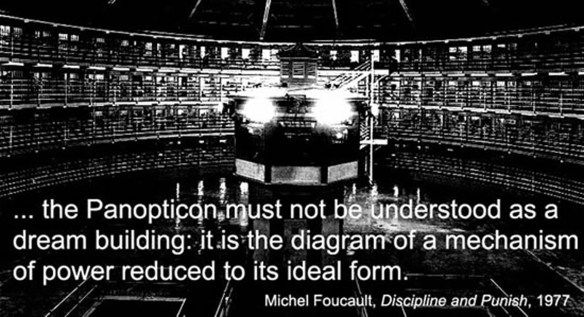
The American Police State, much like The Prisoner’s Village, is a metaphorical panopticon, a circular prison in which the inmates are monitored by a single watchman situated in a central tower. Because the inmates cannot see the watchman, they are unable to tell whether or not they are being watched at any given time and must proceed under the assumption that they are always being watched.

Eighteenth century social theorist Jeremy Bentham envisioned the panopticon prison to be a cheaper and more effective means of “obtaining power of mind over mind, in a quantity hitherto without example.”

Bentham’s panopticon, in which the prisoners are used as a source of cheap, menial labor, has become a model for the modern surveillance state in which the populace is constantly being watched, controlled and managed by the powers-that-be and funding its existence.

Nowhere to run and nowhere to hide: this is the new mantra of the architects of the police state and their corporate collaborators (Facebook, Amazon, Netflix, Google, Instagram, etc.).

Government eyes are watching you.

They see your every move: what you read, how much you spend, where you go, with whom you interact, when you wake up in the morning, what you’re watching on television and reading on the internet.

Every move you make is being monitored, mined for data, crunched, and tabulated in order to form a picture of who you are, what makes you tick, and how best to control you when and if it becomes necessary to bring you in line.

When the government sees all and knows all and has an abundance of laws to render even the most seemingly upstanding citizen a criminal and lawbreaker, then the old adage that you’ve got nothing to worry about if you’ve got nothing to hide no longer applies.

Apart from the obvious dangers posed by a government that feels justified and empowered to spy on its people and use its ever-expanding arsenal of weapons and technology to monitor and control them, we’re approaching a time in which we will be forced to choose between obeying the dictates of the government—i.e., the law, or whatever a government official deems the law to be—and maintaining our individuality, integrity and independence.

When people talk about privacy, they mistakenly assume it protects only that which is hidden behind a wall or under one’s clothing. The courts have fostered this misunderstanding with their constantly shifting delineation of what constitutes an “expectation of privacy.” And technology has furthered muddied the waters.

However, privacy is so much more than what you do or say behind locked doors. It is a way of living one’s life firm in the belief that you are the master of your life, and barring any immediate danger to another person (which is far different from the carefully crafted threats to national security the government uses to justify its actions), it’s no one’s business what you read, what you say, where you go, whom you spend your time with, and how you spend your money.

Unfortunately, George Orwell’s 1984—where “you had to live—did live, from habit that became instinct—in the assumption that every sound you made was overheard, and, except in darkness, every movement scrutinized”—has now become our reality.

We now find ourselves in the unenviable position of being monitored, managed and controlled by our technology, which answers not to us but to our government and corporate rulers.

Consider that on any given day, the average American going about his daily business will be monitored, surveilled, spied on and tracked in more than 20 different ways, by both government and corporate eyes and ears.

A byproduct of this new age in which we live, whether you’re walking through a store, driving your car, checking email, or talking to friends and family on the phone, you can be sure that some government agency, whether the NSA or some other entity, is listening in and tracking your behavior.

This doesn’t even begin to touch on the corporate trackers that monitor your purchases, web browsing, Facebook posts and other activities taking place in the cyber sphere.

Stingray devices mounted on police cars to warrantlessly track cell phones, Doppler radar devices that can detect human breathing and movement within in a home, license plate readers that can record up to 1800 license plates per minute, sidewalk and “public space” cameras coupled with facial recognition and behavior-sensing technology that lay the groundwork for police “pre-crime” programs, police body cameras that turn police officers into roving surveillance cameras, the internet of things: all of these technologies add up to a society in which there’s little room for indiscretions, imperfections, or acts of independence—especially not when the government can listen in on your phone calls, monitor your driving habits, track your movements, scrutinize your purchases and peer through the walls of your home.

As French philosopher Michel Foucault concluded in his 1975 book Discipline and Punish, “Visibility is a trap.”

This is the electronic concentration camp—the panopticon prison—the Village—in which we are now caged.

It is a prison from which there will be no escape if the government gets it way.

As Glenn Greenwald notes:

“The way things are supposed to work is that we’re supposed to know virtually everything about what [government officials] do: that’s why they’re called public servants. They’re supposed to know virtually nothing about what we do: that’s why we’re called private individuals. This dynamic – the hallmark of a healthy and free society – has been radically reversed. Now, they know everything about what we do, and are constantly building systems to know more. Meanwhile, we know less and less about what they do, as they build walls of secrecy behind which they function. That’s the imbalance that needs to come to an end. No democracy can be healthy and functional if the most consequential acts of those who wield political power are completely unknown to those to whom they are supposed to be accountable.”

Even now, the Trump Administration is working to make some of the National Security Agency’s vast spying powers permanent.

In fact, Attorney General Jeff Sessions is pushing for Congress to permanently renew Section 702 of the Foreign Intelligence Surveillance Act, which allows government snoops to warrantlessly comb through and harvest vast quantities of our communications.

And just like that, we’re back in the Village, our escape plans foiled, our future bleak.

Except this is no surprise ending: for those who haven’t been taking the escapist blue pill, who haven’t fallen for the Deep State’s phony rhetoric, who haven’t been lured in by the promise of a political savior, we never stopped being prisoners.

So how do we break out?

For starters, wake up. Resist the urge to comply.

The struggle to remain “oneself in a society increasingly obsessed with conformity to mass consumerism,” writes Steven Paul Davies, means that superficiality and image trump truth and the individual. The result is the group mind and the tyranny of mob-think.

Think for yourself. Be an individual. As McGoohan commented in 1968, “At this moment individuals are being drained of their personalities and being brainwashed into slaves… As long as people feel something, that’s the great thing. It’s when they are walking around not thinking and not feeling, that’s tough. When you get a mob like that, you can turn them into the sort of gang that Hitler had.”

In a media-dominated age in which the lines between entertainment, politics and news reporting are blurred, it is extremely difficult to distinguish fact from fiction. We are so bombarded with images, dictates, rules and punishments and stamped with numbers from the day we are born that it is a wonder we ever ponder a concept such as freedom. As McGoohan declared, “Freedom is a myth.”

In the end, as I make clear in my book Battlefield America: The War on the American People, we are all prisoners of our own mind.

In fact, it is in the mind that prisons are created for us. And in the lockdown of political correctness, it becomes extremely difficult to speak or act individually without being ostracized. Thus, so often we are forced to retreat inwardly into our minds, a prison without bars from which we cannot escape, and into the world of video games and television and the Internet.

We have come full circle from Bentham’s Panopticon to McGoohan’s Village to Huxley’s Brave New World.

As cultural theorist Neil Postman observed:

What Orwell feared were those who would ban books. What Huxley feared was that there would be no reason to ban a book, for there would be no one who wanted to read one. Orwell feared those who would deprive us of information. Huxley feared those who would give us so much that we would be reduced to passivity and egoism. Orwell feared we would become a captive audience. Huxley feared the truth would be drowned in a sea of irrelevance. Orwell feared that we would become a captive culture. Huxley feared we would become a trivial culture, preoccupied with some equivalent of the feelies, the orgy porgy, and the centrifugal bumblepuppy. As Huxley remarked in Brave New World Revisited, the civil libertarians and rationalists who are ever on the alert to oppose tyranny “failed to take into account man’s almost infinite appetite for distractions.” In Brave New World, they are controlled by inflicting pleasure. In short, Orwell feared that what we hate would ruin us. Huxley feared that what we love will ruin us.

You want to be free? Break out of the circle.

Love and Let Love: Overcoming Egocentric Love

By Gary Z. McGee

Source: The Mind Unleashed

“Love could be labeled poison and we’d drink it anyway.” ~Atticus

Love is a tricky subject. It’s multifaceted, both subjectively and objectively. It’s both lost and found within the complex folds of our unique mind-body-spirit dynamic. It’s both a spiraling in and a spiral out. We all know the “feeling” of love, but we can’t seem to describe it to each other. But boy do we try: in poetry, in song, in dance, in bed. Even in art.

Unfortunately, the predominant love paradigm in our culture is egocentric, ownership-based love. We live in a world where relationships are mostly based upon materialism, ownership and immediate gratification. It’s almost like we’re conditioned to consume to the point that we “consume” each other. Even the words we use toward each other imply ownership.

It’s sad. But no condition is insurmountable. We can recondition ourselves to form healthy relationships based upon respect, honesty, and trust. We can update the love paradigm into one of soul-centric, relationship-based love. But first we need to recognize each other as opposite sides of the same being. Our yin-yang dynamic is more dynamic than we tend to allow it to be.

The thing is, our language is dreadfully inadequate to do the concept of love any justice. There are over seven-billion people on the planet and we each have a different psycho-physiological reaction to any given stimuli, however minute that difference. And with abstract stimuli such as Love, Consciousness, and God, that difference is magnified.

The fact is: we each have our own definition for the concept of love (ego), but that definition is written in a language older than words (soul). So how do we understand this language? Simply put: mindfulness. More complexly put: we must become aware of what our mind-body-spirit is telling us, and then be honest about that information regarding our relationships. And poetically put: “You only have to let the soft animal of your body love what it loves.” ~Mary Oliver

The ability to love (vulnerability):

“Vulnerability is not knowing victory or defeat, it’s understanding the necessity of both; it’s engaging. It’s being all in.” ~Brene Brown

Our ability to love another person is predetermined by our ability to love ourselves. Similar to the airplane-crash-landing analogy, “Always put the mask on yourself before assisting someone who may be less capable,” we must put the Mask of Love on ourselves before loving someone who may or may not be capable of authentic love.

The irony is that we must first learn self-love to understand that egocentric love isn’t the healthiest way to love. We must first love our ego in order to transform it into an ego that isn’t just in love with itself. An ego that isn’t loved tends to become self-serving and egocentric (codependent or merely independent), but an ego that is loved tends to become self-actualized and soul-centric (interdependent).

An ego that has learned interdependence through self-love is more likely to love authentically. It is more likely to be vulnerable with another ego. And vulnerability is the key to loving greatly. It’s the secret of deep authenticity. A crucial aspect of self-actualized love, as opposed to egocentric love, is to allow ourselves to be vulnerable so that we may be astonished by love, taken aback by it, in awe of it. As the great Rumi once said, “Close your eyes. Fall in love. Stay there.”

The ability to let others love (freedom):

“The only way of loving a person is to love them without hope.” ~Walter Benjamin

Have you ever caught yourself saying this, regarding love and relationships? “I just don’t want to get hurt.” Or heard someone else say it? We hear people say this, and we nod in empathy, followed by an understanding pat on the back, or a sympathetic hug.

But, wait a minute! Who ever said getting hurt wasn’t a part of love? Are not pain and love two sides of the same coin? If we love something deeply enough, does it not hurt when we lose it? The thing is, the ability to love another person takes an enormous act of courage. And if we are genuinely allowing ourselves to love another person, then we must open ourselves up to the possibility of being hurt. This is what it means to be vulnerable. If we’re not “all in,” then what’s the point of trying?

Pain should not be avoided at the expense of love. Love should be embraced at the risk of pain. Indeed.

If we’ve already learned to love ourselves, which we should have taken care of before attempting to love another person anyway, then insecurities be damned! It’s time to go for it. It’s time to move all in. Rejection happens. But if we don’t at least give it a shot, and that means getting vulnerable and laying our insecurities out on the table like a bad hand of poker, then we’ll never know if it could have been something magical or not.

A relationship is actually two uniquely different people who have gone from being independent dancers to becoming an interdependent dance. This is the beauty of romantic, soul-centric love. It becomes a dance. But, and here’s the rub, the dance can only be enjoyable if both parties are free to dance… or not.

This is where it gets difficult: allowing our partner to love the way they need to love. This sounds simple enough, but it is deceivingly simple. Because we might not like the way they love. It requires good communication skills, brutal honesty, and an exemplary trust in the other dancer.

One of the biggest assumptions we make about love is imagining that the other person loves the same way that we do. In other words, we assume that what the other person means by love means the same thing that we mean by it. But this simply cannot be true if we are genuinely allowing the other person to be an individual with their own unique tastes and opinions.

Letting our lover love the way they need to love is just as much a part of the dance as our unique way of loving is. But we must be honest, first with ourselves and then with our partners. Sometimes this honesty will hurt, but pain is necessary for growth. And if a relationship is what we’re trying to grow, then pain is par for the course.

If the way another person loves doesn’t jive with the way that you love, then the dance either needs to end or it needs to take on a new form. If this sounds counter-intuitive, that’s because it is. As the great Victor Hugo cryptically stated, “Love is never stronger than when it is completely unreasonable.”

The ability to let love go (compersion):

Everything we love is well-arranged dust.” ~Atticus

The ability to let love go is our ability to let go of our ego’s attachment to it.

Falling in love is both very easy and very difficult. It is easy when we are coming from a place of non-attachment and interdependence; when we’re allowing all things to mysteriously and majestically flow. But it is difficult when we are coming from a place of attachment and codependence, and we’re rigidly trying to control everything. It’s the difference between being Love, and vainly trying to pigeonhole love into the box of our expectation.

As Stephen Levine profoundly stated, “True love has no object. Many speak of their unconditional love for another. Unconditional love is the experience of being. You cannot unconditionally love someone. You can only be unconditional love. It is not a dualistic emotion. It is a sense of oneness with all that is. The experience of love arises when we surrender our separateness into the universal. It is a feeling of unity. You don’t love another, you are another.”

When we let love go, we’re not letting go of Love itself –not at all. We are letting go of the ego aspect of love. We’re letting go of the attachment, the need to cling. It’s not like we let go of love and then forget about it. No, it’s more like we are saying goodbye. Like proud parents who are sad that their child has left home, but are happy for their growth and open to the possibility of their return.

Love itself is never abandoned, nor is it forgotten. Only the needy, codependent, ego side of love that’s filled with unhealthy expectations and cultural predispositions about the way love should be is abandoned. Authentic love lasts forever, despite us, and even in spite of our egos. The more we let love go, the more we realize that we never owned it in the first place. It was never a thing that could be owned. It could only ever have been free, or it was never really love at all.

So, let’s learn to be Love in the face of expectation. Let’s be Love despite the love that thinks it needs validation. Let’s be Love even when others cannot. That is the heart of both compersion and forgiveness… Love, let others love, and then let go of your ego’s attachment to love. Do this, again and again, in a kind of loving life-death-rebirth process, and the ability of soul-centric, self-actualized love will not elude you.