MASS PSYCHOSIS – HOW AN ENTIRE POPULATION BECOMES MENTALLY ILL

By Dylan Charles

Source: Waking Times

“Mass psychosis is an epidemic of madness and it occurs when a large portion of reality loses touch with reality and descends into illusions.”

When most people hear the term mass psychosis they think that it applies to everyone else but themselves. In the reality we’re sharing, however, we are all heavily influenced by the same negative forces, which have been assaulting the public psyche for decades now, and have only become increasingly more scientific and efficient in their ability to covertly influence the subconscious mind.

We are all targets in a war that aims to kill the mind, and cut it off from the ability to engage in rational thought and logical, reasonable discourse.

“Logic can be met with logic, while illogic cannot. It confuses those who think straight.”

In my quest to understand what is happening to people as a result of the mass-conditioning, mind-control and indoctrination oozing from every seam of our society, I’ve found that in order to root these forces out of your own mind, you can equip yourself with the same tools used against you, namely the reprogramming of the subconscious mind.

With the situation we are in now, we cannot expect for the current trends in media, propaganda and censorship to change in our favor any time soon. If we don’t turn the light of truth onto our own lives, we risk being swept away with the herd, going along just to be part of a tribe that only keeps you unhealthy, dysfunctional and afraid.

The following presentation does a helpful job of distilling the historical and philosophical understanding of what mass psychosis is, and how it manifests in our world as the most devastating social disasters and tragedies.

As a self-mastery coach, I help individuals ferret out the delusions that have been constructed in their own lives by their personal history and by the cultural influences hounding us to conform and join in the panic. They want us to lose touch with reality, therefore, we have to fight back by seizing total control of our own minds, bodies and behaviors.

Totalitarianism is on our door step. It is the obliteration of the individual. Your weapon in this war is your unique individuality, and when you step fully into this possibility, you become, simply, ungovernable and unencumbered by the forces tearing this society apart. If you’d like help in seeing how these forces are compelling you to sabotage your own life and never pursue the path of self mastery, contact me here. I love helping people remember who they really are amongst this insane backdrop of mass psychosis.

Nature Is Not a Machine—We Treat It So at Our Peril

By Jeremy Lent

Source: resilience

From genetic engineering to geoengineering, we treat nature as though it’s a machine. This view of nature is deeply embedded in Western thought, but it’s a fundamental misconception with potentially disastrous consequences.

Climate change, avers Rex Tillerson, ex-CEO of ExxonMobil and erstwhile US Secretary of State,  “is an engineering problem, and it has engineering solutions.” This brief statement encapsulates how the metaphor of the machine underlies the way our mainstream culture views the natural world. It also hints at the grievous dangers involved in perceiving nature in this way.

This mechanistic worldview has deep roots in Western thought. The great pioneers of the Scientific Revolution, such as Galileo, Kepler, and Newton, believed they were decoding “God’s book,” which was written in the language of mathematics. God was conceived as a great clockmaker, the “artificer” who constructed the intricate machine of nature so flawlessly that, once it was set in motion, there was nothing more to do (bar the occasional miracle) than let it run its course. “What is the heart, but a spring,” wrote Thomas Hobbes, “and the nerves but so many strings?” Descartes flatly declared: “I do not recognize any difference between the machines made by craftsmen and the various bodies that nature alone composes.”

In recent decades, the mechanistic conception of nature has been updated for the computer age, with popularizers of science such as Richard Dawkins arguing that “life is just bytes and bytes and bytes of digital information” and as a result, an animal such as a bat “is a machine, whose internal electronics are so wired up that its wing muscles cause it to home in on insects, as an unconscious guided missile homes in on an aeroplane.” This digital metaphor of nature pervades our culture and is used unreflectively by those in a position to direct our society’s future. According to Larry Page, co-founder of Google, for example, human DNA is just “600 megabytes compressed, so it’s smaller than any modern operating system . . .  So your program algorithms probably aren’t that complicated.”

But nature is not in fact a machine nor a computer—and it can’t be engineered or programmed like one. Thinking of it as such is a category error with ramifications that are both deluded and dangerous.

A four-billion-year reversal of entropy

Ultimately, this machine metaphor is based on a simplifying assumption, known as reductionism, which approaches nature as a collection of tiny parts to investigate. This methodology has been resoundingly effective in many fields of inquiry, leading to some of our greatest advances in science and technology. Without it, most of the benefits of our modern world would not exist—no electrical grids, no airplanes, no antibiotics, no internet. However, over the centuries, many scientists and engineers have been so swept up by the success of their enterprise that they have frequently mistaken this assumption for reality—even when advances in scientific research uncover its limitations.

When James Watson and Francis Crick discovered the shape of the DNA molecule in 1953, they used metaphors from the burgeoning information revolution to describe their findings. The genotype was a “program” that determined the exact specifications of an organism, just like a computer program. DNA sequences formed the “master code” of a “blueprint” that contained a detailed set of “instructions” for building an individual. Prominent geneticist Walter Gilbert would begin his public lectures by pulling out a compact disk and proclaiming “This is you!”

Since then, however, further scientific research has revealed fundamental defects in this model. The “central dogma” of molecular biology, as coined by Crick and Watson, was that information could only flow one way: from the gene to the rest of the cell. Biologists now know that proteins act directly on the DNA of the cell, specifying which genes in the DNA should be activated. DNA can’t do anything by itself—it only functions when certain parts of it get switched on or off by the activities of different combinations of proteins, which were themselves formed by the instructions of DNA. This process is a vibrant, dynamic circular flow of interactivity.

This leads to a classic chicken-and-egg problem: if a cell is not determined solely by its genes, what ultimately causes it to “decide” what to do? Biologists who have researched this issue generally agree that the emergence of life on Earth was most likely a self-organized process known as autopoiesis—from the Greek words meaning self-generation—performed originally by non-living molecular structures.

These protocells essentially staged a temporary, local reversal of the Second Law of Thermodynamics which describes how the universe is undergoing an irreversible process of entropy: order inevitably becomes disordered and heat always flows from hot regions to colder regions. We see entropy in our daily lives every time we stir cream into our coffee, or break an egg for an omelet. Once the egg is scrambled, no amount of work will ever get the yolk back together again. It’s a depressing law, especially when applied to the entire universe which, according to most physicists, will eventually dissipate into a bleak expanse of cold, dark nothingness. Those first protocells, however, learned to turn entropy into order by ingesting it in the form of energy and matter, breaking it apart, and reorganizing it into forms beneficial for their continued existence—the process we know as metabolism.

Ever since then, for roughly four billion years, the defining quality of life has been its purposive self-organization. There is no programmer writing a program; no architect drawing up a blueprint. The organism is the weaver of its own fabric, using DNA as an instrument of transmission. It sculpts itself according to its own inner sense of purpose, which it inherited ultimately—like all of us—from those first autocatalytic cells: the drive to resist entropy and generate a temporary vortex of self-created order in the universe. In the words of philosopher of biology Andreas Weber,

“Everything that lives wants more of life. Organisms are beings whose own existence means something to them.”

This implies that, rather than being an aggregation of unconscious machines, life is intrinsically purposive. In recent decades, carefully designed scientific studies have revealed the deep intelligence throughout the natural world employed by organisms as they fulfil their purpose of self-generation. The inner life of a plant, biologists have discovered, is a rich plethora of complex experience. Plants have their own versions of our five senses, as well as up to fifteen other ways of sensing their environment for which we don’t have analogues. Plants act intentionally and purposefully: they have memories and learn, they communicate with each other, and can even allocate resources as a community through what biologist Suzanne Simard calls the “wood-wide web” of mycorrhizal fungi linking their roots together underground.

Extensive studies now point to the profound realization that every animal with a nervous system is likely to have some sort of subjective experience driven by feelings that, at the deepest level, are shared by all of us. Bees have been shown to feel anxious when their hives are shaken. Fish will make trade-offs between hunger and pain, avoiding part of an aquarium where they’re likely to get an electric shock, even if that’s where the food is—until they get so hungry that they’re willing to take a risk. Octopuses, one of the earliest groups to evolve separately from other animals about 600 million years ago, live predominantly solitary lives, but just like humans, get cozy with others when given a dose of the “love-drug” MDMA.

The ideology of human supremacy

As we confront the existential crises of the twenty-first century, the mechanistic thinking that brought us to this place may be driving us headlong toward catastrophe. As each new global problem appears, attention gets focused on short-term, mechanistic solutions, rather than probing deeper systemic causation. In response to the worldwide collapse of butterfly and bee populations, for example, some researchers have designed tiny airborne drones to pollinate trees as artificial substitutes for their disappearing natural pollinators.

As the stakes get higher through this century, the dangers arising from this mechanistic metaphor of nature will only become more harrowing. Already, in response to the acceleration of climate breakdown, the techno-dystopian idea of geoengineering is becoming increasingly acceptable. Following Tillerson’s misconceived logic, rather than disrupt the fossil fuel-based growth economy, policymakers are beginning to seriously countenance treating the Earth as a gigantic machine that needs fixing, and developing massive engineering projects to tinker with the global climate.

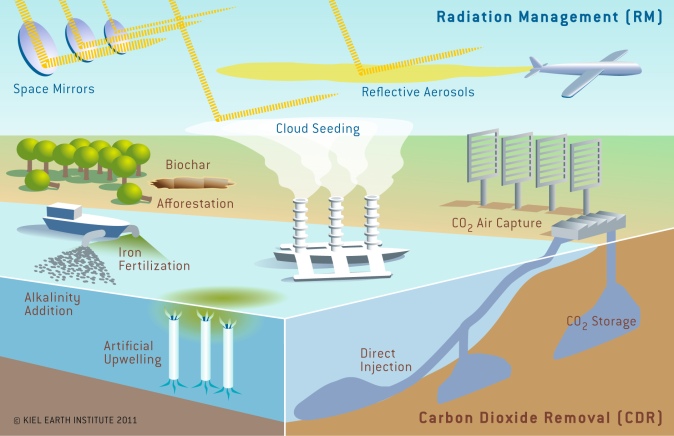
Given the innumerable nonlinear feedback loops that generate our planet’s complex living systems, the law of unintended consequences looms menacingly large. The eerily named field of “solar radiation management”, for example, which has received significant financing from Bill Gates, envisages spraying particles into the stratosphere to cool the Earth by reflecting the Sun’s rays back into space. The risks are enormous, such as causing extreme shifts in precipitation around the world and exacerbating damage we’ve already done to the ozone layer. Additionally, once begun, it could never be stopped without immediate catastrophic rebound heating; it would further increase ocean acidification; and would likely turn the blue sky into a perpetual white haze. These types of feedback effects, arising from the innumerable nonlinear dynamic interdependencies of Earth’s complex systems, get marginalized by a worldview that ultimately sees our planet as a machine requiring a quick fix.

Further, there are deep moral issues that arise from confronting the inherent subjectivity of the natural world. Ever since the Scientific Revolution, the root metaphor of nature as a machine has infiltrated Western culture, inducing people to view the living Earth as a resource for humans to exploit without regard for its intrinsic value. Ecological philosopher Eileen Crist describes this as human supremacy, pointing out that seeing nature as a “resource” permits anything to be done to the Earth with no moral misgivings. Fish get reclassified as “fisheries,” and farm animals as “livestock”—living creatures become mere assets to be exploited for profit. Ultimately, it is the ideology of human supremacy that allows us to blow up mountaintops for coal, turn vibrant rainforest into monocropped wastelands, and trawl millions of miles of ocean floor with nets that scoop up everything that moves.

Once we recognize that other animals with a nervous system are not machines, as Descartes proposed, but likely experience subjective feelings similar to humans, we must also reckon with the unsettling moral implications of factory farming. The stark reality is that around the world, cows, chicken, and pigs are enslaved, tortured, and mercilessly slaughtered merely for human convenience. This systematic torment administered in the name of humanity to over 70 billion animals a year—each one a sentient creature with a nervous system as capable of registering excruciating pain as you or I—quite possibly represents the greatest cataclysm of suffering that life on Earth has ever experienced.

The “quantum jazz” of life

What, then, are metaphors of life that more accurately reflect the findings of biology—and might have the adaptive consequence of influencing our civilization to behave with more reverence toward our nonliving relatives on this beleaguered planet which is our only home?

Frequently, when cell biologists describe the mind-boggling complexity of their subject, they turn to music as a core metaphor. Denis Noble entitled his book on cellular biology The Music of Life, depicting it as “a symphony.” Ursula Goodenough describes patterns of gene expression as “melodies and harmonies.” While this metaphor rings truer than nature as a machine, it has its own limitations: a symphony is, after all, a piece of music written by a composer, with a conductor directing how each note should be played. The awesome quality of nature’s music arises from the fact that it is self-organized. There is no outside agent telling each cell what to do.

Perhaps a more illustrative metaphor would be a dance. Cell biologists increasingly refer to their findings in terms of “choreography,” and philosopher of biology Evan Thompson writes vividly how an organism and its environment relate to each other “like two partners in a dance who bring forth each other’s movements.”

Another compelling metaphor is an improvisational jazz ensemble, where a self-organized group of musicians spontaneously creates fresh melodies from a core harmonic theme, riffing off each other’s creativity in a similar way to how evolution generates complex ecosystems. Geneticist Mae-Wan Ho captures this idea with her portrayal of life as “quantum jazz,” describing it as “an incredible hive of activity at every level of magnification in the organism . . . locally appearing as though completely chaotic, and yet perfectly coordinated as a whole.”

What might our world look if we saw ourselves as participating in a coherent ensemble with all sentient beings interweaving together to collectively reverse entropy on Earth? Perhaps we might begin to see humanity’s role, not to re-engineer a broken planet for further exploitation, but to attune with the rest of life’s abundance, and ensure that our own actions harmonize with the Earth’s ecological rhythms. In the profound words of 20th century humanitarian Albert Schweitzer, “I am life that wills to live, in the midst of life that wills to live.” How, we may ask, might our future trajectory change if we were to reconstruct our civilization on this basis?

IT’S NO TIME TO BE NORMAL

By Paul Levy

Source: Waking Times

These times of the new normal are not normal times at all. Psychoanalyst Joyce McDougall coined the term normopathy to connote an excessive—and pathological—attachment and adaptation to conventional social norms. English psychoanalyst Christopher Bollas has coined a term with a similar meaning – normotic, which seems to be a variation of and play on the word neurotic. Not having developed an independent sense of self, people who are normopathic or normotic have a neurotic obsession with appearing normal, to fit in – they are abnormally normal. At the bottom of this malady is an insecurity of being judged and rejected. Normotics are overly concerned with how others view them, rendering them afraid to creatively express their unique individuality (which remains undeveloped as a result), which results in being afraid of participating in the call of their own individuation. As Jung counsels, we should be afraid of being too healthy-minded, as, ironically, this can easily become unhealthy.

Many families, groups or societies are afflicted with normopathy (according to whatever the group’s rules are regarding what is considered “normal”), such that it is considered normal to be normotic. The strange thing is if that if almost everyone in the group is normotic, the pathology is seen as normal and healthy, which makes the person in the group who isn’t subscribing to being normotic appear to be ab-normal, the one with the pathology. Insanely, in a case of projecting their own craziness, the ones with the pathology then pathologize the one who doesn’t have it. Something of this nature is going on in our world at the present time.

One of the greatest dangers about unconsciousness is proneness to suggestion, where we take on other peoples’ perspective of the world—and of who we are—thereby easily falling prey to the prevailing collective groupthink of the herd. The proclivity towards hive-mindedness strongly correlates with being susceptible to having our minds hijacked, manipulated and controlled by forces outside of ourselves.

Whatever term we use—normopathic or normotic—there are many people who depend upon and derive their self-worth through external validation by others. Being social creatures, we have an unconscious undertow to want to belong to a group, which opens us up to the possibility of disconnecting from our own intrinsic urge to uniquely individuate. Instead of seeing the world through our own eyes, we then see the world—and ourselves, i.e., our own self-image—not through how others see us, but how we imagine others see us. The source of this process lies in our own creative imagination, which we have out-sourced to others. To connect with our own sovereignty, we have to find the source within ourselves from which our true creative power derives.

In the challenging times that we are living through, it is crucially important for us to not “fit in,” but rather, express our unique creative spirit that more than anything wants to come through us and find its place in the world. Instead of blindly and passively subscribing to the new normal, let us create “the new abnormal,” in which we step into the radical act of being our naturally creative selves. Whereas repressed and unexpressed creativity is the greatest poison there is to the human psyche, creativity given free license to express itself is the greatest medicine imaginable.

FU@K FEAR! TRANSFORM IT INTO FUEL INSTEAD

By Gary McGee

Source: Waking Times

“We are all ready to be savage in some cause. The difference between a good man and a bad one is the choice of the cause.” ~William James

Fuck fear! Fuck angst! Fuck existential dread! Turn it all into fuel for the fire of life instead. Life is less about getting what you want and more about making the best of what you get. It’s about playing a shitty hand of poker like a boss. So you got dealt fear, angst, ennui, dread, and a sense of meaninglessness? So what? Play the hand! Own it. Double down on it. Bluff the devil and take God for all he’s worth. Turn it all into gold by becoming unfuckwithable.

Unfuckwithable (adj.): When you are truly at peace and in touch with yourself, and nothing anyone says or does bothers you, and no negativity or drama can touch you. ~Urban Dictionary

Transform fear into fuel for fire:

“The difference between a good life and a bad life is how well you walk through the fire.” ~Carl Jung

Rule number one of being unfuckwithable: Fear is fuel for the fire of doing what you love.

Never forget that. It will get you through just about anything. And even if it doesn’t, at least you’ll have the ‘fuck-it bucket of your daring’ to toss all your fucks into.

At least you’ll have what you love. At least you’ll have your passion. Whatever that is. It will be unique to you. It might even be something that nobody else will ever need to know.

As long as what you love to do is valid and in alignment with the universal laws of health, you can’t go wrong. Be savage. Be fierce. Love dangerously. Love as you live—on the edge. Love on purpose, with purpose. Love like you’re not going to live forever. Because you aren’t.With a love this fierce, this bold, this full-frontal boss-mode, fear has no choice but to become fuel for its fire. For—have no illusions—love is fire. Fear is its kindling. Because of this, it is the hottest fire that ever burned. No moth can resist it. No moth can survive it. Only the Phoenix thrives there. Or fire itself.

Be fire itself! No fear, but for the fuel of it. No concern, all burn. This is what fearlessness truly is. Your love is a blaze of glory just waiting to flare up. Let it flare through the sieve of what you fear.

Be brave despite danger or hardship:

“The bravest are surely those who have the clearest vision of what is before them, glory and danger alike, and yet notwithstanding, go out to meet it.” ~Thucydides

Rule number two of being unfuckwithable: Focus on what you can control, let go of what you can’t.

You can’t know the future. You can’t control how things will turn out. You can only control how you react to how things turn out. Even then, it’s not about control. It’s about being adaptable. It’s about being flexible and resilient. It’s about being prepared for the worst, even as you hope for the best. It’s about pulling your fragile past toward your antifragile future.

In that speck of hope is all the courage you’ll ever need. A dash of courage trumps an ocean of doubt. Use that courage like a sword. Or, even better, a scythe. Cut through the storm of the unknown. Shred the shroud of not knowing. Slice and dice the thickness of uncertainty. Not for the goal of invulnerability. No. For the transcendence of absolute vulnerability.

Cut with your soul. Meet the danger in the throes of adventure. Meet the glory in the field. Meet the albatross on the path. Meet the Minotaur in the labyrinth. Cut! To cut means to engage absolutely. To cut is to become the sword. Even if you have no sword. Cut. Cut the obstacle until it becomes the path. And if God Himself should stand in your way, cut that bastard down and become one with all things.

Nip fear in the bud through self-inflicted knowledge:

“Ignorance leads to fear, fear leads to hatred, and hatred leads to violence. This is the equation.” ~Averroes

Rule number three of being unfuckwithable: Stay as close to the edge as you can without going over.

Death is a given. Use it to hone a proper perspective, to sharpen the sword of your courage. This soul-sharpening comes in the form of spiritual circumspection, or existential skepticism. Ignorance will lead to fear and fear will lead to hatred—with paranoia, nihilism, and ennui in between—if you’re not careful.

Stay ahead of the curve by questioning things to the nth degree. Be a razor-sharp question mark in the dark. Just don’t forget to also cut through the blinding light. For blinding light can be just as unhealthy as too much darkness. Be both: a beacon of light that cuts through the darkness and a beacon of darkness that cuts through the blinding light.

Allow uncertainty to become your guide. Just as fear can be transformed into fuel for fire, uncertainty can be transformed into fuel for curiosity. Curiosity is the cure for certainty. It will give you an edge. It will keep you ahead of the game. You’ll be playing James P. Carse’s Infinite Game while everyone else is toppling over themselves in the myopic one-upmanship of the Finite Game.

Most of all, even as it cures certainty, your curiosity will be your guiding light through uncertainty. It’s double-edged. It will help you become resilient despite discomfort. It will help you stretch your comfort zone despite comfort. It will help you become adaptable despite an inhospitable world. It will help you overcome yourself by not getting hung-up on your ego.

Why? Because curiosity is always on the edge. It is always the tip of the spear. It is always foremost. It is utmost, supreme, ahead of itself because it is always on the edge of its seat. It is always cutting, despite the world’s attempts at dulling its mettle.

Use it. Harness its trailblazer essence. Channel its catalyst synergy. Recalibrate the universe with it. Discover the cheat codes hidden in the storm. Do it despite the storm. Do it despite the slings and arrows of vicissitude. Do it despite the worst the tempest can dish out. Do it despite the fear. Do it because of the fear. Do it for the tribe. Then come back and share the magic elixir of being unfuckwithable.

Back to that shitty hand of poker… So you got dealt fear, angst, ennui, dread, and a sense of meaninglessness? Transform the fear into fuel, the angst into hunger, the ennui into curiosity, the dread into humor, and the sense of meaninglessness into meaning. Then go all in.

The War on Reality

By CJ Hopkins

Source: Consent Factory, Inc.

So, the War on Reality is going splendidly. Societies all across the world have been split into opposing, irreconcilable realities. Neighbors, friends, and even family members are bitterly divided into two hostile camps, each regarding the other as paranoid psychotics, delusional fanatics, dangerous idiots, and, in any event, as mortal enemies.

In the UK, Germany, and many other countries, and in numerous states throughout the US, a “state of emergency” remains in effect. An apocalyptic virus is on the loose. Mutant variants are spreading like wildfire. Most of society is still shut down or subject to emergency health restrictions. People are still walking around in public with plastic face shields and medical-looking masks. The police are showing up at people’s homes to arrest them for “illegally gathering outdoors.” Any deviation from official reality is being censored by the Internet corporations. Constitutional rights are still suspended. Entire populations are being coerced into being injected with experimental “vaccines.” Pseudo-medical segregation systems are being brought online. And so on … you’re familiar with the details.

Meanwhile, in Sweden, and a few other countries, and in various other states throughout the US, there is no apocalyptic pandemic. People are just going about their lives as normal. OK, sure, there is a nasty virus going around, so people are taking common sense precautions, as people typically do for any nasty virus, but there is no “state of emergency” in effect, and no reason to radically transform society into a paranoid, pathologized-totalitarian dystopia.

This state of affairs, in which two contradictory, mutually-exclusive realities exist, is … well, it’s impossible, and so it cannot continue. Either there exists a devastating global pandemic that justifies a global “state of emergency,” the suspension of constitutional rights, and the other totalitarian “emergency measures” we have been subjected to since March of 2020 or there doesn’t. It really is as simple as that.

Except that it isn’t as simple as that. It is easy to forget, given the last 16 months, that people have been bitterly divided, and inhabiting mutually-exclusive realities, and regarding people who don’t conform to their realities as enemies for the last five years. I’m not talking about political disagreements, or even socio-cultural differences. I’m talking about contradictory realities. Things that actually happened, or didn’t happen. Things that exist, or do not exist.

I’m not going rehash the whole War on Populism — I covered it extensively at the time — but that’s when the current global-capitalist War on Reality was officially launched. It wasn’t just the usual lies and propaganda. It was a full-scale ideological assault. By the end of it, people actually believed that (a) Donald Trump was a Russian agent, (b) that he was literally Hitler, and so was going to stage some sort of “coup,” declare himself American Führer, and launch the “Trumpian-White-Supremacist Fourth Reich,” and (c) that he had actually attempted this by sending a few hundred unarmed protesters — violent domestic extremist grandmothersfather-and-son kill squads, and bison hat loonies — to “storm the Capitol” and overthrow the government during the so-called “January 6 Insurrection.”

So, when GloboCap rolled out the “New Normal” reality, they weren’t exactly starting from scratch. Millions of people — not just Americans, because the War on Populism was a global campaign — were already living in a new reality in which facts no longer mattered at all, where things that never happened officially happened, and other things that obviously happened never happened, not officially, or were “far-right extremist conspiracy theories,” “fake news,” or “disinformation,” or whatever, despite the fact that people knew that they weren’t.

But the goal of GloboCap’s War on Reality isn’t simply to deceive the masses and divide them into opposing camps. Rulers have been deceiving the masses and dividing them into opposing camps since the dawn of human civilization. This time, it’s a bit more complicated than that.

OK, bear with me now, because this gets kind of heady.

The War on Reality is not an attempt to replace reality with a fake reality. Or it is that, but that is only one part of it. Its real goal is to render reality arbitrary, to strip it of its epistemological authority, to turn it into a “floating signifier,” a word that has no objective referent, which, of course, technically, it already is. You cannot take a picture of reality. It is a concept. It is not a physical object that exists somewhere in time and space.

But let’s leave that last point for a later discussion. This is not the time to get lost in semiotics. For most people, for most practical purposes, reality is … well, reality. It’s objective. Material. It actually exists. It exists independent of our beliefs. It isn’t just an arbitrary, empty signifier that doesn’t actually refer to anything, but which we use, strategically, to assert authority, or to impose ideology on society. If that were the case, there would be no reality. Nothing would be true, everything would be permitted … which is a bunch of postmodern Marxist nonsense.

But just imagine, for a moment, if that were the case … if what determined reality was actually just a question of power rather than facts. Imagine that reality was just a concept that we used to mark the current limits of our knowledge and ideological beliefs. Our doctors — oncologists and virologists, for example, but they could be any kind of doctors or scientists — would be not all that different from medieval alchemists, who totally believed in their reality at the time, as did the patients they were treating, but which we know now was not reality at all, because our reality is the real reality. I mean, it’s not as if people, five hundred years from now, are going to look back at our medical practices and scientific knowledge, and laugh, like we do at those medieval alchemists, right?

Sorry, I got a little off track there. I was trying to explain the ultimate purpose of this global-capitalist War on Reality, and I wandered off into an ontological swamp, which isn’t going to get us anywhere. So, let’s get back to imagining reality, not as what we all know it is (i.e., an actual, material thing that exists), but as a construct people use to validate certain officially-sanctioned beliefs and perceptions and invalidate other beliefs and perceptions, more or less like a system of morals, except instead of dividing things into to “good” and “evil,” it divides things into “real” and “fake.”

Now imagine that you were an immensely powerful, globally hegemonic ideological system, and you wanted to impose your ideology on as much of the entire world as possible, but you didn’t have an ideology per se, or any actual values at all, because exchange value was your only real value, and so your mission was to erase all ideologies, and values, and truths, and belief systems, and so on, and transform everything and everyone in existence into de facto commodities that you could manipulate any way you wanted, because they had no inherent value whatsoever, because their only real value was assigned by the market.

How would you go about doing that, erasing all existing values, religious, cultural, and social values, and rendering everything a valueless commodity?

Well, you wouldn’t want to destroy reality completely, because people wouldn’t stand for that. They would freak right out. Things would get ugly. So, instead, you might want to go the other way, and generate a lot of contradictory realities, not just contradictory ideologies, but actual mutually-exclusive realities, which could not possibly simultaneously exist … which would still freak people out pretty badly.

Naturally, there would be one official reality that you would force everyone to rigidly conform to at any given moment in time, but you would change the official reality frequently, and force everyone to conform to the new one (and pretend that they’d never conformed to the old one), and then, once they had settled into that one, you would change the official reality again, until people’s brains just shut down completely, and they gave up trying to make sense of anything, and just tried to figure out what you wanted them to believe on any given day.

If you repeated that process long enough, eventually, nothing would mean anything anymore, because everything could potentially mean anything … at which point, you could basically tell people anything you wanted and they would go along with it, because what the hell difference would it make? A narcissistic billionaire ass-clown could be a Russian agent and literally Hitler. A half-assed riot could be an “insurrection.” Children could be born “systemically racist.” Men could menstruate. But wait … it’s gets better.

You could stage an apocalyptic global pandemic that only happened in certain countries, or in certain parts of certain countries, and that more or less mirrored natural mortality, and that didn’t drastically increase historical death rates, but was nonetheless totally apocalyptic.

Perfectly healthy people could become “medical cases.” You could count anyone who died of anything as having died of your apocalyptic virus. You could tell people in no uncertain terms that medical-looking masks will not protect them from viruses, and then turn around and tell them that they will, and then, later, publicly admit you were lying in order to manipulate them, and then deny you ever said that, and tell them to wear masks.

You could experimentally “vaccinate” millions of people whose risk of becoming seriously ill or dying from your apocalyptic virus was minuscule or non-existent, and kill tens or hundreds of thousands in the process, and the people whose brains you had methodically broken would thank you for murdering their friends and neighbors, and then rush out to their local discount drugstore to experimentally “vaccinate” their own kids and post pictures of it on the Internet.

At that point, you wouldn’t really have to worry about “populist uprisings,” or “terrorism,” or any other type of insurgent activity, because the vast majority of the global population would be scramble-headed automatons who were totally incapable of independent thought, and who had no idea what was real and what wasn’t, so just repeated whatever new script you fed them like customer-service representatives on Haldol.

It doesn’t get much better than that for globally hegemonic ideological systems!

OK, sorry, I think I got lost there again. I’m not sure what I was trying to say. I’ve been a little foggy lately. I’m not sleeping so well. It’s probably Long Covid. Or maybe it’s just that time of month. Whatever. It’s not like it matters anyway. Still, I think I’ll go down to my former local bookshop and get myself tested.

Have a nice day in … you know, reality!
Overcoming the Hypnosis of Fear

By Julian Rose

Source: Waking Times

You are a Universal Being. Your body is just a vehicle for the manifestation of this Universal Being here on Earth. As a Universal Being your ‘essence’ lives forever. Start identifying your Self as a Universal Being, merged with the source of all existence. The more you live in this Self – the Real You – during this lifetime – the more seamless is the passage onwards at the time of passing.

Say:

“I am a spiritual entity and nothing can harm me, because ‘I’ am not this physical body which carries me through this third density existence experienced here on Earth. ‘I’ am soul, ether, spirit, plasma – and I chose to come back to planet Earth and to be reborn into a human body in order to perform valuable tasks and help realign Earthly existence with Cosmic existence – and thereby create harmony and balance.”

Repeat this – and feel the fear fall away. Feel it dissolve like the sun-burned morning mist.

Fear is a state of mind. A cramped mind. Every part of it is alien to us save that useful bit that warns us not to do some crazy act – like jump over the edge of a cliff under the illusion that one will sprout wings and fly away into the blue horizon!

Yes, the ‘real you’ can fly. The ether/spirit you. But the physical you is a gravity respecting entity here on dear mother Earth. Respect this type of fear, for it is a God given preservation instinct.

So, you are not convinced? You hold onto your fear because it seems ‘real’, doesn’t it? You quite like it, a sort of drug. After all every TV, newspaper, radio and neighbour is telling you ‘to be afraid.’ It’s easier to give in than not to. There are so many things you need to fear, they say, so many that there is almost no room left for anything else to get you going in a positive direction.

We live in a culture of fear, imposed by those we elect and allow to manage our lives. Think about it – so determined are most of us to avoid taking true responsibility for our lives and the lives of other living beings that we allow our minds to say to us “OK, that’s fine, leave it to the politicians, bankers and corporate board members to run our affairs for us.” Then we turn around and curse them for introducing a despotic top-down police-state agenda that makes a misery out of our lives!

How foolish can one get?

All the while ‘the elected ones’ (by us) learn better and better how to manipulate those who elected them, so that they can hold onto the power. They are addicted to power – and use it to make us addicted to fear. So we shrink, while they expand.

How very foolish so much of mankind is. Both parties, the purveyors of fear and the fearful, bogged-down in a rail siding leading to nowhere. Both sides bogged-down in a rail siding completely terminating our natural evolutionary instinct and putting in its place a state of perpetual self-imprisonment.

“Fear not!” say I, for anyone reading this is not heading for the end of the line or the gallows; is not busy constructing a hangman’s noose to stick his/her neck in. Nobody reading this can suffer the delusion that to profit from worldly riches is superior to profiting from the flow of Divine uplift. An ecstatic state which comes from rejecting fear and ceasing to hide in the shadows of a frightened ‘little me’.

This ‘little me’ is a hypnotised being who has convinced himself/herself that one can never step forward and take responsibility for one’s destiny, or make a valuable contribution on the stage of life.

Out you go ’little me’ – and stay out. No place for you in the unfolding age of Truth. For as has been said, You are not a cipher, You are a Divine eminence – and is that a quality to hide away under a cloak of self impoverishment? Well, is it?

After what seems like an interminable pause, an answer emerges: ‘NO’

And immediately, as if shot from a cannon, the Real You bursts upon the scene – soul-burden immeasurably lightened! Yes, I can see this Real You, right now, and I can tell you – you are an outstanding being with enough potential to single-handedly transform both yourself and your community into manifestations of an age of instant enlightenment!

Yes, my friend, I’m not talking about someone else, it’s you who is transformed. ‘Little me’, who was that? Never mind, gone forever.

Now you stand single, strong, proud, all traces of fear banished forever. Maybe for the first time, you are free, out of jail, ready to be intoxicated by the sweet scent of the wild rose, the symphonic triumph of the dawn chorus, the illustrious beauty of awakened nature calls you forth – rejoice in her and act in her defence!

Proudly step forward to defend her precious wealth of vital diversity, so cruelly sterilised by vampires wearing carefully pressed city suits and a fixed smile on their faces. They and their clan scared you once, didn’t they? But no more, you now see the fake smile for exactly what it is.

You are metamorphosed and stand shining, a ray of the living sun. Use your new gifts well, my friend, millions need the support of your awakened powers to themselves be awakened and freed from the hypnosis of fear. These are the builders of the New Society which is our imperative to create – and no one else’s.

COMMUNITY VERSUS COMMODITY: THE HIDDEN BATTLE THAT AFFECTS US ALL

By Gary Z McGee

Source: Waking Times

“We abuse the land because we see it as a commodity belonging to is. When we see the land as a community to which we belong, we may begin to use it with love and respect.” ~Aldo Leopold

If, as Krishnamurti said, “It’s no measure of health to be well adjusted to a profoundly sick society,” then it stands to reason that remaining “well adjusted” has kept us in a perpetual state of ecocide.

Our society poisons the air it breathes, the water it drinks, and the food it eats. And then it has the audacity to poison the minds of its citizens by convincing them that this is somehow “progress”.

The problem is that we don’t have a healthy sense of community. What little sense of community we do have is wrapped up in the unhealthy society that we were born into. It’s caught up in the nine-to-five daily grind and the rat-in-a-cage drudgery of a fear-based lifestyle that’s codependent upon a corrupt state. And this is happening on a global scale. You would be hard-pressed to find a healthy society: that is, a society that does not poison its air, water, food, and minds.

It all comes down to perspective—or the lack thereof. We have been conditioned by a sick society to perceive the world as a commodity that belongs to us. In order to cure ourselves, in order to no longer be sick, we must find a way to flip our perspective into perceiving the world as a community to which we belong.

It will require unlearning what we have learned from the profoundly sick society. It will require unwashing the brainwash and reconditioning the cultural conditioning. It will require living a courage-based lifestyle despite the fear-based lifestyle that surrounds us. It will require becoming interdependent from, rather than codependent on, the profoundly sick society. It will require obtaining an eco-centric perspective while rejecting the egocentric perspective that got us into this mess.

This will be an arduously Herculean task. But no battle is more important for the continued survival of our species.

World as Commodity:

“Do not become one of those who only has the courage of other people’s convictions.” ~A. Bartlett Giamatti

What makes it so difficult to flip our perspective? It’s the fact that the sick society keeps us comfortable, safe, and secure while at the same time that it keeps us unhealthy and codependent. The other reason is that it is so much easier to use the world as a commodity.

And that’s the rub. Nobody wants to take responsibility. Nobody wants to be uncomfortable, unsafe, or insecure. Everybody wants to take the easy road. And so the profoundly sick society just keeps on getting sicker.

It’s all too easy to simply rely upon unsustainable corporations that pollute the air and poison the water. In order to keep up with the rat race and keep food on the table, we are forced to rely on corrupt corporations and bureaucratic governments that are dead set on using the world as a commodity while calling it progress. After all, even unhealthy food is better than no food at all. Right?

And even when we do try to become independent and grow our own food or catch our own rainwater, we have overreaching governments with the monopoly on violence coming down on us and slapping us with fines or threatening us with jail time.

The ‘world as commodity’ is an unhealthy snake eating its own tail. Even worse, it gives birth to citizens that are codependent sheep grazing on the unhealthy snake shit and somehow managing to convince themselves it’s food. “Hell! If it’s cheap and easy and keeps me comfortable and safe from government oppression, I might as well eat it. Ignorance is bliss, right?” Right.

And that’s the real kicker. Any awareness of living in a sick society is easily pushed to the side and repressed through the psychosocial convenience of cognitive dissonance. Which usually sounds a little something like this: “It’s uncomfortable for me to believe that I live in a profoundly sick society, even though the evidence is overwhelming. So, rather than think about it, I’ll simply ignore it. After all, there are bills to pay. My kids need to eat (probably McDonald’s or Roundup-laced vegetables). Who do you think I am? Captain Fantastic?”

Satire aside, comfort and convenience are the front lines in the battle against the world as a commodity. If we have any chance of winning this battle, every single one of us will have to win that war at the front line. Which will mean a lot of discomfort and inconvenience.

World as Community:

“We are what we repeatedly do. Excellence, then, is not an act, but a habit.” ~Aristotle

The solution to winning the war against perceiving the world as a commodity is flipping our perspective and perceiving it as a community. Unfortunately, this will require discomfort and inconvenience.

This will require peeling away layer upon layer of cultural conditioning. The first layer is fear of the unknown. It’s the fear of trying something new, of making a healthy lifestyle change. It’s the fear of being ostracized or left out. It’s the fear of some arbitrary authority coming in with some arbitrary power and fining us with some arbitrary law.

So, the first thing we’ll need is courage. But not just any kind of courage. We’ll need a particular flavor of courage that is willing to be “the bad guy,” the maverick, the martyr. It will require the kind of courage that can stand up to codependent peer pressure and take independent leaps of courage, despite goodie-two-shoe conformists and weak-kneed milquetoasts.

The kind of courage that will make the sick society hate you for being healthy; when, really, it just hates itself for remaining sick. It’s the kind of courage that eco-centrically crushes out into healthy interdependence with cosmos, despite the sick society that egocentrically flushes everything away in codependent excess and greed.

The second thing we’ll need is the ability to question the sick society to the nth degree. But not just any kind of questioning. No. We need a particular flavor of questioning that is ruthless, penetrating, interrogating—no-holds-barred.

The kind of questioning that puts unsustainable corporations on blast. The kind of questioning that’s civilly disobedient. The kind of questioning that tears apart the outdated, xenophobic reasoning of the sick society; that reveals the chain-of-command as nothing more than an up-jumped human centipede, blind and poisonous to reason. Indeed. The kind of questioning that has shock value; that won’t allow the sick society to fall back into pretending it’s asleep.

Most of all, it will require us all to practice self-interrogation, self-improvement, and self-overcoming—all of which are exceedingly uncomfortable and inconvenient. Oh well.

When it comes down to it, things will probably get worse before they get better. Transitioning from a sick society that treats the world as a commodity to a healthy society that treats the world as a community will not be an easy task. Things may even slip into anarchy (no masters, no rulers). But even uncomfortable anarchy is healthier than comfortable tyranny, or convenient sickness. Especially when the tyranny and the sickness are ecocidal. Without a healthy planet there can be no healthy people. It really is that critical. Indeed. We may need to sow a little strategic disorder to reap a higher order.

The world can be a community to which we belong, full of compassion, respect, love, and tolerance. But only if we let it. And not if we continue to treat the world like a commodity that belongs to us.

Our tolerance of a ‘profoundly sick society’ can only go so far. Lest we inadvertently end up on the side of the executioners, we must draw the line somewhere. It must be drawn at sickness, at excess, at violence, at greed, and at ecocide. And only free, healthy, courageous individuals will have the wherewithal to draw it.

The Etymological Animal Must Slip Out of the Cage of Habit to Grasp Truth

Etymology – from Greek, etymos, true, real, actual (the study of roots)

By Edward Curtin

Source: Behind the Curtain

Life is full of slips.

Words slip out of our mouths to surprise us.  Thoughts slip into our minds to shock us.  Dreams slip into our nights to sometimes slip into our waking thoughts to startle us.  And, as the wonderful singer/songwriter Paul Simon, sings, we are always “slip sliding away,” a reminder that can be a spur to courage and freedom or an inducement to fear and shut-upness.

Slips are double-edged.

It is obvious that since September 11, 2001, and more so since the corona virus lockdowns and the World Economic Forum’s push for a Fourth Industrial Revolution that will lead to the marriage of artificial intelligence, cyborgs, digital technology, and biology, that the USA and other countries have been slipping into a new form of fascist control.  Or at least it should be obvious, especially since this push has been accompanied by massive censorship by technology companies of dissenting voices and government crackdowns on what they term “domestic terrorists.”  Dissent has become unpatriotic and worse – treasonous.

Unless people wake up and rebel in greater numbers, the gates of this electronic iron cage will quietly be shut.

In the name of teleological efficiency and reason, as Max Weber noted more than a century ago in The Protestant Ethic and the Spirit of Capitalismcapitalist elites, operating from within the shadows of bureaucratic castles such as The World Economic Forum (WEF), the World Health Organization WHO), the International Monetary Fund (IMF), The World Bank (WBG), The US Centers for Disease Control and Prevention (CDC), Google, Facebook, the National Security Agency (NSA), the CIA, etc., – run by people whose faces are always well hidden – have been using digital technology to exert increasing control over the thoughts and actions of people worldwide.  They have been doing this not only by diktats but by manufacturing social habits – customary usages – through which they exert their social power over populations.  This linguistic and ideational propaganda is continually slipped into the daily “news” by their mainstream media partners in crime. They become social habits that occupy people’s minds and lead to certain forms of behavior.  Ideas have consequences but also histories because humans are etymological animals – that is, their ideas, beliefs, and behaviors have histories.  It is not just words that have etymologies.

When Weber said “a polar night of icy darkness” was coming in the future, he was referring to what is happening today.  Fascism usually comes on slowly as history has shown.  It slips in when people are asleep.

John Berger, commenting on the ghostly life of our received ideas whose etymology is so often lost on us, aptly said:

Our totalitarianism begins with our teleology.

And the teleology in use today is digital technology controlled by wealthy elites and governments for social control.  For years they have been creating certain dispositions in the general public, as Jacques Ellul has said, “by working spells upon them and exercising a kind of fascination” that makes the public receptive to the digital life.  This is accomplished slowly in increments, as permanent dispositions are established by slipping in regular reminders of how wonderful the new technology is and how its magical possibilities will make life so free and easy. Efficient. Happiness machines.  A close study of the past twenty-five years would no doubt reveal the specifics of this campaign.  In The Technological Society, Ellul writes:

… the use of certain propaganda techniques is not meant to entail immediate and definite adhesion to a given formula, but rather to bring about a long-range vacuity of the individual.  The individual, his soul massaged, emptied of his natural tendencies, and thoroughly assimilated to the group, is ready for anything.  Propaganda’s chief requirement is not so much to be rational, well-grounded, and powerful as it is to produce individuals especially open to suggestion who can easily be set into motion.

Once this softening up has made people “available,” the stage is set to get them to act impulsively.  Ellul again:

It operates by simple pressure and is often contradictory (since contradictory mass movements are sometimes necessary).  Of course, this dissociation can be effective only after the propaganda technique has been fused with the popular mores and has become indispensable to the population. This stage may be reached quickly, as, for example, in Germany in 1942, after only ten years of psychic manipulation.

The end result, he argues, is the establishment of an abstract universe, in which reality is completely recreated in people’s minds.  This fake reality is truer than reality as the news is faked and people are formed rather than informed.

In today’s computer driven world, one thing that people have been told for decades is to be vigilant that their computers do not become infected with viruses.  This meme was slipped regularly into popular consciousness.  To avoid infection, everyone was advised to make sure to have virus protection by downloading protection or using that provided by their operating systems, despite all the back doors built in which most have been unaware of.

Now that other incredible “machine” – the human body – can get virus “protection” by getting what the vaccine maker Moderna says is its messenger RNA (mRNA) non-vaccine “vaccine” that functions “like an operating system on a computer.”  First people must be softened up and made available and then “set in motion” to accept the solution to the fearful problem built in from the start by the same people creating the problem.  A slippery slope indeed.

But slipping is also good, especially when repetition and conventional thought rules people’s lives as it does today in a digital screen life world where algorithms often prevent creative breakthroughs, and the checking of hourly weather reports from cells is a commonplace fix to ease the anxiety of being trapped in a seemingly uncontrollable nightmare.  It seems you now do need computer generated weather reports to know which way the wind blows.

In our culture of the copy, new thoughts are difficult and so the problems that plague society persist and get rehashed ad infinitum.  I think most people realize at some level of feeling if not articulation that they are caught in a repetitive cycle of social stasis that is akin to addiction, one that has been imposed on them by elite forces they sense but don’t fully comprehend since they have bought into this circular trap that they love and hate simultaneously.  The cell phone is its symbol and the world-wide lockdowns its reality.  Even right now as the authorities grant a tactical reprieve from their cruel lockdowns if you obey and get experimentally shot with a non-vaccine vaccine, there is an anxious sense that another shoe will drop when we least expect it.  And it will.  But don’t say this out loud.

So repetition and constant change, seemingly opposites, suffuse society these days. The sagacious John Steppling captures this brilliantly in a recent article:

So ubiquitous are the metaphors and myths of AI, post humanism, transhumanism, et al. that they infuse daily discourse and pass barely noticed. And there is a quality of incoherence in a lot of this post humanist discourse, a kind of default setting for obfuscation….The techno and cyber vocabulary now meets the language of World Banking. Bourgeois economics provides the structural underpinning for enormous amounts of political rhetoric, and increasingly of cultural expression….This new incoherence is both intentional, and unintentional. The so called ‘Great Reset’ is operationally effective, and it is happening before our eyes, and yet it is also a testament to just how far basic logic has been eroded….Advanced social atomization and a radical absence of social change. Today, I might argue, at least in the U.S. (and likely much of Europe) there is a profound sense of repetitiveness to daily life. No matter one’s occupation, and quite possibly no matter one’s class. Certainly the repetitiveness of the high-net-worth one percent is of a different quality than that of an Uber driver. And yet, the experience of life is an experience of repetition.

A kind of flaccid grimness accompanies this sensibility.  Humor is absent, and the only kind of laughter allowed is the mocking kind that hides a nihilistic spirit of resignation – a sense of inevitability that mocks the spirit of rebellion.  Everything is solipsistic and even jokes are taken as revelations of one’s personal life.

The other day I was going grocery shopping.  My wife had written on the list: “heavy cream or whipping cream.”  Not knowing if there were a difference, I asked her which she preferred.  “I prefer whipping,” she said.

I replied, “But I don’t have a whip nor do they sell them at the supermarket.”

We both laughed, although I found it funnier than she.  She slipped, and I found humor in that.  Because it was an innocent slip of the tongue with no significance and she had done the slipping, there was also a slippage between our senses of humor.

But when I told this to a few people, they hesitated to laugh as if I might be revealing some sado-masochistic personal reality, and they didn’t know whether to laugh or not.

It’s harder to laugh at yourself because we get uptight and are afraid to say the “wrong” things.  Many people come to the end of their lives hearing the tolling for their tongues that never spoke freely because of the pale cast of thought that has infected them.  Not their own thoughts, but thoughts that have been placed into their minds by their controllers in the mass media.

Freud famously wrote about slips of the tongue and tried to pin them down.  In this he was a bit similar to a lepidopterist who pins butterflies.  We are left with the eponymous Freudian slips that sometimes do and sometimes don’t signify some revelation that the speaker does not consciously intend to utter.

It seems to me that in order to understand anything about ourselves and our present historical condition – which no doubt seems very confusing to many people as propagandists and liars spew out disinformation daily – we need to develop a way to cut through the enervating miasma of fear that grips so many.  A fear created by elites to cower regular people into submission, as another doctor named Anthony Fauci has said: “Now is the time to just do what you are told.”

But obviously words do matter, but what they matter is open to interpretation and sometimes debate.  To be told to shut up and do what you’re told, to censor differences of opinion, to impose authoritarian restrictions on free speech as is happening now, speech that can involve slips of the tongue, is a slippery slope in an allegedly democratic society.  Jim Garrison of JFK fame said that we live in a doll’s house of propaganda where the population is treated as children and fantasies have replaced reality. He was right.

So how can we break out of this deeply imbedded impasse?

This is the hard part, for digital addiction has penetrated deep into our lives.

I believe we need to disrupt our routines, break free from our habits, in order to clearly see what is happening today.

We need to slip away for a while. Leave our cells.  Let their doors clang shut behind. Abandon television.  Close the computer.  Step out without any mask, not just the paper kind but the ones used to hide from others.  Disburden our minds of its old rubbish. Become another as you go walking away.  Find a park or some natural enclave where the hum and buzz quiets down and you can breathe.  Recall that in Orwell’s Nineteen Eighty-Four the only place Winston Smith can escape the prying eyes and spies of Big Brother, the only place he can grasp the truth, was not in analyzing Doublethink or Crimestop, but “in a natural clearing, a tiny grass knoll surrounded by tall saplings that shut it in completely” and bluebells bloomed and a thrush sang madly.  Here he meets his lover and they affirm their humanity and feel free and alive for a brief respite.  Here in the green wood, the green chaos, new thoughts have a chance to grow.  It is an old story and old remedy, transitory of course, but as vital as breathing.  In his profound meditation on this phenomenon, The Tree, John Fowles, another Englishman, writes:

It is not necessarily too little knowledge that causes ignorance; possessing too much, or wanting to gain too much, can produce the same thing.

I am not proposing that such a retreat is a permanent answer to the propaganda that engulfs us.  But without it we are lost.  Without it, we cannot break free from received opinions and the constant mental noise the digital media have substituted for thought.  Without it, we cannot distinguish our own thoughts from those slyly suggested to us to make us “available.”  Without it, we will always feel ourselves lost, “shipwrecked upon things,” in the words of the Spanish philosopher Ortega Y Gasset.  If we are to take a stand against the endless lies and a world-wide war waged against regular people by the world’s elites, we must first take “a stand within the self, ensimismamiento,” by slipping away into contemplation.  Only then, once we have clarified what we really believe and don’t believe, can we take meaningful action.

There’s an old saying about falling or slipping between the cracks.  It’s meant to be a bad thing and to refer to a place where no one is taking care of you. The saying doesn’t make sense. For if you end up between the cracks, you are on the same ground where habits hold you in learned helplessness.  Better to slip into the cracks where, as Leonard Cohen sings, “the light gets in.”

It may feel like you are slipping away, but you may be exploring your roots.