Media, Mind-Control, & Meditation: Plato’s E-Cave Panopticon and Beyond

panopticon-image

By Mankh (Walter E. Harris III)

Source: Axis of Logic

“Relax,” said the night man,
”We are programmed to receive.
You can check-out any time you like, 
But you can never leave!”

 – The Eagles, from “Hotel California”

In Plato’s Allegory of the Cave, people saw a shadow play on the wall and perceived it as reality. Today that Cave has morphed to provide umpteen TV channels and mini-screen gadgets; and the once sanctified living room cave has expanded into a free-range bubble of consciousness – heads bowed before an electronic altar, seemingly oblivious to the outside world.

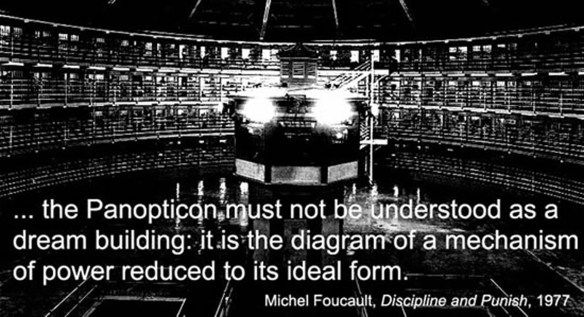
“The “panopticon” refers to an experimental laboratory of power in which behaviour could be modified, and Foucault viewed the panopticon as a symbol of the disciplinary society of surveillance.”[1]

In Plato’s E-Cave, not only are the people watching a shadow play, they, and the shadows they watch, are being watched.

HyperNormalization
With a veneer of calm aplomb, the masses communicate 24-7, often in a frenetic urgency of the mundane, hence one interpretation of HyperNormalization. In all the years of overhearing cell-phone conversations in public, I can’t recall one snippet of philosophy or practical advice, rather stuff like, ‘yeah OMG I’ll get the chips!’ and ‘I’ll be there in like 30 seconds!’; if you’re old enough, you’d remember the days when, you got there when you got there! That said, a cell-phone can be a helpful even life-saving device.

The USEmpire election appears to have both proven and disproven the main theory of Adam Curtis’ fascinating new documentary “HyperNormalization.”

“Curtis argues that since the 1970s, governments, financiers, and technological utopians have given up on the complex “real world” and built a simple “fake world” that is run by corporations and kept stable by politicians.”[2]

The California cyber-tech-boom was a love-child of LSD-consciousness that found refuge in E-wizardy all the while looking to escape repressive politics. In his book “2030” Pepe Escobar describes it as: “Digital network capitalism would then shape post-modern globalization, from the New Economy before the end of the millennium to every digital wall to be broken beyond. California cosmology forged our world.”

According to Wikipedia:

“The term “hypernormalisation” is taken from Alexei Yurchak’s 2006 book Everything was Forever, Until it was No More: The Last Soviet Generation, about the paradoxes of life in the Soviet Union during the 20 years before it collapsed. A professor of anthropology at the University of California, Berkeley, he argues that everyone knew the system was failing, but as no one could imagine any alternative to the status quo, politicians and citizens were resigned to maintaining a pretence of a functioning society. Over time, this delusion became a self-fulfilling prophecy and the “fakeness” was accepted by everyone as real, an effect which Yurchak termed “hypernormalisation”.”[3]

First off, I see HyperNormalization as a half-truth because while the self-referential, gossipy world is fake, it is a veneer for a very real world of resource extraction and the violence perpetrated to maintain the status quo – and that is what the fakers ignore. As far as the election, many expected the Clinton dynasty to prevail as the corrupt, business as usual lesser of two evils. Breaking snooze: Where’s  the headline news that Melania Trump plans to focus on helping women and children?; I saw that mentioned on CNN’s Anderson Cooper 360, such a perfect antidote for Hillary’s loss and The Donald’s anti-feminist track record.

Even though WikiLeaks revealed the DNC (Democratic National Convention) was rigged against Sanders and leaks of Podesta/Clinton e-mails may have been proverbial straws for Hillary’s campaign camel, the prevailing media sentiment was that she would win – despite the fact that the day before the election some polls indicated a shrinking 3-4 point lead, thus with the typical margin of error, it was, in effect, tied. Yet the mass hyper-surprise!; and all that after the corporate media and comedy shows had simultaneously bashed Trump and given him more air-time than a kite on a windy day – both disdaining and elevating him, a media-mindfuck if ever there was one.

And there was little uproar when Gary Johnson and Jill Stein were excluded from debates and virtually banned from all corporate news, thus proving (if you didn’t know already) that it’s not a truly democratic election. Yet carry on we must and do the best we can with what we got, was the general sentiment, in other words, “the “fakeness” was accepted by everyone as real” aka HyperNormalization.

Yet the non-coastal, poor and middle America White working class (with sides of KKK and minorities!), which reportedly was the key demographic for The Don’s victory, was voting out of bare-bones needs; in effect they were not HyperNormalized. Then again, if Trump, who promises to challenge the status quo, caves-in to Deep State pressure, we will have an answer to an interesting article’s titular question: “President Trump: big liar going to Washington or Tribune of the People?”[4] And if that answer is the former, then the mostly White working poor will also have been duped/HyperNormalized.

You see, it’s hard to know what’s what; which all seems to prove HyperNormalization as the dominant societal charade; which screen is real, if any?

What you perceive is what you get
Another key phrase in Curtis’ documentary is “managed perception” – akin to Chomsky and Herman’s  “Manufacturing Consent: The Political Economy of the Mass Media” (1988) which showed how opinions and desensitized agreement to the status quo became a product to be mined and marketed. Witness CBS Chairman Les Moonves’ comment from February 2016:

“Man, who would have expected the ride we’re all having right now? … The money’s rolling in and this is fun. I’ve never seen anything like this, and this [is] going to be a very good year for us. Sorry. It’s a terrible thing to say. But, bring it on, Donald. Keep going.” [5] And, if i might satirically add, like an orangey topped Duracell battery, The Don does seem to have a lot of energy.

HyperNormalization is also akin to Sheldon Wolin’s theory  of “inverted totalitarianism,” where the faceless corporate machine wields so much entertainment and bureaucratic power that the people barely notice they are being played hook, line, and sinking feelings.

Some of Curtis’ info, however, is inaccurate or questionable. For examples, he blames the demise of the Occupy Movement on lack of vision and planning yet neglects to mention the FBI coordinated systemic crackdown on the ‘camps’ across the country. [6]

About Syria he says that President Bashar al-Assad retaliated with a “vengeful fury,” whereas Assad has defended his actions as self-defense for his people; numerous journalists back the Syrian President’s claim.

Post-election, I wonder: Why were so many liberals, lefties, and women more surprised that Trump won than that the DNC/HRC rigged it against Sanders? Were they simply feeling impotent due to HyperNormalized shadow play? Whatever the case, his victory revealed a crack in the smooth screen of HyperNormalization.

According to Patrick Caddell’s survey before the election, the populace seems to be hip to what’s happening:

“Powerful interests from Wall Street banks to corporations, unions and political interest groups have used campaign and lobbying money to rig the system for them. They are looting the national treasury of billions of dollars at the expense of every man, woman and child. AGREE = 81%; DISAGREE = 13%…

“The country is run by an alliance of incumbent politicians, media pundits, lobbyists and other powerful money interests for their own gain at the expense of the American people. AGREE = 87%; DISAGREE = 10%

The real struggle for America is not between Democrats and Republicans but between mainstream American and the ruling political elites. AGREE = 67%; DISAGREE = 24%.” [7]

This makes it seem it is the ‘how-to bring about change’ that is the deeper conundrum of the HyperNormalized world. Then again, people too often seem to have only their own best interests at heart. Approximately 90% of Americans want their food labeled so as to know if they contain GMOs etc. or not, yet hardly a peep out of anyone that climate change or the “environment” aka Mother Earth & Nature-beings were deliberately excluded as a main topic of the presidential debates. This makes it seem that, in general, Americans want clean food for themselves, they want a clean environment so they can go ‘play in the park’ by themselves. And that brings us to the Great Disconnect and Standing Rock.

Flow like water, be steady as a rock
Part of HyperNormalization is a disconnect from Nature and from being self- and community-guided, and therefore disconnected from the Original Peoples of Turtle Island. While many people are certainly aware of what’s happening with Standing Rock, the corporate media’s lack of attention, let alone empathy, fosters lack of concern for the outcome, lack of being outraged by the violent and racist treatment of those in prayer and peacefully protecting the main source of water for the Standing Rock Sioux and other Natives as well as approximately 17-million people downstream. The real-fake outrage is over the outcome of a fake election.

For many Native reservations where poverty and PTSD are prevalent, the people are anything but HyperNormalized; they are struggling to survive – as with Standing Rock, they are not asking for much: clean water and the space to live their lives with ancient traditions timelessly connected with the land, the water, the stones…

Plato, imagining a prisoner getting outside of the Cave, wrote: “Slowly, his eyes adjust to the light of the sun. First he can only see shadows. Gradually he can see the reflections of people and things in water and then later see the people and things themselves. Eventually, he is able to look at the stars and moon at night until finally he can look upon the sun itself .” [8]

Standing Rock is bringing people together, raising consciousness at many levels. As one example from a little over a week ago:

“In a “historic” show of interfaith solidarity, 500 clergy members prayed along the banks of North Dakota’s Cannonball River on Thursday where they “bore witness with the Standing Rock Sioux Nation,” which has faced intimidation, violence, and arrests for protecting their sacred land and water supply from the threats of a massive oil pipeline. According to the Episcopal News Service, “The interfaith group spent more than five hours on site, marching, singing hymns, sharing testimony, and calling others to join them in standing with the more than [300] tribes who have committed their support to the Sioux Nation as they protest the route of the Dakota Access Pipeline (DAPL).” [9]

This solidarity is in stark contrast with the election where a typically 51/49 system determines an outcome for a society literally programmed for exciting close-call winners – think sporting events,
reality shows, awards ceremonies.

Outside in and inside out
There are many ways to get outside the Cave. One of those is by going within. When I first started to meditate, as is common, I became aware of the constant chatter in my head and soon realized that the mind left unattended will rattle on endlessly. Meditation then showed me that once the chatter quiets, one then has access to other frequencies, other ‘channels’ – what happens then is a very personal matter yet also impersonal because one becomes connected with another source of thinking-seeing-feeling. Chatter, like cell-phones, has it’s usefulness, say, if you forgot to turn the stove off. My point to the personal anecdote is that the corporate media is too much chatter, endlessly looping itself. The gadgets, too, though useful, seem hard-wired for HyperNormalization.

Some of the chatter we must live with, yet by learning to follow our intuitions, listening to and connecting with Nature, talking with elders and little children we can better tune-out from the shadow-play, we can find new and ancient ways for more people – and that includes trees, rivers, etc. –  “to look at the stars and moon at night” and “look upon the sun itself.”

“Sin filo ya y derrotada se quejó: Soy más fuerte que ella, pero no le puedo hacer daño y ella a mi, sin pelear. me ha vencido.’”

“Without sharpness and defeated, it [the sword] complained: ‘I am stronger than the water, but I cannot harm her. And the water, without fighting, has conquered me.’” [10]

NOTES:
1.    Panopticism here and here.
2.    Ibid.
3.    HyperNormalization
4.    See here.
5.    “Les Moonves: Trump’s run is ‘damn good for CBS’”. See here.
6.    “Revealed: how the FBI coordinated the crackdown on Occupy
7.    “Patrick Caddell; The Pollster Who ‘Got it Right’
8.    “Allegory of the Cave
9.    “A Prayer for People and Planet: 500 Clergy Hold ‘Historic’ Mass Gathering for Standing Rock
10.    “Questions & Swords: Folktales of the Zapatista Revolution” as told by Subcomandante Marcos, Cino Puntos Press, El Paso, Texas, 2001, p.82.

To watch “HyperNormalization”, click here.

Mankh (Walter E. Harris III) is an essayist and resident poet on Axis of Logic. In addition to his work as a writer, he is a small press publisher and Turtle Islander. His new book of genre-bending poetic-nonfiction is “Musings With The Golden Sparrow.” You can contact him via his literary website.


Oceania Forever: Rise of the Global Police State

1984-screenhillary-1024x576

By Patrick Henningsen

Source: Waking Times

Much has been written about the approaching Police State in alternative media. Commentary ranges from various warnings, to shock and outrage, and fear over an impending martial law takeover in North America and Western Europe. It’s hitting us from so many different angles, and yet the mainstream conversation continues to be woefully inadequate in both characterising the situation and offering a remedy.

In order to really understand the modern Police State, we need to explore some very profound and difficult questions. Many people who consider themselves aware think Western society has already reached the tipping point and the deteriorating situation is simply inevitable. If you feel like Winston Smith right about now you aren’t alone.

Prior to the mid 1990s, one might have described the militarisation of public law enforcement something of a creeping paradigm, but one that was still a long way off. Society explored many aspects of the Police State, both the physical and Orwellian psychological scenario, through literature and film. American science fiction writer Philip K. Dick penned some significant works like The Minority Report, and cinematic hits like Paul Verhoeven’s Robocop and Terry Gilliam’s Brazil also explored what this dystopic, future vision of fascist technocracy might look like. As it turned out, and far from fantasy, countless devices, systems and themes depicted in so many of these supposedly ‘fictional’ classics have since made their way into our day to day lives. The dark dream became real.

Unfortunately, as humanity’s freshmen class of the early 21st century, we can no longer afford the intellectual distance enjoyed by previous generations between life today and that blurry, far-off spectre of something that might arrive sometime at some point in the future.

Any modern globalised Police State requires a social engineering framework in order to provide its shape and scope of law enforcement. The latest social engineering blueprint for global technocratic management was unveiled at this year’s 70th United Nations General Assembly in New York City. Their ‘new’ agenda (newer than the old one) entitled, Agenda 2030,1 hopes to “transform our world for the better by 2030.” Author Michael Snyder from the blogEnd of The American Dream’ explains: “The entire planet is going to be committing to work toward 17 sustainable development goals and 169 specific sustainable development targets, and yet there has been almost a total media blackout about this…”2

Within its 17 ‘universal goals’, the actual Police State provision for Agenda 2030 can be found within Goal 11, which states how the new global government will, “Make cities and human settlements inclusive, safe, resilient and sustainable.” Translated in technocracy terms, this means more Big Brother tech, smart grid tracking and big data surveillance states.

The age of computerisation and database integration, along with advances in military and crowd control technology perfected overseas, have enabled a sharp advance toward the Police State. Trying to make sense of ‘it’ is a major challenge, to say the least. In its totality, the control system is both multifaceted and multilayered. It may have been possible to describe it, or even define it 20, 30, or 40 years ago, as Philip K. Dick and so many others did. Today, as society has already eclipsed the possible, we face a situation whereby the very thing we are trying to describe is woven through nearly every fabric of modern social, professional, family, religious and political life.

If you happen to live in one of the technocratic nations, you can’t opt out, nor can you fully repeal the advances already made by the control system. What other options are available?

Firstly, we have to try and understand, from an economic, cultural and political perspective at least, how this control system came to be.

What are its strongest areas? Can we reform those areas? Where is it still emerging? Cannot those areas be slowed down? What was the political climate that enabled it?

How to Build a Police State

When you observe a modern Police State, the first things you might notice will not necessarily be the batons, shield, helmets or MRAPs. Think Switzerland or Singapore. A modern Police State will be neat, clean and efficient. Retail zones will be shiny and feature all the top designer brands. Many of the people you see in public will be well-groomed, well-healed and beautiful, but often with only one political party and a strict public code.

Just like admirers of the modern Chinese State, Singapore’s proponents refer to the single party State as “a great argument for Authoritarianism.” Order and civility rule the day, so long as you don’t fall foul of the narrow perimeters set by the State.

What has been accomplished in Southeast Asia since 1965, and what is possible in previously ‘free’ countries like the US, UK and Australia, are two very different social and political evolutions. Still, the modern Police State is advancing globally and it’s being driven primarily by three factors: technology, for-profit industry, and an age-old obsession by the ruling class to manage the masses.

The first and easiest area to challenge is the physical realm of the control system. The most obvious of these are the gadgets and toys. They are easy to see. Look at your local police department and notice the difference between what officers looked like and what they wore in the 1970s, 1980s, 1990s and now in the 21st century. Notice the firearms and tasers, the ‘Bat-Belts’, and now the body cameras. Your average officer today looks like a cross between a soldier and an android. Dress them like robots and don’t be surprised when they act like machines (and it won’t be long until many of them are replaced by machines).

If you’ve ever attended a street protest or witnessed some civil unrest, then you’ll have noticed the high-tech body armour, the riot and ‘crowd suppression’ equipment.

My first intense experience where I felt the full force of the modern Police State was in 2009, at the G20 Protests in the City of London, England. It was early in the evening and approximately 4,000 demonstrators suddenly found themselves trapped at Bishopsgate. Several hundred police officers on foot and horseback had blocked all the entrances and egresses in and out of the main road. Even alleyways were manned by riot police. Then police began charging the crowds, and beating protesters with clubs. They alternated their ‘surge’ efforts, from different ends of the street, north to south, one brutal flurry after another. The worst part about it was there was no escape route away from the police. Many were beaten and trampled on that evening. It was as if police planners were playing a video game.

Finally, at around 9pm, after being forced to stand, surrounded by police in a ‘Kettle’ for nearly three hours, along with 500 other demonstrators and press, who spent most of that time pressed up against police shields and not knowing what would happen next – I realised this is an impersonal, disinterested and totally uncompromising machine. It does not care who you are, what your views and opinions are, or whether you were innocent or guilty. The lesson was simple: “next time, stay home.” The only detail this machine is concerned with is that you comply with orders, and if no orders are given, then the machine demands you stay where you are until the machine decides what to do with you. If you complain too much, or become emotional, or heaven forbid act out in any way, then the machine will move in to subdue and detain you. That is all there is to it.

Big Brother Reality

It’s well-known that Great Britain is home of the world’s largest and most sophisticated physical Police State, including tens of millions of closed circuit television (CCTV) cameras, covering every conceivable inch of habitable space, both indoors and outdoors. The CCTV phenomenon in Britain was fuelled by an obsession with cameras that became increasingly popular with both government and corporate technocrats in the 1980s and 1990s. The psychology behind the exponential proliferation in cameras was mainly a fairly crude bit of criminology which held that the cameras would somehow act as a deterrent to criminal behaviour, and thus subdue the feral population into a more docile state. Industry used this line too, as sales persons were deployed en masse with endless flip charts and statistical models that claimed CCTV cameras would prevent the UK’s spiralling social malaise.

The only problem is that more cameras don’t equal less crime. Canadian writer Cory Doctorow observed this reality back in 2011, explaining: “After all, that’s how we were sold on CCTV – not mere forensics after the fact, but deterrence. And although study after study has concluded that CCTVs don’t deter most crime (a famous San Francisco study showed that, at best, street crime shifted a few metres down the pavement when the CCTV went up), we’ve been told for years that we must all submit to being photographed all the time because it would keep the people around us from beating us, robbing us, burning our buildings and burglarising our homes.”3

The CCTV is only one single aspect of Big Brother. It turns out that the real value of the CCTV camera grid is not so much the monitoring of crime per se, as it is in mass applied behavioural psychology.

The Panopticon

The physical Police State could not exist without some philosophical underpinning. Before Orwell, there was Bentham…

In the mid 19th century Britain developed a new style of prison architecture known as the ‘Panopticon’ under the aegis of utilitarian philosopher Jeremy Bentham.4 The unique feature of this Panopticon concept was the transparent nature of each prisoner cell, visible to a central surveillance guard tower that could eye inmates at all times. The result of this psychological experiment, according to the pragmatic Benthamite philosophy, was to produce a regime of “self-policing” amongst the inmates, a kind of early behavioural conditioning. For technocrats and emerging utilitarian social managers of that era, this was seen as the most economic and efficient solution. Ultimately, this Benthamite concept is what underpinned phase one of the mass CCTV deployment throughout the UK. Sitting well above the security minions and the industry profiteers, elite scholars knew full well that CCTV cameras do not stop crime.

The real power of the Panopticon is in convincing the general population they are under constant surveillance. After that point, through a long-term process of nudging, diversions and scare tactics, the State gradually moulds the behaviour and thoughts of its subjects.

In order to keep citizens locked into this new conscious state of fear and trepidation, the State needs anenemy…

The Long War & ‘The Extremist’

One of the chief campaigns to nudge society towards a fully-functional Orwellian State is the War on Terror. Ever since September 11, 2001, the concept of an endless war against the ‘terrorists’ – a seemingly ubiquitous and constantly shape-shifting enemy – has been used to justify nearly every large new security expenditure and policy. Back in 2006, US President George W. Bush’s chief architect of the ‘long war’, Secretary of Defense Donald Rumsfeld, laid out the tea leaves for the next 100 years, stating: “It does not have to do with deployment of US military forces, necessarily. It has to do with the struggle that’s taking place within that faith between violent extremists – a small number of them, relatively – who are capable of going out and killing a great many people, as they’re doing, and the overwhelming majority of that religion that does not believe in violent extremism or terrorism.”5

In George Orwell’s classic novel 1984, Winston Smith also grappled with the State’s endless war. “Oceania was at war with Eurasia: therefore Oceania had always been at war with Eurasia.”

In Oceania, people eventually forgot what started the long war. The news was just one terrorist attack after another. They enemy was everywhere, but nowhere too. The population learned to acquiesce to the idea that war was the permanent state of affairs, and that questioning the provenance of this idea was futile.

“Winston could not definitely remember a time when his country had not been at war, but it was evident that there had been a fairly long interval of peace during his childhood, because one of his early memories was of an air raid, which appeared to take everyone by surprise. Perhaps it was the time when the atomic bomb had fallen on Colchester. He did not remember the raid itself.”

And so it was, in the early moments of the 21st century, Orwell’s dream suddenly became a waking reality. Social engineers are firm believers that if the Panopticon (married with the threat of an invisible enemy) can remain in place for a generation, then the State could fundamentally change a once free-thinking society into something noticeably different – a much more fearful and compliant populace.

The Social Media Panopticon

As terror scares and attacks become somewhat of a daily event in the West, identifying and quarantining the ‘extremist’ becomes a primary fetish of the Police State and its media arms. This is very much evident in how terrorists and ‘active shooters’ (dead or alive) are now profiled after the event. The mainstream media has integrated this into its work practice by crafting the post hoc guilty verdict of the accused, prior to a trial, with circumstantial or non sequitur accusations based on an individual’s “web history” that may have “radicalised” the suspect. In effect, the mainstream media’s function as an establishment propaganda arm results in trial by media – the bypassing of any trial by jury as the accused have already been implicitly or explicitly declared guilty by association or something as nebulous as “web history.”

Such incidents, as they are portrayed in the media for psychological conditioning purposes, are intended to cause the public mind to dismiss outdated notions of fair and due process and rule of law in favour of fiat corporate news and government “official” pronouncements. The net effect of this trend is that social media users, ie. the majority of the population, are adopting self-policing habits in their communications online. According to the principals of applied behavioural psychology, if you change the language people use, then eventually you change the way they think and act.

Like Bentham’s Panopticon, this new social media monitoring system works by utilising the digital web, which is arguably the most economic and efficient solution. The acceptance of self-policing and vague terms such as “radicalised” that are subject to the increasingly elastic definitions of the social engineering establishment.

This leads to one of the most profound questions one might ask in the wake of Edward Snowden’s NSA spying revelations: Knowing what we know now, are people more outspoken or are they more self-policing because of the Snowden leaks?

‘The Daily Shooter’

By extension, once the technocrat has regained some modicum of physical control, then the next domain to be conquered is the mind. In 1984, the technocracy was viewed through the eyes of the protagonist Winston Smith, who while remaining a physical prisoner of the Police State, could still retreat into his own mental state.

In our day, the expansion of the surveillance State and vast spying by the likes of the NSA and GCHQ are precisely intended to achieve this same effect, with the justification for such intrusions being an endless series of terror spectacles and lone wolf public shooting events. In the US, these mass shootings and terror scares are happening on an almost daily basis, hence, ‘The Daily Shooter’. Media coverage is both chaotic and relentless. As a result, the pubic are left stupefied and completely unable to challenge whatever narrative the government-media complex is selling at that time. The Police State marches forward.

A similar psychodrama also played out for 1984’s protagonist Winston Smith. As time progressed, however, maintaining some level of autonomy in one’s own thoughts became increasingly difficult for Winston. The final objective of the Police State, it seemed, was not only to fundamentally transform the way citizens act, but how they think too. The all-seeing and all-controlling “Big Brother” State was also the de facto social authority figure. The State’s law enforcement police force also became the “thought police.”

We see this same exact narrative playing out today as the State’s political figureheads continue in their mission to widen their definition of “extremism” along with other State-issued euphemisms used to describe citizens who should be regarded with suspicion.

Fall out of line and you might even be segregated or sent away to a special camp. Following the recent mass shooting in Chattanooga, Tennessee, retired US General and NATO Commander Wesley Clark proposed that any “disloyal Americans” should be sent to internment camps for the “duration of the conflict.” Notice the language: “for the duration of the conflict.” Indeed, it seems that Oceania is at war. He went even further, calling for the US government to identify people most likely to be “radicalised” so we can “cut this off at the beginning.”

“At the beginning?” Here, it seems Clark might be alluding to pre-crime, which will be powered by A.I…

Artificial Intelligence

Post-September 11, UK society was still hooked on their CCTV matrix, and with millions of cameras already in place and crime continuing to rise, security ‘experts’ and politicians simply doubled down on their previous wager, insisting that what the country really needed was more cameras. They believed that once a certain CCTV saturation was reached, by default they would somehow reached their twisted utopia.

It turned out that’s not humanly possible for security workers, most of whom are on a mere £7-10 (aud$14-20) per hour, to keep track, let alone analyse, a seemingly endless stream of footage. For the technocrat, the operative word here is ‘humanly’. Enter A.I…

Once again, advanced technology enters the narrative and supplies the solution to this previous insurmountable problem. The age of Artificial Intelligence, or A.I., is nearly upon us, and this next step in technological development is certain to radically change the entire concept of the Police State.

Laying down the framework an A.I. grid is not easy because the grid must be designed to cope with the application of A.I. As A.I.’s potential and practical applications have not yet been fully realised, designing the grid upon which it will be unleashed has been problematic up to this point. Sadly, society on the whole appears disinterested in questioning the social and unethical imperative currently driving the adoption of these new technologies.

At present, the big money is on the Smart Grid. Technocrats and their corporate partners are hoping to usher in their new surveillance grid under the auspices of ‘smart’ technologies. With A.I. in play, technocrats will be able to utilise the smart grid – which includes your mobile phone – to detect and track multiple targets over a wide area.6 Add facial recognition and data profiling to the mix and it’s a recipe for a full-on A.I. Smart Grid future. The ultimate hands-free, ‘surveillance selfie’ – compliments of Big Brother.

Just imagine, one day you’re simply walking down the street and pointing to something in the air. All of it is being captured on a 1.8 billion pixel video stream from the sky. They already know your identity and location with the phone in your pocket, and they already have your face logged and tracked.7

At this point we introduce Philip K. Dick’s concept of “pre-crime” whereby an A.I. system can predict an action you are likely to take.8 The system will then close the ‘Big Data’ loop by storing the video footage alongside your profile into a massive data ‘mash-up’. It will then compare with other potentially ‘suspicious’ activity in the area. Great Britain’s national police force, the Metropolitan Police, are already using a type of pre-crime software that British technocrats believe will somehow ‘revolutionalise’ modern policing in the 21st century.9

UK consumer advocate Pippa King explains how CCTV is already being phased out: “CCTV, closed circuit television, is not quite what is operating on our streets today. What we have now is IPTV, an internet protocol television network that can relay images to analytical software that uses algorithms to determine pre-crime area in real time.”

“Currently this AI looks at areas that may be targeted for crimes such as burglaries or joyriding,10 with the predicted hotspot information being sent direct to law enforcement smart phones in the field. This analytical software is being used in Glasgow, hailed as Britain’s first ‘smart city’,11 where the Israeli security firm NICE Systems are running the CCTV/IPTV network, analysing data from the 442 fixed HD surveillance cameras and 30 mobile units under a project called ‘Community Safety Glasgow’,12 whose primary objectives are described as ‘delivering Glasgow a more efficient traffic management system, identifying crime in the city and tracking individuals’.”13

This all can happen thanks to the US Defense Advanced Research Projects Agency’s (DARPA) latest creation – the ARGUS camera, Autonomous Real-Time Ground Ubiquitous Surveillance.14 According to its designers ARGUS, “melds together video from each of its 368 chips to create a 1.8 billion pixel video stream” all in real-time and archived. It’s just one of the many new toys used by the State to realise its Orwellian ambitions.

Who’s Paying For It All?

Aside from its ability to trample over the rights of law abiding citizens, the Police State has one other chief characteristic which may also be its Achilles heal: it’s bankrupting the State. Here’s how it works:

The gravy chain is endless, but only with the help of taxpayers’ money, along with a series of bribes and favours between politicians and corporates. If you have ‘friends’ in government administration, then you are more likely to cash in on any number of lucrative ‘domestic defense’ contracts.

Where you have constant crisis you also have constant business opportunity. In this dark paradigm, timing is everything. As US President Barack Obama’s sociopathic15 former chief of staff, now Mayor of Chicago, Rahm Emmanuel, once said:

“You never let a serious crisis go to waste. And what I mean by that it’s an opportunity to do things you think you could not do before.”

With that mantra in mind, in the wake of any shooting, terror scare, or crisis, industrial lobbyists and their elected political gophers will waste no time pushing for new federally-funded add-ons like training courses, workplace psychologists, regulators, specialist contractors, police cameras and other big-ticket items16 – anything to help “solve the crisis.” One such program in the US is known simply as the ‘1033’.

Joseph Lemieux writes:

“The 1033 program has flooded our local police forces with military equipment, and has turned them from Peace Officers, to a domestic army.”

“Officers stopped looking like officers, and more like soldiers all kitted out with fully automatic weapons, armoured vehicles, body armour, grenades launchers, night vision, and even bayonets! Besides the cost of liberty, how much has this domestic army cost you the tax payer?”17

In the US, no single entity embodies the Police State gravy train more than the Department of Homeland Security (DHS), where federal grants are used to bribe local law enforcement and absorb them into a larger framework of institutional dependency.

At over $200 billion per year, the DHS is now America’s most expensive federal agency. As any sane local law enforcement chief will tell you, once you smoke from the federal crack pipe, you’re hooked for life. Remember that each federal Police State agenda item has a lucrative contract attached to it. With each move central government makes, a large amount of money is also made (by someone).

By cutting off public money that is driving the runaway federal Police State in Western countries, the people have a chance to mitigate and potentially reform the current agenda.

If we hope to preserve what is left of our hard fought democracy, then now is the time to put it to the test. The alternative is unthinkable.


About the Author

Patrick Henningsen is an independent investigative reporter, editor, and journalist. A native of Omaha, Nebraska and a graduate of Cal Poly San Luis Obispo in California, he is currently based in London, England and is the managing editor of 21st Century Wire – News for the Waking Generation (www.21stCenturyWire.com) which covers exposés on intelligence, geopolitics, foreign policy, the war on terror, technology and Wall Street. Patrick is a regular commentator on Russia Today.

Footnotes:

  1. ‘Transforming our world: the 2030 Agenda for Sustainable Development’,https://sustainabledevelopment.un.org/post2015/transforming
    ourworld
  2. ‘The 2030 Agenda: This Month The UN Launches A Blueprint For A New World Order With The Help Of The Pope’ by Michael Snyder, 2 Sept 2015, http://endoftheamericandream.com/archives/the-2030-agenda-this-month-the-un-launches-a-blueprint-for-a-new-world-order-with-the-help-of-the-pope
  3. ‘Why CCTV has failed to deter criminals’ by Cory Doctorow, The Guardian, 17 August 2011
  4. www.ucl.ac.uk/Bentham-Project/who/panopticon
  5. www.sourcewatch.org/index.php/The_Long_War
  6. ‘Bilderberg 2015: Implementation of the A.I. Grid’ by Jay Dyer, 21st Century Wire (www.21stcenturywire.com), 14 June 2015
  7. ‘Britain Launches “Big Brother” System, Uploads One Third of Population to Facial Recognition Database’, 21st Century Wire, 3 Feb 2015
  8. ‘Already Underway: Smart A.I. Running Our Police and Cities’ by Pippa King, 21st Century Wire, 13 Mar 2015
  9. ‘British Police Roll Out New “Precrime” Software to Catch Would-Be Criminals’, 21st Century Wire, 13 Mar 2015
  10. ‘Pre-crime software recruited to track gang of thieves’ by Chris Baraniuk, New Scientist, 11 Mar 2015
  11. ‘Glasgow wins “smart city” government cash’, BBC News, www.bbc.com/news/technology-21180007
  12. www.saferglasgow.com
  13. ‘Already Underway: Smart A.I. Running Our Police and Cities’, op.cit.
  14. www.darpa.mil/program/autonomous-real-time-ground-ubiquitous-surveillance-infrared
  15. ‘The Two Sides of Rahm Emanuel: Sociopathic Political Hitman and Puppy Lover’ by Foster Kamer, 16 Aug 2009, gawker.com
  16. ‘Mayor de Blasio Announces Retraining of New York Police’ by Marc Santoradec, The New York Times,4 Dec 2014
  17. ‘How Much Money Have American Taxpayers Spent on Building a Domestic Police State?’ by Joseph Lemieux, 1 Dec 2014, http://theantimedia.org/taxpayers-police-state/

The above article appeared in New Dawn 153 (Nov-Dec 2015)

Prisons Without Walls: We’re All Inmates in the American Police State

they-live

By John W. Whitehead

Source: The Rutherford Institute

“It is perfectly possible for a man to be out of prison and yet not free—to be under no physical constraint and yet be a psychological captive, compelled to think, feel and act as the representatives of the national state, or of some private interest within the nation wants him to think, feel and act. . . . To him the walls of his prison are invisible and he believes himself to be free.”—Aldous Huxley, A Brave New World Revisited

Free worlders” is prison slang for those who are not incarcerated behind prison walls.  Supposedly, those fortunate souls live in the “free world.” However, appearances can be deceiving.

“As I got closer to retiring from the Federal Bureau of Prisons,” writes former prison employee Marlon Brock, “it began to dawn on me that the security practices we used in the prison system were being implemented outside those walls.” In fact, if Brock is right, then we “free worlders” do live in a prison—albeit, one without visible walls.

In federal prisons, cameras are everywhere in order to maintain “security” and keep track of the prisoners. Likewise, the “free world” is populated with video surveillance and tracking devices. From surveillance cameras in stores and street corners to license plate readers (with the ability to log some 1,800 license plates per hour) on police cars, our movements are being tracked virtually everywhere. With this increasing use of iris scanners and facial recognition software—which drones are equipped with—there would seem to be nowhere to hide.

Detection and confiscation of weapons (or whatever the warden deems “dangerous”) in prison is routine. The inmates must be disarmed. Pat downs, checkpoints, and random searches are second nature in ferreting out contraband.

Sound familiar?

Metal detectors are now in virtually all government buildings. There are the TSA scanning devices and metal detectors we all have to go through in airports. Police road blocks and checkpoints are used to perform warrantless searches for contraband. Those searched at road blocks can be searched for contraband regardless of their objections—just like in prison. And there are federal road blocks on American roads in the southwestern United States. Many of them are permanent and located up to 100 miles from the border.

Stop and frisk searches are taking place daily across the country. Some of them even involve anal and/or vaginal searches. In fact, the U.S. Supreme Court has approved strip searches even if you are arrested for a misdemeanor—such as a traffic stop. Just like a prison inmate.

Prison officials open, search and read every piece of mail sent to inmates. This is true of those who reside outside prison walls, as well. In fact, “the United States Postal Service uses a ‘Mail Isolation Control and Tracking Program’ to create a permanent record of who is corresponding with each other via snail mail.” Believe it or not, each piece of physical mail received by the Postal Service is photographed and stored in a database. Approximately 160 billion pieces of mail sent out by average Americans are recorded each year and the police and other government agents have access to this information.

Prison officials also monitor outgoing phone calls made by inmates. This is similar to what the NSA, the telecommunication corporation, and various government agencies do continually to American citizens. The NSA also downloads our text messages, emails, Facebook posts, and so on while watching everything we do.

Then there are the crowd control tactics: helmets, face shields, batons, knee guards, tear gas, wedge formations, half steps, full steps, pinning tactics, armored vehicles, and assault weapons. Most of these phrases are associated with prison crowd control because they were perfected by prisons.

Finally, when a prison has its daily operations disturbed, often times it results in a lockdown. What we saw with the “free world” lockdowns following the 2013 Boston Marathon bombing and the melees in Ferguson, Missouri and Baltimore, Maryland, mirror a federal prison lockdown.

These are just some of the similarities between the worlds inhabited by locked-up inmates and those of us who roam about in the so-called “free world.”

Is there any real difference?

To those of us who see the prison that’s being erected around us, it’s a bit easier to realize what’s coming up ahead, and it’s not pretty. However, and this must be emphasized, what most Americans perceive as life in the United States of America is a far cry from reality. Real agendas and real power are always hidden.

As Author Frantz Fanon notes, “Sometimes people hold a core belief that is very strong. When they are presented with evidence that works against that belief, the new evidence cannot be accepted. It would create a feeling that is extremely uncomfortable, called cognitive dissonance. And because it is so important to protect the core belief, they will rationalize, ignore and even deny anything that doesn’t fit in with the core belief.”

This state of denial and rejection of reality is the essential plot of John Carpenter’s 1988 film They Live, where a group of down-and-out homeless men discover that people have been, in effect, so hypnotized by media distractions that they do not see their prison environment and the real nature of those who control them—that is, an oligarchic elite.

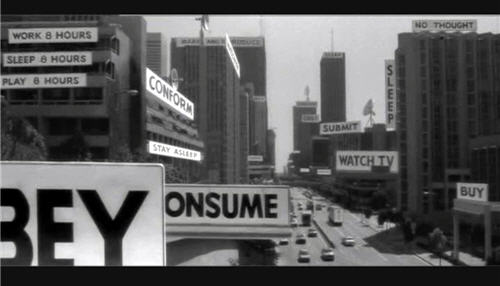
Caught up in subliminal messages such as “obey” and “conform,” among others, beamed out of television and various electronic devices, billboards, and the like, people are unaware of the elite controlling their lives. As such, they exist, as media analyst Marshall McLuhan once wrote, in “prisons without walls.” And of course, any resistance is met with police aggression.

A key moment in the film occurs when John Nada, a homeless drifter, notices something strange about people hanging about a church near the homeless settlement where he lives. Nada decides to investigate. Entering the church, he sees graffiti on a door: They live, We sleep. Nada overhears two men, obviously resisters, talking about “robbing banks” and “manufacturing Hoffman lenses until we’re blue in the face.” Moments later, one of the resisters catches Nada fumbling in the church and tells him “it’s the revolution.” When Nada nervously backs off, the resister assures him, “You’ll be back.”

Rummaging through a box, Nada discovers a handful of cheap-looking sunglasses, referred to earlier as Hoffman lenses. Grabbing a pair and exiting the church, he starts walking down a busy urban street.

Sliding the sunglasses on his face, Nada is shocked to see a society bombarded and controlled on every side by subliminal messages beamed at them from every direction. Billboards are transformed into authoritative messages: a bikini-clad woman in one ad is replaced with the words “MARRY AND REPRODUCE.” Magazine racks scream “CONSUME” and “OBEY.” A wad of dollar bills in a vendor’s hand proclaims, “THIS IS YOUR GOD.”

What’s even more disturbing than the hidden messages, however, are the ghoulish-looking creatures—the elite—who appear human until viewed them through the lens of truth.

This is the subtle message of They Live, an apt analogy of our own distorted vision of life in the American police state. These things are in plain sight, but from the time we are born until the time we die, we are indoctrinated into believing that those who rule us do it for our good. The truth, far different, is that those who rule us don’t really see us as human beings with dignity and worth. They see us as if “we’re livestock.”

It’s only once Nada’s eyes have been opened that he is able to see the truth: “Maybe they’ve always been with us,” he says. “Maybe they love it—seeing us hate each other, watching us kill each other, feeding on our own cold f**in’ hearts.” Nada, disillusioned and fed up with the lies and distortions, is finally ready to fight back. “I got news for them. Gonna be hell to pay. Cause I ain’t daddy’s little boy no more.”

What about you?

As I point out in my book Battlefield America: The War on the American People, the warning signs have been cautioning us for decades. Oblivious to what lies ahead, most have ignored the obvious. We’ve been manipulated into believing that if we continue to consume, obey, and have faith, things will work out. But that’s never been true of emerging regimes. And by the time we feel the hammer coming down upon us, it will be too late.

As Rod Serling warned:

All the Dachaus must remain standing. The Dachaus, the Belsens, the Buchenwalds, the Auschwitzes—all of them. They must remain standing because they are a monument to a moment in time when some men decided to turn the earth into a graveyard, into it they shoveled all of their reason, their logic, their knowledge, but worst of all their conscience. And the moment we forget this, the moment we cease to be haunted by its remembrance. Then we become the grave diggers.

The message: stay alert.

Take the warning signs seriously. And take action because the paths to destruction are well disguised by those in control.

This is the lesson of history.

The Asshole Factory

index

Our economy doesn’t make stuff anymore. So what does it make?

By Umair Haque

Source: Medium

My good friend Mara has not one but two graduate degrees. From fine, storied universities. Surprise, surprise: the only “job” she was able to find was at a retail store.

Hey—it’s only minimum wage, but at least she’s working, right? And at a major-league, blue-chip company, An American icon; an institution; a name every man, woman, and child in this country knows; an historic company that rings of the American Dream the world over, besides. Surely, if nothing else, it’s a start.

Perhaps you’re right. Maybe it isn’t the start she always dreamed of…but at least it is one. If so…then awaits her at the finish?

What is Mara’s job like? Her sales figures are monitored…by the microsecond. By hidden cameras and mics. They listen to her every word; they capture her every movement; that track and stalk her as if she were an animal; or a prisoner; or both. She’s jacked into a headset that literally barks algorithmic, programmed “orders” at her, parroting her own “performance” back to her, telling her how she compares with quotas calculated…down to the second…for all the hundreds of items in the store…which recites “influence and manipulation techniques” to her…to use on unsuspecting customers…that sound suspiciously like psychological warfare. It’s as if the NSA was following you around……and it was stuck in your head…telling you what an inadequate failure you were…psychologically waterboarding you…all day long…every day for the rest of your life.

Mara’s boss sits in the back. Monitoring all twelve, or fifteen, or twenty people that work in the store. On a set of screens. Half camera displays, half spreadsheets; numbers blinking in real-time. Glued to it like a zombie. Chewing slowly with her mouth open. Jacked into a headset. A drone-pilot… piloting a fleet of human drones…pressure-selling disposable mass-made shit…as if it were luxury yachts…through robo-programmed info-warfare…like zombies…to other zombies…who look stunned…like they just got laser blasted, cluster-bombed, shock-and-awed…

WTF?

It’s bananas. The whole scene is like a maximum-security mental asylum designed by sadomasochists in a sci-fi movie. If Jeffrey Dahmer, Rasputin, and Michael Bay designed a “store” together, they couldn’t do any better. Her “job” will begin to drive her crazy—paranoid, depressed, deluded—in a matter of years if she continues doing it. No human psyche can bear that kind of relentless, systematic abuse.

Now. Note what all the technology and bureaucracy that wonderful, noble company has invested hundreds of millions in doesn’t ask her to do. Learn. Think. Reflect. Teach. Inspire. Lead. Connect. Imagine. Create. Grow. Dream. Actually…serve customers. Heaven forbid. It just beats her over the head, over and over again, three times a minute, every twenty seconds, with how much she hasn’t sold; hasn’t made; hasn’t produced. For her shitty .0003% commission. According to the quota that’s been set for her. By her boss. For his boss. For their boss. And so on all the way up the food chain.

See my point? Mara’s job isn’t to benefit customers. It isn’t to educate, understand, listen to, or even to chat with them. It isn’t to stop them from buying what they don’t want; to help them find what they might need; to match them with the right stuff. Nope. It’s merely to push more and more and more and more shit at them…faster, meaner, and dumber than any sane person would think is humanly possible…using advanced military technology and techniques… programmed to abuse her…so she can wage advanced psychological warfare…on her customers. And they were just suckers, gaping maws, fools, marks. And be yelled at…by a robot…if she doesn’t.

Really? This is the best our economy can do? To take the stuff of 21st century warfare and use them them to…rack up the profit? To turn a bright young woman with two grad degrees…into a Superprofitable Human Weapon of Mass Consumption…a half-crazed algorithmically-programmed asshole…a human drone…so even bigger, actually crazy assholes…can get super-rich…by slinging entire supertankers full of junk…at people getting poorer at four thousand percent interest a year…by using drones and bots to wage psy-warfare against them…so they’re conned into buying too much?

The economy doesn’t make stuff anymore. That much you know. So what does it make?

It makes assholes.

The Great Enterprise of this age is the Asshole Industry.

And that’s not just a tragedy. It is something approaching the moral equivalent of a crime. For it demolishes human potential in precisely the same way as locking someone innocent up, and throwing away the key.

Consider Mara again. Who in Christ’s name would design such an inhuman system? Whose sick joke of an idea is a “store” like that? What do you even call it? Because it’s surely not a “store”.

Only a monstrous asshole of the highest order could assemble such a demonically vampiric bullshit machine to prey on…everyone. Customers, managers, workers alike. Such a carefully sophisticated engine of human misery; of finessed cruelty; all to rake in a few extra pennies an hour, at the expense of dignity, intelligence, creativity, commitment, fairness, craft, service, sovereignty…sanity.

The store is an Asshole Factory.

Allow me to explain.

What happens to Mara when she’s “doing her job”? Think about it for a second. She turns into precisely the kind of asshole that the heartless dweebs who thought up this infernal torture-machine no doubt already are. Not because she wants to. But because she has to.

That’s exactly what the store was designed to do. Turn everyone into the same kind of asshole as the assholes that made it, run it, and benefit from it…want everyone to be.

The store is an Asshole Factory.

Our world is now full of Asshole Factories. That’s what the stores, offices, industrial parks, skyscrapers, malls, low-rise blocks, gleaming headquarters, whimsically designed corporate campuses, really are.

It’s the grand endeavor of today. We don’t make stuff anymore. We make assholes. The Great Enterprise of this age is the Asshole Industry.

Consider, for a moment, my tiny hypothesis.

Have you noticed, lately, that people seem to be more, well, assholish…than before? That everywhere you go, people seem to be meaner, nastier, dumber, angrier, more brutish?

Why?

It is the last and greatest industry left in an economy that has been impoverished, emptied, hollowed out, drained.

The Great Enterprise of the Age of Stagnation is the wholesale manufacture not of great, world-shaking, ground-breaking ideas, inventions, concerns…but of bigger and bigger assholes.

The chain-store; the mall; the hypermarket. The corporation; the firm; the partnership. B-school; law school; med school. The boardroom; the backroom; the trading floor.

These are, by and large, Asshole Factories. They don’t make people. Capable of great things. Who create and build and touch and soar. They make assholes.

They are designed to disinfect us of our fragility. To cleanse us of our flaws. To disinfect us of weakness. Love, grace, mercy, longing, forgiveness, passion, truth, nobility, dreams. Their objective is to stamp all that out; to eradicate it; to erase it. To replace it with calculation, ruthlessness, self-concern; gluttony; cruelty; anxiety, despair. By using the most sophisticated technology ever made to subjugate, oppress, and goad us into being little torturers ourselves.

And in so doing, they emotionally sterilize us. They psychically traumatize us. They intellectually castrate us. They socially neuter us. They cheat us of greatness. That is how they turn us into assholes.

They are designed to deprive us into depriving everyone else of the lives we could and have, at our highest and truest and noblest.

The assholes haven’t just taken our incomes, our savings, our careers, our educations. They’ve taken something far more precious; something priceless. It is our lives—the full, true lives we should be living—that have been taken from us. And in the gaping void where the lives we should be living are, the assholes have deftly inserted carbon copies of…themselves.

When you think about it that way…is it any wonder that society seems to be stuck? That the economy seems headed into oblivion? That life for so pretty much anyone under the age of 35 and/or worth less than $20 million or so appears to be going…nowhere?

Remember my friend Mara? She’s probably being piloted like a drone…yelled at by a bot…three times a minute…into waging advanced techniques of psycho-war…designed to traumatize prisoners…over and over and over again…right this very second…

Until she’s cleansed. Perfect. Flawless. Pure. Another gleaming, brand-new asshole, rolling proudly off the assembly line of the Asshole Factory.

We’re obedient constructivists. Pragmatists. Rationalists. So you probably want to know: what can we do about it?

It’s pretty simple.

Don’t be an asshole. Remember the Asshole Factories? Here’s a secret: they’re churning out assholes by the millions. And so should you bravely decide to be an asshole, what you’ll really be is just another interchangeable, forgettable, rapidly depreciating commodity.

So who should you be?

Be yourself. The person you were meant to be. Whether you believe in heaven or the inferno, freedom or fate, the simple fact is: each and every one of us was put here to be something greater than Just Another Asshole stealing pennies from his neighbors to pay off Even Bigger Assholes.

So let me say it again. Don’t be an asshole. Be yourself. The miracle of being that you were meant to be. A person that, consumed with passion, seared with happiness, aglow with meaning, brings forth all that is great, noble, and true in the world, and so, with love, mercy, and wisdom, lifts every life that you meet into the light.

Thank you and goodbye.

Numbered Man – An Analysis of The Prisoner (1967)

index

An excellent analysis from Jay Dyer of one of the best television series created so far, imho.

Grooming Students for A Lifetime of Surveillance

index

The same technologists who protest against the NSA’s metadata collection programs are the ones profiting the most from the widespread surveillance of students.

By Jessy Irwin

Source: Model View Culture

Since 2011, billions of dollars of venture capital investment have poured into public education through private, for-profit technologies that promise to revolutionize education. Designed for the “21st century” classroom, these tools promise to remedy the many, many societal ills facing public education with artificial intelligence, machine learning, data mining, and other technological advancements.

They are also being used to track and record every move students make in the classroom, grooming students for a lifetime of surveillance and turning education into one of the most data-intensive industries on the face of the earth. The NSA has nothing on the monitoring tools that education technologists have developed in to “personalize” and “adapt” learning for students in public school districts across the United States.

(Mega)data Collection + Analysis

“Adaptive”, “personalized” learning platforms are one of the most heavily-funded verticals in education technology. By breaking down learning into a series of tasks, and further distilling those tasks down to a series of clicks that can be measured and analyzed, companies like Knewton (which has raised $105 million in venture capital), or the recently shuttered inBloom (which raised over $100 million from the Gates Foundation) gather immense amounts of information about students into a lengthy profile containing personal information, socioeconomic status and other data that is mined for patterns and insights to improve performance. For students, these clickstreams and data trails begin when they are 5 years old, barely able to read much less type in usernames and passwords required to access their online learning portals.

Data collection and number crunching aren’t the only technologies being explored to revolutionize education– technology billionaire and philanthropist Bill Gates funded a $1.1 million project to fit middle-school students with biometric sensors to monitor their response and engagement levels during lessons, and advocated a $5 billion program to install video cameras in every classroom to record teachers for evaluation.

The Family Educational Rights and Privacy Act, a law put in place in 1974 to protect student academic records, does nothing to protect student data when it is in the hands of education technology companies. Instead, FERPA threatens to take federal funding away from schools who are found to have breached student privacy while it fails to mandate bare minimum security standards for the storage and transmission of student data. In fact, a recent revision of FERPA increased the power that companies have to collect and mine student data.  Though lawmakers and privacy advocates are regularly outraged at the immense volume of student data freely floating through the web, the repeated failure to create legislation that protects student data from being used for profit is astounding.

One thing is clear: those who have the power to protect student privacy will not do so as long as they can continue to subsidize the cost of public education with student data.

Internet Censorship in Schools

In most educational institutions, the vast majority of IT operations are focused on monitoring, filtering and blocking web traffic instead of building secure networks that safeguard student records and sensitive behavioral data. Nowhere is this more apparent than in the widespread adoption of web filtering software tools in K-12 schools. Usage of these technologies is required for compliance with programs like E-Rate, which grant federal money to schools to fund internet access for their students.

To be eligible for funding from the E-Rate program, schools are required to comply with federal regulations that ban access to websites displaying pornography, graphic material, or any other that could otherwise be judged as immoral, improper or lewd. More often than not, this subjective criteria is determined by the opinions and belief systems of school administrators under political pressure to deny students access to content on controversial issues about topics like evolution, birth control and sex education. These decisions disproportionately affect young girls and LGBTQ students by denying them access to sites that provide important information about their rights, their developing bodies, their sexuality and their access to contraceptives. In the case of Securly, the first filtering tool designed for schools, the controls set by IT and administration for web access can extend far beyond the walls of the school and determine what content students can access while using school- issued machines from their home internet connections.

Despite the many positive contributions of the internet in the distribution and dissemination of knowledge across the planet, students are regularly denied access to valuable information that could positively impact their learning… all to safeguard a small percentage of federal budget money granted to their schools. The implications of this are particularly severe for low-income students who do not have access to the Internet at home; without the ability to freely access the web on their own terms, their digital literacy skills lag behind those of their affluent peers. Though teachers request better and broader internet access for students in their classrooms, administrator-imposed blocks and filters on school internet leave most students woefully unprepared to navigate the realities of the web. When students do find a way around the tools used to limit their access to the outside world (this happened with a group of students who were given iPads in the Los Angeles United School district last year), they’re labelled as “hackers” or miscreants, and disciplined for using Tor, a tool popular among students for anonymous web browsing and circumventing blacklists that ban websites from school networks.

Social Media Surveillance

Schools are adopting many other surveillance technologies with unprecedented reach into the private communications and lives of students and their families. In Lower Merion, PA, a suburb outside of Philadelphia, educators engaged remote administration tools on students’ laptops to regularly spy on their activities while at home. In a case that made its way into federal courts, one student was punished by administrators who mistook candy pictured through his laptop’s camera for drugs. While the full extent of the spying was never exposed, parents and students have expressed concern about educators having the ability to watch young girls undress in the privacy of their homes, unaware that they were being watched through their school-issued computers.

In 2013, the Glendale Unified School District in Glendale, CA took a move straight from the NSA surveillance handbook by seeking out a $40,000 contract with Geo Listening, a social media monitoring company that charges schools to eavesdrop on student social media chatter. While the company claims to only access posts that are public in the school districts they work with, and says it works closely with school districts to tailor their monitoring programs to prevent cyberbullying, suicide and active shooter incidents, it is very easy— too easy, in fact— to use such technologies to identify and target students who have been labeled deviant or delinquent within their communities, or who are otherwise outspoken and critical of their teachers and schools.

Schools are also demanding access to students’ social media communications in ways that severely harm their constitutionally protected rights to free speech. In Minnewaska, MN, a female student who complained about a hall monitor’s behavior in a Facebook post was questioned and given in-school suspension. Later, when a parent reported the student for “sexting” over Facebook with a classmate, she was removed from class again as a group of educators and a police officer armed with a taser demanded that the student hand over her password. They then read private communications that took place outside of school through her Facebook account. After being pulled from class multiple times, suspended from school, and barred from attending a school field trip (the same punishment was not doled out to the male student involved in the messaging), the ACLU stepped in to defend the student’s right to privacy and free speech in communications outside of school property. Though the ruling in the case upheld students’ protection under the 1st and 4th amendments, school districts around the country continue to demand access to students’ social media accounts and threaten to mark students’ academic records to make it difficult to get into a desired university or to seek other avenues for continued education.

Physical Surveillance

In addition to the online monitoring taking place in schools, there are many surveillance mechanisms in place to enforce physical security in public schools. Since the shootings that took place at Virginia Tech in 2007, and again after those that took place in Sandy Hook, CT in 2012, technology companies have launched myriad tools designed to minimize the potential loss of life in the next active shooting incident at a school. Some of these technologies include:

By preying on the absolute worst fears of administrators and parents across the country, technology companies are earning millions of dollars selling security “solutions” that do not accurately address the threat model these tools claim to dispel. School districts that purchase these systems further perpetuate the farce of security theater and infringe on students’ rights to privacy and individual freedom.

A Lifetime of Surveillance

When we develop and use educational technologies that monitor a student’s every moment in school and online, we groom that student for a lifetime of surveillance from the NSA, from data brokers, from advertisers, marketers, and even CCTV cameras. By watching every move that students make while learning, we model to students that we do not trust them– that ultimately, their every move will be under scrutiny from others. When students recognize that they are being watched, they begin to act differently– and from that very moment they begin to cede one small bit of freedom at a time.

Though the education technology revolution continually promises a silver bullet that will be a great democratizing force for all of society’s ills, it categorically disregards the patriarchal power structures and biases that both legitimate and perpetuate discrimination against minorities and marginalized groups. Despite it being well within the scope of educational technology tools to track, identify and expose biases towards groups of students, technologists avoid implementing small changes that monitor educator performance and correct for unconscious biases that negatively affect student learning. Because the surveillance taking place in schools is typically based on qualitative criteria like morality, appropriateness and good behavior, these technologies extend current practices and prejudices that perpetuate injustices against marginalized groups.

There are few to no safeguards built into the online and offline monitoring systems to protect students from the abuse of these tools. Young female students who are active on social media can be unfairly targeted, slut-shamed and disciplined for suggestive language that takes place outside of school, while their male counterparts are not held equally accountable for participating in sexually charged online conversations. Youth of color, a group that is disproportionately stereotyped as angry, aggressive, and unpredictable by educators, can easily be monitored, disciplined, and entered into the juvenile justice system for any outburst that could vaguely be misinterpreted as a threat to a homogeneous caucasian school culture. Any student grappling with issues of abuse, depression, disability, gender identity or sexuality could easily be discovered by online surveillance tools, stigmatized and outed to their teachers, parents and wider community.

Education technologists also continue to widen the digital divide between affluent and economically oppressed. Despite an industry-wide insistence that technology is not being developed to replace educators in the classroom, many poor school districts faced with massive budget cuts are implementing experimental blended learning programs reliant on “adaptive” and “personalized” software as a way to mitigate the effect of large class sizes on student learning. This means that students who attend costly private schools or live within rich school districts that can afford to employ more educators and maintain smaller class sizes receive much more personalized instruction from their teachers. Instead of receiving much-needed interaction and personalized learning directly from educators, poor students living in disadvantaged communities receive instruction from educational software that collects their data (which is likely to be sold), and have less individual instruction time from teachers than their affluent counterparts.

By developing technologies that collect, track, record, analyze every move a student makes both online and off, technologists and investors and educators are ensuring that today’s students will have less privacy than any other generation that came before them, threatening to make privacy and anonymity unattainable for future generations. Though the surveillance mechanisms at play in education technologies affect the privacy of millions of students who pass through the education system each year, this system is a profound, persistent threat to the privacy and individual liberty of LGBTQ students, low-income students, and students of color who have already been so severely failed by the status quo.

Ironically, the same technologists and investors who protest against the NSA’s metadata collection programs are the ones profiting the most from the widespread surveillance of students across the country, by building educational tools with the same function.

Public Outrage Forces Seattle Officials to Backtrack on DHS Surveillance Grid

index

Last week, Seattle’s alternative weekly paper The Stranger published an exposé on their city’s new wireless mesh network, part of a $2.7 million project purchased by the Department of Homeland Security. The Seattle Police Department refused to answer more than a dozen questions about the network (which was fast-tracked by Seattle City Council with very little process for review and approval) including whether it’s operational, who can access its data, what it might be used for, whether the SPD has used or intends to use it to geo-locate people’s devices via MAC addresses or other identifiers, and how accurately it would be able to track people.

On November 12, Anthony Gucciardi and Mikael Thalen released reports on Infowars and Storyleak featuring leaked documents on the surveillance mesh posted by an anonymous whistleblower earlier this year. Some of the findings are recapped in the video below:

Shortly after the leaks went public (Tuesday evening) Seattle Police Spokesperson Sgt. Sean Whitcomb announced “The wireless mesh network will be deactivated until city council approves a draft policy and until there’s an opportunity for vigorous public debate.” While it’s fortunate they were forced to do this due to public pressure, it contradicted previous statements SPD had made to the local press in the wake of The Stranger article. As reported by RT:

The SPD told The Stranger previously that the system was not being used, but anyone with a smart phone who wandered through the jurisdiction covered by the digital nodes could still notice that their devices were being discovered by the internet-broadcasting boxes, just as a person’s iPhone or Android might attempt to connect to any network within reach. In theory, law enforcement could take the personal information transmitted as the two devices talk to each other and use that intelligence to triangulate the location of a person, even within inches.

When the SPD was approached about the system last week, they insisted that it wasn’t even in operation yet. David Ham of Seattle’s KIRO-7 News asked, however, how come “we could see these network names if it’s not being used?”

Well, they couldn’t give us an explanation,” Ham said at the time.

They now own a piece of equipment that has tracking capabilities so we think that they should be going to city council and presenting a protocol for the whole network that says they won’t be using it for surveillance purposes,” Jamela Debelak of the American Civil Liberties Union told the network.

Now just days later, the SPD has admitted to The Stranger that indeed the mesh network was turned on — it just wasn’t supposed to be.

SPD maintains it has not been actively using the network — it was operational without being operated, having been turned on for DHS grant-mandated testing and then never turned off — so shutting it down won’t hamper any current SPD activities,” The Stranger reported.

Are we supposed to believe the SPD “forgot” to shut the system off or trust that they would leave it operational without anyone operating it in light of the fact that they lied to reporters about the system being on a few days earlier? Both seem unlikely, as does promises that they’ll have enough safeguards in place to prevent misuse of the information they collect.

As RT previously reported, the DHS has been quietly rolling out similar surveillance grids in other cities including Oakland and Las Vegas. At this point, all Americans must remain extra vigilant to stay on top of such Orwellian schemes and do everything within power to shut them down.

UPDATE 11/28: Infowars just released this follow-up report revealing SPD had in fact NOT shut down the surveillance grid after publicly announcing that they would. This is further evidence that government lies and/or is incompetent at doing anything not a high priority for them (like shutting off surveillance grids), as if anyone needed more evidence.

UPDATE 12/9: Seattle police just announced today that the last of the surveillance nodes had finally been shut off last Friday (12/6). According to The Stranger:

Today, an SPD spokesperson said the department had turned off the final nodes in the network on Friday—156 could be disabled remotely, which happened weeks ago (though 19 had to be double-checked in person), but 8 had to be deactivated manually by a technician. Those are now off.

Today, I also received a copy of a letter sent from SPD Chief Jim Pugel to city councilperson Bruce Harrell about the mesh network. The full text is below the jump, but the relevant points are: (a) the department says the technology needs “more vetting with the ACLU and other stakeholders before a public hearing” and (b) Chief Pugel’s assertion that the network does not have the capability to track or record a person’s movements, but that SPD’s draft policies about its use “will cover any non-video technology” anyway.

The department, Pugel says, should be ready for a briefing with the council member earlier next year.