
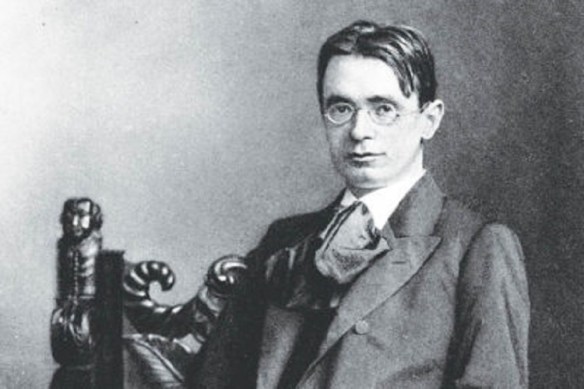
RUDOLF STEINER: DWELLER ON THE THRESHOLD

By Gary Lachman

Source: Waking Times

The most enigmatic figure to emerge from the “occult revival” of the early twentieth century was also the most successful, the Austrian “spiritual scientist” Rudolf Steiner (1861-1925). Although many of his contemporaries were outwardly more eccentric – think of Madame Blavatsky, Gurdjieff or Aleister Crowley – it’s precisely Steiner’s sobriety that is so striking, making him seem somewhat out of place in the often flamboyant world of the esoteric.

We generally associate ideas of the occult, higher consciousness and spiritual worlds with exotic, extraordinary characters with something of the trickster about them; Blavatsky, Gurdjieff and Crowley would certainly fall into this category. Steiner was precisely the opposite. Standing at the lectern with his pince-nez in hand, he projected an image of irreproachable rectitude. Steiner was earnestness incarnate, his one gesture of bohemian extravagance the flowing bow ties he was fond of wearing, a remnant of his early student days. Where Blavatsky, Gurdjieff and Crowley each took pains to present a formidable self-image, there was something simple and peasant-like about Steiner. Combined with this wholesomeness was an encyclopedic erudition. If we were to use an archetype to describe Steiner, it would have to be that of “the Professor” – or more precisely, “the Doctor,” as he was known by those around him. Commenting on her magnum opus, The Secret Doctrine, Madame Blavatsky once remarked that she “wrote, wrote, wrote” like the Wandering Jew “walks, walks, walks.” Steiner too wrote a great deal, but his main mode of disseminating his ideas was lecturing, and in the years between 1900 and 1925, he lectured, lectured, lectured, delivering more than 6,000 talks across Europe.

In a dry and often pedantic style, Steiner informed his audience of the results of his spiritual research, his “supersensible” readings of the occult history of the world made available to him through what is called “the Akashic Record.” In matter-of-facts terms, he introduced them to his teaching, Anthroposophy, telling them along the way about ancient Atlantis, life after death, astral and etheric bodies, the true meaning of Christianity and much, much more. Yet this humble, self-effacing character became one of the most influential, and simultaneously vilified, forces in the spiritual and cultural life of early twentieth century Europe, and his ideas are still relevant today.

Steiner’s efforts to lead “the Spiritual in the human being to the Spiritual in the Universe” have produced remarkably concrete results. Since his death, more than 1,000 schools around the world work with Steiner’s pedagogical principles, not to mention the many special-needs schools, working along lines developed by Steiner a century ago. There are also the hundreds of “bio-dynamic” farms, employing Steiner’s agricultural insights, developed decades in advance of our interest in ecology and organic foods. The practical application of Steiner’s ideas had also informed very successful avenues in holistic healing, the arts, architecture, economics, religion and other areas.

Given these achievements in the “real world,” which certainly exceed those of other esoteric teachers, why isn’t Steiner better known? You would reasonably expect the average educated person to have some idea of who, say, Jung is, or Krishnamurti, or the Dalai Lama; possibly even Blavatsky, Gurdjieff or Crowley. But Steiner? He remains something of a mystery, a name associated with a handful of different disciplines and endeavours, but not solidly linked to any one thing. He remains, as one of his most eloquent apologists, the Inkling Owen Barfield, called him “the best kept secret of the twentieth century.” It’s certainly time that he was better known.

Rudolf Steiner was born on 27 February 1861, in the small rural town of Kraljevec in what was then Hungary but is today part of Croatia. His father was a telegraph operator for the Southern Austrian Railway, and Steiner spent his first years amidst magnificent scenery: mountain ranges and green plains were his playgrounds. Steiner felt that it was significant that he grew up in a part of Europe where East meets West, as it was also significant that childhood had an equal measure of natural beauty and modern technology – at the time, both the railways and the telegraph were relatively new innovations.

In Knowledge of the Higher Worlds and its Attainment (1905), Steiner relates that a crucial experience on the path of higher consciousness is an encounter with the Guardian of the Threshold, a spiritual being embodying one’s unredeemed karma. Well before his career as an esoteric teacher, Steiner was himself a dweller on several thresholds, having one foot in the mysteries of nature, the other in the methodology of science. It was this combination of mystic visionary and disciplined thinker that gave Steiner’s later career its peculiar character.

When Steiner was eight, his father was transferred to Neudörfl, near the border with Lower Austria. An argument with the local teacher led his father to educate the boy himself, and this meant that he spent a great deal of time on his own at the railway station where his father worked. Young Steiner was deeply introverted; as he admits in his Autobiography (1925), he had great difficulty relating to the outer world. He also had an inquisitive mind and was obsessed with many questions the adults he knew seemed unable to answer. This subjectivity might have taken a morbid turn were it not for his discovery of mathematics. When Steiner came upon a book of geometry, it was a revelation. “That one can work out forms which are seen purely inwardly, independent of the outer senses, gave me a feeling of deep contentment. I found consolation for the loneliness caused by the many unanswered questions. To be able to grasp something purely spiritual brought me an inner joy. I know that through geometry I first experienced happiness.”1

Steiner’s joy upon discovering geometry may strike us as odd, yet the experience was essential in getting him through an early crisis. What impressed Steiner so greatly about geometry was that it seemed to offer proof that within the mind there existed a kind of “soul space,” an inner equivalent of the external space of the natural world. The soul space was “the setting for spiritual beings and events.” Thoughts for the young Steiner were not “mere pictures we form of things”; they were rather the “revelations of a spiritual world seen on the stage of the soul.” Geometry, Steiner believed, although produced by the human mind, had an objective reality independent of it, and for him this meant that the soul space in which it was revealed was also real.2

Rather precocious stuff, perhaps, but Steiner’s early years included an event that made him question the outer world’s monopoly on reality.

A Paranormal Encounter

One day at the railway station, he had a paranormal experience, an early manifestation of his psychic abilities. Sitting in the waiting room, he saw a strange woman enter; although he didn’t know her, he felt she resembled other members of his family. Standing in the middle of the room, the woman spoke to the boy. “Try to help me as much as you can – now as well as in later life,” she said. Then she walked into the stove and disappeared. Steiner decided not to tell his parents, afraid that they would scold him for lying. But he noticed that his father was sad, and he later discovered that a female relative who lived in the neighbouring town had committed suicide at the same time that he had had his vision.

This early experience marks for Steiner the beginning of a life-long involvement with the dead. Much of his later esoteric teaching involves accounts of the soul’s experiences in the afterlife and of the machinery of karma and reincarnation, the balancing of the spiritual books that casts the departed back into the stream of life in order to complete their tasks. While other boys of his age were fantasising about the Austrian equivalent of cowboys and Indians, Steiner was preoccupied with the reality of the spirit worlds and the soul’s encounter with the beings that inhabit them.

Later, as a young man, Steiner would on two occasions have unusual opportunities to verify some of his ideas about the meaning of death. Twice he would come into intimate contact with families in which the father was a recluse who would die soon after Steiner made their acquaintance. Yet on both occasions, although never actually meeting the man, Steiner formed a profound intuitive relation with the deceased, so deep and insightful in fact that he was asked by both families to give the funeral orations. Later still, during his years as an esoteric teacher, Steiner informed his followers that one means of helping the dead in their spiritual journeys was to read to them from his writings.

When Steiner was eighteen, his father was transferred once again, this time to Inzersdorf. His new location had the advantage of being close to Vienna, and it was decided that Steiner would study at the Technical School there. Although he had leanings toward literature and philosophy, he chose instead to work towards becoming a science teacher.

One day on the train to Vienna, he met a man who would have a profound influence on his life. Felix Koguzki was a herb-gatherer who travelled to Vienna regularly to sell his wares. It’s not known how they fell into conversation, but the teenaged Steiner soon discovered that this simple, uneducated man had strange experiences like his own, and a deep, personal knowledge of the other worlds. He was the first person with whom he could speak about his spiritual visions, and their talks boosted Steiner’s confidence; more than likely, they also convinced him that he wasn’t crazy.

Meeting a Master

Around the same time, Steiner had an encounter with another individual whose name has not come down to us. Steiner refers to him only as “the Master.” The French writer Edouard Schuré, author of the bestselling The Great Initiates (1889), and later a friend and follower of Steiner, remarked that the Master was “one of those potent personalities who are on Earth to fulfil a mission under the mask of some homely occupation.” Steiner had by this time read widely in philosophy, specifically the German Idealists, and had worked his way through Hegel, Schelling and several others, absorbing Kant’s Critique of Pure Reason during his history class, which bored him. Steiner was obsessed, then and later, with refuting scientific materialism, and this became the impulse that drove his philosophical studies.

Although he doesn’t mention this episode in his Autobiography, in a lecture given in Berlin in 1913, Steiner spoke of the experience. Speaking in the third person, he told his audience: “from that time onward a soul-life began to develop in the boy which made him entirely conscious of worlds from which not only external trees or mountain speak to the human soul, but also the Beings who live behind them…”3

What little we know of the Master is that he pointed out some passages in the work of Johann Gottlieb Fichte, one of Kant’s most important followers, which helped Steiner in his quest. Fichte’s work focused on the centrality of the human ego, the “I,” the locus of consciousness and the self that scientific materialism argued was mere illusion. Steiner’s spiritual experiences convinced him that this was palpably false and the “I,” rather than being an illusion, was a concrete, irreducible reality. For the next twenty years, until Steiner’s re-invention as a spiritual leader, his work would focus on developing a methodical epistemology proving this fact.

Introduction to Goethe

The single most important influence on his ideas, however, was the work of Johann Wolfgang von Goethe. Goethe is best known for his drama Faust (1808-1832), which takes a cautionary tale about a pact with the Devil and transforms it into an archetype of Western consciousness. Although he’s never enjoyed the same reputation among English speakers, Goethe is one of the Olympians of Western literature, sharing the top shelf with Plato, Dante and Shakespeare (Jung too thought Goethe a key figure, even to the extent of sometimes believing he was an illegitimate descendent of the great man.) Often regarded as the last true Renaissance man, Goethe was not just a giant of literature but also a statesman, traveller, and most important for Steiner, a scientist, making important contributions to botany, anatomy, mineralogy, and optics. Through his literature tutor Karl Schröer, who opened his mind to Goethe’s importance, Steiner was offered what must have seemed the chance of a lifetime. At twenty-two, he was head-hunted as the editor of Goethe’s scientific writings for a major edition of the polymath’s work.

For an unknown rural scholar to be offered such a position might seem unusual, but the general consensus on Goethe’s scientific musings at this point was that they were useless as science and dreary as literature; in truth, no one else wanted the job of editing them. Aside from his early success in proving that the human upper jaw contained the intermaxillary bone found in other mammals – Goethe was, in a different way, an evolutionist long before Darwin – most scientists found Goethe’s attempts to disprove Newton’s theory of colour, or to demonstrate the existence of what he called the Urpflanze, the archetypal plant from which others emerged, muddleheaded if not insane.

Yet for Steiner, Goethe’s science was the prototype for what would become his own phenomenology of the spirit worlds. Instead of the conventional scientist’s cold, dispassionate eye regarding the world as mere matter, passive to his intrusions, Goethe called instead for “objective imagination,” an active participation in the reality under scrutiny. The subjectivity of the scientist – his state of consciousness – was vastly more important than the increasingly hair-splitting exactitude provided by his instruments. This “objective imagination” became for Steiner the basis for his own “supersensible cognition.”

Encountering Nietzsche

Steiner’s work on Goethe opened many doors. One led to Weimar, Goethe’s city, where he was asked to work on the Goethe Archive, another prestigious task. Although Steiner found few congenial colleagues, the work had other compensations. He was introduced to the city’s literary and cultural life and made many acquaintances. One in particular led to a momentous meeting. Elizabeth Forster Nietzsche, sister of the ill-fated philosopher, approached Steiner to work with her in establishing a Nietzsche Archive. This led to Elizabeth introducing Steiner to her brother, who had been insane from syphilis for several years. Elizabeth had taken to dressing the defenceless Friedrich in a toga, and positioning him by the window, where his blank stare and unkempt appearance provided the impression of a great prophet. Steiner, aware of Nietzsche’s madness, was nevertheless impressed – not with the figure before him, but with its spiritual aura. He saw Nietzsche’s soul “hovering over his head, infinitely beautiful in its spiritual sight…” It was a soul that “brought from former lives on Earth golden riches of great spirituality…”4

If mention of Nietzsche’s “soul” brimming with “golden riches of great spirituality” suggests to readers familiar with the author of Beyond Good and Evil and The Antichrist that Steiner was as ignorant of Nietzsche’s philosophy as his sister Elizabeth notoriously was, they should have a look at Steiner’s book Friedrich Nietzsche: Fighter for Freedom (1895), a remarkable perceptive study which at times even reads like Nietzsche. Throughout his career, Steiner had an uncanny knack for entering into and defending the ideas of thinkers with whom he had profound disagreements – like the staunch materialist Ernst Haeckel – a critical sympathy that often led to much misunderstanding.

When his work at Weimar was ending, rather than embark on academic career (Steiner had received his doctorate in philosophy during his stay and could easily have found a comfortable niche somewhere), he decided instead to move to Berlin, home of Germany’s nascent avant-garde. He had by this time published what many believe to be his most important book, The Philosophy of Freedom (1894), an exhilarating, if often difficult work of epistemology which Steiner believed established beyond doubt the reality of the human “I.” Others, like the influential philosopher Eduard von Hartmann, author of the once immensely popular The Philosophy of the Unconscious, were less convinced and suggested he had muddled the question. Steiner, however, was undaunted and believed he had a mission to disseminate his ideas. He also needed to find work. Although his followers tend to see Steiner’s life as the undeviating unfolding of a pre-ordained destiny – and Steiner himself, we must admit, contributes to this belief – like the rest of us, he was looking for his place in the world and the means to get on in it. He was also filled – rightly so – with the conviction of his own genius. The literary and cultural world of Berlin might offer opportunities not available elsewhere.

Steiner, however, made the thoroughly impractical decision of buying a moribund periodical, The Magazine for Literature. His previous brief catastrophic experience in Vienna as an editor of a political magazine seemingly forgotten, Steiner proceeded to run the already failing Magazine for Literature into the ground, alienating its readers with his persistent exhortations regarding the spiritual life. In the age of Strindberg, Wilde, Ibsen, Wedekind, and Shaw, Steiner’s idealism seemed a stale leftover from a forgotten time.

Yet, although he bemoaned the burden destiny had placed on him, Steiner seems to have enjoyed hobnobbing with bohemians: his acquaintances include poets, playwrights, novelists and political activists. In fact, his reputation among the demi-monde caused academics to cancel their subscriptions, and Steiner earned the unique distinction of being the one esoteric teacher – as far as I know – to have a periodical banned in Czarist Russia, because its editor was known to socialise with anarchists.

It was also in Berlin that Steiner married his first wife, although one gets the impression that the relationship with Anna Eunicke was little more than platonic. Anna had been Steiner’s landlady in Weimar, and when he moved to Berlin she followed him. There he moved in with her again, and, almost as an afterthought, married her in 1899 in a civil ceremony. (It was in the Eunicke household in Weimar that Steiner had had one of his experiences with the death of a reclusive father.) Anna, not particularly well-educated or cultured, was apparently very happy to have Herr Doctor Steiner under her roof; Steiner, for his part, thus avoided the “misery of living alone,” as well as that of the cheap lodgings and bad food he had endured up till then. Anna was ten years older than Rudolf, and their relationship raises the question of Steiner’s sexuality, of which there is no mention in the entire 406 pages of his Autobiography. I do have it on the authority of one Steiner scholar, Christopher Bamford, that the Doctor was indeed celibate.

Berlin & Theosophy

But it was in Berlin that Steiner’s real career began. For a time he seemed willing to speak to any group who would listen to him. He lectured on history and other subjects at the Workingman’s College, surreptitiously slipping large doses of Idealism to budding Marxist materialists. He also lectured to the Giordano Bruno Society and The Coming Day, a quasi-Nietzschean cultural group. He managed, however, to alienate all of this (as well as Anna Eunicke, whom he soon left) when he accepted a request to lecture to the Berlin Theosophical Society. For years, Steiner had tried to express his insights into the spiritual worlds under the cover of philosopher. Now, at the turn of the century and the age of forty, he decided to forgo the camouflage and speak directly of his experiences.

Steiner quickly rose to prominence among the Theosophists and was soon made head of the society’s branch. One member of his audience was particularly struck. Marie von Sivers, who became Steiner’s second wife in 1914, was a Baltic Russian actress. She asked if it weren’t time for a new spiritual movement to arise in Europe. More to the point, didn’t Steiner think he should lead it? Steiner did, but he insisted that any such movement would be firmly based on Western esoteric sources. Steiner had recently passed through a spiritual crisis which convinced him that the “Christ event” was the single most important incident in human history. He had no time for “Eastern wisdom” or mystic Mahatmas. He more or less adopted the cosmic evolutionary framework of Madame Blavatsky’s Secret Doctrine and informed it with large helpings of German Idealist philosophy and Christian mysticism, developing a peculiarly idiosyncratic neo-Rosicrucian system of esoteric thought, aided by his own readings of the Akashic Record. In light of this it’s difficult to ignore the occult historian James Webb’s remark that Steiner joined the Theosophical Society in order to take it over.

His relationship to the society was rocky, and in 1913 he and its head, the ex-Fabian Annie Besant, came to rhetorical blows over C.W. Leadbeater’s advocacy of the Indian boy Krishnamurti as the second coming of Christ. Steiner was disgusted at the idea, and even more so at Leadbeater’s known paedophilic predilections. He demanded Besant’s resignation; she retaliated by ex-communicating him. Steiner left with much of his flock – by this time several thousand – and started his own group, the Anthroposophical Society. As opposed to Theosophy, which spoke of the wisdom of the gods, anthroposophy was concerned with the wisdom of the human being.

Building a New Movement & the Goetheanum

Practically the first thing Steiner did was to build a temple for his new movement. Land was secured in Dornach, Switzerland, and during WWI Steiner gathered a community of followers from several different countries to construct the Goetheanum, a weirdly beautiful fusion of art nouveau and Expressionist architecture that Steiner himself designed. His lecturing was curtailed by the fighting, but his greatest popularity came with the war’s end. Steiner’s plan to reconstruct Europe, The Threefold Commonwealth (1922), sold some 80,000 copies in its first edition, and audiences for his public appearances were now in the thousands; on one occasion the crowds outside a Berlin auditorium were so great they stopped traffic.

This period, however, also saw the start of the anti-Steiner campaign that would plague him henceforth. Practically everybody hated him: Catholics, Protestants, Marxists, proto-Nazis, not to mention other esotericists. There were at least two attempts on his life, and the number of occult attacks fomented by the “black brotherhoods” is unknown. One clear victory from this time was the establishment of the first Steiner school in Stuttgart in 1919. Based on pedagogical principles developed over decades of tutoring – in Vienna he had cured a retarded hydrocephalic boy to the extent that child grew up to earn a medical degree – Steiner’s educational ideas earned him deserved renown, and an international reputation among experts that continues today.

Steiner endured vilification in the press and disruption at his lectures with equanimity, but one victim of the attacks was, many believe, the Goetheanum, which burned to the ground on New Year’s Eve 1922. Arson by right-wing proto-Nazis is the common assumption, although an electrical fault remains a possibility. In any case, a decade’s effort, not to mention an architectural wonder, was lost overnight: the building was made of the same wood as that used in making violins and burned fiercely. Steiner took the tragedy as a sign that some changes in the society were necessary. His original occult teachings, based on the idea of an evolution of consciousness and the ability to achieve “supersensible thinking,” were, he felt, obscured by the success of subsequent initiatives.

Steiner education, the Christian Community (a religious group using Steiner’s ideas), the Threefold Movement for social change, eurythmy – a form of what he called “visible speech” – and newer developments like bio-dynamic farming and anthroposophical medicine were taking centre stage. Steiner had attracted many younger followers after the war, eager to rebuild society, and these clashed with his older, more esoterically inclined devotees. Bickering within the Anthroposophical Society, whose numbers had swollen in the post-war years, threatened to undo much that had been achieved. On the first anniversary of the Goetheanum’s destruction, Steiner announced plans for a second temple; it stands today in Dornach, defiantly made of concrete. He also told his followers that he was reconstructing the society as well. Although he had not previously even been a member of the society, remaining only its spiritual guide and adviser, he now declared himself president of the newly formed General Anthroposophical Society which, although most successful in Germany, today has branches around the world.

Ahriman & Coming World Inferno

Steiner’s last years were spent in sowing as many seeds as possible for future work; they were also darkened by his belief in a coming world conflagration, when the archangel Michael, overseer of the current stage of human consciousness, would face off against the power of Ahriman, a spiritual being who seeks to prevent humanity’s development. Steiner spoke ominously of the incarnation of Ahriman, an Antichrist-like figure, whose display of miraculous powers would precede a catastrophic “war of all against all.” Steiner believed this unavoidable destiny would take some time to unfold – Ahriman is scheduled to arrive in the 3000s – yet many of his followers suspect that in recent years the process has been speeded up. Steiner himself had grave doubts about the growing pace of technological development, warning his followers that materialist science gains its great power through unwittingly releasing Ahrimanic entities. In his last communications, Steiner called on his followers to develop their consciousness in order to rise above nature to the same extent that technology sank below it. He also gave series of lectures about karma and its work in human history.

Steiner died on 30 March 1925. He had been ill for at least a year with an undisclosed stomach ailment, although there is some speculation he had been poisoned. He continued lecturing until it was physically impossible for him to do so, and his followers were astounded when, on the evening of his last scheduled lecture, they found a note saying that it had to be cancelled because of the Doctor’s health. Nothing like this had ever happened before. The Doctor, they believed, was invulnerable.

The exact nature of Steiner’s illness remains unknown, but it is clear that his inability to refuse help to those who came to him was a key factor. Along with his public and private lectures, and his practical work as a teacher, architect, and agriculturalist, Steiner made himself available to any who needed his counsel. For many years, he had practically no free time, and wherever he went his hotel room saw a constant stream of visitors including, on one occasion, Franz Kafka. Some asked about their astral bodies; others their diet or their marriages; Kafka asked about his writing. Steiner advised them all, giving little bits of himself to thousands. He was, as the Russian novelist Andrei Biely, a follower, once remarked, “a giant of the power of kindness.”5 It’s not hard to see how such solicitude would eventually wear anyone down.

In the end, it’s difficult to give an exact assessment of a man whose work combines cogent criticisms of Kant with accounts of life in Atlantis. But this “mild, gentle, good, kindly man,” whose achievement in “humanitarian terms is remarkable and enduring,” as the psychiatrist Anthony Storr wrote of Steiner in his study of gurus, Feet of Clay, remains, for devotees and non-initiate alike, something of an enigma.

A Clockwork Orange: Waiting for the Sun

By Doug “Uncola” Lynn

Source: The Burning Platform

Society should not do the wrong thing for the right reason, even though it frequently does the right thing for the wrong reason.

 History has shown us what happens when you try to make society too civilized, or do too good a job of eliminating undesirable elements. It also shows the tragic fallacy in the belief that the destruction of democratic institutions will cause better ones to arise in their place.

Stanley Kubrick on “A Clockwork Orange”, an interview with film critic Michel Ciment

An obscure Texas political consultant named Bill Miller once said “politics is show business for ugly people”.  It’s true for the most part, aside from the consequences.  This is because the theatrics of politicians result in policies that affect the lives of others; often against the will of the governed. In books and movies, however, the characters are much ado about nothing. Until, that is, life imitates art.

So it is with the futuristic dystopian story of “A Clockwork Orange”.  Both the book, by the author Anthony Burgess, and the film by director Stanley Kubrick, serve as moral dilemmas and cautionary tales plumbing such considerations as free will, the duality of mankind, societal anarchy, and the ascendancy of an all-powerful state.

A 1973 review written in Sight and Sound Magazine, stated: “Kubrick has appropriated theme, character, narrative and dialogue from Anthony Burgess’ novel, but the film is more than a literal translation of a construct of language into dramatic-visual form”. Therefore, for that reason, and for others described later, the film will remain this article’s primary focus.

As any perfunctory internet research will show, Stanley Kubrick is known as a visionary artist and director, but also as the subject of multiple conspiracies. In addition to A Clockwork Orange, Kubrick’s oeuvre includes avant-garde films such as Dr. Strangelove, The Shining, 2001 A Space Odyssey, and Eyes Wide Shut; to name a few.  Just as these movies demonstrate the inner workings of mankind operating through the disparate threads which bind reality, so do some claim that a larger picture is presented as well.  The big picture, of course, is said to include conspiratorial clues and undertones in Kubrick’s films ranging from Freemasonry, to America’s alleged faked moon landing, to an occultist global financial elite, and the terrorist attacks of 911 being planned as a world transformational event.

There exist multiple published writings, both online and in print, describing the secret meanings hidden in Kubrick’s movies.  Furthermore, it has been argued that Kubrick’s “somewhat surreal films” appeal to the viewer’s subconscious and, therefore, “lend themselves to this sort of interpretation”.

That is another reason why Kubrick’s film will remain the focus of this essay, as opposed to the novel: Either these alleged conspiracies are imagined in the minds of the viewers, or Kubrick deliberately inserted these elements into his creations.  Given Kubrick’s reputation for perfectionism, one can only conclude the symbolism was specifically placed and for exact reasons.

For example, in Kubrick’s The Shining, there are those who contend it is “laden with symbolism, hidden messages”, and “conspiracy theories”.   In Eyes Wide Shut, some contend it was meant to reveal secret societies and sex-magic by means of “evidence” which includes occult symbolism and references to Ishtar, the ancient Babylonian goddess of fertility, love, war and sex.

In his other films, like 2001 A Space Odyssey, it has been argued the strategic placement of the sun, or other circular lights, were utilized by Kubrick as symbolic movie projectors of sorts, whereby time and events unwind before the audience like a clock.  Additionally, even in movies not directed by Kubrick, there are those who say mirrors are used to demonstrate mind control.  It is a fact both of these visualizations are present in A Clockwork Orange.

Once again, and for all of the reasons delineated heretofore, the following presentation will analyze Kubrick’s film as opposed to the novel from which it derived.  The story, and Kubrick’s alchemy, will then be analyzed through the lens of three separate realities followed by some concluding comments at the very end.

THE UNWINDING

In Kubrick’s A Clockwork Orange, the viewers witness the tragic life and circumstances of a teenager named Alex DeLarge navigating a decadent post-modern world. In the film, Alex is played by the actor Malcolm McDowell.  The story unfolds against the backdrop of a futuristic dystopian society that has descended into anarchy and violence; especially within the younger generation.

The very first scene focuses on the evil-eyed Alex adorned with a black fedora and sunray eyeliner beneath his right eye. As the camera pulls back, the boy is shown with three of his young friends identified in the narrative as “droogs”. The youths are shown sitting in the Korova Milk Bar where they imbibe “Milk Plus”; or milk laced with recreational drugs of various types.

Upon leaving the bar, the boys come across a drunk lying in an alley and singing what Alex calls the songs of the drunk man’s “fathers”.  This implies a line of separation between the previous time and the new; between the old and the young.  This separation of time is actually confirmed when the drunk tells the young hooligans he no longer wants to live in this “stinking world” because there’s “no law and order anymore”, where the young “get onto the old”, and “it’s no world for an old man any longer”.

The boys commence to beat the old boozer senseless.

In the next scene, Alex and his droogs come across a group of five other boys who, on an abandoned theatrical stage, are attempting to rape a young woman.  Seemingly, the stage implies the violence unfolding as melodrama, causing this viewer to question if the descent into societal violence was staged as well?  The boys assaulting the woman were wearing military-style camo clothing and adorned with Nazi accoutrements. Alex taunted them in a near Shakespearean manner, and the rival gangs went to war.  The battle also appeared as theatrically choreographed and was set in sync to Giaochino Rossini’s La Gazza Ladra overture.

In the next scene, we see Alex and his gang fleeing to the countryside in a red sports car, looking very much like four demons racing towards hell.

Chaos ensued until Alex eventually ended up in prison and, thus, in possession of the state.

In prison, Alex sat before an open Bible and fantasized he was a Roman soldier whipping the back of Jesus Christ. His voiceover narration said he didn’t like the New Testament’s “preachy talking” as much as the Old Testament’s violence and sex. He furthermore envisioned slicing open the throats of ancient enemies and later eating grapes fed to him by the naked wives and handmaidens of his vanquished foes.

In the privacy of the facility’s library, Alex petitioned the prison chaplain regarding a new treatment that could help him secure his freedom.  The chaplain informed Alex the new treatment was called the Ludovico Technique and that it was dangerous.  The boy then tells the priest that in spite of any potential danger, he wanted “for the rest of his life to be one act of goodness”.

In response, the chaplain tells Alex that “goodness is chosen” and “when a man cannot choose, he ceases to be a man”.

The next scenes showed a group of prisoners walking outside around a circle on the ground.  Before the men are lined up for inspection, a cadre of dignitaries exit from a long hallway, and walk before the prisoners. In so doing, one man tells the others that, soon, the “prisons will be full of political prisoners” and that the “petty criminals need faster reconditioning”. Standing in line, Alex speaks up and the man selects Alex from the group. The viewer later discovers the man was actually the new Minister of the Interior who was visiting the prison that day.

Soon, Alex is admitted into the Ludovico Treatment Center and begins his reconditioning. He is strapped to a chair with brackets forcing both of his eyes open so they can’t be closed. He then watches violent videos of which he greatly enjoys at first. When a man begins to bleed on screen, Alex’s bloodlust is quenched, and speaking in the Nadsat lingo (a combination of Cockney English and Russian), he says: “It’s funny how the colors of the real world only seem really real when you viddy them on a screen”.

After the first video, another film is shown where a woman in a red wig is being gang-raped. Due to the drugs being injected into Alex’s bloodstream, he begins to feel ill, but he can’t avert his gaze due to the brackets on his eyes. Even trying to move his eyes away, he says: “I still could not get out of the line of fire of this picture”.

In another scene, Alex views another session which consists of Nazis marching, paratroopers jumping, bombs falling, and all to the light and airy melody of Beethoven’s “Ninth Symphony, Fourth Movement”.  When Alex realizes the soundtrack is Beethoven, he begins to scream pitifully, begging the doctors to stop the treatment; because he once enjoyed that music as a free man.

Certainly one of the most challenging and difficult social problems we face today is, how can the State maintain the necessary degree of control over society without becoming repressive, and how can it achieve this in the face of an increasingly impatient electorate who are beginning to regard legal and political solutions as too slow? The State sees the spectre looming ahead of terrorism and anarchy, and this increases the risk of its over-reaction and a reduction in our freedom. As with everything else in life, it is a matter of groping for the right balance, and a certain amount of luck.

Stanley Kubrick on “A Clockwork Orange”, an interview with film critic Michel Ciment

His treatment complete, Alex is then presented to a group of onlookers as the Ministry of Interior addresses the audience.  The man tells them his political party promised Law and Order and “to make the streets safe for ordinary peace-loving citizens“.

In a demonstration that ensues on a raised dais, or stage, in front of the group, Alex is verbally and physically bullied while remaining unable to fight back.  As the bully exits the stage, an overhead spotlight, appearing very much like a film projector, or the sun, follows the man as he bows and waves to the audience.

Next, Alex was presented with a gorgeous, nicely tanned, platinum blonde who stands topless before him wearing only a pair of cotton panties.  As Alex, on his knees, reaches upward to touch her breasts, he becomes sick once again. The blonde then exits the stage similar to the bully, waving and bowing in dramatic fashion.

As the minister touts the new and improved Alex, the boy’s old prison chaplain rises up to challenge him, claiming Alex had been deprived of choice, and that his “reformation is insincere” because his conditioning requires “self-interest merely to avoid pain”. The chaplain then says: “He ceases to be a wrongdoer, he ceases also to be a creature capable of moral choice”.

In response, the Minister exclaims: “We’re not concerned with motives, with the higher ethics; we are concerned only with cutting down on crime and with relieving the ghastly congestions within our prisons”.  He then added:

“He will be your true Christian, ready to turn the other cheek. Ready to be crucified rather than crucify. Sick to the very heart at the thought of even killing a fly. Reclamation. Joy before the angels of God! The point is that it works!”

The State had set Alex free. Literally.  More chaos ensued; but, this time, it is all directed against the boy.  As Alex eventually returns to his old self, and the State even apologizes for not knowing any better, it remains clear the government still views Alex as a political pawn to be played in its next theatrical production.

The viewer is left with the impression of the cycle continuing; or merely more of the same as the sun rises and sets over the spinning world.

Alex is characterised not only by his actions against society, but in the actions of the State against Alex. The two are equated in the film, his charm reproduced in its durance, the principal difference – a perhaps considerable one – in the State’s coarsely institutional and indiscriminately committed immoralities that Alex can only practise on a restricted scale.

  – Daniels, Don. “A Clockwork Orange”,  Sight & Sound, Winter 1973

[A clockwork orange is] an organic entity, full of juice and sweetness and agreeable odor, being turned into an automaton.

 – Burgess, Anthony. 1987 prefatory note to “A Clockwork Orange: A Play With Music”

…the attempt to impose upon man, a creature of growth and capable of sweetness, to ooze juicily at the last round the bearded lips of God, to attempt to impose, I say, laws and conditions appropriate to a mechanical creation, against this, I raise my swordpen–”

  – Burgess, Anthony.  The character F. Alexander, “A Clockwork Orange”, p. 25

Through the Lens of Psychology and Violence, Chemically Enhanced

When I was a young man at college more than three decades ago, I asked one of my friends what he thought of the film A Clockwork Orange.  Now, this guy had a high IQ. When younger, he was identified as a gifted child who then became member of Mensa, and later the dean of the psychology department at a large American university.  I’ve never forgotten his answer. He said: “The future is sex and violence”.

Obviously, both he and Kubrick were proven correct.

Over the past four decades, global academia has made ignorant the youth in Western Societies. Whereas emphasis was once placed on critical thinking, logic, classic literature, science, and math, today’s schools now prioritize identity politics while the youth, especially boys, fall through society’s cracks mesmerized by television, violent video games, and drugs; prescribed or otherwise.

In A Clockwork Orange, Alex and his gang of droogs demonstrated awareness and cleverness, but simultaneously lacked compassion and empathy in ways that were near reptilian. Moreover, Alex’s parents were goofy enablers; the mother in particular, who had purple hair and seemed blind to her son’s evil. They were, in fact, perfect representations of the modern real-world parents who go on television, after their child murders and maims, to say:  “He seemed like such a nice boy. We never saw it coming”.

This has remained true since the Columbine shooters through the most current of events in even the bucolic U.S. Midwestern state of Iowa, where two separate girls were recently brutally assaulted and murdered in as many months.  Both the killers of Mollie Tibbets and Celia Barquin Arozamena were young men in their early twenties.  In the latter case, the murderer, Collin Daniel Richards, admitted he had an urge to rape and kill a woman” and the meme for his Facebook cover page said:  “Let’s go commit a murder”.

Obviously, we no longer live in a Norman Rockwell world.  Even so, we can’t say we weren’t warned by Kubrick in A Clockwork Orange.

The famous psychologist, Sigmund Freud, presented the idea that humans operate by means of a trinity of cognitive processes as follows:  The Id (instincts), Ego (reality) and Superego (morality).  Freud furthermore speculated these three systems (i.e. tripartite) developed at different stages of life.

In the case of Alex in Kubrick’s film, he was representative of the Id, acting out of his desire for childish satisfaction.  It is therefore possible the Ego in the film was represented by the modifying presence of the prison chaplain, and with the State acting as the Superego taming Alex’s Id by means of chemically conditioned censorship of action.

The Id, Ego, and Superego could also be perceived as manifested in the body (impulse), mind/soul (cognitive) and spirit (conscious /law).

As both the film, A Clockwork Orange, and present reality indicate: When balance is lacking, chaos follows in the form of hell on earth.  But, on the other hand, if proper balance can be restored, then both individuals and society are better off.

But what is the proper balance and who decides?  The State?  Or, is there another way to unify mankind into peace and harmony?

By definition, a human being is endowed with free will.  He can use this to choose between good and evil.  If he can only perform good or only perform evil, then he is a clockwork orange–meaning he has the appearance of an organism lovely with colour and juice but is in fact only a clockwork toy to be wound up by God or the Devil or (since this is increasingly replacing both) the Almighty State.  It is as inhumane to be totally good as it is to be totally evil.  The important thing is moral choice.  Evil has to exist along with good, in order that moral choice may operate.  Life is sustained by the grinding opposition of moral entities.

 –  Burgess, Anthony. 1986 introduction to “A Clockwork Orange”

I think this suggests the failure of culture to have any morally refining effect on society. Hitler loved good music and many top Nazis were cultured and sophisticated men but it didn’t do them, or anyone else, much good.

Stanley Kubrick on “A Clockwork Orange”, an interview with film critic Michel Ciment

Through the Lens of the Occult, Sun Worship, and Ancient Knowledge

Again, a simple internet search of “Stanley Kubrick occult” will yield a number of online links and even a book on the topic entitled “Kubrick’s Code: An Examination of Illuminati & Occult Symbolism in Stanley Kubrick’s Films”.  In A Clockwork Orange, specifically, there are those who contend “subliminals” are present therein, including references to MK Ultra/mind control, Freemasonry, Sun/Solar worship, Templar/Iron Cross, Black Sun, the Eye of Horus, and more.

Having personally seen the movie, and recently, I will say these elements are definitely incorporated into the film.  I was intrigued by the “Clockwork Orange as Sun” angle but, upon viewing the movie again, it appeared to me the solar aspect was presented (similar to Kubrick’s other films) as more of a film projector of sorts; whereby the viewers could nearly perceive themselves as projections in the screen, along with the fictional characters, as the story unwound.

A Clockwork Orange.  Mechanical. Circles. Time.

It is also said the sun can affect people’s moods; as does film.

In the earliest written creation epic, the “Enuma Elish”, claimed by some scholars to have influenced the Bible’s Book of Genesis, Marduk is the Babylonian god who defeats the female water god, Tiamat. Marduk is then awarded fifty other names. In Mesopotamia and Sumeria, Marduk is known as the sun gods Shamash and Anu (Utu), respectively.  In Egypt he was worshipped as Ra.

According to ancient lore, Marduk’s act of creation marks the start of time. He was also worshipped as Bel Marduk the God of war.

In the scriptures of Judaism and Christianity, Marduk and Tiamat were first identified as the humans Nimrod (In Genesis, chapter 10, called “a mighty hunter before the Lord”) and his wife Semiramis (later known as the mythological Queen of Heaven).

There are those who say it was Nimrod who established the first state religion by unifying mankind and building a tower in the Tigris/Euphrates region of antiquity.  However, after he incorporated, and then diversified, he went public:

Source

Did it all start on the plains of Shinar after a great flood, when the male sun overcame female water?

In A Clockwork Orange, Alex and his droogs were certainly warlike and sought to ravage the females in their paths.  Moreover, perhaps as another clue, one of the songs on the film’s soundtrack is titled “Overture to the Sun”.

In the scene previously described, when the rival gang was in the act of melodramatically wrestling a woman in order to rape her on a stage, it did appear Kubrick incorporated elements of the “Enuma Elish” into his film: namely the expanse of sky above and a winged sun god overlooking acts of sex and violence (Chaos) below.

Within the occult, there are those identifying the Sun as being a symbol of Lucifer the Light Bringer and with the accompanying “illuminating rays of knowledge”; all supposedly essential to the ancient sun worship cult called “The Illuminati”.

Furthermore, others have connected both Freemasonry and the Illuminati as having originated in ancient Egypt:

Popular history texts and encyclopedias generally paint the Illuminati as having its origins in 1776 Bavaria. However, the origins go back much further. The Illuminati are tied directly through masonry to the sun and Isis cults of ancient Egypt.

Source

In truth, Kubrick’s A Clockwork Orange has more occult symbols than even a U.S. dollar bill; along with specific parallels to Freemasonry.  All of these visuals, like the Eye of Horus right on the money, are hidden in plain sight:

The checkered pattern is found in Freemason lodges and is known as “Moses Pavement” which symbolizes the duality of man.  Of course, the Eye of Horus, snakes, and phalluses, are all symbols of the occult as well.

Why would Kubrick have included these in A Clockwork Orange and, also, in his other films?

Coincidence? Art? Conspiracy?

Let the readers, and viewers, decide.

Additionally, as addressed before, Kubrick’s film does include some peculiar references to Christianity.  Complementing Alex’s aforementioned prison fantasy of being a Roman soldier in the act of whipping Christ, there was an earlier scene in his room where he fondles his pet snake before the snake appeared to act as a phallus between the legs of a naked woman pictured on his wall.  The buttocks of the woman looked to have been held up by the raised arms of four naked Jesus Christ figurines; complete with crowns of thorns.  Then, as a rapturous Alex enjoyed the music of Beethoven in a near masturbatory manner, he envisioned himself a vampire and saw a woman in a white (wedding?) dress being hung by rope, along with fiery explosions and men being crushed by rocks.

These examples, along with the symbols of Alex’s pet snake and the Eye of Horus on his right sleeve and right eye, leave the viewer with the impression the boy’s worldview was nothing short of Luciferian.

Moreover, just as western holidays like Christmas (Sol) and Easter (Ishtar) have their originations in ancient sun worship and female pagan fertility deities, so too, it seems, does A Clockwork Orange.  In another example, one of the droogs in the Korova Milk Bar, with sun/projector overhead, drew milk from the breasts of a replica nymph that he called “Lucy”.

Are all of these occult references designed to point the viewer’s attention towards Lucifer? Was Kubrick trying to warn his audience that the future for both individual and state belonged to Satan? Or, is it possible the director was actually advocating for such?

Either way, Kubrick’s futuristic vision may have been right, on many levels correct, and in more ways, than most people today realize.

Through the Lens of the Established State, Modern Politics , Time, and the Circular Cycles of Man

There are those who have tied Donald Trump to Kubrick’s A Clockwork Orange:

And, paradoxically, it now appears the Satanists are even threatened by The Orange Jesus as they seek to convert the younger generation.

Founded in 2012, The Satanic Temple (not to be confused with the Church of Satan) is a non-theistic organization that has gained prominence since President Trump’s election. The group reported it gained “thousands of new members” after Trump won the presidential race.

…Since the election, The Satanic Temple has launched multiple campaigns aimed at challenging Christian influence in the political sphere. One example is their After School Satan Clubs.

Obviously those on the Political Left, and some in the middle, view Trump as similar to the right-wing, authoritarian (law and order) party in Kubrick’s film; who brainwashed naive dupes into supporting misguided policies. Yet, to the other half of the audience watching the political theater on their screens, it appears that Trump is more comparable to Alex; who, after creating carnage in the proverbial political swamp, is now undergoing reeducation by the Established State right before their very eyes.

Could Kubrick have foreseen the inevitability of time’s passage delivering an Orange Reality TV Star to the world stage? It’s doubtful, because he didn’t write the book.  Even so, is it still possible that Trump is a clockwork man, arriving right on schedule?

Since the times of the first songs, the elite have cynically oppressed the proles while telling them it’s for their own good; for their safety, or for the good of Mankind overall.  That is the commonality of gangsters, thugs, neocons, corrupt politicians, fascists, and tyrannical collectivists. They abrogate timeless moral principles for their own benefit and tell us it’s for ours.

In the narrative of A Clockwork Orange, there is a contrarian to the current government, an author, who played dual roles in the film’s plot. Towards the end, he argues on the telephone with an unseen coconspirator that “the common people must not sell liberty for a quieter life”.

Yet, isn’t that what we’ve done today in the once free nations of the western world?

In many ways, A Clockwork Orange is a mirrored representation of modern America.  In the movie, a right-wing party is the established power suppressing the rights of commoners in order to sustain its continuity of control; and the media, and opposition party, were fighting on the side of liberty.

Paradoxically, in the real world currently, the media, the Political Left, and lukewarm conservatives, are in singularity with the Established State; as Trump and his Deplorables wreak havoc before the global towers of power.

Based upon raw intuition, instinct, and Tweets, Trump is the political manifestation of Freud’s Id.  Therefore, he and his gang of supporters must be reformed via electronic programming and conditioning (punishment and reward) by the state as it seeks to secure its everlasting continuity.

Play ball and society will experience harmony, but only on the state’s terms.  Disobey at your own peril. This is one of the themes in A Clockwork Orange.   Other undertones of the film speak to secrecy, smoke, mirrors, and mind control, where the state vanquishes the violent urges of its citizens by creating a new reality via cyclical, or looped, feedback.  Consensus will be manufactured and contrarian views need not apply.  Not acceptable? No problem. The state has a pill for that.

As humans, we have free will, and that is a right that cannot be denied to us.  The Ludovico Technique represents the government’s, or any authority figure’s, interference with our personal liberties, and the dangers of these interferences. The battle of good versus evil is presented an innumerable amount of times in literature and cinema–but A Clockwork Orange puts a twist on this common theme.  Which is worse, chosen evil or forced good?  According to A Clockwork Orange, chosen evil is the lesser evil, because it demonstrates it allows us a choice.  If humans lose moral choice, they become machines.  Free will to choose between good and evil is the central theme and message in A Clockwork Orange.

Source

Whether or not Trump is real or just an actor, like in Kubrick’s films, he has revealed certain realities. The fact remains the state does not now endorse free will and it has, instead, resorted to electronic conditioning to form its new reality.

This will work until it doesn’t. Then the process begins again, just has it always has throughout history; as predictable as seasons, or the sun crossing the sky.

Conclusion

In researching this article, and Stanley Kubrick’s life’s work, I discovered many websites that were a strange combination of profoundly perceptive insights, unique observations, and batshit craziness.  But one interesting theme presented in Kubrick’s storytelling is the idea of mankind’s Odyssey:  Seeking meaning through faith, action, and fortune, upon the world stage; overcoming base instincts, then rising on a tide of reason and rationality, before the cycle rounds another bend and mankind falls again.

When watching A Clockwork Orange, the viewer is forced to consider the ironies of individual and state. In turn, this blogger now questions if both entities are not merely two parallel paths to hell on earth.

The sun rises and sets on individuals and nations alike. Yet, throughout history, Man’s Id was successfully moderated at times by his Ego and Superego thus allowing, for the most part, periods of equilibrium and justice; even if only for a season.

Fate or free will? That is the question. Given the cycles of history, where does hope now reside?  Why would anyone have optimism at all?

In A Clockwork Orange, the Ludovico Technique was meant to fix dystopia’s problems.  Today, in the real world, it is media narratives that are meant to address what ails us. Unfortunately, however, these are twin movies unspooling separately and all at once. In turn, it means certain worldviews must be reprogrammed, as it were.

This explains why social media companies are purging “incorrect thinkers” on their respective platforms. They are viewed as subversive moles, and petty criminals, damaging the fertile ground of the new world order.

It’s also why a bogus Russian dossier was utilized to derail the Orange Criminal.  One wonders if he was wound up as part of a plan to place asunder the old ways; like the tide rolling out before the dawn of a new day.

The lesson learned from A Clockwork Orange is to beware the algorithmic hammers of conformity; always watching, ever ready, and waiting to shine down from on high; ceaselessly smiling, shaking hands, and kissing babies on the way.

Before new experiments and orthodoxies can be tried, there must be good reasons to do so.  For out of chaos comes creation.  The circle runs like clockwork and always on time.

The Id of Man will be tempered by a new religion; or perhaps an old one by another name.

Numbered Man – An Analysis of The Prisoner (1967)

index

An excellent analysis from Jay Dyer of one of the best television series created so far, imho.