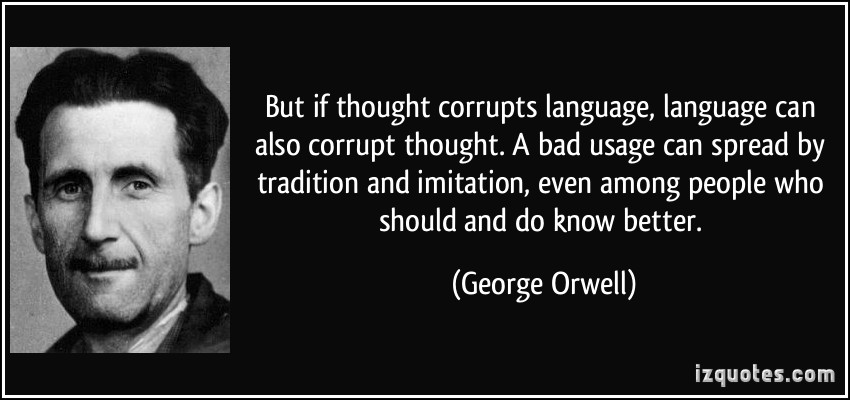
Disinformation, 1984-2023

By Peter Van Buren

Source: We Meant Well

Orwell, again. 1984 was prescient on so many concepts that it seems it was written for the Biden era. Underlying it all is the concept of disinformation, the root of propaganda and mind control. So it is in 2023. Just ask FBI Director Chris Wray. Or Facebook.

George Orwell’s novel explores the concept of disinformation and its role in controlling and manipulating society. Orwell presents a dystopian future where a totalitarian regime, led by the Party and its figurehead Big Brother, exerts complete control over its citizens’ lives, including their thinking. The Party employs a variety of techniques to disseminate disinformation and maintain its power. One of the most prominent examples is the concept of “Newspeak,” a language designed to restrict and manipulate thought by reducing the range of expressible ideas. Newspeak aims to replace words and concepts that could challenge or criticize the Party’s ideology, effectively controlling the way people think and communicate (unhomed, misspoke, LGBQTIAXYZ+, nati0nalist, terrorist.)

Orwell also introduces the concept of doublethink, which refers to the ability to hold two contradictory beliefs simultaneously and accept them both as true. This psychological manipulation technique allows the Party to control the minds of its citizens and make them believe in false information or embrace contradictory ideas without questioning (masks which do not prevent disease transmission are still mandatory.) The Party in 1984 alters historical records and disseminates false information through the Ministry of Truth. This manipulation of historical events and facts aims to control the collective memory of the society in a post-truth era, ensuring that the Party’s version of reality remains unquestioned (war in Ukraine, Iraq, El Salvador, Vietnam, all to protect our freedom at home.)

Through these portrayals, Orwell highlights the dangers of disinformation and its potential to distort truth, manipulate public opinion, and maintain oppressive systems of power. The novel serves as a warning about the importance of critical thinking, independent thought, and the preservation of objective truth in the face of disinformation and propaganda.

Disinformation is bad. But replacing disinformation with censorship and/or replacement with other disinformation is worse. 1984 closed down the marketplace of ideas. So for 2023.

In 2023 America the medium is social media and the Ministry of Truth is the Executive Branch, primarily the FBI. Topics the FBI at one point labeled disinformation and sought to censor in the name of protecting Americans from disinformation include but are not limited to the contents of Hunter Biden’s laptop, the Covid lab leak theory, the efficiency and value to society of masks, lockdowns, and vaccines, speech about election integrity and the 2020 presidential election, the security of voting by mail, even parody accounts mocking the president (about Finnegan Biden, Hunter Biden’s daughter.)

When asked before Congress to define disinformation, FBI Director Christopher Wray could not do it, even though it is the basis for the FBI’s campaign to censor Americans. It’s a made up term with no fixed meaning. That gives it its power, like “terrorism” was used a decade or so earlier. Remember “domestic terrorism”? That stretched to cover everything from white power advocates to J6 marchers to BLM protestors to Moms for Liberty. It just can’t be all those things all the time but it can be all those things at different times, as needed. The term “hate speech” is another flexible tool of enforcement and is why efforts to codify banning hate speech under the First Amendment must be resisted so strongly. Same for QAnon. We’ve heard about QAnon for years now but still can’t figure out if it even exists. To read the MSM, you would think it is the most powerful and sinister thing one can imagine yet seems to be imaginary, another Cthulhu. Do they have an office, an email address, a lair somewhere?

In simple words: the government is using social media companies as proxies to censor the contrary thoughts of Americans, all under the guise of correcting misinformation and in direct contrivance of the First Amendment.

How bad does it get? As part of its 2023 investigation into the federal government’s role in censoring lawful speech on social media platforms, the House Committee on the Judiciary issued a subpoena to Meta, the parent company of Facebook and Instagram, and Alphabet, the parent of Google and YouTube. Documents obtained revealed the FBI, on behalf of a compromised Ukrainian intelligence service, requested and, in some cases, directed, the world’s largest social media platforms to censor Americans engaging in constitutionally protected speech online about the war in Ukraine.

Another tool of thought control is the Foreign Intelligence Surveillance Act (FISA), which was supposed to be used to spy on foreigners but has been improperly used against thousands of Americans. Over 100,000 Americans were spied on in 2022, down from three million in 2021.

Does it sound familiar? An amorphous threat is pounded into the heads of Americans (Communism and Red Scares, Covid, terrorism, disinformation) and in its name nearly anything is justified, including in the most recent battle for freedom, censorship. The wrapper is that it is all for our own protection (Biden himself accused social-media companies of “killing people,” the more modern version of the terrorism-era’s “blood on their hands”) with the government assuming the role of knowing what is right and correct for Americans to know. The target in name is always some Ruskie-type foreigner, but in reality morphs to be censorship of our citizens ourselves (stained as “pro-Putin.”) Yet Meta CEO Mark Zuckerberg admitted the government asked Facebook to suppress true information. He said during the Covid era the scientific establishment within the government asked “for a bunch of things to be censored that, in retrospect, ended up being more debatable or true.”

Under President Joe Biden, the government has undertaken “the most massive attack against free speech in United States history.” That was the extraordinary conclusion reached by a federal judge in Missouri v. Biden. The case exposed the incredible lengths to which the Biden White House and its federal agencies have gone to bully social-media platforms into removing political views they dislike. The White House is appealing and attained a stay, hoping to retain this powerful tool of thought control right out of 1984. A victory for censorship of Americans and their thoughts could be the greatest threat to free speech in American history.

A State of Never-Ending Crisis: The Government Is Fomenting Mass Hysteria

By John & Nisha Whitehead

Source: The Rutherford Institute

This country has been having a nationwide nervous breakdown since 9/11. A nation of people suddenly broke, the market economy goes to shit, and they’re threatened on every side by an unknown, sinister enemy. But I don’t think fear is a very effective way of dealing with things—of responding to reality. Fear is just another word for ignorance.”—Hunter S. Thompson, gonzo journalist

We have become guinea pigs in a ruthlessly calculated, carefully orchestrated, chillingly cold-blooded experiment in how to control a population and advance a political agenda without much opposition from the citizenry.

This is mind-control in its most sinister form.

With alarming regularity, the nation is being subjected to a spate of violence that terrorizes the public, destabilizes the country, and gives the government greater justifications to crack down, lock down, and institute even more authoritarian policies for the so-called sake of national security without many objections from the citizenry.

Take this latest shooting in Nashville, Tenn.

The 28-year-old shooter (a clearly troubled transgender individual in possession of several military-style weapons) opened fire in a Christian elementary school, killing three children and three adults.

Already, fingers are being pointed and battle lines are being drawn.

Those who want safety at all costs are clamoring for more gun control measures (if not at an outright ban on assault weapons for non-military, non-police personnel), widespread mental health screening of the general population, more threat assessments and behavioral sensing warnings, more CCTV cameras with facial recognition capabilities, more “See Something, Say Something” programs aimed at turning Americans into snitches and spies, more metal detectors and whole-body imaging devices at soft targets, more roaming squads of militarized police empowered to do random bag searches, more fusion centers to centralize and disseminate information to law enforcement agencies, and more surveillance of what Americans say and do, where they go, what they buy and how they spend their time.

This is all part of the Deep State’s master plan.

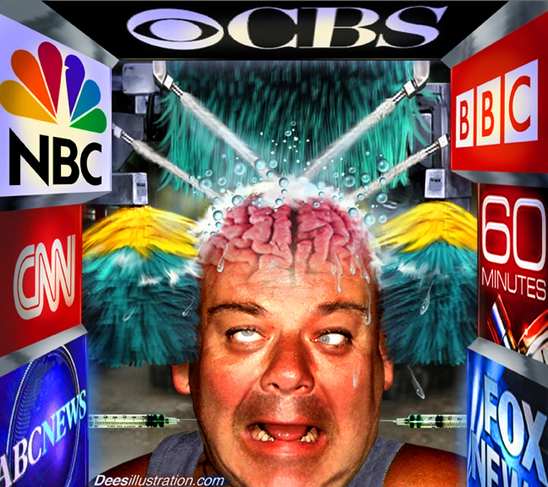
Ask yourselves: why are we being bombarded with crises, distractions, fake news and reality TV politics? We’re being conditioned like lab mice to subsist on a steady diet of bread-and-circus politics and an endless spate of crises.

Caught up in this “crisis of the now,” the average person has a hard time keeping up with and remembering all of the “events,” manufactured or otherwise, which occur like clockwork in order to keep us distracted, deluded, amused, and insulated from reality.

As investigative journalist Mike Adams points out:

“This psychological bombardment is waged primarily via the mainstream media which assaults the viewer by the hour with images of violence, war, emotions and conflict. Because the human nervous system is hard wired to focus on immediate threats accompanied by depictions of violence, mainstream media viewers have their attention and mental resources funneled into the never-ending ‘crisis of the NOW’ from which they can never have the mental breathing room to apply logic, reason or historical context.”

Professor Jacques Ellul studied this phenomenon of overwhelming news, short memories and the use of propaganda to advance hidden agendas. “One thought drives away another; old facts are chased by new ones,” wrote Ellul.

All the while, the government continues to amass more power and authority over the citizenry.

When we’re being bombarded with wall-to-wall news coverage and news cycles that change every few days, it’s difficult to stay focused on one thing—namely, holding the government accountable to abiding by the rule of law—and the powers-that-be understand this.

Yet as John Lennon reminds us, “nothing is real,” especially not in the world of politics.

In other words, it’s all fake, i.e., manufactured, i.e., manipulated to distort reality.

Much like the fabricated universe in Peter Weir’s 1998 film The Truman Show, in which a man’s life is the basis for an elaborately staged television show aimed at selling products and procuring ratings, the political scene in the United States has devolved over the years into a carefully calibrated exercise in how to manipulate, polarize, propagandize and control a population.

This is the magic of the reality TV programming that passes for politics today.

As long as we are distracted, entertained, occasionally outraged, always polarized but largely uninvolved and content to remain in the viewer’s seat, we’ll never manage to present a unified front against tyranny (or government corruption and ineptitude) in any form.

The more that is beamed at us, the more inclined we are to settle back in our comfy recliners and become passive viewers rather than active participants as unsettling, frightening events unfold.

Reality and fiction merge as everything around us becomes entertainment fodder.

We don’t even have to change the channel when the subject matter becomes too monotonous. That’s taken care of for us by the programmers (the corporate media).

“Living is easy with eyes closed,” says Lennon, and that’s exactly what reality TV that masquerades as American politics programs the citizenry to do: navigate the world with their eyes shut.

As long as we’re viewers, we’ll never be doers.

Studies suggest that the more reality TV people watch—and I would posit that it’s all reality TV, entertainment news included—the more difficult it becomes to distinguish between what is real and what is carefully crafted farce.

“We the people” are watching a lot of TV.

On average, Americans spend five hours a day watching television. By the time we reach age 65, we’re watching more than 50 hours of television a week, and that number increases as we get older. And reality TV programming consistently captures the largest percentage of TV watchers every season by an almost 2-1 ratio.

This doesn’t bode well for a citizenry able to sift through masterfully-produced propaganda in order to think critically about the issues of the day, whether it’s fake news peddled by government agencies or foreign entities.

Those who watch reality shows tend to view what they see as the “norm.” Thus, those who watch shows characterized by lying, aggression and meanness not only come to see such behavior as acceptable and entertaining but also mimic the medium.

This holds true whether the reality programming is about the antics of celebrities in the White House, in the board room, or in the bedroom.

It’s a phenomenon called “humilitainment.”

A term coined by media scholars Brad Waite and Sara Booker, “humilitainment” refers to the tendency for viewers to take pleasure in someone else’s humiliation, suffering and pain.

Humilitainment” largely explains not only why American TV watchers are so fixated on reality TV programming but how American citizens, largely insulated from what is really happening in the world around them by layers of technology, entertainment, and other distractions, are being programmed to accept the brutality, surveillance and dehumanizing treatment of the American police state as things happening to other people.

The ramifications for the future of civic engagement, political discourse and self-government are incredibly depressing and demoralizing.

This is what happens when an entire nation—bombarded by reality TV programming, government propaganda and entertainment news—becomes systematically desensitized and acclimated to the trappings of a government that operates by fiat and speaks in a language of force.

Ultimately, the reality shows, the entertainment news, the surveillance society, the militarized police, and the political spectacles have one common objective: to keep us divided, distracted, imprisoned, and incapable of taking an active role in the business of self-government.

Look behind the political spectacles, the reality TV theatrics, the sleight-of-hand distractions and diversions, and the stomach-churning, nail-biting drama, and you will find there is a method to the madness.

How do you change the way people think? You start by changing the words they use.

In totalitarian regimes—a.k.a. police states—where conformity and compliance are enforced at the end of a loaded gun, the government dictates what words can and cannot be used.

In countries where the police state hides behind a benevolent mask and disguises itself as tolerance, the citizens censor themselves, policing their words and thoughts to conform to the dictates of the mass mind.

Even when the motives behind this rigidly calibrated reorientation of societal language appear well-intentioned—discouraging racism, condemning violence, denouncing discrimination and hatred—inevitably, the end result is the same: intolerance, indoctrination, infantilism, the chilling of free speech and the demonizing of viewpoints that run counter to the cultural elite.

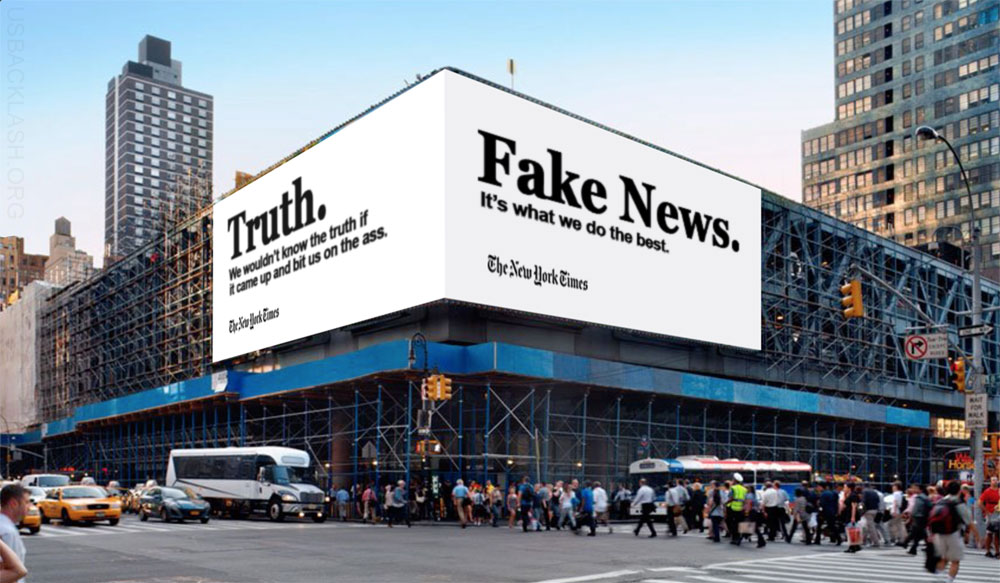
Labelling something as “fake news” is a masterful way of dismissing truth that may run counter to the ruling power’s own narrative.

As George Orwell recognized, “In times of universal deceit, telling the truth is a revolutionary act.”

Orwell understood only too well the power of language to manipulate the masses. In Orwell’s 1984, Big Brother does away with all undesirable and unnecessary words and meanings, even going so far as to routinely rewrite history and punish “thoughtcrimes.”

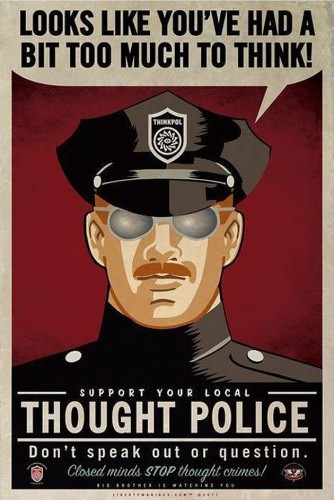
In this dystopian vision of the future, the Thought Police serve as the eyes and ears of Big Brother, while the Ministry of Peace deals with war and defense, the Ministry of Plenty deals with economic affairs (rationing and starvation), the Ministry of Love deals with law and order (torture and brainwashing), and the Ministry of Truth deals with news, entertainment, education and art (propaganda). The mottos of Oceania: WAR IS PEACE, FREEDOM IS SLAVERY, and IGNORANCE IS STRENGTH.

Orwell’s Big Brother relied on Newspeak to eliminate undesirable words, strip such words as remained of unorthodox meanings and make independent, non-government-approved thought altogether unnecessary.

Where we stand now is at the juncture of Oldspeak (where words have meanings, and ideas can be dangerous) and Newspeak (where only that which is “safe” and “accepted” by the majority is permitted).

Truth is often lost when we fail to distinguish between opinion and fact, and that is the danger we now face as a society. Anyone who relies exclusively on television/cable news hosts and political commentators for actual knowledge of the world is making a serious mistake.

Unfortunately, since Americans have by and large become non-readers, television has become their prime source of so-called “news.” This reliance on TV news has given rise to such popular news personalities who draw in vast audiences that virtually hang on their every word.

In our media age, these are the new powers-that-be.

Yet while these personalities often dispense the news like preachers used to dispense religion, with power and certainty, they are little more than conduits for propaganda and advertisements delivered in the guise of entertainment and news.

Given the preponderance of news-as-entertainment programming, it’s no wonder that viewers have largely lost the ability to think critically and analytically and differentiate between truth and propaganda, especially when delivered by way of fake news criers and politicians.

The bottom line is simply this: Americans should beware of letting others—whether they be television news hosts, political commentators or media corporations—do their thinking for them.

A populace that cannot think for themselves is a populace with its backs to the walls: mute in the face of elected officials who refuse to represent us, helpless in the face of police brutality, powerless in the face of militarized tactics and technology that treat us like enemy combatants on a battlefield, and naked in the face of government surveillance that sees and hears all.

As I make clear in my book Battlefield America: The War on the American People and in its fictional counterpart The Erik Blair Diaries, it’s time to change the channel, tune out the reality TV show, and push back against the real menace of the police state.

If not, if we continue to sit back and lose ourselves in political programming, we will remain a captive audience to a farce that grows more absurd by the minute.

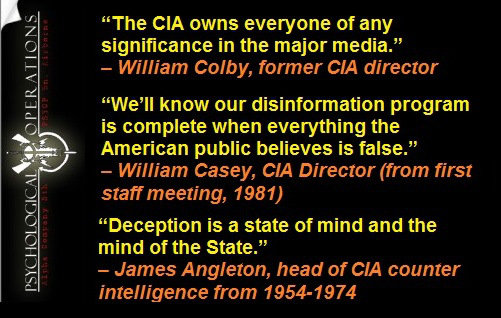
The New York Times is Orwell’s Ministry of Truth

By Edward Curtin

Source: Behind the Curtain

“Ingsoc. The sacred principles of ingsoc. Newspeak, double-speak, the mutability of the past.” – George Orwell, 1984

As today dawned, I was looking out the window into the cold grayness with small patches of snow littering the frozen ground.  As light snow began to fall, I felt a deep mourning in my soul as a memory came to me of another snowy day in 1972 when I awoke to news of Richard Nixon’s savage Christmas bombing of North Vietnam with more than a hundred B-52 bombers, in wave after wave, dropping death and destruction on Hanoi and other parts of North Vietnam.  I thought of the war the United States is now waging against Russia via Ukraine and how, as during the U.S. war against Vietnam, few Americans seem to care until it becomes too late.  It depressed me.

Soon after I was greeted by an editorial from The New York Times’ Editorial Board, “A Brutal New Phase of the War in Ukraine.”  It is a piece of propaganda so obvious that only those desperate to believe blatant lies would not fall down laughing.  Yet it is no laughing matter, for The N.Y. Times is advocating for a wider war, more lethal weapons for Ukraine, and escalation of the fighting that risks nuclear war.  So their title is apt because they are promoting the brutality.  This angered me.

The Times’ Editorial Board tells us that President Putin, like Hitler, is mad.  “Like the last European war, this one is mostly one man’s madness.”  Russia and Putin are “cruel”; are conducting a “regular horror” with missile strikes against civilian targets; are “desperate”; are pursuing Putin’s “delusions”; are waging a “terrible and useless war”; are “committing atrocities”; are responsible for “murder, rape and pillaging,” etc.

On the other hand, “a heroic Ukraine” “has won repeated and decisive victories against Russian forces” who have lost “well over 100,000 Russian soldiers killed and wounded,” according to the “reliable” source, chairman of the U.S. Joint Chief of Staff, Gen. Mark A. Milley.  To add to this rosy report, the Ukrainians seem to have suffered no causalities since none are mentioned by the cozy Times’ Editorial Board members from their keyboards on Eighth Avenue.  When you support a U.S. war, as has always been The Times’ modus operandi as a stenographer for the government, mentioning the dead pawns used to accomplish the imperialists’ dreams is bad manners.  So are the atrocities committed by those forces, so they too have been omitted.  Neo-Nazis, the Azov Battalion?  They too must never have  existed since they are not mentioned.

But then, according to the esteemed editorial writers, this is not a U.S. proxy war waged via Ukraine by U.S./NATO “to strip Russia of its destiny and greatness.”  No, it is simply Russian aggression, supported by “the Kremlin’s propaganda machinery” that has churned “out false narratives about a heroic Russian struggle against forces of fascism and debauchery.”  U.S./NATO were “horrified by the crude violation of the postwar order,” so we are laughingly told, and so came to Ukraine’s defense as “Mr. Putin’s response has been to throw ever more lives, resources and cruelty at Ukraine.”

Nowhere in this diatribe by the Times’ Board of propagandists – and here the whole game is given away for anyone with a bit of an historical sense – is there any mention of the U.S. engineered coup d’état in Ukraine in 2014.  It just didn’t happen.  Never happened.  Magic by omission.  The U.S., together with the Ukrainian government “led” by the puppet-actor “President Volodymyr Zelensky,” are completely innocence parties, according to the Times.  (Note also, that nowhere in this four page diatribe is President Putin addressed by his title, as if to say that “Mr. Putin” is illegitimate and Zelensky is the real thing.)

All the problems stem from when “Mr. Putin seized Crimea and stirred up a secessionist conflict in eastern Ukraine n 2014.”

Nowhere is it mentioned that for years on end U.S./NATO has been moving troops and weapons right up to Russia’s borders, that George W. Bush pulled the U.S. out of the Anti-Ballistic Missile Treaty and that Trump did the same with the Intermediate-Range Nuclear Forces Treaty, that the U.S. has set up so-called anti-ballistic missile sites in Poland and Rumania and asserted its right to a nuclear first-strike, that more and more countries have been added to NATO’s eastern expansion despite promises to Russia to the contrary, that 15,000 plus mostly Russian-speaking people in eastern Ukraine have been killed by Ukrainian forces for years before February 2022, that the Minsk agreements were part of a scheme to give time for the arming of Ukraine, that the U.S. has rejected all calls from Russia to respect its borders and its integrity, that the U.S./NATO has surrounded Russia with military bases, that there was a vote in Crimea after the coup, that the U.S. has been for years waging economic war on Russia via sanctions, etc.  In short, all of the reasons that Russia felt that it was under attack for decades and that the U.S. was stone deaf to its appeals to negotiate these threats to its existence.  It doesn’t take a genius to realize that if all were reversed and Russia had put troops and weapons in Mexico and Canada that the United States would respond forcefully.

This editorial is propaganda by omission and strident stupidity by commission.

The editorial has all its facts “wrong,” and not by accident.  The paper may say that its opinion journalists’ claims are separate from those of its newsroom, yet their claims echo the daily barrage of falsehoods from its front pages, such as:

  • Ukraine is winning on the battlefield.
  • “Russia faces decades of economic stagnation and regression even if the war ends soon.”
  • That on Jan.14, as part of its cruel attacks on civilian targets, a Russian missile struck an apartment building in Dnipro, killing many.
  • Only one man can stop this war – Vladimir Putin – because he started it.
  • Until now, the U.S. and its allies were reluctant to deploy heavy weapons to Ukraine “for fear of escalating this conflict into an all-in East-West war.”
  • Russia is desperate as Putin pursues “his delusions.”
  • Putin is “isolated from anyone who would dare to speak truth to his power.”
  • Putin began trying to change Ukraine’s borders by force in 2014.
  • During the last 11 months Ukraine has won repeated and decisive victories against Russian forces …. The war is at a stalemate.”
  • The Russian people are being subjected to the Kremlin’s propaganda machinery “churning out false narratives.”

This is expert opinion for dummies.  A vast tapestry of lies, as Harold Pinter said in his Nobel Prize address.  The war escalation the editorial writers are promoting is in their words, “this time pitting Western arms against a desperate Russia,” as if the U.S./NATO does not have CIA and special forces in Ukraine, just weapons, and as if “this time” means it wasn’t so for the past nine years at least as the U.S. was building Ukraine’s military and arms for this very fight.

It is a fight they will lose in the days to come.  Russia was, is, and will triumph.

Everything in the editorial is disingenuous.  Simple propaganda: the good guys against the bad guys.  Putin another Hitler.  The good guys are winning, just as they did in Vietnam, until reality dawned and it had to be admitted they weren’t (and didn’t).  History is repeating itself.

Little has changed and so my morning sense of mourning when I remembered Nixon and Kissinger’s savagery at Christmas 1972 was appropriate.  As then, so today, we are being subjected to a vast tapestry of lies told by the corporate media for their bosses, as the U.S. continues its doomed efforts to control the world.  It is not Russia that is desperate now, but propagandists such as the writers of this strident and stupid editorial.  It is not the Russian people who need to wake up, as they claim, but the American people and those who still cling to the myth that The New York Times Corporation is an organ of truth.  It is the Ministry of Truth with its newspeak, double-speak, and its efforts to change the past.

Let Harold Pinter have the last words:

The crimes of the United States have been systematic, constant, vicious, remorseless, but very few people have actually talked about them. You have to hand it to America. It has exercised a quite clinical manipulation of power worldwide while masquerading as a force for universal good. It’s a brilliant, even witty, highly successful act of hypnosis.

Why Orwell matters

His defence of freedom flies in the face of all that is woke and regressive today.

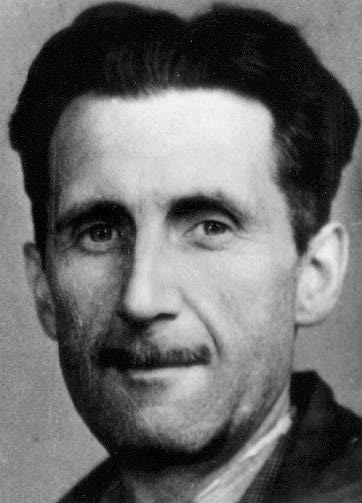
George Orwell aka Eric Blair (25 June 1903 – 21 January 1950)

By Bruno Waterfield

Source: Spike Online

Most people think that George Orwell was writing about, and against, totalitarianism – especially when they encounter him through the prism of his great dystopian novel, Nineteen Eighty-Four.

This view of Orwell is not wrong, but it can miss something. For Orwell was concerned above all about the particular threat posed by totalitarianism to words and language. He was concerned about the threat it posed to our ability to think and speak freely and truthfully. About the threat it posed to our freedom.

He saw, clearly and vividly, that to lose control of words is to lose control of meaning. That is what frightened him about the totalitarianism of Nazi Germany and Stalinist Russia – these regimes wanted to control the very linguistic substance of thought itself.

And that is why Orwell continues to speak to us so powerfully today. Because words, language and meaning are under threat once more.

Totalitarianism in Orwell’s time

The totalitarian regimes of Nazi Germany and Stalin’s Soviet Union represented something new and frightening for Orwell. Authoritarian dictatorships, in which power was wielded unaccountably and arbitrarily, had existed before, of course. But what made the totalitarian regimes of the 20th century different was the extent to which they demanded every individual’s complete subservience to the state. They sought to abolish the very basis of individual freedom and autonomy. They wanted to use dictatorial powers to socially engineer the human soul itself, changing and shaping how people think and behave.

Totalitarian regimes set about breaking up clubs, trade unions and other voluntary associations. They were effectively dismantling those areas of social and political life in which people were able to freely and spontaneously associate. The spaces, that is, in which local and national culture develops free of the state and officialdom. These cultural spaces were always tremendously important to Orwell. As he put it in his 1941 essay, ‘England Your England’: ‘All the culture that is most truly native centres round things which even when they are communal are not official – the pub, the football match, the back garden, the fireside and the “nice cup of tea”.’

Totalitarianism may have reached its horrifying zenith in Nazi Germany and Stalin’s USSR. But Orwell was worried about its effect in the West, too. He was concerned about the Sovietisation of Europe through the increasingly prominent and powerful Stalinist Communist Parties. He was also worried about what he saw as Britain’s leftwing ‘Europeanised intelligentsia’, which, like the Communist Parties of Western Europe, seemed to worship state power, particularly in the supranational form of the USSR. And he was concerned above all about the emergence of the totalitarian mindset, and the attempt to re-engineer the deep structures of mind and feeling that lie at the heart of autonomy and liberty.

Orwell could see this mindset flourishing among Britain’s intellectual elite, from the eugenics and top-down socialism of Fabians, like Sidney and Beatrice Webb and HG Wells, to the broader technocratic impulses of the intelligentsia in general. They wanted to remake people ‘for their own good’, or for the benefit of the race or state power. They therefore saw it as desirable to force people to conform to certain prescribed behaviours and attitudes. This threatened the everyday freedom of people who wanted, as Orwell put it, ‘the liberty to have a home of your own, to do what you like in your spare time, to choose your own amusements instead of having them chosen for you from above’.

In the aftermath of the Second World War, this new intellectual elite started to gain ascendancy. It was effectively a clerisy – a cultural and ruling elite defined by its academic achievements. It had been forged through higher education and academia rather than through traditional forms of privilege and wealth, such as public schools.

Orwell was naturally predisposed against this emergent clerisy. He may have attended Eton, but that’s where Orwell’s education stopped. He was not part of the clerisy’s world. He was not an academic writer, nor did he position himself as such. On the contrary, he saw himself as a popular writer, addressing a broad, non-university-educated audience.

Moreover, Orwell’s antipathy towards this new elite type was long-standing. He had bristled against the rigidity and pomposity of imperial officialdom as a minor colonial police official in Burma between 1922 and 1927. And he had always battled against the top-down socialist great and good, and much of academia, too, who were often very much hand in glove with the Stalinised left.

The hostility was mutual. Indeed, it accounts for the disdain that many academics and their fellow travellers continue to display towards Orwell today.

The importance of words

Nowadays we are all too familiar with this university-educated ruling caste, and its desire to control words and meaning. Just think, for example, of the way in which our cultural and educational elites have turned ‘fascism’ from a historically specific phenomenon into a pejorative that has lost all meaning, to be used to describe anything from Brexit to Boris Johnson’s Tory government – a process Orwell saw beginning with the Stalinist practice of calling Spanish democratic revolutionaries ‘Trotsky-fascists’ (which he documented in Homage to Catalonia (1938)).

Or think of the way in which our cultural and educational elites have transformed the very meanings of the words ‘man’ and ‘woman’, divesting them of any connection to biological reality. Orwell would not have been surprised by this development. In Nineteen Eighty-Four, he shows how the totalitarian state and its intellectuals will try to suppress real facts, and even natural laws, if they diverge from their worldview. Through exerting power over ideas, they seek to shape reality. ‘Power is in tearing human minds to pieces and putting them together in new shapes of your own choosing’, says O’Brien, the sinister party intellectual. ‘We control matter because we control the mind. Reality is inside the skull… You must get rid of these 19th-century ideas about the laws of nature.’

In Nineteen Eighty-Four, the totalitarian regime tries to subject history to similar manipulation. As anti-hero Winston Smith tells his lover, Julia:

‘Every record has been destroyed or falsified, every book has been rewritten, every picture has been repainted, every statue and street and building has been renamed, every date has been altered. And that process is continuing day by day and minute by minute. History has stopped. Nothing exists except an endless present in which the Party is always right.’

As Orwell wrote elsewhere, ‘the historian believes that the past cannot be altered and that a correct knowledge of history is valuable as a matter of course. From the totalitarian point of view history is something to be created rather than learned.’

This totalitarian approach to history is dominant today, from the New York Times’ 1619 Project to statue-toppling. History is something to be erased or conjured up or reshaped as a moral lesson for today. It is used to demonstrate the rectitude of the contemporary establishment.

But it is language that is central to Orwell’s analysis of this form of intellectual manipulation and thought-control. Take ‘Ingsoc’, the philosophy that the regime follows and enforces through the linguistic system of Newspeak. Newspeak is more than mere censorship. It is an attempt to make certain ideas – freedom, autonomy and so on – actually unthinkable or impossible. It is an attempt to eliminate the very possibility of dissent (or ‘thoughtcrime’).

As Syme, who is working on a Newspeak dictionary, tells Winston Smith:

‘The whole aim… is to narrow the range of thought. In the end we shall make thoughtcrime literally impossible, because there will be no words in which to express it. Every year fewer and fewer words, and the range of consciousness always a little smaller… Has it ever occurred to you, Winston, that by the year 2050, at the very latest, not a single human being will be alive who could understand such a conversation as we are having now?’

The parallels between Orwell’s nightmarish vision of totalitarianism and the totalitarian mindset of today, in which language is policed and controlled, should not be overstated. In the dystopia of Nineteen Eighty-Four, the project of eliminating freedom and dissent, as in Nazi Germany or Stalinist Russia, was backed up by a brutal, murderous secret police. There is little of that in our societies today – people are not forcibly silenced or disappeared.

However, they are cancelled, pushed out of their jobs, and sometimes even arrested by the police for what amounts to thoughtcrime. And many more people simply self-censor out of fear of saying the ‘wrong’ thing. Orwell’s concern that words could be erased or their meaning altered, and thought controlled, is not being realised in an openly dictatorial manner. No, it’s being achieved through a creeping cultural and intellectual conformism.

The intellectual turn against freedom

But then that was always Orwell’s worry – that intellectuals giving up on freedom would allow a Big Brother Britain to flourish. As he saw it in The Prevention of Literature (1946), the biggest danger to freedom of speech and thought came not from the threat of dictatorship (which was receding by then) but from intellectuals giving up on freedom, or worse, seeing it as an obstacle to the realisation of their worldview.

Interestingly, his concerns about an intellectual betrayal of freedom were reinforced by a 1944 meeting of the anti-censorship organisation, English PEN. Attending an event to mark the 300th anniversary of Milton’s Areopagitica, Milton’s famous 1644 speech making the case for the ‘Liberty of Unlicenc’d Printing’, Orwell noted that many of the left-wing intellectuals present were unwilling to criticise Soviet Russia or wartime censorship. Indeed, they had become profoundly indifferent or hostile to the question of political liberty and press freedom.

‘In England, the immediate enemies of truthfulness, and hence of freedom of thought, are the press lords, the film magnates, and the bureaucrats’, Orwell wrote, ‘but that on a long view the weakening of the desire for liberty among the intellectuals themselves is the most serious symptom of all’.

Orwell was concerned by the increasing popularity among influential left-wing intellectuals of ‘the much more tenable and dangerous proposition that freedom is undesirable and that intellectual honesty is a form of anti-social selfishness’. The exercise of freedom of speech and thought, the willingness to speak truth to power, was even then becoming seen as something to be frowned upon, a selfish, even elitist act.

An individual speaking freely and honestly, wrote Orwell, is ‘accused of either wanting to shut himself up in an ivory tower, or of making an exhibitionist display of his own personality, or of resisting the inevitable current of history in an attempt to cling to unjustified privilege’.

These are insights which have stood the test of time. Just think of the imprecations against those who challenge the consensus. They are dismissed as ‘contrarians’ and accused of selfishly upsetting people.

And worst of all, think of the way free speech is damned as the right of the privileged. This is possibly one of the greatest lies of our age. Free speech does not support privilege. We all have the capacity to speak, write, think and argue. We might not, as individuals or small groups, have the platforms of a press baron or the BBC. But it is only through our freedom to speak freely that we can challenge those with greater power.

Orwell’s legacy

Orwell is everywhere today. He is taught in schools and his ideas and phrases are part of our common culture. But his value and importance to us lies in his defence of freedom, especially the freedom to speak and write.

His outstanding 1946 essay, ‘Politics and the English Language’, can actually be read as a freedom manual. It is a guide on how to use words and language to fight back.

Of course, it is attacked today as an expression of privilege and of bigotry. Author and commentator Will Self cited ‘Politics and the English Language’ in a 2014 BBC Radio 4 show as proof that Orwell was an ‘authoritarian elitist’. He said: ‘Reading Orwell at his most lucid you can have the distinct impression he’s saying these things, in precisely this way, because he knows that you – and you alone – are exactly the sort of person who’s sufficiently intelligent to comprehend the very essence of what he’s trying to communicate. It’s this the mediocrity-loving English masses respond to – the talented dog-whistler calling them to chow down on a big bowl of conformity.’

Lionel Trilling, another writer and thinker, made a similar point to Self, but in a far more insightful, enlightening way. ‘[Orwell] liberates us’, he wrote in 1952:

‘He tells us that we can understand our political and social life merely by looking around us, he frees us from the need for the inside dope. He implies that our job is not to be intellectual, certainly not to be intellectual in this fashion or that, but merely to be intelligent according to our lights – he restores the old sense of the democracy of the mind, releasing us from the belief that the mind can work only in a technical, professional way and that it must work competitively. He has the effect of making us believe that we may become full members of the society of thinking men. That is why he is a figure for us.’

Orwell should be a figure for us, too – in our battle to restore the democracy of the mind and resist the totalitarian mindset of today. But this will require having the courage of our convictions and our words, as he so often did himself. As he put it in The Prevention of Literature, ‘To write in plain vigorous language one has to think fearlessly’. That Orwell did precisely that was a testament to his belief in the public just as much as his belief in himself. He sets an example and a challenge to us all.

Humilitainment: How to Control the Citizenry Through Reality TV Distractions

By John W. Whitehead & Nisha Whitehead

Source: The Rutherford Institute

Big Brother does not watch us, by his choice. We watch him, by ours…. When a population becomes distracted by trivia, when cultural life is redefined as a perpetual round of entertainments, when serious public conversation becomes a form of baby-talk, when, in short, a people become an audience, and their public business a vaudeville act, then a nation finds itself at risk; culture-death is a clear possibility.”—Professor Neil Postman

Once again, the programming has changed.

Like clockwork, the wall-to-wall news coverage of the latest crisis has shifted gears.

We have gone from COVID-19 lockdowns to Trump-Biden election drama to the Russia-Ukraine crisis to the Ketanji Brown Jackson confirmation hearings to Will Smith’s on-camera assault of comedian Chris Rock at the Academy Awards Ceremony.

The distractions, distortions, and political theater just keep coming.

The ongoing reality show that is life in the American police state feeds the citizenry’s voracious appetite for titillating, soap opera drama.

Much like the fabricated universe in Peter Weir’s 1998 film The Truman Show, in which a man’s life is the basis for an elaborately staged television show aimed at selling products and procuring ratings, the political scene in the United States has devolved over the years into a carefully calibrated exercise in how to manipulate, polarize, propagandize and control a population.

This is the magic of the reality TV programming that passes for politics today: as long as we are distracted, entertained, occasionally outraged, always polarized but largely uninvolved and content to remain in the viewer’s seat, we’ll never manage to present a unified front against tyranny (or government corruption and ineptitude) in any form.

The more that is beamed at us, the more inclined we are to settle back in our comfy recliners and become passive viewers rather than active participants as unsettling, frightening events unfold.

We don’t even have to change the channel when the subject matter becomes too monotonous. That’s taken care of for us by the programmers (the corporate media).

“Living is easy with eyes closed,” observed John Lennon, and that’s exactly what reality TV that masquerades as American politics programs the citizenry to do: navigate the world with their eyes shut.

As long as we’re viewers, we’ll never be doers.

Studies suggest that the more reality TV people watch—and I would posit that it’s all reality TV, entertainment news included—the more difficult it becomes to distinguish between what is real and what is carefully crafted farce.

“We the people” are watching a lot of TV.

On average, Americans spend five hours a day watching television. By the time we reach age 65, we’re watching more than 50 hours of television a week, and that number increases as we get older. And reality TV programming consistently captures the largest percentage of TV watchers every season by an almost 2-1 ratio.

This doesn’t bode well for a citizenry able to sift through masterfully-produced propaganda in order to think critically about the issues of the day, whether it’s fake news peddled by government agencies or foreign entities.

Those who watch reality shows tend to view what they see as the “norm.” Thus, those who watch shows characterized by lying, aggression and meanness not only come to see such behavior as acceptable and entertaining but also mimic the medium.

This holds true whether the reality programming is about the antics of celebrities in the White House, in the board room, or in the bedroom.

It’s a phenomenon called “humilitainment.”

A term coined by media scholars Brad Waite and Sara Booker, “humilitainment” refers to the tendency for viewers to take pleasure in someone else’s humiliation, suffering and pain.

Humilitainment” largely explains not only why American TV watchers are so fixated on reality TV programming but how American citizens, largely insulated from what is really happening in the world around them by layers of technology, entertainment, and other distractions, are being programmed to accept the government’s brutality, surveillance and dehumanizing treatment as things happening to other people.

The ramifications for the future of civic engagement, political discourse and self-government are incredibly depressing and demoralizing.

This explains how we keep getting saddled with leaders in government who are clueless about the Constitution and out-of-touch with the needs of the people they were appointed to represent.

This is also what happens when an entire nation—bombarded by reality TV programming, government propaganda and entertainment news—becomes systematically desensitized and acclimated to the trappings of a government that operates by fiat and speaks in a language of force.

Ultimately, the reality shows, the entertainment news, the surveillance society, the militarized police, and the political spectacles have one common objective: to keep us divided, distracted, imprisoned, and incapable of taking an active role in the business of self-government.

Look behind the political spectacles, the reality TV theatrics, the sleight-of-hand distractions and diversions, and the stomach-churning, nail-biting drama, and you will find there is a method to the madness.

We have become guinea pigs in a ruthlessly calculated, carefully orchestrated, chillingly cold-blooded experiment in how to control a population and advance a political agenda without much opposition from the citizenry.

This is mind-control in its most sinister form.

How do you change the way people think? You start by changing the words they use.

In totalitarian regimes where conformity and compliance are enforced at the end of a loaded gun, the government dictates what words can and cannot be used.

In countries where tyranny hides behind a benevolent mask and disguises itself as tolerance, the citizens censor themselves, policing their words and thoughts to conform to the dictates of the mass mind.

Even when the motives behind this rigidly calibrated reorientation of societal language appear well-intentioned—discouraging racism, condemning violence, denouncing discrimination and hatred—inevitably, the end result is the same: intolerance, indoctrination, infantilism, the chilling of free speech and the demonizing of viewpoints that run counter to the cultural elite.

As George Orwell recognized, “In times of universal deceit, telling the truth is a revolutionary act.”

Orwell understood only too well the power of language to manipulate the masses.

In Orwell’s 1984, Big Brother does away with all undesirable and unnecessary words and meanings, even going so far as to routinely rewrite history and punish “thoughtcrimes.” In this dystopian vision of the future, the Thought Police serve as the eyes and ears of Big Brother, while the Ministry of Peace deals with war and defense, the Ministry of Plenty deals with economic affairs (rationing and starvation), the Ministry of Love deals with law and order (torture and brainwashing), and the Ministry of Truth deals with news, entertainment, education and art (propaganda). The mottos of Oceania: WAR IS PEACE, FREEDOM IS SLAVERY, and IGNORANCE IS STRENGTH.

Orwell’s Big Brother relied on Newspeak to eliminate undesirable words, strip such words as remained of unorthodox meanings and make independent, non-government-approved thought altogether unnecessary.

Where we stand now is at the juncture of Oldspeak (where words have meanings, and ideas can be dangerous) and Newspeak (where only that which is “safe” and “accepted” by the majority is permitted).

Truth is often lost when we fail to distinguish between opinion and fact, and that is the danger we now face as a society. Anyone who relies exclusively on television/cable news hosts and political commentators for actual knowledge of the world is making a serious mistake.

Unfortunately, since Americans have by and large become non-readers, television has become their prime source of so-called “news.” This reliance on TV news has given rise to such popular news personalities who draw in vast audiences that virtually hang on their every word.

In our media age, these are the new powers-that-be.

Yet while these personalities often dispense the news like preachers used to dispense religion, with power and certainty, they are little more than conduits for propaganda and advertisements delivered in the guise of entertainment and news.

Given the preponderance of news-as-entertainment programming, it’s no wonder that viewers have largely lost the ability to think critically and analytically and differentiate between truth and propaganda, especially when delivered by way of fake news criers and politicians.

While television news cannot—and should not—be completely avoided, the following suggestions will help you better understand the nature of TV news.

1. TV news is not what happened. Rather, it is what someone thinks is worth reporting. Although there are still some good TV journalists, the old art of investigative reporting has largely been lost. While viewers are often inclined to take what is reported by television “news” hosts at face value, it is your responsibility to judge and analyze what is reported.

2. TV news is entertainment. There is a reason why the programs you watch are called news “shows.” It’s a signal that the so-called news is being delivered as a form of entertainment. “In the case of most news shows,” write Neil Postman and Steve Powers in their insightful book, How to Watch TV News (1992), “the package includes attractive anchors, an exciting musical theme, comic relief, stories placed to hold the audience, the creation of the illusion of intimacy, and so on.”

Of course, the point of all this glitz and glamour is to keep you glued to the set so that a product can be sold to you. (Even the TV news hosts get in on the action by peddling their own products, everything from their latest books to mugs and bathrobes.) Although the news items spoon-fed to you may have some value, they are primarily a commodity to gather an audience, which will in turn be sold to advertisers.

3. Never underestimate the power of commercials, especially to news audiences. In an average household, the television set is on over seven hours a day. Most people, believing themselves to be in control of their media consumption, are not really bothered by this. But TV is a two-way attack: it not only delivers programming to your home, it also delivers you (the consumer) to a sponsor.

People who watch the news tend to be more attentive, educated and have more money to spend. They are, thus, a prime market for advertisers. And sponsors spend millions on well-produced commercials. Such commercials are often longer in length than most news stories and cost more to produce than the news stories themselves. Moreover, the content of many commercials, which often contradicts the messages of the news stories, cannot be ignored. Most commercials are aimed at prurient interests in advocating sex, overindulgence, drugs, etc., which has a demoralizing effect on viewers, especially children.

4. It is vitally important to learn about the economic and political interests of those who own the “corporate” media. There are few independent news sources anymore. The major news outlets are owned by corporate empires.

5. Pay special attention to the language of newscasts. Because film footage and other visual imagery are so engaging on TV news shows, viewers are apt to allow language—what the reporter is saying about the images—to go unexamined. A TV news host’s language frames the pictures, and, therefore, the meaning we derive from the picture is often determined by the host’s commentary. TV by its very nature manipulates viewers. One must never forget that every television minute has been edited. The viewer does not see the actual event but the edited form of the event. For example, presenting a one- to two-minute segment from a two-hour political speech and having a TV talk show host critique may be disingenuous, but such edited footage is a regular staple on news shows. Add to that the fact that the reporters editing the film have a subjective view—sometimes determined by their corporate bosses—that enters in.

6. Reduce by at least one-half the amount of TV news you watch. TV news generally consists of “bad” news—wars, torture, murders, scandals and so forth. It cannot possibly do you any harm to excuse yourself each week from much of the mayhem projected at you on the news. Do not form your concept of reality based on television. TV news, it must be remembered, does not reflect normal everyday life. Studies indicate that a heavy viewing of TV news makes people think the world is much more dangerous than it actually is.

7. One of the reasons many people are addicted to watching TV news is that they feel they must have an opinion on almost everything, which gives the illusion of participation in American life. But an “opinion” is all that we can gain from TV news because it only presents the most rudimentary and fragmented information on anything. Thus, on most issues we don’t really know much about what is actually going on. And, of course, we are expected to take what the TV news host says on an issue as gospel truth. But isn’t it better to think for yourself? Add to this that we need to realize that we often don’t have enough information from the “news” source to form a true opinion. How can that be done? Study a broad variety of sources, carefully analyze issues in order to be better informed, and question everything.

The bottom line is simply this: Americans should beware of letting others—whether they be television news hosts, political commentators or media corporations—do their thinking for them.

As I make clear in my book Battlefield America: The War on the American People and in its fictional counterpart The Erik Blair Diaries, a populace that cannot think for themselves is a populace with its backs to the walls: mute in the face of elected officials who refuse to represent us, helpless in the face of police brutality, powerless in the face of militarized tactics and technology that treat us like enemy combatants on a battlefield, and naked in the face of government surveillance that sees and hears all.

It’s time to change the channel, tune out the reality TV show, and push back against the real menace of the police state.

If not, if we continue to sit back and lose ourselves in political programming, we will remain a captive audience to a farce that grows more absurd by the minute.
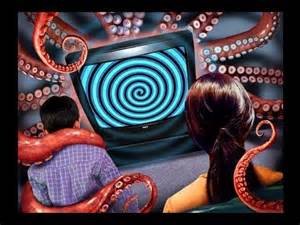
The Mind Control Police: The Government’s War on Thought Crimes and Truth-Tellers

By John W. Whitehead & Nisha Whitehead

Source: The Rutherford Institute

“In a time of deceit telling the truth is a revolutionary act.”— George Orwell  

The U.S. government, which speaks in a language of force, is afraid of its citizenry.

What we are dealing with is a government so power-hungry, paranoid and afraid of losing its stranglehold on power that it is conspiring to wage war on anyone who dares to challenge its authority.

All of us are in danger.

In recent years, the government has used the phrase “domestic terrorist” interchangeably with “anti-government,” “extremist” and “terrorist” to describe anyone who might fall somewhere on a very broad spectrum of viewpoints that could be considered “dangerous.” The ramifications are so far-reaching as to render almost every American an extremist in word, deed, thought or by association.

In the government’s latest assault on those who criticize the government—whether that criticism manifests itself in word, deed or thought—the Biden Administration has likened those who share “false or misleading narratives and conspiracy theories, and other forms of mis- dis- and mal-information” to terrorists.

The next part is the kicker.

According to the Department of Homeland Security’s latest terrorism bulletin, “These threat actors seek to exacerbate societal friction to sow discord and undermine public trust in government institutions to encourage unrest, which could potentially inspire acts of violence.”

You see, the government doesn’t care if what you’re sharing is fact or fiction or something in between. What it cares about is whether what you’re sharing has the potential to make people think for themselves and, in the process, question the government’s propaganda.

Get ready for the next phase of the government’s war on thought crimes and truth-tellers.

For years now, the government has used all of the weapons in its vast arsenal—surveillance, threat assessments, fusion centers, pre-crime programs, hate crime laws, militarized police, lockdowns, martial law, etc.—to target potential enemies of the state based on their ideologies, behaviors, affiliations and other characteristics that might be deemed suspicious or dangerous.

For instance, if you believe in and exercise your rights under the Constitution (namely, your right to speak freely, worship freely, associate with like-minded individuals who share your political views, criticize the government, own a weapon, demand a warrant before being questioned or searched, or any other activity viewed as potentially anti-government, racist, bigoted, anarchic or sovereign), you could be at the top of the government’s terrorism watch list.

Moreover, as a New York Times editorial warns, you may be an anti-government extremist (a.k.a. domestic terrorist) in the eyes of the police if you are afraid that the government is plotting to confiscate your firearms, if you believe the economy is about to collapse and the government will soon declare martial law, or if you display an unusual number of political and/or ideological bumper stickers on your car.

According to one FBI latest report, you might also be classified as a domestic terrorism threat if you espouse conspiracy theories, especially if you “attempt to explain events or circumstances as the result of a group of actors working in secret to benefit themselves at the expense of others” and are “usually at odds with official or prevailing explanations of events.”

In other words, if you dare to subscribe to any views that are contrary to the government’s, you may well be suspected of being a domestic terrorist and treated accordingly.

This latest government salvo against consumers and spreaders of “mis- dis- and mal-information” widens the net to potentially include anyone who is exposed to ideas that run counter to the official government narrative.

You don’t have to be a Joe Rogan questioning COVID-19 to get called out, cancelled and classified as an extremist.

There’s a whole spectrum of behaviors ranging from thought crimes and hate speech to whistleblowing that qualifies for persecution (and prosecution) by the Deep State.

Simply liking or sharing this article on Facebook, retweeting it on Twitter, or merely reading it or any other articles related to government wrongdoing, surveillance, police misconduct or civil liberties might be enough to get you categorized as a particular kind of person with particular kinds of interests that reflect a particular kind of mindset that might just lead you to engage in a particular kinds of activities and, therefore, puts you in the crosshairs of a government investigation as a potential troublemaker a.k.a. domestic extremist.

Chances are, as the Washington Post reports, you have already been assigned a color-coded threat score—green, yellow or red—so police are forewarned about your potential inclination to be a troublemaker depending on whether you’ve had a career in the military, posted a comment perceived as threatening on Facebook, suffer from a particular medical condition, or know someone who knows someone who might have committed a crime.

In other words, you might already be flagged as potentially anti-government in a government database somewhere—Main Core, for example—that identifies and tracks individuals who aren’t inclined to march in lockstep to the police state’s dictates.

As The Intercept reported, the FBI, CIA, NSA and other government agencies have increasingly invested in corporate surveillance technologies that can mine constitutionally protected speech on social media platforms such as Facebook, Twitter and Instagram in order to identify potential extremists and predict who might engage in future acts of anti-government behavior.

Where many Americans go wrong is in naively assuming that you have to be doing something illegal or harmful in order to be flagged and targeted for some form of intervention or detention.

In fact, all you need to do these days to end up on a government watch list or be subjected to heightened scrutiny is use certain trigger words (like cloud, pork and pirates), surf the internet, communicate using a cell phone, limp or stutterdrive a car, stay at a hotel, attend a political rally, express yourself on social mediaappear mentally ill, serve in the militarydisagree with a law enforcement officialcall in sick to work, purchase materials at a hardware store, take flying or boating lessons, appear suspicious, appear confused or nervous, fidget or whistle or smell bad, be seen in public waving a toy gun or anything remotely resembling a gun (such as a water nozzle or a remote control or a walking cane), stare at a police officer, question government authority, or appear to be pro-gun or pro-freedom.

And then at the other end of the spectrum there are those such as Julian Assange, for example, who blow the whistle on government misconduct that is within the public’s right to know.

Assange, the founder of WikiLeaks—a website that published secret information, news leaks, and classified media from anonymous sources—was arrested on April 11, 2019, on charges of helping U.S. Army intelligence analyst Chelsea Manning access and leak more than 700,000 classified military documents that portray the U.S. government and its military as reckless, irresponsible and responsible for thousands of civilian deaths.

Included among the leaked Manning material were the Collateral Murder video (April 2010), the Afghanistan war logs (July 2010), the Iraq war logs (October 2010), a quarter of a million diplomatic cables (November 2010), and the Guantánamo files (April 2011).

The Collateral Murder leak included gunsight video footage from two U.S. AH-64 Apache helicopters engaged in a series of air-to-ground attacks while air crew laughed at some of the casualties. Among the casualties were two Reuters correspondents who were gunned down after their cameras were mistaken for weapons and a driver who stopped to help one of the journalists. The driver’s two children, who happened to be in the van at the time it was fired upon by U.S. forces, suffered serious injuries.

In true Orwellian fashion, the government would have us believe that it is Assange and Manning who are the real criminals for daring to expose the war machine’s seedy underbelly.

Since his April 2019 arrest, Assange has been locked up in a maximum-security British prison—in solitary confinement for up to 23 hours a day—pending extradition to the U.S., where if convicted, he could be sentenced to 175 years in prison.

This is how the police state deals with those who challenge its chokehold on power.

This is why the government fears a citizenry that thinks for itself. Because a citizenry that thinks for itself is a citizenry that is informed, engaged and prepared to hold the government accountable to abiding by the rule of law, which translates to government transparency and accountability.

After all, we’re citizens, not subjects. For those who don’t fully understand the distinction between the two and why transparency is so vital to a healthy constitutional government, Manning explains it well:

When freedom of information and transparency are stifled, then bad decisions are often made and heartbreaking tragedies occur – too often on a breathtaking scale that can leave societies wondering: how did this happen? … I believe that when the public lacks even the most fundamental access to what its governments and militaries are doing in their names, then they cease to be involved in the act of citizenship. There is a bright distinction between citizens, who have rights and privileges protected by the state, and subjects, who are under the complete control and authority of the state.

This is why the First Amendment is so critical. It gives the citizenry the right to speak freely, protest peacefully, expose government wrongdoing, and criticize the government without fear of arrest, isolation or any of the other punishments that have been meted out to whistleblowers such as Edwards Snowden, Assange and Manning.

The challenge is holding the government accountable to obeying the law.

A little over 50 years ago, the U.S. Supreme Court ruled 6-3 in United States v. Washington Post Co. to block the Nixon Administration’s attempts to use claims of national security to prevent The Washington Post and The New York Times from publishing secret Pentagon papers on how America went to war in Vietnam.

As Justice William O. Douglas remarked on the ruling, “The press was protected so that it could bare the secrets of government and inform the people. Only a free and unrestrained press can effectively expose deception in government. And paramount among the responsibilities of a free press is the duty to prevent any part of the government from deceiving the people and sending them off to distant lands to die of foreign fevers and foreign shot and shell.”

Fast forward to the present day, and we’re witnessing yet another showdown, this time between Assange and the Deep State, which pits the people’s right to know about government misconduct against the might of the military industrial complex.

Yet this isn’t merely about whether whistleblowers and journalists are part of a protected class under the Constitution. It’s a debate over how long “we the people” will remain a protected class under the Constitution.

Following the current trajectory, it won’t be long before anyone who believes in holding the government accountable is labeled an “extremist,” relegated to an underclass that doesn’t fit in, watched all the time, and rounded up when the government deems it necessary.

We’re almost at that point now.

Eventually, we will all be potential suspects, terrorists and lawbreakers in the eyes of the government.

Partisan politics have no place in this debate: Americans of all stripes would do well to remember that those who question the motives of government provide a necessary counterpoint to those who would blindly follow where politicians choose to lead.

We don’t have to agree with every criticism of the government, but we must defend the rights of all individuals to speak freely without fear of punishment or threat of banishment.

Never forget: what the architects of the police state want are submissive, compliant, cooperative, obedient, meek citizens who don’t talk back, don’t challenge government authority, don’t speak out against government misconduct, and don’t step out of line.

What the First Amendment protects—and a healthy constitutional republic requires—are citizens who routinely exercise their right to speak truth to power.

The right to speak out against government wrongdoing is the quintessential freedom.

As I make clear in my book Battlefield America: The War on the American People and in its fictional counterpart The Erik Blair Diaries, once again, we find ourselves reliving George Orwell’s 1984, which portrayed in chilling detail how totalitarian governments employ the power of language to manipulate the masses.

In Orwell’s dystopian vision of the future, Big Brother does away with all undesirable and unnecessary words and meanings, even going so far as to routinely rewrite history and punish “thoughtcrimes.”

Much like today’s social media censors and pre-crime police departments, Orwell’s Thought Police serve as the eyes and ears of Big Brother, while the other government agencies peddle in economic affairs (rationing and starvation), law and order (torture and brainwashing), and news, entertainment, education and art (propaganda).

Orwell’s Big Brother relies on Newspeak to eliminate undesirable words, strip such words as remained of unorthodox meanings and make independent, non-government-approved thought altogether unnecessary.

Where we stand now is at the juncture of OldSpeak (where words have meanings, and ideas can be dangerous) and Newspeak (where only that which is “safe” and “accepted” by the majority is permitted). The power elite has made their intentions clear: they will pursue and prosecute any and all words, thoughts and expressions that challenge their authority.

Orwell was Right: Control the Language, Control the World

By Bill Rice Jr.

Source: American Thinker

Of all the elements of today’s “New Normal,” the most ominous is the “reform” that effectively changed the meanings of previously accepted words or terms. The following glossary illustrates how changes to our vocabulary played a central role in making the world a more dangerous and frightening place.

New Normal – “Normal” is something that has long been the norm and is accepted as the norm. The key point is that the “old” normal no longer applies. This change in thinking provided authority figures the license to enact reforms that would not have been widely accepted in the past. 

In the old normal, a citizen might not have complied with authoritarian mandates, but in the New Normal, most will… that is, if one accepts the premise that we now have a New Normal, a premise most people now accept.

Vaccine — Previously a vaccine was an injection that provided “immunity” or prevented diseases, as well as the spread of diseases. Today, at least as it involves the COVID “vaccines,” vaccines simply (and allegedly) reduce the probability someone will develop a severe case of this disease or die from this disease.

Safe — An activity that is not dangerous or does not cause harm. 

According to public health officials and almost all doctors, COVID vaccines are “safe and effective.” According to VAERS, approximately one million Americans believe they have suffered adverse medical reactions to COVID vaccines, with approximately 20,000 deaths possibly caused by the vaccines. Several studies have concluded that VAERS captures only a small fraction of such adverse events.

Effective — Certainly today “effective” does not mean COVID vaccines prevent infection or virus spread. In many heavily vaccinated countries, the vaccinated comprise a greater percentage of new COVID cases than the unvaccinated.

Harm — Something that injures, perhaps even kills, or causes someone pain or discomfort. The key change here is that “harm” can now be caused by speech. The nexus that would definitively trace any alleged harm to any piece of speech is nebulous and impossible to prove.

Still, a person who composes words determined to include “misinformation” or “disinformation” is held guilty of causing potential harm to people who might read these words. Such a person can be censored, maligned, lose their jobs, or even be prosecuted. In our Old Normal, this rarely happened. In our New Normal, it happens daily.

Misinformation or Disinformation — In its simplest terms, this would be information that is provably false.

In our “New Normal,” misinformation or disinformation is simply any information that challenges the veracity of pronouncements made by authorized experts or authorities. That is, Dr. Anthony Fauci, America’s leading public health authority, cannot be charged with producing “disinformation,” but skeptic Robert F. Kennedy, Jr. can and should be.

Also, in today’s New Normal, many people censor their own thoughts as they know “free speech” can result in personal or professional harm. By now, the censors don’t even have to censor everyone.  People do it themselves.

Science and “The science” — A theory largely accepted by the scientific community and public. 

“Science” used to be the process of testing a hypothesis and was almost never “settled.” In the past, a skeptic who examined or challenged the conclusions of peers was himself engaging in science. Today, “The Science” is what the authorized scientists and officials at public health bureaucracies say it is, and cannot or should not be challenged by other “scientists…” who perhaps should not even be called scientists and should now be labeled as “science deniers.” Or as…

Anti-vaxxer — Technically, this would be a person who opposes all vaccines. In Newspeak, it means anyone who is against mandatory COVID vaccines. In practice, this term is used as a slur to denigrate anyone who questions the pronouncements of authorities.  If you oppose mandatory COVID vaccines for whatever reason, you are a “science denier” or “anti-science…” and, as such can and should be punished or censored because you could be causing “harm” to the public. 

Free or freedom — In “the land of the free” the definition of freedom has also been radically changed.

Today, some Americans are “free” to keep their jobs or go to a restaurant or see a play if they can prove they have received at least two injections of an experimental vaccine (a vaccine where the vaccinated waive their right to sue if they later suffer harm). Americans may be allowed to engage in “free speech” on social media… if they say the right things.

It’s not just “COVID” topics that are now being regulated by speech monitors. If you publish “extremist” speech or politically incorrect speech that can be labeled as “harmful” or “dangerous,” you also can lose your job or speech privileges. 

With the precedent established that speech can cause “harm” and that the primary role of government is to protect people from harm, the harm of being “offended” by speech is now a sanctionable offense. 

Patriotism or patriot — In the past, a “patriot” was one who stood up to tyrannical governments and/or displayed a great love for their country. Today, for many Americans, a patriot is one who complies with the edicts of their government and helps attack or embarrasses those who challenge governmental authority.

Just this week, President Biden proclaimed that Americans who get vaccinated are doing their patriotic duty. This statement builds on the “us-against-them” theme, the good American vs. bad American narrative.

Public health — This term once meant the state of overall health in hundreds of millions of people who comprise “the public.” In the last two years, it’s come to mean the “health” of people who may or may not have COVID-19.

Today, cancer, heart disease, diabetes, mental health, obesity – all the conditions that kill and harm people — are afterthoughts when compared to “COVID health.” 

All of the above was made possible by changes in accepted language. George Orwell was right. If you want to control people, first control the language.

COVID, a virus that poses no significant health risk to 98 percent of the population, has given us a “New Normal” where “vaccines” are not vaccines, where “freedom” is now a privilege granted to those who obey, and where unelected public health officials have made billions of dollars for pharmaceutical companies.

Resolution for 2022: Dare to Build Your Own Opinions and Then Defend Them!

By Alfred De Zayas

Source: CounterPunch

– Sapere aude!, Horace

Anyone who has followed the political culture in the US, Canada, UK, EU over the past twenty years must have realized that a war on epistemology, on truth, on semantics is going on.  We witness the hijacking of concepts like democracy, freedom, peace, patriotism, human rights — and their instrumentalization for domestic and geopolitical purposes.  We observe a process of language destruction not unlike what Orwell foresaw in his sadly visionary book 1984.  “Newspeak” is not the future, it is now, hic et nunc. We recognize it in the jargon of political correctness, the language and practice of the “cancel culture”.

The military-industrial-financial complex in the US, Canada, UK, EU is hell bent on full spectrum cognitive control and inundates the population with plausible “narratives” based on fake news, fake history, fake law, fake diplomacy and fake democracy. We are literally swimming in an ocean of lies – but, remarkably, most people are not conscious of the fact that they are systematically manipulated by governments, corporate media, compliant think tanks and universities. The power of “political correctness” surrounds us in direct and subliminal ways. Most accept it as the “new normal”, as long as they continue having Hollywood entertainment and lots of sports on television. The classical panem et circensis (Juvenal).

A particularly worrisome phenomenon is the gradual emergence of a “human rights industry” that systematically subverts and weaponizes human rights.  The holistic approach to civil, political, economic, social and cultural rights advocated by Eleanor Roosevelt has been quietly denatured, dismantled, discarded.  We see how the “industry” transforms the individual and collective entitlement to assistance, protection, respect and solidarity — based on our common human dignity  — into a hostile arsenal to target competitors and political adversaries.

In the stockpile of weaponized human rights, the technique of “naming and shaming” has become a sort of ubiquitous Kalashnikov. Yet, experience shows that naming and shaming fails to alleviate the suffering of victims and only satisfies the strategic aims of certain governments, non-governmental organizations and of a burgeoning clique of human rights operatives in government, academia and even in international organizations.  Allegations of real and putative human rights violations have proven politically very useful to destabilize rivals, denouncing and demonizing them.  To this end the deliberate use of double-standards, the maximation of human rights violations by a targeted country and the negation or suppression of evidence of violations by our own governments or by our allies, prepares the population to accept patently unjust and illegal actions to prepare “regime change” elsewhere.  Precisely this kind of indoctrination of the population through evidence-free allegations and hyperbole paves the way to barbarism e.g.  the aggression against Iraq in 2003 and against Libya in 2011, to name only two emblematic examples.

The Iraq invasion, which UN Secretary General Kofi Annan repeatedly called an “illegal war” found the support of a “coalition of the willing” – 43 States that turned their backs on the UN Charter and on international law, with the support of many university pundits and the corporate media.  One could affirm without fear of contradiction that the Iraq war constituted an international revolt, an assault on the international order established under the UN Charter and a negation of the Nuremberg Principles.

The Iraq war was preceded by a public relations and disinformation scheme of “naming and shaming”, a concerted campaign about the non-existent weapons of mass destruction, about the extraordinary criminality of Saddam Hussein, who a few years earlier had done the Pentagon’s bidding in the US proxy war against Iran.  Barely eight years later, in 2011, alleged human rights violations were again invoked to denounce Muammar al-Gaddafi for the sole purpose of destabilizing Libya, imposing undemocratic “regime change” and facilitating the looting of Libya’s natural resources.  This occurred in flagrant violation of the customary international law principle of non-intervention in the internal affairs of sovereign States, also contained in treaties and stipulated in the 1986 Judgment of the International Court of Justice in the Military and Paramilitary Activities in and against Nicaragua case[1].

Many rapporteurs of the UN Human Rights Council, European Commission and Inter-American commission also make use of “naming and shaming”, a  strategy that rests on the false premise that the “namer” somehow possesses moral authority and that the “named” will recognize this moral superiority and act accordingly. Theoretically this could function if the “namer” were to practice “naming and shaming” uniformly, in a non-selective manner. Alas, the technique frequently backfires, because the “namer” has many skeletons in the closet and engages in blatant double-standards. Such intellectual dishonesty usually stiffens the resistance of the “named” party, who will be even less inclined to take any measures to remedy the alleged violations.

Another technique of norm-warfare is what is termed “lawfare”, whereby the apparatus of the administration of justice, both civil and criminal, is complicit in the subversion of the rule of law.  We witness how domestic and international criminal law are instrumentalized to demonize certain persons and not others. A self-respecting judge would not betray the profession by playing this kind of game — but some do – as we have seen in the US, UK, Sweden and Ecuador in the Julian Assange case.  The book by UN Rapporteur on Torture Professor Nils Melzer (Switzerland), originally published in German and now being released in English translation (by the author himself) The Trial of Julian Assange  (Verso, New York 2022)[2]  reveals the breakdown of the rule of law in the US, UK, Sweden and Ecuador – a tour de force, far more serious than Emile Zola’s J’accuse in 1898 during the Dreyfus Affaire in France. Instead of safeguarding the ethos of the rule of law, these political judges corrupt it (remember Roland Freisler in Hitler’s infamous Volksgerichtshof!) thus undermining the credibility of the entire system. Quis custodiet ipsos custodes (Juvenal).  This is a crucial question of constitutional law.  Who will guard over the guardians? The corruption of the rule of law by those courts that engage in “lawfare” is far more serious than many will admit, because it is precisely the administration of justice that must be the gatekeeper of truth and equity, the defender of the weak and most vulnerable.  The deliberate corruption of the administration of justice to target political or economic rivals leaves us powerless against tyranny.

Under certain conditions, “naming and shaming” as we know it from politicians, rapporteurs and the media, raise issues of additionalviolations of human rights and the rule of law, contravening Arts. 6, 7, 9, 10, 14, 17, 18, 19 and 26 of the International Covenant on Civil and Political Rights, and could reach the threshold of what is termed “hate speech” under Art. 20 ICCPR.

Experience shows that “naming and shaming” is an ineffective instrument of change. States and ngo’s would do well to revisit Matthew VII, 3-5 and replace the obsolete “naming and shaming” technique by good faith proposals and constructive recommendations, accompanied by the offer of advisory services and technical assistance so as to concretely help the victims on the ground. Sowing honesty and friendship is necessary if we expect to reap cooperation and progress in human rights terms. What is most needed today is mature diplomacy, result-oriented negotiations, a culture of dialogue and mediation, instead of a petulant culture of posturing, grandstanding, intransigence and holier-than-thou pretence.

The arsenal of weaponized human rights also includes non-conventional wars such as economic wars and sanctions regimes, ostensibly justified because of the alleged human rights violations of the targeted State. The result is that, far from helping the victims, entire populations are held hostage –victims not only of violations by their own governments, but also of “collective punishment” by the sanctioning State(s). This can entail crimes against humanity under article 7 of the Statute of the International Criminal Court, when as a consequence food security is impacted, medicines and medical equipment are rendered scarce or are available only at exorbitant prices. Demonstrably, economic sanctions kill[3]. It is particularly disgraceful how several non-governmental organizations including  Amnesty International and Human Rights Watch have preferred to focus on real and alleged violations of civil and political rights by Venezuela’s Nicolas Maduro and forgotten the fundamental human rights of the Venezuelan people and the fact that tens of thousands of Venezuelans have already perished as a direct result of illegal unilateral coercive measures and financial blockades, as we know from independent reports, including the 2019 report “Collective Punishment” by Professor Jeffrey Sachs (Colombia) and Mark Weisbrot (Center for Economic and Policy Research)[4] .

Another grotesque example of weaponization of human rights principles is reflected in UN Security Council Resolution 1973 concerning humanitarian assistance to the Libyan population. This resolution was promptly hijacked by NATO to wage an all-out war on Libya, leading to the assassination of Libya’s head of State, Muammar Gadaffi in 2011. Ten years later the country is still in civil war and chaos, but the natural resources are safely in the hands of Western economic interests. More recently, in February 2019, USAID and the National Endowment for Democracy organized  “humanitarian assistance” for Venezuela and placed an impostor with no constitutional legitimacy, the pretender Juan Guaidó, as the leader who would bring this humanitarian assistance to Venezuela. The operation failed. This was followed by a real coup d’état attempt in April 2019, which again failed, and yet another attempt in May 2020, the Operation Gideon, which similarly failed.  The violations by the US and accomplices of fundamental norms of international law – and common decency – were breathtaking.  And yet, the New York Times, Washington Post, CNN, Fox, etc. whitewashed these operations and sided with the putschists – invoking “principles” such as “democracy”, “humanitarian intervention” and “responsibility to protect”.  Hypocrisy had indeed come a long way.

Yet another form of weaponizing values is the grotesque undermining of peace and human rights by Committees that award such prizes.  A notorious disgrace is the undermining of the last will and testament of Alfred Nobel, who genuinely wanted to promote peace and human rights.  If one regards the laureates over the past years, we realize that most of them do not come within the testamentary purpose.  These days the laureates are not genuine pacifists like Henri Dunant or Bertha von Suttner.  They are chosen for purely political purposes – not to advance peace and dialogue, but to denounce certain governments (in 2021 the Philippines and Russia) and to promote a geopolitical model over another.  This is totally against the letter and spirit the Nobel Peace Prize. The best book on the subject is by the Norwegian lawyer Fredrik Heffermehl, The Nobel Peace Prize – What Nobel really wanted.

And let us not forget the politicization and weaponization of sports.  We are being manipulated into thinking that boycotting the Beijing Olympics is a good and honourable thing.  It is not.  It is an oxymoron, a public relations stunt.

What can we average citizens do?  First and foremost we must know the facts.  And because the corporate media lies to us, we must pro-actively get the information.  Thanks to the internet, it is still possible to access information that we do not get in the New York Times (“all the news that’s fit to print”), Washington Post, CNN and Fox.  We must demand transparency and accountability from our democratically elected leaders, when instead of formulating constructive solutions to problems they engage in confrontational politics.  We must demand that our elected officials learn the habits of collaboration and compromise, enable true competition by guaranteeing a level playing field for everyone, both domestically and internationally. Our politicians, the media and the university pundits should embrace a new paradigm:  competition in solidarity.  I incorporate these thoughts into my 25 Principles of International Order,presented to the UN Human Rights Council in 2018.[5]

Here our New Year’s Resolutions:

1. Sapere aude (Horace). Get the facts and act thereon.

2. Pushback against the hybrid war being waged by governments and the media. Demand truth from the government and the private sector. Only on the basis of correct information can the citizen exercise his democratic rights.

3. Pushback against the war being waged against whistleblowers, true human rights defenders. Demand the immediate release of Julian Assange. Recognize the contribution of Edward Snowden to the survival of true American values.

4. Pushback against Orwellian newspeak and “political correctness”. Refuse to retreat into self-censorship.

5. Pushback against the military-industrial-financial complex

In 2022 let us  commit to listen more to others, practice self-criticism and intellectual honesty, stop instrumentalizing values for short-term political gain.

Let us reject the weaponization of everything.

Notes.

[1] https://www.icj-cij.org/en/case/70/judgments

[2] https://www.transcend.org/tms/2021/11/the-trial-of-julian-assange-a-book-by-nils-melzer/

[3] https://undocs.org/A/HRC/39/47/Add.1

[4] https://cepr.net/report/economic-sanctions-as-collective-punishment-the-case-of-venezuela/

[5] https://www.claritypress.com/product/building-a-just-world-order/