27 Premises

Silent Assumptions to Drive Systemic Thinking

By J Circio

Source: Modern Mythology

When you derive a conclusion, how do you get there? As you gather facts and pieces of narratives and figure out the picture that the puzzle should be configured into, what assumptions are you making — do you need to make for the sake of expediency, if nothing else — to get there without spending the better part of a lifetime so you no longer require a shortcut?

These are intrinsically generalizations, since they seem to arise from experience such as — if you find blue seashells every time you go to a particular sea shore, you might derive that sea shells are often blue and so come to conclude that is a general rather than local effect.

The following list each contain a brief explanation, and then a few additional comments. More on this in the upcoming Newsletter! (December 2023)

Talk with a GPT instructed to follow these 27 Premises, aka Narrative Machine-139.

1. Simpler is not necessarily more correct; Complicated is not necessarily more correct.

This principle challenges the idea that the truth or correctness of an idea, theory, or system can be judged based on its simplicity or complexity alone. It’s a rebuttal to both any rigid application of Occam’s Razor, which suggests that simpler explanations are generally better, and to the assumption that more complex theories are inherently more sophisticated or accurate simply on account of their complexity.

“Correctness” is question and context dependent, not innate.

2. Simplicity often obscures inner complications… and the inverse is also often true.

This principle underscores the notion that both simplicity and complexity can be misleading in their own ways. A simple explanation might overlook critical nuances, while a complex one might overcomplicate what is fundamentally straightforward.

An important corollary is that looking at a problem with the mindset of optimal complexity, or optimal simplicity, each will bring out some dynamics and minimize or remove others. Ideally, both frames need to be considered, although not always equally weighted.

3. Anything true is likely propped up by unspoken falsehoods. The inverse is sometimes but not always true.

This suggests that truths are often supported by assumptions or beliefs that may not be accurate. It underscores the importance of scrutinizing the underlying assumptions of any ‘truth,’ as well as the extreme difficulty of actually doing so. The inverse — that falsehoods can support truths — is acknowledged as a less common but possible scenario.

Logical relationship is based on assumptions about likeness, mimesis, and consistency with specified rules. In generalized form, it is tautological. This was a major fin de siecle fixation (before WW1), and in many ways historically and culturally, the devastation of that particular apocalypse was a form of answer to the question, in terms of some of the potential outcomes of “applied reason.”

Of that which goes beyond such tautological relationships, to quote Wittgenstein, “we cannot speak.” As he would also later come to recognize, that includes a significant portion of life.

4. Everything is relatively dependent on context; everything is in some sense connected, but not equivalently.

Context is critical in understanding any concept, idea, or system, as the environment in which anything might come to be. This principle aligns with systems theory, where the meaning and function of a component can only be fully understood in relation to the whole system. It also touches on existentialist ideas about individual perception being shaped by one’s unique context, however the emphasis is on the distributed interconnections of systems that actually operate within the world.

Everything is relatively dependent/contingent, and the range of possibilities that exist within those overlapping contexts in a given place and time, which is another way of saying that everything is connected but not equivalent. Your mileage may vary based on the local neighborhood you’re living in, whether that means solar system or city block. The same is likely true regarding time.

5. Time has various senses, such as that which is measured versus that which allows for experience.

This principle integrates ideas from physics and phenomenology. While time has measurable physical properties, our experience of time is subjective and varies based on individual perception and context.

Time can be measured through the entropy in a system, and it can be distorted by mass (4d curvature), but as a field that allows for experience to occur, our experience of time is just another socio-biological construct of our nervous system.

6. There are no first causes. Look instead for drivers of outcomes.

In line with complex systems theory, this principle rejects the notion of an original, singular cause of events, suggesting that causes are themselves effects of prior conditions, forming an interconnected web of causality.

The billiard ball model is oftentimes less salient than the idea of ‘entanglement.’ Attempting to chase that train to its point of origin will invariably lead you back to the big bang, although that neither means that it necessarily started there, or that it was ‘caused’ by it. Rather, if that had not happened, its antecedents would similarly not exist. That is to say the chain is one of contingency and continuity rather than discrete causality.

7. Nothing happens for a “reason”. (Causal syncretism).

This principle challenges the notion of a singular, directed purpose in events, instead favoring a view of causality where events are contingent on preceding conditions, always “reasons” plural. This aligns with complex systems theory, where outcomes are often the result of numerous interacting variables rather than a linear cause-effect relationship.

“It was meant to be.” Only in the sense that everything happens because many other things did or didn’t happen. What can we actually make of this contingency?

8. Meaning is something we project on the world, not the other way around.

This principle reflects the existentialist and constructivist view that meaning is not an inherent property of the world but is either constructed or imagined by individuals through their interactions, experiences, and interpretations.

Meaning is dependent on action and intent. What is the meaning of a rock? What is the meaning of a flower? What is the meaning of that letter you sent to me? Only one of these makes sense. Even the Buddha’s “flower sermon” only makes sense because of the intention behind holding up the flower, even if its specific meaning is enigmatic.

9. Conversely, and yet equally, our meaning is shaped by our being in the world.

Expanding on the previous as a corollary and yet seemingly contradictory point, this principle suggests that our personal meaning is contingent on our interactions with the world around us. There is in fact no contradiction here. This is a phenomenological view, recognizing that our consciousness and perception shape our understanding and meaning-making processes.

Our meaning is shaped by our own being in the world. We are not in any way inseparable from the worlds in which we have been. “Nothing exists within a void.” That also has dual meaning.

10. No point of view, model, or experience can singularly encompass the truth; they can only model it well or poorly, which is to say, be more or less pertinent to the needs of a specific situation.

This aligns with the philosophical understanding that absolute objectivity is unattainable, and in fact incoherent. All perspectives and models are inherently limited by virtue of their very existence, and can only approximate truth within specific contexts.

Those “needs” might be broad or narrow. Relating back to the first Premise, this is a determinative factor when it comes to how to model a situation, how many variables are necessary to track, and how they should be evaluated.

11. Correlation isn’t causation except when it is.

This principle addresses a fundamental concept in statistics and scientific reasoning, emphasizing the distinction between correlation (when two variables are related) and causation (when one variable directly affects another). While correlation does not inherently imply causation, there are instances where a causal relationship does exist, emphasizing the need for careful analysis in understanding relationships between variables.

This impetus to look for the exception to the rule holds true for many other things as well: e.g. The human mind isn’t like a computer… except in the ways it is.

12. Cause is often both partial and plural.

This principle suggests that in many situations, causes are not singular or absolute but are instead multiple and interconnected, each contributing partially to the outcome. It emphasizes a more nuanced understanding of causality that acknowledges the complexity and interdependence of factors in various contexts.

13. Beware false binaries, such as Free Will/Determinism.

This principle emphasizes the importance of recognizing and challenging oversimplified dichotomies, like the free will versus determinism debate. It suggests that such binary oppositions often fail to capture the complexity and nuance of philosophical, scientific, and ethical concepts.

Outcomes are determined within the context of systems, and in that sense nothing exists “outside” of the system including our own volition. We are free to the extent that our available range of choices allow us to be, although those actions are similarly conditioned (and so on down the chain). All parts affect all other parts, if not universally in the same type or measure.

14. Emergent complexity makes determinism problematic, and randomness or order may appear to emerge at certain levels of complexity or scale.

This principle addresses the challenges determinism faces in the context of complex systems, where emergent properties and behaviors can arise unpredictably. It suggests that at different levels of complexity, what may seem random or orderly may be a product of the system’s own inherent complexity. The unpredictability and non-linearity inherent in complex systems, where larger patterns and behaviors emerge from the interactions of simpler components, render deterministic models less applicable or even irrelevant in certain contexts.

Emergent complexity makes determinism not just epistemologically problematic, but also it doesn’t seem to hold between different scales. For example, things may appear more random at certain levels of complexity or scale, and deterministic at others.

15. Taxonomic categories are descriptive, not prescriptive.

This principle suggests that the classifications and categories we use in various disciplines are tools for describing the world, not inherent truths that dictate how the world must be. It aligns with contemporary understandings in linguistics, biology, and social sciences, challenging essentialist and fixed views of categorization.

We cannot learn all we need to know about an entity from its descriptive taxonomy. Language conceals as it reveals. This has cross-domain salience.

16. Fixed reality is always off limits.

This principle suggests that reality is not knowable without introducing some form of extension or abstraction based on our own prior assumptions, our experiences, and is similarly contingent upon the types of experience we can have. This aligns with post-structuralist ideas about the fluidity of meaning and reality.

We are required to look around corners to derive anything about the world we live in. This is at the root of the “problem of language” and representation in western philosophy.

17. Consciousness as we so far know it on earth is an embodied phenomenon.

This principle posits that consciousness may be a fundamentally embodied experience, emerging from the interactions between a living organism and its environment. It suggests that consciousness is not an abstract or detached entity but is intimately connected to the physical and experiential realities of organisms, operating within an environment.

More on this in upcoming notes.

18. Complexity and emergence on their own don’t simply result in capacity for experience.

This principle posits that consciousness arises not merely as a byproduct of complexity, but from a confluence of various factors within a system, leading to emergent phenomena that cannot be predicted solely from the properties of individual components. It emphasizes the role of emergence in the development of consciousness and warns against simplistic, reductionist views.

19. Consciousness may have a plurality of forms.

This principle recognizes the diversity and continuum of consciousness across different life forms, challenging the notion of a singular, universal model of consciousness. It posits that consciousness manifests in various forms, each unique to its bearer’s biological and ecological makeup.

20. The form of embodiment appears to determine cognitive shaping.

This principle acknowledges the significant role of the body in shaping cognition and consciousness, challenging the traditional dichotomy between the self and the external world. It suggests that the form of embodiment — how an entity exists within an existing ecosystem — plays a crucial role in the development and nature of its consciousness.

21. Self is sustained by narrative.

This is influenced by both existentialism and narrative psychology. It posits that our sense of self is constructed through the stories we tell about ourselves and our experiences, highlighting the importance of narrative in identity formation.

In this specific sense, we don’t exist save as a figment of our collective imagination, and the universe is just another such narrative construction, even if what it represents is obviously quite ‘real’ in a sense that none of our stories are. (Real, but singularly unknowable.)

22. Stories collectivize experience.

This aligns with the role of narrative in forming collective identities and shared understandings, a concept central to folklore and myth studies. Stories serve a crucial role in shaping collective understanding, identity, and social cohesion, but they also have the power to enforce and sustain hierarchies, manipulate public opinion, and solidify power structures.

This dual aspect of storytelling reflects its significant influence in societies, capable of both unifying and dividing through the central lie that the signifier is an entity akin to the signified.

23. A group, when regarded as a single entity, is a kind of mental fiction.

This principle acknowledges that while we often conceptualize groups as singular entities, this is a cognitive simplification. Each member of a group retains individuality as actually existing entities, whereas the group identity is an abstract construct.

The singular entities described by a group are not a mental fiction, nor are they usually strictly limited by that definition.

24. Entities are replicated within other minds by way of narrative methods.

This principle reflects the idea that our understanding of others and the world is mediated through the stories we construct and share, highlighting the role of narrative in shaping our understanding and internal representation of entities, whether they are individuals, groups, concepts, or events. It suggests that our mental models of these entities are largely formed and communicated through storytelling and narrative frameworks.

Our experience is direct, certain, and present to ourselves, and to no one else. Language is one of the primary ways that humans attempt to bridge that gap, to maintain the illusion of a society when living in groups far larger than actual kinship groups.

25. Ideology is a form of fashion.

This principle suggests that aesthetics, beyond mere surface beauty, play a significant role in forming ideologies, cultural hierarchies, and power dynamics. It emphasizes that our understanding and interpretation of the world are profoundly influenced by aesthetic values and preferences.

“Aesthetics” as based in the “image”, a field of idealized possibilities and desires that run through the whole of our daily lives, composed among other things of what we want to see and how we want to be seen. Much of our ethics might amount to the attempt to make that idealized vision a reality.

26. Performance is a fundamental aspect of social life.

This principle, drawing from Judith Butler’s concept of performativity and the ideas presented in the excerpt, suggests that performance and performativity are fundamental aspects of social life, shaping and reifying social relations, structures, and ethics. It highlights the dual nature of performance as both a real act in the world and a constructed representation that can distort reality.

This might seem a path through which ethics can be materialized from art — as if by a single work you might write a new Gospel through the act of speaking or writing. There is a danger, however, in misunderstanding the function of performativity.

It is not a process that lends inherent truth to the concepts it conveys, but rather, it creates a semblance of reality, often masking their inherently subjective and contingent nature.

27. Interpretation is in part an act of projection.

This principle reflects the postmodernist view that multiple interpretations of any text or artwork are valid. It acknowledges the intersubjective / co-creative nature of understanding and interpretation.

There is no singularly correct reading of a book, movie, album, meme, piece of street theater. This includes the creator’s reading of their own work. Some are however nearer or further from the mark. (Determined by who or what? There’s the rub).

There’s a deeper level to it. Mythic symbols — like a god such as Dionysus — tend to bear a great deal of resemblance on the people investing attention (manna) into that image. This is true whether that reflection is a positive or negative one. As an embodiment of libidinally repressed “homicidal fury” (in Rene Girdard’s words), to Freud, Dionysus was a threat. To Nietzsche, he came to represent the allure of a kind of revolution of the spirit. To Jung, the potential of casting off restriction seemed most salient. And so on.

It might even seem as if we only see the psychology of the person speaking writ large in their symbols and the stories they make of them. And yet it is not quite so. The fact that they aren’t just a simple mirror is the greater mystery, as there’s a character hiding out there within or perhaps beyond the symbol, or at least a bias or tendency, which exists outside our influence, on the other side of the mirror.

Reading List Recommendations

For more explication in the following, begin with the following list:

Philosophy and Systems Theory:

  • “The Structure of Scientific Revolutions” by Thomas Kuhn — Explores how scientific theories and paradigms evolve and are influenced by historical and social contexts.
  • “The Logic of Scientific Discovery” by Karl Popper — A critical analysis of the philosophy of science, emphasizing the importance of falsifiability in scientific theories.

Complexity Theory and Biology:

  • “Complexity: A Guided Tour” by Melanie Mitchell — Offers an accessible introduction to complexity theory and its applications in various disciplines, including biology and computer science.
  • “The Web of Life: A New Scientific Understanding of Living Systems” by Fritjof Capra — This book delves into the principles of living systems and their relevance to understanding complex biological and ecological networks.

Semiotics and Phenomenology:

  • “Course in General Linguistics” by Ferdinand de Saussure — A foundational text in the study of semiotics, exploring the nature of linguistic signs and their meaning.
  • “Being and Time” by Martin Heidegger — A seminal work in phenomenology, discussing concepts of being, time, and existence.

Existentialism:

  • “Existentialism is a Humanism” by Jean-Paul Sartre — A concise introduction to existentialist philosophy, emphasizing human freedom and responsibility.
  • “On Truth and Lie in a Non-moral Sense” by Friedrich Nietzsche — Examination of several cogent concepts.

Narrative Psychology and Myth Studies:

  • “The Hero with a Thousand Faces” by Joseph Campbell — Examines the common patterns in global myths, highlighting the significance of storytelling in human culture. The monomyth reduces differences and conflates similarities, which poses both a conceptual tool and a potential cognitive risk, if unexamined.
  • “Acts of Meaning” by Jerome Bruner — Explores the role of narrative in shaping human perception, cognition, and culture.

Folklore and Myth Studies:

  • “Mythologies” by Roland Barthes — A collection of essays analyzing modern myths and the semiotics of popular culture.
  • “The Power of Myth” by Joseph Campbell and Bill Moyers — A dialogue exploring the enduring power of myth in human society.

Manuel DeLanda:

  • “A Thousand Years of Nonlinear History” — DeLanda applies the concepts of nonlinearity and self-organization to interpret the course of history, offering a unique perspective on social and biological systems.
  • “Intensive Science and Virtual Philosophy” — This book tackles the topic of virtuality and its relation to reality, emphasizing the role of topological thinking in understanding complex systems.

Jean Baudrillard:

  • “Simulacra and Simulation” — Baudrillard’s exploration of the nature of reality, simulation, and the hyperreal offers critical insights into the impact of media and technology on society.
  • “The Consumer Society: Myths and Structures” — An analysis of consumer culture, exploring themes of consumption, social stratification, and the creation of modern myths.

Peter Godfrey-Smith:

  • “Other Minds: The Octopus, the Sea, and the Deep Origins of Consciousness” — An intriguing exploration of consciousness through the lens of cephalopod intelligence, blending philosophy, biology, and the study of the mind.
  • “Metazoa” — extends this exploration into the history of evolution beyond cephalopods.
  • “Theory and Reality: An Introduction to the Philosophy of Science” — This book provides an accessible introduction to the main themes in the philosophy of science, from logical positivism to scientific realism and antirealism.

John Gray:

  • “Straw Dogs: Thoughts on Humans and Other Animals” — Gray challenges the commonly held beliefs about what it means to be human, questioning humanism and our perceptions of human progress.
  • “The Silence of Animals: On Progress and Other Modern Myths” — A contemplative work that critiques the idea of human progress and explores the value of contemplating the world beyond human-centric narratives.

Additional Recommendations:

  • “Narrative Machines: Modern Myth, Revolution & Propaganda” by James Curcio — This work examines the role of narrative and myth in shaping cultural and political realities.
  • “Nonzero: The Logic of Human Destiny” by Robert Wright — An exploration of cultural evolution, arguing that human history is marked by a trend toward increased complexity and cooperation.
  • “Chaos: Making a New Science” by James Gleick — A seminal work on chaos theory, illustrating how the principles of chaos are evident in various scientific disciplines.
  • “The Postmodern Condition: A Report on Knowledge” by Jean-François Lyotard — This book examines the status of knowledge in the computerized societies of the West and the legitimization of knowledge in the postmodern era.
  • “The Spell of the Sensuous: Perception and Language in a More-Than-Human World” by David Abram — An examination of the relationship between human perception, language, and the natural world, advocating for a more ecologically attuned way of living.
  • “The Society of the Spectacle” by Guy Debord — A critical theory of media and consumer culture, examining the ways in which reality is constructed and consumed.
  • “Finite and Infinite Games” by James P. Carse — Explores the concept of life as a series of games, each with different rules and outcomes, influencing our perception of identity and reality.


How Mainstream Media Becomes Controlled

Most people think of money and agenda, and that’s part of the picture, but there’s one incredibly common factor most don’t consider: access. Let’s explore Kim Iverson’s Dershowitz interview.

By Joe Martino

Source: The Pulse

In personal development, one can’t change something about themselves until they are first made aware of the pattern or problem they are experiencing. Once they know, steps can be taken to adjust, better themselves, or grow beyond the problem.

The same can be said for how our society functions. After all, we as individuals are a microcosm of our collective story.

In that sense, I am a strong believer that if we don’t have an understanding of how our world works, then we don’t stand a chance in making it a better place as we don’t know what problem we are solving.

The first step towards uncovering truth is being able to re-examine our positions and embrace uncertainty.

Propaganda Produces Narrative

In my previous piece on propaganda I talked about how governments distribute a “story” or “narrative” about current events to rally the public behind an idea. It’s through this propaganda that people believe something about how the world works, even if it’s not at all true.

Mainstream media is the mouthpiece that connects government to the people. It has incredible power in shaping public opinion, and governments and powerful people know this.

The is how the masses come to believe they live in a democracy, that government is doing their best to fight enemies. Or that government is keeping people safe through their authoritarian actions, and attempting to create wellness in society. Don’t question government or else you’re a conspiracy theorist.

This narrative is all told through mainstream media. Control mainstream media and you control the masses’ perception.

Controlling Mainstream Media

There are many ways in which mainstream media can be controlled. A common belief is that newsroom directors are constantly getting phone calls from government people telling them not to run certain stories.

This may be true for a small portion of MAJOR stories as we saw with the government program Project Mockingbird.

A 1991 a declassified document from the CIA archives shows the Central Intelligence Agency had a close relationship with mainstream media and academia.

The document states that the CIA task force “now has relationships with reporters from every major wire service, newspaper, news weekly, and television network in the nation,” and that “this has helped us turn some ‘intelligence failure’ stories into ‘intelligence success” stories,’ and has contributed to the accuracy of countless others.”

It admits the agency had “persuaded reporters to postpone, change, hold, or even scrap stories that could have adversely affected national security interests or jeopardized sources and methods.”

We learned through COVID that this sort of thing does still happen, especially with major stories. But for the most part this isn’t how media is controlled in my opinion.

One other common idea is that “all of the journalists at The New York Times or CBC know they are lying.” I don’t think this is true.

Most of these people fully believe in what they publish, and are more so regulated by a news culture and environment that is built around avoiding certain conclusions. They also tend to perform unbalanced investigation into certain subjects.

Part of how news culture is built, and what stops journalists from following their gut, is the fear of the loss of access.

What is Access?

Access is simple: a news outlet can gain access to certain individuals like politicians, powerful business people, or celebrities based on their reputation and knowledge that they won’t “cross the line” or surprise guests.

In this case “the line” is asking tough questions or holding people accountable. Cross the line, and word gets out that powerful people shouldn’t associate with those brands as readily.

Imagine during the Freedom Convoy if the CBC decided they were going to ask Justin Trudeau very tough questions about his abuse of power, lies, and hatred he was disseminating towards unvaccinated people.

You can bet that the CBC would be fearful Trudeau’s admin would give them less access to early stories, updates, interviews and so on if they don’t “play ball” with Trudeau.

If the CBC doesn’t play ball, they will be late on stories, their competition will get things first and the CBC would be playing catch up all the time. This is bad for business.

Access is directly tied to the profitability of many news organizations. Thus, it becomes a race to the bottom dynamic of kissing the ass of those in power and not upsetting them so you can compete amongst other news organizations to get access to stories and interviews first – or even at all.

A Prime Example

This concept is well demonstrated in a recent interview Kim Iverson conducted with Alan Dershowitz on her show. To note, Iverson’s program is independent, and not considered mainstream media.

Iverson interviewed Dershowitz about Trump’s looming arrest. During the interview, she also asked him about his ties to Epstein and whether or not Epstein had ties to Mossad.

Dershowitz went on to provide short, weak answers to the questions, but eventually became annoyed with Iverson questioning him about Epstein.

Dershowitz said:

“Are you used to having people come on your show to talk about one subject, and then sandbagging them on another subject without any warning? It’s nice to know you do that. I have nothing to hide, and I’m happy to talk about any of this, but I’m used to more ethical journalism.”

Iverson goes on to state that her team notified the people who booked Dershowitz onto the show that she would ask about Epstein.

Dershowitz said they never told him, and ended the interview by saying,

“[…] it’s the last time you’ll have me on your show, so take advantage of it.”

Iverson went on to provide proof that Dershowitz’s team was notified about upcoming Epstein questions.

Iverson asked Dershowitz tough questions that were significantly less “soft ball” than what he would get from mainstream media. He was also less prepared to tailor his answers perfectly because of an internal team mistake.

As a result, he won’t go on her show again. She lost access to him, and this message could spread throughout, causing her to lose access to others as well.

Simply put, the game is rigged. Play ball in the way powerful people want you to or you don’t get to play.

Put another way, ask tough questions that are “out of bounds” in authoritarian culture and you’ll stop getting interviews. Why then would someone ask tough questions?

But this instance also reveals something important: powerful people know the questions first before they appear on news shows. Does this make sense? Does this create the opportunity for true and honest answers?

Is real journalism even being done by mainstream outlets?

The Purpose of Media is Largely Lost, But Slowly Repairing

All of us who wonder why certain questions aren’t asked by mainstream journalists even when they are strikingly obvious, should consider the concept of access.

Every person listed on Epstein’s flight log could have been asked to explain themselves by The New York Times or Washington Post, but they weren’t. Because that’s not allowed.

However those organizations can forgo good journalistic practices to push COVID fear and propaganda all day long, because that will only gain them more access in the end.

Thus, mainstream media is controlled by the threat of losing access.

Does it make sense that a person should know all of the questions they are going to be asked before coming on a show? Does it make sense that they should be allowed to fully prepare those answers? Doesn’t that give a deep opportunity to deceive?

Why is this accepted as “ethical journalism” when in reality it can protect powerful people?

A Way Forward

This is why I believe we must point out the ways in which mainstream media has no incentive to tell the truth, and point out the ways in which mainstream journalism works.

We must also illustrate the ways in which the mainstream media is obviously wrong or misleading on certain subjects.

It is often too difficult to prove EXACTLY what is true, because that can be incredibly hard to know, but to critique the MSM in ways that reveal their deception can help people begin granting less legitimacy to MSM, and start embracing more uncertainty.

I do believe more and more people are seeing how corrupt mainstream media is, and perhaps we are getting closer to a tipping point. As a result, even The New York Times is trying to convince their audience they are ‘independent journalism.’

The MSM Never Was Objective—and It Never Questioned Power, Either

By Iain Davis

Source: The Disillusioned Blogger

In his excellent exposé of the recent decision by the Knight-Cronkite News Lab (KCNL) to advocate journalism that goes beyond objectivity, and in light of the report from the Columbia Journalism Review (CJR) confirming that RussiaGate was fabricated nonsense, genuinely independent researcher, writer and filmmaker James Corbett made a number of very salient points.

As Corbett points out:

As a moment’s sober reflection will immediately reveal, the mouthpiece mockingbirds of the controlled establishment media have never been objective and they have no credibility to damage.

But there is far more to this particular psyop than merely covering up the inconvenient history of media. The new narrative, sold to us in this instance by both KCNL and the CJR, is laying the foundations for a transformation of the media landscape.

The establishment wants us to believe that our “trust” in journalism is a vital component of our democracy—and, moreover, that the state can determine which news media organisation is deserving of our “trust.”

In truth, if democratic principles really matter to us, it is essential that we never trust any “news reports” from any journalist or news provider. Democracy places a duty upon us to be fierce critical thinkers. We should never unquestioningly accept anything we are told.

Journalism Is Story Telling

Every mainstream media (MSM) and “alternative media” outlet presents narratives. They are in the business of telling stories, not simply presenting “objective” facts.

Good journalism expresses an opinion and then cites the evidence that informs it. Well written journalism does this within the engaging and intriguing narratives it weaves. But no journalism is free from the journalist’s own conformation bias, and the tenor of the story is often directed by the editorial policy and allegiances of the publisher.

Pulitzer Prize winner Seymour Hersh’s recent investigation, in which he exposes the likelihood that the US government was behind the destruction of the Nord Stream II pipeline, is only available via independent outlets and on his own Substack. Despite this apparently being a story of enormous magnitude, the MSM seems extremely reluctant to bring it to wider attention. You can read about it only in the so-called “alternative media.”

While some MSM outlets report the official denial of Hersh’s piece, none have lent it much credibility, and many have been quick to cast aspersions on Hersh himself. Yes, the old game of attacking the messenger while avoiding the content of the message.

It is fair to say, based on the Hersh article alone, that no one can really verify his revelations in specific regard to Nord Stream II. He presents no evidence other than anecdotal accounts from unnamed sources. But nowhere in the MSM does there appear to be any interest in pursuing the needed investigation that Hersh’s piece demands.

Thus, it remains a piece of fantastic journalism, most notably because the very specific references it makes to orders given and operations undertaken during the BALTOPS22 exercise can be investigated. Detailed questions can be asked of officials. The blanket denials of Hersh’s story and his precise allegations are nowhere near enough to discredit it.

Given all the circumstantial evidence that also points towards US and NATO aligned culpability, his journalism—a great story—adds real fuel to the fire. This is real investigative journalism. That the story he presents in part reflects his own perspective is irrelevant.

The MSM Was Never Objective

One of the MSM’s main criticisms of the so-called “alternative media” is that it can often be described as activist journalism. This allegation implies that the perspective of the alternative news journalist biases their reporting. But such a criticism is itself a deception, because all journalism reports from a perspective.

There are basic commercial reasons why objectivity doesn’t suit journalism. Consumers of “news” don’t want to simply know what the facts are. They also want a steer on the broader implications of those facts. If that reaffirms their existing world view, all the better for sales. We all want to believe we are right and not be constantly reminded that we are probably wrong.

This is why very few Guardian readers also read the Daily Telegraph or Sun readers the Mirror, even when the presented “facts” are essentially the same. We pay for the perspective we agree with, not simply an objective reporting of the facts.

It is science, not journalism, that strives to achieve absolute objectivity in its pursuit of empirical facts. But the problem with scientific objectivity, beyond its corruption, is that it tends to introduce immense complexity and can be extremely boring to read. It doesn’t lend itself well to stirring up emotions or selling media content.

Other than a few obsessive researchers and the scientists themselves, few of us actually want to read highly technical and sterile scientific papers. We rely upon the journals and the MSM to tell us what the science says, wrongly assuming that their reporting of it is “objective.”

Our faith in the MSM places us in a vulnerable position, especially when it comes to the reporting of hard facts, such as those supposedly revealed by science. If those same alleged “facts” then become the basis for justifying government policy and/or our own decisions, then we had better be damn sure that our belief in the veracity of the story is well-placed.

The evidence that the MSM doesn’t even report the facts accurately is overwhelming. The CJR has exposed RussiaGate as the politically motivated nonsense it was. But this rubbish was relentlessly spewed out on both sides of the Atlantic for more than a year—alongside the equally baseless Skripal yarn—by a majority of MSM outlets. The obvious propaganda was designed to illegitimately demonise the Russian government.

https://odysee.com/$/download/Skripal-Salisbury-Chemical-Weapons-Attack-2018/890ead50a0e7139bbcca98425260c767e938590e

The CJR report demonstrates that today’s Western MSM is a mass purveyor of mis- and disinformation. We are presently regaled with highly spurious Ukraine war propaganda. This is the culmination of the Russophobic Western MSM agenda that has been building for many years.

The scene has seemingly been set, and we have all been psychologically prepared for the current conflict. This makes it easier for us to imagine that the Russians are our enemy.

State propaganda partnerships with the MSM are nothing new. Three examples quickly come to mind:

— British military intelligence were feeding senior broadsheet correspondents “stories” for decades, long before the MSM made up tales about WMD in Iraq to convince the public to accept a fake casus belli for the Iraq War.

— The Church Committee formally exposed the “Operation Mockingbird” network in the US in 1975. The CIA had been manipulating the reporting of the US MSM for many years, feeding selected operative journalists intel that they then reported as “objective journalism.”

— The Mockingbird Operation PBSuccess employed public relations guru Edward Bernays to use the media to overthrow the Guatemalan government on behalf of the United Fruit Company in 1954.

While proven MSM disinformation operations and campaigns, such as these, have purportedly been assigned to the annals of history, disinfo activity is manifestly ongoing. If anything, state control of the MSM narrative for propaganda purposes has reached heights that even Bernays couldn’t have imagined.

State propaganda has been privatised. Governments channel taxpayers’ money to their global corporate partners, which in turn pay the MSM to produce the desired disinformation. During the pseudopandemic we saw whole teams of behavioural scientists at the World Health Organisation global governance level and in various nations states “use” the MSM to unethically deploy applied psychology and disinformation to tackle what the establishment and its MSM hypocritically called “the infodemic.”

When Spi-B—the team of behavioural change experts within the UK’s Scientific Advisory Group for Emergencies (SAGE)—recommended that the UK government should “use the media” to increase “the perceived level of personal threat” to convince British people that they were living through a pandemic, contrary to the evidence of their own eyes, the MSM dutifully obliged. They launched numerous corporate backed terror campaigns upon an unsuspecting public.

We are constantly told by the political class that “press freedom” is an essential part of our democracy. If the MSM really were a pluralistic and free media, it wouldn’t be possible to “use” it for propaganda. There would be too many dissenting articles by investigative MSM journalists to maintain a single, uniform narrative across all outlets simultaneously. But it isn’t a pluralistic and free media and never was, so it is entirely possible for the MSM to be co-opted. What does this say about our alleged democracy?

The so-called “infodemic,” identified by the World Health Organisation as being “just as dangerous” as an alleged global pandemic, included any and all information that questioned the diktats of our “democratic” policymakers. The MSM attacked all dissent—literally without question—on the behalf of governments and intergovernmental authorities and their corporate partners.

The infodemic, according to the establishment, was prompted by the public’s questions about government policy, about “science” as reported by the MSM, and about data that revealed statistical manipulation. The infodemic was also prompted by the MSM looking askance at sceptical scientific papers shared by people who dared question the reported “science” as well as at the millions of people who raised their voices in mass protests. These protests were either ignored by the MSM or the protestors views were distorted and their peaceful demonstrations labelled “extremist.”

There was nothing remotely “objective” about any of this mainstream “news coverage.” Rather, in total obedience to the state, the Western MSM attacked informed opinion, ridiculed all questions and demonised individuals who did not comply. Not because there was any justification for doing so, but because that is the role of the MSM. Objectivity is nowhere in sight, nor has it ever been.

The MSM Has Never Questioned Power

The Knight-Cronkite News Lab (KCNL) goal is to create a “set of standards for trustworthy news.” Indeed, maintaining the public’s “trust” is the overwhelming fixation of the MSM and its government partners. We are urged to place our faith in those who evidently lie to us and suppress facts all the time.

At one point the KCNL noted:

As early as the turbulent 1960s, some younger journalists, especially investigative reporters, began to question what objectivity really meant if it did not challenge power, privilege and inequality.

Similarly, the CJR report on RussiaGate states that “primary missions” of journalism include “informing the public and holding powerful interests accountable.”

We are told that “holding power to account,” or watchdog journalism, is the core principle of journalism. Yet nowhere in the International Federation of Journalists Charter of Ethics or in the UK National Union of Journalists Code of Conduct is there any mention of this alleged principle.

The American Press Association’s (APA) Principles of Journalism does say that journalism must serve as an independent monitor of power. But this “principle” speaks more about defending journalists’ alleged legal “rights” than it does about exposing any wrongdoing:

Journalism has an unusual capacity to serve as watchdog over those whose power and position most affect citizens. The Founders recognized this to be a rampart against despotism when they ensured an independent press; courts have affirmed it; citizens rely on it. As journalists, we have an obligation to protect this watchdog freedom by not demeaning it in frivolous use or exploiting it for commercial gain.

The APA’s watchdog principle is supposedly protected by the government and its courts. It is not a “right,” but rather a permit bestowed upon American journalists by the establishment. This permit can be rescinded. The extent to which journalists in the US can question “power” is based solely on the protection that legacy journalism receives from the institutions it allegedly questions.

Demeaning something as frivolous is precisely what the MSM does when it labels people as conspiracy theorists, as science deniers or as COVID deniers. These attacks are rarely, if ever, based upon any exploration of the evidence. In fact, the labelling system itself is used to omit, obscure or “deny” the evidence.

All the APA’s principles mean is that certain subjects and certain kinds of evidence, characterised as “frivolous,” must not be reported by its members. What is or is not considered “frivolous” is entirely subjective. Given journalism’s legislative “protections,” it seems pretty clear what will be considered “frivolous.” A high degree of subjectivity, not objectivity, is the full extent of the APA members’ ethical commitment to “watchdog” journalism.

We only need look at the history we’ve discussed to understand that the news media barely and rarely holds power to account. Instead, the MSM is more frequently an extension of state and corporate power and is used to control the people through disinformation, omission and misdirection rather than to inform them and question power of their behalf.

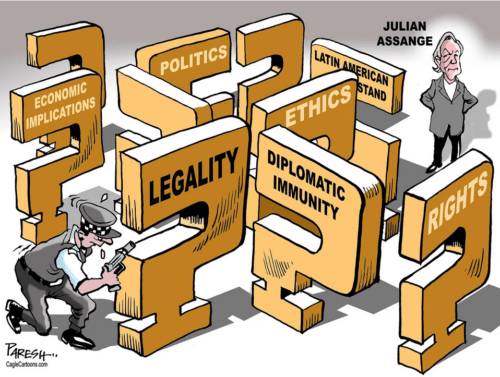
This is not to say that good MSM journalism doesn’t exist. But, on those few occasions when MSM journalists do expose state crimes, they pay a terrible price for doing so. Julian Assange is among the small band of journalists who have dared to question power. He currently languishes in a British high-security prison precisely because he did so.

The MSM doesn’t question power when it deceives the public about chemical weapon attacks on behalf of the state. It isn’t holding power to account with its refusal to investigate, or even report, evidence of malfeasance in office. Its ignoring of state crimes can in no way be considered “watchdog freedom.” And it certainly does not act as any kind of watchdog when it simply reports whatever it is ordered to report by a centrally controlled global propaganda network.

We Are the Problem and the Solution

Social media has been lambasted for corralling its users into self-affirming information silos. While this is somewhat concerning, it isn’t anything new. The technological capability of social media to control opinion is an added dimension, to be sure, but the MSM has been doing exactly the same thing for more than a century.

Unfortunately, the MSM is able to propagandise us with relative ease. It does this partly by exploiting our own misconceptions. While we all seem to agree that the Russian and Chinese MSM are state propaganda, we Westerners, for some unknown reason, apparently imagine that our own mainstream media isn’t.

There is, however, a caveat with regard to this apparent gullibility. Research statistics show that there is a remarkable lack of trust in the MSM in the West. Notably, in the US “trust” in the news is as low as 26%. The UK fares little better, at just 34%. “Trust” in the news is higher in Scandinavian countries.

We only need have brief conversations with friends and family to realise that the propaganda does, in fact, work. But what explains this disconnect between our lack of trust in the MSM with our continuing willingness to believe what it tells us?

The answer lies in the greatest achievement of the Western MSM and the parasite class it serves: They have convinced us that our media is free and is pluralistic—this despite it never being true.

Consequently, it seems that while we are wary of spin and propaganda, we refuse to contemplate the likelihood that the MSM is out-and-out lying to us. Perhaps that is because we perceive the MSM as basically serving the public interest—even if we admit to ourselves that it bends the truth a little. Our scepticism does not extend as far as disbelief.

We therefore remain unable to reconcile our credulous acceptance of MSM claims about itself with the reality that we are being misled en masse by that same institution. Cognitive dissonance—the uncomfortable psychological sensation we experience when we hold two or more contradictory thoughts at the same time—may account for our irreconcilable beliefs.

In other words, we are caught between not “trusting” the MSM, on the one hand, and, on the other, our inability to accept the fact that virtually nothing the MSM tells us is true. The implications of this dichotomy are beyond anything we want to contemplate. As a result, we still believe that “the news” is our window on the world.

If you think about it, the idea that all the important global events of the day can be condensed into a single “newspaper” or a 30-minute “evening news” broadcast is quite ridiculous. Even if it were composed of honest, unbiased reports, which it seldom is, “the news” cannot provide us with anything approaching a reasonable understanding of what is actually going on.

Therefore, if we genuinely want to know what’s happening, we have to actively seek information and critically evaluate it ourselves. As James Corbett wrote:

Granted, the realization that all media is constructed for us by someone with an interest in making us believe something is not a happy one for most people. Instead, it is a deeply unpopular realization, because it means we can’t just switch on the evening news, switch off our brain, and expect some totally neutral journalistic saviour to come along and hand us “the news” from on high.

Like it or not, it is our responsibility to think critically about all information, no matter who relays it. This responsibility applies equally to the stories we are fed by the “alternative media.” This article should be read critically! It is, after all, just information that’s being passed along to you.

The Knight-Cronkite News Lab suggests that journalists should give their “readers, viewers, listeners and users valuable information that helps them make better decisions and lead better lives.”

Here, the new breed of MSM journalists, no more nor less objective than their predecessors, has been given the task of reporting “the news” from a value-driven perspective. The aim is to change us by making us “better” people. So what are the values the new breed of journalists are being taught to advocate?

KCNL tell us:

There is broad consensus today about the reality of climate change and the threats that it poses. That may well inform how many resources a newsroom devotes to reporting on the issue as well as any point of view its stories reflect. The same might go for opposition to systemic racism, say, or support for LGBTQ rights. [. . .] One value we believe is worth stating out loud is support for democratic institutions, which are under attack on multiple fronts. Trustworthy news is essential to sustaining a healthy democracy.

Herein lies the problem. Every one of these “values” serves global political agendas and dovetails neatly with government policy and, perhaps most notably, with global governance policy. That is to say, the MSM’s new values are exactly the same as their old values. Their “new” objective, just like the old objective, is to advocate for power, not question it.

Contrary to the KCNL’s claims, democracy is not founded upon our acceptance of whatever we are told by government “institutions.” Rather, it is predicated upon our ability not just to question the state but to limit it. Thus, KCNL’s contention that a “healthy democracy” is one where “democratic institutions” assert sovereignty over us is entirely false.

To point out that these institutions have no authority over us whatsoever is not to attack “democracy.” On the contrary, doing so defends “democracy.” But you will never hear that from the MSM. The MSM’s continuing mission is to maintain the lies that ensure we never realise this “truth.”

It is ironic that the MSM attacks their alternative counterparts for advocacy journalism and yet the MSM’s own apparent solution to the trust issue that preoccupies it is to itself emulate advocacy journalism. The difference? The alternative media is far more likely to advocate the questioning of power, while the MSM looks set to continue advocating for power.

Seeing as how the concept of “news” is, in and of itself, absurd, the suggestion that news should be “trusted” simply adds another layer of misdirection to this new MSM advocacy journalism. So, if our “faith” in the stories we are told is part of the problem, a solution is self-evident. We should abandon any notion of “trust.” We should invest our efforts in being “better” critical thinkers.

The “alternative” media outlet UK Column sums up this point nicely. It asks:

Why should I trust the UK Column? Put simply, you shouldn’t. The question of whether or not to trust a news organisation is a false choice. Making such a choice is promoted by government, the old media, and two new organisation types: the fact checker and the trust provider.

It disenfranchises readers, viewers and listeners. It is based on the principle that if you trust the media organisation you are visiting, there is no need for you to check the information they present. So we ask you not to trust us. Instead, view everything published here with a critical eye. Where possible, primary source material is made available for everything we publish: check it; make up your own mind.

In his previously referenced article, James Corbett provides a list of questions we should all ask ourselves whenever we encounter information offered by any source. We don’t need government or any other “democratic institution” to control information for us, nor we do need to be told what to think about it. We just need to think critically and answer these simple questions to our own satisfaction:

  • Why is this media outlet showing us this report?
  • What interest do they have in making us think a particular way about the issue presented?
  • Can the information in the report be independently confirmed or triangulated from other sources?
  • Whose viewpoint is being shown, and how is that viewpoint portrayed? Whose viewpoint is being excluded? Why?
  • What language is being used to frame the issue?
  • What does the report make us believe about the world?
  • Are we in agreement with the report? Why or why not?

Ultimately, as ever, the choice is yours. You can gather information from any source you wish. If you want to know what the state wants you to believe and what behaviour it expects of you, then go to the MSM. If you want to explore broader criticism of government and its policies, then the more independent “alternative media” provides richer pickings.

Treat those two impostors just the same. There is honest, high-quality journalism in both. There is also propaganda to be found in both. Fortunately, if you answer James Corbett’s suggested questions, you’ll be able to spot the difference more often than not.

What is the Rules-Based Order?

By Kim Petersen

Source: Dissident Voice

In fits of, what might well be termed, masochism, some of us now-and-then tune in to the legacy media. When doing so, one is likely to hear western-aligned politicians rhetorize ad nauseam about the linguistically vogue rules-based order. Now and then, the word “international” is also inserted: the rules-based international order.

But what exactly is this rules-based order?

The way that the wording rules-based order is bandied about makes it sound like it has worldwide acceptance and that it has been around for a long time. Yet it comes across as a word-of-the-moment, both idealistic and disingenuous. Didn’t people just use to say international law or refer to the International Court of JusticeNuremberg Law, the UN Security Council, or the newer institution — the International Criminal Court? Moreover, the word rules is contentious. Some will skirt the rules, perhaps chortling the aphorism that rules are meant to be broken. Rules can be unjust, and shouldn’t these unjust rules be broken, or better yet, disposed of? Wouldn’t a more preferable wording refer to justice? And yes, granted that justice can be upset by miscarriages. Or how about a morality-based order?

Nonetheless, it seems this wording of a rules-based order has jumped to the fore. And the word order makes it sound a lot like there is a ranking involved. Since China and Russia are advocating multipolarity, it has become clearer that the rules-based order, which is commonspeak among US and US-aligned politicians, is pointing at unipolarity, wherein the US rules a unipolar, US-dominated world.

An Australian thinktank, the Lowy Institute, has pointed to a need “to work towards a definition” for a rules-based order. It asks, “… what does America think the rules-based order is for?

Among the reasons cited are “… to entrench and even sanctify an American-led international system,” or “that the rules-based order is a fig leaf, a polite fiction that masks the harsh realities of power,” and that “… the rules-based order can protect US interests as its power wanes relative to China…”

China is aware of this, and this is expressed in the Asia Times headline: “US ‘rules-based order’ is a myth and China knows it.”

The Hill wrote, “The much-vaunted liberal international order – recently re-branded as the rules-based international order or RBIO – is disintegrating before our very eyes.” As to what would replace the disintegrated order, The Hill posited, “The new order, reflecting a more multipolar and multicivilizational distribution of power, will not be built by Washington for Washington.”

The Asia Times acknowledged that it has been a “West-led rules-based order” and argued that a “collective change is needed to keep the peace.”

It is a given that the rules-based order is an American linguistic instrument designed to preserve it as a global hegemon. To rule is America’s self-admitted intention. It has variously declared itself to be the leader of the free world, the beacon on the hill, exceptional, the indispensable nation (in making this latter distinction, a logical corollary is drawn that there must be dispensable nations — or in the ineloquent parlance of former president Donald Trump: “shithole” nations).

Thus, the US has placed itself at the apex of the international order. It seeks ultimate control through full-spectrum dominance. It situates its military throughout the world; it surrounds countries with bases and weapons that it is inimically disposed toward — for example, China and Russia. It refuses to reject the first use of nuclear weapons. It does not reject the use of landmines. It still has a chemical-weapons inventory, and it allegedly carries out bioweapons research, as alluded to by Russia, which uncovered several clandestine biowarfare labs in Ukraine. This news flummoxed Fox News’ Tucker Carlson. Dominance is not about following rules, it is about imposing rules. That is the nature of dominating. Ergo, the US rejects the jurisdiction of the International Criminal Court and went so far as to sanction the ICC and declare ICC officials persona non grata when its interests were threatened.*****Having placed itself at the forefront, the US empire needs to keep its aligned nations in line.

Thus it was that Joe Biden, already back in 2016, was urging Canada’s prime minister Trudeau to be a leader for rules-based world order.

When Trudeau got together with his Spanish counterpart, Pedro Sánchez, they reaffirmed their defence of the rule-based international order.

It is a commonly heard truism that actions speak louder than words. But an examination of Trudeau’s words compared to his actions speaks to a contradiction when it comes to Canada and the rule of law.

So how does Trudeau apply rules based law?1

Clearly, in Canada it points to a set of laws having been written to coerce compliance. This is especially evident in the case of Indigenous peoples.2

It seems Canada is just a lackey for the leader of the so-called free world.

One of the freedoms the US abuses is the freedom not to sign or ratify treaties. Even the right-wing thinktank, the Council on Foreign Relations lamented, “In lists of state parties to globally significant treaties, the United States is often notably absent. Ratification hesitancy is a chronic impairment to international U.S. credibility and influence.”

The CFR added, “In fact, the United States has one of the worst records of any country in ratifying human rights and environmental treaties.”

It is a matter of record that the US places itself above the law. As stated, the US does not recognize the ICC; as a permanent member of the UN Security Council, the US has serially abused its veto power to protect the racist, scofflaw nation of Israel; it ignored a World Court ruling that found the US guilty of de facto terrorism for mining the waters around Nicaragua.

The historical record reveals that the US, and its Anglo-European-Japanese-South Korean acolytes, are guilty of numerous violations of international law (i.e., the rules-based, international order).

When it comes to the US, the contraventions of the rules-based order are myriad. To mention a few:

  1. Currently, the US is occupying Syria and stealing the oil of the Syrian people;
  2. It attacked, occupied, and plundered Afghanistan;
  3. It has been carrying out an embargo, condemned by the international community, against Cuba and its people for six decades;
  4. The US has been in illegal occupation of Cuba’s Guantanamo Bay since 1903; even if deemed to be legal, it is clearly unethical;
  5. American empire has a history of blatant, wanton disregard for democracy and sovereignty;
  6. The US funded the Maidan coup that overthrew the elected president of Ukraine, leading to today’s special military operation devastating Ukraine, which continues to fight a US-NATO proxy war.
  7. Then, there is the undeniable fact that the US exists because of a genocide wreaked by its colonizers, which has been perpetuated ever since.
  8. Even the accommodations that the US imposed on the peoples it dispossessed are ignored, revealed by a slew of broken treaties.3

The history of US actions (as opposed to its words) and its complicit tributaries needs to be kept firmly in mind when the legacy media unquestioningly reports the pablum about adhering to a rules-based order.

  1. See also Yves Engler, “Ten ways Liberals undermined international rules-based order,” rabble.ca, 17 September 2021. []
  2. Read Bob Joseph, 21 Things You May Not Know About the Indian Act: Helping Canadians Make Reconciliation with Indigenous Peoples a Reality, 2018. []
  3. Vine Deloria, Jr., Behind the Trail of Broken Treaties: An Indian Declaration of Independence, 1985. This governmental infidelity to treaties is also true in the Canadian context. []

They don’t just lie to us about wars; they lie to us about everything

By Caitlin Johnstone

Source: Intrepid Report

Propaganda isn’t just about manufacturing consent for wars and ridiculous governmental measures we’d never normally accept. That’s what most people think of when they hear that word, but there’s so very, very much more to it than that.

The lion’s share of propaganda goes not toward convincing us to accept new agendas of the powerful, but toward keeping us entranced in the status quo dream world which enables the powerful to have power in the first place. Toward normalizing status quo systems and training us to shape ourselves to fit into them like neat little cogs in a well-oiled machine.

And it’s not even a grand, monolithic conspiracy in most cases. The giant corporations who indoctrinate us with their advertisements, their Hollywood movies and shows, their apps, their websites and their news media are all naturally incentivized to point us further and further into delusion by the fact that they benefit from the status quo systems which have elevated them to wealth.

So day in and day out we are presented with media which train us what to value, where to place our interest and attention, what success looks like, and how a normal human behaves on this planet. And it always aligns perfectly with the interests of the rich and powerful.

They don’t just teach us what to believe. They teach us who we are. They give us the frameworks upon which we cast our ambitions and evaluate our success, and we build psychological identities out of those constructs. I am a businessman. I am unemployed. My life is about making money. My life is about disappointing people. I am a success. I am a failure. They invent the test of our adequacy, and they invent the system by which we are graded.

These artificial constructs take up such vast portions of our personal psychology that people will live their entire lives completely enslaved to them, making them their entire focus. This enslavement is so pervasive that people will often even take their own lives based on what those made-up constructs tell them about who they are and what they’re worth.

And it’s all a lie. A dream world, made entirely of narrative, constructed by the powerful for the benefit of the powerful. Things as intimate as the thoughts in our heads and the movement of our interest and attention are controlled and dominated with iron-fisted force, all for the benefit of some stupid made-up games about imaginary money and fictional authority.

So most of us sleepwalk through life chasing make believe goals and fleeing artificially constructed demons. Too preoccupied with the illusion to look up and notice the thunderous majesty of life as it really is, and usually too confused to truly perceive it even on those rare occasions when we snap out of the trance for a moment to make an effort.

Untangling yourself from this dream world isn’t easy. It takes time. It takes work. It takes a deep, sustained curiosity about what’s really going on underneath all the muddled mental chatter, about what life truly is underneath all the stories we’ve been told about what life is, about who we truly are underneath all the stories we’ve been told about who we are.

The difference between what we’ve been told and what we find over the course of this investigation is the difference between dream and waking life. The real world is as different from the status quo narrative about the world as it is from any other work of fiction. The two things really could not be any more different.

And the good news is that just as your false view of yourself and your world shaped your human expression in the service of the powerful, the rolling back of that mind fog shapes your human expression into something else entirely. Something grounded in reality. Something authentic. Something primal. Something that exists not for the benefit of some faceless oligarchic empire, but for the same reason the grass grows and the galaxies spin in the cosmos.

And that’s what humanity looks like on the other side of this awkward transition phase that our species is going through at this adolescent point in its development. Free from illusion. In harmony with the real. Enslaved to nobody. Striding clear-eyed into the mystery of what’s to come.

Not News But A Juicy Collection Of Narratives – How The New York Times Failed Its Readers

By Moon of Alabama

The New York Times star reporter Rukmini Callimachi had been widely criticized for her exaggerated reporting about the Islamic State and terrorism. But her editors kept supporting and promoting her stories. That finally ended when Canada recently indicted one Shehroze Chaudhry, also known as Abu Huzaifa, for falsely claiming to have been an ISIS member. Chaudhry had made up his blood dripping stories. He had never been with ISIS and had never been to Syria or Iraq.

But the unverified stories of Abu Huzaifa al-Kanadi had been the central element of the NYT’s ten part Caliphate podcast by Rukmini Callimachi.

The failure of her reporting finally was so evident that the NYT had to allow its media columnist Ben Smith to write about the issue. Remarkably his reporting was published in the Business section of the paper.

An Arrest in Canada Casts a Shadow on a New York Times Star, and The Times

It is a pretty devastating report about the support Callimachi got from her editors even as an ever growing number of her collogues criticized her over-sensationalized reporting. The root cause of the problem is the way in which the Times, as well as other news media, try to change from news providers to narrative creators:

The crisis now surrounding the podcast is as much about The Times as it is about Ms. Callimachi. She is, in many ways, the new model of a New York Times reporter. She combines the old school bravado of the parachuting, big foot reporter of the past, with a more modern savvy for surfing Twitter’s narrative waves and spotting the sorts of stories that will explode on the internet.

Ms. Callimachi’s approach and her stories won her the support of some of the most powerful figures at The Times: early on, from Joe Kahn, who was foreign editor when Ms. Callimachi arrived and is now managing editor and viewed internally as the likely successor to the executive editor, Dean Baquet; and later, an assistant managing editor, Sam Dolnick, who oversees the paper’s successful audio team and is a member of the family that controls The Times.

Ms. Callimachi’s approach to storytelling aligned with a more profound shift underway at The Times. The paper is in the midst of an evolution from the stodgy paper of record into a juicy collection of great narratives, on the web and streaming services. And Ms. Callimachi’s success has been due, in part, to her ability to turn distant conflicts in Africa and the Middle East into irresistibly accessible stories.

The highlighted sentence is the essence of the piece. It was even repeated in the caption of a picture accompanying it.

The striving for ‘juicy narratives’ is the biggest mistake of current news media. Their attempt to copy the success of Hollywood dramas by creating narratives has destroyed their credibility. It has put incentives on the wrong aspect of a reporter’s work. Instead of requiring well checked facts the editors are now asking for confirmations of preconceived tales:

What is clear is that The Times should have been alert to the possibility that, in its signature audio documentary, it was listening too hard for the story it wanted to hear — “rooting for the story,” as The Post’s Erik Wemple put it on Friday.

Callimachi is far from the only one guilty of creating fake news to fulfill her editors demand of narratives. The four year long coverage of ‘Russiagate’, the fairytale collection of made up connections between Donald Trump and Russia, was full of such. The editorial push towards narratives is rooted in the desire to create clickbait and to generate a social media echo around the reporting. That may be profitable in the short term but it is also a guarantee for a long term failure.

False of hyped narratives will over time get debunked. People then lose trust in the media that provided them with the fake news. That again will cause a long term loss of readership.

A similar case of falling for ‘narratives’ happened to German magazine Der Spiegel. Its star author Claas Relotius wrote fake stories on a large scale. Whether he wrote about Trump voters in Arizona or about a little girl in Syria, Relotius invented the witnesses to the ‘news’ he provided. He made up ‘facts’ and described himself visiting places he had never been to. For years there had been warnings that many of the detail Relotius provided were wrong. But his editors promoted him because the slick ‘narratives’ he delivered were exactly what they wanted. Der Spiegel, a once universally trusted source of news, is now joked about as ‘the former news magazine’.

The media trend towards providing narratives instead of verified facts also increases the danger of falling for manipulation. Governments as well as political marketing campaigns love to provide ready made tales. It is easier and cheaper for media to pick these up and repeat them instead of digging into the facts and their logic. We thus get false tales about chemical weapon use in Syria and a Skripal poisoning ‘narrative’ that does not stand up to the slightest scrutiny.

Can we please have real news? Just the new facts, with no ‘narrative’ or moral tales attached to them? Facts that are verified and described in the context of the issue they relate to? Do they fit the logic of already known ones? Do they make sense? How may they influence further developments?

To provide the above can easily fill a reporter’s day of work. It is usually enough material to write an 800 words report. Its sufficient for the reader to create his own narrative from it.

Dear news media. Please go back to providing real news. If you do so you will eventually regain my trust. That will be, in the long run, a much more valuable asset than the social media chatter you are currently trying to generate.

If the “Market” Never Goes Down, The System Is Doomed

By Charles Hugh Smith

Source: Of Two Minds

The reliance on “good news” narratives dooms our financial system and economy to a death spiral once reality breaks through the induced euphoria.

“Markets” that never go down aren’t markets, they’re signaling mechanisms of the Powers That Be. Markets are fundamentally clearing houses of information on price, demand, sentiment, expectations and so on–factual data on supply and demand, shipping costs, cost of credit, etc.–and reflections of trader and consumer emotions and psychology.

If markets are never allowed to go down, the information clearing house has been effectively shut down. Whatever information leaks out has been edited to fit the prevailing narrative, which in this moment is “central banks will never let markets go down ever again, so jump in and ride the guaranteed Bull to easy gains.”

The past 12 years offer ample evidence for this narrative: every dip draws a near-instantaneous monetary-policy response that reverse the dip and gooses markets higher.

That permanent monetary intervention distorts markets doesn’t matter to participants. Who cares if markets have become “markets,” simulacra of real markets that are now nothing but signaling mechanisms that all is well so buy, buy, buy? If gains are essentially guaranteed, who cares that markets are not longer information clearing houses?

Indeed. There’s no reason to care until the fatal spiral downward surprises us all. Here’s an analogy of what happens when real information gets edited to fit a convenient narrative.

Unfortunately, the patient has cancer which is starting to metastasize, i.e. spread to other organs in the body. But unbeknownst to the patient, this accurate information is considered “bad news,” so the test results and other information is carefully edited to show the cancer is actually shrinking–the exact opposite of what the actual facts reflect.

The patient is naturally delighted with this false data because it appears he’s on the mend and doesn’t need any surgery or other drastic treatments.

If participants don’t have information that reflects actual conditions, they cannot help but make disastrous decisions. Falsified or heavily edited information is misleading, and so all decisions made on the assumption this information is accurate will be fatally skewed.

Symptoms of the fatal spread of the disease are masked by stimulants that not only mask the spread but give the patient a sense of euphoric power and supreme confidence.

Imagine the patient’s terrible dismay when symptoms break through the euphoria and he learns his cancer is now terminal. Increasing the tragedy is his awareness that had the authorities in charge of his care given him the real-world data instead of the carefully edited “happy story” version, treatments could have been undertaken that might have extended his life. Now those options have been lost forever.

That’s the situation in our economy and financial system. The information cleared in markets has been suppressed, distorted and edited for 12 long years of permanent and ever-increasing monetary interventions, as the “doses” of intervention required to maintain the cocaine-like euphoria and supreme confidence in central bank manipulation of “markets” so they always signal the “good news” of guaranteed gains ratchets higher on every intrusion of reality.

The reliance on “good news” narratives dooms our financial system and economy to a death spiral once reality breaks through the induced euphoria. Our last chances to clear the financial cancers eating away at our economy are slipping away forever, masked by the “market’s” cocaine-like euphoria and supreme confidence in central-bank guaranteed gains.

If the stock market is never allowed to go down, this is the equivalent of telling the cancer-riddled patient that their cancer has disappeared, even as the disease is leading inexorably to the patient’s needless demise.

Why We Need Dystopian Fiction Now More Than Ever

By August Cole and P.W. Singer

Source: Slate

It hits you every so often.

When you when you tug on a face mask to go pick up food for your family.

When you witness the powerless suffer casual violence by a man with a sneer.

When you see riot police surround the Lincoln Memorial and protesters snatched off the streets by masked soldiers in unmarked cars.

And when you realize that it is all being watched by an unblinking eye of A.I. surveillance.

At times, it feels like we are living in a real-world version of dystopia. The strange outcome, though, is that it means we need dystopian fiction now more than ever, to help us sort and even make it through it.

You’d think with everything going on, now would be the last time to escape to a world of darkness. And yet books, including those of awful imagined worlds, are in deep demand.
Some of it has been a return to old classics. In a period of disease and lockdowns lasting for weeks, booksellers report the seeming irony that Albert Camus’ The Plague and Gabriel García Márquez’s One Hundred Years of Solitude have seen renewed demand. And some of it has been escaping into new worlds, as with Divergent author Veronica Roth taking readers into another post-apocalypse with her new novel Chosen Ones. People have even been willing to enter imagined worlds that seem not too far away, such as Lawrence Wright’s best-selling pandemic thriller The End of October.

Yet the value of the genre is as much in education as entertainment. It can elucidate dangers, serving the role of warning and even preparation. Think of the recent resonance of Margaret Atwood’s 1985 Handmaid’s Tale and its 2020 sequel The Testaments or the revival of interest in It Can’t Happen Here by Sinclair Lewis in 1935. These are finely written works, not as indulgences, but as a pure expression of the idea that to be forewarned is to be forearmed. Even Susan Collins’ Hunger Games prequel, The Ballad of Songbirds and Snakes, might be interpreted in that light, showing how authoritarian rule can originate through the manipulations of an ambitious striver.

Our personal corner of this dark market is the meld of imagination with research. For our book Burn-In: A Novel of the Real Robotic Revolution, we chose the setting of not a far-off imagined world like Panem or Gilead, but Washington, D.C., just around the corner. What happens as Silicon Valley’s visions of utopia hits our real, and very divided, country? What plays out in politics, business, and even family life as our economy is rewired by AI and automation? Yet to make our scenario more haunting, we back up everything that happens in it with 27 pages of endnotes.

When the scarier elements from an imagined world come to life in the real one, however, there is no gleeful “I told you so.” When the novel coronavirus accelerated the more widespread roll out of the robots, remote work, job automation, and AI surveillance projected in our book, we certainly weren’t happy. All it meant was that all the tough dilemmas that our characters face would come quicker for all of us. What was perhaps most disturbing of the last few weeks, though, were when some of the most dystopian scenes we had painted of a future Washington, D.C., also came true, from our book’s scene of riot police deployed around the Lincoln Memorial to the militarized fence thrown up around the White House being put exactly where we had it in Burn-In.

Yet what makes dystopian fiction different is that its creators are oddly optimists at heart, as we are. These works are not about prediction, but prevention. The stories warn of just how far things can go if action isn’t taken, wrapped in a package that is far more impactful than a white paper or PowerPoint. Indeed, research shows that narrative, the oldest communication technology of all, holds more sway over both the public and policymakers than even the “most canonical academic sources.” Our minds can’t help but connect to the “synthetic environment” that our fictional heroes and villains experience, living part of our lives through theirs, even if imagined.

Most importantly, though, the dark worlds are only the setting. The stories are really about the agency of the people in them. And that is perhaps the true value of the dystopian fiction. These stories are not about what those characters experience so much as how they act. At the heart of every story of darkness is a story of perseverance.

As we face our own difficult journeys through the reality of 2020, it is perhaps that lesson which is most important of all.