Degrowth: closing the global wealth divide

Contradicting the dominant paradigm that economic growth equals development, degrowth theorists argue that serious cutbacks are crucial to protect life on our planet.

By Riccardo Mastini

Source: ROAR

Today, some 4.3 billion people — more than 60 percent of the world’s population — live in debilitating poverty, struggling to survive on less than the equivalent of $5 per day (which is the mean average of all the national poverty lines in the Global South). Half do not have access to enough food. And these numbers have been growing steadily over the past few decades.

With these data, Jason Hickel, an anthropology professor and global development expert, starts his controversial book, The Divide: A Brief Guide to Global Inequality and Its Solutions, in which he meticulously and convincingly debunks the narrative told by the UN and the likes of Bill Gates and Steven Pinker. In fact, while the good-news story leads us to believe that poverty has been decreasing around the world, in reality the only places this holds true are in China and East Asia. And these are some of the only places in the world where free-market capitalism was not forcibly imposed by the World Bank and the IMF, allowing these governments to pursue state-led development policies and gradually liberalize their economies on their own terms.

Development agencies, NGOs and the world’s most powerful governments explain that the plight of poor countries is a technical problem — one that can be solved by adopting the right institutions and the right economic policies, by working hard and accepting a bit of help. As Hickel writes: “It is a familiar story, and a comforting one. It is one that we have all, at one time or another, believed and supported. It maintains an industry worth billions of dollars and an army of NGOs, charities and foundations seeking to end poverty through aid and charity.” But it’s against this narrative that Hickel takes aim.

ECONOMIC UNEQUAL EXCHANGE OVER THE CENTURIES

The main argument presented in the book is that the discourse of aid distracts us from seeing the broader picture. It hides the patterns of extraction that are actively causing the impoverishment of the Global South today and actively impeding meaningful development. “The charity paradigm obscures the real issues at stake: it makes it seem as though the West is ‘developing’ the Global South, when in reality the opposite is true. Rich countries aren’t developing poor countries; poor countries are effectively developing rich countries — and they have been since the late 15th century,” argues Hickel.

In the book it is laid bare for all to see that underdevelopment in the Global South is not a natural condition, but a consequence of the way Western powers have organized the world economic system.

It’s not that the $128 billion in aid disbursements that the West gives to the Global South every year doesn’t exist — it does. But if we broaden our view and look at it in context, we see that it is vastly outstripped by the financial resources that flow in the opposite direction.

If all of the financial resources that get transferred between rich and poor countries each year are tallied up, we find that in 2012, the last year of recorded data, developing countries received a little over $2 trillion, including all aid, investment and income from abroad. But more than twice that amount, some $5 trillion, flowed out of them in the same year. In other words, developing countries “sent” $3 trillion more to the rest of the world than they received.

What do these large outflows from the Global South consist of? “Well, some of it is payments on debt. Today, poor countries pay over $200 billion each year in interest alone to foreign creditors, much of it on old loans that have already been paid off many times over, and some of it on loans accumulated by greedy dictators,” states Hickel. Another major contributor is the income that foreigners make on their investments in developing countries and then repatriate. Think of all the profits that Shell extracts from Nigeria’s oil reserves, for example, or that Anglo American pulls out of South Africa’s gold mines.

But by far the biggest chunk of outflows has to do with capital flight. A big proportion of this takes place through “leakages” in the balance of payments between countries. Another takes place through an illegal practice known as “trade misinvoicing.” Basically, corporations report false prices on their trade invoices in order to spirit money out of developing countries directly into tax havens and secrecy jurisdictions. A similarly large amount flows out annually through “abusive transfer pricing”, a mechanism that multinational companies use to steal money from developing countries by shifting profits illegally between their own subsidiaries in different countries. But perhaps the most significant loss has to do with exploitation through trade.

Hickel explains that “from the onset of colonialism through to globalization, the main objective of the North has been to force down the cost of labor and goods bought from the South. In the past, colonial powers were able to dictate terms directly to their colonies. Today, while trade is technically “free,” rich countries are able to get their way because they have much greater bargaining power.” On top of this, trade agreements often prevent poor countries from protecting their workers in ways that rich countries do. And because multinational corporations now have the ability to scour the planet in search of the cheapest labor and goods, poor countries are forced to compete to drive costs down. As a result of all this, there is a yawning gap between the “real value” of the labor and goods that poor countries sell and the prices they are actually paid for them. This is what economists call “unequal exchange.”

Since the 1980s, countries of the West have been using their power as creditors to dictate economic and trade policies to indebted countries in the South, effectively governing them by remote control, without the need for bloody interventions. “Leveraging debt,” argues Hickel, “they imposed “structural adjustment programs” that reversed all the economic reforms that Global South countries had painstakingly enacted in the previous two decades. In the process, the West went so far as to ban the very protectionist and Keynesian policies that it had used for its own development, effectively kicking away the ladder to success.”

DEGROWTH FOR SUSTAINABLE AND FAIR LIVELIHOODS

Hickel then ponders over how — if these unfair trade and business practices were amended — poor countries could actually go about developing their economies following the same path as the one embraced by the Global North over the past two centuries. He references a study by the economist David Woodward in which the latter shows that given our existing economic model, poverty eradication can’t happen. Not that it probably won’t happen, but that it physically can’t. It is a structural impossibility.

He explains that:

Right now, the main strategy for eliminating poverty is to increase global GDP growth. The idea is that the yields of growth will gradually trickle down to improve the lives of the world’s poorest people. But all the data we have shows quite clearly that GDP growth doesn’t really benefit the poor. While global GDP per capita has grown by 65 percent since 1990, the number of people living on less than $5 a day has increased by more than 370 million. Why does growth not help reduce poverty? Because the yields of growth are very unevenly distributed. The poorest 60 percent of humanity receive only 5 percent of all new income generated by global growth. The other 95 percent of the new income goes to the richest 40 percent of people. And that’s under best-case-scenario conditions.

Given this distribution ratio, Woodward calculates that it will take more than 100 years to eradicate absolute poverty at $1.25 a day. At the more accurate level of $5 a day, eradicating poverty will take 207 years. To eradicate poverty at $5 a day, global GDP would have to increase to 175 times its present size. In other words, we need to extract, produce and consume 175 times more commodities than we presently do. It is worth pausing for a second to think about what this means. Even if such outlandish growth were possible, the consequences would be disastrous. We would quickly chew through our planet’s ecosystems, destroying the forests, the soils and, most importantly, the climate.

According to data compiled by researchers at the Global Footprint Network in Oakland, our planet only has enough ecological capacity for each of us to consume 1.8 “global hectares” annually — a standardized unit that accounts for resource use, waste, pollution and emissions. Anything over this means a degree of resource consumption that the Earth cannot replenish, or waste that it cannot absorb; in other words, it locks us into a pathway of progressive degradation. The figure of 1.8 global hectares is roughly what the average person in Ghana or Guatemala consumes.

By contrast, Europeans consume 4.7 global hectares per person, while in the US and Canada the average person consumes 8 — many times their fair share. To get a sense of how extreme this overconsumption is: if we were all to live like the average citizen of the average high-income country, we would require the ecological capacity equivalent to 3.4 Earths. Hickel elaborates:

Scientists tell us that even at existing levels of aggregate global consumption we are already overshooting our planet’s ecological capacity by about 60 percent each year. And all of this is just at our existing levels of aggregate economic activity — with the existing levels of consumption in rich and poor countries. If poor countries increase their consumption, which they will have to do to some extent in order to eradicate poverty, they will only tip us further towards disaster. Unless, that is, rich countries begin to consume less.

If we want to have a chance of keeping within the 2°C threshold — which the Paris Agreement on climate change sets as an absolute cap — we can emit no more than another 805 gigatons of CO2 at the global level. Now, let’s accept that poor countries will need to use a portion of this carbon budget in order to grow their incomes enough to eradicate poverty; after all, we know that for poor countries human development requires an increase in emissions, at least up to a relatively lowish point. This principle is already widely accepted in international agreements, which recognize that all countries have a “common but differentiated responsibility” to reduce emissions. Because poor countries did not contribute much to historical emissions, they have a right to use more of the carbon budget than rich countries do — at least enough to fulfill basic development goals (as I also argue in this article). This means that rich countries have to figure out how to make do with the remaining portion of the budget.

Professor Kevin Anderson, one of Britain’s leading climate scientists, has been devising potential scenarios for how to make this work. If we want to have a 50 percent chance of staying under 2°C, there’s basically only one feasible way to do it — assuming, of course, that negative emissions technologies is not a real option. In this scenario, poor countries can continue to grow their economies at the present rate until 2025, using up a disproportionate share of the global carbon budget. That’s not a very long time, so this strategy will only work to eradicate poverty if the gains from growth are distributed with a heavy bias towards the poor.

As Hickel writes: “The only way for rich countries to keep within what’s left of the carbon budget is to cut emissions aggressively, by about 10 percent per year. Efficiency improvements and clean energy technologies will contribute to reducing emissions by at most 4 percent per year, which gets them part of the way there. But to bridge the rest of the gap, rich countries are going to have to downscale production and consumption by around 6 percent each year. And poor countries are going to have to follow suit after 2025, downscaling economic activity by about 3 percent per year.” This strategy of downscaling the production and consumption of a country is called “degrowth.”

Hickel describes this visionary idea as follows: “All it means is easing the intensity of our economy, cutting the excesses of the very richest, sharing what we have instead of plundering the Earth for more, and liberating ourselves from the frenetic consumerism that we all know does nothing to improve our wellbeing or happiness.” And since the book first came out in 2017, Hickel has been developing an increasingly clearer position on how we can go about making such changes happen.

His thinking on degrowth was recently encapsulated in a captivating blog exchange he had with Branko Milanović, another global development expert. But Milanović still maintains that economic growth should be at the core of poverty relief. Paraphrasing a passage from Kate Raworth’s Doughnut Economics, we could summarize Milanović’s position as “economic growth is still necessary, and so it must be possible,” while Hickel argues that “economic growth is no longer possible, and so it cannot be necessary.” I side with the latter, simply because the laws of physics trump the laws of economics.

In light of this, perhaps we should regard countries like Costa Rica not as underdeveloped, but rather as appropriately developed. We should look at societies where people live long and happy lives at low levels of income and consumption not as backwaters that need to be developed according to Western models, but as exemplars of efficient living — and begin to call on rich countries to cut their excess consumption.
The Global Elite is Insane Revisited

By Robert J. Burrowes

In 2014 I wrote an article titled ‘The Global Elite is Insane’. I want to elaborate what I explained in the earlier article so that people have a clearer sense of what we are up against in our struggle to create a world of peace, justice and ecological sustainability.

Of course, as I explained previously, it is not just the global elite that is insane. All those individuals – politicians, businesspeople, academics, corporate media editors and journalists, judges and lawyers, bureaucrats…. – who serve the elite, including by not exposing and resisting it, are also insane. And it is important to understand this if we are to develop and implement effective strategies to resist elite violence, exploitation and destruction but also avert the now-imminent human extinction driven by their insane desire for endless personal privilege, corporate profit and political control whatever the cost to Earth’s biosphere and lifeforms (human and non-human alike).

But first, who constitutes the global elite? Essentially, it is those extremely wealthy individuals – notably including the Rothschild family, Jeff Bezos, Bill Gates, Warren Buffett, Amancio Ortega, Mark Zuckerberg, Carlos Slim, the Walton family and the Koch brothers – as well as the world’s other billionaires and millionaires. See ‘Bloomberg Billionaires Index’.

Testament to their secretly and long-accumulated wealth and power, a 2012 investigation concluded that rich individuals and their families have as much as $32 trillion of hidden financial assets – which excludes non-financial assets such as real estate, gold, yachts and racehorses – in offshore tax havens. See the Tax Justice Network.

If this sum was devoted to programs of social uplift then starvation, poverty, homelessness and other privations would vanish immediately and environmental restoration projects as well as research, development and implementation of visionary sustainability initiatives would flourish instantly. The idea of an ‘underdeveloped’ or ‘developing’ national economy would vanish from the literature on Africa, Asia and Central/South America.

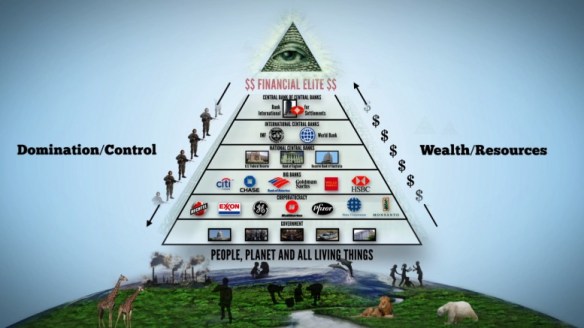
In addition to these individuals, however, the global elite includes the major multinational corporations, particularly including the following – although, it should be noted, this list simplifies the picture considerably by ignoring the conglomerate nature of many of these corporations and not including many of the (more difficult to identify) private corporations that should be listed in any comprehensive presentation:

* the major weapons manufacturers (such as Lockheed Martin, Boeing, BAE Systems, Raytheon, Northrop Grumman and General Dynamics)

* the major banks (including Industrial & Commercial Bank of China, China Construction Bank, HSBC Holdings, JPMorgan Chase, Mitsubishi UFJ Financial Group and Bank of America) and their ‘industry groups’ like the International Monetary Conference

* the major investment companies (including BlackRock, Capital Group Companies, FMR, AXA, and JP Morgan Chase)

* the major financial services companies (including Berkshire Hathaway, AXA, Allianz and BNP Paribas)

* the major energy corporations including coal companies (such as Coal India, Adani Enterprises, China Shenhua Energy, China Coal Energy, Mechel, Exxaro Resources, Public Power, Glencore and Peabody Energy) as well as the oil and gas corporations (such as Saudi Aramco, Gazprom, Rosneft, PetroChina, ExxonMobil, Lukoil, BP, Royal Dutch Shell, Petrobras, Chevron, Novatek, Total S.A. and Eni)

* the major media corporations (including Alphabet [Google owner], Comcast, Disney, AT&T, News Corporation, Time Warner, Fox, Facebook, Bertelsmann and Baidu)

* the major marketing and public relations corporations (including Edelman, W2O Group, APCO Worldwide, Deksia, BrandTuitive, Fearless Media, and Citizen Group)

* the major agrochemical (pesticides, seeds, fertilizers) giants (including Bayer, Syngenta, Dow, Monsanto and DuPont)

* the major pharmaceutical corporations (including Johnson & Johnson, Roche, Pfizer, Novartis, Sanofi and GlaxoSmithKline)

* the major biotechnology (genetic mutilation) corporations (again including Johnson & Johnson, Roche, Pfizer and Novartis)

* the major mining corporations (including Glencore Xtrata, BHP Billiton, Rio Tinto, Vale, Anglo American, China Shenhua Energy, Freeport McMoRan Copper & Gold, and Barrick Gold)

* the major nuclear power corporations (including Areva, Rosatom, General Electric/Hitachi, Kepco, Mitsubishi, Babcock & Wilcox, BNFL, Duke Energy, McDermott International, Southern, NextEra Energy, American Electric Power, and Westinghouse)

* the major food multinationals (including Cargill, Archer Daniels Midland Company [ADM], Nestlé, PepsiCo, Coca-Cola, Unilever, Danone, General Mills, Kellogg’s, Mars, Associated British Foods and Mondelez)

* the major water corporations (including Veolia, Suez Environnement, ITT Corporation, United Utilities, Severn Trent, Thames Water, American Water Works).

Of course, the global elite also includes elite fora where various combinations of elite individuals from the corporate, political, media and academic worlds gather to plan their continuing violence against, and exploitation of, the Earth and its inhabitants. This is intended to consolidate and extend t heir control over populations, markets and resources to maximize their privilege, profit and power at the expense of the rest of us and life generally. Among intergovernmental organizations, it includes the United Nations, the World Bank and the International Monetary Fund.

A quick perusal of the agenda of such elite gatherings – including the World Economic Forum, the Bilderberg Group and the Trilateral Commission – reveals a comprehensive lack of interest, despite rhetoric and the occasional token mention, of pressing issues ranging from the threat of nuclear war and the climate catastrophe to the many ongoing wars, deepening exploitation within the global economy, extensive range of environmental threats and the refugee crisis, each of which they generated and now continue to deliberately exacerbate. See, for example, the agenda of the recent WEF meeting in Davos.

Primary servants of the global elite include political leaders in major industrialized countries (who legislate to progressively expand elite power, profit and privilege, such as Donald Trump’s recent tax cuts for the wealthy at the expense of social programs), the judges and lawyers (who defend elite power using the elite-designed and manipulated legal system: ever heard of a wealthy individual convicted in court and given any serious punishment or of any major corporation genuinely held to legal account for its exploitation of indigenous peoples or destruction of the natural environment?), as well as corporate media editors and journalists, entertainment industry personnel, academics, industry organizations (such as the European Round Table of Industrialists) that represent the interests of major corporations, so-called ‘think tanks’ (such as the Council on Foreign Relations and the Brookings Institution) and ‘philanthropic trusts’ (such as the Rockefeller, Carnegie and Ford foundations) all of which justify, ignore or divert attention from elite violence and exploitation.

Importantly too, primary servants of the global elite include those who work within elite-directed agencies, notably including those in the so-called ‘intelligence community’ (such as the US CIA, British MI6, Russian SVR RF, Chinese Ministry for State Security and Israeli Mossad), who perform elite functions in relation to spying, surveillance and secret assassinations (particularly of grassroots activists), ostensibly under the direction of national governments. But it also includes many lower-level servants such as those who work as political lobbyists or in the bureaucracy as well as the education, police and prison systems.

So why do I claim that the elite and those who serve them are insane?

Any dictionary will offer a simple definition of ‘sanity’ along the lines of ‘soundness of judgment or reason’ and ‘the ability to think and speak in a reasonable way and to behave normally’.

But if we use this definition of sanity then, obviously, ‘sanity’ must be interpreted to mean that it is ‘sound judgment, reasonable and normal’ to further perpetrate the violence and exploitation that are overwhelmingly characteristic of our world. After all, most people powerlessly accept this incredibly violent state of affairs and, if they discuss it, do so in terms of its merits, politically, economically, morally or otherwise. Few people argue, simply, that violence is just insane.

So I would like to propose a more rigorous definition of sanity: Sanity is the capacity to consider a set of circumstances, to carefully analyze the evidence pertaining to those circumstances, to identify the cause of any conflict or problem, and to respond appropriately, both emotionally and intellectually, to that conflict or problem with the intention of resolving it, preferably at a higher level of need satisfaction for all parties (including those of the Earth and all of its living creatures).

Clearly, my proposed definition of sanity is designed to imply that any conceptions we have of ‘sound judgment’, ‘reasonable’ and ‘normal’ mean that they are qualities we associate with individuals who possess the desirable capacity to improve the overall state of human affairs, whether an interpersonal relationship or geopolitically. This means, as an absolute minimum, the capacity to reduce violence or exploitation in one context or another.

You might, of course, accuse me of writing a definition of ‘sanity’ that serves my agenda to dramatically improve world order in the direction of peace, justice and sustainability. And you are right! But whose interest does it serve to have sanity defined as behavior that involves ‘sound judgment’ and is considered ‘reasonable and normal’ in the context of perpetuating extraordinary violence?

Alternatively, you might argue that my definition of insanity is too broad. Surely, you might say, we can account for many of the behaviors outlined above in terms of different belief systems, ideologies and religions. Doesn’t a person who believes in killing people to win wars (or for other reasons) just have a worldview different from those who believe that people should resolve conflict nonviolently? Doesn’t a capitalist just have a worldview different from those who believe that people should share resources equally? Doesn’t a person who believes in the unlimited accumulation of wealth just have a worldview different from those who believe in ecological sustainability?

But there is a more fundamental issue here. As I explained in my original article, cited at the beginning of this one: Do you really believe that someone who is capable of perpetrating extraordinary violence, inequity and biosphere-threatening behavior – and thus clearly incapable of experiencing and expressing the love, compassion, empathy and sympathy that would drive a nonviolent approach to the world – is sane? Given that emotional qualities such as love, compassion, empathy and sympathy are an evolutionary gift to those not seriously damaged during childhood, what happened to those individuals who do not possess them? See Why Violence?’ and Fearless Psychology and Fearful Psychology: Principles and Practice.

Or, to explain it based on my longer definition of sanity highlighted above: Casual observation of the state of our world, including the primary threat of near-term human extinction through climate catastrophe or nuclear war – see ‘On Track for Extinction: Can Humanity Survive?’ – clearly reveals that none of the elite is paying considered attention to the perilous state of our world, analyzing the evidence in relation to it, identifying the cause(s) driving it or responding powerfully to end it. Why is this?

In essence, it is because one manifestation of their insanity drives them to deny reality to make huge profits from weapons production used to kill people, the burning of climate-destroying fossil fuels, environmental destruction (through, for example, mining and rainforest logging), commercial farming based on the poisoning and genetic mutilation of foods, the mass production and sale of poisoned, processed and nutritionally-depleted foods, the consumption of health-destroying and dependency-creating drugs, and control over the sale of water, once considered a human right. Moreover, insanity makes the elite do everything in its power to maintain this highly profitable state of affairs. See ‘Profit Maximization is Easy: Invest in Violence’.

Moreover, of course, there is no evidence of committed elite engagement in efforts to end the many local wars (from which they make huge profits), end corporate exploitation of human beings (which kills, through starvation alone, 100,000 people every day but from which they make huge profits) and nonhuman beings (which drives 200 species of life to extinction daily but from which they make huge profits) or end local environmental destruction in a myriad ways (from which they make huge profits).

So, in summary, given our ongoing rush to extinction, it is clear that those who exacerbate this threat through failure to consider and act with awareness (as well as encourage aware action by others) fail to satisfy the definition of sanity that I offered above. In short: Gambling on the future of humanity is not sane.

As an aside, it should be noted: Often enough too, the elite can rely on a largely insane population to mindlessly consume the latest consumer product, no matter how unnecessary, or they can rely on their marketing and advertising agents to persuade those of us who show the slightest reluctance to buy the latest inanity.

So with an insane global elite and its many insane servants as well as a largely insane consumer population, what can those of us who have the sanity to respond powerfully to the many threats to our survival do?

Well, if you want a child who is emotionally and intellectually engaged with the world and therefore capable of responding powerfully to their circumstances (which includes being able to resist the lure of serving the elite and being suckered by its marketing), then terrorizing the child into obedience is not the way to go about it. So, you might like to consider making ‘My Promise to Children’.

If you are sane enough to investigate the evidence and to act intelligently and powerfully in response to it, I encourage you to do so. One option you have if you find the evidence in relation to one or more of the threats mentioned above compelling, is to join those participating in ‘The Flame Tree Project to Save Life on Earth’.

If you are self-aware enough to know that you are inclined to avoid ‘difficult issues’ and to take the action that these require, then perhaps you could tackle this problem at its source by ‘Putting Feelings First’. Unfortunately, as mentioned above, few of us had a childhood that nurtured our sanity.

If you want to mobilize people to campaign effectively on the climate, war, rainforest destruction or any other elite-driven violence that threatens our future, consider developing a comprehensive nonviolent strategy to do so. See Nonviolent Campaign Strategy.

And if you want to participate in the worldwide effort to end the insanity we call violence in all of its manifestations, you are welcome to consider signing the online pledge of The Peoples Charter to Create a Nonviolent World.

Elite insanity, if not stopped, will drive us out of existence. If you believe that the elite and their servants will ‘see the light’ before it is too late, I invite you to seek out the evidence to justify your belief. I have found none.

I also see no evidence that individual members of the elite will do the emotional healing necessary to be able to act sanely in response to the extinction-threatening crisis it has generated.

So it is up to those of us who can think and act sanely to stop the rush to extinction before it is too late.

Are you one of those people?


Biodata: Robert J. Burrowes has a lifetime commitment to understanding and ending human violence. He has done extensive research since 1966 in an effort to understand why human beings are violent and has been a nonviolent activist since 1981. He is the author of Why Violence? His email address is flametree@riseup.net and his website is here.

Robert J. Burrowes
P.O. Box 68
Daylesford, Victoria 3460
Australia

Email: flametree@riseup.net

Websites:
Nonviolence Charter
Flame Tree Project to Save Life on Earth
‘Why Violence?’
Feelings First
Nonviolent Campaign Strategy
Nonviolent Defense/Liberation Strategy
Anita: Songs of Nonviolence
Robert Burrowes
Global Nonviolence Network

The Future of Crime

mindinvaders

(Editor’s note: This essay was originally published in G-Spot 14 Winter 1994 and later included in the anthology book Mind Invaders: A Reader in Psychic Warfare, Cultural Sabotage and Semiotic Terrorism [Home, 1997]. Though intended as speculative satire, aspects of it now seem eerily prophetic.)

By Stewart Home

Source: Stewart Home Society

In the nineteen-sixties a group of French radicals called the Situationists suggested that ‘freedom is the crime that contains all other crimes’. Things have changed a lot since then, although those at the top of the social heap still believe that the vast mass of humanity are simply cattle to be fattened and slaughtered. It sounds like a cliche, but it’s now ten years since 1984 and the hardware for our total electronic control not only exists, it is also completely obsolete.

The industrial economy based around railways, electricity and the car is a historical curiosity. Until recently, the technological innovations revolutionising society were centred on the generation, storage, processing and transmission of information. Today, we are witnessing the rise of a new technological revolution, a bioeconomy dependent upon genetic engineering, nanotechnology and neurocomputers. Obviously, the level of scientific, technological and cultural development within any given society dictates the types of crime that may be committed within it. Among nomadic tribes, the chief crimes are rape and murder. With the establishment of agriculture and the development of a class system, theft became the major concern of those who controlled the fast expanding, and increasingly bureaucratic, legal system.

A lot of would-be trendy magazines and tv programmes like to pretend they’re covering the cutting edge of crime by running features on computer hacking. Basically, what these people present as the future of crime is hi-tech theft, with cybernauts ripping off money from bank accounts and credit card facilities. When you think about it, this scenario isn’t so different from some farmer of three thousand years ago stealing his neighbour’s cow. A theft, is a theft, is a theft, despite the fact that the methodology of larceny is transformed by technological developments.

What isn’t being reported by the mainstream media is the way in which biotechnology, based on genetic engineering, is being used to boost the profits of multinational corporations as it simultaneously destroys the health of ordinary people. At its most simple, this consists of drugs like Thalidomide being prescribed to pregnant women in Brazil, despite the fact that Thalidomide is banned in Europe because it causes children to be born without limbs. Biotechnology gets even sicker when it’s combined with pre-existing forms of mind control based on psychiatric and electro-shock treatments.

While RoboCop and Terminator were presented to the public as futuristic scenarios, they portray a situation that already exists. The technology required to remake a man or woman, either psychologically or physically, has existed for years. This is where the future of crime really lies, because the police and intelligence services require criminal activity to keep them in a job. While biotechnology is being used to transform the bulk of the population into obedient slaves, the psychological aspect of such mass brainwashing works much more effectively when a minority of individuals are programmed to act as violent psychopaths. The passive majority already accept that the constant surveillance of both public places and cyberspace is fully justified to protect them from those maniacs who threaten the smooth functioning of a well ordered society.

A huge body of publicly available literature exists on CIA experiments such as MK-Ultra, which used LSD as a means of turning ordinary men and women into mind controlled zombies. A number of MK-Ultra test subjects were programmed to slaughter their fellow citizens. Everyone from Luc Jouret and Charles Manson, to Jim Jones and Mark Chapman, the bloke who murdered former Beatle John Lennon, is a victim of coercive psychiatry which transformed them from a regular guy into a murder maniac. During LSD sessions, these future killers were subjected to ‘psychic driving’, a torture technique which consists of revelations extracted under psychoanalysis being played back over and over again, via a helmet the victim can’t remove. In the future, virtually every piece of mayhem to gain widespread publicity will be the involuntary act of some helpless sap whose murderous antics were pre-programmed in a government institution.

Alongside increasingly sophisticated mass murder programmes sponsored by the security services and multinational corporations, there will be resistance from those groups who have already been criminalised for wanting the freedom to party. The Criminal Justice Act, now in force, makes raves illegal and worse is to follow. Fortunately there are still plenty of people about who want to defend themselves from this crackdown. In England, the resistance will be led by the London Psychogeographical Association, who will use games of three-sided football to free people from the shackles of dualistic thinking. Already, the state is preparing to outlaw football played on triangular pitches, with three goals, where a tally of the goals conceded reveals who has won. The shifting allegiances this game brings into play teaches people to break out of the dualistic system of thought that tricks them into becoming victims of the mind control techniques employed by the ruling class.

When three-side football is banned, which will certainly happen in the next two or three years, the London Psychogeographical Association will organise games in abandoned multi-storey car parks and the basements of deserted office blocks. Some games will be played for a full ninety minutes, while others will be broken up by the cops. Anyone arrested will have been told in advance to claim that they are Luther Blissett, a name which has been appearing mysteriously on buildings all over Bologna, Italy, in recent weeks.  Some of those who are nicked during games of three-sided football will later reappear among their friends, and with great sadness they will be killed, to free them from the programming that’s destroyed their personality and will compulsively drive them to murder anyone who resists the state. This is the future of crime and it demonstrates that the Situationists were right. FREEDOM IS THE CRIME THAT CONTAINS ALL OTHER CRIMES.

The National Endowment for Democracy: Not National and Not for Democracy

ned

By Tony Cartalucci

Source: New Eastern Outlook

Using a front to hide illegal or immoral activities has been a feature of human criminality since the beginning of human civilization itself. Facades, both ideological and economical, have helped criminal enterprises conceal the true nature of their activities for centuries.
In ages past, organized religion would often take systems of legitimate philosophy and spirituality, and transform them into a means of organizing the masses for the benefit of an elite few, often those heading empires, kingdoms, or nation-states. More recently, patriotism and now the notion of “democracy” have been used successfully by similar cadres of special interests to conceal their self-serving agendas behind notions likely to recruit support from large segments of a population that would otherwise be disinterested.

There is no example of this more transparent than that of the US National Endowment for Democracy (NED). According to its own website, it claims:

The National Endowment for Democracy (NED) is a private, nonprofit foundation dedicated to the growth and strengthening of democratic institutions around the world. Each year, NED makes more than 1,200 grants to support the projects of non-governmental groups abroad who are working for democratic goals in more than 90 countries.

“The growth and strengthening  of democratic institutions around the world” sounds noble enough. One would expect, then, that the NED would be led by a collection of some of the most notable activists involved in the empowerment of “the people.” Instead, upon NED’s board of directors, we find people representing corporate-financier interests notorious for instead, exploiting and subjugating “the people.”

Unfortunately, for those receiving the millions upon millions of dollars the NED hands out annually to “nongovernmental organizations” (NGOs) around the world, few bother to actually check who it is underwriting their daily activities, and fewer still have the integrity to both turn down the money let alone inform the people they claim to represent just who is attempting to reach into their respective nations and subvert their political systems, and to what end.

Quite literally, each and every member of the NED’s board of directors represents Fortune 500 corporations, insidious corporate-financier funded policy think-tanks, and a wide variety of other obvious conflicts of interest unbecoming of an organization truly interested in, “the growth and strengthening of democratic institutions around the world.” 

NED: Who’s Who

The worst part of NED’s activities worldwide and the fact that allegedly liberal progressive NGOs are taking money from them and aiding and abetting their agenda, is the fact that the background of NED’s board of directors is posted directly on NED’s own website. This means recipients of NED cash either recklessly didn’t bother to look into the organization sponsoring them, or simply do not care about the compromised nature of their sponsors.

For example, Marilyn Carlson Nelson (NED secretary) is co-CEO of one of the largest privately held companies in the world, Carlson Holdings operating hotels around the world. She also serves on the board of Exxon Mobil and chairs the U.S. Travel and Tourism Advisory Board. She alone represents such a tangled web of compromising and conflicting interests, it calls into question the integrity and true agenda of NED.

Carlson Nelson’s company, Carlson Holdings, deals in hotels, yet she concurrently sits on a government board under the International Trade Administration which makes decisions and policies on behalf of the US that directly benefits private industry specifically like that of Carlson Holdings. Her position upon Exxon Mobil’s board of directors is also troublesome. Exxon, a gargantuan multinational corporation, conducts business around the world and by necessity, requires political (and military) interventions to enter into and overwhelm those few remaining markets it has yet to dominate.

Carlson Nelson’s role in the NED, then, could be (and is) easily abused to subvert foreign governments that pose barriers to Carlson Holdings or Exxon, and put into power opposition parties that would deal in favor of such multinations – all under the guise of “the growth and strengthening of democratic institutions around the world.” 

Other NED board members representing compromising corporate-financier special interests include Marne Levine (Facebook, Coo, Instagram), Mark Ordan (WP Glimcher – real estate), and with Carl Gershman, Princeton Lyman, Stephen Sestanovich, and Melanne Verveer serving as members of the Council on Foreign Relations (CFR) – a corporate-financier funded think-tank representing the collective economic and geopolitical ambitions of Wall Street, London, and Brussels’ most powerful special interests.
The CFR’s corporate sponsors include Bank of America, Chevron, Citi, Exxon, Goldman Sachs, JP Morgan, PepsiCo, Shell Oil, Coca-Cola, BP, Google, Lockheed Martin, AT&T, Boeing, Facebook, DynCorp, Northrop Grumman, Pfizer, Raytheon, Microsoft, and Merck – a virtual who’s who of abusive special interests plaguing the world with socioeconomic disparity, compromising “free trade” deals, and driving conflicts ranging from “color revolutions” and proxy wars to full-scale invasions and decade-long occupations.

NED – which poses as a liberal-progressive organization – includes a surprising number of right-wing Neoconservatives (Neocons). This includes Vin Weber, a Bush-era Neocon who strongly advocated the invasion and occupation of Iraq – a war now revealed to have been predicated on an intentional lie regarding Iraq’s supposed chemical and biological weapons program.

Weber is a partner at the public strategy firm, Mercury. There, he consults and lobbies for multinational corporations, governments, and corporate-funded foundations including Microsoft, Visa, Pfizer, AT&T, Ebay, the Ford Foundation, pharmaceutical firm Gilead, NBC, the government of Qatar, and many others.

For what reason would NED include a pro-war corporate lobbyist on its board of directors if not for the fact that NED itself is but a facade for carrying out pro-corporate-financier agendas under the guise of promoting “democracy” around the world?

Other Neocons populating NED’s board of directors includes Elliot Abrams, Francis Fukuyama, Zalmay Khalilzad,  and Will Marshall. One pro-war Neocon could have been an anomaly – five begins to fit a pattern. It should be noted that NED’s subsidiary, Freedom House, also hosts corporate lobbyists and pro-war Neocons as well, including Kenneth Adelman.

NED Funds Your Local “Pro-Democracy Activists,” But Who Funds NED? 

One of NED’s subsidiaries, Freedom House, is admittedly funded by multinational corporations including AT&T, defense contractors BAE Systems and Northrop Grumman, industrial equipment exporter Caterpillar, tech-giants Google and Facebook, and financiers including Goldman Sachs.

NED itself – according to a 2013 disclosure (.pdf) – is funded by among others, Chevron, Coca-Cola, Goldman Sachs, Google, Microsoft, and the US Chamber of Commerce.

What do these corporations have to do with “the growth and strengthening of democratic institutions around the world?” 

The US Chamber of Commerce in particular is also heavily involved in post-regime change operations carried out by the US government either through direct military conflict or proxy wars and “color revolutions,” being the first to appear in front of new proxy governments to establish Western corporate-financier hegemony over newly “opened” market space.

NED’s individual donors also are telling. They include Frank Carlucci of the notorious Bush-family linked equity firm, the Carlyle Group. There is also former NED board member Kenneth Duberstein, a board member of defense contractor Boeing, big oil’s ConocoPhillips, and the Mack-Cali Realty Corporation. Duberstein also served as a director of Fannie Mae until 2007. He too is a CFR member as are two of the companies he chairs, Boeing and ConocoPhillips.

Also listed as an individual donor to NED is Neocon Paula Dobriansky – a trustee at NED’s subsidiary Freedom House, as well as former US Secretary of State Condoleezza Rice who served during the Bush administration.

Supposedly liberal-progress NGOs around the world taking money from corporate-financiers, warmongers, and right-wing ideologues embodies perfectly the notion of a fraudulent front used to conceal criminal intentions under the guise of a noble cause.

How it Works: A Case Study 

The Southeast Asian state of Thailand is currently gripped by a long-running political crisis centered around Thailand’s indigenous institutions and political order, and that of US-backed proxy Thaksin Shinawatra. Shinawatra himself was – like NED individual donor Frank Carlucci, a member of the Carlyle Group. Before becoming prime minister in 2001, Shinawatra would pledge to his friends in the US business community that he would use his office to serve as a “matchmaker” between Wall Street and Thailand’s people and resources.

Upon taking office, he would carry out a series of abusive and unpopular moves including the commitment of  Thai troops to America’s illegal invasion and occupation of Iraq, the hosting of the CIA’s abhorrent rendition program on Thai soil, and an attempt to ram through a US-Thai free trade agreement in 2004 without parliamentary approval.

In 2006, Shinawatra would ultimately be ousted from power by the Thai military. Since then, he has been represented by some of the largest lobbying firms in Washington, including by the above mentioned Freedom House trustee Kenneth Adelman. However, that is not the limit to which the NED has helped prop up Shinawatra’s political front in Thailand.

The NED also funds a myriad of “NGOs” in Thailand aimed specifically at undermining Thailand’s institutions – most notably the military, monarchy, courts, and even the economy itself. These are included on a long list on NED’s own website and include:

  • Thai Poor Act;
  • Thai Civil Rights and Investigative Journalism;
  • Thai Volunteer Service;
  • Makhampom Foundation;
  • Cafe Democracy;
  • Media Inside Out Group;
  • ENLAWTHAI Foundation;
  • Human Rights Lawyers Association and;
  • Foundation for Community Educational Media

It should be noted that in recent years, NED has become as ambiguous as possible about listing which NGOs it specifically funds – while NGOs in Thailand receiving NED funding regularly attempt to conceal NED funding and have been caught on several occasions outright lying about it.

For instance, while NED lists “Foundation for Community Educational Media,” it actually includes organizations like Thai Netizen and Prachatai – two entwined media fronts who have habitually covered up their foreign funding all while asking for donations locally.

Such behavior indicates that NGOs like Thai Netizen and Prachatai are fully aware of the impropriety they are a party to.

Each and every NED-funded NGO in Thailand is currently engaged in daily attacks against the current government, and serves a direct supporting role in bolstering opposition fronts directly tied to the ousted regime of Thaksin Shinawatra. “Human rights lawyers” underwritten by NED regularly represent US-backed agitators rounded and charged for various crimes while media fronts like Prachatai churn out a daily tidal wave of disinformation in support of US interests both in Thailand and across Asia.

Legitimate grassroots campaigns such as opposition to foreign multinational agribusiness and attempts to impose genetically modified organisms (GMOs) upon Thai agriculture receive little to no support from this milieu of US-funded fronts. Likewise, pragmatic and constructive opposition to current government policies done within a framework of cooperating with government agencies to arrive at compromises are also ignored entirely by NED’s networks.

NED’s various fronts are solely focused on pressuring the government into arranging elections and giving America’s proxies, Thaksin Shinawatra and his political allies, another opportunity at seizing power.

Shinawata, once back in power, and after sufficiently diminishing the power of Thailand’s existing political order, would return to destructive pro-US policies ranging from “free trade” with Wall Street special interests to supporting America’s unending wars worldwide. His regime would also likely mobilize Thailand’s population and resources on behalf of Washington’s proxy war with China – costing Thailand a valuable trade and military partner along with peace and stability across Asia.

When political instability surfaces around the world – opposition forces mobilizing in the streets and over the airwaves must be carefully scrutinized. Determining from where they receive their funding and political support is essential in determining whether these opposition forces are legitimate or the manufactured pawns of Western corporate-financier special interests being funded through fronts like the National Endowment for Democracy – a front that is private – not national, and that is for corporate-financier special interests – only under the guise as being “for democracy.”


The Trans-Pacific Partnership and the Death of the Republic

TPPequals

By Ellen Brown

Source: Washington’s Blog

The United States shall guarantee to every State in this Union a Republican Form of Government.    — Article IV, Section 4, US Constitution

A republican form of government is one in which power resides in elected officials representing the citizens, and government leaders exercise power according to the rule of law. In The Federalist Papers, James Madison defined a republic as “a government which derives all its powers directly or indirectly from the great body of the people . . . .”

On April 22, 2015, the Senate Finance Committee approved a bill to fast-track the Trans-Pacific Partnership (TPP), a massive trade agreement that would override our republican form of government and hand judicial and legislative authority to a foreign three-person panel of corporate lawyers.

The secretive TPP is an agreement with Mexico, Canada, Japan, Singapore and seven other countries that affects 40% of global markets. Fast-track authority could now go to the full Senate for a vote as early as next week. Fast-track means Congress will be prohibited from amending the trade deal, which will be put to a simple up or down majority vote. Negotiating the TPP in secret and fast-tracking it through Congress is considered necessary to secure its passage, since if the public had time to review its onerous provisions, opposition would mount and defeat it.

Abdicating the Judicial Function to Corporate Lawyers

James Madison wrote in The Federalist Papers:

The accumulation of all powers, legislative, executive, and judiciary, in the same hands, . . . may justly be pronounced the very definition of tyranny. . . . “Were the power of judging joined with the legislative, the life and liberty of the subject would be exposed to arbitrary control, for the judge would then be the legislator. . . .”

And that, from what we now know of the TPP’s secret provisions, will be its dire effect.

The most controversial provision of the TPP is the Investor-State Dispute Settlement (ISDS) section, which strengthens existing ISDS  procedures. ISDS first appeared in a bilateral trade agreement in 1959. According to The Economist, ISDS gives foreign firms a special right to apply to a secretive tribunal of highly paid corporate lawyers for compensation whenever the government passes a law to do things that hurt corporate profits — such things as discouraging smoking, protecting the environment or preventing a nuclear catastrophe.

Arbitrators are paid $600-700 an hour, giving them little incentive to dismiss cases; and the secretive nature of the arbitration process and the lack of any requirement to consider precedent gives wide scope for creative judgments.

To date, the highest ISDS award has been for $2.3 billion to Occidental Oil Company against the government of Ecuador over its termination of an oil-concession contract, this although the termination was apparently legal. Still in arbitration is a demand by Vattenfall, a Swedish utility that operates two nuclear plants in Germany, for compensation of €3.7 billion ($4.7 billion) under the ISDS clause of a treaty on energy investments, after the German government decided to shut down its nuclear power industry following the Fukushima disaster in Japan in 2011.

Under the TPP, however, even larger judgments can be anticipated, since the sort of “investment” it protects includes not just “the commitment of capital or other resources” but “the expectation of gain or profit.” That means the rights of corporations in other countries extend not just to their factories and other “capital” but to the profits they expect to receive there.

In an article posted by Yves Smith, Joe Firestone poses some interesting hypotheticals:

Under the TPP, could the US government be sued and be held liable if it decided to stop issuing Treasury debt and financed deficit spending in some other way (perhaps by quantitative easing or by issuing trillion dollar coins)? Why not, since some private companies would lose profits as a result?

Under the TPP or the TTIP (the Transatlantic Trade and Investment Partnership under negotiation with the European Union), would the Federal Reserve be sued if it failed to bail out banks that were too big to fail?

Firestone notes that under the Netherlands-Czech trade agreement, the Czech Republic was sued in an investor-state dispute for failing to bail out an insolvent bank in which the complainant had an interest. The investor company was awarded $236 million in the dispute settlement. What might the damages be, asks Firestone, if the Fed decided to let the Bank of America fail, and a Saudi-based investment company decided to sue?

Abdicating the Legislative Function to Multinational Corporations

Just the threat of this sort of massive damage award could be enough to block prospective legislation. But the TPP goes further and takes on the legislative function directly, by forbidding specific forms of regulation.

Public Citizen observes that the TPP would provide big banks with a backdoor means of watering down efforts to re-regulate Wall Street, after deregulation triggered the worst financial crisis since the Great Depression:

The TPP would forbid countries from banning particularly risky financial products, such as the toxic derivatives that led to the $183 billion government bailout of AIG. It would prohibit policies to prevent banks from becoming “too big to fail,” and threaten the use of “firewalls” to prevent banks that keep our savings accounts from taking hedge-fund-style bets.

The TPP would also restrict capital controls, an essential policy tool to counter destabilizing flows of speculative money. . . . And the deal would prohibit taxes on Wall Street speculation, such as the proposed Robin Hood Tax that would generate billions of dollars’ worth of revenue for social, health, or environmental causes.

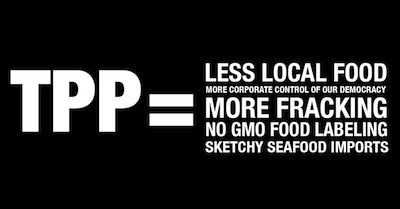
Clauses on dispute settlement in earlier free trade agreements have been invoked to challenge efforts to regulate big business. The fossil fuel industry is seeking to overturn Quebec’s ban on the ecologically destructive practice of fracking. Veolia, the French behemoth known for building a tram network to serve Israeli settlements in occupied East Jerusalem, is contesting increases in Egypt’s minimum wage. The tobacco maker Philip Morris is suing against anti-smoking initiatives in Uruguay and Australia.

The TPP would empower not just foreign manufacturers but foreign financial firms to attack financial policies in foreign tribunals, demanding taxpayer compensation for regulations that they claim frustrate their expectations and inhibit their profits.

Preempting Government Sovereignty

What is the justification for this encroachment on the sovereign rights of government? Allegedly, ISDS is necessary in order to increase foreign investment. But as noted in The Economist, investors can protect themselves by purchasing political-risk insurance. Moreover, Brazil continues to receive sizable foreign investment despite its long-standing refusal to sign any treaty with an ISDS mechanism. Other countries are beginning to follow Brazil’s lead.

In an April 22nd report from the Center for Economic and Policy Research, gains from multilateral trade liberalization were shown to be very small, equal to only about 0.014% of consumption, or about $.43 per person per month. And that assumes that any benefits are distributed uniformly across the economic spectrum. In fact, transnational corporations get the bulk of the benefits, at the expense of most of the world’s population.

Something else besides attracting investment money and encouraging foreign trade seems to be going on. The TPP would destroy our republican form of government under the rule of law, by elevating the rights of investors – also called the rights of “capital” – above the rights of the citizens.

That means that TPP is blatantly unconstitutional. But as Joe Firestone observes, neo-liberalism and corporate contributions seem to have blinded the deal’s proponents so much that they cannot see they are selling out the sovereignty of the United States to foreign and multinational corporations.

For more information and to get involved, visit:

Flush the TPP

The Citizens Trade Campaign

Public Citizen’s Global Trade Watch

Eyes on Trade

__________________

Ellen Brown is an attorney, founder of the Public Banking Institute, and author of twelve books including the best-selling Web of Debt. Her latest book, The Public Bank Solution, explores successful public banking models historically and globally. Her 300+ blog articles are at EllenBrown.com.