Prostitutes of the Press

By Stephen Lendman

Source: The Stephen Lendman Blog

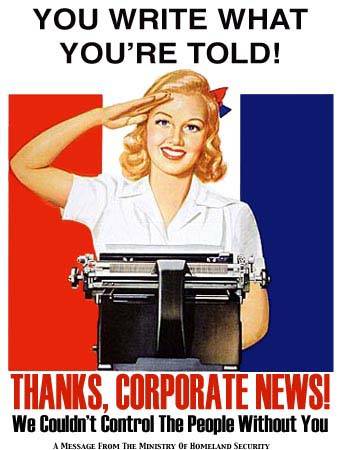
Western MSM operate as fake news ministries of truth in nations where they’re located.

They’re bribed with big bucks to lie and mass-deceive by sticking exclusively to the fabricated official narrative.

On major world and national issues, what’s reported on TV, radio or in print is based on state-approved talking points.

Orwell long ago explained today’s reality, his no longer fiction dystopian “1984” novel saying the following:

“The Ministry of Peace concerns itself with war, the Ministry of Truth with lies, the Ministry of Love with torture and the Ministry of Plenty with starvation.” 

“These contradictions are not accidental, nor do they result from from ordinary hypocrisy.”

“They are deliberate exercises in doublethink.”

Orwell’s Ministry of Truth was all about controlling the message, eliminating whatever conflicts with it, memory holes used for this purpose.

What’s suppressed is “whirled away (in) enormous furnaces…devoured by flames,” Orwell, adding:

“(T)here were the directing brains who co-ordinated the whole effort and laid down policy which made it necessary that this fragment of the past should be preserved, that one falsified, and the other rubbed out of existence.”

No memory holes are needed today throughout the decadent, depraved West.

MSM operate as willing co-conspirators in support of manipulating the public mind with rubbish unfit to print or report electronically.

A daily diet of fake news over the real thing includes drug pushing by heavily promoting health-destroying kill shots, the scourge of Nazism in Ukraine and use of its criminal class for perpetual war on Russia because it’s free from hegemon USA control.

Truth and full disclosure are mortal enemies of peace, equity, justice, imperial rampaging and the rule of law.

So MSM are used to suppress what conflicts with the fabricated official narrative in support of hegemon USA-dominated NATO’s war on humanity domestically and worldwide.

Russia and China are targeted for regime change because they alone stand in the way of the US war party’s drive for unchallenged hegemony by a policy of perpetual war-making on invented enemies.

Throughout the US/West, free and open societies, including democracy as it should be, are virtually banned.

Nor do their ruling regimes tolerate these notions anywhere, targeting them for elimination where exist.

Yet state-approved MSM-proliferated fake news, information and opinion pretend otherwise.

Turning reality on its head and trampling on it, they pretend that Nazi-infested Ukraine is democratic, that its battered and degraded military is defeating overwhelmingly superior Russian firepower.

And well over $100 billion worth of weapons, munitions and equipment supplied to Ukrainian Nazis by US/Western regimes since 2014 were largely destroyed by Russia or resold by Kiev kleptocrats for self-enrichment.

Unable to defeat Russia’s military superiority on the battlefield, regime troops largely focus on terror-shelling of its residential areas in Donetsk, Lugansk and elsewhere to kill, injure and terrorize noncombatants in harm’s way.

Yet US/Western regimes, Kiev Nazis and their MSM press agents falsely blame Russia for war crimes committed against the state and its people.

There’s been no ambiguity about the ability of Russian forces to demilitarize and deNazify Ukraine from day-one of its liberating SMO.

And sanctions war on Russia by US/Western regimes is deindustrializing Europe as planned by the empire of lies, while leaving the Russian Federation largely unscathed. 

Separately on Wednesday, Sergey Lavrov stressed the following:

Hegemon USA-dominated Western regimes “closed ranks” against Russia.

“Their mentality of domination” is hard-wired with no signs of “moderat(ing).”

Russia is “at war with the collective West led by” nuclear armed and recklessly dangerous USA.

“China is next in line.”

“It poses the most formidable and systemic longterm challenge and is the only country capable of surpassing (hegemon USA) in almost all areas” to eventually become the dominant world power politically, economically, financially and militarily.

The notion has both wings of the US war party planning for war on a nation it cannot win.

Yet with Taiwan as an invented pretext like Ukraine is used against Russia, the threat of war on China by the empire of lies is ominously real. 

Built on a one-China foundation a half century ago, normalized Sino/US relations no longer exist.

A state of war exists by hegemon USA against nonthreatening Russia, China earmarked for regime change by its war party in similar fashion.

Brave new dystopian world order proponent/notorious international con man, George Soros, once said we need a global sheriff.

Did he have hegemon USA or himself in mind by enforcing a policy of perpetual war on humanity?

Questioning The Official Story About Official Stories: A Role for Citizen Investigations

By Time Hayward

Source: Tim Hayward Blog

Official stories, according to the official story about them, are (nearly) always true. The ‘nearly’ gets mentioned just because, on rare occasions, an official story is acknowledged to have been wrong, as, for instance, with Iraq’s falsely alleged weapons of mass destruction in 2003. But that’s considered an exception to the rule, and to extrapolate from it to a more pervasive mistrust is to be foolish, ill-informed or even a dupe of hostile propaganda. In fact, diagnosing what is wrong with sceptics about official stories, and proposing ways of curing or otherwise dealing with them, are now becoming a growth industry in the media and academia. So we hear a lot about how dissenting from official narratives is to fall victim to ‘conspiracy theory’ or ‘disinformation’; and dissenters may be diagnosed as needing re-education or even psychological help. As for the dissent itself, this is increasingly subject to censure and censorship.

However, a major question is left unaddressed: What is it that’s supposed to make official stories so credible?

The assumption is that official stories are produced by people with relevant expert knowledge, so disputing them is a product of ignorance; and since experts have credentials, experience and the backing of competent institutions, rejecting their expertise is unwise or even delusional. Also assumed is that official stories are generally produced and disseminated in good faith.

But are those assumptions generally warranted? In probing their grounds we are brought to question whether the official meta-story, as we may call it, overstates reasons for automatically accepting official stories and underestimates the competence that members of the public can bring to independent inquiries.

Why Believe Official Stories?

No serious thinker would suggest that an official story should be believed just because it comes from officials. Indeed, use of the very expression ‘official story’, in practice, tends to imply that there is also some alternative story that does not have the backing of officials but might be more credible. We know, too, that many societies from various times and places have maintained order by invoking all manner of mythological stories, ideological stories, and blatantly discriminatory stories. Sometimes this has meant denying, suppressing or persecuting as heretics people engaged in rigorous intellectual questioning of officialdom.

A more plausible reason for believing official stories has been set out by the philosopher Neil Levy (2007). He points out that we all know most of the things we know in life because we have learned them from others: our direct personal experience of the world is extremely limited compared to the expanse of our general knowledge and the intricacies of our more specialist understandings. We rely on the testimony and good faith of others in almost everything we do, so just to live a normal life in society we trust a wide range of institutions and social arrangements. To doubt their general dependability would contradict the tacit assumptions that get us through life and would render inexplicable how even a tolerably well-ordered society could ever be possible.

The force of that consideration is strong, but not absolute – and how strong also depends on what kinds of communication we are referring to as official stories. It is strongest if one uses the term to refer to all public communications that emanate from an official source. In actual usage, however, that is not how the term ‘official story’ is normally understood. We don’t regard it as an ‘official story’ that to get a passport you need to submit an authenticated photograph of yourself; we don’t regard it as an ‘official story’ that in UK cars are to be driven on the left; and nor do we these days regard it as an ‘official story’ that smoking is bad for our health. By far the greater part of public pronouncements, like these, are simply taken to state how matters stand. When the distinctive term ‘official story’ occurs, it is typically in contexts where a public pronouncement has met with scepticism. So, for example, whereas we seldom nowadays hear the rationale for mandating wearing seatbelts in cars referred to as an ‘official story’, because there is no longer serious dissent, recent claims that the rationale for mandating mRNA injections against SARS-Cov2 was substantially comparable to that for seatbelts encountered resistance: the ‘official story’ about the benefits and safety of the mRNA injections has been subject to criticism from some sections of medical and scientific communities.

Of course, the mere fact of scepticism in some quarters does not mean that a given official story is necessarily mistaken, but it does highlight how an official story is not just an uncontroversial statement of how matters stand. It leads thoughtful people to look more closely at the nature of authority claimed for an official story.

Are There Experts in Expertise?

The authority claimed for official stories derives, as Levy explains, from the fact of being produced by ‘people socially acknowledged as the relevant experts on a topic’ (Levy 2022). Relevance here is understood in terms of knowledge and experience relating to the salient subject matter. However, certain people might officially be appointed as relevant experts, on other bases, such as known affinities with the organisation’s mission. So it is possible for designated experts to support an official story while a number of other people with materially relevant knowledge and experience take a quite different view.

Even among designated expert advisers, however, achieving an authoritative consensus on the kind of matter that official stories relate to is not straightforward. This is for reasons similar to those involved in giving policy advice (see e.g. Grundmann 2017). Insofar as an official story appeals to a scientific basis, it should be borne in mind that findings of science – a process of open, collaborative and progressive inquiry – have a provisional status, with all scientific statements being in principle corrigible. This means that a scientific adviser’s confidence can never be completely unconstrained or unhedged. Zeynep Panuk (2021) refers to a ‘paradox of scientific advice’ that arises from the difficulties of basing decisions on scientific knowledge that is almost always uncertain and subject to disagreement. Panuk cites experience of how overconfident scientists in advisory committees may suppress dissent so as to present a consensus view, only to find that its implementation had unfortunate or even disastrous consequences. Recent experiences of overconfident pronouncements on ‘The Science’ during the Covid pandemic have furnished further examples (Miller 2022Nelson 2022).

The kind of controversy for which an ‘official story’ comes into play will not normally reduce to some specialist detail of basic science, or even a collection of these, but will concern a situation involving many factors – including those pertaining to social organisation, human action and decision-making. Such situations are similar to those where policy advice is sought from scientific experts (SAPEA 2019 Ch. 2; Martin et al 2020). Official stories are seldom if ever straightforward statements of scientific opinion on a single well-defined scientific research question: they typically relate to situations where many interacting variables may not all be clearly disaggregable. There is in principle no necessary reason why an independent and unofficial grouping of investigators with materially relevant expertise might not be as well-suited to an inquiry as an official grouping. In fact, challenges to official stories can sometimes draw on impressive constellations of expertise.

Citizen Investigations

If the official meta-story may overestimate the dependability of designated expert advice, it may also underestimate the investigative competence of ordinary citizens. For challenges to official stories can be mustered not just by isolated individuals, caricatured as ‘doing their own research’ while ‘reading things on the internet,’ but by well-informed collaborative groups. These can be better able to track truths than independent individuals: ‘the superiority of the group over the individual does not require that one member has the right answer prior to deliberation: group deliberation may enable the aggregation of the genuine insights of several members and the rejection of the false hypotheses of some of the same individuals.’ (Levy 2019: 316)

Furthermore, if it is the case that ‘[g]roups of individuals who are strangers to one another are better at tracking truths than groups of individuals who have a shared history’ (Levy 2019: 318) then this is an advantage of groups comprising people who come together in cyberspace from all walks of life and may have little or no biographical information about those they connect with. Citizens doing their own research sometimes start their own Wikis, or form groups on Reddit, or informally deliberate via Twitter or Telegram. Sometimes they create investigative collectives offline.

It was from participating in chatrooms, for instance, that the now much-feted organisation Bellingcat originated: its founder, Eliot Higgins, a gamer-turned-investigative-citizen, would review copious amounts of war footage from his sofa in Leicester and discuss his observations in chatrooms. The work of his investigative collaborative has come to be ‘commended in the global media and by global agencies such as Amnesty International and Human Rights Watch.’ (Nguyen and Scifo 2018: 377) Impressed by the methods of ‘open source intelligence’ (D’Alessandra and Sutherland 2021), curators of official stories in the West – particularly those relating to geopolitical issues involving Russia – have bestowed accolades on Bellingcat, along with generous funding and encouragement.

So, there is precedent for treating citizens’ investigations as authoritative. Other groups of citizen investigators, that do not receive any funding, have mounted significant challenges to some of the West’s own official stories. Thus, directly countering Bellingcat, on occasion, is the Working Group on Syria, Propaganda and Media which has earned the confidence of whistleblowers rather than officials (OPCW 2020).

Aside from the benefits of collaboration, the reality of serious dissent in the digital sphere is that it can involve myriad critical individuals with significant independent claims to epistemic authority in their professional fields and who exhibit judicious awareness of both their own limitations and the value of others’ insights. For instance, challenging various official narratives are whistleblowers who include scientists, diplomats, intelligence officers, and various state or corporate employees. Challenges come too from professionals with relevant specialist expertise across fields like medicine, architecture, engineering, pharmaceuticals, and a gamut of others. Also worth highlighting are those journalists with previous careers in mainstream media organisations who found they could only maintain their professional integrity by becoming independent.[1] When a group of people independently deliberating together can include, for instance, a former head of a nation’s armed services, a UN weapons inspector, a senior diplomat, an intelligence officer, a world leading International Relations expert and a seasoned war correspondent, the insights they generate regarding situations relevant to foreign policy may well be no less sound than those informing the official story.[2] Indeed, in virtue of their freedom from institutional constraints, they may be more reliably informative for the public than the official story.

If serious challenges to official stories have become more prevalent in recent years, as they arguably have, this is likely due in good part to the sheer extent to which mainstream media have excluded the voices of experts who, maintaining their professional integrity and independence in the face of sometimes considerable hostility, have continued to articulate their challenges to official stories. Attentive members of the public notice this – just as they notice when the force of the state is brought to bear on those who bring to light its lies and malfeasance, and not only in high profile cases like Edward Snowden, Chelsea Manning, Katharine Gun or Julian Assange.

Part of the official meta-story currently is that the internet and social media are being flooded by targeted disinformation that is misleading and confusing people. However, from another perspective one might see that thanks to digital communications citizens can become aware of arguments developed by other experts which are suppressed by protectors of an ‘official story’. An example would be the authors of the Great Barrington Declaration (GBD) (2020), advocating an approach to dealing with the Covid situation characterized as ‘focused protection’ instead of the officially promoted lockdown approach. Lay persons may not be able to adjudicate first hand between recommendations from the GBD and the John Snow Memorandum (2020), which defended lockdown, but they can understand enough to know that the latter does not command an unproblematic consensus such as would be rational simply to defer to. Members of the public can assess the trustworthiness of expertise and official stories without a high level of technical knowledge, as science studies scholars have shown (Yearley 2005; Hess 2012).

People understand that if a view is suppressed rather than openly addressed and rebutted the reason might be that it cannot be rebutted. If an attentive public observes that dissent is simply treated as inadmissible, and especially if those formulating it are subject to smearing or censorship, then there is a corresponding diminution of public trust in the orthodox view.

Tension At The Heart of An Official Story

If the claim that the authority of an official story derives from an expert consensus can be questionable, something more certain is that an official story is asserted with the kind of authority that comes with power. People may defer to an official story not because they necessarily find it credible but out of a prudent concern to avoid the costs of dissidence. Those with power can also incentivise wider media of communication to stick to the narrative. This difference between epistemically earned authority and politically declared authority is a tension at the heart of official stories. Understanding it helps explain why we find a good many journalistic and scholarly studies of the supposed pathologies of dissident citizens and rather little reflection on the real nature of the authority of official stories.

Today we find a welter of studies of online ‘disinformation’ that trace webs of connection across cyberspace seeking to link influential dissenting accounts on social media with bots and trolls associated with malign actors. These communications are said to be engaged in strategically. That is, their aim is to persuade the public to accept a pre-established story rather than to allow people to determine, through open deliberations, what the most credible story is.

Yet this is exactly what the promulgators of official stories themselves do. Regardless of whether the content of a given official story is reliable or not, the form of an official story – in virtue of fulfilling its official function – is that of a strategic communication. Its communication, as official, is presented as a matter not for deliberation but for public acceptance. It is not submitted to public scrutiny with an implicit invitation for critical feedback. It is not up for discussion. It is communicated not to advance debate but to settle it.

This is the inherent tension in an official story: its assertion of epistemic authority depends on an implicit claim that it can be backed by processes of deliberative reasoning, but the pronouncement of an official story as a settled opinion curtails any such process.

What this means in practice has been illustrated, for instance, in the situation arising with the UK Government’s Covid response, which professedly aimed to ‘Follow The Science’ (Stevens 2020). This notion can only ever be ‘a misleading oversimplification’ of what it means to base policy on science (Abbasi 2020), and when UK government ministers claimed to be ‘guided by the science’, what they meant in practice was being guided by their scientists: ‘Ministers formed strong relationships with key scientific advisors, relied on evidence from their Scientific Advisory Group for Emergencies (SAGE), and ignored or excluded many other sources.’ (Cairney 2021) Thus a policy of public communications was decided on the basis of a selective interpretation of scientific findings. But more than this, instead of caution in the face of uncertainty, a policy of robustly promoting a particular view involved the use of psychological operations of a kind more normally associated with a war effort than with public health advice (Sidley 2021, 2022).

Unfortunately, as that example also showed, the defence of an official story against criticism can include counter-measures taken to smear and discredit dissenters. This is never an edifying approach, but is especially troubling when it involves discrediting serious critics who have their own credible claim to epistemic authority. This was illustrated in the case of the eminent scientists who signed the Great Barrington Declaration. They were widely vilified not only in the media but even by other academics, for pointing to certain established principles of epidemiology – including those developed over the two preceding decades of pandemic preparedness planning – that were being set aside and overridden by policy-makers on the basis of modellers’ projections in favour of a ‘zero-covid’ strategy (Ioannidis 2022). This vilification involved not only overt smearing but also something more insidious, namely, the pre-emptive dismissal of their views – notwithstanding their impeccable academic pedigree – as too far ‘beyond the pale’ to warrant serious consideration (HART 2022).

This situation showed that the other institutions of civil society, including the media and academia, which the official meta-story claims provide critical scrutiny, can in fact simply amplify official strategic communications. Thus the organisations that Levy recommends we rely on as guarantors of the authors of official stories can in reality see it as their responsibility to promote and defend the official story rather than question it. Public perceptions that this is the case are accompanied by a deficit of trust in the media and institutions more generally.

The official meta-story blames ‘conspiracy theorists’ and other critical questioners for this lack of trust. But perhaps that gets things the wrong way round.

Conclusion

Trust is something that has to be won, and, if betrayed, it can be lost. As the public’s trust in official stories diminishes, the official meta-story looks to blame this on ‘conspiracy theorists’ and other ‘disruptive influences’. Perhaps a more credible story about official stories would include serious reflection on how they might be made more transparently trustworthy.

Meanwhile, it is reasonable to suggest that each serious challenge to an official story should be assessed on its merits. This does not mean being swayed by extravagant contrarian hypotheses, since these should be treated with even more caution, and, when appropriate, summarily rejected. It does mean being duly aware of how the presumption in favour of official stories is necessarily defeasible. That is the case not just because any story may prove to be mistaken, even in all good faith, but also because we know that any organisation with politically-conferred authority is liable at times to come under political pressures that may, in certain circumstances, override scruples of honesty.

References

Abbasi, Kamran. 2020. ‘Covid-19: politicisation, “corruption,” and suppression of science’. BMJ; 371:m4425, 13 November: doi:10.1136/bmj.m4425   

Cairney, Paul. 2021. ‘The UK Government’s COVID-19 Policy: What Does “Guided by the Science” Mean in Practice?’ Frontiers in Political Science 315 March.https://www.frontiersin.org/articles/10.3389/fpos.2021.624068 DOI: 10.3389/fpos.2021.624068

D’Alessandra, Federica and Kirsty Sutherland. 2021. ‘The Promise and Challenges of New Actors and New Technologies in International Justice’. Journal of International Criminal Justice, 19(1): 9–34. https://doi.org/10.1093/jicj/mqab034

Great Barrington Declaration. 2020. https://gbdeclaration.org/

Grundmann, Reiner. 2017. ‘The Problem of Expertise in Knowledge Societies’. Minerva 55, 25–48 (2017). https://doi-org.ezproxy.is.ed.ac.uk/10.1007/s11024-016-9308-7

HART [Health Advisory and Recovery Team]. 2022. ‘The crushing of dissent throughout the covid era’, 8 October: https://www.hartgroup.org/the-crushing-of-dissent-throughout-the-covid-era/

Hess, David J. 2012. Science Studies: An Advanced Introduction. New York: NYU Press.

Ioannidis, John P. 2022. ‘Citation impact and social media visibility of Great Barrington and John Snow signatories for COVID-19 strategy.’ BMJ Open 2022;12:e052891. doi:10.1136/ bmjopen-2021-052891

John Snow Memorandum. 2020. https://www.johnsnowmemo.com/

Levy, Neil. 2007. ‘Radically Socialized Knowledge and Conspiracy Theories’, Episteme 4(2): 181-192.

Levy, Neil. 2019. ‘Due deference to denialism: explaining ordinary people’s rejection of established scientific findings’. Synthese 196: 313-327.

Levy, Neil. 2022. ‘Do Your Own Research!’ Synthese 200: 356. https://doi.org/10.1007/s11229-022-03793-w

Martin, Graham P., Esmée Hanna, Margaret McCartney and Robert Dingwall. 2020. ‘Science, society, and policy in the face of uncertainty: reflections on the debate around face coverings for the public during COVID-19’. Critical Public Health 30:5: 501-508, DOI: 10.1080/09581596.2020.1797997

Miller, Ian. 2022. Unmasked: The Global Failure of COVID Mask Mandates.

Nelson, Fraser. 2022. ‘The lockdown files: Rishi Sunak on what we weren’t told.’ The Spectator, 27 August: https://www.spectator.co.uk/article/the-lockdown-files-rishi-sunak-on-what-we-werent-told/

Nguyen, An and Salvatore Scifo. 2018. ‘Mapping the Citizen News Landscape: Blurring Boundaries, Promises, Perils, and Beyond.’ In Journalism, edited by Tim P. Vos. Berlin/Boston: De Gruyter.

OPCW [Organisation for the Prohibition of Chemical Weapons]. 2019. ‘Report Of The Fact-Finding Mission Regarding The Incident Of Alleged Use Of Toxic Chemicals As A Weapon In Douma, Syrian Arab Republic, On 7 April 2018.’ OPCW Technical Secretariat S/1731/2019: https://www.opcw.org/sites/default/files/documents/2019/03/s-1731-2019%28e%29.pdf

Panuk, Zeynep (2021) ‘COVID-19 and the Paradox of Scientific Advice.’ Perspectives on Politics 20(2): 562-576. DOI: https://doi.org/10.1017/S1537592721001201

SAPEA [Science Advice for Policy by European Academies]. 2019. Making sense of science for policy under conditions of complexity and uncertainty. Berlin: SAPEA. https://doi.org/10.26356/MASOS 

Sidley, Gary. 2021. ‘A Year of Fear.’ The Critic 23 March: https://thecritic.co.uk/a-year-of-fear/

Sidley, Gary. 2022. ‘Britain’s unethical Covid messaging must never be repeated.’ The Spectator 6 February: https://www.spectator.co.uk/article/britain-s-unethical-covid-messaging-must-never-be-repeated/

Stevens, Alex. 2020. ‘Governments cannot just ‘follow the science’ on COVID-19’. Nature Human Behaviour 4, 560: https://doi.org/10.1038/s41562-020-0894-x

Yearley, Steven. 2005. Making Sense of Science: Understanding the Social Study of Science. Thousand Oaks, CA: Sage.


[1] This is the case, for instance, with Jonathan Cook (formerly of The Guardian), Chris Hedges (formerly with the New Yorker), John Pilger (award-winning documentary film maker), and the late Robert Parry who founded the independent outlet Consortium News.

[2] This is to characterize part of the composition of the Berlin Group 21 that has produced the Statement of Concern relating to whistleblowers from the OPCW. See https://berlingroup21.org/ and associated press release: https://www.einnews.com/pr_news/538579944/leading-international-voices-call-on-opcw-and-its-scientific-advisors-to-allow-all-douma-investigators-to-be-heard

Hunting the Twitter Files

Legacy Media Censor Details About Censorship

By Nolan Higdon

Source: Project Censored

More than two years since Big Tech made the historic decision to limit access to the New York Post’s story about President Joe Biden’s son Hunter, users are getting a glimpse into how Twitter came to that decision. However, delusional legacy and social media outlets are doing everything they can to misrepresent and bury the consequential details of the process.

An October 2020 New York Post story titled “Smoking-gun email reveals how Hunter Biden introduced Ukrainian businessman to VP dad” offered sensationalistic photos and details of Hunter’s addiction issues coupled with damning emails indicating that Hunter utilized his connection with his father to curry favor and economic opportunity in foreign countries. At the time, intelligence officials told members of the press that the story was Russian propaganda aimed at influencing that year’s election. As a result, Big Tech platforms limited access to the story including in direct messages which is usually done only in extreme cases such as child pornography.

On Friday, December 2, 2022, Elon Musk promised to release files related to the matter. Soon afterward, journalist Matt Taibbi published a report based on thousands of internal Twitter documents. Taibbi demonstrated that Twitter’s decision to remove the Hunter Biden story was influenced in part by Biden’s campaign. Indeed, as Taibbi described, Twitter’s staff regularly fields phone calls from powerful people in government and acts upon their requests to moderate content. And it’s is not just Twitter. During a 2022 interview with Joe Rogan, co-founder, chairman, and CEO of Meta (formerly Facebook) Mark Zuckerberg admitted that his company’s decision to moderate content – including the 2020 Hunter story – is sometimes based on recommendations from the intelligence community. Similarly, The Intercept reported in 2022 that the Department of Homeland Security regularly informs Big Tech’s content moderation practices.

In any other country, the revelation that government and Big Tech collude to shape public discourse and democratic participation would make Americans irate, but the story has received little coverage. The coverage received by legacy media has been dismissive. CNN reduced the files as simply showing “how employees debated how to handle 2020 New York Post Hunter Biden story.” Variety echoed the same sentiments. Meanwhile, giving readers less than 24-hours to process what Taibbi reported, WAPO declared that Musk’s Twitter Files “haven’t changed minds.”

The lack of substantive coverage of the Twitter Files is rooted in the legacy media’s fears over the broader implications of the story. Since 2015, legacy media have been fostering a moral panic over fake news and blamed their competition – digital media – for its spread. They have practically begged Big Tech overlords to fix the country and restore faith in journalism by censoring problematic content, which they often refer to as misinformation or disinformation. Taibbi’s reporting demonstrates that the news media’s framing of Big Tech content moderation as a solution to anti-democratic practices, actually functioned as an anti-democratic position that enables the elite political class to shape public dialogue and manufacture consent of the electorate.

Adding to the news media’s inability to cover the story is their business model which depends on framing every story as an issue of left versus right, blue versus red, Democrat versus Republican. Indeed, whether it is cable news audiences or legacy newspaper subscribers, news outlets cater to audiences’ confirmation biases by villainizing a caricature of the “otherside.” This has reduced every story to a partisan issue, and fostered such high levels of hyper-partisanship vitriol that half of Americans cite “other Americans” as their number one fear, while 40% contend that a civil war will occur in their lifetime.

Although they still try, the legacy media has found it impossible to frame the Twitter Files as a hyper-partisan story because the political duopoly, not one party, utilizes Big Tech to manufacture the consent of the people. For example, Big Tech’s content moderation of was influenced by Biden’s Campaign in 2020 and leading Democrats after January 6th. Similarly, Donald Trump’s campaign spent $100 million to work with Facebook staff to amplify their campaign messages, and Trump met personally with Zuckerberg in secret meetings throughout his presidency. Furthermore, legacy news media outlets cannot villainize the “other side” for censorship when loyalists for both parties are complicit. Indeed, the feckless liberals who begged Big Tech overlords to censor content about elections and Covid-19 are equally complicit as the neocons who championed censorship of the press and individuals, and organizations during the War on Terror and Trump supporters who lauded his attacks on the free press and whistleblowers such as Julian Assange.

Anyone can, and will, argue that Hunter’s photos are not newsworthy, but that is for the citizens to decide when they encounter the story. That is how a free press in a democratic republic works. A democracy does not depend on Big Tech overlords acting at the behest of the political class to determine what content the public should see. The notion that censorship will erode hate, correct falsehoods, or solve national problems is a fallacy of utmost proportions.  The contemporary censorious crowd seems to be in such a state of delusion that they have come to believe that World War II and the Holocaust could have been avoided if Twitter was around to censor Nazis. It is ludicrous and the establishment news media deserve part of the blame for perpetuating this lunacy.

A truly independent press would privilege narratives that expose Silicon Valley propaganda, which has led users of all political ideologies to a delusional state of Stockholm Syndrome, where Big Tech exploits their labor, erodes their privacy, and manufactures their consent for the duopoly, but users still laud and entrust the industry with their democracy. To be clear, Big Tech commercialized tools that were developed by the military industrial complex during the Cold War (which was not so cold in much of the world) to surveil and exploit users. They advertised their platforms as transformative tools that strengthen democracy and inclusion. As whistleblower after whistleblower remind us, this is all nonsense: Big Tech’s oligarchs are rapacious capitalists who time and time again put profits over people. No entity should be moderating information in a democracy, and as the Twitter Files reveal, the unaccountable profiteers in Big Tech are no exception.

Related Video:

AP Editor Said She “Can’t Imagine” A US Intelligence Official Being Wrong

By Caitlin Johnstone

Source: CaitlinJohnstone.com

The Associated Press journalist who reported a US intelligence official’s false claim that Russia had launched missiles at Poland last week has been fired.

As we discussed previously, AP’s anonymously sourced report which said “A senior U.S. intelligence official says Russian missiles crossed into NATO member Poland, killing two people” went viral because of the massive implications of direct hot warfare erupting between Russia and the NATO alliance. AP subsequently retracted its story as the mainstream political/media class came to accept that it was in fact a Ukrainian missile that had struck Poland.

AP’s firing of reporter James LaPorta looks at this time to be the end point of any accountability for the circulation of this extremely dangerous falsehood. AP spokesperson Lauren Easton says no disciplinary action will be taken against the editors who waved the bogus story through, and to this day the public has been kept in the dark about the identity of the US official who fed such extremely egregious misinformation/disinformation to the public through the mainstream press.

It is utterly inexcusable for AP to continue to protect the anonymity of a government official who fed them such a profoundly significant falsehood. This didn’t just affect AP staff, it affected the whole world; we deserve to know what happened and who was responsible, and AP has no business obstructing that knowledge from us.

LaPorta’s firing looks like this is yet another instance where the least powerful person involved in a debacle is being made to take the fall for it. A powerful intelligence official will suffer no consequences for feeding false information to the press — thereby ensuring that it will happen again — and no disciplinary action will be taken against LaPorta’s superiors, despite the absolute buffoonery that subsequent reporting has revealed on their part.

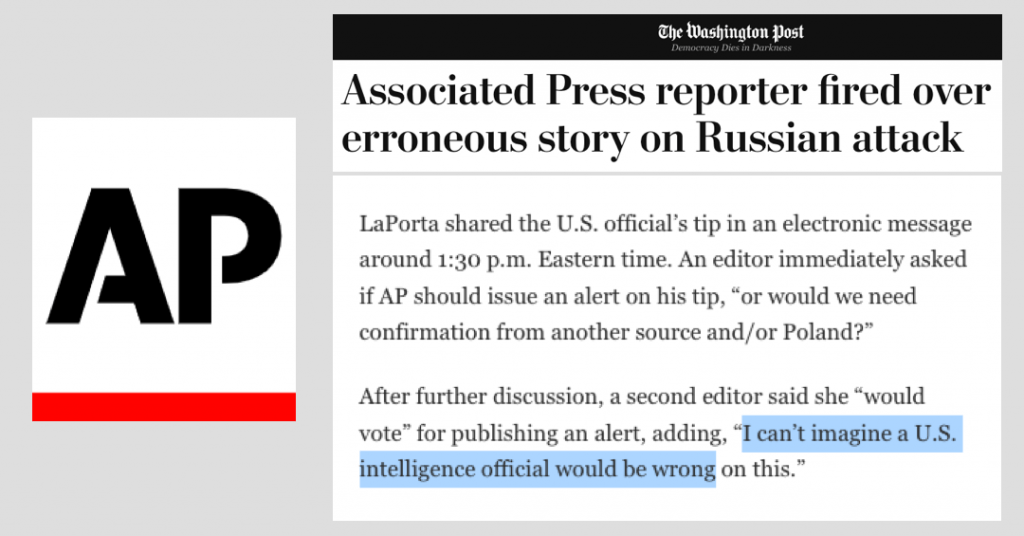
In an article titled “Associated Press reporter fired over erroneous story on Russian attack,” The Washington Post reports the following (emphasis added):

Internal AP communications viewed by The Post show some confusion and misunderstanding during the preparations of the erroneous report.

LaPorta shared the U.S. official’s tip in an electronic message around 1:30 p.m. Eastern time. An editor immediately asked if AP should issue an alert on his tip, “or would we need confirmation from another source and/or Poland?”

After further discussion, a second editor said she “would vote” for publishing an alert, adding, “I can’t imagine a U.S. intelligence official would be wrong on this.”

“I can’t imagine a US intelligence official would be wrong on this.”

Can you imagine not being able to imagine a US intelligence official being wrong? This would be an unacceptable position for any educated adult to hold, much less a journalist, still less an editor, and still less an editor of one of the most influential news agencies on earth.

These are the people who publish the news reports we read to find out what’s happening in the world. This is the baby-brained level of thinking these people are serving the public interest with.

Antiwar commentator Daniel Larison writes the following of the AP editor’s shocking quote:

Skepticism about official claims should always be the watchword for journalists and analysts. These are claims that need more scrutiny than usual rather than less. If you can’t imagine that an intelligence official could get something important wrong, whether by accident or on purpose, you are taking far too many things for granted that need to be questioned and checked out first.

Intelligence officials of many governments feed information to journalists and have done so practically ever since there was a popular press to feed information to, and that information certainly should not be trusted just because an official source hands it over. It is also always possible for intelligence officials to just get things wrong, whether it is because they are relying on faulty information or because they were too hasty in reaching conclusions about what they think they know.

Whether the AP’s source was feeding them a line or was simply mistaken, a claim as provocative and serious as this one should have been checked out much more thoroughly before it got anywhere near publication. The AP report in this case seems to have been a combination of a story that was “too good to check” and a culture of deference to official sources in which the editors didn’t feel compelled to make the effort to check.

Indeed, the only reason the press receive such explicit protections in the US Constitution is because they are supposed to hold the powerful to account. If the editors of a wildly influential news agency will just unquestioningly parrot whatever they are fed by government officials while simultaneously protecting those officials with anonymity, they are not holding the powerful to account, and are in fact not meaningfully different from state propagandists.

They are state propagandists. Which is probably why they are sipping lattes in the AP newsroom while Julian Assange languishes in prison.

As Jacobin’s Branko Marcetic observed, this is far from the first time AP has given the cover of anonymity to US government officials circulating bogus claims of potentially dangerous consequence, like the time it reported an official’s evidence-free assertion which later proved false that Iran had carried out an attack on four oil tankers off the coast of the United Arab Emirates, or the time it let another one anonymously claim that “Iran may try to take advantage of America’s troop withdrawals from Iraq and Afghanistan.”

So to recap  —

  • Powerful government official who fed AP a false story: Zero accountability
  • AP editor who asked if a report should immediately be published upon receipt of the story: Zero accountability
  • Second AP editor who says she can’t imagine a U.S. intelligence official would be wrong:  Zero accountability
  • Journalist who wrote the story: Singular accountability

In a sane society, power and responsibility would go hand in hand. A disaster would be blamed on the most powerful people involved in its occurrence. In our society it’s generally the exact opposite, with the rank-and-file taking all of the responsibility and none of the power.

Our rulers lie to us, propagandize us, endanger us, impoverish us, destroy journalism, start wars, kill our biosphere and make our world dark and confusing, and they suffer no consequences for it. We cannot allow them to continue holding all of the power and none of the responsibility. This is backwards and must end.

The Military Industrial Complex Wants You To Be More Media (l)literate!

By Nolan Higdon

Source: Project Censored

A September 2022 report from Tessa Jolls, president of the Center for Media Literacy, titled “Building Resiliency: Media Literacy as a Strategic Defense Strategy for the Transatlantic,” read like a blueprint for how to indoctrinate students in corporatism and militarism under the auspices of  media literacy education. Jolls received a Fulbright-NATO Security Studies Award to study “aspects of the current information ecosystem and the state of media literacy in NATO countries.”

For historical context, the North Atlantic Treaty Organization (NATO) was created after World War II during the Cold War and has long since outlived its stated purpose of stopping the spread of communism. Indeed, as political sociologists such as Peter Phillips have noted, NATO has morphed into a global army that engages in questionable conflicts and other human rights abuses in an effort to serve the “transnational capitalist class.” 

Just like the crisis of “fake news,” media literacy can and is being weaponized by organizations and individuals seeking to increase their power by influencing the public’s perception of reality. For example, Steve Bannon, former White House Chief Strategist for President Donald Trump has a long history of spreading false information. Form 2012-18, he was the executive chairman of Breitbart’s website which has been caught manipulating videosmanufacturing stories, and spreading baseless conspiracies. Starting with Bannon’s tenure, Breitbart published articles lauding media literacy as a way to combat “fake news,” while touting that its founder, Andrew Breitbart, integrated media literacy into the platform. However, their consistent spreading of false information seems to run counter to traditional definitions of media literacy. 

The standard U.S. definition of media literacy is “the ability to access, analyze, evaluate, create, and act using all forms of communication.” In response to the post-2016 moral panic over fake news, there was a demand for more media literacy education in schools. This provided a window of opportunity for media companies – which had long sought to enter the classroom to advertise products and collect student data- to move at rapid speed to indoctrinate students with their corporate propaganda. 

Jolls’ report aids these efforts by arguing that corporations’ “allocations for media literacy education are few and far between.” Jolls’ report speaks to the military industrial complex when it calls for “funding and programming from all corners: government, foundations, and the private sector (tech and media companies, other corporations).” The military industrial complex refers to the relationship between the military and related defense and national security industries. In fact, Big-Tech emerged from and continues to serve the same military industrial complex. 

Rather than advocate for a critical media literacy education that would account for the power dynamics invested in NATO and its long history of working against democracy and social justice, Jolls’ lauds the “values that NATO states” arguing that they represent an “excellent foundation” for “media literacy initiatives.” To normalize NATO values in the educational process, Jolls suggests what amounts to a psychological operations campaign (PSYOP) to spread NATO’s version of media literacy to the public through “mass media, media aggregators such as AP, Reuters and LexisNexis, social media and influencers.” The report calls on NATO to “nurture grassroots efforts,” which sounds more like astroturfing.

Jolls’ report ignores that members of the very same military and intelligence community that she lauds have been producing and spreading fake news to U.S. citizens from Operation Mockingbird in the 20th century up through the present on various social media platforms. It dismisses the public’s rejection of empowering the military industrial complex to determine truth for the citizenry. For example, in 2022, critics from the left and the right successfully lobbied to have the Department of Homeland Security scrap its Disinformation Governance Board because it was reminiscent of the Ministry of Truth in George Orwell’s 1984

Instead, Jolls is following the lead of similar media literacy projects from the military industrial complex such as the NewsGuard browser extension. Known as an “Internet Trust Tool,” NewsGuard’s Advisory Board includes numerous people who served in the military and intelligence community as well as bureaucrats known for opposing the interests of educators. Yet, NewsGuard positions itself as an objective tool for educators while its rating system is ideologically driven. It touts the legitimacy of establishment and legacy media sources that echo the status quo – even when they have been proven to spread false information – and downgrades independent and alternative media outlets that challenge powerful institutions of government, industry, and the military. Jolls’ mirrors NewsGuard’s top-down approach to media literacy education calling on NATO leaders to determine “the intent and purposes for media literacy interventions” by choosing the “social problem or behavior or ideology” or issue for educators to focus on.   

It is clear that we do need a critical media literacy curriculum in the U.S., but that is not what Jolls and her ilk are promoting. A true media literacy education empowers students to be autonomous and sophisticated media users, who ask their own questions about who controls media messaging and interrogate the power structures behind them. When a student is left dependent on the military industrial complex to analyze content for them, it is not education, it is indoctrination. 

FILMMAKER REVEALS THE TRUTH ABOUT SUBLIMINAL MESSAGES

By Dylan Charles

Source: Waking Times

We’re all being conditioned to think and believe certain things without any rational explanation through subliminal messaging in advertising, music, film, television, political propaganda, and military psychological operations.

Considering the definition of the word subliminal – ‘existing or functioning below the threshold of consciousness’ – it is easy to downplay the power of this brainwashing technique because most people are not consciously aware that it is happening, yet, it is affecting their lives. Once you realize that subliminal messaging is real and start to pay attention, it becomes much easier to recognize the we are, indeed, all being conditioned to behave a certain way, to want certain things, and to believe in ideas, without being able to rationally explain why.

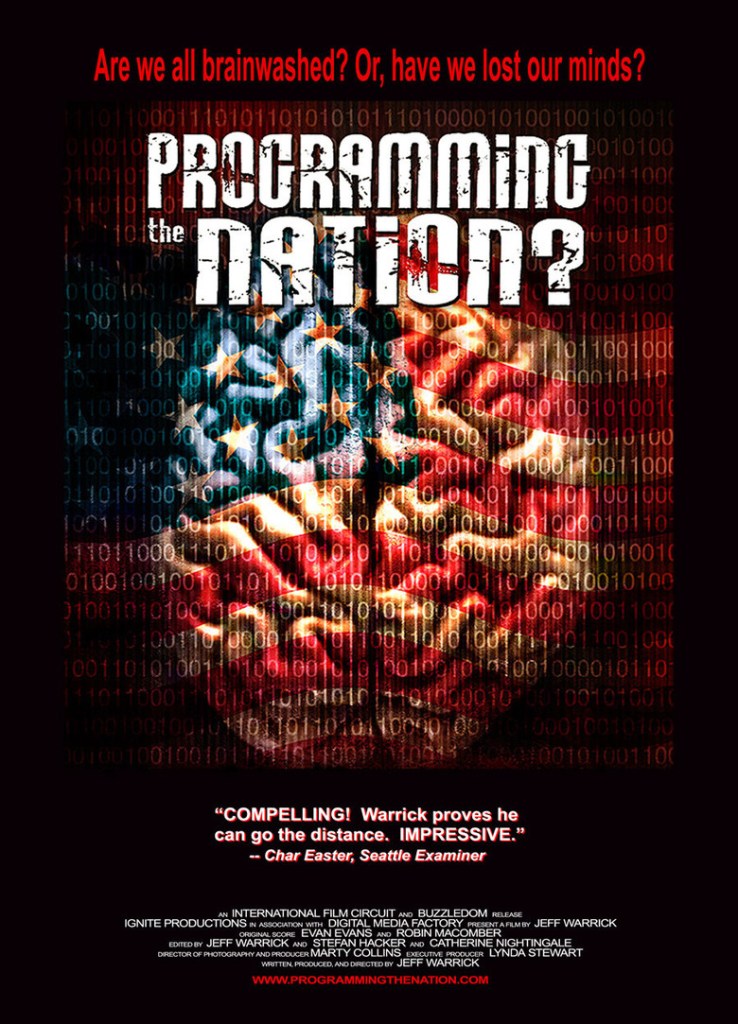
Below is a short video in which Jeff Warrick, the director of Programming the Nation (2011), offers his take on the truth about subliminal messaging. Warrick shares a few examples of messages embedded within ads, which are not likely to be seen consciously, but are admitted into the subconscious mind.

A common response to this type of revealing information is skepticism and disbelief that sexual innuendos or random words embedded in pictures or film will not impact a person’s willingness to buy a product.

Although it is a common assumption that sex sells because for most people it is associated with feelings of pleasure, excitement, enjoyment or even love, subliminal messaging is about much more than helping advertisers sell more product. These messages are designed to have an impact on general consumer behavior and affect people’s life patterns, thus molding society as a whole, creating and captivating more and more receptive consumers.

When bombarded with subliminal messaging, the mind is likely to trigger emotions, memories or feelings, without a person’s conscious recognition of why they feel a certain way. A person may not consciously realize why they start to become more attracted to certain behaviors, lifestyles or products, but they are more likely to succumb to the attraction.

“..subliminal ads are used as a technique not only to increase sales but is also used to divert youth and involve them in such type of behaviour which is only hazardous to the consumer.” ~ (Impact of Subliminal Messaging in TV Advertisements on Consumer Behaviour – A Case Study of Youth in Kashmir Province of J&K, Blue Ocean Research Journalssource)

Are subliminal messages contributing to a variety of economic, social, and political problems currently present in our culture, such as over-competitiveness, low self-esteem, obesity, over-consumption and debt? There are many examples that support this idea and demonstrate that subliminal messaging, over time, can have a powerful impact.

Take, for instance, advertising to women. If you look at any variety of ads that are targeted at women ages 18-35, an overwhelming majority will personify that women and girls should be thin, wear lots of makeup, style their hair in certain ways, and, of course, look very sexy. It almost appears as though it is the advertisers’ job to make young women feel bad about themselves.

See the following example of women in advertising in the video below:

Other examples are films such as the Rambo series of the 1980’s and the more resent American Sniper, which glorify mindless military self-sacrifice, torture and violence. They romanticize obedience to authority and unquestioning loyalty to a war-mongering government.

“‘American Sniper’ lionizes the most despicable aspects of U.S. society—the gun culture, the blind adoration of the military, the belief that we have an innate right as a “Christian” nation to exterminate the “lesser breeds” of the earth, a grotesque hypermasculinity that banishes compassion and pity, a denial of inconvenient facts and historical truth, and a belittling of critical thinking and artistic expression.” – Chris Hedges

Below is the complete documentary by Jeff Warrick, Programming the Nation, that offers a full history behind subliminal message. In the film, Warrick examines if subliminal messaging and other subconscious techniques have conditioned the United States public to become one of the highest consuming nations in the world, accounting for about 25 percent use of the worlds natural resources even though its populace makes up less than 5 percent of the global population.

Cultivate a habit of small acts of sedition

By Caitlin Johnstone

Source: Intrepid Report

It is not easy being someone who cares about the world and opposes the status quo. It’s a series of disheartening failures and crushing disappointments amid an endless deluge of information saying that everything is getting worse and worse.

The environment keeps degrading. Ruling power structures keep getting more and more controlling. Capitalism gets more and more imbalanced and exploitative. World powers get closer and closer to a mass military confrontation of unspeakable horror.

And what do we get when we try to oppose these things? Letdown after letdown. Politicians we support lose their elections, often after brazen interference from the very power structures we’d hoped they’d oppose. Political organizing breaks down in sectarian infighting. Activist leaders get caught up in sex scandals. Agendas we helped push for fizzle into impotence. Power wins time after time.

What passes for “the left” in the English-speaking world is basically either controlled opposition or a glorified online hobby group. Or both. The real left has been so successfully subverted by power that the mainstream public doesn’t even know what it is anymore; most think the left is either a mainstream political party that’s wholly owned and operated by the empire or a loose bunch of vaguely related ideas like having pink hair or saying your pronouns. The left really has been so successfully dismantled that it has almost been purged from memory.

Every time, at every turn, power wins and the people lose. After a while it starts to feel like you’re bashing your head against an immovable object. Some people fall down after a few hard bashes. Some don’t get back up again. Others keep bashing away, becoming harder and harder and more and more miserable and neurotic the longer they go at it.

And most people don’t even know any of this is happening, that’s what can really make it hard. You talk to your loved ones about what you’re seeing and they just get uncomfortable or look at you like you’re crazy. They don’t see the problems you’re pointing to because none of the places they’re getting their information from tell them it’s happening, because the powerful control those information sources.

As Terence McKenna put it, “The cost of sanity in this society is a certain level of alienation.” And as Marshall McLuhan put it, “In the land of the blind, the one-eyed man is a hallucinating idiot.”

And it sucks. No matter how you slice it, it sucks. It sucks watching this massive juggernaut slowly devour your world and see everyone’s attempts to stop it fail, and to have most people in your life not understand it or even see what it is you’re pointing to.

So what can you do? Is there a way to beat the bastards? Is there a way to stop the machine in its tracks and turn this thing around?

Well, no. Not right this moment anyway, and not by yourself. The machine’s far too big, far too entrenched, and its control over information systems means you’re not going to get help from other people in the numbers that you will need them. It’s just you and a few others against an entire globe-spanning power structure.

But that doesn’t mean you are powerless, and it doesn’t mean there’s nothing you can do. It just means you’re not going to be single-handedly knocking out the bad guy and saving the world in some grand, ego-pleasing way like an action hero in some stupid Hollywood movie.

What you can do as an individual is cultivate a habit of committing small acts of sedition. Making little paper cuts in the flesh of the beast which add up over time. You can’t stop the machine by yourself, but you can sure as hell throw sand in its gears.

Giving a receptive listener some information about what’s going on in the world. Creating dissident media online. Graffiti with a powerful message. Amplifying an inconvenient voice. Sharing a disruptive idea. Supporting an unauthorized cause. Organizing toward forbidden ends. Distributing literature. Creating literature. Having authentic conversations about real things with anyone who can hear you.

Every day there’s something you can do. After you start pointing your creativity at cultivating this habit, you’ll surprise yourself with the innovative ideas you come up with. Even a well-placed meme or tweet can open a bunch of eyes to a reality they’d previously been closed to. Remember, they wouldn’t be working so frantically to restrict online speech if it didn’t pose a genuine threat to the empire.

People tend to overestimate how much they can accomplish in a day, but sorely underestimate how much they can accomplish over a span of several years. Finding little ways to undermine the oppression machine every day gradually adds up to hundreds of acts of defiance in a year, which after a few years becomes thousands.

Do this, and then relax. Don’t expect yourself to save the world on your own. You’re only human, and there’s only one of you. You can only do what you can do, and humanity will either make the leap into health or it won’t. Just exert influence over the things you can exert influence over, and outside that little sphere of influence you’ve got to let go and let be. Don’t put any unfair or unreasonable pressures on yourself.

Perpetrate regular small acts of sedition, and then surrender to whatever life brings. I personally see many reasons to hold out hope that we can bring that machine crashing down together one day.

At the Lost and Found

By Edward Curtin

Source: Behind the Curtain

“Nothing is more real than nothing.”
Samuel Beckett, Malone Dies

Those who are never lost are forever lost.  Only those who know they are lost and that life is a shipwreck have a chance to find their way to shore.

The world’s great religions, including Taoism and Existential philosophy, understand that at the heart of human existence is the presence of the not (death, emptiness, void), but this negative reality, this “nothingness” interpenetrates with the positive of being alive so that our knowledge coincides with our ignorance, our lives with our death, and our truth with untruth.  This is also common sense.

Everyone is a pilgrim on the way, and because there are no maps, we all get lost.  And it is only by getting lost in a deep sense that we can find ourselves and discover the truth about the world.

It is well known that Ernest Hemingway made famous the phrase “the lost generation” when he opened his novel The Sun Also Rises with the epigram “You are all a lost generation,” attributed to Gertrude Stein, who said she heard it from a garage owner who said it about a young auto mechanic in his employ.

It is less well known that Hemingway later wrote “that all generations were lost by something and always had been and always would be …But to hell with her lost-generation talk and all the dirty easy labels.”

He was thinking of how the madness of war with the calls to patriotism and God and country and the never-ending official lies about everything maimed people at very deep levels.  His words in A Farewell to Arms have lasted because they are so true in their dismissal of abstract obscenities and their embrace of the concrete:

I was always embarrassed by the words sacred, glorious, and sacrifice and the expression in vain …. And I had seen nothing sacred, and the things that were glorious had no glory and the sacrifices were like the stockyards of Chicago if nothing were done with the meat except to bury it …. Abstract words such as glory, honor, courage, or hallow were obscene beside the concrete names of villages, the numbers of roads, the names of rivers, the numbers of regiments and the dates.

No doubt he was also thinking of the existential anxiety of being alive and the fear of death and nothingness that is conveyed in his powerful short story, “A Clean Well-Lighted Place” that appeared in the 1930 volume Winner Take Nothing.  He was well acquainted with nothing (the not, nada) and knew that social circumstances only add to it, particularly wars and the nihilistic death wishes of lying political leaders.

Some say nothing has changed for millennia and that every age is similar and people are the same, always complaining about the present and recalling the good old days.  There is some truth in this, but the issue of assessing today in all its uniqueness remains paramount.  For every age and every generation is different; therein lies its potential and dangers.  Each can only be understood within its place and time.  We live in the era of high technology that has never before existed.  It is unique.  And it is uniquely dangerous.

Today is a time of unprecedented official lies about everything, endless wars hot and cold, class wars of the rich against the poor, medical wars of international elites against everyone, etc. –  it is a daily electronic digital  barrage meant to pound people into the deepest despair.  Call it “The Lost World of the Information Superhighway.”  These lies have sown a vast sense of bewilderment, as intended.  Lostness for so many, including those who don’t know it and take those lies for truth. People who don’t know that there are still places, although they are shrinking, where truth can be found.  The problem is, of course, that even when they are told about media sites and writers that operate honestly and outside the propaganda mill, they usually refuse to go there.  They prefer to live inside what Jim Garrison, the former New Orleans District Attorney who brought the only trial in the assassination of President Kennedy, correctly termed “the Doll’s House.”

Picking through the bins at the lost and found on the Internet, which is dominated by intelligence services and their Silicon Valley big tech partners, many who feel lost find “things” they think they have lost but which are counterfeit.  They cling to them as to false gods, not realizing that they have been placed there by the elite mountebanks and their accomplices, a process similar to a document dump that contains fabricated records.  It is an old trick.  Often what is really lost is the sense that life makes sense and is meaningful, but this awareness is often replaced with shards of false reassurance meant to distract and far too much information for anyone to comprehend.

What’s up?  Check your cell phone and head down the primrose path to unreality.

Just as there are two senses to being lost, one based on the awareness that if we refuse to grasp at straws and proceed through life by faith, the unknown road will bear us up (Thoreau said, “How vigilant we are! determined not to live by faith if we can avoid it…”), and the other being the more socially induced one of incessant propaganda, so too there are two ways of thinking about nothing.  The existential sense as described by Hemingway in his famous story mentioned above, and the sense of trivia or superficial preoccupations that distract.  C.S. Lewis described the latter sense very well:

The Christians describe the enemy as one ‘without whom Nothing is strong’. And Nothing is very strong: strong enough to steal away a man’s best years not in sweet sins but in a dreary flickering of the mind over it knows not what and knows not why, in the gratification of curiosities so feeble that the man is only half aware of them, in drumming of fingers and kicking of heels, in whistling tunes that he does not like, or in the long dim labyrinth of reveries that have not even lust or ambition to give them relish, but which, once chance association has started them, the creature is too weak and fuddled to shake off.

This is a perfect description of the passivity of scrolling the internet or social media.  Much ado about absolutely nothing but distractions.  Tranquilized by trivia.

Our current situation has been long in coming.  Back in the early 1960s, there was a  highly touted intellectual named Marshall McLuhan whose 1964 book, Understanding Media: The Extensions of Man, was gobbled up by the baby boomers raised on television, whose rebellious members protested the inhumanity of IBM computer technology of that time.  Ironically, it was members of this generation who later created the computer revolution and have promoted the digital revolution.  They carry cell phones as sidearms to defend themselves from reality.

Newsweek called McLuhan “the oracle of the New Communications.”  He was an obscurantic celebrator of the electronic media and retribalized man long before the Internet, cell phones, personal computers, and digital mania.  McLuhan’s paeans to technology sounded very profound and liberating  with their vaguely Gnostic and Jungian rhetoric, which also fit with the 1960s “vibes.”  He called the electronic media our gods whom we must serve, for they in turn would liberate us.  He gave life to things while taking it from persons.  He wrote:

Electromagnetic technology requires utter human docility and quiescence of meditation such as befits an organism that now wears its brain outside its skull and its nerves outside its hide. Man must serve his electronic technology with the same servo-mechanistic fidelity with which he served his coracle, his canoe, his typography, and all other extensions of his physical organs. But there is this difference, that previous technologies were partial and fragmentary, and the electric is total and inclusive. An external consensus or conscience is now as necessary as private consciousness. [my emphases]

Clearly this was a message of a prescient religious crank: mystical, mythological, technological nonsense perfectly in tune with the dawning new age. Not any coming of the Age of Aquarius, however, but that of the Age of Digital Control and endless wars.

By turning the person inside out and giving life to things, McLuhan was certainly anticipating and promoting the developments of the past forty years.  His ideas gave legitimacy to the passivity of the person in the face of the burgeoning mass media consumer culture.  They supported the growing commodification of all aspects of life, especially people.  By externalizing the person, McLuhan was eliminating the idea of the autonomous self and opening the way for today’s era of consumers, blank screens for the reception of advertising, public relations, and propaganda on a vast scale.  In fact, what he wrote of television runs deeper for cell phones and computer screens.  “ … with TV,” he wrote, “the viewer is the screen.  He is bombarded with light impulses that James Joyce called the ‘Charge of the Light Brigade’ that imbues his ‘soulskin with subconscious inklings.’ “

Inklings of abstract obscenities at war with the lost world of reality.

While many people sense this, they still embrace their killers, feeling that they would be lost without them. They have become appendages of their electronic appendages.  The current push to transform all person-to-person life into a digital one run by Artificial Intelligence (AI) technologies with its mass surveillance powers is recognized by many but dismissed as a weird conspiracy.  This is so far from the truth.  A good indicator of this nonchalant attitude toward such developing trends is the vastly increased popularity of on-line shopping.  Its innocence conceals the future that is coming.

I recently won a very high-tech looking electric toothbrush at the dentist.  When I opened it, I discovered it contained a gadget with a suction cup that could hold a “smart phone” that you could attach to the mirror.  The phone could electronically be linked to the toothbrush and it would monitor your brushing as you watched yourself brush.  Poor me, I felt so stupid: a man without a smart phone!

While everybody knows that the boat is leaking and the captain lied, to paraphrase Leonard Cohen, such knowledge is abstract.  It is a sort-of knowledge, sensed but also denied.  Real but unreal.  Known but unknown.  And that’s how it goes.  It is very difficult for many conventional people to admit that the life they have known is disappearing while they dawdle in fantasy land, believing the propaganda of their rulers.  To live in the U.S.A. is to live in Neverland where no one ever has to be alone, never grow up, and always be “in touch” through the ether.  It is a country of lost children.

You can choose any issue of importance and its official explanation is certain to be untrue, obvious or subtle propaganda.  The lies about Ukraine and Russia; Covid-19, lockdowns, and vaccines; China and Taiwan; U.S. forces in Syria and U.S. support for Israeli aggression against Syria and the Palestinians; its support for Saudi Arabia’s ruthless policies and war against Yemen; the economy, central banking, and inflation; the increasing censorship of dissident voices; digital IDs, digital programmable currencies, and social credit systems; the persecution of Julian Assange; the Great Reset; a series of binaries meant to suggest false alternatives, etc.  The list is endless.  All official lies to support a sinking ship captained by psychopathic liars seemingly intent on a world war that will destroy the world.  Melville’s Captain Ahab writ large. Like those traveling on the Titanic, today’s passengers on the flailing American empire’s Good Ship Lollipop are in for a surprise, and it won’t be a sweet trip to a candy shop.

Hemingway was surely right that “Winner Take Nothing.”  Yet losers also exit empty-handed.  Everybody knows this but goes on surrounding themselves with stuff, lots of things.  Hoarders are a popular TV subject because they represent the extreme form of this madcap method of trying to secure oneself from loss.  It is a form of mental and spiritual despair that could only exist in advanced capitalist consumer society.  Too many possessions and too much information.  Cluttered minds, cluttered abodes.  There is a reason why the world’s poor are called the dispossessed.  One could say hoarders are the possessed, and it is a form of demonic possession.

Recently I was called upon to help a hospitalized elderly relative by checking on her house.  The house is filled from attic to basement, in every nook and cranny, with collected things that serve no life purpose but were kept to provide a security blanket that was really a strangulation cord.  I will spare you the details, except to say that this relative is an intelligent woman, as was her deceased husband, and yet they surrounded themselves with so much “stuff,” never threw things out, kept papers from 70 years ago, old keys and coins, empty jewelry boxes by the score, etc.  An overwhelming scene to behold.  And why did they do this?  Because they thought they were protecting themselves against loss, against nothing, nada.

As T. S. Eliot wrote in The Wasteland: “These fragments I have shored against my ruins.”  But there is nothing that will protect against the loss Eliot was referring to – the social, psychological, and spiritual fragmentation of Europe as a result of World War I.  A wasteland created by politicians. Like today.

We too are now living in a wasteland, and the only way to find our way forward is to acknowledge that we are lost and to jettison the false security of believing the vast tapestry of lies promulgated by the captains of the American-led Titanic.

I often think of the words of the poet Rilke as good advice, a step in the right direction where there is a lost and found worth visiting and insights await us. While primarily writing about the artist who time and again is that someone who emerges from the crowd and whose “winged heart everywhere beats against the walls of their time,” I think his words apply to every person, including journalists.  To plumb the depths of our sordid current world demands aesthetic, political, and spiritual resistance rooted in the open sociological imagination, a willingness to go wherever the facts and intuition leads us.  Rilke said:

Not any self-control or self-limitation for the sake of specific ends, but rather a carefree letting go of oneself; not caution, but rather a wise blindness; not working to acquire silent, slowly increasing possessions, but rather a continuous squandering of all perishable values. This way of being has something naïve and instinctive about it, and resembles that period of the unconscious best characterized by a joyous confidence, namely the period of childhood …. [the child] has no anxiety about losing things …. And whatever he has once been lit up in love remains as an image, never more to be lost, and the image is possession; that is why children are so rich.

For a country of lost children, this is a good place to start.