The Titanic Sails at Dawn: Warning Signs Point to Danger Ahead in 2017

rearrange-deckchairs-and-ignore-sinking-1

By John W. Whitehead

Source: A Government of Wolves

“When did the future switch from being a promise to being a threat?” ― Chuck Palahniuk, Invisible Monsters

Despite our best efforts, we in the American police state seem to be stuck on repeat, reliving the same set of circumstances over and over and over again: egregious surveillance, strip searches, police shootings of unarmed citizens, government spying, censorship, retaliatory arrests, the criminalization of lawful activities, warmongering, indefinite detentions, SWAT team raids, asset forfeiture, etc.

Unfortunately, as a nation we’ve become so desensitized to the government’s acts of violence, so accustomed to reports of government corruption, and so anesthetized to the sights and sounds of Corporate America marching in lockstep with the police state that few seem to pay heed to the warning signs blaring out the message: Danger Ahead.

Remember, the Titanic received at least four warnings from other ships about the presence of icebergs in its path, with the last warning issued an hour before disaster struck. All four warnings were ignored.

Like the Titanic, we’re plowing full steam ahead into a future riddled with hidden and not-so-hidden dangers. We too have been given ample warnings, only to have them drowned out by a carefully choreographed cacophony of political noise, cultural distractions and entertainment news—what the Romans termed “bread and circuses”—aimed at keeping the American people polarized, pacified and easily manipulated.

However, there is still danger ahead. The peril to our republic remains the same.

As long as a permanent, unelected bureaucracy—a.k.a. the shadow government— continues to call the shots in the halls of power and the reach of the police state continues to expand, the crisis has not been averted.

Here’s a glimpse of some of the nefarious government programs we’ll be encountering on our journey through the treacherous waters of 2017.

Mandatory quarantines without due process or informed consent: Under a new rule proposed by the Centers for Disease Control and Prevention, government agents will be empowered to indefinitely detain any traveler they suspect of posing a medical risk to others without providing an explanation, subject them to medical tests without their consent, and carry out such detentions and quarantines without any kind of due process or judicial review.

Mental health assessments by non-medical personnel: As a result of a nationwide push to train a broad spectrum of so-called gatekeepers such as pastors, teachers, hair stylists, bartenders, police officers and EMTs in mental health first-aid training, more Americans are going to run the risk of being reported by non-medical personnel and detained for having mental health issues.

Tracking chips for citizens: Momentum is building for the government to be able to track citizens, whether through the use of RFID chips embedded in a national ID card or through microscopic chips embedded in one’s skin. In December 2016, the House of Representatives overwhelmingly approved legislation allowing police to track individuals suffering from some form of mental disability such as Alzheimer’s or autism by way of implanted chips.

Military training to deal with anti-establishment movements in megacities: The future, according to a Pentagon training video, will be militaristic, dystopian and far from friendly to freedom. Indeed, if this government propaganda-piece that is being used to train special forces is to be believed, the only thing that can save the world from outright anarchy—in the eyes of the government, at least—is the military working in conjunction with local police. The video confirms what I’ve been warning about for so long: in the eyes of the U.S. government and its henchmen, the battlefield of the future is the American home front.

Government censorship of anything it classifies as disinformation: This year’s National Defense Authorization Act, which allocates $619 billion for war and military spending, not only allows the military to indefinitely detain American citizens by placing them beyond the reach of the Constitution, but it also directs the State Department to establish a national anti-propaganda center to “counter disinformation and propaganda.” Translation: the government plans to crack down on anyone attempting to exercise their First Amendment rights by exposing government wrongdoing, while persisting in peddling its own brand of fake news.

Threat assessments: Government agents—with the help of automated eyes and ears, a growing arsenal of high-tech software, hardware and techniques, government propaganda urging Americans to turn into spies and snitches, as well as social media and behavior sensing software—are spinning a sticky spider-web of threat assessments, behavioral sensing warnings, flagged “words,” and “suspicious” activity reports aimed at snaring potential enemies of the state. It’s the American police state rolled up into one oppressive pre-crime and pre-thought crime package.

War on cash: The government and its corporate partners are engaged in a concerted campaign to do away with large bills such as $20s, $50s, $100s and shift consumers towards a digital mode of commerce that can easily be monitored, tracked, tabulated, mined for data, hacked, hijacked and confiscated when convenient. As economist Steve Forbes concludes, “The real reason for this war on cash—start with the big bills and then work your way down—is an ugly power grab by Big Government. People will have less privacy: Electronic commerce makes it easier for Big Brother to see what we’re doing, thereby making it simpler to bar activities it doesn’t like, such as purchasing salt, sugar, big bottles of soda and Big Macs.”

Expansive surveillance: Whether you’re walking through a store, driving your car, checking email, or talking to friends and family on the phone, you can be sure that some government agency, whether the NSA or some other entity, will still be listening in and tracking your behavior. This doesn’t even begin to touch on the corporate trackers who work with the government to monitor your purchases, web browsing, Facebook posts and other activities taking place in the cyber sphere. In such an environment, we are all suspects to be spied on, searched, scanned, frisked, monitored, tracked and treated as if we’re potentially guilty of some wrongdoing or other.

Militarized police: Americans are finding their once-peaceful communities transformed into military outposts, complete with tanks, weaponry, and other equipment designed for the battlefield. Now, the Department of Homeland Security, the Justice Department and the FBI are preparing to turn the nation’s police officers into techno-warriors, complete with iris scanners, body scanners, thermal imaging Doppler radar devices, facial recognition programs, license plate readers, cell phone extraction software, Stingray devices and so much more.

Police shootings of unarmed citizens: Owing in large part to the militarization of local law enforcement agencies, not a week goes by without more reports of hair-raising incidents by police imbued with a take-no-prisoners attitude and a battlefield approach to the communities in which they serve. Indeed, as a special report by The Washington Post reveals, despite heightened awareness of police misconduct, the number of fatal shootings by officers in 2016 remained virtually unchanged from the year before.

False flags and terrorist attacks: Despite the government’s endless propaganda about the threat of terrorism, statistics show that you are 17,600 times more likely to die from heart disease than from a terrorist attack. You are 11,000 times more likely to die from an airplane accident than from a terrorist plot involving an airplane. You are 1,048 times more likely to die from a car accident than a terrorist attack. You are 404 times more likely to die in a fall than from a terrorist attack. And you are 8 times more likely to be killed by a police officer than by a terrorist.

Endless wars to keep America’s military’s empire employed: The military industrial complex that has advocated that the U.S. remain at war, year after year, is the very entity that will continue to profit the most from America’s expanding military empire. The U.S. Department of Defense is the world’s largest employer, with more than 3.2 million employees. Thus far, the U.S. taxpayer has been made to shell out more than $1.6 trillion to wage wars in Afghanistan and Iraq. When you add in military efforts in Pakistan, as well as the lifetime price of health care for disabled veterans and interest on the national debt, that cost rises to $4.4 trillion.

Attempts by the government to identify, target and punish so-called domestic “extremists”: The government’s anti-extremism program will, in many cases, be utilized to render otherwise lawful, nonviolent activities as potentially extremist. To this end, police will identify, monitor and deter individuals who exhibit, express or engage in anything that could be construed as extremist before they can become actual threats. This is pre-crime on an ideological scale.

SWAT team raids: More than 80% of American communities have their own SWAT teams, with more than 80,000 of these paramilitary raids are carried out every year. That translates to more than 200 SWAT team raids every day in which police crash through doors, damage private property, kill citizens, terrorize adults and children alike, kill family pets, assault or shoot anyone that is perceived as threatening—and most often in the pursuit of someone merely suspected of a crime, usually some small amount of drugs.

Erosions of private property: Private property means little at a time when SWAT teams and other government agents can invade your home, break down your doors, kill your dog, wound or kill you, damage your furnishings and terrorize your family. Likewise, if government officials can fine and arrest you for growing vegetables in your front yard, praying with friends in your living room, installing solar panels on your roof, and raising chickens in your backyard, you’re no longer the owner of your property.

Overcriminalization: The government’s tendency towards militarization and overcriminalization, in which routine, everyday behaviors become targets of regulation and prohibition, has resulted in Americans getting arrested for making and selling unpasteurized goat cheese, cultivating certain types of orchids, feeding a whale, holding Bible studies in their homes, and picking their kids up from school.

Strip searches and the denigration of bodily integrity: Court rulings undermining the Fourth Amendment and justifying invasive strip searches have left us powerless against police empowered to forcefully draw our blood, forcibly take our DNA, strip search us, and probe us intimately. Accounts are on the rise of individuals—men and women alike—being subjected to what is essentially government-sanctioned rape by police in the course of “routine” traffic stops.

Drones: As corporations and government agencies alike prepare for their part in the coming drone invasion—it is expected that at least 30,000 drones will occupy U.S. airspace by 2020, ushering in a $30 billion per year industry—it won’t be long before American citizens find themselves to be the target of these devices. Drones—unmanned aerial vehicles—will come in all shapes and sizes, from nano-sized drones as small as a grain of sand that can do everything from conducting surveillance to detonating explosive charges, to middle-sized copter drones that can deliver pizzas to massive “hunter/killer” Predator warships that unleash firepower from on high.

Prisons: America’s prisons, housing the largest number of inmates in the world and still growing, have become money-making enterprises for private corporations that manage the prisons in exchange for the states agreeing to maintain a 90% occupancy rate for at least 20 years. And how do you keep the prisons full? By passing laws aimed at increasing the prison population, including the imposition of life sentences on people who commit minor or nonviolent crimes such as siphoning gasoline.

Censorship: First Amendment activities are being pummeled, punched, kicked, choked, chained and generally gagged all across the country. Free speech zones, bubble zones, trespass zones, anti-bullying legislation, zero tolerance policies, hate crime laws and a host of other legalistic maladies dreamed up by politicians and prosecutors have conspired to corrode our core freedoms. The reasons for such censorship vary widely from political correctness, safety concerns and bullying to national security and hate crimes but the end result remains the same: the complete eradication of what Benjamin Franklin referred to as the “principal pillar of a free government.”

Fascism: As a Princeton University survey indicates, our elected officials, especially those in the nation’s capital, represent the interests of the rich and powerful rather than the average citizen. We are no longer a representative republic. With Big Business and Big Government having fused into a corporate state, the president and his state counterparts—the governors—have become little more than CEOs of the Corporate State, which day by day is assuming more government control over our lives. Never before have average Americans had so little say in the workings of their government and even less access to their so-called representatives.

James Madison, the father of the Constitution, put it best when he warned: “Take alarm at the first experiment with liberties.” Anyone with even a casual knowledge about current events knows that the first experiment on our freedoms happened long ago.

We are fast moving past the point of no return when it comes to restoring our freedoms. Worse, as I make clear in my book Battlefield America: The War on the American People, we can barely see the old America with its revolutionary principles and value for independence in the rear view mirror. The only reality emerging generations will know is the one constructed for them by the powers-that-be, and you can rest assured that it will not be a reality that favors individuality, liberty or anything or anyone who challenges the status quo.

As a senior advisor to George W. Bush observed, “We’re an empire now, and when we act, we create our own reality. And while you’re studying that reality—judiciously, as you will—we’ll act again, creating other new realities, which you can study too, and that’s how things will sort out. We’re history’s actors . . . and you, all of you, will be left to just study what we do.”

In other words, the government has been operating ten steps ahead for quite some time now, and we have yet to catch up, let alone catch our breath as the tides of change swirl around us.

You’d better tighten your seatbelts, folks, because we could be in for a rough ride in 2017.


ABOUT JOHN W. WHITEHEAD

Constitutional attorney and author John W. Whitehead is founder and president of The Rutherford Institute. His new book Battlefield America: The War on the American People (SelectBooks, 2015) is available online at http://www.amazon.com. Whitehead can be contacted at johnw@rutherford.org.

Five Ways America Is Like a Third-World Country

Some+of+the+90,000+abandoned+and+derelict+homes+of+Detroit

By Nathan Wellman

Source: U.S. Uncut

The United States of America is possibly the wealthiest nation in the history of the world. However, many third-world countries actually surpass America in many of the most vital gauges for measuring human development.

Here are five of the most jaw-droppingly unforgivable ways in which America is lagging behind the rest of the world:

1. America’s criminal justice system is broken

The U.S. represents only 5% of the world’s population, but this one country comprises 25% of the world’s prison population. According to the NAACP, a disproportionate 58% of America’s prisoners are African-American or Hispanic despite these demographics only adding up to about 30% of the U.S. population.

The only nation that imprisons a greater percentage of its citizens than America is North Korea. The U.S. jails 716 people for every 100,000 Americans, according to the International Center for Prison Studies. That’s nearly twice as many as Russia (484 prisoners per 100,000), and far more than Iran (284) or China (121). For context, the U.S. only jailed around 100-200 people per 100,000 citizens in the 1970s, and the incarcerated rate is only getting worse today, even as crime rates fall. A staggering 60% of prisoners are in jail for nonviolent drug charges.

Inside prison, about 600 victims are raped every day, according to an estimate from the Justice Department. An in-depth DOJ investigation found that of the approximate 217,000 prisoners raped each year, 17,000 were juveniles.

2. Gun Violence is an epidemic

America has 20 times more murders when compared to the average rate of the developed world. Even terrorism-plagued Iraq has half the murder rate of the U.S. Over half of the deadliest mass shootings from the last 50 years happened in America, and 79% of those shooters got ahold of their guns legally. Some American cities, particularly New Orleans and Detroit, even surpass many Latin American countries, which suffer from some of the highest gun violence rates in the world.

3. Healthcare costs too much and delivers too little

America is the only developed country that does not ensure healthcare to all of its citizens. Even in the wake of the Affordable Care Act, millions of poverty-stricken Americans have no medical insurance because Republican governors have refused to expand Medicaid, even though the federal government is paying the cost and the simple measure would actually save money for their states.

Life expectancy in many American counties is lower than Nicaragua, Algeria, or Bangladesh. The U.S. is unusual among developed countries in that Americans die in the tens of thousands as a direct result of a lack of health insurance. America also spends twice the percentage of our GDP on healthcare than the average wealthy country for these substandard results.

America also suffers from the highest infant mortality and teen pregnancy rate in the developed world.

4. Inequality is rampant

Researchers have shown that economic inequality directly correlates to public distrust in government representatives, as well as a decrease in health and well-being.

Unfortunately, the U.S. has the worst rates of income inequality in the world, according to the 2015 Global Wealth Report conducted by Allianz. The wealthiest one percent of Americans own nearly half of the nation’s wealth invested in stocks and mutual funds, and the overall gap between rich and poor has only grown since the recession, with almost all income gains going to the top 1% since 2009.

Despite the idea of America being a meritocracy, those born in the poorest 20% of the American population have less than a 3% chance of making it to the top quintile.

5. Infrastructure is crumbling

America is quite literally falling apart.

One study concludes that the U.S. needs to invest $3.6 trillion into infrastructure over the next six years. One out of every nine American bridges (66,405 bridges) have been labeled “structurally deficient.”

Water runs through dilapidated wooden pipes in certain parts of South Dakota, Alaska, and Pennsylvania. Some of Detroit’s sewer lines still used today were originally constructed in the mid-1800s.

A whopping 45% of Americans have no access to public transit, and the construction of the infamously still-incomplete Second Avenue subway line in New York City has been hit with delays dating all the way back to World War II.


America certainly has and continues to achieve greatness in many ways. But if we want to truly earn our oft-proclaimed slogan of “Greatest Country in the World,” these fatal flaws in our system must be acknowledged and addressed. Otherwise, the emperor will continue to parade about with no clothes, and we run the risk of being completely surpassed by a world marveling at our oblivious nakedness.

Punishment is Violent and Counterproductive

stpp

By Robert J. Burrowes

Punishment is a popular pastime for humans. Parents punish children. Teachers punish students. Employers punish workers. Courts punish lawbreakers. People punish each other. Governments punish ‘enemies’. And, according to some, God punishes evildoers.

What is ‘punishment’? Punishment is the infliction of violence as revenge on a person who is judged to have behaved inappropriately. It is a key word we use when we want to obscure from ourselves that we are being violent.

The violence inflicted as punishment can take many forms, depending on the context. It might involve inflicting physical injury and/or pain, withdrawal of approval or love, confinement/imprisonment, a financial penalty, dismissal, withdrawal of rights/privileges, denial of promised rewards, an order to perform a service, banishment, torture or death, among others.

Given the human preoccupation with punishment, it is perhaps surprising that this behaviour is not subjected to more widespread scrutiny. Mind you, I can think of many human behaviours that get less scrutiny than would be useful.

Anyway, because I am committed to facilitating functional human behaviour, I want to explain why using violence to ‘punish’ people is highly dysfunctional and virtually guarantees an outcome opposite to that intended.

Punishment is usually inflicted by someone who makes a judgment that another person has behaved ‘badly’ or ‘wrongly’. At its most basic, disobedience (that is, failure to comply with elite imposed norms) is often judged in this way, whether by parents, teachers, religious figures, lawmakers or national governments.

But is obedience functional or even appropriate?

Consider this. In order to behave optimally, the human organism requires that all mental functions – feelings, thoughts, memory, conscience, sensory perception (sight, sound, touch, smell, taste), truth register, intuition… – must be developed and readily involved, without interference, in our life. If this happens, then all of these individual functions will play an integrated role in determining our behaviour in any given circumstance. This is a very sophisticated mental apparatus that has evolved over billions of years and if it was allowed to function without interference in each individual, human beings would indeed be highly functional.

So where does obedience fit into all of this? It doesn’t. A child is genetically programmed to seek to meet their own needs, not obey the will of another. And they will behave functionally in endeavouring to meet these needs unless terrorized out of doing so. Moreover, they will learn to meet their own needs, by acting individually in some circumstances and by cooperating with others when appropriate, if their social environment models this.

However, if a child is terrorized into being obedient – including by being punished when they are not – then the child will have no choice but to suppress their awareness of the innate mental capacities that evolved over billions of years to guide their behaviour until they have ‘learned’ what they must do to avoid being punished. For a fuller explanation of this, see ‘Why Violence?’ and ‘Fearless Psychology and Fearful Psychology: Principles and
Practice’.

Unfortunately, as you can probably readily perceive, this process of terrorizing a child into suppressing their awareness of what they want to do so that they do what someone else directs is highly problematical. And it leads to a virtually infinite variety of dysfunctional
behaviours, even for those who appear to have been successfully ‘socialized’ into performing effectively in their society. This is readily illustrated.

Perhaps the central problem of terrorizing individuals into obedience of conventions, commands, rules and the law is that once the individual has been so terrorized, it is virtually impossible for them to change their behaviour because they are now terrified of doing so. If the obedient behaviours were functional in the circumstances then, apart from the obviously enormous damage suffered by the individual, there would be no other adverse social or environmental consequences.

Unfortunately, when all humans have been terrorized into behaving dysfunctionally on a routine basis (in the Western context, for example, by engaging in over-consumption) then changing their behaviour, even in the direction of functionality, is now unconsciously associated with the fear of violence (in the form of punishment) and so desirable behavioural change (in the direction of reduced consumption, for example) is much more difficult. It is not just that many Western humans are reluctant to reduce their consumption in line with environmental (including climatic) imperatives, they are unconsciously terrified of
doing so.

By now you might be able to see the wider ramifications of using violence and threats of violence to force children into being obedient. Apart from terrorizing each child into suppressing their awareness of their innate mental capacities, we create individuals whose entire (unconscious) ‘understanding’ of human existence is limited to the notion that violence, mislabeled ‘punishment’, drives socialization and society.

As just one result, for example, most people consider punishment to be appropriate in the context of the legal system: they expect courts to inflict legally-sanctioned violence on those ‘guilty’ of disobeying the law. As in the case of the punishment of children, how many people ask ‘Does violence restore functional behaviour? Or does it simply inflict violence as revenge? What do we really want to achieve? And how will we achieve that?’

Fundamentally, the flaw with violence as punishment is that violence terrifies people. And you cannot terrorize someone into behaving functionally. At very best, you can terrorize someone into changing their behaviour in an extremely limited context and/or for an extremely limited period of time. But if you want functional and lasting change in an individual’s behaviour, then considerable emotional healing will be necessary. This will allow the suppressed fear, anger, sadness and other feelings resulting from childhood terrorization to safely resurface and be expressed so that the individual can perceive their own needs and identify ways of fulfilling them (which does not mean that they will be obedient). For an explanation of what is required, see ‘Nisteling: The Art of Deep Listening’ which is referenced in ‘My Promise to Children‘.

So next time you hear a political leader or corporate executive advocating or using violence (such as war, the curtailment of civil liberties, an economically exploitative and/or ecologically destructive initiative), remember that you are observing a highly dysfunctionalized individual. Moreover, this dysfunctional individual is a logical product of our society’s unrelenting use of violence, much of it in the form of what is euphemistically called ‘punishment’, against our children in the delusional belief that it will give us obedience and hence social control.

Or next time you hear a public official, judge, terrorist or police officer promising ‘justice’ (that is, retribution), remember that you are listening to an emotionally damaged individual who suffered enormous violence as a child and internalized the delusional message that ‘punishment works’.

You might also ponder how bad it could be if we didn’t require obedience and use punishment to get it, but loved and nurtured children, by listening to them deeply, to become the unique, enormously loving and powerful individuals for which evolution genetically programmed them.

I am well aware that what I am suggesting will take an enormous amount of societal rethinking and a profound reallocation of resources away from violent and highly profitable police, legal, prison and military systems. But, as I wrote above, I am committed to facilitating functional human behaviour. I can also think of some useful ways that we could allocate the resources if we didn’t waste them on violence.

If you share this commitment and working towards this world appeals to you too, then you are welcome to consider participating in the fifteen-year strategy outlined in ‘The Flame Tree Project to Save Life on Earth‘ and to consider signing the online pledge of ‘The People’s Charter to Create a Nonviolent World‘.

Punishment can sometimes appear to get you the outcome you want in the short term. The cost is that it always moves you further away from any desirable outcome in the long run.


Biodata: Robert J. Burrowes has a lifetime commitment to understanding and ending human violence. He has done extensive research since 1966 in an effort to understand why human beings are violent and has been a nonviolent activist since 1981. He is the author of ‘Why Violence?‘ His email address is flametree@riseup.netand his website is at http://robertjburrowes.wordpress.com

Robert J. Burrowes
P.O. Box 68
Daylesford
Victoria 3460
Australia
Email: flametree@riseup.net

Websites:
Nonviolence Charter
Flame Tree Project to Save Life on Earth
‘Why Violence?’
Nonviolent Campaign Strategy
Nonviolent Defense/Liberation Strategy
Anita: Songs of Nonviolence
Robert Burrowes
Global Nonviolence Network

The Wickedness of [US] Foreign Policy

us-imperialism-nepal-south-asia-revolution

By Sheldon Richman

Source: Center for a Stateless Society

If you want to see how inhumane people can be, just watch those who make and execute foreign policy. We could spend all day discussing the cruelties that politicians and bureaucrats commit against people who live inside the United States. Think how many are caged like wild animals because they manufacture, sell, or consume disapproved substances; gamble where government has forbade it; traded sexual services for money; possessed a gun they weren’t “supposed” to possess; etc. ad infinitum. Naturally, America leads the world in locking up people.

But at least the policy of mass imprisonment gets increasing attention. Subject to far less scrutiny is how America’s (mis)leaders, (mis)representatives and public (self-)servants treat foreigners, especially those with dark skins and a still-unfamiliar religion. When we talk about foreign policy, how easy it is to get wrapped up in abstractions like empire,intervention, nonintervention, and kinetic military action. These are important concepts to understand, of course, but foreign-policy conversations often become sterile examinations of “policy,” when what we need is a full awareness of the harm to individual human beings, the destruction of their families, homes, communities, and societies. These persons are the victims of our rulers’ geopolitical stratagems, which seemly outrank all other considerations. Yet each victim has a story embodying unique relationships and aspirations, a story that is permanently changed by an American cluster bomb, drone-launched missile, or special-ops mission.

The best that can be said of the perpetrators of this carnage and social devastation is that they are guilty of gross negligence. Many of their acts, however, cross into the territory of premeditated murder and the infliction of mayhem with malice aforethought.

One need not look hard for the most egregious examples taking place right at this moment. In Yemen the Obama administration gives indispensable material support to Saudi Arabia’s barbaric war — war ought not to require a qualifier like barbaric, but it seems necessary these days — on the poorest population in the region. The U.S.-facilitated starvation blockade and cluster-bombing take an untold number of Yemeni lives while devastating the social order. Policymakers — a euphemism for the architects of devastation — can rationalize this cruelty in geopolitical terms — the Houthis, who incidentally are fighting al-Qaeda-affiliated jihadis, are (falsely) said to be instruments of Iran — but the fact remains that individual persons who did no harm to anyone are being slaughtered and starved with the help of American politicians and military bureaucrats.

Or how about Syria? U.S. conduct carries out a seemingly incoherent policy of simultaneously targeting the regime of President Bashar al-Assad and one of his chief adversaries, the Islamic State, while helping another Islamist group, al-Nusra Front, that has pledged allegiance to Ayman al-Zawahiri, Osama bin Laden’s successor as head of al-Qaeda, perpetrators of the 9/11 attacks. Estimates of the death total in Syria’s civil war reach as high as 340,000, a number that represents the toll at the hands of both government and rebel forces. (The total is sometimes invidiously attributed to Assad’s military alone.) The injured and refugees are probably uncountable.

What must be understood is that most of these deaths, injuries, and dispossessions would probably not have occurred had the Obama administration — most especially Secretary of State Hillary Clinton — not early on intensified the civil war by declaring Assad’s regime “illegitimate,” demanding that he “go” (i.e., die), and overseeing the transfer weapons and jihadi fighters from Benghazi, Libya. While doing all this, the Obama administration was thwarting promising efforts toward a negotiated settlement, which might have stopped or at least reduced the killing of innocent persons. For details see these three articles by the excellent investigate journalist Jonathan Marshall.

And then there’s Libya itself, which Clinton boasts is an example of “smart power at its best.” In 2011 she had egg on her face because she was on the wrong side of the Arab Spring, having defended Egypt’s military dictator, Hosni Mubarak, as a family friend and trusted world leader to the bitter end while throngs of aggrieved Egyptians were in the streets demanding his exit. Needing to clean up her image (perhaps in preparation for her quest for the presidency), she along with administration national-security VIPs Samantha Power and Susan Rice persuaded a reluctant Obama that the residents of Benghazi had to be saved from Col. Muammar Gaddafi’s alleged genocidal designs. The only problem was that Gaddafi had no genocidal designs. (Also see this and this.) And in a classic exhibition of mission-creep, the U.S.-led NATO air campaign went from protecting Benghazi to changing the regime in Tripoli, prompting Clinton to gloated, “We came. We saw. He died.” (Gaddafi was killed extrajudicially, reportedly in a most gruesome manner.)

Since the U.S. intervention, Libya has been wracked by sectarian civil war — even the Islamic State now holds territory there — prompting many Libyans to flee to Europe, which now has to contend with a growing refugee crisis. As noted, the Libyan power vacuum, featuring the unlocking of Gaddafi’s arsenal of heavy weapons, helped to boost the Islamist rebel militias in Syria, to the delight of U.S. allies Turkey (which fears the Kurds) and Saudi Arabia (which fears Iran and the Shi’ites). After the nightmare in Iraq, one has to wonder what Clinton was thinking. The closest thing we have to an answer is from then-Secretary of War Robert Gates, an opponent of the intervention, who said, “We were playing it by ear.” (And let’s not forget: destabilization itself can be an objective.)

Of course we could point to Iraq, George W. Bush’s invasion of which in 2003 set most of the aforementioned mayhem in motion, and Afghanistan, but the story is largely the same: innocent lives are sacrificed to the politicians’ grand agenda. Little people living small lives can’t be allowed to stand in the way.

There is No Pipeline, Schools are Prisons

school_is_prison_by_twarrior-d4atw5g

By Ryan Calhoun

Source: Center for a Stateless Society

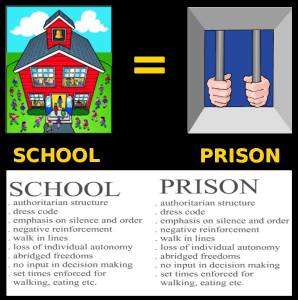
We are told there is a pipeline in the United States that travels from our school system to our criminal justice system. Correct as the data corroborating the pipeline’s existence may be, it is a flawed way of conceptualizing the issue. There is no pipeline out of schools and into prisons, because schools and prisons in this country are not conceptually separable.

Every child is mandated to receive an education with the threat of reprisal by the judicial system if they fail to. Children are thus coerced into attending a learning center, almost none of which adequately meet the educational needs of children. Some opt for public school “alternatives” like homeschooling or private schools, but the model of education is still generally the same and attendance is vigorously enforced. Through forced schooling, children are largely deprived of the ability to engage with the world and learn by means of play. They must cease the process of seeking fulfillment of genuine desires and begin one of alienation from their natural curiosity.

The consequences are shockingly apparent in a case out of Columbia, South Carolina where a police officer at a public high school physically manhandled a young black girl. The scene: A female student sits passively in her chair while the officer demands she stand. The lead-up to the incident is irrelevant. Insubordination to authority in schools is an inevitability for any child with a mind and drive of her own. For having such a mind and drive of her own (“resisting” in law enforcement-speak) the student was grabbed by the neck, slammed to the ground and dragged across the classroom, all while still partially connected to her desk.

Once again, this is not abnormal behavior. Disobedience is something youth do well and often. The response to disobedience, insubordination, and general independent-streaks at any school usually boils down to authoritative command and punishment. Physical assault on children is not legal in all schools, but it is in 19 states. Each year, over 800 children are assaulted legally and as a matter of policy at their schools. In South Carolina, it is legal to handcuff students for simply being loud.

In addition to the female assault victim in the South Carolina incident, the classmate who filmed the shocking video was also later arrested and held on bail. She was kidnapped for filming what was, by any reasonable standard, child abuse. Why was this allowed to happen? Her charge was “Disturbing school.” Please allow this to fully register. Non-violent, peaceful actions by children are construed as attacks on the supposed civility of school.

This officer’s assault is not an aberration; it is how schools treat students. They have no freedom to leave. Anyone who escapes is treated as a fugitive. They are permitted to go home, but this does not change the striking similarities between prisons and schools. It is now regular for schools to have guards — some are cops hired out and some are the schools’ own security staff. Students are filed along corridors and into rooms in such a way as to surveil and control their flow of activity.

People of color are far more likely to find themselves physically assaulted by staff in schools. They are more likely to receive punishment than their white counterparts for the same behavior, and as a result, they begin to recognize the system’s perception of them as marked criminals. Eventually, many are sent to even more coercive penal environments, where the violence and authoritarianism from the administration only escalates. Many students are lucky enough to avoid the transition from educational to criminal detention centers. But far too many either aren’t able to successfully navigate the educational-police state, or have the deck stacked against them from the outset. Their fate is a sad and unnecessary one.

There is no pipeline from school to prison. Some are just forced to stay in class.

Citations to this article:

Jade Helm, Terrorist Attacks, Surveillance and Other Fairy Tales for a Gullible Nation

TerrorAlert

By John W. Whitehead

Source: The Rutherford Institute

“Strange how paranoia can link up with reality now and then.” ― Philip K. Dick, A Scanner Darkly

Once upon a time, there was a nation of people who believed everything they were told by their government.

When terrorists attacked the country, and government officials claimed to have been caught by surprise, the people believed them. And when the government passed massive laws aimed at locking down the nation and opening the door to total government surveillance, the people believed it was done merely to keep them safe. The few who disagreed were labeled traitors.

When the government waged costly preemptive wars on foreign countries, insisting it was necessary to protect the nation, the citizens believed it. And when the government brought the weapons and tactics of war home to use against the populace, claiming it was just a way to recycle old equipment, the people believed that too. The few who disagreed were labeled unpatriotic.

When the government spied on its own citizens, claiming they were looking for terrorists hiding among them, the people believed it. And when the government began tracking the citizenry’s movements, monitoring their spending, snooping on their social media, and surveying their habits—supposedly in an effort to make their lives more efficient—the people believed that, too. The few who disagreed were labeled paranoid.

When the government let private companies take over the prison industry and agreed to keep the jails full, justifying it as a cost-saving measure, the people believed them. And when the government started arresting and jailing people for minor infractions, claiming the only way to keep communities safe was to be tough on crime, the people believed that too. The few who disagreed were labeled soft on crime.

When the government hired crisis actors to take part in disaster drills, never alerting the public to which “disasters” were staged, the people genuinely believed they were under attack. And when the government insisted it needed greater powers to prevent such attacks from happening again, the people believed that too. The few who disagreed were told to shut up or leave the country.

Finally, the government started carrying out covert military drills around the country, insisting they were necessary to train the troops for foreign combat, and most of the people believed them. The few who disagreed, warning that perhaps all was not what it seemed, were dismissed as conspiracy theorists and quacks.

By the time the government locked down the nation, using local police and the military to impose martial law, there was no one left in doubt of the government’s true motives—total control and domination—but there was also no one left to fight back.

Now every fable has a moral, and the moral of this story is to beware of anyone who urges you to ignore your better instincts and trust the government.

In other words, if it looks like trouble and it smells like trouble, you can bet there’s trouble afoot.

For instance, while there is certainly no shortage of foul-smelling government activities taking place right now, the one giving off the greatest stench is Jade Helm 15. This covert, multi-agency, multi-state, eight-week military training exercise is set to take place from July 15 through Sept. 15 in states across the American Southwest.

According to official government sources, “Jade Helm: Mastering the Human Domain” is a planned military exercise that will test and practice unconventional warfare including, but not limited to, guerrilla warfare, subversion, sabotage, intelligence activities, and unconventional assisted recovery. The training exercise will take place in seven different southwestern states: California, New Mexico, Colorado, Arizona, Texas, Utah and Nevada.

U.S. Army Special Operations Command will primarily lead this interagency training program but the Navy Seals, Air Force Special Operations, Marine Special Operations Command, Marine Expeditionary Units, 82nd Airborne Division, and other interagency partners will also be involved. Approximately 1,200 troops are expected to participate in these exercises.

The training is known as Realistic Military Training because it will be conducted outside of federal property. The exercises are going to be carried out on both public and private land, with the military reportedly asking permission of local authorities and landowners prior to land usage. The military map listing the locations that will host the exercise shows Texas, Utah, and the southern part of California as “hostile territory.” According to U.S. officials, these three areas are marked as hostile to simulate environments where American troops are viewed as the enemy. The other areas on the map are marked as permissive, uncertain (leaning friendly), or uncertain (leaning hostile).

Military officials claim that the southwestern states were chosen because this exercise requires large areas of undeveloped land as well as access to towns and population hubs. These states purportedly also provide a climate and terrain that is similar to that of potential areas of combat for the United States, particularly Iraq, Iran and Syria.

Now the mainstream media has happily regurgitated the government’s official explanation about Jade Helm. However, there is a growing concern among those who are not overly worried about being labeled conspiratorialists or paranoid that the government is using Jade Helm as a cover to institute martial law, bring about total population control, or carry out greater surveillance on the citizenry.

In the first camp are those who fear that Jade Helm will usher in martial law. These individuals believe that by designating the two traditionally conservative and Republican-dominated states, Utah and Texas, as hostile territory, while more Democratic states like Colorado and California are marked as friendly, the military plans to infiltrate the states with large numbers of gun owners and attempt to disarm them.

Adding fuel to the fire is the mysterious and sudden temporary closures of five Walmart stores in Texas, California, Oklahoma and Florida, two of which are located near Jade Helm training sites. Those in this camp contend that the military is planning to use the Walmart stores as processing facilities for Americans once martial law is enacted.

Pointing to the mission’s official title, “Jade Helm: Mastering the Human Domain,” there is a second camp that fears that the military exercises are merely a means to an end—namely total population control—by allowing the military to discern between friendly civilians and hostiles. This concern is reinforced by military documents stating that a major portion of Jade Helm training will be about blending in with civilians, understanding how to work with civilians, using these civilians to find enemy combatants, and then neutralizing the target.

In this way, the United States military is effectively using psychological warfare to learn how people function and how to control them.

As a study written by military personnel states, mastering the human domain, also known as identity processes, means “use of enhanced capabilities to identify and classify the human domain; to determine whether they are adversarial, friendly, neutral, or unknown.” The study later states that identity processes can be used to “manage local populations during major combat, stability, and humanitarian assistance and/or disaster relief operations.”

While the military has promised that the work they are doing is aimed for use overseas, we have seen first-hand how quickly the military’s weapons and tactics used overseas are brought home to be used against the populace. In fact, some of the nation’s evolutionary psychologists, demographers, sociologists, historians and anthropologists have been working with the Department of Defense’s Minerva Initiative to master the human domain. This security research includes “Understanding the Origin, Characteristics, and Implications of Mass Political Movements” at the University of Washington and “Who Does Not Become a Terrorist and Why?” at the Naval Academy Post Graduate School. Both studies focus on Americans and the different movements and patterns that the government can track to ensure “safety and security.”

The Department of Homeland Security (DHS) is also working to infiltrate churches across the country to establish a Christian Emergency Network, carry out emergency training exercises to prevent and prepare for disasters (active shooter drills and natural disaster preparedness), and foster two-way information sharing, while at the same time instituting a media blackout of their activities. As the DHS continues to establish itself within churches, a growing number of churches are adopting facial recognition systems to survey their congregations, identify and track who attends their events, and target individuals for financial contributions or further monitoring. As the partnership between churches and the DHS grows, their facial recognition databases may be shared with the federal government, if that is not already happening.

Finally, there is the third camp which fears that Jade Helm is merely the first of many exercises to be incorporated into regular American life so that the government can watch, study, and better understand how to control the masses. Certainly, psychological control techniques could be used in the future to halt protests and ensure that the nation runs “smoothly.”

It remains to be seen whether Jade Helm 15 proves to be a thinly veiled military plot to take over the country (one lifted straight out of director John Frankenheimer’s 1964 political thriller Seven Days in May), turn the population into automatons and psychological experiments, or is merely a “routine” exercise for troops, albeit a blatantly intimidating flexing of the military’s muscles.

However, as I point out in my book Battlefield America: The War on the American People, the problem arises when you add Jade Helm to the list of other troubling developments that have taken place over the past 30 years or more: the expansion of the military industrial complex and its influence in Washington DC, the rampant surveillance, the corporate-funded elections and revolving door between lobbyists and elected officials, the militarized police, the loss of our freedoms, the injustice of the courts, the privatized prisons, the school lockdowns, the roadside strip searches, the military drills on domestic soil, the fusion centers and the simultaneous fusing of every branch of law enforcement (federal, state and local), the stockpiling of ammunition by various government agencies, the active shooter drills that are indistinguishable from actual crises, the economy flirting with near collapse, the growing social unrest, the socio-psychological experiments being carried out by government agencies, etc.

Suddenly, the overall picture seems that much more sinister. Clearly, there’s a larger agenda at work here, and it’s one the American people had better clue into before it’s too late to do anything about it.

Call me paranoid, but I think we’d better take James Madison’s advice and “take alarm at the first experiment on our liberties.”


The Prison Industry in the United States: Big Business or a New Form of Slavery?

national-occupy-day-in-support-of-prisoners-022012-by-kevin-rashid-johnson-web

By Vicky Pelaez

Source: Global Research

Human rights organizations, as well as political and social ones, are condemning what they are calling a new form of inhumane exploitation in the United States, where they say a prison population of up to 2 million – mostly Black and Hispanic – are working for various industries for a pittance. For the tycoons who have invested in the prison industry, it has been like finding a pot of gold. They don’t have to worry about strikes or paying unemployment insurance, vacations or comp time. All of their workers are full-time, and never arrive late or are absent because of family problems; moreover, if they don’t like the pay of 25 cents an hour and refuse to work, they are locked up in isolation cells.

There are approximately 2 million inmates in state, federal and private prisons throughout the country. According to California Prison Focus, “no other society in human history has imprisoned so many of its own citizens.” The figures show that the United States has locked up more people than any other country: a half million more than China, which has a population five times greater than the U.S. Statistics reveal that the United States holds 25% of the world’s prison population, but only 5% of the world’s people. From less than 300,000 inmates in 1972, the jail population grew to 2 million by the year 2000. In 1990 it was one million. Ten years ago there were only five private prisons in the country, with a population of 2,000 inmates; now, there are 100, with 62,000 inmates. It is expected that by the coming decade, the number will hit 360,000, according to reports.

What has happened over the last 10 years? Why are there so many prisoners?

“The private contracting of prisoners for work fosters incentives to lock people up. Prisons depend on this income. Corporate stockholders who make money off prisoners’ work lobby for longer sentences, in order to expand their workforce. The system feeds itself,” says a study by the Progressive Labor Party, which accuses the prison industry of being “an imitation of Nazi Germany with respect to forced slave labor and concentration camps.”

The prison industry complex is one of the fastest-growing industries in the United States and its investors are on Wall Street. “This multimillion-dollar industry has its own trade exhibitions, conventions, websites, and mail-order/Internet catalogs. It also has direct advertising campaigns, architecture companies, construction companies, investment houses on Wall Street, plumbing supply companies, food supply companies, armed security, and padded cells in a large variety of colors.”

According to the Left Business Observer, the federal prison industry produces 100% of all military helmets, ammunition belts, bullet-proof vests, ID tags, shirts, pants, tents, bags, and canteens. Along with war supplies, prison workers supply 98% of the entire market for equipment assembly services; 93% of paints and paintbrushes; 92% of stove assembly; 46% of body armor; 36% of home appliances; 30% of headphones/microphones/speakers; and 21% of office furniture. Airplane parts, medical supplies, and much more: prisoners are even raising seeing-eye dogs for blind people.

CRIME GOES DOWN, JAIL POPULATION GOES UP

According to reports by human rights organizations, these are the factors that increase the profit potential for those who invest in the prison industry complex:

. Jailing persons convicted of non-violent crimes, and long prison sentences for possession of microscopic quantities of illegal drugs. Federal law stipulates five years’ imprisonment without possibility of parole for possession of 5 grams of crack or 3.5 ounces of heroin, and 10 years for possession of less than 2 ounces of rock-cocaine or crack. A sentence of 5 years for cocaine powder requires possession of 500 grams – 100 times more than the quantity of rock cocaine for the same sentence. Most of those who use cocaine powder are white, middle-class or rich people, while mostly Blacks and Latinos use rock cocaine. In Texas, a person may be sentenced for up to two years’ imprisonment for possessing 4 ounces of marijuana. Here in New York, the 1973 Nelson Rockefeller anti-drug law provides for a mandatory prison sentence of 15 years to life for possession of 4 ounces of any illegal drug.

.The passage in 13 states of the “three strikes” laws (life in prison after being convicted of three felonies), made it necessary to build 20 new federal prisons. One of the most disturbing cases resulting from this measure was that of a prisoner who for stealing a car and two bicycles received three 25-year sentences.

. Longer sentences.

. The passage of laws that require minimum sentencing, without regard for circumstances.

. A large expansion of work by prisoners creating profits that motivate the incarceration of more people for longer periods of time.

. More punishment of prisoners, so as to lengthen their sentences.

HISTORY OF PRISON LABOR IN THE UNITED STATES

Prison labor has its roots in slavery. After the 1861-1865 Civil War, a system of “hiring out prisoners” was introduced in order to continue the slavery tradition. Freed slaves were charged with not carrying out their sharecropping commitments (cultivating someone else’s land in exchange for part of the harvest) or petty thievery – which were almost never proven – and were then “hired out” for cotton picking, working in mines and building railroads. From 1870 until 1910 in the state of Georgia, 88% of hired-out convicts were Black. In Alabama, 93% of “hired-out” miners were Black. In Mississippi, a huge prison farm similar to the old slave plantations replaced the system of hiring out convicts. The notorious Parchman plantation existed until 1972.

During the post-Civil War period, Jim Crow racial segregation laws were imposed on every state, with legal segregation in schools, housing, marriages and many other aspects of daily life. “Today, a new set of markedly racist laws is imposing slave labor and sweatshops on the criminal justice system, now known as the prison industry complex,” comments the Left Business Observer.

Who is investing? At least 37 states have legalized the contracting of prison labor by private corporations that mount their operations inside state prisons. The list of such companies contains the cream of U.S. corporate society: IBM, Boeing, Motorola, Microsoft, AT&T, Wireless, Texas Instrument, Dell, Compaq, Honeywell, Hewlett-Packard, Nortel, Lucent Technologies, 3Com, Intel, Northern Telecom, TWA, Nordstrom’s, Revlon, Macy’s, Pierre Cardin, Target Stores, and many more. All of these businesses are excited about the economic boom generation by prison labor. Just between 1980 and 1994, profits went up from $392 million to $1.31 billion. Inmates in state penitentiaries generally receive the minimum wage for their work, but not all; in Colorado, they get about $2 per hour, well under the minimum. And in privately-run prisons, they receive as little as 17 cents per hour for a maximum of six hours a day, the equivalent of $20 per month. The highest-paying private prison is CCA in Tennessee, where prisoners receive 50 cents per hour for what they call “highly skilled positions.” At those rates, it is no surprise that inmates find the pay in federal prisons to be very generous. There, they can earn $1.25 an hour and work eight hours a day, and sometimes overtime. They can send home $200-$300 per month.

Thanks to prison labor, the United States is once again an attractive location for investment in work that was designed for Third World labor markets. A company that operated a maquiladora (assembly plant in Mexico near the border) closed down its operations there and relocated to San Quentin State Prison in California. In Texas, a factory fired its 150 workers and contracted the services of prisoner-workers from the private Lockhart Texas prison, where circuit boards are assembled for companies like IBM and Compaq.

[Former] Oregon State Representative Kevin Mannix recently urged Nike to cut its production in Indonesia and bring it to his state, telling the shoe manufacturer that “there won’t be any transportation costs; we’re offering you competitive prison labor (here).”

PRIVATE PRISONS

The prison privatization boom began in the 1980s, under the governments of Ronald Reagan and Bush Sr., but reached its height in 1990 under William Clinton, when Wall Street stocks were selling like hotcakes. Clinton’s program for cutting the federal workforce resulted in the Justice Departments contracting of private prison corporations for the incarceration of undocumented workers and high-security inmates.

Private prisons are the biggest business in the prison industry complex. About 18 corporations guard 10,000 prisoners in 27 states. The two largest are Correctional Corporation of America (CCA) and Wackenhut, which together control 75%. Private prisons receive a guaranteed amount of money for each prisoner, independent of what it costs to maintain each one. According to Russell Boraas, a private prison administrator in Virginia, “the secret to low operating costs is having a minimal number of guards for the maximum number of prisoners.” The CCA has an ultra-modern prison in Lawrenceville, Virginia, where five guards on dayshift and two at night watch over 750 prisoners. In these prisons, inmates may get their sentences reduced for “good behavior,” but for any infraction, they get 30 days added – which means more profits for CCA. According to a study of New Mexico prisons, it was found that CCA inmates lost “good behavior time” at a rate eight times higher than those in state prisons.

IMPORTING AND EXPORTING INMATES

Profits are so good that now there is a new business: importing inmates with long sentences, meaning the worst criminals. When a federal judge ruled that overcrowding in Texas prisons was cruel and unusual punishment, the CCA signed contracts with sheriffs in poor counties to build and run new jails and share the profits. According to a December 1998 Atlantic Monthly magazine article, this program was backed by investors from Merrill-Lynch, Shearson-Lehman, American Express and Allstate, and the operation was scattered all over rural Texas. That state’s governor, Ann Richards, followed the example of Mario Cuomo in New York and built so many state prisons that the market became flooded, cutting into private prison profits.

After a law signed by Clinton in 1996 – ending court supervision and decisions – caused overcrowding and violent, unsafe conditions in federal prisons, private prison corporations in Texas began to contact other states whose prisons were overcrowded, offering “rent-a-cell” services in the CCA prisons located in small towns in Texas. The commission for a rent-a-cell salesman is $2.50 to $5.50 per day per bed. The county gets $1.50 for each prisoner.

STATISTICS

Ninety-seven percent of 125,000 federal inmates have been convicted of non-violent crimes. It is believed that more than half of the 623,000 inmates in municipal or county jails are innocent of the crimes they are accused of. Of these, the majority are awaiting trial. Two-thirds of the one million state prisoners have committed non-violent offenses. Sixteen percent of the country’s 2 million prisoners suffer from mental illness.