The notion that consequence can be as easily managed as PR is the ultimate artifice and the ultimate delusion.
The consequences of the drip-drip-drip of moral decay is difficult to discern in day-to-day life. It’s easy to dismiss the ubiquity of artifice, PR, spin, corruption, racketeering, fraud, collusion and narrative manipulation (a.k.a. propaganda) as nothing more than human nature, but this dismissal of moral decay is nothing more than rationalizing the rot to protect insiders from the sobering reality that the entire system is unraveling and heading for its final reckoning: collapse.
We’ve become so accustomed to the excesses of marketing that we’ve lost the ability to recognize the difference between “science” that’s been carefully designed to reach a pre-planned conclusion and science that accepts the outcome, even if it harms well-funded interests.
The vast expanses of ignorance greatly aid this artifice. Even though high school physics, chemistry and biology are sufficient to tease apart the vast majority of rigged experiments, trials and studies, few Americans have the interest or fortitude to read Phase III trial results, etc. critically, and so the corporate media can trumpet bogus results without fear of exposure: all the statistical tricks and gimmicks are passed off as “science” to the distracted and gullible.
And if someone dares to examine the results critically, then those benefiting from the ignorance make the results “secret” until the year 2929. And that’s the entire game in a nutshell: maximizing private gain from artifice, PR, spin, corruption, racketeering, fraud, collusion and narrative manipulation, all masked by an putrid spew of virtue-signaling and PR.
Every institution that was once trustworthy has been debauched to maximize private gain: higher education, science, medicine, national defense–the list includes virtually every sector and industry in America. Nothing can be trusted because somebody behind the scenes is spinning the story and data to mask their self-interest, their immense gains and the carefully contrived structure of diverting investigation and eliminating transparency, competition and accountability.
Our technocratic obsession denies the existence of the moral universe, reducing the world to techno-gimmicks (electric air taxis for everyone!), techno-fantasies (fusion reactors on every corner!) and techno-distractions (which billionaire will be the first on Mars?), as if a nation and society hurtling toward moral, social, civic and economic collapse can be saved by some “innovation” that beneath the surface is nothing more than another profiteering monopoly or cartel.
Many people fear collapse, but quality, service and reliability have already collapsed. The washing machine that two generations ago was designed and built to last 25 years now breaks down after a few years–so sorry, the motherboard failed. That will cost you almost as much as new washer, and so the manufacturer, bank and retailer win because the weary, clueless consumer will do the easy thing and buy a new, expensive appliance on credit. The “old” appliance (brand-new by previous standards) is hauled off to the landfill, the ultimate destination of everything in our Landfill Economy of poorly made junk.
Service would be hauled to the landfill as well if it was tangible. Alas, it is simply maddening, as nothing works and Kafkaesque bureaucracies have so much power that they are immune to transparency, competition and accountability. their websites don’t work, they botch the most basic transactions and they perpetuate incorrect information, but too bad–there is no recourse.
Big Tech is equally impervious to transparency, competition and accountability. Your “crime” is never explained, and there is no recourse, for the Machine has no judiciary or human contact: you query the Machine knowing full well that you will never extract anything remotely fair or just from its algorithmic monstrosity.
Technology doesn’t extinguish moral decay or eliminate the stench of self-serving artifice, PR, spin, corruption, racketeering, fraud, collusion and narrative manipulation. Technology only enhances the potential for profiteering under the tissue-thin guise of “innovation,” “technological advance” and the threadbare delusions of a populace that has watched too many contrived narratives in which technology saves the day.
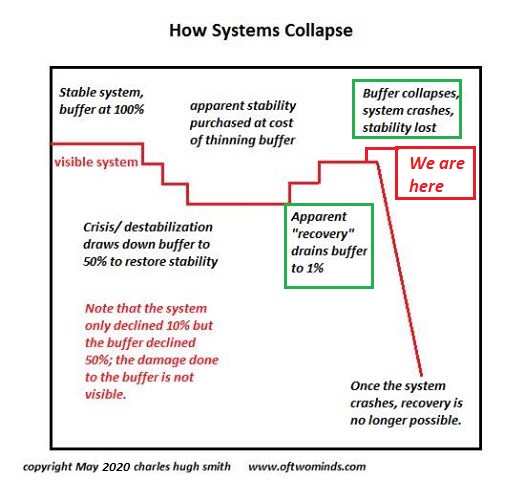
The moral buffers have already thinned; there is nothing left to tap. There is nothing left in what actually matters: social cohesion, moral legitimacy, civic virtue–all stripped, depleted, gone.
Drones and robots won’t save us from collapse. Neither will fusion reactors, electric air taxis, billionaires in space, missions to Mars, algae-based meat or any of the other thousand “innovations” those profiting from moral rot promote in the hopes that the banquet of consequences being served can be swept away by more gimmicks, more artifice, more delusions, more fantasies, more PR, more spin and more narrative control.
Collapse can’t be gimmicked away. The notion that consequence can be as easily managed as PR is the ultimate artifice and the ultimate delusion.
I’m a committed advocate of freedom, personal liberty, pharmaceutical free health, bodily autonomy, and free-thinking, which, apparently, puts me at odds with the majority. As shocking as it is, these basic standards of a good life, which have governed humans for centuries, are suddenly being portrayed as selfish and even dangerous.
How does an individual come to view personal sovereignty as a detriment to themselves and to society, especially when that society is so obviously sick and dysfunctional? How does one come to see their own body as a threat to the world at large, and a playground for experimental science?
People ask me these questions all the time, and the best way to explain what’s happening is to look at how mind control, social engineering, propaganda, and hypnosis affect the mind and steer the individual away from individualistic and self-governing behavior. The hysteria so prevalent today only makes sense when you recognize that most people are truly not thinking for themselves, but are instead programmed to run scripts and programs that have been prepared for mass consumption.
By looking at how hypnotism works, for example, you can begin to understand what’s really happening today, and more importantly you can begin to understand how your own life is affected by the environment we’re in.
Here’s a look at how hypnosis (and mass media) hack your mind to control your behavior.
First of all, let’s acknowledge the power of hypnosis. Therapeutic hypnosis is widely used clinically for the management of pain, depression, anxiety, stress, phobias, and habit disorders, such as smoking.
Stage hypnotists are well-known for inducing some extraordinarily illogical and ridiculous behavior in their subjects. In a matter of minutes, an accomplished stage hypnotists can get complete strangers to do absurd things like believe their hands are glued together, forget their own name, lose the ability to drink water, to be unable to see a person or object right in front of their face, to jump up and yell something bizarre when they hear a code word, and on and on.
Hypnotism is real, and anyone is susceptible to it, in varying degrees. In the following clip, hypontist Keith Barry explains what it takes to hypnotize a person… any person. He explains that a subject needs to be intelligent, as a key requirement for hypnotism is the ability to focus on the imagery, speech and commands of the hypnotist. He gives us a simple exercise to show that certain people can be more or less susceptible to hypnosis.
YouTuber Derek Banas explains the process of how to hypnotize someone. Firstly, you must hold the belief that hypnosis is real and that it will work, then you must build a rapport with the subject, have them place their full attention on you, completely focusing at all levels on one thing. When their attention is completely focused, the subject is ready to be led into trance, which involves giving repeated simple commands and suggestions, until they are told to close their eyes and fully relax.
There are variations of this, including different techniques, although the process is essentially uniform.
You act with authority and confidence. You direct all of their attention on to one thing, You repeatedly tell the subject that they are being hypnotized. You lead them into trance with repetitive language and directives, while directing the movements of their eyes.
As the subject undergoes this process they are making a series of micro-agreements along the way, essentially giving the hypnotist deeper access to consent. The attention is focused along with repetitive and downwards inflecting suggestions while their eyes are trained on a specific object, like a swinging watch, for example. Doing this brings the subjects brainwaves closer and closer to an alpha state, the most hypnotic brainwave state.
The confidence and rapport of the hypnotist serves to bypass what is known as the critical factor, which is considered the gateway between the conscious and subconscious mind. It is believed that 95+% of our behavior is governed by the subconscious mind, and bypassing the critical factor moves the subject from analytical thinking toward emotional and unconscious thinking, forgoing logic and reason. Essentially, the subject’s nervous system is either overloaded, or made to completely relax, and high emotions such as lust or fear are the most effective emotional energies to bypass the critical factor. A hypnotist does this by presenting with authority and certainty, thereby giving the subject the freedom to relax into a subconscious or automatic mode of behavior.
The physical signs of hypnosis include dilated pupils, relaxed breathing, eyes wanting to close, skin flushes and other subtle physiological signs. When a person is deep in an alpha brainwave state, a hypnotic state, their conscious, rational mind is effectively switched off, and they become incredibly open to suggestion, making it possible to implant ideas and behaviors into them, which the subject will adopt without critical thinking.
Hypnotherapist Marc Marshall explains this in more detail and in the context of our global situation, discussing how the amygdala is also hijacked to bypass the critical factor, taking over a person’s fight or flight responses.
“Let me pull back the curtain a bit on how this process works and show you what has happened and is continuing to happen in this current emergency. Many of you have witnessed what hypnotists call an instant or shock induction. These are the dramatic inductions that many stage and street hypnotists use to induce a trance state (hypnosis) in their volunteers. It literally takes just a few seconds for this to happen. What the hypnotist typically does is cause a firing of that portion of the brain known as the amygdala. We literally hijack the amygdala which is responsible for the “fight/flight/freeze” mechanism of our bodies. It is in this split second of time, that the subconscious mind is looking for a program that will provide an appropriate response. Nancy Moyer, MD., describes it as “When stress makes you feel strong anger, aggression, or fear, the fight-or-flight response is activated. … It happens when a situation causes your amygdala to hijack control of your response to stress. The amygdala disables the frontal lobes and activates the fight-or-flight response.” It is this most basic of instinctual responses that is responsible for our survival as a species. It is caused by the release of cortisol, a powerful stress hormone.
There are several extremely critical parts of this phenomena of amygdala hijack that are the essence of what I am seeing and which concerns me. As stated above, the amygdala disables the frontal lobe of our brains. The frontal lobe is the part of the brain that controls important cognitive skills in humans, such as emotional expression, problem solving, memory, language, judgment, and sexual behaviors. It is, in essence, the “control panel” of our personality and our ability to communicate. We lose our ability to make rational judgements, our stress increases and dramatic physical changes take place in our bodies. Most importantly, we become and remain highly suggestible in this highly aroused state. Our subconscious minds are seeking to find that “program” that will free us from this threat and we take that cue from the perceived leaders.” ~Marc Marshall
That’s a short synopsis of how a hypnotist brings someone into a suggestive trance, and here’s an excellent video of this process, and a demonstration of what a hypnotist can influence a person to unconsciously do.
The keys to the process of inducing hypnosis are the projection of confidence and authority, capturing the full attention of the subject, using repeated trance inducing language and repeated suggestions, bypassing the critical factor, and inducing an alpha brainwave trance.
Confidence, authority, repetition, suggestion and trance induction.
Now, back to how mass media uses this very skillset to induce mass hypnosis and generate widespread unconscious and controllable behavior.
Firstly, the primary medium for blasting non-stop cable news into your brain is TV. Television itself is well-known to rapidly induce alpha brain wave states in the viewer, bringing them into a hypnotic trance automatically, typically affecting the function of the frontal lobe within an astonishing 90 seconds, and bypassing critical thinking.
“If you’ve ever experienced a mind fog after watching television, you’re not alone.
The brain has four modes that it operates in, and four brain wave patterns. Delta is when you’re deep asleep, Theta is when you’re in light sleep, Alpha is awake but relaxed, it’s the mode of thinking that you are in when you’re in the most heightened state of suggestibility, and then there’s Beta, the highest functioning mode like when you’re reading a book or you’re having a very stimulating conversation.” ~Pseudology: The Art of Lying
This presentation explains this in greater detail.
Furthermore, the graphic design elements commonly used in news presentations serves the purpose of capturing one’s full attention and jarring the nervous system into an overloaded state. Think about the various moving parts and messages the screen at any given moment during a regular broadcast. While the anchor is speaking about one thing, you’ll see side-scrolling text at the bottom talking about an entirely different issue, with evolving background graphics, typically emphasizing the colors red and blue, which are subconsciously regarded as the colors of authority and trust.
Also, they commonly use swirling spheres and circles, graphics are used much in the same way that hypnotist uses a watch or a pen as a point of eye fixation to capture the full attention of the viewer.
Here’s a perfect example:
Now, if you look at marketing in general, it is a confidence game. That is, marketers will attempt to sell you anything at all while pretending it is the most amazing and life-changing thing ever. TV infomercials come to mind.
Mass media is a confidence game (con-game), meaning that the anchors, reporters, experts and pundits are adept at presenting any information with absolute and total confidence. Colin Powell did this when he showed up at the UN with a vial of white powder and told everyone in the room that Saddam Hussein was going to kill everyone. It’s difficult to disbelieve someone who presents with such confidence, and psychopaths are the best at this, and know to exploit their victims’ trust by over exaggerating confidence.
The top news anchors will never let their confidence down, and they’re marketed in such a way as to manufacture rapport with the audience. They’re seen in heart-warming town hall segments relating to the common man, out in nature celebrating life, and out on the town kissing babies. Here’s everyone’s favorite, Anderson Cooper, being portrayed as a humanitarian. Such a likable guy!
Finally there is the detail of suggesting and commanding the viewer to believe or to do certain things. In hypnosis, when the critical factor is bypassed, it allows access to the subconscious mind where what are known as ‘pillars of belief’ are implanted. Below the rational, critical thinking part of the mind is a deep sea of beliefs which govern most behavior. Once a subject is in an induced trance, the news repeats ideas, suggestions and beliefs, ad nauseam until the viewer basically becomes a parrot and information repeater. You see these people everywhere today.
Final Thoughts
More than ever before, those of you who believe in freedom, as I do, are called to gather your strength, sovereignty and power to stand up for these timeless moral values. It is of critical importance to recognize that the world has been deliberately lulled into a hypnotic state and fed beliefs and ideas about how things should be or how we should address crisis.
If you understand what is happening, and if you understand how all of this plays a role in shaping your own life, beliefs, and behaviors, you’r better equipped to take back control of your life.
At the dark heart of corporate consumer culture lie the social programs that mass-produce conformity, obedience, acquiescence and consent for the matrix.
The cult of celebrity is the royal monarch of these schemes, the ace in the hole for mass mind control and the disempowerment of the individual. This is the anointed paradigm of idol worship and idol sacrifice, a vampire’s feast on our individual and collective dreams. Who do you love? Who do you hate? Who do want to be like?
Combine this paradigm with the technology of social media, and the individual is flung into oblivion, never fully understanding the importance and value of their own life, instead always comparing themselves to phony ideals and well-designed, well-funded marketing campaigns.
‘The camera has created a culture of celebrity; the computer is creating a culture of connectivity. As the two technologies converge – broadband tipping the Web from text to image; social-networking sites spreading the mesh of interconnection ever wider – the two cultures betray a common impulse. Celebrity and connectivity are both ways of becoming known. This is what the contemporary self wants. It wants to be recognized, wants to be connected: It wants to be visible. If not to the millions, on Survivor or Oprah, then hundreds, on Twitter or Facebook. This is the quality that validates us, this is how we become real to ourselves – by being seen by others. The great contemporary terror is anonymity.’ ~William Deresiewicz
Marketeers and propagandists are skilled at leveraging human psychology to exploit human nature. They utilize the study of the psyche to gain inroads into your behavior, and they employ this science as a tool for stoking insecurities and triggering urges.
They may be selling an idea, a lifestyle, a product, or a war, but, the pitch is the same: a false idol rises from the wastelands of the American dream, and is presented to the hordes as a well-packaged product. The celebrity’s life is a projection of a niche fantasy, and a following is built up around this fantasy, and the cult followers are steered toward whatever point of purchase.
And that’s what a cult is: “a system of religious veneration and devotion directed toward a particular figure or object.”
This kind of externalized validation serves as a power transfer. Your personal power is extracted and foisted onto a manufactured image in the matrix, and without realizing it, you’ve forfeited your power to influence the direction of your own life.
“The Fantasy of celebrity culture is not designed simply to entertain. It is designed to drain us emotionally, confuse us about our identity, make us blame ourselves for our predicament, condition us to chase illusions of fame and happiness, and keep us from fighting back.” – Chris Hedges
This is about usurping individuality in order to foster groupthink and hive consciousness. It’s also about creating a barrier between what you believe is possible for yourself and what chances you are willing to take in order to manifest a unique vision for your life.
You see, human beings are energetic creations, partly made of matter and partly made of spirit, but wholly malleable to the direction of the mind. We are affected by subtle energies, body language, electromagnetic energy, frequencies of light that we cannot see, sounds that we cannot hear, and a thousand other hidden cues. We are beings of energy, and much like a battery, we can can give or receive energy.
But the mind is at the center of it all. Whatever the mind entertains, the being creates.
When the mind fixes on an external idol, this innate power to form ourselves is transferred outside of our own locus of control, and where the mind could be centered on creating and expanding the self, it is instead focused on the fantasy of achieving an impossible ideal.
As journalist Jon Rappoport notes:
“If perception and thought can be channeled, directed, reduced, and weakened, then it doesn’t matter what humans do to resist other types of control. They will always go down the wrong path. They will always operate within limited and bounded territory. They will always ignore their own authentic power.” ~Jon Rappoport
The end game here is to keep us from accepting ourselves as worthy and perfect divine beings, and to disconnect us from our own potential. This is deep stuff, reaching far beyond the push to convert us into greedy, materialistic consumers. In a metaphysical sense it is a transfer of energy, and where once we were strong and full of promise, we are now helpless and content to observe as the world flits by.
What’s most dangerous to any system of control is for the individual to know their own strength and to speak their own language, as Chris Hedges puts it.
“That’s why I don’t own a television… and I work as hard as I can to distance myself from popular culture so that I can speak in my own language, not the one they give me.” ~Chris Hedges
Branded (2012) is a Russian-US sci-fi parable written and directed by Jamie Bradshaw and Aleksandr Dulerayn. Much of the story is told in flashbacks documenting the rise, fall and rebirth of top-level advertising executive Misha (Ed Stoppard, son of playwright Tom Stoppard). Upon being scapegoated for a marketing disaster, Misha withdraws to the countryside where in a trance state he’s compelled to perform a bizarre ritual. Shortly after, he finds he has a unique ability to “see” strange parasitic creatures which are the embodiment of corporate influence. Horrified, Misha sets out to destroy the creatures of his visions, a quest which could ultimately liberate society but at the expense of his personal and professional life. Though the film is hindered by uneven tonal shifts and occasionally stilted performances, Branded is notable for its relevant social critique which mixes elements of Putney Swope,They Live and novels of Philip K. Dick.
Ralph Waldo Emerson once said, “A man in debt is so far a slave.” Money has no intrinsic value yet we spend our days damaging our health and spirit in order to obtain it. Why do we sacrifice our well-being for it? Is it the cliché that “we just want to provide a better life for our kids than we had?” Is it just way of the civilized world? The most important question to ask, however, is what power do we have to change this way of thinking and living? The reality is simple: money is a vehicle for social control. Debt makes us good, obedient workers and citizens.
The traditional workweek started in 1908 at The New England Cotton Mill in order to allow followers of the Jewish religion to adhere to Sabbath. With the passage of The Fair Labor Standards Act in 1938, the 40-hour workweek became the norm. Data from the 2013 American Community Survey showed that the average commute time in America is about 26 minutes each way. According to a Gallup poll, the average workweek in America is 34.4 hours, however, when only taking into account full time workers, that average shoots up to 47, or 9.4 hours per day during a 5-day workweek. Keeping averages in mind then, between commuting, working and figuring in an hour for lunch (usually less), that puts us at approximately 11 hours and 40 minutes for the average full time worker. If you have a family with young kids, just add in another few hours for homework, baths, etc.
When the day is done, how much time do you have for yourself? To exercise, meditate or otherwise unwind the way that all the healthy living gurus preach? And how much of yourself, your presence of mind, is left to devote to family? We give the company the heat of our most intense mental fire while our families get the smoke. Yet Jeb Bush, the 2016 GOP presidential hopeful, says we need to work more.
The answer to why we put ourselves through this daily grind is multifaceted. The most pervasive reason is workplace and societal pressures. We are raised in a matrix of sorts. The cycle starts around the age of five when we are expected to adhere to a regimented 8-hour day of school. At this age, we don’t have the intellect to question why, so we mechanistically follow the path that’s laid out. This daily path becomes engraved in our minds and becomes as automatic as the sun’s daily journey. Our school system is adept at churning out working class individuals en masse. We are taught along the way not to question authority, again adhering to the working class mentality.
On the opposite end of the spectrum are those in power. They are the ones that like to color outside the lines. Many books abound with titles such as The Wisdom of Psychopaths that illustrate how people with psychopathic traits, ones who don’t tend to follow rules, are often found in managerial roles such as CEOs all the way up to presidents of countries. With these rare manipulative, coldhearted personalities in place and the rest of us following like good sheeple without questioning, the stage is set for compliance.
If you have been in the working world long enough, then the following statement should ring true: if you work extra hours, you are a great worker; if you decline, you’re useless and apathetic. In the work world, there’s typically no in between. The pressure to succeed for the pride and benefit of the company unfortunately supersedes that of the pressure to be a good parent, sibling, son or daughter. According to a study done by the economic policy institute, between 1948 and 2013, productivity has grown 240% while income for non-managerial workers has grown by 108%. To make up for this discordance, pride of doing what’s best for the company has been employed as a motivational tactic. This tactic has been used as a sharp IV needle that’s been inserted into our veins and we have willingly ingested the contents that are injected through it. Pressure to conform toward achieving the company’s goals has overcome our will to be compensated accordingly.
The other side of this pressure comes from society as a whole outside the education/workplace. A close friend of mine works for a state court and makes about $40K/year. He is also a self-employed business owner on the off hours. I estimate that he works about 70-80 hours a week. He owns a home in a well-to do neighborhood and he drives a seventy thousand dollar luxury car. This crystallizes the saying ‘big hat, no cattle.’ But when a lie is told over and over, the lie becomes the truth.
When we look at someone who drives a luxury car and lives in an upscale part of town, we see this as success because of how often that visual of it has been pounded tirelessly into our minds. We fail to see that these are nothing but symbols of success and false ones at that. They appear real because as a society, we have been conditioned to see them this way by the advertising industry. In the book, The Millionaire Next Door, the authors annihilate this illusion. Numbers don’t lie and the statistics show that most true millionaires, those with a net worth of over one million dollars, do not own those luxuries that we typically associate with success and wealth. They view them as the reality of what they are: a depreciating liability. According to the book, the typical millionaire owns a home in the two to three hundred thousand dollar-range and a non-luxury automobile. If something goes wrong with either, they have the cash reserves to fix it. On the other hand, the commonplace owner of the luxury home and car can’t afford the roof and the tires respectively without going deeper into debt if they should need replacing.
Ownership of these symbols of wealth becomes a self-perpetuating illusion to satisfy the psychological need for acceptance. Unfortunately, human behavior dictates that emotional needs often override logical thinking. It’s been said that the borrower is slave to the debt-owner and with luxury items, debt is the rule, not the exception. Debt is healthy for those in power and contributes to a needy and thus obligated worker.
The current wisdom of slave, spend and save for retirement has only one destiny. That destiny can be summed up in three sentences. Spend your healthiest and most productive years working to support a life of materials and thus illusions of success while elevated stress damage your health. During this time, be sure to save enough money for retirement so you can enjoy those years of the subsequent poor health. And lastly, do it in the name of pride for your company and country.
I take pride in being American, as I’m sure most Americans do, however, if you’re reading this you’re likely smart enough to see the holes in the daily grind. It saps our creative potential and our physical, as well as our spiritual energy. We don’t need any studies to tell us how stressed we are and subsequently, how unhealthy we are. The physical manifestations of stress such as obesity, hypertension, heart disease, increased risk of cancer, depression, anxiety and many others tell us all we need to know. They tell us that we need a better work/life balance. They tell us that the pendulum has swung too much in the direction of work and away from life. Fortunately, there’s a way that we can take it back.
The most important way to restore this balance is to realize the power that we, as consumers, hold. Tyler Durden, the protagonist in the film, Fight Club said it best…
“…advertising has us chasing cars and clothes, working jobs we hate so we can buy shit we don’t need.”
The marketing and advertising industry know, more than anyone else, what motivates the human mind and how to tap into those instinctual drives. To defend against this industries seductiveness, we need to journey within ourselves and bring to light what’s really important to us. What most of us will find is that experiences and time well spent, not materials, are what makes us happy. In the book, aptly titled Well Being, the authors Tom Rath and Jim Harter discuss how experiences have been proven to make us happier than material posessions.
We revel in the anticipation of the experience, we enjoy the experience itself and we look back on it fondly for as long as we live. We do this while the expensive car or house that we borrowed money long ago to obtain falls apart causing us to borrow more money. If we live according to the rule that everything we purchase, with the exception of a home, is acquired by cash, then we fail to become slaves to debt and by extension, work. We no longer relinquish our power to creditors.
Oscar Wilde was famously quoted as saying that anyone who lives within their means suffers from a lack of imagination. Materialistically speaking, living by this notion will bind us with shackles to a life of debt servitude. When we rip those shackles of debt from our wrists, our minds become clear and we see what truly makes us happy. We spend more time with friends and family. We focus on our passions and hobbies. In essence, we get back to the foundation of what it means to be human. After all, none of us will ever arrive upon the mountain of our last moments of existence wishing we spent more time at the office. We will instead arrive wishing we completed that book, that painting or that experience with those we love most. For those can be purchased not with debt, but with time. And there is no more cunning, covert and deceitful thief of time as that villain we call debt.
About the Author
M.J. Higby practices medicine in Phoenix, AZ. He is passionate about martial arts, most notably Brazilian Jiu Jitsu. He enjoys writing about mental, spiritual and physical well being and questioning the methods by which we attain it. You can reach him on Facebook and Twitter @MJHigby






 After the Crash