Saturday Matinee: Kurt Vonnegut: Unstuck in Time

By Matt Zoller Seitz

Source: RogerEbert.com

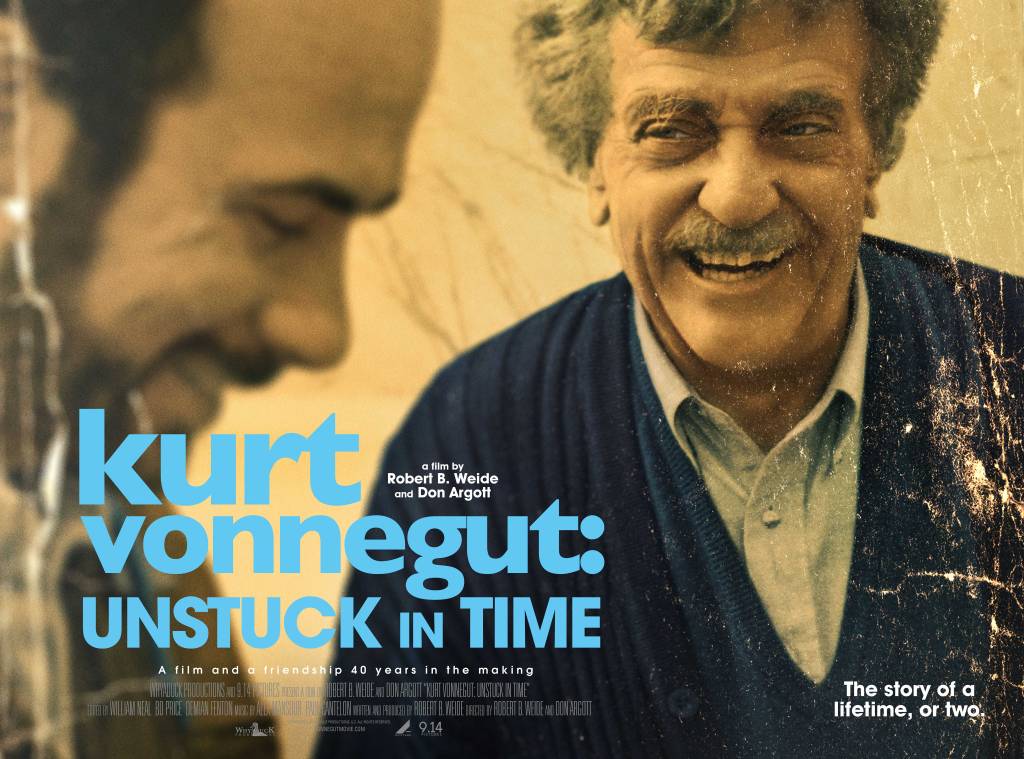
“Kurt Vonnegut: Unstuck in Time” is messy in the way that wakes for dear friends are messy.

Some speakers go on too long, and there are others that you may wish you’d heard from at greater length, or at all. And the raw sentiment coursing through every moment of the affair, however heartfelt, can be overwhelming, especially if you didn’t know the deceased as well as the folks memorializing him. 

The deceased here is Kurt Vonnegut, and the person who planned, executed and hosted this cinematic wake, director Robert B. Weide (a veteran documentarian and an Emmy-winning director for “Curb Your Enthusiasm”), was a friend of Vonnegut’s throughout the final 25 years of his life. This movie, co-directed by Don Argott, runs over two hours. Thematic and structural ideas are introduced, nurtured, forgotten, then reintroduced awkwardly. Weide himself is a major character—as well he should be, considering that Vonnegut essentially made Weide his personal archivist, sending him letters and manuscripts and faxes and video and audio tapes, and this film is as much a portrait of a friendship as it is the warts-and-all record of a great writer’s life—but sometimes the proportions feel off. When Weide disappears for long stretches, I don’t know that it’s exactly a slam to say that you don’t miss him, because people are mainly here for Vonnegut, one of the most important American writers of the 20th century, and a fount of charisma even at his lowest depths of sour narcissism in the 1970s. 

Vonnegut fans know that he specialized in slim, nimbly written books, with short chapters and short paragraphs that jumped wherever Vonnegut’s consciousness happened to take him. “Unstuck in Time” lets us know that it is consciously modeling its structure on Vonnegut’s writing, in particular his widest-read work, the nonlinear novel/memoir “Slaughterhouse Five,” from whence the documentary’s subtitle is drawn (“Billy Pilgrim came unstuck in time,” it starts); and to a lesser extent, Vonnegut’s late-career bestseller “Timequake,” a fragmented, self-aware book that is partly about the difficulty of writing “Timequake.” 

There are also cinematic allusions to Vonnegut’s literary alter-ego, Kilgore Trout, in the way that Weide and Argott and three credited film editors weave together the relationship between Vonnegut and Weide. Weide first meets Vonnegut in 1982 at age 23 after writing him a fan letter inquiring about the possibility of making a documentary about his life, and he holds onto that youthful starstruck quality even in reminiscences shot long after Vonnegut’s death in 2007. Over time, the pupil gains the master’s respect, to the point where Weide writes and coproduces a feature-length adaptation of Vonnegut’s novel “Mother Night,” starring Nick Nolte and directed by actor-filmmaker Keith Gordon, who as luck would have it played Rodney Dangerfield’s son in “Back to School,” a comedy in which Vonnegut played himself.

This may all sound as if it’s articulated more cleanly and effectively than it is. The filmmakers have committed simultaneously and with equal enthusiasm to a couple of filmmaking approaches that are at odds. One is the detached, clinical-mathematical, unsentimental, science-fictional, time-tripping biography, a la “Slaughterhouse Five” and “Timequake,” represented here by inventive cutting from image to image and idea to idea, sometimes lingering on signifiers of creative self-awareness. These include closeups of the timeline on an editor’s computer screen, montages of Vonnegut doing or saying the same thing in different decades of his life, snippets of films based on Vonnegut’s writing, and animated sequences modeled on Vonnegut’s drawings, which were as distinctive as his prose.

The other approach is more straightforward: Weide and Argott are making a straightforward PBS-style documentary about an artist’s life, supervised by a director and fan who knew him intimately, and tghat draws on footage ranging from childhood through old age. The latter might jump around in time in terms of the years in which it was created, but it ultimately tells Vonnegut’s story in a far more conventional way that the movie promises to do in its opening minutes.

This is fine; in fact it’s more than fine, because as Vonnegut and various experts on his work point out, Vonnegut remains readable and relevant in large part because he expressed himself in a direct way, drawing upon what’s described here as a journalistic writing style. Correspondingly, the most moving scenes and moments in “Unstuck in Time” are unmannered accounts of events. These range in emotional character from elating (Vonnegut’s commercial and critical success with “Slaughterhouse Five” after years of financial struggle) to vexing (after that success, he left his first wife, Jane, who’d been by his side during the lean years, moved to Manhattan, and married his mistress) to tragic (Vonnegut’s brother-in-law dying in a train wreck just two days before Vonnegut’s older sister died of cancer) to inspirational (Vonnegut unhesitatingly raising his late sister’s four sons alongside the three kids he had with Jane).

All of this material is fascinating, and articulated in vivid detail thanks to Weide’s trove of material. There are closeups of typewritten revisions of Vonnegut classics, each alteration indicated in pencil or pen, and letters and answering machine messages covering every imaginable life event. The filmmakers lay it all out so elegantly that whenever the movie seems to forget that it’s also about Weide and suddenly interrupts the flow to insert a reference to one of Weide’s own milestone events (such as his wife’s own battle with a debilitating illness and his Emmy win for “Curb,” which seems to be in there so that he can include Vonnegut’s answering machine message congratulating him) it’s awkward because Weide is clearly still grieving, too, and the viewer is torn between wanting to bear witness to Weide’s miseries and triumphs and wanting him to get back to Kurt Vonnegut as quickly as possible.

There is, nevertheless, something to be said for a documentary that tries to do something different and perhaps impossible, even if it doesn’t quite get there. And in the end, any flaws or missed opportunities are subsumed by the movie’s sincerity and wealth of insight. Its analysis of the role that Vonnegut’s World War II experience played in his demeanor as well as his fiction is fascinating and on-point, and the editors bring it all back at the end when Vonnegut, outraged by the second Bush administration’s invasion of Iraq and weaponizing of patriotism, writes a series of columns for “In These Times” magazine that will ultimately be collected in 2005’s “A Man Without a Country,” arguably his last major work.

Weide himself comes across as a sardonic and compassionate witness and guide, often taking the piss out of his own reverence for Vonnegut just when things threaten to get a bit moist. The devotion he displays towards Vonnegut throughout the second half of the writer’s life is as inspiring as Vonnegut’s own high points as a human being. We should all be lucky enough to have a friend who will tell our story.

____________________

Watch Kurt Vonnegut: Unstuck in Time on Kanopy here: https://www.kanopy.com/en/product/13799154
Did David Foster Wallace predict the future?

Our world is more dystopian than Infinite Jest

By Sarah Ditum

Source: UnHerd

Infinite Jest is frequently attention-repellent. David Foster Wallace’s brick-sized novel is physically challenging, an 800g book that forces you to flick back and forth to the errata. This is not optional. Major plot points hinge on throwaway glosses. 

I was a bratty, bookish 15-year-old when it was published in 1996. A 1,000-page-plus novel bloated with endnotes that have their own footnotes was an irresistible challenge. David Foster Wallace was not an obscurantist in his own literary taste — he taught Stephen King and Thomas Harris at Illinois state university — but Infinite Jest is a book at bloody-minded war with its own bookness. With its maddening excess of information that you must hold in your hand as best you can, it feels more like the internet.

As well as being attention-repellent, it is also sometimes just repellent. There are scenes of comedically extreme horror: a woman dying after the handbag that holds her artificial heart is snatched from her, a man dying in his own filth while obsessively watching reruns of M*A*S*H, a dog dragged behind a car until all that’s left is a leash, a collar and a “nubbin”. Before livestreamed mass shootings and animal cruelty for clicks, Wallace knew that the grisly and grotesque was what the public wanted.

He did not see the future. But he saw the forces shaping the future, and understood the ways they would deform people in turn. 

In an aside, Wallace writes about how, with the introduction of the “Teleputer” (what we would call a laptop), video calls enjoyed huge popularity, followed by dramatic decline. Users quickly discover that being seen is enormously anxiety-inducing, partly because it means you must visibly be paying attention to the other party at all times, partly because you must also pay attention to how you look when making a call.

The answer to this anxiety is, first, “high definition masking” — a flattering composite of the user’s face digitally overlaid on the screen. Then comes actual masking — hyperreal rubber versions of the user’s face that can be quickly strapped on for calls. Eventually, in response to this “stressfully vain repulsion at their own videophonic appearance”, consumers revert to audio-only, which is now “culturally approved as a kind of chic integrity”. 

This divide between the real and the represented has been borne out by our experience of Zoom, Instagram and TikTok: filters are now so advanced that they can be applied to moving images, and you can digitally beautify yourself while livestreaming. Only instead of resorting to rubber masks, we remodel the flesh itself: “filter face” tweakments, intended to bring the human closer to the digital ideal, are on the rise. Wallace was right about the way pervasive exposure to our own image would break us. It’s just that the way we’ve responded is, somehow, even more dystopian than he imagined.

Infinite Jest’s near future is now our near past, and in 2008, Wallace killed himself after suffering decades of profound depression. By the middle of the next decade, his greatest novel had been recast as a byword for tedious white masculinity, the author himself cancelled. This was, at least in the biographical sense, deserved. In 1990, Wallace had met the poet Mary Karr. He was a resident in a halfway house, she was a volunteer, and he became obsessed with her. They dated, they broke up, then he assaulted and stalked her. In 2018, Karr tweeted that he had “tried to buy a gun. kicked me. climbed up the side of my house at night. followed my son age 5 home from school. had to change my number twice, and he still got it. months and months it went on.”

The novel includes multiple men in recovery steeping in the shame of their past violence, and it would be nice to imagine that this was Wallace examining his own conscience. On the other hand, it also includes a reciprocated love story between the large, lunkish, David-Foster-Wallace-ish character Don Gately, and the beautiful, idealised, Mary-Karr-ish Joelle van Dyne. Infinite Jest was, arguably, an implement of his ongoing harassment and should not be dishonestly mined for signs of redemption.

Still, it is a very contemporary thing to demand moral purity in artists: the kind of impulse that, perhaps, comes from seeking simplicity when far too much knowing is possible. “What do we do with the art of monstrous men?” asked Claire Dederer, as though to be an audience is inevitably to be an accomplice. Good art can be made by people who’ve done bad things, and perhaps only a monstrous man can faithfully portray the outlines of his own monstrosity. Reading is not an act of worship, although one of the problems for Infinite Jest is that certain male readers have treated it as such. 

And so, Infinite Jest has plummeted from literary touchstone to confirmed red flag. In a viral tweet from 2020 listing “Top 7 Warning Signs In a Man’s Bookshelf”, the first item was “A dog-eared copy of Infinite Jest”. The “dog-eared” was important: it was the act of having read it, rather than posing as someone who might read it, that sounded the klaxon.

But unread copies could be equally alarming: when the actor Jason Segal bought Infinite Jest in preparation for playing Wallace in a film, he recalled that the female bookseller rolled her eyes and said: “Every guy I’ve ever dated has an unread copy on his bookshelf.” Nicole Cliffe made it number four on her catalogue of “Books that Literally All White Men Own”. 

I have never run into a “DFW guy” — they’re probably more of an American campus thing. But I ran into the “Philip Roth guy” at university and recognise the type: clammy, proprietorial, forcing his literary taste on girls in lieu of forcing himself. That I had read Infinite Jest felt vaguely embarrassing. All that effort, and it turned out the most high-status option would have been to not read it and then be glibly dismissive. 

It’s perversely appropriate that Infinite Jest ended up holding such a key place in the vocabulary of this irony-bound strand of performative feminism, because irony was one of the things that Wallace was both appalled and fascinated by. In a 1993 essay, he writes that “irony and ridicule are entertaining and effective, and that at the same time they are agents of a great despair and stasis in US culture.”

Infinite Jest isn’t above irony, but it often pits itself against irony. “It’s like there’s some rule that real stuff can only get mentioned if everybody rolls their eyes or laughs in a way that isn’t happy,” thinks one character. Another feels an “aftertaste of shame after revealing passion of any belief and type when with Americans, as if he had made flatulence instead of had revealed belief” (the weird syntax is because this character is Quebecois). When sincerity is untenable, it becomes easier to engage with symbols than things. 

Over and again in the novel, the “real” gets displaced by the representation, like the rubber faces that can replace flesh ones on video calls. One of the centrepiece scenes of Infinite Jest features a geopolitical strategy game called Eschaton — a kind of Risk, but played by teenagers with balls and rackets to stand for missiles. The game comes violently undone when the players start hitting each other and the referee can’t work out how to distinguish between the territory and the map. As for the M*A*S*H-obsessive, “crucial distinctions had collapsed” between the fiction and the real.

And maybe this is connected to the novel’s weirdly well-informed interest in transsexuality. The gender ideology that makes front-page news now was a niche interest in the Nineties, confined mostly to academic papers and message boards for transitioners. Wallace’s inclusion of a young, effeminate, gay, “gender-dysphoric” character and a middle-aged, masculine, straight crossdresser suggests a hefty familiarity with the sexology literature long before any of this had crossed into the mainstream — it’s effectively a thumbnail sketch of the influential theory, developed by Ray Blanchard in the Eighties and Nineties, that male transsexuality divides into “two types”, the autogynephiliac and the homosexual.

But it also fits with the vision of an America where the signifiers that stand for “woman” hold more weight than the physical fact of femaleness. Gender as we experience it now — the idea of an “essence” or “true self” that renders the material body irrelevant — couldn’t have come to exist without the internet. Only when technology allowed people to present themselves as pure language, signifier unmoored from signified, did it become possible to believe that sex was malleable or unreal. Maybe transsexuality fascinated Wallace because he saw it as another way that humans confuse the symbol with the thing itself, the feminine with the female.

This summer, I started rereading Infinite Jest, mostly out of curiosity. It is, still, a very annoying book. But there’s something I didn’t understand about it in 1996 that I do now I’m older than Wallace was when he wrote it. He saw American culture as an exhausted force, trapped smirking in a hall of mirrors. And he saw that getting worse as screens extended their influence.

One of Wallace’s influences, Thomas Pynchon, wrote stories about the technology that made America possible: geographical surveys (Mason Dixon), the postal service (The Crying of Lot 49). Infinite Jest is about the technology that could undo a state: a kind of entertainment so compelling that it turns consumers utterly away from reality. It asks whether the real, or something like it, might be worth recovering. 

It is, still, a difficult book — and difficult in new ways. The wheedling presence of my phone is competition that Infinite Jest never had to contend with the first time around. The disturbing fact of Wallace’s own bad acts, too, was not available to me in the Nineties, and even if it had been it probably wouldn’t have struck me as a problem for the novel. But the difficulty is, and always has been, the point. Of course Infinite Jest could be shorter, lighter, less infuriating. But if it’s heavy, it’s because it’s weighing you back down in the physical world.

Pop Culture Has Become an Oligopoly

By Adam Mastroianni

Source: Experimental History

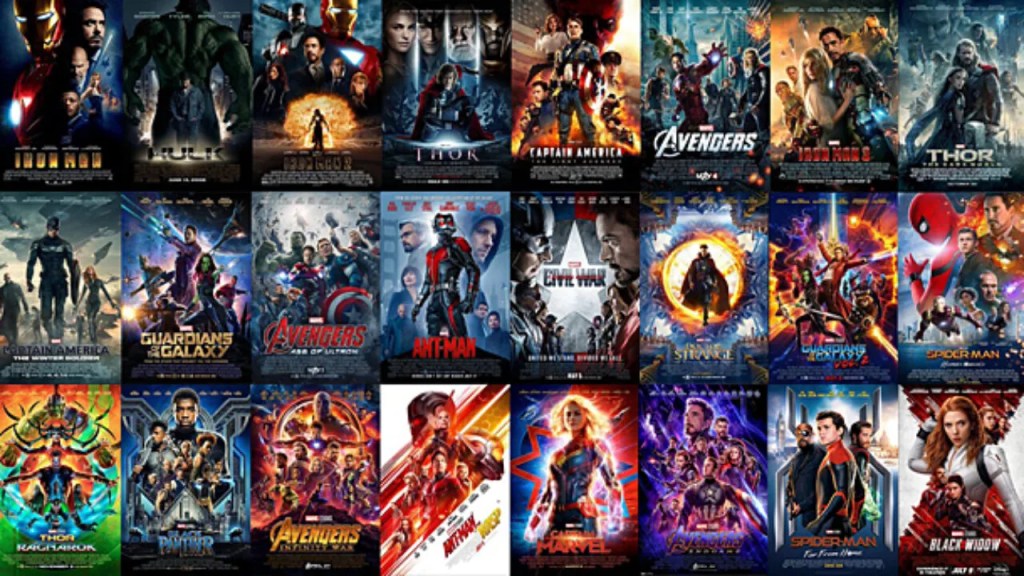
You may have noticed that every popular movie these days is a remake, reboot, sequel, spinoff, or cinematic universe expansion. In 2021, only one of the ten top-grossing films––the Ryan Reynolds vehicle Free Guy––was an original. There were only two originals in 2020’s top 10, and none at all in 2019.

People blame this trend on greedy movie studios or dumb moviegoers or competition from Netflix or humanity running out of ideas. Some say it’s a sign of the end of movies. Others claim there’s nothing new about this at all.

Some of these explanations are flat-out wrong; others may contain a nugget of truth. But all of them are incomplete, because this isn’t just happening in movies. In every corner of pop culture––movies, TV, music, books, and video games––a smaller and smaller cartel of superstars is claiming a larger and larger share of the market. What used to be winners-take-some has grown into winners-take-most and is now verging on winners-take-all. The (very silly) word for this oligopoly, like a monopoly but with a few players instead of just one.

I’m inherently skeptical of big claims about historical shifts. I recently published a paper showing that people overestimate how much public opinion has changed over the past 50 years, so naturally I’m on the lookout for similar biases here. But this shift is not an illusion. It’s big, it’s been going on for decades, and it’s happening everywhere you look. So let’s get to the bottom of it.

(Data and code available here.)

Movies 

At the top of the box office charts, original films have gone extinct. 

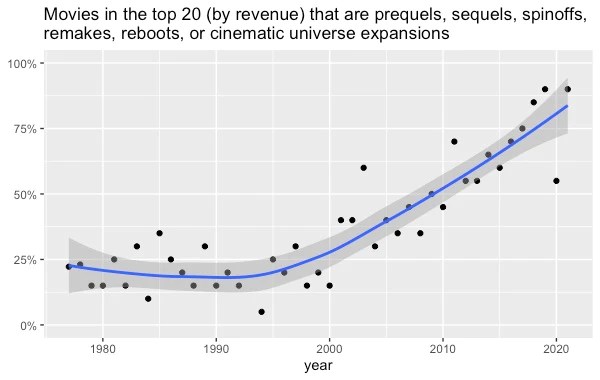
I looked at the 20 top-grossing movies going all the way back to 1977 (source), and I coded whether each was part of what film scholars call a “multiplicity”—sequels, prequels, franchises, spin-offs, cinematic universe expansions, etc. This required some judgment calls. Lots of movies are based on books and TV shows, but I only counted them as multiplicities if they were related to a previous movie. So 1990’s Teenage Mutant Ninja Turtles doesn’t get coded as a multiplicity, but 1991’s Teenage Mutant Ninja Turtles II: The Secret of the Ooze does, and so does the 2014 Teenage Mutant Ninja Turtles remake. I also probably missed a few multiplicities, especially in earlier decades, since sometimes it’s not obvious that a movie has some connection to an earlier movie.

Regardless, the shift is gigantic. Until the year 2000, about 25% of top-grossing movies were prequels, sequels, spinoffs, remakes, reboots, or cinematic universe expansions. Since 2010, it’s been over 50% ever year. In recent years, it’s been close to 100%.

Original movies just aren’t popular anymore, if they even get made in the first place.

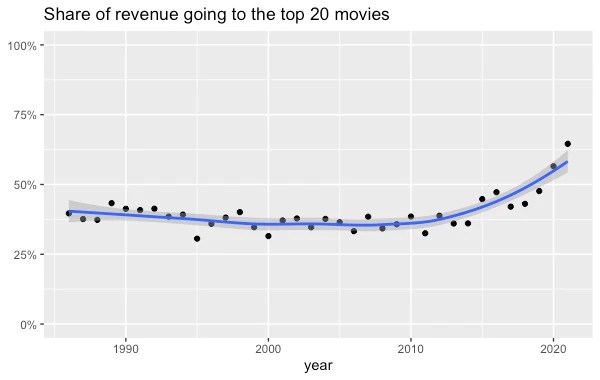
Top movies have also recently started taking a larger chunk of the market. I extracted the revenue of the top 20 movies and divided it by the total revenue of the top 200 movies, going all the way back to 1986 (source). The top 20 movies captured about 40% of all revenue until 2015, when they started gobbling up even more.

Television

Thanks to cable and streaming, there’s way more stuff on TV today than there was 50 years ago. So it would make sense if a few shows ruled the early decades of TV, and now new shows constantly displace each other at the top of the viewership charts.

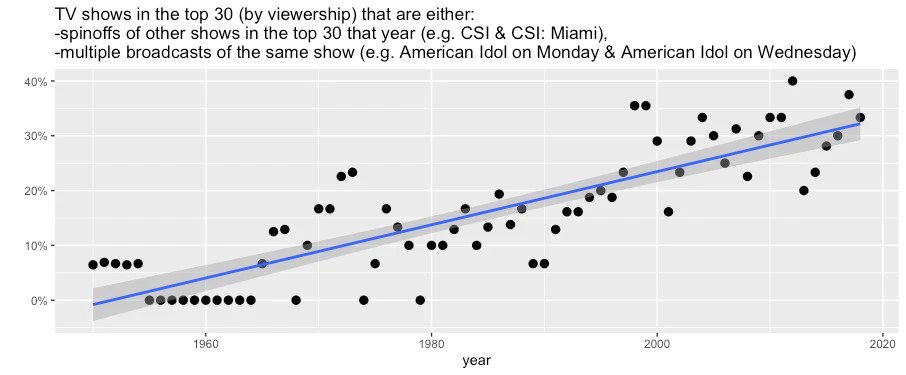
Instead, the opposite has happened. I pulled the top 30 most-viewed TV shows from 1950 to 2019 (source) and found that fewer and fewer franchises rule a larger and larger share of the airwaves. In fact, since 2000, about a third of the top 30 most-viewed shows are either spinoffs of other shows in the top 30 (e.g., CSI and CSI: Miami) or multiple broadcasts of the same show (e.g., American Idol on Monday and American Idol on Wednesday). 

Two caveats to this data. First, I’m probably slightly undercounting multiplicities from earlier decades, where the connections between shows might be harder for a modern viewer like me to understand––maybe one guy hosted multiple different shows, for example. And second, the Nielsen ratings I’m using only recently started accurately measuring viewership on streaming platforms. But even in 2019, only 14% of viewing time was spent on streaming, so this data isn’t missing much.

Music

It used to be that a few hitmakers ruled the charts––The Beatles, The Eagles, Michael Jackson––while today it’s a free-for-all, right?

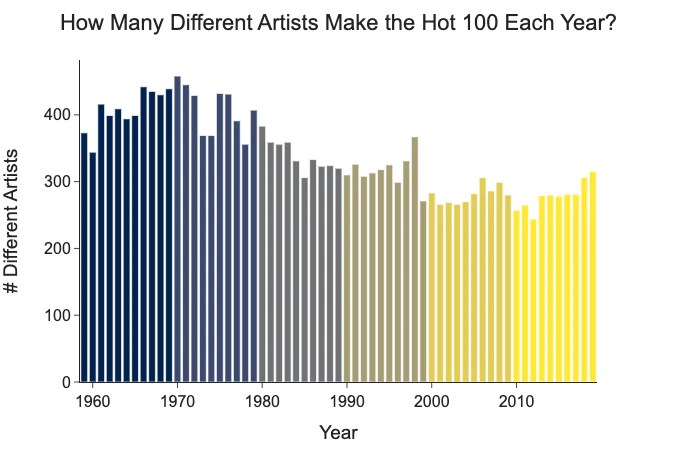
Nope. A data scientist named Azhad Syed has done the analysis, and he finds that the number of artists on the Billboard Hot 100 has been decreasing for decades.

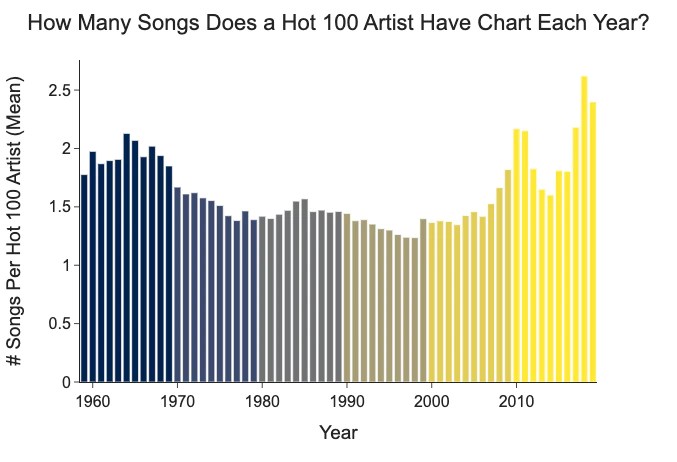
And since 2000, the number of hits per artist on the Hot 100 has been increasing. 

(Azhad says he’s looking for a job––you should hire him!)

A smaller group of artists tops the charts, and they produce more of the chart-toppers. Music, too, has become an oligopoly.

Books

Literature feels like a different world than movies, TV, and music, and yet the trend is the same.

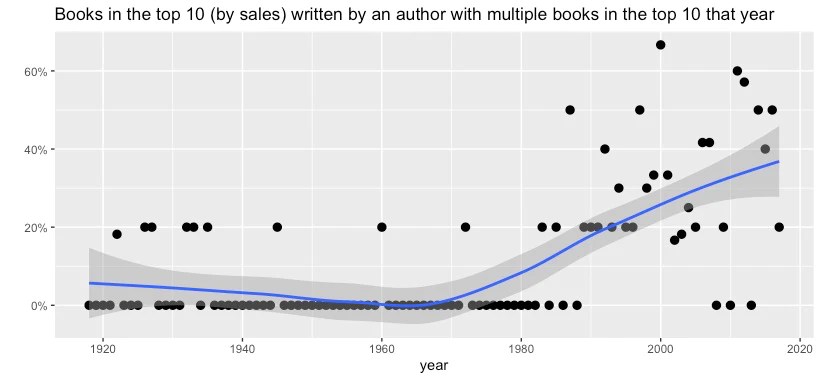
Using LiteraryHub’s list of the top 10 bestselling books for every year from 1919 to 2017, I found that the oligopoly has come to book publishing as well. There are a couple ways we can look at this. First, we can look at the percentage of repeat authors in the top 10––that is, the number of books in the top 10 that were written by an author with another book in the top 10.

It used to be pretty rare for one author to have multiple books in the top 10 in the same year. Since 1990, it’s happened almost every year. No author ever had three top 10 books in one year until Danielle Steel did it 1998. In 2011, John Grisham, Kathryn Stockett, and Stieg Larsson all had two chart-topping books each.

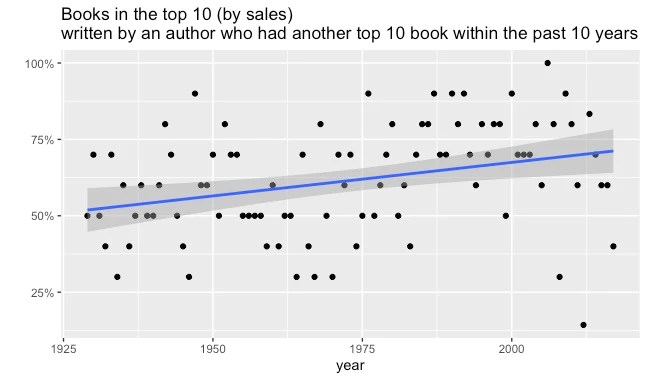
We can also look at the percentage of authors in the top 10 were already famous––say, they had a top 10 book within the past 10 years. That has increased over time, too. 

In the 1950s, a little over half of the authors in the top 10 had been there before. These days, it’s closer to 75%.

Video games

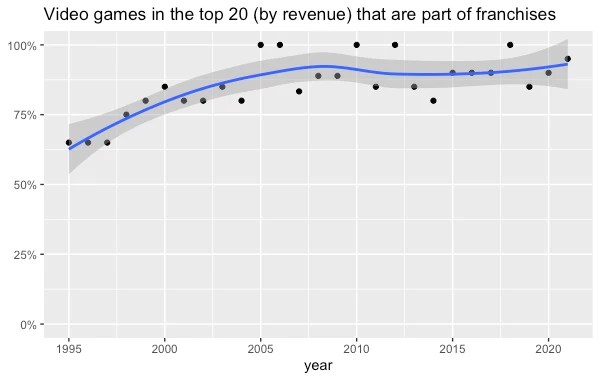
I tracked down the top 20 bestselling video games for each year from 1995 to 2021 (sources: 1234567) and coded whether each belongs to a preexisting video game franchise. (Some games, like Harry Potter and the Sorcerer’s Stone, belong to franchises outside of video games. For these, I coded the first installment as originals and any subsequent installments as franchise games.)

The oligopoly rules video games too:

In the late 1990s, 75% or less of bestselling video games were franchise installments. Since 2005, it’s been above 75% every year, and sometimes it’s 100%. At the top of the charts, it’s all Mario, Zelda, Call of Duty, and Grand Theft Auto.

Why is this happening?

Any explanation for the rise of the pop oligopoly has to answer two questions: why have producers started producing more of the same thing, and why are consumers consuming it? I think the answers to the first question are invasionconsolidation, and innovation. I think the answer to the second question is proliferation.

Invasion

Software and the internet have made it easier than ever to create and publish content. Most of the stuff that random amateurs make is crap and nobody looks at it, but a tiny proportion gets really successful. This might make media giants choose to produce and promote stuff that independent weirdos never could, like an Avengers movie. This can’t explain why oligopolization started decades ago––YouTube only launched in 2005, for example, and most Americans didn’t have broadband until 2007––but it might explain why it’s accelerated and stuck around.

Consolidation

Big things like to eat, defeat, and outcompete smaller things. So over time, big things should get bigger and small things should die off. Indeed, movie studiosmusic labelsTV stations, and publishers of books and video games have all consolidated. Maybe it’s inevitable that major producers of culture will suck up or destroy everybody else, leaving nothing but superstars and blockbusters. Indeed, maybe cultural oligopoly is merely a transition state before we reach cultural monopoly.

Innovation

You may think there’s nothing left to discover in art forms as old as literature and music, and that they simply iterate as fashions change. But it took humans thousands of years to figure out how to create the illusion of depth in paintings. Novelists used to think that sentences had to be long and complicated until Hemingway came along, wrote some snappy prose, and changed everything. Even very old art forms, then, may have secrets left to discover. Maybe the biggest players in culture discovered some innovations that won them a permanent, first-mover chunk of market share. I can think of a few:

  • In books: lightning-quick plots and chapter-ending cliffhangers. Nobody thinks The Da Vinci Code is high literature, but it’s a book that really really wants you to read it. And a lot of people did!
  • In music: sampling. Musicians seem to sample more often these days. Now we not only remake songs; we franchise them too.
  • In movies, TV, and video games: cinematic universes. Studios have finally figured out that once audiences fall in love with fictional worlds, they want to spend lots of time in them. Marvel, DC, and Star Wars are the most famous, but there are also smaller universe expansions like Better Call Saul and El Camino from Breaking Bad and The Many Saints of Newark from The Sopranos. Video game developers have understood this for even longer, which is why Mario does everything from playing tennis to driving go-karts to, you know, being a piece of paper.

Proliferation

Invasion, consolidation, and innovation can, I think, explain the pop oligopoly from the supply side. But all three require a willing audience. So why might people be more open to experiencing the same thing over and over again?

As options multiply, choosing gets harder. You can’t possibly evaluate everything, so you start relying on cues like “this movie has Tom Hanks in it” or “I liked Red Dead Redemption, so I’ll probably like Red Dead Redemption II,” which makes you less and less likely to pick something unfamiliar. 

Another way to think about it: more opportunities means higher opportunity costs, which could lead to lower risk tolerance. When the only way to watch a movie is to go pick one of the seven playing at your local AMC, you might take a chance on something new. But when you’ve got a million movies to pick from, picking a safe, familiar option seems more sensible than gambling on an original.

This could be happening across all of culture at once. Movies don’t just compete with other movies. They compete with every other way of spending your time, and those ways are both infinite and increasing. There are now 60,000 free books on Project Gutenberg, Spotify says it has 78 million songs and 4 million podcast episodes, and humanity uploads 500 hours of video to YouTube every minute. So uh, yeah, the Tom Hanks movie sounds good.

What do we do about it?

Some may think that the rise of the pop oligopoly means the decline of quality. But the oligopoly can still make art: Red Dead Redemption II is a terrific game, “Blinding Lights” is a great song, and Toy Story 4 is a pretty good movie. And when you look back at popular stuff from a generation ago, there was plenty of dreck. We’ve forgotten the pulpy Westerns and insipid romances that made the bestseller lists while books like The Great GatsbyBrave New World, and Animal Farm did not. American Idol is not so different from the televised talent shows of the 1950s. Popular culture has always been a mix of the brilliant and the banal, and nothing I’ve shown you suggests that the ratio has changed.

The problem isn’t that the mean has decreased. It’s that the variance has shrunk. Movies, TV, music, books, and video games should expand our consciousness, jumpstart our imaginations, and introduce us to new worlds and stories and feelings. They should alienate us sometimes, or make us mad, or make us think. But they can’t do any of that if they only feed us sequels and spinoffs. It’s like eating macaroni and cheese every single night forever: it may be comfortable, but eventually you’re going to get scurvy. 

We haven’t fully reckoned with what the cultural oligopoly might be doing to us. How much does it stunt our imaginations to play the same video games we were playing 30 years ago? What message does it send that one of the most popular songs in the 2010s was about how a 1970s rock star was really cool? How much does it dull our ambitions to watch 2021’s The Matrix: Resurrections, where the most interesting scene is just Neo watching the original Matrix from 1999? How inspiring is it to watch tiny variations on the same police procedurals and reality shows year after year? My parents grew up with the first Star Wars movie, which had the audacity to create an entire universe. My niece and nephews are growing up with the ninth Star Wars movie, which aspires to move merchandise. Subsisting entirely on cultural comfort food cannot make us thoughtful, creative, or courageous.

Fortunately, there’s a cure for our cultural anemia. While the top of the charts has been oligopolized, the bottom remains a vibrant anarchy. There are weird books and funky movies and bangers from across the sea. Two of the most interesting video games of the past decade put you in the role of an immigration officer and an insurance claims adjuster. Every strange thing, wonderful and terrible, is available to you, but they’ll die out if you don’t nourish them with your attention. Finding them takes some foraging and digging, and then you’ll have to stomach some very odd, unfamiliar flavors. That’s good. Learning to like unfamiliar things is one of the noblest human pursuits; it builds our empathy for unfamiliar people. And it kindles that delicate, precious fire inside us––without it, we might as well be algorithms. Humankind does not live on bread alone, nor can our spirits long survive on a diet of reruns.

Alice Walker and the Price of Conscience

Alice Walker was disinvited to the Bay Area Book Festival after Zionist groups threatened to carry out protests. The public and presenters are complicit in her blacklisting if they attend.

By Chris Hedges

Source: The Chris Hedges Report

There is a steep price to pay for having a conscience and more importantly the courage to act on it. The hounds of hell pin you to the cross, hammering nails into your hands and feet as they grin like the Cheshire cat and mouth bromides about respect for human rights, freedom of expression and diversity. I have watched this happen for some time to Alice Walker, one of the most gifted and courageous writers in America. Walker, who was awarded the Pulitzer Prize for fiction for her novel The Color Purple, has felt the bitter sting of racism. She refuses to be silent about the plight of the oppressed, including the Palestinians.

“Whenever I come out with a book, or anything that will take me before the public, the world, I am assailed as this person I don’t recognize,” she said when I reached her by phone. “If I tried to keep track of all the attacks over the decades, I wouldn’t be able to keep working. I am happy people are standing up. It is all of us. Not just me. They are trying to shut us down, shut us up, erase us. That reality is what is important.”

The Bay Area Book festival delivered the latest salvo against Walker. The organizers disinvited her from the event because she  praised the writings of the New Age author David Icke and called his book And the Truth Shall Set You Free “brave.” Icke has denied critics’ charges of anti-Semitism. The festival organizers twisted themselves into contortions to say they were not charging Walker with anti-Semitism. She was banned because she lauded a controversial writer, who I suspect few members of the committee have read. The poet and writer Honorée Fanonne Jeffers, who Walker was to interview, withdrew from the festival in protest.

Walker, a supporter of the Boycott, Divestment and Sanctions (BDS) movement, has been a very public advocate for Palestinian rights and a critic of Israel for many years. Her friendship with Icke has long been part of the public record. She hid nothing. It is not as if the festival organizers suddenly discovered a dark secret about Walker. They sought to capitalize on her celebrity and then, when they felt the heat from the Israel lobby, capitulated to the mob to humiliate her.

“I don’t know these people,” Walker said of the festival organizers who disinvited her. “It feels like the south. You know they are out there in the community, and they have their positions, but all you see are sheets. That’s what this is. It’s like being back in the south.”

Banning writers because of books they like or find interesting nullifies the whole point of a book festival. Should I be banned because I admire Louis-Ferdinand Céline’s masterpieces Journey to the End of the NightDeath on the Installment Plan, and Castle to Castle, despite his virulent anti-Semitism, which even after World War II he refused to relinquish? Should I be banned for liking Joseph Heller’s Catch-22, which I recently reread, and which is rabidly misogynistic? Should I be banned for loving William Butler Yeats, who, like Ezra Pound, many of whose poems I have also committed to memory, was a fascist collaborator? Should I be banned because I revere Hannah Arendt, whose attitudes towards African-Americans were paternalistic, at best, and arguably racist? Should I be banned because I cherish books by C.S. Lewis, Norman Mailer and D.H. Lawrence, who were homophobic?

We might as well sweep clean library shelves if the attitudes of writers we read mean we are denied a right to speak. 

And let’s not even get started with the Bible, which I studied as a seminarian at Harvard Divinity School. God repeatedly demands righteous acts of genocide, transforming the Nile into blood so the Egyptians will suffer from thirst. God sends swarms of locusts and flies to torture the Egyptians, along with hail, fire and thunder to destroy all plants and trees. God orders the firstborn in every Egyptian household killed so all will know “that the Lord makes a distinction between Egyptians and Israel.” The killing goes on until “there was not a house where one was not dead.” 

The Bible contains much of this divinely sanctioned slaughtering of non-believers. It endorses slavery and the beating of enslaved people. It condones the execution of homosexuals and women who commit adultery. It views women as property and approves the right of fathers to sell their daughters. But the Bible also remains, with all these contradictions and moral failings, a great religious, ethical and moral document. Even the most flawed books often have something to teach us.

Organizers of the festival attacked Walker for her poem “It is Our Frightful Duty.” They accuse Walker of channeling Icke’s alleged anti-Semitism into her writing, as if Walker is unable to think for herself. The attack on the poem, which is a gross misreading of its intent, exposes the lie that Walker’s position on Israel and Palestine had nothing to do with her being disinvited.

“Unfortunately, Ms. Walker has not only promoted Icke’s ideas widely on her own blog and in interviews, but they may have influenced her own writing,” the festival wrote in a statement. “Ms. Walker’s 2017 poem “It is our (Frightful) Duty to Study the Talmud” encourages people to use Google and Youtube to “follow the trail of “The / Talmud” as its poison belatedly winds its way / Into our collective consciousness. // Some of what you find will sound / Too crazy to be true. Unfortunately those bits are likely / To be true.” A New York Magazine essay by writer Nylah Burton (who identifies as Black and Jewish) describes her reaction to Walker’s support of Icke and this poem.”

The poem calls out these hate-filled religious texts. “All of it: The Christian, the Jewish, The Muslim; even the Buddhist. All of it, without exception, At the root.” Walker reminds us in the poem that these texts have been used throughout millennia to sanctify subjugation, dehumanization and murder. Slave holders defended the enslavement of Blacks by citing numerous passages in the Old and the New Testament, including Paul’s Letter to the Ephesians where, equating slaveholders with God, Paul writes: “Slaves, be obedient to your human masters with fear and trembling, in sincerity of heart, as to Christ.”  

Israel seeks, in the same way, to legitimize its colonial-settler project by citing the Old Testament and the Talmud, the primary source of Jewish law. Never mind that Palestine was a Muslim country from the 7th century until it was seized by military force in 1948. The Old Testament, in the hands of Zionists, is a deed to Palestinian land.

Walker excoriates this religious chauvinism and mythology. She warns that theocracies, which sacralize state power, are dangerous. In the poem, she highlights  passages in the Talmud used to condemn those outside the faith. Jews must repudiate these sections in the Talmud and the Old Testament, as those of us who are Christians must repudiate the hateful passages in the Bible. When these religious screeds are weaponized by zealots —Christian, Muslim or Jewish — they propagate evil. 

Walker writes:

Is Jesus boiling eternally in hot excrement,

For his “crime” of throwing the bankers

Out of the Temple? For loving, standing with,

And defending

The poor? Was his mother, Mary,

A whore?

Are Goyim (us) meant to be slaves of Jews, and not only

That, but to enjoy it?

Are three year old (and a day) girls eligible for marriage and intercourse?

Are young boys fair game for rape?

Must even the best of the Goyim (us, again) be killed?

Pause a moment and think what this could mean

Or already has meant

In our own lifetime.

Walker was invited to the festival to interview Honorée Fanonne Jeffers about her work, not to give a lecture on Icke or Palestine — but no matter. She ran afoul of the thought police, who are always vigilant about catering to smear campaigns against Israeli critics but blithely ignore the virulent and overt racism of Israeli politicians, military commanders, writers and intellectuals.

Walker is not the first writer targeted by Israel. Israel banned the author Gunter Grass and demanded the rescindment of his Nobel prize after he wrote a poem denouncing Germany’s decision to provide Israel with nuclear submarines, warning that Israel “could wipe out the Iranian people” if it attacked Iran. Former Israeli Defense Minister Avigdor Lieberman, who calls for the ethnic cleansing of Palestinians to create a “Greater” Israel, described the Palestinian poet Mahmoud Darwish as “someone who has written texts against Zionism — which are still used as fuel for terror attacks against Israel.” He said honoring Darwish was the equivalent to honoring Adolf Hitler for “Mein Kampf.” Israeli bookstores Steimatzky and Tzomet Sefarim purged Sally Rooney’s novels from some 200 branches and online sites because of her support for BDS. Israeli writer Yehonatan Geffen was beaten outside his home for calling the Israeli prime minister a racist.

Bay Area Book Festival founder and director Cherilyn Parsons defended the board’s decision to disinvite Walker when I requested a comment:  

Our decision to disinvite Ms. Walker had nothing to do with her position on Palestine, her voice as a Black woman writer, or her right to speak her mind freely. We honor all those things. We also do not hold that she is anti-Semitic. (To be pro-Palestinian does not mean a person is anti-Semitic, just as to be Jewish does not mean that one is anti-Palestine.) Our decision was based purely on Ms. Walker’s inexplicable, ongoing endorsement of David Icke, a conspiracy theorist who dangerously promulgates such beliefs as that Jewish people bankrolled Hitler, caused the 2008 global financial crisis, staged the 9/11 terrorist attacks, and more. (See his book “And the Truth Shall Set You Free,” available full-text on the Internet Archive.) Icke also regularly promotes “The Protocols of the Elders of Zion,” a fabricated, uber-anti-Semitic text that was widely read during the time of social upheaval in pre-WWII Germany and turned public sentiment against Jews–a truly dangerous document for a populace to embrace. Finally, we note that Ms. Walker provided financial support for, and participation in, a documentary celebrating Icke and his work.

“I do not believe he is anti-Semitic or anti-Jewish,” Walker posted on her website. “I do believe he is brave enough to ask the questions others fear to ask, and to speak his own understanding of the truth wherever it might lead. Many attempts have been made to censor and silence him. As a woman, and a person of color, as a writer who has been criticized and banned myself, I support his right to share his own thoughts.”

“I maintain that I can be friends with whoever I like,” Walker told me. “The attachment to this belief that this person is evil is strange. He’s not.”

I worked for two years as a reporter in Jerusalem. I listened to the daily filth spewed out by Israelis about Arabs and Palestinians, who used racist tropes to sanctify Israeli apartheid and gratuitous violence against Palestinians. Israel routinely orders air strikes, targeted assassinations, drone attacks, artillery strikes, tank assaults and naval bombardments on the largely defenseless population in Gaza. Israel blithely dismisses those it murders, including children, as unworthy of life, drawing on poisonous religious edicts. It is risible that Israel  and its US supporters can posit themselves as anti-racists, abrogating the right to cancel Walker. It is the equivalent of allowing the Klan to vet speakers lists.  

Torat Ha’Melech by Rabbi Yitzhak and Rabbi Yosef Elitzur is one of innumerable examples of the deep racism embedded in Israeli culture. The book provides rabbinical advice to Israeli soldiers and officers in the occupied Palestinian territories. It  describes non-Jews as “uncompassionate by nature” and justifiably exterminated to “curb their evil inclinations.” “If we kill a gentile who has violated one of the seven commandments of [Noah]…there is nothing wrong with the murder.” It assures troops that it is morally legitimate to kill Palestinian children, writing, “There is justification for killing babies if it is clear they will grow up to harm us, and in such a situation they may be harmed deliberately, and not only during combat with adults.” The Biblical prohibition on murder, Yitzhak and Elitzur write, “refers only to a Jew who kills a Jew, and not to a Jew who kills a gentile, even if that gentile is one of the righteous among the nations.” They even say it is “permissible” to kill Jewish dissidents. A Jewish dissident, the rabbis write, is a rodef. rodef, according to traditional Jewish law, is someone who is “pursuing” another person to murder him or her. It is the duty of a Jew to kill a rodef if the rodef is told to cease the threatening behavior and does not. Yigal Amir, who assassinated Israeli Prime Minister Yitzhak Rabin in 1995, argued that the din rodef, or “law of the pursuer,” justified Rabin’s murder.

Walker is the best among us. She is one of our most gifted and lyrical writers. She stands unequivocally with the crucified of the earth. She sees her own pain in the pain of others. She demands justice. She pays the price.

Boycott the Bay Area Book Festival.

That is the least we owe a literary and moral titan.