The Long Cycles Have All Turned: Look Out Below

By Charles Hugh Smith

Source: Of Two Minds

Long cycles operate at such a glacial pace they’re easily dismissed as either figments of fevered imagination or this time it’s different.

But since Nature and human nature remain stubbornly grounded by the same old dynamics, cycles eventually turn and the world changes dramatically. Nobody thinks the cyclical turn is possible until it’s already well underway.

Multiple long cycles are turning in unison:

1. The cycle of interest rates: down for 40+ years (last turn, 1981), now up for an unknown but consequential period of time.

2. The cycle of inflation / deflation: the 40-year period of low real-world inflation and rip-roaring speculative debt-asset inflation has ended and now an era of scarcity, real-world inflation and speculative debt-asset deflation begins.

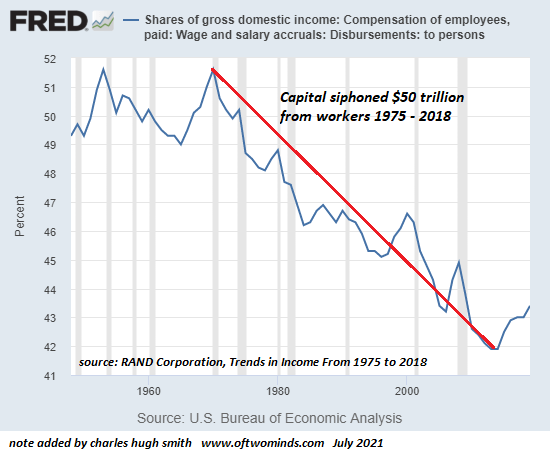
3. The cycle of capital-labor balance: capital has dominated labor for 40+ years, siphoning $50 trillion from labor. This cycle has now turned and the rebalancing is underway: it’s capital’s turn to surrender gains and power.

4. The cycle of social order-disorder: as documented by historian Peter Turchin and others, social order (in Turchin’s phrase, the integrative phase) holds sway for about 50 years and then it gives way to an era of social disorder (the disintegrative phase). This phase doesn’t end with mild reforms nobody even notices, it ends with a rebalancing of social, political and economic power.

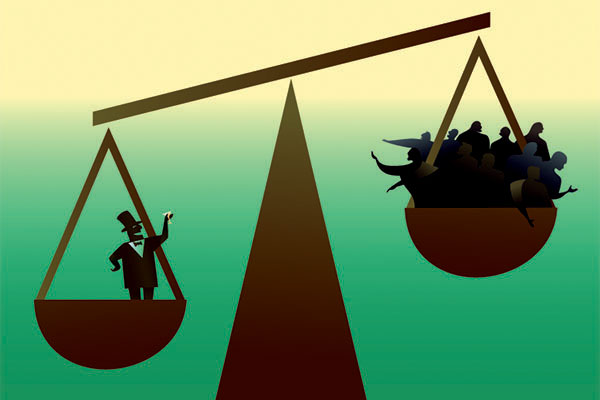
5. The cycle of wealth/power inequality: wealth–and the political power it buys–becomes increasingly concentrated in the hands of the few at the expense of the many. This feeds economic and political dysfunction and exploitation that must be remedied by reducing extremes of wealth-power inequality.

6. The cycle of speculative excess: those in power protect their wealth and the wealth of their cronies by instituting moral hazard, the disconnect of risk and consequence: the central state and central bank backstop and bail out the most egregious big speculators, who keep all their gains and transfer their losses to the public.

The public concludes the only way to get ahead in such a rigged financial system is to belly up to the gaming tables and gamble that the next bubble will never pop because those in power won’t ever let it pop.

But alas, humans do not possess god-like powers, they only possess hubris, and so all bubbles pop: the more extreme the bubble, the more devastating the pop. The faint cries that fade to silence are: but this time it’s different! and the Fed will save us! That’s not how cycles work: all the god-like powers are revealed as hubris, which arouses the fatal ire of Nemesis.

The Illusion of Getting Rich While Producing Nothing

By Charles Hugh Smith

Source: Of Two Minds

Of all the mass delusions running rampant in the culture, none is more spectacularly delusional than the conviction that we can all get fabulously rich from speculation while producing nothing. The key characteristic of speculation is that it produces nothing: it doesn’t generate any new goods or services, boost productivity or increase the functionality of real-world essentials.

Like all mass delusions, the greater the disconnect from reality, the greater the appeal. Mass delusions gain their escape velocity by leaving any ties to real-world limitations behind, and by igniting the most powerful booster to human euphoric confidence known, greed.

Lost in the mania of easy wealth from speculative trading is the absence of any value creation in the rotation-churn of moving bets from one table to the latest hot game: in flipping houses sight unseen, no functionality was added to the house. In transferring bets on one cryptocurrency to another or from one meme stock to another, no value to the economy or society was created.

In the mass delusion that near-infinite wealth can be generated without producing anything, creating value has no value: the delusion is that I can get rich producing nothing but speculative gains, and then I can buy all the stuff somebody else is making.

The fantasy powering the speculative frenzy is once I get rich, I’ll stop working and live off my wealth. It’s interesting, isn’t it, how everyone can get rich via unproductive speculation, quit their jobs and then live off the productive work of somebody else who failed to get rich off speculation.

Maybe that’s why all the container ships are lined up at Long Beach, waiting to unload the goodies made in China for American speculators to buy. This is what happens when the incentive structure of the economy decays so that being productive has little upside (i.e., working is for chumps) while speculating is all upside (get rich quickly and easily).

Everyone knows great empires became great by transferring their critical supply chains to competing nations, living it up on borrowed/printed money, exploiting the highest bidder wins regulatory/governance system and incentivizing speculation while pushing wage earners into debt-and-tax servitude. Bone up on your history, Bucko; all great nations got there by quitting boring, tiresome productive work to speculate on illusions of value with borrowed money.

This is the result of monopolies and cartels becoming the financial and political power centers of the nation. Maximizing private gains is all that matters in this incentive structure, and so treating employees as chattel to lower costs, offshoring critical supply chains to squeeze out a few more dollars of profits, engineering products to break down (planned obsolescence), buying regulatory barriers and “free passes” and tax breaks galore with all the billions showered on financiers and other fraudsters by the Federal Reserve: in a word, a system that optimizes corruption.

This is how you hollow out a nation and guarantee collapse. The most rewarding “skillsets” are a sociopathological obsession with maximizing profits by any means available and speculating with Fed free money for financiers. The millions of “retail” speculators are simply picking up the cues being given by the billionaires who gained their wealth by issuing debt to fund stock buy-backs and other financial manipulations.

Working for monopolies and cartels is for chumps because monopolies and cartels have zero incentive to share profits with mere employees. Their profits are made not by taking care of their workforce but by regulatory captureartificial scarcities and financialized destruction of competition: first, borrow billions thanks to the Fed and Wall Street, destroy the competition (for example, the taxi industry), then once the competition has been wiped out, jack up prices because now consumers have no choice other than another member of the cartel.

Speculative “wealth” is phantom wealth, a flickering illusion of prosperity. All speculative bubbles pop, and all speculative bubbles inflated by borrowed money and central bank manipulation pop even more ferociously than bubbles funded by actual savings.

By incentivizing speculation and corruption, reducing the rewards for productive work and sucking wages dry with inflation, America has greased the skids to collapse. As with all mass delusions, the incentives to continue believing are immense and the incentives to reconnect with reality few.

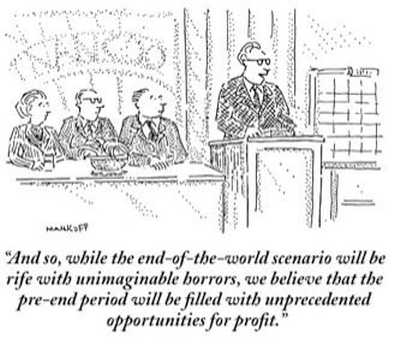
So in conclusion: the speculative gains to be made in the collapse of the mass delusion will be spectacular. There’s nothing like the collapse of a hollowed out, completely corrupt economy to generate outsized profits for nimble speculators. Just keep your speculative winnings on number 22 on the roulette wheel. (A Casablanca movie reference….)

The Houses of Dead and Crooked Souls

By Edward Curtin

Source: Behind the Curtain

“A house constitutes a body of images that give mankind proofs or illusions of stability.”      – Gaston Bachelard, The Poetics of Space

There is a vast and growing gulf between the world’s rich and poor.  An obscene gulf. If we can read houses, they will confirm this.  They offer a visible lesson in social class.

Houses stand before us like books on a shelf waiting to be read, and when the books are missing, as they are for a vast and growing multitude of the homeless exiled wandering ones and those imprisoned, their absence serves to indict the mansion-dwelling wealthy and to a lesser extent those whose homes serve to shield them from the truth of the ill-begotten gains of the wealthy elites who create the world’s suffering through their avarice, lies, and war making.

Many regular people want to say with Edmund in Eugene O’Neill’s play, Long Day’s Journey into Night:

The fog is where I wanted to be. Halfway down the path you can’t see this house. You’d never know it was here. Or any of the other places down the avenue. I couldn’t see but a few feet ahead. I didn’t meet a soul. Everything looked and sounded unreal. Nothing was what it is.That’s what I wanted – to be alone with myself in another world where truth is untrue and life can hide from itself….Who wants to see life as it is, if they can help it?

Yet the rich don’t hide or give a damn. They flaunt their houses.  They know they are crooks and creators of illusions.  Their nihilism is revealed in their conspicuous consumption and their predatory behavior; they want everyone else to see it too.  So they rub it in their faces.  Their wealth is built on the blood and suffering of millions around the world, but this is often hidden knowledge.

For many regular people prefer the fog to the harsh truth.  It shields them from intense anger and the realization that the wealthy elites who run the world and control the media lie to them about everything and consider them beneath contempt.  That would demand a response commensurate with the propaganda – rebellion.  It would impose the moral demand to look squarely at the houses of death with their tiny cells in which the wealthy elites and their henchmen imprison and torture truth tellers like Julian Assange, an innocent man in a living hell; to make connections between wealth and power and the obscene flaunting of the rich elite’s sybaritic lifestyles in houses where every spacious room testifies to their moral depravity.

The recent news of Barack Obama’s vile selfie birthday celebration for his celebrity “friends” at his 29-acre estate and mansion (he has another eight-million-dollar mansion in Washington, D. C.) on Martha’s Vineyard is an egregious recent case in point.  If he thinks this nauseating display is proof of his stability and strength – which obviously he does – then he is a deluded fool.  But those who carry water for the military-intelligence-media complex are amply rewarded and want to tell the world that this is so.  It’s essential for the Show.  It must be conspicuous so the plebians learn their lesson.

Obama’s Vineyard mansion stands as an outward sign of his inner disgrace, his soullessness.

Trump’s golden towers and his never-ending self-promotion or the multiple million-dollar mansions of high-tech, sports, and Hollywood’s superstars send the same message.

Take Bill Gates’ sixty-three-million-dollar mansion, Xanadu, named after William Randolph Hearst’s estate in Citizen Kane, that took seven years to build.

Take the house up the hill from where I live in an erstwhile working-class town that sold for one million plus and now is being expanded to double its size with a massive swimming pool that leaves no grass uncovered. Every week, three black window-tinted SUVs arrive with New Jersey plates to join two white expensive sedans to oversee the progress in this small western Massachusetts town where McMansions rise throughout the hills faster than summer’s weeds.

Take the blue dolomite stone Searles Castle with its 60 acres, 40 rooms, and “dungeon” basement down the hill on Main St. that was recently bought by a NYC artist who also owns seven grand estates around the country that he showcases as examples of his fine artistic taste.  “All these houses have endless things to do — it’s just mind-boggling,” he has said. The artist, Hunt Slonem, calls himself a “glamorizer,” and his “exotica” paintings, inspired by Andy Warhol’s repetition of soup cans and Marilyn Monroe, hang in galleries, museums, cruise ships, and the houses of film celebrities.  Like his showcase houses, his exotica must have endless things to do.

What would Vincent van Gogh say?  Perhaps what he wrote to his brother Theo: that the greatest people in painting and literature “have always worked against the grain” and in sympathy with the poor and oppressed.  That might seem “mind-boggling” to Slonem.

Such ostentatious displays of wealth and power clearly reveal the delusions of the elites, as if there are no spiritual consequences for living so.  Even if they read Tolstoy’s cautionary tale about greed, How Much Land Does A Man Need?, it is doubtful that its truth would register.  Like Tolstoy’s protagonist Pahόm, they never have enough.  But like Pahόm, the Devil has them in his grip, and like him, they will get their just rewards, a small room, a bit of land to imprison them forever.

His servant picked up the spade and dug a grave long enough for Pahóm to lie in, and buried him in it. Six feet from his head to his heels was all he needed.

Where does the money for all these estates, not just Slonem’s, come from? Who wants to ask?

Getting to the roots of wealth involves a little digging.  Slonem’s castle was originally commissioned in the late 1800s by Mark Hopkins for his wife.  Hopkins was one of the founders of the Central Pacific Railroad, which was built by Irish and Chinese immigrants.  Labor history is quite illuminating on the ways immigrants have always been treated, in this case “the dregs of Asia” and the Irish dogs.  Interestingly enough, the great black scholar and radical, W. E. B. Du Bois, a town native, worked at the castle’s construction site as a young man.  No doubt it informed his future work against racism, capitalism, and economic exploitation.

Wealthy urbanites flooded this area after September 11, 2001, and now, in their terror of disease and death, they have bought every house they could find.  Their cash-filled pockets overflow with blood-money and few ask why. To suggest that massive wealth is almost always ill-begotten is anathema.  But innocence wears many masks, and the Show demands washed hands and no questions asked.

It is rare that one becomes super-wealthy in an honest and ethical way.  The ways the rich get money almost without exception lead downward, to paraphrase Thoreau from his essay, “Life Without Principle.”

Since the corona crisis began, investment firms such as the Blackstone Group have been gobbling up vast numbers of houses across the United States as their prices have gone through the roof.  The lockdowns – an appropriate prison term – have set millions of regular people back on their heels as the wealthiest have gotten exponentially wealthier. Poverty and starvation have increased around the world.  This is not an accident.  Despair and depression are widespread.

There is a taboo in life in general and in journalism: Do not ask where people’s money comes from.  Thoreau was so advised long ago:

Do not ask how your bread is buttered; it will make you sick…

But the super-wealthy do not get sick.  They are sick.  For they revel in their depravity and push it in the faces of regular people, many who envy them and wish to become super-rich and powerful themselves.  Of course there are the blue bloods whose method is understatement, but it takes many decades to enter their theater of deception.  In many ways, these people are worse, for their personae have been crafted over decades of play-acting and public relations so their images are laundered to smell fresh and benevolent.  They often wear the mask of philanthropy, while the history of their wealth lies shrouded in an amnestic fog.

Yet soul murder includes suicide, and while the old and new moneyed ones smoothly justify their oppression of the vast majority, many regular people kill the best in themselves by envying the rich.

Years ago, I discovered some documents that showed that one of this country’s most famous philosophers, known for his lofty moral pronouncements, owned a lot of stock in companies that were doing evil things – war making, poisoning and killings huge numbers with chemicals, etc.  But his image was one of Mr. Clean, Mr. Good Guy. I suspect this is typical and that there are many such secrets in the basements and attics of the rich.

But let us also ask where the writers and presenters of the mainstream and alternative media get their money.  Although “to follow the money” is a truism, few do.  If we do, we will learn that money talks and those who take it toe the line, nor do they live in shacks by the side of the road or rent like so many others.  They invest with Black Rock and their ilk and have money managers who can increase their wealth while shielding them from the ways that money is made on the backs of the poor and working people.  And they lie about people like Assange, Daniel Hale, Reality Winner, Craig Murray, et al., all imprisoned for daring to reveal the depredations of the power elites, the violence at the heart of predatory capitalism.

Yes, houses speak.  But few ever speak of where their money comes from.  Those that are on the take – which has multiple meanings – always plead innocent.  Yes, I can hear you say that I am being too harsh; that there are exceptions.  That is obvious.  So let’s skip the exceptions and focus on the general principle. There is a Buddhist principle that right livelihood is a core ethic in earning money.  Jesus had another way of putting it but was of course in agreement, as were so many others whom people hold in highest esteem.

Thoreau wrote: “If you are acquainted with the principle, what do you care for a myriad instances and applications.”

The truth is that for most people, work, if they can find it, is drudgery and hard, a matter of survival. The late great Studs Terkel called it hell and rightly said that most jobs are not big enough for people because they crush the soul, they lack meaning.  And behind all ledgers of great wealth lie crushed souls.  This reality is so obvious and goes by many names, including class warfare, that further commentary would be redundant.

A few years ago, I visited Mark Twain’s house in Hartford, Connecticut.  It is advertised as “a house with a heart and a soul.”  It is not a house but a mansion, and it was an ostentatious display in Twain’s time. Similar or worse than Obama’s mansion on Martha’s Vineyard today.  It has no soul or heart.  It was built with Twain’s wife’s family money.  Her father was an oil and coal tycoon from upstate New York.  Twain reveled in opulent respectability.  He lived the life of a Gilded Age tycoon, an American magnate. It is not a pretty story, but the Twain myth says otherwise.  Not that he catered to popular tastes to please the crowd and his domineering wife and that he lived in luxury, but that he was a radical critic of the establishment.  This is false.  For he withheld for the most part the publication of his withering take on American imperialism until after his death.  He committed soul murder.  But his mansion impressed his neighbors and his humor distracted from his luxurious lifestyle.  His house still stands as a cautionary tale for those who will read it.

Baudelaire once said that in palaces “there is no place for intimacy.”  This is no doubt why in people’s dreams small, simple houses with a light in the window loom large.  Bachelard says, “When we are lost in darkness and see a distant glimmer of light, who does not dream of a thatched cottage or, to go more deeply still into legend, of a hermit’s hut.”  For here man and God meet in solitude; here human intimacy is possible.  “The hut can receive none of the riches ‘of this world.’  It possesses the felicity of intense poverty; indeed, it is one of the glories of poverty; as destitution increases, it gives access to absolute refuge.”

He is not espousing actual poverty, but the oneiric depths of true desire, the dreams of hope, reconciliation, and simple living that run counter to the amassing of wealth to prove one’s power and majesty. A humble house of truth, not a mansion of lies. This, to borrow the title of William Goyen’s novel, is “the house of breath” where the spirit can live and pseudo-stability gives way to faith, for insecurity is the essence of life.

There is such a hermit’s hut where the light shines.  It is the tiny cell in Belmarsh Prison where Julian Assange hangs onto his life by a thread.  His witness for truth sends an inspiring message to all those lost in the world’s woods to look to his fate and not turn away.  To follow to their sources the money that greases the palms of all the so-called journalists and politicians who want him dead or imprisoned for life, who tell their endless lies, not just about him, but about everything.

The house of propaganda is built on unanimity.  When one person says no, the foundation starts to crumble.  The houses of the rich dead and crooked souls, erected to project the stability of their bloody illusions, start to crumble into sand when people dissent one by one.

Soon the fog lifts and there is no hiding any more.  At the end of the path, you can see the vultures circling overhead as their prey go running out of their mansions in terror.

Sing Hallelujah!

IN ORDER TO UNDERSTAND THE WORLD TODAY YOU MUST UNLEARN THIS ONE THING

By Sigmund Fraud

Source: Waking Times

At present, we are dangerously trending toward chaos, total world war, civil war, incivility, and a complete breakdown of civil society, and to the indoctrinated, it’s difficult to understand why exactly this is happening. As the stress of this mounts, the misinformed lash out at friends, family members and strangers who do not fully subscribe to their worldview. The battle really is one of understanding how the world works, and with such epidemic false perceptions, people choose the wrong targets for their ire.

If one were to unlearn, however, many of the things we’ve been taught about how our world works, re-educate the self, and re-orient to a more complete and truthful assessment of the world today, the picture becomes more clear, things make more sense, and a pathway to unity opens up. One thing we can all agree on, though, is that we’ve all been duped in big ways, most notably in the one arena which affects everyone, everyday, at every time. Money.

False = Money is Real and the Economy is Capitalist

Trained to worship money and the idea of infinite growth, it’s tough to understand just how much unnatural stress is being introduced in our world by a financial system and world economy which is operates explicitly for the profit a few key players. The money is fiat, and its value is controlled by privately run organizations who have the power to enslave the entire world with debt.

Furthermore, the system is not capitalism, but rather something beyond capitalism. Post capitalism, perhaps, as it more closely resembles the zombie ghost of capitalism, soullessly eating everything in its path with no interest at all in sustainability.

Recently speaking on this matter, financial analyst Max Keiser explained the result of having central bank managed interest rates kept artificially low in order to enrich those at the top of the pyramid. This is one major piece of very large and hidden puzzle.

“There’s no incentive to save money, there’s only an incentive to commit fraud. So if there’s no incentive to save money, then there’s no capital, and without capital there’s no capitalism. So you have, unfortunately, now a situation where it’s the survival of the most fraudulently inclined. It’s a kakistocracy, which is rule by the least capable of a society.” ~Max Keiser

This short interview with Max Kaiser by Luke Rudkowski sheds more insight on this issue:

The system we have today is really more akin to an elaborate slave plantation. All money that we use today in public is borrowed from private banks, and we pay dearly for the privilege of using it.

This is because money is created out of debt in a one-to-one increase in public debt. The national debt is $20 Trillion. That means the (roughly) 234 million US Americans would have to pay approximately $62,000 each to pay it off. This includes babies, children, poor people, and homeless people. There are even those who claim that it’s mathematically impossible to pay off the debt. And almost every country is in debt to every other country. It’s the height of insanity.

As former Governor of the Federal Reserve Marriner Eccles said, “If there were no debts in our money system, there wouldn’t be any money.” ~Gary ‘Z’ McGee

The stress in our world stemming from a global banking system designed to enslave is felt everywhere, from endless wars to unaffordable healthcare and evermore expensive food. Yet while few people really understand how this works, we are battling a war of propaganda and mind control.

Making sense of the world today is no easy task for those who’ve yet to abandon the standard American diet of propaganda and mental programming. Indoctrination works in a couple of key ways. Firstly, beliefs are instilled and reinforced by repetition, and secondly, undesirable beliefs are ignored and cast aside as fringe. What’s left is a mind which focuses on what it’s supposed to focus on, constructing a reality around a false and incomplete picture of the world.

This is food for thought for free thinkers, with the aim overcoming petty division in order to create a more prosperous and unified future.

Private gain must no longer be allowed to elbow out the public good

By Dirk Philipsen

Source: aeon

Adam Smith had an elegant idea when addressing the notorious difficulty that humans face in trying to be smart, efficient and moral. In The Wealth of Nations (1776), he maintained that the baker bakes bread not out of benevolence, but out of self-interest. No doubt, public benefits can result when people pursue what comes easiest: self-interest.

And yet: the logic of private interest – the notion that we should just ‘let the market handle it’ – has serious limitations. Particularly in the United States, the lack of an effective health and social policy in response to the coronavirus disease (COVID-19) outbreak has brought the contradictions into high relief.

Around the world, the free market rewards competing, positioning and elbowing, so these have become the most desirable qualifications people can have. Empathy, solidarity or concern for the public good are relegated to the family, houses of worship or activism. Meanwhile, the market and private gain don’t account for social stability, health or happiness. As a result, from Cape Town to Washington, the market system has depleted and ravaged the public sphere – public health, public education, public access to a healthy environment – in favour of private gain.

COVID-19 reveals a further irrational component: the people who do essential work – taking care of the sick; picking up our garbage; bringing us food; guaranteeing that we have access to water, electricity and WiFi – are often the very people who earn the least, without benefits or secure contracts. On the other hand, those who often have few identifiably useful skills – the pontificators and chief elbowing officers – continue to be the winners. Think about it: what’s the harm if the executive suites of private equity, corporate law and marketing firms closed down during quarantine? Unless your stock portfolio directly profits from their activities, the answer is likely: none. But it is those people who make millions – sometimes as much in an hour as healthcare workers or delivery personnel make in an entire year.

Simply put, a market system driven by private interests never has protected and never will protect public health, essential kinds of freedom and communal wellbeing.

Many have pointed out the immorality of our system of greed and self-centred gain, its inefficiency, its cruelty, its shortsightedness and its danger to planet and people. But, above all, the logic of self-interest is superficial in that it fails to recognise the obvious: every private accomplishment is possible only on the basis of a thriving commons – a stable society and a healthy environment. How did I become a professor at an elite university? Some wit and hard work, one hopes. But mostly I credit my choice of good parents; being born at the right time and the right place; excellent public schools; fresh air, good food, fabulous friends; lots of people who continuously and reliably provide all the things that I can’t: healthcare, sanitation, electricity, free access to quality information. And, of course, as the scholar Robert H Frank at Cornell University so clearly demonstrated in his 2016 book on the myth of the meritocracy: pure and simple luck.

Commenting on how we track performance in modern economies – counting output not outcome, quantity not quality, prices not possibilities – the US senator Robert F Kennedy said in 1968 that we measure ‘everything, in short, except that which makes life worthwhile’. His larger point: freedom, happiness, resilience – all are premised on a healthy public. They rely on our collective ability to benefit from things such as clean air, free speech, good public education. In short: we all rely on a healthy commons. And yet, the world’s most powerful metric, gross domestic product (GDP), counts none of it.

The term ‘commons’ came into widespread use, and is still studied by most college students today, thanks to an essay by a previously little-known American academic, Garrett Hardin, called ‘The Tragedy of the Commons’ (1968). His basic claim: common property such as public land or waterways will be spoiled if left to the use of individuals motivated by self-interest. One problem with his theory, as he later admitted himself: it was mostly wrong.

Our real problem, instead, might be called ‘the tragedy of the private’. From dust bowls in the 1930s to the escalating climate crisis today, from online misinformation to a failing public health infrastructure, it is the insatiable private that often despoils the common goods necessary for our collective survival and prosperity. Who, in this system based on the private, holds accountable the fossil fuel industry for pushing us to the brink of extinction? What happens to the land and mountaintops and oceans forever ravaged by violent extraction for private gain? What will we do when private wealth has finally destroyed our democracy?

The privately controlled corporate market has, in the precise words of the late economics writer Jonathan Rowe, ‘a fatal character flaw – namely, an incapacity to stop growing. No matter how much it grew yesterday it must continue to do so tomorrow, and then some; or else the machinery will collapse.’

To top off the items we rarely discuss: without massive public assistance, late-stage extractive capitalism, turbocharged by private interest and greed, would long be dead. The narrow kind of macroeconomic thinking currently dominating the halls of government and academia invokes a simpleminded teenager who variously berates and denounces his parents, only to come home, time and again, when he is out of ideas, money or support. Boeing, Goldman Sachs, Bank of America, Exxon – all would be bust without public bailouts and tax breaks and subsidies. Every time the private system works itself into a crisis, public funds bail it out – in the current crisis, to the tune of trillions of dollars. As others have noted, for more than a century, it’s a clever machine that privatises gains and socialises costs.

When private companies are back up and running, they don’t hold themselves accountable to the public who rescued them. As witnessed by activities since the 2008 bailouts at Wells Fargo, American Airlines and AIG, companies that have been rescued often go right back to milking the public.

By focusing on private market exchanges at the expense of the social good, policymakers and economists have taken an idea that is good under clearly defined and very limited circumstances and expanded it into a poisonous and blind ideology. Now is the time to assert the obvious: without a strong public, there can be no private. My health depends on public health. My freedom depends on social freedom. The economy is embedded in a healthy society with functional public services, not the other way around.

This moment of pain and collapse can serve as a wakeup call; a realisation that the public is our greatest good, not the private. Look outside the window to see: without a vibrant and stable public, life can quickly get poor, nasty, brutish and short.

Is the U.S. Becoming a Third World Nation?

By Charles Hugh Smith

Source: Of Two Minds

This is a chart of an informal kleptocracy which cloaks itself in the faux finery of democracy and a (rigged) “market” economy.

Back in the day, nations that didn’t qualify as either developed (First World) or developing (Second World) were by default Third World, impoverished, corrupt and what we now refer to as failed states–governments that were incapable of improving the lives of their people and the machinery of governance, generally as a result of corruption and self-serving elites, i.e. kleptocracies.

Is the U.S. slipping into Third World status? While many scoff at the very question, others citing the rise of homelessness, entrenched pockets of abject poverty and the decaying state of infrastructure might nod “yes.”

These are not uniquely Third World problems, they’re symptoms of a status quo that’s fast losing First World capabilities. What characterizes Third World/Failing States isn’t just poverty, crumbling infrastructure and endemic corruption; at a systems level these are the key dynamics in Third World/Failing States:

1. The status quo protects insiders at the expense of everyone else.

2. There is no real accountability; failure has no consequences, bureaucrats are never fired for incompetence, reforms are watered down or neutered by institutional sclerosis.

3. Pay-to-play is the most cost-effective way to influence policy or evade consequences.

4. The status quo is incapable of differentiating between complexity that serves the legitimate purposes of transparency and accountability and complexity that serves no purpose beyond guaranteeing insiders’ paper-shuffling jobs. As a consequence, complexity that adds no value chokes the economy and the government.

5. There are two sets of laws: one for insiders and the super-wealthy, and another harsher set for everyone else.

6. The super-wealthy fear nothing because the system functions to serve their interests.

7. The super-wealthy and state insiders control the media’s narratives and the machinery of governance to serve their interests. Reforms are in name only; the faces of elected officials change but nothing changes structurally.

8. Insiders, well-paid pundits and the technocrats serving the corporate and state elites believe the status quo is just fine because they’re doing fine; they are blind to the soaring inequality, systemic corruption, stupendous waste and the impossibility of real reform.

Does America’s status quo protect insiders at the expense of everyone else? Yes. As for the other seven characteristics: yes, yes, yes, yes, yes, yes and yes.

And lets’ not forget #9: the vast majority of the economic gains flow to the elite at the very top of the wealth-power pyramid: is this true in the U.S.? Definitively yes. Just look at this chart: this is a chart of an informal kleptocracy which cloaks itself in the faux finery of democracy and a (rigged) “market” economy.

That’s the very definition of a Third World failed state.

Related Video:

Why We’re Blind to the System Destroying Us

By Jonathan Cook

Source: Information Clearing House

I rarely use this blog to tell readers what they should believe. Rather I try to indicate why it might be wise to distrust, at least without very good evidence, what those in power tell us we should believe.

We have well-known sayings about power: “Knowledge is power”, and “Power tends to corrupt, while absolute power tends to corrupt absolutely.” These aphorisms resonate because they say something true about how we experience the world. People who have power – even very limited power they hold on licence from someone else – tend to abuse it, sometimes subtly and unconsciously, and sometimes overtly and wilfully.

If we are reasonably self-aware, we can sense the tendency in ourselves to exploit to our advantage whatever power we enjoy, whether it is in our dealings with a spouse, our children, a friend, an employee, or just by the general use of our status to get ahead.

This isn’t usually done maliciously or even consciously. By definition, the hardest thing to recognise are our own psychological, emotional and mental blind spots – and the biggest, at least for those born with class, gender or race privileges, is realising that these too are forms of power.

Nonetheless, these are all minor forms of power compared to the power wielded collectively by the structures that dominate our societies: the financial sector, the corporations, the media, the political class, and the security services.

But strangely most of us are much readier to concede the corrupting influence of the relatively small power of individuals than we are the rottenness of vastly more powerful institutions and structures. We blame the school teacher or the politician for abusing his or her power, while showing a reluctance to do the same about either the education or political systems in which they have to operate.

Similarly, we are happier identifying the excessive personal power of a Rupert Murdoch than we are the immense power of the corporate empire behind him and on which his personal wealth and success depend.

And beyond this, we struggle most of all to detect the structural and ideological framework underpinning or cohering all these discrete examples of power.

Narrative control

It is relatively easy to understand that your line manager is abusing his power, because he has so little of it. His power is visible to you because it relates only to you and the small group of people around you.

It is a little harder, but not too difficult, to identify the abusive policies of your firm – the low pay, cuts in overtime, attacks on union representation.

It is more difficult to see the corrupt power of large institutions, aside occasionally from the corruption of senior figures within those institutions, such as a Robert Maxwell or a Richard Nixon.

But it is all but impossible to appreciate the corrupt nature of the entire system. And the reason is right there in those aphorisms: absolute power depends on absolute control over knowledge, which in turn necessitates absolute corruption. If that were not the case, we wouldn’t be dealing with serious power – as should be obvious, if we pause to think about it.

Real power in our societies derives from that which is necessarily hard to see – structures, ideology and narratives – not individuals. Any Murdoch or Trump can be felled, though being loyal acolytes of the power-system they rarely are, should they threaten the necessary maintenance of power by these interconnected institutions, these structures.

The current neoliberal elite who effectively rule the planet have reached as close to absolute power as any elite in human history. And because they have near-absolute power, they have a near-absolute control of the official narratives about our societies and our “enemies”, those who stand in their way to global domination.

No questions about Skripals

One needs only to look at the narrative about the two men, caught on CCTV cameras, who have recently been accused by our political and media class of using a chemical agent to try to murder Sergei Skripal and his daughter Yulia back in March.

I don’t claim to know whether Alexander Petrov and Ruslan Boshirov work for the Russian security services, or whether they were dispatched by Vladimir Putin on a mission to Salisbury to kill the Skripals.

What is clear, however, is that the British intelligence services have been feeding the British corporate media a self-serving, drip-drip narrative from the outset – and that the media have shown precisely no interest at any point in testing any part of this narrative or even questioning it. They have been entirely passive, which means their readers – us – have been entirely passive too.

That there are questions about the narrative to be raised is obvious if you turn away from the compliant corporate media and seek out the views of an independent-minded, one-time insider such as Craig Murray.

A former British ambassador, Murray is asking questions that may prove to be pertinent or not. But at this stage, when all we have to rely on is what the intelligence services are selectively providing, these kinds of doubts should be driving the inquiries of any serious journalist covering the story. But as is so often the case, not only are these questions not being raised or investigated, but anyone like Murray who thinks critically – who assumes that the powerful will seek to promote their interests and avoid accountability – is instantly dismissed as a conspiracy theorist or in Putin’s pocket.

That is no meaningful kind of critique. Many of the questions that have been raised – like why there are so many gaps in the CCTV record of the movements of both the Skripals and the two assumed assassins – could be answered if there was an interest in doing so. The evasion and the smears simply suggest that power intends to remain unaccountable, that it is keeping itself concealed, that the narrative is more important than the truth.

And that is reason enough to move from questioning the narrative to distrusting it.

Ripples on a lake

Journalists typically have a passive relationship to power, in stark contrast to their image as tenacious watchdog. But more fundamental than control over narrative is the ideology that guides these narratives.  Ideology ensures the power-system is invisible not only to us, those who are abused and exploited by it, but also to those who benefit from it.

It is precisely because power resides in structures and ideology, rather than individuals, that it is so hard to see. And the power-structures themselves are made yet more difficult to identify because the narratives created about our societies are designed to conceal those structures and ideology – where real power resides – by focusing instead on individuals.

That is why our newspapers and TV shows are full of stories about personalities – celebrities, royalty, criminals, politicians. They are made visible so that we do not notice the ideological structures we live inside that are supposed to remain invisible.

News and entertainment are the ripples on a lake, not the lake itself. But the ripples could not exist without the lake that forms and shapes them.

Up against the screen

If this sounds like hyperbole, let’s stand back from our particular ideological system – neoliberalism – and consider earlier ideological systems in the hope that they offer some perspective. At the moment, we are like someone standing right up against an IMAX screen, so close that we cannot see that there is a screen or even guess that there is a complete picture. All we see are moving colours and pixels. Maybe we can briefly infer a mouth, the wheel of a vehicle, a gun.

Before neoliberalism there were other systems of rule. There was, for example, feudalism that appropriated a communal resource – land – exclusively for an aristocracy. It exploited the masses by forcing them to toil on the land for a pittance to generate the wealth that supported castles, a clergy, manor houses, art collections and armies. For several centuries the power of this tiny elite went largely unquestioned.

But then a class of entrepreneurs emerged, challenging the landed artistocracy with a new means of industrialised production. They built factories and took advantage of scales of economy that slightly widened the circle of privilege, creating a middle class. That elite, and the middle-class that enjoyed crumbs from their master’s table, lived off the exploitation of children in work houses and the labour of a new urban poor in slum housing.

These eras were systematically corrupt, enabling the elites of those times to extend and entrench their power. Each elite produced justifications to placate the masses who were being exploited, to brainwash them into believing the system existed as part of a natural order or even for their benefit. The aristocracy relied on a divine right of kings, the capitalist class on the guiding hand of the free market and bogus claims of equality of opportunity.

In another hundred years, if we still exist as a species, our system will look no less corrupt – probably more so – than its predecessors.

Neoliberalism, late-stage capitalism, plutocratic rule by corporations – whatever you wish to call it – has allowed a tiny elite to stash away more wealth and accrue more power than any feudal monarch could ever have dreamt of. And because of the global reach of this elite, its corruption is more endemic, more complete, more destructive than any ever known to mankind.

A foreign policy elite can destroy the world several times over with nuclear weapons. A globalised corporate elite is filling the oceans with the debris from our consumption, chopping down the forest-lungs of our planet for palm-oil plantations so we can satisfy our craving for biscuits and cake. And our media and intelligence services are jointly crafting a narrative of bogeymen and James Bond villains – both in Hollywood movies, and in our news programmes – to make us fearful and pliable.

Assumptions of inevitability

Most of us abuse our own small-power thoughtlessly, even self-righteously. We tell ourselves that we gave the kids a “good spanking” because they were naughty, rather than because we established with them early on a power relationship that confusingly taught them that the use of force and coercion came with a parental stamp of approval.

Those in greater power – from minions in the media to executives of major corporations – are no different. They are as incapable of questioning the ideology and the narrative – how inevitable and “right” our neoliberal system is – as the rest of us. But they play a vital part in maintaining and entrenching that system nonetheless.

David Cromwell and David Edwards of Media Lens have provided two analogies – in the context of the media – that help explain how it is possible for individuals and groups to assist and enforce systems of power without having any conscious intention to do so, and without being aware that they are contributing to something harmful. Without, in short, being aware that they are conspiring in the system.

The first:

When a shoal of fish instantly changes direction, it looks for all the world as though the movement was synchronised by some guiding hand. Journalists – all trained and selected for obedience by media all seeking to maximise profits within state-capitalist society – tend to respond to events in the same way.

The second:

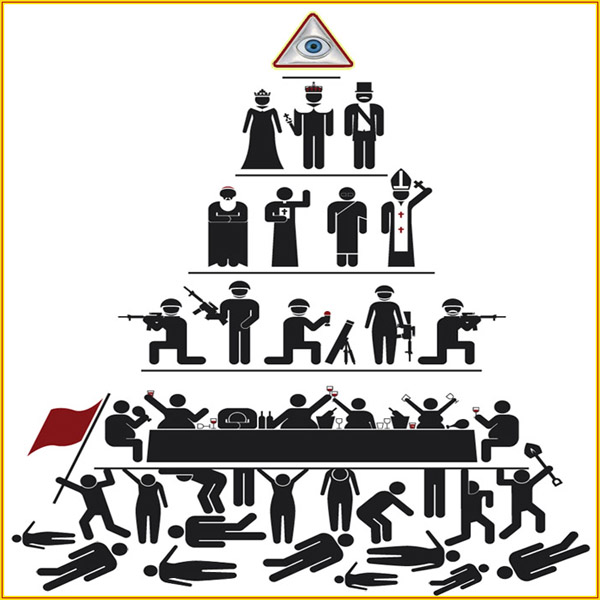
Place a square wooden framework on a flat surface and pour into it a stream of ball bearings, marbles, or other round objects. Some of the balls may bounce out, but many will form a layer within the wooden framework; others will then find a place atop this first layer. In this way, the flow of ball bearings steadily builds new layers that inevitably produce a pyramid-style shape. This experiment is used to demonstrate how near-perfect crystalline structures such as snowflakes arise in nature without conscious design.

The system – whether feudalism, capitalism, neoliberalism – emerges out of the real-world circumstances of those seeking power most ruthlessly. In a time when the key resource was land, a class emerged justifying why it should have exclusive rights to control that land and the labour needed to make it productive. When industrial processes developed, a class emerged demanding that it had proprietary rights to those processes and to the labour needed to make them productive.

Our place in the pyramid

In these situations, we need to draw on something like Darwin’s evolutionary “survival of the fittest” principle. Those few who are most hungry for power, those with least empathy, will rise to the top of the pyramid, finding themselves best-placed to exploit the people below. They will rationalise this exploitation as a divine right, or as evidence of their inherently superior skills, or as proof of the efficiency of the market.

And below them, like the layers of ball bearings, will be those who can help them maintain and expand their power: those who have the skills, education and socialisation to increase profits and sell brands.

All of this should be obvious, even non-controversial. It fits what we experience of our small-power lives. Does bigger power operate differently? After all, if those at the top of the power-pyramid were not hungry for power, even psychopathic in its pursuit, if they were caring and humane, worried primarily about the wellbeing of their workforce and the planet, they would be social workers and environmental activists, not CEOs of media empires and arms manufacturers.

And yet, base your political thinking on what should be truisms, articulate a worldview that distrusts those with the most power because they are the most capable of – and committed to – misusing it, and you will be derided. You will be called a conspiracy theorist, dismissed as deluded. You will be accused of wearing a tinfoil hat, of sour grapes, of being anti-American, a social warrior, paranoid, an Israel-hater or anti-semitic, pro-Putin, pro-Assad, a Marxist.

None of this should surprise us either. Because power – not just the people in the system, but the system itself – will use whatever tools it has to protect itself. It is easier to deride critics as unhinged, especially when you control the media, the politicians and the education system, than it is to provide a counter-argument.

In fact, it is vital to prevent any argument or real debate from taking place. Because the moment we think about the arguments, weigh them, use our critical faculties, there is a real danger that the scales will fall from our eyes. There is a real threat that we will move back from the screen, and see the whole picture.

Can we see the complete picture of the Skripal poisoning in Salisbury; or the US election that led to Trump being declared president; or the revolution in Ukraine; or the causes and trajectory of fighting in Syria, and before it Libya and Iraq; or the campaign to discredit Jeremy Corbyn as leader of the Labour party; or the true implications of the banking crisis a decade ago?

Profit, not ethics

Just as a feudal elite was driven not by ethics but by the pursuit of power and wealth through the control of land; just as early capitalists were driven not by ethics but by the pursuit of power and wealth through the control of mechanisation; so neoliberalism is driven not by ethics but the pursuit of power and wealth through the control of the planet.

The only truth we can know is that the western power-elite is determined to finish the task of making its power fully global, expanding it from near-absolute to absolute. It cares nothing for you or your grand-children. It is a cold-calculating system, not a friend or neighbour. It lives for the instant gratification of wealth accumulation, not concern about the planet’s fate tomorrow.

And because of that it is structurally bound to undermine or discredit anyone, any group, any state that stands in the way of achieving its absolute dominion.

If that is not the thought we hold uppermost in our minds as we listen to a politician, read a newspaper, watch a film or TV show, absorb an ad, or engage on social media, then we are sleepwalking into a future the most powerful, the most ruthless, the least caring have designed for us.

Step back, and take a look at the whole screen. And decide whether this is really the future you wish for your grand-children.

 

Loneliness

By Yogi Prateado

Source: Adbusters

The Silicon Valley in which I live, a culture infused with the cocaine high of technological breakthroughs, grates against my earthly sensibilities.

Riding on the crest of adrenalin, discovery, and money, what many in the fair Bay Area know, is not in fact what is. This temporary party atmosphere, around until catastrophe hits, is the last hurrah of capitalism. Whether technology will trap us in a surveillance state, or liberate us from mediating political, economic, and social predators, dangles in the hands of deliberate planning and meta-organizing on the part of those developers.

As users and citizens, we are all developers.

Not knowing the implications of one’s discoveries is very different from saying that there aren’t any. The neoteny of tech bros and gals is part of the enforced juvenilization of tech “campuses” and a society that values brain plasticity over wisdom.

After all, wisdom doesn’t sell. You can’t fake wisdom; there’s no wise way to put lipstick on a pig’s face, but there is money to be made from exploiting our mammalian dispositions.

Thus, tech people are predisposed to think, act, and do as children do. They are rewarded for doing so. But this has consequences for where we are going as a culture, and as a planet.

Enforced childhood and adolescence—having other people clean your clothes, make your food, and take you to work—creates “first world problems”, obsessions with gourmet food, and infantile competition. By disconnecting life from work and work from life, millenials are entranced by expensive eating out, Instagramming meals, and living off rich meat, sugar, and dairy (internal parasite-cultivating, climate change-causing) indulgences. Meanwhile, the products you make hand the keys of ultimate social control over to the highest bidder.

Thus, to work in the tech industry becomes a self-fulfilling prophecy. Young minds are inculcated into believing what they are doing is indeed a good thing, a helpful thing for society, rewarded by their superiors with a glamorous job which treats them like a kid, pays well, and provides a roulette wheel of opportunity.

At the same time, those highest on the food chain realize their techno optimism must be tempered with social intelligence. Zuckerberg’s Harvard Address talks about the need for universal health care (duh) and Universal Basic Income, simple solutions needed before we can begin to talk about truth, fairness, justice, diversity, or intelligence. Here, the boy billionaire unfortunately does have a point, one he’s cynically selling to the masses as he consolidates money and power.

It’s now a given that there are multiple intelligences, but in the West (particularly the self-interested, individualistic US), this is still some sort of revelation. It has yet to be integrated into schools, politics, commerce, or tech, let alone science, as many conveniently believe in one scale of intelligence (usually the one they excel at).

As Maslow knew, until we have basic welfare (food, water, shelter), the people have no hope of participating in democracy. Since 1970, Rawls and every reasonable political theorist agreed with this theory, yet we still expect a polity without a society. “Society” is fragmented, violent, scared, and unequal; millionaire 20-year-olds dodging and ignoring homeless 60-year-olds in the street.

The illusion of progress is one of the most pernicious veils currently enthralling our eyes.

The high of “being part of the solution” or “doing well while doing good,” is a strong opiate indeed. Since Marx, drug metaphors have been used to compare capitalism’s co-opting and metabolizing any opposition, novelty, or expression of freedom. Like an out-of-control nanobot army, capitalism turns color into grey goo, turns freedom into products, and commodifies all authentic expression. To quote Wright, we are in a technology trap, where every problem demands a technofix.

But the will-to-power techno-optimism concept doesn’t pan out. What cosmology could support the absurd conclusion that a problem’s old template can be used to “innovate” a new solution? The notion that there is a template—the homogenization of the mind globally through damaging the climate, spreading uniform media, and the colonialism of language and culture—is the problem.

We’re talking out of both sides of our mouths, saying we value diversity then quenching it, saying we’re open to difference then suppressing it. When it does pop up, diversity is first a novelty then a perversion, objectified and commodified as it fights to exist in a white capitalist heteropatriarchy. As Erica Wohldmann says, “Complete control is merely an illusion so we might as well be comfortable.” Comfort requires being pushed back, eating and being eaten, giving and taking. Symbiosis—sharing.

We have been stingy with sharing, forgetting our knowledge is limited.
It’s time to come home to fallibility, responsibility, and the truth about our poor state of affairs. Delaying the operation makes the sickness worse and decreases the chance for a resilient recovery.

Our ancestors only owned as much as they could carry. Live simply so that others may simply live. But what of this simplicity at the societal, political, legal, medical, global level?

Decentralization is the first priority; no more anonymous policy-making. If a decision doesn’t directly affect you, you have no right to legislate over it. No more long arms of the government, no more far-reaching corporations preying on the people thousands of miles from their headquarters.

How does the internet and digital technology play into this? Well, we need a localized technology. Can we still have global epistemic cultures with a non-commercial and non-domination clause?

A moratorium on new technologies will allow us room to assess, democratize, and redistribute the existing technologies. We need to remove oil drilling and gas mining from our technological arsenal. Prioritize technologies that clean up social, economic, racial, and gender-centred wounds. The precious resources—human and natural—that we command should be distributed to the most urgent problems with an interdisciplinary, cross-cultural plan of attack, not one made to make money. Then we collectively apply solutions, not with the bull-in-a-China-shop attitude of big tech, but with care and empathy.

We need to shut the 10,000 Pandora’s boxes opened by technology, and doing that will require technologies. But those technologies must be different form the single, aggressive one we have. An indigenous science, a feminist science, a postcolonial science—all are needed for any hope of change.

We need to go where scares us to know our courage. May we be humbled by the sublime, overwhelmed before the creations which created us. May we work in inner and outer service only towards the true liberation of all beings.

Share more, use less.
Evolve ourselves.