Time to Wake Up: the Neoliberal Order is Dying

By Jonathan Cook

Source: CounterPunch

In my recent essay, I argued that power in our societies resides in structure, ideology and narratives – supporting what we might loosely term our current “neoliberal order” – rather than in individuals. Significantly, our political and media classes, who are of course deeply embedded in this neoliberal structure, are key promoters of the very opposite idea: that individuals or like-minded groups of people hold power; that they should, at least in theory, be held accountable for the use and misuse of that power; and that meaningful change involves replacing these individuals rather than fundamentally altering the power-structure they operate within.

In other words, our political and media debates reduce to who should be held to account for problems in the economy, the health and education systems, or the conduct of a war. What is never discussed is whether flawed policies are the fleeting responsibility of individuals and political parties or symptoms of the current neoliberal malaise – manifestations of an ideology that necessarily has goals, such as the pursuit of maximised profit and endless economic growth, that are indifferent to other considerations, such as the damage being done to life on our planet.

The focus on individuals happens for a reason. It is designed to ensure that the structure and ideological foundations of our societies remain invisible to us, the public. The neoliberal order goes unquestioned – presumed, against the evidence of history, to be permanent, fixed, unchallengeable.

So deep is this misdirection that even efforts to talk about real power become treacherous. My words above and below might suggest that power is rather like a person, that it has intention and will, that maybe it likes to deceive or play tricks. But none of that is true either.

Big and little power

My difficulty conveying precisely what I mean, my need to resort to metaphor, reveals the limitations of language and the necessarily narrow ideological horizons it imposes on anyone who uses it. Intelligible language is not designed adequately to describe structure or power. It prefers to particularise, to humanise, to specify, to individualise in ways that make thinking in bigger, more critical ways near-impossible.

Language is on the side of those, like politicians and corporate journalists, who conceal structure, who deal in narratives of the small-power of individuals rather than of the big-power of structure and ideology. In what passes for news, the media offer a large stage for powerful individuals to fight elections, pass legislation, take over businesses, start wars, and a small stage for these same individuals to get their come-uppance, caught committing crimes, lying, having affairs, getting drunk, and more generally embarrassing themselves.

These minor narratives conceal the fact that such individuals are groomed before they ever gain access to power. Business leaders, senior politicians and agenda-setting journalists reach their positions after proving themselves over and over again – not consciously but through their unthinking compliance to the power-structure of our societies. They are selected through their performances in exams at school and university, through training programmes and indentures. They rise to the top because they are the most talented examples of those who are blind or submissive to power, those who can think most cleverly without thinking critically. Those who reliably deploy their skills where they are directed to do so.

Their large and small dramas constitute what we call public life, whether politics, world affairs or entertainment. To suggest that there are deeper processes at work, that the largest of these dramas is not really large enough for us to gain insight into how power operates, is to instantly be dismissed as paranoid, a fantasist, and – most damningly of all – a conspiracy theorist.

These terms also serve the deception. They are intended to stop all thought about real power. They are scare words used to prevent us, in a metaphor used in my previous post, from stepping back from the screen. They are there to force us to stand so close we see only the pixels, not the bigger picture.

Media makeover

The story of Britain’s Labour party is a case in point, and was illustrated even before Jeremy Corbyn became leader. Back in the 1990s Tony Blair reinvented the party as New Labour, jettisoning ideas of socialism and class war, and inventing instead a “Third Way”.

The idea that gained him access to power – personified in the media narrative of the time as his meeting with Rupert Murdoch on the mogul’s Hayman Island – was that New Labour would triangulate, find a middle way between the 1 per cent and the 99 per cent. The fact that the meeting took place with Murdoch rather than anyone else signalled something significant: that the power-structure needed a media makeover. It needed to be dressed in new garb.

In reality, Blair made Labour useful to power by re-styling the turbo-charged neoliberalism Margaret Thatcher’s Conservative party of the rich had unleashed. He made it look compatible with social democracy. Blair put a gentler, kinder mask on neoliberalism’s aggressive pursuit of planet-destroying power – much as Barack Obama would do in the United States a decade later, after the horrors of the Iraq invasion. Neither Blair nor Obama changed the substance of our economic and political systems, but they did make them look deceptively attractive by tinkering with social policy.

Were the neoliberal order laid bare – were the emperor to allow himself to be stripped of his clothes – no one apart from a small psychopathic elite would vote for neoliberalism’s maintenance. So power is forced to repeatedly reinvent itself. It is like the shape-shifting Mystique of the X-Men films, constantly altering its appearance to lull us into a false sense of security. Power’s goal is to keep looking like it has become something new, something innovative. Because the power-structure does not want change, it has to find front-men and women who can personify a transformation that is, in truth, entirely hollow.

Power can perform this stunt, as Blair did, by repackaging the same product – neoliberalism – in prettier ideological wrapping. Or it can, as has happened in the US of late, try a baser approach by adding a dash of identity politics. A black presidential candidate (Obama) can offer hope, and a woman candidate (Hillary Clinton) can cast herself as mother-saviour.

With this model in place, elections become an illusory contest between more transparent and more opaque iterations of neoliberal power. In failing the 99 per cent, Obama so woefully voided this strategy that large sections of voters turned their back on his intended successor, the new makeover candidate Hillary Clinton. They saw through the role-playing. They preferred, even if only reluctantly, the honest vulgarity of naked power represented by Trump over the pretensions of Clinton’s fakely compassionate politics.

Unstable politics

Despite its best efforts, neoliberalism is increasingly discredited in the eyes of large sections of the electorate in the US and UK. Its attempts at concealment have grown jaded, its strategy exhausted. It has reached the end-game, and that is why politics now looks so unstable. “Insurgency” candidates in different guises are prospering.

Neoliberal power is distinctive because it seeks absolute power, and can achieve that end only through global domination. Globalisation, the world as a plaything for a tiny elite to asset-strip, is both its means and its end. Insurgents are therefore those who seek to reverse the trend towards globalisation – or at least claim to. There are insurgents on both the left and right.

If neoliberalism has to choose, it typically prefers an insurgent on the right to the left. A Trump figure can usefully serve power too, because he dons the clothes of an insurgent while doing little to actually change the structure.

Nonetheless, Trump is a potential problem for the neoliberal order for two reasons.

First, unlike an Obama or a Clinton, he too clearly illuminates what is really at stake for power – wealth maximisation at any cost – and thereby risks unmasking the deception. And second, he is a retrograde step for the globalising power-structure.

Neoliberalism has dragged capitalism out its nineteenth-century dependency on nation-states into a twenty-first ideology that demands a global reach. Trump and other nativist leaders seek a return to a supposed golden era of state-based capitalism, one that prefers to send our children up chimneys if it prevents children from far-off lands arriving on our shores to do the same.

The neoliberal order prefers a Trump to a Bernie Sanders because the nativist insurgents are so much easier to tame. A Trump can be allowed to strut on his Twitter stage while the global power-structure constrains and undermines any promised moves that might threaten it. Trump the candidate was indifferent to Israel and wanted the US out of Syria. Trump the president has become Israel’s biggest cheerleader and has launched US missiles at Syria.

Faustian pacts

The current power-structure is much more frightened of a left insurgency of the kind represented by Corbyn in the UK. He and his supporters are trying to reverse the accommodations with power made by Blair. And that is why he finds himself relentlessly assaulted from every direction – from his political opponents; from his supposed political allies, including most of his own parliamentary party; and most especially from the state-corporate media, including its bogus left-liberal elements like the Guardian and the BBC.

The past three years of attacks on Corbyn are how power manifests itself, shows its hand, when it is losing. It is a strategy of last resort. A Blair or an Obama arrive in power having already made so many compromises behind the scenes that their original policies are largely toothless. They have made Faustian pacts as a condition for being granted access to power. This is variously described as pragmatism, moderation, realism. More accurately, it should be characterised as betrayal.

It does not stop when they reach high office. Obama made a series of early errors, thinking he would have room to manoeuvre in the Middle East. He made a speech in Cairo about a “New Beginning” for the region. A short time later he would help to snuff out the Egyptian Arab Spring that erupted close by, in Tahrir Square. Egypt’s military, long subsidised by Washington, were allowed to take back power.

Obama won the 2009 Nobel peace prize, before he had time to do anything, for his international diplomacy. And yet he stepped up the war on terror, oversaw the rapid expansion of a policy of extrajudicial assassinations by drone, and presided over the extension of the Iraq regime-change operation to Libya and Syria.

And he threatened penalties for Israel over its illegal settlements policy – a five-decade war crime that has gone completely unpunished by the international community. But in practice his inaction allowed Israel to entrench its settlements to the point where annexation of parts of the West Bank is now imminent.

Tame or destroy

Neoliberalism is now so entrenched, so rapacious that even a moderate socialist like Corbyn is seen as a major threat. And unlike a Blair, Obama or Trump, Corbyn is much harder to tame because he has a grassroots movement behind him and to which he is ultimately accountable.

In the US, the neoliberal wing of the Democratic party prevented the left-insurgent candidate, Bernie Sanders, from contesting the presidency by rigging the system to keep him off the ballot paper. In the UK, Corbyn got past those structural defences by accident. He scraped into the leadership race as the token “loony-left” candidate, indulged by the Labour party bureaucracy as a way to demonstrate that the election was inclusive and fair. He was never expected to win.

Once he was installed as leader, the power-structure had two choices: to tame him like Blair, or destroy him before he stood a chance of reaching high office. For those with short memories, it is worth recalling how those alternatives were weighed in Corbyn’s first months.

On the one hand, he was derided across the media for being shabbily dressed, for being unpatriotic, for threatening national security, for being sexist. This was the campaign to tame him. On the other, the Murdoch-owned Times newspaper, the house journal of the neoliberal elite, gave a platform to an anonymous army general to warn that the British military would never allow Corbyn to reach office. There would be an army-led coup before he ever got near 10 Downing Street.

In a sign of how ineffectual these power-structures now are, none of this made much difference to Corbyn’s fortunes with the public. A truly insurgent candidate cannot be damaged by attacks from the power-elite. That’s why he is where he is, after all.

So those wedded to the power-structure among his own MPs tried to wage a second leadership contest to unseat him. As a wave of new members signed up to bolster his ranks of supporters, and thereby turned the party into the largest in Europe, Labour party bureaucrats stripped as many as possible of their right to vote in the hope Corbyn could be made to lose. They failed again. He won with an even bigger majority.

Redefining words

It was in this context that the neoliberal order has had to play its most high-stakes card of all. It has accused Corbyn, a lifelong anti-racism activist, of being an anti-semite for supporting the Palestinian cause, for preferring Palestinian rights over brutal Israeli occupation. To make this charge plausible, words have had to be redefined: “anti-semitism” no longer means simply a hatred of Jews, but includes criticism of Israel; “Zionist” no longer refers to a political movement that prioritises the rights of Jews over the native Palestinian population, but supposedly stands as sinister code for all Jews. Corbyn’s own party has been forced under relentless pressure to adopt these malicious reformulations of meaning.

How anti-semitism is being weaponised, not to protect Jews but to protect the neoliberal order, was made starkly clear this week when Corbyn criticised the financial elite that brought the west to the brink of economic ruin a decade ago, and will soon do so again unless stringent new regulations are introduced. Useful idiots like Stephen Pollard, editor of the rightwing Jewish Chronicle, saw a chance to revive the anti-semitism canard once again, accusing Corbyn of secretly meaning “Jews” when he actually spoke of bankers. It is a logic intended to make the neoliberal elite untouchable, cloaking them in a security blanket relying on the anti-semitism taboo.

Almost the entire Westminister political class and the entire corporate media class, including the most prominent journalists in the left-liberal media, have reached the same preposterous conclusion about Corbyn. Whatever the evidence in front of their and our eyes, he is now roundly declared an anti-semite. Up is now down, and day is night.

High-stakes strategy

This strategy is high stakes and dangerous for two reasons.

First, it risks creating the very problem it claims to be defending against. By crying wolf continuously about Corbyn’s supposed anti-semitism without any tangible evidence for it, and by making an unfounded charge of anti-semitism the yardstick for judging Corbyn’s competence for office rather than any of his stated policies, the real anti-semite’s argument begins to sound more plausible.

In what could become self-fulfilling prophecy, the anti-semitic right’s long-standing ideas about Jewish cabals controlling the media and pulling levers behind the scenes could start to resonate with an increasingly disillusioned and frustrated public. The weaponising of anti-semitism by the neoliberal order to protect its power risks turning Jews into collateral damage. It makes them another small or bigger drama in the increasingly desperate attempt to create a narrative that deflects attention from the real power-structure.

And second, the effort to stitch together a narrative of Corbyn’s anti-semitism out of non-existent cloth is likely to encourage more and more people to take a step back from the screen so that those unintelligible pixels can more easily be discerned as a smoking gun. The very preposterousness of the allegations, and the fact that they are taken so seriously by a political and media class selected for their submissiveness to the neoliberal order, accelerates the process by which these opinion-formers discredit themselves. Their authority wanes by the day, and as a result their usefulness to the power-structure rapidly diminishes.

This is where we are now: in the final stages of a busted system that is clinging on to credibility by its fingernails. Sooner or later, its grip will be lost and it will plunge into the abyss. We will wonder how we ever fell for any of its deceptions.

In the meantime, we must get on with the urgent task of liberating our minds, of undoing the toxic mental and emotional training we were subjected to, of critiquing and deriding those whose job is to enforce the corrupt orthodoxy, and of replotting a course towards a future that saves the human species from impending extinction.
The Utility of the RussiaGate Conspiracy

New McCarthyism allows corporate media to tighten grip, Democrats to ignore their own failings

By Alan MacLeod

Source: FAIR

To the shock of many, Donald Trump won the 2016 presidential elections, becoming the 45th president of the United States. Not least shocked were corporate media, and the political establishment more generally; the Princeton Election Consortium confidently predicted an over 99 percent chance of a Clinton victory, while MSNBC’s Rachel Maddow (10/17/16) said it could be a “Goldwater-style landslide.”

Indeed, Hillary Clinton and her team actively attempted to secure a Trump primary victory, assured that he would be the easiest candidate to beat. The Podesta emails show that her team considered even before the primaries that associating Trump with Vladimir Putin and Russia would be a winning strategy and employed the tactic throughout 2016 and beyond.

With Clinton claiming, “Putin would rather have a puppet as president,” Russia was by far the most discussed topic during the presidential debates (FAIR.org, 10/13/16), easily eclipsing healthcare, terrorism, poverty and inequality. Media seized upon the theme, with Paul Krugman (New York Times, 7/22/16) asserting Trump would be a “Siberian candidate,” while ex-CIA Director Michael Hayden (Washington Post, 5/16/16) claimed Trump would be Russia’s “useful fool.”

The day after the election, Jonathan Allen’s book Shattered detailed, Clinton’s team decided that the proliferation of Russian-sponsored “fake news” online was the primary reason for their loss.

Within weeks, the Washington Post (11/24/16) was publicizing the website PropOrNot.com, which purports to help users differentiate sources as fake or genuine, as an invaluable tool in the battle against fake news (FAIR.org, 12/1/16, 12/8/16). The website soberly informs its readers that you see news sources critiquing the “mainstream media,” the EU, NATO, Obama, Clinton, Angela Merkel or other centrists are a telltale sign of Russian propaganda. It also claims that when news sources argue against foreign intervention and war with Russia, that’s evidence that you are reading Kremlin-penned fake news.

PropOrNot claims it has identified over 200 popular websites that “routinely peddle…Russian propaganda.” Included in the list were Wikileaks, Trump-supporting right-wing websites like InfoWars and the Drudge Report, libertarian outlets like the Ron Paul Institute and Antiwar.com, and award-winning anti-Trump (but also Clinton-critical) left-wing sites like TruthDig and Naked Capitalism. Thus it was uniquely news sources that did not lie in the fairway between Clinton Democrats and moderate Republicans that were tarred as propaganda.

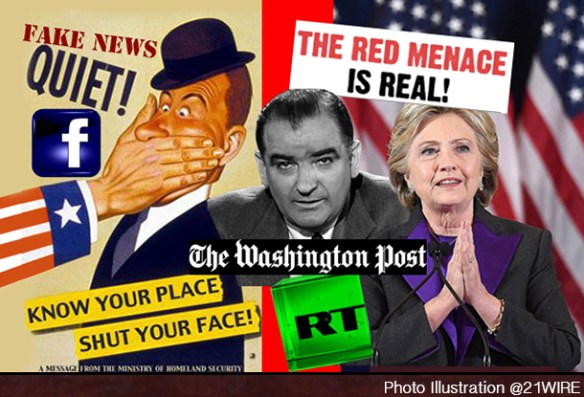
PropOrNot calls for an FBI investigation into the news sources listed. Even its creators see the resemblance to a new McCarthyism, as it appears as a frequently asked question on their website. (They say it is not McCarthyism, because “we are not accusing anyone of lawbreaking, treason, or ‘being a member of the Communist Party.’”) However, this new McCarthyism does not stem from the conservative right like before, but from the establishment center.

That the list is so evidently flawed and its creators refuse to reveal their identities or funding did not stop the issue becoming one of the most discussed in mainstream circles. Media talk of fake news sparked organizations like Google, Facebook, Bing and YouTube to change their algorithms, ostensibly to combat it.

However, one major effect of the change has been to hammer progressive outlets that challenge the status quo. The Intercept reported a 19 percent reduction in Google search traffic, AlterNet 63 percent and Democracy Now! 36 percent. Reddit and Twitter deleted thousands of accounts, while in what came to be called the “AdPocalypse,” YouTube began demonetizing videos from independent creators like Majority Report and the Jimmy Dore Show on controversial political topics like environmental protests, war and mass shootings. (In contrast, corporate outlets like CNN did not have their content on those subjects demonetized.) Journalists that questioned aspects of the Russia narrative, like Glenn Greenwald and Aaron Maté, were accused of being agents of the Kremlin (Shadowproof, 7/9/18).

The effect has been to pull away the financial underpinnings of alternative media that question the corporate state and capitalism in general, and to reassert corporate control over communication, something that had been loosened during the election in particular. It also impels liberal journalists to prove their loyalty by employing sufficiently bellicose and anti-Russian rhetoric, lest they also be tarred as Kremlin agents.

When it was reported in February that 13 Russian trolls had been indicted by a US grand jury for sharing and promoting pro-Trump and anti-Clinton memes on Facebook, the response was a general uproar. Multiple senior political figures declared it an “act of war.” Clinton herself described Russian interference as a “cyber 9/11,” while Thomas Friedman said that it was a “Pearl Harbor–scale event.” Morgan Freeman’s viral video, produced by Rob Reiner’s Committee to Investigate Russia, summed up the outrage:  “We have been attacked,” the actor declared; “We are at war with Russia.” Liberals declared Trump’s refusal to react in a sufficiently aggressive manner further proof he was Putin’s puppet.

The McCarthyist wave swept over other politicians that challenged the liberal center. Green Party presidential candidate Jill Stein refused to endorse the Russia narrative, leading mainstream figures like Rachel Maddow to insinuate she was a Kremlin stooge as well. After news broke that Stein’s connection to Russia was being officially investigated, top Clinton staffer Zac Petkanas announced:

Jill Stein is a Russian agent.

Jill Stein is a Russian agent.

Jill Stein is a Russian agent.

Jill Stein is a Russian agent.

Jill Stein is a Russian agent.

Jill Stein is a Russian agent.

Jill Stein is a Russian agent.

Jill Stein is a Russian agent.

“Commentary” that succinctly summed up the political atmosphere.

In contrast, Bernie Sanders has consistently and explicitly endorsed the RussiaGate theory, claiming it is “clear to everyone (except Donald Trump) that Russia was deeply involved in the 2016 election and intends to be involved in 2018.” Despite his stance, Sanders has also been constantly presented as another Russian agent, with the Washington Post (11/12/17) asking its readers, “When Russia interferes with the 2020 election on behalf of Democratic nominee Bernie Sanders, how will liberals respond?” The message is clear: The progressive wave rising across America is and will be a consequence of Russia, not of the failures of the system, nor of the Democrats.

It is not just politicians who have been smeared as Russian agents, witting or unwitting; virtually every major progressive movement challenging the system is increasingly dismissed in the same way. Multiple media outlets, including CNN (6/29/18), Slate (5/11/18), Vox (4/11/18) and the New York Times (2/16/18), have produced articles linking Black Lives Matter to the Kremlin, insinuating the outrage over racist police brutality is another Russian psyop. Others claimed Russia funded the riots in Ferguson and that Russian trolls promoted the Standing Rock environmental protests.

Meanwhile, Democratic insider Neera Tanden retweeted a description of Chelsea Manning as a “Russian stooge,” writing off her campaign for the Senate as “the Kremlin paying the extreme left to swing elections. Remember that.” Thus corporate media are promoting the idea that any challenge to the establishment is likely a Kremlin-funded astroturf effort.

The tactic has spread to Europe as well. After the poisoning of Russian double agent Sergei Skripal, the UK government immediately blamed Russia and imposed sanctions (without publicly presenting evidence). Jeremy Corbyn, the pacifist, leftist leader of the Labour Party, was uncharacteristically bellicose, asserting, “The Russian authorities must be held to account on the basis of the evidence and our response must be both decisive and proportionate.”

The British press was outraged—at Corbyn’s insufficient jingoism. The Sun‘s front page (3/15/18) attacked him as “Putin’s Puppet,” while the Daily Mail (3/15/18) went with “Corbyn the Kremlin Stooge.” As with Sanders, the fact that Corbyn endorsed the official narrative didn’t keep him from being attacked, showing that the conspiratorial mindset seeing Russia behind everything has little to do with evidence-based reality, and is increasingly a tool to demonize the establishment’s political enemies.

The Atlantic Council published a report claiming Greek political parties Syriza and Golden Dawn were not expressions of popular frustration and disillusionment, but “the Kremlin’s Trojan horses,” undermining democracy in its birthplace. Providing scant evidence, the report went on to link virtually every major European political party challenging the center, from right or left, to Putin. From Britian’s UKIP to Spain’s Podemos to Italy’s Five Star Movement, all are charged with being under one man’s control. It is this council that Facebook announced it was partnering with to help promote “trustworthy” news and weed out “untrustworthy” sources (FAIR.org, 5/21/18), as its CEO Mark Zuckerberg met with representatives from some of the largest corporate outlets, like the New York Times, CNN and News Corp, to help develop a system to control what content we see on the website.

The utility of this wave of suspicion is captured in Freeman’s aforementioned video. After asserting that “for 241 years, our democracy has been a shining example to the world of what we can all aspire to”—a tally that would count nearly a century of chattel slavery and almost another hundred years of de jure racial disenfranchisement—the actor explains that “Putin uses social media to spread propaganda and false information, he convinces people in democratic societies to distrust their media, their political process.”

The obvious implication is that the political process and media ought to be trusted, and would be trusted were it not for Putin’s propaganda. It was not the failures of capitalism and the deep inequalities it created that led to widespread popular resentment and movements on both left and right pressing for radical change across Europe and America, but Vladimir Putin himself. In other words, “America is already great.”

For the Democrats, Russiagate allows them to ignore calls for change and not scrutinize why they lost to the most unpopular presidential candidate in history. Since Russia hacked the election, there is no need for introspection, and certainly no need to accommodate the Sanders wing or to engage with progressive challenges from activists on the left, who are Putin’s puppets anyway. The party can continue on the same course, painting over the deep cracks in American society. Similarly, for centrists in Europe, under threat from both left and right, the Russia narrative allows them to sow distrust among the public for any movement challenging the dominant order.

For the state, Russiagate has encouraged liberals to forego their faculties and develop a state-worshiping, conspiratorial mindset in the face of a common, manufactured enemy. Liberal trust in institutions like the FBI has markedly increased since 2016, while liberals also now espouse a neocon foreign policy in Syria, Ukraine and other regions, with many supporting the vast increases in the US military budget and attacking Trump from the right.

For corporate media, too, the disciplining effect of the Russia narrative is highly useful, allowing them to reassert control over the means of communication under the guise of preventing a Russian “fake news” infiltration. News sources that challenge the establishment are censored, defunded or deranked, as corporate sources stoke mistrust of them. Meanwhile, it allows them to portray themselves as arbiters of truth. This strategy has had some success, with Democrats’ trust in media increasing since the election.

None of this is to say that Russia does not strive to influence other countries’ elections, a tactic that the United States has employed even more frequently (NPR, 12/22/16). Yet the extent to which the story has dominated the US media to the detriment of other issues is a remarkable testament to its utility for those in power.

Right to Burn

Free-market economics gives the poor equal rights to substandard housing

 By Siddhartha Deb

Source: The Baffler

At the very end of the film High-Rise, Ben Wheatley’s 2015 adaptation of J.G. Ballard’s novel from the seventies, we hear a familiar authoritarian voice extolling the virtues of capitalism. Against the backdrop of the high-rise building that is in many ways the protagonist of the film, the camera closes in on a young boy sitting on a jerry-rigged structure made up of discarded tires, a golf bag, a hockey stick, and a profusion of wires that have allowed him to tune in to the wisdom of Margaret Thatcher. “There is only one economic system in the world, and that is capitalism,” Thatcher says, and the only remaining argument is whether this is to be a form of state capitalism, “where there will never be political freedom,” or if capitalism is to be “in the hands of people outside State control.”

The fire last month that killed eighty people in Grenfell Tower, a twenty-four-story high-rise for low-income, mostly minority Londoners, is a stark example of what that Thatcherite vision looks like when carried out to its logical extreme. Built in the seventies in what can now be seen as the last great wave of public housing in Britain, a trend that started under the post-war Labour Government with the New Towns Act of 1946, Grenfell Tower steadily came under assault from the market forces unleashed by Thatcher. Located in London’s wealthiest borough of Kensington and Chelsea, the upkeep of the building was outsourced by the borough council to the ingeniously named Kensington and Chelsea Tenants Management Organisation, a body that steadfastly ignored, and sometimes used lawyers to threaten, tenants protesting about safety concerns.

The cladding newly installed on the exterior, apparently more for the purpose of making the building appear attractive to private buyers of available units than for reasons of maintenance, was found to be highly flammable and responsible for spreading the fire throughout the building. Other “refurbishment” work left the building with just one staircase and exit, and that too partially blocked. In the aftermath of the fire, when the Conservative party prime minister Theresa May visited the site to talk to members of the emergency services, she avoided meeting residents of the building. The borough council, meanwhile, at first refused to admit residents and media into its “public” meeting. Then, when ordered by a court to allow the media to attend its proceedings, it cancelled a scheduled session.

When Ballard’s novel was published in 1975, Thatcher was merely a rising star in the Conservative Party, still four years away from occupying 10 Downing Street. From there, she would go on to use every lever of the state to promote her vision of state-less capitalism, a ferocious ideology of elite self-interest that would ravage Britain and, promoted across the Atlantic by her American counterpart Ronald Reagan, blight the United States. Given a massive boost by the end of the Cold War, this worldview received regular technocratic updates from the Anglo-American leaders who succeeded Thatcher and Reagan, the old piss always managing to find new bottles—Tony Blair’s New Labour, Bill Clinton’s New Democrats, George Bush’s New American Century and so on, all the way to Barack Obama and David Cameron until we reach what now looks like the terminal point of that blight, the endgame of Theresa May and Donald Trump.

The rhetoric of neoliberalism was that, with a market society taking root in Britain and the United States, the model could be exported to the world at large. Grenfell Tower shows, instead, that it meant turning Britain, the so-called home of free markets and democracy, into a banana republic. The same could be said of the United States, where crises in infrastructure show a similar trajectory, including in the cost-cutting measures that led to the presence of lead and other toxins in the drinking water of Flint, Michigan, in the very town that, as portrayed by Michael Moore in the documentary Roger and Me, was once home of the nation’s largest General Motors plant.

In London, this transformation was achieved, by successive Conservative governments as well as by Blairite New Labour types, through a relentless stripping away of public housing in favor of private residences for the extremely wealthy. Thatcher, in 1979, had introduced “Right to Buy,” allowing tenants in public housing to buy their units at discounts of up to 50 percent. Initially reluctant at the idea of providing a state subsidy to buyers, and nudged into the populist move by other Conservative politicians, Thatcher was nevertheless the one who endowed Right to Buy with an aspirational flavor that everyone could become middle class. The buyers, however, tended to be the most well-off among the tenants, and although the units were initially meant to be lived in, they were eventually often sold at market rates to private landlords, in effect a privatization carried out with the help of public money. It is a process similar to what has happened to Mitchell-Lama housing in New York as buildings have steadily been acquired by private investors, including a building in East Harlem where seven died in a fire in 1987 and that, once purchased by a company backed by a Morgan Stanley investment fund, saw long-time minority residents harassed to make way for new, wealthier tenants.

The resulting housing crisis in London has been accompanied by an evisceration of services, as in the cuts in fire services and policing pioneered by May as home secretary. And all this has been achieved swiftly, accompanied by a technocratic jargon that appears utterly self-referential. Among these are words like deregulation, outsourcing, and, especially, “austerity,” as if what has been going on is some kind of secular Ramadan, a communal fasting to be followed by an iftar party, rather than a refusal by elites to provide basic services to citizens of the sort depicted, recently, in Ken Loach’s film, I, Daniel Blake.

Ballard’s novel captures all this quite perfectly, including the arc from enlightened self-interest to enlightened dementia as his high-rise, which starts out as a self-contained utopia for the professional classes, descends steadily into a small-scale civil war. It ends, as emphasized by the opening passage of the novel where a character eats “the roast hindquarter of the Alsatian,” in a man-eats-dog free enterprise society. With its forty floors, thousand apartments, supermarket, swimming-pools, bank, and school, Ballard’s high-rise, one guesses, has been at least partially funded by taxpayers’ money. It is built, after all, in a reclaimed area of London’s “abandoned dockland and warehousing along the north bank of the river.” Once completed, however, one of five such towers, it looks out with a glance every bit as predatory as the wealthy in Kensington and Chelsea eyeing the property values near Grenfell Tower, at the “rundown areas around it, decaying nineteenth-century terraced houses and empty factories already zoned for reclamation.”

But if Grenfell is a working-class, minority other to Ballard’s tower, ravaged from the outside by predatory capitalists rather than a gated community devoured from within, it also provokes something that is not to be found in Ballard’s prescient work. The tenants who voiced concerns about safety, including two minority women who went missing in the blaze, exemplify a social vision quite different from Ballard’s crazed professionals turning upon each other. In the continuing protests of survivors and their allies asking to be let into the closed meetings being conducted by the borough council and in the demands made by the Labour party leader  that empty residences in the borough, owned by absentee rich landlords, be used to house survivors, we see the inverse of Ballard’s psychotic elites competing to the death. Corbyn’s proposal stirred a Tory writer to ventilate about his “true, disturbing nature,” as if he were beginning a class war. But in Corbyn’s bringing to life a moribund Labour party in the face of a relentless media campaign against him, in the votes his party received in the recent general elections, especially from the disenfranchised young, the working class, and minorities, there is a profound stirring of hope, the beginnings of a refusal of Thatcher’s diseased world of man eats dog in a gutted tower.


Corbyn Teaches Us to Embrace the Change We Need

By Kevin Zeese and Margaret Flowers

Source: The Unz Review

The shocking election result in the United Kingdom – the Conservatives losing their majority and the creation of a hung Parliament; and Jeremy Corbyn being more successful than any recent Labor candidate – cutting a 20 point Theresa May lead down to a near tie – gives hope to many that the global shift to the right, fueled by the failures of governments to meet the basic needs of their population and growing economic insecurity, may be ending.

Corbyn is a lifelong activist whose message and actions have been consistent. He presented a platform directed at ending austerity and the wealth divide and was openly anti-war. There are a lot of lessons for the Labor Party in the UK from this election but there are also lessons for people in the United States. We review what happened and consider the possibilities for creating transformative change in the United States.

The Corbyn Campaign Results

The Corbyn campaign showed that a political leader urging a radical progressive transformative agenda can succeed. Many in his own party, the neo-liberal pro-war Blairites, claimed Corbyn could not win, tried to remove him from leadership, and sabotaged and refused to assist his campaign.

Corbyn showed he could win the leadership of the UK in the future, maybe sooner than later. While Theresa May is in the process of forming a minority government with a small radical conservative party from Northern Ireland, there has already been a backlash, mass petitions and protests against it and UK history has shown in similar circumstances that the second place finisher, may, in the end form the government. Corbyn is taking bold and radical actions. He is preparing to present a Queen’s speech in which he will say that he and his party are “ready to serve” and will continue to push his program through Parliament. He is calling on other parties to defeat the government in Parliament.

Corbyn did better than any recent Labor leader. Jonathan Cook, a British political commentator, writes in “The Facts Proving Corbyn’s Election Triumph” that Corbyn received 41 percent of the vote against May’s 44 percent. This was a big improvement in Labor’s share of seats, the largest increase since 1945. Cook points out that Corbyn won more votes than “Ed Miliband, Gordon Brown and Neil Kinnock, who were among those that, sometimes noisily, opposed his leadership of the party.” Even Tony Blair does not look all that good compared to Corbyn, Cook recounts:

“Here are the figures for Blair’s three wins. He got a 36 per cent share of the vote in 2005 – much less than Corbyn. He received a 41 per cent of the vote – about the same as Corbyn – in 2001. And Blair’s landslide victory in 1997 was secured on 43 per cent of the vote, just two percentage points ahead of Corbyn last night.

“In short, Corbyn has proved himself the most popular Labour leader with the electorate in more than 40 years, apart from Blair’s landslide victory in 1997.”

Bhaskar Sunkara, the founding editor of Jacobin, writes that Corbyn was not only campaigning against the Tories and Theresa May, but battling his own party – yet he still “won”:

“This is the first election Labour has won seats in since 1997, and the party got its largest share of the vote since 2005 — all while closing a twenty-four point deficit. Since Corbyn assumed leadership in late 2015, he has survived attack after attack from his own party, culminating in a failed coup attempt against him. As Labour leader he was unable to rely on his parliamentary colleagues or his party staff. The small team around him was bombarded with hostile internal leaks and misinformation, and an unprecedented media smear campaign.

“Every elite interest in the United Kingdom tried to knock down Jeremy Corbyn, but still he stands.”

The Blairites were taught a lesson by Corbyn. Many of his harshest critics are now changing their tune and embracing Corbyn. Hopefully they will join in creating a party in Corbyn’s image – a party for the many, not the few. Corbyn has rebuilt the mass base of Labor. The party is now the largest in Europe with half a million members. It is time for the “leaders” of Labor to follow the lead of the people and of Jeremy Corbyn.

What can we learn regarding US politics?

Sunkara argues Corbyn demonstrated that a winning campaign strategy is “to offer hopes and dreams to people, not just fear and diminished expectations.” In current US terms that means it is insufficient just to oppose Trump, a positive vision for the future that shows what a candidate and party stand for is needed, e.g. it is not just enough to defend the failing Affordable Care Act and oppose the Republican’s American Health Care Act, you must stand for something positive: National Improved Medicare for All. This is one example of many.

Sunkara provides more detail:

“Labour’s surge confirms what the Left has long argued: people like an honest defense of public goods. Labour’s manifesto was sweeping — its most socialist in decades. It was a straightforward document, calling for nationalization of key utilities, access to education, housing, and health services for all, and measures to redistribute income from corporations and the rich to ordinary people.

“£6.3 billion into primary schools, the protection of pensions, free tuition, public housing construction — it was clear what Labour would do for British workers. The plan was attacked in the press for its old-fashioned simplicity — “for the many, not the few” — but it resonated with popular desires, with a view of fairness that seemed elementary to millions.

“The Labour left remembered that you don’t win by tacking to an imaginary center — you win by letting people know you feel their anger and giving them a constructive end to channel it towards. ‘We demand the full fruits of our labor,’ the party’s election video said it all.”

Corbyn showed how important it is to have the correct analysis on foreign policy. Twice during the campaign, the UK was hit by a terrorist attack. Corbyn responded by telling the truth: part of the reason for terrorism is the UK foreign policy, especially in Libya. He also opposed the use of nuclear weapons. The Conservatives thought these anti-war positions would hurt Corbyn, instead they helped.

This is even more true in the United States with the never ending wars the country is fighting. But, the unspeakable in the United States, as Paul Street calls it, is acknowledging that terrorism is conducted by the US. This taboo subject makes it hard for people to understand that the US is constantly committing acts of terrorism around the world, which lead to predictable blow back from US militarism, regime change and war. No elected official will tell these obvious truths, which the people of the United States would instinctively understand if they were voiced.

Although the U.S. is often portrayed as a ‘center-right’ nation and progressives are called extremists, the reality is that there is majority support for a progressive agenda. There is a developing national consensus in the United States for transformational change, and Bernie Sanders articulated some of that consensus, at least on domestic issues, in his run for president, but the problem is that U.S. elections are manipulated by the elites in power who make sure that their interests are represented by the winner

Sunkara ends his article on Corbyn saying “Also, Bernie Sanders would have won.” We do not know what would have happened in a Trump-Sanders election. The closest example may be McGovern’s 1972 campaign against Nixon which he lost in a landslide. In that campaign, the Democrats deserted their candidate, even the AFL-CIO and big unions did not support McGovern and Nixon demonized him in the media. Would Clinton-Democrats have stood with Sanders or would they have sabotaged him like the party did to McGovern?

A key to Corbyn’s success was retail politics. The population of the UK is 65 million, compared to the US population of 321 million. Retail politics can work in the UK, while in the US paid media advertising drives the campaign, which means money often determines the outcome. This gives great power to big business interests, and while it can be overcome, it is a steep hill to climb.

Despite their significant losses, the Democrats are still controlled by Clinton-Obama Wall Street and war neo-liberals as we saw in the recent DNC chair election where Clinton protégé, Tom Perez, was elected. We are not optimistic that the US can apply the Corbyn model within the Democratic Party because it has been a party representing the oligarchs from its origins as the party of plantation slave-owners.

The duopoly parties that represent Wall Street, war and empire will not allow voices that represent “the many, not the few” to participate in US elections. They shut them out whether they run as an insurgent inside a party, as people learned from the mistreatment of Bernie Sanders by the DNC, or if they run outside of the two parties. The bi-partisans make independent party runs nearly impossible with unfair ballot access laws, barriers to voter registration, secret vote counting on unverifiable election machines, exclusion from the debates and exclusion by the corporate media, who are in cahoots with the bi-partisans.

It Comes Down to Building An Independent Mass Political Movement

We live in a mirage democracy with managed elections, as we describe in the article “Fighting for A Legitimate Democracy By and For the People,” on the long history of wealth dominating politics in the U.S.

Historically, transformations have occurred because of mass social movements demanding change and participating in elections through independent parties that have grown out of a movement with candidates from the movement (Corbyn has been involved in every anti-war movement, anti-apartheid, anti-austerity, pro-peace and human rights movements among others). Showing mass electoral support, even without winning, has resulted in significant changes – union rights, women’s voting rights, the eight-hour workday – indeed the New Deal came out of third party platforms. It is important to resist the duopoly parties in order to get to the root of the problems we face; as Patrick Walker explains, the “grassroots resistance must oppose Democrats as well as Trump.”

A broad and diverse social movement whose demands are articulated by an independent party platform has forced one of the two parties to capitulate to the movement or disappear. That still seems to be the most likely path to real change for the US.

Corbyn teaches that we should embrace the radical transformational change that is needed, whether in elections or as a movement, to inspire people to take action and shift the realm of the possible. The people thirst for change as their economic situation becomes more insecure. There needs to be a movement that addresses that insecurity through a human rights lens, or else the insecurity will be channeled towards hatred and violence.

The key first step is to show the many, we are with them; that we are listening and acting consistent with their beliefs. Taking this correct first step, lights the path ahead of us.


Kevin Zeese and Margaret Flowers co-direct Popular Resistance.


Related Article: The Breaking of the Corporate Media Monopoly

#Brexit confirms: the neoliberal center cannot hold

eu-broken1-701x351

By Jerome Roos

Source: ROAR Magazine

The post-Brexit pandemonium has less to do with Britain’s relationship to Europe than it has with elites losing control over the monsters they have created.

Britain finds itself in a general state of pandemonium. The UK is in the midst of a full-blown constitutional crisis, Prime Minister David Cameron has resigned, and both the country’s governing party and the opposition are in the throngs of a fierce internal power struggle.

As the cheerleaders of the leave campaign dither with no clear plan on how to move forward, the financial consequences continue to ripple through the City: within days, the pound collapsed to its lowest level since 1985, the government’s credit rating was slashed by two full points, and world markets were sent into a tailspin, with a record $3 trillion shaved off stock values on Friday and Monday alone. As if things could not get any worse, recent days have also seen reports of an epidemic of hate crimes spreading across the UK.

Reading the headlines, one could easily be forgiven for experiencing the creeping sensation of living through the postmodern equivalent of the apocalypse: the financial press is providing minute-to-minute coverage of the “battering” of world markets; liberal establishment columnists repeatedly declare this to be Britain’s and Europe’s “worst crisis” since the Second World War; and the New York Times has already held Brexit up as the telltale sign of a world order that is slowly falling apart.

To top it all off, a hysterical Tony Blair took to the same pages last weekend to make a desperate plea in defense of globalization and for more of his failed Third Way recipe, proclaiming in characteristic platitudes that “the center must hold” ­— as if Yeats’ “blood-dimmed tide” and “mere anarchy” were about to be loosed upon the world once more.

The immediate cause for all the commotion is clear: Cameron’s risky bet to hold a referendum on Britain’s EU membership has backfired disastrously. The unexpected victory for the leave camp has shaken both Unions to their very core, dividing left and right on either side of the Channel and burning all bridges between them. There is no denying the historic nature of these developments; the world is a different place after last Thursday, and it is clear that Europe and Britain now find themselves in uncharted territory.

Yet the unspeakable truth is that, at a deeper level, the financial fallout and political pandemonium of recent days has less to do with Britain’s place in Europe than it has with the widening gulf between political elites and European citizens more generally. While racism and anti-immigrant sentiment have been central to the leave campaign from the very start, it is difficult to believe that all 52 percent of Britons who voted leave are committed fascists. Many of these people are ordinary working class folks who are simply fed up with the erosion of their living standards, the disintegration of their communities, and the lack of responsiveness of their political representatives and the unaccountable technocracy that has “taken control” over their lives. Brexit was first and foremost a political statement by the dispossessed and disempowered.

The reason this statement has proven so explosive is because the referendum happened to sit on the convergence point of a number of profoundly unstable social and political fault-lines, all of which were shaking well before Brexit, all of which would have trembled even in the absence of Brexit, and all of which will continue to quake and thunder for a very long time after Brexit. It is highly unlikely that a victory for remain would have produced a very different outcome in the long run — it would certainly not have stemmed any of the discontent, pacified any of the social tensions, or resolved any of the political conflicts that underlie the referendum’s shock outcome.

While Brexit clearly hands victory to the bigots of UKIP and the Tory right, a victory for remain would simply have perpetuated the anti-democratic neoliberal masochism that produced the motivation for people to align themselves with these bigots in the first place. In this light, we have to stop seeing the rabid nationalism of the far-right and the neoliberal cosmopolitanism of the pro-EU camp as polar opposites — in reality, the former is the logical outgrowth of the latter; its deformed Siamese twin in flesh and blood. The only thing the pro-EU camp was able to offer British voters was a continuation of the structural conditions that led to Brexit, combined with fanatical fear-mongering over the consequences of that outcome.

Ultimately, the British vote to leave the EU, whether it eventually materializes or not (and there is no guarantee that it will), is symptomatic of a much deeper and much more debilitating crisis: a structural crisis of democratic capitalism that has in recent years evolved from a global financial crisis into a deepening legitimation crisis of the political establishment, which is now in turn exploding into a full-blown crisis of governability of the existing social and political order. The fault-lines currently opening up in British and European politics would have eventually laid waste to the stability of the continent’s postwar order regardless of the outcome of this particular referendum. Brexit will simply speed up that ongoing process of political decomposition.

It is important to remember in this respect that David Cameron did not call this referendum because he truly cared about the opinion of ordinary people on the EU. Like Alexis Tsipras last year, he called the referendum in a risky and desperate gambit to keep his flailing party together — to silence the Tories’ eurosceptic right wing, disarm the constant backbencher challenges to his leadership, and inoculate the government against future defections to UKIP. This vote was never really about the EU; it was about one of the figureheads of Europe’s crumbling neoliberal center trying to reassert his hold over a party that was once the stable bedrock of the UK’s landed aristocracy and its metropolitan bourgeoisie, but that is now rapidly disintegrating in the face of a resurgent reactionary right.

The ongoing coup against Jeremy Corbyn similarly has little to do with Europe. As an article in the Telegraph from June 13 confirms, Labour MPs and the Blairite wing of the party have been plotting an anti-Corbyn revolt for weeks, if not months, aiming to bring down their leftist leader in “a 24-hour blitz” after the referendum, regardless of its outcome. Again, this is not about the EU; it is about the incompetent lackeys of a crumbling neoliberal center trying to reclaim their hold over a party that was once Europe’s most enthusiastic cheerleader of neoliberalism, financialization and overseas military intervention, but that is now rapidly disintegrating — or realigning itself — in the face of an insurgent “hard” left.

In this respect, Blair’s apocalyptic reference to Yeats in his New York Times opinion piece was awkwardly on point: things are falling apart; the center cannot hold. This is the crux of the matter, and it helps explain the hysterical doomsday discourse of the centrist establishment: their globalized post-democratic fantasy world is crumbling before their very eyes, as their once-passive voter-cum-consumer base is suddenly gobbled up and mobilized by a motley crew of “angry populists” who thrive on the electoral spoils of a crippling legitimation crisis and feast on the popular discontent sowed by years of austerity and decades of neoliberal restructuring.

The answer to the steady disintegration of the established political order clearly cannot be more of the same. Against Blair’s hopeless cries that “the center must hold”, and against the thinly-veiled conspiracies of his neoliberal acolytes in Parliament — who are now closing in on Jeremy Corbyn in a last-ditch attempt to reclaim the Labour Party and destroy from within, once and for all, the only political force that could possibly pose an electoral counterweight to the far-right in this defining moment in British history — against all of these turncoats, the left must stand firm and insist: the center will fall.

But to avoid ceding the resulting void to the racists and reactionaries, the weakened and dispersed forces of the left will need to rally in face of the historic battles now coming their way. Despair as one may, this means the choice is now fairly straightforward: it’s Corbyn or nothing. Not because the embattled Labour leader will bring democratic socialism or fully automated luxury communism to a newly independent Britain, but because this decent, principled leftist is now the only bulwark still standing between ordinary working people of all colors, and the monsters that are about to be unleashed on them.

About the author:

Jerome Roos is the founder and editor of ROAR Magazine, and a researcher in International Political Economy at the European University Institute. For more on his research and writings, visit jeromeroos.com.

LONDON CALLING! The DNC in England on ‘hols’

By Daniel Hopsicker

Source: MadCowNews

Primaries polished off, the Democratic National Committee has apparently decided to pop over to swinging London on holiday.  Because what’s happening right now in Great Britain explains how Bernie Sanders somehow “lost” the California Democratic primary to a candidate who couldn’t fill a high school auditorium there without trucking in busloads of middle-aged white women wearing boxy pantsuits and smug smiles.

What’s happening in London puts what happened in California in the context of globalization.

hols

Voting in the “Brisket” Referendum

They were voting on “Brisket,” the surprisingly highly-contested election about choosing the Best BBQ in the UK.

In the end, newspaper columnists were shocked by the voter’s bad taste. Members of the commentariat were said to be absolutely appalled, especially at a few sneers and dirty looks conflated into a rise in racist and anti-immigrant hate crimes, like the non-existent chairs that weren’t thrown after the Nevada Democratic convention.

Disinformation acknowledges no borders, knows no terrestrial bounds!

“The Brexit vote has precipitated the deepest political crisis in Britain in a generation. The nation is divided and the climate is lurching dangerously towards the far right. At this critical moment for the future of the country, the Blairites have opportunistically mounted an anti-Corbyn coup. They have been incubating this coup from day one despite Corbyn’s overwhelming mandate.”

Some guy Americans have never heard of—or if they’ve heard of him don’t know how to pronounce his name— named Jeremy Corbyn, head of the Labor Party (only they spell it “Labour,” like teen-aged girls spelling their names cute: “That Cyndy! She’s special!”

Dozens of Labour Members of Parliament (confusing, don’t they know “MP’” stands for Military Police?) want this Corbyn guy to resign.

It seems they never liked him from the get-go, and would have shrugged him off long before now, except he won a massive victory from the Party’s rank-and-file in an election.

And now he won’t go!

mod

I thought, OMG! He’s just like Bernie!

And that’s when everything began to make sense.

The ‘objective correlative’ 

Remember how just after the California primary everything looked very “Through the Looking Glass? Remember? Bernie Sanders drawing monster crowds all up and down California… and then going on to “defeat” in the Democratic Presidential primary?

Losing to a candidate who couldn’t fill a third-grade classroom without sprinkling the crowd with California Democratic officials?

hill

Sure ya do, mate.


“Mister Peabody Almost Goes to Washington”

We’ve all seen the movie. A candidate barnstorms across the state. Draws multitudes. Enthusiastic slogans chanted all around.

11

Election night is always the next scene in the montage. Basking in the approval of an excited crowd at a victory party roaring in celebration. The candidate waves for quiet (who are they kidding? Everyone knows they don’t mean it.)

But not this time. Not in California. Lucy picked up the football, took it home. It was DEFLATE-GATE  writ large.


Romeo wakes up, sees Juliet dead, tears all around. 

Many thought, “I must be dreamin’. This can’t be real.” Because there was no “objective correlative” to help bring sense to the experience. No recognizable human moment, as in “Romeo wakes up, sees Juliet dead, tears all around.”

bb

On Youtube, a baby struggles to stand; we all smile. Watch a toddler stumble across a room, swaying side to side like a drunk on a gambling cruise unexpectedly caught in high seas.

We silently urge the drooling little thing on. “Trust your tiny gyroscope, diapered one. In your forehead. Behind your Third Eye.”

There was no recognizable human moment in California, nor many of the other Democratic primaries.

Just a sinking feeling that—once again—we’ve been had.


Hey! That sinking feeling! Stay outta London 

But the jury’s still out on London.

“A massive show of support for Jeremy Corbyn has left the coup coalition of media pundits and disgruntled MPs with their jaws to the floor. With only 24 hours notice, over 10,000 people marched on parliament square to reinforce the Labour leader’s unprecedented democratic mandate.”

sup

Being Britain, things quickly got snarky.

gotime


We wish them well. They’re a plucky bunch. Some have even had their lips surgically removed, which must be a pretty painful procedure.

lip

The Slow, Inevitable Collapse of the Two-Party System

march_of_tyranny

By Russell A. Whitehouse

Source: Strategic Culture Foundation

In this election year, it’s clear that a seismic political shift is rumbling through America.  Widespread discontent for the status quo is surfacing from both the left and right.  A year ago, it would have been impossible to envision a card-carrying socialist and a pre-WWII style populist mounting legitimate presidential campaigns (much less without Super PACs).  Now, far-left and far-right sentiments are emerging from the underground as perfectly palatable options to Middle America.  Establishment darlings like Hillary Clinton, Jeb Bush & Marco Rubio have faced extreme pressure from the New Normal in their respective political tents.

It has become clear that the traditional 2-party system in America is starting to erode.  Sanders’ supporters view Clinton as too untrustworthy & beholden to Big Business.   Meanwhile Trump’s blue-collar base has rejected rank-and-file Republicans as being too unsympathetic to their economic concerns, while his surprising chunk of the evangelical contingent is refuting the Bush-flavored puritanism of Ted Cruz.  Conversely, Clinton’s supporters reject Sander’s bold platform as delusional and Cruz’s base is increasingly being filled by #NeverTrump neocon purists and Romey-ite country club Republicans.

One can see political parallels across the pond, in the UK’s 2015 Parliamentary elections.  The two main parties in Westminster Palace, Conservative and Labour (roughly equivalent to the GOP and Democrats), were shaken up by two popular insurgencies.  UKIP, the UK Independence Party, rose up from the rising flames of the relatively conservative British heartland’s fears of free trade in the EU and immigration, winning an eighth of the popular vote in England. To the north, SNP, the Scottish National Party, won 95% of Scotland’s seats by inspiring among other things, record youth turnout and social media support (sound familiar?), with a message of social democracy and defiance against the British status quo.

Intra-party schisms are also forming in the two Anglophone democracies.  The Tories are tearing themselves apart over the Brexit, austerity and jockeying to succeed Cameron as Party Leader, while the American neocons are assessing the fallout of Trump’s ascendance while in free fall.  Labour officials are debating whether to follow their insurgent leader Jeremy Corbyn to the far Left after 20 years of Tony Blair’s New Labour movement, which moved the party to the center to win back the support of big business and blue-collar voters.  The New Labour centrist putsch coincided with Bill Clinton (and later Obama’s) similar efforts as the face of the Democrats.   Now, Democratic voters are beginning to second-guess this political realignment, spearheaded by the presumptive Democratic nominee’s husband.  Her opponent Bernie Sanders is siphoning away the youth vote and blue-collar moderates from the Democratic establishment, two of the Party’s traditional constituencies, by railing against neoliberal policies like free trade and social welfare cuts.

Given the rise of social-democratic populism and nativist-protectionist populism to either flank of American politics, it would make sense to look at the formation of entirely new parties.  Bernie Sanders can form a Stars-and-Pinstripes version of SNP; he too has the momentum of a more secular, progressive generation reaching political maturity as the more religious, conservative Baby Boomers begin to die out.  Assuming Trump completes his takeover of the Grand Old Party at July’s convention, the neocon brain trust can form a new conservative movement; this is already being planned by members of the #NeverTrump triad. Evangelical and free market diehards can unite to mount a serious challenge to Trump’s right by fielding a Texas crusader like Ted Cruz or Rick Perry, or Mormon elder statesman Mitt Romney.

Regardless of how Trump and Sanders fare in their respective conventions, they could still operate a serious race for the White House.  Both New York loudmouths boast a gigantic wave of rabid new voters, as well as a wellspring of working-class Americans desperate to reverse Wall Street’s increasingly oligarchical dominance, mass layoffs/underemployment, stagnant wages, crumbling infrastructure & the other byproducts of the neoliberal-neoconservative economic policy alliance.  Sanders could march into November as the nominee of the new Democratic Socialist Party, with a trail of young, idealistic future leaders tweeting and live-streaming behind him.  Depending on July’s RNC, we could see a Make America Great Again Party (MAGAP, for short) trumpeting Trump’s message of putting power back in the hands of the American working class or a Romney-Cruz True Conservatives Party ticket touting Christian piety and Wall St fiscal policy.

Get used to Sanders, Clinton, Trump & Cruz.  You may see all 4 of them, come November…