The West Is Becoming Irrelevant, The World Is Laughing

By Andre Vltchek

Source: TruePublica

I was recently told by an Asian friend of mine who is working in Paris: “Lately I stopped following almost all that is happening politically in the United States, in the UK and even here in France. It all feels suddenly so irrelevant, a waste of time.”

Statements like this would be unimaginable only one decade ago. In the past, what came from Washington and (to a smaller extent) from London was monitored with great attentiveness and fear, all over the world.

But all of a sudden, things have begun to change, rapidly. Despite the extremely violent nature of the Western-designed-and-manufactured global regime, which has been over-imposed on so many parts of the world for decades and centuries, increasing amounts of people in Asia, Latin America and Africa stopped worrying and went leisurely to the ‘barricades’, beginning to rebel against the perverseness of the ‘world order’.

Did it all really happen ‘all of a sudden’?

Or were there various catalysts at work, for already quite a substantial period of time?

It is a well-known fact that any deep-seated, chronic anxiety cannot disappear in just a short moment. People who are enslaved, humiliated, scared into obedience, people who are forced to feel uncertain and constantly frightened, cannot reverse their state of mind without some important external factor or set of factors.

It became obvious to me, as I have been working continuously on all continents and in almost all conflict zones of our Planet, that the renewed pride and courage which is now inspiring millions of oppressed human beings, actually came from the decisive and determined stand of just several brave and determined nations, big and small.

The myth about the omnipotence of the Empire has received a few significant blows.

The fable of invincibility has not completely disappeared yet, but at least it has got fractured and gravely injured.

The gate of the terrible prison began cracking. It has not collapsed, but the fractures were wide enough for at least some sunlight to enter the dark and dreadful cavities inhabited by billions of unfortunate and shattered beings.

Some victims stood up immediately; not many but at least some did. Others raised their heads in feeble hope, still lying down on the dirty ground, still chained, and still shaking. That weak light alone entering the dungeon was actually much brighter than what most people ever experienced in their entire life. It has been strong enough to provoke wonderful, brilliant sparks of hope

Except for some temporary setbacks (like in Brazil and Argentina), the anti-imperialist coalition is now steadier than ever; it is determined and constantly expanding.

And it is clearly winning!

It is truly a ‘rainbow coalition’ of countries, big and small, ‘red’ and ‘pink’, even ‘green’.

The only unifying factor is the shared determination not to be controlled by Western imperialism and neo-colonialism.

For decades, Cuba stood against the Empire, even after the Soviet block was broken to bits, even when all mutual agreements ceased to be honored by the criminal Yeltsin administration. The Cuban people never surrendered. It is because most of them always believed, from the bottom of their hearts, in socialism and internationalism. And also because they have been convinced that the Western Empire is a morally corrupt and illegitimate entity and therefore has to be resisted.

A small and relatively poor country – Cuba – demonstrated to the entire world that while the Empire is mighty, sadistic and brutal, it is not omnipotent, and it is possible to defy it. There is no reason why one should not dare, or one should not dream about a much better world, why one shouldn’t fight for true freedom, attempting to win.

Cuba inspired the world. Its daring Revolution took place just a few miles from the shores of the United States. Soon after, its teachers and doctors went to all parts of the earth, spreading optimism, solidarity and kindness. Its heroic revolutionaries went to fight against the most dreadful forms of colonialism, which were torturing people, is such places as Congo, Angola and Namibia.

After Obama’s attempts to water down the determination of the Cuban citizens, many enemies began to predict, cynically: “Now Cuba will compromise and sell its Revolution.”

It never did! I travelled to the Island last year, driving through the countryside, and speaking to people in Havana, Guantanamo and Santiago de Cuba. Almost no one was ready to compromise. A greatly educated nation, Cuba saw through the Empire’s tricks and deceptions.

Now almost nobody speaks about the “Cuban compromise”, anymore, simply because there isn’t any on the table.

China, one of the oldest and greatest civilizations on Earth, went through the terrible period of ‘humiliation’. Divided, occupied and plundered by the West, it has never forgotten nor forgiven.

Now the Chinese Communist state and its mixed economy are helping countries in virtually all parts of the world, from Oceania and Latin America, to the Middle East and especially Africa, to survive and to finally stand on their own feet. Despite all the vitriolic propaganda regurgitated by the West (those people in Europe or North America who know close to zero about Africa or China, habitually passing ‘confident’ and highly cynical ‘judgments’ about China’s involvement in the poor world; judgments based exclusively on the lies and fabrications produced by the Western media), China has been gaining great respect and trust in virtually all corners of the globe.

The Chinese people and their government are now standing firmly against Western imperialism. They will not allow any recurrence of the disgraceful and dreary past.

The West is provoking this mighty and optimistic nation, pushing it into a terrible confrontation. China doesn’t want any military conflict. It is the most peaceful, the most non-confrontational large nation on Earth. But it is becoming clear that if pushed against the wall, this time it will not compromise: it will fight.

In the last years I have spoken to many Chinese people, as I travelled to all corners of the country, and I’m convinced that by now the nation is ready to meet strength with strength.

Such determination gives hope to many other countries on our Planet. The message is clear: the West cannot do whatever it wants, anymore. If it tries, it will be stopped. By reason or by force!

Russia is ready again, too. It is standing next to China, enormous and indignant.

Go to Novosibirsk or Tomsk, to Khabarovsk, Vladivostok or Petropavlovsk in Kamchatka. Talk to Russian people and you will soon understand: almost nobody there believes or respects the West, anymore. Throughout history, Russia was attacked and ransacked from the West. Millions, tens of millions of its people were murdered, literally exterminated. And now, the nation is facing what some consider to be yet another imminent attack.

Like the Chinese people, Russians are unwilling to compromise, anymore. The old Russian forecast is once again alive, that very one professed by Alexander Nevsky:

Go tell all in foreign lands that Russia lives! Those who come to us in peace will be welcome as a guest. But those who come to us sword in hand will die by the sword! On that Russia stands and forever will we stand!

In Russia, as in China, and as in so many other nations that were devastated by the Western plunderers, nothing is forgotten and no one is forgotten. It only appeared for a while that the memory had fainted. It never does. You cannot burn down an entire land, ruin the cities, burn the fields, and still pose as one with the moral mandate. Or as we say in Chile: “Justice takes time, but it always comes!”

And the world is watching. It is suddenly clearly registering this determined and brave, epic stand of morally strong nations. Many of those who are watching are deeply impressed with what they are seeing. Perhaps not in London or in Paris, but go and ask those in Johannesburg or Beirut, or even in Calcutta, Cairo or Buenos Aires. Perhaps you suspect what answers you’d receive there!

Throughout modern history, not once has Iran invaded a foreign country. Yet its secular, progressive and democratic government (under the leadership of Mohammad Mosaddegh) was overthrown in 1953, in a CIA-backed coup. What followed was the monstrosity of the ‘pro-Western Shah’, and then a horrendous war, an invasion by Iraq, which was also fully backed by the West and which took hundreds of thousands of human lives. Since then, Iran has been suffering from targeted killings of its scientists (by the West and Israel), as well as terrorist attacks also backed from abroad.

Instead of falling on its knees and begging for mercy, Iran defied the West. On several occasions and when provoked, it sent its battleships to the neutral waters near the US coast, and it pledged to defend its land, in case it was to be attacked.

Iran also showed great solidarity towards Latin America, working closely with virtually all of the revolutionary governments there. It stood firmly by Venezuela in a time of great crises, building social housing in Caracas and supporting the Process by all other means.

In Latin America, no one will ever forget how former Iranian President Mahmoud Ahmadinejad came to Caracas to attend the funeral of Venezuelan leader Hugo Chavez, his dear friend. During the memorial, the aged mother of Chavez suddenly approached Ahmadinejad, in tears. Breaking all religious protocol of a Shi’a country that he was representing, the Iranian President embraced her, and held her against his heart, until she calmed down.

This moment was expressing one simple and powerful reality: all of us, the internationalists and anti-imperialists, are fighting for the survival of humanity and this planet. There is more that unites us than what is tearing us apart. Once we win, and we will win, the world will be able to find a common language. The West wants to divide us, by spreading hostilities and distrust, all through ‘false news’ and fabrications. But we understand its game. We will not break our ranks, anymore.

The West is clearly losing. It knows it. It is in panic.

Its nihilism, its propaganda and indoctrination tactics will soon be defeated.

I wrote a lot about the DPRK and how it joined the list of the ‘most hated nations on Earth’. It is a well known fact that North Korea was, for years and decades, much richer and more democratic than South Korea (ROK). But it embarked on one tremendous humanist ‘project’, and together with Cuba, the Soviet Union and to some extent China, it liberated almost the entire African continent, at great cost and sacrifice. And not only that: it sent its top educators and doctors to all corners of the most devastated continent on Earth. Its pilots also flew Egyptian MIGs against Israel, during the 1967 war. These facts have been silenced by Western propaganda, but they clearly explain why the DPRK has been ostracized, pushed to the corner, hit by senseless embargos, and forced to react the way it has been reacting for at least the last two decades.

North Korea has never surrendered either, and it never will.

Neither has Venezuela, for many years the great sentinel and engine of the Bolivarian Revolution, as well as of Latin Internationalism and solidarity. Surviving coups, embargos, plots and propaganda campaigns, surviving attacks, even terror, of the foreign-backed ‘opposition’, Venezuela has been injured but it is alive. Just a few days ago I spoke to an Italian Parliamentary delegation, consisting of  the“5-Star-Movement” MPs, which recently returned from Caracas. Their conclusion was simple: “The worst is over”.

The world knows it! Venezuela, DPRK, Cuba – they never fell. No matter how many knives penetrated their bodies, despite so much pain caused by the sanctions, coup attempts and direct acts of terrorism administered by the West and its monstrous Empire.

It is becoming clear and obvious: the West is helpless against determination, true courage and patriotic love. It is powerless when confronted with humanist ideologies, and with true loyalty!

And the world keeps watching, drawing its conclusions.

I wrote about Syria, comparing Aleppo to the 20th Century Stalingrad. This is where racism, terrorism, and the lowest forms of Western imperialism were decisively stopped. The price was terrible, but the message to the world extremely clear: The people who love their country with their entire hearts can fight and win against all odds, especially if by their side stand truly great and reliable friends and comrades!

One day the world will thank the Syrian people, profusely and properly. One day, everything will be understood. One day, perhaps soon.

This is one of the greatest moments in human history, perhaps the greatest.

It has arrived without big salvos announcing monumental revolutions.

Everything is happening fast, in an organized and determined manner.

The greatest minds of Russia, China, Latin America and the rest of the world, are feverishly, day and night, trying to determine what really brought our world, our civilization, to this ludicrous downfall.

The simplified and stripped-down answer is this: Western imperialism (military, economic and ‘intellectual’/ ’cultural’), colonialism and neo-colonialism, as well as that dreadful by-product of all the above combined – a set of unchecked and savage form of capitalism.

Simultaneously, new forms of government, of economy and social systems are being, once again, planned.

The military strategists of the countries that are refusing to kneel in front of the barbaric terror of the West, responsible for hundreds of millions of murders and billions of ruined lives, are planning how to defend their countries and the world.

Once again, the world is at work! It is building trenches, educating people, preparing them for the final showdown with the culture that has been tormenting our Planet for centuries.

It is the moment of great hope and renewed enthusiasm.

Of course, if seen from Western capitals, everything is bleak and depressing. There is no ‘hope’ at all.

I agree fully: there is no hope ‘for them’.

The logic, the ‘philosophy’ with which the Europeans and the North Americans have become accustomed to analyze the world, has arrived at a dead end.

Yes, it is ‘the end of philosophy’, or as they say, ‘the end of history’. I fully agree: it is the end of their philosophy and of their history.

That’s why, reading about their elections or statements produced by their politicians, is nothing less than a waste of time. The world realizes it, more and more.

Their ‘new tricks’ are actually very old. Their entire system is outdated. It should have been retired at least one hundred years ago. It survived only because of its savagery and cruelty. It will go soon, anyway.

These days, encountering people inhabiting the West is like encountering those zombies who were living in Nazi Germany during WWII. After the war was over, they were streetwalking for years, at least many of them, repeating the same refrains: “We didn’t know!” “We never realized”. The Nazi propaganda and the one, which has been used in the West and in the colonies (as Noam Chomsky and I defined in our book “On Western Terrorism”), are based on precisely the same roots, foundations and methods. Both are extremely effective, when it comes to the total brainwashing of the population.

To follow up the last chapter of the imperialist and turbo capitalist morass of the West is embarrassing and useless.

Both Europe and the United States are suffering from a series of devastating mental illnesses, as was defined by the great Swiss psychologist Carl Gustav Jung, right after WWII.

Getting too much involved in pathological behavior, constantly studying and analyzing it, could only break and deeply depress any healthy person’s mind.

There is nothing more to understand. Hundreds of millions of victims in all parts of the world are speaking for themselves.

The only rational issue here is this: how to stop this horror, as soon as possible? How to allow humanity to return to its natural development and evolution patterns?

I don’t believe in ‘punishments’ and ‘trials’ and other vehicles of intimidation and of spreading fear. I don’t care whether the West will ‘pay’ for all that it has done to the world. I only want it to be stopped, once and for all.

I work very hard for it to be stopped.

So are others.

And the world is watching, and all of a sudden enjoying what it sees.

Suddenly more and more people are daring to laugh at the global regime. Of course not in Paris, London or New York (here they are scared and obedient, even more than before). But outside, yes!

People on all continents want to see and hear about what ‘others do’, what ‘we do’, not what the Empire and its mental conditions are producing.

They are laughing and waiting impatiently for what a new day, a new year will bring. They are waiting for the true new beginning to arrive.


Andre Vltchek is a philosopher, novelist, filmmaker and investigative journalist. He has covered wars and conflicts in dozens of countries. Three of his latest books are revolutionary novel “Aurora” and two bestselling works of political non-fiction: “Exposing Lies Of The Empire” and  “Fighting Against Western Imperialism. View his other books here. Andre is making films for teleSUR and Al-Mayadeen. Watch Rwanda Gambit, his groundbreaking documentary about Rwanda and DRCongo. After having lived in Latin America, Africa and Oceania, Vltchek presently resides in East Asia and the Middle East, and continues to work around the world. He can be reached through his website and his Twitter

International Collaboration to End Violence


By Robert J. Burrowes

While much of the world is engulfed in violence of one sort or another
(whether violence in the home or on the street, exploitation, ecological
destruction or war), a global network of individuals and organizations
is committed to ending this violence in all of its manifestations.

With individual signatories in 100 countries and organizational
endorsements in 35 countries, each of these individuals and
organizations works on one or more manifestations of violence in their
locality and some of the organizations and networks have considerable
national or even international reach.

However, as you might understand, there is a great deal to be done and
the Charter network continues to expand as more people and organizations
are motivated to join this shared effort.

Here is an outline of what some of these individual signatories of ‘The
People’s Charter to Create a Nonviolent World‘ are doing. You are
welcome to join them.

A native of Iran, Professor Manijeh Navidnia was born in Tehran where
she attended school and university. She married in 1982 and had her
first child in 1985. Her original research interests were in social
science and sociology but after collaborating with the Islamic Azad
University, she became interested in strategic studies and most of her
research work and publications since then have focused on security. Her
first book in 2009 was particularly focused on ‘societal security’ and
her political engagements are designed to enhance international
cooperation across cultures.

Mahad Wasuge is a key figure at the Heritage Institute for Policy
Studies in Somalia. The Institute has recently published a shocking
report on ‘Somalia’s Drought Induced Crises: Immediate Action and Change
of Strategy Needed‘ in response to the ongoing drought in Somalia which threatens millions of people. ‘The ongoing drought in Somalia – referred to in the Somali
language as Sima, which means the leveler, ubiquitous or pervasive – has
enveloped the entire country. If rain does not arrive by mid April, and
if a massive humanitarian campaign is not mounted swiftly, the drought
could morph into an insidious famine that could devastate the country’:
hundreds of thousands of vulnerable men, women and children could starve
to death. Sadly, while awareness of the ongoing suffering and the
potential famine has been high, ‘the response of the international
community and the mitigation strategy by Somalia has been wholly
inadequate.’ Despite UN agencies raising over US$300 million, the
majority of the population across the country is not receiving basic
necessities. ‘Many pastoral communities have also lost 80 percent of
their livestock, escalating their vulnerability to an alarming and
perilous level.’

Ruth Phillips is the central figure in the initiative to create ‘an
ecological, co-housing village here on a fully restored, 17th century
chateau estate in rural France. The property lies in the heart of 30
acres of parklands and forests in the midst of quiet, deep-green nature,
surrounded by hills and mountains, forests and lakes. It is set in the
eastern Dordogne, one of most unspoilt regions of France’. They have
permission to create a permaculture village around the chateau for
residential and/or holiday use, with 23 houses blended into the natural
and historic landscape. Plans include the chateau ‘hub’ offering
education, leisure and cultural activities for residents and visitors; a
small restaurant; a multi-functional workshop space; the swimming pool;
a sauna and communal space, as well as large individual garden plots and
access to acres of forest and fields on the property. The site aims to
be a showcase for permaculture and sustainable living. Too good to be
true? Check out the Ecochateau website and email Ruth if you want to go there to stay for a while and help make their vision a more complete reality.

Burmese scholar and activist, Dr Maung Zarni has been indefatigable in
his efforts to raise awareness of the Burmese government’s genocidal
assault on the Rohingya Muslim population in Burma. He has also not
shied away from drawing attention to democracy icon Aung San Suu Kyi’s
complicity in this genocidal assault. While he has written many articles
on the subject, this two-minute video will give you a clearer sense of
Zarni, the compassionate scholar/activist: ‘Multiple Denials of
Myanmar’s Atrocity Crimes against Rohingyas prevent a peaceful
resolution’. For more, check out Zarni’s website.

In one of her public talks, Kathleen Macferran posed the question ‘Are we really safer when we put those who harm others behind bars and forget about them?‘ She explores
the idea of ‘turning our prisons into houses of healing and creating connections that lead to greater safety’ by having incarcerated men and women return to our communities as peacemakers.

Greg Kleven is a 68 year-old American living and teaching English in
Viet Nam. He was 18 years old when he went to Viet Nam as a soldier in
1967 ‘and thought that what I was doing was right. But after a few
months in country I realized that I had made a huge mistake. The war was
wrong and I should never have participated.’ After going home he had a
hard time adjusting back into society. ‘I couldn’t get the war out of my
mind.’ In 1988 he went back to Viet Nam as a tourist and realized he had
a chance ‘to make up for what I had done’. For the next two years he
helped organize ‘return trips for veterans who wanted to go back and see
Viet Nam as a country, not a war’. In 1990 he started teaching English
in Ho Chi Minh City and he has been doing it ever since. Greg shares the
passion to ‘some day put an end to all wars and violence in the world’.

Professor of Mathematical Analysis, Tarcisio Praciano-Pereira, reports
from Brazil that he is personally well but that living in Brazil is
‘very bad! I am 73 years old and I have suffered the dictatorship of
1964 when I was forced into exile. So I have a very clear picture of
what is going on here and this doesn’t make
me well because I know clearly the dangers we are facing. My life has
changed entirely, my intellectual production has dropped down because I
am all the time in the fight. I am seriously afraid! And I am not a
young boy anymore as I was in 1964.’ He advised the death of a judge of
the Supreme Court, who was overseeing a massive corruption investigation
into the state oil company, Petrobras, against the will of the ‘putsch
owners’ and conservative media outlet ‘Globo’. It is clear that the
possibility of crime in this death cannot be dismissed. Now they are
trying to replace the dead judge with the Justice Secretary ‘who is
nothing but a criminal. Please take a stand against this if you can.
Afraid is the right picture, friend! Yes, Fora Temer! Fora Temer, o
traira!’

Ending human violence requires courage, not to mention toughness and
determination, often in extraordinarily difficult circumstances.

For that reason, you might be sceptical about the prospects of achieving
it.

But if you wish to join the people above in working to create a world in
which peace, justice and ecological sustainability ultimately prevail
for all life on Earth, you can do so by signing the online pledge of
The People’s Charter to Create a Nonviolent World‘ and participating in
The Flame Tree Project to Save Life on Earth‘.

Can we do it? If we do not try, we will never know. And one day, fairly
soon now according to some climate scientists (and assuming we can avert
nuclear war in the meantime), homo sapiens sapiens will enter Earth’s
fossil record without even making a concerted effort to prevent it.


Biodata: Robert J. Burrowes has a lifetime commitment to understanding
and ending human violence. He has done extensive research since 1966 in
an effort to understand why human beings are violent and has been a
nonviolent activist since 1981. He is the author of ‘Why Violence?
His email address is flametree@riseup.net
and his website is at http://robertjburrowes.wordpress.com


Robert J. Burrowes
P.O. Box 68
Daylesford
Victoria 3460
Australia
Email: flametree@riseup.net

Websites:
Nonviolence Charter
Flame Tree Project to Save Life on Earth
‘Why Violence?’
Nonviolent Campaign Strategy
Nonviolent Defense/Liberation Strategy
Anita: Songs of Nonviolence
Robert Burrowes
Global Nonviolence Network

Why Do “Progressives” Like War?

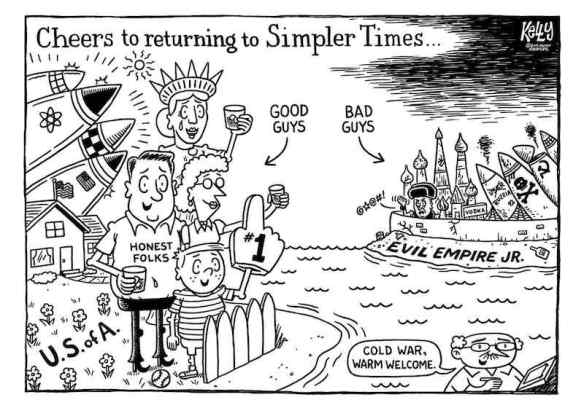
kelly-cold-war

By Philip Giraldi

Source: Unz Review

Liberals are supposed to be antiwar, right? I went to college in the 1960s, when students nationwide were rising up in opposition to the Vietnam War. I was a Young Republican back then and supported the war through sheer ignorance and dislike of the sanctimoniousness of the protesters, some of whom were surely making their way to Canada to live in exile on daddy’s money while I was on a bus going to Fort Leonard Wood for basic combat training. I can’t even claim that I had some grudging respect for the antiwar crowd because I didn’t, but I did believe that at least some of them who were not being motivated by being personally afraid of getting hurt were actually sincere in their opposition to the awful things that were happening in Southeast Asia.

As I look around now, however, I see something quite different. The lefties I knew in college are now part of the Establishment and generally speaking are retired limousine liberals. And they now call themselves progressives, of course, because it sounds more educated and sends a better message, implying as it does that troglodytic conservatives are anti-progress. But they also have done a flip on the issue of war and peace. In its most recent incarnation some of this might be attributed to a desperate desire to relate to the Hillary Clinton campaign with its bellicosity towards Russia, Syria and Iran, but I suspect that the inclination to identify enemies goes much deeper than that, back as far as the Bill Clinton Administration with its sanctions on Iraq and the Balkan adventure, which resulted in hundreds of thousands of deaths and the creation of a terror-narco state in the heart of Europe. And more recently we have seen the Obama meddling in Libya, Yemen and Syria in so called humanitarian interventions which have turned out to be largely fraudulent. Yes, under the Obama Dems it was “responsibility to protect time” (r2p) and all the world trembled as the drones were let loose.

Last Friday I started to read an op-ed in The Washington Post by David Ignatius that blew me away. It began “President Trump confronts complicated problems as the investigation widens into Russia’s attack on our political system.” It then proceeded to lay out the case for an “aggressive Russia” in the terms that have been repeated ad nauseam in the mainstream media. And it was, of course, lacking in any evidence, as if the opinions of coopted journalists and the highly politicized senior officials in the intelligence community should be regarded as sacrosanct. These are, not coincidentally, the same people who have reportedly recently been working together to undercut the White House by leaking and then reporting highly sensitive transcripts of phone calls with Russian officials.

Ignatius is well plugged into the national security community and inclined to be hawkish but he is also a typical Post politically correct progressive on most issues. So here was your typical liberal asserting something in a dangerous fashion that has not been demonstrated and might be completely untrue. Russia is attacking “our political system!” And The Post is not alone in accepting that Russia is trying to subvert and ultimately overthrow our republic. Reporting from The New York Times and on television news makes the same assumption whenever they discuss Russia, leading to what some critics have described as mounting American ‘hysteria’ relating to anything coming out of Moscow.

Rachel Maddow is another favorite of mine when it comes to talking real humanitarian feel good stuff out one side of her mouth while beating the drum for war from the other side. In a bravura performance on January 26th she roundly chastised Russia and its president Vladimir Putin. Rachel, who freaked out completely when Donald Trump was elected, is now keen to demonstrate that Trump has been corrupted by Russia and is now controlled out of the Kremlin. She described Trump’s lord and master Putin as an “intense little man” who murders his opponents before going into the whole “Trump stole the election with the aid of Moscow” saga, supporting sanctions on Russia and multiple investigations to get to the bottom of “Putin’s attacks on our democracy.” Per Maddow, Russia is the heart of darkness and, by way of Trump, has succeeded in exercising control over key elements in the new administration.

Unfortunately, people in the media like Ignatius and Maddow are not alone. Their willingness to sell a specific political line that carries with it a risk of nuclear war as fact, even when they know it is not, has been part of the fear-mongering engaged in by Democratic Party loyalists and many others on the left. Their intention is to “get Trump” whatever it takes, which opens the door to some truly dangerous maneuvering that could have awful consequences if the drumbeat and military buildup against Russia continues, leading Putin to decide that his country is being threatened and backed into a corner. Moscow has indicated that it would not hesitate use nuclear weapons if it is being confronted militarily and facing defeat.

The current wave of Russophobia is much more dangerous than the random depiction of foreigners in negative terms that has long bedeviled a certain type of American know-nothing politics. Apart from the progressive antipathy towards Putin personally, there is a virulent strain of anti-Russian sentiment among some self-styled conservatives in congress, best exemplified by Senators John McCain and Lindsey Graham. Graham has recently said “2017 is going to be a year of kicking Russia in the ass in Congress.”

It is my belief that many in the National Security State have convinced themselves that Russia is indeed a major threat against the United States and not because it is a nuclear armed power that can strike the U.S. That appreciation, should, if anything constitute a good reason to work hard to maintain cordial relations rather than not, but it is seemingly ignored by everyone but Donald Trump.

No, the new brand of Russophobia derives from the belief that Moscow is “interfering” in places like Syria and Ukraine. Plus, it is a friend of Iran. That perception derives from the consensus view among liberals and conservatives alike that the U.S. sphere of influence encompasses the entire globe as well as the particularly progressive conceit that Washington should serve to “protect” anyone threatened at any time by anyone else, which provides a convenient pretext for military interventions that are euphemistically described as “peace missions.”

There might be a certain cynicism in many who hate Russia as having a powerful enemy also keeps the cash flowing from the treasuring into the pockets of the beneficiaries of the military industrial congressional complex, but my real fear is that, having been brainwashed for the past ten years, many government officials are actually sincere in their loathing of Moscow and all its works. Recent opinion polls suggest that that kind of thinking is popular among Americans, but it actually makes no sense. Though involvement by Moscow in the Middle East and Eastern Europe is undeniable, calling it a threat against U.S. vital interests is more than a bit of a stretch as Russia’s actual ability to make trouble is limited. It has exactly one overseas military facility, in Syria, while the U.S. has more than 800, and its economy and military budget are tiny compared to that of the United States. In fact, it is Washington that is most guilty of intervening globally and destabilizing entire regions, not Moscow, and when Donald Trump said in an interview that when it came to killing the U.S. was not so innocent it was a gross understatement.

Ironically, pursuing a reset with Russia is one of the things that Trump actually gets right but the new left won’t give him a break because they reflexively hate him for not embracing the usual progressive bromides that they believe are supposed to go with being antiwar. Other Moscow trashing comes from the John McCain camp which demonizes Russia because warmongers always need an enemy and McCain has never found a war he couldn’t support. It would be a tragedy for the United States if both the left and enough of the right were to join forces to limit Trump’s options on dealing with Moscow, thereby enabling an escalating conflict that could have tragic consequences for all parties.

Noseblind to Odors in Your Empire?

quigley_us_empire_cartoon

By John Rohn Hall

Source: Axis of Logic

Using metaphor or analogy as a creative aid is especially useful when venturing journalistically into uncomfortable, foreign territory, and Trump’s new version of Amerika is indeed uncomfortable and foreign territory. Gotta admit to a serious case of writer’s block for the last couple weeks since The Donald’s coronation fiasco. Where to begin? All my go-to sources came up cold as January days in Jackson Hole…dried up like puddles after a Mohave Desert rainstorm. The Wizard of Oz, Alice in Wonderland, and The Matrix all seemed irrelevant.  George Carlin, Kurt Vonnegut, or Mark Twain quotes weren’t caustic enough to cut through the slime, nor offer adequate support for a conversation on the subject. But then the Heavens opened up and, through the miracles of Madison Avenue, there was a vehicle available to begin writing anew. A Febreze commercial on HGTV threw a left jab that hit me right between the eyes. Right there on my 46′ Magnavox, a kitchen island in a typical Amerikan home morphed into a back-alley dumpster, complete with roaches, flies, rats, alley cats, garbage, and stench. “Have you gone noseblind to the odors in your home?” the announcer asked. Perhaps, but more importantly, I’d guess that most Amerikans have gone noseblind to odors in their Empire.

And now Donald Trump’s in charge, and he leaves me longing for the pleasant sight of Obama’s smile, that soothing voice, and comforting demeanor. The familiar, believable, lovable, family man. A guy who never lost his cool. When Barack Obama stepped up to the microphone, the sweet, fresh scent of familiarity filled the air. Like the caustic but lively chemical fragrance of Febreze, Obama casually and effortlessly lulled Amerika into dumb insouciance. When Trump takes charge of the same microphone, the resulting clamor smells like a rat-infested dumpster. But then, beauty is in the olfactory receptors of the beholder. In truth, my nose is no more talented than those which decorate the faces of the sea of deplorables, sporting “Make America Great Again!” caps. We’ve all gone noseblind to the stench of Empire. If the truth be told, Amerika stinks under Trump’s watch, it stank during Obama’s eight year reign, it certainly reeked under the orchestration of Bush/Cheney, and the offensive smell lingers in the air just about as far back into the last 500 years of European occupation of The Western Hemisphere as you’d care to go.

Seriously, which odor is more offensive? Trump’s seemingly racist, xenophobic Muslim ban, or Obama’s record of bombing most of the same countries into oblivion? Trump’s signature on a document or Obama’s deadly drone assassination program? All seven Muslim-intensive countries on Trump’s justice-offensive Keep Out List have been subject to invasion or economic sanctions under Obama’s reign. Seems that Obama created the flow of refugees who fear for the lives of their children, and Trump has put out the No Trespassing sign, leaving a sea of desperate people with nowhere to go. The whole thing stinks, and has always stunk. Death and destruction never smell good.

The foul stench emanating from Trump’s Mexican Border Wall Plan is about enough to bring on a case of reverse peristalsis. Taking advantage of Mexico’s weakened condition following three centuries of Spanish occupation, the U.S.A. swooped in and confiscated the entire northern half of that country during The Mexican War. Since then, poor Mexicans have always come in our back door, doing the jobs U.S. Citizens find beneath their dignity, and doing so for slave wages. Obama threw the “illegals” a few bones during his tenure, but managed to deport a record-breaking 2 & 1/2 million of them while he was at it. Trump promises to lock the border and throw away the key. Smells like they’ve both been playing the same nasty game. The stench which filled the air while Obama sat on the throne has neither intensified nor diminished. If you haven’t noticed, you just might be noseblind to the odors of Empire.

We U.S. Citizens shoulder much of the blame for the stinking shenanigans of Empire. We believe the incessant lies of politicians over and over again. Fool us once, shame on you. Fool us 45 times, shame on us. We basked in the foul stench of Obama’s promises to end the wars in the Mideast, only to watch as he authorized the invasions of even more helpless, hapless populations. We cheered when he said he’d shut down Guantanamo. It’s a good thing we didn’t hold our breath. More recently, Trump seemed to be making peace with Russia, announced that the U.S.A. should stop attacking other countries, and seemed to be a good option over Hillary NevermetawarIdidntlike Clinton. In his next breath he beat the war drums, promised even more “defense” spending, and pointed a finger of blame and doom at China and Iran. While he was at it, he reaffirmed that along with maintaining a strong presence at Guantanamo, he’d reopen Black Sites abroad, and ramp up our lagging enhanced interrogation program. Ya gotta love torture. Only time will tell when or where our current loose cannon will fire his next stinking verbal barrage.

As a U.S. Citizen, I know a few things (almost) for sure about the Empire I call home. It is on the march, has been on the march since the penning of The Constitution, and will continue its foul, rancid march until somebody breaks both of its legs, and it can march no more. Empire devours everything in its path, then defecates broken countries and peoples into reeking mounds of destruction and death. The path of Empire’s march does not depend upon who holds its highest office and appears to be making all of the important decisions. While such apparent opposites as Obama and Trump appear to be at odds, they both play the game as they’re instructed. ‘Tis a grand illusion. Voting is an act of complete futility, and American Democracy is a lie. Our leaders are selected and assigned from above. As U.S. Citizens, we are no more than resources to be harvested, then cast aside as our utility diminishes and evaporates, our broken, decaying bodies becoming just another layer in the stench of death permeating the skies over the land of the free and home of the brave.

If Americans Truly Cared About Muslims, They Would Stop Killing Them by the Millions

index

By Glen Ford

Source: Black Agenda Report

In the most dramatic expression of insider opposition to a sitting administration’s policies in generations, over 1,000 U.S. State Department employees signed on to a memo protesting President Donald Trump’s temporary ban on people from seven predominantly Muslim countries setting foot on U.S. soil. Another recent high point in dissent among the State Department’s 18,000 worldwide employees occurred in June of last year, when 51 diplomats called for U.S. air strikes against the Syrian government of President Bashar al Assad.

Neither outburst of dissent was directed against the U.S. wars and economic sanctions that have killed and displaced millions of people in the affected countries: Iran, Iraq, Libya, Somalia, Sudan, Syria and Yemen. Rather, the diplomatic “rebellion” of last summer sought to pressure the Obama administration to join with Hillary Clinton and her “Big Tent” full of war hawks to confront Russia in the skies over Syria, while the memo currently making the rounds of State Department employees claims to uphold “core American and constitutional values,” preserve “good will towards Americans” and prevent “potential damage to the U.S. economy from the loss of revenue from foreign travelers and students.”

In neither memo is there a word of support for world peace, nor a hint of respect for the national sovereignty of other peoples — which is probably appropriate, since these are not, and never have been, “core American and constitutional values.”

Ironically, the State Department “dissent channel” was established during one of those rare moments in U.S. history when “peace” was popular: 1971, when a defeated U.S. war machine was very reluctantly winding down support for its puppet regime in South Vietnam. Back then, lots of Americans, including denizens of the U.S. government, wanted to take credit for the “peace” that was on the verge of being won by the Vietnamese, at a cost of at least four million Southeast Asian dead. But, those days are long gone. Since 2001, war has been normalized in the U.S. — especially war against Muslims, which now ranks at the top of actual “core American values.” Indeed, so much American hatred is directed at Muslims that Democrats and establishment Republicans must struggle to keep the Russians in the “hate zone” of the American popular psyche. The two premiere, officially-sanctioned hatreds are, of course, inter-related, particularly since the Kremlin stands in the way of a U.S. blitzkrieg in Syria, wrecking Washington’s decades-long strategy to deploy Islamic jihadists as foot soldiers of U.S. empire.

The United States has always been a project of empire-building. George Washington called it a “nascent empire,” Thomas Jefferson bought the Louisiana Territory from France in pursuit of an “extensive empire,” and the real Alexander Hamilton, contrary to the Broadway version, considered the U.S. to be the “most interesting empire in the world.” The colonial outpost of two million white settlers (and half a million African slaves) severed ties with Britain in order to forge its own, limitless dominion, to rival the other white European empires of the world. Today, the U.S. is the Mother of All (Neo)Colonialists, under whose armored skirts are gathered all the aged, shriveled, junior imperialists of the previous era.

In order to reconcile the massive contradiction between America’s predatory nature and its mythical self-image, however, the mega-hyper-empire must masquerade as its opposite: a benevolent, “exceptional” and “indispensible” bulwark against global barbarism. Barbarians must, therefore, be invented and nurtured, as did the U.S. and the Saudis in 1980s Afghanistan with their creation of the world’s first international jihadist network, for subsequent deployment against the secular “barbarian” states of Libya and Syria.

In modern American bureaucratese, worrisome barbarian states are referred to as “countries or areas of concern” — the language used to designate the seven nations targeted under the Terrorist Travel Prevention Act of 2015 signed by President Obama. President Donald Trump used the existing legislation as the basis for his executive order banning travelers from those states, while specifically naming only Syria. Thus, the current abomination is a perfect example of the continuity of U.S. imperial policy in the region, and emphatically not something new under the sun (a sun that, as with old Britannia, never sets on U.S. empire).

The empire preserves itself, and strives relentlessly to expand, through force of arms and coercive economic sanctions backed up by the threat of annihilation. It kills people by the millions, while allowing a tiny fraction of its victims to seek sanctuary within U.S. borders, based on their individual value to the empire.

Donald Trump’s racist executive order directly affects about 20,000 people, according to the United Nations High Commissioner on Refugees. President Obama killed an estimated 50,000 Libyans in 2011, although the U.S. officially does not admit it snuffed out the life of a single civilian. The First Black President is responsible for each of the half-million Syrians that have died since he launched his jihadist-based war against that country, the same year. Total casualties inflicted on the populations of the seven targeted nations since the U.S. backed Iraq in its 1980s war against Iran number at least four million — a bigger holocaust than the U.S. inflicted on Southeast Asia, two generations ago — when the U.S. State Department first established its “dissent channel.”

But, where is the peace movement? Instead of demanding a halt to the carnage that creates tidal waves of refugees, self-styled “progressives” join in the macabre ritual of demonizing the “countries of concern” that have been targeted for attack, a process that U.S. history has color-coded with racism and Islamophobia. These imperial citizens then congratulate themselves on being the world’s one and only “exceptional” people, because they deign to accept the presence of a tiny portion of the populations the U.S. has mauled.

The rest of humanity, however, sees the real face of America — and there will be a reckoning.


Washington’s Global Economic Wars

bf82233ae78cbffa718c3c7768ed31afc418d015

By James Petras

Source: Axis of Logic

Introduction
During most of the past two decades Washington has aggressively launched military and economic wars against at least nine countries, either directly or through its military aid to regional allies and proxies.  US air and ground troops have bombed or invaded Afghanistan, Iraq, Pakistan, Libya, Somalia, Syria, Yemen and Lebanon.

More recently Washington has escalated its global economic war against major economic rivals as well as against weaker countries.  The US no longer confines its aggressive impulses to peripheral economic countries in the Middle East, Latin America and Southern Asia:  It has declared trade wars against world powers in Asia, Eastern and Central Europe and the Gulf states.

The targets of the US economic aggression include economic powerhouses like Russia, China, Germany, Iran and Saudi Arabia, as well as Syria, Yemen, Venezuela, Cuba and the Donbas region of Ukraine.

There is an increasingly thinner distinction between military and economic warfare, as the US has frequently moved from one to the other, particularly when economic aggression has not resulted in ‘regime change’ – as in the case of the sanctions campaign against Iraq leading up to the devastating invasion and destruction.

In this essay, we propose to examine the strategies and tactics underlying Washington’s economic warfare, their successes and failures, and the political and economic consequences to target nations and to world stability.

Washington’s Economic Warfare and Global Power
The US has used different tactical weapons as it pursues its economic campaigns against targeted adversaries and even against its long-time allies.

Two supposed allies, Germany and Saudi Arabia, have been attacked by the Obama Administration and US Congress via ‘legal’ manipulations aimed at their financial systems and overseas holdings.  This level of aggression against sovereign powers is remarkable and reckless.  In 2016 the US Justice Department slapped a $14 billion dollar penalty on Germany’s leading international bank, Deutsche Bank, throwing the German stock market into chaos, driving the bank’s shares down 40% and destabilizing  Germany’s financial system.  This unprecedented attack on an ally’s major bank was in direct retaliation for Germany’s support of the European Commission’s $13 billion tax levy against the US-tax evading Apple Corporation for its notorious financial shenanigans in Ireland.  German political and business leaders immediately dismissed Washington’s legalistic rhetoric for what it was: the Obama Administration’s retaliation in order to protect America’s tax evading and money laundering multinationals.

The chairman of the German parliament’s economic committee stated that the gross US attempt to extort Deutsche Bank had  all the elements of an economic war.   He noted that Washington had a “long tradition of using every available opportunity to wage what amounted to a  trade war if it benefits their own economy” and the “extortionate damages claim” against Deutsche Bank were a punitive example.  US economic sanctions against some of Germany’s major trade partners, like Russia, China and Iran, constitute another tactic to undermine Germany’s huge export economy.  Ironically, Germany is still considered “a valued ally” when it comes to the US wars against Syria, Afghanistan and Iraq, which have driven millions of refugees to Europe creating havoc with Germany’s political, economic and social system and threatening to overthrow the government of ‘ally’ Angela Merkel.

The US Congress launched an economic-judicial war against its closest ally in the Gulf region when it approved legislation granting US victims of Islamist terrorism, especially related to the attacks on September 11, 2001, the right  to sue the government of Saudi Arabia and seize its overseas assets.  This included the Kingdom’s immense ‘sovereign funds’ and constitutes an arbitrary and blatant violation of Saudi sovereignty.  This opens the Pandora’s Box of economic warfare by allowing victims to sue any government for sponsoring terrorism, including the United States!   Saudi leaders immediately reacted by threatening to withdraw billions of dollars of assets in US Treasuries and investments.

The US economic sanctions against Russia are designed to strengthen its stranglehold on the economies of Europe which rely on trade with Russia.  These have especially weakened German and Polish trade relations with Russia, a major market for German industrial exports and Polish agriculture products.   Originally, the US-imposed economic sanctions against Moscow were supposed to harm Russian consumers, provoke political unrest and lead to ‘regime change’.   In reality, the unrest it provoked has been mainly among European exporters, whose contracts with Russia were shredded and billions of Euros were lost.  Furthermore, the political and diplomatic climate between Europe and Russia has deteriorated while Washington has ‘pivoted’ toward a more militaristic approach.

Results in Asia have been even more questionable:  Washington’s economic campaign against China has moved awkwardly in two directions:  Prejudicial trade deals with Asian-Pacific countries and a growing US military encirclement of China’s maritime trade routes.

The Obama regime dispatched Treasury Secretary Jack Lew to promote the Trans- Pacific Partnership (TPP) among a dozen regional governments, which would blatantly exclude China, Asia’s largest economic power.   In a slap to the outgoing Obama Administration, the US Congress rejected his showpiece economic weapon against China, the TPP.

Meanwhile, Obama ‘encouraged’ his erstwhile ‘allies’ in the Philippines and Vietnam to sue China for maritime violations over the disputed ‘Spratly Islands’ before the Permanent Court of Arbitration.   Japan and Australia signed military pacts and base agreements with the Pentagon aimed at disrupting China’s trade routes.  Obama’s so-called ‘Pivot to Asia’ is a transparent campaign to block China from its markets and trading partners in Southeast Asia and Pacific countries of Latin American.  Washington’s flagrant economic warfare resulted in slapping harsh import tariffs on Chinese industrial exports, especially steel and tires.  The US also sent a ‘beefed up’ air and sea armada for ‘joint exercises’ along China’s regional trade routes and its access to critical Persian Gulf oil, setting off a ‘war of tension’.

In response to Washington’s ham-fisted aggression, the Chinese government deftly rolled out the Asian Infrastructure Investment Bank (AIIB) with over fifty countries eagerly signing on for lucrative trade and investment deals with Beijing.  The AIIB’s startling success does not bode well for Obama’s ‘Pivot to Pacific Hegemony’.

The so-called US-EU-Iran accord did not end Washington’s trade war against Teheran.  Despite Iran’s agreement to dismantle its peaceful uranium enrichment and nuclear research programs, Washington has blocked  investors and tried to undermine trade relations, while still holding billions of dollars of Iranian state assets, frozen since the overthrow of the Shah in  1979.  Nevertheless, a German trade mission signed on a three billion trade agreement with Iran in early October 2016 and called on the US to fulfill its side of the agreement with Teheran – so far to no avail.

The US stands alone in sending its nuclear naval armada to the Persian Gulf and threatens commercial relations. Even the Kingdom of Saudi Arabia, the longstanding enemy of the Iranian Islamic Republic, has agreed to a cooperative oil production arrangement at a recent OPEC meeting.

Washington’s declaration of economic warfare against two of its most strategic powerful allies, Germany and Saudi Arabia and three rising competitor world powers, has eroded US economic competitiveness, undermined its access to lucrative markets and increased its reliance on aggressive military strategies over diplomacy.

What is striking and perplexing about Washington’s style of economic warfare is how costly this has been for the US economy and for US allies, with so little concrete benefit.

US oil companies have lost billions in joint exploitation deals with Russia because of Obama’s sanctions.  US bankers, agro-exporters, high-tech companies are missing out on lucrative sales just to ‘punish’ Russia over the incredibly corrupt and bankrupt US coup regime in Ukraine.

US multi-national corporations, especially those involved in Pacific Coast transport and shipyards, Silicon Valley high tech industry and Washington State’s agro-export producers are threatened by the US trade agreements that exclude China.

Iran’s billion dollar market is looking for everything from commercial airplanes to mining machinery.  Huge trade deals have has been lost to US companies because Obama continues to impose de facto sanctions.  Meanwhile, European and Asian competitors are signing contracts.

Despite Washington’s dependence on German technical knowhow and Saudi petro-dollar investments as key to its global ambitions, Obama’s irrational policies continue to undermine US trade.

Washington has engaged in economic warfare against ‘lesser economic powers’ that nevertheless play significant political roles in their regions.  The US retains the economic boycott of Cuba; it wages economic aggression against Venezuela and imposes economic sanctions against Syria, Yemen and the Donbas region in eastern Ukraine.  While these countries are not costly in terms of economic loss to US business interests, they exercise significant political and ideological influence in their regions, which undermine US ambitions.

Conclusion
Washington’s resort to economic warfare complements its military fueled empire building.

But economic and military warfare are losing propositions.  While the US may extract a few billion dollars from Deutsch Bank, it will have lost much more in long-term, large-scale relations with German industrialists, politicians and financiers.  This is critical because Germany plays the key role in shaping economic policy in the European Union.  The practice of US multi-national corporations seeking off-shore tax havens in the EU may come to a grinding halt when the European Commission finishes its current investigations.  The Germans may not be too sympathetic to their American competitors.

Obama’s Trans-Pacific Partnership (TPP) has not only collapse, it has compelled China to open new avenues for trade and cooperation with Asian-Pacific nations – exactly the opposite of its original goal of isolating Beijing.  China’s Asia Infrastructure and Investment Bank (AIIB) has attracted 4 time more participants than Washington’s TPP and massive infrastructure projects are being financed to further bind ASEAN countries to China.  China’s economic growth at 6.7% more than three times that of the US at 2%.  Worse, for the Obama Administration, Washington has alienated its historically most reliable allies, as China, deepens economic ties and cooperation agreements with Thailand, Philippines, Pakistan, Cambodia and Laos.

Iran, despite US sanctions, is gaining markets and trade with Germany, Russia, China and the EU.

The Saudi-US conflict has yet to play-out but any escalation of law suits against the kingdom will result in the flight of hundreds of billions of investment dollars from the US.

In effect, Obama’s campaign of economic warfare may lead to the infinitely more costly military warfare and the massive loss of jobs and profits for the US economy.   Washington is increasingly isolated. The only allies supporting its campaign of economic sanctions are second and third rate powers, like Poland and current corrupt parasites in Ukraine.  As long as the Poles and Ukrainians can ‘mooch’ off of the IMF and grab EU and US ‘loans’, they will cheerlead Obama’s charge against Russia.  Israel, as long as it can gobble up an additional $38 billion dollars in ‘aid’ from Washington, remains  the biggest advocate for war against Iran.

Washington spends billions of US tax-payer dollars on its military bases in Japan, Philippines and Australia to maintain its hegemony in the Asia-Pacific region.   Its allies, though, are salivating at the prospect for greater trade and infrastructure investment  deals with China.

Economic warfare doesn’t work for the Washington because the US economy cannot compete, especially when it attacks its own allies and traditional partners.  Its regional allies are keen to join the ‘forbidden’ markets and share in major investment projects funded by China.  Asian leaders increasingly view Washington, with its ‘pivot to militarism’ as politically unreliable, unstable and dangerous.  After the Philippine government economic mission to China, expect more to ‘jump ship’.

Economic warfare against declared adversaries can only succeed if the US is committed to free trade with its allies, ends punitive sanctions and stops pushing for exclusive trade treaties that undermine its allies’ economies.   Furthermore, Washington should stop catering to the whims of special domestic interests.  Absent these changes, its losing campaign of economic warfare can only turn into military warfare – a prospect devastating to the US economy and to world peace.


Please note James Petras’s new collection of essays with Clarity Press:
THE END OF THE REPUBLIC AND THE DELUSION OF EMPIRE

ISBN: 978-0-9972870-5-9
$24.95 / 252 pp. / 2016

The Age of Disintegration

images

Neoliberalism, Interventionism, the Resource Curse, and a Fragmenting World

By Patrick Cockburn

Source: TomDispatch.com

We live in an age of disintegration. Nowhere is this more evident than in the Greater Middle East and Africa. Across the vast swath of territory between Pakistan and Nigeria, there are at least seven ongoing wars — in Afghanistan, Iraq, Syria, Yemen, Libya, Somalia, and South Sudan. These conflicts are extraordinarily destructive. They are tearing apart the countries in which they are taking place in ways that make it doubtful they will ever recover. Cities like Aleppo in Syria, Ramadi in Iraq, Taiz in Yemen, and Benghazi in Libya have been partly or entirely reduced to ruins. There are also at least three other serious insurgencies: in southeast Turkey, where Kurdish guerrillas are fighting the Turkish army, in Egypt’s Sinai Peninsula where a little-reported but ferocious guerrilla conflict is underway, and in northeast Nigeria and neighboring countries where Boko Haram continues to launch murderous attacks.

All of these have a number of things in common: they are endless and seem never to produce definitive winners or losers. (Afghanistan has effectively been at war since 1979, Somalia since 1991.) They involve the destruction or dismemberment of unified nations, their de facto partition amid mass population movements and upheavals — well publicized in the case of Syria and Iraq, less so in places like South Sudan where more than 2.4 million people have been displaced in recent years.

Add in one more similarity, no less crucial for being obvious: in most of these countries, where Islam is the dominant religion, extreme Salafi-Jihadi movements, including the Islamic State (IS), al-Qaeda, and the Taliban are essentially the only available vehicles for protest and rebellion. By now, they have completely replaced the socialist and nationalist movements that predominated in the twentieth century; these years have, that is, seen a remarkable reversion to religious, ethnic, and tribal identity, to movements that seek to establish their own exclusive territory by the persecution and expulsion of minorities.

In the process and under the pressure of outside military intervention, a vast region of the planet seems to be cracking open. Yet there is very little understanding of these processes in Washington. This was recently well illustrated by the protest of 51 State Department diplomats against President Obama’s Syrian policy and their suggestion that air strikes be launched targeting Syrian regime forces in the belief that President Bashar al-Assad would then abide by a ceasefire. The diplomats’ approach remains typically simpleminded in this most complex of conflicts, assuming as it does that the Syrian government’s barrel-bombing of civilians and other grim acts are the “root cause of the instability that continues to grip Syria and the broader region.”

It is as if the minds of these diplomats were still in the Cold War era, as if they were still fighting the Soviet Union and its allies. Against all the evidence of the last five years, there is an assumption that a barely extant moderate Syrian opposition would benefit from the fall of Assad, and a lack of understanding that the armed opposition in Syria is entirely dominated by the Islamic State and al-Qaeda clones.

Though the invasion of Iraq in 2003 is now widely admitted to have been a mistake (even by those who supported it at the time), no real lessons have been learned about why direct or indirect military interventions by the U.S. and its allies in the Middle East over the last quarter century have all only exacerbated violence and accelerated state failure.

A Mass Extinction of Independent States

The Islamic State, just celebrating its second anniversary, is the grotesque outcome of this era of chaos and conflict. That such a monstrous cult exists at all is a symptom of the deep dislocation societies throughout that region, ruled by corrupt and discredited elites, have suffered. Its rise — and that of various Taliban and al-Qaeda-style clones — is a measure of the weakness of its opponents.

The Iraqi army and security forces, for example, had 350,000 soldiers and 660,000 police on the books in June 2014 when a few thousand Islamic State fighters captured Mosul, the country’s second largest city, which they still hold. Today the Iraqi army, security services, and about 20,000 Shia paramilitaries backed by the massive firepower of the United States and allied air forces have fought their way into the city of Fallujah, 40 miles west of Baghdad, against the resistance of IS fighters who may have numbered as few as 900. In Afghanistan, the resurgence of the Taliban, supposedly decisively defeated in 2001, came about less because of the popularity of that movement than the contempt with which Afghans came to regard their corrupt government in Kabul.

Everywhere nation states are enfeebled or collapsing, as authoritarian leaders battle for survival in the face of mounting external and internal pressures. This is hardly the way the region was expected to develop. Countries that had escaped from colonial rule in the second half of the twentieth century were supposed to become more, not less, unified as time passed.

Between 1950 and 1975, nationalist leaders came to power in much of the previously colonized world. They promised to achieve national self-determination by creating powerful independent states through the concentration of whatever political, military, and economic resources were at hand. Instead, over the decades, many of these regimes transmuted into police states controlled by small numbers of staggeringly wealthy families and a coterie of businessmen dependent on their connections to such leaders as Hosni Mubarak in Egypt or Bashar al-Assad in Syria.

In recent years, such countries were also opened up to the economic whirlwind of neoliberalism, which destroyed any crude social contract that existed between rulers and ruled. Take Syria. There, rural towns and villages that had once supported the Baathist regime of the al-Assad family because it provided jobs and kept the prices of necessities low were, after 2000, abandoned to market forces skewed in favor of those in power. These places would become the backbone of the post-2011 uprising. At the same time, institutions like the Organization of Petroleum Exporting Countries (OPEC) that had done so much to enhance the wealth and power of regional oil producers in the 1970s have lost their capacity for united action.

The question for our moment: Why is a “mass extinction” of independent states taking place in the Middle East, North Africa, and beyond? Western politicians and media often refer to such countries as “failed states.” The implication embedded in that term is that the process is a self-destructive one. But several of the states now labeled “failed” like Libya only became so after Western-backed opposition movements seized power with the support and military intervention of Washington and NATO, and proved too weak to impose their own central governments and so a monopoly of violence within the national territory.

In many ways, this process began with the intervention of a U.S.-led coalition in Iraq in 2003 leading to the overthrow of Saddam Hussein, the shutting down of his Baathist Party, and the disbanding of his military. Whatever their faults, Saddam and Libya’s autocratic ruler Muammar Gaddafi were clearly demonized and blamed for all ethnic, sectarian, and regional differences in the countries they ruled, forces that were, in fact, set loose in grim ways upon their deaths.

A question remains, however: Why did the opposition to autocracy and to Western intervention take on an Islamic form and why were the Islamic movements that came to dominate the armed resistance in Iraq and Syria in particular so violent, regressive, and sectarian? Put another way, how could such groups find so many people willing to die for their causes, while their opponents found so few? When IS battle groups were sweeping through northern Iraq in the summer of 2014, soldiers who had thrown aside their uniforms and weapons and deserted that country’s northern cities would justify their flight by saying derisively: “Die for [then-Prime Minister Nouri] al-Maliki? Never!”

A common explanation for the rise of Islamic resistance movements is that the socialist, secularist, and nationalist opposition had been crushed by the old regimes’ security forces, while the Islamists were not. In countries like Libya and Syria, however, Islamists were savagely persecuted, too, and they still came to dominate the opposition. And yet, while these religious movements were strong enough to oppose governments, they generally have not proven strong enough to replace them.

Too Weak to Win, But Too Strong to Lose

Though there are clearly many reasons for the present disintegration of states and they differ somewhat from place to place, one thing is beyond question: the phenomenon itself is becoming the norm across vast reaches of the planet.

If you’re looking for the causes of state failure in our time, the place to start is undoubtedly with the end of the Cold War a quarter-century ago. Once it was over, neither the U.S. nor the new Russia that emerged from the Soviet Union’s implosion had a significant interest in continuing to prop up “failed states,” as each had for so long, fearing that the rival superpower and its local proxies would otherwise take over. Previously, national leaders in places like the Greater Middle East had been able to maintain a degree of independence for their countries by balancing between Moscow and Washington. With the break-up of the Soviet Union, this was no longer feasible.

In addition, the triumph of neoliberal free-market economics in the wake of the Soviet Union’s collapse added a critical element to the mix. It would prove far more destabilizing than it looked at the time.

Again, consider Syria. The expansion of the free market in a country where there was neither democratic accountability nor the rule of law meant one thing above all: plutocrats linked to the nation’s ruling family took anything that seemed potentially profitable. In the process, they grew staggeringly wealthy, while the denizens of Syria’s impoverished villages, country towns, and city slums, who had once looked to the state for jobs and cheap food, suffered. It should have surprised no one that those places became the strongholds of the Syrian uprising after 2011. In the capital, Damascus, as the reign of neoliberalism spread, even the lesser members of the mukhabarat, or secret police, found themselves living on only $200 to $300 a month, while the state became a machine for thievery.

This sort of thievery and the auctioning off of the nation’s patrimony spread across the region in these years. The new Egyptian ruler, General Abdel Fattah al-Sisi, merciless toward any sign of domestic dissent, was typical. In a country that once had been a standard bearer for nationalist regimes the world over, he didn’t hesitate this April to try to hand over two islands in the Red Sea to Saudi Arabia on whose funding and aid his regime is dependent. (To the surprise of everyone, an Egyptian court recently overruled Sisi’s decision.)

That gesture, deeply unpopular among increasingly impoverished Egyptians, was symbolic of a larger change in the balance of power in the Middle East: once the most powerful states in the region — Egypt, Syria, and Iraq — had been secular nationalists and a genuine counterbalance to Saudi Arabia and the Persian Gulf monarchies. As those secular autocracies weakened, however, the power and influence of the Sunni fundamentalist monarchies only increased. If 2011 saw rebellion and revolution spread across the Greater Middle East as the Arab Spring briefly blossomed, it also saw counterrevolution spread, funded by those oil-rich absolute Gulf monarchies, which were never going to tolerate democratic secular regime change in Syria or Libya.

Add in one more process at work making such states ever more fragile: the production and sale of natural resources — oil, gas, and minerals — and the kleptomania that goes with it. Such countries often suffer from what has become known as “the resources curse”: states increasingly dependent for revenues on the sale of their natural resources — enough to theoretically provide the whole population with a reasonably decent standard of living — turn instead into grotesquely corrupt dictatorships. In them, the yachts of local billionaires with crucial connections to the regime of the moment bob in harbors surrounded by slums running with raw sewage. In such nations, politics tends to focus on elites battling and maneuvering to steal state revenues and transfer them as rapidly as possible out of the country.

This has been the pattern of economic and political life in much of sub-Saharan Africa from Angola to Nigeria. In the Middle East and North Africa, however, a somewhat different system exists, one usually misunderstood by the outside world. There is similarly great inequality in Iraq or Saudi Arabia with similarly kleptocratic elites. They have, however, ruled over patronage states in which a significant part of the population is offered jobs in the public sector in return for political passivity or support for the kleptocrats.

In Iraq with a population of 33 million people, for instance, no less than seven million of them are on the government payroll, thanks to salaries or pensions that cost the government $4 billion a month. This crude way of distributing oil revenues to the people has often been denounced by Western commentators and economists as corruption. They, in turn, generally recommend cutting the number of these jobs, but this would mean that all, rather than just part, of the state’s resource revenues would be stolen by the elite. This, in fact, is increasingly the case in such lands as oil prices bottom out and even the Saudi royals begin to cut back on state support for the populace.

Neoliberalism was once believed to be the path to secular democracy and free-market economies. In practice, it has been anything but. Instead, in conjunction with the resource curse, as well as repeated military interventions by Washington and its allies, free-market economics has profoundly destabilized the Greater Middle East. Encouraged by Washington and Brussels, twenty-first-century neoliberalism has made unequal societies ever more unequal and helped transform already corrupt regimes into looting machines. This is also, of course, a formula for the success of the Islamic State or any other radical alternative to the status quo. Such movements are bound to find support in impoverished or neglected regions like eastern Syria or eastern Libya.

Note, however, that this process of destabilization is by no means confined to the Greater Middle East and North Africa. We are indeed in the age of destabilization, a phenomenon that is on the rise globally and at present spreading into the Balkans and Eastern Europe (with the European Union ever less able to influence events there). People no longer speak of European integration, but of how to prevent the complete break-up of the European Union in the wake of the British vote to leave.

The reasons why a narrow majority of Britons voted for Brexit have parallels with the Middle East: the free-market economic policies pursued by governments since Margaret Thatcher was prime minister have widened the gap between rich and poor and between wealthy cities and much of the rest of the country. Britain might be doing well, but millions of Britons did not share in the prosperity. The referendum about continued membership in the European Union, the option almost universally advocated by the British establishment, became the catalyst for protest against the status quo. The anger of the “Leave” voters has much in common with that of Donald Trump supporters in the United States.

The U.S. remains a superpower, but is no longer as powerful as it once was. It, too, is feeling the strains of this global moment, in which it and its local allies are powerful enough to imagine they can get rid of regimes they do not like, but either they do not quite succeed, as in Syria, or succeed but cannot replace what they have destroyed, as in Libya. An Iraqi politician once said that the problem in his country was that parties and movements were “too weak to win, but too strong to lose.” This is increasingly the pattern for the whole region and is spreading elsewhere. It carries with it the possibility of an endless cycle of indecisive wars and an era of instability that has already begun.


Patrick Cockburn is a Middle East correspondent for the Independent of London and the author of five books on the Middle East, the latest of which isChaos and Caliphate: Jihadis and the West in the Struggle for the Middle East(OR Books).

Gurus of the progressive community . . . Chomsky and Goodman

Amy Goodman Say Something for FB Promo

By Dave Alpert

Source: Intrepid Report

There was a time when I, like tens of thousands of my progressive partners, held Noam Chomsky and Amy Goodman in awe. After all, Amy informed us and Noam spoke for us, coherently explaining the issues. However, as I became more aware and more informed, I realized that there were great differences between their thinking and mine.

In many instances, our gurus spoke with forked tongue. Although Amy’s program Democracy Now! was informative, there were many areas of reporting that were out of bounds and were not reported on.

One could legitimately claim that reporters cannot report on everything and they would be right. But let us be honest. When 9/11 occurred, it was an historical event and an event that changed the course of history. Where was Amy? Relatively silent. She invited David Ray Griffin, who has written several books illustrating the lies and misdirections of the government’s narrative about that day, to Democracy Now! which one could claim was a significant journalistic move.

However, instead of interviewing him so that he could reveal to her listening audience the facts that he had accumulated that put into question the government’s explanations of that day, she paired him with a pro-government guest who spent the hour attacking Griffin personally and ignoring any of the data Griffin produced. It became a three-ring circus and helped sabotage any impetus the Truth Movement might have gained within the progressive community. Was that her goal? I’m not sure I can answer that but it was a successful strategy, progressives seemed reluctant to support the Truth Movement. The Movement was being portrayed as one in which there were marginal “conspiracy nuts” leading the charge and should be avoided.

Where was Noam Chomsky on this issue? Despite the significance of 9/11, Chomsky has remained relatively passive concerning this event.

During an interview on Democracy Now!, Noam Chomsky stated that he believes Osama bin Laden was probably behind the attacks of September 11, 2001. The statement was curious because in earlier interviews Chomsky described the evidence against bin Laden as thin to nonexistent, which was accurate and, no doubt, explains why the US Department of Justice never indicted bin Laden for the 9/11 attacks.

In two peer-reviewed papers published in 2008–2009, independent scientists reported finding residues of nanothermite, an incendiary, military level explosive which is capable of cutting through steel, in dust samples from the collapsed World Trade Center. The scientists also found tiny flakes of unexploded nanothermite.

How did this explosive material get into the dust at the WTC? Certainly, one could conclude that the explosives were used to bring down all three towers (WTC #7 collapsed later that day in free fall time despite the fact a plane never touched it).

This evidence of explosives coupled with the testimony of many New York City firemen, who claimed they heard a continuing series of explosions before the towers collapsed, and the testimony of Willie Rodriquez, a maintenance worker in the towers, who stated that there was an explosion in the sub-basement before any planes flew into the towers, make it clear that it was the explosives, not the planes that brought the towers down. The question now is, who planted these explosives in the three buildings that collapsed? It takes time to set up a controlled demolition which means the explosives had been placed in the buildings prior to 9/11. Does this sound like a conspiracy to anyone?

In response to a question at the University of Florida recently, Noam Chomsky claimed that there were only “a minuscule number of architects and engineers” who felt that the official account of WTC Building 7 should be treated with skepticism. Chomsky followed-up by saying, “a tiny number—a couple of them—are perfectly serious.” The reality is that close to 2,500 architects and engineers have expressed their doubts about the government’s explanation of how and why the towers fell. It doesn’t matter how many professionals or intellectuals are willing to admit it. The facts remain that the U.S. government’s account for the destruction of the WTC on 9/11 is purely false. There is no science behind the government’s explanation for WTC 7 or for the Twin Towers and everyone, including the government, admits that WTC Building 7 experienced free fall on 9/11. There is no explanation for that other than the use of explosives.

Also, Chomsky’s assumption that only a small number of architects and engineers have expressed support for the notion that the towers fell because of explosives planted in the buildings and that a much larger majority of architects and engineers have remained silent, is the argument of the absurd. It is equivalent to implying that if 10,000 New Yorkers claim the schools are substandard, because the rest of New Yorkers remain silent, the schools cannot be considered substandard.

Chomsky and Goodman are bright, knowledgeable, intelligent people. What has influenced them to avoid confronting the government regarding the events of 9/11?

The fact that 9/11 investigators had already presented substantial documented evidence for: prior warnings, Air Force stand-down, anomalous insider trading connected to the CIA, withdrawal of most of the U.S. fighter planes from the east coast to participate in military exercises on that particular day, cover-up of the domestic anthrax attacks, inconsistencies in identities and timelines of “hijackers” did not appear to influence either Amy or Noam.

Their influence on people who view themselves as progressive cannot be over estimated. When I began questioning the government’s role regarding 9/11, several of my friends responded to me negatively and said specifically that if my suspicions had any legitimacy, Chomsky and Goodman would be speaking out.

Ever since the events of 9/11, the American Left and even ultra-Left have been downright fanatical in combating notions that the U.S. government was complicit in the attacks or at least had foreknowledge of the events.

This kind of response from Chomsky regarding possible government conspiracies is not new. He still insists that Lee Harvey Oswald was the lone gunman in Dallas. Anyone who still supports the Warren Commission hoax after 50 years of countering proofs is either ill-informed, dumb, gullible, afraid to speak truths to power or a disinformation agent.

Michael Morrissey stated, in one of his articles, “Rethinking Chomsky,” in 1994, “we should be clear about the stand that ‘America’s leading intellectual dissident,’ as he is often called, has taken on the assassination. It is not significantly different from that of the Warren Commission or the majority of Establishment journalists and government apologists, and diametrically opposed to the view ‘widely held in the grassroots movements and among left intellectuals’ and in fact to the view of the majority of the population.”

Michael Parenti states, “Conspiracy is a legitimate concept in law: the collusion of two or more people pursuing illegal means to effect some illegal or immoral end. People go to jail for committing conspiratorial acts. Conspiracies are a matter of public record, and some are of real political significance. The Watergate break-in was a conspiracy, as was the Watergate cover-up, which led to Nixon’s downfall. Iran-contra was a conspiracy of immense scope, much of it still uncovered. The savings and loan scandal was described by the Justice Department as “a thousand conspiracies of fraud, theft, and bribery,” the greatest financial crime in history.”

However, the word conspiracy is often used by those in power, who have participated in a conspiracy to advance their own power and/or wealth, as a label to marginalize and neutralize those who seek to reveal the conspiracy. Thus we, as a society, have developed what Parenti calls conspiracy phobia.

The behavior of both Chomsky and Goodman have led me to conclude that they hesitate to see the conspiracies for fear that such acknowledgment would compromise their reputations. Either that or they are controlled by powerful people who censor their behavior. We cannot afford to accept what they say at face value.

Chomsky’s questionable political positioning is still evident today. On May 17, Chomsky appeared on Democracy Now! and was asked by Amy Goodman to speak on the Syrian crisis. Chomsky is a linguist and words are very meaningful to him. So what he said and how he said it is significant.

“It’s necessary to cut off the flow of arms, as much as possible, to everyone. That means to the vicious and brutal Assad regime, primarily Russia and Iran, to the monstrous ISIS, which has been getting support tacitly through Turkey, through—to the al-Nusra Front, which is hardly different, has just the—the al-Qaeda affiliate, technically broke from it, but actually the al-Qaeda affiliate, which is now planning its own—some sort of emirate, getting arms from our allies, Qatar and Saudi Arabia. Our own—the CIA is arming them.”

I found it particularly informative that he describes Assad’s regime as vicious and brutal and places Russia and Iran right alongside ISIS.

If Assad’s government is really brutal and vicious, why did 86% of the Syrian people vote for him in the last election. Also, let it be clear that it was Russian’s entrance into the conflict last September that led to the retreat of ISIS from many cities and villages, a success that the U.S. had avoided for a year. Syrians who were freed from ISIS rule were openly happy to welcome Assad’s “brutal” army into their villages. Many Syrian refugees began returning to their homes.

Chomsky also managed to portray the Irish Republican Army (IRA) as terrorists in their conflict with Britain. He conveniently omitted the context for their behavior . . . the brutality of British rule against the Irish Catholics for hundreds of years.

Both Amy and Noam are extremely influential and have attained a degree of power amongst progressives. It is crucial that we remain aware of what they are telling us, how they are framing it, and what it is they are not telling us. Both seem to have provided, and continue to provide today, a cover from the left for the U.S.’s imperialist agenda.

Chomsky is called upon to address various issues periodically. Amy, on the other hand, is viewed every week, Monday through Friday. It is easy to identify her evolution into someone slightly to the left of MSNBC.

With the world collapsing around her, she offers relative silence on issues such as the U.S. supported takeover of the Ukrainian government by neo-Nazis, the surrounding of Russia by U.S. and NATO military forces, the threat of WW3 which would likely be a nuclear war, the Syrian crisis and the U.S. desire to overthrow Assad’s government, the humanitarian crisis in Libya, the coup to oust Dilma Rousseff from office in Brazil, the ongoing collapse of the Venezuelan economy and the threat to the Madero government (please note: both Rousseff and Madero are progressive thinkers—is the U.S. behind the collapse of their governments?). She does not address the continuous wars sponsored by the U.S. and NATO countries in their imperialistic ventures.

Instead, most of her time is spent covering the election and interviewing guests who have recently published books. Her program has mellowed. Most of her guests are establishment people, people MSNBC would not hesitate to have on. The radical view, the view that challenges the establishment, is no longer part of her coverage.

Amy’s audience expects to get the news coverage and the variety of views the MSM does not provide. Today’s Democracy Now! no longer provides that.


Dave Alpert has masters degrees in social work, educational administration, and psychology. He spent his career working with troubled inner city adolescents.