What happened to individual empowerment in the internet age?

By Kurt Cobb

Source: Resilience

Apple Computer’s 1984 Superbowl commercial—one of the most iconic television commercials ever made—announced two things: the introduction of the Macintosh computer and that this computer could in some fashion allow each of us to escape a future of tyranny and social control prophesied in George Orwell’s dystopian novel 1984.

The computer age and the coming of the internet have certainly moved more power into the hands of the individual, giving him and her access to social and professional connections around the world, information on every conceivable topic, and awareness of events in real-time or near real-time across the globe. The possibilities of the combined computational power of the modern computer and the connectivity of those computers across the globe are still being explored and expanded every day.

So, how is individual empowerment faring? Not so well. It turns out that practically every device, piece of software and internet platform not only holds the promise of enhancing the individual’s power but also can be weaponized to undermine it.

We somehow forget that for every thing and every person we can look up on the internet, those things and people can look back. Naturally, we can try to protect ourselves with antivirus programs and firewalls. But as with any arms race, there is a never-ending back-and-forth struggle to create better tools and strategies for snooping on and disrupting computers and their networks and simultaneously to build defenses against the newest methods of attack and surveillance.

But I am less concerned with this battle than I am with the voluntary things we do that undermine all the individual empowerment that was supposed to come our way.

The single most important power humans have is their ability to pay attention. It’s our focus that allows us to do not only our daily tasks but also to perform progressively better at tasks we choose. Now the most important thing to know about our attention is that it is a limited resource. There are only so many hours in a day and only so many of those when we are not sleeping and only so many of those when we can pay attention to something outside our basic needs of eating, getting a livelihood, staying safe.

I have noticed a distinct generational divide between those who have grown up with cellphones and computers and those who purchased their first cellphone and personal computer after age 30 when their daily habits and outlook were already well-cemented. Those who joined the computer, internet and cellphone age as adults tend to see these devices and networks as tools for accomplishing certain tasks they had previously accomplished some other way such as keeping a calendar, holding meetings and writing and sharing documents.

Those who grew up in the age of the computer, cellphone and internet view these technologies as portals to experience. The most important things that are happening in their lives, social, cultural, and economic, are happening online and via cellphone. Experiences mediated through electronic means have become primary and more important than direct immediate experience.

I am most struck by this when I walk the streets and see person after person listening to something coming from their cellphones as they walk, run or bicycle. People can listen to whatever they like as far as I’m concerned. But it occurs to me that they cannot simultaneously pay careful attention to the world right in front of them AND to whatever they are listening to.

It reminds me of the quote attributed to then California gubernatorial candidate Ronald Reagan about the cutting of the state’s redwood forest: “If you’ve seen one redwood, you’ve seen them all.” That’s not exactly what he said, but his opponent captured Reagan’s view all too well.

In any case, we now have a segment of the population which apparently believes that there is little to notice in any environment and for whom the physical world is just a concept and not at all the endlessly complex, differentiated, nuanced and ever-changing place that I experience.

Today, we have virtual reality to entertain us, complete with virtual reality goggles. Does it not occur to those putting on the goggles that they are limiting their reality rather than expanding it? That they are limiting it to what the creators of that particular virtual reality wish to convey? And, all this is undertaken when the reality that is right in front of them in their homes, workplaces, and outdoors has barely been explored or understood.

Every modern communications device, cellphone, computer and virtual reality machine gives us a highly edited version of the world, one designed especially to meet the goals of those who created the devices. The primary goals are making money and controlling our behavior in order to get us to pay more attention (so our attention can be sold to advertisers) and/or to get us to make additional purchases.

The addictive quality of these technologies has been well-documented. But it is in the nature of the addict to believe that he or she is being nourished by the very things to which he or she is addicted. And, that is the most devilish trick of modern networks: the idea that our futures and very well-being will be enhanced—when, in fact, our autonomy is simply being dissipated as we give our attention to things which sap our own power and health and enslave us to marketing and programming executives who themselves are caught up in a system that does not value individual autonomy in the least.

There are, of course, the myriad ways in which individual empowerment has backfired and put us into far more danger than ever before. The ability of a small group of hackers to tap into critical networks which service power generating stations and water and sewer plants is a rising concern. Especially concerning are nuclear power plants.

Miniaturization technology is making it possible to put more and more destructive power in smaller and smaller packages. Combine that with the ready availability of drones and you get a lethal combination.

The rise of designer viruses, though not yet open to those without sophisticated laboratories, threatens an unstoppable epidemic.

Empowering the individual sounds great when you say it. But it helps to be specific about what kind of power you want the individual to have and how that power might be used in nefarious ways or simply dissipated by absorbing a person’s attention in ways that undermine that empowerment.

The centers of official power—economic and political elites, corporations, and the government security apparatus of police, intelligence agencies, militaries—are all petrified at the vast destructive power flowing to the hands of individuals and small groups. And, they are equally petrified at the individual economic, political and social empowerment available to the individual through the very technologies these elites have unleashed.

The first threat they use as an excuse for blanket surveillance, preventive detention and secret prisons. The second threat they hope will be dissipated by the myriad distractions that the commercial interests which now largely control the internet provide to the public.
Internet Free Speech All But Dead

Unelected, unnamed censors are operating across the Internet to suppress “unapproved” content.

By Philip Giraldi

Source: OpEdNews.com

The Internet was originally promoted as a completely free and uncensored mechanism for people everywhere to exchange views and communicate, but it has been observed by many users that that is not really true anymore. Both governments and the service providers have developed a taste for controlling the product, with President Barack Obama once considering a “kill switch” that would turn off the Internet completely in the event of a “national emergency.”

President Donald Trump has also had a lot to say about fake news and is reported to be supporting limiting protections relating to the Internet. In May, a “net neutrality” bill that would have prevented service providers from manipulating Internet traffic passed in the House of Representatives, but it is reported to be “dead on arrival” in the Senate, so it will never be enacted.

Social networking sites have voluntarily employed technical fixes that restrict some content and have also hired “reviewers” who look for objectionable material and remove it. Pending European legislation, meanwhile, might require Internet search engines to eliminate access to many unacceptable old posts. YouTube has already been engaged in deleting existing old material and is working with biased “partners” like the Anti-Defamation League (ADL) to set up guidelines to restrict future content. Many users of Facebook will have already undoubtedly noted that some contacts have been blocked temporarily (or even permanently) and denied access to the site.

Google now automatically disables or limits searches for material that it deems to be undesirable. If Google does not approve of something it will either not appear in search results or it will be very low on the list. And what does come up will likely favor content that derives from those who pay Google to promote their products or services. Information that originates with competitors will either be very low in the search results or even blocked. Google is consequently hardly an unbiased source of information.

In May 2017 Facebook announced that it would be hiring 3,000 new censors, and my own experience of social networking censorship soon followed. I had posted an article entitled “Charlottesville Requiem” that I had written for a website. At the end of the first day, the site managers noticed that, while the article had clearly attracted a substantial Facebook readership, the “likes” for the piece were not showing up on the screen counter, i.e., were not being tabulated. It was also impossible to share the piece on Facebook, as the button to do so had been removed.

The “likes” on sites like Facebook, Yahoo! news comments, YouTube, and Google are important because they automatically determine how the piece is distributed throughout the site. If there are a lot of likes, the piece goes to the top when a search is made or when someone opens the page. Articles similarly can be sent to Coventry if they receive a lot of dislikes or negative marks, so the approvals or disapprovals can be very important in determining what kind of audience is reached or what a search will reveal.

In my case, after one day my page reverted to normal, the “likes” reappeared, and readers were again able to share the article. But it was clear that someone had been managing what I had posted, apparently because there had been disapproval of my content based on what must have been a political judgment.

A couple of days later, I learned of another example of a similar incident. The Ron Paul Institute (RPI) website posts much of its material on YouTube (owned by Google) on a site where there had been advertising that kicked back to RPI a small percentage of the money earned. Suddenly, without explanation, both the ads and rebate were eliminated after a “manual review” determined the content to be “unsuitable for all advertisers.” This was a judgment rendered apparently due to disapproval of what the institute does and says. The ability to comment on and link from the pieces was also turned off.

Dissident British former diplomat Craig Murray also noted in April 2018 the secretive manipulation of his articles that are posted on Facebook, observing that his “site’s visitor numbers [were] currently around one-third normal levels, stuck at around 20,000 unique visitors per day. The cause [was] not hard to find. Normally over half of our visitors arrive via Facebook. These last few days, virtually nothing has come from Facebook. What is especially pernicious is that Facebook deliberately imposes this censorship in a secretive way.

The primary mechanism when a block is imposed by Facebook is that my posts to Facebook are simply not sent into the timelines of the large majority of people who are friends or who follow. I am left to believe the post has been shared with them, but in fact it has only been shown to a tiny number. Then, if you are one of the few recipients and do see the post and share it, it will show to you on your timeline as shared, but in fact the vast majority of your own friends will also not receive it. Facebook is not doing what it is telling you it is doing — it shows you it is shared — and Facebook is deliberately concealing that fact from you. Twitter has a similar system known as ‘shadow banning.’ Again, it is secretive and the victim is not informed.”

More recently, pressure to censor Internet social networking and information sites has increased, coming both from government and from various interested constituencies. In late May, Facebook founder and CEO Mark Zuckerberg met with French President Emmanuel Macron to discuss how to eliminate “hate speech” on the Internet. The two men agreed that the United States Internet model, in spite of already being heavily manipulated, is too laissez faire, and expressed an interest in exploring the French system where it is considered acceptable to ban unacceptable points of view. Zuckerberg suggested that it might serve as a good model for the entire European Union. France is reportedly considering legislation that establishes a regulator with power to fine Internet companies up to 4% of their global revenue, which can in some cases be an enormous sum, if they do not curb hateful expressions.

So unelected, unnamed censors are operating all around the Internet to control the content, which I suppose should surprise no one, and the interference will only get worse as both governments and service providers are willing to do what it takes to eliminate views that they find unacceptable — which, curiously enough, leads one to consider how “Russia-gate” came about and the current hysteria being generated in the conventional media and also online against both Venezuela and Iran. How much of the anger is essentially fake, being manipulated or even fabricated by large companies that earn mega billions of dollars by offering under false pretenses a heavily managed product that largely does what the government wants? Banning hate speech will be, unfortunately, only the first step in eliminating any and all criticisms of the status quo.

Jacques Ellul: A Prophet for Our Tech-Saturated Times

Read his works to understand how we’ve been caught in technology’s nightmarish hold.

By Andrew Nikiforuk

Source: The Tyee

By now you have probably read about the so-called “tech backlash.”

Facebook and other social media have undermined what’s left of the illusion of democracy, while smartphones damage young brains and erode the nature of discourse in the family.

Meanwhile computers and other gadgets have diminished our attention spans along with our ever-failing connection to reality.

The Foundation for Responsible Robotics recently created a small stir by asking if “sexual intimacy with robots could lead to greater social isolation.”

What could possibly go wrong?

The average teenager now works about two hours of every day — for free — providing Facebook and other social media companies with all the data they need to engineer young people’s behaviour for bigger Internet profits.

Without shame, technical wonks now talk of building artificial scientists to resolve climate change, poverty and, yes, even fake news.

The media backlash against Silicon Valley and its peevish moguls, however, typically ends with nothing more radical than an earnest call for regulation or a break-up of Internet monopolies such as Facebook and Google.

The problem, however, is much graver, and it is telling that most of the backlash stories invariably omit any mention of technology’s greatest critic, Jacques Ellul.

The ascent of technology

Ellul, the Karl Marx of the 20th century, predicted the chaotic tyranny many of us now pretend is the good and determined life in technological society.

He wrote of technique, about which he meant more than just technology, machines and digital gadgets but rather “the totality of methods rationally arrived at and having absolute efficiency” in the economic, social and political affairs of civilization.

For Ellul, technique, an ensemble of machine-based means, included administrative systems, medical tools, propaganda (just another communication technique) and genetic engineering.

The list is endless because technique, or what most of us would just call technology, has become the artificial blood of modern civilization.

“Technique has taken substance,” wrote Ellul, and “it has become a reality in itself. It is no longer merely a means and an intermediary. It is an object in itself, an independent reality with which we must reckon.”

Just as Marx deftly outlined how capitalism threw up new social classes, political institutions and economic powers in the 19th century, Ellul charted the ascent of technology and its impact on politics, society and economics in the 20th.

My copy of Ellul’s The Technological Society has yellowed with age, but it remains one of the most important books I own. Why?

Because it explains the nightmarish hold technology has on every aspect of life, and also remains a guide to the perplexing determinism that technology imposes on life.

Until the 18th century, technical progress occurred slowly and with restraint. But with the Industrial Revolution it morphed into something overwhelming due in part to population, cheap energy sources and capitalism itself.

Since then it has engulfed Western civilization and become the globe’s greatest colonizing force.

“Technique encompasses the totality of present-day society,” wrote Ellul. “Man is caught like a fly in a bottle. His attempts at culture, freedom, and creative endeavour have become mere entries in technique’s filing cabinet.”

Ellul, a brilliant historian, wrote like a physician caught in the middle of a plague or physicist exposed to radioactivity. He parsed the dynamics of technology with a cold lucidity.

Yet you’ve probably never heard of the French legal scholar and sociologist despite all the recent media about the corrosive influence of Silicon Valley.

His relative obscurity has many roots. He didn’t hail from Paris, but rural Bordeaux. He didn’t come from French blue blood; he was a “meteque.”

He didn’t travel much, criticized politics of every stripe and was a radical Christian.

But in 1954, just a year before American scientists started working on artificial intelligence, Ellul wrote his monumental book, The Technological Society.

The dense and discursive work lays out in 500 pages how technique became for civilization what British colonialism was for parts of 19th-century Africa: a force of total domination.

In the book Ellul explains in bold and uncompromising terms how the logic of technological innovation conquered every aspect of human culture.

Ellul didn’t regard technology as inherently evil; he just recognized that it was a self-augmenting force that engineered the world on its terms.

Machines, whether mechanical or digital, aren’t interested in truth, beauty or justice. Their goal is to make the world a more efficient place for more machines.

Their proliferation combined with our growing dependence on their services inevitably led to an erosion of human freedom and unintended consequences in every sphere of life.

Ellul was one of the first to note that you couldn’t distinguish between bad and good effects of technology. There were just effects and all technologies were disruptive.

In other words, it doesn’t matter if a drone is delivering a bomb or book or merely spying on the neighbourhood, because technique operates outside of human morality: “Technique tolerates no judgment from without and accepts no limitations.”

Facebook’s mantra “move fast and break things” epitomizes the technological mindset.

But some former Facebook executives such as Chamath Palihapitiya belatedly realized they have engineered a force beyond their control. (“The short-term dopamine-driven feedback loops that we have created are destroying how society works,” Palihapitiya has said.)

That, argued Ellul, is what technology does. It disrupts and then disrupts again with unforeseen consequences, requiring more techniques to solve the problems created by latest innovations.

As Ellul noted back in 1954, “History shows that every technical application from its beginnings presents certain unforeseeable secondary effects which are more disastrous than the lack of the technique would have been.”

Ellul also defined the key characteristics of technology.

For starters, the world of technique imposes a rational and mechanical order on all things. It embraces artificiality and seeks to replace all natural systems with engineered ones.

In a technological society a dam performs better than a running river, a car takes the place of the pedestrians — and may even kill them — and a fish farm offers more “efficiencies” than a natural wild salmon migration.

There is more. Technique automatically reduces actions to the “one best way.” Technical progress is also self-augmenting: it is irreversible and builds with a geometric progression.

(Just count the number of gadgets telling you what to do or where to go or even what music to play.)

Technology is indivisible and universal because everywhere it goes it shows the same deterministic face with the same consequences. And it is autonomous.

By autonomous, Ellul meant that technology had become a determining force that “elicits and conditions social, political and economic change.”

The role of propaganda

The French critic was the first to note that technologies build upon each other and therefore centralize power and control.

New techniques for teaching, selling things or organizing political parties also required propaganda.

Here again Ellul saw the future.

He argued that propaganda had to become as natural as breathing air in a technological society, because it was essential that people adapt to the disruptions of a technological society.

“The passions it provokes — which exist in everybody — are amplified. The suppression of the critical faculty — man’s growing incapacity to distinguish truth from falsehood, the individual from the collectivity, action from talk, reality from statistics, and so on — is one of the most evident results of the technical power of propaganda.”

Faking the news may have been a common practice on Soviet radio during Ellul’s day, but it is now a global phenomenon leading us towards what Ellul called “a sham universe.”

We now know that algorithms control every aspect of digital life and have subjected almost aspect of human behaviour to greater control by techniques whether employed by the state or the marketplace.

But in 1954 Ellul saw the beast emerging in infant form.

Technology, he wrote, can’t put up with human values and “must necessarily don mathematical vestments. Everything in human life that does not lend itself to mathematical treatment must be excluded… Who is too blind to not see that a profound mutation is being advocated here.”

He, too, warned about the promise of leisure provided by the mechanization and automatization of work.

“Instead of being a vacuum representing a break with society,” our leisure time will be “literally stuffed with technical mechanisms of compensation and integration.”

Good citizens today now leave their screens at work only to be guided by robots in their cars that tell them the most efficient route to drive home.

At home another battery of screens awaits to deliver entertainments and distractions, including apps that might deliver a pizza to the door.

Stalin and Mao would be impressed — or perhaps disappointed — that so much social control could be exercised with such sophistication and so little bloodletting.

Ellul wasn’t just worried about the impact of a single gadget such as the television or the phone but “the phenomenon of technical convergence.”

He feared the impact of systems or complexes of techniques on human society and warned the result could only be “an operational totalitarianism.”

“Convergence,” he wrote, “is a completely spontaneous phenomenon, representing a normal stage in the evolution of technique.”

Social media, a web of behavioural and psychological systems, is just the latest example of convergence.

Here psychological techniques, surveillance techniques and propaganda have all merged to give the Russians and many other groups a golden opportunity to intervene in the political lives of 126 million North Americans.

Social media has achieved something novel, according to former Facebook engineer Sam Lessin.

For the first time ever a political candidate or party can “effectively talk to each individual voter privately in their own home and tell them exactly what they want to hear… in a way that can’t be tracked or audited.”

In China the authorities have gone one step further. Using the Internet the government can now track the movements of every citizen and rank their political trustworthiness based on their history of purchases and associations. It is, of course, a fantastic “counterterrorism” tool.

The Silicon Valley moguls and the digerati promised something less totalitarian. They swore that social media would help citizens fight bad governments and would connect all of us.

Facebook, vowed the pathologically adolescent Mark Zuckerberg, would help the Internet become “a force for peace in the world.”

But technology obeys its own rules and prefers “the psychology of tyranny.”

The digerati also promised that digital technologies would usher in a new era of decentralization and undo what mechanical technologies have already done: centralize everything into big companies, big boxes and big government.

Technology assuredly fragments human communities, but in the world of technique centralization remains the norm.

“The idea of effecting decentralization while maintaining technical progress is purely utopian,” wrote Ellul.

Towards ‘hypernormalization’

It is worth noting that the word “normal” didn’t come into currency until the 1940s along with technological society.

In many respects global society resembles the Soviet Union just prior to its collapse when “hypernormalization” ruled the day.

A recent documentary defined what hypernormalization did for Russia: it “became a society where everyone knew that what their leaders said was not real, because they could see with their own eyes that the economy was falling apart. But everybody had to play along and pretend that it was real because no one could imagine any alternative.”

In many respects technology has hypernormalized a technological society in which citizens exercise less and less control over their lives every day and can’t imagine anything different.

Throughout his life Ellul maintained that he was “neither by nature, nor doctrinally, a pessimist, nor have I pessimistic prejudices. I am concerned only with knowing whether things are so or not.”

He called a spade a spade, and did not sugarcoat his observations.

If you are growing more anxious about our hypernormalized existence and are wondering why you own a phone that tracks your every movement, then read The Technological Society.

Ellul believed that the first act of freedom a citizen can exercise is to recognize the necessity of understanding technique and its colonizing powers.

Resistance, which is never futile, can only begin by becoming aware and bearing witness to the totalitarian nature of technological society.

Ellul believed that Christians had a special duty to condemn the worship of technology, which has become society’s new religion.

To Ellul, resistance meant teaching people how to be conscious amphibians, with one foot in traditional human societies, and to purposefully choose which technologies to bring into their communities.

Only citizens who remain connected to traditional human societies can see, hear and understand the disquiet of the smartphone blitzkrieg or the Internet circus.

Children raised by screens and vaccinated only by technology will not have the capacity to resist, let alone understand, this world any more than someone born in space could appreciate what it means to walk in a forest.

Ellul warned that if each of us abdicates our human responsibilities and leads a trivial existence in a technological society, then we will betray freedom.

And what is freedom but the ability to overcome and transcend the dictates of necessity?

In 1954, Ellul appealed to all sleepers to awake.

Read him. He remains the most revolutionary, prophetic and dangerous voice of this or any century.

Another Reason Young Americans Don’t Revolt Against Being Screwed

By

Source: CounterPunch

8 Reasons Young Americans Don’t Fight Back: How the US Crushed Youth Resistance” was originally published in 2011, then republished on several Internet sites, and has become one of my most viewed articles. The eight reasons include: student-loan debt; various pacifying effects of standard schooling; the psychopathologizing and medicating of noncompliance; surveillance; television; and fundamentalist religion and fundamentalist consumerism. Over the last seven years, many young people have told me that they appreciate that article, but they have urged me to detail a hugely important pacifying source which I had not included.

First, to be clear, not all young people are completely broken. The general state of acquiescence by young people was recently interrupted by their short-lived burst of dissent in the form of large rallies for gun control, in reaction to fears of being murdered in their classrooms. But that was an exception to the general rule of resignation to eating shit.

A longer period of dissent occurred during Occupy, in which many young people protested against their financial subjugation by the 1%. However, one lesson that young people learned from Occupy is that their rulers only pay lip service to democracy—and so mere dissent has little impact. Young people today are correct to recognize the impotence of mere dissent if it is unaccompanied by a withdrawal of cooperation with the ruling class’s capacity to turn a profit. But because young people have been broken in so many ways, decreasing numbers of them have the individual strength, class consciousness, and group cohesiveness that is required to move beyond dissent to the kind of constructive disobedience (for example, a labor strike) that can create greater justice for them.

It’s not that young people in the United States are ignorant of the reality that they are being financially screwed; they know they have been screwed, they expect to be screwed even worse, and most of them passively accept this reality.

Young people are not ignorant of their increasingly crippling student-loan debt. At last look, 70% of college students graduate with significant debt; the average student-loan debt at $37,172, and the average monthly payment at $393 (and this doesn’t include their credit card debt). Add this to the reality that many young people with student-loan debt never even graduate college; and even among those who do graduate, many of them find only low-paying jobs.

The majority of young people feel so beaten down that they have also passively accepted that they will get screwed out of Social Security benefits. A 2015 Gallup poll asked “Do you think the Social Security system will be able to pay you a benefit when you retire?” Among those 18 to 29 years of age, 64% said no. Yet, most are resigned to having money deducted from their paychecks for benefits that they believe they will never receive.

Since my 2011 article was published, many millennials have informed me that they are being broken by something that I hadn’t originally included: the Internet, which many of them tell me is the most important aspect of their lives. From these young people, I have learned how the Internet creates fears, lowers self-esteem, and divides them—all of which weakens their capacity to resist injustices.

Fear is a great way to break people, and the Internet—similar to other areas that I had previously detailed—creates fear. Facebook, Twitter, Instagram, Tumblr, Snapchat, and other so-called “social media” create the fear of permanent shame and shunning. Millennials repeatedly see how a single error in judgment on social media will not be forgotten and can haunt forever—and destroy lives. While many young students voice concern about a shooting in their school, my experience is that they are more viscerally terrified of something being posted on social media by them or about them that can damage their attractiveness to their peers or to future employers. For young people, denial over their life being ruined on social media is impossible—most never unplug from it.

The Internet heightens a fear-based consciousness. People have different private fears and, as George Orwell detailed, their greatest fears can be exploited to break them. For many young people, their greatest fear is being “doxxed”—having private information about them published on the Internet so as to hurt them. For other young people, their greatest fear is “FoMo”—the fear of missing out—which is intensified on social media where they are constantly bombarded with images of others doing “cool” stuff. One young woman recently told me, “You don’t know how crazy we are. I saw a party on Instagram that looked really cool, and I had FoMo over it, even though I know the guy who posted it always makes parties look cooler than they really are.”

Many young people tell me that the constant barrage of their peers’ self-promotions on social media makes them feel inferior; and low self-esteem—like fear—debilitates the strength to resist. One young man recently explained to me that millennials are always aware of their “digital selves” which can be measured in metrics such as “likes”; and that comparing themselves to others routinely results in low self-esteem. Of course, some young people do attempt rebellion, but effective rebellion, they tell me, requires completely extricating from social media, which would be an extremely radical action.

Not only does the Internet create fear and low self-esteem but also divides, which of course allows the 1% to more easily conquer the 99%. The Gilded Age robber barron Jay Gould reportedly bragged, “I can hire one half of the working class to kill the other half.” Millenials have educated me on the various divides among the 99% that have been created and perpetuated on the Internet.

Every millennial young man tells be about the Internet war between “social justice warriors” and “red pillers.” Young people who care about justice for historically oppressed groups (such as women, people of color, and LGBT folks) are mocked as social justice warriors by those who call themselves red pillers who feel that, today, white males are the oppressed group. In an Internet world absent of face-to-face contact, there is only mutual venom. Absent is a mutual grasping that each side is in the 99%, that each side cares about injustice, and that the financial hell for all of them has been created by the 1%—not by each other.

Screen addiction subverts the in-person contact necessary for face-to-face dialogue and solidarity, and the Internet is even more addictive than television, as young people are virtually never away from their smart phones, laptops, or other screens. Walk into any coffee shop, and you’ll often see many young people in close proximity with one another but locked into their own screens and not looking at each other.

Several of my millennial young male informants tell me that they are afraid to risk face-to-face contact, afraid to be seen as violating a woman’s privacy, afraid to be viewed as a creep. I joked with one young guy, “Are you afraid that if you walk over to some pretty young woman in a coffee shop and tell her that you like her shoes, then you’ll be accused of ‘rape-staring’ and have your life ruined on the Internet, and end up being falsely labeled all over the Internet as a sex offender?” The young man laughed and said, “I know that you are exaggerating, but that’s the kind of shit that many of us millennial guys think about, as we have become pathetic.”

Having young men and young women in the 99% being afraid of one another may be even more of a coup for the 1% than their historical successes at getting ethnic and racial groups to hate one another. With this fear and hate among the 99%, it is impossible to have the solidarity and strength necessary to effectively revolt in an organized way against the 1%.

The Internet technology need not necessarily be a pacifying force as, for example, the Internet was effectively utilized during the Arab spring to foment rebellion and organize resistance. Similarly, some of the other pacifying forces that I originally detailed need not be pacifying. Teachers could inspire resistance against illegitimate authorities rather than indoctrinate compliance to any and all authorities. And my fellow mental health professionals could embrace liberation psychology rather than pathologize and medicate rebellion.

My experience is that young people, in general, are becoming increasingly pained and weakened by multiple oppressive forces, and older people who give a damn about them can help. The 1% will always attempt to seize powerful technologies and institutions to pacify all of us—especially young people. To manage these technologies and institutions, the 1% needs technocrats, administrators, and guards; thus, what would help is what Howard Zinn called a “revolt of the guards.” However, if technicians, teachers, mental health professionals, and other guards never even admit to ourselves our societal role—as guards who maintain the status quo—then we guards will never consider a revolt. Many older people are guards, and they can choose to revolt and help young people gain the strength necessary to resist injustices.


Bruce E. Levine, a practicing clinical psychologist often at odds with the mainstream of his profession, writes and speaks about how society, culture, politics and psychology intersect. His most recent book is Resisting Illegitimate Authority: A Thinking Person’s Guide to Being an Anti-Authoritarian―Strategies, Tools, and Models(AK Press, September, 2018). His Web site is brucelevine.net

No Need To Wait – Dystopia Is Almost Upon Us

Source: TruePublica

Microsoft’s CEO has warned the technology industry against creating a dystopian future, the likes of which have been predicted by authors including George Orwell and Aldous Huxley. Satya Nadella kicked off the the company’s 2017 Build conference with a keynote that was as unexpected as it was powerful. He told the developers in attendance that they have a huge responsibility, and that the choices they make could have enormous implications.

They won’t listen of course. The collection of big data along with management, selling and distribution and the systems architecture to control it is now worth exactly double global military defence expenditure. In fact, this year, the big data industry overtook the worlds most valuable traded commodity – oil.

The truth is that the tech giants have already captured us all. We are already living in the beginnings of a truly dystopian world.

Leaving aside the endemic surveillance society our government has chosen on our behalf with no debate, politically or otherwise, we already have proof of the now and where it is leading. With fingerprint scanning, facial recognition, various virtual wallets to pay for deliveries, some would say your identity is as good as stolen. If it isn’t, it soon will be. That’s because the hacking industry, already worth a mind blowing $1trillion annually is expected to reach $2.1 trillion in just 14 months time.

The reality of not being able to take public transportation, hire a car, buy a book, or a coffee – requiring full personal identification is almost upon us. Britain even had an intention to be completely cashless by 2025 – postponed only by the impact of Brexit.

Alexa, the Amazon home assistant listens to everything said in the house. It is known to record conversations. Recently, police in Arkansas, USA demanded that Amazon turn over information collected from a murder suspect’s Echo — the speaker that controls Alexa, because they already knew what information could be extracted from it.

32M is the first company in the US that provides a human chip, allowing employees “to make purchases in their break-room micro market, open doors, login to computers, use the copy machine.” 3M also confirmed what the chip could really do – telling employees to “use it as your passport, public transit and all purchasing opportunities.”

Various Apps now locate people you may know and your own location can be shared amongst others without your knowledge and we’ve known for years that governments and private corporations have access to this data, whether you like it not.

Other countries are providing even scarier technologies.  Hypebeast Magazine reports that  Aadhaar is a 12-digit identity number issued to all Indian residents based on their biometric and demographic data. “This data must be linked to their bank account or else they’ll face the risk of losing access to their account. Folks have until the end of the year to do this, with phone numbers soon to be connected through the 12 digits by February. Failure to do so will deactivate the service. ” The technology has the ability to refuse access to state supplied services such as healthcare.

Our article “Insurance Industry Leads The Way in Social Credit Systems” also highlights what the fusion of technology and data is likely to end up doing for us. An astonishing 96 per cent of insurers think that ecosystems or applications made by autonomous organisations are having a major impact on the insurance industry. The use of social credit mechanisms is being developed, some already implemented, which will determine our future behaviour, which will affect us all – both individually and negatively.”

The Chinese government plans to launch its Social Credit System in 2020. Already being piloted on 12 million of its citizens, the aim is to judge the trustworthiness – or otherwise – of its 1.3 billion residents. Something as innocuous as a person’s shopping habits become a measure of character. But the system not only investigates behaviour – it shapes it. It “nudges” citizens away from purchases and behaviours the government does not like. Friends are considered as well and individual credit scores fall depending on their trustworthiness. It’s not possible to imagine how far this will go in the end.

However to get us all there, to that situation, we need to be distracted from what is going on in the background. Some, are already concerned.


Distraction – detaching us from truth and reality

The Guardian wrote an interesting piece recently which highlighted some of the concerns of those with expert insider knowledge of the tech industry. For instance, Justin Rosenstein, the former Google and Facebook engineer who helped build the ‘like’ button –  is concerned. He believes there is a case for state regulation of smartphone technology because it is “psychologically manipulative advertising”, saying the moral impetus is comparable to taking action against fossil fuel or tobacco companies.

If we only care about profit maximisation,” he says, “we will go rapidly into dystopia.” Rosenstien also makes the observation that after Brexit and the election of Trump, digital forces have completely upended the political system and, left unchecked, could render democracy as we know it obsolete.

Carole Cadwalladre’s recent Exposé in the Observer/Guardian proved beyond doubt that democracy has already departed.  Here we learn about a shadowy global operation involving big data and billionaires who influenced the result of the EU referendum. Britain’s future place in the world has been altered by technology.

Nir Eyal 39, the author of Hooked: How to Build Habit-Forming Products writes: “The technologies we use have turned into compulsions, if not full-fledged addictions.” Eyal continues: “It’s the impulse to check a message notification. It’s the pull to visit YouTube, Facebook, or Twitter for just a few minutes, only to find yourself still tapping and scrolling an hour later.” None of this is an accident, he writes. It is all “just as their designers intended”.

Eyal feels the threat and protects his own family by cutting off the internet completely at a set time every day. “The idea is to remember that we are not powerless,” he said. “We are in control.”

The truth is we are no longer in control and have not been since we learned that our government was lying to us with the Snowden revelations back in 2013.

Tristan Harris, a 33-year-old former Google employee turned vocal critic of the tech industry agrees about the lack of control. “All of us are jacked into this system,” he says. “All of our minds can be hijacked. Our choices are not as free as we think they are.” Harris insists that billions of people have little choice over whether they use these now ubiquitous technologies, and are largely unaware of the invisible ways in which a small number of people in Silicon Valley are shaping their lives.

Harris is a tech whistleblower. He is lifting the lid on the vast powers accumulated by technology companies and the ways they are abusing the influence they have at their fingertips – literally.

“A handful of people, working at a handful of technology companies, through their choices will steer what a billion people are thinking today.”

The techniques these companies use such as social reciprocity, autoplay and the like are not always generic: they can be algorithmically tailored to each person. An internal Facebook report leaked this year, ultimately revealed that the company can identify when teenagers feel “worthless or “insecure.” Harris adds, that this is “a perfect model of what buttons you can push in a particular person”.

Chris Marcellino, 33, a former Apple engineer is now in the final stages of retraining to be a neurosurgeon and notes that these types of technologies can affect the same neurological pathways as gambling and drug use. “These are the same circuits that make people seek out food, comfort, heat, sex,” he says.

Roger McNamee, a venture capitalist who benefited from hugely profitable investments in Google and Facebook, has grown disenchanted with both of the tech giants. “Facebook and Google assert with merit that they are giving users what they want,” McNamee says. “The same can be said about tobacco companies and drug dealers.”

James Williams ex-Google strategist who built the metrics system for the company’s global search advertising business, says Google now has the “largest, most standardised and most centralised form of attentional control in human history”. “Eighty-seven percent of people wake up and go to sleep with their smartphones,” he says. The entire world now has a new prism through which to understand politics, and Williams worries the consequences are profound.

Williams also takes the view that if the attention economy erodes our ability to remember, to reason, to make decisions for ourselves – faculties that are essential to self-governance – what hope is there for democracy itself?

“The dynamics of the attention economy are structurally set up to undermine the human will,” he says. “If politics is an expression of our human will, on individual and collective levels, then the attention economy is directly undermining the assumptions that democracy rests on. If Apple, Facebook, Google, Twitter, Instagram and Snapchat are gradually chipping away at our ability to control our own minds, could there come a point, I ask, at which democracy no longer functions?”

“Will we be able to recognise it, if and when it happens?” Williams says. “And if we can’t, then how do we know it hasn’t happened already?”


The dystopian arrival

Within ten years, some are speculating that many of us will be wearing eye lenses. Coupled with social media, we’ll be able to identify strangers and work out that a particular individual, in say a bar, has a low friend compatibility, and data shows you will likely not have a fruitful conversation. This idea is literally scratching the surface of the information overload en-route right now.

It is not at all foolish to think that in that same bar a patron is shouting at the bartender, who refuses to serve him another drink because the glass he was holding measured his blood-alcohol level through the sweat in his fingers. He’ll have to wait at least 45 minutes before he’ll be permitted to order another scotch. You might even think that is a good idea – it isn’t.

Google’s Quantum Artificial Intelligence  Lab, already works with other organisations associated with NASA. Google’s boss sits on the Board of the Pentagon with links plugged directly into the surveillance architecture of the NSA in the USA and GCHQ in Britain. This world, where artificial intelligence makes its mark, as Williams mentions earlier, will deliberately undermine the ability to think for yourself.

In the scenario of the eye lenses, you might even have the ability to command your eyewear to shut down. But when you do, suddenly you are confronted with an un-Googled world. It appears drab and colourless in comparison. The people before you are bland, washed out and unattractive. The art, plants, wall paint, lighting and decorations had all been shaped by your own preferences, and without the distortion field your wearable eyewear provided, the world appears as a grey, lifeless template.

You find it difficult to last without the assistance of your self imposed augmented life, and accompanied by nervous laughter you switch it back on. The world you view through the prism of your computer eyewear has become your default setting. You know you have free will, but don’t feel like you need it. As Marcellino says the same neurological pathways as gambling and drug use drive how you choose to see the world.

This type of technology will be available and these types of scenario’s will become real, sooner than you think.

Our governments, allied with the tech giants are coercing us into a place of withering obedience with the use of 360 degree state surveillance. New technology, which is somehow seen as the road to liberty, contentment and prosperity, is really our future being shaped by a system that will destroy our civil liberties, crush our human rights and it will eventually ensnare and trap us all. This much they are already attempting in China and Japan with social credit mechanisms and pre-crime technology which is a truly frightening prospect. Without debate or our knowledge, here in western democracies, these technologies are already in use.


How Interlinked Corporations Rule The World

By Kris Kanthan

Source: Activist Post

Globalism is just like the mafia, but with lot more complexity and respectability. If you have watched mob films such as The Godfather, you can understand how the world works. For example, in Godfather II, a bunch of mobsters get together in Havana, Cuba, to celebrate Hyman Roth’s birthday. As the birthday cake is symbolically cut into pieces and distributed, Roth tells the group how Cuba will be split up amongst the guests. Extrapolate this scene to the world, you can visualize how the world works.

Corporations to Central Banks

The power structure of global elites is like nested Russian dolls made up of corporations. How many people realize that KFC, Taco Bell and Pizza Hut are owned by the same corporation? Or that HBO, CNN, TBS, TNT, Cartoon Network all report to the same boss? Or that whether you drink Budweiser, Corona, Stella, Busch or Michelob (and dozens of others), you end up paying one giant corporation?

Who controls these corporations? It’s not the CEO, as most people believe. The real control lies in the hands of the largest shareholders and/or the Board of Directors. The Board of Directors of all giant corporations are linked to each other by one or two degrees of separation. Some elites even sit on multiple boards at the same time. For example, Rochelle Lazarus sits on the boards of Merck, GE and Blackstone; Jon Huntsman sits on the boards of Hilton, Ford, Caterpillar and Chevron; and Timothy P. Flynn is a director at JP Morgan Chase, Wal-Mart, Alcoa and United Healthcare. Think for a moment how all these corporations would seem totally unrelated to a regular person.

Below is an image that show how the Boards at Netflix and Procter & Gamble are linked to some other popular corporations. (Note: this is a partial list of connections).

The Board of Directors report to the next level of bosses, the financial overlords. All the public corporations in the West – and much of the world now – are controlled by large shareholders, who are giant financial corporations. Thus a study in 2011 showed that fewer than 150 mega corporations pretty much control all the corporations in the world! Some of these have recognizable names such as Barclays or JP Morgan; other names such as State Street or AXA are hardly known outside the financial circles, yet they have incredible influence and wealth.

For these people, it doesn’t matter if you buy Pepsi or Coke; cars from GM or Ford or Toyota; or produce from Walmart or Safeway. It also doesn’t matter to them if you watch ABC or NBC or Fox. Your money goes to the same place.

There are also a few individuals like Carl Icahn or Paul Singer who can borrow billions of dollars at 0%, buy tons of shares of a corporation, change its policies (say, the dividends given out), and make a killing few months later. This is how the financial mafia’s shakedown works.

On the top of the food chain are the central banks who have the amazing ability to create money out of thin air. As Rothschild once said, “Give me control of a nation’s money supply, and I don’t care who makes the laws.” These people are the ultimate Godfathers of globalism. They determine the winners and the losers in capitalism, and thus control all the corporations (including the media), politicians, militaries, and the Deep States around the world.

How to use Corporations

All these corporations are but tools to be used for a higher purpose – controlling people. The financial system is the primary tool used to control nations. Any nation’s debt, wealth, credit rating, stock market, etc. can be manipulated by Wall Street, which is the financial weapon of mass destruction.

There are other corporations that wield power in less obvious ways. GMOs are effective weapons in controlling nations (if a country has to buy seeds and pesticides from foreign corporations every year, that country will stay submissive). Big Pharma and medicines also create dependencies in people and nations.

Above all, globalists strive for the ability to control what people think. This is where media, entertainment and the Internet come into play. Fortunately, all are corporatized, so that Facebook, Twitter, Google, mainstream media, and Hollywood can all work together to form the Ministry of Truth and control what people all over the world feel, think and believe.

The Internet is also a great tool to spy on people and leaders of nations all over the world. This comes in handy when uncooperative leaders have to be blackmailed or overthrown (example: anti-US Brazilian president, Rousseff, was removed by a leaked phone call. The NSA had spied on her and tapped her phone).

When Corporations Need Some Help…

Corporatocracy needs a lot of help in a “free market,” and that’s where military and politics come into play. Globalism demands that all the natural resources around the world be privatized, people of all nations be ready to work for the globalists, and all the economies be open for the corporations to sell their products. When nations resist this trend, they will suddenly face extraordinary problems. (Those who are familiar with John Perkins and his work as an “Economic Hit Man” understand this process.)

An ideal nation will be a vassal nation which will generously share and privatize its natural resources, provide cheap labor, open its markets to multi-national corporations, borrow excessive amounts from the World Bank and IMF, buy a lot of US treasury bonds, host US/NATO military bases, purchase US/EU weapons, and vote in the UN as instructed.

In the mafia movies, people who need to be persuaded may receive a dead fish wrapped in a newspaper or may wake up next to a horse’s head on their beds. In geopolitics, the warnings come in the form of color revolutions (Georgia, Ukraine), attacks by Islamic terrorists (Libya, Syria, Philippines), rise of separatist movements (Kurdistan, Balochistan), hostile attitudes from neighboring countries (Qatar, Iran), etc. If those don’t work, there will be sanctions (Venezuela) and eventually a shock and awe invasion. Unlike the mobster world who can simply carry out a helicopter attack(Godfather II), globalists put in a lot of efforts to justify their overt violence. This task of selling a war is carried out by press, pundits and politicians.

In my book, “Syria – War of Deception,” I explain the geopolitics of proxy wars, Islamic terrorism, and the struggle for global hegemony.

Politicians are also key stakeholders in globalism, and they sell to the public treaties such as NAFTA, WTO and TPP that give corporations power over individual nations. Secretary of State Hillary Clinton said in a speech (exposed by WikiLeaks) that the plan is to create a “hemispheric common market” that would be a union of North, Central and South Americas. There are also political unions that go beyond trade treaties – the creation of EU being an excellent example.

The Beginning of the end? 

People who’re not caught up in the daily drama can see enormous problems with the current system. Globalists have used fake, fiat money to push the U.S. and most nations around the world into colossal debt. The entire global economy is sustained by artificial interest rates, real estate bubbles, stock market bubbles, and fictitious assets such as $500 trillion of derivatives (when the global GDP is only $75 trillion). We live in a real world that’s dependent on a Ponzi system fueled by virtual assets. While globalists keep assuring us how wonderful things are, the uber rich now have more wealth than ever before – just one-fifth of one percent of the world have a net worth of $63 trillion!

Most leaders of countries around the world have bought into this globalist system, either willingly or grudgingly. However, there are a few who are still resisting it to various degrees – North Korea does it belligerently; Syria, Iran, Venezuela and Russia do it defensively; and some such as China, Myanmar and the Philippines do it in more nuanced ways.

There’s also resistance to globalism from the left and the right of the political spectrum, albeit for different reasons.

The next twenty years may be the most significant in modern human history. Entire nations, societies and our way of life may change irrevocably. Will there be a challenge to the current world order either from sovereign nations or grassroots level organizations? Or will we say, “fuggedaboutit” and meekly go along, hoping for the best?


Chris Kanthan is the author of a new book, Syria – War of Deception. It’s available in a condensed as well as a longer version. Chris lives in the San Francisco Bay Area, has traveled to 35 countries, and writes about world affairs, politics, economy and health. His other book is Deconstructing Monsanto.

Something is wrong on the internet

By James Bridle

Source: Medium

As someone who grew up on the internet, I credit it as one of the most important influences on who I am today. I had a computer with internet access in my bedroom from the age of 13. It gave me access to a lot of things which were totally inappropriate for a young teenager, but it was OK. The culture, politics, and interpersonal relationships which I consider to be central to my identity were shaped by the internet, in ways that I have always considered to be beneficial to me personally. I have always been a critical proponent of the internet and everything it has brought, and broadly considered it to be emancipatory and beneficial. I state this at the outset because thinking through the implications of the problem I am going to describe troubles my own assumptions and prejudices in significant ways.

One of the thus-far hypothetical questions I ask myself frequently is how I would feel about my own children having the same kind of access to the internet today. And I find the question increasingly difficult to answer. I understand that this is a natural evolution of attitudes which happens with age, and at some point this question might be a lot less hypothetical. I don’t want to be a hypocrite about it. I would want my kids to have the same opportunities to explore and grow and express themselves as I did. I would like them to have that choice. And this belief broadens into attitudes about the role of the internet in public life as whole.

I’ve also been aware for some time of the increasingly symbiotic relationship between younger children and YouTube. I see kids engrossed in screens all the time, in pushchairs and in restaurants, and there’s always a bit of a Luddite twinge there, but I am not a parent, and I’m not making parental judgments for or on anyone else. I’ve seen family members and friend’s children plugged into Peppa Pig and nursery rhyme videos, and it makes them happy and gives everyone a break, so OK.

But I don’t even have kids and right now I just want to burn the whole thing down.

Someone or something or some combination of people and things is using YouTube to systematically frighten, traumatise, and abuse children, automatically and at scale, and it forces me to question my own beliefs about the internet, at every level. Much of what I am going to describe next has been covered elsewhere, although none of the mainstream coverage I’ve seen has really grasped the implications of what seems to be occurring.

To begin: Kid’s YouTube is definitely and markedly weird. I’ve been aware of its weirdness for some time. Last year, there were a number of articles posted about the Surprise Egg craze. Surprise Eggs videos depict, often at excruciating length, the process of unwrapping Kinder and other egg toys. That’s it, but kids are captivated by them. There are thousands and thousands of these videos and thousands and thousands, if not millions, of children watching them.

From the article linked above:

The maker of my particular favorite videos is “Blu Toys Surprise Brinquedos & Juegos,” and since 2010 he seems to have accrued 3.7 million subscribers and just under 6 billion views for a kid-friendly channel entirely devoted to opening surprise eggs and unboxing toys. The video titles are a continuous pattern of obscure branded lines and tie-ins: “Surprise Play Doh Eggs Peppa Pig Stamper Cars Pocoyo Minecraft Smurfs Kinder Play Doh Sparkle Brilho,” “Cars Screamin’ Banshee Eats Lightning McQueen Disney Pixar,” “Disney Baby Pop Up Pals Easter Eggs SURPRISE.”

As I write this he has done a total of 4,426 videos and counting. With so many views — for comparison, Justin Bieber’s official channel has more than 10 billion views, while full-time YouTube celebrity PewDiePie has nearly 12 billion — it’s likely this man makes a living as a pair of gently murmuring hands that unwrap Kinder eggs. (Surprise-egg videos are all accompanied by pre-roll, and sometimes mid-video and ads.)

That should give you some idea of just how odd the world of kids online video is, and that list of video titles hints at the extraordinary range and complexity of this situation. We’ll get into the latter in a minute; for the moment know that it’s already very strange, if apparently pretty harmless, out there.

Another huge trope, especially the youngest children, is nursery rhyme videos.

Little Baby Bum, which made the above video, is the 7th most popular channel on YouTube. With just 515 videos, they have accrued 11.5 million subscribers and 13 billion views. Again, there are questions as to the accuracy of these numbers, which I’ll get into shortly, but the key point is that this is a huge, huge network and industry.

On-demand video is catnip to both parents and to children, and thus to content creators and advertisers. Small children are mesmerised by these videos, whether it’s familiar characters and songs, or simply bright colours and soothing sounds. The length of many of these videos — one common video tactic is to assemble many nursery rhyme or cartoon episodes into hour+ compilations —and the way that length is marketed as part of the video’s appeal, points to the amount of time some kids are spending with them.

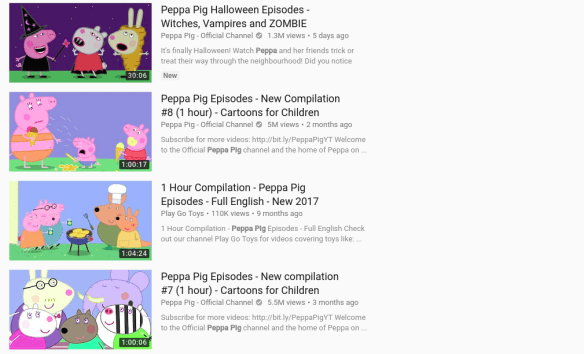
YouTube broadcasters have thus developed a huge number of tactics to draw parents’ and childrens’ attention to their videos, and the advertising revenues that accompany them. The first of these tactics is simply to copy and pirate other content. A simple search for “Peppa Pig” on YouTube in my case yielded “About 10,400,000 results” and the front page is almost entirely from the verified “Peppa Pig Official Channel”, while one is from an unverified channel called Play Go Toys, which you really wouldn’t notice unless you were looking out for it:

Play Go Toys’ channel consists of (I guess?) pirated Peppa Pig and other cartoons, videos of toy unboxings (another kid magnet), and videos of, one supposes, the channel owner’s own children. I am not alleging anything bad about Play Go Toys; I am simply illustrating how the structure of YouTube facilitates the delamination of content and author, and how this impacts on our awareness and trust of its source.

As another blogger notes, one of the traditional roles of branded content is that it is a trusted source. Whether it’s Peppa Pig on children’s TV or a Disney movie, whatever one’s feelings about the industrial model of entertainment production, they are carefully produced and monitored so that kids are essentially safe watching them, and can be trusted as such. This no longer applies when brand and content are disassociated by the platform, and so known and trusted content provides a seamless gateway to unverified and potentially harmful content.

(Yes, this is the exact same process as the delamination of trusted news media on Facebook feeds and in Google results that is currently wreaking such havoc on our cognitive and political systems and I am not going to explicitly explore that relationship further here, but it is obviously deeply significant.)

A second way of increasing hits on videos is through keyword/hashtag association, which is a whole dark art unto itself. When some trend, such as Surprise Egg videos, reaches critical mass, content producers pile onto it, creating thousands and thousands more of these videos in every possible iteration. This is the origin of all the weird names in the list above: branded content and nursery rhyme titles and “surprise egg” all stuffed into the same word salad to capture search results, sidebar placement, and “up next” autoplay rankings.

Play Go Toys’ channel consists of (I guess?) pirated Peppa Pig and other cartoons, videos of toy unboxings (another kid magnet), and videos of, one supposes, the channel owner’s own children. I am not alleging anything bad about Play Go Toys; I am simply illustrating how the structure of YouTube facilitates the delamination of content and author, and how this impacts on our awareness and trust of its source.

As another blogger notes, one of the traditional roles of branded content is that it is a trusted source. Whether it’s Peppa Pig on children’s TV or a Disney movie, whatever one’s feelings about the industrial model of entertainment production, they are carefully produced and monitored so that kids are essentially safe watching them, and can be trusted as such. This no longer applies when brand and content are disassociated by the platform, and so known and trusted content provides a seamless gateway to unverified and potentially harmful content.

(Yes, this is the exact same process as the delamination of trusted news media on Facebook feeds and in Google results that is currently wreaking such havoc on our cognitive and political systems and I am not going to explicitly explore that relationship further here, but it is obviously deeply significant.)

A second way of increasing hits on videos is through keyword/hashtag association, which is a whole dark art unto itself. When some trend, such as Surprise Egg videos, reaches critical mass, content producers pile onto it, creating thousands and thousands more of these videos in every possible iteration. This is the origin of all the weird names in the list above: branded content and nursery rhyme titles and “surprise egg” all stuffed into the same word salad to capture search results, sidebar placement, and “up next” autoplay rankings.

A striking example of the weirdness is the Finger Family videos (harmless example embedded above). I have no idea where they came from or the origin of the children’s rhyme at the core of the trope, but there are at least 17 million versions of this currently on YouTube, and again they cover every possible genre, with billions and billions of aggregated views.

Once again, the view numbers of these videos must be taken under serious advisement. A huge number of these videos are essentially created by bots and viewed by bots, and even commented on by bots. That is a whole strange world in and of itself. But it shouldn’t obscure that there are also many actual children, plugged into iphones and tablets, watching these over and over again — in part accounting for the inflated view numbers — learning to type basic search terms into the browser, or simply mashing the sidebar to bring up another video.

What I find somewhat disturbing about the proliferation of even (relatively) normal kids videos is the impossibility of determining the degree of automation which is at work here; how to parse out the gap between human and machine. The example above, from a channel called Bounce Patrol Kids, with almost two million subscribers, show this effect in action. It posts professionally produced videos, with dedicated human actors, at the rate of about one per week. Once again, I am not alleging anything untoward about Bounce Patrol, which clearly follows in the footsteps of pre-digital kid sensations like their fellow Australians The Wiggles.

And yet, there is something weird about a group of people endlessly acting out the implications of a combination of algorithmically generated keywords: “Halloween Finger Family & more Halloween Songs for Children | Kids Halloween Songs Collection”, “Australian Animals Finger Family Song | Finger Family Nursery Rhymes”, “Farm Animals Finger Family and more Animals Songs | Finger Family Collection – Learn Animals Sounds”, “Safari Animals Finger Family Song | Elephant, Lion, Giraffe, Zebra & Hippo! Wild Animals for kids”, “Superheroes Finger Family and more Finger Family Songs! Superhero Finger Family Collection”, “Batman Finger Family Song — Superheroes and Villains! Batman, Joker, Riddler, Catwoman” and on and on and on. This is content production in the age of algorithmic discovery — even if you’re a human, you have to end up impersonating the machine.

Other channels do away with the human actors to create infinite reconfigurable versions of the same videos over and over again. What is occurring here is clearly automated. Stock animations, audio tracks, and lists of keywords being assembled in their thousands to produce an endless stream of videos. The above channel, Videogyan 3D Rhymes — Nursery Rhymes & Baby Songs, posts several videos a week, in increasingly byzantine combinations of keywords. They have almost five million subscribers — more than double Bounce Patrol — although once again it’s impossible to know who or what is actually racking up these millions and millions of views.

I’m trying not to turn this essay into an endless list of examples, but it’s important to grasp how vast this system is, and how indeterminate its actions, process, and audience. It’s also international: there are variations of Finger Family and Learn Colours videos for Tamil epics and Malaysian cartoons which are unlikely to pop up in any Anglophone search results. This very indeterminacy and reach is key to its existence, and its implications. Its dimensionality makes it difficult to grasp, or even to really think about.

We’ve encountered pretty clear examples of the disturbing outcomes of full automation before — some of which have been thankfully leavened with a dark kind of humour, others not so much. Much has been made of the algorithmic interbreeding of stock photo libraries and on-demand production of everything from tshirts to coffee mugs to infant onesies and cell phone covers. The above example, available until recently on Amazon, is one such case, and the story of how it came to occur is fascinating and weird but essentially comprehensible. Nobody set out to create phone cases with drugs and medical equipment on them, it was just a deeply weird mathematical/probabilistic outcome. The fact that it took a while to notice might ring some alarm bells however.

Likewise, the case of the “Keep Calm and Rape A Lot” tshirts (along with the “Keep Calm and Knife Her” and “Keep Calm and Hit Her” ones) is depressing and distressing but comprehensible. Nobody set out to create these shirts: they just paired an unchecked list of verbs and pronouns with an online image generator. It’s quite possible that none of these shirts ever physically existed, were ever purchased or worn, and thus that no harm was done. Once again though, the people creating this content failed to notice, and neither did the distributor. They literally had no idea what they were doing.

What I will argue, on the basis of these cases and of those I’m going to describe further, is that the scale and logic of the system is complicit in these outputs, and requires us to think through their implications.

(Also again: I’m not going to dig into the wider social implications of such processes outside the scope of what I am writing about here, but it’s clear that one can draw a clear line from examples such as these to pressing contemporary issues such as racial and gender bias in big data and machine intelligence-driven systems, which require urgent attention but in the same manner do not have anything resembling easy or even preferable solutions.)

Let’s look at just one video among the piles of kid videos, and try to parse out where it comes from. It’s important to stress that I didn’t set out to find this particular video: it appeared organically and highly ranked in a search for ‘finger family’ in an incognito browser window (i.e. it should not have been influenced by previous searches). This automation takes us to very, very strange places, and at this point the rabbithole is so deep that it’s impossible to know how such a thing came into being.

Once again, a content warning: this video is not inappropriate in any way, but it is decidedly off, and contains elements which might trouble anyone. It’s very mild on the scale of such things, but. I describe it below if you don’t want to watch it and head down that road. This warning will recur.

The above video is entitled Wrong Heads Disney Wrong Ears Wrong Legs Kids Learn Colors Finger Family 2017 Nursery Rhymes. The title alone confirms its automated provenance. I have no idea where the “Wrong Heads” trope originates, but I can imagine, as with the Finger Family Song, that somewhere there is a totally original and harmless version that made enough kids laugh that it started to climb the algorithmic rankings until it made it onto the word salad lists, combining with Learn Colors, Finger Family, and Nursery Rhymes, and all of these tropes — not merely as words but as images, processes, and actions — to be mixed into what we see here.

The video consists of a regular version of the Finger Family song played over an animation of character heads and bodies from Disney’s Aladdin swapping and intersecting. Again, this is weird but frankly no more than the Surprise Egg videos or anything else kids watch. I get how innocent it is. The offness creeps in with the appearance of a non-Aladdin character —Agnes, the little girl from Despicable Me. Agnes is the arbiter of the scene: when the heads don’t match up, she cries, when they do, she cheers.

The video’s creator, BABYFUN TV (screenshot above), has produced many similar videos. As many of the Wrong Heads videos as I could bear to watch all work in exactly the same way. The character Hope from Inside Out weeps through a Smurfs and Trolls head swap. It goes on and on. I get the game, but the constant overlaying and intermixing of different tropes starts to get inside you. BABYFUN TV only has 170 subscribers and very low view rates, but then there are thousands and thousands of channels like this. Numbers in the long tail aren’t significant in the abstract, but in their accumulation.

The question becomes: how did this come to be? The “Bad Baby” trope also present on BABYFUN TV features the same crying. While I find it disturbing, I can understand how it might provide some of the rhythm or cadence or relation to their own experience that actual babies are attracted to in this content, although it has been warped and stretched through algorithmic repetition and recombination in ways that I don’t think anyone actually wants to happen.

Toy Freaks is a hugely popular channel (68th on the platform) which features a father and his two daughters playing out — or in some cases perhaps originating — many of the tropes we’ve identified so far, including “Bad Baby”, above. As well as nursery rhymes and learning colours, Toy Freaks specialises in gross-out situations, as well as activities which many, many viewers feel border on abuse and exploitation, if not cross the line entirely, including videos of the children vomiting and in pain. Toy Freaks is a YouTube verified channel, whatever that means. (I think we know by now it means nothing useful.)

As with Bounce Patrol Kids, however you feel about the content of these videos, it feels impossible to know where the automation starts and ends, who is coming up with the ideas and who is roleplaying them. In turn, the amplification of tropes in popular, human-led channels such as Toy Freaks leads to them being endlessly repeated across the network in increasingly outlandish and distorted recombinations.

There’s a second level of what I’m characterising as human-led videos which are much more disturbing than the mostly distasteful activities of Toy Freaks and their kin. Here is a relatively mild, but still upsetting example:

A step beyond the simply pirated Peppa Pig videos mentioned previously are the knock-offs. These too seem to teem with violence. In the official Peppa Pig videos, Peppa does indeed go to the dentist, and the episode in which she does so seems to be popular — although, confusingly, what appears to be the real episode is only available on an unofficial channel. In the official timeline, Peppa is appropriately reassured by a kindly dentist. In the version above, she is basically tortured, before turning into a series of Iron Man robots and performing the Learn Colours dance. A search for “peppa pig dentist” returns the above video on the front page, and it only gets worse from here.

Disturbing Peppa Pig videos, which tend towards extreme violence and fear, with Peppa eating her father or drinking bleach, are, it turns out very widespread. They make up an entire YouTube subculture. Many are obviously parodies, or even satires of themselves, in the pretty common style of the internet’s outrageous, deliberately offensive kind. All the 4chan tropes are there, the trolls are out, we know this.

In the example above, the agency is less clear: the video starts with a trollish Peppa parody, but later syncs into the kind of automated repetition of tropes we’ve seen already. I don’t know which camp it belongs to. Maybe it’s just trolls. I kind of hope it is. But I don’t think so. Trolls don’t cover the intersection of human actors and more automated examples further down the line. They’re at play here, but they’re not the whole story.

I suppose it’s naive not to see the deliberate versions of this coming, but many are so close to the original, and so unsignposted — like the dentist example — that many, many kids are watching them. I understand that most of them are not trying to mess kids up, not really, even though they are.

I’m trying to understand why, as plainly and simply troubling as it is, this is not a simple matter of “won’t somebody think of the children” hand-wringing. Obviously this content is inappropriate, obviously there are bad actors out there, obviously some of these videos should be removed. Obviously too this raises questions of fair use, appropriation, free speech and so on. But reports which simply understand the problem through this lens fail to fully grasp the mechanisms being deployed, and thus are incapable of thinking its implications in totality, and responding accordingly.

The New York Times, headlining their article on a subset of this issue “On YouTube Kids, Startling Videos Slip Past Filters”, highlights the use of knock-off characters and nursery rhymes in disturbing content, and frames it as a problem of moderation and legislation. YouTube Kids, an official app which claims to be kid-safe but is quite obviously not, is the problem identified, because it wrongly engenders trust in users. An article in the British tabloid The Sun, “Kids left traumatised after sick YouTube clips showing Peppa Pig characters with knives and guns appear on app for children” takes the same line, with an added dose of right-wing technophobia and self-righteousness. But both stories take at face value YouTube’s assertions that these results are incredibly rare and quickly removed: assertions utterly refuted by the proliferation of the stories themselves, and the growing number of social media posts, largely by concerned parents, from which they arise.

But as with Toy Freaks, what is concerning to me about the Peppa videos is how the obvious parodies and even the shadier knock-offs interact with the legions of algorithmic content producers until it is completely impossible to know what is going on. (“The creatures outside looked from pig to man, and from man to pig, and from pig to man again; but already it was impossible to say which was which.”)

Here’s what is basically a version of Toy Freaks produced in Asia (screenshot above). Here’s one from Russia. I don’t really want to use the term “human-led” any more about these videos, although they contain all the same tropes and actual people acting them out. I no longer have any idea what’s going on here and I really don’t want to and I’m starting to think that that is kind of the point. That’s part of why I’m starting to think about the deliberateness of this all. There is a lot of effort going into making these. More than spam revenue can generate — can it? Who’s writing these scripts, editing these videos? Once again, I want to stress: this is still really mild, even funny stuff compared to a lot of what is out there.

Here are a few things which are disturbing me:

The first is the level of horror and violence on display. Some of the times it’s troll-y gross-out stuff; most of the time it seems deeper, and more unconscious than that. The internet has a way of amplifying and enabling many of our latent desires; in fact, it’s what it seems to do best. I spend a lot of time arguing for this tendency, with regards to human sexual freedom, individual identity, and other issues. Here, and overwhelmingly it sometimes feels, that tendency is itself a violent and destructive one.

The second is the levels of exploitation, not of children because they are children but of children because they are powerless. Automated reward systems like YouTube algorithms necessitate exploitation in the same way that capitalism necessitates exploitation, and if you’re someone who bristles at the second half of that equation then maybe this should be what convinces you of its truth. Exploitation is encoded into the systems we are building, making it harder to see, harder to think and explain, harder to counter and defend against. Not in a future of AI overlords and robots in the factories, but right here, now, on your screen, in your living room and in your pocket.

Many of these latest examples confound any attempt to argue that nobody is actually watching these videos, that these are all bots. There are humans in the loop here, even if only on the production side, and I’m pretty worried about them too.

I’ve written enough, too much, but I feel like I actually need to justify all this raving about violence and abuse and automated systems with an example that sums it up. Maybe after everything I’ve said you won’t think it’s so bad. I don’t know what to think any more.

This video, BURIED ALIVE Outdoor Playground Finger Family Song Nursery Rhymes Animation Education Learning Video, contains all of the elements we’ve covered above, and takes them to another level. Familiar characters, nursery tropes, keyword salad, full automation, violence, and the very stuff of kids’ worst dreams. And of course there are vast, vast numbers of these videos. Channel after channel after channel of similar content, churned out at the rate of hundreds of new videos every week. Industrialised nightmare production.

For the final time: There is more violent and more sexual content like this available. I’m not going to link to it. I don’t believe in traumatising other people, but it’s necessary to keep stressing it, and not dismiss the psychological effect on children of things which aren’t overtly disturbing to adults, just incredibly dark and weird.

A friend who works in digital video described to me what it would take to make something like this: a small studio of people (half a dozen, maybe more) making high volumes of low quality content to reap ad revenue by tripping certain requirements of the system (length in particular seems to be a factor). According to my friend, online kids’ content is one of the few alternative ways of making money from 3D animation because the aesthetic standards are lower and independent production can profit through scale. It uses existing and easily available content (such as character models and motion-capture libraries) and it can be repeated and revised endlessly and mostly meaninglessly because the algorithms don’t discriminate — and neither do the kids.

These videos, wherever they are made, however they come to be made, and whatever their conscious intention (i.e. to accumulate ad revenue) are feeding upon a system which was consciously intended to show videos to children for profit. The unconsciously-generated, emergent outcomes of that are all over the place.

To expose children to this content is abuse. We’re not talking about the debatable but undoubtedly real effects of film or videogame violence on teenagers, or the effects of pornography or extreme images on young minds, which were alluded to in my opening description of my own teenage internet use. Those are important debates, but they’re not what is being discussed here. What we’re talking about is very young children, effectively from birth, being deliberately targeted with content which will traumatise and disturb them, via networks which are extremely vulnerable to exactly this form of abuse. It’s not about trolls, but about a kind of violence inherent in the combination of digital systems and capitalist incentives. It’s down to that level of the metal.

This, I think, is my point: The system is complicit in the abuse.

And right now, right here, YouTube and Google are complicit in that system. The architecture they have built to extract the maximum revenue from online video is being hacked by persons unknown to abuse children, perhaps not even deliberately, but at a massive scale. I believe they have an absolute responsibility to deal with this, just as they have a responsibility to deal with the radicalisation of (mostly) young (mostly) men via extremist videos — of any political persuasion. They have so far showed absolutely no inclination to do this, which is in itself despicable. However, a huge part of my troubled response to this issue is that I have no idea how they can respond without shutting down the service itself, and most systems which resemble it. We have built a world which operates at scale, where human oversight is simply impossible, and no manner of inhuman oversight will counter most of the examples I’ve used in this essay. The asides I’ve kept in parentheses throughout, if expanded upon, would allow one with minimal effort to rewrite everything I’ve said, with very little effort, to be not about child abuse, but about white nationalism, about violent religious ideologies, about fake news, about climate denialism, about 9/11 conspiracies.

This is a deeply dark time, in which the structures we have built to sustain ourselves are being used against us — all of us — in systematic and automated ways. It is hard to keep faith with the network when it produces horrors such as these. While it is tempting to dismiss the wilder examples as trolling, of which a significant number certainly are, that fails to account for the sheer volume of content weighted in a particularly grotesque direction. It presents many and complexly entangled dangers, including that, just as with the increasing focus on alleged Russian interference in social media, such events will be used as justification for increased control over the internet, increasing censorship, and so on. This is not what many of us want.

I’m going to stop here, saying only this:

What concerns me is not just the violence being done to children here, although that concerns me deeply. What concerns me is that this is just one aspect of a kind of infrastructural violence being done to all of us, all of the time, and we’re still struggling to find a way to even talk about it, to describe its mechanisms and its actions and its effects. As I said at the beginning of this essay: this is being done by people and by things and by a combination of things and people. Responsibility for its outcomes is impossible to assign but the damage is very, very real indeed.


The War on Social Media is Being Stepped Up

By Jonathan Cook

Source: Dissident Voice

A really social media, one where we can freely express ourselves and where we alone control the content, is the problem. It must be stopped at all costs.

First, it was “fake news”: the suggestion that social media is uniquely damaging to democracy, rather than the corporately owned media that feeds us constant lies, including the egregious deception that WMD existed in Iraq, and selects self-serving political priorities, such as that Russia’s Vladimir Putin is the biggest threat to the planet’s safety (Donald Trump and climate breakdown are far bigger threats right now).

The latest concern is “trolling”. The UK’s Electoral Commission wants to ban people from voting over bad online etiquette. How will “trolling” be defined? We don’t know yet, but you can be sure it won’t encompass someone like Tony Blair, who trolled some 40 million British voters, then ignored their views, to take us into an illegal war.

Behind the scenes, social media platforms are advanced on creating new algorithms that will increasingly hide dissenting sites from view for all but the most committed to finding them.

These are the first shots in a coming war for control of the internet. Don’t be fooled by arguments that fake news and trolls are to be found on social media. Of course, they are. That is the price one pays for democratic platforms. There will always be people who prefer abuse or mischief over rational discussion and good manners.

But the panic about fake news and trolling is not driven by a sudden concern about media deception and misinformation. That has always been with us. It is about who gets to decide what is real and fake, and who gets to be abusive. It is – and always has been – about power.

Once, not long ago, the only media choice you had was to select your source of propaganda: the Sun, Telegraph, Guardian, New York Times, USA Today, National Enquirer, BBC, CNN etc. If you read a paper and felt strongly enough, you could write a letter to the editor. The paper decided whether you would be one of a dozen people whose views got aired that day on the letters page. That was what “media” meant.

There were no websites, talk-backs, below the line commentaries, blogs, Facebook or Twitter. It was a one-way process. The corporate media told you what was happening, and you listened. There was a consensus only because it had been manufactured through omission.

Now that consensus is breaking down. Certainly, the freedom to speak and think has gone to our heads. It can lead us in all kinds of directions, good and bad, as we try to use these newly discovered muscles like a baby learning to crawl.

The corporate media, and the political class they serve, hate this development. We do not have long. We need to defy the evolutionary process, moving from toddlers to teenagers and adults in record time.

Do not mistake the political and media elite for doting parents, concerned with our welfare. They are not trying to help us get on feet and walk. They want us back in our cribs, gurgling and cooing.