Political Collapse: The Center Cannot Hold

By Kirkpatrick Sale

Source: CounterPunch

Have you noticed? From Hong Kong to Baghdad, Paris to Tehran, 2019 is shaping up to be, as the New York Times dubbed it, “the year of the protest.” Violent—and often deadly—anti-government protests are breaking out throughout the world in an unprecedented fashion, in rich countries as well as poor, as people everywhere are expressing their anger at corrupt, inefficient, brutal, and unresponsive regimes.

But what isn’t so much in the news is worse—worse enough that they don’t want to tell you. At the moment, there are no less than 65 countries are now fighting wars—there are only 193 countries recognized by the United Nations, so that’s a third of the world. These are wars with modern weapons, organized troops, and serious casualties—five of them, like Afghanistan, Libya, Syria, Somalia, and Yemen, with 10,000 or more deaths a year, another 15 with more than 1,000 a year—all of them causing disruptions and disintegrations of all normal political and economic systems, leaving no attacked nation in a condition to protect and provide for its citizens. From 2015 to 2019 more state-based conflicts were engaged in than at any time since World War II, with an estimated 1 million deaths in all.

In addition, there are at least 638 other conflicts between various insurgent and separatist militias, armed drug bands, and terrorist organizations, increasing each year as states fail or collapse completely.

What has made the wars and internal disputes even more egregious as the years go on is that chaotic weather has a direct effect on how societies function. Agriculture, of course, is impacted by higher temperatures, lack of rain, droughts, and wildfires, and crops have failed in many places over the last five years, including North and Central Africa, the Middle East, India, Pakistan, northern China, northern Europe, Argentina, Brazil, Central America, and even parts of North America. The collapse of Syria, for example, and subsequent civil wars were made more devastating if not directly caused by the drought of 2006-2011, in which 75 per cent of the farms failed and 85 per cent of the livestock died. And an official United Nations report in 2019, by 100 experts from 52 countries, warned that things will only get worse, with the world’s land and water resources exploited at “unprecedented rates,” threatening “the ability of humanity to feed itself.”

One obvious consequence, beyond death, famine, disease and starvation, is, as the U.N. report’s lead author says, “a massive pressure for migration,” a desperate attempt to find some refuge and relief when homes have been destroyed and families are uprooted. According to the United Nations, in what I regard as a certain undercount, in 2019 there were 272 million migrants worldwide, up from 258 million in 2017, with the weather in 2019 causing more refugees even than warfare. (The unprecedented crisis at the U.S. southern border in 2019 is only one manifestation of the porous and chaotic collapse of boundaries across the Americas, Africa, and most of Asia.) And meanwhile, the International Committee of the Red Cross in 2018 estimated that more than 100,000 people are simply “missing,” a figure it admits “represents only a fraction” of those who are unaccounted for by any government or organization.

Given the turmoil over wars and immigration threats, it is not surprising that half the world is without coherent government.

Organizations that track these things say that of the 174 covered nations, 76 are in various stages of collapse—that would be 43 per cent—and that excludes a dozen smaller nations that are locked into autocracy and poverty. These include seven completely failed states—Congo-Brazzaville, Central African Republic, Syria, Yemen, Somalia, South Sudan, and Venezuela—and another seven that are on the edge—Guinea, Haiti, Iraq, Zimbabwe, Afghanistan, Chad, and the Sudan—plus 19 that are in an “alert” category, meaning that some but not all government functions have failed, 15 in Africa and 4 in Asia.

In other words, many political systems in the world have effectively collapsed, people are dispossessed and without governments, and almost everywhere else, including the U.S. and Europe, governments are severely strained and political rifts abound. The vote for Brexit in the U.K., the election of Donald Trump (and the subsequent attempts to overturn it), the turmoil that erupted in December 2018 in France and Belgium, the continued protests in Poland were all examples of the population of developed nations coming to see that the attempt to establish capitalist-led democracies in an internationalist arrangement of benefit to corporate and banking interests just was not working, and a rising segment of what were called “deplorables” in America did not want any longer to be powerless, manipulated, and disdained. These turmoils also demonstrated that the established powers in these countries, especially the U.S. and Britain, resisted all of these attempts to change the status quo and in effect ignored or tried to thwart the popular will (cf. the “impeachment” farce)—the developed world’s form of the failed state. Those fissures have widened as the years have worn on, and as one astute observer, James Kunstler, put it in 2019, “The West is enduring paroxysms of political uproar and disenchantment.”

And here’s something weird that sums it all up. It is the opinion of two recent political scientists that “the state system seems to be failing all over the world,” and they have proposed a new study called “archy” to examine how to grow, maintain, and fund states so as to avert their collapse. No better evidence of the seriousness of the world’s “uproar and disenchantment” can there be when academics need to create a discipline to overcome it.

Yeats summed it up some years ago: “The center cannot hold. Mere anarchy is loosed upon the world.”


Kirkpatrick Sale’s new book The Collapse of 2020 will be published in January.

Western Elites Decrying ‘Populism’ Betrays Fear of Democracy

By Finian Cunningham

Source: Strategic Culture Foundation

A new dreaded word has entered into official Western media speak: “Populism”. Political parties and governments which are deemed to be illegitimate are invariably labeled with the prefix “populist”. There is a vague implication that “populist” parties are imbued with disreputable politics of xenophobia, racism, nationalism and even fascism.

But who is doing the “deeming” here? It is establishment political parties and politicians who have the advantage of establishment news media organizations conveying their words and terminology.

Take French President Emmanuel Macron. He may have coined a new political party, En Marche, but he is nevertheless a politician very much of the prevailing Western establishment. He is pro-European Union as it currently operates, albeit with reforming tweaks; he is pro-NATO, pro-Atlanticist; and pro-neoliberal economic policies.

Recently, Macron decried the rise of “populist” parties across Europe. He compared them to the spread of “leprosy” and claimed they were posing a morbid threat to the conventional order of politics. Macron was referring in particular to the new coalition government in Italy, comprising the anti-establishment Five Star Movement and the League.

The French leader could also have been referring to any number of governments as seen in Austria, Hungary and other Central European states which, like the new Italian government, have challenged the EU’s official stance overEU irregular migration into the bloc.

In this context, the word “populist” as used by Macron and other establishment politicians has the connotation of “racist” or “inhumane” owing to the opposition towards the uncontrolled influx of people from outside Europe.

The “populist” prefix is often used alongside the term “far-right”. Again, the implication is that somehow the largely newcomer parties are something that should be abhorred because they are tarnished with alleged proclivities towards fascism and authoritarianism.

To reinforce that implied demonization, it is often cited by Western establishment politicians and media that the “populist” parties in Europe are aligned with Russian President Vladimir Putin, if not stealthily bankrolled by the Kremlin.

American President Donald Trump also qualifies as “populist” according to the US political and media establishment. Again, the word is loaded to infer a uniquely noxious quality in the Trump presidency and his supporters, in the same way that Democrat presidential rival Hillary Clinton once haughtily denigrated Trump and his voter base as “deplorable”. It’s a way of sanitizing the establishment from any past, and far greater, sins.

The P-word does not always mean “rightwing nationalism”. The recent elected Mexican President, Andrés Manuel Lopez Obrador, has been described in Western media as a “leftwing populist”.

In Italy, the main ruling coalition party, the Five Star Movement, headed by Luigi Di Maio, is associated with leftwing social policy.

Parties and politicians deemed to be “populist” are eclectic and defy an easy categorization, as their detractors would perhaps like to assign them. Certainly, there is a strong common stance of being opposed to uncontrolled immigration. But it is too simplistic to explain such a stance as merely xenophobic or racist.

There are legitimate and reasonable concerns that the issue of large-scale immigration has been exploited by ruling establishments and their ideological backers as a way to undermine national sovereignty and workers’ rights, from the consequent lowering of wages and employment conditions.

There is also the legitimate concern in Europe that the migration phenomenon has been largely created by illegal wars pursued by the US and its European NATO allies. Why should European member states and ordinary taxpayers have to incur financial and cultural integration problems that have been largely manufactured by ruling elites who have never been held to account for their criminal wars?

So-called populist parties are also opposed to the seemingly slavish adherence by the European political establishment to neoliberal capitalism. There is a legitimate popular backlash to economic policies which are oppressive and destructive, and whose sole priority seems to be satisfying the profits of Big Business and transnational capital. Why should European governments be held in hock to fiscal rules and debt limitations set arbitrarily by institutions seemingly under the diktat of private banks?

There are several fundamental issues that form a groundswell of popular opposition towards the conventional ways of governance, both in Europe and the US. The failings of neoliberal capitalism and its rich-get-richer racket is surely top of the grievance list. So too is relentless, irrational militarism by Western governments, unleashing illegal wars and massive refugee problems, as well as stoking unnecessary hostility towards other powers like Russia, China, Iran and North Korea.

The conventional politics, that is, the ruling establishments and their dutiful news media, are increasingly seen as incompetent, if not bankrupt. The establishment across Western countries has lost legitimacy and “moral authority” in the eyes of masses of people. That dwindling authority of the ruling class in Western states is the real, morbid concern.

One factor for this is the growth of global communications and “alternative” media sources, which Western publics are availing of to inform themselves independently from the old information monopolies that served the established order. That is why the “problem” of alleged “Russian influence” has been invented. In a desperate gambit to distract the masses from noticing the real problem, which is the crumbling of legitimacy for the Western establishment and its obedient political parties.

The looming fear among the ruling order is the ever-growing dissent among the populace. It is a fear of their own inherent failing and impending doom in the face of democratic challenge to power.

It is not so much that Trump or the new Italian government or Hungarian leader Viktor Orban, and so on, represent a vanguard for renewed democracy. These changes are merely symptoms of a deeper popular opposition to the established way of conducting politics – the order that has prevailed for most of the seven-decade period following the Second World War.

There has always been a wariness among ruling elites on both sides of the Atlantic towards a genuine democratic order breaking out, as Noam Chomsky discusses in his book ‘Deterring Democracy’. Western elites have typically viewed the masses as “rabble rousers” who are deemed to be “incapable” of governing society in the “proper way” that benefits the elites, protects their profits and property, and safeguards their imperial war-making overseas.

This underlying tension about the control of political power in Western societies encapsulates the present historical juncture where the word “populist” is being increasingly deployed. It is a term of disparagement by a failing Western establishment. What the failed order is trying to do is divert genuine popular challenge by painting it as something uncouth, vulgar, noxious, or manipulated by foreign enemies like Russia.

As American political analyst Randy Martin notes: “Populism is a convenient term for those in power who seek to isolate those who would want to share, or worse, take that power.”

When you think of the original meaning of the word – “the people” – it is starkly revealing what is really at stake for those elites who wield the “populist” term as a disparagement.

Resisting Donald Trump’s Violence Strategically

american-empire

(Editor’s note: we realize the issues addressed by the article are hardly unique to Trump and his administration but as they are the puppets currently in power, their actions and those of their controllers should be of primary concern.)

By Robert J. Burrowes

It is already clearly apparent, as many predicted, that Donald Trump’s
election as president of the United States would signal the start of
what might be the final monumental assault on much of what is good in
our world. Whatever our collective gains to date to create a world in
which peace, social justice and environmental sustainability ultimately
prevail for all of Earth’s inhabitants, we stand to lose it all in the
catastrophic sequence of events that Trump is now initiating with those
who share his delusional worldview.

Starting with the appointment to his administration of individuals, such
as Steve Bannon, Rex Tillerson and Scott Pruitt, who share his warped
view of the world, and continuing with the policy decisions he is now
implementing via executive orders, Trump threatens our biosphere with
ecological catastrophe (through climate/environment-destroying decisions
and perhaps through nuclear war) – see ‘US election: Climate scientists
react to Donald Trump’s victory’ and ‘It is two and a half minutes to midnight: 2017 Doomsday Clock Statement‘ as well as ‘Trump pledges “greatest military build-up in American history“‘ – exacerbates military violence in existing war zones – see ‘Obama
Killed a 16-Year-Old American in Yemen. Trump Just Killed His 8-Year-Old
Sister’ – increases regional geopolitical tensions in ways that inflame the
possibility of political unrest and military violence in new theatres –
see ‘Worried Over Trump, China Tries to Catch up With U.S. Navy‘ – supports violent and repressive regimes against those who struggle for liberation – see ‘The Middle East “peace process” was a myth. Donald Trump ended it‘ – and is generally implementing decisions that reverse progressive outcomes from years of peace, social justice and environmental
struggles. See, for example, ‘Trump’s Immigration Crackdown Is Likely to
Bring a Flood of Lawsuits‘ and ‘One of Donald Trump’s first moves in the White House strips women of abortion rights‘ as well as ‘President Trump Breaks a Promise on Transgender Rights‘.

Moreover, Trump, and those like him, further criminalize our right to
dissent. See ‘North Dakota Senate passes bills criminalizing Dakota
Access Pipeline protests‘.

Why does Trump ignore overwhelming scientific evidence (for example, in
relation to the climate) and want to ‘lock out’ people who are desperate
to improve their lives? Why does he want to prepare for and threaten
more war and even nuclear war?

Is Donald Trump sane?

According to Dr John D. Gartner, a practising psychotherapist who taught
psychiatric residents at Johns Hopkins University Medical School,
‘Donald Trump is dangerously mentally ill and temperamentally incapable
of being president’. See ‘Temperament Tantrum: Some say President Donald
Trump’s personality isn’t just flawed, it’s dangerous‘.

Moreover, Chris Hedges argues, Trump is dangerously violent. See ‘Trump
Will Crush Dissent With Even Greater Violence and Savagery‘.

But why is Trump ‘dangerously mentally ill’ and violent?

For the same reason that any person, whether in the Trump administration
or not, ends up in this state: it is an outcome of the ‘visible’,
‘invisible’ and ‘utterly invisible’ violence that they suffered during
childhood and which unconsciously determines virtually everything they
now do. In brief, Trump is utterly terrified and full of self-hatred but
projects this as terror and hatred of women, migrants, Muslims… and this
makes him behave insanely. For a brief explanation, see ‘The Global
Elite is Insane‘. For a more comprehensive explanation of why many human beings are violent, see ‘Why Violence?‘ and ‘Fearless Psychology and Fearful Psychology: Principles and Practice‘.

So what are we to do? Well, if you are inclined to resist the diabolical
actions of Donald Trump (and his insane and violent equivalents in the
United States and other countries around the world), I invite you to
respond powerfully. This includes maintaining a large measure of empathy
for the emotionally damaged individual who is now president of the US
(and his many equivalents). It also includes recognizing that this
individual and his equivalents are the current ‘face’ of a global system
of violence and exploitation built on many long-standing structures that
we must systematically dismantle.

Here are some options for resisting and rebuilding, depending on your
circumstances.

If you wish to strike at the core of human violence, consider modifying
your treatment of children in accordance with the suggestions in the
article ‘My Promise to Children‘.

If you wish to simultaneously tackle all military, climate and
environmental threats to human existence while rebuilding human
societies in ways that enhance individual empowerment and community
self-reliance, consider joining those participating in ‘The Flame Tree
Project to Save Life on Earth‘.

If you wish to resist particular elite initiatives that threaten peace,
justice and environmental sustainability, consider planning, organizing
and implementing nonviolent strategies to do so. But I wish to emphasize
the word ‘strategies’. There is no point taking piecemeal measures or
organizing one-off events, no matter how big, to express your concern.
If you don’t plan, organize and act strategically, you will have wasted
your time and effort on something that has no impact. Remember 15
February 2003? Up to thirty million people in over 600 cities around the
world participated in rallies against the war on Iraq in what some
labeled ‘the largest protest event in human history’. Did it stop the
war?

So if you are inclined to respond powerfully by planning a nonviolent
strategy for your campaign, you might be interested in the Nonviolent
Strategy Wheel and other strategic thinking on this website – Nonviolent
Campaign Strategy – or the parallel one: Nonviolent Defense/Liberation Strategy.

And if you wish to join the worldwide movement to end violence in all of
its forms, you might also be interested in signing the online pledge of
The People’s Charter to Create a Nonviolent World‘.

Donald Trump has formidable institutional power at his disposal and he
and his officials will use it to inflict enormous damage on us and our
world in the months ahead.

What most people do not realize is that we have vastly greater power at
our disposal to stop him and the elite and their institutions he
represents. But we need to deploy our power strategically if we are to
put this world on a renewed trajectory to peace, justice and
sustainability.


Biodata: Robert J. Burrowes has a lifetime commitment to understanding and ending human violence. He has done extensive research since 1966 in an effort to understand why human beings are violent and has been a nonviolent activist since 1981. He is the author of ‘Why Violence?‘ His email address is flametree@riseup.netand his website is at http://robertjburrowes.wordpress.com

Robert J. Burrowes
P.O. Box 68
Daylesford
Victoria 3460
Australia
Email: flametree@riseup.net

Websites:
Nonviolence Charter
Flame Tree Project to Save Life on Earth
‘Why Violence?’
Nonviolent Campaign Strategy
Nonviolent Defense/Liberation Strategy
Anita: Songs of Nonviolence
Robert Burrowes
Global Nonviolence Network

The real Hunger Games: the Capitalist recipe to maximise profits while ‘having fun’

peacekeeper

By Sky Wanderer

Source: Investment Watch

Introduce a political economy upon the arbitrary axiom that Capitalism is the one and only economic system for mankind, and introduce a narcissistic moral philosophy that you as a Capitalist represent unsurpassable objective moral virtues.

You as a Capitalist hire politicians to implement policy as per your moral and economic philosophy and redefine ‘democracy’ as the political system to sustain Capitalism. Then from such position of self-established authority, abolish unions and all labour-representation, thus force your employees into a race-to-the-bottom contest to compete for jobs by accepting lower and lower wages.

Give decent jobs and benefits to only those who belong to your noble circles. For everyone else reintroduce slavery in the form of “workfare”. The goal is that you pay the lowest wages for jobs done by the fittest slaves, who will survive the contest. If you wish, you can call the contest “real Hunger Games”.

To speed up the process, extend the race-to-the-bottom into global scope so that you will have access to the cheapest and fittest labour everywhere on the planet. Never mind that your slaves will have to live out of a suitcase and every time when you lay them off and labour demand calls them elsewhere, they will have to relocate to yet another continent.

To further accelerate the process, make good use of your 3rd-world colonies, your Mideast colonising wars and your secretly sponsored mercenaries (ISIS). Via your “leftist” assistants, organise a massive refugee crisis to import the cheapest possible workforce via your war-refugees and economic migrants. These migrants are the fittest contestants who – glad just to escape your bombs – will worship you as their saviours and will work for you for literally zero payment. The migrants will not only boost your profits to sky-high levels but will rapidly pull down the overall wages of your domestic employees.

Meanwhile keep increasing the prices so your slaves can’t pay for food, energy, heat and shelter from their next-to-zero incomes. If some of them attempt to survive by taking bank-loans to acquire shelter, education and meet other basic needs, but they can’t repay the loans from their low incomes, you can just evict them from their homes via your banks.

When you made them homeless this way, make sure their ugly presence won’t spoil the beauty of your city. Install pretty anti-homeless spikes, so when they crush onto the pavement they will die, and you can just collect their bodies. To project your capitalist moral virtues into eternity, incorporate the beauty of your anti-homeless spikes into the modern concept of art and beauty.

Introduce private banking to enable yourself to creating new money when you wish. This way you can easily indebt the entire society, soon you can even purchase the whole planet.

Meanwhile dismantle public healthcare, so those of your slaves who are still alive but get sick, will die without treatment. Eliminate (privatise) all affordable public services, destroy the public sphere, abolish all public spaces and welfare benefits. To have a dandy excuse for such policy, make sure to keep the country in ever increasing debt by taking countless £ billions of government loans, and transfer the responsibility of these odious debts onto your slaves. Refer to these debts as the reason for the crisis, then refer to the crisis as the reason for these debts, then refer to the debts and the crisis as the reason for austerity and spending cuts. Then you can increase the public debt again and continue the same loop ad infinitum.

Make sure your very own mainstream media and academia would never reveal the truth that the never-ending crisis and mass-unemployment are due to your private banking and debt- and profit-mongering dysfunctional capitalist system, and keep the real disastrous indicators of the state of economy in secret.

Instead of admitting the truth, use the divide et impera strategy to make your victims blame themselves and one another. To increase the fun, produce reality shows where the still active part of your slaves will blame the disabled and the unemployed, meanwhile make the local poor blame the immigrant poor for the overall misery that you inflicted. Then establish offices where the local poor dressed as fancy clerks will evict the immigrant poor, meanwhile watch how all of them are begging for their lives until they give up and commit suicide.

Enjoy!

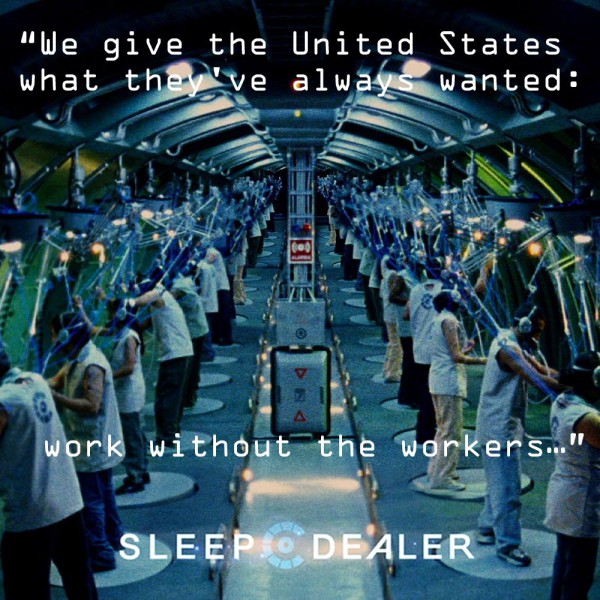
Saturday Matinee: Sleep Dealer

sleep-dealer-work

“Sleep Dealer” (2008) is a dystopian parable directed and co-written by Alex Rivera. Luis Fernando Peña stars as Memo, a hacker who also works as a type of virtual migrant worker. It’s revealed through flashback how his situation was a result of a drone attack on his family and homestead. While trying to find work, Memo meets Luz (Leonor Varela), a fellow hacker who, with additional assistance from a repentant drone pilot in the US, helps him strike a blow against the system.

Note: may not play on some portable devices.

http://www.hulu.com/watch/703496

Oil and Money – Lessons Learned

petrodollar-systemThis is a concluding post for an excellent 7 part long-form series featured on the Hipcrime Vocab blog. While this serves as an adequate synopsis of what was covered, I highly recommend the series for it’s depth and scope starting with the introduction.

Source: Hipcrime Vocab

The first thing I learned is that I bit off more than I could chew, lol. I was intending a simple book review, and it turned into a lot more than I intended to write. I also learned how difficult and thankless a task blogging can be. I’m glad at least a few of you chimed in to let me know you enjoyed it.

One major thing I learned (which I already sort-of knew) is how much real resources have to do with the economy, and economic history, despite economists’ insistence that land, labor and capital are all that matter. In fact, real resources appear to be the MAJOR driver of our economic fortunes. Even Forbes magazine had to admit: The Recessions of 1973,1980,1991,2001,2008 Were Caused By High Oil Prices. Energy doesn’t matter, huh?

I was really taken aback at how recent this all is. I was somewhat aware the historic problem with oil was that there was too much of the stuff.  Eric Roston, in The Carbon Age, writes, “Gasoline was a throwaway by product of kerosene refining until the early 1900s, used sometimes in solvents or as fuel for stoves. In 1892, two cents a gallon was a decent price. For another thirty years, apothecaries were the makeshift filling stations.”

But I had no idea just how much of a glut there was and how people thought it would last forever. That it was so cheap we needed the Texas Railroad Commission to hold back production so that the prices would be high enough. I mean, this substance contains the equivalent of ten to eleven years of human labor (1750 Kilowatt hours of human labor), for crying out loud! And it is a non-renewable resource! I was amazed at how far we went in coming up with new uses for the stuff, to the point destroying perfectly good and workable infrastructure just so we could use more of it. Can anything be more insane?

The long boom was driven by the exploitation of oil as a resource. This led to the dominance of the ICE (Internal Combustion Engine). All of the knock-on effects of the ICE were behind the post-war boom. I mean, you could write a book about all the economic development caused by cars and trucks. In fact, truck driver/delivery is still the most common job in most states to this day! The ability to deliver goods cheaply anywhere had so many knock-on effects, from the creation of whole new cities to the rise of big-box retailers. Let’s not forget that everything in that big-box retailer is made from plastic which is made from petroleum feedstocks. Kunstler calls the suburbs the greatest misallocation of resources in human history. It’s easy to see how that’s true.

I didn’t know that it was only as late as 1959 that petroleum overtook coal to be more than 50 percent of our energy use. I didn’t know that coal only became the world’s predominant energy source after 1900. Before that, we were still essentially in a wood/biofuel economy. As I wrote before, that’s pretty recent – less than three generations.

 We think of the 19th century as the era of coal, but as the distinguished Canadian energy economist Vaclav Smil has pointed out, coal only reached 5% of world energy supply in 1840, and it didn’t get to 50% until about 1900.

The modern oil industry began in 1859, but it took more than a century for oil to eclipse coal as the world’s No. 1 source. “The most important historical lesson,” Dr. Smil says, is that “energy resources require extended periods of development.”

The Power Revolutions (WSJ)

Peak oil ideas made it sound like oil (specifically petroleum) was the only resource that matters to the economy, so that once oil production stops growing, the economy will collapse. That’s clearly not the case (oil is 36 percent of the world’s energy). There are lots of other fuels in the mix. However, things like fracking, tar sands, and offshore drilling clearly mean that cheap, easy-to-get oil is on the wane. Oil is cheap now because of fracking – not the tight oil itself, but rather because the fear of it is keeping prices low by the Saudis. That will change. I’m always amazed at the people who run out and buy SUVs the minute the oil price goes down. Do they expect it to be cheap forever or do they expect to drive their car for only a year? It’s also cheap because our economy is in the crapper.

Forget who the candidates are and all the campaigning and the billions of dollars spent– If oil prices are high, the economy is in recession, and the incumbent party will lose power. You can pretty much predict any presidential election by this fact alone. Two-thousand is the only one that sort-of breaks the mold, and that was such a bizarre election between the hanging chads, the voting fraud and the Supreme Court. In other words, it’s not just the economy driven by energy prices – it’s the political world too. Everything else is just meaningless fluff.

At the end of the day, whether a president presides over a good economy or a bad economy is almost entirely down to oil prices.

The other thing that strikes you is the “Groundhog Day” nature of the situation. Oil prices get high, we get worried about the environment, and there’s a great boom in alternative energy, energy efficiency, environmental impacts, worries about the economy and supply chains, and so forth. Then oil prices go down and we forget all about alternative energy and all the inherent problems with relying on a finite resource. All the progress toward getting off of oil stagnates, and people assume oil will be cheap forever. Then they get high again, and suddenly it all becomes important again, and we have to go back to square one (compare the EV-1 to Tesla, for example. Heck, Edison built an electric car!). Charles Mann had a great line along the lines of “The human propensity to see flukes of good fortune as never coming to an end,” or something like that.

Given the manipulation of oil prices, it’s hard to see natural economic factors as ever being able to do the right thing when it comes to energy. When prices get high, new supply comes online and alternatives are pursued. But then oil prices crush the economy, demand falls more in line with supply, the price falls, and the initiatives are halted. It feels like the invisible hand is attached to an idiot. Maybe this time we’ll finally get serious.

Prices are temporary conditions. Peak oil is permanent.

The drug dealer analogy of us being addicted to oil is shopworn, but it is just so accurate. It was only once we were addicted to the product that they could jack up the price, and then we HAD to pay what they demanded. But like a drug that devastates the lives of its users, when you hit rock-bottom you try to get on the twelve-step program and get your life back. Then, the dealers will lower the price to keep you addicted, and the cycle begins again. Plus, every dealer wants to be your dealer, so they need to be just a little bit cheaper than the next guy. Barring that, they will bind together with the other dealers to keep the price high and protect their “turf.” The economics of drug dealing and oil are eerily similar. I wonder if anyone’s formally studied this.

In the past each new energy source was added on to the previous ones. Now we are talking about substitution – a totally different ballgame. That is, new energy sources will replace old. That’s substitution, not expansion.

Cheap oil combined with the opening up of China drove globalization. There is no way we could build the largest moving structures ever built to transport goods if we didn’t have a fuel source cheap enough to make it worthwhile. A single ship can move 19,000 containers, enough to move 300 million tablet computers.

That oil played a role in foreign policy shouldn’t be a surprise, but looking at exactly how it led to the invasions of Afghanistan and Iraq, the civil war in Syria, the removal of Qaddafi, the propping up or removing of dictators, and the positioning of armies around the globe was still eye-opening. So much foreign policy is dictated by access to oil. So much…

I was actually unaware of the Eurodollar and how I caused the fall of Bretton Woods. As Smith illustrates, going back to the gold standard is practically impossible (sorry libertarians). I was unaware of the role that Petrodollar recycling played in the Latin American debt crisis. I was aware of how the Petrodollars funded terrorism. I’m sure readers of Dmitry Orlov were familiar with the role oil and grain prices played in the fall of the Soviet Union. Again, this made Reagan look like a genius.

What I really wanted to describe is how the oil price crisis came about and how it led directly to the rise of Neoliberalism. I also wanted to show how Jimmy Carter’s “failure” and Ronald Reagan’s “success” was based mostly on oil prices. Some people would take issue with that, but it’s hard to separate one from the other. Is it 100 percent? Maybe not, but what percentage was oil prices? Seventy? Fifty? Twenty-five? Surely it played a role.

The problem is that it made Neoliberalism look like a success. People came to believe that unions were evil, and tax cuts for the rich and corporations, deregulation, and speculation were the magic keys to prosperity. But throughout the Neoliberal reign, oil prices were either stable or crashing. When that wasn’t the case, as in 2007-2008, the system came apart. The rise of China also made Neoliberalism appear to work. But it was smoke and mirrors – cheap uneducated labor, overinvestment, state-controlled enterprises, artificially cheap currencies, entire cities built with no people in them, etc. It was a Potemkin’s village on the scale of a nation. Globalization is a Ponzi scheme.

But now Neoliberalism is literally tearing the world apart. Some major reasons:

1.) Turning the speculators loose. The oil price rise and the food price rise seem to be mainly problems of market speculations (i.e. greed and fear, always the real movers of markets, not supply and demand). This has, in turn, led to political turmoil as we saw in the Arab Spring. If speculation continues to cause price rises for essentials like food, fuel and water to pad the fortunes of speculators, expect more chaos and collapse. Even in the U.S., the actions of Enron and “Kenny-boy” lay caused serious harm to economies, not expansion. And we spent enough on the bailouts to give every unemployed person a job and every homeless person a home, with billions left over. Is this how economies should be run?

2.) The suppression of worker wages has caused massive hardship around the world. The abandonment of full employment as a policy goal has led to a worldwide unemployment crisis that is destabilizing the world. Unemployed people have nothing to lose. People with nothing to lose tend to revolt (see above). The gutting of social services and welfare safety nets has also led to poverty and desperation all around the world. It calls into question the ability of capitalism to deliver broad increases in living standards everywhere. We are clearly not seeing that. We’ve been in reverse for some time. Shouldn’t an economic system make us ALL richer, rather than provide winners and losers? If it can’t, what kind of system is it?

3.) Globalism spreads not only the wealth around, but the poverty too. Some countries, notably Western Europe, have attempted to defend their citizens, while others like the United States, did nothing to insulate its workers from third-world wages and working conditions (and even encouraged them). Rising living standards in China and India are one thing, but falling living standards in formerly wealthy countries make the rich capitalists richer, but cause anger and consternation which is easily exploited by the unscrupulous and power-hungry. This is also destabilizing. Just look at all the anger in the U.S. today searching for a scapegoat.

4.) Austerity and the straitjacketing of governments has led to wealthy, industrialized countries “undeveloping.” The United States is a nation of private affluence and public squalor, with one-third of its children living in poverty, entire cities abandoned and crumbling, urban areas too expensive for median income workers, the infrastructure of a banana republic, poor access to education and healthcare, pockets of poverty, ghettoes, etc. Greece is being gutted as an example to the West. This is leading to rise of right-wing parties in Europe, again redolent of the run-up to the Second World War.

5.) The faith in Markets to solve all problems is especially disastrous with an ongoing environmental crisis. Instead of rationing or capping, instead we get easily gamed “cap and trade” markets to reduce emissions. Nature is just “natural capital,” and every drop of water, tree leaf, and grain of sand must be assigned an owner and a price. In other words, all of nature must be subsumed into the market, because markets are the only way we can solve our problems! This is a Neoliberal idea. Look at how the United States responded to the crisis in the seventies by contrast.

6.) Debt crises have caused massive hardship around the world. As I learned, Mexico’s reputation as a haven for poverty, prostitution, drug gangs, etc. was only after the Latin American debt crisis of 1982. That, in turn, led the massive influx of Latin American refugees into the United States turning America into a Latin country overnight.  Prior to 1979, places like Afghanistan, Iran, Lebanon, Egypt, Iraq, Algeria, Syria and Libya were stable, secular, relatively prosperous places (See this. And this). Now look at them. Yes, they had dictators and human rights violations. But compare it to today. Latin America has fared somewhat better, largely by finding a way to reject or bypass Neoliberalism. Africa has not fared well, either. Note that you only heard about collapse and famine after the 1980’s (remember Ethiopia?). Yes, Africa was poor before then, but it seemed to be heading in the right direction. Not any more.

7.) People from these wrecked countries are heading to the Western industrialized countries in massive waves of migration–Latin America for the United States and Canada, and the Middle East and Africa for the European Union. This has driven down wages and caused the rise of nativist parties. Everyone is heading for the lifeboats as more and more countries become failed states. There is simply not enough room for all. But rebuilding these countries would mean abandoning the Neoliberal paradigm, forgoing debt and putting into place quasi-socialist policies. Then again, the rich can always retreat to floating offshore islands (and eventually space colonies).

It’s clear that much of the money that has not been collected by governments has gone not only into speculation as opposed to productive activity, but in purchasing political representation. This has led to democracies devolving into oligarchies and a mistrust of democracy in general. The buying of politicians and the media blocks any attempts to deal with collapsing systems. We’ve seen ever greater instability and ever greater bubbles under Neoliberalism now that government has been “contained” and workers have been “disciplined.”

The answer to our problems should be clear: abandon Neoliberalism and return to the mixed economy. Stop hamstringing governments. End speculation. Tax the rich. Close offshore tax shelters. Raise tariffs. Defend domestic industries. Write down the debts. Pursue full employment policies such as a job guarantee, reduced working hours and an basic income guarantee. Distribute essential social services through the government, and let the market handle non-necessities. Regulate to deal with externalities. Impose limits on natural resource extraction. Decarbonize energy.

All of this used to be common-sense. Now it beyond the pale.

The problem is, it’s a ratchet effect. We cannot go back, because TPTB will not allow it. And since the 1970s, they learned they had to not only control the government, but the information we imbibe day after day, otherwise we would instruct our government to do something the powerful may not want. Instead, we had to be convinced that Neoliberalism is the only valid economy – hence the think tanks, talk radio, publishing mills, Fox news, etc. Any sense of common purpose or solidarity is evil “socialism.” As we learned, even “liberal” news sources are fully dedicated to defending this paradigm at all costs, even at the cost of credibility. And the funding of the political classes by the wealthy will ensure that anything that threatens the fortunes of the oligarchs will be a non-starter, even if people do see past the media rhetoric.

The change in economics swallowed the hope of the sixties. How much does it have to do with Neoliberalism, and how much with oil prices? A lot of commenters say, “Hey, the oil is gone, we just need to learn to be peasants.” They point out that American wages stopped growing in 1973, around the time domestic oil production peaked in the U.S. But I think that’s simplistic. American wages stopped growing, not everyone else’s–not what we’d expect in an energy descent scenario. Rather, I think it was the wealth transfer of the seventies, and the politics it engendered, that was the primary culprit. The oil shock opened the door for globalized Neoliberalism, and that is the primary cause of our misfortune. By using oil as an excuse to be politically passive, we remove any chance at creating an economy that works better for all and play into the hands of the powerful.

I think old economy Steve puts it best. Or shall we say, “mixed economy” Steve:

OY4w945

Yes, Global Wealth Inequality is Unjust

Income-Inequality

By Jessica Flanigan

Source: Bleeding Heart Libertarians

Jonathan Anomaly asks, “Is global wealth inequality unjust?” Anomaly and Dan Moller suggest that global wealth inequality may be less unjust than a lot of people think because rich countries have good political institutions and cultures that encourage social and scientific experimentation, not because they are actively harming poor countries.

Moller’s argument is that if wealthy countries did not cause global poverty they have no duty to provide aid. His main targets seem to be Richard Miller and Thomas Pogge, who argue that the system of global trade, which is imposed on everyone in the world, does cause poverty in poor countries. I agree with Moller that if anything, the system of global trade has made everyone better off, though it has made some much better off than others. And like Moller, I don’t think inequality is necessarily a moral problem. But like Pogge and Miller, I do think it is a moral problem if a system of property is imposed on everyone and it leaves some people so desperately poor they don’t have enough.

This argument is the same as my argument for the basic income. As Harry Frankfurt writes in one of my favorite papers, we should care about everyone having enough rather than an equal share. It is much easier to calculate an equal share than to calculate what counts as enough, but enough is what matters. Though it requires a further moral argument to say what enough is, I think most of us could agree that conditions extreme poverty do not give a person enough, whatever enough means. More than a billion people live in extreme poverty, and their lives are governed by a global property system that they have no choice but to participate in. My intuition is that just as domestic property systems should provide citizens with a basic income, a similar argument can be deployed to support limited duties of assistance for people in extreme poverty if we could know that assistance could make a meaningful difference.

I imagine a lot of BHL readers will be pretty unsympathetic to this argument. Some libertarians will object to my claim that property systems are coercive in ways that require providing everyone who is coerced by a property system to have enough. Some libertarians seem to think that the existing system of global capitalism is just everyone exercising their natural pre-political property rights without violating anyone else’s entitlements. Or, some people think that assistance would just do more harm than good, and people aren’t owed assistance if it would make the global rich worse off without making anyone better off. Of course it’s hard to know what would be enough assistance. Aid may not work. If aid works, it’s hard to know why. It’s hard to know how to make aid better too. But there are amazing researchers who are working to find the answers to these questions. Some worry that aid is paternalistic or infantilizing, but it doesn’t have to be. Just because we don’t know how best to improve the lives the global poor doesn’t mean we should stick to the current system of basically not trying at all.

For libertarians who are skeptical of wealth redistribution though, here is another reason that global wealth inequality is unjust—borders. As my co-blogger Chris writes, there’s no such thing as a closed border libertarian. As far as I know, Pogge doesn’t mention the global system of borders in his argument for eradicating systemic poverty and Moller doesn’t discuss immigration in his article either. This is a striking oversight. Both Moller and Anomaly emphasize the non-zero sum nature of trade. Moller considers and responds to the objection that the rich got rich by unfair trade practices, but does not include borders on the list of unfair trade practices.

I’m not saying that rich countries got rich by turning poor people away at the border. I suspect the opposite is true, and that rich countries got rich when they had a lot of migration (like the US in the 19th century) and continue to get rich despite immigration restrictions. But one thing is clear, poorer people are poorer because of the border system. As Jason Brennan points out, opening the borders would not only respect people’s freedom of movement and association, it would also add trillions to the world economy and benefit rich and poor countries alike.

So yes, global wealth inequality is unjust. Not because rich countries cause poor countries to be poor, but because coercive property rules and borders trap people in conditions of extreme poverty. For these reasons, even libertarians should support policy reforms that improve the lives of the global poor—especially open borders.