HOW THE AMERICAN CULTURE OF CONVENIENCE IS KILLING US

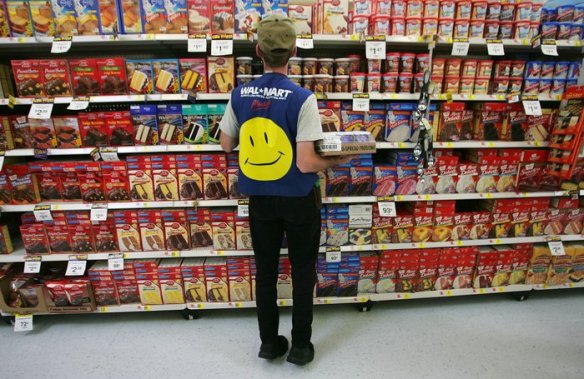
TROY, OH – MAY 11: An employee restocks a shelf in the grocery section of a Wal-Mart Supercenter May 11, 2005 in Troy, Ohio. Wal-Mart, America’s largest retailer and the largest company in the world based on revenue, has evolved into a giant economic force for the U.S. economy. With growth, the company continues to weather criticism of low wages, anti-union policies as well as accusations that it has homogenized America’s retail economy and driven traditional stores and shops out of business. (Photo by Chris Hondros/Getty Images)

By Daisy Luther

Source: Waking Times

In the United States, we are lucky to have massive convenience at our fingertips. I was talking to one of the instructors for the urban survival course, who is from Sweden, on a car ride. He was blown away by some of the things I told him about the levels of convenience and comfort in the United States. Things I completely took for granted don’t even exist there. I thought some of you might be interested in hearing about some of the insights we discussed.

Before I left for the course, I was walking my dogs a mile or two every day with my dogs, but that was about it. I thought it was enough but I learned during the field exercises that it wasn’t even close to the physicality required during an SHTF situation. But I digress. Let’s get back to convenience.

A caveat before people respond indignantly and tell me about all the inconvenience with which they deal every day: this is an opinion piece. Obviously many people in America still work out hard and have manual jobs. But when two-thirds of American adults and 30% of American children are overweight or obese, you have to see that you are not in the majority.

And it’s the majority here that I’m discussing. Between a combination of low-quality food and extremely sedentary lifestyles, the majority are killing themselves with convenience.

The American Culture of Convenience

The first thing that struck me when I landed in the Balkans was how different their lifestyle is from ours in the United States. But the longer I’ve been here, the more obvious it has become.

In the United States, depending on where you live, everything is dropped in your lap.

Food can be quickly acquired by shouting your order into a microphone and driving around a building, all without you having to leave your car. And if you live in a larger town or city, with the advent of services like GrubHub and DoorDash, the food delivered to your home is no longer the domain of pizza chains. You can have your choice of practically any restaurant in town brought right to your door within 45 minutes.

But it isn’t just about food. Instacart offers pick-up services from a wide variety of stores, including places like chain grocers, Wal-Mart, and Target. All you have to do is drive up, let them know by phone that you’ve arrived, and pop your trunk. Poof. Your shopping is done. In some cities, you can even use services like Instacart to have these things brought to your door.

Amazon has brought us practically anything else we could want with two-day shipping, regardless of where you live in the country. Gone are the days of scouring half a dozen stores to locate the whatchamacallit you needed. A quick search on Amazon and One-Click ordering and it’s yours within 48 hours and you never moved off your comfy chair.

If you need to go somewhere you don’t even have to drive yourself or take public transit. Uber or Lyft will happily send somebody to pick you up and drive you anywhere you need to go for a reasonable price, and you can watch the approach of your driver from the convenience of your phone.

Entire billion dollar industries are evolving to make our lives more convenient and easy every single day. Imagine how stunned our hunter-gatherer ancestors would be to discover we don’t even have to leave the house to be clothed and fed in epic abundance.

We don’t walk much, either.

And speaking of drive-thrus and driving to the store to get your Instacart packages, we drive everywhere. Part of this is because of the way suburbia is developed. It’s rare to live in a neighborhood where you can walk to the market, the bakery, and the wine store. So instead of walking to get our goods, we drive there, dash in, and get back in our cars. Those in big cities probably walk far more than those in suburbia, and for those in the country, it depends if they actually have a place to walk and whether they’re taking care of a large property.

And if we’re not walking to run our errands, we’re not carrying stuff. We get as close as possible with our cars if heavy groceries need to be lugged in and we carry as little as we can if we’re heading somewhere. When you walk the dogs, you might take your phone and some poop bags but you’re generally not taking it as a training opportunity and strapping on a pack.

Then there are the stairs.

Even two-story buildings in the United States have elevators much of the time because everything, by law, has to be easily accessible to every person. (And no, I’m not saying that people in wheelchairs need to try to haul themselves up the stairs. I’m discussing a trend.) But it goes even further than that. Adding elevators to your home is a growing trend in both the United States and Canada. New home builders are including elevators in the original design of some homes.

On the other hand, in Europe, they don’t have elevators in many buildings with fewer than five floors. I walked up and down more stairs in the past month than I have in the past year at home combined, and I live in a three-story house.

And the list of conveniences that would blow the minds of people I met in the Balkans goes on.

It’s an agoraphobic’s paradise in the United States.

You can get all sorts of mobile services that come to your door – everything from hairstyling to dog grooming. Other people mow our lawns, clean our homes, service our vehicles, and take care of us in general. There are even people who hire others to walk their dogs. Some people definitely need help with physical tasks but able-bodied people should be able to do a little yard work, shouldn’t we? Especially if we’re preparing for some kind of apocalypse.

In many areas, things are perfectly level, the sidewalks are carefully maintained (because who wants to ask for trouble in our litigious society), and a slight incline is considered a “hill” that people avoid to make their dog walk a little easier.

You can get meal kits brought to your door with every single ingredient you need to make a gourmet meal, right down to the seasonings accurately doled out in little packages. You can have fresh fruits and vegetables dropped off at your door by your local CSA. You can get subscription services of all types with the delivery of things like cosmetics, fitness gear, food from exotic locales, wine, candy, home decor items, socks, and dog paraphernalia.

Looking at it from the perspective of the area where I’ve been spending time, it’s simply mind-boggling that all of these riches are brought to you at the click of a button.

And it’s killing us.

As I mentioned earlier in this article, the obesity rate in the United States is staggering. A lot of it is our food. Thanks to subsidization by the USDA, many of the foods that are cheap are highly processed with low-quality ingredients. The NY Times reports:

At a time when almost three-quarters of the country is overweight or obese, it comes as no surprise that junk foods are the largest source of calories in the American diet. Topping the list are grain-based desserts like cookies, doughnuts and granola bars. (Yes, granola bars are dessert.)

That’s according to data from the federal government, which says that breads, sugary drinks, pizza, pasta dishes and “dairy desserts” like ice cream are also among Americans’ top 10 sources of calories.

What do these foods have in common? They are largely the products of seven crops and farm foods — corn, soybeans, wheat, rice, sorghum, milk and meat — that are heavily subsidized by the federal government, ensuring that junk foods are cheap and plentiful, experts say.

Between 1995 and 2010, the government doled out $170 billion in agricultural subsidies to finance the production of these foods, the latter two in part through subsidies on feed grains. While many of these foods are not inherently unhealthy, only a small percentage of them are eaten as is. Most are used as feed for livestock, turned into biofuels or converted to cheap products and additives like corn sweeteners, industrial oils, processed meats and refined carbohydrates. (source)

And even when we try to clean up our diets, foods are genetically modified, produce is doused in pesticides, and it’s packaged in all sorts of hormone-disrupting material that leaches in when you heat it up.

But it’s not just the crappy food. A lot of folks in the United States just do not get off their butts. And – I hate to say it – but I’m talking to a lot of people in the survival and preparedness world. Sitting at a keyboard or phone typing all day while Netflix plays in the background is sedentary to a deadly degree. On average Americans sit for 8.2 hours per day and this does not include the average 7-ish hours a day we’re sleeping.  And when we’re not sitting, it doesn’t mean we’re doing things that are good for us. We spend a great deal of time standing in line and driving in our cars. And the trend toward inactivity is only increasing.

Meanwhile, obesity contributes to many diseases such as:

  • High blood glucose (sugar) or diabetes.
  • High blood pressure (hypertension).
  • High blood cholesterol and triglycerides (dyslipidemia, or high blood fats).
  • Heart attacks due to coronary heart disease, heart failure, and stroke.
  • Bone and joint problems, more weight puts pressure on the bones and joints. This can lead to osteoarthritis, a disease that causes joint pain and stiffness.
  • Stopping breathing during sleep (sleep apnea). This can cause daytime fatigue or sleepiness, poor attention, and problems at work.
  • Gallstones and liver problems.
  • Some cancers.

The National Institute of Health is incredibly concerned about the future of overweight, sedentary Americans.

More recent evidence points to differential roles for body fat distribution patterns, in addition to excess overall adiposity, in elevating risk of many major chronic diseases. The large numbers of children entering adulthood overweight, together with increased weight gain in adulthood, portend an enormous burden in terms of human suffering, lost productivity, and health care expenditure in the coming decades. (source)

And – since it’s the purview of this website – imagine if the SHTF and you were too overweight and sedentary to go out and acquire the supplies you need to survive. Imagine what will happen when your medication runs out and you have a preventable disease brought on by your sedentary lifestyle. Imagine how your family will feel watching you suffer.

You need to add more movement to your life.

Unless you are among the 23% of Americans who meet the national exercise guidelines, you need to add more movement to your life. I suspect that there are a lot of people who believe they are disabled because getting started on a movement program is hard. It really does hurt, I know. But there’s a very good chance as you begin to move more it will become far easier. Don’t give in to it if your doctor says, “Oh, you’re disabled” and hands you a sticker for your car unless you really, truly are. If there’s even a glimmer of doubt in your mind, try to move just a few more steps each day. Instead of using the scooter to shop, push a cart to give yourself something to lean on. You aren’t training for a marathon – 10 extra steps a day will add up if you keep on pushing. But, MOVE.

The best way to increase movement is to decrease convenience. I don’t mean that you need to suddenly become a hunter-gatherer but you need to get off your duff. (To get started, check out this article or Bug Out Boot Camp and of course, always contact your doctor before beginning an exercise program. Blah, blah, blah.)

You need to carry heavy things instead of getting them delivered. You need to climb the stairs instead of taking the elevator or escalator. You need to actually go inside the store to do your shopping instead of sitting in your car, waiting for stuff to get loaded into your trunk. Park at the back of the parking lot, or better yet, at a store further away. Quit ordering from Amazon and buy things locally so you can walk around the store. Look for the hills and walk up and down them instead of avoiding them. If you want to eat restaurant food, go to the dad-gum restaurant. Find a place to walk to every day – maybe the post office, a coffee shop, or the dog park – and make it part of your routine.

It’s not unusual in other parts of the world to walk 8, 10, or even more miles, every single day. You don’t need to start there but maybe you should strive to get there. Once you’re in your groove, it should only take an hour or so to walk 4 miles. Using your feet as transportation is one of the healthiest things you can do.


Embodied Spirituality: The Truth Shall Set You Free

By Jack Adam Weber

Source: Collective Evolution

For myself, spirituality means aligning with what is true, or most likely true. This means looking at what is true through the lens of my unique experience and self-reflection (subjectively) and what is true in the world (objectively).

Living in accord with what’s true means I have to confront lots of things that are tough to stomach and that I’d prefer weren’t true. I practice resiliency by enduring this discovery process. It takes courage, humility, sensitivity, insight, intellectual rigor, emotional intelligence, and flexibility—in essence, all of me.

Why does it require all of me to be honest?

Because we humans have evolved to stick to our beliefs, even though many of them are false. We, in fact, experience a dopamine rush (a feel-good neurotransmitter in our brains) when we affirm our beliefs, even if they are wrong. So, confronting false beliefs about myself and the world means I have to endure some degree of feeling badly, some emotional turmoil, cognitive dissonance, and reorientation of my world. When I challenge many of my false beliefs, I encounter nothing short of transformation on all levels. Sounds like a bona fide spiritual path to me.

The Power of (False) Belief

This being human is a guesthouse,
Every morning a new arrival.
A joy, a depression, a meanness,
some momentary awareness comes
as an unexpected visitor.

—Rumi

When we don’t align with what’s true about ourselves, interpersonally, and in the world, we develop false beliefs. And we like to assert these false beliefs. Using evidence and acknowledging reality can help us let go of our false beliefs. We receive this information subjectively through self-reflection and what others share with us (which we also need to sort through for false projections). We receive true information about objective reality by direct observation and through evidence.

Ascertaining inconvenient truths means we have to let go of our self-administered dopamine addiction (by lying to ourselves and others when wrong) and experience feeling badly temporarily. We have to accept new visitors to the guesthouse of our psyche if we want to be more honest. If we can’t do this, we cut ourselves short of our potential.

We can’t be as loving and kind when we’re deluded about what’s true, subjectively and objectively. If I can’t accept that I am more self-serving than I think I am, I will continue to unconsciously put myself first at the expense of others. If I can’t acknowledge that smoking cigarettes, synthetic chemicals in perfumes, or spraying RoundUp is harmful, I am more likely to condone their use, which causes harm.

To change belief structures includes a collapse of our sense of self, trust, safety, belonging, and our perceived survival. This is also why many cling so dearly to their beliefs; even war can seem like a better option than to adjust ourselves to reality. Reality seems pretty powerful this way! If we adopt reality as our guru, we have a powerful teacher on our side to wake us up. So, a willingness to embody our humanness can be a path to greater compassion and peace. Embodied spirituality means being fully human—accepting and working skillfully with all our thoughts, emotions, physical issues, and relationships.

When we don’t embody our spirituality, we don’t take as good care of the Earth, which is the extension of our own bodies. In the age of environmental collapse, an earthy and embodied relationship to life that apprehends what is true helps us heal what’s ill. Like missing a medical diagnosis, how can we treat what what we can’t bear to admit and accurately diagnose? Honesty is therefore the first step to healing and embodying our lives.

Being Human is Very Spiritual

We, in fact, need nothing more than everyday honest living for spirituality to put us on a path of massive transformation.The more we can let go of spiritual loftiness and encounter our ordinary humanness, the more resilient and honest we become. Ironically, it is precisely this difficult growth that has given rise to many spiritual and religious paths that abandon the ordinary, grounded world of embodied living, as complex as it is. These spiritual paths thrive on what is highly likely untrue. They try to escape the pain of everyday living by denying what’s painful, which is called spiritual bypassing. With skillfulness, wisdom, and support we can navigate what’s honestly human while not bypassing.

Learning to welcome and tolerate all manner of emotions and inconvenient truths to our guesthouse allows us to align with reality, especially welcoming what makes us feel badly. It’s important to align both with the good and the ugly because when we ignore the ugly and painful, it goes unhealed and untended. Our precious biosphere suffering under the weight of our pollution is a prime example. What we don’t want to look at, we can’t address. Turning our heads and hearts away from it creates more pain and ugliness.

The New Age dictum, “What you put your attention on grows,” fails to acknowledge the importance of embracing what’s ugly and painful. A wiser, more embodied version might go: “The negative things you put your attention on allow you to see reality and address it before it takes over beyond the point of repair.” Look at the plastic pollution issue or climate change as examples. Acknowledging both sides of the coin is more important than choosing only the bright side of life in order to remain happy, which is short-lived when we’re in denial of the dark side. Wanting to remain happy at the expense of not seeing reality (except when we need a recharge break from honestly facing it) is fear in disguise that ultimately comes back to bite us. It also bites us in the moment because this denial cuts us off from our deeper hearts—our compassion and empathy—which are stirred by painful realities.

We can’t know everything, of course. Nor can we be right all the time. But we can be aligned enough with everyday reality (what matters at the end of the day) to make a difference and eliminate unnecessary suffering. We just have to be willing to be selfless enough to stop avoiding necessary pain to the degree we do.

Science & Critical Thinking

Scientific consensus is the primary arbiter of what’s objectively true in the world; what we subjectively experience is not as good a measure of what’s objectively true. “I like apples” is a subjective truth. No one can disprove this; it’s a personal truth. It is not the purview of science to disprove a subjective experience. Yet, if I claim that everyone likes apples just because I experience their yumminess, this is imposing a personal truth onto external reality. And, it’s not true—we know not everyone likes apples, and nothing is wrong with them for not liking them. It is the purview of science to demonstrate that not everyone likes apples, and simple common sense will do in a pinch.

Of course, there is bad science, like the junk (dishonest) science produced by many corporations such as Big Pharma and Bayer-Monsanto with regard to GMOs. So, when I say science, I mean good, peer-reviewed (and not conflict-of-interest and corporate-funded), consensus science. And yes, many scientific truths are always in flux, but many scientific discoveries do not change because they have stood the test of many challenges. Think about the law of gravity and the laws of thermodynamics. Many who want to protect their sense of self and ego deem all science to be manipulative, dishonest, and just another belief system. This is just not true. If it were, the device on which you are reading this article would not function because it’s constructed as a result of the collaboration of many scientific laws that have not been debunked and instead stood the test of time.

Consider another example: If I experience a vision during a medicine journey or receive a message in a dream one night that has personal meaning to me, I might conclude it’s true for everyone, or true in the world. Let’s say a blue dragon with white polka-dots tells me that aliens are communicating to humanity by way of trees. Well, before I know if this is true or not, I’d have to investigate its veracity. I don’t deem it true simply because I had a subjective experience that conveyed it was. This way, I can tentatively receive this bit of intuitive knowledge and seek to determine if it’s true. Intuition tips me off to what is possible, not necessarily what is true.

Confounding subjective and objective truth is one of the biggest faux pas we make, especially in spiritual circles.

Science shows us what’s most likely true beyond our own intuition, beliefs, and biases. Even with science’s errors and its dishonest publishing politics, good scientific consensus is still the best tool we have for determining what’s true about the natural world, not our subjective experiences. We have to be skillful and aware not to automatically deem our subjective experiences as objective truths. This helps us align with reality, keep an appropriately open mind, and helps everyone get along better because we’re not feuding over what’s objectively true.

“What’s True for Me”

When everyone feels entitled to their opinion—”what’s true for me”—we end up with lots of personal beliefs and memes that aren’t true. “Personal truth” or “what’s true for me” is a subjective truth. Your like of apples doesn’t mean anything about the external world, such as my opinion of apples. If I don’t trust politicians or my landlord, this doesn’t mean they are untrustworthy. I need objective evidence to prove or verify my distrust. Or I can just own this hunch and honestly call it so, while knowing it might not be true. This discernment between subjective and objective truth helps prevent assumptions and dogmas. This also sounds pretty spiritual to me.

If someone sheds distressing light on a politician I like or my best friend, I’m likely to become defensive because my sense of self and orientation in the world, as well as my emotional security, are invested in these beliefs. If my belief structures are challenged, all of what that belief system keeps in place becomes shaky. And this is just too scary for most of us, so much so that we defend against it or attack and assault others because of it. We often make the mistake of imposing “what’s true for me” onto what’s true for everyone or what’s true in the world.

“What’s true for me”  beliefs can’t automatically be extended to external reality unless we have evidence beyond our own subjective perception to deem them so. If I believe the world is flat and this is “what’s true for me,” that doesn’t fly. This is to make a subjective truth objectively factual. This is what leads to conflict and living in fantasy. Just look at religious and many New Age beliefs as examples. They are not different from our personal beliefs about the nature of reality that are also false and cause us to act in egoic, violent ways.

What’s True “Out There”

Good science to determine the mostly likely and factual objective knowledge offers us the opportunity to dismantle our egos and illusions. Science and critical thinking show us that many of our “what’s true for me” opinions about the world are wrong. Notice I am not talking about personal feelings and preferences, but rather our statements of fact about the world.

Objective truths implicitly challenge us to change, to transform ourselves. It takes spiritual-emotional courage to accept these facts, which builds resiliency the more we practice aligning with what is both subjectively and objectively true. The sun appears to go down over the horizon; the Earth appears flat. Via science, we know these subjective observations are not true. Using my intuition to make such conclusions is a wrong use of this faculty. If my intuition tells me there is more to the story, then I can investigate it for other evidence. This, in fact, is how many scientific discoveries occur. Intuition and science are not mutually exclusive. In fact, they are allies as long as we don’t assume what’s subjectively true to be objectively true, and vice versa.

Many people dismiss science precisely because its conclusions fly in the face of what they’d prefer to believe. This results in intellectual dishonesty and spiritual delusion. Our emotional bents and grudges—especially those resulting from our hurt and wounds that have generated anger, fear, pain and thus, bias—prevent us from being intellectually honest, unless we recognize the dynamic by which we deceive ourselves and we set about to be more honest. This requires enduring the discomfort of being humbled and sacrificing a temporary dopamine rush for the truth.

To be able to accept truth therefore requires that we deal with our emotional baggage and triggers, because this is the primary driver for our intellectual dishonesty and spiritual laziness. Many of us would fall apart if we discovered that parts of our worldview are untrue. That could result in a spiritual emergency, akin to a healing crisis, which ultimately improves us and makes us more effective in the world.

Warriorship

This is why spiritual warriorship—aligning myself with what is most likely objectively and subjectively true—requires I be emotionally and intellectually rigorous and courageous. It means that I listen to scientific consensus and not discard it because I’d like to believe something else. It means that I listen to the opinions of others and gain perspective on myself (while also honestly and humbly sorting out projections and displacements of other people’s biases). It means that I genuinely and honestly consider interpersonal facts about which I might have an incorrect opinion. And it means that I notice the whispers inside me that tell me when I am being dishonest or hiding from the truth, with white lies tolerated now and again.

Many spiritual paths involve giving over one’s will and beliefs to a guru. Yet, that guru can be corrupt and deluded and conflate subjective and objective truths. For example, feeling “one with all” in meditation doesn’t mean that we are all one in a black or white way—without appropriate boundaries, individual needs, and different tolerances and sensibilities. In this sense, aligning ourselves with what is most likely true, subjectively and objectively, is a robust spiritual path—because, much like a guru, it forces us to align with truth and withstand the breakdown of some part of our existing paradigm. This is death and rebirth work, for sure. Again, this sounds pretty spiritual to me.

Detachment from reality by remaining stuck in one’s self-centered and deluded beliefs doesn’t help the planet or help us show up for one another. Consider our government’s failure to acknowledge the widespread harm of key pesticides, or the neurotoxic chemicals in perfumes and scented products, despite the scientific evidence and the fact that many of these products are banned in the EU and other, more sensible places than America. This creates crimes of global proportion because of the actions (and inactions) and resulting injury that a denial of the facts causes. Or consider a smaller-scale example. If someone doesn’t appreciate you, despite evidence to the contrary they choose not to see, they will treat you poorly and create unnecessary suffering for you and themselves.

Embodied Spirituality

To live an embodied spirituality—where we are in alignment with reality and what’s as true as we can glean— means we have to give up many of our fantasies and wishful thinking. It means we have to tend intimately to our emotional lives and the hidden aches and wounds that hide us from the truth. We find these hidden places when we descend into and become more conscious of our bodies (this is a key aspect of the “body” part of “embodied spirituality”). We have to practice critical thinking to align with external reality, what’s known as “intellectual honesty.” Emotional and intellectual honesty are the pillars that produce spiritual honesty.

When we practice emotional healing, good thinking, and care for the greater good, we inhabit our bodies more fully. Belonging to ourselves this way connects us to the body of the Earth, so we can treat it with the same integrity with which we treat ourselves . This way, spirituality begins with our (extra)ordinary humanness and self-healing and extends to the ordinary, extraordinary world around us in the same vein of integrity.

It’s easy to live in a fantasy world, believing what’s convenient, what feeds our biases, puffs up our superiority, denies what makes us uncomfortable, and propels our hate. These convenient, false beliefs also protect our core wounds and our need to belong in the world at any cost. The problem is that believing in what’s untrue damages the world because it guides our actions and inaction.

Science and everyday evidence are beautiful because they bypass our bias and opinion; they don’t care what we believe or what injures our ego. They’re impartial. Sounds like the work of a good guru to me. When we get humility, courage, honesty, good thinking, and passion all working in harmony and assuming their appropriate roles for truth-discerning, we get integration, which begets integrity. These psycho-spiritual capacities are the cornerstone of an embodied spirituality, which is simply to be an exquisitely integrated and aware human being who genuinely cares about oneself and the world . . . enough to be willing to suffer disillusionment to align with and serve it.

When we align our subjective and objective truths, we live in more harmony, not only with ourselves but with every other precious, living thing. What better path could we take than to strive for an embodied, earthy life in the age of environmental collapse? For, the collapse of the natural world may indeed be due to our collective, personal collapse of integrity—the abandonment of our own embodiment.

The Stomach-Churning Violence of the Agrochemical Oligopoly

By Colin Todhunter

Source: OffGuardian

As humans, we have evolved with the natural environment over millennia. We have learned what to eat and what not to eat, what to grow and how to grow it and our diets have developed accordingly. We have hunted, gathered, planted and harvested. Our overall survival as a species has been based on gradual, emerging relationships with the seasons, insects, soil, animals, trees and seeds. And out of these relationships, we have seen the development of communities whose rituals and bonds have a deep connection with food production and the natural environment.

However, over the last couple generations, agriculture and food production has changed more than it had done over previous millennia. These changes have involved massive social upheaval as communities and traditions have been uprooted and have entailed modifying what we eat, how we grow our food and what we apply to it. All of this has been driven by geopolitical concerns and powerful commercial interests with their proprietary chemicals and patented seeds. The process of neoliberal globalisation is accelerating the process as farmers are encouraged to produce for global supply chains dominated by transnational agribusiness.

Certain crops are now genetically engineered, the range of crops we grow has become less diverse, synthetic biocides have been poured on crops and soil and our bodies have been subjected to a chemical bombardment. We have arrived at a point where we have lost touch with our deep-rooted microbiological and social connection with nature and have developed an arrogance that has placed ‘man’ above the environment and all other species. One of the consequences is that we have paid an enormous price in terms of the consequent social, environmental and health-related devastation.

Despite the promise and potential of science, it has too often in modern society become a tool of vested interests, an ideology wrapped in the vestiges of authority and the ‘superstition’ that its corporate-appointed priesthood should not be challenged nor questioned. Instead of liberating humankind, it has now too often become a tool of deception in the hands of agribusiness conglomerates which make up the oligopoly that controls what is an increasingly globalised system of modern food and agriculture.

These corporations have successfully instituted the notion that the mass application of biocides, monocropping and industrial agriculture are necessary and desirable. They are not. However, these companies have used their science and propaganda to project certainty in order to hide the fact that they have no real idea what their products and practices are doing to human health or the environment (and in cases when they do know, they do their best to cover it up or hide behind the notion of ‘commercial confidentiality’).

Based on their limited, tainted studies and co-opted version of science, they say with certainty that, for example, genetically engineered food and glyphosate are ‘safe’. And when inconvenient truths do emerge, they will mobilise their massive lobbying resources to evade regulations, they will seek to hide the dangers of their products or they will set out to destroy scientists whose findings challenge their commercial bottom line.

Soil microbiologists are still trying to fully comprehend soil microbes and how they function as anintegrated network in relation to plants. The agrochemical sector has little idea of how their biocides have affected soils. It merely churns out public relations spin that their inputs are harmless for soil, plants and human health. Such claims are not based on proper, in-depth, long-term studies. They are based on a don’t look, don’t find approach or a manipulation of standards and procedures that ensure their products make it on to the commercial market and stay there.

And what are these biocides doing to us as humans? Numerous studies have linked the increase in pesticide us with spiralling rates of ill health. Kat Carrol of the National Health Federation is concerned about the impacts on human gut bacteria that play a big role in how organs function and our neurological health. The gut microbiome can contain up to six pounds of bacteria and is what Carroll calls ‘human soil’. She says that with their agrochemicals and food additives, powerful companies are attacking this ‘soil’ and with it the sanctity of the human body.

And her concerns seem valid. Many important neurotransmitters are located in the gut. Aside from affecting the functioning of major organs, these transmitters affect our moods and thinking. Feed gut bacteria a cocktail of biocides and is it any surprise that many diseases are increasing?

For instance, findings published in the journal ‘Translational Psychiatry’ provide strong evidence that gut bacteria can have a direct physical impact on the brain. Alterations in the composition of the gut microbiome have been implicated in a wide range of neurological and psychiatric conditions, including autism, chronic pain, depression, and Parkinson’s Disease.

Environmental campaigner Dr Rosemary Mason has written extensively on the impacts of agrochemicals (especially glyphosate) on humans, not least during child and adolescent development. In her numerous documents and papers, she cites a plethora of data and studies that link the use of agrochemicals with various diseases and ailments. She has also noted the impact of these chemicals on the human gut microbiome.

The science writer Mo Costandi discusses the importance of gut bacteria and their balance. In adolescence the brain undergoes a protracted period of heightened neural plasticity, during which large numbers of synapses are eliminated in the prefrontal cortex and a wave of ‘myelination’ sweeps across this part of the brain. These processes refine the circuitry in the prefrontal cortex and increase its connectivity to other brain regions. Myelination is also critical for normal, everyday functioning of the brain. Myelin increases a nerve fibre’s conduction velocity by up to a hundred times, and so when it breaks down, the consequences can be devastating.

Other recent work shows that gut microbes control the maturation and function of microglia, the immune cells that eliminate unwanted synapses in the brain; age-related changes to gut microbe composition might regulate myelination and synaptic pruning in adolescence and could, therefore, contribute to cognitive development. Upset those changes, and, As Mason argues, there are going to be serious implications for children and adolescents. Mason places glyphosate at the core of the ailments and disorders currently affecting young people in Wales and the UK in general.

Yet we are still being subjected to an unregulated cocktail of agrochemicals which end up interacting with each other in the gut. Regulatory agencies and governments appear to work hand in glove with the agrochemical sector.

Carol Van Strum has released documents indicating collusion between the manufacturers of dangerous chemicals and regulatory bodies. Evaggelos Vallianatos has highlighted the massive fraud surrounding the regulation of biocides and the wide scale corruption at laboratories that were supposed to test these chemicals for safety. Many of these substances were not subjected to what was deemed proper testing in the first place yet they remain on the market. The late Shiv Chopra also highlighted how various dangerous products were allowed on the commercial market and into the food chain due to collusion between these companies and public officials.

Powerful transnational corporations are using humanity as their collective guinea pig. But those who question them, or their corporate science, are automatically labelled anti-science and accused of committing crimes against humanity because they are preventing their products from being commercialised ‘to help the poor or hungry’. Such attacks on critics by company mouthpieces who masquerade as public officials, independent scientists or independent journalists are mere spin. They are, moreover, based on the sheer hypocrisy that these companies (owned and controlled by elite interests) have humanity’s and the environment’s best interests at heart.

Many of these companies have historically profited from violence. Unfortunately, that character of persists. They directly profit on the back of militarism, whether as a result of the US-backed ‘regime change’ in Ukraine or the US invasion of Iraq. They also believe they can cajole (poison) nature by means of chemicals and bully governments and attack critics, while rolling out propaganda campaigns for public consumption.

Whether it involves neocolonialism and the destruction of indigenous practices and culturesunder the guise of ‘development’, the impoverishment of farmers in India, the twisting and writing of national and international laws, the destruction of rural communities, the globalisation of bad food and illness, the deleterious impacts on health and soil, the hollowing out of public institutions and the range of human rights abuses we saw documented during The Monsanto Tribunal, what we are witnessing is structural violence in many forms.

Pesticides are in fact “a global human rights concern” and are in no way vital to ensuring food security. Ultimately, what we see is ignorance, arrogance and corruption masquerading as certainty and science.

…when we wound the planet grievously by excavating its treasures – the gold, mineral and oil, destroy its ability to breathe by converting forests into urban wastelands, poison its waters with toxic wastes and exterminate other living organisms – we are in fact doing all this to our own bodies… all other species are to be enslaved or driven to extinction if need be in the interests of human ‘progress’… we are part of the same web of life –where every difference we construct artificially between ‘them’ and ‘us’ adds only one more brick to the tombstone of humankind itself.”
from Micobes of the World Unite! by Satya Sager

The Evidence Pours In: Poverty Is Getting Much Worse In America

By Paul Buchheit

Source: Occupy.com

A White House report recently proclaimed that the “War on Poverty is largely over and a success.” United Nations Ambassador Nikki Haley said it was “ridiculous for the United Nations to examine poverty in America.”

Well-positioned Americans must talk like this, of course, because admitting the debilitating state of poverty in America might provoke feelings of guilt for 35 years of oppressive economic policies. Wealthier people need to take an honest look at the facts. They need to face reality as it sadly exists in America today.

1 in 7 Americans is Part of the World’s Poorest 10%

According to the Credit Suisse 2018 Global Wealth Databook, 34 million American adults are among the world’s poorest 10%. How is that possible? In a word, debt. In more excruciating words: stifling, misery-inducing, deadly amounts of debt for the poorest Americans. And it goes beyond dollars to the “deaths of despair” caused by the stresses of inferior health care coverage, stagnating incomes, and out-of-control inequality.

Numerous sources report on the rising debt for the poor half of America, especially for the lowest income group, and largely because of health care and education costs. Since 2008 consumer debt has risen almost 50 percent. The percentage of families with more debt than savings is higher now than at any time since 1962.

It could be argued that Scandinavian countries face the same degrees of debt as Americans. But far less of the debt is for health and education costs. And the Scandinavian safety net is renowned for its generous provisions for all citizens.

Half of us Are in or Near Poverty

$1 in expenses twenty years ago is now $1.25. $1 in earnings twenty years ago is now still $1.

More and more Americans are facing financial difficulty. Estimates of adults living from paycheck to paycheck range from half to 60 percent to 78 percent. Any sign of a recession would be devastating for most of us.

It’s estimated that a typical U.S. household needs about $60,000 annually to meet all expenses. That’s only manageable if two adults are working full-time for $15 per hour. Beyond that, little cushion exists. No American adult in the bottom 40% has more than $31,124 in total wealth, including house and car and savings (Table 3-4).

Booming Economy, Low Unemployment, and Other Deceptions

While 1 in 7 Americans is part of the world’s poorest 10%, nearly 3 in 7 Americans are part of the world’s richest 10%. The economy is booming for THEM. Yet the Wall Street Journal has the arrogance to claim that “Americans traditionally left behind…are reaping the benefits..”

How about the “jobs for everyone” fantasy? The official unemployment rate, according to the Bureau of Labor Statistics (BLS) itself, is based on employees “who did any work for pay or profit during the survey reference week.” The BLS workforce includes contingent and alternative employment arrangements that make up about 10% of the workforce. It includes part-time workers (even one hour a week!), who make up about 16% of the workforce. And, inexplicably, it fails to count as unemployed those who have given up looking for work – 4% more Americans than in the year 2000.

Many of today’s ‘gig’ jobs don’t pay a living wage, and most have no retirement or health benefits, no job security, no government regulations backing them, and usually a longer work day, with many people putting in 10- to 12-hour days for $13 per hour or less. According to a New York Times report, “41.7 million laborers – nearly a third of the American work force – earn less than $12 an hour, and almost none of their employers offer health insurance.”

Safety Net Failures

While it’s true that the U.S. spends a greater percentage of its GDP on social safety net programs than developing countries, Americans generally have to face much higher costs for housing, heating, transportation, child care, and other basic expenses.

Beyond this, there are significant shortcomings in American social protections, as pointed out by the UN. These include the “shockingly high number of children living in poverty” and the “reliance on criminalization to conceal the underlying poverty problem.” Furthermore, with the call for work requirements comes the realization that the job market for the poorest Americans is “extraordinarily limited.”

Poverty: Not Just a Number

Poverty is living without health care, and choosing the life-threatening alternative of opioid painkillers. Poverty is the stress of overwhelming debt; the steady decline of jobs that pay enough to support a family; the inability to afford a move to a desired neighborhood; the deadening impact of inequality on physical and mental well-being.

The United Nations describes America as a nation near the bottom of the developed world in safety net support and economic mobility, with its citizens living “shorter and sicker lives compared to those living in all other rich democracies,” with the highest infant mortality rate in the developed world, the world’s highest incarceration rate, and the highest obesity levels.

Low-income Americans are often surrounded by food deserts, with insufficient access to clean water and sanitation, and with the pollution levels of third-world countries. The poorest among us are even susceptible – unbelievably – to rare tropical diseases and once-eradicated scourges like hookworm.

The extreme levels of American poverty and inequality are ripping apart once-interdependent communities with mental health and homelessness problems, and with a surge in drug and alcohol and suicide“deaths of despair.”

Part of the definition of poverty is “the state of being inferior in quality.” As one of the most unequal nations in the entire world, America is also, in many ways, one of the most poverty-stricken.

On Becoming Free – What Are We Really Freeing Ourselves For?

By Gary Z. McGee

Source: Waking Times

“I must create a system or be enslaved by another Man’s.” ~William Blake

Becoming free is creating your own virtuous system despite being outflanked by unvirtuous systems controlled by unvirtuous men. It is cultivating a healthy way of living despite the unhealthy ways of unhealthy men. It’s becoming so “absolutely free that your very existence is an act of rebellion” (Albert Camus). Then it’s building “a new model that makes the existing model obsolete” (Buckminster Fuller).

But first, we must ask ourselves what we are freeing ourselves for before asking ourselves what we are freeing ourselves from. The answer to that question, what are we freeing ourselves for, will be the foundation of our freedom, the cornerstone of our virtue, the building blocks of a healthier way of being human in the world.

Understand: we must be critical and highly skeptical of any “answer” that should arise from asking this most vital of questions. For if our “answer” is deemed invalid/unhealthy by the dictates of universal law (what’s healthy and what’s not), then it should be discarded as invalid/unhealthy for any humans who are attempting to be virtuous and healthy. Also, every “answer” should remain flexible and adaptable lest it become stagnant, rigid, dogmatic, tyrannical, or stuck in its ways.

A virtuous system follows the Golden Rule and the Nonaggression Principle:

“Beware of the good and the just! They like to crucify those who invent their own virtue for themselves.” ~Nietzsche

As human beings there is no way around the fact that we are social creatures. We need each other to survive in a hostile (entropic) universe. Therefore, the golden rule is paramount.

It is imperative that whatever we are freeing ourselves for does not overreach or impede the health and welfare of others. A truly virtuous system never forces its virtue onto others. The moment a so-called virtuous system forces its virtue or values onto others, it ceases to be virtuous. There’s no way around this absolute fact. Any attempt to “get around it” is a violation of the golden rule and therefore unvirtuous.

Likewise, it is vital that whatever we are freeing ourselves for does not violate the nonaggression principle (See caveat). A truly virtuous system is never directly violent. It is only ever violent in self-defense. The moment a so-called virtuous system becomes directly violent it ceases to be virtuous. The only moral exception to this fact is when violence is necessary to defend against direct violence –and, even then, only as a last resort. Any attempt to use violence to force others into compliance is a violation of the nonaggression principle and therefore unvirtuous.

Caveat: Being social animals in an environment with finite resources is highly complicated. To the extent that our virtuous system indirectly pollutes the environment it gets a pass for somewhat violating the nonaggression principle. The tragedy of the commons is a very real and sometimes unavoidable paradox. But, and here’s the rub, to the extent that our virtuous system directly pollutes the environment it is in direct violation of the nonaggression principle and therefore can no longer be considered virtuous.

A healthy system is sustainable, moral, and eco-conscious:

“A thing is right when it tends to preserve the integrity, stability, and beauty of the biotic community. It is wrong when it tends otherwise.” ~ Aldo Leopold

How do we know the current system (society) is unsustainable, immoral and even ecocidal, and thus unfit for healthy and virtuous people? It’s self-evident…

1.) Our society pollutes the air it needs to breathe.

2.) Our society pollutes the water it needs to drink.

3.) Our society pollutes the food it needs to eat.

4.) Our society creates unhealthy individuals it needs to evolve with.

Any system that forces its people to breathe polluted air, drink polluted water, eat polluted food and then continues to do all the things that causes that pollution is a profoundly sick society. Krishnamurti’s quote is a powerful reminder of this vital fact: “It’s no measure of health to be well-adjusted to a profoundly sick society.”

The solution is to create a system that is sustainable, moral, and eco-conscious; to create a healthy system that makes the unhealthy system obsolete.

The problem is that the unhealthy system overreaches. It overreaches with its pollution and it overreaches with its power. So almost any attempt at creating a healthier system will have to be covert and strategically defensive. Both in its attempt to create a healthy system and in its attempt to thwart the encroaching unhealthy system. It will have to be clandestine and stealthy on the one hand, and creative and daring on the other hand.

This will probably result in pockets of horizontal democracy on the group level: sustainable communes, ecovillages, and various types of anarchist groups. While on the individual level it will probably result in plenty of free-range humans, ninjaneers, eco-warriors, and various types of sustainable hermits.

The bottom line: Discovering a healthy and virtuous answer to the question ‘what are we freeing ourselves for?’ is no easy feat. It’s not for the faint of heart. It will take counterintuitive reasoning. It will require you to think outside of whatever box you’ve been conditioned to think inside of for most of your life. It will force you to unwash the brainwash. It will involve reprogramming your programming. It will demand that you question the profoundly sick society you were born into.

Most of all, it will require audacious courage in the face of comfortable cowardice. As Ralph Waldo Emerson said:

“A man is to carry himself in the presence of all opposition…I ought to go upright and vital and speak the rude truth in all ways…Your goodness must have some edge to it — else it is none.”

But, in the end, it will have been worth it. For you will have discovered moral virtue. You will have discovered provident health. You will have discovered authentic freedom. And your conscience will have finally been cleared.

America’s Social Depression Is Accelerating

By Charles Hugh Smith

Source: Of Two Minds

We need to value honesty above optimism. Once we can speak honestly, there is a foundation for optimism.

Beneath the rah-rah statistics of “the greatest economy ever,” the social depression is accelerating. The mainstream is reluctantly waking up to the future of the American Dream: downward mobility for all but the top 10% of households. A 2015 Atlantic article fleshed out the zeitgeist with survey data that suggests the Great Middle Class/Nouveau Proletariat is also waking up to a future of downward mobility: The Downsizing of the American DreamPeople used to believe they would someday move on up in the world. Now they’re more concerned with just holding on to what they have.

I have been digging into the financial and social realities of what it takes to be middle class in today’s economy for years: Are You Really Middle Class?

The reality is that the middle class has been reduced to the sliver just below the top 5%–if we use the standards of the prosperous 1960s as a baseline.

The downward mobility isn’t just financial–it’s a decline in political power, control of one’s work and income-producing assets. This article reminds us of what the middle class once represented: What Middle Class? How bourgeois America is getting recast as a proletariat.

The costs of trying to maintain a toehold in the upper-middle class are illuminated in these recent articles on health and healthcare–both part of the downward mobility:

Health Care Slavery and Overwork

How a toxic workplace could, literally, destroy your health

We’re afraid our work is killing us, and we are right

This reappraisal of the American Dream is also triggering a reappraisal of the middle class in the decades of widespread prosperity: The Myth of the Middle Class: Have Most Americans Always Been Poor?

Downward mobility excels in creating and distributing what I term social defeat: In my lexicon, social defeat is a spectrum of anxiety, insecurity, chronic stress, powerlessness, and fear of declining social status.

Downward mobility and social defeat lead to social depression. Here are the conditions that characterize social depression:

1. High expectations of endless rising prosperity have been instilled in generations of citizens as a birthright.

2. Part-time and unemployed people are marginalized, not just financially but socially.

3. Widening income/wealth disparity as those in the top 10% pull away from the shrinking middle class.

4. A systemic decline in social/economic mobility as it becomes increasingly difficult to move from dependence on the state (welfare) or one’s parents to financial independence.

5. A widening disconnect between higher education and employment: a college/university degree no longer guarantees a stable, good-paying job.

6. A failure in the Status Quo institutions and mainstream media to recognize social recession as a reality.

7. A systemic failure of imagination within state and private-sector institutions on how to address social recession issues.

8. The abandonment of middle class aspirations by the generations ensnared by the social recession: young people no longer aspire to (or cannot afford) consumerist status symbols such as luxury autos or homeownership.

9. A generational abandonment of marriage, families and independent households as these are no longer affordable to those with part-time or unstable employment, i.e. what I have termed (following Jeremy Rifkin) the end of work.

10. A loss of hope in the young generations as a result of the above conditions.

The rising tide of collective anger arising from social depression is visible in many places: road rage, violent street clashes between groups seething for a fight, the destruction of friendships for holding the “incorrect” ideological views, and so on. I Think We Can Safely Say The American Culture War Has Been Taken As Far As It Can Go.

A coarsening of the entire social order is increasingly visible: The Age of Rudeness.

Depressive thoughts (and the emotions they generate) tend to be self-reinforcing, and this is why it’s so difficult to break out of depression once in its grip.

One part of the healing process is to expose the sources of anger that we are repressing. As psychiatrist Karen Horney explained in her 1950 masterwork, Neurosis and Human Growth: The Struggle Towards Self-Realization, anger at ourselves sometimes arises from our failure to live up to the many “shoulds” we’ve internalized, and the idealized track we’ve laid out for ourselves and our lives.

The recent article, The American Dream Is Killing Us does a good job of explaining how our failure to obtain the expected rewards of “doing all the right things”(getting a college degree, working hard, etc.) breeds resentment and despair.

Since we did the “right things,” the system “should” deliver the financial rewards and security we expected. This systemic failure to deliver the promised rewards is eroding social mobility and the social contract while generating frustration, anger, etc.

We are increasingly angry at the system, but we reserve some anger for ourselves, because the mass-media trumpets how well the economy is doing and how some people are doing extremely well. Naturally, we wonder, why them and not us? The failure is thus internalized.

One response to this sense that the system no longer works as advertised is to seek the relative comfort of echo chambers–places we can go to hear confirmation that this systemic stagnation is the opposing political party’s fault.

We don’t just self-sort ourselves into political “tribes” online– we are congregating in increasingly segregated communities and states:.

Americans are moving to communities that align more with their politics. Liberals are moving to liberal areas, and conservatives are moving to conservative communities. It’s been going on for decades. When Jimmy Carter was elected in 1976, 26.8% of Americans lived in landslide counties; that is counties where the president won or lost by 20% of the vote.

By 2004, 48.3% of the population lived in these counties. This trend continues to worsen. As Americans move to their preferred geographic bubbles, they face less exposure to opposing viewpoints, and their own opinions become more extreme. This trend is at the heart of why politics have become so polarizing in America.

We’re self-sorting at every level. Because of this, Americans are only going to grow more extreme in their beliefs, and see people on the other side of the political spectrum as more alien.”

Part of the American Exceptionalism we hear so much about is a can-do optimism: set your mind to it and everything is possible.

The failure to prosper as anticipated is generating a range of negative emotions that are “un-American”: complaining that you didn’t get a high-paying secure job despite having a college degree (or advanced degree) sounds like sour-grapes: the message is you didn’t work hard enough, you didn’t get the right diploma, etc.

It can’t be the system that’s failed, right? I discuss this in my book Why Our Status Quo Failed and Is Beyond Reform: the top 10% who are benefiting mightily dominate politics and the media, and their assumption is: the system is working great for me, so it must be working for everyone. That’s the implicit narrative parroted by status quo mouthpieces.

The inability to express our despair and anger generates depression. Some people will redouble their efforts, others will seek to lay the blame on “the other” (some external group) and others will give up. What few people will do is look at the sources of systemic injustice.

Perhaps we need a national dialog about declining expectations, rising inequality and the failure of the status quo that avoids the blame-game and the internalization trap (i.e. it’s your own fault you’re not well-off).

We need ways to express our resentment, anger, despair, etc. that are directed at the source, the complex system we inhabit, not “the other.” We need to value honesty above optimism. Once we can speak honestly, there is a foundation for optimism.

4 SIGNS WE LIVE IN A PROFOUNDLY SICK SOCIETY

By Gary Z McGee

Source: Waking Times

“It is no measure of health to be well adjusted to a profoundly sick society.” ~Jiddu Krishnamurti

What makes our society so sick? How do we know for sure that our society is unhealthy? Is there a way to reason our way into a clear explanation for why our society is unfit for healthy human beings attempting to evolve in a healthier way?

It really comes down to answering one critical question: Do you want to live, or do you want to die? As Albert Camus famously stated, “There is but one truly serious philosophical problem, and that is suicide. Judging whether life is or is not worth living amounts to answering the fundamental question of philosophy.” It seems extreme, but in order to get down to the crux of the issue, we need to ask extreme questions.

If your answer is ‘life,’ then it stands to reason that you want that life to be as healthy as possible. If your answer is suicide, then obviously all other questions of survival are irrelevant, and you fall under the null hypothesis.

Let’s assume that your answer is ‘life.’ What is the next logical question? It stands to reason that all subsequent questions would be: What do I need to do in order to continue my survival? The first answer to that question must be: I need to breathe clean air. After that? I need to drink clean water. Then, I need to eat healthy food. And then, I need to find healthy human relations. So on, and so forth.

This gives us a four-fold foundation to begin to see why the system is so unhealthy, while possibly shedding some light on how we can heal our profoundly sick society. Let’s break it down…

1. Our Society Pollutes the Air

“A thing is right when it tends to preserve the integrity, stability, and beauty of the biotic community. It is wrong when it tends otherwise.” ~Aldo Leopold

So, you want to live? Well you’ve got to breathe air. And if you want to live healthy, you must breathe clean air. The first fundamental reason how we know we live in a profoundly sick society is when it becomes evident that our society is directly affecting the quality of the air in a negative and unhealthy way.

Forget the ongoing debate about climate change and global warming. Some people’s cognitive dissonance is so powerful that no amount of arguing will convince them. It will only solidify their hardheaded stance.

Focus instead on the real problem; something we can all agree on: pollution. There is no denying that our society’s excessive use of fossil fuels is a dangerous air pollutant. Just look at the horizon in almost every single major city on the planet. If it’s harming the air quality there, then it’s harming the air quality everywhere. The planet is an interconnected system. Everything is connected to everything else. Especially when it comes to the flow of air.

It’s simple: when our waste output exceeds the planet’s ability to absorb it in a healthy way –that is to say, in a way that preserves the integrity, stability, and beauty of the biotic community– then we know, without a doubt, that it’s unhealthy and that we must scale back. Otherwise, our health and the planet’s health, is compromised.

A society that continues to output more waste into the air than the atmosphere can absorb in a healthy way is a profoundly sick society.

2. Our Society Pollutes the Water

“We forget that the water cycle and the life cycle are one.” ~Jacques Yves Cousteau

So, you’ve decided you want to live and you’ve taken care of breathing air. The next step, if you wish to continue your survival, is to find clean water. This is no easy task in a sick society.

As predicted, the Keystone Pipeline has leaked. Twice! Once on May 4, 2017 (84,000 gallons of oil) and on November 16, 2017 (210,000 gallons). Then there was the Iowa Pipeline (140,000 gallons) on January 31, 2017, the Rover Pipeline in Ohio on May 10, 2017, and the Texas Pipeline (over 50,000 gallons of crude oil) on July 13, 2017. Then there was the Gulf of Mexico oil spill (400,000 gallons of oil). And these were just a few of the larger spills in 2017 alone.

The real war being fought on this planet is between water protectors (healthy people) and oil mongers (unhealthy people). Water represents life, and oil represents entropy. But, it’s not quite so simple. There is a kind of yin-yang dynamic going on here. The white dot on the oil side of the yin-yang represents energy and progress. The black dot on the water side of the yin-yang represents pollution. We use oil for energy to propel our civilizations progressively forward but at a great cost –rampant, poisonous pollution.

The problem is that the black dot on the water side is getting out of control, leading to environmental collapse at best and ecocide at worst. If we’re not careful, the yin-yang of our world is going to be a black mass of oily entropy spinning through space –a burnt-out husk of a planet. Something’s got to give.

Oil has been an industrious boon for our species. No doubt. It helped us achieve many technological marvels. But we were naïve to its pollutant power. At this point, the pollution is so bad that it supersedes the gain. Burning oil, coal, and gas is simply too toxic for us and our environment. We cannot, in good conscience, continue to burn through this now outdated mode of energy use. If we would be a healthy society, we must switch to solar, wind, electric, tide, and especially hemp, or we will burn ourselves out.

A society that continues to use outdated energy-producing methods which cannot be absorbed by their environment in a healthy way, is a profoundly sick society.

3. Our Society Pollutes Our Food

“I screamed at god for the starving child, until I realized that God was the child screaming at me.” ~Unknown

So, you still want to live, and you’ve managed to breathe air and drink water. The next step is to consume clean and healthy food. Again, this is no easy task in a sick society.

From Agent Orange to Roundup, from Nestle to Monsanto, from DDT to GMO, from Fukushima to overfished waters, from hoarding to unnecessary starvation, and everything in between, the range of ways our society has managed to destroy our food supply is laughable.

Do you know why so many fish products are mislabeled? Because corporations don’t have the guts to tell you that the fish you like are practically gone. Yes, 70%of the world’s fisheries are either completely exploited, overexploited or collapsed as a result of overfishing and warmer waters. This should come as a wake-up call of the highest order.

Again, human pollution is the biggest part of the problem. Especially plastic pollution. But another big part of the problem is how we farm, how we distribute (or lack thereof), and how we waste our food. The utter failure of our distribution system undermines the health of our species. It prevents people from thriving because they are expending all their vital energy on merely surviving.

On one end of the spectrum, we have wealthy people hoarding and/or wasting enough food to feed an entire third-world country; on the other end, we have the poor pinching pennies to eat the unhealthiest (but cheapest) “food” ever created: fast food.

One way to fix at least part of this daunting problem is through polyculture farming. Where monoculture is about industry, polyculture is about diversity. Monoculture suffers from a lack of biodiversity and nutrients in soil. Polyculture thrives with biodiversity and replenishes soil. Monoculture requires pesticides. Polyculture is a function of biological pest control. Monoculture is unnatural. Polyculture is natural. Monoculture leads to disease and famine. Polyculture leads to abundance and permaculture. Monoculture is about money over people. Polyculture is about people and healthy food over money.

A society that continues to pollute, mismanage, hoard, poison, and poorly distribute its own food supply is a profoundly sick society.

4. Our Society Creates Unhealthy Individuals

“The system cannot be fixed by the system.” ~Tom Morello

So, you’ve managed to breathe air, drink water, and eat food. But is it healthy? The question ‘do we live in a profoundly sick society’ comes down to this critical question: is the air, the water, and the food we are consuming healthy? If not, is it because of something our society is doing to the air, the water, and the food that is causing it to be unhealthy? If so, what are you, as a member of society, going to do about it?

Are you just going to ignore it and hope it works itself out? Are you going to wait for technology to bail us out somehow? Are you waiting for a hero to save the day?

The main reason we live in a profoundly sick society is because most people do nothing about the unhealthy system that props it up. As a result, we live in a sick society that creates unhealthy individuals which creates more unhealthy individuals. The unhealthy cycle will continue to repeat itself until healthy-minded individuals rise-up to change it. This is an arduously Herculean task, but no task is more important. The very health, indeed the very evolution, of our species is at stake.

When it comes down to it, a society that breathes dirty air, drinks polluted water, eats poisoned food and then continues to do all the things that cause dirty air, polluted water and poisoned food is a profoundly sick society.


Humanity’s ‘Dirty Little Secret’: Starving, Enslaving, Raping, Torturing and Killing our Children

© UNICEF/UN0126672/Brown
A drawing by a Rohingya boy reveals the horrific experiences he endured while fleeing from Myanmar to Bangladesh, October 2017.

By Robert J. Burrowes

In a recent article titled ‘Challenges for Resolving Complex Conflicts’, I pointed out four conflict configurations that are paid little attention by conflict theorists.

In this article, I would like to discuss a fifth conflict configuration that is effectively ignored by conflict theorists (and virtually everyone else). This conflict is undoubtedly the most fundamental conflict in human society, because it generates all of the violence humans perpetrate and experience, and yet it is utterly invisible to almost everyone.

I have previously described this conflict as ‘the adult war on children’. It is indeed humanity’s ‘dirty little secret’.

Let me illustrate and explain the nature and extent of this secret war. And what we can do about it.

Every day, according to some estimates, human adults kill 50,000 of our children. The true figure is probably significantly higher. We kill children in wars. See, for example, ‘Scourging Yemen’. We kill them with drones. We kill them in our homes and on the street. We shoot them at school.

We also kill children in vast numbers by starving them to death, depriving them of clean drinking water, denying them medicines – see, for example, ‘Malaria is alive and well and killing more than 3000 African children every day’ – or forcing them to live in a polluted environment, particularly in parts of Africa, Asia and Central/South America. Why? Because we use military violence to maintain an ‘economic’ system that allocates resources for military weapons, as well as corporate profits for the wealthy, instead of resources for living.

We also execute children in sacrificial killings after kidnapping them. We even breed children to sell as a ‘cash crop’ for sexual violation, child pornography (‘kiddie porn’) and the filming of ‘snuff’ movies (in which children are killed during the filming), torture and satanic sacrifice. And these are just some of the manifestations of the violence against children that have been happening for centuries or, in some cases, millennia. On these points, see the video evidence presented at the recent Judicial Commission of Inquiry into Human Trafficking and Child Sex Abuse organized by the International Tribunal for Natural Justice.

The opening statement by Chief Counsel Robert David Steele refers to an estimated eight million children trafficked annually – with 600,000-800,000 of these children (excluding both those bred within the USA without birth certificates and those imported without documentation) in the United States alone – and mentions such practices as ritual torture and ritual murder as well as training dogs to rape children and toddlers. He mentions the range of organizations involved from Oxfam and the Boy Scouts of America to ‘child-service’ agencies and police forces as well as various United Nations organizations, where pedophiles (those who prey on children) rise through the ranks to exercise enormous control. He also points out that many of the children bred or kidnapped into this system usually last about two years before dying (often after being raped several times each hour for some of that time) or being killed outright. He also mentions (with evidence provided in other video presentations) the forced removal of body organs from children of Falun Gong practitioners in China.

Steele, who is a former CIA operations officer, also points out that the 1,000 US military bases around the world are ‘not there for national defense; they are there to serve as lilypads for the smuggling of guns, gold, cash, drugs and small children’. The obvious and clear inference to be drawn from his statement is that the US military is heavily involved in child trafficking (as well as its well-known involvement in drug and weapons trafficking, for example), which means that vast numbers of US military personnel know about it too. And do nothing.

The compelling testimony at the Commission of Inquiry of survivor/perpetrator Ronald Bernard will give you a clear sense of the deep elite engagement (that is, the 8,000-8,500 ‘elite’ individuals running central banks, governments, secret service agencies, multinational corporations, terrorist organizations and churches) in the extraordinary violence inflicted on children, with children illegally trafficked internationally along with women, weapons, drugs, currencies, gold and wildlife.

In a particularly poignant series of moments during the interview, after he has revealed some of the staggering violence he suffered as a child at the hands of his father and the Church, Bernard specifically refers to the fact that the people engaged in these practices are terrified (and ‘serving the monster of greed’) and that, during his time as a financial entrepreneur, he was working with people who understood him as he understood them: individuals who were suffering enormously from the violence they had suffered as children themselves and who are now so full of hatred that they want to destroy life, human and otherwise. In short: they enjoy and celebrate killing people and destroying the Earth as a direct response to the violence they each suffered as a child.

There are more video testimonies by survivors, expert witnesses, research scholars in the field and others on the International Tribunal for Natural Justice website and if you want to read scholarly books documenting aspects of this staggering violence against children then see, for example, ‘Childhunters: Requiem of a Child-killer’ and ‘Epidemic: America’s Trade in Child Rape’.

For further accounts of the systematic exploitation, rape, torture and murder of children over a lengthy period, which focuses on Canada’s indigenous peoples, Rev. Kevin Annett’s evocative report ‘Hidden from History: The Canadian Holocaust – The Untold Story of the Genocide of Aboriginal Peoples by Church and State in Canada’, and his books ‘Unrelenting’ and ‘Murder by Decree: The Crime of Genocide in Canada’ use eyewitness testimonies and archival documentation to provide ‘an uncensored record of the planned extermination of indigenous children in Canada’s murderous “Indian residential schools”’ from 1889 to 1996.

Apart from what happened in the Indian Residential Schools during this period, however, the books also offer extensive evidence documenting the ongoing perpetration of genocide, including child rape, torture and killing, against Canada’s indigenous peoples by its government, the Royal Canadian Mounted Police and the Catholic, Anglican and United Churches since the 19th century. Sadly, there is plenty more in Kevin’s various books and on the website of the International Tribunal into Crimes of Church and State which also explain the long-standing involvement of the Vatican in these genocidal crimes against children.

Of course, Canada is not alone in its unrelenting violence against indigenous children (and indigenous peoples generally). The United States and Australia, among many others, also have long records of savagery in destroying the lives of indigenous children, fundamentally by taking their land and destroying their culture, traditional livelihoods and spirituality. And when indigenous people do not simply abandon their traditional way of being and adopt the dominant model, they are blamed and persecuted even more savagely, as the record clearly demonstrates.

Moreover, institutional violence against children is not limited to the contexts and settings mentioned above. In the recently conducted Royal Commission into Institutional Responses to Child Sexual Abuse undertaken in Australia, childcare services, schools, health and allied services, youth detention, residential care and contemporary out-of-home services, religious activities, family and youth support services, supported accommodation, sporting, recreational and club activities, youth employment, and the military forces were all identified as providing contexts for perpetrating violence against children.

Over half of the survivors suffered sexual violation in an institution managed by a religious organization such as places of worship and for religious instruction, missions, religious schools, orphanages, residential homes, recreational clubs, youth groups, and welfare services. Another one-third of survivors suffered the violence in an institution under government management such as a school, an out-of-home care service, a youth detention centre or at a health service centre. The remaining 10% suffered violence in a private organization such as a child care centre, a medical practice or clinic, a music or dance school, an independent school, a yoga ashram or a sports club, a non-government or not-for-profit organization.

Needless to say, the failure to respond to any of this violence for the past century by any of the institutions ‘responsible’ for monitoring, oversight and criminal justice, such as the police, law enforcement and agencies responsible for public prosecution, clearly demonstrates that mechanisms theoretically designed to protect children (and adults) do not function when those same institutions are complicit in the violence and are, in any case, designed to defend elite interests (not ‘ordinary’ people and children). Hence, of course, this issue was not even investigated by the Commission because it was excluded from the terms of reference!

Separately from those children we kill or violate every day in the ways briefly described above, we traffic many others into sexual slavery – such as those trafficked (sometimes by their parents) into prostitution to service the sex tourism industry in countries such as Thailand, Cambodia, the Dominican Republic, the Philippines and India – we kidnap others to terrorize them into becoming child soldiers with 46 countries using them according to Child Soldiers International, we force others to work as slave laborers, in horrific conditions, in fields, factories and mines (and buy the cheap products of their exploited labor as our latest ‘bargain’) with Human Rights Watch reporting over 70,000,000 children, including many who aren’t even, technically-speaking, slaves, working in ‘hazardous conditions’ – see ‘Child Labor’ – and we condemn millions to live in poverty, homelessness and misery because national governments, despite rhetoric to the contrary, place either negligible or no value on children apart from, in some cases, as future wage slaves in the workforce.

We also condemn millions of children, such as those in Palestine, Tibet, Western Sahara and West Papua, to live under military occupation, where many are routinely imprisoned, shot or killed.

In addition, while fighting wars we cause many children to be born with grotesque genetic deformities because we use horrific weapons, like those with depleted uranium, on their parents. See ‘“Falluja Babies” and Depleted Uranium: America’s Toxic Legacy in Iraq’ and ‘Depleted uranium used by US forces blamed for birth defects and cancer in Iraq’.

In other cases, we cause children shockingly debilitating injuries, if they are not killed outright, by using conventional, biological and chemical weapons on them directly. See ‘Summary of historical attacks using chemical or biological weapons’.

But war also destroys housing and other infrastructure forcing millions of children to become internally displaced or refugees in another country (often without a living parent), causing ongoing trauma. Worldwide, one child out of every 200 is a refugee, whether through war or poverty, environmental or climate disruption. See ‘50mn children displaced by war & poverty worldwide’.

We also inflict violence on children in many other forms, ranging from ‘ordinary’ domestic violence to genital mutilation, with UNICEF calculating that 200 million girls and young women in 30 countries on three continents have been mutilated. See ‘Female genital mutilation/cutting’.

And we deny children a free choice (even those who supposedly live in a ‘democracy’) and imprison vast numbers of them in school in the delusional belief that this is good for them. See ‘Do We Want School or Education?’ Whatever other damage that school does, it certainly helps to create the next generation of child-destroyers. And, in many countries, we just imprison children in our jails. After all, the legal system is no more than an elite tool to control ‘ordinary’ people while shielding the elite from accountability for their grotesque violence against us all. See ‘The Rule of Law: Unjust and Violent’.

While almost trivial by comparison with the violence identified above, the perversity of many multinational corporations in destroying our children’s health is graphically illustrated in the film ‘Global Junk Food’. In Europe, food manufacturers have signed up to ‘responsibility pledges’, promising not to add sugar, preservatives, artificial colours or flavours to their products and to not target children.

However, the developing world is not in Europe so these ‘responsibility pledges’ obviously do not apply and corporations such as Coca-Cola, McDonald’s, Kentucky Fried Chicken and Domino’s Pizza sell their junk food in developing countries (with the video above showcasing Brazil and India) loaded with excess oil, salt and sugar and even using fake cheese.

The well-documented report reveals corporations like these to be nothing more than drug dealers, selling toxic food to ill-informed victims that deliver a lifetime of diabetes and obesity to huge numbers of children. So, just as weapons corporations derive their profits from killing children (and adults), junk food corporations derive their profits from destroying the health of children (and adults). Of course, the medical industry, rather than campaigning vigorously against this outrage, prefers to profit from it too by offering ‘treatments’, including the surgical removal of fat, which offer nothing more than temporary but very profitable ‘relief’.

But this is far from representing the only active involvement of the medical industry in the extraordinary violence we inflict on children. For example, western children and many others are rarely spared a plethora of vaccinations which systematically destroy a child’s immune system, thus making their health ongoingly vulnerable to later assaults on their well-being. For a taste of the vast literature on this subject, see ‘Clinical features in patients with long-lasting macrophagic myofasciitis’, ‘Vaccines: Who’s Allergic To Thimerosal (Mercury), Raise Your Hand’ and ‘Vaccine Free Health’.

And before we leave the subject of food too far behind, it should be noted that just because the junk food sold in Europe and some other western countries has less fat, salt, sugar, preservatives and artificial colors and flavours in it, this does not mean that it is healthy. It still has various combinations of added fat, salt, sugar, preservatives and artificial colors and flavours in it.

Separately from this: don’t forget that virtually all parents are systematically poisoning their children by feeding them food grown by the corporate agribusiness giants which is heavily depleted of nutrients and laced with poisons such as glyphosate. For a taste of the vast literature, see ‘The hidden truth about glyphosate EXPOSED, according to undeniable scientific evidence’. Of course, in many countries we are also forcing our children to drink fluoridated water to the detriment of their health too. See Research Exposes How our Water is Making us Depressed, Sick: Fluoridated water is much to blame’.

Obviously, organically/biodynamically grown food, healthily prepared, and unfluoridated water are not health priorities for their children, according to most parents.

As our ultimate act of violence against all children, we are destroying their future. See ‘Killing the Biosphere to Fast-track Human Extinction’.

So how do we do all of this?

Very easily, actually. It works like this.

Perpetrators of violence learn their craft in childhood. If you inflict violence on a child, they learn to inflict violence on others. The child rapist and ritual child killer suffered violence as a child. The terrorist suffered violence as a child. The political leader who wages war suffered violence as a child. The man who inflicts violence on women suffered violence as a child. The corporate executive who exploits working class people and/or those who live in Africa, Asia or Central/South America suffered violence as a child. The racist and religious bigot suffered violence as a child. The soldier who kills in war suffered violence as a child. The individual who perpetrates violence in the home, in the schoolyard or on the street suffered violence as a child. The parent who inflicts violence on their own children suffered violence as a child.

So if we want to end violence, exploitation, ecological destruction and war, then we must finally admit our ‘dirty little secret’ and end our longest and greatest war: the adult war on children. And here is an incentive: if we do not tackle the fundamental cause of violence, then our combined and unrelenting efforts to tackle all of its other symptoms must ultimately fail. And extinction at our own hand is inevitable.

How can I claim that violence against children is the fundamental cause of all other violence? Consider this. There is universal acceptance that behavior is shaped by childhood experience. If it was not, we would not put such effort into education and other efforts to ‘socialize’ children to fit into society. And this is why many psychologists have argued that exposure to war toys and violent video games shapes attitudes and behaviors in relation to violence.

But it is far more complex than these trivialities suggest and, strange though it may seem, it is not just the ‘visible’ violence (such as hitting, screaming at and sexually abusing) that we normally label ‘violence’ that causes the main damage, although this is extremely damaging. The largest component of damage arises from the ‘invisible’ and ‘utterly invisible’ violence that we adults unconsciously inflict on children during the ordinary course of the day. Tragically, the bulk of this violence occurs in the family home and at school. See Why Violence? and Fearless Psychology and Fearful Psychology: Principles and Practice.

So what is ‘invisible’ violence? It is the ‘little things’ we do every day, partly because we are just ‘too busy’. For example, when we do not allow time to listen to, and value, a child’s thoughts and feelings, the child learns to not listen to themSelf thus destroying their internal communication system. When we do not let a child say what they want (or ignore them when they do), the child develops communication and behavioral dysfunctionalities as they keep trying to meet their own needs (which, as a basic survival strategy, they are genetically programmed to do).

When we blame, condemn, insult, mock, embarrass, shame, humiliate, taunt, goad, guilt-trip, deceive, lie to, bribe, blackmail, moralize with and/or judge a child, we both undermine their sense of Self-worth and teach them to blame, condemn, insult, mock, embarrass, shame, humiliate, taunt, goad, guilt-trip, deceive, lie, bribe, blackmail, moralize and/or judge.

The fundamental outcome of being bombarded throughout their childhood by this ‘invisible’ violence is that the child is utterly overwhelmed by feelings of fear, pain, anger and sadness (among many others). However, mothers, fathers, teachers, religious figures and other adults also actively interfere with the expression of these feelings and the behavioral responses that are naturally generated by them and it is this ‘utterly invisible’ violence that explains why the dysfunctional behavioral outcomes actually occur.

For example, by ignoring a child when they express their feelings, by comforting, reassuring or distracting a child when they express their feelings, by laughing at or ridiculing their feelings, by terrorizing a child into not expressing their feelings (e.g. by screaming at them when they cry or get angry), and/or by violently controlling a behavior that is generated by their feelings (e.g. by hitting them, restraining them or locking them into a room), the child has no choice but to unconsciously suppress their awareness of these feelings.

However, once a child has been terrorized into suppressing their awareness of their feelings (rather than being allowed to have their feelings and to act on them) the child has also unconsciously suppressed their awareness of the reality that caused these feelings. This has many outcomes that are disastrous for the individual, for society and for nature because the individual will now easily suppress their awareness of the feelings that would tell them how to act most functionally in any given circumstance and they will progressively acquire a phenomenal variety of dysfunctional behaviors, including some that are violent towards themself, others and/or the Earth.

From the above, it should also now be apparent that punishment should never be used. ‘Punishment’, of course, is one of the words we use to obscure our awareness of the fact that we are using violence. Violence, even when we label it ‘punishment’, scares children and adults alike and cannot elicit a functional behavioural response. See ‘Punishment is Violent and Counterproductive’.

If someone behaves dysfunctionally, they need to be listened to, deeply, so that they can start to become consciously aware of the feelings (which will always include fear and, often, terror) that drove the dysfunctional behavior in the first place. They then need to feel and express these feelings (including any anger) in a safe way. Only then will behavioral change in the direction of functionality be possible. See ‘Nisteling: The Art of Deep Listening’.

‘But these adult behaviors you have described don’t seem that bad. Can the outcome be as disastrous as you claim?’ you might ask. The problem is that there are hundreds of these ‘ordinary’, everyday behaviors that destroy the Selfhood of the child. It is ‘death by a thousand cuts’ and most children simply do not survive as Self-aware individuals. And why do we do this? We do it so that each child will fit into our model of ‘the perfect citizen’: that is, obedient and hardworking student, reliable and pliant employee/soldier, and submissive law-abiding citizen. In other words: a slave.

Of course, once we destroy the Selfhood of a child, it has many flow-on effects. For example, once you terrorize a child into accepting certain information about themself, other people or the state of the world, the child becomes unconsciously fearful of dealing with new information, especially if this information is contradictory to what they have been terrorized into believing. As a result, the child will unconsciously dismiss new information out of hand.

In short, the child has been terrorized in such a way that they are no longer capable of thinking critically or even learning (or their learning capacity is seriously diminished by excluding any information that is not a simple extension of what they already ‘know’). If you imagine any of the bigots you know, you are imagining someone who is utterly terrified. But it’s not just the bigots; virtually all people are affected in this manner making them incapable of responding adequately to new (or even important) information. This is one explanation why many people are ‘climate deniers’ and most others do nothing in response to the climate catastrophe.

Of course, each person’s experience of violence during childhood is unique and this is why each perpetrator becomes violent in their own particular combination of ways.

But if you want to understand the core psychology of all perpetrators of violence, it is important to understand that, as a result of the extraordinary violence they each suffered during childhood, they are now (unconsciously) utterly terrified, full of self-hatred and personally powerless, among another 20 psychological characteristics. You can read a brief outline of these characteristics and how they are acquired on pages 12-16 of Why Violence?’

As should now be clear, the central point in understanding violence is that it is psychological in origin and hence any effective response must enable both the perpetrator’s and the victim’s suppressed feelings (which will include enormous fear about, and rage at, the violence they have suffered) to be safely expressed. As mentioned above, for an explanation of what is required, see ‘Nisteling: The Art of Deep Listening’.

Unfortunately, this nisteling cannot be provided by a psychiatrist or psychologist whose training is based on a delusionary understanding of how the human mind functions. See ‘Defeating the Violence of Psychiatry’ and ‘Psychiatry: Science or Fraud? The professor’s trick that exposed the ongoing Psychiatry racket…’ Nisteling will enable those who have suffered from psychological trauma to heal fully and completely, but it will take time.

So if we want to end violence (including the starvation, trafficking, rape, torture and killing of children), exploitation, ecological destruction and war, then we must tackle the fundamental cause. Primarily, this means giving everyone, child and adult alike, all of the space they need to feel, deeply, what they want to do, and to then let them do it (or to have the feelings they naturally have if they are prevented from doing so). See ‘Putting Feelings First’. In the short term, this will have some dysfunctional outcomes. But it will lead to an infinitely better overall outcome than the system of emotional suppression, control and punishment which has generated the incredibly violent world in which we now find ourselves.

This all sounds pretty unpalatable doesn’t it? So each of us has a choice. We can suppress our awareness of what is unpalatable, as we have been terrorized into doing as a child, or we can feel the various feelings that we have in response to this information and then ponder (personal and collective) ways forward.

If feelings are felt and expressed then our responses can be shaped by the conscious and integrated functioning of thoughts and feelings, as evolution intended, and we can plan intelligently. The alternative is to have our unconscious fear controlling our thinking and deluding us that we are acting rationally.

It is time to end the most fundamental conflict that is destroying human society from within – the adult war on children – so that we can more effectively tackle all of the other violence that emerges from this cause too.

So what do we do?

Let me briefly reiterate.

If you are willing, you can make the commitment outlined in ‘My Promise to Children’. If you need to do some healing of your own to be able to nurture children in this way, then consider the information provided in the article ‘Putting Feelings First’.

In addition, you are also welcome to consider participating in ‘The Flame Tree Project to Save Life on Earth’ which maps out a fifteen-year strategy for creating a peaceful, just and sustainable world community so that all children (and everyone else) has an ecologically viable planet on which to live.

You might also consider supporting or even working with organizations like Destiny Rescue, which works to rescue children trafficked into prostitution, or any of the many advocacy organizations associated with the network of End Child Prostitution and Trafficking.

But for the plethora of other manifestations of violence against children identified above, you might consider using Gandhian nonviolent strategy in any context of particular concern to you. See Nonviolent Campaign Strategy or Nonviolent Defense/Liberation Strategy. And, if you like, you can join the worldwide movement to end all violence by signing online ‘The People’s Charter to Create a Nonviolent World’.

In summary: Each one of us has an important choice. We can acknowledge the painful truth that we inflict enormous violence on our children (which then manifests in a myriad complex ways) and respond powerfully to that truth. Or we can keep deluding ourselves and continue to observe, powerlessly, as the violence in our world proliferates until human beings are extinct.

If you want a child who is nonviolent, truthful, compassionate, considerate, patient, thoughtful, respectful, generous, loving of themself and others, trustworthy, honest, dignified, determined, courageous, powerful and who lives out their own unique destiny, then the child must be treated with – and experience – nonviolence, truth, compassion, consideration, patience, thoughtfulness, respect, generosity, love, trust, honesty, dignity, determination, courage, power and, ideally, live in a world that prioritizes nurturing the unique destiny of each child.

Alternatively, if you want a child to turn out like the perpetrators of violence described above, to be powerless to respond effectively to the crises in our world, or to even just turn out to be an appalling parent, then inflict violence – visible, ‘invisible’ and ‘utterly invisible’ – on them during their childhood.

Tragically, with only the rarest of exceptions, human adults are too terrified to truly love, nurture and defend our children from the avalanche of violence that is unleashed on them at the moment of birth.


Biodata: Robert J. Burrowes has a lifetime commitment to understanding and ending human violence. He has done extensive research since 1966 in an effort to understand why human beings are violent and has been a nonviolent activist since 1981. He is the author of Why Violence? His email address is flametree@riseup.net and his website is here.

Robert J. Burrowes
P.O. Box 68
Daylesford, Victoria 3460
Australia

Email: flametree@riseup.net

Websites:
Nonviolence Charter
Flame Tree Project to Save Life on Earth
‘Why Violence?’
Feelings First
Nonviolent Campaign Strategy
Nonviolent Defense/Liberation Strategy
Anita: Songs of Nonviolence
Robert Burrowes
Global Nonviolence Network