The patriotism of killing and being killed

Why are patriotism and war so intertwined in U.S. media and politics?

By Norman Solomon

Source: Nation of Change

The Fourth of July—the ultimate patriotic holiday—is approaching again. Politicians orate, American Flags proliferate and, even more than usual, many windows on the world are tinted red, white and blue. But an important question remains unasked: Why are patriotism and war so intertwined in U.S. media and politics?

The highest accolades often go to those who died for their country. But when a war is based on deception with horrific results, as became clear during the massive bloodshed in Vietnam, realism and cynicism are apt to undermine credulity. “War’s good business so give your son,” said a Jefferson Airplane song in 1967. “And I’d rather have my country die for me.”

Government leaders often assert that participating in war is the most laudable of patriotic services rendered. And even if the fighters don’t know what they’re fighting for, the pretense from leadership is that they do. When President Lyndon Johnson delivered a speech to U.S. troops at Cam Ranh Bay in South Vietnam, he proclaimed that “you know what you are doing, and you know why you are doing it—and you are doing it.”

Five decades later, long after sending U.S. troops to invade Panama in 1989 and fight the 1991 Gulf War, former President George H.W. Bush tweeted that he was “forever grateful not only to those patriots who made the ultimate sacrifice for our Nation—but also the Gold Star families whose heritage is imbued with their honor and heroism.” Such lofty rhetoric is routine.

Official flattery elevates the warriors and the war, no matter how terrible the consequences. In March 2010, making his first presidential visit to Afghanistan, Barack Obama told the assembled troops at Bagram Air Base that they “represent the virtues and the values that America so desperately needs right now: sacrifice and selflessness, honor and decency.”

From there, Obama went on to a theme of patriotic glory in death: “I’ve been humbled by your sacrifice in the solemn homecoming of flag-draped coffins at Dover, to the headstones in section 60 at Arlington, where the fallen from this war rest in peace alongside the fellow heroes of America’s story.” Implicit in such oratory is the assumption that “America’s story” is most heroic and patriotic on military battlefields.

A notable lack of civic imagination seems to assume that there is no higher calling for patriotism than to kill and be killed. It would be an extremely dubious notion even if U.S. wars from Vietnam to Afghanistan and Iraq had not been based on deception—underscoring just how destructive the conflation of patriotism and war can be.

From Vietnam to Iraq and beyond, the patriotism of U.S. troops—and their loved ones as well as the general public back home—has been exploited and manipulated by what outgoing President Dwight Eisenhower called the “military-industrial complex.” Whether illuminated by the Pentagon Papers in 1971 or the absence of the proclaimed Iraqi weapons of mass destruction three decades later, the falsehoods provided by the White House, State Department and Pentagon have been lethal forms of bait-and-switch.

Often lured by genuine love of country and eagerness to defend the United States of America, many young people have been drawn into oiling the gears of a war machine—vastly profitable for Pentagon contractors and vastly harmful to human beings trapped in warfare.

Yet, according to top officials in Washington and compliant media, fighting and dying in U.S. wars are the utmost proof of great patriotism.

We’re encouraged to closely associate America’s wars with American patriotism in large part because of elite interest in glorifying militarism as central to U.S. foreign policy. Given the destructiveness of that militarism, a strong argument can be made that true patriotism involves preventing and stopping wars instead of starting and continuing them.

If such patriotism can ever prevail, the Fourth of July will truly be a holiday to celebrate.

Saturday Matinee: Lessons of Darkness

By Martin Purvis

Source: The Film Sufi

Werner Herzog’s documentary films lie at an extreme distance from the Anglo-American tradition of documentary filmmaking. Part of that distance can be linked to the distinction between two fundamental stances towards the depiction of reality: “Objectivism” and “Interactionism”, which I have discussed in other essays, for example, Avatar (2009), Close-Up (1990), and SiCKO (2007). American documentarians generally align themselves with Objectivism and hold that they are presenting an objective view of reality. An extreme form of this approach is “direct cinema”, which seeks to create the illusion that the filmmaker is an invisible “fly on the wall” and has no impact on the subjects being filmed, thereby supposedly ensuring scientific objectivity. But even in more conventional American documentaries with explicitly polemical content, there is a presumption that objective reality, independent of any observer, is being presented. Continental European documentary filmmakers, on the other hand, have had a tendency to lean towards Interactionism and have made more personal films in which the filmmaker and his or her point of view is a confessed part of the narrative. Herzog is so much on the Interactionist side of the ledger that his documentary films not only include his personal perspective, but seem primarily to be his own personal essays about the world – he, himself, is an implicit focus of the film, and the “reality” depicted is self-consciously Herzog’s own reality. Lessons of Darkness (Lektionen in Finsternis, 1992), which was shot in Kuwait in the immediate aftermath of the First Gulf War (1990-91) is one such example of Herzog’s style.

Although focussed on the harrowing events and ravages that happened in Iraq and Kuwait during that time, Lessons of Darkness has clear-cut affinities with Herzog’s first documentary Fata Morgana (1971), which was shot in Africa. In that earlier film Herzog edited footage that he had (seemingly randomly) shot in the African Sahel and tried to fashion a dark vision about man’s hopeless ineffectiveness, and consequently likely impermanent existence, on the planet – an ephemeral existence like a mirage. Some twenty years later, with Lessons of Darkness, Herzog again collected footage, this time in Kuwait, and then assembled his photographic essay in post-production, and again his vision is one of dark apocalypse and pessimism concerning man’s prospects for a sustainable future. In fact both Fata Morgana and Lessons of Darkness contain vague commentary that suggests that humankind on Earth is being clinically observed, with amazement and horror, by a visitor from another planet. However, in neither film is there any real narrative or sequence of events that could amount to a story – they are both more or less personal essays of despair. But if we assert that they are both cinematic commentaries, we have also to concede that neither of these two films provides an explicit disquisition or argument, or even has a clearly articulated thesis. What we are really presented with is just a suggestive sequence of images, on which the viewer reflectively fills in many of the blanks and faces a greater-than-usual task of constructing his or her own story or vision. This process of placing much of the narrative burden on the viewer essentially fails with Fata Morgana (which was almost a random collection of lurid images of garish and pathetic human folly), but is more successful with Lessons of Darkness, primarily because the viewer in this case is more likely to bring to the film considerable familiarity with what happened during the “First Gulf War”and use that material for his own imaginative reconstructions.

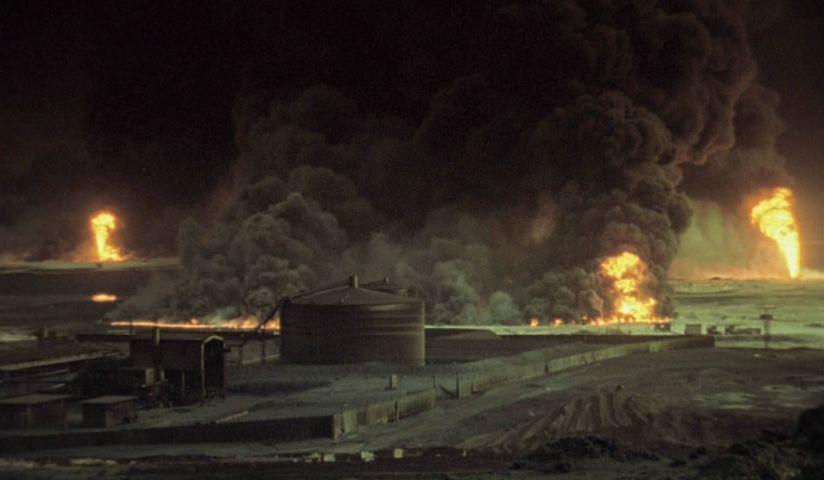
The greater part of Lessons of Darkness consists of lurid scenes of fires in the Kuwaiti oilfields burning out of control and spewing gargantuan clouds of smoke. These images are interspersed with images of devastation, both at the physical and human level, and with human firefighters seemingly overmatched in their efforts to quell the multiple, raging infernos. The images are apparently meant to be abstractly horrific, and there is almost no spoken dialogue and no explicit reference to the Gulf War, or to specific places, or to any historical context. To set some kind of context, Lessons of Darkness opens with images of wasteland and destruction, and the prologue refers to a planet “in our solar system” which evidently has undergone a catastrophic war. So the viewer sees things simultaneously with respect to two overarching narrative perspectives: the real Gulf War and an abstract metaphorical fable of how bizarre humankind’s self-destructive impulses might be to a detached, external observer. The film is then presented partitioned into thirteen chapters, each identified by apocalyptic, perhaps oracular, intertitles which suggest chapters to some sort of apocryphal Book of Revelations.

  1. “A Capital City”. This section features an opening voiceover narration with images of Kuwait City filmed from a low-flying helicopter, ominously suggesting that this doomed city will soon be utterly destroyed by warfare (it wasn’t, and this footage was filmed after the conflict).
  2. “The War”. Here is shown footage of the aerial bombing of Iraq as seen via night-vision video cameras. Although this section is relatively short and no mention of “Operation of Desert Storm” is made, the context is likely to be familiar to a worldwide audience, since it was widely viewed on CNN.
  3. “After the Battle”. Images of war devastation are presented.
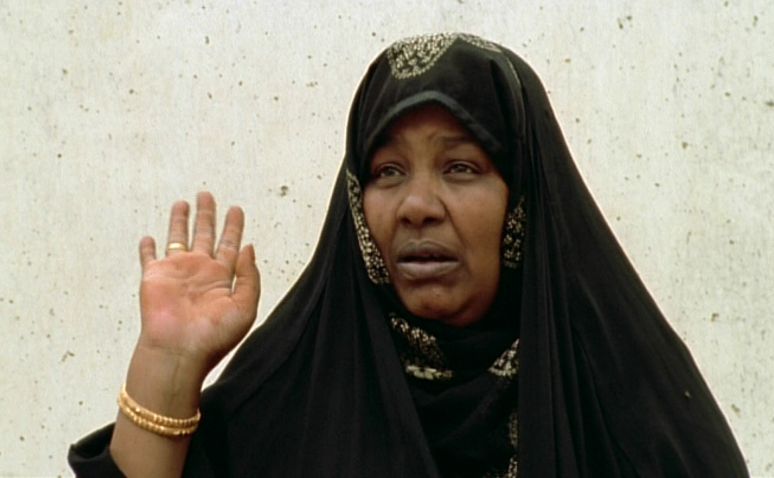
  4. “Torture Chambers”. This thankfully brief section is one of the most memorable, though difficult to bear, sections in the film. First is shown what is apparently the insides of one of the torture chambers run by Saddam Hussein’s government, and it features a mute display of mechanical devices designed to inflict unbearable pain. Then an Arab woman is shown who was been rendered almost permanently speechless by having been forced by the authorities to witness her own sons being tortured to death.
  5. “Satan’s National Park”. Helicopter footage of what seems to be a vast marshland are revealed to be in fact entirely flooded with oil.
  6. “Childhood”. Another Arab mother is shown, this time with a young, disturbed boy who has been rendered speechless by what he has witnessed during the conflict. As with the woman shown earlier, the horror of what happened is not shown, it is only something so unspeakable that one cannot bear to think about it. The viewer’s imagination then fills in the blanks.
  7. “And A Smoke Arose Like The Smoke From A Furnace”. Here, 23 minutes into the film, the raging fires take over the screen. Again, they are filmed from low-flying helicopters.
  8. “A Pilgrimage”. Now the (American) firefighters are shown, sometimes relatively up close and at other times at a distance and dwarfed by the towering flames of the fires that burn endlessly. This section shows the firefighters using explosives to try to put out the fire.
  9. “A Dinosaur’s Feast”. This is more or less a continuation of the previous section showing the firefighters, but now emphasizing some of the huge construction and excavation machines employed in their work. The machinery has monster-like appearances, with arching cranes, serpentine bodies, and huge digging claws.
  10. “Protuberances” – a brief section showing closeups of oil–and-mud swamps bubbling and frothing, and evoking more nightmarish images of Hell.
  11. “The Drying Up of the Wells”. The oil-covered firefighters are shown, often in slow-motion, intensely engaged in the mechanics of their operations. The functional nature of these activities is incomprehensible to the typical viewer, and it all appears perhaps as an abstract Ballet Mécanique from the dark side. The macabre strangeness of it all, and the degree to which these operations seem to be foreign to what we might call normal human intercourse, are worth comparing to Louis Malle’s documentary, Humain, Trop Humain (1974).
  12. “Life Without Fire”. With many of the fires now apparently having been extinguished, the voiceover commentary of the interplanetary visitor expresses wonder as these strange creatures to him (i.e. the firefighters) engage in the baffling act of relighting an extinguished geyser of oil. He comments: “Has life without fire become unbearable for them? . . . . . Others, seized by madness, follow suit. . . . . Now they are content, now there’s something to extinguish again.”
  13. “I am So Weary of Sighing, O Lord, Grant That the Night Cometh”. The final portion returns to the fires, themselves, carrying with it an air of resignation and gloom.

Herzog’s fascination with fire extends to a fascination with its opposite, darkness (hence the title). The demonic forces that lurk inside the hearts of men seem to be beyond civilized understanding or rational control. These issues of cruelty and madness are as elemental as fire, itself, and are not confined to the Middle East [1]. This apparently was Herzog’s project: not to focus on just the particular horror of what happened in one part of the globe, but to fashion a fiction that would portray a more universal damnation. To this end, he opens the film with his own fabricated quotation (“The collapse of the stellar universe will occur, like creation, in grandiose splendor”) which he probably attributes to Blaise Pascal in order to give it the appropriate resonance – Pascal is perhaps not so well-known to English-speaking audiences, but his genius occupies a peculiarly iconic place in the European mind.

The horror that Herzog attempts to convey by his images of man-made Hell is enhanced by its unspeakable nature – it is beyond human articulation. Instead of a deafening roar from the fires drowning out occasional shouts from the firefighters, much of the stoundtrack is filled with funereal, dirge-like orchestral music from Mahler, Prokofieff, Verdi, Wagner, and Arvo Part. The unspeakable nature of this horror is explicitly referenced by the two mothers: one mother is unable to speak comprehensibly, and the child of the other mother has been rendered speechless by rational choice. It is left to our imaginations to fill out these nightmares.

Notes:

  1. For example, consider the use of germ warfare by the Japanese during the Second Sino-Japanese War (1937-45). Here is a quotation from an article on the subject (Judith Miller, “When Germ Warfare Happened”City Journal, (Spring 2010)):

“The methods were brutal. Army trucks dumped gallons of deadly germs alongside roads and railway lines linking Chinese towns so that infections would spread from town to town; planes dropped porcelain bombs containing infected fleas on dozens of villages, causing devastating outbreaks of bubonic plague. The Japanese laced more than 1,000 wells in the area of Harbin with typhoid bacilli. They also inserted typhus into bottles of lemonade that children loved to drink in the summer, Harris reported. In Nanking, they distributed anthrax-filled chocolate and cake to hungry children. The Japanese discovered that packing fountain pens and walking sticks with deadly germs was a particularly effective way of secretly disseminating them. In 1940, Major General Ishii sent a train carrying 70 kilograms of typhus bacterium, 50 kilograms of cholera germs, and 5 kilograms of plague-infected fleas to the city of Hangzhou, a holiday resort favored by Shanghai’s wealthy. From there, the germs were dumped into ponds and reservoirs and spread by aerial spraying, contaminating all life in fields of wheat and millet during the harvest.”

GHW Bush: Honoring a War Criminal

By Stephen Lendman

Source: StephenLendman.org

America honors its worst. Throughout his career as a House member, UN envoy, GOP National Committee chairman, ambassador to China, CIA director, vice president and president, GHW Bush was an unapologetic imperial spear carrier.

He supported all US wars of aggression and launched his own – against nations threatening no one. His actions showed profound indifference to rule of law principles and human suffering.

Countless millions were grievously harmed by an agenda he backed and led as president. Major media shamefully praised what demands condemnation and accountability, even posthumously.

Praising “his leadership and choices on the global stage,” the NYT claimed “historians will almost certainly treat him more kindly than the voters did in 1992” – establishment ones only, not honorable truth-tellers.

A Jeb Bush/James Baker op-ed shamefully said they “never met a man as remarkable as George HW Bush” – a profound perversion of truth.

Wall Street Journal editors praised his war on Iraq, ignoring his naked aggression and genocidal sanctions, the latter responsible for the deaths of around 5,000 Iraqi children under age-five monthly while in force.

He was involved in Washington’s Contra war in Nicaragua. It followed the Sandinista National Liberation Front’s (FSLN) overthrow of US-supported tyrannical Anastasio Somoza’s fascist regime.

As president, he ordered the invasion of Panama on December 20, 1989, aiming to prove his toughness against a defenseless nation no match against America’s military might.

Manuel Noriega was Washington’s man in Panama from December 1983 until yearend 1989, a valued CIA asset until forgetting who’s boss.

No longer being convenient stooge enough for his imperial master led to his downfall.

Bush’s machismo and imperial arrogance bore full responsibility for thousands of Panamanian civilian deaths and injuries, many more thousands displaced.

Residential neighborhoods were destroyed in poorest parts of the country, including by incendiary devices used to torch structures.

Tanks crushed victims. Panamanian defense force members, civilians, journalists, and others were executed in cold blood.

Bush proved his cajones by mass slaughter and destruction. In the aftermath, he shamefully said it was “worth it” – smashing nations a US specialty before and after the rape of Panama.

William Blum earlier called (fantasy) “democracy” America’s deadliest export. Its agenda makes the world safe for Wall Street and other corporate favorites at the expense of ordinary people everywhere.

Commenting on carnage in Panama, Blum said “(t)he invasion and ensuing occupation produced gruesome scenes: People burning to death in the incinerated dwellings, leaping from windows, running in panic through the streets, cut down in cross fire, crushed by tanks, human fragments everywhere.”

Accountability never follows the highest of US high crimes, victims blamed for US wrongdoing every time.

Most Americans know nothing about the so-called 1989 Christmas invasion, why it was launched, the devastation caused, or human toll.

Raping Panama, deposing and arresting Noriega, along with Bush’s Gulf War walkover of Iraq let him crow that “we’ve kicked the Vietnam syndrome once and for all.”

Horrendous Nuremberg-level crimes don’t matter. Noriega fell out of favor for not cooperating with Washington’s contra war on Nicaragua.

Media hysteria vilified him, citing things that didn’t matter when he was Washington’s man in Panama.

When no longer wanted, his fate was sealed, how Washington treats other foreign leaders no longer useful, notably Saddam Hussein.

The January 1991 Gulf War followed imposition of sanctions in August 1990. Enforced for over a dozen years, they were genocidal. A Kuwait-funded PR campaign whipped up public support for naked aggression – ending on February 28.

US forces committed high crimes of war and against humanity, including mass slaughter and destruction of essential to life facilities.

Terror-bombing blasted power plants, dams, water purification facilities, sewage treatment and disposal systems, telephone and other communications, hospitals, schools, residential areas, mosques, irrigation sites, food processing, storage and distribution facilities, hotels and retail establishments.

Transportation infrastructure, oil wells, pipelines, refineries and storage tanks, chemical plants, factories and other commercial operation, civilian shelters, government buildings, and historical sites were also destroyed.

The Panama and Gulf War were two of history’s great crimes. In Iraq, virtually everything needed for normal life was destroyed or heavily damaged.

Genocidal sanctions killed up to two millions Iraqis, two-thirds of them children under age-five. Bush II’s 2003 “shock and awe” blitzkrieg through 2007 took up to 2.0 million more lives, mostly young children.

Two imperial wars of aggression and genocidal sanctions destroyed the cradle of civilization. War and related violence in Iraq continues to this day, the nation occupied as a US colony.

Bush I’s new world order agenda, continued by his successors, including Bush II, features endless wars of aggression, state terror on a global scale, along with growing homeland tyranny, heading toward becoming full-blown.

A special place in hell awaits GHW Bush, Bush II when he passes, and all other US war criminals.

They include everyone supporting Washington’s imperial agenda, including congressional  members authorizing funds without which wars can’t be waged.

An earlier article said the Bush I, II, and entire family dynasty speaks for itself – a crime family for over a century.


Related Articles:

The Amazing GWHB Hagiography

If There’s A Hell Below, That’s Where He’ll Go: The BAR Obituary on George H.W. Bush


“Crimes against Peace”: Historic Class Action Law Suit against George W. Bush

WarCrimesBushObama

The case for Aggressive War against George W. Bush and his Administration.

By Inder Comar

Source: GlobalResearch.ca

On March 13, 2013, my client, an Iraqi single mother and refugee now living in Jordan, filed a class action lawsuit against George W. Bush, Richard Cheney, Colin Powell, Condoleezza Rice, Donald Rumsfeld and Paul Wolfowitz in a federal court in California.

 She alleges that these six defendants planned and waged the Iraq War in violation of international law by waging a “war of aggression,” as defined by the International Military Tribunal at Nuremberg, more than sixty years ago. (The current complaint can be found here). 

At the Nuremberg Trials, American chief prosecutor and associate justice of the US Supreme Court Robert H. Jackson focused his prosecution on the planning and execution of the various wars committed by the Third Reich. Jackson aimed to show that German leaders committed “crimes against peace,” and specifically, that they “planned, prepared, initiated wars of aggression, which were also wars in violation of international treaties, agreements, or assurances.”

For Jackson, the Nuremberg Trials were a high watermark of legalism. In his report regarding the negotiations of the treaty that would set up the Nuremberg Tribunal, Jackson wrote that the Tribunal “ushers international law into a new era where it is in accord with the common sense of mankind that a war of deliberate and unprovoked attack deserves universal condemnation and its authors condign penalties.” He concluded, “all who have shared in this work have been united and inspired in the belief that at long last the law is now unequivocal in classifying armed aggression as an international crime instead of a national right.”

The Nuremberg Tribunal agreed with Jackson. In its famous judgment in 1946, the Tribunal wrote,

“War is essentially an evil thing . . . to initiate a war of aggression, therefore, is not only an international crime; it is the supreme international crime differing only from other war crimes in that it contains within itself the accumulated evil of the whole.”

The case against Bush is based on the conduct of members of the administration prior to coming into office as well as conduct taking place on and after 9/11. Years before their appointment to the Bush Administration, Richard Cheney, Donald Rumsfeld and Paul Wolfowitz were vocal advocates of a militant neoconservative ideology that called for the United States to use its armed forces in the Middle East and elsewhere.

They openly chronicled their desire for aggressive wars through a non-profit called The Project for the New American Century (or PNAC). In 1998, Rumsfeld and Wolfowitz would personally sign a letter to then-President Clinton, urging the president to implement a “strategy for removing Saddam’s regime from power,” which included a “willingness to undertake military action as diplomacy is clearly failing.”

On 9/11, Rumsfeld and Wolfowitz openly pressed for the United States to invade Iraq, even though intelligence at the time confirmed that it was al Qaeda, and not Saddam, that was responsible. Richard Clarke, former National Coordinator for Security, Infrastructure Protection and Counter-terrorism, famously told President Bush that attacking Iraq for 9/11 would be like invading Mexico after Pearl Harbor.

We now know that the Bush Administration began a concerted effort to scare and mislead the American public in order to obtain support for the Iraq War. As alleged in the complaint, this included the famous phrase that “the smoking gun could not be a mushroom cloud,” which was used repeatedly by Administration officials on news shows as a way of equating non-action with the vaporization of a United States city. The Administration used bogus and false intelligence to make the case for weapons of mass destruction, and also falsely linked al Qaeda to Iraq, despite the fact that there has never been any evidence of any operational linkages between the two. These were not simple mistakes: this was an intentional campaign by Administration officials to use faulty data to garner support for a war.

The crime of aggression was completed when these officials failed to secure proper authorization for the war. So concerned with their invasion, the Administration dismissed any need for a formal Security Council mandate. Today, Kofi Annan, an official Dutch inquiry, the Costa Rican Supreme Court, a former law lord from the House of Lords (Lord Steyn) and a former chief prosecutor from the Nuremberg Trials (Benjamin Ferencz) have all concluded the Iraq War was illegal under international law.

After months of briefing, the Northern District of California will issue its order any day as to whether it will recognize the crime of aggression, and whether my client may pursue a civil case against the Bush-era defendants based on that crime. In August of last year, the Obama Department of Justice requested that the district court immunize Bush and his high officials from civil charges on the basis that they were acting “within the scope of their authority.” This issue also remains pending before the court, but it should be noted that both Nuremberg, as well as the more recent Pinochet decision, reject the idea of immunity for leaders when they step outside the appropriate scope of their authority.

We need your support and attention to this case. We cannot let the crime of aggression disappear into history; indeed, even the International Criminal Court has now provided its own definition for aggression, with jurisdiction for this crime being enabled after 2017. We must affirm Jackson’s belief that, “law is not only to govern the conduct of little men, but that even rulers are, as Lord Chief Justice Coke put it to King James, under God and the law.”

For most of the post-war period, this notion — that leaders must be held accountable for their decisions to go to war — has gathered dust. This must change, or else the legacy of Nuremberg, and its foundation for the post-war international legal regime, will be tossed aside in favor of the state of anarchic international relations that led to the Second World War itself. It is time to fulfill Jackson’s dream of a global order governed by law, not war. And it is time for accountability over the Iraq War and for the millions of people who lost their lives or who were affected by it.

Inder Comar is counsel of record for Sundus Shaker Saleh in her case against members of the Bush Administration. The case is Saleh v. Bush, Case No. 3:13-cv-1124 JST (N.D. Cal. March 13, 2013). The firm is providing case updates at witnessiraq.com and is representing Saleh pro bono.

Are We Living In a Police State?

police-share-1

Based on the criteria listed by Sibel Edmonds here, we definitely are. Even folks at the “Top Criminal Justice Degrees” website (Your Online Guide to the Best Criminal Justice Degrees) seem to think so.

The Militarization of the Police
Image source: www.topcriminaljusticedegrees.org

The Militarization of the Police

Are we living in a police state?

– There has been a 4000% increase in “no knock,” militarily-armed swat team raids over the past thirty years.
– Mid 80’s: 2,000-3,000 raids per year[1]
– Present day: 80,000 raid estimate[1]
– ——————
– Pros:
– –Element of Surprise
– –Suspect can’t destroy evidence
– Cons:
– –Invasion of privacy
– –Seconds for suspect to decide if these or cops or break in.
– –Faulty intelligence

– ————
Case Study

– Basics:[4]
– Ogden, Utah. 1/4/12 8:40 pm.
– Local swat team battered down Matthew David Stewart’s door with no warning. Thinking his home was being invaded, Stewart readied his pistol.
– Stewart: 31 rounds fired
– Swat: 250 rounds fired
– Tip: Stewart’s girlfriend saying he might be growing weed.
– Previous record: Clean, veteran.
– Result: 6 wounded swat. 1 killed. Stewart shot twice.
– Findings: 16 small pot plants. No intent to sell.
– Outcome: Upon losing hearing about search warrent legality. Stewart hangs himself in jail cell.

– ————-

And that’s just one of potentially hundreds of similar tragedies.

– Spotlight: NY
– 1994: 1,447 swat style drug raids
– 2002: 5,117
– “I have my own army in the NYPD–the seventh largest army in the world.” Michael Bloomberg

– ————
– Swat Armament:[3]
– Submachine Guns
– Automatic Weapons
– Breaching Shotguns
– Sniper Rifles
– Stun Grenades
– Heavy Body Armor
– Motion Detectors
– Advanced Night Vision Wear
– Armored Personal Carriers
– “From the Gulf war to the drug war–Battle proven” Heckler and Koch’s slogan for the M5[6]

– ————-

These “criminals” are heavily armed too, right?

– WRONG:
– [Weapon used in violent crime: %]
– Gun: 12.7%
– Knife: 10.1%
– Other: 12.1%
– Unknown weapon: 1.8%
– None: 55.8%
– Don’t Know: 5.8%

– —-
– So how can we allow this? The fact is, we don’t.
– 1970: The “no-knock” law is passed with the beginning of the war on drugs.
– 1974: The law was repealed.
– Today: “No knock” happens ALL THE TIME.
– ——
– Leading to more and more unecessary, intrusive, illegal, and deadly SWAT raids.
– Raids leading to civilian injuries, death, or intrusion of the privacy of innocents.
– While injuries from “no knock” raids have been around since the inception of the swat team. Paramilitary like brutality has become a feature of the increasing armed SWAT of the last 10 years.

– Using the military in civic life is like using a hammer when you need a butter knife. There’s bound to be collateral damage. It could happen to you, your neighbors, your friends, or your family. Speak out against the militarization of the police.
Citations- http://usatoday30.usatoday.com/news/nation/2011-02-14-noknock14_ST_N.htm
https://www.aclu.org/blog/criminal-law-reform-free-speech-technology-and-liberty/too-many-cops-are-told-theyre-soldiers
http://en.wikipedia.org/wiki/SWAT
http://online.wsj.com/article/SB10001424127887323848804578608040780519904.html?mod=WSJ_hpp_LEFTTopStories
http://www.cato.org/raidmap


Update 10/25:

Lee Camp recently posted his thoughts on the topic of police militarization: