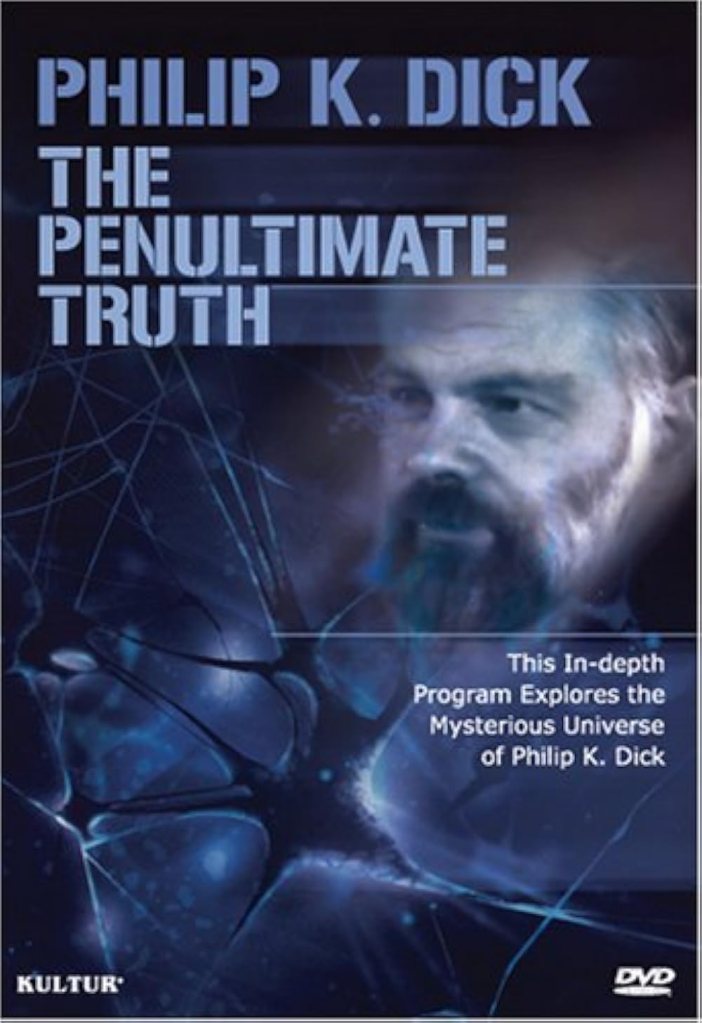
Saturday Matinee: The Penultimate Truth About Philip K. Dick

The Penultimate Truth About Philip K. Dick: Documentary Explores the Mysterious Universe of PKD

By Colin Marshall

Source: Open Culture

Even readers not particularly well versed in science fiction know Philip K. Dick as the author of the stories that would become such cinematic visions of a troubled future as Blade RunnerTotal RecallMinority Reportand A Scanner Darkly. Dick’s fans know him better through his 44 novels, 121 short stories, and other writings not quite categorizable as one thing or the other. All came as the products of a creatively hyperactive mind, and one subject to more than its fair share of disturbances from amphetamines, hallucinogens, unconventional beliefs, and what those who write about Dick’s work tend to call paranoia (either justified or unjustified, depending on whom you ask). But Dick, who passed in 1982, channeled this constant churn of visions, theories, convictions, and fears into books like The Man in the High CastleDo Androids Dream of Electric Sheep?Ubik, and VALIS, some of the most unusual works of literature ever to carry the label of science fiction — works that, indeed, transcend the whole genre.

But what must it have felt like to live with the guy? The Penultimate Truth About Philip K. Dick (named after his 1964 novel of humanity tricked into living in underground warrens) seeks out the writer’s friends, colleagues, collaborators, stepdaughter, therapist, and wives (three of them, anyway), assembling a portrait of the man who could create so many textual worlds at once so off-kilter and so tapped into our real worries and obsessions. Each of these interviewees regards differently Dick’s dedication to the pursuits of both literary achievement and psychonautical adventure, his complicated conception of the true nature of reality, his at times unpredictable behavior, and his penchant for encounters with the divine. Director Emeliano Larre and writer Patricio Vega’s 2007 documentary reveals one of the most fascinating personalities in late 20th-century letters, though, as any professor of literature will tell you, we ultimately have to return to the work itself. Fortunately, Dick’s personality ensured that we have a great deal of it, all of it unsettling but greatly entertaining. Readers taken note. You can Download 14 Great Sci-Fi Stories by Philip K. Dick as Free Audio Books and Free eBooks.

Related Content:

Robert Crumb Illustrates Philip K. Dick’s Infamous, Hallucinatory Meeting with God (1974)

Philip K. Dick Previews Blade Runner: “The Impact of the Film is Going to be Overwhelming” (1981)

Colin Marshall hosts and produces Notebook on Cities and Culture and writes essays on literature, film, cities, Asia, and aesthetics. He’s at work on a book about Los AngelesA Los Angeles Primer. Follow him on Twitter at @colinmarshall.

Sacred Agency

By Kingsley L. Dennis

Source: Reality Sandwich

The following essay was originally published on KingsleyDennis.com


Transcendence is the only real alternative to extinction.

—Václav Havel, Independence Hall, Philadelphia, July 4, 1994

We are cosmologizing the human.

—Henryk Skolimowski, The Participatory Mind


Human consciousness has been on a long journey. Our awareness has shifted from the earlier archaic, animistic mode; to the religious and scientific; and then later to an industrial, mechanistic consciousness. Our ancestors did not live in the same world as we live in now, nor would they have exhibited the same kind of consciousness as we currently do. Consciousness is not a fixed phenomenon or static expression—it changes alongside the flows and fluxes of history, time, and environment.

An integral mode of consciousness began to emerge after the successive industrial revolutions that adapted a “machine style” perspective of control, power, and efficiency; and which eventually propelled global society toward excessive consumption and accelerated growth. This integral consciousness emerged parallel to a new era of technological innovation. That is, a consciousness that reflects dynamics of connection and communication across condensed time and space.

It can be said that we have gone from worshipping faith, then objective knowledge, to finally arriving at an understanding that everything depends upon the subjective self. Throughout this whole journey, like the hero that traverses through the underworld, we have ventured far in search of a mode of being – a state of consciousness and awareness – that can benefit us. A place of conscious self-awareness, which may be termed as sacred, has been present within humanity from the very beginning. It never went away – only we went away. This situation is similar to the behavior of individuals as observed by psychologist Abraham Maslow. Maslow noted how people step back from doing something important, believing others will do it instead. Somewhere along the way we made an internal agreement to stay back and not to overestimate our abilities. It appears that too many of us for too long have avoided being ‘fully human’ and content to remain as ‘only human.’

Regardless of how we may articulate it, the sacred presence within humanity cannot be denied as it is an expression of the evolutionary impulse. As such, it does not stop at transitional stages but is compelled to push toward ever higher states and degrees of consciousness. We are in the hands of a force that we can barely recognize. Throughout the long journey of our development human beings have been deeply involved in this sacred unfolding (for want of a better expression). What this means is that the transcendental yearning to go beyond one’s present state persists in each of us. All of this, our very humanism, should be an inherent part of our cultural mythology. Or at least should influence how we understand and perceive our reality.

Our experience of reality is never pure, but always mediated through consciousness in its various states of reception. The myths we hold as an individual, a culture, and as a collective species reflects our own state of mind. Unfortunately, humanity has for far too long considered itself separate from the cosmos. We feel as if exiled upon a dead planet somewhere upon the fringes of our galaxy. If we do not fully know ourselves it may be because our cultural myths (our narratives) place us within a cosmically isolated reality. To be truly integrated we must recognize that we participate not only upon the planet but also within a grander mythology. In other words, we should accept our responsibility as having sacred agency. After all, the history of human civilization is the history of ourselves as change agents.


Sacred Agency

The philosopher Karl Jaspers referred to the period from 800–200 BCE as the Axial Age. It was a time that, according to Jaspers, similar expressions of new thinking appeared in Persia, India, China, and the Western world. He indicated also that the Axial Age represented an in-between period, where old certainties had lost their validity and new ones were yet to emerge. The new religions that arose in this time—Hinduism, Buddhism, Confucianism, Taoism, and monotheism—influenced new thinking in terms of individuality, identity, and the human condition. These new emerging religions helped to catalyze new forms of thinking and expressions of human consciousness. And yet, over time, we have seen how they were not wholly successful in establishing permanent developmental change.

Social thinker Duane Elgin has referred to our present time as the Second Axial Age in that religions of separation are being replaced by a new spirit of communion. Elgin says that the world is moving into a spiritual communion and empathic connection with a living cosmos. Maybe we are in need of being reminded that there is nowhere else to go when the cosmos already exists within us. This empathic consciousness that Elgin speaks of can be related to the emerging integral consciousness that reflects our increased interconnectivity through our global networks. This connects with our innate, fundamental drive to seek out communion and coherence. A mode of human consciousness that seeks coherence is itself a reflection of a universal natural order. In other words, it is a self-referencing feedback loop. And so now allow me to speculate.

My suggestion is that a purpose for sentient human life upon this planet is as a driver toward establishing a coherent planetary consciousness. In other words, to act as a channel to ‘bring in’ – i.e., receive consciousness – from the consciousness field and to manifest it specifically (that is, to project it) within our earthly reality. There is a correlation here with Aurobindo’s concept of the Supermind/Overmind, in that a form of higher consciousness can be made immanent upon the material plane. Aurobindo referred to this as human evolution moving towards a suprarational or spiritual age that exhibits an intuitive or Gnostic mode of consciousness.

The finer channeling of the consciousness field would require the adequate preparation of human receptivity. That is, our minds and even perhaps our nervous system would need to be sufficiently prepared in order to successfully actualize this potential. By raising localized aspects of human consciousness through individual perceptions and awareness we may better increase the coherence of consciousness amongst the whole—a form of collective transcendence through species consciousness. And this can be made tangible by local agents – i.e., each one of us – becoming aware and conscious in everyday acts of right thinking, right behavior, and right being. It is a mode of sensitive and balanced consciousness that comes only with considerable effort and discipline. This discipline forms part of the developmental awakening within each individual, and which then influences our perceptions and life experiences.

As such, we can come to recognize that we are no longer either isolated individuals or an inarticulate mass. We are localized consciousness acting through aware individuals who consciously seek to connect, collaborate, and care about the future. Each one of us, as localized consciousness, is a reflection of the grander nonlocal consciousness. And in this way each one of us is also a reflection of the other. No individual lives within a shell separated from everybody else, but each is connected to all through our conscious humanity.

What we are seeing emerge across the world is the early stirrings of a planetary civilization; one that is driving toward diversity and coherence. And as we connect and share our thoughts, ideas, and visions we will be helping to strengthen the signal or reception of consciousness and thus the bringing in of the grander cosmic consciousness. A planetary consciousness spread across the Earth may not only be a real possibility, it may very well be a fundamental cosmic purpose.


Human Purpose in the Sacred Order

Recent scientific discoveries indicate that our reality is coded from beyond cosmic space-time; and as such our reality behaves in a way consistent with what we know as a holographic projection. That is, the totality of our reality is in-formed from a deep consciousness beyond it. The known cosmos thus acts as a nonlocal consciousness field, of which sentient life forms as localized manifestations. It has been inferred through various religious and sacred texts, and various wisdom traditions, that the universe (material reality) came into being as a way for its source to ‘know itself.’ This is reminiscent of ‘know thyself,’ the famous maxim from the Oracle of Delphi. Or, in modern language, we can say that we are the eyes through which the cosmos contemplates itself.

Self-consciousness is generally attributed to those sentient organisms at a high peak of mental development. Self-reflection is one of the prized attributes of self-consciousness. Furthermore, self-realization is something we credit to each attained individual consciousness. A realization of the self is part of the path of human actualization. It is a path in which purpose and meaning are core drivers and potentials. Human beings – or we could say human becomings – are naturally driven by a longing, a purpose, and this signifies a connection with a sacred impulse. In our times human civilization has shifted into an unprecedented era of self-actualization. The psychologist Abraham Maslow, who originated a scale of self-actualization, recognized that one of the characteristics of self-actualizers is that they have far less doubt about what is right and wrong than normal people do, and they act upon this inner knowing.

As we further speculate, what would self-realization upon a greater scale be like? That is, self-realization as a planetary consciousness? Or as a galactic consciousness? What would a fully realized and self-conscious cosmic consciousness operating through all of its localized manifestations be like? This would constitute a state of coherent self-aware consciousness beyond our imagination. We can only speculate, or internally gaze upon the possibility.

As a recap then, human consciousness is a localized expression of the greater nonlocal consciousness field. As sentient beings we receive aspects of this consciousness that pervades our space-time. We are animated by it, and we then manifest this through our own minds and human cultures. Our individual expressions of consciousness also reflect back into the greater nonlocal consciousness field. The greater our individual perceptions and conscious realization, the greater the total realization of the entire holographic field consciousness (as if in a feedback loop). To put it another way, cosmic consciousness is ‘in-formed’ through the emerging awareness of each of its conscious subparts, or components. The art of the sacred then is that we each have a role in bringing the unfinished world into existence through conscious participation.

As each one of us wakes up (to use a common metaphor) the cosmic net shines that little bit brighter. If enough individual consciousnesses awake upon this planet we may catalyze a localized planetary field into collective conscious awareness. In this case, we are each a conscious agent of cosmic realization and immanence. We each have an obligation in our existence on this planet to raise our individual, localized expressions of consciousness. In doing so, we both infect and inspire others in our lives to raise theirs, as well as reflecting back our conscious contribution into the cosmic consciousness. In this way, we can act as both citizens of the cosmos as well as caretakers for the sacred order.

We have now arrived at a place where we can recognize and accept that our reality is not a static affair but an active, fluid realm that makes demands upon us. And in knowing this we are compelled to embrace the obligations and responsibilities that come with this role. We are on a path of completion – of conscious completion and communion – which is the eternal path of the sacred. Through this sacred journey of completion we connect and commune with everything else in our reality, and beyond. As human beings we have been tasked with this sacred endeavor. We can become aware of our creative contribution to reality and this can give us meaning and purpose. Perhaps this will finally provide us with our place in the cosmos. And how can we walk this path?

We can take this journey through our small acts of conscious awareness – our thoughts, attitudes, behavior, and our everyday actions. Upon the next level, our social changes and emerging technologies may form part of this process, establishing an extended mind and empathic embrace across the face of the earth. Magic is alive; magic never died. Everything is ultimately a technology of the soul; and all magic, all science, and all human expression is a part of this soulful technology. And with each step forward we move closer to soulful communion with a grand conscious and sacred order.

The sacred impulse animates the expression of consciousness at the individual, collective, and planetary level. And one day we may witness a grand awakening, unprecedented upon this planet, and this may very well be the purpose for sentient life, as conscious agents of the sacred order. This is likely to be more reality than fantasy. The hidden treasure that is at the very core of our existence wishes to be known – for us to know ourselves – by our individual journeys of self-realization.  We are not alone. A great planetary future awaits us, as a great treasure that wishes for communion. Welcome to the new story.


Truth has to appear only once, in a single mind, for it to be impossible for anything ever to prevent it from spreading universally and setting everything ablaze.

—Teilhard de Chardin, The Heart of Matter

The Search for Meaning in Modern Life

By Kingsley L. Dennis

Source: Waking Times

Every good story about a search begins with a tale. So, here’s one; it’s a tale about a magician who gave a dinner for his neighbours.

There was once a Magician who built a house near a large and prosperous village. One day he invited all the people of the village to dinner. ‘Before we eat,’ he said, ‘we have some entertainments.’

Everyone was pleased, and the Magician provided a first-class conjuring show, with rabbits coming out of hats, flags appearing from nowhere, and one thing turning into another. The people were delighted. Then the Magician asked: ‘Would you like dinner now, or more entertainments?’

Everyone called for entertainments, for they had never seen anything like it before; at home there was food, but never such excitement as this. So, the Magician changed himself into a pigeon, then into a hawk, and finally into a dragon. The people went wild with excitement.

He asked them again, and they wanted more. And they got it. Then he asked them if they wanted to eat, and they said that they did. So the Magician made them feel that they were eating, diverting their attention with a number of tricks, through his magical powers.

The imaginary eating and entertainments went on all night. When it was dawn, some of the people said, ‘We must go to work.’ So the Magician made those people imagine that they went home, got ready for work, and actually did a day’s work

In short, whenever anyone said that he had to do something, the Magician made him think first that he was going to do it, then, that he had done it and finally that he had come back to the Magician’s house.

Finally, the Magician had woven such spells over the people of the village that they worked only for him while they thought that they were carrying on with their ordinary lives. Whenever they felt a little restless he made them think that they were back at dinner at his house, and this gave them pleasure and made them forget.

And what happened to the Magician and the people, in the end? Do you know, I cannot tell you, because he is still busily doing it, and the people are still largely under his spell.

Modern life is much like this tale – we live under a magician’s spell – and the magician is called Modernity. Modernity, especially as it emerged in western, industrialized cultures, created a system that put a spell on us. And this spell is principally promoted through our mainstream medias. Whether rationally, instinctively, or deep in our hearts, most of us know that something is not right about how human societies are managed. Human life is not yet in balance. And too many people still live in fear.

We are manipulated by our mainstream medias at unprecedented levels, and constantly fed with a controlled flow of information. This process is the old mind of humanity, still operating through control, censorship, and consumerism. In this way our contemporary societies are increasingly centered around emotion to a degree that allows people to be entertained as well as manipulated like never before. What we may be less aware of is that the human being is driven by an evolutionary energy that manifests through mental, emotional, and physical/sexual processes. This energy can be used to develop and drive us forward, or it can be hampered, blocked, and manipulated into slowing down our development. Mental, emotional, and physical/sexual energies are all necessary components of the social human being. If we take just a casual look at our mainstream media, entertainment, and social attractions/distractions we will readily see that these are the very areas which are targeted by the ‘culture of spectacle’ that is modern society.

Ancient religious-spiritual traditions have long talked about such ‘energy predators’ that are said to feed off from unstable human mental and emotional states. The early gnostic Christians referred to some of these as the Archons; various North American Indian tribes refer to Wetiko/Wendigo; Don Juan in the Carlos Castenada books refers to the Predators; and South American shamans have long talked of spirits that feed off from and fragment the vulnerable human inner state/soul.

We must wonder why it is that our modern cultures promote entertainments that manipulate and play upon excessively distorted images of mental and emotional anguish as well as exaggerated portrayals of sexuality. Furthermore, we are bombarded daily with images of death. In fact, a recent study into western media announced that the most repeated word in media is ‘death.’ Further, it revealed that in the first twelve years of a child’s life they would have been subjected to around 20,000 murders through television news and programs, films, online content, and video games. These forms of stimulation directly target a person’s mental, emotional, and physical states, which in turn hampers the operation of harmonious, developmental energies.

Modern life is increasingly a life addicted to high stimulation. Yet by its very nature it also creates anxiety. Many people are forced, or seduced, into lives that are continually stressful and busy. There is no room for the spaces, the intervals, of internal reflection. Yet similar to how music is not music without the intervals, so is life not a life without those internal spaces.

We spend our days trying to grasp at life, trying to understand it, often with ways that are not adequate. It is like trying to capture the ocean with a bucket. The ocean stands magnificently before us, and yet so many of us in modern societies are running around anxiously with empty buckets in our hands. We’ve been told that only full buckets are of any use – full buckets represent usefulness and progress.

Here is another story:

A man had two large pots, each hung on an end of a pole which he carried across his neck. One of the pots had a crack in it, and while the other pot was perfect and always delivered a full portion of water at the end of the long walk from the stream to his house, the cracked pot arrived only half full.

For a full two years this went on daily, with the man delivering only one and a half pots full of water to his house. Of course, the perfect pot was proud of its accomplishments, feeling accepted and appreciated. But the poor cracked pot was ashamed of its own imperfection, and miserable that it was able to accomplish only half of what it had been made to do. After two years of what it perceived to be a bitter failure, it spoke to the man one day by the stream.

“I am ashamed of myself, and I want to apologize to you.”

“Why?” asked the man. “What are you ashamed of?”

“I have been able, for these past two years, to deliver only half my load because this crack in my side causes water to leak out all the way back to your house. Because of my flaws, you have to do all of this work, and you don’t get full value from your efforts.” the pot said.

The man felt sorry for the old cracked pot, and in his compassion, he said, “As we return to my house, I want you to look at the beautiful flowers along the path. It will make you feel better.”

Indeed, as they went up the hill, the old cracked pot took notice of the sun warming the beautiful wild flowers on the side of the path, and this made it feel a little happier. But at the end of the path, it still felt bad because it had leaked out half its load, and so again the Pot apologized to the man for its failure.

The man said to the pot, “Did you notice that there were flowers only on your side of your path, but not on the other pot’s side? That’s because I have always known about your flaw, and I took advantage of it. I planted flower seeds on your side of the path, and every day while we walk back from the stream, you’ve been watering them. For two years I have been able to pick these beautiful flowers to take home to my wife. With you being just the way you are, you have given beauty and meaning to me every day.”

The way we are can give us beauty and meaning every day, and yet it seems we are living in a world of decreasing meaning. Our modern systems strive for perfection – for progress and efficiency – yet there is less and less happiness.

And the situation is worse in modern western cultures where so many people are seemingly dissatisfied even when they have acquired most things to keep them happy. Perhaps a society that provides superficial comfort produces conditions that do not develop people or cause them to turn an inward gaze or to question notions of their meaning and existence. It is important that other cultures do not follow this western model of superficial consumerism.

It is unfortunate that the meaning of life is often a meaningless question to so many people. Seeking the ‘unnamable’ might sound like madness to many people, and certainly there is little place for it in modern societies that prize themselves on progress. And yet a life that seeks meaning is its own adventure. The ‘unnamable’ does not need to be named – only recognized internally. The external world is not the only reality that exists for us.

The attitude of the modern-day person to the ‘world outside’ has largely been one of hostility – we have been conquering the external world for the most part of human history, instead of mastering our own inner nature. This hostile attitude ignores the reality that all life is interdependent and that our lives are a projection of our inner realities – that is, our fears, anxieties, and insecurities become projected into the world the same as our hopes, visions, and dreams. Whatever we project externally eventually becomes our sense of reality.

We all share a collective reality, despite our cultural differences. Although it alters depending upon where we were born and in which cultures we live, the methods each modern system uses are basically the same – we are provided with beliefs, cultural references, and norms and attitudes. The writer Doris Lessing referred to this as ‘The prisons we choose to live inside.’ And within these psychological prisons many people, as well as the institutions of the modern world, have rejected the wisdom of sages, mystics, philosophers, and even the voices of creative artists. They prefer instead the superficial trappings, entertainments, and technological distractions of the consumerist marketplace. Now, I wish to be clear here – I am not anti-technology. In fact, I am a great supporter of it; but not at the expense of the human vision. Despite the technological progress of the external world, there must always be a developed interior world to observe, reflect, and to question it. Without this, the exterior life is unleashed without values. Without an interior life to seek for significance, what gives meaning to our lives?

So, what is the ‘interior life’? There are no instruction sets for how to live a human life – and we live in a world where more and more people are at a loss to know either why they live or why they die. In life we must strive to examine the human condition.

Modernity has attempted to reinterpret the human condition – to see it as an external drive for progress – and this has resulted in a separation from our need to seek an essential inner self. This modern project has sought to divorce the human being from their imperative to find meaning in existence. The human project, if we wish to call it that, can never be ‘completed’ – it is an eternal quest to always be becoming. Here is a quote I would like to share:

‘When you have found yourself you can have knowledge. Until then you can only have opinions. Opinions are based on habit and what you conceive to be convenient to you. The study of the Interior Life requires self-encounter along the way. You have not met yourself yet. The only advantage of meeting others in the meantime is that one of them may present you to yourself. Before you do that, you will possibly imagine that you have met yourself many times. But the truth is that when you do meet yourself, you come into a permanent endowment and bequest of knowledge that is like no other experience on earth.’ ~TARIQAVI

What we are truly seeking for – and what the interior life can show us – is power over ourselves: not for power over others.

The world is in need of soulful healing, not power-seeking through corruption and manipulation. The world requires healed, integrated, and balanced people; for that which we lack in ourselves we shall always find lacking in the world outside. Also, there are many external forces in the world that are trying to make us live not according to our own sense but according to dominant social narratives. We are told that we must live according to certain social narratives that generally benefit those systems that have no interest in the human soul. And when we deny ourselves such essential nutrients we find that we have a discomfort within us. People are taking increasing amounts of antidepressants, or stimulants; as well as relaxants – we take drugs to bring us up and other drugs to take us down. We are open and vulnerable to the energies of discouragement. Here is a tale about the price of discouragement:

Once the word spread that the devil was pulling out of his business and was arranging to sell-off all his tools of the trade to the highest bidder. The night of the sale all the tools were arranged for the bidders to view. What a motley crew it was! There were sinister tools of hatred, jealousy, envy, malice, treachery, plus all the other elements of evil. Yet besides these there also was an instrument that seemed harmless, a wedge-shaped instrument that appeared worn out, shabby, and yet was priced so much higher than all others. Someone asked the devil what was the name of such a poor-looking instrument.

‘Discouragement,’ answered the Devil.

‘And why is the price so high for such a non-malicious sounding instrument? asked the bidder.

‘Because,’ spoke the Devil, ‘this instrument is more useful to me than any other. I can enter the consciousness of a human being when all other ways fail me and once inside through the discouragement of that person I can do whatever I please. The instrument is worn out because I use it almost everywhere and as very few people know about this I can continue to successfully achieve my goals.’

And as the price of discouragement was so very, very high even today it remains a tool in the property of the Devil.

The price of discouragement is a price too many people are paying – and it is a high price (as the devil knows!)

It is a common situation that we tell people at work we are happy when for much of the time we are not. We buy more and more items to feel happiness within ourselves or to buy happiness in others. People in modern cultures continue to accumulate goods and possessions whilst feeling empty within. Such consumerism empties our pockets and fails to fill our souls. And not only our physical lives become crowded with belongings but our psychological spaces too. We are crowded with those belongings that have accumulated as psychological attachments: the beliefs, ideologies, nationalisms, opinions, likes, dislikes, and all the rest. We are often cluttered in our minds by belonging to this and that and all the other things that we cling to or that cling to us. And this is where some of the disruptions are, and will continue to come from, because our belongings are now breaking apart. As our social, cultural, economic, and work lives go through change and transformation – as they are currently doing – then the clinging to old ‘belongings’ will only serve to cause greater confusion and disorientation. Already it seems as if we are living in a world that is displaying increasing outward signs of craziness and psychopathic tendencies. We must ensure that the world never has more critics than visionaries, or more complainers than positive doers. We must ensure that we do not lose sight of our frameworks for meaning.

Pre-modern societies, for example, lived within their own frameworks of meaning. Not all questions had their answers, yet mysteries and the mysterious at least had a home in which they could exist. We often live today within an atmosphere of meaningless questions and contradictory answers. The pursuit of meaning is being replaced by the pursuit of progress. Progress may alleviate some of our suffering and pains, yet it shall never compensate for the lack of fulfillment we feel inside, for this requires metaphysical or transcendental nourishment. Any notion of the spiritual, or the metaphysical, is often considered not essential to our daily life, and we are taught to dismiss it. Modernity’s task was thus seen as freeing us from the illusions of transcendence. And yet the desire, or the need, for some Absolute remains deep within us and can never be totally eradicated. Perhaps it is this contradiction that lies at the heart of our contemporary distress.

Modern life also tries to eradicate, or at least hide, all sense of enigma. Yet it is precisely these enigmas that make our lives rich in wonder and awe. To attempt to abolish them is an act of great ignorance and hubris. Unanswerable questions must be embraced and not rejected. Mystery and the mysterious must be allowed a space to thrive and enthrall us. It is this sense of mystery that keeps us curious, and curiosity is one of our driving, motivating forces.

Modern societies may well praise their sophisticated intellectual culture, yet it comes at the cost of having a deteriorated spiritual culture. That which belongs to the experience of the human soul is considered not only incommunicable, but rather dangerous to communicate. In the end, life’s mysteries are kept out of sight because they cannot be fully known and thus controlled. There is a spell upon us, and we are being distracted from the essential. Here is another tale:

A lion was captured and imprisoned in a reserve where, to his surprise, he found other lions that had been there for many years, some even their whole life having been born in captivity. The newcomer soon became familiar with the activities of the other lions, and observed how they were arranged in different groups.

One group was dedicated to socializing, another to show business, whilst yet another group was focused on preserving the customs, culture and history from the time the lions were free. There were church groups and others that had attracted the literary or artistic talent. There were also revolutionaries who devoted themselves to plot against their captors and against other revolutionary groups. Occasionally, a riot broke out and one group was removed or killed all the camp guards and so that they had to be replaced by another set of guards. However, the newcomer also noticed the presence of a lion that always seemed to be asleep. He did not belong to any group and was oblivious to them all. This lion appeared to arouse both admiration and hostility from the others. One day the newcomer approached this solitary lion and asked him which group he belonged to.

‘Do not join any group,’ said the lion. ‘Those poor ones deal with everything but the essential.’

‘And what is essential?’ asked the newcomer.

‘It is essential to study the nature of the fence’

A whole society can be distracted. There is a pertinent analogy here to how, in 256AD, the Persian army took Antioch from the Roman Empire. Many of the inhabitants were attending the roman theatre and were oblivious to the enemy archers who had climbed up behind them into the stands. The actors down below had seen the enemy archers and were desperately trying to warn them with hand signals…but the audience did not understand, thinking it part of the entertainment – until it was too late. They were amused up to the point of death. Perhaps we too, in the words of social critic Neil Postman, are ‘Amusing ourselves to Death.’

Understanding Our Place In The World

The only genuine freedom is to be found by turning within ourselves. The human being is naturally an imaginative and creative creature. Reality may be harsh and painful, yet it is also the realm of so much wonder and awe. We may live our lives playing in the mud, yet our minds can reach the stars. Our science can reach into the molecule as well as penetrate into the formation of the universe. Our mystics and sages can reach into the pulsating heart of the cosmos. The human being has an inner dimension that needs to be investigated and which, in turn, is timeless.

It is my view that the role of imagination – the interpenetration of the interior world – is crucial. It is what fuses together that which is above to that which is below. It is also a channel for intuition; and it is through intuition that we get closer to the essential. The inward gaze forever attempts to reveal the role of the human being, and what makes us human. It is about trying to understand our place in the world and our shifting views of the world. And right now, we find ourselves at a crucial point in human history.

Life on this planet is undergoing a great change. There is a revolution coming as people, especially the young people, develop their ways of communication, collaboration, and a new consciousness. We are seeing examples of empathy and compassion from young people around the world, as well as innovation, creativity, and inspired motivation. I have stated before that we are shifting into an epoch where new value sets will emerge as the dominant traits.

[1] And some of these values are already being expressed within our younger generations. I refer to these as the ‘C’ values of Connection – Communication – Collaboration – Consciousness – Compassion. Such changes will come into our lives, yet not overnight. It is not like flicking on a light switch. I expect it will be a process where much soul-searching and the questioning of our meanings and values will have to occur beforehand. However, it is not all about violence and thuggery, despite what our mainstream news may be showing us. There is a change emerging across the planet, and this change shall arise from within, through a new understanding of the human spirit, and of our place not only in our local cultures but also within a shared, planetary home. These are critical times of transition – and of momentous importance to us.It is important to recognize that we are undergoing a shift from localized cultures into a period of becoming planetary citizens. Nationalisms will need to become secondary, or put aside altogether, as we come closer together as a global species. And this significant transition is dissolving our securities, our belief systems, and our models of reality. Everything around us is beginning to shake – and so is the earth, literally. We can no longer remain within the old narratives. We are in need of new worldviews, both as individuals as well as within our communities and societies. What we now need is genuine and sincere far-reaching vision. And in our mainstream cultures we are also lacking hope and trust, especially in our socio-political systems. What is now essential is hope and trust in humanity, and in the richness and resilience of the human spirit. We are on the cusp of a different world coming into being, and at its centre shall be the human heart and soul. There can be no genuine, lasting future if it is based solely on the exterior life – it must be driven by the values that come from the interior of the human being.

To be prepared for the future world that is now emerging before us we must adapt our thinking and our consciousness to all possibilities. What we first need is a genuine change of mind:

God decided to come down to Earth for a quick look at how creation was coming along.

God approached Earth and happened to look at a big tree full of howling monkeys. As God looked down, one of the monkeys happened to look up and saw God.

The monkey became excited and started to shout: ‘I see God…..I see God!’

None of the other monkeys paid any attention. Some thought the monkey was crazy or perhaps just a religious fanatic. They went on about their daily lives of collecting food, taking care of their young, fighting with each other, etc., etc. Not getting any attention, our monkey decided to try to get attention from God, and said:

‘God, Almighty, You are the Beneficent, the Merciful, please help me!’

In an instant, the monkey was transformed into a man living in his own human community. Everything changed, except for one thing: the monkey’s mind. The monkey immediately realized that could be a problem.

‘Well, thank you God, but what about my mind?’

‘That,’ said God, ‘you will have to change yourself.’ 

As in this story, we have the human form. The next step is for us to assume the responsibility for the correct level of consciousness. It is as simple and as difficult as that.

We have to accept the responsibility for our own choices and actions; and also, how we choose to respond to events. Everything begins and ends with ourselves, and anything other than this is an excuse, no matter how plausible it may seem to us. As creative, imaginative beings we invent and innovate. At the same time, we are masters at inventing our own false stories and imaginings that self-deceive. In this regard we must choose carefully where we wish to put our attention, time, and efforts. After all, when we visit a beautiful garden do we choose to sit by the roses and savour their sweet smell, or to sit amidst the weeds that prick us? It is important to gift ourselves moments of joy, for joy is an infectious energy – and it shares easily too.

It is up to us to choose those moments, events, and circumstances to engrave upon our memories and heart. It is also about choosing what things to forget. Most of the things we encounter or accumulate we would be best to give up, or give away. We should only keep the few, thus ensuring the quality and integrity of those things we keep close to us. Here is another tale:

An Arabian legend tells of two friends who were travelling through the desert and at one point they fell into disagreement about the trip whereby one of the friends slaps the other across the face.

The friend who had been slapped said nothing, only wrote in the sand: ‘Today my best friend slapped me in the face.’

Both friends continued on their journey and eventually arrived at an oasis where there were baths to refresh themselves. The friend who had been slapped jumped into the large baths yet soon found himself starting to drown. The other friend immediately jumped in after him and saved him. After recovering the first man took a pen and wrote on a stone: ‘Today my best friend saved my life.’

Intrigued, the friend asked: ‘Why is it that after I hurt you, you wrote in the sand and now after saving you, you write on a stone?

Smiling, the other friend replied: ‘When a good friend offends us, we write in the sand where the wind of forgetfulness and forgiveness will be responsible for clearing it off; on the other hand, when something great happens to us, we burn it into stone in memory of the heart where no wind in the world can erase it.’

We build up and develop our own interior world by all the small things and moments we choose to engrave upon our heart, spirit, and soul. We can choose those things we wish to line our forward path with.

Choosing Our Path

We should not be afraid to talk about things of the spirit – to be present with spirit and to live with it in our everyday moments. As Bob Dylan says, those who are not busy being born are busy dying. We are representatives of the spirit, and so should seek to be present to this, without the urge for external showing-off. There is no need for acting weird or strange; to wear odd clothes or follow customs antagonistic to the culture in which we are living. We may think and feel differently, and have experiences that are beyond the accepted, normal ken. Yet to revert to odd external behavior only shows that we are unable to internalize and stabilize these experiences and energies. To all purposes, there is nothing wrong in appearing normal to the outside world. To engage with the spirit, we may have to first learn how to be still, without being bored. There are already enough active distractions in the world as it is – why add more?

It is a normal request to ask for ‘practical things.’ People want to find activities, acts, exercises, and rituals to help them along their own path of development. And the world offers many of these things, in varying degrees of genuineness, sincerity, and effectiveness. Yet sometimes being given an action to attend to belittles the process of the initial search. For me personally, I am unable to give specific remedies for the search for meaning, other than to say that a person must first experience what this longing, this need, feels like. We are catalysts for our own search for meaning, and each path is walked differently. To begin with, we must learn how to articulate this need. This will then begin the course of one’s life that will forever alter what comes after. We are compelled to trust our instincts, our intuition, and to take the appropriate response. We are not here in this life to live like ghosts amongst the phantasms of the world. We always have an internal choice, and this should not force us to surrender into the abyss of mass insanity. As the story goes,

There was once a wise and powerful king who ruled in a remote city of a far kingdom. And the king was feared for both his might and his love of wisdom. At the heart of the city was a well whose water was cool and crystalline, and all the inhabitants drank from this well, even the king and his courtiers, because there was no other well in the city. One night, while everyone was asleep, a witch entered the city and poured seven drops of a strange liquid into the well, and said:

‘From now on, anyone who drinks this water will go crazy.’

The next morning all the inhabitants drank the water from the well, except the king and his lord chamberlain, and very soon everyone went mad, as the witch had foretold. During that day, all people went through the narrow streets and public places whispering to each other:
‘The king is mad. Our king and his lord chamberlain have lost their reason. Naturally, we cannot be ruled by a mad king. We must dethrone him!’

That night, the king ordered a golden cup of water from the well to be brought to him. And when they brought the cup the king and his lord chamberlain drank heavily from it. Soon after that there was great rejoicing in that distant city of a far kingdom because the king and his lord chamberlain had regained their reason.

We must be fearless in committing to the inner path we have chosen, so long as we harm no other. The genuine inner path is a subtle one. At times it can seem as if nothing is happening – as if we are going nowhere. Perhaps the path itself is a search for no-place and no-where. And yet we can rest assured that the inner path is active in each moment, in all times. And the search for this can bring meaning to us as we engage with the modern world. Amidst the distractions and entertainments on offer it is possible to remain focused with our own internal meaningful enjoyment. And this inner joy brings with it its own sacred moments.

It will do us good to remember that life lies beyond reason, and is a sacred thing. And we should allow this sacred presence into our lives, with joy, respect, and even a little humour. After all, just a little bit of joy, respect, and humour can go a long, long way – and we have far to travel.


References:

[1] See The Phoenix Generation: A New Era of Connection, Compassion & Consciousness

The Philosophy of Westworld

By Jeremy D. Johnson

Source: Omni

Michael Crichton wrote and directed Westworld for the big screen in 1973. That same decade, in 1976, an adjunct professor named Julian Jaynes made the bestseller list with a surprising title: The Origins of Consciousness in the Breakdown of the Bicameral Mind. You wouldn’t think that a book with a name like that would become such a popular success. Yet, there it was. In 2016, when Westworld came to the small screen in the re-imagined HBO series, you wouldn’t imagine Jaynes getting heard from again. Especially since bicameralism wasn’t even mentioned in the Michael Crichton’s original film. Yet, there he was. Early on in Westworld’s first season Dr. Ford, one of the creators of the park, explains how he and his co-founder Arnold used a “debunked” theory about the origins of consciousness to bootstrap A.I. The scientific community didn’t recognize bicameralism as an explanation for the origins of the human mind, but, as Dr. Ford suggests, it could be useful for building an artificial one. Thousands of people—perhaps more—started Googling for “bicameral mind.” Bloggers and YouTube channels capitalized on the sudden interest by writing articles and introductory videos about this weird, arguably psychedelic theory of consciousness. Suddenly everyone was interested.

This article isn’t going to be one of those explanation pieces, but it’s worth mentioning a few, precursory details.

Looking Through the Mirror of Consciousness

According to bicameralism, human beings used to hear voices—auditory hallucinations—as a means for the right brain to “talk” with the left. Rather than having an inner monologue, the kind of self-consciousness we take for granted today, ancient people literally heard the voices of gods as their conscience, telling them what to do. This, Jaynes argues, accounts for the abundant descriptions from antiquity of gods and deities appearing all over the place, meddling directly in human affairs. Over time—about 3000 years ago—as various calamities occurred and societies got bigger, more complex, the bicameral mind broke down. The gods went silent. The modern, introspective self, quite literally, came to mind.

Jaynes may have been onto something, but even if he wasn’t, his book makes for a compelling and well-written read. The cultural zeitgeist of the 1970s, we must remember, was the high-water mark of psychedelic intrigue and “High Weirdness,” with writers like Philip K. Dick and Robert Anton Wilson both having their own inextricable experiences in 1974 (see “2-3-74”). Dick would turn this encounter into the semi-autobiographical VALIS trilogy as well as his Exegesis. This brings us back to our time.

Bicameralism would have been enough to place Westworld in good, present company: Netflix’s recent Stranger Things and OA, cerebral films like Arrival, and even the metaphysical, possibly D.M.T. inspired comic book movie Dr. Strange. Just to name a few. What connects any and all of these media is pop culture’s intensifying allure to the mysteries of our own consciousness. We’re having something, as The Atlantic recently suggested, like a “metaphysical moment.” Multiple realities intersecting with our own. Deep, dark structures of the psyche spilling up into the conscious mind in the form of auditory hallucinations. The emergence of consciousness buried somewhere in archaic chapters of history. All of these subjects are in a full saturation moment through hit T.V. series, and at least flirted with in Hollywood blockbusters. Consciousness is in. (Permit a moment of conjecture, but with the increased sense of global, existential malaise around issues like climate change and political nativism, that we’ve turned inward for solutions should come as no surprise. Western culture in the 1960s and 70s, despite, or because, of being under threat of a Cold War and nuclear armageddon, produced tremendously thoughtful and visionary art.)

Westworld is a show that celebrates the kind of weird prevalent in pop culture during the 1970s: a desire to connect with those hidden recesses of the psyche that each of us have experienced in dream, creative process, and revery. “O, what a world of unseen visions and heard silences,” Jaynes writes in The Origins of Consciousness, “this insubstantial country of the mind!” When Dolores, a “host” in the park, goes on her journey of self-discovery, there’s a part of us that goes with her. It helps that Dolores, along with the other hosts in the park, experience their memories as a kind of waking dreaming, navigating altered states of consciousness and auditory hallucinations in order to succeed in their quest for liberation. We’ve all felt, quite rightly, that there is more to ourselves than our waking, conscious minds, and that if there was some way to communicate with those occluded dimensions of ourselves we could gain some inkling of wisdom (hence, I think, all the self-described “psychonauts” around today). Westworld functions like a scrying mirror for the curious audience to embark on their own journeys of self-knowledge. It is this more intangible aspect of the show—and not just Western gunslinging androids—that made it such a hit.

Jeffrey Kripal, a religious scholar, writes about this intimate link between pop culture and consciousness in Mutants and Mystics: Science Fiction, Superhero Comics, and the Paranormal.

“What makes these particular forms of American popular culture so popular is precisely the paranormal. The paranormal here understood as dramatic physical manifestations of the meaning and force of consciousness itself.”

We are drawn to the weird because the weird is showing us something about ourselves.

Elaine Pagels published The Gnostic Gospels in 1979, a book which quickly became a classic in the American spiritual counter-culture. I mention it here because of the intriguing gnostic motifs embodied so well by Dr. Ford himself. For those of who you aren’t familiar with gnosticism, or The Gnostic Gospels, these were written by early Christian sects who, speaking very generally, believed in heretical ideas. There was no single gnostic church. Philip K. Dick was drawn to their darker, paranoid theme of the false world: the idea that our reality was somehow an illusory one—a trap—created by a lesser god. A “demiurge.” The demiurge would rule over its creation and keep human souls ignorant of their spiritual birthright, lest they break through themselves in states of elevated consciousness or “gnosis.” It was, in other words, up to the individual to liberate themselves, not through reason, or faith, but gnosis. Other popular films, like The Matrix Trilogy, would take this motif and run with it quite successfully. But Westworld’s Dr. Ford plays the perfect gnostic demiurge; having created the hosts in the first place, he ensures that they stay ignorant to their own potential for self-consciousness and liberation. Trapped in their loops, and wiped of their memories, the hosts remain blissfully unaware that they are existing inside of an amusement park. (To avoid any major spoilers I’ll simply leave this cryptic remark: we know this is only partly true by the end of season one. The gnostic trap becomes a different, albeit more violent, means toward freedom. Dr. Ford, by the final episode, becomes a triumphant expounder of the gnostic doctrine: the gods won’t help you liberate yourself. Those voices were you. You are the higher being waiting to become self-illuminated. Westworld is not only about consciousness, but liberation through personal gnosis.)

This Path is Never Linear

The maze is an image with deep significance. Hosts in the park, when they begin to develop nascent self-consciousness, are invited to partake in a puzzle—“The Maze.” The Man in Black is repeatedly told, much to his dismay, “the maze isn’t meant for you.” It doesn’t stop him from trying. The goal is to get to the center of it, but what does this mean? Carl Jung, the Swiss psychologist responsible for developing a theory of the unconscious, and for whom the 70s spiritual counterculture would help to popularize, would immediately recognize the maze as a symbol of both the labyrinth and the mandala. Let me explain.

By entering the maze, or synonymous labyrinth (the show dangles this myth in front of us with the strange appearance of a Minotaur host), an individual embarks on a perilous journey of self-discovery. It is through surviving the perilous twists and turns of the labyrinth that the adventurer gains some a form of self-realization. Think: Luke Skywalker and Yoda’s cave in Star Wars V: The Empire Strikes Back. In the case of Westworld, the maze leads to consciousness, and perhaps even freedom from the park itself. Jung, if he were alive today, might smile and nod. “The goal of psychic development,” he writes in Memories, Dreams, Reflections, “is the self.” Jung adds—echoing Dr. Ford—that consciousness isn’t a pyramid but a maze: “There is no linear evolution; there is only the circumambulation of the self.” When we see the image of the maze painted on the skull of a host, early on in the season, we’re looking at a mandala: those intricately patterned mazes often leading towards some center. Jung writes, “The mandala is the center. It is the exponent of all paths… to the center, to individuation.” It is through the messy, round-about series of wrong turns that we come to consciousness. “Mistake. Mistake.” There is no straight path to the center of the maze. There is no easy way towards self-discovery. No wonder we loved this show. It turns out the maze really is meant for us.

6 The Enlightened Madness of Philip K. Dick: The Black Iron Prison and Wetiko

images

(Editor’s note: Today happens to mark the anniversary of the birth of Philip K. Dick on December 16, 1928.)

By Paul Levy

There is something terribly wrong in our world. The Native American people have a term—wetiko—that can really help us to contextualize and get more of a handle on the ever-unfolding catastrophe playing out all over our planet. As my research deepens, I am continually amazed that so many different spiritual wisdom traditions, as well as creative artists, are each in their own unique ways, pointing out wetiko. Wetiko—which can be likened to a virus of the mind—works through our unconscious blind spots, which is to say that it depends upon our unawareness of its covert operations within our own minds to keep itself in business. There is no one definitive model that fully delineates the elusive workings of wetiko disease, but when all of these unique articulations are seen together, a deeper picture begins to get in focus that can help us to see it. Seeing how wetiko works—both out in the world and within our own minds—is its worst nightmare, for once we see how it is playing us, its gig is up.

Recently, I have been delighted to learn that the science fiction author Philip K. Dick (henceforth PKD) was, in his own completely unique and “Philip K. Dickian” way describing wetiko—the psycho-spiritual disease that afflicts our species—to a T. Considered to be one of the pre-eminent sci-fi writers of his—or any—time, PKD had one of the most unique, creative, unusual and original minds I have ever come across. Way ahead of his time, he was a true visionary and seer, possibly even a prophet. To say that PKD had an unfettered imagination is an understatement of epic proportions—it is hard to imagine an imagination more unrestrained. Continually questioning everything, he was actually a very subtle thinker whose prime concern was the question “What is reality?”

Though mainly a writer of fiction, PKD didn’t consider himself a novelist, but rather, a “fictionalizing philosopher,” by which he meant that his stories—what have been called “his wacky cauldron of science fiction and metaphysics”[1]—were employed as the medium for him to formulate his perceptions. In other words, his fiction was the way he was trying to figure out what was going on in this crazy world of ours, as well as within his own mind. As the boundary dissolved between what was real and what wasn’t, he even wondered whether he had become a character in one of his own novels (in his own words, “I’m a protagonist from one of PKD’s books”). Through his writing, PKD tapped into the shamanic powers of language to shape, bend and alter consciousness, thereby changing our view and experience of reality itself.

From all accounts, it is clear that PKD’s life involved deep suffering; his process included bungled suicide attempts, self-described psychotic episodes, psychiatric hospitalizations and abuse of drugs (he was a “speed writer,” in that most of his writing was fueled by speed—amphetamines). We shouldn’t throw the baby out with the bathwater, however, and use these facts to invalidate his insights or dismiss the profundity of his work. Though much of what he wrote came out of whatever extreme state he was in at the moment, he was definitely (in my opinion) plugged into something profound. PKD was a true creative artist who, in wrestling with his demons, left us a testament that can help us illumine our own struggles.

In 1974 Dick had—at least from his point of view—an overwhelming mystical experience, which he spent the rest of his life trying to understand and integrate. He was thrown into a “crisis of revelation,” feeling an inner demand to understand what had been revealed to him. I love that he didn’t have a fixed point of view in his inquiry, but, depending on the day, wondered whether he had become, in his words, a saint or schizophrenic. He continually came up with new theories and viewpoints, depending upon who knows what. There is no psychiatric category yet devised that could do justice to the combination of genius and high weirdness that characterized PKD’s process. It is clear from his philosophical writings, letters and personal journal (his “Exegesis”) that whatever it was he experienced in 1974 radically changed his whole perception of the universe and his—and our—place in it.

PKD confesses in his letters that the world has always seemed “dreamlike” to him. To quote PKD, “The universe could turn into a dream because in point of fact our universe is a dream.”[2] We are asleep—in a dream state—and mistakenly think we are awake. PKD writes in his journal, “We are forgetful cosmocrators [i.e., rulers], trapped in a universe of our own making without our knowing it.”[3] It is as if we are living inside of a dreamlike universe, but in our state of amnesia we have forgotten that we are the dream’s creators—the dreamers of the dream—and hence, have become trapped inside of a world that is our own creation. As PKD points out, “one of the fundamental aspects of the ontological category of ignorance is ignorance of this very ignorance; he not only does not know, he does not know that he does not know.”[4] We ignore—and remain ignorant of—what PKD is pointing at to our own peril.

I imagine that if PKD were here today he would be most pleased to learn that his mind-blowing revelations were helping us to wrap our minds around the over-the-top craziness that is getting acted out in every corner of our world. Not only precisely mapping the covert operations of the destructive aspects of wetiko, PKD offers psycho-activating insights into how to deal with its insidious workings that are novel beyond belief, insights that can therefore add to the ever-growing corpus of studies on wetiko. Like a modern-day shaman, PKD descended into the darkness of the underworld of the unconscious and took on—and into himself—the existential madness that afflicts humanity, and in his creative articulations of his experience, is offering gifts for all the rest of us. For this we should be most grateful.

The Black Iron Prison

We are trapped in a dream of our own making. PKD writes, “We are in a kind of prison but do not know it.”[5] Becoming aware of our imprisonment, however, is the first, crucial step in becoming free of it. One of the main terms PKD coined to describe wetiko is the “Black Iron Prison” [henceforth BIP]. PKD writes, “The BIP is a vast complex life form (organism) which protects itself by inducing a negative hallucination of it.”[6] By negative hallucination, PKD means that instead of seeing what is not there, we cannot see whatis there. In PKD’s words, “The criminal virus controls by occluding (putting us in a sort of half sleep)…. The occlusion is self-perpetuating; it makes us unaware of it.”[7] Being self-perpetuating, this occlusion in our consciousness will not go away of its own accord; it acts as a feedback loop (in PKD’s words, “a positive feedback on itself”) that perpetually self-generates until we manage to break its spell. PKD writes, “the very occlusion itself prevents us from assessing, overcoming or ever being aware of the occlusion.”[8]

An intrinsic challenge to our investigation of wetiko/BIP is that it is incarnating in and through the very psyche which itself is the means of our inquiry. Speaking about the difficulty of seeing wetiko/BIP, PKD writes, “we alter it by perceiving it, since we are not outside it. As our views shift, it shifts. In a sense it is not there at all.”[9] Similar to how an image in a dream doesn’t exist separate from the mind of the dreamer, wetiko/BIP does not objectively exist, independent from the mind that is perceiving it. In our encounter with wetiko, we find ourselves in a situation where we are confronted—practically face-to-face—with the unconscious, both its light and darker halves.

There is another problem with seeing wetiko/BIP. Because it is invisible to most people, seeing it can be an isolating experience. When we see wetiko/BIP, we are, in PKD’s words, “seeing what is there—but no one else does, hence no semantic sign exists to depict the entity and therefore the organism cannot continue an empathic relationship with the members of his society. And this breakdown of empathy is double; they can’t empathize his ‘world,’ and he can’t theirs.”[10] This points to the important role language plays in human life—it is the cardinal instrument through which individual worldviews are linked so that a shared, agreed-upon, and for all intents and purposes common reality is constructed. Hence, creating language and finding the name—be it wetiko, the Black Iron Prison or whatever we call it—is crucial for getting a handle on this elusive mind-virus.

It is as if our species is suffering from a thought-disorder. PKD writes, “There is some kind of ubiquitous thinking dysfunction which goes unnoticed especially by the persons themselves, and this is the horrifying part of it: somehow the self-monitoring circuit in the person is fooled by the very dysfunction it is supposed to monitor.”[11] When we have fallen under the spell of the wetiko virus, we aren’t aware of our affliction; from our point of view we are normal, oftentimes never feeling more ourselves (while the exact opposite is actually true; i.e., we have been taken over by something alien to ourselves). Working through the projective tendencies of the mind, wetiko distracts us by exploiting our unconscious habitual tendency to see the source of our problems outside of ourselves.

Speaking of the BIP, PKD writes, “We are supposed to combat it phagocyte-wise, but the very valence of the (BIP) stasis warps us into micro-extensions of itself; this is precisely why it is so dangerous. This is the dread thing it does: extending its android thinking (uniformity) more and more extensively. It exerts a dreadful and subtle power, and more and more people fall into its field (power), by means of which it grows.”[12] “Android thinking,” i.e., robotic, machine-like group-thinking (with no creativity programmed in), is one of the qualities of a mind taken over by wetiko/BIP. Just as someone bit by a vampire becomes a vampire themselves, if we don’t see how wetiko/BIP works through our unconscious blind spots, it “warps us into micro-extensions of itself” such that we unwittingly become its purveyors, which is how it propagates itself in the field.

Masses are breeding grounds for this nefarious mind virus to flourish. Wetiko/BIP is not just something that afflicts individuals—it is a collective psychosis that can only work the full power of its black magic through groups of people. In his bookThe Divine Invasion, PKD has one of his characters say, “Sometimes I think this planet is under a spell…. We are asleep or in a trance.” Along similar lines, in hisExegesis, PKD writes, “We got entangled in enchantment, a gingerbread cottage that beguiled us into enslavement and ruin…we are not merely enslaved, we are trapped.”[13] As if living within a mythic or fairy tale-like reality, our species is under a bewitchment—a seeming curse—of massive proportions. Contemplating “the basic condition of life,” PKD writes that each one of us will “be required to violate your own identity…this is the curse at work, the curse that feeds on all life.”[14] This curse that feeds on life is another name for wetiko/BIP. Thankfully, in his writings PKD gives us clues regarding how to break out of this curse.

We can’t break out of the curse, however, without first shedding light on the nature of the darkness we have fallen into that is informing the curse. Giving a precise description of how wetiko/BIP works, PKD writes, “This is a sinister life form indeed. First it takes power over us, reducing us to slaves, and then it causes us to forget our former state, and be unable to see or to think straight, and not to know we can’t see or think straight, and finally it becomes invisible to us by reason of what it has done to us. We cannot even monitor our own deformity, our own impairment.”[15] A complex and seemingly malevolent life form, wetiko/BIP works through the cover of the unconscious, rendering itself invisible to our conscious awareness. It feeds off of and into our unawareness of it.

Further elaborating the BIP, PKD writes, “It can not only affect our percept systems directly but can alter our memories.”[16] We become convinced that our—i.e., “its”—memories are objectively real, therefore feeding into the self-limiting and self-defeating narrative the virus wants us to believe about ourselves. We then tell stories—both to others as well as ourselves—about who we are and what happened to us in the past to make us this way in a manner that reifies us into a solidified identity. In The Divine Invasion, PKD has a character say, “something causes us to see what it wants us to see and remember and think what it wants us to remember and think.” Are these the ravings of a paranoid madman, or insights of someone who is seeing through the illusion, snapping out of the spell and waking up?

PKD writes, “It is as if the immune system has failed to detect an invader, a pathogen (shades of William Burroughs: a criminal virus!). Yes, the human brain has been invaded, and once invaded, is occluded to the invasion and the damage resulting from the invasion; it has now become an instrument for the pathogen: it winds up serving as its slave, and thus the ‘heavy metal speck’ [i.e., the BIP] is replicated (spread through linear and lateral time, and through space).”[17] The mind invaded becomes an unwitting channel for the pathogen to further propagate and spread itself in and through the field.

To quote PKD, “We may not be what we seem even to ourselves.”[18] Wetiko/BIP is a shape-shifting bug; it cloaks itself in and assumes our form, impersonating us such that we then identify with its limited and impoverished version of who we are while we simultaneously dissociate from—and forget—who we actually are. Wetiko/BIP is in competition with us for a share of our own mind; it literally does everything it can to think in our place, sit in our seat and occupy—and possess—our very selves. Speaking of this very situation, PKD writes, “A usurper is on the throne.”[19]

Having no creativity on its own, once wetiko “puts us on,” i.e., fools us into buying into its version of who we are, it can then piggyback onto and plug into our intrinsic creativity, co-opting our creative imagination to serve its malevolent agenda. PKD writes, “Being without psyche of its own it slays the authentic psyches of those creatures locked into it, and replaces them with a spurious microform of its own dead psyche.”[20] Sometimes using the phrase the “Black Iron Prison Police State” (which is mirrored externally in the ever-increasing “police state” of the world), PKD also describes this state as one where the person so afflicted becomes “frozen” (as in trauma), in a “corpse-state” (i.e., spiritually dead).

Wetiko/BIP can be conceived of as a cancer of the psyche that slowly metastasizes, gradually subsuming all of the healthy parts of the psyche into itself to serve its sinister agenda. Speaking of the part of the psyche that has been captured by the BIP, PKD comments, “This section died. It became fossilized, and merely repeats itself. This is scary; it is like mental illness: ‘one day nothing new ever entered his mind—and the last thought just recirculated endlessly.’ Thus death rules here…The BIP is the form of this death, its embodiment—of what is wrong, here.”[21] Like a vampire, wetiko/BIP is—and turns us into—one of the undead; it is death taking on living human form so as to take life. Wetiko/BIP, like a virus, is “dead” matter, it is only in a living creature that viruses acquire a “quasi-life.” When we fall under wetiko’s spell, our life-force and God-given creativity become vampirically drained, as we are bled dry of what really counts.

Commenting on the BIP, PKD continues, “To see it is to see the ailment, the complex which warps all other thoughts to it.”[22] To see the BIP is to begin to heal it; there is no healing it without first seeing it. Once wetiko/BIP entrenches itself within a psyche, however, the personality then becomes one-sided, self-organizing an outer display of coherence around this pathogenic core, which masks the inner dysfunction, making it hard to recognize. In a psychic coup d’état, the wetiko bug can usurp and displace a person—or a group of people—who become its puppet and marionette. To quote PKD, “We’re a fucking goddam “Biosphere” ruled by an entity who—like a hypnotist—can make us not only quack like a duck on cue, but imagine, to boot, that we wanted (decided) to quack.”[23]

PKD comments that when “we begin to see what formerly was concealed to us, or from us, and the shock is great, since we have, all our lives, been trading (doing business) with evil.”[24] This is one of the reasons it is so hard to see wetiko/BIP—there is a counterincentive built into seeing it, as we have to be strong enough to bear the trauma of seeing our own collusion with darkness. If we choose to look away from how the BIP occludes us and become resistant to bringing awareness to the nature of our situation, we are then being unconsciously complicit in our own imprisonment. To quote PKD, “So there was a base collusion between us andthe BIP: it was a kind of pact!”[25] He conjectures, “we’re sources of psychic/psychological energy to it: we help power it.”[26]

As if we are in a double-bind with no exit, PKD points out that “the enslaved people cannot be rescued by departing the Empire [the BIP] because the Empire is worldwide.”[27] Existing within the collective unconscious itself, wetiko/BIP/Empire is ubiquitous; being nonlocal it can’t be located within the third-dimensional space-time matrix, and yet, there is no place where it is not. Its very root—as well as the medium through which it operates—is the psyche, which is somehow able to inform, extend itself and give shape to events in our world. To think that the ultimate source of the horrors that are playing out in our world is to be found somewhere other than within the human psyche is to be truly dis-oriented, i.e., looking in the wrong direction.

PKD writes, “The very doctrine of combating the ‘hostile world and its power’ has to a large extent been ossified by and put at the service of the Empire.”[28] In fighting the seeming demonic power of wetiko/BIP/Empire, we are playing its game and have already lost, as it feeds off of polarization. PKD warns that “the BIP warps every new effort at freedom into the mold of further tyranny.”[29] Even our thoughts regarding how to solve the BIP only “fuel” the seeming reality of the BIP. The Empire/BIP/wetiko will subvert every attempt at shedding light on its darkness in such a way as to feed the very darkness we are trying to illumine. And yet, if we don’t fight it, then we have no chance. What are we to do?

PKD opines, “The idea is to break the BIP’s power by revealing more and more about it.”[30] Just as a vampire loses its power in the light of day, wetiko/BIP has no power in the light of conscious awareness. To quote PKD, “The Empire is only a phantasm, lingering because we have gone to sleep.”[31] It is as if the Empire/BIP/wetiko is an after-image that we have mistaken for being real; PKD refers to it as a “deceitful corpse” that apes life. The idea is to shed light on darkness—what good is seeing the light if our vision doesn’t illumine the darkness? The Gnostic text The Gospel of Philip says, “So long as the root of wickedness is hidden, it is strong. But when it is recognized, it is dissolved. When it is revealed, it perishes…. It is powerful because we have not recognized it.” (II, 3, 83.5-30.)

Fake Fakes

Wetiko/BIP can be likened to an “anti-information” virus—not only does it block the reception of information, but it substitutes false information for the real thing. PKD writes, “the bombardment of pseudorealities begins to produce inauthentic humans very quickly [in his words ‘spurious humans’].”[32] PKD writes of the BIP, “it has grown vine-like into our information media; it is an information life form.”[33] It is an info life form (composed of and creating living dis-information) that lies to us—PKD compares this to the figure of Satan, who is “the liar.” Wetiko/BIP has co-opted the mainstream, corporatized media to be its propaganda organ, which becomes its instrument for creating—and delivering into our minds—fictitious realities. These institutions have, to quote PKD “an astonishing power: that of creating whole universes, universes of the mind. I ought to know. I do the same thing. It is my job to create universes.”[34]

PKD was intensely interested in what makes an authentic human being. He continues, “Fake realities will produce fake humans. Or, fake humans will produce fake realities and then sell them to other humans, turning them, eventually, into forgeries of themselves.”[35] An authentic human being, on the other hand, to quote PKD, “cannot be compelled to be what they are not.”[36] He elaborates, “The power of spurious realities battering at us today—these deliberately manufactured fakes never penetrate to the heart of true human beings.”[37]

Wetiko/BIP has no creativity on its own, but is a master of imitation—it apes, mimes and impersonates both our world and ourselves, such that, if we identify with its version of the way things are, we have then given ourselves away. Succinctly stating the problem, PKD writes, “The problem is that a mock creation has filtered in, which must be transubstantiated into the real.”[38] Our universe is a collectively shared dream or hallucination that appears real; in PKD’s words, “our reality is a cunning counterfeit, mutually shared.”[39] To imbue our world with an intrinsic, objective reality that exists separate from the mind that is observing it would be, in PKD’s words, “a dreadful intellectual error.”

Pointing directly at wetiko/BIP, PKD writes that “there is a vast life form here, that has invaded this world and is camouflaged.”[40] He marvels at how it camouflages itself; in PKD’s words, it “simulated normal objects and their processes so as to copy them and in such an artful way as to make himself [the BIP] invisible within them.”[41] Through its mimicry of real phenomenal objects, the BIP, in PKD’s words, “steadily, stealthily replaces them and mimics—assumes their form.”[42] Though PKD’s writings appear “out there,” and can easily sound crazy, paranoid and conspiratorial, it should be pointed out that what he is pointing at is exactly what an apocryphal text of the Bible is referring to when it speaks of a “counterfeiting spirit.”[43]

PKD has articulated wetiko’s/BIP’s counterfeiting ability—and how the universe responds—in a way that only he can. He has realized that the very ground of being itself—PKD refers to it by various names—Christ, God, the Savior, the Urgrund (a German term used by both Meister Eckhart and Jacob Boehme to describe ultimate reality)—is responding to wetiko/BIP in a very unique and revelatory way. As the BIP mimes reality so as to create a counterfeit of the real thing, the ground of reality, in PKD’s words, “counterfeits the counterfeit.” In PKD’s words, “So originally the bogus info mimicked the actual successfully enough to fool us, and now we have a situation in which the actual has returned in a form mimicking the bogus.”[44]

Wetiko/BIP has created an illusory, fake world, and the ground of being itself, in a radically new ontological category that PKD calls a “fake fake,” has imitated the imitation. Delighted by this new idea, PKD asks the question, “Is a fake fake more fake than just a fake, or null-fake?”[45] In other words, if a fake fake is not more fake than a fake, is it the real thing? PDK’s idea of a fake fake is cognate to the indeterminacy between originals and simulacra that is the hallmark of the world of virtual reality. To quote PKD, “A fake fake = something real. The demiurge [the false God in Gnosticism] unsuccessfully counterfeited the pleroma, and now God/the Savior is mimicking this counterfeit cosmos with a stealthily growingrealone.”[46] In other words, God/the ground of being is assimilating our seemingly counterfeit universe into and as itself.

Writing about the Savior, PKD writes that “it doesn’t want its adversary to know it’s here, so it must disguise (randomize) its presence, including by giving out self discrediting information; as if mimicking a hoax.”[47] Just like the BIP tricks us into identifying with its world, the true ground of being tricks the BIP by surreptitiously imitating and becoming it; i.e., taking it on (and into itself). It doesn’t want to let the BIP know it is doing this, which would defeat the purpose of its counter-ploy; the Savior does its mimicry on the sly. PKD comments, “The Urgrund does not advertise to the artifact [i.e., wetiko/BIP] that it is here.”[48] Just as the BIP works through our blind spots, the ground of being works through the BIP’s blind spots. PKD comments, “the artifact is as occluded as to the nature and existence of the Urgrund as we are to the artifact.”[49] Like an underground resistance movement, the Urgrund’s activities, in PKD’s words, “resemble the covert advance of a secret, determined revolution against a powerful tyranny.”[50]

Speaking of Christ as another reference for the ground of being, Dick writes, “Through him the properly functioning (living and growing) total brain replicated itself here in microform (seed-like) thereafter branching out farther and farther like a vine, a viable life form taking up residence within a dead, deranged and rigid one [BIP]. It is the nature of the rigid region to seek to detect and ensnare him, but his discorporate plasmatic nature ensures his escape from the intended imprisonment.”[51] In other words, the spirit can’t be pinned down; in PKD’s words, “He is everywhere and nowhere.”[52]

Describing this deeper process of how the ground of being potentially saves us—and itself—from wetiko/BIP, PKD comments, “a criminal entity [BIP] has been invaded by life giving cells [Christ, God, the Urgrund] which it can’t detect, and so it accepts them into itself, replacing the ‘iron’ ones.”[53] PKD is describing transubstantiation in the flesh. Speaking of the savior, PKD writes, “like a gas (plasma) he begins invisibly to expand and fill up the whole of BIP.”[54]

What I so appreciate about PKD’s vision is that he’s not just describing the life-destroying workings of wetiko/BIP, but he’s also articulating the other half of this process, which is the response from the living intelligence of the universe as a whole. To quote PKD, “The key to everything lies in understanding this mimicking living stuff.”[55] PKD equates this “form-mimicker” with the Deus Absconditus, the dark and hidden God. The idea is that God reveals Itself through its darker half.

This makes me think how the unconscious responds to a one-sided situation in our psychic lives by sending compensatory forms—like symbols in a dream—so as to bring us back into balance. To quote PKD, “If the universe is a brain the BIP is a rigid ossified complex, and Zebra [another of PKD’s names for the savior] is metabolic toxin (living info) designed to melt it out of existence by restoring elasticity to it, which means to cause it to cease recirculating the same thought over and over again.”[56]Seen psychologically, the BIP is a rigidified complex which has developed an autonomy and has gone rogue, seemingly having an independent life and a will of its own that is antithetical to and at odds with our own. In psychological-speak, until this “autonomous complex” (what indigenous people refer to as a “demon”) is dissolved and rejoins the wholeness of the psyche, “the organism,” to quote PKD, “is stuck in its cycle, in cybernetic terms; it won’t kick over—which fits with my idea that we are memory coils which won’t kick over and discharge their contents.”[57] We are like malfunctioning memory coils in a quasi-dream state; in PKD’s words, “we are an impaired section of the megamind.”[58]

These contemplations helped PKD to contextualize, and hopefully integrate his overwhelming spiritual experience of 1974. He writes that his experience is “an achievement by the Urgrund in reaching its objective of reflecting itself back to itself, using me as a point of reflection.”[59] In other words, PKD realized that we are all potentially reflecting mirrors for the divine ground of being to wake up to itself. This is to say that we play a crucial role in the deeper archetypal process of the Incarnation of the deity. PKD writes in his journal, “Perhaps the transformation of and in me in 3-74 [i.e., March, 1974] was when this mimicking ‘plasma’ reached me and replaced me—although I appeared outwardly the same (i.e., my essence changed—a new self replaced the old)…my ‘me’ was covertly replaced by a greater other ‘me’ I’d never seen or known before.”[60] This greater self that replaced PKD’s ego goes by many names: the greater personality, the Self, our true nature, Buddha nature and Christ, to name but a few.

PKD writes, “A human can evolve into Christ if Christ ignites his own self in the human and takes the human over[61]…it is at the moment of when the ultimate blow (of pain, murderous injury, humiliation and death) is struck, it is Christ who is there, replacing the victim and taking the blow himself. This is what happened to me in 3-74.”[62] He continues, “So flight from suffering inexorably involves a flight from life (reality)…. But the secret, mysterious opposite from this is a full facing of suffering—a non-flinching—that can lead to a magic alchemy: suddenly it is you/suddenly it is Christ/so you must equal (be) Christ.”[63] In psychological speak, the “genuine suffering” (to use Jung’s words) that PKD went through enabled him to withdraw his unconscious projections from an outward historical or metaphysical figure and wake up the Christ within himself. In other words, he was able to introject this sacred figure, i.e., realize that Christ (i.e., the Self) lived in him and was not an external figure separate and different from himself.[64]

Dreamlike Cosmology

According to PKD’s cosmology, it is as if God the creator has allowed himself to become captured, enslaved by and hostage to his own creation. PKD writes, “He, the living, is at the mercy of the mechanical. The servant has become the master, and the master the servant.”[65] PKD’s words have a particular ring of truth in this technological age of ours, where many people think that one of the greatest dangers that faces humanity is that AI (artificial intelligence) can potentially enslave its human creators. PKD continues, “But the artifact is teaching him, painfully, by degrees, over thousands of years, to remember—who he is and what he is. The servant-become-master is attempting to restore the master’s lost memories and hence his true identity.”[66]

PKD’s contemplations shed light on what might be the hidden purpose of the emergence of wetiko/BIP in our world. PKD comments, “The artifact enslaves us, but on the other hand it is attempting to teach us to throw off its enslavement.”[67] Wetiko/BIP tests us so as to make sure that we will make optimal use of our divine endowment. As PKD points out, the fundamental dialectic at work is liberation vs. enslavement. Here’s what I wrote in Dispelling Wetiko, “Wetiko literally demands that we step into our power and become resistant to its oppression such that we discover how to step out of bondage and become free, or else!”[68] In a sense wetiko/BIP is the guardian of the threshold of our evolution.

PKD has created a parable in which a fallen and amnesiac God has fallen prey to Its own creation and is in need of redemption. Lest we think that PKD’s cosmological imaginings are the ravings of a madman, it should be pointed out that his theories are fully resonant with those found in the profound wisdom traditions of alchemy, Gnosticism, Kabbalah and Christianity. Evoking “Christ as the salvator salvandus,” PKD writes of “the savior who must be saved and who is in a certain real sense identical with those he saves.”[69]

In PKD’s words, “The creator can afford to descend into his own creation. He can afford to shed his memories (of his identity) and his supernatural powers…. The creator deliberately plants clues in his irreal creation—clues which he cunningly knows in time (eventually) will restore his memory (anamnesis) of who he is…. So he has a fail-safe system built in. No chance he won’t eventually remember. Makes himself subject to spurious space, time and world (and death, pain, loss, decay, etc.), but has these disinhibiting clues or stimuli distributed deliberately strategically in time and space. So it is he himself who sends himself the letter which restores his memory (Legend of the Pearl). No fool he!”[70]

It is as if we, or more accurately, our true identity as the Self (which is whole and connected with the whole) plants alarm clocks in the waking dream—what PKD calls “a perturbation in the reality field”—that are set to go off at just the right time, acting as a catalyst to wake us up. In PKD’s words, “The megamind is attempting to stimulate us back to being in touch with itself.”[71] Once these clues—which can be conceived of as a higher dimension of our being signaling to us—are deciphered, we can discover, as PKD suggests, that we’ve composed them ourselves. What PKD calls “disinhibiting clues” (what he also calls “Logos triggering agents,” and what I call “lucidity stimulators”) are like keys that open up the lock encasing our minds so that we can remember who we are and our life’s mission, i.e., what we are here to do. PKD writes, “Zebra is trying to find—reach—us and make us aware of it—more primarily, it seeks to free us from the BIP, to break the BIP’s power over us.”[72]

Our classical, materialist mechanistic worldview is, as PKD rightfully points out, “shabby and cracking apart and fading away.”[73] PKD writes that there is a “universe lying behind ours, concealed within—yes, actually concealed within ours!”[74] The universe we see simultaneously conceals and reveals the universe lying behind ours. It is PKD’s opinion that in order to construct a new worldview to replace the one that is cracking apart, we need to see—to re-cognize—the universe concealed within ours. “The world is not merely counterfeit,” PKD writes, “there is more: it is counterfeit, but under it lies another world, and it is this other world, this Logos world, which filters or breaks through.”[75] He continues, “But in truth, in very truth, this is a shadow universe we see, a reflection in the mirror of another universe behind it, and that other universe can be reached by an individual directly, without the help of any priest.”[76] This other universe—a universe that we are not separate from and is not separate from our consciousness—doesn’t need an external mediator to be accessed, but can be reached through direct experience.

I call this other, higher-dimensional world that underlies and is concealed within ours (borrowing a term from physics) the “nonlocal field,” which is a field that contains, pervades and expresses itself through our third-dimensional world (while at the same time not being constrained by the third-dimensional laws of space and time). The nonlocal field connects us with everything. When the nonlocal field, or in PKD’s words, the “Logos world” breaks through consensus reality and reveals itself are when we experience synchronicities—what physicist F. David Peat calls “‘flaws’ in the fabric of reality.” Synchronistic phenomena are, in Peat’s words “momentary fissures that allow us a brief glimpse of the immense and unitary order underlying all of nature.”

Just like the BIP/artifact/Empire/wetiko will co-opt and subvert any of our attempts at illumining it to feed into and serve its nefarious agenda, God/Christ/Zebra/Urgrund/Savior will use the BIP/artifact/Empire/wetiko’s attempts at imprisonment to ultimately serve our freedom. Speaking of the artifact’s agenda of “enslavement, deception and spiritual death” PKD writes, “even this is utilized by the Urgrund, which utilizes everything, [this] is a sacred secret.”[77] PKD points out that one way of expressing the fundamental dialectic is information vs. anti-information (remember: wetiko is an anti-information virus). To quote PKD, “The Empire, which by suppressing information is therefore in a sense the anti-Christ, is put to work as half of the dialectic; Christ uses everything (as was revealed to me): in its very act of suppressing information, the Empire aids in the building of the soma of the Cosmic Christ (which the Empire does not realize).”[78] This is to say that the Cosmic Christ is, in essence, generated by its antithesis (the anti-Christ).

This brings to mind Goethe’s masterpiece Faust, in which Faust asks Mephistopheles (who represents the devil) who he is, and Mephistopheles replies that he is the “part of that force which would do evil, yet forever works the good.” It is a Kabbalistic idea that, though at cross purposes to the good at its core, evil is the very condition and foundation of the highest good’s very realization.

Bodhisattvic Madness

A collective psychosis, wetiko is a psycho-spiritual disease of the soul that pervades the collective unconscious of humanity. To quote PKD, “The only question is, which kind of madness will we choose?…. We are, then, all mad, but I, uniquely, choose to go mad while facing pain, not mad while denying pain.”[79]PKD is delineating two different ways of facing the pain of reality; in his writings he makes it clear that his (“non-flinching”) way of facing pain isn’t necessarily better, it just “hurts more.” PKD writes, “In a very real sense the pain we feel as living creatures is the pain of waking up…the pressure of this pain motivates us to seek an answer; which is to say, motivates us toward greater and greater consciousness.”[80] PKD is professing a point of view that can help us to recontextualize what seems to be meaningless suffering; one of the things that’s hardest for human beings to bear are experiences bereft of meaning. “The artifact,” PKD explains, speaking of and from his own experience, “by inflicting too much pain on me it had, in a certain real sense, awakened me.”[81]

In his novel Valis, PKD writes, “It is sometimes an appropriate response to reality to go insane.” PKD writes, “My insanity, facing an insane world, is, paradoxically, a facing of reality, and this is sane; I refuse to close my eyes and ears.”[82]Paradoxically, PKD’s form of insanity is the most sane response of all. PKD wonders, “Perhaps if you know you are insane you are not insane.”[83] He elaborates, “The distinction between sanity and insanity is narrower than a razor’s edge, sharper than a hound’s tooth, more agile than a mule deer. It is more elusive than the merest phantom. Perhaps it does not even exist; perhaps it is a phantom.”[84]

Never one to shy away from the tough questions, PKD asks, “So, then, in what sense am I insane? I am insane in that I continue to face the truth without the ability to come up with a workable answer…. I really do not know anything in terms of the solution; I can only state the problem. No other thinker has ever stated a problem and so miserably failed to solve it in human histories; human thought is, basically, problem-solving, not problem stating.”[85]

I personally don’t think PKD is giving himself enough credit. For in fact, it is clear in his writings that he did come up with a “workable answer,” one that is universal and is common to all wisdom traditions. PKD likened our existential situation to being in a maze, what he refers to as “one colossal and absolute Chinese finger trap.” The harder we try to get out, the more trapped we become; this is to say that we are not able to find our way out through ordinary means. Seemingly alive and sentient, the maze has a peculiar nature of shifting as we become aware of it. It isas if it is aware of—and responds to—our awareness of it.

One only escapes from the maze, to quote PKD, “when he decides voluntarily to return (to resubject himself to the power of the maze) for the sake of these others, still in it. That is, you can never leave alone, to leave you must elect to take the others out…the ultimate paradox of the maze, its quintessential ingenuity of construction, is that the only real way out is a voluntary way back in (into it and its power), which is the path of the bodhisattva.”[86] We would only voluntarily return to help others if we recognized that they are not separate from ourselves, which is to realize that we are all interdependent and interconnected—which is the very realization that simultaneously enlivens compassion and dissolves wetiko.

PKD writes, “when you think you are out of the maze—i.e., saved—you are in fact still in it.”[87] This brings to mind the insight that if we think we are free of wetiko and it is only “others” that are afflicted with it, this very perspective is, paradoxically, a symptom of having fallen under the spell of wetiko. To quote PKD, “If there is to be happiness it must come in a voluntary relinquishing of self in exchange for aware participation in the destiny of the total one.”[88]

In a very real sense, PKD did find the solution to humanity’s existential dilemma. He writes, “compassion’s highest power is the only power capable of solving the maze.”[89] As PKD points out, “The true measure of a man is not his intelligence or how high he rises in this freak establishment. No, the true measure of a man is this: how quickly can he respond to the needs of others and how much of himself he can give.”[90] In other words, the true measure of who we are is how much we are able to love.

PKD concludes, “If the final paradox of the maze is that the only way you can escape it is voluntarily to go back in (into it), then maybe we are here voluntarily; we came back in.”[91] In other words, perhaps we have chosen to incarnate at this very moment in time, i.e., our voluntary return to the maze has already happened (evidenced by the simple fact of our incarnation), which is to say that we have already solved the maze and simply have to recognize this fact. This is true anamnesis—a loss of forgetfulness—which is a remembering, a recollection of our dissociated members, as we re-member our rightful place as part of a greater whole, connected with all that is. “Anamnesis,” to quote PKD from a 1976 interview, “was the loss of amnesia. You remembered your origins, and they were from beyond the stars.”[92]

~

A pioneer in the field of spiritual emergence, Paul Levy is a wounded healer in private practice, assisting others who are also awakening to the dreamlike nature of reality. He is the author ofAwakened by Darkness: When Evil Becomes Your Father(Awaken in the Dream Publishing, 2015), Dispelling Wetiko: Breaking the Curse of Evil(North Atlantic Books, 2013) and The Madness of George W. Bush: A Reflection of Our Collective Psychosis (Authorhouse, 2006). He is the founder of the “Awakening in the Dream Community” in Portland, Oregon. An artist, he is deeply steeped in the work of C. G. Jung, and has been a Tibetan Buddhist practitioner for over thirty years. He is the coordinator for the Portland PadmaSambhava Buddhist Center. Please visit Paul’s websitewww.awakeninthedream.com. You can contact Paul at paul@awakeninthedream.com; he looks forward to your reflections.

[1] A phrase used by Richard Doyle to describe PKD’s writings, from the Afterword to PKD’s Exegesis, p. 899.

[2] Jackson, Pamela and Lethem, Jonathan, eds., The Exegesis of Philip K. Dick(New York: Houghton Mifflin Harcourt, 2011), p. 553.

[3] Ibid., 778.

[4] Herron, Don, The Selected Letters of Philip K. Dick: 1980-1982(Nevada City, California: Underwood Books, 2009), p. 267.

[5] Ibid., 96.

[6] Jackson, Pamela and Lethem, Jonathan, eds., The Exegesis of Philip K. Dick(New York: Houghton Mifflin Harcourt, 2011), p. 404.

[7] Ibid., 294.

[8] Ibid., 403.

[9] Ibid., 517.

[10] Sutin, Lawrence, ed., The Shifting Realities of Philip K. Dick: Selected Literary and Philosophical Writings (New York: Pantheon Books, 1995), p. 173.

[11] Herron, Don, The Selected Letters of Philip K. Dick: 1980-1982(Nevada City, California: Underwood Books, 2009), p. 146.

[12] Jackson, Pamela and Lethem, Jonathan, eds., The Exegesis of Philip K. Dick(New York: Houghton Mifflin Harcourt, 2011), p. 473.

[13] Sutin, Lawrence, ed., The Shifting Realities of Philip K. Dick: Selected Literary and Philosophical Writings (New York: Pantheon Books, 1995), p. 310.

[14] From Do Androids Dream of Electric Sheep?

[15] Jackson, Pamela and Lethem, Jonathan, eds., The Exegesis of Philip K. Dick(New York: Houghton Mifflin Harcourt, 2011), p. 405.

[16] Ibid., 357.

[17] Ibid., 405.

[18] Sutin, Lawrence, ed., The Shifting Realities of Philip K. Dick: Selected Literary and Philosophical Writings (New York: Pantheon Books, 1995), p. 310.

[19] Jackson, Pamela and Lethem, Jonathan, eds., The Exegesis of Philip K. Dick(New York: Houghton Mifflin Harcourt, 2011), p. 828.

[20] Ibid., 319.

[21] Ibid., 391.

[22] Ibid.

[23] Ibid., 291.

[24] Ibid., 178.

[25] Ibid., 402.

[26] Ibid., 328.

[27] Ibid., 608.

[28] Ibid., 473.

[29] Ibid., 346.

[30] Ibid., 323.

[31] Ibid., 414.

[32] Ibid., 263.

[33] Ibid., 596.

[34] Sutin, Lawrence, ed., The Shifting Realities of Philip K. Dick: Selected Literary and Philosophical Writings (New York: Pantheon Books, 1995), p. 262.

[35] Ibid., 263-4.

[36] Ibid., 279.

[37] Ibid.

[38] Jackson, Pamela and Lethem, Jonathan, eds., The Exegesis of Philip K. Dick(New York: Houghton Mifflin Harcourt, 2011), p. 554.

[39] Ibid., 289.

[40] Ibid., 596.

[41] Sutin, Lawrence, ed., The Shifting Realities of Philip K. Dick: Selected Literary and Philosophical Writings (New York: Pantheon Books, 1995), p. 251.

[42] Jackson, Pamela and Lethem, Jonathan, eds., The Exegesis of Philip K. Dick(New York: Houghton Mifflin Harcourt, 2011), p. 222.

[43] Referred to as the antimimon pneuma in the Apocryphon of John (Apoc. John III, 36:17),

[44] Jackson, Pamela and Lethem, Jonathan, eds., The Exegesis of Philip K. Dick(New York: Houghton Mifflin Harcourt, 2011), p. 327.

[45] Ibid., 419.

[46] Ibid., 277.

[47] Ibid., 316.

[48] Sutin, Lawrence, ed., The Shifting Realities of Philip K. Dick: Selected Literary and Philosophical Writings (New York: Pantheon Books, 1995), p. 308.

[49] Ibid., 285.

[50] Ibid., 309.

[51] Jackson, Pamela and Lethem, Jonathan, eds., The Exegesis of Philip K. Dick(New York: Houghton Mifflin Harcourt, 2011), p. 391.

[52] Sutin, Lawrence, ed., The Shifting Realities of Philip K. Dick: Selected Literary and Philosophical Writings (New York: Pantheon Books, 1995), p. 295.

[53] Jackson, Pamela and Lethem, Jonathan, eds., The Exegesis of Philip K. Dick(New York: Houghton Mifflin Harcourt, 2011), p. 332.

[54] Ibid., 315.

[55] Ibid., 222.

[56] Ibid., 332.

[57] Ibid., 414.

[58] Ibid., 278.

[59] Sutin, Lawrence, ed., The Shifting Realities of Philip K. Dick: Selected Literary and Philosophical Writings (New York: Pantheon Books, 1995), p. 296.

[60] Jackson, Pamela and Lethem, Jonathan, eds., The Exegesis of Philip K. Dick(New York: Houghton Mifflin Harcourt, 2011), p. 222.

[61] Ibid., 290.

[62] Ibid., 294.

[63] Ibid., 317.

[64] This brings to mind the quote from the Bible, “It is no longer I who live, but Christ who lives in me.” (Galatians: 2:20).

[65] Sutin, Lawrence, ed., The Shifting Realities of Philip K. Dick: Selected Literary and Philosophical Writings (New York: Pantheon Books, 1995), p. xxiii.

[66] Ibid., 294.

[67] Ibid., 291.

[68] Levy, Paul, Dispelling Wetiko: Breaking the Curse of Evil (Berkeley: North Atlantic Books, 2013), pp. 261-2.

[69] Herron, Don, The Selected Letters of Philip K. Dick: 1980-1982(Nevada City, California: Underwood Books, 2009), p. 79.

[70] Jackson, Pamela and Lethem, Jonathan, eds., The Exegesis of Philip K. Dick(New York: Houghton Mifflin Harcourt, 2011), p. 413.

[71] Ibid., 278.

[72] Ibid., 404.

[73] Ibid., 75.

[74] Ibid.

[75] Ibid., 272.

[76] Ibid., 76.

[77] Sutin, Lawrence, ed., The Shifting Realities of Philip K. Dick: Selected Literary and Philosophical Writings (New York: Pantheon Books, 1995), p. 289.

[78] Jackson, Pamela and Lethem, Jonathan, eds., The Exegesis of Philip K. Dick(New York: Houghton Mifflin Harcourt, 2011), p. 612.

[79] Ibid., 692.

[80] Sutin, Lawrence, ed., The Shifting Realities of Philip K. Dick: Selected Literary and Philosophical Writings (New York: Pantheon Books, 1995), pp. 309-310.

[81] Ibid., 296.

[82] Jackson, Pamela and Lethem, Jonathan, eds., The Exegesis of Philip K. Dick(New York: Houghton Mifflin Harcourt, 2011), p. 692.

[83] From The Man in the High Castle, https://www.goodreads.com/author/quotes/4764.Philip_K_Dick?page=4

[84] From Valis, https://www.goodreads.com/author/quotes/4764.Philip_K_Dick?page=2

[85] Jackson, Pamela and Lethem, Jonathan, eds., The Exegesis of Philip K. Dick(New York: Houghton Mifflin Harcourt, 2011), pp. 692-3.

[86] Ibid., 877-878.

[87] Ibid., 878.

[88] Ibid., 296.

[89] Ibid., 877.

[90] https://www.goodreads.com/author/quotes/4764.Philip_K_Dick?page=1

[91] Jackson, Pamela and Lethem, Jonathan, eds., The Exegesis of Philip K. Dick(New York: Houghton Mifflin Harcourt, 2011), pp. 878.

[92] DePrez, Daniel, An Interview with Philip K. Dick, Science Fiction Review, No. 19, Vol. 5, no. 3, August (1976).

This article was originally published on Paul’s website, Awaken in the Dream

Modern Fictions – How the Sacred Manifests in Chaos, Superheroes and Outer Spaces

3124315-chaoswar00302

By Kingsley L. Davis

Source: Reality Sandwich

The virtual topographies of our millennial world are rife with angels and aliens, with digital avatars and mystic Gaian minds, with utopian longings and gnostic science fictions, and with dark forebodings of apocalypse and demonic enchantment
Erik Davis

…All our so-called consciousness is a more or less fantastic commentary on an unknown, perhaps unknowable, but felt text…
Frederick Nietzsche

Science fiction is always more important than science
Timothy Leary

Everything that can be said has already been said, or something to that effect. It is not original to make the statement that originality no longer exists as it’s all been done before. Yet, as Marshall McLuhan famously said, ‘the medium is the message.’ So it may not be the message we are concerned with here but rather the medium of its passing. And the adage goes that everything exists according to ‘time and place.’ When the ‘sacred speaks’ – so to speak – it does so through the ways and means of the times. This could apply to prophets, oracles, and channelling as well as pop culture and its modern fictions. The sacred, the sublime, has always walked amongst the profane. The signs are everywhere, blended into the sidewalks, pulp fictions, and the kitsch ‘n’ kool of the art world. For iconic sci-fi writer Philip K. Dick, most of the sublime things of his world were disguised as trash that seamlessly slipped into the background of a dysfunctional world reality. As modern society slipstreamed into a post-modern smorgasbord of chaos, clutter, poetically burnt outbursts, and beatific revelations, a new landscape of the sacred was scattered across the bedrock. The seeming trash of the everyday mundane clashed with the incoming cosmic, and a new urge for the transcendental found its way into so many popular cultural forms that it would take an encyclopaedic mobius-strip to recite it all. For my purposes here I will only all-so-briefly take a hop and skip around some of the budding flora that displayed a burgeoning sacred urge to blur the boundaries and reach for the sublime connection.

However paradoxical it may sound, one of the mediums for the sacred virus to spread came through the channel of chaos. Chaos, contrary to what we may think of it as being an anarchic and senseless cacophony, is actually a canvas for patterns to play out on. As the later emergence of the chaos sciences showed, there was a theory behind chaos – a method behind its apparent madness. Chaos, as we soon learned, did not operate in isolation. As the famous ‘butterfly effect’ was apt at promoting, a minimal disturbance in one part of the world (e.g., a butterfly flapping its wings) could result in a climate effect in another part (a tornado was often cited!). Everything thus existed in patterns, and not in arbitrary, random molluscs and mole-hills. The Santa Fe Institute (founded in 1984) quickly became a prominent centre for the research into complex systems, otherwise known as chaos science. Yet the emergence of chaos science had been actualized earlier through many different cultural forms of recognizing ‘chaos’ as a precursor to states of consciousness. Many forms/functions that emerge as aspects of the human condition are first seeded in popular culture ahead of their wider actualization. After all, the basis of the sacred refers to actualized aspects of human consciousness. And what the sacred art shows us is that its presence in our reality-matrix is determined by our capacity of consciousness to receive and acknowledge it. Chaos, as well as being patterns embedded in physical, computational, biological, and social systems, is also patterns of our minds. In fact, it can be said that chaos is part of the order of the cosmos.


Chaos & the Cosmic

“Tis an ill wind that blows no minds” – Principia Discordia

The signs for magic, chaos, and transcendental byways were popping up almost everywhere on the western landscape in the post-war, post-modern years. Enochian magic, Golden Dawn rituals, and meta-computing of the self were seeding a growing experimentalism of the human mind. In the US especially, a blend of anarchic cultural subversions were manifesting that played upon known semi-mystical memes. One of these was the text of the Principia Discordia that emerged in the nineteen-sixties as a ‘sacred text’ of Discordianism. Written by Malaclypse the Younger (Greg Hill) and Omar Khayyam Ravenhurst (Kerry Thornley) it proclaimed “All hail Discordia!” in a mixture of goddess worship with the notion of order and disorder as balancing illusions. The fifth commandment of Principia Discordia states, ‘V – A Discordian is Prohibited of Believing What he Reads.’ In mode with a rising tide of memes dealing with truth-through-contradiction the Principia Discordia also went on to claim that,

All statements are true in some sense, false in some sense, meaningless in some sense, true and false in some sense, true and meaningless in some sense, false and meaningless in some sense, and true and false and meaningless in some sense.

Discordia came to influence the writings of maverick author-philosopher Robert Anton Wilson, who popularised it further in his books, especially in ‘The Illuminatus! Trilogy.’ These utterances were echoed by the writer William S. Burroughs who, besides experimenting in cut-up narrative techniques, proclaimed a Discordian-esque ‘Nothing is absolutely true – Everything is permissible.’ Burrough’s infamous outburst was a culmination of religious history (the Assassins of Hassan-i Sabbah) with anarchic chaos from his spirit-possessed universe.

Around this time literate and literary magicians were cropping up everywhere, writing tracts on magic for a modern reader. Many of these literary figures were connected to the Golden Dawn system of magic. Yet another emerging stream was that of chaos magic which originated in United Kingdom in the late seventies. This broader magical path was liberal enough to combine forms of neoshamanism, eastern philosophy, quantum science, visionary art, and later computer technology. This experimental perspective on magic was part of a wider trend in experimenting with known forms for new avenues of stimulating and awakening consciousness. These ‘chaotic’ paths were attempting to destabilize our conditioning patterns and our resultant consensus reality. They were all aimed at waking up the usually-slumbering human mind. As the seminal work Waking Up (1986) by Charles Tart showed, humanity was largely intoxicated with a ‘consensus trance’ that kept us from recognizing sigils of the sacred. In more recent years the metaphors and memes of being trapped within a waking dream, or of dreams within dreams, have been explored in such popular films as ‘The Truman Show’ (1998); the ‘Matrix Trilogy’ (1999-2003); and Inception (2010). Part of the myth we find ourselves popularising is the mythology that we are in some sort of constructed reality – a gnostic-inspired simulacrum of truth.

Gnostic ideas are being gnawed over, processed, and consumed in ever more popular forms of culture. There’s an odd wave of mystical-spiritual impulses now radiating through popular culture that encourages us to throw ourselves into new world-spaces, fantastic realms, and mythological fictions and factions. These are new mash-ups of the counterculture now being packaged and presented as part of mainstream culture. And in recent years the most extraordinary success in this area has been the incredible, phenomenal rise of the modern superhero.


Superheroes & the Super-Self

Ever since Nietzsche first declared that ‘God is dead’ we have been reeling and dealing from our encroaching mortality – and trying to avoid this by seeking new technologies and cultural expressions of immortality. This collective experience on the possible ‘death of god’ is like a shock hammer-blow that propels us against the loss of sacred meaning and sublime mystery. Whether we admit it or not we fear the sense of absence, where nothing exists to which we can lend our communal assent. We don’t wish to struggle fragmented and bewildered, abashed by creative forms of indulgence. We cannot be left behind, losing our vital contact with the imaginal, the numinous, or the magical. We cannot be left untransformed in our vacant spaces as a paranormal pop culture washes over us. No – we need our superheroes, our possibilities, our potentials. We need to find a cultural expression for the human psyche; for our psychic currents and transmissions and sacred communication – our superheroes must live on!

Perhaps through the loss of our gods we have had to become our own multiple gods, as we realized a need to fill a vacuum left by myth. With the loss of the godly connection a different psychic wave was released upon the world to coincide with a rising arc of human consciousness. According to Jung, the gods gradually became our disease – ‘The gods have become diseases…who unwittingly let loose psychic epidemics on the world.’[1] These diseases have now morphed into mutations that make us into a hybrid human-god, with superhuman capacities, yet shunned by the world for being heretical against the natural order. We have the X-Men walking amongst us, a mutant subspecies of humans. The natural order is evo-mythological – it is sacred, beyond human, and connects us with evolutionary currents. In the absence of our ancient myths we have ingested the sacred alchemical root and through pop-culture morphed this transformation into the new wave of superheroes – myth lives anew in spandex. Maybe it is a cliché because it is true; we wish to find the personal superhero within each of us – the journey of the individual, unfolding within the great cosmic drama. This myth – this journey – has largely been taken from us through scientific rationalism and an industrial modernity. Yet now, by becoming more than oneself, we serve the larger story arc.

Our popular subcultures are gradually becoming the norm.  It is not only a question of whether more people are interested or not, but rather that these ideas are more widely available now thanks to popular culture. As William Irwin Thompson notes – ‘We Americans, who are so intent on creating a culture of technological materialism, cannot take in esoteric lore directly; it has to find another way in, and so comic books, science fiction, and movies are the back door.’ [2] Popular culture has been the back door for most of us, and not just for the Americans. But now perhaps the door frames are merging into the background and disappearing altogether. The waking life and the dream are becoming part of the same movie plot, as in Richard Linklater’s film version of Philip K. Dick’s A Scanner Darkly (2006). We are more and more waking up into our own movie – our very own Truman Show – where ideas are seeded directly into our environments in order to catalyze our awakening. Like the ancient Eastern tales told us, we have been asleep in a distant land and now we are receiving messages – signals – flashing like neon signs through our popular culture. This marks our juncture, our crisis point, between moving toward waking up or falling back into archaic, catastrophic and catatonic slumber. Again, Thompson reminds us that we ‘intuitively sense our evolutionary crisis and are expressing the catastrophe bifurcation through art – primarily through science fiction.’[3]

Our ultra high-definition visual culture is acting like a portal for the otherworld to enter. The psychedelic experiences that were once fringe and condemned are being re-played out through modern fictions that blend Gnostic tropes, mythological memes, and multidimensional portholes. Transcendental states of consciousness, ratified by the far explorations of new science, are adding to the mix of a new 21st century mythology that as of yet remains unnamed. Perhaps we are emerging toward the birth of new sacred gods. These are the gods of mutations, of neurological and biological adaptations. And they are emerging first in our pop-culture as our superheroes and psychic mutants. In this initiation into a psychically enhanced future we will need more than ever to learn how to distinguish the demonic from the spiritual. Hence the current barrage of cultural tropes in our films, TV series, and fiction that show angels vs. devils, humans vs. vampires, and the whole gamut of the good vs. the bad that has crawled from the forest floor to enter into the quest for the holy grail. All the while the Fisher King sits immobilized, feasting on an orgy of massively multiplayer online role-playing games (MMORPG). In this way the gods will never be forgotten as they merge with a super-augmented mutant humanity in spandex. As psychologist James Hillman says,

Remember: what the Greeks said their Gods asked for above all else, and perhaps only, was not blood; it was not to be forgotten, that is, to be kept in mind, recollected as psychological facts… [The God’s] reality can never fade as long as they are remembered, that is, kept in mind. That’s how they survive. [4]

The real gods, as we knew all along and yet had forgotten, reside within our psyche – they are kept in mind. And yet they can only become real for us – to re-mind us – when dashing about on the stage and streets in front of our very eyes. We need the sacred to slap our faces in spandex gloves before we begin to blink a waking eye.

As Jeffrey J. Kripal writes in his Mutants and Mystics, we have entered the stage of ‘Realization’ whereby we begin to recognize that the events around us in popular culture are not only real but are participatory. That is, our sacred and supernatural fictions appear for us and require our engaged reading of them in order for them to read us. Kripal says that,

In some fundamental way that we do not yet understand, they are us, projected into the objective world of events and things, usually through some story, symbol, or sign. Realization is the insight that we are caught in such a story. Realization is the insight that we are being written.[5]

The latest revival in the superheroes genre is significant in how it takes the mutant trope further and projects it forward as a form of evolutionary mysticism. Our new heroes are displaying to us our latent capacities and powers that are yet to unfold. We are witness to the first wave of mutant evolutionary pioneers. The summit of human evolution is far in the distance, and yet its early stages are manifesting through the Marvel and DC Universes where god-like potentials await us. Through such characters as Spider-Man, Iron Man, Captain America, Wolverine, and Doctor Strange, Marvel mesmerizes paranormal subliminals into popular cultural consciousness. And DC does the same with Superman, Batman, Wonder Woman, Green Lantern, Flash, and Green Arrow. Then as gangs they come together as the Guardians of the Galaxy, the Fantastic Four, the X-Men (Marvel), or as the Justice League (DC). They are now our teachers, our guides, our mutant futures that are beyond human. As Kripal recognized, the mutants have become practicing mystics.

We are seemingly living more and more in a mutational and metaphysical universe; and with the arrival of augmented reality our boundaries of interaction with the physical world around us will blur. And yet this suggests a return to the sacred perspective whereby the tangible and intangible worlds become an integral part of our holistic reality-matrix. And we are already well on our way as our outer and inner spaces explode into new blistering supernova.


Outer Spaces – Inner Spaces

Humankind has always been a child of the stars. Our early civilizations mapped the heavens before they mapped the terrain under their feet. The abode of the gods was amongst the glitterballs of the night sky, and their chariots blazed across the incandescent cosmic canvas. So it was no surprise then when the UFOs started to dart across our urban skies and come crashing down disguised as government weather balloons. Recent popular culture has nurtured a fascination with outer spaces and our galactic cousins from the Golden Age of science fiction of the nineteen thirties, forties, and fifties to the new wave of the sixties and seventies. The concerns of our outer space relations shifted from how to make contact with our space cousins to the entropic death of the universe. And then the environmental trope entered our outer spaces, as if a subliminal projection from our very own inner spaces. The sacred inner space of humankind was now tethering with the galactic outer spaces concerned with our future place in the universe. The growing number of alleged UFO abductees that emerged in the latter part of the twentieth century began to relay messages of extraterrestrial concern for our planetary well-being.

John. E Mack, an American professor of psychiatry at Harvard Medical School, in his later years became a leading authority on the spiritual or transformational effects of the alien abduction experience. Mack came to view the alien abduction phenomenon as acting as a catalyst to ‘shatter the boundaries of the psyche and to open consciousness to a wider sense of existence and connection in the universe.’[6] For more than a decade Mack rigorously studied the alien abduction phenomenon and interviewed hundreds of people (whom Mack referred to as ‘experiencers’). What initially started out as an exercise in studying mental illness soon turned into an in-depth inquiry into personal and spiritual transformation. Mack eventually came to see the alien abduction phenomenon as one of the most powerful agents for spiritual growth, personal transformation, and expanded awareness – in other words, as a trigger for a sacred experience. Despite the external anxiety produced by the experience, it was clear to both Mack and his set of experiencers that a profound communion was being established between humankind and other realities. Further, that this interaction was catalyzing a shift in human consciousness toward collapsing the old models of materialistic duality and opening up a connection not only ‘beyond the Earth’ but with other dimensional realities. Mack notes that ‘the process of psychospiritual opening that the abduction phenomenon provokes may bring experiencers to a still deeper level of consciousness where the oneness or interconnectedness of creation becomes a compelling reality.’[7]

This interconnectedness became a channel for the experiencers (abductees) to receive an impressive range of information; such as healing knowledge, spiritual truths, science, technology, and ecology. A major part of the information was apparently concerning the status of the Earth and humanity’s relationship with its environment. Many of the experiencers referred to their own abduction phenomenon as participating in a trans-dimensional or interspecies relationship. The transformative effects of these unusual encounters were often remarkable. Mack’s experiencers talked about an expansion of psychic or intuitive abilities; a heightened reverence for nature; the feeling of having a special mission on Earth; the collapse of space/time perception; an understanding of multi-dimensions of reality and the existence of multi-verses;  a feeling of connection with all of creation; and a whole range of related transpersonal experiences. Significant from these accounts is that, according to the experiencers, the abduction phenomenon is sometimes accompanied by a sense of moving into, or connecting with, other realities or dimensions. The sacred space and outer space were becoming one and the same. Or to put it another way, the contact initiated from those ‘out there’ was having a catalyzing effect to trigger an awakening in the inner spaces way ‘down here.’ It made sense then that our human future was going to include space migration. And according to our galactic cousins, it may even be a necessity if we continued to mess up our planetary home as if it were nothing but a playground to scoff around in.

Inner space junkie Timothy Leary was already riding that space-me-outta-here ticket with his S.M.I.2L.E. philosophy. Leary’s S.M.I.2L.E. stood for Space Migration, Increased Intelligence, and Life Extension. Basically, these were all the tropes from the post-humanism melange added on to the sci-fi dream of humanity living off-planet. We also have now the commercial race to establish a new branch of space tourism, with Virgin Galactic being one of the visible and vocal frontrunners. SpaceX, another private enterprise, is banking its dollars on helping to colonize Mars. There’s no lack of vision, it’s now down to the know-how and the technological leg-up. Now that the space cat is out the bag (excuse the pun), it’s only going to be a matter of time before the picture we have of ‘being human’ will incorporate the starry, cold vistas of outer space. From the earliest sacred expressions in the cave art of our ancestors to the ideas of space migration, they all show two fundamental urges within the human being: i) I am human, I am here (recognition); and ii) Where is the heavenly connection? (contact). Human dreams have encompassed living on Mars, leaving and migrating beyond the solar system, and of contact with ‘Higher Intelligence.’ Gene Roddenberry, creator of Star Trek, managed to combine both contact and communication through his receiving of channelled information. It has been documented that Roddenberry was introduced to an entity called ‘Tom’ who represented the Council of Nine, through the channel medium Phyllis Schlemmer. Roddenberry was allegedly receiving information for a film script to be written that would help prepare the public for extraterrestrial contact. The alleged film never got made, yet we might wonder what ideas made their way into Star Trek (including Star Trek: Deep Space Nine). It appears that there are those ‘out there’ who are concerned for our proper preparation for the sacred communion. And the archetypes are now flooding through our popular culture like an evangelical tsunami.

The mythic archetypes from Joseph Campbell’s The Hero with a Thousand Faces filled out the roles in George Lucas’s epic Star Wars universe. The good, the bad, and the hairy all took their cue and played along with the hero’s journey for an updated mythological rendering. Whilst the rise of industrial modernity and the secularization of culture may have contributed to an eroding of our myth-consciousness and a demotion of mystery, a new vital force has emerged that is shifting our planetary pranic energy. There may be those who bemoan that our current civilization does not have a mythic centre, yet they’re missing the point. And this point is that there is no exact point anymore. As hermetic lore states, the center is everywhere and the circumference nowhere. The earlier gods retreated back on their sky chariots until we finally arrived at the point where we asked ourselves where all the gods went. The new sacred guides are now secreted in our popular texts that penetrate the outer and inner worlds. These post-historic mythic guides are first to be found within us – within our collective species psyche that gets projected out onto our celluloid and digital-scapes. These re-modelled chameleon mythic memes are telling us that we are not here alone, nor are we here for ourselves alone. The future is both arriving, is here now, and has already been.

We have such films as Back to the Future, Primer, Looper, Terminator, Interstellar, and all the rest to attest to our obsession with shifting our timely perspectives. Everything is now malleable, according to our new quantum sciences, and our sacred revival is knocking down linear walls of rigidity. Just when you thought that you were safe in stable comfort zones, the paranormal is getting ready to redress itself as the new normal. A Gnostic-like awareness of being embedded in a reality-construct will become ever greater as our technologies increasingly broker and interface our physical experience. There are a plentiful array of fictions and films that ply us with plots on technologically-driven machine gnosis. Perhaps they are trying to signal that we are entering the sacred space of hybrid awareness. The film Transcendence (2014), for example, showed humanity edging toward sacred sentience as a means for solving the world’s global problems. As Vaclev Havel stated in one of his addresses – ‘Transcendence is the only real alternative to extinction’ (July 4th, 1994). Yet we are not on our way out, despite what the fear-mongering mainstream media may be trying to ram down our throats. Nor are we heading toward a techno-machine Overlord future with us as the slaves. Because the sacred works in multiple streams and never hedges all bets on a one-trick pony.

The game changer coming onto the scene is the participatory mind of human consciousness. The coming space migration is a reflection of our expanding inner spaces. We are toying with these memes in our popular culture now ahead of their coming actualization. What our fictions are dealing with are the blueprints before we’re ready to go the full hog. And that’s why we’re in a period of incredible experimentation – we are juggling with a new type of energy coming into our cultural realities. And this new pranic force is getting expressed in a myriad of multiple forms; be it creatively, chaotically, commercially, or crazily. It’s a cacophony of exuberance and experimentation trying to find its harmonic resonance. We are gaming, bopping, and trailblazing our way into a re-identification with a sacred energy. There’s a strong sense of the sacred filtering through our modern cultural memes, and it’s not all as chaotic as it seems.


References

1 Sabini, Meredith (ed) (2008) C.G. JUNG on Nature, Technology & Modern Life, Berkeley, CA, North Atlantic Books, p98

2 Thompson, William Irwin (1998) Coming Into Being: Artifacts and Texts in the Evolution of Consciousness. New York, St. Martin’s Griffin, p218

3 Thompson, William Irwin (1998) Coming Into Being: Artifacts and Texts in the Evolution of Consciousness. New York, St. Martin’s Griffin, p223

4 Cited in Hollis, James (1995) Tracking the Gods: The Place of Myth in Modern Life. Toronto, Canada, Inner City Books, p147

5 Kripal, Jeffrey J (2011) Mutants & Mystics: Science Fiction, Superhero Comics, and the Paranormal. Chicago The University of Chicago Press, p217-18

6 Mack, John, E. (1999) Passport to the Cosmos: Human Transformation & Alien Encounters. New York: Crown Publishers, p218

7 Mack, John, E. (1999) Passport to the Cosmos: Human Transformation & Alien Encounters, New York, Crown Publishers, p136

Philip K. Dick’s Moral Vision

731200982635AM

[Editor’s note: on this 34th anniversary of the death of Philip K. Dick, I’m sharing the 10th and final chapter of Patricia S. Warrick’s bibliographical retrospective “Mind in Motion” (1987). It’s a good reminder of what makes PKD’s work so unique and enduringly relevant.]

This critical study of Dick’s fiction is a work without a concluding chapter – and appropriately so. To summarize his ideas, to categorize his work, to deliver the final word would be to violate Dick’s vision. He saw a universe of infinite possibility, with shapes that constantly transformed themselves – a universe in process. He had not delivered his final word when he died on March 2, 1982, because for him the Word was truly the Living Word, the power that creates and re-creates patterns. Trapped in the stasis of a final statement, the Word would have been defeated by entropy and death.

But if we cannot make a final statement, we can at least note the significance of his opus of fiction for the times in which we live. Great creative personalities often see the essence of an age with a clarity denied to the mass of people. their vision is so vivid that when subsequent events confirm it, humanity, slower at arriving at a realization of its present, hails them as prophetic. I believe that Dick may well be one of those creative personalities whom we hail as visionaries. The claim seems a strange one, considering the literary form in which he worked. Blake, Wordsworth, Yeats – the Romantics with the the elegance of poetic diction make up the visionary company, not writers working in a prose form often regarded as trash. But let us for the moment ignore the form in which he was forced to write and consider instead his vision.

He had a remarkable sense of the cultural transformation taking place in the last half of the twentieth century. He pointed out the cracks in our institutions, our ideologies, and our value systems that would inevitably lead to their collapse. He understood that what had been functional in an industrial age would not work as our culture transformed itself and moved into an Information Age. Such changes often march in with violence. As Dick’s fiction declares again and again, the late twentieth century is a time at war with itself, not with an external enemy. To fight against what one abhors without realizing it lies within is to destroy all. Dick warns us against doing this to ourselves. The cloud of chaos inevitably hangs above the Dickian landscape, a reminder that a like chaos will descend on the real world and envelop us if we continue to make war.

Dick’s fiction calls up our basic cultural assumptions, requires us to reexamine them, and points out the destructive destinations to which they are carrying us. The American Dream may have succeeded as a means of survival in the wilderness of early America; it allowed us to subdue that wilderness and build our holy cities of materialism. But now, the images in Dick’s fiction declare, we live in a new kind of wilderness, a wasteland wilderness, because those cities and the culture that built them are in decay. We need a new American dream to overcome this wasteland. Dick’s ubiquitous wasteland landscape is a moral mirror asking us to journey within and explore the universe of mind and psyche where all the forms that shape the outer world are created. The critical journey of discovery is into the mysterious realm of inner space. Just as Dick’s Fomalhaut Cosmos was a universe created by his imagination, so the universe in which we live is constructed of our ideas about it. To change it we must change our ideas.

Dick’s work makes no new declarations about our time; we knew early in the twentieth century that ours was an Age of Anxiety. But the gift of his powerful mythmaking ability is to give us the stories that help us see both what we are and what we may become as we move into the Space Age. His novel contribution is the bizarre images he creates that so vividly picture our anxieties. Phantasmagoric  shapes, the Dickian protagonist calls them, as he muses about the swirl of awesome possibilities sweeping through his mind. They are disorienting images – without clear boundary, inconsistent, contradictory, fragmented, at war with one another. They force us to reconsider our conventional conception of reality. Dick said that “science fiction is uniquely a kind of semi-reality. It is not a statement that ‘this is,’ but a statement, ‘What if this were.’ The difference is crucial in every respect.” Frightening as are some of the futures Dick imagines for mankind, they are not fixed. We are Leo Buleros, we are “choosers,” Dick tells us in the Three Stigmata of Palmer Eldritch; and The Divine Invasion envisions another future than nuclear destruction that we can choose.

We have noted Dick’s wide acquaintance with the classics. But much as Dick loved classical literature, he did not draw on this source in creating his characters. The Dickian fictional world is a world without Titans or Heroes; instead it is a world cut off from the gods. It is filled with little people lacking in power or wisdom, who daily face the dilemma of trying to survive in the face of the inexplicable destructive forces that constantly try to snuff them out. Yet they are not the conventional antiheroes of modern fiction. Perhaps the oxymoron heroic antihero best describes Dick’s protagonist. finally, the Dickian hero acts. He may writhe and struggle to escape, but in the end he accepts the burden of his existential freedom. Daily, he finally learns, he must once again to push the boulder of moral responsibility up the hill of right action. Freedom thus becomes of highest value in Dick’s code. The individual must be free to make moral choices, even though he may often fail to make the right choice. Dick declares again and again, for the individual to be turned into a machine programmed to carry out the decisions of others is “the greatest evil imaginable; the placing on what was a free man who laughed and cried and made mistakes and wandered off into foolishness and play a restriction that limits him, despite what he may imagine or think, to fulfilling an aim outside his own personal – however puny – destiny.”

Our study of Dick’s writings has traced the journey of his restless mind, watching as it grasped an idea, created a metaphor for it in a fictional pattern of antimonies, discarded it for another idea – always spiraling forward albeit often in a wobbling, erratic course. Yet from the beginning one element remains constant in all the fiction – Dick’s faith in the power of empathy. The idea was not well developed or labeled when it first appeared. We see empathy in two of his early short stories as through a glass darkly. He has not yet given it a name. Instead, his characters act it out, and only later does he recognize what his fiction has said. In “Roog” Dick pictures a dog who guards the garbage can of his owners against the garbage men who come to collect it each week. The dog is driven crazy because he cannot offer protection to his owners against these weekly raids. Years later, Dick commented on the story, explaining that he was describing an actual dog owned by a Berkeley neighbor. “I watched the dog suffer, and I understood a little of what was destroying him, and I wanted to speak for him. That’s the whole of it right there. Snooper couldn’t talk. I could. In fact I could write it down, and someone could publish it and many people could read it. Writing fiction has to do with this: becoming the voice for those without voices. It’s not your own voice, you the author; it is all those other voices which normally go unheard.”

“Beyond Lies the Wub,” Dick’s first published story, also dramatizes the concept of empathy. It tells the story of a pig-like alien captured and eventually eaten be a crew of space adventurers despite the fact that the wub possesses human characteristics. Captain Franco and his men lack the ability to see beneath the wub’s appearance. Twenty years later Dick said of the story”:

The idea I wanted to get down on paper had to do with the definition of “human.” The dramatic way I trapped the idea was to present ourselves, the literal humans, and then an alien life form that exhibits the deeper traits that I associate with humanity: not a biped with an enlarged cortex — a forked radish that thinks, to paraphrase the old saying — but an organism that is human in terms of its soul.

I’m sorry if the word “soul” offends you, but I can think of no other term. Certainly, when I wrote the story “Beyond Lies the Wub” back in my youth in politically active Berkeley, I myself would never have thought of the crucial ingredient in the wub being a soul; I was a fireball radical and atheist, and religion was totally foreign to me. However, even in those days (I was about twenty-two years old) I was casting about in an effort to contrast the truly human from what I was later to call the “android or reflex machine” that looks human but is not — the subject of the speech I gave in Vancouver in 1972 [“The Android and the Human,” included herein] — twenty years after “Beyond Lies the Wub” was published. The germ of the idea behind the speech lies in this, my first published story. It has to do with empathy, or, as it was called in earlier times, caritas or agape.

In this story, empathy (on the part of the wub, who looks like a big pig and has the feelings of a man) becomes an actual weapon for survival. Empathy is defined as the ability to put yourself in someone else’s place. The wub does this even better than we ordinarily suppose could be done: Its spiritual capacity is its literal salvation. The wub was my idea of a higher life form; it was then and it is now. On the other hand, Captain Franco (the name is deliberately based on General Franco of Spain, which is my concession in the story to political considerations) looks on other creatures in terms of sheer utility; they are objects to him, and he pays the ultimate price for this total failure of empathy. So I show empathy possessing a survival value; in terms of interspecies competition, empathy gives you the edge. Not a bad idea for a very early story by a very young person!

Two years after writing “The Wub,” Dick again explored the concept in “The Last of the Masters” (1954) and now he named it and actually called it empathy. In the story a young freedom fighter, Silvia, finally encounters the head of the coercive government and discovers he is a robot. She says in horror, “My God, you have no understanding of us. You run all this, and you’re incapable of empathy. You’re nothing but a mechanical computer.”

By the second period of Dick’s fiction when he writes his great novels of the 1960s, empathy is regularly used as the key element defining the authentic human being. the concept is made concrete most vividly in “The Little Black Box,” published in 1964. Dick then incorporates the black empathy box in Do Androids Dream where those like J.R. Isidore who use it regularly gain the strength to climb up through the difficulties of their daily lives. Beyond that, the power of empathy frees the individual from the prison house of his own consciousness and allows him to slip through the mirror forever reflecting back his own image. Once beyond, he sees the world from an alien consciousness to which he gives the same rights and worth as his own awareness. All life, not just his own, becomes sacred.

At first glance, Dick seems to be a contemporary writer who in many ways espouses an old-fashioned moral view that places him in the long tradition of humanistic writers. From the beginning, his writing insists that each individual has a responsibility to act in a moral way, even though that early fiction makes no reference to God. And of course by the end of his career, the novels focus on the major concepts of the Judeo-Christian tradition. While these concepts are never accepted in their entirety – in fact they are almost always revised – they are never denied or negated.

A closer examination of Dick’s moral code, however, shows us that given the complexities of the contemporary world, the values of traditional Christian humanists are too simple to be workable. He develops a code of valor that is much more demanding. Choice is no longer a choice between good and evil, as the moralist in an earlier age would have declared. Today the problem facing each man is that even when he practices empathy and yearns to make the right moral choice, he often finds himself in a moral dilemma where in order to do right he must also do wrong. Again and again the Dickian hero is faced with this tragic choice: to do the right thing he must violate his own moral nature: for example, Tagomi, Glen Runciter, Joseph Adams, Joe Chip, Rick Deckard. The moral road is not an easy one. The critical metaphor for this arduous journey is the upward climb – Wilbur Mercer on the hill, Joe Chip on the stairs.

In an interview near the end of his life Dick once again reinforced his belief that moral values are the ultimate values: “In a sense what I’m saying is that all life is a moral issue. Which is a very Jewish idea. The Hebrew idea about god is that God is found in morality, not in epistemology. That is where the Almighty exists, in the moral area. It isn’t just what I said once, that in Hebrew monotheism ethics devolve directly god. that’s not it. It’s that God and ethics are so interwoven that where you have one you have the other.”

Dick is an iconoclastic literary figure. His fiction refuses to conform to the characteristics of any particular category. Because he uses many of the techniques of science fiction, he is customarily labeled as a writer in that genre. But the strong, often overwhelming, elements of realism in his fiction – novels Martian Time-Slip and Dr. Bloodmoney, for example – make that label somewhat inaccurate. In many ways he seems to fit into the tradition of Absurdist literature, and he readily admitted the influence in his formative stage of Beckett, Genet, and other Absurdist dramatists. The typical Absurd hero inhabits a grotesque world whose structures violate reason and common sense but are nevertheless true. He is constantly frustrated, muddled, or horrified by the inexplicable events that seem to happen only to him and finally lead him in paranoiac panic to decide that Fate is deliberately playing pranks on him. Not the Fall of Man but his pratfalls are the concern of the Absurdist writer. So, too, are pratfalls often Dick’s concerns. Yet in fuller assessment, we find that Dick does not fit neatly into this category because he refuses to give in to the nihilism of the French Absurdists.

Dick on occasion proclaimed himself a writer in the Romantic tradition who was particularly influenced by German Romanticism. He read Goethe and Schiller when he was young, and the works of Beethoven and other German romantic composers were among his favorites. His intuitive mode of creativity and his emotional excesses characterize him as a romantic, as does his rebellion against all institutions that violate individual freedom. “I’m a Sturm and Drang romantic,” he himself declares in one interview.

When we continue to look for Dick’s literary ancestors, we discover that the ones from which he is rooted most directly are the metaphysical poets. Dick claimed them as among his favorite poets and uses quotations from Vaughan and Marvell and Donne in his fiction. For example, he quotes Donne’s Holy Sonnet XIV, “Batter my Heart, three person’d God,” in its entirety in Timothy Archer. His four chambered metaphors resemble metaphysical conceits with their concentrated images that involve an element of dramatic contrast, or strain, or of intellectual difficulty. Like Donne, he uses a colloquial style. Both writers are obsessed with the idea of death and treat it again and again in their works. So, too, do both writers blend wit and seriousness, intense feelings and vast erudition.

A discussion of literary influences is not a discussion of the essence of Dick’s fiction because his literary voice is unique. He is an eclectic, choosing and using ideas, techniques, and quotations from the literary tradition as he creates in his own distinctive form. He is a synthesizer but never an imitator. the bibliography accompanying Timothy Archer demonstrates the wide range of literature that yielded material to him: the Bible, works of Aeschylus, Plato, Virgil, Dante, Shakespeare, Donne, Vaughan, Goethe, Schiller, Yeats, to name the major writers. In this final novel Dick felt free to reveal his debt to and use of the great literary tradition, a use that he hid under cryptic allusions in most of his science fiction.

Time must be  the judge of Dick’s literary worth. If, as some of us suspect it will, Time does declare him one of the major writers of the twentieth century, he will be hailed as the synthesizer of a new literary form yoking realism and the fantastic. The novels to which I have given major attention in this study (with the possible exception of A Scanner Darkly) all succeed in this new form, for which I have chosen the term quantum-reality fiction. Dick’s fiction gives too little emphasis to science to be called true science fiction. It gives too much emphasis to the real world to be called fantasy. It violates common-sense reality too often to be called realistic fiction. He sees with a new vision as he creates imaginary worlds for his reader – a vision that declares all worlds to be fictions, brought into existence by the consciousness of the creator. Man faces the void and keeps it at bay only by the power of his intelligence to create forms.

The universe where Dick’s characters live when they fall out of commonsense reality is built on concepts that are a part of quantum physics. As physicists describe it, quantum reality is evasive and seems forever to hide beyond direct observation. Quantum physicists do not entirely agree about the nature of quantum reality, except in labeling it as bizarre. A contemporary physicist notes, “if we take the claims [of some outspoken physicists] at face value, the stories physicists tell resemble the tales of mystics and madmen… Not ignorance, but the emergence of unexpected knowledge forces on us all new visions of the way things really are.” Quantum theory holds that all elementary events occur at random, governed only by statistical laws. And Heisenberg’s famous uncertainty principle forbids an accurate knowledge of a quantum particle’s position and momentum. Beyond that, the prevailing quantum theory holds that there is no reality without the act of observation. Dick’s fiction catches the essence of this quantum reality, and he is probably the first writer of fiction to have done so.

In addition to his creation of quantum reality fiction, Dick also deserves recognition for the development of the complex four-chambered metaphor that allows him to picture the dialectical mode of the human mind as it moves in the process of thinking.

Beyond his accomplishments as a writer, Dick merits recognition for his accomplishments as a human. He struggled to live by his code of valor. In the face of great adversity, he survived and created. He was a tortured genius, condemned to live within a brilliant mind that compulsively drove itself to gather up and live out all the anxiety, pain, and torment of our age. Perhaps he needed so to suffer before he could transform our shared experiences into literature. Perhaps he did not choose but worked heroically in the shadow of a mental illness from which he had no escape. He is not the first writer to be so tortured. I recently reread a biography of Virginia Woolf which describes her struggle to write in the face of repeated nervous breakdowns, and I noted how similar Dick’s life was in this respect. He was less fortunate than she; he had no lifetime spouse like Leonard Woolf to shelter him economically and emotionally and to publish his works.

Dick’s life was a quest for meaning, a struggle with the great metaphysical problem of our time – how to reconcile what he knew in his head with what he knew in his heart. He identified himself with his little men, unheroic protagonists who endure in the face of great adversity, going quietly about their work. His work was writing and he, too, went about it quietly, eschewing publicity. Through all the mental and physical illness he never stopped writing for more than a brief time. He never lost faith in the power of literature to create a shared consciousness for the community of men. Looking at our strife-torn world, he said:

The key is this. We must shape a joint dream that differs for and from each of us, but it must harmonize in the sense that it must not exclude and negate from section to section. How this is to be done I can’t of course say; maybe it can’t be done. But… if two people dream the same dream it ceases to be an illusion; the sole prior test that distinguished reality from hallucination was the consensus gentium, that one other or several others saw it, too. This is the idios kosmos, the private dream, contrasted to the shared dream of us all, the koinos kosmos. What is new in our time is that we are begining to see the plastic, trembling quality of the koinos kosmos – which scares us, its insubstantiality – and the more-the-merrier-vapor quality of the hallucination. Like science fiction, a third reality is formed half way between.

In his writing Dick shared with us his private dreams and his nightmares about this new reality in the future toward which we move. He said he was disturbed by those reviewers who found only bitterness and pessimism in his fiction because his mood was one of trust. “Perhaps,” he said, “they are bothered by the fact that what I trust is so very small. They want something vaster. I have news for them; there is nothing vaster.” For Dick all that one could trust was the capacity of the ordinary person to act with courage when courage is required. He explained, “To me the great joy in writing a book is showing some small person, some ordinary person doing something in a moment of great valor, for which he would get nothing and which would be unsung in the real world. the book, then, is the song about his valor.”

Perhaps this book can be regarded at least in part as a song about the valor of Philip K. Dick. For he continued to write over the years, hounded by poverty, often depressed, and ignored by the mainstream literary world where he hoped for recognition. He lived in a sea of emotional disaster, he was often ill, he used drugs, he alienated his friends, he destroyed five marriages… Yet incredibly he wrote well over forty novels and one hundred short stories, and at least eight of those novels, the ones we have examined in detail, seem likely to become classics. He was one of the most courageous of writers, a man who lived by his own code of valor.

Life in VALIS

216377

By Kingsley L. Dennis

Source: Reality Sandwich

VALIS is a 1981 science fiction novel by Philip K. Dick. The title stands for Vast Active Living Intelligence System, which in some respects is very close to the living intelligence I discuss in this series of essays.[i] A living intelligence also suggests a non-local field view of reality. The latest findings in the quantum sciences (notably quantum mechanics and biophysics) posit a field-view understanding that is said to underpin the construction of our universe, and hence the nature of our reality.

In the past, various people — mystics, psychologists, and consciousness researchers — have alluded to this intelligence field by a variety of names: cosmic consciousness, superconsciousness, transpersonal consciousness, integral consciousness, etc. All these descriptions share common themes; namely, a heightened sense of intuition and empathy, a feeling of greater connectivity to the world and to people, a sense of ‘inner knowing’ (gnosis), and the realization that humanity exists and evolves within a universe of intelligence and meaning. Forms and intimations of these new consciousness patterns are already emerging in the world, but as yet they have not become a part of our accepted paradigm.

As Dr. Richard Bucke stated in his work Cosmic Consciousness, the early signs of this new evolutionary development have been appearing within humankind for some time:

The simple truth is, that there has lived on the earth, ‘appearing at intervals’, for thousands of years among ordinary men, the first faint beginnings of another race … This new race is in the act of being born from us, and in the near future it will occupy and possess the earth.1

Such signs — or evolutionary mutations — have included, for example, visionaries, mystics, artists, psychics, and a smattering of young gifted children. I would posit that social and cultural events have occurred throughout world history that have served to seed higher functioning into human consciousness. Such events would have taken the form of artistic movements; scientific innovations; faith movements; cultural/social revolutions; architecture; fraternities; myths and legends; sporting fixtures, and more. All such socio-cultural impacts affect human consciousness in a way that prepares the human mind for periods of development and change. Within these seemingly random occurrences lie the components that act as the ‘technologies’ for developing human consciousness. In recent years we have seen the rapid expansion of our informational flows, and thus human awareness in general.

The increasing manifestation of a collective human consciousness — or rather a collective of minds accessing the living intelligence — is most likely to be in line with certain evolutionary necessities. Preparation has been necessary through a succession of events that form an overall pattern of mutually reinforcing stimuli aimed at raising humanity’s psychic awareness. This includes the expansion of intellect, psychological awareness, social development, humanitarianism, empathy, and creativity. These developments have also served to stimulate human intuition. In other words, there have been moments throughout recent human history that helped prepare the ‘mental soil’ for new patterns of consciousness to slowly seed and grow. According to one well-placed commentator on this subject:

The human being’s organism is producing a new complex of organs in response to such a need. In this age of the transcending of time and space, the complex of organs is concerned with the transcending of time and space. What ordinary people regard as sporadic and occasional bursts of telepathic or prophetic power are…nothing less than the first stirrings of these same organs.2

Similarly, the revered Persian poet Jalalludin Rumi stated,

New organs of perception come into being as a result of necessity/Therefore, O man, increase your necessity, so that you may increase your perception.[ii]

On the whole, socio-cultural and material forces are slow to react to changes in expressions of human consciousness. Yet this is nothing new, as throughout history there have been individuals who, feeling the need for transformational change, have been caught up in social-cultural upheavals. These events and human efforts, according to Gopi Krishna, indicate a stirring of the human evolutionary impulse:

I can safely assert that the progress made by mankind in any direction, from the subhuman level to the present, has been far less due to man’s own efforts than to the activity of the evolutionary forces at work within him. Every incentive to invention, discovery, aesthetics, and the development of improved social and political organizations invariably comes from within, from the depths of his consciousness by the grace of … the superintelligent Evolutionary Force in human beings.3

I would further add that in order for continued human development to occur there are particular periods of human history wherein humanity becomes ready, or in need of, the activation of particular faculties — our evolutionary potentials. During such transitional periods humanity will acquire — or be coerced into developing — new capacities for accessing consciousness (a.k.a. the living intelligence).  As in all paradigm shifts, old energies must inevitably give way to the new.

In the years ahead a new wave of young people will be manifesting a consciousness that is simultaneously open to spiritual impulses as well as to the latest in scientific research. A new generation will be growing up with the desire to develop a collective sense of wellbeing, connectedness, empathy and creative vision. What we refer to as the ‘nonlocal’ will to them be the same as integral interconnectedness, and will feel natural and normal. New patterns of thinking and a stronger sense of intuition will also be a sign that greater access to the field of living intelligence is occurring. This access is the same as, in our older language, direct interaction with nonlocal and non-ordinary states of consciousness.

The experience of direct nonlocal consciousness used to be the domain of experienced practitioners (shamans, mystics, psychics) who would have undergone rigorous and lengthy training. Our ‘everyday consciousness’ of the local view of the universe has been until now largely unprepared for the realms of non-ordinary reality. In Western civilization especially, the nonlocal mode of perception (subjective experience) has not been encouraged, or even recognized. As such it has lain dormant, atrophied, and largely left to the province of the esoteric sciences. The myopic, linear, and rational view of reality has resulted in the dominating values of competition, power, ego, and greed. A nonlocal, intuitive sense of reality, however, will be one that embraces the values of Connection ~ Communication ~ Collaboration ~ Consciousness ~ Compassion. It is my view that the new generation(s) of young people in the world will be the first to embody these values in a widespread manner — thus ushering in a new epoch for the development of human consciousness.

Connected to Living Information

It appears that the Earth is now receiving different forms of energetic impacts — especially electromagnetically — which will alter the Earth’s resonant energy signature. As the Earth’s magnetic field is not a static shield, but rather like an oscillating wave, fluctuations in the field are known to affect living systems upon the Earth. Biological bodies, being electrical energy units, are sensitive to external energetic and atmospheric variations, though usually these reactions operate at a subconscious level. Likewise, magnetic variations can have unusual effects on human consciousness. Our sciences are now understanding more and more how human life – our thoughts, emotions, and behavior — are affected directly by fluctuations in Earth’s magnetic field.[iii] As the energetic resonance of the Earth alters over time, this will undoubtedly affect how human DNA calibrates itself as a newborn child enters into the world.

The knowledge that human DNA can be influenced and modulated by frequencies (sound, light, language, and thought) has been utilized by various spiritual traditions over the ages. This can be seen in the variety of exercises that utilize thought focus (prayer), sounds (music, chanting, singing), light (both natural light and produced light, such as in stained glass), and language (specific recitations such as a mantra and zikr). Similarly, various shamanic practices have alluded to the notion that DNA can be accessed through deliberate, conscious intention.4 DNA appears to function, therefore, not only as a protein builder (the minority function) but also as a medium for the storage, receiving, and communication of information.

If we understand that information is processed by us on a neurobiological level, then we can accept that our nervous systems are channels for information. Since we know that DNA is present throughout our cellular structure, we can be sure that our complete physiology is involved in and related to external energy fields — electromagnetism, gamma bursts, solar rays, as well as consciousness fields.

It appears that part of our human DNA ‘energetic signature’ can be re-calibrated in our lifetime through exercising various techniques, as in a range of meditative practices and associated stimuli (as described above). For many people, these are the exact practices that have guided them through their lives. It may be that in past epochs direct intervention — such as wisdom teachings, mystery schools, and the like — were required in preparing individuals to access the living intelligence as the current environment alone was not sufficient to provide the catalytic trigger.

This situation, I speculate, may now be changing. The young children being born today appear to be already more connected with a form of intuitive intelligence. Contact with one’s own intuitive intelligence is another way of saying a person manifests a degree of gnosis. And true gnosis is a form of transceiving of information; that is, the receiving as well as transmitting of nonlocal information. Such gnosis is likely to be in the form of informational exchange between the human nervous system and living intelligence, which together in-form the body consciousness field. A more coherent connection between a person and the living intelligence field suggests greater potential/capacity for a self-initiated awakening, without the need for external teaching environments. It may be the case that humanity has just been waiting for the establishment of an energetically conducive environment. And that time may now be at hand.

Fields of Resonance

In preceding years the human socio-cultural environment was not conducive to individual development on a large scale. For this reason many wisdom teachings or streams of perennial wisdom had to operate quietly, or as clandestine operations. And yet the human capacity to access consciously the living intelligence field is without doubt an in-born natural ability. Only that for most people this capacity has lain dormant as, like an under-exercised muscle, it was never properly used. As one source recently pointed out — ‘The information you need is encoded in the structural makeup of every single cell in your body. Contact is there.’5 The same source also noted that:

When you are aware of your totality, the Life-impulse will transmit to you everything that you need to know in any given situation. Its message will always come as your first spontaneous impulse. Be attentive.6

We now know that the entire genetic information for a human body is contained in each of the body’s many trillion cells. It may be the case — only speculative at this stage — that accessing the living intelligence also operates through connection/communication with the information that is en-folded in these communicating fields of energy. That is, our human physiology — DNA, cellular structure, nervous system, etc. — acts as a whole, coherent, transceiving apparatus that filters our consciousness from the nonlocal intelligence field. The bodily ‘transceiving apparatus’ resonates with the various energy fields that originate literally under our feet as well as above our heads.

Geologists are developing their understanding of how Earth energies are transmitted both along the surface of the crust as well as within the core of the Earth. Latest research indicates that the Earth’s core behaves more along the lines of a crystalline structure, rather than as the molten mass that many of us imagine. In 1936 it was discovered (by the seismologist Inge Lehmann) that the Earth has a solid inner core distinct from its liquid outer core. This solid inner core was deduced by observing how earthquake-generated seismic waves were being reflected off the boundary of the inner core. Likewise, the outer core was found to be liquid, as earlier suspected. However, more recent observations have shown that the inner core is not completely uniform. Rather, it contains large-scale structures indicated by seismic waves that pass more rapidly through some parts of the inner core than through others. It has even been suggested that the inner solid core is formed from iron crystals. What is known by science is that the inner core, through its dynamo action, plays a significant role in the generation of Earth’s magnetic field. Similarly, the crust of the Earth is known to support a network of energized, or ‘magnetized’ paths — variously called ley lines, Earth grid, pilgrimage routes, etc. It appears that the Earth manifests particular tracks, or routes, of increased energy upon which it is said many ancient temples, ceremonial sites, gatherings, and the like have been based. Indeed, many gatherings and buildings today continue to be based upon certain accepted energized ‘hot spots.’ Quite literally, the energy fields of the Earth pulsate under our very feet. In addition to this, above our heads the Earth’s magnetic field, interacting with solar and cosmic rays, envelopes humanity in a bubble of fluctuating energy.

The latest findings in science tell us that the Earth’s electromagnetic field is a sensitive membrane that responds to solar activity such as sun spot cycles, solar flares, coronal mass ejections, and solar winds. We also know from neuroscience that human brain activity creates small electrical charges. Further, the human heart is now understood to act as a vibrant generator of electromagnetic energy. Collate this with a human nervous system and cellular structure that communicates as a coherent quantum field, then we have intrinsic resonance between human biology and our terrestrial, solar, and cosmic environments. We are literally living amidst a VALIS Vast Active Living Intelligence System.

This understanding connects us with notions of a nonlocal field of consciousness that has been referred to over the years as the noosphere (Teilhard de Chardin; Vladimir Vernadsky); Overmind (Sri Aurobindo); and the world sensorium (Oliver Reiser). We can also consider this ‘noosphere/overmind’ — a.k.a. living intelligence field — as emerging as a form of planetary consciousness. If this is the case, then humanity may be instrumental in facilitating the emergence of a single planetary organism with a shared living intelligence (i.e., consciousness). A collectively aligned conscious and aware human civilization could become a physical channel for this living intelligence. This suggests that, as a species, we would have arrived at the point where we now needed to interiorize the evolutionary process for further development to occur.

The manifestation of consciousness through humanity appears to be undergoing an increased psychic compression that may serve to synchronize life on this planet. This process, in fact, is nothing ‘esoteric’ as it has been part of human civilization from the first day our ancestors began to worship an external presence. The convergence of human consciousness/thought patterns takes place in ceremonial worship, and is central to human prayer. If we look at the salah practice of formal worship in Islam (it constituting one of the Five Pillars of Sunni Islam), we see that this ritual prayer obliges the worshipper to pray five times a day facing Mecca. These specifically designated times of concentrated states of consciousness create an intense convergence and focused stream of energy across the globe directed toward the geographical location of Mecca. We have many other forms of consciousness convergence (or mental synchronization) upon this planet, throughout a myriad of socio-cultural-religious-spiritual ceremonies, events, gatherings, etc. For example, the ‘Global Consciousness Project’[iv], established by Roger Nelson at Princeton University, has demonstrated how human consciousness becomes collectively coherent and synchronized at moments of global emotional release. In the past, however, heightened synchronization in the human collective consciousness field was induced by external triggers[v]. It is to be speculated whether a change is underway upon this planet that will result in supporting greater coherence in the human consciousness field. If this is the case, we may suspect that this will facilitate a clearer contact between the human transceiving apparatus (the human body) and the nonlocal living intelligence field.

It is my own sense that the coming generation(s) will be among the first to awaken en masse to an era of instinctual gnosis. That is, a generation of instinctively aware young children who inherently feel an intentional connection and communion between their ‘self’ and the living intelligence. This contact will be a young person’s primary contact in their life, providing trustful feelings and instinctual guidance. This, we can hope, will assist in making our epochal and monumental planetary transition less turbulent and more coherent. The 13th century Persian poet Jalāl ad-Dīn Rūmī – known in the West simply as Rumi – suggested this intentional coherence when he accurately wrote about the distinction between acquired and instinctual intelligence:

Two Kinds of Intelligence

There are two kinds of intelligence: One acquired,
as a child in school memorizes facts and concepts
from books and from what the teacher says,
collecting information from the traditional sciences
as well as from the new sciences.

With such intelligence you rise in the world.
You get ranked ahead or behind others
in regard to your competence in retaining
information. You stroll with this intelligence
in and out of fields of knowledge, getting always more
marks on your preserving tablets.

There is another kind of tablet, one
already completed and preserved inside you.
A spring overflowing its springbox. A freshness
in the center of the chest. This other intelligence
does not turn yellow or stagnate. It’s fluid,
and it doesn’t move from outside to inside
through the conduits of plumbing-learning.

This second knowing is a fountainhead

from within you, moving out. 7

This ‘second knowing’ which is the ‘fountainhead’ within us corresponds to the source of living intelligence – present within our very cells. Through accessing this contact/communication we are likely to find ourselves actively engaging with a developmental impulse unfolding upon this planet.

Notes 

1 Bucke, R. (1972/1901) Cosmic Consciousness: A Study in the Evolution of the Human Mind. London:  The Olympia Press.

2 Shah, I. (1982) The Sufis. London:  Octagon, p.54

 3 Krishna, G. (1993) Higher Consciousness and Kundalini. Ontario, CA:  F.I.N.D. Research Trust, p.166

 4 Narby, J. (1999) Cosmic Serpent: DNA and the Origins of Knowledge. London:  Phoenix.

 5Carey, K. (1995/1982) The Starseed Transmissions. New York:  HarperCollins, p.47

 6Carey, K. (1995/1982) The Starseed Transmissions. New York:  HarperCollins, p.41

7 Jalāl ad-Dīn Rūmī, ‘Two Kinds of Intelligence’, Mathnawi IV:1960-1968 (Trans. Coleman Barks) 

[i] See the first part –  The Rise of an Intuitive Humanity

[ii] Taken from Rumi’s Masnavi

[iii] See research material at HeartMath Institute – https://www.heartmath.org/research/research-library/

[iv] See http://noosphere.princeton.edu/

[v] Examples include the death of Princess Diana in the UK, and the World Trade Center collapse in the US.