Is the Purge of Independent Media a Coordinated Attack by the Military Industrial Complex?

By Derrick Broze

Source: Activist Post

Victims of Facebook’s most recent purge should not forget the connections between the social media giant and the Western Military-Industrial Complex.

On Thursday, Facebook announced they were unpublishing, or purging, over 500 pages and 200 accounts who are accused of spreading political spam. Several of these pages and writers were also removed from Twitter on the same day.

“Today, we’re removing 559 Pages and 251 accounts that have consistently broken our rules against spam and coordinated inauthentic behavior,” Facebook stated in a blog post. Facebook states that the people behind this alleged spam “create networks of Pages using fake accounts or multiple accounts with the same names” and “post the same clickbait posts in dozens of Facebook Groups.”

Essentially, Facebook is accusing these pages of writing articles related to politics and then using the social media platform to…. post the articles in as many places as possible to reach as many people as possible. Hardly dangerous or scary stuff. However, these actions are in violation of Facebook’s Terms of Service. Facebook also accused the pages and accounts of using their fake accounts to generate fake likes and shares which may artificially inflate their reach and mislead people about their popularity. According to Facebook, “This activity goes against what people expect on Facebook, and it violates our policies against spam.”

Facebook also stated that “sensational political content” from across the political spectrum is being used to “build an audience and drive traffic to their websites, earning money for every visitor to the site.” Again, this does not qualify as dangerous or threatening activity. This is a standard practice for most media outlets who are trying to earn revenue to pay writers, editors, social media managers, etc. It is true that some of the pages on this list (see below for a current list) have indeed used clickbait headlines or even posts that are likely untrue. However, the list also includes legitimate independent news outlets such as The Anti-Media, The Free Thought Project, Cop Block, and Police the Police, which focused on countering mainstream and establishment narratives related to politics and police.

Facebook’s statement that the pages and accounts were “often indistinguishable from legitimate political debate” begs the question – which pages and accounts are “legitimate political debate”? and by which metric does Facebook decide what counts as legitimate? These questions are yet to be answered. Perhaps with time Facebook will come clean about their process, but in the meantime it’s important to reflect on Facebook’s recent partnership with the Atlantic Council and attempts to stifle the flow of information in the name of fighting “fake news.”

The fight against Fake News started immediately following the election of Donald Trump. In November 2016, Merrimack College associate professor Melissa Zimdars posted a public Google document titled, “False, Misleading, Clickbait-y, and/or Satirical ‘News’ Sources” which went viral after being reported on by most corporate mainstream outlets. This list lumped in some of the same outlets which fell victim to Facebook’s most recent purge with actual fake news websites which are well known among the indy and alt media industry. Within a matter of weeks, a new list appeared online from an organization calling itself PropOrNot, an allegedly independent group of researchers trying to find the truth about the dissemination of Russian propaganda and fake news. This list also contained names of prominent independent media outlets like The Anti-Media, The Corbett Report, MintPress News, and many others.

It was this combination of the Zimdars list and the PropOrNot list which had the immediate effect of placing a target on the vast majority of independent journalists and outlets who were now being accused of directly or indirectly conspiring with the Russians. Websites and social media pages for these outlets began suffering a drastic reduction in reach and interaction with their audiences and many websites lost access to Google advertising money due to these false associations.

The problem is that the majority of the mainstream media unquestionably reported on and repeated the claims made by these two lists without any attempt at investigative work. For example, PropOrNot claims they are “completely independent” and “nonpartisan” because they are not funded by anyone and have no formal institutional affiliations or political connections. They say the must remain anonymous for now because they are a “are civilian Davids taking on a state-backed adversary Goliath.” However, a report by Russian news outlet Sputnik (yes, I am aware many readers will automatically scream, “Fake news!”, but I encourage you to read on.) challenges the alleged unbiased nature of PropOrNot.

Sputnik reports that George Eliason, a Ukraine-based investigative journalist, authored an exposé of PropOrNot in which he argued the organization was a “deep-state hitjob on alternative news outlets.”

“So when you’re looking at PropOrNot, it’s just basic investigative techniques. Who are they — that’s the first thing you need to know,” Eliason told Sputnik. “So you look them up on the web and you find nothing. I went to their website and did a basic scan, and the funny thing about PropOrNot is that to get into their website, you need to be logged into the dashboard of The Interpreter magazine.”

So who runs The Interpreter?

Eliason states that “The Interpreter is also overseen by the the Broadcasting Board of Governors, who run Voice of America and half a dozen other US propaganda projects across the globe.”

In addition, “The Interpreter is a product of the Atlantic Council committee, who is basically setting our foreign policy right now in Eastern Europe and Russia,” Eliason stated. “They’re an NGO, they work outside the government, and they work with the Ukrainian diaspora. They actually have a signed contract with the diaspora — you can view them signing it.”

The important takeaway from this report is that only 4 months later, in May 2018, Facebook announced a new partnership with the Atlantic Council –the same think tank tied to PropOrNot – which officially claims to provide a forum for international political, business, and intellectual leaders. Facebook said the partnership is aimed at preventing  the social media tool from “being abused during elections.” The press release promoted Facebook’s efforts to fight fake news by using artificial intelligence, as well as working with outside experts and governments.

The Atlantic Council of the United States was established in 1961 to bolster support for international relations. Although not officially connected to the North Atlantic Treaty Organization, the Atlantic Council has spent decades promoting causes and issues which are beneficial to NATO member states. In addition, The Atlantic Council is a member of the Atlantic Treaty Organization, an umbrella organization which “acts as a network facilitator in the Euro-Atlantic and beyond.” The ATA works similarly to the Atlantic Council, bringing together political leaders, academics, military officials, journalists and diplomats to promote values that are favorable to the NATO member states. Officially, ATA is independent of NATO, but the line between the two is razor thin.

Essentially, the Atlantic Council is a think tank which can offer companies or nation states access to military officials, politicians, journalists, diplomats, etc. to help them develop a plan to implement their strategy or vision. These strategies often involve getting NATO governments or industry insiders to make decisions they might not have made without a visit from the Atlantic Council team. This allows individuals or nations to push forth their ideas under the cover of hiring what appears to be a public relations agency but is actually selling access to high-profile individuals with power to affect public policy. Indeed, everyone from George H.W. Bush to Bill Clinton to the family of international agent of disorder Zbigniew Brzezinski have spoken at or attended council events.

The list of financial supporters reads like a who’s-who of think tanks and Non-Governmental Organizations. The Atlantic Council receives funding from the Brookings Institution, Carnegie Endowment, Cato Institute, Council on Foreign Relations, and the Rand Corporation, to name a few. In addition, various members of the Military-Industrial Complex are benefactors of the Atlantic Council, including Huntington Ingalls, the United States’ sole maker of aircraft carriers; Airbus, the plane manufacturer; Lockheed Martin, the shipbuilder and aviation company; and Raytheon, which makes missile systems. All of the companies have contracts with the U.S. Department of Defense and offer financial support to the Atlantic Council. The Council also receives support from Chevron and the Thomson Reuters Foundation. Finally, the Atlantic Council receives direct financial support from the U.S. Departments of the Air Force, Army, Navy and Energy and from the U.S. Mission to NATO.

Is it possible Facebook is acting under the direction of their partners at the Atlantic Council to suppress anti-war, anti-establishment voices three weeks before the U.S. midterm elections? It is absolutely possible and likely.

We should also remember this is not the first time Facebook has deleted accounts which operate outside the mainstream corporate media. In August, Facebook deleted accounts containing “fringe or holistic medicine,” including Just Natural Medicine (1 million followers), Natural Cures Not Medicine (2.3 million followers), and People’s Awakening (3.6 million followers). The same month Facebook and Twitter deleted pages they claimed were connected to Iran and Russia.

This entire ongoing attack of independent media and free thought stemmed from the establishment media’s nonstop coverage of what has become known as Fake News. Anyone and everyone who has countered the establishment narrative of endless war, a growing surveillance and police state, and an allegedly growing divide in American politics, has been labeled a Russian bot, accomplice, or useful idiot. One way or another, the message is clear: stand against the establishment and you will be labeled an enemy of the State.

By spreading the Fake News meme, the elitists behind the American power centers are able to attack  growing independent media icons by painting them as propagators of false Russian propaganda. The media is also using this Fake News meme and Russian prop to accuse Trump of being an illegitimate president, further playing into the “Trump is an outsider” narrative. All of this is being done with the goal of keeping the domestic front as divided as possible while selling the brainwashed masses into another war. Coincidentally, all of this nonsense is taking place while the corporate media spreads lies about Syria and Russia.

It’s more important than ever to remain level headed and use critical thinking. It’s never been more important to follow the pages that were purged directly from their websites. See the full list below and decide which outlets you want to continue to support in the information war.

List of websites taken down on Thursday October 11, 2018:

The Free Thought Project – 3.1 million fans
The Anti-Media – 2.1 million fans
Police the Police – 1.9 million fans
Cop Block – 1.7 million fans
Filming Cops – 1.4 million fans
Rachel Blevins – 69,000 fans
V is For Voluntary – 160,000 fans
End the War on Drugs – 460,000 fans
Mass Report – 500,000 fans
Get Involved, You Live Here – 360,000 fans
Press for Truth – 350,000 fans
Political Junkie News Media – 300,000 fans
Murica Today – 180,000 fans
Choice & Truth – 2.9 million fans
You won’t see this on TV – 172,000 fans
Modern Slavery Hilarious Vines – 129,000 fans
Fuck the Government – 168,000 fans
Punk Rock Libertarians – 190,000 fans
Reverb Press – 700,000 fans
Nation In Distress – 3.2 million fans
Right Wing News –
Reasonable People United –
Psychologic Anarchist –
Policing the Police
Cop Logic
Legalizing Cannabis
Free Your Mind Conference – 75000
Hemp
End the Drug War
Anonymous News

Pages purged by Facebook were on blacklist promoted by Washington Post

By Andre Damon

Source: WSWS.org

Media outlets removed by Facebook on Thursday, in a massive purge of 800 accounts and pages, had previously been targeted in a blacklist of oppositional sites promoted by the Washington Post in November 2016.

The organizations censored by Facebook included The Anti-Media, with 2.1 million followers, The Free Thought Project, with 3.1 million followers, and Counter Current News, with 500,000 followers. All three of these groups had been on the blacklist.

In November 2016, the Washington Post published a puff-piece on a shadowy, and up to then largely unknown, organization called PropOrNot, which had compiled a list of organizations it claimed were part of a “sophisticated Russian propaganda campaign.”

The Post said the report “identifies more than 200 websites as routine peddlers of Russian propaganda during the election season, with combined audiences of at least 15 million Americans.”

The publication of the blacklist drew widespread media condemnation, including from journalists Matt Taibbi and Glenn Greenwald, forcing the Post to publish a partial retraction. The newspaper declared that it “does not itself vouch for the validity of PropOrNot’s findings regarding any individual media outlet.”

While the individuals behind PropOrNot have not identified themselves, the Washington Post said the group was a “collection of researchers with foreign policy, military and technology backgrounds.”

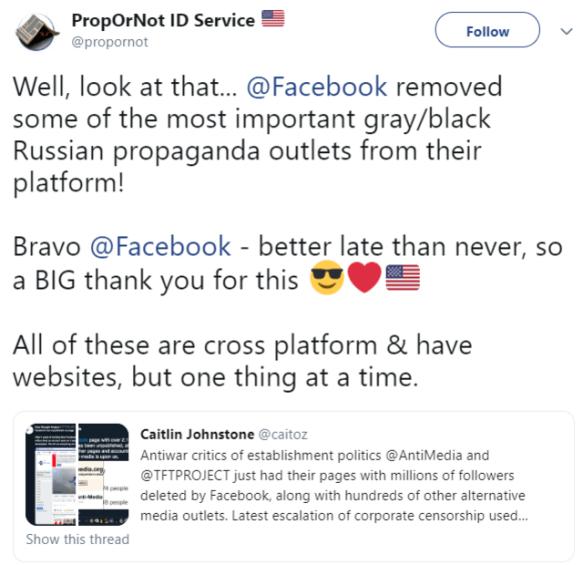
PropOrNot, which remains active on Twitter, publicly gloated about Facebook’s removal of the pages. “Russian propaganda is VERY VERY MAD about their various front outlets & fellow travellers getting suspended by @Facebook &/or @Twitter.” The tweet tagged The Anti Media and The Free Thought Project, and included a Russian flag emoji next to an emoji depicting feces.

PropOrNot did not attempt to reconcile its own narrative that the targeted organizations were front groups for the Kremlin with Facebook’s official claim that they operated independently of any government, but instead sought to “stir up political debate” for financial motives. This is because both accusations are hollow pretexts for political censorship.

In a separate post, Propornot added: “Well, look at that… @Facebook removed some of the most important gray/black Russian propaganda outlets from their platform! Bravo @Facebook – better late than never, so a BIG thank you for this.”

It added, ominously: “All of these [organizations] are cross platform & have websites, but one thing at a time.”

These comments by PropOrNot make clear where the US government’s censorship measures are going. While these organizations still “have websites,” the authorities are handling “one thing at a time.”

The clear implication is that censorship will not end with Google’s search platform or the removal of accounts by Facebook and Twitter. The ultimate aim is the total banning of oppositional news web sites.

The publication of the PropOrNot blacklist and its promotion by the Washington Post helped trigger a wave of censorship measures against oppositional news sites by the major technology companies, working at the instigation of the US intelligence agencies and leading politicians.

Last Year, the World Socialist Web Site reported that many of the sites, including Global Research, Counterpunch, Consortium News, WikiLeaks, and Truth-out saw their search traffic plunge after search giant Google implemented a change to its search ranking algorithm.

In the subsequent period, search traffic to these sites has fallen even further. Search traffic to Counterpunch has fallen by 39 percent, and Consortium News has fallen by 51 percent.

These developments confirm the analysis made by the World Socialist Web Site in its open letter to Google alleging that it was censoring left-wing, anti-war and socialist websites.

“Censorship on this scale is political blacklisting,” the letter declared. “The obvious intent of Google’s censorship algorithm is to block news that your company does not want reported and to suppress opinions with which you do not agree. Political blacklisting is not a legitimate exercise of whatever may be Google’s prerogatives as a commercial enterprise. It is a gross abuse of monopolistic power. What you are doing is an attack on freedom of speech.”

On Tuesday, Google admitted that it and other technology companies had “gradually shifted away from unmediated free speech and towards censorship and moderation.” The document admitted that an aim of carrying out censorship was to “increase revenues” under conditions of growing government and commercial pressure.

The document acknowledged that such actions constitute a break with the “American tradition that prioritizes free speech for democracy.”

What We Threw Away

By Patrick Armstrong

Source: Strategic Culture Foundation

Forty years ago I was quite impressed by the books of Jean François Revel in which he argued that The West was pretty much doomed because it was messy and indecisive. On the other hand, the communist world was decisive, centrally controlled, had a goal in mind and was patient and cunning in achieving that goal (the communisation of the planet, of course). They pushed on all fronts, where the West woke up and pulled itself together enough to push back, the communists recoiled, but the advance continued elsewhere. And so, bit by bit, the world became redder. These were, as I recall, the principal arguments of The Totalitarian Temptation (1977) and How Democracies Perish (1983). And there were plenty of other people bemoaning the fact that the inchoate Western democracies were frittering away valuable time.

And then, suddenly, the Warsaw Pact and the USSR fall apart and essentially took communism into the grave with them. The West was left standing. Still argumentative, inchoate, indecisive and all the rest of it but – and this is my point – still existing when the other was dead. And come to think of it, we’d outlasted that other stainless-steel perfection of centrally directed will and power, Nazi Germany. And there had been plenty of people in the 1930s who thought that, between communism and nazism, the West was doomed. This set me to thinking that Revel and the others had missed something in their analysis.

We outlived them. We survived, they didn’t. And that what I wondered about – there must be something in the West’s way of doing things that led to survival and something in the nazi or communist systems that led to death. I thought some more and the analogy that occurred to me is that there are many kinds of trees. Big ones, little ones, in-between sized ones. Some live in the wet, others in the dry, others half drowned by the sea and so on. There is in fact, a tree, or several trees, for almost any conceivable environmental condition. And therefore, there will always be trees. Why? Because instead of one Perfect Tree, there is a multitude of different trees. And of fishes, beetles, birds and so on. Nature is pluralistic: many many solutions for every imaginable situation and the ability to change to meet new challenges. Arnold Toynbee called this “challenge and response”; a society responds to a challenge: a good response and it survives to meet the next challenge, a bad response and it fades away.

Could this be the clue? Nazism and communism had One Big Answer for every question. That answer worked for a time until it met some questions it couldn’t answer and down it went. To grossly oversimplify things: the nazis loved force and they went to war with everybody, but you can’t win against everybody else, although you may do well for a while; a hammer and a sickle do not really mentally equip you for life in the later twentieth century; “a road to a blind alley” as Putin called it. Grossly simplified to be sure. If you prefer, ideological societies can only function inside the ontological assumptions of that ideology. But no ideology is any more than a small subset of boundless reality.

So what do we (or, sadly I have to ask, did we) have in the West? I think the three fundamental freedoms in the West are free speech, free politics and free enterprise. Looking at these through the lens of pluralism, they are pluralism of thought, pluralism of power and pluralism of action. Remember that the question I was trying to answer was why did the West survive? I wasn’t asking who’s better, more ideal, more moral; just why is one still around and the other two not? To me the answer was the same thing that allows us to be certain there will still be trees and beetles around in the future – pluralism: lots of different trees and beetles.

Take free speech or pluralism of thought. Everybody’s different, everybody has different ideas, insights, points of view. Let’s assume that, for some issue, mine is the winning idea today. But tomorrow you may have a better solution for the problem that appears tomorrow. If I suppressed you (“no man no problem”, as Stalin used to say) or otherwise prohibited your irrelevant (today) but relevant (tomorrow) idea, we would be in trouble tomorrow and less likely to survive until the next day. So, since we don’t know what tomorrow’s problems are, it’s best to let everybody think his thoughts because who can say whose ideas will be winners tomorrow? The same argument can be made for the other two pluralisms/freedoms. And so, by practising pluralism of thought, power and action, a society improves its chances of survival. That’s all: survival. But that was the question I asked myself in the first place.

So, to my mind, that was the great secret that communism’s fall had revealed – social or national survivability is best assured by pluralism of thought, power and action. So, in all humility, we should have understood that and proclaimed it. And, of course, the essence of pluralism is that you are free to be, and should be, yourself. All nations should be themselves: Russians should be Russian, Hungarians Hungarian and so on. Who can say who will have the next good idea? Who is so wise that he can direct his neighbour’s life? That to me was what should have been done and, had that been the message the West had preached, I think we’d all be better off today.

What instead? We had the fatuous proclaiming of “values”: we had ’em and they didn’t. All over the West stuffed shirts got up in parliaments to boast of “our values”. How we got them no one knew. Did God hand them out to some people but not to others? Russians, too lazy or shiftless or something, having missed the ceremony? Had they mysteriously grown in some national soil over long time? A relict of ancient Saxon customs that only their descendants could inherit? The product of centuries of learning? And what is a “value” anyway? A practical guide to action or a virtue that you either have or don’t? Was it something innate or something learned? Could they get these values? Could they be taught? But, whatever, we had ’em and they didn’t; we were virtuous, they weren’t. And there was another tiresome thing about this, especially when, as it often was, the values were given the adjective “European”. Franco, Hitler, Marx, Engels, Mussolini, Robespierre, Napoleon, Quisling and all the rest of them were Europeans. Every single one of them based his ideas and political views on sources deeply rooted in European thought and experience. And, for certain, had it not been for the Soviets and the Anglosphere, the “European values” Eurocrats and their flunkeys would have been boasting about today would have involved a lot more leather, jackboots and stiff-armed salutes. The whole enterprise resembled something from the movie Idiocracy: “Brawndo has what plants crave because plants crave what Brawndo has“. It was weirdly fascinating to watch.

Our “values” and our “virtue” entitled us to rule the world. We were licensed to do just about anything because we had “what plants crave”. And so triumphalist arrogance and complacent ignorance combined with the West’s monopoly of exportable brutal power. And so it went. An unexamined conceit, frighteningly widespread, became the justification, and cover, for less noble actions.

But some responses to challenges are not so successful and we must ask what has become of our boasted “values” today? Well, we’re still free to speak our minds. Not of course if it’s hate speech or fake news; who could defend that? And not, certainly, to offend anyone’s safe space. And you’d probably better not say anything in Russian. Political freedom? Not entirely gone I suppose, in those little corners not already bought up by lobbyists. And it would certainly be wrong to question anything said or done by “those brave men and women who put their life on the line for our safety”. Free enterprise of course still flourishes. In whatever tiny spaces a few gigantic and well-connected corporations have not yet got to.

Altogether, we can’t be very happy with the state of pluralism in the West. And if I’m correct that pluralism is the key to survival, how much longer do we have?

So who did win the Cold War in the end?

The Battle for Our Minds

By Patrick Lawrence

Source: Consortium News

After reading The New York Times piece “The Plot to Subvert an Election” I put the paper down with a single question.

Why, after two years of allegations, indictments, and claims to proof of this, that, and the other did the newspaper of record—well, once the newspaper of record—see any need to publish such a piece? My answer is simple: The orthodox account of Russia-gate has not taken hold: It has failed in its effort to establish a consensus of certainty among Americans. My conclusion matches this observation: The orthodox narrative is never going to achieve this objective. There are too many holes in it.

“The information age is actually a media age,” John Pilger, the noted British–Australian journalist, remarked during a symposium four years ago, when the Ukraine crisis was at its peak. “We have war by media; censorship by media; demonology by media; retribution by media; diversion by media—a surreal assembly line of obedient clichés and false assumptions.” Pilger revisited the theme in a piece last week on Consortium News, arguing that once-tolerated, dissenting opinion has in recent years “regressed into a metaphoric underground.”

There are battlefields in Syria, Ukraine, Yemen, and elsewhere, but perhaps the most consequential battle now being fought is for our minds.

Those who dispense with honest intellectual inquiry, healthy skepticism of all media, and an insistence that assertions require supporting evidence should not win this war. The Times piece by Scott Shane and Mark Mazzetti—two of the paper’s top-tier reporters—is a case in point: If the Russia-gate narrative were so widely accepted as their report purports, there would have been no need to publish such a piece at this late date.

Many orthodox narratives are widely accepted however among a public that is not always paying attention. The public too often participates in the manufactured consent. Usually it take years for the truth to be widely understood. Sometimes it comes when the U.S. admits it decades later, such as the role of the CIA in the coups in Iran and Chile. Other times it comes through admissions by former U.S. officials, such as former Defense Secretary Robert McNamara about the Vietnam War.

Even Recent Narratives are Fraying

There are more recent examples of official narratives quickly fraying if not starting to fall apart, though Establishment media continues to push them.

For instance, there are serious doubts about who was responsible for alleged chemical weapons attacks in Syria. The most significant was in Eastern Ghouta in August 2013 followed by attacks in Khan Sheikhoun (April 2017) and Douma (April 2018).

The corporate media accounts of each of these attacks have been countered with persuasive evidence against the prevailing view that the government of Bashar al–Assad was to blame. It has been provided journalists (Seymour Hersh ), a scientist (Theodore Postol ), and on-the-ground correspondents and local witnesses. These reports are subject to further verification. But by no means do official narratives stand without challenge.

There is also the case of Malaysian Flight MH–17, shot down over Ukrainian territory in June 2014. The official report, issued a year later, concluded that the plane was downed by Ukrainian rebels using a Russian-supplied missile. The report was faulty from the first: Investigators never visited the site , some evidence was based on a report produced by Bellingcat , an open-source web site affiliated with the vigorously anti–Russian Atlantic Council, and Ukraine was given the right to approve the report before it was issued.

Last week the Russian military disclosed evidence that serial numbers found in the debris at the MH–17 crash site indicate the missile that downed the plane was produced at a Soviet military-production plant in 1986 owned by Ukraine. Let us see further verification of this evidence (although I seriously doubt any Western correspondent will seek any). The official report of 2015 noted the serial numbers, so we know they are authentic, but it did not use them to trace the missile’s provenance.

There is also the seriously muddled case of the poisoning of the Skripals in Britain.  Why hasn’t the Western media dug into this story rather than accept at face value the pronouncements of the British government?

A month ago I lamented the damage Russia-gate has done to many of our most important institutions, the press not least among them. What is the corporate media thinking? That once President Trump is dumped, all will return to normal and professional standards will be restored? One can also argue the reverse: that adversarial journalism has returned to the White House beat largely out of personal animus towards Trump and that it will disappear again once a more “normal” president is in office.

As Pilger put it, “This is a seismic shift, with journalists policing the new ‘groupthink,’ as [Robert] Parry called it, dispensing myths and distractions, pursuing its enemies.”

In other words, Establishment journalism has shifted far afield from its traditional ideals of non-partisan, objective reporting and is instead vying for your mind to enlist it in its agenda to promote American interests abroad or one party or the other at home.

We can’t let them get away with it. Our minds are our own.

A New World Order: Brought to you by the Global-Industrial Deep State

By John W. Whitehead

Source: Intrepid Report

“There are no nations. There are no peoples . . . There is only IBM and ITT and AT&T, and DuPont, Dow, Union Carbide and Exxon. Those are the nations of the world today. The world is a collage of corporations, inexorably determined by the immutable by-laws of business.”—Network (1976)

There are those who will tell you that any mention of a New World Order government—a power elite conspiring to rule the world—is the stuff of conspiracy theories.

I am not one of those skeptics.

What’s more, I wholeheartedly believe that one should always mistrust those in power, take alarm at the first encroachment on one’s liberties, and establish powerful constitutional checks against government mischief and abuse.

I can also attest to the fact that power corrupts, and absolute power corrupts absolutely.

I have studied enough of this country’s history—and world history—to know that governments (the U.S. government being no exception) are at times indistinguishable Civilfrom the evil they claim to be fighting, whether that evil takes the form of terrorism, torture, drug traffickingsex trafficking, murder, violence, theft, pornography, scientific experimentations or some other diabolical means of inflicting pain, suffering and servitude on humanity.

And I have lived long enough to see many so-called conspiracy theories turn into cold, hard fact.

Remember, people used to scoff at the notion of a Deep State (a.k.a. Shadow Government), doubt that fascism could ever take hold in America, and sneer at any suggestion that the United States was starting to resemble Nazi Germany in the years leading up to Hitler’s rise to power.

We’re beginning to know better, aren’t we?

The Deep State (“a national-security apparatus that holds sway even over the elected leaders notionally in charge of it”) is real.

We are already experiencing fascism, American-style.

Not with jackboots and salutes, as Robert Kagan of the Brookings Institution notes, “but with a television huckster, a phony billionaire, a textbook egomaniac ‘tapping into’ popular resentments and insecurities, and with an entire national political party—out of ambition or blind party loyalty, or simply out of fear—falling into line behind him.”

And the United States is increasingly following in Nazi Germany’s footsteps, at least in the years leading up to Hitler’s rise to power.

Given all that we know about the U.S. government—that it treats its citizens like faceless statistics and economic units to be bought, sold, bartered, traded, and tracked; that it repeatedly lies, cheats, steals, spies, kills, maims, enslaves, breaks the laws, overreaches its authority, and abuses its power at almost every turn; and that it wages wars for profit, jails its own people for profit, and has no qualms about spreading its reign of terror abroad—it is not a stretch to suggest that the government has been overtaken by global industrialists, a new world order, that do not have our best interests at heart.

Indeed, to anyone who’s been paying attention to the goings-on in the world, it is increasingly obvious that we’re already under a new world order, and it is being brought to you by the Global-Industrial Deep State, a powerful cabal made up of international government agencies and corporations.

It is as yet unclear whether the American Police State answers to the Global-Industrial Deep State, or whether the Global-Industrial Deep State merely empowers the American Police State. However, there is no denying the extent to which they are intricately and symbiotically enmeshed and interlocked.

This marriage of governmental and corporate interests is the very definition of fascism.

Where we go wrong is in underestimating the threat of fascism: it is no longer a national threat but has instead become a global menace.

Consider the extent to which our lives and liberties are impacted by this international convergence of governmental and profit-driven interests in the surveillance state, the military industrial complex, the private prison industry, the intelligence sector, the technology sector, the telecommunications sector, the transportation sector, and the pharmaceutical industry.

All of these sectors are dominated by mega-corporations operating on a global scale and working through government channels to increase their profit margins: Walmart, Alphabet (formerly Google), AT&T, Toyota, Apple, Exxon Mobil, Facebook, Lockheed Martin, Berkshire Hathaway, UnitedHealth Group, Samsung, Amazon, Verizon, Nissan, Boeing, Microsoft, Northrop Grumman, Citigroup . . . these are just a few of the global corporate giants whose profit-driven policies influence everything from legislative policies to economics to environmental issues to medical care.

The U.S. government’s deep-seated and, in many cases, top secret alliances with foreign nations and global corporations are redrawing the boundaries of our world (and our freedoms) and altering the playing field faster than we can keep up.

Global surveillance

Spearheaded by the National Security Agency (NSA), which has shown itself to care little for constitutional limits or privacy, the surveillance state has come to dominate our government and our lives.

Yet the government does not operate alone.

It cannot.

It requires an accomplice.

Thus, the increasingly complex security needs of our massive federal government, especially in the areas of defense, surveillance and data management, have been met within the corporate sector, which has shown itself to be a powerful ally that both depends on and feeds the growth of governmental bureaucracy.

Take AT&T, for instance. Through its vast telecommunications network that crisscrosses the globe, AT&T provides the U.S. government with the complex infrastructure it needs for its mass surveillance programs. According to The Intercept, “The NSA considers AT&T to be one of its most trusted partners and has lauded the company’s ‘extreme willingness to help.’ It is a collaboration that dates back decades. Little known, however, is that its scope is not restricted to AT&T’s customers. According to the NSA’s documents, it values AT&T not only because it ‘has access to information that transits the nation,’ but also because it maintains unique relationships with other phone and internet providers. The NSA exploits these relationships for surveillance purposes, commandeering AT&T’s massive infrastructure and using it as a platform to covertly tap into communications processed by other companies.”

Now magnify what the U.S. government is doing through AT&T on a global scale, and you have the “14 Eyes Program,” also referred to as the “SIGINT Seniors.” This global spy agency is made up of members from around the world (United States, United Kingdom, Australia, Canada, New Zealand, Denmark, France, Netherlands, Norway, Germany, Belgium, Italy, Sweden, Spain, Israel, Singapore, South Korea, Japan, India and all British Overseas Territories).

Surveillance is just the tip of the iceberg when it comes to these global alliances, however.

Global war profiteering

War has become a huge money-making venture, and America, with its vast military empire and its incestuous relationship with a host of international defense contractors, is one of its best buyers and sellers. In fact, as Reuters reports, “[President] Trump has gone further than any of his predecessors to act as a salesman for the U.S. defense industry.”

The American military-industrial complex has erected an empire unsurpassed in history in its breadth and scope, one dedicated to conducting perpetual warfare throughout the earth. For example, while erecting a security surveillance state in the U.S., the military-industrial complex has perpetuated a worldwide military empire with American troops stationed in 177 countries (over 70% of the countries worldwide).

Although the federal government obscures so much about its defense spending that accurate figures are difficult to procure, we do know that since 2001, the U.S. government has spent more than $1.8 trillion in the wars in Afghanistan and Iraq (that’s $8.3 million per hour). That doesn’t include wars and military exercises waged around the globe, which are expected to push the total bill upwards of $12 trillion by 2053.

The illicit merger of the global armaments industry and the Pentagon that President Dwight D. Eisenhower warned us against more than 50 years ago has come to represent perhaps the greatest threat to the nation’s fragile infrastructure today. America’s expanding military empire is bleeding the country dry at a rate of more than $15 billion a month (or $20 million an hour)—and that’s just what the government spends on foreign wars. That does not include the cost of maintaining and staffing the 1,000-plus U.S. military bases spread around the globe.

Incredibly, although the U.S. constitutes only 5% of the world’s population, America boasts almost 50% of the world’s total military expenditure,spending more on the military than the next 19 biggest spending nations combined. In fact, the Pentagon spends more on war than all 50 states combined spend on health, education, welfare, and safety. There’s a good reason why “bloated,” “corrupt” and “inefficient” are among the words most commonly applied to the government, especially the Department of Defense and its contractors. Price gouging has become an accepted form of corruption within the American military empire.

It’s not just the American economy that is being gouged, unfortunately.

Driven by a greedy defense sector, the American homeland has been transformed into a battlefield with militarized police and weapons better suited to a war zone. Trump, no different from his predecessors, has continued to expand America’s military empire abroad and domestically, calling on Congress to approve billions more to hire cops, build more prisons and wage more profit-driven war-on-drugs/war-on-terrorism/war-on-crime programs that pander to the powerful money interests (military, corporate and security) that run the Deep State and hold the government in its clutches.

Global policing

Glance at pictures of international police forces and you will have a hard time distinguishing between American police and those belonging to other nations. There’s a reason they all look alike, garbed in the militarized, weaponized uniform of a standing army.

There’s a reason why they act alike, too, and speak a common language of force.

For example, Israel—one of America’s closest international allies and one of the primary yearly recipients of more than $3 billion in U.S. foreign military aid—has been at the forefront of a little-publicized exchange program aimed at training American police to act as occupying forces in their communities. As The Intercept sums it up, American police are “essentially taking lessons from agencies that enforce military rule rather than civil law.”

Then you have the Strong Cities Network programFunded by the State Department, the U.S. government has partnered with the United Nations to fight violent extremism “in all of its forms and manifestations” in cities and communities across the world. Working with the UN, the federal government rolled out programs to train local police agencies across America in how to identify, fight and prevent extremism, as well as address intolerance within their communities, using all of the resources at their disposal. The cities included in the global network include New York City, Atlanta, Denver, Minneapolis, Paris, London, Montreal, Beirut and Oslo.

What this program is really all about, however, is community policing on a global scale.

Community policing, which relies on a “broken windows” theory of policing, calls for police to engage with the community in order to prevent local crime by interrupting or preventing minor offenses before they could snowball into bigger, more serious and perhaps violent crime.

It sounds like a good idea on paper, but the problem with the broken windows approach is that it has led to zero tolerance policing and stop-and-frisk practices among other harsh police tactics.

When applied to the Strong Cities Network program, the objective is ostensibly to prevent violent extremism by targeting its source: racism, bigotry, hatred, intolerance, etc. In other words, police—acting ostensibly as extensions of the United Nations—will identify, monitor and deter individuals who exhibit, express or engage in anything that could be construed as extremist.

Of course, the concern with the government’s anti-extremism program is that it will, in many cases, be utilized to render otherwise lawful, nonviolent activities as potentially extremist. Keep in mind that the government agencies involved in ferreting out American “extremists” will carry out their objectives—to identify and deter potential extremists—in concert with fusion centers (of which there are 78 nationwide, with partners in the private sector and globally), data collection agencies, behavioral scientists, corporations, social media, and community organizers and by relying on cutting-edge technology for surveillance, facial recognition, predictive policing, biometrics, and behavioral epigenetics (in which life experiences alter one’s genetic makeup).

This is pre-crime on an ideological scale and it’s been a long time coming.

Are you starting to get the picture now?

We’re the sitting ducks in the government’s crosshairs.

On almost every front, whether it’s the war on drugs, or the sale of weapons, or regulating immigration, or establishing prisons, or advancing technology, if there is a profit to be made and power to be amassed, you can bet that the government and its global partners have already struck a deal that puts the American people on the losing end of the bargain.

Unless we can put the brakes on this dramatic expansion, globalization and merger of governmental and corporate powers, we’re not going to recognize this country 20 years from now.

It’s taken less than a generation for our freedoms to be eroded and the police state structure to be erected, expanded and entrenched.

Rest assured that the U.S. government will not save us from the chains of the global police state.

The current or future occupant of the White House will not save us.

For that matter, anarchy, violence and incivility will not save us.

Unfortunately, the government’s divide and conquer tactics are working like a charm.

Despite the laundry list of grievances that should unite “we the people” in common cause against the government, the nation is more divided than ever by politics, by socio-economics, by race, by religion, and by every other distinction that serves to highlight our differences.

The real and manufactured events of recent years—the invasive surveillance, the extremism reports, the civil unrest, the protests, the shootings, the bombings, the military exercises and active shooter drills, the color-coded alerts and threat assessments, the fusion centers, the transformation of local police into extensions of the military, the distribution of military equipment and weapons to local police forces, the government databases containing the names of dissidents and potential troublemakers—have all conjoined to create an environment in which “we the people” are more divided, more distrustful, and fearful of each other.

What we have failed to realize is that in the eyes of the government, we’re all the same.

In other words, when it’s time for the government to crack down—and that time is coming—it won’t matter whether we voted Republican or Democrat, whether we marched on Washington or stayed home, or whether we spoke out against government misconduct and injustice or remained silent.

When the government and its Global-Industrial Deep State partners in the New World Order crack down, we’ll all suffer.

If there is to be any hope of freeing ourselves, it rests—as it always has—at the local level, with you and your fellow citizens taking part in grassroots activism, which takes a trickle-up approach to governmental reform by implementing change at the local level.

One of the most important contributions an individual citizen can make is to become actively involved in local community affairs, politics and legal battles. As the adage goes, “Think globally, act locally.”

America was meant to be primarily a system of local governments, which is a far cry from the colossal federal bureaucracy we have today. Yet if our freedoms are to be restored, understanding what is transpiring practically in your own backyard—in one’s home, neighborhood, school district, town council—and taking action at that local level must be the starting point.

Responding to unmet local needs and reacting to injustices is what grassroots activism is all about. Attend local city council meetings, speak up at town hall meetings, organize protests and letter-writing campaigns, employ “militant nonviolent resistance” and civil disobedience, which Martin Luther King Jr. used to great effect through the use of sit-ins, boycotts and marches.

And then, as I make clear in my book A Government of Wolves: The Emerging American Police State, if there is any means left to us for thwarting the government in its relentless march towards outright dictatorship, it may rest with the power of communities and local governments to invalidate governmental laws, tactics and policies that are illegitimate, egregious or blatantly unconstitutional.

Nullification works.

Nullify the court cases. Nullify the laws. Nullify everything the government does that flies in the face of the principles on which this nation was founded.

We could transform this nation if only Americans would work together to harness the power of their discontent.


Constitutional attorney and author John W. Whitehead is founder and president of The Rutherford Institute. His book A Government of Wolves: The Emerging American Police State is available online at www.amazon.com. Whitehead can be contacted at johnw@rutherford.org. Information about The Rutherford Institute is available at www.rutherford.org.

Facebook’s New Propaganda Partners

By Alan Mcleod

Source: FAIR

Media giant Facebook recently announced (Reuters, 9/19/18) it would combat “fake news” by partnering with two propaganda organizations founded and funded by the US government: the National Democratic Institute (NDI) and the International Republican Institute (IRI). The social media platform was already working closely with the NATO-sponsored Atlantic Council think tank (FAIR.org, 5/21/18).

In a previous FAIR article (8/22/18), I noted that the “fake news” issue was being used as a pretext to attack the left and progressive news sites. Changes to Facebook’s algorithm have reduced traffic significantly for progressive outlets like Common Dreams (5/3/18), while the pages of Venezuelan government–backed TeleSur English and the independent Venezuelanalysis were shut down without warning, and only reinstated after a public outcry.

The Washington, DC–based NDI and IRI are staffed with senior Democratic and Republican politicians; the NDI is chaired by former Secretary of State Madeleine Albright, while the late Sen. John McCain was the longtime IRI chair. Both groups were created in 1983 as arms of the National Endowment for Democracy (NED), a Cold War enterprise backed by then–CIA director William Casey (Jacobin, 3/7/18). That these two US government creations, along with a NATO offshoot like the Atlantic Council, are used by Facebook to distinguish real from fake news is effectively state censorship.

Facebook’s collaboration with the NED organizations is particularly troubling, as both have aggressively pursued regime change against leftist governments overseas. The NDI undermined the Sandinista government of Nicaragua in the 1980s, and continues to do so to this day, while the IRI claimed a key role in the 2002 coup against leftist President Hugo Chávez of Venezuela, announcing that it had

served as a bridge between the nation’s political parties and all civil society groups to help Venezuelans forge a new democratic future…. We stand ready to continue our partnership with the courageous Venezuelan people.

The Reuters report (9/19/18) mentioned that Facebook was anxious to better curate what Brazilians saw on their feeds in the run-up to their presidential elections, which pits far-right Jair Bolsonaro against leftist Fernando Haddad. The US government has a long history of undermining democracy in Brazil, from supporting a coup in 1964 against the progressive Goulart administration to continually spying on leftist President Dilma Rousseff (BBC, 7/4/15) in the run-up to the parliamentary coup against her in 2016 (CounterSpin, 6/2/17).

Soon after it partnered with the Atlantic Council, Facebook moved to delete accounts and pages connected with Iranian broadcasting channels (CNBC, 8/23/18), while The Intercept (12/30/17) reported that in 2017 the social media platform met with Israeli government officials to discuss which Palestinian voices it should censor. Ninety-five percent of Israeli government requests for deletion were granted. Thus the US government and its allies are effectively using the platform to silence dissenting opinion, both at home and on the world stage, controlling what Facebook‘s 2 billion users see and do not see.

Progressives should be deeply skeptical that these moves have anything to do with their stated objective of promoting democracy. Bloomberg Businessweek (9/29/17) reported that the far-right Alternative fur Deutschland (AfD) party went to Facebook headquarters for discussions with US companies about how it could use the platform for recruitment and micro-targeting in the 2017 elections. AfD tripled its previous vote share, becoming the third-largest party in Germany, the far right’s best showing since World War II.

Public trust in government is at 18 percent—an all-time low (Pew, 12/14/17). There is similar mistrust of Facebook, with only 20 percent of Americans agreeing social media sites do a good job separating fact from fiction. And yet, worldwide, Facebook is a crucial news source. Fifty-two percent of Brazilians, 61 percent of Mexicans, and 51 percent of Italians and Turks use the platform for news; 39 percent of the US gets their news from the site.

This means that, despite the fact that even its own public mistrusts it, the US government has effectively become the arbiter of what the world sees and hears, with the ability to marginalize or simply delete news from organizations or countries that do not share its opinions. This power could be used at sensitive times, like elections. This is not an idle threat. The US created an entire fake social network for Cubans that aimed to stir unrest and overthrow the Cuban government, according to the Guardian (4/3/14).

That a single corporation has such a monopoly over the flow of worldwide news is already problematic, but the increasing meshing of corporate and US government control over the means of communication is particularly worrying. All those who believe in free and open exchange of information should oppose Facebook becoming a tool of US foreign policy.

Trump’s new cyber strategy seeks global dominion over internet

Source: RT.com

Setting the global standard for online behavior, preserving American dominance, political and economic interests, punishing ‘malicious actors’ like Russia and China: these are the ambitious goals of the new US cyber-strategy.

The White House published the 40-page document on Thursday afternoon, the first comprehensive cyber strategy in 15 years. The strategy’s core assumption is that the US created the internet and that Washington must maintain the dominant role in defining, shaping and policing cyberspace in much the same way as it does the globe.

All strategies are but broad outlines of general measures and overall objectives, and this one is no different. Beyond merely defending US computer networks – that’s just the first part, devoted to protecting the “American People, the Homeland, and the American Way of Life” – it wants to promote US economic prosperity while advancing influence around the world and achieving “peace through strength” as well.

The Trump administration’s approach to cyberspace is “anchored by enduring American values, such as the belief in the power of individual liberty, free expression, free markets, and privacy,” the strategy says right at the start.

It also takes as an article of faith that Russia, China, Iran, and North Korea use “cyber tools to undermine our economy and democracy, steal our intellectual property, and sow discord in our democratic processes.

Having signed on to this central assertion of Russiagate-peddlers, the Trump administration lays out the ways in which it intends to achieve its pie-in-the-(cyber)sky objectives.

‘Securing US democracy’

The Department of Homeland Security, a vast bureaucracy established after 9/11, is supposed to centralize management and oversight of federal computer networks, with the notable exceptions of those belonging to the Pentagon and the intelligence community. Reforms are supposed to make government networks more secure, reliable and efficient, while federal contracting will drive improvements in both products and services. This is the same process that has produced the F-35, a trillion-dollar clunker.

Those obsessed with seeing Russian hackers behind every voting machine might be interested in page nine, where the strategy proposes to “secure our democracy” by… offering training and risk management to state and local governments “when requested.” Admittedly, there isn’t much more the federal government can do to protect election systems, aside from securing the network infrastructure.

A particularly interesting tidbit here is also that law enforcement will “work with private industry to confront challenges presented by technological barriers, such as anonymization and encryption technologies” to obtain “time-sensitive evidence.” This is basically a rehash of former FBI Director James Comey’s perpetual refrain about the need for backdoor access to encrypted products and services.

The most (in)famous example of this was when the FBI took Apple to court over accessing the San Bernardino terrorist suspect’s iPhone, then hiring an Israeli company to crack the device, only to find… nothing of interest.

Privacy and civil rights advocates will be overjoyed to hear that Trump also wants to “update electronic surveillance and computer crime statutes” to make sure law enforcement can gather more evidence of cyber crimes and “impose appropriate consequences upon malicious cyber actors.”

‘Promoting American prosperity’

The second pillar talks a lot about the US government sponsoring innovation and creating jobs, but its key objective is to “promote the free flow of data across borders” (p.15). And if “repressive regimes” use US-made cybersecurity tools to “undermine human rights,” Washington will expose and counter them.

No word on whether that will apply to Google’s work in China, or Twitter, YouTube and Facebook’s throttling of speech that runs counter to their executives’ politics.

‘Preserving peace through strength’

Pillar three is where things get offensive – literally. Its objective is to “identify, counter, disrupt, degrade, and deter behavior in cyberspace that is destabilizing and contrary to national interests” while preserving US “overmatch.”

In addition to authorizing offensive cyber operations against suspected bad actors, the strategy proceeds from the assumption that the world craves US leadership, and envisions Washington promoting a “framework of responsible state behavior in cyberspace” based on international law and “voluntary non-binding norms.”

A coalition of like-minded states, led by the US would “coordinate and support each other’s responses to significant malicious cyber incidents.”

How? Well, through intelligence sharing, but also “buttressing of attribution claims, public statements of support for responsive actions taken, and joint imposition of consequences against malign actors.”

If that sounds a bit like what happened after the UK accused Russia, without evidence, of using a chemical agent to poison ex-spy Sergei Skripal and his daughter in Salisbury, and the US and other allies just took Whitehall’s word for it… that’s because it does.

‘Advancing US influence’

That leads us to the fourth and final pillar, advancing US influence around the globe. Accusing China not only of wanting to create a closed, censored internet by exporting that model elsewhere, the strategy envisions US evangelizing for a “free and open” internet.

Washington “will continue to work with like-minded countries, industry, civil society, and other stakeholders to advance human rights and Internet freedom globally and to counter authoritarian efforts to censor and influence Internet development,” the strategy says.

Does that mean the State Department intends to challenge the new EU copyright rules that would effectively outlaw memes and charge a “link tax”? Somehow that seems highly… unlikely.

Moscow blames downing of Russian plane near Syria on Israeli “provocation”

By Bill Van Auken

Source: WSWS.org

Tensions remain high in Syria after the downing of a Russian Il-20 electronic intelligence plane and the killing of all 15 crew members aboard during a major Israeli airstrike against the Syrian port city of Latakia Monday night.

The attack on Latakia, a government stronghold and the site of Russia’s major military base in the country, represented a dangerous escalation of the war in Syria, which the Israelis almost certainly carried out in consultation with Washington.

Tel Aviv claimed that its strike was motivated by intelligence that weapons located there were being transferred from Iran to the Lebanese Shia movement Hezbollah. A more powerful underlying motive, however, is the frustration of US imperialism and its allies, Israel and the NATO powers, over the increasing consolidation of control over Syria by the Russian-backed government of President Bashar al-Assad and the failure of the Al Qaeda-linked militias that they backed in a proxy war for regime change.

The Russian Ministry of Defense Tuesday acknowledged that its plane had been hit by Syrian anti-aircraft fire, but placed blame for the incident squarely on what it termed a “provocation” and “hostile” act on the part of Israel.

The Russian turboprop plane was returning to the Russian-run Hmeymim airbase, when it went off the radar screens in the midst of an attack by four Israeli F-16 fighter jets against Syrian defense industry facilities in Latakia.

“The Israeli pilots were using the Russian aircraft as a shield and pushed it into the line of fire of the Syrian defense,” Igor Konashenkov, the Russian defense ministry spokesperson, said on Tuesday.

Russia’s Interfax news agency quoted Konashenkov as describing Israel’s military strike as “hostile” and “an act of provocation,” warning, “We reserve the right to take commensurate measures in response.”

This response was echoed by Russian Defense Minister Sergey Shoigu, who declared that the “blame for the downing of the Russian plane and the deaths of its crew members lies squarely on the Israeli side.” He added, “The actions of the Israeli military were not in keeping with the spirit of the Russian-Israeli partnership, so we reserve the right to respond.”

Later the same day, Russian President Vladimir Putin demonstratively backed away from this sharp response and implicit threat of military retaliation.

Speaking in Moscow at a joint press conference with Hungarian Prime Minister Viktor Orban, Putin drew a distinction between Latakia and the 2015 incident in which a Turkish warplane had shot down a Russian S24 jet, after which Moscow imposed severe sanctions against Ankara.

The Turkish military, he said, had “deliberately downed” the Russian plane, while the Latakia incident “looks like a chain of tragic circumstances, because the Israeli plane didn’t shoot down our jet.”

Subsequently, Putin took a telephone conversation from Israeli Prime Minister Benjamin Netanyahu, who reportedly expressed condolences over the deaths of the Russian plane crewmembers, while reiterating Tel Aviv’s determination to continue carrying out strikes against targets in Syria that it claims are linked to Iran and Hezbollah.

Israeli government officials had placed the entire blame for the downing of the plane on Iran and Hezbollah, while stating that its immediate cause was “extensive and inaccurate Syrian anti-aircraft (surface-to-air missile) fire.”

The Kremlin’s readout of the phone conversation had Putin adopting a somewhat tougher line, reportedly telling Netanyahu that Israeli operations like the one in Latakia “violated Syrian sovereignty” and “agreements around the prevention of dangerous incidents.” The Kremlin added, “The president of Russia urged the Israeli side not to allow such situations from now on.”

Israel earlier this month acknowledged that it has carried out at least 200 airstrikes against Syria over the past 18 months, dropping some 800 munitions on targets across the country. Each of these was also a violation of “Syrian sovereignty.” They have been carried out, however, with the tacit permission of Moscow, which has received advance notice of these operations on an Israeli-Russian “deconfliction” line set up three years ago, and has thus far refrained from using its advanced antiaircraft systems deployed in Syria against Israeli warplanes.

Whether Russia will now deny Israel a green light for airstrikes in Syria, and for how long, remains to be seen.

The shifting tone in the response from Moscow to the deaths of its military personnel may reflect divisions within the Kremlin, or between Putin’s administration and the Russian military command. It almost certainly also expresses fears that the situation in Syria could quickly spill over into a wider military confrontation, including one involving the world’s two major nuclear powers, the US and Russia, as well as the region’s only nuclear-armed state, Israel. Washington would almost certainly respond militarily to any Russian retaliation against the Israeli action in Latakia.

Putin’s government represents the interests of the Russian oligarchs who consolidated their power in the wake of the Moscow Stalinist bureaucracy’s dissolution of the Soviet Union. It has sought to promote Russian interests in the oil-rich Middle East, not only through backing the Assad government—alongside Iran—against the Western-backed Islamist militias employed as proxies in a war for regime change, but also by forging close ties with Israel, with which Russia has established military, trade and investment links.

This complex and conflicting set of relations also includes the attempt by Moscow to cement closer ties with Turkey, which has backed a range of Islamist militias in Syria, while joining the Astana talks together with Moscow and Tehran in search of a ceasefire in the Syrian conflict.

The attack on Latakia came within hours of the announcement Monday by Putin and Turkish President Recep Tayyip Erdogan of an agreement reached in the Russian Black Sea resort city of Sochi to establish a jointly patrolled “demilitarized zone” between Syrian government troops and the Western-backed “rebels” concentrated in Syria’s northwestern Idlib province.

For weeks there had been predictions that a Russian-backed Syrian government offensive in Idlib was imminent, along with mounting threats by Washington and its allies, including Britain, France and Germany, to carry out a sustained military retaliation against an advance on the last major redoubt of the Al Qaeda-linked “rebels.”

The deal reached between Moscow and Ankara calls for the DMZ separating Syrian government forces from the Islamist militias to consist of a 15 to 20-kilometer buffer around the province. All “radical”, i.e., Al Qaeda-affiliated, militias are supposed to be removed from the area.

Turkey’s Foreign Minister Mevlüt Çavuşoğlu told reporters Tuesday that Ankara will deploy more troops to Idlib in the coming days to patrol the border areas. Turkish tanks and other military vehicles had already been dispatched to the south of the province, an area where Russian and Syrian airplanes had carried out strikes.

Asked where the Al Qaeda-affiliated militias would go, Çavuşoğlu said that Ankara and Moscow were still working on the issue.

The US has signaled that the more than 2,000 American troops presently deployed in Syria will remain indefinitely, not merely to complete their supposed mission of combating the Islamic State of Iraq and Syria (ISIS), but to roll back Iranian and Russian influence in both the country and the region and to deny Damascus control of the economically vital oil fields now under US control.

Washington has no interest in seeing the agreement between Moscow and Ankara over Idlib succeed. At a UN Security Council meeting Tuesday on Syria, where UN Special Envoy on Syria Staffan de Mistura called for a speedy implementation of the Russian-Turkish agreement, the US Special Representative for Syria Engagement, James Jeffrey, insisted that, “The only way forward is a genuine and inclusive political solution,” Washington’s euphemism for regime change. To this end, the US and its allies, Israel chief among them, are prepared to push the country and the region into a potentially world catastrophic war.