Either Reverse All the Perverse Incentives or the System Will Implode

By Charles Hugh Smith

Source: Of Two Minds

Every perverse incentive is the cash cow for a vested interest or cartel.

I hope it’s not a great shock to discover all the incentives in our status quo are perverse: those who rig the financial system while creating zero real value, jobs, goods or services reap all the big profits; those who take near-zero responsibility for their own health are subsidized by those who take responsibility for their own health; those who try to start enterprises and hire workers are saddled with endless regulations, junk fees and taxes while those who game the system to get welfare (household or corporate) skim the cream for doing nothing for their community or for the nation.

Systems in which all the incentives are perverse implode under their own weight. Those who struggle to pay the mounting costs of Imperial Over-Reach, crony-capitalism and all the skimmers and scammers eventually go bankrupt or quit in disgust, while the army of state dependents and cronies explodes higher.

It has taken decades for the incentives to become so perverse, so we no longer notice the perversity or the pathological consequences.

High-frequency traders and financiers with the ready ear of well-paid political lackeys, stooges, toadies and sycophants run never-lose skimming operations and pay lower tax rates than self-employed and small business owners.

Corporations have increased their share prices not by earning more money by producing more goods and services but by borrowing cheap money from the Federal Reserve and buying back outstanding shares.

Corporations pay less tax if they move production overseas and keep their profits in other countries.

If I wreck one vehicle after another due to reckless irresponsibility, what happens to my insurance premiums? They skyrocket, of course, reflecting the higher risks that result from my behavior and poor choices. Nobody thinks safe drivers should subsidize irresponsible drivers.

But if I wreck my health by recklessly pursuing risky behaviors, I pay the same as people who are careful “drivers” of their health. What sort of incentives does this system generate?

If I want to buy an over-priced home, the system is loaded with incentives to encourage that potentially poor financial decision. But if I want to launch a small enterprise, the incentives are all perverse: steep upfront fees, taxes from the first dollar, and in many cases, fees and taxes on revenues, regardless of whether I am making a profit or losing my shirt.

Corporate profits have soared as financialization and rigging the system have paid much higher returns than risking capital in new goods and services.

corp-profits3-16d

The incentives for home ownership have turned the bottom 90% into debt-serfs in servitude to banks while the top 5% own income-producing assets and businesses.

ownership-assets2-16

Larded with the most perverse incentives possible, the U.S. healthcare system in the final stages of maximum costs, just before it implodes:

US-healthcare4

It’s not hard to design positive incentives. For example:

1. Make preventative care essentially free to everyone ($5 co-pay) but weight the risks and costs created by irresponsible behaviors that ruin health. Reward those who take responsibility for their health by reducing the premiums they pay.

2. Tax all profits on securities held less than a day at 95%. Raise corporate taxes generated by financial activities to 50%, and lower the corporate tax rate on profits earned from producing domestic goods and services to zero.

3. Lower the tax for the first $25,000 earned by small enterprises to zero. Limit total government fees to 5% of revenues for all businesses up to $10 million in annual revenues.

4. Phase out the mortgage interest deduction. Limit mortgage interest deductions to the first $100,000 of mortgage debt.

5. Eliminate the personal income tax (and the need to file a return) for every household with income of $100,000 or less.

6. Automatically sunset every government regulation. Make city, county, state and federal governments renew every regulation every few years via a majority vote or it vanishes from the law books.

7. Make every politician wear a NASCAR-style jacket plastered with the names and logos of their corporate, union and financier contributors. The California Initiative to make this a reality is seeking signatures of registered California voters. Since politicians are owned, let’s make the ownership transparent.

8. Treat drug abuse and addiction as medical conditions rather than crimes.

9. Eliminate the Federal Reserve and its free-money for financiers perverse incentives for debt-serfdom and financial plundering.

10. Eliminate all student loans and debts. Make colleges compete for students on a cash-only basis.

As you no doubt noticed, every perverse incentive is the cash cow for a vested interest or cartel. That’s why the perverse incentives will endure until the system implodes under their pathological weight.

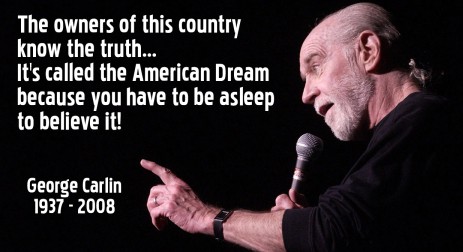
The American Dream is Dead

george-carlin-american-dream

By Dustin Meyer

Source: The Evolutionary Mind

To say the American Dream is Dead couldn’t be more true. The American people as a whole are ignorant. They grow up believing that there is a perfect lifestyle in which they will get once they get older and “pay their dues”. Unfortunately this is very far from wrong, the system is corrupt and is against anyone who thinks this way. Simply put, there is no American dream.

What is it? The American Dream, at least as I knew it was where you would live an ideal life, work a 9-5 job, have a house with a white picket fence, a yard, car, and a dog. More in a modern sense, it is getting rich and famous, owning a huge house, fancy car, having all the fanciest clothes and things. This is why it had been dying but not why it is dead. People are greedy, they want more and more, and forget to appreciate the simple life they have. Some people don’t even have their lives anymore, and yet so many people take theirs for granted.

Pop culture can be given much of the credit due to the skewing of the American dream. Since the people are influenced by anything and everything, they will believe any message conveyed to them. Music and film are the main mediums where this is, but a huge culprit is the news and daytime television. Also, unfortunately people are losing their individualism, which is leading to them falling more into this hole in which you cannot escape, you just aren’t you anymore once you’ve given in.

But a big question is why do I say it is dead? Well, the system in general is against us. The gap between rich and poor is expanding exponentially each and every day. The odds are not in the average person’s favor. People are working until they are 60+ years old and barely being able to retire, and with that work, most aren’t in executive type jobs. For the small business owner, you have huge corporations that are destroying your chances to even provide for your family. So why is it dead? Opening you eyes will show you.

People have to stand up, to realize that something is wrong. With this upcoming election (being quite possibly the worst election/selection of candidates’ ever.) we have to fight for the people. No matter who is in office no one will ever fight for you, unless you do. The people are for the people, we have a choice to change. The change must happen!

The Rise of the Corporatocracy

Fellow Americans, Wake Up & Escape The Matrix

MatrixBluePillRedPill-1024x534

Where Do Matters Stand?

On the eve of World War II the United States was still mired in the Great Depression and found itself facing war on two fronts with Japan and Germany. However bleak the outlook, it was nothing compared to the outlook today.

By Paul Craig Roberts

Source: Covert Geopolitics

Has anyone in Washington, the presstitute Western media, the EU, or NATO ever considered the consequences of constant military and propaganda provocations against Russia? Is there anyone in any responsible position anywhere in the Western world who has enough sense to ask: “What if the Russians believe us? What if we convince Russia that we are going to attack her?”

The same can be asked about China.

The recklessness of the White House Fool and the media whores has gone far beyond mere danger. What do the Russians think when they see that the Democratic Party intends to elect Hillary Clinton president of the US? Hillary is a person so crazed that she declared the president of Russia to be “the new Hitler” and organized through her underling, neocon monster Victoria Nuland, the overthrow of the democratically elected government of Ukraine. Nuland installed Washington’s puppet government in a former Russian province that until about 20 years ago was part of Russia for centuries.

I would bet that this tells even the naive pro-western part of the Russian government and population that the United States intends war with Russia.

Ever since Russia stood up to Obama over Syria, the Russians have been experiencing hostile propaganda and military operations on their borders. These provocations are justified by Washington and its NATO vassals as a response to “Russian aggression.” Russian aggression consists of nothing but obviously false assertions that Russia is about to invade the Baltics, Poland, and Romania and recreate the Soviet Empire, the Eastern European part of which, together with the former Russian provinces of Georgia and Ukraine, now belong to the American Empire.

The Russians know that the propaganda about “Russian aggression” is a lie. What is the purpose of the lie other than to prepare the Western peoples for war with Russia?

There is no other explanation.

Even morons such as Obama, Merkel, Hollande, and Cameron should be capable of understanding that it is extremely dangerous to convince a major military power that you are going to attack. To simultaneously also convince China doubles the danger.

Clearly, the West is incapable of producing leadership capable of preserving life on earth.

What can be done when the entire West demonstrates a death wish for Planet Earth?

Until the criminal regimes of Clinton, George W. Bush, and Obama, American presidents from John F. Kennedy forward worked to reduce tensions with the Soviets. Kennedy worked with Khrushchev to reduce tensions caused by US missiles in Turkey and Soviet missiles in Cuba. President Nixon negotiated SALT I (the Strategic Arms Limitation Treaty) and the Anti-Ballistic Missile Treaty. President Carter negotiated SALT II, which was never ratified by the US Senate but was observed by the executive branch. President Reagan negotiated with Soviet leader Gorbachev the end of the Cold War. President George H.W. Bush in exchange for Gorbachev’s agreement to the reunification of Germany promised that NATO would not move one inch to the East.

All of these achievements were thrown away by the neoconized Clinton, George W. Bush, and Obama regimes, each a criminal regime on par with Nazi Germany.

Today life on Planet Earth is far less secure than during the darkest days of the Cold War. Whatever threat global warming poses, it is miniscule compared to the threat of nuclear winter. If the evil that is concentrated in Washington and its vassals perpetrates nuclear war, cockroaches will inherit the earth.

I have been warning about the growing danger of a nuclear war resulting from the arrogance, hubris, ignorance, and evil personified by Washington. Recently, four knowledgable Russian-Americans spelled out the likely consequences of trying to drive Russia to submission with war threats: http://www.paulcraigroberts.org/2016/06/03/41522/

See also: http://www.paulcraigroberts.org/2016/05/28/as-our-past-wars-are-glorified-this-memorial-day-weekend-give-some-thought-to-our-prospects-against-the-russians-and-chinese-in-world-war-iii/

Don’t expect the brainwashed American population to have the moral conscience and fortitude to prevent nuclear war or even the intelligence to prevent their own vaporization. In a recent article in the Wall Street Journal Scott Sagan and Benjamin Valentino report that 59% of the US population support attacking Iran with nuclear weapons in the event that Iran sank one US Navy ship: http://www.wsj.com/articles/would-the-u-s-drop-the-bomb-again-1463682867

Republicans were much more likely than Democrats to approve attacking Iran with nuclear weapons with 81% of Republicans approving nuclear war compared to 47% of Democrats. Yet, the Democrats are behind Hillary who would be the first to use nuclear weapons. After all, a feminized woman has to prove how tough she is, just as Margaret Thatcher was “the Iron Lady.”

Before it is too late for Americans and all of humanity, arrogant Americans need to recall that “those who live by the sword, die by the sword.”

The economic picture is equally dismal and unpromising. The latest payroll jobs report was even more awful than reported. Hardly any new jobs were created, but what largely escaped reporting is the fact that the economy actually lost 59,000 full-time jobs.

Increasingly the US economy consists of part-time jobs that cannot support an independent existence. Thus, more Americans age 19-34 live at home with parents than independently with spouses or partners. Fully half of 25-year old Americans live in their childhood rooms in their parents’ homes.

This is the “New Economy” that the filthy lying neoliberal economists promised would be reward for the American work force giving up their manufacturing and professional skill jobs to foreigners. What a monstrous lie the neoliberal economists told so that corporate executives and shareholders could put into their own pockets the living wage of the American work force. These neoliberal economists, and, alas, libertarian “free market” ones, have not been held accountable for their impoverishment of the American work force deeply buried in debt with no future prospects.

Those few Americans who have any awareness are beginning to realize that the One Percent and the western governments that serve them are re-establishing feudalism. The brilliant and learned economist, Michael Hudson, has labeled our era the era of neo-feudalism.

He is correct. The majority of young Americans come out of university heavily indebted, primed for debtor prison. When half of 25-year olds cannot marry and form households, how can anyone believe that housing sales and prices are rising except as a result of speculative investors banking on rental income from a population that cannot even pay its student loans.

The United States is the sickest place on earth. There is no public or political discussion of any important issue or of the multiple crises that confront America or the crises that America brings to the world.

The American people are so stupid and unaware that they are capable of electing a criminal and a warmonger like Hillary president of the United States and be proud of it.

These “tough” Americans are so frightened of hoax dangers, such as “Muslim terrorists” and “Russian aggression” that they willingly sacrificed their depleted pocketbooks, the Constitution of the United States—an act of treason on the part of the American people who utterly failed their responsibility to protect the Constitution—and their own liberty to a universal police state that has all power over them.

It is extraordinary that once-proud, once-great European peoples look for leadership from a country of moronic non-entities who have pissed away the liberty, security, and prosperity that their Founding Fathers gave to them.

Fellow Americans, if you care to avoid vaporization and, assuming we do avoid it, live a life other than serfdom, you must wake up and realize that your most deadly enemy is Washington, not the hoax of “Russian aggression,” not the hoax of “Muslim terrorism,” not the hoax of “domestic extremism,” not the hoax of welfare bankrupting America, not the hoax of democracy voting away your wealth, which Wall Street and the corporations have already stolen and stuck in their pockets.

If you cannot wake up and escape The Matrix, your doom will bring the doom of the planet.

‘Stop Drinking the Kool-Aid, America: Political Fiction in an Age of Televised Lies’

20120527040549-stop-drinking-kool-aid

By John W. Whitehead

Source: A Government of Wolves

“We’ve got to face it. Politics have entered a new stage, the television stage. Instead of long-winded public debates, the people want capsule slogans—‘Time for a change’—‘The mess in Washington’—‘More bang for a buck’—punch lines and glamour.”— A Face in the Crowd (1957)

Politics is entertainment.

It is a heavily scripted, tightly choreographed, star-studded, ratings-driven, mass-marketed, costly exercise in how to sell a product—in this case, a presidential candidate—to dazzled consumers who will choose image over substance almost every time.

This year’s presidential election, much like every other election in recent years, is what historian Daniel Boorstin referred to as a “pseudo-event”: manufactured, contrived, confected and devoid of any intrinsic value save the value of being advertised. It is the end result of a culture that is moving away from substance toward sensationalism in an era of mass media.

As author Noam Chomsky rightly observed, “It is important to bear in mind that political campaigns are designed by the same people who sell toothpaste and cars.” In other words, we’re being sold a carefully crafted product by a monied elite who are masters in the art of making the public believe that they need exactly what is being sold to them, whether it’s the latest high-tech gadget, the hottest toy, or the most charismatic politician.

Tune into a political convention and you will find yourself being sucked into an alternate reality so glossy, star-studded, emotionally charged and entertaining as to make you forget that you live in a police state. The elaborate stage show, the costumes, the actors, the screenplay, the lighting, the music, the drama: all carefully calibrated to appeal to the public’s need for bread and circuses, diversion and entertainment, and pomp and circumstance.

Politics is a reality show, America’s favorite form of entertainment, dominated by money and profit, imagery and spin, hype and personality and guaranteed to ensure that nothing in the way of real truth reaches the populace.

After all, who cares about police shootings, drone killings, SWAT team raids, asset forfeiture schemes, private prisons, school-to-prison pipelines, overcriminalization, censorship or any of the other evils that plague our nation when you can listen to the croonings of Paul Simon, laugh along with Sarah Silverman, and get misty-eyed over the First Lady’s vision of progress in America.

But make no mistake: Americans only think they’re choosing the next president.

In truth, however, they’re engaging in the illusion of participation culminating in the reassurance ritual of voting. It’s just another Blue Pill, a manufactured reality conjured up by the matrix in order to keep the populace compliant and convinced that their vote counts and that they still have some influence over the political process.

Stop drinking the Kool-Aid, America.

The nation is drowning in debt, crippled by a slowing economy, overrun by militarized police, swarming with surveillance, besieged by endless wars and a military industrial complex intent on starting new ones, and riddled with corrupt politicians at every level of government. All the while, we’re arguing over which corporate puppet will be given the honor of stealing our money, invading our privacy, abusing our trust, undermining our freedoms, and shackling us with debt and misery for years to come.

Nothing taking place on Election Day will alleviate the suffering of the American people.

The government as we have come to know it—corrupt, bloated and controlled by big-money corporations, lobbyists and special interest groups—will remain unchanged. And “we the people”—overtaxed, overpoliced, overburdened by big government, underrepresented by those who should speak for us and blissfully ignorant of the prison walls closing in on us—will continue to trudge along a path of misery.

With roughly 22 lobbyists per Congressman, corporate greed will continue to call the shots in the nation’s capital, while our elected representatives will grow richer and the people poorer. And elections will continue to be driven by war chests and corporate benefactors rather than such values as honesty, integrity and public service. Just consider: it’s estimated that more than $5 billion will be spent on the elections this year, yet not a dime of that money will actually help the average American in their day-to-day struggles to just get by.

And the military industrial complex will continue to bleed us dry. Since 2001 Americans have spent $10.5 million every hour for numerous foreign military occupations, including in Iraq and Afghanistan. There’s also the $2.2 million spent every hour on maintaining the United States’ nuclear stockpile, and the $35,000 spent every hour to produce and maintain our collection of Tomahawk missiles. And then there’s the money the government exports to other countries to support their arsenals, at the cost of $1.61 million every hour for the American taxpayers.

Then again, when faced with the grim, seemingly hopeless reality of the American police state, it’s understandable why Americans might opt for escapism. “Humankind cannot bear too much reality,” T. S. Eliot once said. Perhaps that is one reason we are so drawn to the unreality of the American political experience: it is spectacle and fiction and farce all rolled up into one glossy dose of escapism.

Frankly, escapism or not, Americans should be mad as hell.

Many of our politicians live like kings. Chauffeured around in limousines, flying in private jets and eating gourmet meals, all paid for by the American taxpayer, they are far removed from those they represent. Such a luxurious lifestyle makes it difficult to identify with the “little guy”—the roofers, plumbers and blue-collar workers who live from paycheck to paycheck and keep the country running with their hard-earned dollars and the sweat of their brows.

Conveniently, politicians only seem to remember their constituents in the months leading up to an election, and yet “we the people” continue to take the abuse, the neglect, the corruption and the lies. We make excuses for the shoddy treatment, we cover up for them when they cheat on us, and we keep hoping that if we just stick with them long enough, eventually they’ll treat us right.

People get the government they deserve.

No matter who wins the presidential election come November, it’s a sure bet that the losers will be the American people.

As political science professor Gene Sharp notes in starker terms, “Dictators are not in the business of allowing elections that could remove them from their thrones.” As I make clear in my book Battlefield America: The War on the American People, the Establishment—the shadow government and its corporate partners that really run the show, pull the strings and dictate the policies, no matter who occupies the Oval Office—are not going to allow anyone to take office who will unravel their power structures. Those who have attempted to do so in the past have been effectively put out of commission.

So what is the solution to this blatant display of imperial elitism disguising itself as a populist exercise in representative government?

Stop playing the game. Stop supporting the system. Stop defending the insanity. Just stop.

Washington thrives on money, so stop giving them your money. Stop throwing your hard-earned dollars away on politicians and Super PACs who view you as nothing more than a means to an end. There are countless worthy grassroots organizations and nonprofits working in your community to address real needs like injustice, poverty, homelessness, etc. Support them and you’ll see change you really can believe in in your own backyard.

Politicians depend on votes, so stop giving them your vote unless they have a proven track record of listening to their constituents, abiding by their wishes and working hard to earn and keep their trust.

Stop buying into the lie that your vote matters. Your vote doesn’t elect a president. Despite the fact that there are 218 million eligible voters in this country (only half of whom actually vote), it is the electoral college, made up of 538 individuals handpicked by the candidates’ respective parties, that actually selects the next president. The only thing you’re accomplishing by taking part in the “reassurance ritual” of voting is sustaining the illusion that we have a democratic republic. What we have is a dictatorship, or as political scientists Martin Gilens and Benjamin Page more accurately term it, we are suffering from an “economic élite domination.”

A healthy, representative government is hard work. It takes a citizenry that is informed about the issues, educated about how the government operates, and willing to make the sacrifices necessary to stay involved, whether that means forgoing Monday night football in order to attend a city council meeting or risking arrest by picketing in front of a politician’s office.

It takes a citizenry willing to do more than grouse and complain. We must act—and act responsibly—keeping in mind that the duties of citizenship extend beyond the act of voting.

Most of all, it takes a citizenry that cares enough to get mad and get active. As Howard Beale declares in the 1976 film Network:

“I want you to get up right now, sit up, go to your windows, open them and stick your head out and yell, ‘I’m as mad as hell and I’m not going to take this anymore.’ Things have got to change. But first, you’ve gotta get mad!…You’ve got to say, ‘I’m as mad as hell, and I’m not going to take this anymore!’ Then we’ll figure out what to do about the depression and the inflation and the oil crisis. But first get up out of your chairs, open the window, stick your head out, and yell, and say it.”


#Brexit confirms: the neoliberal center cannot hold

eu-broken1-701x351

By Jerome Roos

Source: ROAR Magazine

The post-Brexit pandemonium has less to do with Britain’s relationship to Europe than it has with elites losing control over the monsters they have created.

Britain finds itself in a general state of pandemonium. The UK is in the midst of a full-blown constitutional crisis, Prime Minister David Cameron has resigned, and both the country’s governing party and the opposition are in the throngs of a fierce internal power struggle.

As the cheerleaders of the leave campaign dither with no clear plan on how to move forward, the financial consequences continue to ripple through the City: within days, the pound collapsed to its lowest level since 1985, the government’s credit rating was slashed by two full points, and world markets were sent into a tailspin, with a record $3 trillion shaved off stock values on Friday and Monday alone. As if things could not get any worse, recent days have also seen reports of an epidemic of hate crimes spreading across the UK.

Reading the headlines, one could easily be forgiven for experiencing the creeping sensation of living through the postmodern equivalent of the apocalypse: the financial press is providing minute-to-minute coverage of the “battering” of world markets; liberal establishment columnists repeatedly declare this to be Britain’s and Europe’s “worst crisis” since the Second World War; and the New York Times has already held Brexit up as the telltale sign of a world order that is slowly falling apart.

To top it all off, a hysterical Tony Blair took to the same pages last weekend to make a desperate plea in defense of globalization and for more of his failed Third Way recipe, proclaiming in characteristic platitudes that “the center must hold” ­— as if Yeats’ “blood-dimmed tide” and “mere anarchy” were about to be loosed upon the world once more.

The immediate cause for all the commotion is clear: Cameron’s risky bet to hold a referendum on Britain’s EU membership has backfired disastrously. The unexpected victory for the leave camp has shaken both Unions to their very core, dividing left and right on either side of the Channel and burning all bridges between them. There is no denying the historic nature of these developments; the world is a different place after last Thursday, and it is clear that Europe and Britain now find themselves in uncharted territory.

Yet the unspeakable truth is that, at a deeper level, the financial fallout and political pandemonium of recent days has less to do with Britain’s place in Europe than it has with the widening gulf between political elites and European citizens more generally. While racism and anti-immigrant sentiment have been central to the leave campaign from the very start, it is difficult to believe that all 52 percent of Britons who voted leave are committed fascists. Many of these people are ordinary working class folks who are simply fed up with the erosion of their living standards, the disintegration of their communities, and the lack of responsiveness of their political representatives and the unaccountable technocracy that has “taken control” over their lives. Brexit was first and foremost a political statement by the dispossessed and disempowered.

The reason this statement has proven so explosive is because the referendum happened to sit on the convergence point of a number of profoundly unstable social and political fault-lines, all of which were shaking well before Brexit, all of which would have trembled even in the absence of Brexit, and all of which will continue to quake and thunder for a very long time after Brexit. It is highly unlikely that a victory for remain would have produced a very different outcome in the long run — it would certainly not have stemmed any of the discontent, pacified any of the social tensions, or resolved any of the political conflicts that underlie the referendum’s shock outcome.

While Brexit clearly hands victory to the bigots of UKIP and the Tory right, a victory for remain would simply have perpetuated the anti-democratic neoliberal masochism that produced the motivation for people to align themselves with these bigots in the first place. In this light, we have to stop seeing the rabid nationalism of the far-right and the neoliberal cosmopolitanism of the pro-EU camp as polar opposites — in reality, the former is the logical outgrowth of the latter; its deformed Siamese twin in flesh and blood. The only thing the pro-EU camp was able to offer British voters was a continuation of the structural conditions that led to Brexit, combined with fanatical fear-mongering over the consequences of that outcome.

Ultimately, the British vote to leave the EU, whether it eventually materializes or not (and there is no guarantee that it will), is symptomatic of a much deeper and much more debilitating crisis: a structural crisis of democratic capitalism that has in recent years evolved from a global financial crisis into a deepening legitimation crisis of the political establishment, which is now in turn exploding into a full-blown crisis of governability of the existing social and political order. The fault-lines currently opening up in British and European politics would have eventually laid waste to the stability of the continent’s postwar order regardless of the outcome of this particular referendum. Brexit will simply speed up that ongoing process of political decomposition.

It is important to remember in this respect that David Cameron did not call this referendum because he truly cared about the opinion of ordinary people on the EU. Like Alexis Tsipras last year, he called the referendum in a risky and desperate gambit to keep his flailing party together — to silence the Tories’ eurosceptic right wing, disarm the constant backbencher challenges to his leadership, and inoculate the government against future defections to UKIP. This vote was never really about the EU; it was about one of the figureheads of Europe’s crumbling neoliberal center trying to reassert his hold over a party that was once the stable bedrock of the UK’s landed aristocracy and its metropolitan bourgeoisie, but that is now rapidly disintegrating in the face of a resurgent reactionary right.

The ongoing coup against Jeremy Corbyn similarly has little to do with Europe. As an article in the Telegraph from June 13 confirms, Labour MPs and the Blairite wing of the party have been plotting an anti-Corbyn revolt for weeks, if not months, aiming to bring down their leftist leader in “a 24-hour blitz” after the referendum, regardless of its outcome. Again, this is not about the EU; it is about the incompetent lackeys of a crumbling neoliberal center trying to reclaim their hold over a party that was once Europe’s most enthusiastic cheerleader of neoliberalism, financialization and overseas military intervention, but that is now rapidly disintegrating — or realigning itself — in the face of an insurgent “hard” left.

In this respect, Blair’s apocalyptic reference to Yeats in his New York Times opinion piece was awkwardly on point: things are falling apart; the center cannot hold. This is the crux of the matter, and it helps explain the hysterical doomsday discourse of the centrist establishment: their globalized post-democratic fantasy world is crumbling before their very eyes, as their once-passive voter-cum-consumer base is suddenly gobbled up and mobilized by a motley crew of “angry populists” who thrive on the electoral spoils of a crippling legitimation crisis and feast on the popular discontent sowed by years of austerity and decades of neoliberal restructuring.

The answer to the steady disintegration of the established political order clearly cannot be more of the same. Against Blair’s hopeless cries that “the center must hold”, and against the thinly-veiled conspiracies of his neoliberal acolytes in Parliament — who are now closing in on Jeremy Corbyn in a last-ditch attempt to reclaim the Labour Party and destroy from within, once and for all, the only political force that could possibly pose an electoral counterweight to the far-right in this defining moment in British history — against all of these turncoats, the left must stand firm and insist: the center will fall.

But to avoid ceding the resulting void to the racists and reactionaries, the weakened and dispersed forces of the left will need to rally in face of the historic battles now coming their way. Despair as one may, this means the choice is now fairly straightforward: it’s Corbyn or nothing. Not because the embattled Labour leader will bring democratic socialism or fully automated luxury communism to a newly independent Britain, but because this decent, principled leftist is now the only bulwark still standing between ordinary working people of all colors, and the monsters that are about to be unleashed on them.

About the author:

Jerome Roos is the founder and editor of ROAR Magazine, and a researcher in International Political Economy at the European University Institute. For more on his research and writings, visit jeromeroos.com.

Brexit Is What Happens When the Pie Is Shrinking

brexit-uk-leaving-eu

By Charles Hugh Smith

Source: Of Two Minds

This process of withdrawal into the relative safety of internally cohesive groups and group identities is intrinsically messy in globalized, multicultural societies.

A great many narratives are drifting around the Brexit pool: a return to sovereignty, class war, “controlled demolition,” nothing-but-another-political-Kabuki- spectacle, end of the European Union, etc.

I think it boils down to something much simpler: the pie is shrinking, and the illusion that it’s about to start growing has been shattered. For many communities in the developed world, the pie started shrinking in the 1970s, and has been shrinking (despite the narrative of “45 years of strong growth”) since then.

Labor’s share of the GDP has been declining for 45 years. Occasional blips higher during debt-fueled bubbles quickly fade when the bubble du jour pops, and the decline of labor’s share of the economy resumes its trendline decline.

wages-GDP5-16a

Since 2008, the only group who feels the pie is growing is the class that has benefited from the unparalleled expansion of debt and leverage, financialization, globalization and central planning–roughly 20% of the work force, with the top 5% gathering most of the gains in income and wealth, and the top .1% gathering most of the increase in wealth. (See chart below)

For seven long years, the citizenry has been told the economy is expanding and therefore they’re “doing better.” But this narrative is not supported by their actual lived experience. Inflation is woefully under-reported by official statistics, and the rosy “rising employment” narrative is based largely on part-time jobs in hospitality and food services (bartenders, waiters, etc.) that are highly contingent on the spending of the top 10%.

While supporters of the status quo are quick to deride supporters of Brexit, the cold reality is the economic pie is shrinking, and Brexit is a direct result of that reality.

A shrinking economic pie generates widespread insecurity that pressures every status quo arrangement as people circle the wagons in an attempt to protect their remaining slice of the pie from others’ claims for a larger piece of the dwindling pie.

The general media line is that the Brexit vote arose out of anger with the status quo’s inequalities and asymmetries of wealth and power. While this is largely self-evident, it isn’t the most fundamental dynamic at work. I see Brexit as a reflection of our naturally-selected defensive response to insecurity and instability: circle the wagons.

By circle the wagons, I mean our tendency to withdraw into an internally cohesive group with defined membership and boundaries.

The largest such political group is the nation-state, and so it is natural for people with strong national identities to circle the wagons around their national identity.

We can also expect people to circle the wagons around ethnic, religious, localized and economic-social class identities. (Some people might feel more kinship with other fans of Manchester United than they do with any religion, ethnicity or state.)

As people identify themselves as members of the class that has not benefited from neoliberal/globalized crony capitalism, the ruling Elites become the “other,” i.e. “foreigners” with whom we have little contact, people who “aren’t like us”– in effect, an “enemy class” that is inherently opposed to our self-interests.

This process of withdrawal into the relative safety of internally cohesive groups and group identities is intrinsically messy in globalized, multicultural societies. No wonder populations are dividing into camps of increasingly angry people with little interest in compromise. Our instinct is to seek clear delineations of “us” and “them” and to seek the relative comfort of “us,” which in a multicultural nation, can contain quite a mixed bag of people who nonetheless feel a shared identity.

Much to the chagrin of political parties whose success is based solely on “identity politics,” the emerging group identities are not conforming to the political classes’ conventional fault lines. “Us” for many people includes everyone who isn’t a protected insider of the status quo, and “the enemy” is any protected insider of the status quo.

That includes virtually the entire political class, the entire class of state nomenklatura/technocrats, the entire banking sector and the wealthy class that’s benefited so handsomely from the globalized, debt-leverage bubbles and state / central bank support that characterize this era of neoliberal/globalized crony capitalism.

wage-inequality3-16a

wealth-distribution10-15a

A Radically Beneficial World: Automation, Technology and Creating Jobs for All is now available as an Audible audio book.


This Is Our Neoliberal Nightmare: Hillary Clinton, Donald Trump, and Why the Market and the Wealthy Win Every Time

neo_liberalism_devolution_via_permanentculturenow.com_

The rage driving our politics stems from cruelty of capitalism. So why do we vote for those who worship the market?

By Anis Shivani

Source: AlterNet

Over the last fifteen years, editors often asked me not to mention the word “neoliberalism,” because I was told readers wouldn’t comprehend the “jargon.” This has begun to change recently, as the terminology has come into wider usage, though it remains shrouded in great mystery.

People throw the term around loosely, as they do with “fascism,” with the same confounding results. Imagine living under fascism or communism, or earlier, classical liberalism, and not being allowed to acknowledge that particular frame of reference to understand economic and social issues. Imagine living under Stalin and never using the communist framework but focusing only on personality clashes between his lieutenants, or likewise for Hitler or Mussolini or Mao or Franco and their ideological systems! But this curious silence, this looking away from ideology, is exactly what has been happening for a quarter century, since neoliberalism, already under way since the early 1970s, got turbocharged by the Democratic party under the Democratic Leadership Council (DLC) and Bill Clinton. We live under an ideology that has not been widely named or defined!

Absent the neoliberal framework, we simply cannot grasp what is good or bad for citizens under Cruz versus Trump, or Clinton versus Sanders, or Clinton versus Trump, away from the distraction of personalities. To what extent does each of them agree or disagree with neoliberalism? Are there important differences? How much is Sanders a deviation? Can we still rely on conventional distinctions like liberal versus conservative, or Democrat versus Republican, to understand what is going on? How do we grasp movements like the Tea Party, Occupy, and now the Trump and Sanders insurgencies?

Neoliberalism has been more successful than most past ideologies in redefining subjectivity, in making people alter their sense of themselves, their personhood, their identities, their hopes and expectations and dreams and idealizations. Classical liberalism was successful too, for two and a half centuries, in people’s self-definition, although communism and fascism succeeded less well in realizing the “new man.”

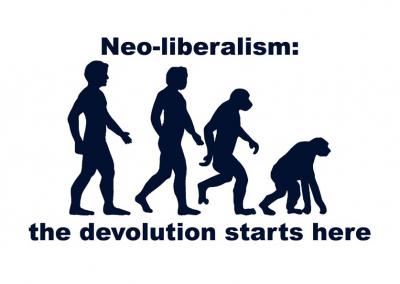
It cannot be emphasized enough that neoliberalism is not classical liberalism, or a return to a purer version of it, as is commonly misunderstood; it is a new thing, because the market, for one thing, is not at all free and untethered and dynamic in the sense that classical liberalism idealized it. Neoliberalism presumes a strong state, working only for the benefit of the wealthy, and as such it has little pretence to neutrality and universality, unlike the classical liberal state.

I would go so far as to say that neoliberalism is the final completion of capitalism’s long-nascent project, in that the desire to transform everything—every object, every living thing, every fact on the planet—in its image had not been realized to the same extent by any preceding ideology. Neoliberalism happens to be the ideology—unlike the three major forerunners in the last 250 years—that has the fortune of coinciding with technological change on a scale that makes its complete penetration into every realm of being a possibility for the first time in human history.

From the early 1930s, when the Great Depression threatened the classical liberal consensus (the idea that markets were self-regulating, and the state should play no more than a night-watchman role), until the early 1970s, when global instability including currency chaos unraveled it, the democratic world lived under the Keynesian paradigm: markets were understood to be inherently unstable, and the interventionist hand of government, in the form of countercyclical policy, was necessary to make capitalism work, otherwise the economy had a tendency to get out of whack and crash.

It’s an interesting question if it was the stagflation of the 1970s, following the unhitching of the United States from the gold standard and the arrival of the oil embargo, that brought on the neoliberal revolution, with Milton Friedman discrediting fiscal policy and advocating a by-the-numbers monetarist policy, or if it was neoliberalism itself, in the form of Friedmanite ideas that the Nixon administration was already pursuing, that made stagflation and the end of Keynesianism inevitable.

It should be said that neoliberalism thrives on prompting crisis after crisis, and has proven more adept than previous ideologies at exploiting these crises to its benefit, which then makes the situation worse, so that each succeeding crisis only erodes the power of the working class and makes the wealthy wealthier. There is a certain self-fulfilling aura to neoliberalism, couched in the jargon of economic orthodoxy, that has remained immune from political criticism, because of the dogma that was perpetuated—by Margaret Thatcher and her acolytes—that There Is No Alternative (TINA).

Neoliberalism is excused for the crises it repeatedly brings on—one can think of a regular cycle of debt and speculation-fueled emergencies in the last forty years, such as the developing country debt overhang of the 1970s, the savings and loan crisis of the 1980s, the Asian currency crisis of the 1990s, and the subprime mortgage crisis of the 2000s—better than any ideology I know of. This is partly because its very existence as ruling ideology is not even noted by the population at large, which continues to derive some residual benefits from the welfare state inaugurated by Keynesianism but has been led to believe by neoliberal ideologues to think of their reliance on government as worthy of provoking guilt, shame, and melancholy, rather than something to which they have legitimate claim.

It is not surprising to find neoliberal multiculturalists—comfortably established in the academy—likewise demonizing, or othering, not Muslims, Mexicans, or African Americans, but working-class whites (the quintessential Trump proletariat) who have a difficult time accepting the fluidity of self-definition that goes well with neoliberalism, something that we might call the market capitalization of the self.

George W. Bush’s useful function was to introduce necessary crisis into a system that had grown too stable for its own good; he injected desirable panic, which served as fuel to the fire of the neoliberal revolution. Trump is an apostate—at least until now—in desiring chaos on terms that do not sound neoliberal, which is unacceptable; hence Jeb Bush’s characterization of him as the “candidate of chaos.” Neoliberalism loves chaos, that has been its modus operandi since the early 1970s, but only the kind of chaos it can direct and control.

To go back to origins, the Great Depression only ended conclusively with the onset of the second world war, after which Keynesianism had the upper hand for thirty-five years. But just as the global institutions of Keynesianism, specifically the IMF and the World Bank, were being founded at the New Hampshire resort of Bretton Woods in 1944, the founders of the neoliberal revolution, namely Friedrich Hayek, Ludwig von Mises, Milton Friedman, and others were forming the Mount Pelerin Society (MPS) at the eponymous Swiss resort in 1947, creating the ideology which eventually defeated Keynesianism and gained the upper hand during the 1970s.

So what exactly is neoliberalism, and how is it different from classical liberalism, whose final manifestation came under Keynesianism?

Neoliberalism believes that markets are self-sufficient unto themselves, that they do not need regulation, and that they are the best guarantors of human welfare. Everything that promotes the market, i.e., privatization, deregulation, mobility of finance and capital, abandonment of government-provided social welfare, and the reconception of human beings as human capital, needs to be encouraged, while everything that supposedly diminishes the market, i.e., government services, regulation, restrictions on finance and capital, and conceptualization of human beings in transcendent terms, is to be discouraged.

When Hillary Clinton frequently retorts—in response to demands for reregulation of finance, for instance—that we have to abide by “the rule of law,” this reflects a particular understanding of the law, the law as embodying the sense of the market, the law after it has undergone a revolution of reinterpretation in purely economic terms. In this revolution of the law persons have no status compared to corporations, nation-states are on their way out, and everything in turn dissolves before the abstraction called the market.

One way to sum up neoliberalism is to say that everything—everything—is to be made over in the image of the market, including the state, civil society, and of course human beings. Democracy becomes reinterpreted as the market, and politics succumbs to neoliberal economic theory, so we are speaking of the end of democratic politics as we have known it for two and a half centuries. As the market becomes an abstraction, so does democracy, but the real playing field is somewhere else, in the realm of actual economic exchange—which isnot, however, the market. We may say that all exchange takes place on the neoliberal surface.

Neoliberalism is often described—and this creates a lot of confusion—as “market fundamentalism,” and while this may be true for neoliberal’s self-promotion and self-presentation, i.e., the market as the ultimate and only myth, as were the gods of the past, I would argue that in neoliberalism there is no such thing as the market as we have understood it from previous ideologies.

The neoliberal state—actually, to utter the word state seems insufficient here, I would claim that a new entity is being created, which is not the state as we have known it, but an existence that incorporates potentially all the states in the world and is something that exceeds their sum—is all-powerful, it seeks to leave no space for individual self-conception in the way that classical liberalism, and even communism and fascism to some degree, were willing to allow.

There are competing understandings of neoliberal globalization, when it comes to the question of whether the state is strong or weak compared to the primary agent of globalization, i.e., the corporation, but I am taking this logic further, I am suggesting that the issue is not how strong the state is in the service of neoliberalism, but whether there is anything left over beyond the new definition of the state. Another way to say it is that the state has become the market, the market has become the state, and therefore both have ceased to exist in the form we have classically understood them.

Of course the word hasn’t gotten around to the people yet, hence all the confusion about whether Hillary Clinton is more neoliberal than Barack Obama, or whether Donald Trump will be less neoliberal than Hillary Clinton. The project of neoliberalism—i.e., the redefinition of the state, the institutions of society, and the self—has come so far along that neoliberalism is almost beyond the need of individual entities to make or break its case. Its penetration has gone too deep, and none of the democratic figureheads that come forward can fundamentally question its efficacy.

I said almost. The reason why Bernie Sanders, self-declared democratic socialist, is so threatening to neoliberalism is that he has articulated a conception of the state, civil society, and the self that is not founded in the efficacy and rationality of the market. He does not believe—unlike Hillary Clinton—that the market can tackle climate change or income inequality or unfair health and education outcomes or racial injustice, all of which Clinton propagates. Clinton’s impending “victory” (whatever machinations were involved in engineering it) will only strengthen neoliberalism, as the force that couldn’t be defeated even when the movement was as large and transcendent as Sanders’s. Although Sanders doesn’t specify “neoliberalism” as the antagonist, his entire discourse presumes it.

Likewise, while Trump supporters want to take their rebellion in a fascist direction, their discomfort with the logic of the market is as pervasive as the Sanders camp, and is an advance, I believe, over the debt and unemployment melancholy of the Tea Party, the shame that was associated with that movement’s loss of identity as bourgeois capitalists in an age of neoliberal globalization. The Trump supporters, I believe, are no longer driven by shame, as was true of the Tea Party, and as has been true of the various dissenting movements within the Republican party, evangelical or otherwise, in the recent past. Rather, they have taken the shackles off and are ready for a no-holds barred “politically incorrect” fight with all others: they want to be “winners,” even at the cost of exterminating others, and that is not the neoliberal way, which doesn’t acknowledge that there can be winners and losers in the neoliberal hyperspace.

In the current election campaign, Hillary Clinton has been the most perfect embodiment of neoliberalism among all the candidates, she is almost its all-time ideal avatar, and I believe this explains, even if not articulated this way, the widespread discomfort among the populace toward her ascendancy. People can perceive that her ideology is founded on a conception of human beings striving relentlessly to become human capital (as her opening campaign commercialso overtly depicted), which means that those who fail to come within the purview of neoliberalism should be rigorously ostracized, punished, and excluded.

This is the dark side of neoliberalism’s ideological arm (a multiculturalism founded on human beings as capital), which is why this project has become increasingly associated with suppression of free speech and intolerance of those who refuse to go along with the kind of identity politics neoliberalism promotes.

And this explains why the 1990s saw the simultaneous and absolutely parallel rise, under the Clintons, of both neoliberal globalization and various regimes of neoliberal disciplining, such as the shaming and exclusion of former welfare recipients (every able-bodied person should be able to find work, therefore under TANF welfare was converted to a performance management system designed to enroll everyone in the workforce, even if it meant below-subsistence wages or the loss of parental responsibilities, all of it couched in the jargon of marketplace incentives).

The actual cost to the state of the AFDC program was minimal, but its symbolism was incalculable. The end of welfare went hand in hand with the disciplinary “crime bill” pushed by the Clintons, leading to an epidemic of mass incarceration. Neoliberalism, unlike classical liberalism, does not permit a fluidity of self-expression as an occasional participant in the market, and posits prison as the only available alternative for anyone not willing to conceive of themselves as being present fully and always in the market.

I believe that the generation of people—in their forties or older—supporting Hillary have already internalized neoliberal subjectivity, which they like to frame as realism or pragmatism, refusing for instance to accept that free college or health care are even theoretical possibilities. After all, they have maintained a measure of success in the past three or four decades after conceptualizing themselves as marketplace agents. Just as the Tea Party supporters found it intolerable that government should help irresponsible homeowners by bailing them out of unsustainable debt, the Clinton supporters hold essentially the same set of beliefs toward those who dare to think of themselves outside the discipline of the market.

I spoke of the myth of the market, as something that has no existence in reality, because none of the elements that would have to exist for a market to work are actually in place; this is even more true for neoliberalism than it was for the self-conscious annihilation of the market by communism, because at least in that system the market, surreptitiously, as in various Eastern European countries, kept making an appearance. But when the market takes neoliberal shape, i.e., the classical conceptions of the buyer and seller as free agents are gone, then radical inequality is the natural outcome. And inequality in the last four decades, as statistics for the U.S. and everywhere neoliberalism has made inroads prove beyond a doubt, has exploded, thereby invalidating neoliberalism’s greatest claim to legitimacy, that it brings about a general increase in welfare. So neoliberalism, to the extent that the inequality discourse has made itself manifest recently, must insist all the more vocally on forms of social recognition, what Clinton, for example, likes to call the “fall of barriers.”

Neoliberalism likes to focus on public debt—in the Clinton years debt reduction became a mania, though George W. Bush promptly spent all the accumulated surpluses on tax cuts for the wealthy and on wars of choice—rather than inequality, because the only way to address inequality is through a different understanding of public debt; inequality can only be addressed through higher taxation, which has by now been excluded from the realm of acceptable discourse—except when Sanders, Trump, or Jeremy Corbyn in England go off script.

So to recapitulate neoliberalism’s comprehensive success, let us note that we have gone from a liberal, Keynesian, welfare state to a neoliberal, market-compliant, disciplinary state.

Neoliberalism expects—and education at every level has been redesigned to promote this—that economic decision-making will be applied to all areas of life (parenthood, intimacy, sexuality, and identity in any of its forms), and that those who do not do so will be subject to discipline. Everyone must invest in their own future, and not pose a burden to the state or anyone else, otherwise they will be refused recognition as human beings.

This supposed economic “rationality” (though it is the greatest form of irrationality) applies to civil society as much as the state, so that none of the ideals of classical liberalism, or previous ideologies rooted in humanism, are valid any longer, the only value is the iteration of the market (as myth, not reality); in other words, neoliberalism, unlike the elevation of the individual in classical liberalism or the state in fascism or the collectivity in communism, has erected something, the market, that has no real existence, as the only god to serve! And it is just like a god, with an ethereal, unchallengeable, irrefutable, ubiquitous presence. Whatever in state policy does not serve market-conformity is to be banned and banished from memory (the secular scriptures are to be rewritten), which explains neoliberalism’s radical narrowing of public discourse, including the severance of identity politics from any class foundation.

Neoliberalism will continue to perpetuate reduced opportunity, because one of its characteristics—as in any system that wants to thrive on the world stage—is to constantly refine the field upon which the human subject can operate.

As such, those displaced workers who have suffered the most from the erosion of the old industries in the former manufacturing centers of the world are not even factors to contend with, they are invisible and cannot be part of the policy equation. To the extent that their actual presence is reckoned with, the economy can be said to have crashed; but the problem doesn’t arise because of the management of unemployment or underemployment statistics, unlike a housing crash which is palpable and cannot escape statistical definition.

The danger for neoliberalism—as is clear from the support of millions of displaced human beings for Trump—is that with each crisis neoliberalism sheds more workers, makes individuals and firms more “disciplined,” narrows the scope of opportunity even further. At times, the disciplining of the non-neoliberal other—as with the killing of Michael Brown or Eric Garner—explodes to surface consciousness in an unsavory way, so an expert manager like Clinton or Obama is required to tamp down the emotions of such unruly entities as Black Lives Matter which arise in response. If climate change, according to Clinton and her cohort, can and should have market solutions, then surely racial disparity, or police violence, should also have market solutions and no others; it is here that neoliberal multiculturalism, operating in the academy, is so insidious, because at the elite level it functions to validate market discourse, it does not step outside it.

The present breakdown of both major political parties can be explained by the frustration that has built up in the body politic over the past decade, because after the crash there was no sustained intellectual movement to question the myth of the market. The substitution of economic justice with identity politics is something Ralph Nader, Howard Dean, and now Bernie Sanders have contested in a humane manner, while the same process is at work, admittedly in an inhumane way, in the Trump phenomenon.

Thus, also, Hillary Clinton’s animus against free college education; that form of expansion of opportunity, which was a reality from the 1950s to the 1980s, cannot be allowed to return, human beings are supposed to invest in their own future earnings potential, they are not entitled to a transcendent experience without barriers manifesting in discipline and self-correction. Education, like everything else, including one’s own health, becomes an expensive consumer good, not a right, no longer an experience that might lead to a consciousness beyond the market but something that should be fully encapsulated by the market. If one is a capable market player, education as we have classically understood it becomes redundant.

Unlike the interregnum between 1945-1973, the rising tide—no matter the befuddlements Arthur Laffer and his fellow Reaganite ideologues proffered—does not lift all boats today, it is outside the logic of neoliberalism that it do so, so the idea of reforming neoliberalism, or what is often called “globalization with a human face,” is a rhetorical distraction. All of the policy innovations—interpreted as “socialism” by the Tea Partiers—offered by Barack Obama fall within the purview of neoliberalism, above all the Affordable Care Act, whose genesis was hatched in neoliberal think tanks decades ago.

It is important to note that neoliberal economic restructuring necessarily means social restructuring, i.e., a movement toward disciplinarity and away from liberalism; the disciplinarity can take a Bushian, Clintonian, or Trumpian form, but these are manifestations of the same tendency.

When wage growth is decoupled from economic growth (as it has been since Friedman and others inaugurated the revolution in the early 1970s), this means that the human subject is ripe for discipline. Furthermore, wage fairness cannot be rationally discussed (hence the obfuscation surrounding the $15 minimum wage orchestrated by Clinton and others) because the concept of the market has been disembedded from society; the market as abstraction, not a concrete reality, makes any notion of reform or restructuring impossible. Like the minimum wage, something like free child care also remains outside the bounds of discourse, because public policy cannot accommodate discussions that do not take the self-regulating market as unassailable myth.

What neoliberalism can accommodate is relentless tax cuts (Trump has already offered his huge tax cut plan, as Bush did as his first order of business), which only exacerbate the problem, leading to increasing concentrations of wealth. It has to be said, though, that Ted Cruz more comfortably fit the neoliberal paradigm, with his familiar calls for lower taxes along with reduced regulation and further limits on social welfare, whereas Trump shows, for now, some elements of apostasy. If neoliberalism were to get a Cruz, it would have no problem working with him, or rather, Cruz would have had no problem executing neoliberalism, beyond the surface dissimilarities from Hillary Clinton.

As Sanders has consistently noted, economic inequality leads to political inequality, which means that democracy, after a certain point, becomes only theoretical (viz. Citizens United and the electoral influence of such powerful entities as the Koch brothers). Both processes—economic inequality and political inequality—have accelerated after each downturn in the forty-five-year history of neoliberalism, therefore a downturn is always exciting, and even preordained, for a Bush, a Trump, or a Clinton. Again, economic inequality and political polarity (polarity is simply a manifestation of democracy having become dysfunctional) strongly correlate, and both have come to a head in this election.

Neoliberalism’s task, from this point on, is to mask and manage the increasing inequalities that are likely to befall humanity, especially as the planet reaches a crisis point in its health. In a way, George W. Bush threw a wrench—he was a perverted Keynesian in a way, believing in war to prime the pump, or inflating unsustainable bubbles, or spending exorbitantly on grandiose gestures—into the process of neoliberal globalization that was going very smoothly indeed under Bill Clinton and would likely have flourished under Al Gore as well. With Hillary Clinton, the movement will be toward further privatization of social welfare, “reforming” it along market principles, as has been true of every neoliberal avatar, whether it was Bill Clinton’s incentives to work in the performance management makeover of welfare, George Bush’s proposed private social security accounts, Mitt Romney’s proposed private health care accounts, or the school vouchers that tempt all of them from time to time.

What remains to be seen is the extent to which the millennial generation might be capable of thinking outside the neoliberal paradigm, i.e., they don’t just want more of what neoliberal promises to give them yet fails to deliver, but want things that neoliberalism does not or cannot promise. On this rests the near-term future of the neoliberal project.

Beyond Sanders himself, the key question is the ability of the millennial generation to conceive of themselves outside the neoliberal subjectivity they have been pushed to internalize. They have been encouraged to think of themselves as capital producers, turning their intellectuality into social media popularity for the benefit of capital, in the service of the same abstract market that has no place, no role, no definition beyond the fallen liberal calculus. Does the millennial generation believe, even about its most intimate core, that everything has been privatized?

I am not necessarily making a pessimistic prediction. I am merely outlining the strength of an opponent that has refused to be named for forty-five years, although it has been the ruling ideology that long! In defining neoliberalism, I have sought to distance myself from the distraction of personalities, and tried to expose the dark side of our politics which we can only see when we name and understand the ideology as such. We are up against a system that is so strong that it has survived, for the most part, the last crash, as citizens couldn’t get their heads around the idea of nationalizing banks or health care.

It is existentially imperative to ponder what happens beyond Sanders, because neoliberalism has its end-game in sight, letting inequality continue to escalate past the crash point (meaning the point where the economy works for most people), past any tolerable degradation of the planet (which is being reconceptualized in the shape of the market).

What, indeed, does happen beyond Sanders, because as we have seen Hillary Clinton is one of the founders of neoliberal globalization, one of its central historical figures (having accelerated the warehousing of the poor, the attack on trade unions, and the end of welfare and of regulatory prowess), while Trump is an authoritarian figure whose conceptions of the state and of human beings within the state are inconsistent with the surface frictionlessness neoliberalism desires? To go back to Hillary Clinton’s opening campaign commercial, to what extent will Americans continue to believe that the self must be entrepreneurially leveraged toward maximum market gains, molded into mobile human capital ever ready to serve the highest bidder?

As to whether a non-neoliberal globalization is possible and what that might look like on the international stage after a quarter-century of Clinton, Bush, and Obama—which is essentially the frustration Trump is tapping into—I’ll take that up in a follow-up essay, which will further clarify the differences between Sanders versus Clinton, and Trump versus Clinton.

I would suggest that it is not that globalization causes or has caused neoliberalism, but that neoliberalism has pushed a certain form of globalization that suits its interests. This is a crucial distinction, on which everything else hinges. The neoliberal market doesn’t actually exist; at the moment it is pure abstraction; what is actually filling up economic and political space can only be discussed when we step away from this abstraction, as Sanders has so ably done, and as the Occupy and Black Lives Matter movements tentatively set in motion.

 

Anis Shivani is the author of several books of fiction, poetry, and criticism, including, most recently, My Tranquil War and Other Poems. His novel Karachi Raj (HarperCollins/Fourth Estate) was released this summer. His next book is the poetry collection Whatever Speaks on Behalf of Hashish, out in October.