RAD, MAD & BAD: The Analog Rebellion of Craig Baldwin and Other Cinema

By Andy Prisbylla

Source: We Are The Mutants

In our current technocratic society, it’s incredibly rare to meet someone who is genuinely free. The erosion of the Consent Decrees of 1948—which allowed media conglomerates to own and control movie theaters—drastically altered the landscape of film and video production, further destabilizing an already unlevel playing field between corporate interests, content creators, and consumers. The trickle-down economics Reagan touted in his 1981 tax act proved only to favor the affluent, further alienating independent creators who were frozen out of a livelihood through economic blacklisting, a perpetual attack that continues to this day. Bill Clinton’s elimination of the fin-syn rules that required television networks to source 35% of their content from independent producers only helped to continue this trend into the new millennium, and soon the mainstream movie and TV-consuming public was offered a slate of hegemonic programming supplied by a monopoly rule. 

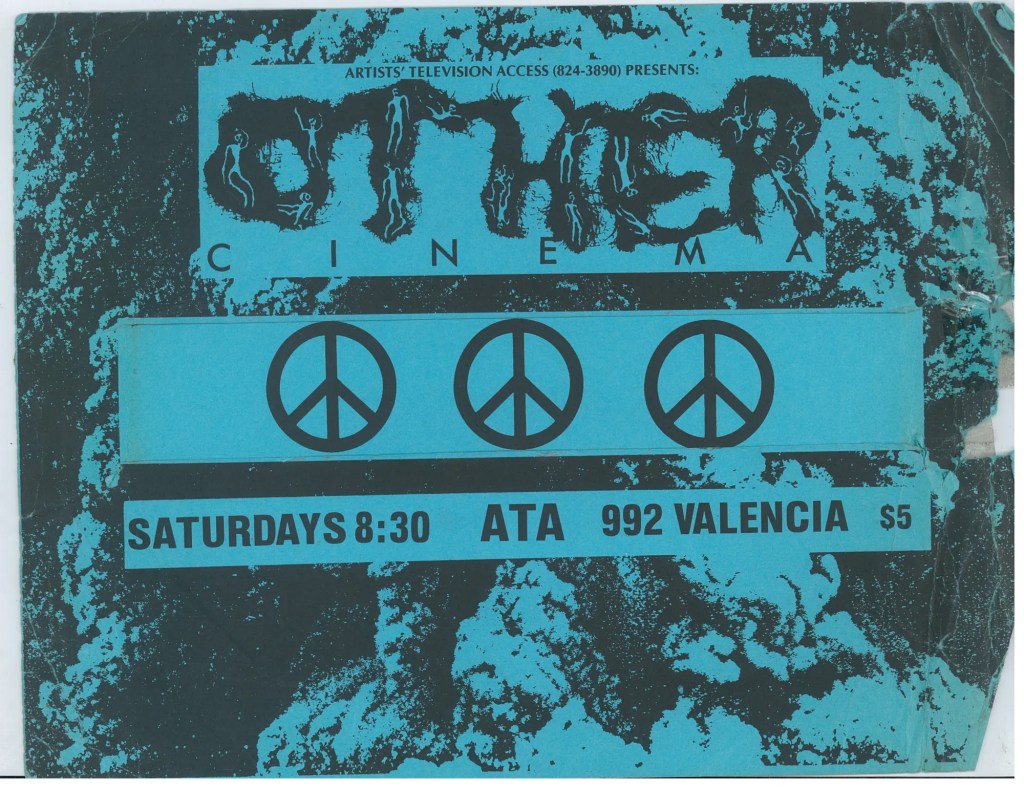
With traditional avenues of information exchange becoming more restricted, pockets of transgressive media resistance—inspired by the countercultural film and video collectives of the ‘60s and ‘70s—gained 501(c)(3) non-profit status in 1980s America. These artist-run community organizations championed alternative educational perspectives on media literacy and performance, such as Artists’ Television Access in the Mission District of San Francisco, California. Operating under the umbrella of this community space exists a cinematic collective with a subversive trajectory: a film screening series and analog archive curated from the margins of mainstream media and acceptable art practice. Under the stewardship of underground filmmaker and curator Craig Baldwin, Other Cinema stands as the vanguard of Baldwin’s personal artistic conviction—what he calls “cinema povera,” an anti-capitalist filmmaking creed where artists only use the materials at their disposal to create art. Combine this practice with an ethos of media archeology and mixed-media collage that predates our current remix culture activities and what’s generated is an exhibition calendar of the modern avant-garde—a thirty-six week screening schedule projecting experimental film and video to the masses. Every Saturday night, cartoons, B movies, and commercials hold equal ground with industrial, educational, documentary, personal essay, and public domain/orphan films, bringing together numerous artists and filmmakers from around the world under one cinematic ceiling for close to 40 years.

Specific details surrounding the origins of Other Cinema are hard to quantify, partially due to the vastly prolific yet oddly cryptic career of founder Craig Baldwin. Born into a self-admitted 1950s middle-class existence in the Sacramento suburb of Carmichael, California, Baldwin spent his teenage years nurturing a ravenous curiosity for subversive cultures and media. During high school, he was often at the local Towne Theater enjoying the latest midnight show of underground programming, absorbing the cinematic combustion of the ‘60s experimental scene led by filmmakers like George Kuchar and Bruce Conner, who as a teacher would later kick Baldwin out of his film class while attending San Francisco State University. In college Baldwin also indulged in subterranean films such as Peter Watkins’s 1966 pseudo-doc The War Game and exploitation flicks like Paul Bartel’s 1975 sci-fi dystopian romp Death Race 2000. Forming a fascination with film exhibition, Baldwin worked as a projectionist at several movie houses throughout the city, navigating the film worlds through an eclecticism of arthouse, exploitation, pornography, and political activism—including contributing programming and film services to El Salvador Film and Video Projects for the Salvadoran solidarity movement of northern California. His early activism with the artistic political action collective the Urban Rats saw him and his cohorts reclaim San Francisco’s urban landscape through adverse possession or “squatter’s rights,” which allowed Baldwin to experiment with expanded cinema performance, such as projecting film in abandoned buildings and other derelict dwellings. 

This direct approach towards genre and social action speaks to Baldwin’s personal opposition towards the status quo, an attitude that not only informs Other Cinema’s motion picture programming but also Baldwin’s own filmmaking forays. His early experiments with Super 8 film—such as the prototypical culture jam/situationist prank Stolen Movie—bled into his 16mm attacks on advertising, consumerism, and colonialism in Wild Gunman and RocketKitKongoKit before gaining maximum velocity with his Dexedrine-driven, countermyth conspiracy report Tribulation 99. Making up the pure found footage/collage aesthetic of his filmography until introducing live-action performance into the mix with his films !O No Coronado!Spectres of the Spectrum, and Mock Up on Mu, these early works draw heavily from Baldwin’s now massive archive of analog film. Housed beneath the Artists’ Television Access property, this subterranean scroll of marginalized media is continuously rescued from the bowels of civilization’s ever evolving technological burden and given new purpose. The shift from film in the 1970s to magnetic tape in the 1980s saw major institutions overhaul their audio/visual collections in favor of more economical video formats, sending reels of celluloid to the dumpsters and landfills. Much like the Dadaists of the early 20th century avant-garde, whose use of appropriation and photomontage expressed anti-bourgeois protest through their art, Baldwin and company salvaged these bastardized works from material obscurity and celebrated their ephemeral nature through collage and remix. These hybrid works of the late 20th century serve as precursor to many of our current 21st century new media innovations, resulting in the continued radicalization of modern artistic folklore, such as the mashups and supercuts of Everything Is Terrible! and the radical anti-authoritarian statements of the sister collective Soda Jerk

Baldwin and Other Cinema’s defense of the diminished and discarded extends not only to the physical media he interacts with but to the audience he exhibits for. Maintaining a dialectical attitude, Baldwin expresses both respect and disrespect towards film genre and classification by spinning one off the other and forming new categories. Each screening is meant to give equal weight to diverse voices and provoke participation amongst attendees—an ethos Baldwin codified with his underground screening series The RAD, The MAD & The BAD while programming film events for Artists’ Television Access during the organization’s formative years. A protean yet practical film genre grouping system sorted through three major categories stripped of pretense and soaked in punk rock colloquialism, each selection was designated its own time slot on Wednesdays and Saturdays with those represented creating a continuity across each section:

The RAD: showcasing political and social action films 

The MAD: mad genius or auteur cinema

The BAD: psychotronic themes of horror/sci-fi/exploitation

Defying the unspoken restraint behind many traditional classification systems that favor a false high-brow aesthetic to an honest low-brow sensibility, The RAD, The MAD & The BAD crossed the cultural demarcation line with an egalitarian stance towards genre representation, allowing for serious discussion about what constitutes a film’s importance and its commodification within society. More importantly, it displayed through example that poor production doesn’t always mean poor quality, and films created on the margins of capital contain a certain cultural influence and accessibility that corporate-backed productions can only hope to afford or inspire.

The authentic response audiences gave towards the weekly film schedule at Artists’ Television Access saw the prestigious San Francisco Cinematheque approach Baldwin to bring his street sensibility to their precocious crowd with Sub-Cinema, a RAD, MAD & BAD-inspired program that ran over the course of 1985. The creation of other pop-up programs like Anti-Films and Eyes of Hell inspired Baldwin to consolidate his film selections under his own programming umbrella, and soon the ethos that fueled The RAD, The MAD & The BAD manifested itself into the physical embodiment of Baldwin’s own psyche and practice with the foundation of Other Cinema. 

If the RAD, MAD & BAD helped bring acceptance to the concept of marginalization in film selection and exhibition during the 1980s, the programming behind Other Cinema built upon this provocation by introducing new alternative voices from the microcinema scene of the 1990s. One of the forefronts of this new cinematic experience, Other Cinema became a home for a subculture of film using and reusing old and new technologies to create future underground works, with filmmakers and exhibitors from across the country like Sam GreenMartha ColburnGreta SniderBill DanielOrgone Cinema3Ton Cinema, and “others” coalescing to this space like the children of Hamelin to the Pied Piper’s whimsical flute. Many of these groups and individuals appear in Baldwin’s upcoming career monograph Avant to Live!, a 500-page treatise detailing his cinematic trajectory in the media arts.

The decline of physical media coupled with our perpetual progression towards a digital state continues to divide us, with some championing the virtual realm and its democratization of new technologies and others questioning its effect on the human experience and how we interact with each other. The popularity of streaming services continues to challenge the economic longevity of physical media, forcing film formats into a wave of obsolescence. Despite this, Craig Baldwin and Other Cinema rise against the tide with an analog assault of expanded cinema every Saturday night. Filmmakers on the fringe and maverick media archeologists with an overwhelming responsibility to film history, yet hamstrung by a lack of resources, congregate at Other Cinema to embrace the struggle in an ever evolving motion picture renaissance. It’s a form of masochism one needs to make it on this side of the art world—the “masochism of the margins,” as Baldwin often says. It takes pain and sacrifice to live here, yet the psychic rewards far outweigh the material loss. 

Craig Baldwin: Avant to Live! is a collaborative project between San Francisco Cinematheque and INCITE: Journal of Experimental Media and was released on May 30, 2023.

Andy Prisbylla is an underground filmmaker and exhibitor from the rust belt apocalypse of Steel City, PA. His screening series SUBCINEMA showcases subterranean movies and art through digital programming and live pop-up events. Find out more through Letterboxd and Mastodon

Saturday Matinee: Kurt Vonnegut: Unstuck in Time

By Matt Zoller Seitz

Source: RogerEbert.com

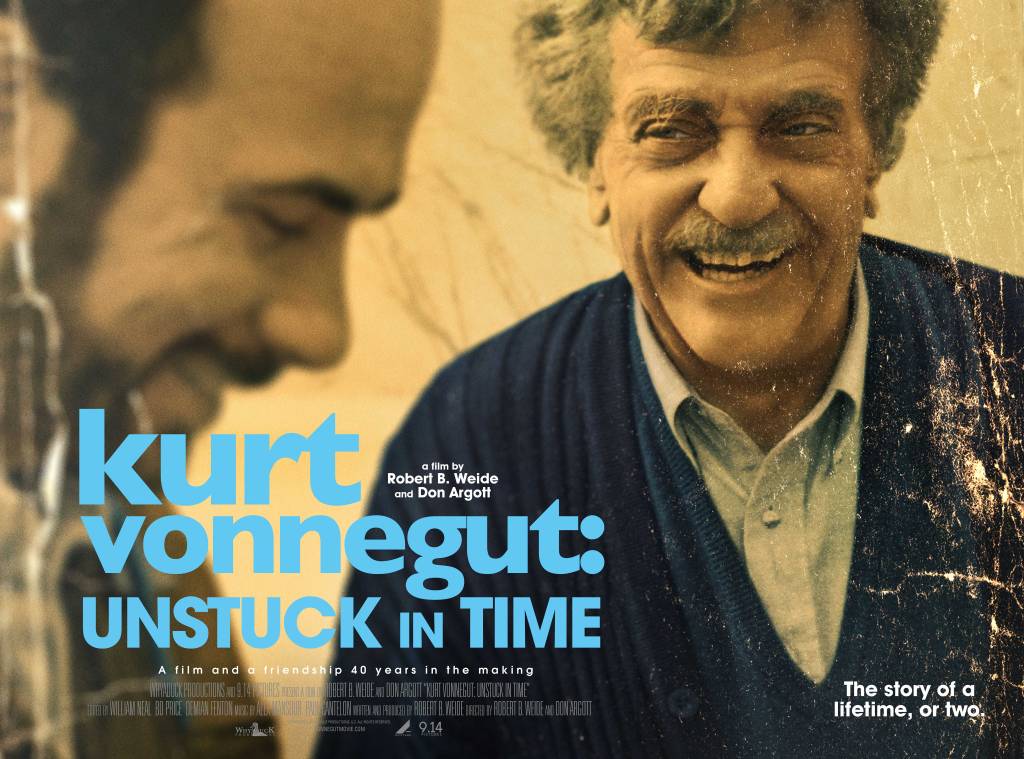
“Kurt Vonnegut: Unstuck in Time” is messy in the way that wakes for dear friends are messy.

Some speakers go on too long, and there are others that you may wish you’d heard from at greater length, or at all. And the raw sentiment coursing through every moment of the affair, however heartfelt, can be overwhelming, especially if you didn’t know the deceased as well as the folks memorializing him. 

The deceased here is Kurt Vonnegut, and the person who planned, executed and hosted this cinematic wake, director Robert B. Weide (a veteran documentarian and an Emmy-winning director for “Curb Your Enthusiasm”), was a friend of Vonnegut’s throughout the final 25 years of his life. This movie, co-directed by Don Argott, runs over two hours. Thematic and structural ideas are introduced, nurtured, forgotten, then reintroduced awkwardly. Weide himself is a major character—as well he should be, considering that Vonnegut essentially made Weide his personal archivist, sending him letters and manuscripts and faxes and video and audio tapes, and this film is as much a portrait of a friendship as it is the warts-and-all record of a great writer’s life—but sometimes the proportions feel off. When Weide disappears for long stretches, I don’t know that it’s exactly a slam to say that you don’t miss him, because people are mainly here for Vonnegut, one of the most important American writers of the 20th century, and a fount of charisma even at his lowest depths of sour narcissism in the 1970s. 

Vonnegut fans know that he specialized in slim, nimbly written books, with short chapters and short paragraphs that jumped wherever Vonnegut’s consciousness happened to take him. “Unstuck in Time” lets us know that it is consciously modeling its structure on Vonnegut’s writing, in particular his widest-read work, the nonlinear novel/memoir “Slaughterhouse Five,” from whence the documentary’s subtitle is drawn (“Billy Pilgrim came unstuck in time,” it starts); and to a lesser extent, Vonnegut’s late-career bestseller “Timequake,” a fragmented, self-aware book that is partly about the difficulty of writing “Timequake.” 

There are also cinematic allusions to Vonnegut’s literary alter-ego, Kilgore Trout, in the way that Weide and Argott and three credited film editors weave together the relationship between Vonnegut and Weide. Weide first meets Vonnegut in 1982 at age 23 after writing him a fan letter inquiring about the possibility of making a documentary about his life, and he holds onto that youthful starstruck quality even in reminiscences shot long after Vonnegut’s death in 2007. Over time, the pupil gains the master’s respect, to the point where Weide writes and coproduces a feature-length adaptation of Vonnegut’s novel “Mother Night,” starring Nick Nolte and directed by actor-filmmaker Keith Gordon, who as luck would have it played Rodney Dangerfield’s son in “Back to School,” a comedy in which Vonnegut played himself.

This may all sound as if it’s articulated more cleanly and effectively than it is. The filmmakers have committed simultaneously and with equal enthusiasm to a couple of filmmaking approaches that are at odds. One is the detached, clinical-mathematical, unsentimental, science-fictional, time-tripping biography, a la “Slaughterhouse Five” and “Timequake,” represented here by inventive cutting from image to image and idea to idea, sometimes lingering on signifiers of creative self-awareness. These include closeups of the timeline on an editor’s computer screen, montages of Vonnegut doing or saying the same thing in different decades of his life, snippets of films based on Vonnegut’s writing, and animated sequences modeled on Vonnegut’s drawings, which were as distinctive as his prose.

The other approach is more straightforward: Weide and Argott are making a straightforward PBS-style documentary about an artist’s life, supervised by a director and fan who knew him intimately, and tghat draws on footage ranging from childhood through old age. The latter might jump around in time in terms of the years in which it was created, but it ultimately tells Vonnegut’s story in a far more conventional way that the movie promises to do in its opening minutes.

This is fine; in fact it’s more than fine, because as Vonnegut and various experts on his work point out, Vonnegut remains readable and relevant in large part because he expressed himself in a direct way, drawing upon what’s described here as a journalistic writing style. Correspondingly, the most moving scenes and moments in “Unstuck in Time” are unmannered accounts of events. These range in emotional character from elating (Vonnegut’s commercial and critical success with “Slaughterhouse Five” after years of financial struggle) to vexing (after that success, he left his first wife, Jane, who’d been by his side during the lean years, moved to Manhattan, and married his mistress) to tragic (Vonnegut’s brother-in-law dying in a train wreck just two days before Vonnegut’s older sister died of cancer) to inspirational (Vonnegut unhesitatingly raising his late sister’s four sons alongside the three kids he had with Jane).

All of this material is fascinating, and articulated in vivid detail thanks to Weide’s trove of material. There are closeups of typewritten revisions of Vonnegut classics, each alteration indicated in pencil or pen, and letters and answering machine messages covering every imaginable life event. The filmmakers lay it all out so elegantly that whenever the movie seems to forget that it’s also about Weide and suddenly interrupts the flow to insert a reference to one of Weide’s own milestone events (such as his wife’s own battle with a debilitating illness and his Emmy win for “Curb,” which seems to be in there so that he can include Vonnegut’s answering machine message congratulating him) it’s awkward because Weide is clearly still grieving, too, and the viewer is torn between wanting to bear witness to Weide’s miseries and triumphs and wanting him to get back to Kurt Vonnegut as quickly as possible.

There is, nevertheless, something to be said for a documentary that tries to do something different and perhaps impossible, even if it doesn’t quite get there. And in the end, any flaws or missed opportunities are subsumed by the movie’s sincerity and wealth of insight. Its analysis of the role that Vonnegut’s World War II experience played in his demeanor as well as his fiction is fascinating and on-point, and the editors bring it all back at the end when Vonnegut, outraged by the second Bush administration’s invasion of Iraq and weaponizing of patriotism, writes a series of columns for “In These Times” magazine that will ultimately be collected in 2005’s “A Man Without a Country,” arguably his last major work.

Weide himself comes across as a sardonic and compassionate witness and guide, often taking the piss out of his own reverence for Vonnegut just when things threaten to get a bit moist. The devotion he displays towards Vonnegut throughout the second half of the writer’s life is as inspiring as Vonnegut’s own high points as a human being. We should all be lucky enough to have a friend who will tell our story.

____________________

Watch Kurt Vonnegut: Unstuck in Time on Kanopy here: https://www.kanopy.com/en/product/13799154

Dictatorship in Disguise: Authoritarian Monsters Wreak Havoc on Our Freedoms

By John & Nisha Whitehead

Source: The Rutherford Institute

“You see them on the street. You watch them on TV. You might even vote for one this fall. You think they’re people just like you. You’re wrong. Dead wrong.” — They Live 

We’re living in two worlds.

There’s the world we see (or are made to see) and then there’s the one we sense (and occasionally catch a glimpse of), the latter of which is a far cry from the propaganda-driven reality manufactured by the government and its corporate sponsors, including the media.

Indeed, what most Americans perceive as life in America—privileged, progressive and free—is a far cry from reality, where economic inequality is growing, real agendas and real power are buried beneath layers of Orwellian doublespeak and corporate obfuscation, and “freedom,” such that it is, is meted out in small, legalistic doses by militarized police and federal agents armed to the teeth.

All is not as it seems.

Monsters with human faces walk among us. Many of them work for the U.S. government.

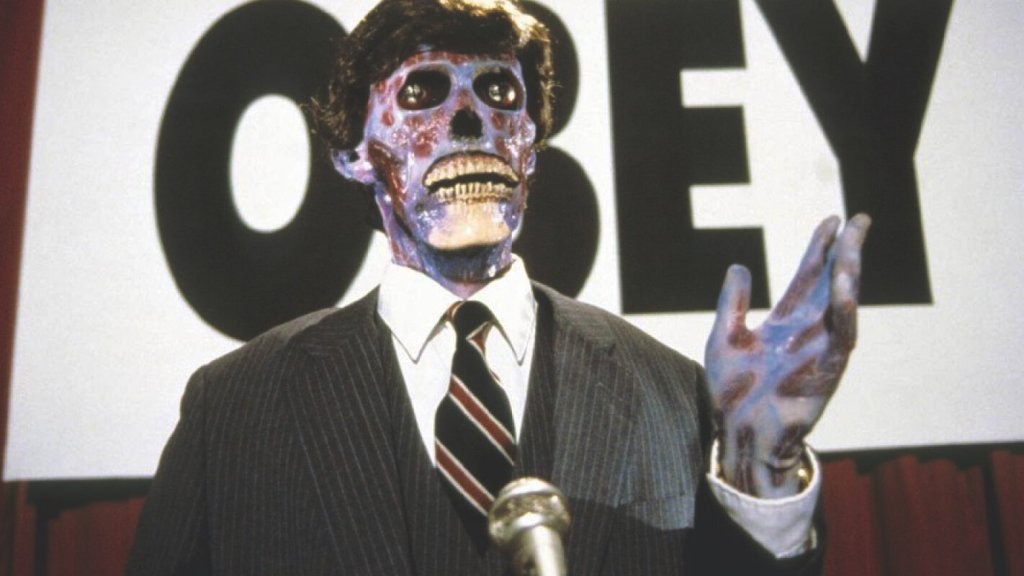
This is the premise of John Carpenter’s film They Live, which was released in November 1988 and remains unnervingly, chillingly appropriate for our modern age.

Best known for his horror film Halloween, which assumes that there is a form of evil so dark that it can’t be killed, Carpenter’s larger body of work is infused with a strong anti-authoritarian, anti-establishment, laconic bent that speaks to the filmmaker’s concerns about the unraveling of our society, particularly our government.

Time and again, Carpenter portrays the government working against its own citizens, a populace out of touch with reality, technology run amok, and a future more horrific than any horror film.

In Escape from New York, Carpenter presents fascism as the future of America.

In The Thing, a remake of the 1951 sci-fi classic of the same name, Carpenter presupposes that increasingly we are all becoming dehumanized.

In Christine, the film adaptation of Stephen King’s novel about a demon-possessed car, technology exhibits a will and consciousness of its own and goes on a murderous rampage.

In In the Mouth of Madness, Carpenter notes that evil grows when people lose “the ability to know the difference between reality and fantasy.”

And then there is Carpenter’s They Live, in which two migrant workers discover that the world is not as it seems. In fact, the population is actually being controlled and exploited by aliens working in partnership with an oligarchic elite. All the while, the populace—blissfully unaware of the real agenda at work in their lives—has been lulled into complacency, indoctrinated into compliance, bombarded with media distractions, and hypnotized by subliminal messages beamed out of television and various electronic devices, billboards and the like.

It is only when homeless drifter John Nada (played to the hilt by the late Roddy Piper) discovers a pair of doctored sunglasses—Hoffman lenses—that Nada sees what lies beneath the elite’s fabricated reality: control and bondage.

When viewed through the lens of truth, the elite, who appear human until stripped of their disguises, are shown to be monsters who have enslaved the citizenry in order to prey on them.

Likewise, billboards blare out hidden, authoritative messages: a bikini-clad woman in one ad is actually ordering viewers to “MARRY AND REPRODUCE.” Magazine racks scream “CONSUME” and “OBEY.” A wad of dollar bills in a vendor’s hand proclaims, “THIS IS YOUR GOD.”

When viewed through Nada’s Hoffman lenses, some of the other hidden messages being drummed into the people’s subconscious include: NO INDEPENDENT THOUGHT, CONFORM, SUBMIT, STAY ASLEEP, BUY, WATCH TV, NO IMAGINATION, and DO NOT QUESTION AUTHORITY.

This indoctrination campaign engineered by the elite in They Live is painfully familiar to anyone who has studied the decline of American culture.

A citizenry that does not think for themselves, obeys without question, is submissive, does not challenge authority, does not think outside the box, and is content to sit back and be entertained is a citizenry that can be easily controlled.

In this way, the subtle message of They Live provides an apt analogy of our own distorted vision of life in the American police state, what philosopher Slavoj Žižek refers to as dictatorship in democracy, “the invisible order which sustains your apparent freedom.”

We’re being fed a series of carefully contrived fictions that bear no resemblance to reality.

Tune out the government’s attempts to distract, divert and befuddle us and tune into what’s really going on in this country, and you’ll run headlong into an unmistakable, unpalatable truth: what we are dealing with today is an authoritarian beast that has outgrown its chains and will not be restrained.

Through its acts of power grabs, brutality, meanness, inhumanity, immorality, greed, corruption, debauchery and tyranny, the government has become almost indistinguishable from the evil it claims to be fighting, whether that evil takes the form of terrorism, torture, disease, drug traffickingsex trafficking, murder, violence, theft, pornography, scientific experimentations or some other diabolical means of inflicting pain, suffering and servitude on humanity.

We have let the government’s evil-doing and abuses go on for too long.

We’re being fed a series of carefully contrived fictions that bear no resemblance to reality.

Despite the fact that we are 17,600 times more likely to die from heart disease than from a terrorist attack; 11,000 times more likely to die from an airplane accident than from a terrorist plot involving an airplane; 1,048 times more likely to die from a car accident than a terrorist attack, and 8 times more likely to be killed by a police officer than by a terrorist , we have handed over control of our lives to government officials who treat us as a means to an end—the source of money and power.

As the Bearded Man in They Live warns, “They are dismantling the sleeping middle class. More and more people are becoming poor. We are their cattle. We are being bred for slavery.”

We have bought into the illusion and refused to grasp the truth.

From the moment we are born until we die, we are indoctrinated into believing that those who rule us do it for our own good. The truth is far different.

The powers-that-be want us to feel threatened by forces beyond our control (terrorists, pandemics, mass shootings, etc.).

They want us afraid and dependent on the government and its militarized armies for our safety and well-being.

They want us distrustful of each other, divided by our prejudices, and at each other’s throats.

Most of all, they want us to continue to march in lockstep with their dictates as fearful, controlled, pacified zombies.

This brings me back to They Live, in which the real zombies are not the aliens calling the shots but the populace who are content to remain controlled.

When all is said and done, the world of They Live is not so different from our own. As one of the characters points out, “The poor and the underclass are growing. Racial justice and human rights are nonexistent. They have created a repressive society and we are their unwitting accomplices. Their intention to rule rests with the annihilation of consciousness. We have been lulled into a trance. They have made us indifferent to ourselves, to others. We are focused only on our own gain.”

We, too, are focused only on our own pleasures, prejudices and gains. Our poor and underclasses are also growing. Injustice is growing. Inequality is growing. A concern for human rights is nearly nonexistent. We too have been lulled into a trance, indifferent to others.

Oblivious to what lies ahead, we’ve been manipulated into believing that if we continue to consume, obey, and have faith, things will work out. But that’s never been true of emerging regimes. And by the time we feel the hammer coming down upon us, it will be too late.

So where does that leave us?

The characters who populate Carpenter’s films provide some insight.

Underneath their machismo, they still believe in the ideals of liberty and equal opportunity. Their beliefs place them in constant opposition with the law and the establishment, but they are nonetheless freedom fighters.

When, for example, John Nada destroys the alien hypno-transmitter in They Live, he delivers a wake-up call for freedom. As Nada memorably declares, “I have come here to chew bubblegum and kick ass. And I’m all out of bubblegum.”

In other words: we need to get active and take a stand for what’s really important.

Stop allowing yourselves to be easily distracted by pointless political spectacles and pay attention to what’s really going on in the country.

As I make clear in my book Battlefield America: The War on the American People and in its fictional counterpart The Erik Blair Diaries, the real battle for control of this nation is taking place on roadsides, in police cars, on witness stands, over phone lines, in government offices, in corporate offices, in public school hallways and classrooms, in parks and city council meetings, and in towns and cities across this country.

All the trappings of the American police state are now in plain sight.

Wake up, America.

If they live (the tyrants, the oppressors, the invaders, the overlords), it is only because “we the people” sleep.

We’ve Been Lied To Our Whole Lives About Everything That Matters

By Caitlin Johnstone

Source: CaitlinJohnstone.com

Stories about protagonists who’ve been misguided their whole lives about something very important have been emerging in our culture for generations, and they continue to delight audiences in the box office to this day.

The pauper was really a prince. Luke was Darth Vader’s son. Keanu Reeves had been living in a computer simulation. Bruce Willis was really a ghost. Jim Carrey’s whole world was the set of a TV show, and everyone in his life had been lying to him since his infancy.

This theme repeats so often because it strongly resonates with people. And it strongly resonates with people because it’s exactly what is happening.

From our earliest moments we are trained to fit in with a society that was designed from the ground up by the powerful in the service of the powerful. As soon as we are old enough to get curious about the world and how it works our heads are filled with lies about such matters, by our education systems, by the media we consume, by our parents who were indoctrinated in the same way, and by the very culture we find ourselves immersed in from day one.

These stories about a character who’s been deceived about life resonate so strongly with us because on some level we all suspect it might be true of our own lives as well. They whisper to something hidden and sacred within us that has always sensed that there’s something not quite right with the way we are perceiving things.

We’ve spent our whole lives marinating in lies which serve the powerful. We’re deceived into believing that we live in a democracy whose government acts in accordance with the will of the voting public. We’re deceived into believing our political systems are driven by two warring ideological factions whose divisions are naturally occurring phenomena in our society instead of the product of deliberate social engineering. We’re deceived into believing our government is basically good, and that it stands in opposition to foreign governments who are pure evil. We’re deceived into believing the way things are is the only way they could possibly be.

We’re deceived into believing false things about the ways we gather information and form our understanding of the world. We’re deceived into believing the news media tell us the truth about what’s going on. We’re deceived into believing that everything we hear from our side of the political partisan divide is true and trustworthy. We’re deceived into believing the partisan filters which have been placed over our perception of national and world events by indoctrination are entirely reliable instruments for interpreting information and drawing conclusions.

We’re deceived into believing false things about ourselves. We’re deceived into believing that we are successful if we can become dominant capitalists and wealthy ladder climbers, and that we are failures if we don’t turn the gears of industry and climb over others to get ahead. We’re deceived into believing that we are good if we uphold the made-up, power-serving rules of law, of culture and of religion, and that we are bad if we transgress them. We are deceived into believing that we need to keep accomplishing, achieving and obtaining, that we need to keep earning money and approval, so that we might one day feel adequate at some imaginary point in a future which never arrives.

If we really commit to uprooting the untruth that’s been planted in us, we can even discover that we’ve been deceiving ourselves about the way we experience reality. That the perception of oneself as a finite character who is separate from the world is based on false assumptions about the way experience is happening, unhelpful mental habits born of incorrect premises, and overlooked aspects of our own consciousness. That we’ve been making ourselves miserable with false beliefs about who and what we are.

This civilization is the set of the Truman Show, and we are all Truman.

But because we are all Truman, we can only walk off the set if we walk off together. There is no option to leave as an individual, because even if you know it’s all lies, you’re still stuck in a world full of humans whose behavior is driven by lies.

Awakening to reality as an individual can for this reason sometimes be more uncomfortable than remaining asleep in the dream, because you’re like Truman after he realizes it’s all a sham, but before he escapes. At times you’re just stuck there, freaking out at the actor who’s playing your mother while she tries in vain to cut to a commercial break. It can be distressing for you, and it can be distressing for the people around you who aren’t yet on the same page.

The only way we’re getting off the set of the Truman Show is if we can all succeed in waking each other up from the lies which built it. Until then we’ll be stuck in a world of poverty, war, exploitation, degradation, ecocide, and suffering. It’s not until enough of us have unplugged our minds from the matrix of lies that we’ll be able to use our strength of numbers to force real change.

Only then will we be able to escape.

Only then will we be able to walk off the set.

Only then will we be able to turn to the audience and say, “In case I don’t see ya: good afternoon, good evening, and good night!”

And then turn around, and walk out the door, and begin our adventure into reality.

Pop Culture Has Become an Oligopoly

By Adam Mastroianni

Source: Experimental History

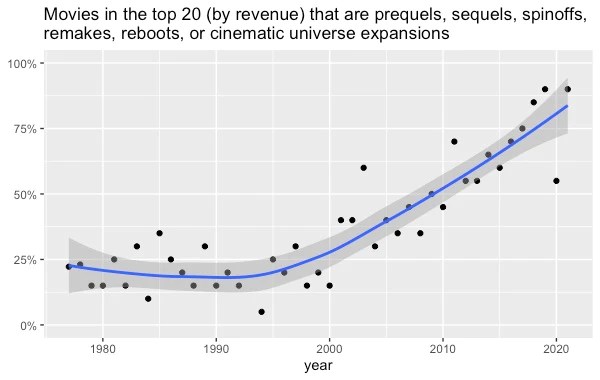
You may have noticed that every popular movie these days is a remake, reboot, sequel, spinoff, or cinematic universe expansion. In 2021, only one of the ten top-grossing films––the Ryan Reynolds vehicle Free Guy––was an original. There were only two originals in 2020’s top 10, and none at all in 2019.

People blame this trend on greedy movie studios or dumb moviegoers or competition from Netflix or humanity running out of ideas. Some say it’s a sign of the end of movies. Others claim there’s nothing new about this at all.

Some of these explanations are flat-out wrong; others may contain a nugget of truth. But all of them are incomplete, because this isn’t just happening in movies. In every corner of pop culture––movies, TV, music, books, and video games––a smaller and smaller cartel of superstars is claiming a larger and larger share of the market. What used to be winners-take-some has grown into winners-take-most and is now verging on winners-take-all. The (very silly) word for this oligopoly, like a monopoly but with a few players instead of just one.

I’m inherently skeptical of big claims about historical shifts. I recently published a paper showing that people overestimate how much public opinion has changed over the past 50 years, so naturally I’m on the lookout for similar biases here. But this shift is not an illusion. It’s big, it’s been going on for decades, and it’s happening everywhere you look. So let’s get to the bottom of it.

(Data and code available here.)

Movies 

At the top of the box office charts, original films have gone extinct. 

I looked at the 20 top-grossing movies going all the way back to 1977 (source), and I coded whether each was part of what film scholars call a “multiplicity”—sequels, prequels, franchises, spin-offs, cinematic universe expansions, etc. This required some judgment calls. Lots of movies are based on books and TV shows, but I only counted them as multiplicities if they were related to a previous movie. So 1990’s Teenage Mutant Ninja Turtles doesn’t get coded as a multiplicity, but 1991’s Teenage Mutant Ninja Turtles II: The Secret of the Ooze does, and so does the 2014 Teenage Mutant Ninja Turtles remake. I also probably missed a few multiplicities, especially in earlier decades, since sometimes it’s not obvious that a movie has some connection to an earlier movie.

Regardless, the shift is gigantic. Until the year 2000, about 25% of top-grossing movies were prequels, sequels, spinoffs, remakes, reboots, or cinematic universe expansions. Since 2010, it’s been over 50% ever year. In recent years, it’s been close to 100%.

Original movies just aren’t popular anymore, if they even get made in the first place.

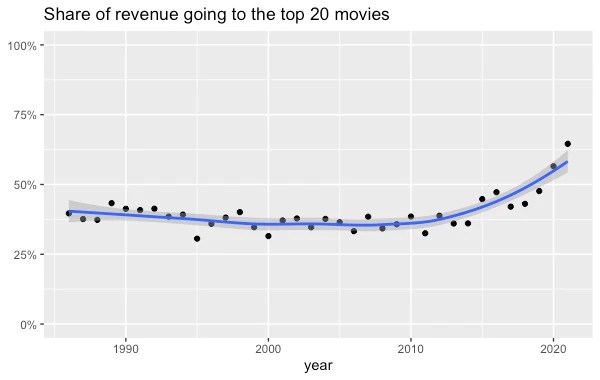
Top movies have also recently started taking a larger chunk of the market. I extracted the revenue of the top 20 movies and divided it by the total revenue of the top 200 movies, going all the way back to 1986 (source). The top 20 movies captured about 40% of all revenue until 2015, when they started gobbling up even more.

Television

Thanks to cable and streaming, there’s way more stuff on TV today than there was 50 years ago. So it would make sense if a few shows ruled the early decades of TV, and now new shows constantly displace each other at the top of the viewership charts.

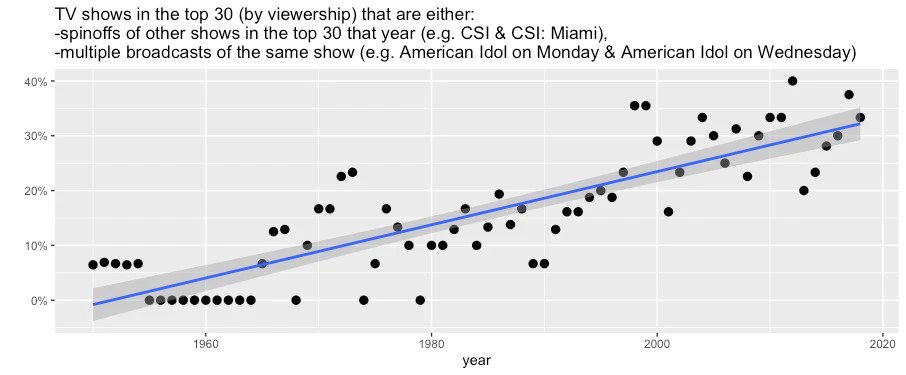
Instead, the opposite has happened. I pulled the top 30 most-viewed TV shows from 1950 to 2019 (source) and found that fewer and fewer franchises rule a larger and larger share of the airwaves. In fact, since 2000, about a third of the top 30 most-viewed shows are either spinoffs of other shows in the top 30 (e.g., CSI and CSI: Miami) or multiple broadcasts of the same show (e.g., American Idol on Monday and American Idol on Wednesday). 

Two caveats to this data. First, I’m probably slightly undercounting multiplicities from earlier decades, where the connections between shows might be harder for a modern viewer like me to understand––maybe one guy hosted multiple different shows, for example. And second, the Nielsen ratings I’m using only recently started accurately measuring viewership on streaming platforms. But even in 2019, only 14% of viewing time was spent on streaming, so this data isn’t missing much.

Music

It used to be that a few hitmakers ruled the charts––The Beatles, The Eagles, Michael Jackson––while today it’s a free-for-all, right?

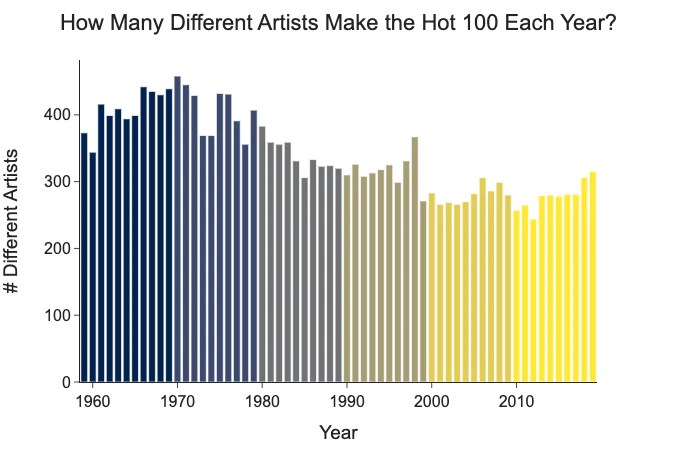
Nope. A data scientist named Azhad Syed has done the analysis, and he finds that the number of artists on the Billboard Hot 100 has been decreasing for decades.

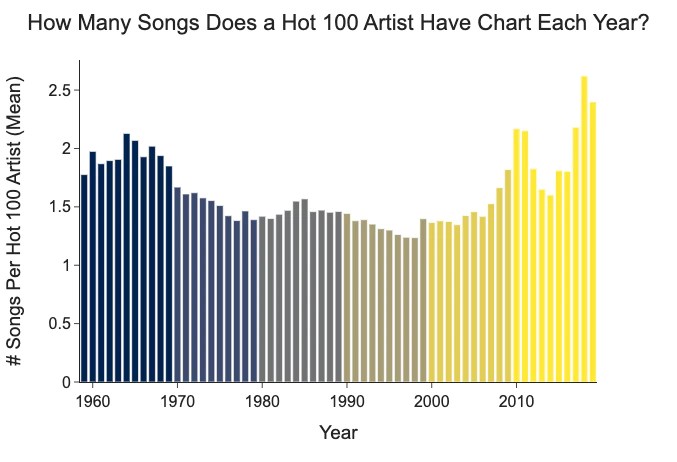
And since 2000, the number of hits per artist on the Hot 100 has been increasing. 

(Azhad says he’s looking for a job––you should hire him!)

A smaller group of artists tops the charts, and they produce more of the chart-toppers. Music, too, has become an oligopoly.

Books

Literature feels like a different world than movies, TV, and music, and yet the trend is the same.

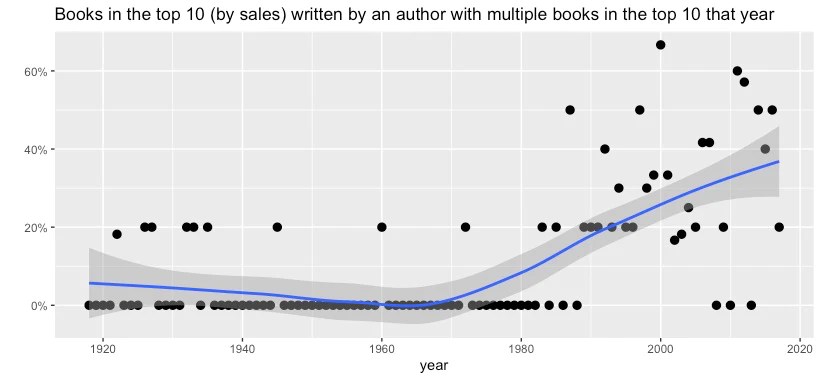
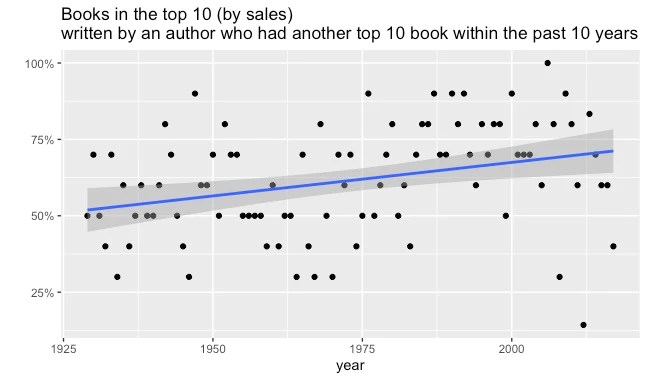
Using LiteraryHub’s list of the top 10 bestselling books for every year from 1919 to 2017, I found that the oligopoly has come to book publishing as well. There are a couple ways we can look at this. First, we can look at the percentage of repeat authors in the top 10––that is, the number of books in the top 10 that were written by an author with another book in the top 10.

It used to be pretty rare for one author to have multiple books in the top 10 in the same year. Since 1990, it’s happened almost every year. No author ever had three top 10 books in one year until Danielle Steel did it 1998. In 2011, John Grisham, Kathryn Stockett, and Stieg Larsson all had two chart-topping books each.

We can also look at the percentage of authors in the top 10 were already famous––say, they had a top 10 book within the past 10 years. That has increased over time, too. 

In the 1950s, a little over half of the authors in the top 10 had been there before. These days, it’s closer to 75%.

Video games

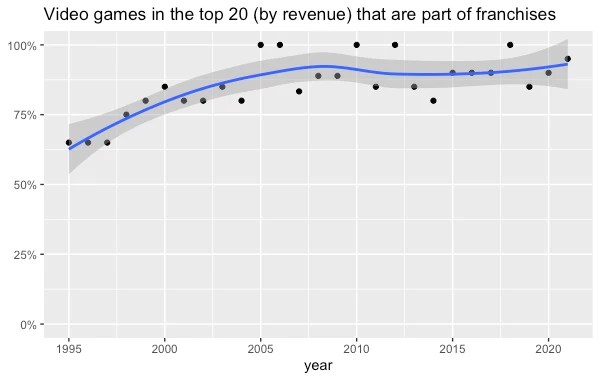
I tracked down the top 20 bestselling video games for each year from 1995 to 2021 (sources: 1234567) and coded whether each belongs to a preexisting video game franchise. (Some games, like Harry Potter and the Sorcerer’s Stone, belong to franchises outside of video games. For these, I coded the first installment as originals and any subsequent installments as franchise games.)

The oligopoly rules video games too:

In the late 1990s, 75% or less of bestselling video games were franchise installments. Since 2005, it’s been above 75% every year, and sometimes it’s 100%. At the top of the charts, it’s all Mario, Zelda, Call of Duty, and Grand Theft Auto.

Why is this happening?

Any explanation for the rise of the pop oligopoly has to answer two questions: why have producers started producing more of the same thing, and why are consumers consuming it? I think the answers to the first question are invasionconsolidation, and innovation. I think the answer to the second question is proliferation.

Invasion

Software and the internet have made it easier than ever to create and publish content. Most of the stuff that random amateurs make is crap and nobody looks at it, but a tiny proportion gets really successful. This might make media giants choose to produce and promote stuff that independent weirdos never could, like an Avengers movie. This can’t explain why oligopolization started decades ago––YouTube only launched in 2005, for example, and most Americans didn’t have broadband until 2007––but it might explain why it’s accelerated and stuck around.

Consolidation

Big things like to eat, defeat, and outcompete smaller things. So over time, big things should get bigger and small things should die off. Indeed, movie studiosmusic labelsTV stations, and publishers of books and video games have all consolidated. Maybe it’s inevitable that major producers of culture will suck up or destroy everybody else, leaving nothing but superstars and blockbusters. Indeed, maybe cultural oligopoly is merely a transition state before we reach cultural monopoly.

Innovation

You may think there’s nothing left to discover in art forms as old as literature and music, and that they simply iterate as fashions change. But it took humans thousands of years to figure out how to create the illusion of depth in paintings. Novelists used to think that sentences had to be long and complicated until Hemingway came along, wrote some snappy prose, and changed everything. Even very old art forms, then, may have secrets left to discover. Maybe the biggest players in culture discovered some innovations that won them a permanent, first-mover chunk of market share. I can think of a few:

  • In books: lightning-quick plots and chapter-ending cliffhangers. Nobody thinks The Da Vinci Code is high literature, but it’s a book that really really wants you to read it. And a lot of people did!
  • In music: sampling. Musicians seem to sample more often these days. Now we not only remake songs; we franchise them too.
  • In movies, TV, and video games: cinematic universes. Studios have finally figured out that once audiences fall in love with fictional worlds, they want to spend lots of time in them. Marvel, DC, and Star Wars are the most famous, but there are also smaller universe expansions like Better Call Saul and El Camino from Breaking Bad and The Many Saints of Newark from The Sopranos. Video game developers have understood this for even longer, which is why Mario does everything from playing tennis to driving go-karts to, you know, being a piece of paper.

Proliferation

Invasion, consolidation, and innovation can, I think, explain the pop oligopoly from the supply side. But all three require a willing audience. So why might people be more open to experiencing the same thing over and over again?

As options multiply, choosing gets harder. You can’t possibly evaluate everything, so you start relying on cues like “this movie has Tom Hanks in it” or “I liked Red Dead Redemption, so I’ll probably like Red Dead Redemption II,” which makes you less and less likely to pick something unfamiliar. 

Another way to think about it: more opportunities means higher opportunity costs, which could lead to lower risk tolerance. When the only way to watch a movie is to go pick one of the seven playing at your local AMC, you might take a chance on something new. But when you’ve got a million movies to pick from, picking a safe, familiar option seems more sensible than gambling on an original.

This could be happening across all of culture at once. Movies don’t just compete with other movies. They compete with every other way of spending your time, and those ways are both infinite and increasing. There are now 60,000 free books on Project Gutenberg, Spotify says it has 78 million songs and 4 million podcast episodes, and humanity uploads 500 hours of video to YouTube every minute. So uh, yeah, the Tom Hanks movie sounds good.

What do we do about it?

Some may think that the rise of the pop oligopoly means the decline of quality. But the oligopoly can still make art: Red Dead Redemption II is a terrific game, “Blinding Lights” is a great song, and Toy Story 4 is a pretty good movie. And when you look back at popular stuff from a generation ago, there was plenty of dreck. We’ve forgotten the pulpy Westerns and insipid romances that made the bestseller lists while books like The Great GatsbyBrave New World, and Animal Farm did not. American Idol is not so different from the televised talent shows of the 1950s. Popular culture has always been a mix of the brilliant and the banal, and nothing I’ve shown you suggests that the ratio has changed.

The problem isn’t that the mean has decreased. It’s that the variance has shrunk. Movies, TV, music, books, and video games should expand our consciousness, jumpstart our imaginations, and introduce us to new worlds and stories and feelings. They should alienate us sometimes, or make us mad, or make us think. But they can’t do any of that if they only feed us sequels and spinoffs. It’s like eating macaroni and cheese every single night forever: it may be comfortable, but eventually you’re going to get scurvy. 

We haven’t fully reckoned with what the cultural oligopoly might be doing to us. How much does it stunt our imaginations to play the same video games we were playing 30 years ago? What message does it send that one of the most popular songs in the 2010s was about how a 1970s rock star was really cool? How much does it dull our ambitions to watch 2021’s The Matrix: Resurrections, where the most interesting scene is just Neo watching the original Matrix from 1999? How inspiring is it to watch tiny variations on the same police procedurals and reality shows year after year? My parents grew up with the first Star Wars movie, which had the audacity to create an entire universe. My niece and nephews are growing up with the ninth Star Wars movie, which aspires to move merchandise. Subsisting entirely on cultural comfort food cannot make us thoughtful, creative, or courageous.

Fortunately, there’s a cure for our cultural anemia. While the top of the charts has been oligopolized, the bottom remains a vibrant anarchy. There are weird books and funky movies and bangers from across the sea. Two of the most interesting video games of the past decade put you in the role of an immigration officer and an insurance claims adjuster. Every strange thing, wonderful and terrible, is available to you, but they’ll die out if you don’t nourish them with your attention. Finding them takes some foraging and digging, and then you’ll have to stomach some very odd, unfamiliar flavors. That’s good. Learning to like unfamiliar things is one of the noblest human pursuits; it builds our empathy for unfamiliar people. And it kindles that delicate, precious fire inside us––without it, we might as well be algorithms. Humankind does not live on bread alone, nor can our spirits long survive on a diet of reruns.

The Future Is Here: Dystopian Movies Fit for a Dystopian World

By John W. Whitehead

Source: The Rutherford Institute

“The Internet is watching us now. If they want to. They can see what sites you visit. In the future, television will be watching us, and customizing itself to what it knows about us. The thrilling thing is, that will make us feel we’re part of the medium. The scary thing is, we’ll lose our right to privacy. An ad will appear in the air around us, talking directly to us.”—Director Steven Spielberg, Minority Report

We have arrived, way ahead of schedule, into the dystopian future dreamed up by such science fiction writers as George Orwell, Aldous Huxley, Margaret Atwood and Philip K. Dick.

Much like Orwell’s Big Brother in 1984, the government and its corporate spies now watch our every move.

Much like Huxley’s A Brave New World, we are churning out a society of watchers who “have their liberties taken away from them, but … rather enjoy it, because they [are] distracted from any desire to rebel by propaganda or brainwashing.”

Much like Atwood’s The Handmaid’s Tale, the populace is now taught to “know their place and their duties, to understand that they have no real rights but will be protected up to a point if they conform, and to think so poorly of themselves that they will accept their assigned fate and not rebel or run away.”

And in keeping with Philip K. Dick’s darkly prophetic vision of a dystopian police state—which became the basis for Steven Spielberg’s futuristic thriller Minority Report which was released 20 years ago—we are now trapped into a world in which the government is all-seeing, all-knowing and all-powerful, and if you dare to step out of line, dark-clad police SWAT teams and pre-crime units will crack a few skulls to bring the populace under control.

Minority Report is set in the year 2054, but it could just as well have taken place in 2022.

Seemingly taking its cue from science fiction, technology has moved so fast in the short time since Minority Report premiered in 2002 that what once seemed futuristic no longer occupies the realm of science fiction.

Incredibly, as the various nascent technologies employed and shared by the government and corporations alike—facial recognition, iris scanners, massive databases, behavior prediction software, and so on—are incorporated into a complex, interwoven cyber network aimed at tracking our movements, predicting our thoughts and controlling our behavior, Spielberg’s unnerving vision of the future is fast becoming our reality.

Both worlds—our present-day reality and Spielberg’s celluloid vision of the future—are characterized by widespread surveillance, behavior prediction technologies, data mining, fusion centers, driverless cars, voice-controlled homes, facial recognition systems, cybugs and drones, and predictive policing (pre-crime) aimed at capturing would-be criminals before they can do any damage.

Surveillance cameras are everywhere. Government agents listen in on our telephone calls and read our emails. Political correctness—a philosophy that discourages diversity—has become a guiding principle of modern society.

The courts have shredded the Fourth Amendment’s protections against unreasonable searches and seizures. In fact, SWAT teams battering down doors without search warrants and FBI agents acting as a secret police that investigate dissenting citizens are common occurrences in contemporary America.

We are increasingly ruled by multi-corporations wedded to the police state. Much of the population is either hooked on illegal drugs or ones prescribed by doctors. And bodily privacy and integrity has been utterly eviscerated by a prevailing view that Americans have no rights over what happens to their bodies during an encounter with government officials, who are allowed to search, seize, strip, scan, spy on, probe, pat down, taser, and arrest any individual at any time and for the slightest provocation.

All of this has come about with little more than a whimper from an oblivious American populace largely comprised of nonreaders and television and internet zombies, but we have been warned about such an ominous future in novels and movies for years.

The following 15 films may be the best representation of what we now face as a society.

Fahrenheit 451 (1966). Adapted from Ray Bradbury’s novel and directed by Francois Truffaut, this film depicts a futuristic society in which books are banned, and firemen ironically are called on to burn contraband books—451 Fahrenheit being the temperature at which books burn. Montag is a fireman who develops a conscience and begins to question his book burning. This film is an adept metaphor for our obsessively politically correct society where virtually everyone now pre-censors speech. Here, a brainwashed people addicted to television and drugs do little to resist governmental oppressors.

2001: A Space Odyssey (1968). The plot of Stanley Kubrick’s masterpiece, as based on an Arthur C. Clarke short story, revolves around a space voyage to Jupiter. The astronauts soon learn, however, that the fully automated ship is orchestrated by a computer system—known as HAL 9000—which has become an autonomous thinking being that will even murder to retain control. The idea is that at some point in human evolution, technology in the form of artificial intelligence will become autonomous and human beings will become mere appendages of technology. In fact, at present, we are seeing this development with massive databases generated and controlled by the government that are administered by such secretive agencies as the National Security Agency and sweep all websites and other information devices collecting information on average citizens. We are being watched from cradle to grave.

Planet of the Apes (1968). Based on Pierre Boulle’s novel, astronauts crash on a planet where apes are the masters and humans are treated as brutes and slaves. While fleeing from gorillas on horseback, astronaut Taylor is shot in the throat, captured and housed in a cage. From there, Taylor begins a journey wherein the truth revealed is that the planet was once controlled by technologically advanced humans who destroyed civilization. Taylor’s trek to the ominous Forbidden Zone reveals the startling fact that he was on planet earth all along. Descending into a fit of rage at what he sees in the final scene, Taylor screams: “We finally really did it. You maniacs! You blew it up! Damn you.” The lesson is obvious, but will we listen? The script, although rewritten, was initially drafted by Rod Serling and retains Serling’s Twilight Zone-ish ending.

THX 1138 (1970). George Lucas’ directorial debut, this is a somber view of a dehumanized society totally controlled by a police state. The people are force-fed drugs to keep them passive, and they no longer have names but only letter/number combinations such as THX 1138. Any citizen who steps out of line is quickly brought into compliance by robotic police equipped with “pain prods”—electro-shock batons. Sound like tasers?

A Clockwork Orange (1971). Director Stanley Kubrick presents a future ruled by sadistic punk gangs and a chaotic government that cracks down on its citizens sporadically. Alex is a violent punk who finds himself in the grinding, crushing wheels of injustice. This film may accurately portray the future of western society that grinds to a halt as oil supplies diminish, environmental crises increase, chaos rules, and the only thing left is brute force.

Soylent Green (1973). Set in a futuristic overpopulated New York City, the people depend on synthetic foods manufactured by the Soylent Corporation. A policeman investigating a murder discovers the grisly truth about what soylent green is really made of. The theme is chaos where the world is ruled by ruthless corporations whose only goal is greed and profit. Sound familiar?

Blade Runner (1982). In a 21st century Los Angeles, a world-weary cop tracks down a handful of renegade “replicants” (synthetically produced human slaves). Life is now dominated by mega-corporations, and people sleepwalk along rain-drenched streets. This is a world where human life is cheap, and where anyone can be exterminated at will by the police (or blade runners). Based upon a Philip K. Dick novel, this exquisite Ridley Scott film questions what it means to be human in an inhuman world.

Nineteen Eighty-Four (1984). The best adaptation of Orwell’s dark tale, this film visualizes the total loss of freedom in a world dominated by technology and its misuse, and the crushing inhumanity of an omniscient state. The government controls the masses by controlling their thoughts, altering history and changing the meaning of words. Winston Smith is a doubter who turns to self-expression through his diary and then begins questioning the ways and methods of Big Brother before being re-educated in a most brutal fashion.

Brazil (1985). Sharing a similar vision of the near future as 1984 and Franz Kafka’s novel The Trial, this is arguably director Terry Gilliam’s best work, one replete with a merging of the fantastic and stark reality. Here, a mother-dominated, hapless clerk takes refuge in flights of fantasy to escape the ordinary drabness of life. Caught within the chaotic tentacles of a police state, the longing for more innocent, free times lies behind the vicious surface of this film.

They Live (1988). John Carpenter’s bizarre sci-fi social satire action film assumes the future has already arrived. John Nada is a homeless person who stumbles across a resistance movement and finds a pair of sunglasses that enables him to see the real world around him. What he discovers is a world controlled by ominous beings who bombard the citizens with subliminal messages such as “obey” and “conform.” Carpenter manages to make an effective political point about the underclass—that is, everyone except those in power. The point: we, the prisoners of our devices, are too busy sucking up the entertainment trivia beamed into our brains and attacking each other up to start an effective resistance movement.

The Matrix (1999). The story centers on a computer programmer Thomas A. Anderson, secretly a hacker known by the alias “Neo,” who begins a relentless quest to learn the meaning of “The Matrix”—cryptic references that appear on his computer. Neo’s search leads him to Morpheus who reveals the truth that the present reality is not what it seems and that Anderson is actually living in the future—2199. Humanity is at war against technology which has taken the form of intelligent beings, and Neo is actually living in The Matrix, an illusionary world that appears to be set in the present in order to keep the humans docile and under control. Neo soon joins Morpheus and his cohorts in a rebellion against the machines that use SWAT team tactics to keep things under control.

Minority Report (2002). Based on a short story by Philip K. Dick and directed by Steven Spielberg, the film offers a special effect-laden, techno-vision of a futuristic world in which the government is all-seeing, all-knowing and all-powerful. And if you dare to step out of line, dark-clad police SWAT teams will bring you under control. The setting is 2054 where PreCrime, a specialized police unit, apprehends criminals before they can commit the crime. Captain Anderton is the chief of the Washington, DC, PreCrime force which uses future visions generated by “pre-cogs” (mutated humans with precognitive abilities) to stop murders. Soon Anderton becomes the focus of an investigation when the precogs predict he will commit a murder. But the system can be manipulated. This film raises the issue of the danger of technology operating autonomously—which will happen eventually if it has not already occurred. To a hammer, all the world looks like a nail. In the same way, to a police state computer, we all look like suspects. In fact, before long, we all may be mere extensions or appendages of the police state—all suspects in a world commandeered by machines.

V for Vendetta (2006). This film depicts a society ruled by a corrupt and totalitarian government where everything is run by an abusive secret police. A vigilante named V dons a mask and leads a rebellion against the state. The subtext here is that authoritarian regimes through repression create their own enemies—that is, terrorists—forcing government agents and terrorists into a recurring cycle of violence. And who is caught in the middle? The citizens, of course. This film has a cult following among various underground political groups such as Anonymous, whose members wear the same Guy Fawkes mask as that worn by V.

Children of Men (2006). This film portrays a futuristic world without hope since humankind has lost its ability to procreate. Civilization has descended into chaos and is held together by a military state and a government that attempts to keep its totalitarian stronghold on the population. Most governments have collapsed, leaving Great Britain as one of the few remaining intact societies. As a result, millions of refugees seek asylum only to be rounded up and detained by the police. Suicide is a viable option as a suicide kit called Quietus is promoted on billboards and on television and newspapers. But hope for a new day comes when a woman becomes inexplicably pregnant.

Land of the Blind (2006). In this dark political satire, tyrannical rulers are overthrown by new leaders who prove to be just as evil as their predecessors. Maximilian II is a demented fascist ruler of a troubled land named Everycountry who has two main interests: tormenting his underlings and running his country’s movie industry. Citizens who are perceived as questioning the state are sent to “re-education camps” where the state’s concept of reality is drummed into their heads. Joe, a prison guard, is emotionally moved by the prisoner and renowned author Thorne and eventually joins a coup to remove the sadistic Maximilian, replacing him with Thorne. But soon Joe finds himself the target of the new government.

All of these films—and the writers who inspired them—understood what many Americans, caught up in their partisan, flag-waving, zombified states, are still struggling to come to terms with: that there is no such thing as a government organized for the good of the people. Even the best intentions among those in government inevitably give way to the desire to maintain power and control at all costs.

Eventually, as I make clear in my book Battlefield America: The War on the American People and in its fictional counterpart The Erik Blair Diaries, even the sleepwalking masses (who remain convinced that all of the bad things happening in the police state—the police shootings, the police beatings, the raids, the roadside strip searches—are happening to other people) will have to wake up.

Sooner or later, the things happening to other people will start happening to us.

When that painful reality sinks in, it will hit with the force of a SWAT team crashing through your door, a taser being aimed at your stomach, and a gun pointed at your head. And there will be no channel to change, no reality to alter, and no manufactured farce to hide behind.

As George Orwell warned, “If you want a picture of the future, imagine a boot stamping on a human face forever.”

Saturday Matinee: Chicago Conspiracy Eight

The Real Chicago 8 Movie: R.G. Davis Gets it Right

By Jonah Raskin

Source: CounterPunch

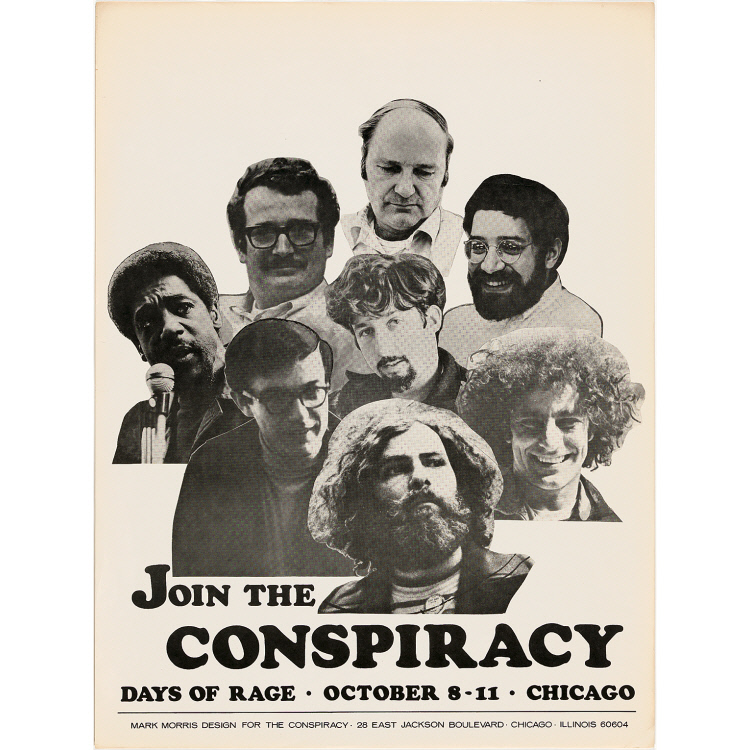
In January 1970, R.G. Davis, the founder of the San Francisco Mime Troupe and one of the fathers of guerrilla theater, filmed a 60-minute video with seven of the defendants in the Chicago Conspiracy Trial. Long buried, the film which is titled “Chicago Conspiracy Eight,” recently surfaced thanks to the Media Burn Archive. Unedited and uninterrupted, it can be viewed on Vimeo.

According to the web site, the Media Burn Archive “collects, restores and distributes documentary video created by artists, activists and community groups.”

They’ve done a great job with the “Chicago Conspiracy Eight,” which illustrates the wonders one can work with a camera, a cast of colorful characters and a lot of gumption. By January 1970, when R. G. Davis produces the video, Bobby Seale of the Black Panther Party had already been severed from the federal case, which indicted eight men on charges of conspiracy and rioting in the streets during the 1968 Demcratic National Convention.

In the video, R. G. Davis and the seven defendants sit around a large table littered with food and drink. R.G. serves as the moderator, though he doesn’t really moderate the discussion. Indeed, it’s a wild hour in which everyone gets to speak, albeit some longer than others. An empty chair sits at the head of the table and carries a sign that reads, “Mr. Bobby Seale.” His absence is palpable.

The video tells a story that Aaron Sorkin’s feature film, “The Trial of the Chicago 7,” can’t and doesn’t tell. In this case, reality beats fiction. The magnificent seven each have their own individual hair styles: Dave Dellinger with long sideburns, Abbie with a Jewfro, as it was called, Jerry and Lee Weiner with full beards, Fronies with a mustache and Tom with the unkempt hair on the top of his head. Rennie Davis looks the cleanest cut of the lot. The era was a lot about hair. Our side clearly won on that front.

The seven defendants talk about Chicago in the summer of 1968, the Conspiracy Trial and anything and everything else that comes up, spontaneously. There’s a great deal of humor and a lot that’s serious, though no one seems to be afraid of going to jail. No topic is sacred. Everything can be and is the butt of comedy, including Abbie raising his middle finger and shouting “Fuck the Movement.”  As a Yippie who battled the stogie members of SDS, that’s understandable.

The video is often about language and the spoken word. Jerry explains that “the most beautiful moment” in the trial takes place when poet Allen Ginsberg of Howl fame testifies on the witness stand and “the courtroom becomes a religious place.” In the video, Abbie is the most literary and cultural of the defendants. He likens the trial to Brave New World and describes Judge Julius Hoffman as Captain Queeg in The Caine Mutiny. Tom Hayden calls the U. S. “a police state” and recounts the murders of members of the Black Panther Party, including Fred Hampton and Mark Clark. Rennie Davis explains that racism “effects every major institution” in American life. That it did.

John Froines jokes about being “a male chauvinist.” Dellinger plugs non-violent tactics as “revolutionary” and Jerry says that the word “Fuck is the biggest issue” in the courtroom. It did push a lot of buttons. Abbie tells R. G. Davis that he and the other defendants want to be honest and not fudge facts and at the same time “beat the rap.” That’s the tricky part, coping to the revolution and aiming for a not guilty verdict. The Chicago eight aimed to beat the rap in the courtroom and outside the courtroom where they organized, appealed to the media and aimed to put pressure on the judge and the prosecutors.

Here and there, bits of history show up in the video: the Haymarket Riot of 1886; and U.S. Communist Party members who defended themselves when they were on trial. Abbie adroitly weaves together comedy and ideology. He calls the Hilton “a symbol of American imperialism” and adds that the demonstrators marched on the hotel with the intention of “changing the sheets.”  That’s still pretty funny.

Near the end of the hour, R.G. Davis tells the others, “I got some good points.” Indeed, he did. He deserves credit for his realization that it was essential to bring the defendants together while the trial still raged. Starr Sutherland and Tom Weinberg produced the 2020 video, along with the team at MediaBurn who deserve praise from everyone who rioted then and everyone who protests these days.

Charlie Chaplin and Truly Modern Times

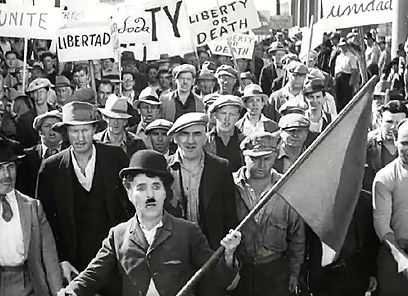
Still of Charlie Chaplin [b. April 16, 1889] from “Modern Times”

By Daniel Warner

Source: CounterPunch

Acrobat, musician, composer, clown, mime, movie star, director and producer, Academy Award winner for lifetime achievement, but still driven from the United States for his backing of the Soviet Union, Charlie Chaplin should need little introduction, except perhaps for Millennials and other late alphabet generations. He was the global star in the crossover from silent films to talkies, making an astonishing $10,000 a week during the Depression, with $150,000 in signing bonuses. Knighted by the Queen, Charlot was universally loved and admired.

But is he relevant today beyond his reputation as a comic icon?

During a recent visit to the magnificent Manoir de Ban near Lausanne, Switzerland, which was his home from 1952 until his death in 1977 and now houses a museum in his honor, I was impressed how his films were political, and how they speak to today’s human rights agenda.

In 1954 Chaplin was awarded the International Peace Prize by the World Peace Council for his outstanding contribution to the cause of peace and friendship among nations. Who can forget his mocking of Hitler in The Dictator when he spins a globe and dances with the world at his fingertips?)

Two examples from his classics show how his films relate to human rights:

The 1921 production The Kid is the story of an unwed, down-and-out mother who abandons her child because she cannot afford to look after him. She places him in an expensive car with a note to the owner to take care of him. After some intrigue, a tramp, Charlie Chaplin, finds the boy and raises and loves him like his own, cementing the idea of the kindness of the fellow impoverished. The tramp and the kid work together against the moneyed class; the kid breaking windows and the tramp repairing them.

The kid is eventually taken away from the tramp by the authorities – border police separating children from their loved ones on the U.S. southern border? – to be returned to his mother. In the end, the kid, the tramp and the mother are re-united.

The Kid was chosen to be preserved in the Library of Congress’s National Film Registry in 2011. It was praised as “an artful melding of touching drama, social commentary and inventive comedy.” The social commentary is what today we would call human rights: the right to a decent life for the mother when she is poor; the right for the mother to have minimum support to raise her boy and not to have to abandon him; the right of the tramp to have a decent wage for his job so he would be able to live properly without having to use illegal means to earn a living; the right to have proper housing for the tramp and the kid; the right to have affordable medical care; the right for the boy to stay with the tramp instead of being sent to an orphanage.

All of these we would call basic social, economic and cultural rights. They are at the heart of Chaplin’s advocacy; they are what make the film so endearing and why we are so relieved when the tramp, kid and mother unite at the end to live happily together. According to Chaplin, and The Kid, there is justice in this world. The good guys overcome injustices and the cruel indifference of the rich with their expensive cars (a foreboding of the 1%?). Although the mother became a rich actress, she takes in the tramp to form a supportive family for the kid, re-uniting him with her son (without the son’s losing the support of the foster father who had raised him, a win-win situation that no family judge could have better decided).

And how does Modern Times, Chaplin’s critique of industrialization, relate to human rights and our modern times of numeric technology? The tramp in Modern Times is a factory worker slaving away on mechanical assembly line. Is this different from today’s information workers tied to their computer screens, forced to work at accelerated speeds as the information flow gets faster and faster, like the quickening assembly line? The hero suffers a nervous breakdown after which he is unemployed, again suffering from having no unemployment insurance or other benefits to carry him over. He is mistakenly arrested with no legal recourse but wishes to stay in jail since he has had no vocational training and is living better in jail than in the street.

The remainder of the film deals with his romance with a fellow hobo who is fleeing punishment because she stole a single loaf of bread (proportional justice?). The film recounts the couple’s various adventures to escape poverty and the desperation of those with no guaranteed income, no right to food or right to housing. Whenever authorities are presented, they are unsympathetic. The poor have no recourse to representation and are left to their own devices to survive. The police – the authorities – are constantly trying to arrest the downtrodden who must seek refuge outside the authoritative system. There is no hope for them within the system; they are left to their own devices in a world with no guaranteed rights.

There is little justice in Modern Times in terms of a happy ending where the heroes overcome injustices. At the end, there is only the love between Chaplin and Ellen. But in the film, as in The Kid, struggles of the underclass represent all the injustices that the 99% of the world today must endure. While economic inequality continues to grow, Chaplin’s films have an important lesson of the struggles of the disenfranchised if one can view the horrors of industrialization and the Depression in our modern context. When 26 individuals are worth as much as 50% of the world’s population, Chaplin’s comic/tragic hero is a pertinent reminder of what it means to live in poverty.

The Manoir de Ban is a beautiful domaine with a lovely park and spectacular view of Lake Geneva. Chaplin died a very rich man. His vision of and advocacy for the poor should remain his greatest legacy. A visit to his museum is a reminder of the schism between the haves and have nots and how a talented, rich genius was able to give such a profound representation of all those who couldn’t afford to live in Vevey and to have the human rights he and many of us enjoy.