Our Financial System Is Optimized for Sociopaths and Exploitation

By Charles Hugh Smith

Source: Of Two Minds

We live in a peculiar juncture of history in which truth has been banished as a threat to the maximization of private gain, i.e. the hyper-pursuit of self-interest. Evidence that supports a causal chain has been replaced by cherry-picked data that supports a self-serving narrative: both the evidence and narrative are manufactured to serve the interests of the few at the expense of the many.

In this juncture of history, evidence is easily disputed because the process of manufacturing self-serving evidence has been perfected. Indeed, self-serving evidence is now a commodity which can be purchased wholesale: rig the sample size, massage the data statistically, conjure up a context that serves to frame the evidence in a slippery self-interested fashion, omit disinterested evidence and contexts, top with arcane math and voila, evidence and narrative are presented as “facts” rather than what they really are, an elaborate, well-staged con designed to maximize the private gains of the few by exploiting the many.

Organizing the entire system to serve the pathological greed of the few is best served by devaluing truth to mere opinion and causal chains to mere narratives. In this juncture of history, truth has been revealed as a chimera; there is only opinion, and all opinions are equal. Opinions are beliefs, and all beliefs are equal. All narratives are equal. All questions boil down to values: values are all equally detached, free-floating and of the same value: zero.

This con has reached perfection in our financial system, which is now optimized for exploitation and sociopaths. As Nassim Taleb has explained (referencing Adam Smith), markets only function if there are rules which are imposed equally on all participants. In our financial system, there are two sets of rules: one which we can summarize as anything goes for the super-wealthy and the well-connected, and another set for everyone else.

Shear the sheep of billions, pay a modest fine–and if all your bets go bad, get bailed out because you’re too important to fail. Sneak a few thousand out of the credit union, go to prison. Sell a financial product that’s designed to go bust as low-risk, oh well, buyer beware, haha, that’s just the free market at work. Sell a nickel bag of drugs, get a tenner in the Gulag.

Two sets of rules: one simulacrum of rules for the rich–just another con, really–and punitive rules for everyone else.

Since evidence, causal chains and values have all been devalued, there is no longer any recognition that the desire for gain–greed–can be either exploitive or beneficial to the many. If your greed drives you to make a product that is faster, better, cheaper, more durable and efficient than what’s currently available, your gain is the result of an advance that serves the interests of the many.

If your desire for gain leads you to misrepresent a shoddy product designed to fail (subprime mortgages, Landfill Economy products) or you raise the price because you can, your greed serves your interests at the expense of the many. This is the acme of exploitation. Kleptocrats and sociopaths, rejoice!

This system is optimized for exploitation, as the exploiters can exploit the many without the many even recognizing they’ve been stripmined. We no longer have the means to differentiate fraud from fact or exploitation from rules-based markets.

This landscape of wide-open exploitation and debauchery is Heaven on Earth for sociopaths who not only do not see any difference between gains skimmed at others’ expense and gains earned by providing a superior product / service, they revel in exploiting the system and every participant: employees, partners, suppliers, depositors, borrowers and customers.

But in this desert of exploitation and the supremacy of self-interest, some things remain true and others remain false. Some truths remain self-evident. As I have shown here many times, we can look at the hourly wages and cost of essentials in 1980, 1990, 2000, 2010 and the present and calculate how many hours of labor it took to pay for essentials such as rent, property taxes, healthcare, childcare, taxes, education, etc. These calculations reveal that the purchasing power of wages has declined for decades. This evidence cannot be made to vanish by declaring it opinion, belief or a “different set of values”–it is fact.

If we measure prosperity by how much labor can buy, all but the top few wage earners are less prosperous today. The evidence and causal chain are self-evident. The self-interested few who have reaped the vast majority of the economy’s gains can hire shills to argue that since TVs now require fewer hours of labor to buy, we’re all better off, but these obfuscations are nothing more than distractions designed to divert our attention from the mechanisms of exploitation that are operating 24/7 beneath the ceaseless churn of “news” and “market action.”

Let’s call this financial system what it really is: the MetaPerverse, a conjured world of self-serving cons that is optimized for exploitation, the perversion of justice, infinite inequality and the stripmining of the many to the benefit of the few, all securely protected by a cloud of confusion in which everything is equally valueless and truth no longer exists. All that remains is a babble of competing cons.

Revolution Is Inevitable and Necessary

By Jason Holland

Source: Dissident Voice

None are so hopelessly enslaved, as those who falsely believe they are free. The truth has been kept from the depth of their minds by masters who rule them with lies. They feed them on falsehoods till wrong looks like right in their eyes.

— Johann Wolfgang von Goethe, Bk. II, Ch. 5; source: Die Wahlverwandtschaften, Hamburger Ausgabe, Bd. 6 (Romane und Novellen I), dtv Verlag, München, 1982, p. 397 (II.5).

I keep plotting a revolution no one else seems to be interested in having. So be it. I’ll have my solitary revolution. There will be no pink hats, guillotines, or marches, just me and a bitter jaded middle finger saluting towards the firmaments in utter rejection of most what this society represents. Although I hold no lasting contempt for anyone in this society because I understand we all have fallen into cultural traps and have done things that we believed we had to do so that we could be accepted, or just to be allowed to sleep indoors somewhere and be fed; we’ve had to commodify and sell out pieces of ourselves to serve the desires of those in a system of power who sanction and control the flow of money backed by military forces and institutions of incarceration, and this way of being was set into motion a long time ago, but it doesn’t have to continue if that’s not what we really desire, but for right now it’s close to all we know.

So, it does seem a revolution of sorts is inevitable due to inequality reaching grotesque heights of avarice where there is no longer any excuse for the wealthy to hide behind in order to explain why it is they have so much and others have so little. However, this just emphasizes the point that this population is largely not wise enough yet to create a revolution worth having, because a more enlightened culture would have taken a stand a long time ago before things became an emergency. Every second we acquiesce to power and don’t push for something radically better we compound an already grim situation. Globally there seems to be a majority who don’t understand what it is to be free, they merely fight to be better treated servants. So it’s highly likely their coming revolution will be a flailing inchoate attempt at something marginally better than what is here now and won’t set out to correct much, if any, of the underlying structural problems.

Consequently, the odds are the revolution we’ll end up with will circle directly back to where we are now or worse in no time at all. But my critiques and frustrations are mine, not a concern for the coming revolution. I must remember it’s their revolution, not mine. I’m not invited to theirs — well, that’s not entirely true.  I just have to ignore most of what I believe to be true, then I’m invited. As things are, I have only a single pathetic pity party scheduled as an event to prove my revolution ever existed, but I should be appreciative of what I have and cease bemoaning what I do not.

So this is where I will make my stand. The beginning and likely end of my revolution of one. In reality my revolution is simply a rough translation through the English language describing my light of truth within, which I’ve gone to great pains to keep safe, dry, and burning from a clean source of fuel. Probably all done in futility except to selfishly inoculate my own mind from the lurking darkness of the culture cave; still, a lingering desire remains to light a path out for others to follow who have become stuck watching dark Platonic shadows flicker across the walls.

With that said, here’s the path I’m lighting with argumentation and I believe it to be a solid one.  We, as in the we consisting of the global middle/lower classes of the entire planet, aka the 99%, are not a free people now nor have ever truly been free while living in the bounds of a social hierarchy. While many a winsome word has been applied to parchment declaring this or that people free, unfortunately soon thereafter the founding document is handed over to record keepers to energize the narratives of posterity while the same ole domination and ownership-driven society meters out the same ole grind. The reward and punishment operant conditioning culture is uniformly applied and chosen specifically to keep people compliant, reactive, and rutted into perpetual business as usual subservience to authoritative forces.

Constitutions supply grandiose ideas which are undermined by underlying conditional legislature where the original words are made into feckless futile notions that allows the ruling authority to do all the draconian bullshit they’ve always done with prettier sounding words. The powers that be couch authoritarian ideas in language that sometimes sounds reasonable on the surface but ultimately leads people to a deleterious state of believing they are free when they are nothing close to any working definition of freedom. Freedom is a condition which is now only possible within our own minds, but our physical bodies are fodder for the whims of a class of people who clearly believe themselves superior to just about everyone else.

Those causing the most damage are simply playing out a cultural role that’s a legacy of deceit passed down from one generation to the next, and each falling prey to traps of chasing after things; endless shiny carrots on shiny sticks. And not just chasing, but lusting, demanding, an obsessive hedonistic pursuit wanting total ego domination at any macabre cost. Pure obsession with the chase. While irony sits on many of their own bookshelves as Melville’s whale tale of wisdom lies fallow and ignored serving only as bookcase filler to give guests the impression they’re well read.

The ego-driven mind thinks primarily in the language of temporal imperatives. Short term must do this, must do that kind of thinking where all thought is disseminated through a lens of self importance with agendas to accomplish to validate that self importance. And if it thinks itself important enough it will eventually see itself as messianic. After they have assumed role of savior it’s just logically congruent that the ruling class allocate all the resources they desire for themselves so they can help all the people they will eventually save, and they need deep pockets to be the inspiration for the entire world.

Over time the ruling class creates rules and cultural dogmas that they claim are for the good of the people, but oddly enough their beliefs always result in making them richer and giving them more power. What an odd purported symbiosis they have dreamed up. The surest sign of being under an authoritarian power is when they make it really difficult to live independent of them. They demand you be hooked up to their electrical grid, pay taxes to live on the land, and hooked into the public water system. Total forced dependency on their system and it is barely noticed yet subtly removing choice and creating an artificial cage. Creating dependency is the best way to control people, and tyranny is then accepted under the umbrella of the common good, so the messianic ones can provide shelter from the storm while, of course, the common person sacrifices most of their free will in the process in a Faustian bargain which is the default role we are thrust into in this world of imperial forces.

Social hierarchies hold their grip on power in increasingly sophisticated ways. They’ve mostly advanced past public executions to keep people in line. They’ve learned it’s far more effective to manipulate minds into believing all are equals and free, and stoke the fear response towards something external that threatens that equality and freedom. It’s become understood by hierarchy that if the ruling power is perceived as the threat they are far more likely to be ousted from that power, so the engines of power must diffuse the blame of their actions lest they be held responsible for the tyranny they impose.

So semi-plausible sounding fears are brought to the forefront so they can provide you with adequate safety, which gives them the power to deprive you of the liberty they are telling you they are protecting, since you know they care so much about you. The gas-lighting of the masses creates reactionary conditioning that puts people in a state where they no longer trust their own mind and become prone to believing all the fears power claims are real. And fear is then used as a prod to move the human animal in a chosen direction power wishes.

Revolution of a real kind, one where our relationship to power radically changes, will be a series of progressions in pulling our minds out of this culture trap. Change will come in relation to how well we come to understand the implications of centralized power and ultimately integrate that knowledge into how we live. Further, how well we learn to work together cooperatively in a voluntary manner will correlate  directly to how likely it is our species survives past the next hundred years. But curing ourselves of  these brutal mental afflictions is not an easy path to traverse. However, I’ll argue a radical change is needed if we want to once again have human lives worth living with real choice and agency over our own mind, body, and time.

Omens, Portents, Karma and the Mandate of Heaven

By Charles Hugh Smith

Source: Of Two Minds

The question of legitimacy isn’t limited to China.

what makes humans unique among social mammals? Some say humor, I would nominate superstition: regardless of how hard we promote our rationality and logic, humanity continues to sense portents and omens in events and feel the intangible tug of karma: the consequences of past actions that we arrogantly thought we’d escaped forever.

Michael Snyder recently compiled a list of peculiarities that are raising eyebrows around the globe: One, sure, two, not that unusual, three, well things happen in threes, but ten disturbances and we’re only six weeks into 2020? 10 ‘Plagues’ That Are Hitting Our Planet Simultaneously (Zero Hedge)

As the saying has it, Nature Bats Last, and maybe arrogant, destructive humanity’s war on Nature is about to get its comeuppance. Maybe overdosing hundreds of millions of chickens and pigs to knock down bacteria in overcrowded conditions has finally generated a karmic blowback via bird and swine viruses.

As for karma in human society: maybe the disruption of the supply chain in China is a karmic response to offshoring production to fatten Corporate America’s profits at the expense of all else in America’s society and economy.

Then there’s the celestial right to rule, a.k.a. The Mandate of Heaven, the concept rooted in Chinese culture that political leadership which fails the people invites divine retribution in the form of withdrawing the support of Heaven. This withdrawal of support manifests in the tangible world as natural disasters: earthquakes, floods, droughts, plagues, etc.

Though it’s not politically correct to discuss The Mandate of Heaven in any serious way, the reading of omens goes back in Chinese history to oracle bones, the process of heating bones until they crack and then interpreting the patterns as portents to the future.

With human and domestic animal epidemics devastating China in a novel cluster of natural disasters, The Mandate of Heaven is in play even if no one dares speak of it openly. The regime is well aware that these parallel plagues are understood as manifestations that question the legitimacy of the current regime.

The question of legitimacy isn’t limited to China. Soaring wealth inequality, the dependence on debt to fund “growth” and the political disenfranchisement of the masses are global manifestations of political-financial systems that invite divine retribution for their excesses of corruption, self-aggrandizement, and exploitation of the planet and its human workforce.

Ending Violence, Exploitation, Ecological Destruction and War: Creating a Culture of Peace

By Robert J. Burrowes

The date 11 November is well known and commemorated in many parts of the world because it marks the Armistice ending World War I – ‘the Great War’ – in 1918.

In the evocative words used by Kurt Vonnegut Jr., an atheist humanist, in his novel Breakfast of Champions, the day is remembered thus:

‘When I was a boy … all the people of all the nations which fought in the First World War were silent during the eleventh minute of the eleventh hour of Armistice Day, which was the eleventh day of the eleventh month. It was at that minute in nineteen-hundred and eighteen, that millions upon millions of human beings stopped butchering one another. I have talked to old men who were on battlefields at that minute. They have told me in one way or another that the sudden silence was the Voice of God. So we still have among us some men who can remember when God spoke clearly to mankind.’

And what, exactly, did God (by whatever name: Allah, Krishna, Yahweh…) or the Gods say? we might ask. Well even those who profess little more than scant knowledge of religious texts that purport to represent the word of God might suggest that s/he simply breathed a (silent) sigh of relief that the insanity of mass warfare had ended. For now at least.

For those of us concerned with the struggle to create cultures of peace or, even, a world culture of peace, there are some fundamental questions to consider including the classic question discussed by two of humanity’s greats – Albert Einstein and Sigmund Freud – when they tackled the question Why War?’

Of course, as many people now understand it, peace entails far more than simply a state without military (including terrorist) violence and war. Beyond these forms of violence, many exponents of peace seek the end of other dimensions of what I call ‘visible’ violence, including:

  1. Direct violence that goes beyond military violence, such as ‘biological violence’ (that is, violence against the body) in the family home and as a result of violent crime as well as ‘physical violence’ (that is, constraints on movement). See ‘Violence, Peace, and Peace Research’.
  2. Institutional violence: socially endorsed violence including that inflicted by parents, teachers, police, legal and prison systems – see ‘Punishment is Violent and Counterproductive’ and ‘The Rule of Law: Unjust and Violent’ – and which now manifests in a myriad other forms with the emergence of the surveillance state that spies on and gathers endless data on individuals to build substantial personal profiles on each – linking many personal records including those related to health and financial matters with political activities and consumption patterns – in violation of any basic understanding of, or commitment to, human rights in their many political, economic, social, cultural and other forms.
  3. Structural violence which Mohandas K. Gandhi originally identified when making his observation that ‘exploitation is violence’ and Professor Johan Galtung – see ‘A Structural Theory of Imperialism’ and ‘Violence, Peace, and Peace Research’ – later elaborated as violence built into structures, such as capitalism and imperialism, that deprive some people of the opportunities to live full and meaningful lives and manifest, for example, as poverty, homelessness and the economic exploitation of people who live in Africa, Asia and Central/South America. And
  4. Ecological violence: those activities ranging from destruction of the climate and rainforests to the killing of insects and wildlife that constitute destruction of the biosphere.

Of course, these categories are not mutually exclusive but they serve to illustrate categories of violence not always recognized as such.

Apart from these forms of ‘visible’ violence Professor Johan Galtung also identified the importance of psychological violence – ‘lies, brainwashing, indoctrination of various kinds, threats, etc. that serve to decrease mental potentialities’ see ‘Violence, Peace, and Peace Research’ – and coined the term ‘cultural violence’ to describe ‘those aspects of culture, the symbolic sphere of our existence – exemplified by religion and ideology, language and art, empirical science and formal science (logic, mathematics) – that can be used to justify or legitimize direct or structural violence’. See ‘Cultural Violence’.

Beyond these and other categories of violence – including patriarchy and racism as specific manifestations of violence that are, arguably, simultaneously direct, structural and cultural – which stand between humanity and a culture of peace, there are two other categories of violence which I will argue it is necessary to end before we can make profound inroads in ending those mentioned above.

These two categories – which I have labeled ‘invisible’ violence and ‘utterly invisible’ violence – describe vitally important categories of violence which human adults inflict on children. Moreover, complemented by the ‘visible’ violence that adults inflict on children, it is this ‘invisible’ and ‘utterly invisible’ violence which destroys the unique human individual who was created during a nine-month gestation period and turns them into a ‘socially constructed delusional identity’ who submissively fulfils the extraordinarily limited expectations of their particular adult world and, with only rare exceptions, willingly participates in many if not all of the other forms of violence that torment our world and certainly includes inflicting invisible and utterly invisible violence on their own children. Which is why the cycle of violence goes on.

Why is this?

Because society is preoccupied with producing submissively obedient students, workers, soldiers, citizens (that is, taxpayers and voters) and consumers. Hence, the last thing society wants is powerful individuals who are each capable of searching their conscience, feeling their emotional response to events, thinking critically and behaving strategically in response. For that reason our parenting and education models use a ruthless combination of visible, ‘invisible’ and ‘utterly invisible’ violence to ensure that our children become terrified, self-hating and powerless individuals like virtually all of the adults around them.

How does this happen? What is this ‘invisible’ and ‘utterly invisible’ violence?

Perpetrators of violence learn their craft in childhood. If you inflict violence on a child, they learn to inflict violence on others. The political leaders who decide to wage war, the military leaders who plan and conduct it, as well as the soldiers, sailors and aircraft personnel who fight war each suffered violence as a child. The terrorist suffered violence as a child. The man who inflicts violence on his partner suffered violence as a child. The corporate executive who exploits working class people and/or those who live in Africa, Asia or Central/South America suffered violence as a child. The racist or religious bigot suffered violence as a child. The individual who perpetrates violence in the home, in the schoolyard or on the street suffered violence as a child. The individual who overconsumes, or even consumes certain products, and/or otherwise destroys the biosphere, suffered violence as a child.

If we want to end violence in all of its manifestations and create a culture of peace, locally and globally, then we must finally end our longest and greatest war: the adult war on children. And here is an additional incentive: if we do not tackle the fundamental cause of violence, then our combined and unrelenting efforts to tackle all of its other symptoms must ultimately fail. And extinction at our own hand is inevitable.

How can I claim that violence against children is the fundamental cause of all other violence? Consider this. There is universal acceptance that behaviour is shaped by childhood experience. If it was not, we would not put such effort into education and other efforts to socialize children to ‘fit into’ their society. And this is why many psychologists have argued that exposure to war toys and violent video games shapes attitudes and behaviours in relation to violence.

But it is far more complex than this and, strange though it may seem, it is not just the ‘visible’ violence (such as hitting, screaming at and sexually abusing) that we normally label ‘violence’ that causes the main damage, although this is extremely damaging. The largest component of damage arises from the ‘invisible’ and ‘utterly invisible’ violence that we adults unconsciously inflict on children during the ordinary course of the day. Tragically, the bulk of this violence occurs in the family home and at school. See ‘Why Violence?’ and ‘Fearless Psychology and Fearful Psychology: Principles and Practice’.

So what is ‘invisible’ violence? It is the ‘little things’ we do every day, partly because we are just ‘too busy’. For example, when we do not allow time to listen to, and value, a child’s thoughts and feelings, the child learns to not listen to themSelf thus destroying their internal communication system. When we do not let a child say what they want (or ignore them when they do), the child develops communication and behavioral dysfunctionalities as they keep trying to meet their own needs (which, as a basic survival strategy, they are genetically programmed to do).

When we blame, condemn, insult, mock, embarrass, shame, humiliate, taunt, goad, guilt-trip, deceive, lie to, bribe, blackmail, moralize with and/or judge a child, we both undermine their sense of Self-worth and teach them to blame, condemn, insult, mock, embarrass, shame, humiliate, taunt, goad, guilt-trip, deceive, lie, bribe, blackmail, moralize and/or judge.

The fundamental outcome of being bombarded throughout their childhood by this ‘invisible’ violence is that the child is utterly overwhelmed by feelings of fear, pain, anger and sadness (among many others). However, mothers, fathers, teachers, religious figures and other adults also actively interfere with the expression of these feelings and the behavioral responses that are naturally generated by them and it is this ‘utterly invisible’ violence that explains why the dysfunctional behavioral outcomes actually occur.

For example, by ignoring a child when they express their feelings, by comforting, reassuring or distracting a child when they express their feelings, by laughing at or ridiculing their feelings, by terrorizing a child into not expressing their feelings (for example, by screaming at them when they cry or get angry), and/or by violently controlling a behavior that is generated by their feelings (for example, by hitting them, restraining them or locking them into a room), the child has no choice but to unconsciously suppress their awareness of these feelings.

However, once a child has been terrorized into suppressing their awareness of their feelings (rather than being allowed to have their feelings and to act on them) the child has also unconsciously suppressed their awareness of the reality that caused these feelings. This has many outcomes that are disastrous for the individual, for society and for nature because the individual will now easily suppress their awareness of the feelings that would tell them how to act most functionally in any given circumstance and they will progressively acquire a phenomenal variety of dysfunctional behaviors, including some that are violent towards themself, others and/or the Earth.

From the above, it should also now be apparent that punishment should never be used. ‘Punishment’, of course, is one of the words we use to obscure our awareness of the fact that we are using violence. Violence, even when we label it ‘punishment’, scares children and adults alike and cannot elicit a functional behavioural response. See ‘Punishment is Violent and Counterproductive’.

If someone behaves dysfunctionally, they need to be listened to, deeply, so that they can start to become consciously aware of the feelings (which will always include fear and, often, terror) that drove the dysfunctional behaviour in the first place. They then need to feel and express these feelings (including any anger) in a safe way. Only then will behavioural change in the direction of functionality be possible. See ‘Nisteling: The Art of Deep Listening’.

‘But these adult behaviors you have described don’t seem that bad. Can the outcome be as disastrous as you claim?’ you might ask. The problem is that there are hundreds of these ‘ordinary’, everyday behaviors that destroy the Selfhood of the child. It is ‘death by a thousand cuts’ and most children simply do not survive as Self-aware individuals. And why do we do this? As mentioned above, we do it so that each child will fit into our model of ‘the perfect citizen’: that is, obedient and hardworking student, reliable and pliant employee/soldier, and submissive law-abiding citizen (that is, one who pays their taxes and votes and/or lobbies politicians).

Moreover, once we destroy the Selfhood of a child, it has many flow-on effects. For example, once you terrorize a child into accepting certain information about themself, other people or the state of the world, the child becomes unconsciously fearful of dealing with new information, especially if this information is contradictory to what they have been terrorized into believing. As a result, the child will unconsciously dismiss new information out of hand.

In short, the child has been terrorized in such a way that they are no longer capable of learning (or their learning capacity is seriously diminished by excluding any information that is not a simple extension of what they already ‘know’). If you imagine any of the bigots you know, you are imagining someone who is utterly terrified. But it’s not just the bigots; virtually all people are affected in this manner making them incapable of responding adequately to new (or even important) information. This is one explanation why some people are ‘climate deniers’, most people do nothing in response to the climate catastrophe and even those people who do take action usually do so ineffectively. See ‘The Global Climate Movement is Failing: Why?’

But the same can be said for those working to end war – see ‘The War to End War 100 Years On: An Evaluation and Reorientation of our Resistance to War’ – end the nuclear weapons race or engage in other struggles, including liberation struggles, that are vital parts of the global struggle to create a culture of peace. See ‘Why Activists Fail’.

To briefly reiterate this vital point (that each child has been terrorized in such a way that they are no longer capable of learning or their learning capacity is seriously diminished): The multifaceted violence inflicted throughout childhood and adolescence ensures that the adult who emerges is suppressing awareness of an enormous amount of fear, pain, sadness and anger (among many other feelings) and must live in delusion to remain unaware of these suppressed feelings. This ensures that, as part of their delusion, the individual develops a strong sense that what they are doing already is functional and working (no matter how dysfunctional and ineffective it may actually be) while unconsciously suppressing awareness of any evidence that contradicts their delusion. They do this because, unconsciously, people learn to identify obedience with ‘functional and working’ (because they do not get punished for being obedient). See Why Violence?, Fearless Psychology and Fearful Psychology: Principles and Practice, ‘Do We Want School or Education?’ and ‘Love Denied: The Psychology of Materialism, Violence and War’.

As an aside, if you want to read more evidence of humanity’s ‘love’ for our children and get a clearer sense of just how deeply violence is buried in human society, see ‘Humanity’s “Dirty Little Secret”: Starving, Enslaving, Raping, Torturing and Killing our Children’.

Just one horrific outcome of this violence against children is that our planet is run by a global elite that is completely insane. See ‘The Global Elite is Insane Revisited’. And this elite plays a key role in driving many of the more obvious manifestations of violence in our world.

Responding to Violence Strategically to Create a World Culture of Peace

However we define the many positive elements of a culture of peace – which will presumably include an inclusive philosophy of society, a cooperative set of social relations, nonviolent methods for dealing with conflict and sustainable patterns of matter-energy use while allowing universal human access to the resources necessary to maintain health and well-being, opportunities for meaningful political and economic engagement as well as cultural opportunities in art, literature and music among its many other forms, while engaging sustainably with the biosphere to enhance life-opportunities for all other species – this culture of peace can only be achieved if we respond strategically to the violence in our world.

And this means that we must address the fundamental cause of human violence because this drives violence in each and all of its other dimensions. For those adults powerful enough to do this, there is an explanation in ‘Putting Feelings First’. And for those adults committed to facilitating children’s efforts to realize their potential and become self-aware (rather than delusional), see ‘My Promise to Children’.

Creating a culture of peace, therefore, relies fundamentally on understanding the critical role of suppressed feelings (emotions) in shaping deep culture and generating conflicts, including violent conflicts, and then taking action that addresses this cause.

This includes the need to understand and deal effectively with those emotions that are being acted out dysfunctionally and/or being projected – see ‘The Psychology of Projection in Conflict’ – in a particular context, which is standard human behaviour in many situations. See ‘Nisteling: The Art of Deep Listening’. Otherwise, that most fundamental of emotions – fear – will continue to drive most cultural predispositions and conflicts in all contexts and make genuine resolution of conflicts virtually impossible. This is because it is only if people are not afraid that discussions about ideas in relation to making culture evolve as we plan (rather than unconsciously or as elites direct) and to resolve conflict nonviolently, become easily possible.

Fundamentally, our parenting and education models fail utterly to produce people of conscience, people who are emotionally functional, people who are capable of critical analysis, people who care and people who can plan and respond to violence strategically. As Professor Galtung noted just recently, ‘While we are busy exploring whether there is intelligent life on other planets, we might spend more time – and intelligence – exploring whether there is [intelligent life] on ours.’ See ‘United States vs Moby Dick’. The problem is that once we terrorize a child, the terrified adult who emerges from childhood behaves as guided by their (unconscious) fear, not by any intelligence they may possess. Again, this is routinely illustrated by the failure of even those who self-label as ‘activists’ to think, plan and act strategically. See ‘Why Activists Fail’.

Of course, we do not need to work on ending violence against children in isolation. We can campaign to end other manifestations of violence – such as war, nuclear weapons and power, economic exploitation, ecological violence in its many forms including geoengineering and the deployment of 5G, violence against women and indigenous peoples, occupations and dictatorships – at the same time. See Nonviolent Campaign Strategy and Nonviolent Defense/Liberation Strategy.

But if we work to end the many manifestations of violence while failing to address the fundamental cause then, ultimately, we must fail, even if we elongate our timeframe a little. See ‘Human Extinction by 2026? A Last Ditch Strategy to Fight for Human Survival’.

If you are also interested in working locally to reduce your consumption and become more self-reliant, in order to reduce your ecological violence, consider participating in The Flame Tree Project to Save Life on Earth.

Alternatively, if you want something simpler, consider committing to:

The Earth Pledge

Out of love for the Earth and all of its creatures, and my respect for their needs, from this day onwards I pledge that:

  1. I will listen deeply to children (see explanation above)
  2. I will not travel by plane
  3. I will not travel by car
  4. I will not eat meat and fish
  5. I will only eat organically/biodynamically grown food
  6. I will minimize the amount of fresh water I use, including by minimizing my ownership and use of electronic devices
  7. I will not buy rainforest timber
  8. I will not buy or use single-use plastic, such as bags, bottles, containers, cups and straws
  9. I will not use banks, superannuation (pension) funds or insurance companies that provide any service to corporations involved in fossil fuels, nuclear power and/or weapons
  10. I will not accept employment from, or invest in, any organization that supports or participates in the exploitation of fellow human beings or profits from killing and/or destruction of the biosphere
  11. I will not get news from the corporate media (mainstream newspapers, television, radio, Google, Facebook, Twitter…)
  12. I will make the effort to learn a skill, such as food gardening or sewing, that makes me more self-reliant
  13. I will gently encourage my family and friends to consider signing this pledge.

And you might wish to join the worldwide movement of people working to end all violence by signing the online pledge of The Peoples Charter to Create a Nonviolent World.

Conclusion

The foundation of our violent world is the unending visible, invisible and utterly invisible violence that human adults inflict on our children. For that reason, it does not matter what superstructure we build on top of this foundation. Whether we use capitalism (and ‘democracy’), socialism or any other political-economic-social model, tack on a New Green Deal or a Just Transition, while the violent foundation on which society is built – violence against children – remains unaddressed, a culture of peace cannot be created.

So we need to raise children in a culture that does not involve terrorizing them so that they end up perceiving violence as the primary way to address conflict because they are too scared to simply perceive the power of, and use, principled nonviolent options.

Hence, until our parenting and teaching models are radically altered, a culture of peace will remain an impossible dream. And human extinction in the near term is inevitable.


Biodata: Robert J. Burrowes has a lifetime commitment to understanding and ending human violence. He has done extensive research since 1966 in an effort to understand why human beings are violent and has been a nonviolent activist since 1981. He is the author of Why Violence? His email address is flametree@riseup.net and his website is here.


Learning from Gandhi

By Robert J. Burrowes

Mohandas Karamchand Gandhi was born on 2 October 1869: 150 years ago this year.

There will be many tributes to Gandhi published in 2019 so I would like to add one of my own.

This reflects not just my belief that he gave the world inspiration, ideas and powerful strategies for tackling violence in a wide range of contexts but because my own experience in applying his ideas has proven their worth. This included his awareness that led him to declare that ‘If we are to make progress, we must not repeat history but make new history. We must add to the inheritance left by our ancestors.’ and his encouragement to reflect deeply and listen to one’s ‘inner voice’: ‘you should follow your inner voice whatever the consequences’ and ‘even at the risk of being misunderstood’.

In essence, we can productively learn from history but we can build on it too. And, vitally, this includes dealing more effectively with violence.

So how did Gandhi influence me?

Shortly after midnight on 1 July 1942, my Uncle Bob was killed when the USS Sturgeon, a U.S. submarine, fired torpedoes into the Japanese prisoner of war (POW) ship Montevideo Maru. The ship sank immediately and, along with 1,052 other POWs, Bob was killed.

Apart from his older brother, my father’s twin brother was also killed in World War II. In Tom’s case, he was shot down over Rabaul on his first (and final) mission. He was a wireless air gunner on a Beaufort Bomber. See ‘The Last Coastwatcher: My Brothers’.

My childhood is dotted with memories of Bob and Tom. The occasional remembrance service, war medals and the rare story shared by my father.

In 1966, the year I turned 14, I decided to devote my life to finding out why human beings kill each other and to work out how such killing could be ended. The good news about this ‘decision’ is that, at 14, it all felt manageable! But I wasn’t much older before my preliminary investigations proved that even understanding why humans are violent was going to be a profound challenge. And I intuitively understood that I needed this understanding if any strategy to end violence was to be effective.

In any case, as one might expect, my research into violence and strategies for addressing it led me to nonviolence. I came across virtually nothing about nonviolence during my own studies at school and university but was regularly presented with news reports of people participating in activities – such as demonstrations and strikes – that I later learned to label ‘nonviolent action’.

In 1981 I decided to seek out materials on nonviolence and nonviolent action so that I could learn more about it. I had not been reading for long when the routine reference to Mohandas K. (or Mahatma) Gandhi, about whom I had heard a little and knew of his role in leading the Indian independence struggle, forced me to pay more attention to his life and work. So I sought out his writing and started to read some of his published work. An Autobiography: The Story of My Experiments with Truth was an obvious and early book but there were many others besides. I also read many books about Gandhi, to get a clearer sense of his life as a whole, as reported by his coworkers and contemporaries, as well as documented by scholars since his death. And I spent a great many hours in a library basement poring over The Collected Works of Mahatma Gandhi.

The thing that struck me immediately about Gandhi was that his own interest in tackling violence had a comprehensive ‘feel’ about it. That is, he was not just interested in the violence that occurs when nations fight wars or one person kills or injures another. He was interested in addressing the violence that occurs when individuals and nations exploit other individuals/nations (such as when British imperialism exploited India and Indians) and the violence that occurs when a structure (such as capitalism or socialism) exploits the individuals within it. In his words: ‘exploitation is the essence of violence’. He was interested in the violence that occurs when members of one social group (say, Hindus) ‘hate’ the members of another social group (such as Muslims). He was interested in the violence that occurs when men oppress women or caste Hindus oppress ‘untouchables’. He was interested in the violence that occurs when humans destroy the environment. And he was interested in the violence that one inflicts on oneself.

This comprehensive interest resonated deeply with me because, apart from war, my own childhood and adolescence had revealed many manifestations of violence ranging from the starvation of people in developing countries to the racism in the United States (highlighted by Rev. Martin Luther King Jr. during the 1960s) to the destruction of the environment, each of which had gradually but deeply embedded itself in my consciousness. Tackling violence was a far bigger task than the large one I had originally imagined. Violence is everywhere. Most importantly, it seemed to me, there was enormous violence directed against children in the family home but little was spoken or written about this.

So how did Gandhi explain violence and what was his strategy for addressing it?

Gandhi on Conflict and Violence

For Gandhi, conflict was a perennial condition. He also viewed it positively and considered it desirable. For him, it is an important means to greater human unity precisely because their shared conflict could remind antagonists of the deeper, perhaps transcendental, unity of life, which is far more profound than the bond of their social relationship.

He viewed violence differently, however. And, as might be gleaned from the many configurations of violence that concerned him, as noted above, he considered that violence was built into social structures and not into people.

Fundamentally, as Leroy Pelton characterized it, Gandhi understood that the truth cannot be achieved through violence (‘which violates human needs and destroys life’), because violence itself is a form of injustice. In any case, violence cannot resolve conflict because it does not address the issues at stake.

To reiterate then, for Gandhi there was nothing undesirable about conflict. However, Gandhi’s preoccupation was working out how to manage conflict without violence and how to create new social arrangements free of structural violence. The essence, then, of Gandhi’s approach was to identify approaches to conflict that preserved the people while systematically demolishing the evil structure. Nevertheless, he firmly believed that structural purification alone is not enough; self-purification is also essential.

In other words, in Gandhi’s view, resolving the conflict (without violence) is only one aspect of the desired outcome. For Gandhi, success also implies the creation of a superior social structure, higher degrees of fearlessness and self-reliance on the part of both satyagrahis (nonviolent activists) and their opponents, and a greater degree of human unity at the level of social relationships.

Two Key Questions

Despite the enormous influence that Gandhi had in shaping my own conception of conflict and the precise conception of nonviolence that should be used in dealing with it, I nevertheless remained convinced that two questions remained unanswered: What is the psychological origin of the violent behavior of the individual who perpetrates it? And what theory or framework should guide the application of nonviolent action so that campaigns of all kinds are strategically effective?

The first question is important because even if someone is trapped within a social structure (such as the class system) that is violent, the individual must still choose, consciously or unconsciously, to participate (as perpetrator, collaborator or victim) in the violence perpetrated by that structure or one must choose, consciously, to resist it. Why do so many individuals perform one of the first three roles and so few, like Gandhi himself, choose the role of resister?

The second question is important because while Gandhi himself was an astonishingly intuitive strategic thinker (whose 30-year nonviolent strategy liberated India from British occupation), no one before him or since his death has demonstrated anything remotely resembling his capacity in this regard.

Hence, while nonviolence, which is inherently powerful, has chalked up some remarkable successes, vital struggles for peace (and to end war); to halt assaults on Earth’s biosphere; to secure social justice for oppressed and exploited populations; to liberate national groups from dictatorship, occupation or genocidal assault; and struggles in relation to many other just causes limp along devoid of strategy (or use one that is ill-conceived). So badly are we failing, in fact, that humans now teeter on the brink of precipitating our own extinction. See ‘Human Extinction by 2026? A Last Ditch Strategy to Fight for Human Survival’.

Anyway, having studied Gandhi extensively and learned from his strategic approach to nonviolence (elements of which I was progressively including in nonviolent campaigns in which I was involved myself), I resumed my original research to understand the fundamental origin of human violence and also decided to develop a strategic theory and framework for addressing violence in the campaign context so that Gandhi’s strategic thinking could be readily copied by other nonviolent activists.

It turned out that developing this strategic theory and strategy was simpler than the original aim (understanding violence) and I have presented this strategic thinking on two websites: Nonviolent Campaign Strategy and Nonviolent Defense/Liberation Strategy.

Despite my preliminary efforts in the 1990s to encourage fellow activists to use this framework, it soon became clear that only the rarest of activists has the capacity to think strategically about an issue, even when presented with a framework for doing so.

The Origin of Human Violence

Consequently, the vital importance of understanding the origin of human violence was starkly demonstrated to me yet again because I knew it would answer key supplementary questions such as these: Why to do so many people live in denial/delusion utterly incapable of perceiving structural violence or grappling powerfully with (military, social, political, economic and ecological) violence? Why is it that so many people, even activists, are powerless to think strategically? How can activists even believe that success can be achieved, particularly on the major issues of our time (such as the threats of nuclear war, ecological devastation and climate cataclysm), without a focused and comprehensive strategy, particularly given elite resistance to such campaigns? See ‘The Global Elite is Insane Revisited’.

Hence, in an attempt to answer questions such as these, Anita McKone and I went into seclusion in an endeavor to understand how our own minds functioned so that we might better understand the minds of others. I hoped it would take a few months. It took 14 years.

So what is the cause of violence in all contexts and which, depending on its precise configuration in each case, creates perpetrators of violence, people who collaborate with perpetrators of violence, people who are passive victims of violence, people who live in denial/delusion, people who are sexist or racist, and activists who cannot think strategically (among many other adverse outcomes)?

Each of these manifestations of human behaviour is an outcome of the adult war on children. That is, adult violence against children is the fundamental cause of all other violence.

How does this happen? It happens because each child, from birth, is socialized – more accurately, terrorized – so that they fit into their society. That is, each child is subjected to an unrelenting regime of ‘visible’, ‘invisible’ and ‘utterly invisible’ violence until they offer the obedience that every adult – parent, teacher, religious figure… – demands.

So what constitutes ‘visible’, ‘invisible’ and ‘utterly invisible’ violence?

‘Visible’ violence includes hitting, screaming at and sexually abusing a child which, sadly enough, is very common.

But the largest component of damage arises from the ‘invisible’ and ‘utterly invisible’ violence that we adults unconsciously inflict on children during the ordinary course of the day. Tragically, the bulk of this violence occurs in the family home and at school. For a full explanation, see ‘Why Violence?’ and Fearless Psychology and Fearful Psychology: Principles and Practice.

‘Invisible’ violence is the ‘little things’ we do every day, partly because we are just ‘too busy’. For example, when we do not allow time to listen to, and value, a child’s thoughts and feelings, the child learns to not listen to themSelf thus destroying their internal communication system. When we do not let a child say what they want (or ignore them when they do), the child develops communication and behavioral dysfunctionalities as they keep trying to meet their own needs (which, as a basic survival strategy, they are genetically programmed to do).

When we blame, condemn, insult, mock, embarrass, shame, humiliate, taunt, goad, guilt-trip, deceive, lie to, bribe, blackmail, moralize with and/or judge a child, we both undermine their sense of Self-worth and teach them to blame, condemn, insult, mock, embarrass, shame, humiliate, taunt, goad, guilt-trip, deceive, lie, bribe, blackmail, moralize and/or judge.

The fundamental outcome of being bombarded throughout their childhood by this ‘invisible’ violence is that the child is utterly overwhelmed by feelings of fear, pain, anger and sadness (among many others). However, mothers, fathers, teachers, religious figures and other adults also actively interfere with the expression of these feelings and the behavioral responses that are naturally generated by them and it is this ‘utterly invisible’ violence that explains why the dysfunctional behavioral outcomes actually occur.

For example, by ignoring a child when they express their feelings, by comforting, reassuring or distracting a child when they express their feelings, by laughing at or ridiculing their feelings, by terrorizing a child into not expressing their feelings (for instance, by screaming at them when they cry or get angry), and/or by violently controlling a behavior that is generated by their feelings (for example, by hitting them, restraining them or locking them into a room), the child has no choice but to unconsciously suppress their awareness of these feelings.

However, once a child has been terrorized into suppressing their awareness of their feelings (rather than being allowed to have their feelings and to act on them) the child has also unconsciously suppressed their awareness of the reality that caused these feelings. This has many outcomes that are disastrous for the individual, for society and for the biosphere because the individual will now easily suppress their awareness of the feelings that would tell them how to act most functionally in any given circumstance and they will progressively acquire a phenomenal variety of dysfunctional behaviors, including some that are violent towards themself, others and/or the Earth.

So what do we do?

Well, if you want to make an enormous contribution to our effort to end violence, you can make the commitment outlined in ‘My Promise to Children’. If you need to do some healing of your own to be able to nurture children in this way, then consider the information provided in the article ‘Putting Feelings First’.

If you want to systematically tackle violence against the biosphere, consider (accelerated) participation in the fifteen-year strategy, inspired by Gandhi, outlined in ‘The Flame Tree Project to Save Life on Earth’. This project outlines a simple plan for people to systematically reduce their consumption, by at least 80%, involving both energy and resources of every kind – water, household energy, transport fuels, metals, meat, paper and plastic – while dramatically expanding their individual and community self-reliance in 16 areas, so that all environmental concerns are effectively addressed. As Gandhi observed 100 years ago: ‘Earth provides enough for every person’s need but not for every person’s greed.’

But, critically important though he believed personal action to be, Gandhi was also an extraordinary political strategist and he knew that we needed to do more than transform our own personal lives. We need to provide opportunities that compel others to consider doing the same.

So if your passion is campaigning for change, consider doing it strategically, as Gandhi did. See Nonviolent Campaign Strategy.

And if you want to join the worldwide movement to end all violence against humans and the biosphere, you can do so by signing the online pledge of The Peoples Charter to Create a Nonviolent World.

Gandhi was assassinated on 30 January 1948. But his legacy lives on. You can learn from it too, if you wish.


Biodata: Robert J. Burrowes has a lifetime commitment to understanding and ending human violence. He has done extensive research since 1966 in an effort to understand why human beings are violent and has been a nonviolent activist since 1981. He is the author of Why Violence? His email address is flametree@riseup.net and his website is here.

Robert J. Burrowes
P.O. Box 68
Daylesford, Victoria 3460
Australia

Email: flametree@riseup.net

Websites:
Nonviolence Charter
Flame Tree Project to Save Life on Earth
‘Why Violence?’
Feelings First
Nonviolent Campaign Strategy
Nonviolent Defense/Liberation Strategy
Anita: Songs of Nonviolence
Robert Burrowes
Global Nonviolence Network


500 years is long enough! Human Depravity in the Congo

By Robert J. Burrowes

I would like to tell you something about human depravity and illustrate just how widespread it is among those we often regard as ‘responsible’. I am going to use the Democratic Republic of the Congo as my example.

As I illustrate and explain what has happened to the Congo and its people during the past 500 years, I invite you to consider my essential point: Human depravity has no limit unless people like you (hopefully) and me take some responsibility for ending it. Depravity, barbarity and violent exploitation will not end otherwise because major international organizations (such as the UN), national governments and corporations all benefit from it and are almost invariably led by individuals too cowardly to act on the truth.

The Congo

Prior to 1482, the area of central Africa now known as the Democratic Republic of the Congo was part of the Kingdom of the Kongo. It was populated by some of the greatest civilizations in human history.

Slavery

However, in that fateful year of 1482, the mouth of the Congo river, which flows into the Atlantic Ocean, became known to Europeans when the Portuguese explorer Diogo Cao claimed he ‘discovered’ it. By the 1530s, more than five thousand slaves a year (many from inland regions of the Kongo) were being transported to distant lands, mostly in the Americas. Hence, as documented by Adam Hothschild, the Congo was first exploited by Europeans during the Atlantic slave trade. See King Leopold’s Ghost: A Story of Greed, Terror, and Heroism in Colonial Africa.

Despite the horrific depredations of the militarized slave trade and all of its ancillary activities, including Christian priests spreading ‘Christianity’ while raping their captive slave girls, the Kingdoms of the Kongo were able to defend and maintain themselves to a large degree for another 400 years by virtue of their long-standing systems of effective governance. As noted by Chancellor Williams’ in his epic study The Destruction of Black Civilization: Great Issues of a Race from 4500 B.C. to 2000 A.D. the Kingdoms of the Congo prior to 1885 – including Kuba under Shyaam the Great and the Matamba Kingdom under Ngola Kambolo – were a cradle of culture, democracy and exceptional achievement with none more effective than the remarkable Queen (of Ndongo and Matamba), warrior and diplomat Nzinga in the 17th century.

But the ruthless military onslaught of the Europeans never abated. In fact, it continually expanded with ever-greater military firepower applied to the task of conquering Africa. In 1884 European powers met in Germany to finally divide ‘this magnificent African cake’, precipitating what is sometimes called ‘the scramble for Africa’ but is more accurately described as ‘the scramble to finally control and exploit Africa and Africans completely’.

Colonization

One outcome of the Berlin Conference was that the great perpetrator of genocide – King Leopold II of Belgium – with the active and critical support of the United States, seized violent control of a vast swathe of central Africa in the Congo Basin and turned it into a Belgian colony. In Leopold’s rapacious pursuit of rubber, gold, diamonds, mahogany and ivory, 10 million African men, women and children had been slaughtered and many Africans mutilated (by limb amputation, for example) by the time he died in 1909. His brutality and savagery have been documented by Adam Hochschild in the book King Leopold’s Ghost: A Story of Greed, Terror, and Heroism in Colonial Africa which reveals the magnitude of human suffering that this one man, unopposed in any significant way by his fellow Belgians or anyone else, was responsible for inflicting on Africa.

If you want to spend a few moments in touch with the horror of what some human beings do to other human beings, then I invite you to look at the sample photos of what Leopold did in ‘his’ colony in the Congo. See ‘“A Nightmare In Heaven” – Why Nobody Is Talking About The Holocaust in Congo’.

Now if you were hoping that the situation in the Congo improved with the death of the monster Leopold, your hope is in vain.

The shocking reality is that the unmitigated horror inflicted on the Congolese people has barely improved since Leopold’s time. The Congo remained under Belgian control during World War I during which more than 300,000 Congolese were forced to fight against other Africans from the neighboring German colony of Ruanda-Urundi. During World War II when Nazi Germany captured Belgium, the Congo financed the Belgian government in exile.

Throughout these decades, the Belgian government forced millions of Congolese into mines and fields using a system of ‘mandatory cultivation’ that forced people to grow cash crops for export, even as they starved on their own land.

It was also during the colonial period that the United States acquired a strategic stake in the enormous natural wealth of the Congo without, of course, any benefit to the Congolese people. This included its use of uranium from a Congolese mine (subsequently closed in 1960) to manufacture the first nuclear weapons: those used to destroy Hiroshima and Nagasaki. See ‘Patrice Lumumba: the most important assassination of the 20th century’.

Independence then Dictatorship

By 1960, the Congolese people had risen up to overthrow nearly a century of slavery and Belgian rule. Patrice Lumumba became the first Prime Minister of the new nation and he quickly set about breaking the yoke of Belgian influence and allied the Congo with Russia at the height of the Cold War.

But the victory of the Congolese people over their European and US overlords was shortlived: Patrice Lumumba was assassinated in a United States-sponsored coup in 1961 with the US and other western imperial powers (and a compliant United Nations) repeating a long-standing and ongoing historical pattern of preventing an incredibly wealthy country from determining its own future and using its resources for the benefit of its own people. See ‘Patrice Lumumba: the most important assassination of the 20th century’.

So, following a well-worn modus operandi, an agent in the form of (Army Chief of Staff, Colonel) Mobutu Sese Seko was used to overthrow Lumumba’s government. Lumumba himself was captured and tortured for three weeks before being assassinated by firing squad. The new dictator Mobutu, compliant to western interests, then waged all-out war in the country, publicly executing members of the pro-Lumumba revolution in spectacles witnessed by tens of thousands of people. By 1970, nearly all potential threats to his authority had been smashed. See ‘“A Nightmare In Heaven” – Why Nobody Is Talking About The Holocaust in Congo’.

Mobutu would rape the Congo (renamed Zaire for some time) with the blessing of the west  – robbing the nation of around $2billion – from 1965 to 1997. During this period, the Congo got more than $1.5 billion in US economic and military aid in return for which US multinational corporations increased their share of the Congo’s abundant minerals. ‘Washington justified its hold on the Congo with the pretext of anti-Communism but its real interests were strategic and economic.’ See ‘Congo: The Western Heart of Darkness’.

Invasion

Eventually, however, Mobutu’s increasingly hostile rhetoric toward his white overlords caused the west to seek another proxy. So, ostensibly in retaliation against Hutu rebels from the Rwandan genocide of 1994 – who fled into eastern Congo after Paul Kagame’s (Tutsi) Rwanda Patriotic Army invaded Rwanda from Uganda to end the genocide – in October 1996 Rwanda’s now-dictator Kagame, ‘who was trained in intelligence at Fort Leavenworth in the United States, invaded the Congo with the help of the Clinton Administration’ and Uganda. By May 1997 the invading forces had removed Mobutu and installed the new (more compliant) choice for dictator, Laurent Kabila.

Relations between Kabila and Kagame quickly soured, however, and Kabila expelled the Rwandans and Ugandans from the Congo in July 1998. However, the Rwandans and Ugandans reinvaded in August establishing an occupation force in eastern Congo. Angola, Zimbabwe and Namibia sent their armies to support Kabila and Burundi joined the Rwandans and Ugandans. Thus began ‘Africa’s First World War’ involving seven armies and lasting until 2003. It eventually killed six million people – most of them civilians – and further devastated a country crushed by more than a century of Western domination, with Rwanda and Uganda establishing themselves as conduits for illegally taking strategic minerals out of the Congo. See ‘Congo: The Western Heart of Darkness’.

During the periods under Mobutu and Kabila, the Congo became the concentration camp capital of the world and the rape capital as well. ‘No woman in the path of the violence was spared. 7 year olds were raped by government troops in public. Pregnant women were disemboweled. Genital mutilation was commonplace, as was forced incest and cannibalism. The crimes were never punished, and never will be.’

Laurent Kabila maintained the status quo until he was killed by his bodyguard in 2001. Since then, his son and the current President Joseph Kabila has held power in violation of the Constitution. ‘He has murdered protesters and opposition party members, and has continued to obey the will of the west while his people endure unspeakable hells.’

Corporate and State Exploitation

While countries such as Belgium, Canada, France, Germany, the Netherlands, South Korea, Switzerland and the UK are heavily involved one way or another (with other countries, such as Australia, somewhat less so), US corporations make a vast range of hitech products including microchips, cell phones and semiconductors using conflict minerals taken from the Congo . This makes ‘companies like Intel, Apple, HP, and IBM culpable for funding the militias that control the mines’. See ‘“A Nightmare In Heaven” – Why Nobody Is Talking About The Holocaust in Congo’.

But many companies are benefitting. For example, a 2002 report by the United Nations listed a ‘sample’ of 34 companies based in Europe and Asia that are importing minerals from the Congo via, in this case, Rwanda. The UN Report commented: ‘Illegal exploitation of the mineral and forest resources of the Democratic Republic of the Congo is taking place at an alarming rate. Two phases can be distinguished: mass-scale looting and the systematic and systemic exploitation of resources’. The mass-scale looting occurred during the initial phase of the invasion of the Congo by Rwanda, Uganda and Burundi when stockpiles of minerals, coffee, wood, livestock and money in the conquered territory were either taken to the invading countries or exported to international markets by their military forces or nationals. The subsequent systematic and systemic exploitation required planning and organization involving key military commanders, businessmen and government structures; it was clearly illegal. See ‘Report of the Panel of Experts on the Illegal Exploitation of Natural Resources and other Forms of Wealth of the Democratic Republic of the Congo’.

For some insight into other issues making exploitation of the Congo possible but which are usually paid less attention – such as the roles of mercenaries, weapons dealers, US military training of particular rebel groups and the secret airline flights among key locations in the smuggling operations of conflict minerals – see the research of Keith Harmon Snow and David Barouski: ‘Behind the numbers: Untold Suffering in the Congo’ and Merchants of Death: Exposing Corporate-Financed Holocaust in Africa; White Collar War Crimes, Black African Fall Guys.

Has there been any official attempt to rein in this corporate exploitation?

A little. For example, the Obama-era US Dodd-Frank Financial Reform Act of 2010 shone a spotlight on supply chains, pressuring companies to determine the origin of minerals used in their products and invest in removing conflict minerals from their supply chain. This resulted in some US corporations, conscious of the public relations implications of being linked to murderous warlords and child labor, complying with the Act. So, a small step in the right direction it seemed. See ‘The Impact of Dodd-Frank and Conflict Minerals Reforms on Eastern Congo’s Conflict’ and ‘Congo mines no longer in grip of warlords and militias, says report’.

In 2011, given that legally-binding human rights provisions, if applied, should have offered adequate protections already, the United Nations rather powerlessly formulated the non-binding ‘Guiding Principles on Business and Human Rights’.

And in 2015, the European Union also made a half-hearted attempt when it decided that smelters and refiners based in the 28-nation bloc be asked to certify that their imports were conflict-free on a voluntary basis! See ‘EU lawmakers to limit import of conflict minerals’.

However, following the election of Donald Trump as US President, in April 2017 ‘the U.S. Securities and Exchange Commission suspended key provisions of its “conflict minerals” rule’. Trump is also seeking to undo the Obama-era financial regulations, once again opening the door to the unimpeded trade in blood minerals by US corporations. See ‘“A Nightmare In Heaven” – Why Nobody Is Talking About The Holocaust in Congo’ and ‘Trump Moves to Roll Back Obama-Era Financial Regulations’.

Today

Despite its corrupt exploitation for more than 500 years, the Congo still has vast natural resources (including rainforests) and mineral wealth. Its untapped deposits of minerals are estimated to be worth in excess of $US24 trillion. Yes, that’s right: $US24trillion. With a host of rare strategic minerals – including cobalt, coltan, gold and diamonds – as well as copper, zinc, tin and tungsten critical to the manufacture of hitech electronic products ranging from aircraft and vehicles to computers and mobile phones, violent and morally destitute western governments and corporations are not about to let the Congo decide its own future and devote its resources to the people of this African country. This, of course, despite the international community paying lip service to a plethora of ‘human rights’ treaties.

Hence, violent conflict, including ongoing war, over the exploitation of these resources, including the smuggling of ‘conflict minerals’ – such as gold, coltan and cassiterite (the latter two ores of tantalum and tin, respectively), and diamonds – will ensure that the people of the Congo continue to be denied what many of those in western countries take for granted: the right to life benefiting from the exploitation of ‘their’ natural resources.

In essence then, since 1885 European and US governments, together with their corporations and African collaborators, have inflicted phenomenal ongoing atrocities on the peoples of the Congo as they exploit the vast resources of the country for the benefit of non-Congolese people.

But, you might wonder, European colonizers inflicted phenomenal violence on the indigenous peoples in all of their colonies – whether in Africa, Asia, Central and South America, the Caribbean or Oceania – so is their legacy in the Congo any worse?

Well, according to the The Pan-African Alliance, just since colonization in 1885, at least 25 million Congolese men, women and children have been slaughtered by white slave traders, missionaries, colonists, corporations and governments (both the governments of foreign-installed Congolese dictators and imperial powers). ‘Yet barely a mention is made of the holocaust that rages in the heart of Africa.’ Why? Because ‘the economy of the entire world rests on the back of the Congo.’ See ‘“A Nightmare In Heaven” – Why Nobody Is Talking About The Holocaust in Congo’.

So what is happening now?

In a sentence: The latest manifestation of the violence and exploitation that has been happening since 1482 when that Portuguese explorer ‘discovered’ the mouth of the Congo River. The latest generation of European and American genocidal exploiters, and their latter-day cronies, is busy stealing what they can from the Congo. Of course, as illustrated above, having installed the ruthless dictator of their choosing to ensure that foreign interests are protected, the weapon of choice is the corporation and non-existent legal or other effective controls in the era of ‘free trade’.

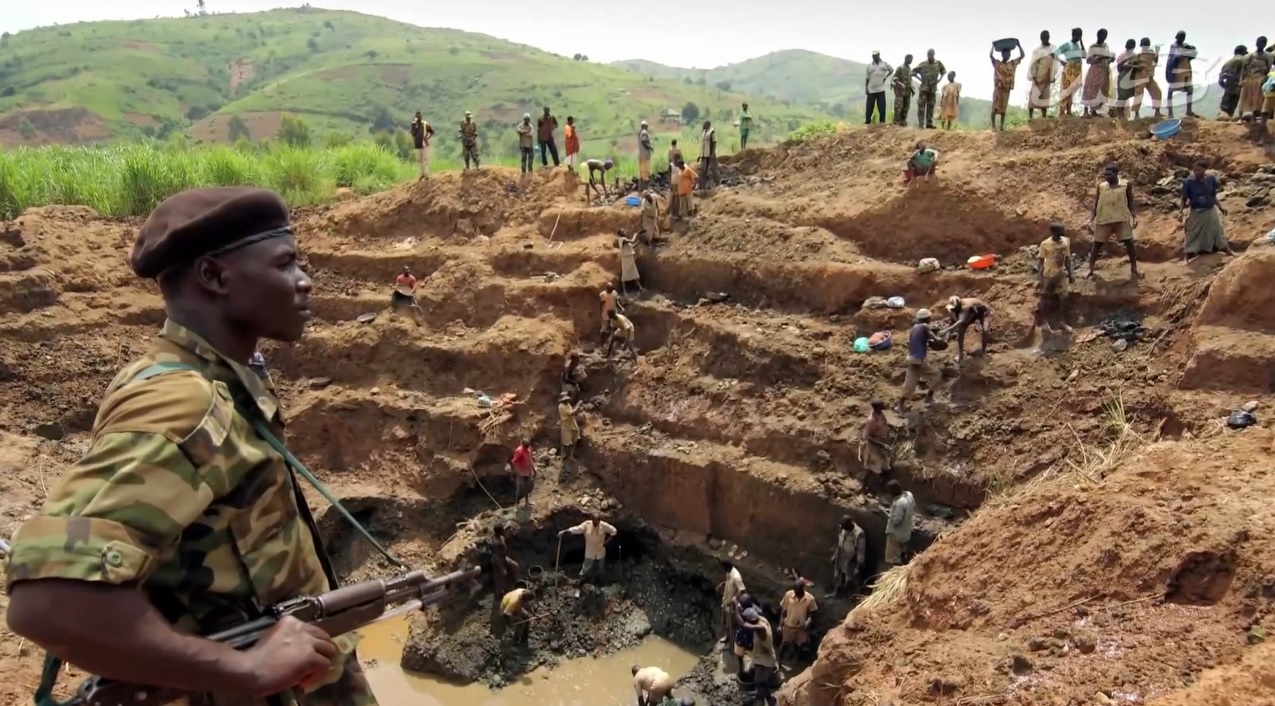
The provinces of North and South Kivu in the eastern Congo are filled with mines of cassiterite, wolframite, coltan and gold. Much mining is done by locals eking out a living using Artisanal and Small-Scale Mining (ASM); that is, mining by hand, sometimes with rudimentary tools. Some of these miners sell their product via local agents to Congolese military commanders who smuggle it out of the country, usually via Rwanda, Uganda or Burundi, and use the proceeds to enrich themselves.

Another report on South Kivu by Global Witness in 2016 – see ‘River of Gold’ and ‘Illegal gold trade in Congo still benefiting armed groups, foreign companies’ – documented evidence of the corrupt links between government authorities, foreign corporations (in this case, Kun Hou Mining of China) and the military, which results in the gold dredged from the Ulindi River in South Kivu being illegally smuggled out of the country, with much of it ending up with Alfa Gold Corp in Dubai. The unconcealed nature of this corruption and the obvious lack of enforcement of weak Congolese law is a powerful disincentive for corporations to engage in ‘due diligence’ when conducting their own mining operations in the Congo.

In contrast, in the south of the Congo in the former province of Katanga, Amnesty International and Afrewatch researchers tracked sacks of cobalt ore that had been mined by artisanal miners in Kolwezi to the local market where the mineral ore is sold. From this point, the material was smelted by one of the large companies in Kolwezi, such as Congo Dongfang Mining International SARL (CDM), which is a smelter and fully-owned subsidiary of Zhejiang Huayou Cobalt Company Ltd (Huayou Cobalt) in China, one of the world’s largest manufacturers of cobalt products. Once smelted, the material is typically exported from the Congo to China via a port in South Africa. See ‘“This is what We Die for”: Human Rights Abuses in the Democratic Republic of the Congo Power the Global Trade in Cobalt’.

In its 2009 report ‘“Faced with a gun, what can you do?” War and the Militarisation of Mining in Eastern Congo’ examining the link between foreign corporate activity in the Congo and the military violence, Global Witness raised questions about the involvement of nearly 240 companies spanning the mineral, metal and technology industries. It specifically identified four main European companies as open buyers in this illegal trade: Thailand Smelting and Refining Corp. (owned by British Amalgamated Metal Corp.), British Afrimex, Belgian Trademet and Traxys. It also questioned the role of other companies further down the manufacturing chain, including prominent electronics companies Hewlett-Packard, Nokia, Dell and Motorola (a list to which Microsoft and Samsung should have been added as well). Even though they may be acting ‘legally’, Global Witness criticized their lack of due diligence and transparency standards at every level of their supply chain. See ‘First Blood Diamonds, Now Blood Computers?’

Of course, as you no doubt expect, some of the world’s largest corporate miners are in the Congo. These include Glencore (Switzerland) and Freeport-McMoRan (USA). But there are another 20 or more mining corporations in the Congo too, including Mawson West Limited (Australia), Forrest Group International (Belgium), Anvil Mining (Canada), Randgold Resources (UK) and AngloGold Ashanti (South Africa).

Needless to say, despite beautifully worded ‘corporate responsibility statements’ by whatever name, the record rarely goes even remotely close to resembling the rhetoric. Take Glencore’s lovely statement on ‘safety’ in the Congo: ‘Ask Glencore: Democratic Republic of the Congo’. Unfortunately, this didn’t prevent the 2016 accident at a Congolese mine that one newspaper reported in the following terms: ‘Glencore’s efforts to reduce fatalities among its staff have suffered a setback with the announcement that the death toll from an accident at a Congolese mine has risen to seven.’ See ‘Glencore reports seven dead in mining accident’.

Or consider the Belgian Forrest Group International’s wonderful ‘Community Services’ program, supposedly developing projects ‘in the areas of education, health, early childhood care, culture, sport, infrastructure and the environment. The FORREST GROUP has been investing on the African continent since 1922. Its longevity is the fruit of a vision of the role a company should have, namely the duty to be a positive player in the society in which it operates. The investments of the Group share a common core of values which include, as a priority, objectives of stability and long-term prospects.’

Regrettably, the Forrest Group website and public relations documents make no mention of the company’s illegal demolition, without notice, of hundreds of homes of people who lived in the long-standing village of Kawama, inconveniently close to the Forrest Group’s Luiswishi Mine, on 24 and 25 November 2009. People were left homeless and many lost their livelihoods as a direct consequence. Of course, the demolitions constitute forced evictions, which are illegal under international human rights law.

Fortunately, given the obvious oversight of the Forrest Group in failing to mention it, the demolitions have been thoroughly documented by Amnesty International in its report ‘Bulldozed – How a Mining Company Buried the Truth about Forced Evictions in the Democratic Republic of the Congo’ and the satellite photographs acquired by the American Academy for the Advancement of Science have been published as well. See Satellite imagery assessment of forced relocations near the Luiswishi Mine.

Needless to say, it is difficult for Congolese villagers to feel they have any ‘stability and long-term prospects’, as the Forrest Group’s ‘Community Services’ statement puts it, when their homes and livelihoods have been destroyed. Are company chairman George A. Forrest and its CEO Malta David Forrest and their family delusional? Or just so familiar with being violently ruthless in their exploitation of the Congo and its people, that it doesn’t even occur to them that there might be less violent ways of resolving any local conflicts?

Tragically, of course, fatal industrial accidents and housing demolition are only two of the many abuses inflicted on mining labourers, including (illegal) child labourers, and families in the Congo where workers are not even provided with the most basic ‘safety equipment’ – work clothes, helmets, gloves, boots and facemasks – let alone a safe working environment (including guidance on the safe handling of toxic substances) or a fair wage, reasonable working hours, holidays, sick leave or superannuation.

Even where laws exist, such as the Congo’s Child Protection Code (2009) which provides for ‘free and compulsory primary education for all children’, laws are often simply ignored (without legal consequence). Although, it should also be noted, in the Congo there is no such thing as ‘free education’ despite the law. Consequently, plenty of children do not attend school and work full time, others attend school but work out of school hours. There is no effective system to remove children from child labour (which is well documented). Even for adults, there is no effective labour inspection system. Most artisanal mining takes places in unauthorized mining areas ‘where the government is doing next to nothing to regulate the safety and labour conditions in which the miners work’. See ‘“This is what We Die for”: Human Rights Abuses in the Democratic Republic of the Congo Power the Global Trade in Cobalt’.

In addition, as noted above, given its need for minerals to manufacture the hitech products it makes, including those for western corporations, China is deeply engaged in mining strategic minerals in the Congo too. See ‘China plays long game on cobalt and electric batteries’.

Based on the Chinese notion of ‘respect’ – which includes the ‘principle’ of noninterference in each other’s internal affairs – the Chinese dictatorship is content to ignore the dictatorship of the Congo and its many corrupt and violent practices, even if its investment often has more beneficial outcomes for ordinary Congolese than does western ‘investment’. Moreover, China is not going to disrupt and destabilize the Congo in the way that the United States and European countries have done for so long. See ‘China’s Congo Plan’ and ‘China vs. the US: The Struggle for Central Africa and the Congo’.

Having noted the above, however, there is plenty of evidence of corrupt Chinese business practice in the extraction and sale of strategic minerals in the Congo, including that documented in the above-mentioned Global Witness report. See ‘River of Gold’.

Moreover, Chinese involvement is not limited to its direct engagement in mining such as gold dredging of the Ulindi River. A vital source of the mineral cobalt is that which is mined by artisanal miners. As part of a recent detailed investigation, Amnesty International had researchers follow cobalt mined by artisanal miners from where it was mined to a market at Musompo, where minerals are traded. The report summarised what happens:

‘Independent traders at Musompo – most of them Chinese – buy the ore, regardless of where it has come from or how it has been mined. In turn, these traders sell the ore on to larger companies in the DRC which process and export it. One of the largest companies at the centre of this trade is Congo Dongfang Mining International (CDM). CDM is a 100% owned subsidiary of China-based Zhejiang Huayou Cobalt Company Ltd (Huayou Cobalt), one of the world’s largest manufacturers of cobalt products. Operating in the DRC since 2006, CDM buys cobalt from traders, who buy directly from the miners. CDM then smelts the ore at its plant in the DRC before exporting it to China. There, Huayou Cobalt further smelts and sells the processed cobalt to battery component manufacturers in China and South Korea. In turn, these companies sell to battery manufacturers, which then sell on to well-known consumer brands.

‘Using public records, including investor documents and statements published on company websites, researchers identified battery component manufacturers who were listed as sourcing processed ore from Huayou Cobalt. They then went on to trace companies who were listed as customers of the battery component manufacturers, in order to establish how the cobalt ends up in consumer products. In seeking to understand how this international supply chain works, as well as to ask questions about each company’s due diligence policy, Amnesty International wrote to Huayou Cobalt and 25 other companies in China, Germany, Japan, South Korea, Taiwan, UK, and the USA. These companies include some of the world’s largest and best known consumer electronics companies, including Apple Inc., Dell, HP Inc. (formerly Hewlett-Packard Company), Huawei, Lenovo (Motorola), LG, Microsoft Corporation, Samsung, Sony and Vodafone, as well as vehicle manufacturers like Daimler AG, Volkswagen and Chinese firm BYD. Their replies are detailed in the report’s Annex.’ See ‘“This is what We Die for”: Human Rights Abuses in the Democratic Republic of the Congo Power the Global Trade in Cobalt’.

As backdrop to the problems mentioned above, it is worth pointing out that keeping the country under military siege is useful to many parties, internal and foreign. Over the past 20 years of violent conflict, control of these valuable mineral resources has been a lucrative way for warring parties to finance their violence – that is, buying the products of western weapons corporations – and to promote the chaotic circumstances that make minimal accountability and maximum profit easiest. The Global Witness report ‘Faced with a gun, what can you do?’ cited above followed the supply chain of these minerals from warring parties to middlemen to international buyers: people happy to profit from the sale of ‘blood minerals’ to corporations which, in turn, are happy to buy them cheaply to manufacture their highly profitable hitech products.

Moreover, according to the Global Witness report, although the Congolese army and rebel groups – such as the Democratic Forces for the Liberation of Rwanda (FDLR), a rebel force opposed to the Rwandan government that has taken refuge in the Congo since the 1994 Rwanda genocide – have been warring on opposite sides for years, they are collaborators in the mining effort, at times providing each other with road and airport access and even sharing their spoils. Researchers say they found evidence that the mineral trade is much more extensive and profitable than previously suspected: one Congolese government official reported that at least 90% of all gold exports from the country were undeclared. And the report charges that the failure of foreign governments to crack down on illicit mining and trade has undercut development endeavors supposedly undertaken by the international community in the war-torn region.

Social and Environmental Costs

Of course, against this background of preoccupation with the militarized exploitation of mineral resources for vast profit, ordinary Congolese people suffer extraordinary ongoing violence. Apart from the abuses mentioned above, four women are raped every five minutes in the Congo, according to a study done in May 2011. ‘These nationwide estimates of the incidence of rape are 26 times higher than the 15,000 conflict-related cases confirmed by the United Nations for the DRC in 2010’. Despite the country having the highest number of UN peacekeeping forces in the world – where the United Nations Organization Stabilization Mission in the Democratic Republic of the Congo (MONUSCO) has operated since the turn of the century – the level of sexual violence soldiers have perpetrated against women is staggering. ‘Currently, there is still much violence in the region, as well as an overwhelming amount of highly strategic mass rape.’ See ‘Conflict Profile: Democratic Republic of Congo’.

Unsurprisingly, given the international community’s complete indifference, despite rhetoric to the contrary, to the plight of Congolese people, it is not just Congolese soldiers who are responsible for the rapes. UN ‘peacekeepers’ are perpetrators too. See ‘Peacekeepers gone wild: How much more abuse will the UN ignore in Congo?’

And the Congo is a violently dangerous place for children as well with, for example, Child Soldiers International reporting that with a variety of national and foreign armed groups and forces operating in the country for over 20 years, the majority of fighting forces have recruited and used children, and most still exploit boys and girls today with girls forced to become girl soldiers but to perform a variety of other sexual and ‘domestic’ roles too. See Child Soldiers International. Of course, child labour is completely out of control with many impoverished families utterly dependent on it for survival.

In addition, many Congolese also end up as refugees in neighbouring countries or as internally displaced people in their own country.

As you would expect, it is not just human beings who suffer. With rebel soldiers (such as the Rwanda-backed M23), miners and poachers endlessly plundering inadequately protected national parks and other wild places for their resources, illegal mining is rampant, over-fishing a chronic problem, illegal logging (and other destruction such as charcoal burning for cooking) of rainforests is completely out of control in some places, poaching of hippopotamuses, elephants, chimpanzees and okapi for ivory and bushmeat is unrelenting (often despite laws against hunting with guns), and wildlife trafficking of iconic species (including the increasingly rare mountain gorilla) simply beyond the concern of most people.

The Congolese natural environment – including the UNESCO World Heritage sites at Virunga National Park and the Okapi Wildlife Reserve, together with their park rangers – and the indigenous peoples such as the Mbuti (‘pygmies’) who live in them, are under siege. In addition to the ongoing mining, smaller corporations that can’t compete with the majors, such as Soco, want to explore and drill for oil. For a taste of the reading on all this, see ‘Virunga National Park Ranger Killed in DRC Ambush’, ‘The struggle to save the “Congolese unicorn”’, ‘Meet the First Female Rangers to Guard One of World’s Deadliest Parks’

and ‘The Battle for Africa’s Oldest National Park’.

If you would like to watch a video about some of what is happening in the Congo, either of these videos will give you an unpleasant taste: ‘Crisis In The Congo: Uncovering The Truth’ and ‘Conflict Minerals, Rebels and Child Soldiers in Congo’.

Resisting the Violence

So what is happening to resist this violence and exploitation? Despite the horror, as always, some incredible people are working to end it.

Some Congolese activists resist the military dictatorship of Joseph Kabila, despite the enormous risks of doing so. See, for example, ‘Release the Congolese activists still in jail for planning peaceful demonstrations’.

Some visionary Congolese continue devoting their efforts, in phenomenally difficult circumstances including lack of funding, to building a society where ordinary Congolese people have the chance to create a meaningful life for themselves. Two individuals and organizations who particularly inspire me are based in Goma in eastern Congo where the fighting is worst.

The Association de Jeunes Visionnaires pour le Développement du Congo, headed by Leon Simweragi, is a youth peace group that works to rehabilitate child soldiers as well as offer meaningful opportunities for the sustainable involvement of young people in matters that affect their lives and those of their community.

And Christophe Nyambatsi Mutaka is the key figure at the Groupe Martin Luther King that promotes active nonviolence, human rights and peace. Christophe’s group particularly works on reducing sexual and other violence against women.

There are also solidarity groups, based in the West, that work to draw attention to the nightmare happening in the Congo. These include Friends of the Congo that works to inform people and agitate for change and groups like Child Soldiers International mentioned above.

If you would like to better understand the depravity of those individuals in the Congo (starting with the dictator Joseph Kabila but including all those officials, bureaucrats and soldiers) who enable, participate in or ignore the violence and exploitation; the presidents and prime ministers of western governments who ignore exploitation, by their locally-based corporations, of the Congo; the heads of multinational corporations that exploit the Congo – such as Anthony Hayward (Chair of Glencore), Richard Adkerson (CEO of Freeport-McMoRan), George A. Forrest and Malta David Forrest (Chair and CEO respectively of Forrest Group International), Christopher L Coleman (Chair of Randgold Resources) and Srinivasan Venkatakrishnan (CEO of AngloGold Ashanti) – as well as those individuals in international organizations such as the UN (starting with Secretary-General António Guterres) and the EU (headed by Jean-Claude Juncker, President of the European Commission), who ignore, provoke, support and/or profit from this violence and exploitation, you will find the document ‘Why Violence?’ and the website ‘Feelings First’ instructive.

Whether passively or actively complicit, each of these depraved individuals (along with other individuals within the global elite) does little or nothing to draw attention to, let alone work to profoundly change, the situation in the Congo which denies most Congolese the right to a meaningful life in any enlightened sense of these words.

If you would like to help, you can do so by supporting the efforts of the individual activists and solidarity organizations indicated above or those like them.

You might also like to sign the online pledge of The Peoples Charter to Create a Nonviolent World which references the Congo among many other examples of violence around the world.

And if you would like to support efforts to remove the dictatorship of Joseph Kabila and/or get corrupt foreign governments, corporations and organizations out of the Congo, you can do so by planning and implementing or supporting a nonviolent strategy that is designed to achieve one or more of these objectives. See Nonviolent Defense/Liberation Strategy.

If you are still reading this article and you feel the way I do about this ongoing atrocity, then I invite you to participate, one way or another, in ending it.

For more than 500 years, the Congo has been brutalized by the extraordinary violence inflicted by those who have treated the country as a resource – for slaves, rubber, timber, wildlife and minerals – to be exploited.

This will only end when enough of us commit ourselves to acting on the basis that 500 years is long enough. Liberate the Congo!


Biodata: Robert J. Burrowes has a lifetime commitment to understanding and ending human violence. He has done extensive research since 1966 in an effort to understand why human beings are violent and has been a nonviolent activist since 1981. He is the author of Why Violence? His email address is flametree@riseup.net and his website is here.

Robert J. Burrowes
P.O. Box 68
Daylesford, Victoria 3460
Australia

Email: flametree@riseup.net

Websites:
Nonviolence Charter
Flame Tree Project to Save Life on Earth
‘Why Violence?’
Feelings First
Nonviolent Campaign Strategy
Nonviolent Defense/Liberation Strategy
Anita: Songs of Nonviolence
Robert Burrowes
Global Nonviolence Network

Slaves and Bulldozers, Plutocrats and Widgets

By Kristine Mattis

Source: CounterPunch

There is not an industrial company on earth, not an institution of any kind – not mine, not yours, not anyone’s – that is sustainable. I stand convicted by me, myself alone, not by anyone else, as a plunderer of the earth. But not by our civilization’s definition. By our civilization’s definition, I’m a captain of industry and in the eyes of many, a kind of modern-day hero.

— Ray Anderson, (1934-2011) CEO of Interface, Inc.

We are living a collective illusion known as the civilized world. We feign concern for our horrendous conditions of poverty, socioeconomic inequality, deteriorating public health, and severe environmental degradation (to which climate change is merely one factor), but everything we do belies that distress. These issues comprise the largest risks to the survival of the human species, as well as the most significant amoral atrocities on the planet. Both individually and as a species, our health, safety, and ability the live a decent, dignified life have always been imperiled by these predicaments. Yet, we continue along with complete cognitive dissonance in that the crux of our lives – our jobs, our consumer culture – all contribute to, perpetuate, and exacerbate the unsustainable and morally reprehensible conditions of our existence. But while we are all marginally responsible for the multitude of calamities befalling us, the one group who bears the brunt of the blame for our social and ecological decay is the wealthy.

Have you looked around and seen just what humanity has done to our stunning Earth? We’ve bulldozed the beauty for bucks. Far too much of what was once a glorious paradise is now a complete disaster of unfathomable proportions. A disaster wholly of our own making. In America, and in most places around the world, from the moment we are born we are preparing for a future career, and  more specifically, for the lifelong goal of making money. But on the whole, most of the jobs we do end up being more detrimental than beneficial to society and the environment. We characterize work through measures of productivity, but producing more and more unnecessary, meaningless, and often useless products compromises our physical environment, which in turn, compromises the health of humans, other beings, and our entire planetary ecosystem.

So many of the things that form the basis of our civilization should not, and perhaps cannot, exist in a just and sustainable world. Items like arms and artillery, synthetic chemicalsconcentrated animal feeding operationsplasticsmartphones and other electronic gadgetrydo not feed a sustainable and equitable world but create more needless havoc. The irony, though, is that the very people who run the systems that incessantly construct and promulgate these harmful, redundant, or unnecessary products are the richest and most successful people on earth.

We define success in our society almost exclusively in terms of wealth, with its attendant power and sometimes, fame. Rich people are the recipients of adulation and reverence for nothing more than their accumulation of wealth and material products. We like to think that riches come by way of great intellect, talent, skill, and a strong work ethic, but in reality, monetary success is more a matter of inherited socioeconomic status, ambition, and determination, rather than ability and aptitude. Most of all, to achieve wealth means to have a myopic resolve, not only to look away from how the sausage is made, but to not care how the sausage is made.

The wealthy in our society then become the people with the most power and influence. While ironically, they are the people least deserving of our respect. They are the exact people whom we should look upon with the utmost skepticism and even disdain. They should not be in the position to make decisions about our collective lives and the workings of our society, because their financial success is completely antithetical to societal justice and sustainability.

It doesn’t take great acumen or diligence to make a lot of money; it takes a narrow-minded, insular, immoral, sometimes psychopathic view of life, in which personal pleasure and profit are the primary variables. It’s quite easy to do well financially and find personal satisfaction if the exploitation of humans, other animals, and the entire biosphere is left outside of the realm of your career consciousness. As Ray Anderson, CEO of Interface Carpet admitted,“For 21 yearsI never gave a thought to what we were taking from the earth or doing to the earth in the making of our products.” He built his fortune without consideration to the effects of his enterprise until someone brought the deleterious consequences to his attention.

We like to believe the cream rises to the top, but the truth is that the top is actually full of scum. We have seen in recent weeks, if we did not know already, that entertainment, politics, and indeed, all of the wealthiest industries are cesspools of moral depravity, especially at the apex.

There may be some exceptions, but scum is the rule. Some might call these people ambitious, some might call them razor-focused, others would call them sociopathic. It takes a careful regimen of willful  ignorance and/or denial to not consider all the harms that directly and indirectly result from avenues toward career achievements in the process of our normal lives – harms such as exploitation of labor, torture of animals, and toxic contamination and of food, water, and natural resources.

Material success requires rape and pillage, figuratively and literally. Donald Trump bragged that when you have the kind of wealth he has, you can treat women as objects and just “grab ’em by the pussy.” You can also exploit resources, exploit labor, befoul the environment, and endanger public health with few or no consequences. On a purely moral basis, only scum could have the hubris to consider others as mere playthings for their own enjoyment, to feel superior enough to warrant their extreme wealth which they did not earn but stole from the commons, and to believe that they deserve obscene riches when the majority of others do not even have basic life necessities.

How often have you heard the phrases “not that there is anything wrong with being rich,” or “I don’t begrudge him his wealth”? Wealth should be considered reprehensible. Wealth has always been in the hands of the few to the detriment of the many, and one’s access to it has always been almost wholly correlated with one’s socioeconomic status at birth. Yet we rationalize this immoral situation and pretend that the proverbial “pie,” of which we all need a slice, is infinite in size and that wealth is accessible to anyone. We assume that being rich is not only acceptable but aspirational. It is neither in a just and sustainable world.

On a finite planet every excess dollar, every excess material good, every extra home, car, garment, trinket, piece of food, or beverage that one person possesses essentially correlates to an item that another person does not have. When we normalize one person having more than he/she needs in a world where billions have far less than the bare minimum required to meet their basic needs, then we are obliged to rethink our morality. When a simple handbag can cost between $12K and $300K and we as a society see nothing wrong with that kind of excess in the face of poverty, hunger, homelessness, and disease, we are not only completely socially corrupt, we are spelling our own doom. Poverty only exists because excessive wealth exists and neither is compatible with a sustainable and humane civilization.

To achieve a sustainable world, we must relinquish our use of non-renewable resources, we must utilize renewable resources at a level in which they have the time and ability to replenish, and we must leave no waste that is not regenerative. To achieve an equitable world, we must relinquish our greed and desire for opulence, excess, and disproportionate influence. In fact, sustainability is also a function of equity. However, our current society is predicated on the antithesis of all such requirements.

Wealthy people gain their successes because they have tunnel vision. They are singularly focused on themselves, their careers, and/or on money. They do not take into consideration the externalities involved in their actions. They pay little mind to the exploitation involved in their pursuits. Ethics never supersedes ambition. Therefore, these are the exact people who should not be in charge of making policies for the benefit of society and should not be in charge of civic ventures. To be able to be so wealthy without shame, guilt, or acknowledgement that your own wealth impedes the lives of others is to be either ignorant or indifferent. We are facing global ecological and economic collapse. Who made this happen? The wealthiest people of the world. If you are rich you do not have the solution. You are the problem.

The world is run on slave labor, indentured servitude, animal and natural resource exploitation, and endless generation of waste and contamination. Material success comes with adopting a shortsighted view of the world – closing yourself off to your own connection to global anthropogenic climate change, toxification, and inequality.

So many of the wealthy who consider themselves socially and environmentally aware perceive no connection between their own wealth accumulation and the causes they claim to champion. Instead of curtailing their materialism, they rationalize it. Instead of acknowledging that their consumerism intensifies global resource extraction, they produce more products (often erroneously labeled “green”) to sustain their riches. When the wealthy are not hawking products for their for-profit activities, they have the audacity to solicit for charitable organizations that are only necessitated by the economic system that produces poverty and environmental devastation in the wake of their extravagant wealth. They ask donations from the majority of citizens who are barely making ends meet, when they themselves could surrender probably 90% of their accumulated wealth and not notice a marked change in their material status whatsoever. The elites who are not in denial about the problems we face want scientific and technological solutions – solutions that they can throw their money at and have others solve so they do not have to think about their own contribution to the problems.

But there are no silver bullets to end inequality and environmental destruction, while continuing with business as usual in civilized society. Science cannot save us. Scientific research itself relies on the same unsustainable production, consumption, use of resources, and waste as every other industry.

Technology mavens always tout the great social or biological service that their new technology will provide. Their innovations comes under the guise of helping the world, but the majority of the time, their creations are frivolous and do not do much more than use natural resources, create waste, and earn them exorbitant profit. At the university where I earned my doctoral degree there is a masters program in biotechnology and there’s a reason why their curriculum extends beyond just science, containing at least two required business courses. Of course, business is fundamental to their instruction because the principle purpose of our education, of our careers, is profit.

All of the harmful products and practices in our civilization – military arms, sweatshops, low wages, pesticides, plastics, throw-away items, excess of products, animal cruelty, overuse of medicine and surgery – only exist to increase revenue for the rich. None are fair or just or equitable or sustainable. Our societal justification of the above items just marks our collective delusion. These products and practices persist in the name of profit, and we rationalize their continuation just as we rationalize extravagant wealth.

When Senator Bernie Sanders was on TV decrying President Barack Obama’s half-million dollar speaking engagements on Wall Street, the anchors of the program said to him, “Wouldn’t you do it if you could?” Bernie replied, “I wouldn’t be asked.” Rather, he should have explained that anyone with integrity would not accept money they do not need for some sort of quid pro quo from a destructive and corrupt institution. The hosts of the show surmised that everyone would jump at the opportunity to earn money if they had the chance. It is precisely that sort of mindset that enables these broadcasters to inhabit their influential positions on a national television program and to earn millions of dollars. They demonstrate what unethical opportunists they, and most of the rich, actually are. Their lack of ethics is internalized and taken for granted by not only them, but most of the rest of our society. They are more than willing to be bought at whatever price for whatever service. “Just doing my job” does not serve as an excuse for immorality.

Nevertheless, there are people who have chosen lives based on conviction rather than money. Former Uruguayan President Jose Mujica and Seattle City Council member Kashama Sawant chose to earn the local average income for their official positions and donate the remainder of their salaries toward social justice work. Biologist and writer Sandra Steingraber donated a portion of her $100K Heinz Award prize toward the fight against hydraulic fracturing (fracking) rather than spend it on personal treats. Likewise, teacher Jesse Hagopian donated his $100K settlement for being unjustly attacked with pepper-spray by Seattle police toward social justice action. Not everyone is looking to cash in, and not everyone is seeking the next, biggest profit-making endeavor.

Living with integrity and simplicity is difficult. People do not choose to live this way because their personal sacrifice will change the world. They do so because it is the right thing to do. They do so because having too much means others don’t have enough. They do so because living by example allows others who care to see that a life of wealth and consumerism augments inequality and unsustainability; it is not the only way to live and need not be. They live this way because only by walking the walk rather than talking the talk will we ever start to achieve justice and sustainability to help preserve the future of our species.

In recent years there have been waves and wave of protests throughout the country and the world in response to myriad societal maladies. The best protest we can do in America now is to reject the bourgeois life – reject excessive wealth and the material components that come with it, reject profligate consumption, reject consumerism, reject wasteful holidays, reject wasteful trinkets,  reject all that is incompatible with what we purport to champion. For example, retired talk-show host David Letterman appears sincere in his dedication toward helping combat climate change, while at the same time, he remains co-owner of an auto racing team. In the world in which we currently live, auto racing is completely incongruent with climate change mitigation. We can’t pretend to value matters like justice and sustainability unless the way we live upholds those values. We can’t decouple our livelihoods from our lives.

The rich tend to ensconce themselves in their well-manicured communities, shop with abandon, and disregard the abject poverty, environmental degradation, and injustices all around them. They are in the process of spending small portions of their vast fortunes building survival bunkers to withstand either the revolutionary upheaval that may soon come as a result of immeasurable socioeconomic inequality, or the catastrophic ecological collapse that may result from reckless resource extraction and expenditure. How misguided or cynical are they to not realize that by renouncing their extreme wealth, they would need no such provisions and could play a large part in salvaging our civilization?

Need I even explain how the current tax scam pending on Capitol Hill will serve to enhance all of the socioeconomic, environmental, and public health calamities that are arising ever more rapidly and in quick succession? Need I elaborate on how our escalating climate-related weather catastrophes only reach the cataclysmic proportions they do because of the wealth disparities involved and because of the high-risk industrial components therein, that exist mainly to enrich the elite? Would these natural disasters be so disastrous if more people had the economic resilience that they deserve and if society took more precaution against the hazards of multibillion-dollar industries that manufacture products of questionable value while generating tremendous wealth to a select few?

We live n a time of unprecedented social disarray, ecological disrepair, public health decay, and moral depravity. Nearly every aspect of the way we live in modern industrial societies is completely unsustainable. Even if we were to transition to 100% solar energy tomorrow throughout the planet, the worst effects of climate change might be averted, but the plastic pollution that permeates the most far-reaching depths of the oceans would still remain, the persistent organic pollutants (POPs) and endocrine disrupting compounds (EDCs) that harm our own health and the health of the entire global ecosystem remain. Not only do they remain, but they continue to be produced, not out of necessity, but for the financial profit of the privileged few. The production of, consumption of, and waste stream from our global industrial society continues unabated. This is the system that forms the foundation of all of our lives in the civilized world, and this is the system that bestows excessive wealth to some while leaving others fighting for survival.

While it is indeed the system of capitalism that generates and sustains our societal injustice and ecological degradation, the system is comprised of people – people who could abdicate their fictional obligation to happiness via indefinitely-increasing earnings, people who can choose better, Without a preponderance of such people, no countervailing just and sustainable system can ever compete.

In 1964, Uruguayan journalist Eduardo Galeano interviewed the famous Argentinean hero of the Cuban revolution Ernesto “Che” Guevara. In the midst of a comprehensive conversation, Che stated to Galeano, ” I don’t want every Cuban to wish he were a Rockefeller.” To be sure, if we are remotely interested in a sustainable and equitable world, the attainment of wealth must be transformed from admirable to contemptible. With regard to the multitude of obstacles we face, Ralph Nader once wrote “only the super-rich can save us.” He’s right. They can save us by not existing.

Lament for Humanity: A 50 Year Reflection

Beryl & James Burrowes 1942 & 2016

Beryl & James Burrowes 1942 & 2016

By Robert J. Burrowes

Source: RINF

Deeply affected by the death of my two uncles in World War II, on 1 July 1966, the 24th anniversary of the USS Sturgeon sinking of the Japanese prisoner-of-war ship Montevideo Maru which killed the man after whom I am named, I decided that I would devote my life to working out why human beings are violent and then developing a strategy to end it.

The good news about this commitment was that it was made when I was nearly 14 so, it seemed, anything was possible. Now I am not so sure.

Here is my report on 50 years of concerted effort to understand and end human violence.

In 1966 one of my immediate preoccupations was war. The US genocidal war on Vietnam was raging and, as a sycophantic ally of the United States, Australia had been drawn into it some years previously. Trying to understand what this war was really about was challenging, particularly given the limited (mainstream) sources of information available to me at the time.

But I was deeply troubled by another problem too. I had seen a photo of a starving African child in the newspaper when I was ten and I found this most disturbing. Why did adults let children starve? I wondered. And trying to make sense of this by reading newspaper reports or asking those around me was utterly unenlightening.

By the early 1970s the environmental crisis was starting to impact on my awareness too, including through environmental campaigns I heard about and the ‘limits to growth’ literature published by the Club of Rome, which I read at University.

So where are we today?

Well, the most casual perusal of the state of our world reveals the ongoing (and recently heightened) threat of nuclear war and obliteration (on top of the ongoing and rapidly spreading radioactive contamination generated by Fukushima and the use of Depleted Uranium weapons), ongoing phenomenal levels of military spending and the endless push from corporate and other elite interests for more wars. Hence, we are witness to and, through our taxes, active supporters of an endless sequence of wars, military invasions, occupations and coups, virtually all of them instigated by the US elite and its allies, as well as a sequence of ‘local’ wars, also instigated by western elites and supplied with weapons by western corporations.

The global economy teeters on the brink of collapse and, of course, from the viewpoint of those 100,000 people in Africa, Asia and Central/South America who starve to death each day or those one billion people who live in a state of semi-starvation and abject poverty in many parts of the world, it has already ‘collapsed’. This all happens at the instigation of insane elites who continue to accumulate and hoard their wealth, much of it in illegal offshore tax havens. Given the enormous psychological damage that individual members of the elite have suffered, millions or even billions can never be enough.

And the environmental crisis has only become vastly worse with the synergistic impact of our combined assaults on the environment causing human extinction-threatening strain on the biosphere. These devastating assaults include those inflicted by military violence (often leaving vast areas uninhabitable), the emission of vast quantities of carbon dioxide, methane and nitrous oxide into the atmosphere, rainforest destruction, industrial farming, mining, commercial fishing and spreading radioactive contamination.

We are also systematically destroying the limited supply of fresh water on the planet and inducing the collapse of hydrological systems. Human activity drives 200 species of life (birds, animals, fish, insects, reptiles, amphibians, plants) to extinction each day and 80% of the world’s forests and over 90% of the large fish in the ocean are already gone.

Despite this readily available information, governments continue to prioritize spending $US2,000,000,000 each day on military violence, the sole purpose of which is to terrorize and kill fellow human beings, now or in the future.

In addition, you might have noticed the ongoing attacks on everything from our civil liberties and right to privacy to our right to eat healthy food that has not been poisoned and/or genetically mutilated.

So why does all of this happen? Well, 50 years of research and decades of nonviolent activism have had some rewards and particularly the research that Anita McKone and I conducted during our 14 years in seclusion (1996-2010) which fully explained why human beings are violent. In essence, it is an outcome of the visible, ‘invisible’ and ‘utterly invisible’ violence inflicted by adults on children. See ‘Why Violence?’ and ‘Fearless Psychology and Fearful Psychology: Principles and Practice’.

Moreover, this research also gave us enormous insight into the insanity of the global elite and those who serve them in order to maintain this worldwide system of violence and exploitation that is killing us all while destroying the biosphere. Whether it be the politicians who implement elite policies, the academics who ‘justify’ or remain silent about this violence and exploitation, the business people who manage it, the judges, magistrates, lawyers and prosecutors who defend and ultimately enforce it, the teachers and media personnel who teach and promote (or distract us from) it, or the soldiers, private military contractors, police and prison officers who inflict its most direct violence, the global elite is served by a ready stream of witting or unwitting people, many of whom are paid by your taxes to do its bidding. See ‘The Global Elite is Insane’.

And just to ensure that you are endlessly frightened into accepting this worldwide system of violence and exploitation, and to support its further encroachment into your life, the global elite conducts an ongoing terrorist campaign against you. See ‘Terrorism: Ultimate Weapon of the Global Elite’ and ‘Why Elites Love Drones’.

But there is another huge problem too: Lack of solidarity.

Elites know that they can divide us and that enables them to conquer us. Despite our efforts to build solidarity over recent decades, elites keep finding new ways to emphasize our ‘differences’. We need to start thinking of our selves as ‘We are all each other’. Does it matter if the ‘big’ difference between us is our gender, our race, our class, our religion, our nationality or something else (or even all of these)?

While elites can easily manipulate us, especially via education systems and the corporate media, into projecting our fear and self-hatred onto others who are ‘different’ and then inflicting violence on, or even killing, each other because, in effect, ‘I am an adult and you are a child’, ‘I am a man and you are a woman’, ‘I am non-indigenous and you are indigenous’, ‘I am a Christian/Jew/Hindu/Buddhist and you are a Muslim’, ‘I am working class and you are middle class’, ‘I am white and you are not’, ‘I am straight and you are LGBTQIA’, ‘I am one nationality and you are another’, ‘I am a feminist and you are a socialist’, or even ‘I am human and you are a bird/animal/fish/insect/reptile/amphibian/plant’ then we haven’t even begun to realize that the real issue is that we are all living beings and this insane elite is willing to do anything they can to exploit and, if necessary, kill us all.

Isn’t it time we started to see what makes us the same – victims of violence and exploitation – rather than focusing on what, after all, are the rather less significant differences in our bodily characteristics, in our beliefs or even the causes of our exploitation (which is not meant to diminish the significance of the outcomes of direct and structural violence which undoubtedly have variable impact)? Fear divides us.

One interesting personal outcome of this lifetime of effort, apart from the many arrests, terms of imprisonment (including once in a psychiatric ward where I was forcibly injected with ‘antipsychotic’ drugs), bankruptcy and seizure of my passport that have been direct results of my nonviolent activism, is that Anita and I have been homeless since 1999: conscience has its costs. Moreover, a worldwide search has failed to identify more than a handful of individuals (but pre-eminently my parents, James and Beryl, both veterans of World War II and now 93) or an organization of any kind that is willing to fund our research or our work to end human violence. Of course, there is a psychological explanation for this as well. See ‘Why Don’t We Try to Understand and End Human Violence?’

So what of human prospects? Not good. With an insane elite controlling the US (and other) military/nuclear arsenals and the highly exploitative global economy (with the secret corporate governance deals, such as the Trans-Pacific Partnership and the Transatlantic Trade and Investment Partnership, designed to further consolidate corporate control of our world), as well as the dominant discourse via the education systems and corporate media, very few people have the emotional and intellectual capacities to critique this world order and then strategically and nonviolently resist the rush to extinction in which we now find ourselves. In short, most human beings are utterly (unconsciously) terrified and remain politically inert despite time and opportunities slipping rapidly away.

And those who do courageously resist this violent world order face a phalanx of violent institutions, ranging from psychiatry – see ‘Defeating the Violence of Psychiatry’ – and the pharmaceutical – see ‘Bad Pharma: How Drug Companies Mislead Doctors and Harm Patients’ – and agribusiness – see ‘Monsanto, America’s Monster’ – industries to the corporate media – see ‘Propaganda & Engineering Consent for Empire’ – and the police, legal and prison systems – see ‘The Rule of Law: Unjust and Violent’ – designed to neutralize or stop us, one way or another.

So what do I suggest? Well, with the scientific evidence now indicating that near term human extinction is the most likely outcome – see ‘Why is Near Term Human Extinction Inevitable?’ – it is increasingly clear that if we are to end human violence in all of its many and complex manifestations, and prevent human extinction, then we need an integrated and comprehensive strategy for doing so that also provides many meaningful avenues for involvement by individuals and organizations who wish to respond powerfully: token gestures have no value. Over many years I have endeavoured to create this overarching strategy and I invite you to participate in it by doing one or more of the following.

If you are an adult, you might consider dramatically modifying your treatment of children in accordance with ‘My Promise to Children’. You might also find this article useful in better understanding how to do so: ‘Nisteling: The Art of Deep Listening’.

If these suggestions seem beyond you, then perhaps your own emotional healing should be your priority. Despite its title, this article explains what you need to do: ‘An Open Letter to Soldiers with “Mental Health” Issues’. And remember this: if you don’t believe that you are ‘important’ enough to spend time learning to know yourself more deeply, I disagree. You are important.

Separately from the above, you might like to join those participating in ‘The Flame Tree Project to Save Life on Earth’. You might also consider signing the online pledge of ‘The People’s Charter to Create a Nonviolent World’.

And if you would like to learn how to make your nonviolent action campaign for a peace, environmental or social justice outcome more strategically effective, you can do so here: ‘Nonviolent Campaign Strategy’. To nonviolently defend against coups and invasions, remove a dictatorship or conduct a liberation struggle, check out ‘Nonviolent Defense/Liberation Strategy’.

I am not going to get another 50 years to try to create the world of peace, justice and sustainability for which many of us strive but I am going to use every single moment of the time I have left.

Why? Because I love the Earth and everything on it. And you?


Robert J. Burrowes has a lifetime commitment to understanding and ending human violence. He has done extensive research since 1966 in an effort to understand why human beings are violent and has been a nonviolent activist since 1981. He is the author of ‘Why Violence?’ His email address is flametree@riseup.net and his website is here.