When He Was Vice-President, Joe Biden Acted Like Ukraine Was His ‘Own Backyard’: Fired Ukraine Prosecutor

“Biden was personally engaged in corruption in Ukraine”

By Arjun Singh

Source: Global Research.ca

The former Ukrainian prosecutor who was fired at the insistence of then-Vice President Joe Biden in 2016 after investigating Burisma, claimed that Biden treated Ukraine like his “own backyard,” according to comments made during an interview with Fox News’ Brian Kilmeade on Saturday.

Viktor Shokin was fired by Ukrainian President Petro Poroshenko in 2016 after Biden — who was in charge of Ukrainian policy during the Obama administration — gave him an ultimatum, saying that Ukraine would not receive $1 billion dollars in aid until Shokin was dismissed. In an interview with Brian Kilmeade on “One Nation” on Saturday, Shokin claimed that Biden treated Ukraine as if it were his “own backyard.”

“I developed a very firm understanding of the fact that the vice president was only acting in his own interest. He, generally speaking, handled Ukraine like it was his own backyard,” Shokin told Kilmeade. “The office of Poroshenko, the president, was humiliated, but the entire country was humiliated,” Shokin added, describing Biden’s ultimatum that he be dismissed, which Biden publicly boasted about at a Council on Foreign Relations event on Jan. 23, 2018.

“I’m going to be leaving here in six hours. If the prosecutor is not fired, you’re not getting the money. Well, son of a bitch, he got fired and they put in place someone who was solid,” Biden said at the event.

At the time of Shokin’s firing, his office was investigating Burisma, a Ukrainian energy company that had hired Biden’s son, Hunter, to join its board. FBI documents released by Congress in July suggested that Hunter was hired to enable Burisma to utilize his father’s political influence and avoid threats to the company.

Shokin also suggested that Biden was personally engaged in corruption in Ukraine, citing his firing as one instance. “They were being bribed. The fact that Joe Biden gave away $1 billion in U.S. money in exchange for my dismissal, my firing, isn’t that alone a case of corruption?” he said.

“For years, these false claims have been debunked, and no matter how much air time Fox gives them, they will remain false,” said White House spokesperson Iam Sams in a statement to the Daily Caller News Foundation. “Fox is giving a platform for these lies to a former Ukrainian prosecutor general whose office his own deputy called a hotbed of corruption, drawing demands for reform not only from then-Vice President Biden but also from U.S. diplomats, international partners, and Republican Senators like Ron Johnson.”

Fauci and the Hagiographical Style of American Journalism

By Justin Hart

Source: Brownstone Institute

Norah O’Donnell has known Dr. Fauci and his wife for ages: “How are you guys?” she starts her interview with Dr. Fauci for InStyle Magazine where Fauci posed for the most hubris-exuding photo of the pandemic.

“With all due modesty, I think I’m pretty effective!” – Dr. Anthony Fauci, July 2020, InStyle Magazine

This was 3 years ago this past week:

Norah’s husband, Chef Geoff, owns the Georgetown restaurant, “Deluxe Hospitality” She admits in her opening that Dr. Fauci and his wife, the bioethicist, Dr. Christine Grady, are frequent patrons there.

“… these days mostly for takeout.” O’Donnell chuckles.

Revisiting this horrible puff piece you can’t help but see the obtuseness of the leader of the pandemic policy in stark relief.

First, as always, the man is incapable of actual reflection:

NO: What have we done wrong?

A F: You know, that’s almost an unanswerable question. There are so many possibilities. I don’t like to phrase it in the context of what we’ve done wrong, as opposed to let’s take a look at what happened and maybe we can have lessons learned.

Showing once again that Dr. Fauci (in July 2020) believed that we did NOT lock down hard enough:

If you look at the European countries, they shut down about 90 to 95 percent of the country. Whereas when we shut down, the calculation is that we shut down about 50 percent. So, put all of those factors together, I can’t say we did anything wrong, you know, but certainly we’ve got to do better.

Lambasting any move to “re-open” he continues: “What we need to do now is to learn the lesson of what happened with the recent surges. We’ve got to pause in the opening and maybe even take a step back in our phases…”

Pushing masks was a high priority for the man who months earlier admitted in an email that they don’t really do anything:

As we try to proceed, we need to really take seriously the issue of wearing masks all the time and not congregating in bars. I think we can stop that by just closing them, because they are certainly an important mechanism of this spread. Keep distances, wash hands, avoid crowds, wear a mask … I think if we diligently do those things, we can turn this around.

Norah asks him about the “noble lie” he told around masks (which is just ridiculous parsing):

NO: It’s been recently reminded to us by the White House that you advised against people wearing masks in public, and, of course, that was due to the surge because the concern was about saving PPEs for medical professionals. Do you regret that comment?

A F: No. I don’t regret anything I said then because in the context of the time in which I said it, it was correct.

I’m always struck as to the casual and flippant manner in which Dr. Fauci proscribed the policies. Here he is continuing to defend his noble lie and pushing masks with assertions that STILL have no science behind them – in fact, quite the opposite.

And also, it soon became clear that we had enough protective equipment and that cloth masks and homemade masks were as good as masks that you would buy from surgical supply stores.

The plan to vaccinate millions was already in place as this comments affirms:

By the beginning of the year we should have the first tens of millions and then hundreds of millions of doses. That being the case, I would think we could vaccinate a substantial portion of the population as we get into 2021 — if the vaccine is safe and effective.

The the hubris really kicks in:

NO: And how long do you see yourself at the NIAID?

A F: I don’t see any termination within the near future because I judge [my career] by my energy and my effectiveness. And right now, with all due modesty, I think I’m pretty effective.

Norah turns to Mrs. Fauci (Dr. Grady):

NO: Let me ask you, Chris, as a bioethicist, what do you make of this moment we’re in, when even a mask has become more of a divisive issue?

CG: Well, I would say that masks shouldn’t be divisive. It’s a relatively easy way to protect one’s self and others. And so for public health reasons, I think everybody should do it. From an ethical perspective there is always this tension between what you ask people to do that feels like a restriction of their liberty and what is required for public health. And in this case, it seems like a slam dunk. It’s not restricting liberty much, and it’s very helpful for public health.

She goes on to lament how “unfair” it all seems to her:

when he gets criticized, it feels unfair to me because he is working so hard for the right reasons.

NO: What feels unfair?

CG: That people are looking for things to criticize — I mean, for anything. They are making things up. They are not putting into perspective the contribution that he is making.

A curious aside, Dr. Fauci and Dr. Grady’s first encounter began with a lie – seems kind of appropriate if you’ll forgive my commentary on that.

CG: [laughs] I had just come back from spending two years with Project Hope in Brazil and came to work at the NIH. There was a patient, Pedro, on the unit at the time who was Brazilian and didn’t speak English. One day he asked me if I could speak to his doctors about sending him home because he really wanted to go home. So I set up a meeting with the fellows who were taking care of him and Tony, who was the attending physician. I had not met Tony before that. I was the interpreter. And Tony told him, “He may go home and be very careful about taking care of his health and doing his dressings and sitting with his leg up and things like that.” And when I told him that, Pedro said, “There’s no way I’m doing that. I’ve been in the hospital for months. I’m going to the beach, and I’m going dancing at night.” And I sort of in a split second decided to tell Tony, “He said he’d do exactly what you said.”

AF: She lied! [laughs]

CG: I lied! So the next day I was walking down the hall, and Dr. Fauci came by and said, “Can I see you in my office at the end of the day?” I thought I was going to get fired. But he asked me out to dinner. [laughs]

The entire hagiographical interview in hindsight is a classic look at the elitist bubble around the people in Washington, D.C. during the pandemic. Dr. Fauci’s contribution to history will not be seen in a kind light.

From Chi-Town bagman to ECOWAS chairman: meet the former money launderer leading the push to invade Niger

By Alexander Rubinsteain and Kit Klarenberg

Source: The Grayzone

Since the overthrow of Niger’s US-friendly government, West African nations of the ECOWAS bloc have threatened an invasion of their neighbor.

Before leading the charge for intervention, ECOWAS chair Bola Tinubu spent years laundering millions for heroin dealers in Chicago, and has since been ensnared in numerous corruption scandals.

Hours after Niger’s Western-backed leader was detained by the country’s presidential guard on July 28, Nigerian President and chair of the Economic Community of West African States (ECOWAS) Bola Tinubu leapt into action, warning that the group of nations “will not tolerate any situation that incapacitates the democratically-elected government.”

“As the Chairperson of ECOWAS…I state without equivocation that Nigeria stands firmly with the elected government in Niger.”

Two days later, ECOWAS imposed severe sanctions on Niger, and the bloc issued a stark ultimatum: if the newly-inaugurated junta won’t reinstall the ousted president in a week’s time, the group’s pro-Western African governments will — by military means, if necessary. 

On Saturday, July 6 — one day before the deadline — ECOWAS leaders approved a plan to invade the country, with the ominous caveat that they are “not going to tell the coup plotters when and where we are going to strike.”

If ECOWAS gets its way, member states Benin, Cabo Verde, Côte d’Ivoire, The Gambia, Ghana, Guinea Bissau, Liberia, Nigeria, Sierra Leone, Sénégal and Togo will be pressured to send their soldiers to invade Niger.

These developments have thrust the typically-overlooked West African country of Niger into the Western media spotlight. But if hostilities break out, it wouldn’t just be one single impoverished African state in the crosshairs.

Neighboring Burkina Faso, Mali and Guinea, which are also governed by military administrations that recently seized power by force, have all warned that any attack on Niger will be viewed as an attack on them too. If their ECOWAS rivals make the first move, the nations which mainstream media have dubbed Africa’s “coup belt” have pledged to unleash their military forces as well — an announcement which should end any illusions that restoring the country’s previous president would be a painless process.

Leading the pro-Western coalition is the president of its most powerful country, Nigeria: Bola Tinubu. One of Nigeria’s wealthiest men, the source of the scandal-plagued president’s fortune remains unclear.

Documents reviewed by The Grayzone reveal Tinubu as a longtime US asset who was named as an accomplice in a massive drug running operation that saw him launder millions on behalf of a heroin-dealing relative. 

Bola Tinubu’s career marred by drug-trafficking, corruption allegations

For over 30 years, Bola Tinubu has been a major force in Nigeria’s political scene and the country’s economy, with local nicknames ranging from “the Mother of the Market” to “the Godfather of Lagos” and “the Lion of Bourdillon.” But his power inside Nigeria went largely unnoticed by international audiences until 2023, when he became ECOWAS chair after winning the presidency in an election closely tracked by the US government.

As president, Tinubu quickly instituted a regime of economic reforms backed by the US-controlled International Monetary Fund and the World Bank. Over the course of Tinubu’s political career in Nigeria, the African operator has cultivated a close relationship with the US embassy. According to a slew of classified State Department cables released by WikiLeaks, American officials relied heavily on Tinubu’s assessments of the domestic political landscape.

The ECOWAS chair’s early life is shrouded in mystery, and even his exact age is unknown. Nearly every detail of Tinubu’s personal history — prior to his appearance in Chicago on a student visa — is in dispute, including his legal birth name.

Records from Chicago State University show that Tinubu received a degree in Business Administration in 1979. In the following years, media reports indicate that Tinubu was employed in some capacity at a number of major US-based multinationals, including Mobil Oil Nigeria, consulting firm Deloitte, and GTE, which was the largest communication and utilities company in the US at the time.

Of the few details about the Nigerian President’s early exploits which can be confirmed, many are derived from a 1993 court docket naming Tinubu as an accomplice in a massive midwestern drug smuggling operation. 

As journalist David Hundeyin has detailed, court documents from the US District Court’s Northern District of Illinois make it clear that Tinubu amassed a small fortune laundering money for a heroin-trafficking relative in Chicago, and that US government officials ultimately seized well over a million dollars from various bank accounts registered under the current Nigerian president’s name.

A 1993 report by IRS Special Agent Kevin Moss explained that “there is probable cause to believe that funds in certain bank accounts controlled by Bola Tinubu… represent proceeds of drug trafficking; therefore these funds are forfeitable to the United States.”

In the documents, Moss describes an extremely close working relationship between the future Nigerian president and two Nigerian heroin dealers named Abiodun Olasuyi Agbele and Adegboyega Mueez Akande, the latter of whom was listed as Tinubu’s cousin on an application for a vehicle loan.

“According to bank employees, when Bola Tinubu came to First Heritage Bank in December 1989 to open the accounts, he was introduced to them by Adegboyega Mueez Akande, who at that time maintained an account at the bank.” What’s more, bank records indicate that “Bola Tinubu also opened a joint checking account in his name and the name of his wife, Oluremi Tinubu,” who had “previously opened a joint bank account also at this bank with Audrey Akande, the wife of Adegboyega Mueez Akande,” Moss explained. In several of the applications, the addresses used by Tinubu exactly matched those previously used by Akande.

“According to bank records… Tinubu opened an individual money market account and a NOW account” at First Heritage Bank in December 1989, the special agent noted. “In the application, Tinubu stated that his address was 7504 South Stewart, Chicago, Illinois” — “the same address used previously by Akande.”

“Bank records disclosed that five days after the account was opened, on January 4, 1990, $80,000 was deposited into the NOW account at First Heritage Bank by wire transfer through First Chicago from Banc One Houston,” the report continues. According to the IRS, the money was sent by Akande.

But the Nigerian president’s financial dealings with the heroin traffickers went even further, according to the IRS special agent. He wrote that Citibank records documented “two additional corporate accounts held in the name of Compass Finance and Investment Company, Ltd. which were controlled by Bola Tinubu.”

“When Bola Tinubu opened these accounts,” he provided “a memorandum of association and articles of association” which “identified Mueez Adegboyega Akande and Abiodun Olasuyi Agbele as directors of Compass Finance and Investment Company, Ltd.,” Moss wrote.

In the end, Tinubu somehow managed to deposit over $660,000 in his First Heritage Bank account in 1990, and more than $1.2 million the next year — all while claiming to take home just $2,400 a month from his position at Mobil Oil Nigeria.

As the investigation into the money laundering scheme began to gain traction, Tinubu left the US and returned to Nigeria. Ultimately, Moss was able to speak to Tinubu by telephone on a number of occasions, and the special agent reported that the future president initially acknowledged his personal and financial dealings with the pair of drug traffickers. 

But in late January of 1992, “Tinubu advised agents investigating this matter that he had no business association or financial relationship with Abele or Akande,” Moss wrote. “This information contradicted his prior statements on January 13, 1992, when he advised law enforcement officers that the money used to open the account at First Heritage Bank had come from Akande.”

Back in Nigeria, Tinubu had already begun to transition into the political arena. By 1992, he’d been elected to the Senate, and in 1999 he became the Governor of Lagos State, a position he retained until 2007. At some point in his tenure, Tinubu established a relationship with the US Embassy which would last for years to come, according to a trove of diplomatic cables released by Wikileaks.

But even his State Department allies couldn’t help noticing Tinubu’s penchant for dishonesty. One particularly noteworthy cable pointed out that the politician was “known to play fast and loose with the facts” and “has been caught in the past embellishing his educational achievements.”

In the end, however, Tinubu’s usefulness seemed to outweigh his casual relationship with the truth, and the future Nigerian president went on to provide American officials with a near-continuous assessment of the political situation in his country. One typically intimate meeting with Tinubu ended with the US ambassador to Nigeria commenting: “as always, we found his take on the national political scene to be insightful.”

When the cables came to light in 2011, many Nigerians were shocked at the candor with which their elected officials spoke to Washington’s envoys. “The willingness of our elites to divulge unsolicited information about the nation to U.S. officials betrays an infantile thirst for a paternal dictatorship,” Nigerian-American professor and columnist Farooq Kperogi wrote.

Though Tinubu appeared to have escaped justice for his alleged role in a heroin trafficking conspiracy, accusations of corruption would continue to dog the ECOWAS chair throughout his political career in Nigeria. Since leaving office as governor of Lagos in 2007, Tinubu “picked every subsequent winning candidate,” according to German broadcaster DW, which noted earlier this year that the tycoon “is believed to be one of Nigeria’s richest politicians but the source of his wealth is unknown.”

In recent years, clues about the origins of the fortune amassed by one of Africa’s leading political players have begun to come to light.

In 2009, Tinubu came under investigation by the Metropolitan Police of London, who were probing allegations that the politician had pooled money with two other Nigerian governors to create a front company known as the “African Development Fund Incorporation.”

Investigators alleged the unusual business arrangement was actually a joint effort to illegally acquire shares of ECONET, a telecommunications firm founded by US intelligence asset and Gates Foundation trustee Strive Masiyiwa. But attempts to probe the legitimacy of the transactions in question were sidelined when the Nigerian federal government stonewalled the British investigation, which ultimately concluded without a single arrest. To this day, Nigerian authorities have yet to release the evidence requested by UK authorities.

In 2011, Tinubu was tried before the Code of Conduct Tribunal in Nigeria for illegally operating 16 foreign bank accounts. Eager to avoid the embarrassment he’d previously suffered when being photographed in court, the ECOWAS chair reportedly refused to take his place at the dock in a judicial hearing.

But the unwelcome attention appears to have done little to rein in the politician’s extravagant taste, and Tinubu once again found himself embroiled in a corruption scandal following an investigation into the luxurious 7,000-square foot mansion where the Nigerian president stays when receiving medical care in London.

According to Nigerian outlet Premium Times, the massive villa in London’s exclusive Westminster borough was picked up for a song by Tinubu’s son, who somehow managed to purchase the property at a discount of approximately $10 million from a wealthy fugitive – even though the seller’s assets, including the mansion in question, had been frozen by a Nigerian court. Photos published on social media in 2017 show Tinubu posing inside the villa alongside Nigeria’s president at the time, Muhammadu Buhari.

The current and previous president worked closely for decades, and Tinubu has publicly claimed sole credit for Buhari’s presidency while campaigning. “If it were not for me standing before you leading the army, saying ‘Buhari, go ahead, we’re behind you,’ he could never have become the president,” he told supporters at a rally last year.

But the suspicious confluence of money and influence didn’t end with the mysterious mansion in London. During Nigeria’s 2019 general election, footage of armored trucks entering Tinubu’s residence went viral on social media, and the incident was widely seen as proof that the politician was engaged in a fraudulent vote-buying scheme. But Tinubu remained defiant, telling reporters, “I keep money wherever I want.”

“Excuse me, is it my money or government money?” he asked. “If I don’t represent any agency of government and I have money to spend, if I have money, if I like, I give it to the people free of charge,” he insisted.

This January, the official explanation for the episode evolved again when one of his party’s representatives told a Nigerian TV station that the armored trucks in question had simply “missed [their] way” and arrived at the wrong address. Asked why Tinubu had seemingly admitted to dispensing cash to the public, the party’s organizing secretary in Lagos offered the bemused presenters an equally improbable explanation: “he said that jokingly.”

ECOWAS as a neocolonial weapon

While ECOWAS was officially founded via the Treaty of Lagos in 1975, its official history notes the bloc’s origins date back to the creation of the CFA Franc in 1945, which consolidated France’s West African empire into a single-currency union. Publicly, the move was described as a benevolent attempt to shield these colonies from the consequences of the French franc’s sharp devaluation in 1945, following the creation of the US-dominated Bretton Woods system. As the French finance minister said at the time:

“In a show of her generosity and selflessness, metropolitan France, wishing not to impose on her faraway daughters the consequences of her own poverty, is setting different exchange rates for their currency.”

In reality, the introduction of the CFA Franc meant that Paris was able to maintain highly unequal trading relationships with its African colonies, at a time when its economy was ravaged by World War II and its overseas empire was rapidly disintegrating. The currency made it cheap for member states to import from France and vice versa, but prohibitively expensive for them to export anything anywhere else.

This forced dependency in Francophone West Africa created a captive market for the French, and by extension the rest of Europe. That dynamic, which has stunted regional economic development for decades, persists to this day. The CFA Franc’s continued dominance ensures West African states remain under the economic and political control of France. Those African nations are powerless to enact meaningful policy changes, as they lack control over their own monetary policy.

That the currency features so prominently in the authorized history of ECOWAS is instructive, because the bloc has long-been criticized as an extension of French imperialism. It was not for nothing that in 1960, then-French President Charles de Gaulle made membership of the CFA Franc a precondition for decolonization in Africa.

Though ECOWAS is theoretically meant to maximize member states’ collective bargaining power by fostering “interstate economic and political cooperation,” such harmonization makes it easier for former imperial powers like France to exploit and enfeeble their constituent countries. The bloc imposes a strict, Western-approved legal and financial framework upon its members, and any state deviating from these rules is harshly punished.

In January 2022, ECOWAS imposed strict sanctions on Mali, prompting thousands to take to the streets in support of the military government that seized power in January the previous year. The new government’s efforts to purge the country of malign foreign influence saw a complete ban on French media imposed, a decision which was slammed by the UN but cheered by average Malians.

ECOWAS applied similar measures to Burkina Faso in response to a September 2022 military coup, which saw Paul-Henri Sandaogo Damiba removed after just eight months in power. Though Damiba himself seized via military coup, there was little condemnation from Western officials and few suggestions that ECOWAS impose sanctions — perhaps due to the ousted leader’s pro-Western orientation and status as a graduate of multiple elite US military and State Department training courses.

Since 1990, ECOWAS has waged seven separate conflicts in West Africa, in order to protect the West’s preferred despots across the region. Meanwhile, between 1960 and 2020, Paris launched 50 separate overt interventions in Africa. Figures for clandestine activities conducted during this time are unavailable, but the country’s fingerprints are plastered all over multiple rigged elections, coups, and assassinations that have sustained compliant, corrupt governments in power throughout the continent.

As President Jacques Chirac remarked in 2008, “without Africa, France will slide down into the rank of a third [world] power.” This perspective was reaffirmed in a 2013 French Senate report, Africa is Our Future. Indeed, the mere existence of anti-imperialist governments anywhere in the region is intolerable to Paris. 

Luckily for the French elite, compromised figures like Bola Tinubu are still on hand to do their dirty work for them.

America’s Constitutional Government Is Gone

By Eric Zuesse

Source: The Duran

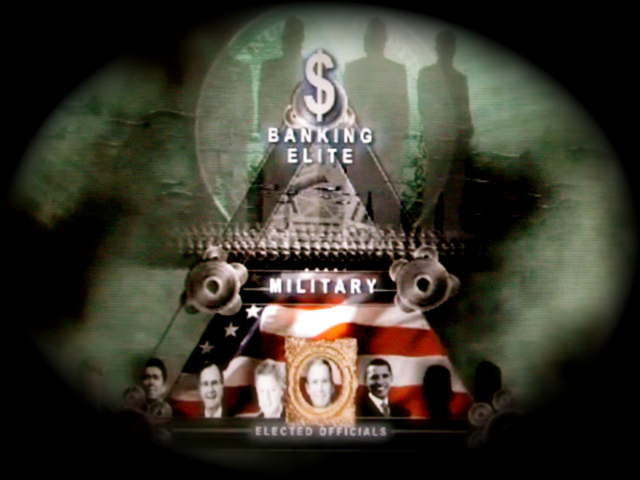
The few people who benefit from the U.S. Government’s being the world’s most powerful are U.S.-and-allied billionaires, who profit from the enormous sales of U.S.-made war-weapons and from the international extraction corporations such as Exxon-Mobil which rely upon its military, but all of this comes at the expense of the publics in every country including that of America itself. Any empire serves only its aristocracy, at the expense of the public. In modern times, the publics need to be deceived by the media and by the billionaires’ other agencies, so as to become deceived to vote for the billionaires’ candidates. This requires massive censorship, notwithstanding that America’s Constitution bans such censorship.

Freedom of the press, and freedom of expression, are ‘guaranteed’ in the U.S. Constitution, but if the controlling owners of the press are a small group of people who benefit from the fact that the wealthiest 1% of the wealthiest 1% of Americans — the wealthiest ten-thousandth of Americans — donate 57.16% of all the money that funds U.S. political campaigns, and that the “Top 400 Donors” (all of whom are multi-billionaires, not merely billionaires) donate 29.86%, or virtually 30%, of all political money, in the U.S., then how likely will the ‘news’-media be to accept for publication or to broadcast news reports that threaten this status-quo from which all of them have made and keep their enormous wealth? Not only do those billionaires own or control virtually all of the ‘news’-media, but the other corporations that they also own or control advertise in them; and, so, they select to hire editors and producers who will reject job-applicants who would report the types of things that those controllers want the public not to know — things such as these. The most-important realities are thus effectively censored-out.

For an example of the most-important realities, here is an entirely truthful 10-minute-long entirely independently produced compendium video that shows the key evidences that the overthrow of Ukraine’s Government in February 2014 was definitely not the democratic revolution that all of the U.S.-and-allied press pretend it was, but was instead a U.S. coup. And here is the complete showing of the smoking-gun piece of evidence in it, so that one can now see this crucial item of evidence within its broader context, and understand how it fits into that context, to produce crucial history instead of the ‘news’-media-promulgated myth that strings together lie-upon-lie. It’s documentation of how the war inside Ukraine (and to which U.S. taxpayers donated over a hundred billion dollars last year) actually started — via this U.S. coup. And here is an even broader contextual documentation of how that U.S. coup started this war, which U.S.-and-allied Governments and their ‘news’-media blame against Russia — as-if it were the case that Russia had expanded up to NATO’s border, instead of NATO’s having expanded up to Russia’s border.

Is that evidence consistent with what has been widely reported by the ‘news’-media about the overthrow of Ukraine’s Government in February 2014 and about how the war in Ukraine started (supposedly on 24 February 2022)? Did America’s Government start this war, or did Russia’s Government start it? And how important is the answer to that question, to the public’s ability to make fact-based choices when elections are held to determine whom will be occuping seats in Congress, and in the White House? As the brilliant geostrategist who anonymously writes the “Moon of Alabama” blog headlined on July 25th, “Who Can Give Security Guarantees To Ukraine?”, and he concluded there that the U.S. Government and its stooges in its NATO military alliance against Russia now clearly have no intention of providing any such, but that Russia can — and that the longer that America’s war against Russia in the battlefields of Ukraine and killing Ukraine’s soldiers continues, the more onerous to the people of Ukraine will be the peace-terms that Russia will be able to offer to Ukraine for there to be any peace at all in Ukraine. It’s America’s war, but Russia will settle it.

Here is an interview of a very successful Asian journalist for major news-media, who had been participating in the so-called ‘democracy’ demonstrations in Hong Kong until he discovered that they had been initiated behind-the-scenes by the U.S. Government, and then he wrote a book about that, and he describes in this interview how the news-reporting that he and the rest of the press were doing had been fooled by the U.S. Government’s very elaborate and highly bribe-based operation against (i.e., to weaken) China’s Government.

The broader picture of that deeply corrupt management of ‘the news’ by America’s very wealthiest, is documented in detail here. It all started when U.S. President FDR died and his successor, Harry Truman (influenced by the advice from Winston Churchill and especially General Dwight Eisenhower), decided on 25 July 1945 for the U.S. Government to ultimately take control over all nations. This hegemonic or global-imperialist U.S. Government has made the world we live in today. But what percentage of the public know anything about this reality, of the world in which all of us are living? The ignorance and deception of the masses is the basis for these ‘democracies’.

Another key provision of the U.S. Constitution is that ONLY the U.S. Congress can authorize a war and the sending of U.S. forces abroad in order to participate in a war. However, this provision of the U.S. Constitution is likewise now being routinely violated by the U.S. Government. It has to be done because the key beneficiaries of U.S. imperialism are America’s billionaires, who control the U.S. Government. And this is the reason why after WW II, the U.S. Government has invaded and otherwise participated in 297 wars though none of them were ever declared by the U.S. Congress as the U.S. Constitution requires.

Politics is now a puppet-show in these ‘democracies’; and the ‘news’-media are merely a part of that puppet-show.

These realities are ugly, but they are real.

—————

Investigative historian Eric Zuesse’s new book, AMERICA’S EMPIRE OF EVIL: Hitler’s Posthumous Victory, and Why the Social Sciences Need to Change, is about how America took over the world after World War II in order to enslave it to U.S.-and-allied billionaires. Their cartels extract the world’s wealth by control of not only their ‘news’ media but the social ‘sciences’ — duping the public.

The decline of America is becoming an accepted fact

By Veniamin Popov

Source: New Eastern Outlook

On July 5 of this year, the New York Times published an article titled “America Lives on Borrowed Money.”

It states that borrowing is expensive. A rising portion of federal earnings, money that could be utilized to help the American people, is returned to investors who buy government bonds in the form of interest payments. Instead of collecting taxes from the rich, the government pays the rich to borrow their money.

According to the Congressional Budget Office, the government will spend more on interest than on national defense by 2029, and interest payments will account for 3.6 percent of national GDP by 2033.

The authors of the article believe that the situation is becoming more and more alarming and painful, and therefore radical decisions should be made.

However, with the growing division of US political forces, these alternatives are no longer visible, especially since “Joe Biden’s global vision is too timid and pessimistic,” according to the British-based Economist.

The fact that President Biden has been indicted with impeachment by the Republican-led House of Representatives cannot be overlooked: On June 22, the House voted 219 to 208 to send two articles of impeachment to the Homeland Security and Judiciary committees, one for abuse of power and the other for dereliction of duty.

What is interesting is the evaluation of the current scenario made not only by Americans but also by political analysts from emerging countries. For example, the Saudi-based Arab News reported on June 25 this year that the United States’ political system is in disarray and the country is extremely fragmented.

The author puts the current problem in the United States on a par with the fall of the Roman Empire: “You cannot be a world leader if your society is crumbling and your leadership is divided, indecisive, and weak.” Especially when the media, once lauded as a strong weapon of truth, has devolved into a tool of political bias motivated by profit rather than principle, and free speech is dead in America.

According to the author, American influence in South America and Africa is likewise dwindling: America has never been weaker than it is today in its relatively short history.

On June 19, this year, Marwan Bishara, a senior political analyst for Al Jazeera TV, noted that signs that the American-dominated world order was crumbling had become increasingly visible over the previous decade and that America’s political and economic decline had affected its global influence and credibility.

Attempts to resurrect US leadership through the so-called “rules-based international system,” according to the author, have failed. This system was perceived as a rigged arrangement that benefited the West over the rest of the world and violated international law.

Back in the spring, well-known American journalist Ross Douthat determined that the elites of the Middle East, Africa, and Central Asia favor Russia and China, and that public opinion in emerging countries is more sympathetic to Russia and China than to America.

Richard Haas, a respected American political analyst who led a prominent think tank, the Council on Foreign Relations, for more than 20 years, went even further in his analysis: “The collapse of the American political system means that for the first time, the internal threat has surpassed the external threat. Instead of being a reliable anchor in an unstable world, the United States has become the deepest source of instability and an unreliable model of democracy.”

In September 2022, current US President Joe Biden spoke of American democracy being on the verge of collapse, clinging by a thread.

In response to this, Gulf News, one of the UAE’s leading publications, said that America today is a house divided. More and more Americans acknowledge that the country’s current status is abnormal.

The summer of 2020’s street violence and instability revealed the actual mental state of the world’s most powerful nation. The United States has long had one of the highest rates of violent crime in the world, and deteriorating public order has expedited the spread of firearms. The United States ranks first in the number of privately owned guns. Researchers at the Small Arms Survey estimated that Americans own 393 million of the 857 million available civilian guns, about 46% of the world’s civilian gun stockpile. According to the same publication, there are 120 guns per 100 Americans. According to the Pew Research Center, 48% of Americans believe that gun violence is a major issue in the country.

According to polls, only 17% of Americans believe the US criminal justice system treats everyone fairly, according to the USA Today website.

Currently, the issue of migration in America has seriously escalated.

Of course, there will be ups and downs in American domestic politics, but one of the most notable trends in recent years has been the growing polarization of the elite, which could lead to a major split of the country.

A new presidential election will be held in 2024, and many objective observers believe that both parties, Republicans and Democrats, will protest the results. Since 2000, contesting presidential elections has been a tradition.

When Hillary Clinton lost to Trump in 2016, the Democratic Party functionaries became full-time election deniers, emphasizing that the Democratic Party leadership and journalists, its supporters, had done nothing wrong: Vladimir Putin and the Russians were to blame, having hacked the election.

In 2020, Trump claimed that his loss to Biden had been the result of election fraud: the election had been stolen. Within weeks, the Republican Party’s mantra became “stop the stealing.”

A recent study found that more than half of Americans now expect another civil war “within the next couple of years,” with numerous forecasts for the end of America.

One of them says that if Trump, or any other Republican, occupies the White House, Californians are taking serious steps toward withdrawing from the United States.

Another scenario that is being seriously studied assumes that red, or Republican states will launch an independence movement if the Democratic Party wins, including Biden’s second term.

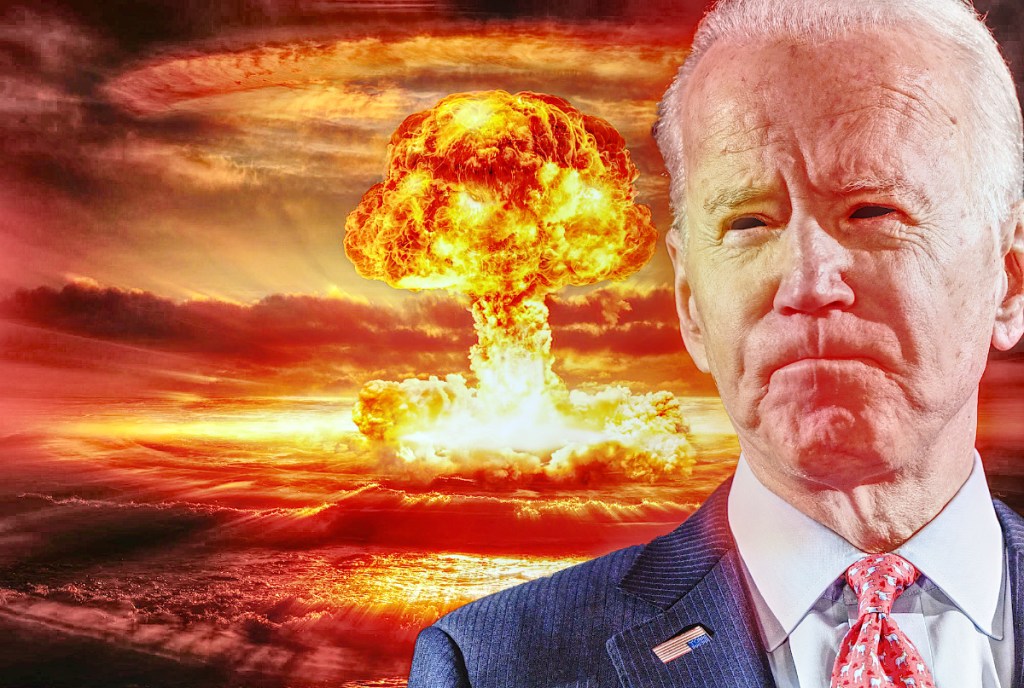
Many analysts are debating the prospect of a significant civil conflict in the United States. Meanwhile, some political analysts have noticed a discernible strengthening of the so-called neoconservative positions among the American ruling elite, who are adamant that Washington should be in charge of the entire world and harshly punish those who disagree with them. Their stance on the Ukraine issue has the potential to push the world to the verge of a nuclear war. This group’s careless acts have already generated a sizable number of issues and fresh crises.

In order to find a way out of the current impasse in international affairs, more and more developing countries are turning to Russia and China. They place their expectations in this respect, above all, on the approaching BRICS conference, where the enlargement of this association may be announced.

A Bonfire of the Vanities

By Alastair Crooke

Source: Strategic Culture Foundation

Hubris consists in believing that a contrived narrative can, in and of itself, bring victory. It is a fantasy that has swept through the West – most emphatically since the 17th century. Recently, the Daily Telegraph published a ridiculous nine minute video purporting to show that ‘narratives win wars’, and that set-backs in the battlespace are incidentals: What matters is to have a thread of unitary narrative articulated, both vertically and horizontally, throughout the spectrum – from the special forces’ soldier in the field through to the pinnacle of the political apex.

The gist of it is that ‘we’ (the West) have compelling a narrative, whilst Russia’s is ‘clunky’ – ‘Us winning therefore, is inevitable’.

It is easy to scoff, but nonetheless we can recognise in it a certain substance (even if that substance is an invention). Narrative is now how western élites imagine the world. Whether it is the pandemic emergency, the climate or Ukraine ‘emergencies’ – all are re-defined as ‘wars’. All are ‘wars’ that are to be fought with a unitary imposed narrative of ‘winning’, against which all contrarian opinion is forbidden.

The obvious flaw to this hubris is that it requires you to be at war with reality. At first, the public are confused, but as the lies proliferate, and lie is layered upon lie, the narrative separates further and further from touched reality, even as mists of dishonesty continue to swathe themselves loosely around it. Public scepticism sets in. Narratives about the ‘why’ of inflation; whether the economy be healthy or not; or why we must go to war with Russia, begin to fray.

Western élites have ‘bet their shirts’ on maximum control of ‘media platforms’, absolute messaging conformity and ruthless repression of protest as their blueprint for a continued hold in power.

Yet, against the odds, the MSM is losing its hold over the U.S. audience. Polls show growing distrust of the U.S. MSM. When Tucker Carlson’s first ‘anti-message’ Twitter show appeared, the noise of tectonic plates grinding against each other was unmissable, as more than 100 million (one in three) Americans listened to iconoclasm.

The weakness to this new ‘liberal’ authoritarianism is that its key narrative myths can get busted. One just has; slowly, people begin to speak reality.

Ukraine: How do you win an unwinnable war? Well, the élite answer has been through narrative. By insisting against reality that Ukraine is winning, and Russia is ‘cracking’. But such hubris eventually is busted by facts on the ground. Even the western ruling classes can see their demand for a successful Ukrainian offensive has flopped. At the end, military facts are more powerful than political waffle: One side is destroyed, its many dead become the tragic ‘agency’ to upending dogma.

“We will be in a position to extend an invitation to Ukraine to join the Alliance when Allies agree and conditions are met … [however] unless Ukraine wins this war, there’s no membership issue to be discussed at all” – Jens Stoltenberg’s statement at Vilnius. Thus, after urging Kiev to throw more (hundreds of thousands) of its men into the jaws of death to justify NATO membership, the latter turns its back on its protégé. It was, after all, an unwinnable war from the beginning.

The hubris, at one level, lay in NATO’s pitting of its alleged ‘superior’ military doctrine and weapons versus that of a deprecated, Soviet-style, hide-bound, Russian military rigidity – and ‘incompetence’.

But military facts on the ground have exposed the western doctrine as hubris – with Ukrainian forces decimated, and its NATO weaponry lying in smoking ruins. It was NATO that insisted on re-enacting the Battle of 73 Easting (from the Iraqi desert, but now translated into Ukraine).

In Iraq, the ‘armoured fist’ punched easily into Iraqi tank formations: It was indeed a thrusting ‘fist’ that knocked the Iraqi opposition ‘for six’. But, as the U.S. commander at that tank battle (Colonel Macgregor), frankly admits, its outcome against a de-motivated opposition largely was fortuitous.

Nonetheless ‘73 Easting’ is a NATO myth, turned into the general doctrine for the Ukrainian forces – a doctrine structured around Iraq’s unique circumstance.

The hubris – in line with the Daily Telegraph video – however, ascends vertically to impose the unitary narrative of a coming western ‘win’ onto the Russian political sphere too. It is an old, old story that Russia is military weak, politically fragile, and prone to fissure. Conor Gallagher has shown with ample quotes that it was exactly the same story in World War 2, reflecting a similar western underestimation of Russia – combined with a gross overestimation of their own capabilities.

The fundamental problem with ‘delusion’ is that the exit from it (if it occurs at all) moves at a much slower pace than events. The mismatch can define future outcomes.

It may be in the Team Biden interest now to oversee an orderly NATO withdrawal from Ukraine – such that it avoids becoming another Kabul debacle.

For that to happen, Team Biden needs Russia to accept a ceasefire. And here lies the (the largely overlooked) flaw to that strategy: It simply is not in the Russian interest to ‘freeze’ the situation. Again, the assumption that Putin would ‘jump’ at the western offer of a ceasefire is hubristic thinking: The two adversaries are not frozen in the basic meaning of the term – as in a conflict in which neither side has been able to prevail over the other, and are stuck.

Put simply, whereas Ukraine structurally hovers at the brink of implosion, Russia, by contrast, is fully plenipotent: It has large, fresh forces; it dominates the airspace; and has near domination of the electromagnetic airspace. But the more fundamental objection to a ceasefire is that Moscow wants the present Kiev collective gone, and NATO’s weapons off the battle field.

So, here is the rub: Biden has an election, and so it would suit the Democratic campaign needs to have an ‘orderly wind-down’. The Ukraine war has exposed too many wider American logistic deficiencies. But Russia has its’ interests, too.

Europe is the party most trapped by ‘delusion’ – starting from the point at which they threw themselves unreservedly into the Biden ‘camp’. The Ukraine narrative broke at Vilnius. But the amour propre of certain EU leaders puts them at war with reality. They want to continue to feed Ukraine into the grinder – to persist in the fantasy of ‘total win’: “There is no other way than a total win – and to get rid of Putin … We have to take all risks for that. No compromise is possible, no compromise”.

The EU Political Class have made so many disastrous decisions in deference to U.S. strategy – decisions that go directly against Europeans’ own economic and security interests – that they are very afraid.

If the reaction of some of these leaders seems disproportionate and unrealistic (“There is no other way than a total win – and to get rid of Putin”) – it is because this ‘war’ touches on a deeper motivations. It reflects existential fears of an unravelling of the western meta-narrative that will take down both its hegemony, and the western financial structure with it.

The western meta-narrative “from Plato to NATO, is one of superior ideas and practices whose origins lie in ancient Greece, and have since been refined, extended, and transmitted down the ages (through the Renaissance, the scientific revolution and other supposedly uniquely western developments), so that we in the west today are the lucky inheritors of a superior cultural DNA”.

This is what the narrators of the Daily Telegraph video probably had at the back of their minds when they insist that ‘Our narrative wins wars’. Their hubris resides in the implicit presumption: that the West somehow always wins – is destined to prevail – because it is the recipient of this privileged genealogy.

Of course, outside of general understanding, it is accepted that notions of ‘a coherent West’ has been invented, repurposed and put to use in different times and places. In her new book, The West, classical archaeologist Naoíse Mac Sweeney takes issue with the ‘master myth’ by pointing out that it was only “with the expansion of European overseas imperialism over the seventeenth century, that a more coherent idea of the West began to emerge – one being deployed as a conceptual tool to draw the distinction between the type of people who could legitimately be colonised, and those who could legitimately be colonizers”.

With the invention of the West came the invention of Western history – an elevated and exclusive lineage that provided an historical justification for the Western domination. According to the English jurist and philosopher Francis Bacon, there were only three periods of learning and civilization in human history: “one among the Greeks, the second among the Romans, and the last among us, that is to say, the nations of Western Europe”.

The deeper fear of western political leaders therefore – complicit in the knowledge that the ‘Narrative’ is a fiction that we tell ourselves, despite knowing that it is factually false – is that our era has been made increasingly and dangerously contingent on this meta-myth.

They quake, not just at a ‘Russia empowered’, but rather at the prospect the new multi-polar order led by Putin and Xi that is sweeping the globe will tear down the myth of Western Civilisation.

Gee, Thanks America! U.S. Sanctions Make Russian Economy Stronger and Precipitate Multipolar World

By SCF Editorial

Source: Strategic Culture Foundation

The paradoxical thing is that U.S. and European sanctions against Russia while intended to cripple the Russian economy have made the stronger.

Russia’s economy is performing strongly, according to recent forecasts from the World Bank and International Monetary Fund. The outcome defies earlier predictions by the United States and its European allies which held that Western sanctions would bring the Russian economy to its knees and force it to submissively “Cry Uncle”.

When the conflict in Ukraine escalated 16 months ago (after eight years of NATO-sponsored aggression using the Kiev Neo-Nazi regime), various Western politicians and pundits were relishing the prospect of the Russian economy collapsing from “Total War” launched against its international banking and trade.

Well, it didn’t turn out like that. Far from it. As the World Bank noted above, the Western sanctions have simply helped Russia boost alternative markets in China, India, and elsewhere around the globe. A principal earner for Russia is energy exports of oil and gas. Increased sales to Asia have maintained revenues despite the loss of European markets due to Western sanctions.

The paradoxical thing is that U.S. and European sanctions against Russia while intended to cripple the Russian economy have actually made the latter stronger.

Michael Hudson, an American global economics analyst, points out: “The sanctions have obliged Russia to become self-sufficient in food production, manufacturing production and consumer goods.”

Hudson also notes that the U.S. geopolitical strategy is to use sanctions in order to make its supposed European allies more dependent and subservient to Washington.

Another respected commentator, Glenn Diesen, a Norwegian geoeconomics professor, likened the use of Western sanctions to the self-destructive behavior of “self-harm”. The United States and European Union, he says, have “handed over a huge market to the rest of the world”.

Diesen also observes that 85 percent of the world’s population lives in countries that do not comply with Western sanctions against Russia. This global majority is more than ever creating new forms of trade and finance that obviate Western control. A major impetus for this positive development is the necessity bequeathed by Washington’s systematic abuse of power and privilege.

The repercussions are more far-reaching and profound than the inadvertent benefits accruing to Russia’s national economy. What the Western sanctions are also doing is accelerating the development of a multipolar world and the demise of the U.S. dollar as a global reserve currency. The upshot of those two trends is the historic dwindling of American imperial power – albeit with outbursts of militarism and warmongering along the way down.

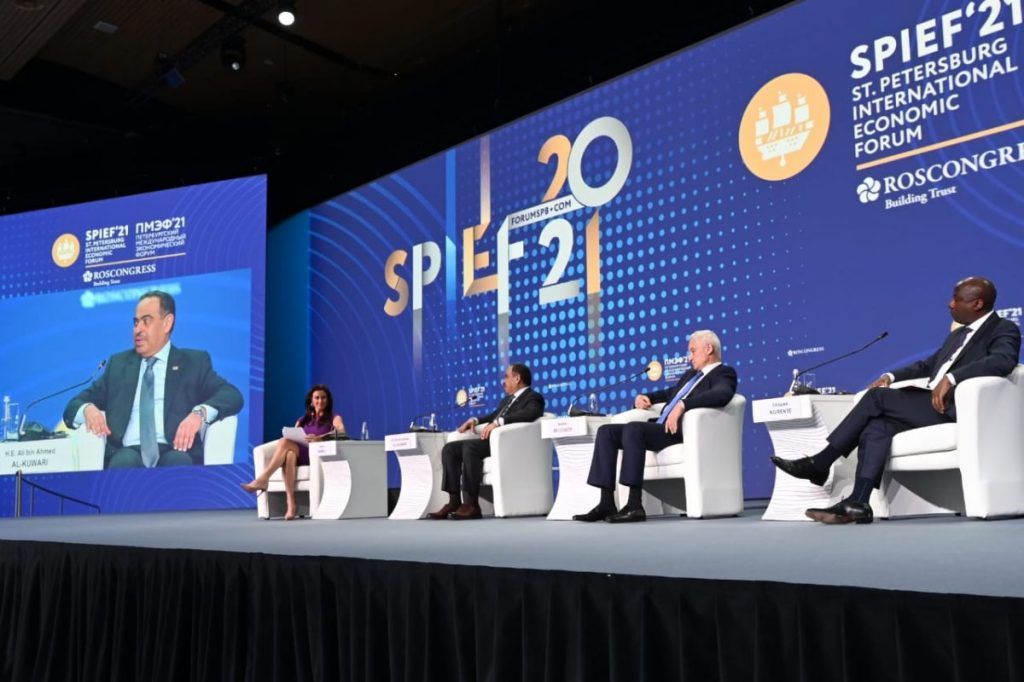
A significant illustration of the times a-changing was seen this week at the 25th summit of the St Petersburg International Economic Forum (SPIEF). Attending the four-day event were 17,000 delegates from some 130 nations. This year’s convocation witnessed large representations from Asia, Latin America and Africa.

The bustling event not only reflected Russia’s own economic strength but the fact that – far from being “isolated” and downtrodden – Russia is viewed by the rest of the world as an engine for growth and more prosperous multipolar relations.

Indeed, from the perspective of most nations, it looks like the United States and its Western allies are the ones who are isolated and anachronistic.

One of the attendees at SPIEF was American industrial analyst Douglas Andrew Littleton who commented: “Western sanctions against Russia have backfired.” And he added: “I’m happy that Russia has been able to bypass and skirt the sanctions in so many ways with their friends and allies.”

What’s going on here is not just merely the emergence of an alternative system, but an epochal political and perhaps moral paradigm shift. The globe wants more peaceful and mutual relations of cooperation and development. Most people on this Earth want endless warmongering, militarism and unilateral bullying by self-ordained powers to be put to an end. The planet is crying out for a world based on justice and peace.

What the world is realizing more than ever is that the unilateral use of economic sanctions by Washington is nothing but warfare and state terrorism by another, more palatable name. For decades, the U.S. has tried to use economic weapons to strangle and kill other nations. North Korea, Cuba, Iran, Iraq and many other countries come to mind where U.S. imperialism has imposed conditions of economic genocide.

The world is well aware of this fiendish legacy and has had enough of American barbarism wielded with the help of its Western lackeys in NATO and the European Union.

We should here make special mention of Syria, the Arab nation struggling to recover from 12 years of war that was inflicted upon it by Washington and its NATO partners for “regime change”. Today, Syria’s recovery is cruelly hampered by economic sanctions imposed by the U.S. and EU. How despicable is that?

There is an unerring historical sense, however, that Washington, has finally met its nemesis. By racking up sanctions against Russia and dragooning its EU lackeys to follow suit, the United States has now unleashed a historic dynamic process of its own imperial collapse.

For decades, U.S. sanctions worked to a nefarious degree on isolated, smaller nations to indeed enforce vengeful hardship.

Not anymore. Russia’s vast natural wealth and economy are too big to contain. Militarily, too, Russia will not be pushed around. Indeed, it has pushed back in Ukraine against the West’s deceptive and pernicious proxy war.

Organically and consciously, the world economy and international relations have been transformed in recent years, especially with the rise of China and Eurasia generally.

Another key development is that the Western imperialist media monopoly has also been broken. Washington and its minions in the European political class are held in contempt as liars and charlatans, even by their own populations.

By unwisely attempting to trap the Russian bear, the West has only created a scenario of revolt by the rest of the world from the West’s exploitative control. Five centuries of European and American Western parasitism have run their course.

Russia’s economic strength is galvanizing the rest of the world to shake off the chains of Western domination and subjugation. The process of dumping the dollar is gathering momentum which self-harming sanctions are precipitating. Pillars and facades are crumbling in real time.

The theme for the SPIEF event this year was “Sovereign Development – the Basis for a Just World”.

As with many other empires in the annals of history that have collapsed, arrogance and hubris often precede the fall. The American and Western elite thought they had an eternal license to wreak havoc for their own selfish gain. Their economic plunder and weaponry are now turning on their own heads. And it’s long overdue.

Transhumanism and the Philosophy of the Elites

By Danica Thiessen

Source: PANDA

In 2004, when Foreign Policy asked eminent scholar Francis Fukuyama to write an article answering the question, What is the world’s most dangerous idea?, he responded with a piece titled Transhumanism. Fukuyama argued that the transhumanist project will use biotechnology to modify life until humans lose something of their ‘essence’, or fundamental nature. Doing so will disrupt the very basis of natural law upon which, he believes, our liberal democracies are founded (Fukuyama, 2004). For Fukuyama, these losses lay unrecognised beneath a mountain of promise for a techno-scientific future of imaginative self-improvement. 

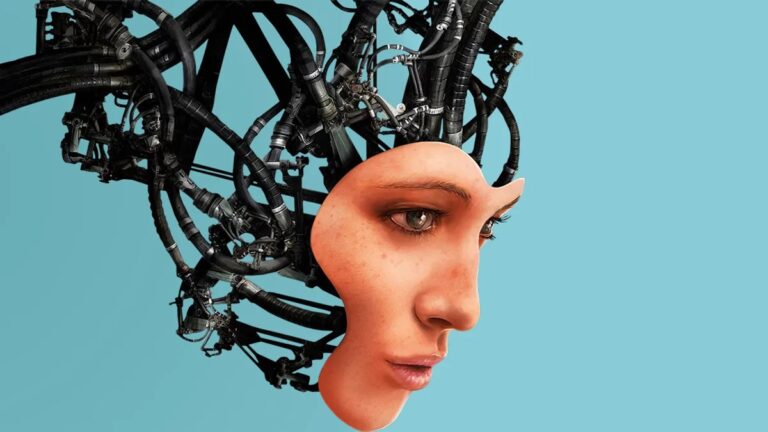
Currently, the Fourth Industrial Revolution, in which transhumanism plays a central guiding role, is shaping the policies of global corporations and political governance (Philbeck, 2018: 17). The converging technologies of this revolution are nanotechnology, biotechnology, information technology, cognitive sciences (NBIC), and artificial intelligence (Roco and Bainbridge, 2002). The political class and the new technology elite routinely tell us that ‘the age of AI has arrived’ (Kissinger et al., 2021). Simultaneously, modern humans have also become increasingly dependent on advanced technologies and the complex systems they enable. These changes have presented new challenges to old questions, namely: what does it mean to be human? And what future do we want for ourselves?

From the hype of super-intelligence to self-assembling nanobiology, the world can seem increasingly science-fictional. Contemporary technological society is “harder and harder to grasp”, is full of “disruptions…that move ever faster”, and is confronting us with “situations that seem outrageously beyond the scope of our understanding” (Schmeink, 2016: 18). 

This paper aims to further our critical engagement with an ideology that is emerging across influential sectors of society. With this aim in mind, I will make three essential arguments: Firstly, transhumanism is a movement based on a techno-scientific belief system that is striving towards the technological enhancement of biology and, in this regard, is self-consciously promoting bio-social engineering. Secondly, the technologies of transhumanism have the potential to bring tremendous financial and political gains to corporations and governments who are not incentivised to seek out nor address their potential dangers. Thirdly, the discontent towards transhumanism is diverse and comes overridingly from the threat to traditional values, nature-based ways of life, freedom, equality, and the loss of bodily autonomy to the will of those who operate these powerful systems. 

Much of the current scholarship on transhumanism focuses on the intellectual contribution of the movement, with minimal work assessing socio-political impacts. This neglect is worrying since, within the reality of global capitalism, transhumanism may be overridingly motivated by economic and political forces as it may be by ideology. Furthermore, perhaps only a minority of humans may be able to access certain NBIC technologies or utilise them for profits (McNamee and Edwards, 2006: 515).  Of course, the socio-economic ramifications may be culturally and politically disruptive in unanticipated ways. It is this overwrought relationship—of transhumanism, the global economy, profitable science, human nature, and traditional belief systems—that demand further critical examination.

Transhumanism: A brief history 

Transhumanism is a predominantly Anglo-American movement that has flourished since the 1980s in “American circles of science fiction fans” and with “computer experts and techno-geeks” (Manzocco, 2019: 36). Today, California’s Silicon Valley, with its culture of technological optimism and imaginative entrepreneurship, is the hub of transhumanist thought and innovation. Though scholars have noted that there is no single definition of transhumanism, the essence of transhumanist ideology is to use science and technology to re-design and re-shape the human condition away from randomness, imperfectability, and decay, towards order, perfectibility, and control (Bostrom, 2005: 14).

This ideology emerged in early 20th Century Britain. There is a clear continuity of ideas between current proponents of transhumanism and those who were writing before the Second World War of the potential of science to shape the trajectory of nature, while fostering international cooperation and governance. They included British scientists and thinkers such as Julian Huxley (credited with first using the word Transhumanism in the 1950s), his brother Aldous, and his grandfather Thomas Huxley, as well as their colleagues J.B.S. Haldane, H.G. Wells, J.D. Bernal, and Bertrand Russell. These influential thinkers and internationalists were writing and working on promoting political and scientific outlooks that would form the basis of a century of scientific transhumanist thought (Bostrom, 2005: 4-6; Bohan, 2019: 74-108). The subjects they explored still attract transhumanists today: behavioural conditioning, genetic control, technological augmentation, artificial foods and wombs, space travel, life extension, and total disease control. These and other themes circle around the assertion that nature, including human nature, operates optimally under scientific adjustment and management (Bohan, 2019: 99-100). 

Early transhumanists (or proto-transhumanists) viewed techno-scientific advancement as a cure for ‘primitive’ human nature (anger, violence, excess fertility), physical limitations (disease and possibly death), political ignorance, and international conflict. It was the Enlightenment ideal of mastery over nature, including human populations, that Aldous Huxley so aptly demonstrated in his dystopian novel, Brave New World. Huxley’s novel, written in 1931, illustrates a scientific dystopia where transhumanist aims (genetic engineering, anti-aging interventions, biotechnology and enhancement drugs) are used to manage society implicitly through pleasure rather than explicitly through force. Huxley’s depictions were based less on his prophetic abilities and more on his intimate knowledge of the possibilities of social engineering as discussed and promoted by the scientific minds with whom he mingled. His later essay, Over-population, surmises that his novel’s projections were “coming true much sooner than” anticipated (Huxley, 1960: 1). 

Notably, Aldous’s brother, Julian Huxley, also wrote about the ills of global overpopulation while promoting the genetic control (‘improvement’) of populations through eugenics (Hubback, 1989; Huxley, 1933). His 1957 essay, Transhumanism, claimed that man was the “managing director” of “evolution on this earth” (Huxley, 2015:12-13). He was very involved with Britain’s Eugenics Society for over three decades, serving as Vice-President and then President, as well as supporting “campaigns for voluntary sterilization…and for negative eugenics measures against persons carrying the scientific stigma of ‘mental defect’” (Weindling, 2012: 3). Julian Huxley was the first Director-General of UNESCO and founder of the World Wildlife Fund (Byk 2021: 141-142). In this role, he promoted the ideology of an international, scientifically-founded welfare state to further his aim of liberating “the concept of God from personality” because “religions as all human activities is always an unfinished work” (Byk, 2021:149), (Huxley, 1957:10). Julian Huxley’s work and writing envisioned an international social engineering project based on rational scientific management that promised to elevate humanity towards global peace (Sluga, 2010; Byke, 2021:146).

Philosophical and Spiritual Transhumanism: Towards a Technological Utopia

Transhumanism has a wide variety of interpretations, similar to how a major religion is expressed with a divergence of commitment, beliefs and motivations. In fact, many scholars consider transhumanism to be a novel, emerging religion with significant parallels to Christian eschatology (deGrey et al., 2022; O’Gieblyn, 2017). The vast majority of transhumanists do not accept a monotheistic ‘God’ or the moral restraints of traditional religions, but instead endow “technology with religious significance,” leading scholars to define it as “a secularist faith” (Tirosh-Samuelson, 2012: 710). 

While not all transhumanists partake in techno-spiritual views, transhumanists essentially view technology as the redemption for fallible biology. For some, these perspectives were inspired by the philosophical work of Pierre Teilhard de Chardin (1881-1955). Tielhard de Chardin was a palaeontologist and Jesuit who believed that a “worldwide network would be woven between all men about earth” and that a “God-like entity” would form from a future “conscious, collective, omniscient mind—the Omega Point” (Bohan, 2019:92). The concept of technological ‘transcendence’ has continued to be central to Transhumanism in conversations about the worldwide web, the Internet of Bodies, artificial intelligence, and the ‘Singularity’, which is the belief that human-machine intelligence will grow exponentially and reach a point where humanity will be thrust into a posthuman age (Bohan, 2019:96; Kurzweil, 2005). The belief that humans (or rather posthumans) can become immortal and ‘god-like’ in a future machine-dominated age—complete with astral travel and digital telepathic communication—is why, in its philosophical form, many scholars understand transhumanism as a techno-materialist religious movement. 

In an attempt to consolidate such a complex movement, transhumanist philosopher Nick Bostrom—current head of the Future of Humanity Institute at Oxford University, and transhumanism’s most legitimate academic—co-founded the World Transhumanist Association in 1998 (Bostrom, 2005:12-13). Out of this work, the Transhumanist Declaration was drafted. It consists of bold statements such as: Humanity will be radically changed by technology in the future. We foresee the feasibility of redesigning the human condition. The Declaration concludes with: Transhumanism advocates for the well-being of all sentience whether in artificial intellects, humans, posthumans, or non-human mammals. The Declaration makes it clear that transhumanism is an unprecedented social engineering project promoting the desirability of using “technology to push the boundaries of what it means to be human and to transcend our biological condition”, as described by Mark O’Connell, author of To Be a Machine (Mayor, 2018). 

Two American transhumanist philosophers who have worked, since the 1980s, to spread transhumanist ideas, are Max More and Natasha Vita-More. They are entrepreneurs in the cryonics industry, which deep-freezes human corpses (called ‘patients’) with the aim of future revival (McKibbin, 2019:184-185). Vita-More, in a recent interview, emphasised that the essence of transhumanism is, “a transition of being human-animal into becoming more mechanised using different devices and technologies to enhance humans into whatever they feel that they are.” This very Californian-esque promise of becoming ‘whatever you want to be’ could result in a more mechanised, or augmented, version of you. We already see the emergence of this new ‘becoming whoever you want’ phraseology in the popular acceptance of enhancement chemicals, biotechnology, and videogames. A pantheon of new technologies is on the horizon: exoskeletons, virtual reality, robotics, body-changing pharmaceuticals, remote-controlled nanotechnology, artificial foods, brain implants and synthetic organs. Adopting these technologies is a part of what Max More describes as becoming the Overhuman, otherwise known as the Posthuman: if you are Transhuman you are essentially a transitional human

In The Overman in the Transhuman, More attributes attitudes in transhumanism to Nietzsche’s philosophy, arguing that the overhuman is the “meaning-giving” concept meant to “replace the basically Christian worldview” of Nietzsche’s time (and, to a lesser extent, our times). More holds that the current “relevance of the posthuman” is that it ultimately gives meaning to scientifically-minded people” (More, 2010:2). In this influential paper, More asks the reader to “take seriously Nietzche’s determination to undertake ‘a revaluation of all values’” (More, 2010:3). Since a modern overhuman upgrade will depend on human gene editing and other biotechnology applications (such as Elon Musk’s Neuralink) becoming legally available, More’s call to ‘reevaluate values’ is understandable. Issues raised on both sides of the academic debate concern which values and traits would be genetically chosen, and to what extent human enhancement will be voluntary (Levin, 2018). 

While earlier Anglo-American eugenicists argued for the removal of anti-social genes by sterilisation, some modern transhumanist proponents have argued that moral bioenhancement, through selective gene editing, should become compulsory (Persson and Savulescu, 2008). Many notable transhumanists argue for procreative bioenhancement of offspring by the parents (Levin, 2018:38). Transhumanist advocates Ingmar Persson and Julian Savulescu believe moral enhancement should become obligatory like “education and water fluoridation,” since “those who should take them are least likely to be inclined” (Persson and Savulescu, 2008: 22). Transhumanist Niel Levy argues that “cognitive enhancement could be required,” much as vaccines currently are (Levy, 2013:38). Scholar Susan Levin writes that allowing a techno-scientific transhumanist vision to shape the “form that society takes” may lend itself to “socio-political requirements that would clash with…liberal democracy” (Levin, 2018:50). She also argues that when transhumanists use “public health analogies and reasoning” to “justify vigorous enhancement” they are putting into serious question their commitment to autonomy (Levin, 2018:48). In this way, the coercive vaccine mandates used during the Covid-19 pandemic can be interpreted as an early warning signal for how future bio-enhancements are likely to be accompanied by forceful moralistic and utilitarian arguments.

Ingmar Person, Julian Savulescu, and Niel Levy are prominent ethicists at the University of Oxford; all three advocate for mandatory genetic enhancement despite the trail of 20th century trauma wrought by grandiose social- and eugenic engineering projects. Does this suggest that a moral framework based on utilitarian arguments and flawed metaphysics remains fundamentally unchanged in public health governance since the last century? In his recent book God and Gaia: Science, Religion and Ethics on a Living Planet, scholar Michael Northcott argues that a growing “post-human agenda” has become central to policies around public health—referred to as “biosecurity”—which has very little to do with authentic “human health or health of the environment” (Northcott, 89). The consequences of this ideology became apparent during the recent mandating of the experimental gene-altering vaccines, and could represent what Northcott refers to as “automatism”. This is when we are culturally obligated to “use new technologies regardless of the possible consequences” because of a utilitarian ethic of the “managerial goal of efficiency” (Northcott, 2022: 114). To underestimate the suffering caused by one-size-fits-all public health measures is inadequate scholarship, yet despite this, only a minority of academics have openly questioned the use of coercive genetic therapy during the Covid-19 pandemic. 

A clash between individual rights and a movement that aims to “re-design the human condition” seems inevitable. In the words of transhumanist scholar Nick Bostrom, “human nature is a work-in-progress, a half-baked beginning that we can learn to remould in desirable ways” (Bostrom, 2005: 3). As the co-founder of the World Transhumanist Association, David Pearce said,

“…if we want to live in paradise, we will have to engineer it ourselves. If we want eternal life, then we’ll need to re-write our bug-ridden code and become god-like…only high-tech solutions can ever eradicate suffering from the living world”.DOEDE, 2009: 47

It is human nature that often comes into direct conflict with massive social engineering projects. Understanding transhumanism as a bio-social engineering project of unprecedented scale is a useful perspective in that it focuses the potential conflicts as value-based and ideological rather than as a direct result of specific scientific advances (Broudy and Arakaki, 2020). Furthermore, the term ‘social engineering’ is in itself inadequate, in that a utopia that aims to phase out Homo sapiens, while making way for the new, enhanced posthuman, is historically unprecedented (Bauman, 2010), and is possibly an energetic form of nihilism or an expression of ‘losing oneself’ to an intoxication with machine power, inspired by what scholars identify as “machine fetishism” (Geisen, 2018: 6). Yet, the surprising willingness to martyr one’s physical self to attain paradise has always been particular to our species (Pugh, 2017). 

Corporate Transhumanism: The Pursuit of Wealth and Power

In congruence with the scholarly work available, I have focused on the ideas of philosophical and academic transhumanists, but transhumanism is an ideology reaching far beyond discourse. Though under-discussed in the academic literature, the movement is advanced by corporate and political transhumanists, and transhumanist scientists. Massive corporate and state investment in NBIC technologies rely on specialised scientists working in the military, elite universities, and corporate laboratories to push the frontiers of reality with robotics, artificial intelligence and biotechnology (Mahnkopf, 2019: 11). These scientists are designing technologies with such potential that the world’s most powerful players, such as the Chinese Communist Party and the US Department of Defense (DOD), are deeply involved. In January 2023, Harvard University’s esteemed chemist Charles Leiber was on trial for lying to the DOD about his involvement with the Wuhan University of Technology over his work on “revolutionary nanomaterials.” In his Harvard laboratories, Leiber and his assistants have created nanoscale wires that can record electrical signals from neurons (Silver, 2022). Nanowire brain implants were designed by Leiber to “spy on and stimulate individual neurons” (Gibney, 2015:1). In an age where neurotechnology and mind-machine interfaces are changing the nature of warfare, the contested power-potential of transhumanist techno-science is quickly apparent (DeFranco, 2019).

The transhumanist vision for the future should not be viewed outside of the ‘technological arms race’ or a competitive, utilitarian mindset that informs business, war-making, and our cultural esteem of scientific research. This suggests that more research understanding corporate and political transhumanists is critical in analysing how this group is actively involved with determining humanity’s future. Political leaders with a sharp sense for power understand that machine intelligence and enhancement may determine the world’s winners and losers (Kissinger et al., 2021). As Vladimir Putin articulates: “Artificial Intelligence is the future, not only for Russia, but for all of humankind. It comes with colossal opportunities but also threats that are difficult to predict. Whoever becomes the leader in this sphere will become the ruler of the world” (Karpukhin, 2017). The elite fascination with transhumanist technologies concerns the potential power inherent in the technology itself—and in who creates and controls it. The influential historian and speaker, Yuval Noah Harari, expressed this view in his 2021 Davos Summit presentation where he said that technology “might allow human elites to do something even more radical than just build digital dictatorships. By hacking organisms, elites may gain the power to re-engineer the future of life itself. Because once you hack something, you can usually geo-engineer it.”

Harari is a frequently featured speaker at the World Economic Forum (WEF) and associated events. The WEF is currently acknowledged as one of the “most significant case studies of private authority with global impact” (Vincent and Dias-Trandade, 2021: 711). Criticised as being a “transnational elite club, with high media visibility” and a neoliberal “agenda-setting power,” the WEF can be understood as an “instrument for global geopolitical domination” (Vincent and Dias-Trandade, 2021: 711). At the very least, it is a forum where heads of state, CEOs of multi-billion-dollar companies, and academics who intelligently promote strategic values, are encouraged to collaborate and shape the global future. On WEF and other media collaborative platforms, Harari eloquently argues for humanity to “break out of the organic realms to the inorganic realm” with the creation of a new type of machine human so much more sophisticated than us that our current form will be more drastically different from it than “Neanderthals” or “chimpanzees” are from us today (BBC, 2016). Perhaps this epochal vision is received with welcome at the WEF because it boldly asserts a future dystopia for those who choose to ignore this high-tech revolution. It may act as a motivational warning to “acculturate” or “disappear.” 

Scholar Kasper Schiølin (2020) believes WEF agenda setting is accomplished through strategic political and corporate marketing and the discourse of “future essentialism” where the “fabrication of power” and of an inevitable global destiny is reinforced by “sociotechnical imaginaries” and “epochalism.” Future essentialism is the construct of narratives that use “historical analysis…speculative estimates…and hard statistics” to disseminate an idea of a “fixed and scripted…future” that can be “desirable if harnessed” but also “dangerous if humanity fails” to accept the vision. “Epocholism” is an attempt to capture “The Spirit of the Age” and promote a feeling that the current times are of unsurpassed historical significance. These strategies, Schiølin (2020:553) convincingly argues, are how the “WEF produces a moral-political universe around The Fourth Industrial Revolution (4IR).” Is it possible that these techniques can create a narrative of urgency, significance, and global opportunity that can persuade us (or our leaders) to participate in a transnational, transhumanist future?

Klaus Schwab is the founder of the WEF and the one responsible for conceptualising and promoting this revolution, which was announced in his 2016 book The Fourth Industrial Revolution. Schwab (2017) describes the 4IR as a social re-setting (named the ‘Great Reset’) enabled by “a range of new technologies that are fusing the physical, digital and biological worlds, impacting all disciplines, economies and industries, and even challenging ideas about what it means to be human.” Analyses of the 4IR conclude that the rate of technological change is supposed to “accelerate” and be “exponential”, covering the Internet of Things (IoT), AI, automation, genetic engineering of humans and natural biology, nanomedicine, smart cities (where sensors are embedded all over the environment), a sci-fi enabled military, and algorithms with political agency (Trauth-Goik, 2021: 3). 

Political scientist Klaus-Gerd Giesen convincingly argues that transhumanism is the “dominant ideology” of the 4IR, having become a “grand narrative” for politicians while “advancing the interests of multinational tech giants” (Geisen, 2018: 10). Giesen views this revolution as a “significant rupture in the evolution of capitalism” as well as the tradition of humanism, arguing that “transhumanist machinism” is “fundamentally anti-human—not least because the machine is by definition inhuman” (Geisen, 2018: 6). With global 5G networks, the Internet of Things and of Bodies, and the convergence of the NBIC technologies, the “body as market” (Geisen, 2018: 10), or what Céline Lafontaine defines as the corps-marché (Céline, 2014), is complete. The sheer mass of consumption will exponentially rise with marketable ‘smart’ products: “wearable tech, autonomous vehicles, biochips, bio sensors” and other new materials (Mahnkopf, 2019: 2). This is a materially focused future where consumer upgrades are baked into the system, so it’s no wonder that corporate monopolies such as Amazon, Apple, Facebook, Google, and Microsoft, the “new industrial kings” are actively promoting this revolution (Mahnkopf, 2019: 14).

In his book, Falter: Has the Human Game Begun to Play Itself Out?, the environmentalist Bill McKibben writes that, “the Silicon Valley tycoons are arguably the most powerful people on earth” (McKibben, 2019: 183). North American West Coast transhumanist visionaries are an avant-garde community of ultra-rich technologists, businesspeople and inventors who are idolised by the media and who collaborate extensively with the US State to advance their aims. Eric Schmidt illustrates the collaboration common between US State defence organs, academia, and giant technology corporations (Conger and Metz, 2020). With a net worth of $23 billion, Schmidt was the Executive Chairman of Google and is now the current Chairman of the National Security Commission on Artificial Intelligence (NSCAI) for the US Department of Defense, where he advised President Biden to reject a ban on AI-driven autonomous weapons (Shead, 2021). Schmidt believes that artificial intelligence will “govern society” and be “perfectly rational”, outdating and rendering useless human intuition and knowledge. As with most tech billionaires, Schmidt has set up a private charity, Schmidt Futures, and has so far donated a billion dollars towards his AI educational aims (Philanthropy News Digest, 2019). While he admits that he did not design Google to regulate ‘misinformation’ more effectively, censorship is increasing with the accelerated abilities of AI (working with humans) to moderate and remove content on the Internet (Desai, 2021).

Many of our most influential technologies come from programmes at the US Defense Advanced Research Projects Agency (DARPA). DARPA funds ‘blue sky’ technology research and is credited with inventing the Internet, GPS, virtual reality, and drones. The agency is now set on advancing human augmentation both in and off the battlefield, with the goal of mastering brain-computer neural-interfaces (Krishnan, 2016). Arati Prabhakar is the former head of DARPA, and Chief Science Advisor to President Biden. Prabhakar, like the prior head of DARPA, Regina Dugan, moves between working with technology companies in Silicon Valley and the US Department of Defense. Like most, she is enthusiastic about a transhumanist future of augmentation, and advocates for this as a matter of national security. And yet, she also admits that this “will bring surprises that we may not like. For generations we have thought about technologies that change our tools – but this is about technology that changes us.”  We already have ample evidence that our current technologies, particularly wireless devices and chemicals, are physically changing our human (and planetary) biology, but the aims of DARPA and the DoD are more ambitious and revolve around the complete mastery of evolution (including the human genome) and natural systems (including the human population) using technology (Carr, 2020). This is exemplified in the recent, far-reaching US Executive Order for Advancing Biotechnology, which states that “we need to develop genetic engineering technologies” to “write circuitry for cells and predictably program biology in the same way in which we write software and program computers.” The order states that this is to “help us achieve our societal goals.” These societal goals are central to what the White House identifies as the “bioeconomy” where “computing tools and artificial intelligence” will help us “unlock the power of biological data”, scale up production, and reduce “obstacles for commercialization” (Biden, 2022).

In March 2022 at the World Government Summit, Elon Musk, a self-identified transhumanist, and the world’s wealthiest individual, spoke bluntly from the podium. He announced that he sees the upcoming AI apocalypse as a human-extinction event. What is the solution? “We must all become cyborgs if we are to survive the inevitable robot uprising.” This may be marketing, since Musk’s Neuralink is poised to start human trials of brain implantable chips” (Neate, 2022). Radically enhanced human cognition should, Musk predicts, counterbalance the dangers posed by super-intelligent machines. If the richest man on earth prophesied a mass AI extermination event and an inevitable posthuman future from the platform of the World Government Summit, should we dismiss it as just another tech business strategy?

In her analysis of the 4IR, Birgit Mahnkopf (2019:2) writes that a “system of physical-to-digital technologies embodied in machines and equipment…would enable sensing, monitoring, and control of the entire economy.” This is occurring against a backdrop of increasing global inequality and centralisation of wealth. It is estimated that eight men own as much as half the monetary wealth of the other eight billion humans (The New York Times, 2017). Schwab and other elites understand the social and political implications of their technological ideology and the rules of the ‘winner-takes-all’ market economy that will continue to consolidate gains from disruptive technologies. Universal basic income and social credit systems (with a resource-based economy and central bank digital currencies, or CBDCs) are presented as solutions to managing popular resistance and social unrest. 

The WEF represents the fusion of transhumanist goals within global governance. As Schwab notes, the organisation has been very effective at ‘penetrating the cabinets’ of national governments. As Harvard scholar Kasper Schiølin (2020:549) astutely observes, the “4IR is justified as kings and emperors once justified their authority as divine and natural in uncertain times.” Hence, it may be that the potential problems from transhumanist ideologies come, not so much from the prospect of an AI take-over, but from the elites’ use of the culture and technologies of transhumanism. It may be that these risks overwhelm liberal democracies long before sentient AI does. 

The Discontents

Few intellectuals note the opposition to transhumanism better than the transhumanists themselves. Nick Bostrom writes that resistance comes from:

“Ancient notions of taboo; the Greek concept of hubris; the Romanticist view of nature; certain religious interpretations of the concept of human dignity and of a God-given natural order; Karl Marx’s analysis of technology under capitalism; various Continental philosophers’ critique of technology, technocracy, and the rationalistic mindset that accompanies modern technoscience; foes to the military industrial complex and multinational corporation; and objectors to the consumerist rat-race.”BOSTROM, 2005:18

Bostrom’s summary is a panorama of human expression, literature, thousands of years of culture, religion, philosophy and human meaning-making. Modern literature on philosophy, culture and technology, from Jacques Ellul, Jerry Mander, Neil Postman and Wendell Berry to Jürgan Habermas and Martin Heidegger, offer poignant critiques that are relevant to opposing transhumanist visions of the future, and remind us of the value of community, embodied wisdom, and traditions, and the effects of technological systems. The difference in writing styles is noteworthy: while pro-transhumanist writing tends to be utilitarian and have a tone of scientific authority, ‘bioconservatives’ will often use narrative, symbols, and a writing style considered traditionally beautiful in human culture. 

What is noticeable is that the opposition to transhumanism is broad, ill-defined and diverse. Nick Bostrom notes that “right-wing conservatives, left wing environmentalists and anti-globalists” are all pushing back against central transhumanist aims (Bostrom, 2005: 18). Firstly, there are the well-published intellectual and academic opponents that engage in a forceful scholarly debate with transhumanism over issues such as biotechnology, threats to liberal democracy, and scientific materialism (Leon Kass, 2000 and Francis Fukyama, 2003), and the environmental and social costs of transhumanism (Bill McKibbin, 2019). Also noteworthy are the bioethicists, George Annas, Lori Andrews and Rosario Isasi, who have advised making “inheritable genetic modification in humans a ‘crime against humanity’” (Annas, et al., 2002: 154-155). These scholars fear the posthuman potential for inequality and war, warning that, “the new species, or ‘posthuman’, will likely view the old ‘normal’ humans as inferior, even savages, and fit for slavery or slaughter…it is the predictable potential for genocide” (Annas, et al., 2002: 162).  The common factor amongst these academics is that they believe biological engineering (of humans) would be disruptive to values, rights, and equality, and would threaten liberal democracy itself. These men have been labelled bio-conservatives or, more dismissively, Neo-Luddites, for rejecting the legitimacy of a posthuman future (Agar, 2007:12).

The second group that is emerging as anti-transhumanist are the environmentalists, non-conformists, primitivists, and anarchists committed to Wild Nature with forceful anti-industrial sentiments. In North America, this includes elements of the Deep Green Movement (Bilek, 2021), represented by various writers, artists, activists, ecologists, organic farmers, herbalists and healers, forest-dwellers and hunter/gatherers, spiritualists, and various alternative people, off-grid or nomadic, who refuse to live within a mechanised, industrial system, and may intentionally attempt to sabotage it. As an eclectic group, they have significant influence over specific geographical areas, tend to identify with traditional local indigenous values, and deeply resent Western consumerist culture, war, global corporations, pollution, and industrial infrastructure (Tsolkas, 2015). Notably, some ecofeminists have written that biotechnology is a dangerous “extension of traditional patriarchal exploitation of women” in promoting the reshaping of natural human bodies (Bostrom, 2005: 18).

The third group that has rapidly developed increasing opposition to transhumanism is religious groups. Besides the Mennonite and Amish communities, who maintain ‘old world’ lifestyles across significant sections of the United States, there is a rising anti-transhumanist sentiment and increasing religious fervour amongst some Evangelical Christians across North America. The New York Times reported on the increasing politicisation of evangelical congregations, with defiant unifying songs that repeated, “We will not comply” in the chorus (Dias and Graham, 2022). The language these groups use to describe transhumanism is often symbolic, archetypal and apocalyptic, and understood as an epic battle between light and darkness. For example, speaker and writer, Thomas Horn, has been preaching about the dangers of transhumanism to Christian congregations for over a decade. His books have titles such as Pandemonium’s Engine: How the End of the Church Age, the Rise of Transhumanism, and the Coming of the Ubermensch (Overman) Herald Satan’s Imminent and Final Assault on the Creation of God. Suspicions of ‘Satanic technology’, and anti-transhumanist sentiments may have been a part of the reason why Evangelical Christians were the demographic most unlikely to cooperate with Covid vaccination mandates in the United States (Lovett, 2021; Porter, 2021).

The tragic situation in Ukraine suggests that ideologically-driven wars may increase with the growing animosity between religious and transhumanist world views, or this may be used in war propaganda. The Russian Orthodox Church, with well over one hundred million members, considers the invasion of Ukraine as a battle of light and darkness, with ‘Holy Russia’ fighting against an unholy NATO alliance (Klip and Pankhurst, 2022). The Church Patriarch, Kirill of Moscow, has taken a strong position against biotechnology—including “gene therapy”, “cloning” and “artificial life extension”—and views the Russian Orthodox Church as defending the traditional family against the liberalism of the West (Stepanova, 2022: 8). Addressing the leaders of Russia at the recent 24th World Russian People’s Council, the orthodox believer and philosopher Alexander Dugin proclaimed, “this war is not only a war of armies, of men…it is a war of Heaven against Hell…the Archangel Michael against the devil…the enemy came to us…in the face of LGBT, Transhumanism—that openly Satanic, anti-human civilization with which we are at war with today.” It may be that an influential number of religious Russians believe that they are not fighting against Ukraine at all, but rather rescuing it from the Satanic hold of the Transhumanist West (Siewers, 2020).

The fourth major group that is exhibiting overwhelming anti-establishment sentiments towards what is perceived as the ‘elites’ and their ‘transhumanist agenda’ are the politically and economically disenfranchised working classes and displaced farmers. Known in academic circles as ‘populists’ (Mazarella, 2019: 50), this group has recently displayed significant anger over extended ‘lockdowns’; losing the freedom to travel and to access decent healthcare (in the US); and experiencing unemployment and poverty. Their physically non-compliant behaviour, seen in mass demonstrations, notably across Europe and with the Canadian truckers, has been met with discursive and physical violence from increasingly irritated political leaders and media corporations. These ‘populists’ often reject transhumanism as an elitist ideology that they fear will lead to further loss of bodily autonomy, increased surveillance, political disempowerment, and a reduction of dignified employment to robots and automation (Mazarella, 2019: 130-134). These fears are not altogether unfounded since, according to the WEF, the 4IR is proposed to lead to significant worldwide job losses, perhaps up to 70% (Mahnkopf, 2019: 7). Steven Bannon, the instrumental ‘populist’ of Trump’s 2016 election force, uses religious polemics to rally resistance against what he sees as a rising transhuman globalist agenda. His popular show, the War Room, features broadcasts such as Descent into Hell: Transhumansim and the New Human Race. The outrage this group has towards 4IR transformations and transhumanism cannot be underestimated: within the US many working class families, though not all, also hold values of egalitarian weapons ownership, and their discourse exudes a willingness to engage in violent confrontation over threats to bodily autonomy (Sturm and Albretch, 2021: 130).

The United States’ most infamous anti-transhumanist/anti-technologist came, not from religious circles, but from within the radical environmental movement and academia. Theodore Kazcynski, a mathematical genius and professor at UC Berkeley, conducted an anti-technology terrorist campaign that spanned 17 years, killing three people and injuring 23 (Fleming, 2022). He blackmailed the FBI into publishing his 35,000-word thesis titled Industrial Society and its Future in the Washington Post and New York Times, which led to his capture. Since spending 25 years in solitary confinement, he has published volumes about how to conduct a revolution against the scientific elite. In one volume, The Anti-Tech Revolution: Why and How, he writes,

“The techies themselves insist that machines will soon surpass human intelligence and natural selection will favour systems that eliminate them (humans)—if not abruptly, then in a series of stages so that the risk of rebellion will be eliminated.”KAZCYNSKI, 2016: 79

Kazcynski reacted with terrorism to what he considered an existential threat posed by technology to humans and his greatest love, Wild Nature. His fear was a loss of freedom and masculine human nature, as well as the transformation of society into a controlled Brave New World, something he viewed as inevitable without a revolution (Moen, 2019: 3). In fact, it is arguable that the United States was already too similar to the Brave New World for Kazcynski, since he depicts “fighting industrial society” as “structurally similar to escaping a concentration camp” (Moen, 2019: 3).

Bill Joy, founder of Sun Technologies, authored an influential essay at the dawn of the 21st century, Why the Future Doesn’t Need Us, advocating for the relinquishment of developing “AI, nanotechnology and genetics because of the risks” (Joy, 2000). Interestingly, Joy argues for the legitimacy of Kazcynski’s logic about the threats of advanced technologies, despite Kazcynski having “gravely injured” one of his friends, a computer scientist, with a bomb. Parts of Kazcynski’s writing that shifted Joy’s views included the following: 

“The human race might easily permit itself to drift into a position of such dependence on machines that it would have no practical choice but to accept all of the machines’ decisions. As society and problems that face it become more and more complex and machines become more and more intelligent, people will let machines make more of their decisions for them…eventually a stage may be reached in which the decisions necessary to keep the system running will be so complex that human beings will be incapable of making them intelligently. At that stage, the machines will effectively be in control. People won’t be able to just turn the machines off, because they will be so dependent on them that turning them off would amount to suicide.”JOY, 2000: 48-49

This scenario is not too hard to imagine since it is quickly becoming our modern predicament. There is an implicit and explicit consensus in much transhumanist and anti-transhumanist thought, by Musk, Kazcynski, Joy and many others, that this phenomenon is leading, and will continue, to this logical end. The other scenario that Bill Joy quoted in his essay, again from Kazcynski, was:

“On the other hand, it is possible that human control over machines may be retained. In that case the average man may have control over certain private machines of his own…but control over large systems of machines will be in the hands of a tiny elite—just as it is today, but with two differences. Due to improved techniques the elite will have greater control over the masses; and because human work will no longer be necessary the masses will be ‘superfluous’, a useless burden on the system. If the elite is ruthless they may simply decide to exterminate the mass of humanity. Or if they are humane they may use propaganda or other psychological or biological techniques to reduce the birth rate until the mass of humanity becomes extinct, leaving the world to the elites.”JOY, 2000: 48-49

Interestingly, the scenarios do not seem mutually exclusive, at least for a time. 

Scholar Ole Martin Moen has noted similarities between Kazycinski, Nick Bostrom and Julian Savulescu in their projections of a future crisis (Moen, 2018: 5). Like Kazcinski, Bostrom has argued that transhumanist technologies expose humanity to a significant risk of eradication (Bostrom, 2019). Savulescu, also like Kazcyinski, argues in Unfit for the Future: The need for moral enhancement, that evolved human nature combined with transhumanist technologies will lead to catastrophic consequences (Persson and Savulescu, 2012). Kazcinski, who believed these outcomes were logical, reacted with violence because his highest ethic was one of authentic, uncontrolled freedom (Moen, 2018:5-6). His life is a warning that some human natures may be entirely incompatible with a techno-scientific future. In fact, the transhumanist vision of human extinction and a ‘posthuman’ future may actually promote anxiety and violence in some humans.

Conclusion

Martin Heidegger has warned that those who seek to use technology’s influence without realising the immense power that the technology has over them, are trapped into becoming extensions of machines rather than free actors. They are “framed like men with advanced computational devices into seeing all of reality as computational information” (Doede, 2009:49). For thousands of years, human existence and meaning-making has accumulated from “birth and death, flood and fire, sleep and waking, the motions of the winds, the cycles of the stars, the budding and falling of the leaves, the ebbing and flowing of the tides” (Powys, 1930: 73), and it seems fitting to question if our highly evolved human tissues and ‘natures’ are strengthened or undermined by advanced technology. Is it possible that human flourishing is encouraged by the ancient struggle with the limitations of our own animal natures, rather than by conforming to the constructs of complex technology? With transhumanism, who is in control and who benefits? 

It may be fair to say that transhumanism is a bio-social engineering project that ultimately concentrates power in machines, and humans who behave with machine-like characteristics. Large sections of the earth’s population, such as various religious groups, the working class, indigenous peoples, and other nature-based humans, may resent undemocratic announcements from forums like the WEF that, with the 4IR, industrialization is accelerating towards genetic engineering, robotic automation and virtual living. Furthermore, we may risk promoting an existential crisis and extreme reactions in those who dislike being told that the future belongs to the posthuman rather than to themselves and their offspring. It is a contested future and one that is entirely unwritten.  


References

Agar, N. (2007). Whereto transhumanism?: the literature reaches a critical mass. The Hastings Center Report37(3), 12-17.
Akhtar, R. (2022). Protests, neoliberalism and right-wing populism amongst farmers in India. The Journal of Peasant Studies, 1-21.
Annas, G. J., Andrews, L. B., & Isasi, R. M. (2002). Protecting the endangered human: toward an international treaty prohibiting cloning and inheritable alterations. American Journal of Law & Medicine28(2-3), 151-178.
Baumann, F. (2010). Humanism and transhumanism. The New Atlantis, 68-84.
BBC (2016) Yuval Noah Harari: “We are probably one of the last generations of Homo sapiens.” Available: https://www.bbc.com/news/av/uk-37171171
Bilek, J. (2021). The Gender Identity Industry, Transhumanism and Posthumanism. Deep Green Resistance News Service. Available: https://dgrnewsservice.org/resistance-culture/radical-feminism/the-gender-identity-industry-transhumanism-and-posthumanism/ 
Bohan, E. (2019). A history of transhumanism. Doctoral dissertation, Ph.D. thesis submitted for examination November 2018. Macquarie University.
Bostrom, N. (2005). A history of transhumanist thought. Journal of Evolution and Technology14(1).
Bostrom, N. (2005). Transhumanist values.  Journal of Philosophical Research30 (Supplement), 3-14.
Bostrom, N. (2019). The vulnerable world hypothesis. Global Policy10(4), 455-476.
Broudy, D., & Arakaki, M. (2020). Who wants to be a slave? The technocratic convergence of humans and data. Frontiers in Communication, 37.
Byk, C. (2021). Transhumanism: from Julian Huxley to UNESCO. Jahr: Europski časopis za bioetiku12(1), 141-162.
Carr, N. (2020). The shallows: What the Internet is doing to our brains. WW Norton & Company.
Céline, L. (2014). Le corps-marché. La marchandisation de la vie humaine à l’ère de la bioéconomie.
Conger, K., & Metz, C. (2020). ‘I Could Solve Most of Your Problems’: Eric Schmidt’s Pentagon Offensive. New York Times. Available: https://www.nytimes.com/2020/05/02/technology/eric-schmidt-pentagon-google.html 
DeFranco, J., DiEuliis, D., & Giordano, J. (2019). Redefining neuroweapons. Prism8(3), 48-63.
Desai, S. (2021). Misinformation is about to get so much worse. The Atlantic. Available: https://www.theatlantic.com/technology/archive/2021/09/eric-schmidt-artificial-intelligence-misinformation/620218/ 
deGrey, A., Bauman, W. A., Cannon, L., Checketts, L., Cole-Turner, R., Deane-Drummond, C., et al. (2022). Religious transhumanism and its critics. Rowman & Littlefield.
Dias, E., & Graham, R. (2022). The growing religious fervor in the American right: ‘This is a Jesus movement’. The New York Times. Available: https://www.nytimes.com/2022/04/06/us/christian-right-wing-politics.html 
Doede, B. (2009). Transhumanism, technology, and the future: Posthumanity emerging or sub-humanity descending?. Appraisal7(3).
Fleming, S. (2022). The Unabomber and the origins of anti-tech radicalism. Journal of Political Ideologies27(2), 207-225.
Fukuyama, F. (2003). Our posthuman future: Consequences of the biotechnology revolution. Farrar, Straus and Giroux.
Fukuyama, F. (2004). Transhumanism. Foreign policy, (144), 42-43.
Gibney, E. (2015). Injectable brain implant spies on individual neurons. Nature522(7555), 137-138.
Giesen, K. G. (2018). Transhumanism as the Dominant Ideology of the Fourth Industrial Revolution. Journal international de bioethique et d’ethique des sciences, (3), 189-203.
Hubback, D. (1989). Julian Huxley and eugenics. In Evolutionary Studies (pp. 194-206). Palgrave Macmillan, London.
Hughes, J. J. (2012). The politics of transhumanism and the techno‐millennial imagination, 1626–2030. Zygon®47(4), 757-776.
Huxley, A. (1960). Brave new world and brave new world revisited. Harper & Row, Publisher, Inc.
Huxley, J. (1933). What I Dare Think. Chatto & Windus.
Huxley, J. (1957). Religion Without Revelation.(New and Revised Edition.). Max Parrish.
Huxley, J. (2015). Transhumanism. Ethics in Progress6(1), 12-16.
Joy, B. (2000). Why the future doesn’t need us (Vol. 8, No. 4, pp. 47-75). San Francisco, CA: Wired.
Kaczynski, T. J. (2016). Anti-tech Revolution: Why and how. Fitch & Madison Publishers.
Karpukhin, S. (2017) Putin: Leader in artificial intelligence will rule the world. CNBC. Available: https://www.cnbc.com/2017/09/04/putin-leader-in-artificial-intelligence-will-rule-world.html 
Kass, L. R. (2000). Triumph or tragedy? The moral meaning of genetic technology. The American Journal of Jurisprudence45(1), 1-16.
Kass, L. R., & Kass, R. (2002). Human cloning and human dignity: the report of the president’s Council on Bioethics. Public Affairs.
Kardaras, N. (2016). Glow kids: How screen addiction is hijacking our kids—and how to break the trance. St. Martin’s Press.
Kilp, A., & Pankhurst, J. G. (2022). Soft, Sharp, and Evil Power: The Russian Orthodox Church in the Russian Invasion of Ukraine. Occasional Papers on Religion in Eastern Europe42(5), 2.
Kissinger, H. A., Schmidt, E., & Huttenlocher, D. (2021). The age of AI: and our human future. Hachette UK.
Krishnan, A. (2016). Military neuroscience and the coming age of neurowarfare. Taylor & Francis.
Kurzweil, Ray. (2005). The Singularity is Near. Penguin Books Ltd.
Levin, S. B. (2018). Creating a Higher Breed: Transhumanism and the Prophecy of Anglo-American Eugenics. In Reproductive Ethics II (pp. 37-58). Springer, Cham.
Levin, S. B. (2020). Posthuman Bliss?: The Failed Promise of Transhumanism. Oxford University Press.
Levy, N. (2013). There may be costs to failing to enhance, as well as to enhancing. The American Journal of Bioethics13(7), 38-39.
Lovett, I. (2021). White Evangelicals Resist COVID-19 Vaccine Most among Religious Groups. The Wall Street Journal. Available: https://www. wsj. com/articles/white-evangelicals-resist-COVID-19-vaccine-most-among-religious-groups-11627464, 601.
Mahnkopf, B. (2019). The ‘4th wave of industrial revolution’—a promise blind to social consequences, power and ecological impact in the era of ‘digital capitalism’. EuroMemo Group.
Mayor, S. (2018). Transhumanism: five minutes with… Mark O’Connell. British Medical Journal. (361:k2327).
Mazocco, R. (2019). Transhumanism—Engineering the Human Condition. Springer Praxis Books.
Mazzarella, W. (2019). The anthropology of populism: beyond the liberal settlement. Annual Review of Anthropology48(1), 45-60.
McKibben, B. (2019). Falter. Black Inc..
McNamee, M. J., & Edwards, S. D. (2006). Transhumanism, medical technology and slippery slopes. Journal of Medical Ethics32(9), 513-518.
Moen, O. M. (2018). The Unabomber’s ethics. Bioethics33(2), 223-229.
More, M. (2010). The overhuman in the transhuman. Journal of Evolution and Technology21(1), 1-4.
Neate, R. (2022) Elon Musk’s brain chip firm Neuralink lines up clinical trials in humans. The Guardian. Available: https://www.theguardian.com/technology/2022/jan/20/elon-musk-brain-chip-firm-neuralink-lines-up-clinical-trials-in-humans
Northcott, M. S. (2022). God and Gaia: Science, Religion and Ethics on a Living Planet. Taylor & Francis.
O’Gieblyn, M. (2017) God in the Machine: My strange journey into transhumanism. The Guardian. Available: https://www.theguardian.com/technology/2017/apr/18/god-in-the-machine-my-strange-journey-into-transhumanism 
Persson, I., & Savulescu, J. (2012). Unfit for the future: The need for moral enhancement. OUP Oxford.
Persson, I., & Savulescu, J. (2008). The perils of cognitive enhancement and the urgent imperative to enhance the moral character of humanity. Journal of Applied Philosophy25(3), 162-177.
Philbeck, T., & Davis, N. (2018). The fourth industrial revolution. Journal of International Affairs72(1), 17-22.
Philanthropy News Digest (2019). Schmidts Commit $1 Billion to Develop Talent for the Public Good. Available: https://philanthropynewsdigest.org/news/schmidts-commit-1-billion-to-develop-talent-for-the-public-good 
Porter, T. (2021) How the evangelical Christian right seeded the false, yet surprisingly resilient, theory that vaccines contain microchips. Business Insider. Available: https://www.businessinsider.com/how-evangelical-right-pushed-microchip-vaccine-conspiracy-theory-2021-9 
Powys, J.C. (1930). The Meaning of Culture. Jonathan Cape.
Roco, M. C., & Bainbridge, W. S. (2002). Converging technologies for improving human performance: Integrating from the nanoscale. Journal of Nanoparticle Research4(4), 281-295.
Schmeink, L. (2016). Dystopia, Science Fiction, Posthumanism, and Liquid Modernity. Biopunk Dystopias. Genetic Engineering, Society and Science Fiction. Liverpool: Liverpool University Press, 18-70.
Schiølin, K. (2020). Revolutionary dreams: Future essentialism and the sociotechnical imaginary of the fourth industrial revolution in Denmark. Social Studies of Science50(4), 542-566.
Shead, S. (2021) U.S. is ‘not prepared to defend or compete in the A.I. era,’ says expert group chaired by Eric Schmidt. CNBC. Available: https://www.cnbc.com/2021/03/02/us-not-prepared-to-defend-or-compete-in-ai-era-says-eric-schmidt-group.html 
Schwab, K. (2017). The fourth industrial revolution. Currency.
Siewers, A. K. (2020). Totalitarian transhumanism versus Christian theosis: From Russian Orthodoxy with love. Christian Bioethics: Non-Ecumenical Studies in Medical Morality26(3), 325-344.
Silver, A. (2022). What Charles Lieber’s conviction means for science. Nature601(7894), 493-494.
Sluga, G. (2010). UNESCO and the (one) world of Julian Huxley. Journal of World History, 393-418.
Stepanova, E. A. (2022). “Everything good against everything bad”: traditional values in the search for new Russian national idea. Zeitschrift für Religion, Gesellschaft und Politik, 1-22.
Sturm, T., & Albrecht, T. (2021). Constituent Covid-19 apocalypses: contagious conspiracism, 5G, and viral vaccinations. Anthropology & Medicine28(1), 122-139.
The New York Times (2017) World’s 8 Richest Men have as much Wealth as Bottom Half, Oxfam says. The New York Times. Available: https://www.nytimes.com/2017/01/16/world/eight-richest-wealth-oxfam.html  
Tirosh‐Samuelson, H. (2012). Transhumanism as a secularist faith. Zygon®47(4), 710-734.
Tolstoy, A., & McCaffray, E. (2015). Mind games: Alexander Dugin and Russia’s war of ideas. World Affairs, 25-30.
Trauth-Goik, A. (2021). Repudiating the fourth industrial revolution discourse: a new episteme of technological progress. World Futures77(1), 55-78.
Tsolkas, P. (2015). No system but the ecosystem: Earth first! and Anarchism. Available: https://anarchiststudies.org/no-system-but-the-ecosystem-earth-first-and-anarchism-by-panagioti-tsolkas-1/.
Vicente, P. N., & Dias-Trindade, S. (2021). Reframing sociotechnical imaginaries: The case of the Fourth Industrial Revolution. Public Understanding of Science30(6), 708-723.
Weindling, P. (2012). Julian Huxley and the continuity of eugenics in twentieth-century Britain. Journal of Modern European History10(4), 480-499.
Wells, H. G. (1940). The New World Order—Whether it is Attainable, How it can be Attained, and What Sort of World a World at Peace Will Have to Be. London: Seeker and Warburg.