After the Crash

Dispatches From a Long Recovery (Est. 10/2024)

After the Crash

$21 Trillion of Unauthorized Spending by US Govt Discovered by Economics Professor

Source: Covert Geopolitics

he US government may have misspent $21 trillion, a professor at Michigan State University has found. Papers supporting the study briefly went missing just as an audit was announced.

Two departments of the US federal government may have spent as much as $21 trillion on things they can’t account for between 1998 and 2015. At least that’s what Mark Skidmore, a Professor of Economics at MSU specializing in public finance, and his team have found.

They came up with the figure after digging the websites of departments of Defense (DoD) and Housing and Urban Development (HUD) as well as repots of the Office of the Inspector General (OIG) over summer.

The research was triggered by Skidmore hearing Catherine Austin Fitts, a former Assistant Secretary in the HUD in the first Bush administration, saying the Inspector General found $6.5 trillion worth of military spending that the DoD couldn’t account for. She was referring to a July 2016 report by the OIG, but Skidmore thought she must be mistaking billion for trillion. Based on his previous experience with public finances, he thought the figure was too big even for an organization as large as the US military.

“Sometimes you have an adjustment just because you don’t have adequate transactions… so an auditor would just recede. Usually it’s just a small portion of authorized spending, maybe one percent at most. So for the Army one percent would be $1.2 billion of transactions that you just can’t account for,” he explained in an interview with USAWatchdog.com earlier this month.

After discovering that the figure was accurate, he and Fitts collaborated with a pair of graduate students to comb through thousands of reports of the OIG dating back to 1998, when new rules of public accountability for the federal government were set and all the way to 2015, the time of the latest reports available at the time. The research was only for the DoD and the HUD.

“This is incomplete, but we have found $21 trillion in adjustments over that period. The biggest chunk is for the Army. We were able to find 13 of the 17 years and we found about $11.5 trillion just for the Army,” Skidmore said.

The professor would not suggest whether the missing trillions went to some legitimate undisclosed projects, wasted or misappropriated, but believes his find indicates that there is something profoundly wrong with the budgeting process in the US federal government. Such lack of transparency goes against the due process of authorizing federal spending through the US Congress, he said.

Skidmore also co-authored a column on Forbes, explaining his research.

The same week the interview took place the DoD announced that it will conduct its first-ever audit. “It is important that the Congress and the American people have confidence in DoD’s management of every taxpayer dollar,” Comptroller David Norquist told reporters as he explained that the OIG has hired independent auditors to dig through the military finances.

“While we can’t know for sure what role our efforts to compile original government documents and share them with the public has played, we believe it may have made a difference,” Skidmore commented.

Interestingly, in early December the authors of the research discovered that the links to key document they used, including the 2016 report, had been disabled. Days later the documents were reposted under different addresses, they say.

This is probably where the Deep State government called CIA and State Department took their extra fund to topple uncooperative governments around the world. The bulk, of course, may have gone to the military industrial complex.

The United States has double the military budget of the combined military spending of Russia, China and G7 countries. Said military spending remains unauditable due to “widespread material internal control weaknesses, significant uncertainties, and other limitations” according to a GAO report in 2010.

So, how can a government spread its wings beyond its own borders, and demand democratic ideals elsewhere when it is not practicing the same values at home?

Why We’re Doomed: Our Economy’s Toxic Inequality

By Charles Hugh Smith

Source: Of Two Minds

Anyone who thinks our toxic financial system is stable is delusional.

Why are we doomed? Those consuming over-amped “news” feeds may be tempted to answer the culture wars, nuclear war with North Korea or the Trump Presidency.

The one guaranteed source of doom is our broken financial system, which is visible in this chart of income inequality from the New York Times: Our Broken Economy, in One Simple Chart.

While the essay’s title is our broken economy, the source of this toxic concentration of income, wealth and power in the top 1/10th of 1% is more specifically our broken financial system.

What few observers understand is rapidly accelerating inequality is the only possible output of a fully financialized economy. Various do-gooders on the left and right propose schemes to cap this extraordinary rise in the concentration of income, wealth and power, for example, increasing taxes on the super-rich and lowering taxes on the working poor and middle class, but these are band-aids applied to a metastasizing tumor: financialization, which commoditizes labor, goods, services and financial instruments and funnels the income and wealth to the very apex of the wealth-power pyramid.

Take a moment to ponder what this chart is telling us about our financial system and economy. 35+ years ago, lower income households enjoyed the highest rates of income growth; the higher the income, the lower the rate of income growth.

This trend hasn’t just reversed; virtually all the income gains are now concentrated in the top 1/100th of 1%, which has pulled away from the top 1%, the top 5% and the top 10%, as well as from the bottom 90%.

The fundamental driver of this profoundly destabilizing dynamic is the disconnect of finance from the real-world economy.

The roots of this disconnect are debt: when we borrow from future earnings and energy production to fund consumption today, we are using finance to ramp up our consumption of real-world goods and services.

In small doses, this use of finance to increase consumption of real-world goods and services is beneficial: economies with access to credit can rapidly boost expansion in ways that economies with little credit cannot.

But the process of financialization is not benign. Financialization turns everything into a commodity that can be traded and leveraged as a financial entity that is no longer firmly connected to the real world.

The process of financialization requires expertise in the financial game, and it places a premium on immense flows of capital and opaque processes: for example, the bundling of debt such as mortgages or student loans into instruments that can be sold and traded.

These instruments can then become the foundation of an entirely new layer of instruments that can be sold and traded. This pyramiding of debt-based “assets” spreads risk throughout the economy while aggregating the gains into the hands of the very few with access to the capital and expertise needed to pass the risk and assets off onto others while keeping the gains.

Profit flows to what’s scarce, and in a financialized economy, goods and services have become commodities, i.e. they are rarely scarce, because somewhere in the global economy new supplies can be brought online.

What’s scarce in a financialized economy is specialized knowledge of financial games such as tax avoidance, arbitrage, packaging collateralized debt obligations and so on.

Though the billionaires who have actually launched real-world businesses get the media attention–Bill Gates, Jeff Bezos, Steve Jobs, et al.–relatively few of the top 1/10th of 1% actually created a real-world business; most are owners of capital with annual incomes of $10 million to $100 million that are finance-generated.

This is only possible in a financialized economy in which finance has become increasingly detached from the real-world economy.

Those with the capital and skills to reap billions in profits from servicing and packaging student loan debt have no interest in whether the education being purchased with the loans has any utility to the indebted students, as their profits flow not from the real world but from the debt itself.

This is how we’ve ended up with an economy characterized by profound dysfunction in the real world of higher education, healthcare, etc., and immense fortunes being earned by a few at the top of the pyramid from the financialized games that have little to no connection to the real-world economy.

Anyone who thinks our toxic financial system is stable is delusional. If history is any guide (and recall that Human Nature hasn’t changed in the 5,000 uears of recorded history), this sort of accelerating income/wealth/ power inequality is profoundly destabilizing–economically, politically and socially.

All the domestic headline crises–culture wars, opioid epidemic, etc.–are not causes of discord: they are symptoms of the inevitable consequences of a toxic financial system that has broken our economy, our system of governance and our society.

“The Richest Nation On Earth” Why Are Many Americans Broke?

By Timothy Gatto

Source: OpEdNews.com

I’m going to talk about some things that many people take for granted and that most writers not will write about. I’m going to throw a lot of information and figures out in this article and I really hope that people start to think about what these facts and figures really mean.

I want to preface this that I am not a mathematician nor am I an economist. I am however, someone who can read and the figures on going to give you come directly from the government. I didn’t make these numbers up.

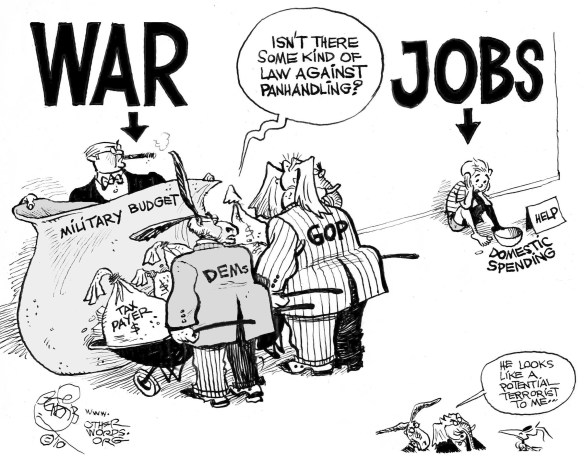
Many people have read some of my articles know that I detest the fact that 55% of our national budget is comprised of our so-called “defense budget”. Many Americans have written and talked about the fact that this nation is involved “in endless war”. What most people don’t realize is how much of our national treasure is devoted to our military.

Let me start by telling how much this nation spends on our so-called “defense budget”. This money that we spend isn’t to defend people of the United States, these funds go to enrich the defense contractors and the people who fund our politicians in Congress.

This is the part where I throw the amounts that fund our so-called “defense budget”:

$2,988,083.00 is the total amount for the US budget. Out of this almost $3 trillion, $582 billion dollars go to the Department of Defense. This doesn’t include all the money that goes to the defense investigative agency the DIA, or to the CIA, or to the NSA, or to the FBI or any other intelligence agencies.

The number of people in the United States in 2017 is 326,474,083. If Congress cut the defense budget for 25% by closing overseas bases and cutting the number military that serve in our endless war machine, we would save $145 billion dollars. If you divide that number by the number of people living in the United States, every man woman and child, it would come out to almost $485,260,952. If Congress only returned 5% of that money “as a dividend” to the American people that would mean a windfall of almost $25,000. A family of four would receive hundred thousand dollars.

I’m not supposing that the government would do anything of the sort, I’m just throwing some numbers around to make people think. We always hear the United States is the richest nation on earth, and this just illustrates where all our wealth is going. Many people explain that the defense industry and shore up our economy and we stop producing arms and having a large military it would hurt the United States economically. What I’m saying is that if we cut the military spending by 25% we would not only give a windfall to the American people, but we could also rebuild our infrastructure and pay down our national debt.

If people honestly looked at those numbers, it should make them angry. How many aircraft carriers do we need to defend the people of the United States? How many cruise missiles do we need to protect the people of the United States? How many spy agencies do we need to protect us from our so-called enemies? We have an ocean on each side of the United States. We have enemies across the world that we ourselves have created. One only must look at the demonization of Russia to understand how United States makes an enemy. The United States needs an enemy to justify the amount of money spent on the military. We are all being sold a giant bill of goods that is unjustifiable and really is criminal when you look at how much money we spend.

I am not isolationist nor my pacifist, I’m just someone who holds citizenship in a country that has lost its perspective.

I would also like to point out that the recent fires in California should be looked at by every citizen in the United States. There are anomalies about these fires vaporizing brick, melting glass and vaporizing steel. There also anomalies where houses were demolished by this fire, yet trees next to these houses were not touched by fire. There also videos on YouTube that showed a tree burning from the inside out. What disturbs me is that many of the videos I looked at looked much like the anomalies that happened at the World Trade Center. I’m not explaining the fires, but I would like people to look at these videos and judge for yourself. I wasn’t going to write about this, but I felt an obligation to at least mention it.

Instead of just accepting the way America puts its money into our war Department, we should demand accountability and justification for all that they do. As a retired servicemember with over 20 years in the United States Army I feel that the military is out of control. Never in my lifetime have I seen military spending on the scale with no discernible enemy creeping up on our shores. As citizens I believe that every American should hold count Congress accountable for this wasteful military spending that should really go to rebuilding United States infrastructure and creating an economy that consumes things instead of just treading water to stay alive. “As the richest nation on earth” we should be helping our citizens instead of interfering in the affairs of other nations. As an American citizen I am angry as hell and I believe that every citizen should feel the same anger that I feel.


Tim Gatto is Ret. US Army and has been writing against the Duopoly for the last decade. He has two books on Amazon, “Kimchee Days, or Stoned-Cold Warriors” and “Complicity to Contempt”.

Media’s Grim Addiction to Perseverance Porn

By Adam Johnson

Source: FAIR

You’ve seen or heard or read the personal interest story a thousand times: An enterprising seven-year-old collects cans to save for college (ABC72/8/17), a man with unmatched moxie walks 15 miles to his job (Today2/20/17), a low-wage worker buys shoes for a kid whose mother can’t afford them (Fox512/14/16), an “inspiring teen” goes right back to work after being injured in a car accident (CBS News12/16/16). All heartwarming tales of perseverance in the face of impossible odds—and all ideological agitprop meant to obscure and decontextualize the harsh reality of dog-eat-dog capitalism.

Man walks eight miles in the snow to get to work every day (ABC 273/14/17). Or was it a teen walking 10 miles in freezing weather to a job interview (New York Daily News2/26/13)? Or was it 10 miles to work every day (Times Herald Record3/17/17)? Or was it 12 (ABC News2/22/17) or 15 (Today2/20/17) or 18 (Evening Standard, 2/9/09) or 21 (Detroit Free Press1/20/15)? Who cares—their humanity is irrelevant. They’re clickbait, stand-in bootstrap archetypes meant to validate the bourgeois morality of click-happy media consumers.

These stories are typically shared for the purposes of poor-shaming, typically under the guise of inspirational life advice. “This man is proof we all just need to keep walking, no matter what life throws at us,” insisted Denver ABC7 anchor Anne Trujillo, after sharing one of those stories of a poor person forced to walk thousands of miles a year to survive.

A healthy press would take these anecdotes of “can do” spirit and ask bigger questions, like why are these people forced into such absurd hardship? Who benefits from skyrocketing college costs? Why does the public transit in this person’s city not have subsidies for the poor? Why aren’t employers forced to offer time off for catastrophic accidents? But time and again, the media mindlessly tells the bootstrap human interest story, never questioning the underlying system at work.

One particularly vulgar example was CBS News(12/16/16) referring to an “inspiring” African-American kid who had to work at his fast food job with an arm sling and a neck brace after a car accident. To compound the perseverance porn, he was, at least in part, doing so to help donate to a local homeless charity. Here we have a story highlighting how society has colossally failed its most vulnerable populations—the poor, ethnic minorities, children and the homeless—and the take-home point is, “Ah gee, look at that scrappy kid.”

Journalism is as much—if not more—about what isn’t reported as what is. Here a local reporter is faced with a cruel example of people falling through the cracks of the richest country on Earth, and their only contribution is to cherry-pick one guy who managed—just barely—to cling on to the edge.

Perseverance porn goes hand in hand with the rise of a GoFundMe economy that relies on personal narrative over collective policy, emotional appeals over baseline human rights. $930 million out of the $2 billion raised on GoFundMe since its inception in 2010 was for healthcare expenses, while an estimated 45,000 people a year die a year due to a lack of medical treatment. Meanwhile, anchors across cable news insist that single-payer healthcare is “unaffordable,” browbeating guests who support it, while populating their broadcasts with these one-off tales of people heroically scraping by.

It’s part of a broader media culture of anecdotes in lieu of the macro, moralizing “success” rather than questioning systemic problems. Perseverance porn may seem harmless, but in highlighting handpicked cases of people overcoming hardship without showing the thousands that didn’t—much less asking broader questions as to what created these conditions—the media traffics in decidedly right-wing tropes. After all, if they can do it, so can you—right?

The Unifying Force of War Abolition

By David Swanson

Source: Let’s Try Democracy

Remarks at United National Antiwar Coalition in Richmond, Virginia, on June 18, 2017.

It’s not unusual for an activist, focused on one of the millions of worthy causes out there, to try to recruit other activists to that particular cause. That’s not exactly what I want to do. For one thing, if we are going to succeed we are going to have to recruit millions of new people into activism who are not now active at all.

Of course I do favor types of activism that eliminate the need for more activism, such as campaigns to make voter registration automatic or to index the minimum wage to the cost of living. But for the most part I want everyone to keep doing what inspires them. Only, I think I know a way to shift our emphases and unite out movements, a way that doesn’t usually occur to us.

It’s not unusual for an activist to think that their particular field is the unifying top priority.

For example:

If we don’t get the money out of politics how can we enact or enforce any laws not favored by money? We’ve legalized bribery for godsake! What else matters until we fix that?

Or:

If we don’t create credible democratic independent media, we can’t communicate. Door knocking can’t defeat television. We only know that Cindy Sheehan went to Crawford or Occupyers went to Wall Street because corporate television chose to tell us. Why have elections if we can’t tell the truth about the candidates?

Or:

Excuse me, the earth is cooking. Our species and many others are losing their habitats. If it’s not already too late, now is the time to decide whether we will have great grandchildren at all. If we don’t have any, what will it matter what kind of elections or television networks they have?

One can go on and on in this vein, as well as in claiming that one societal evil precedes and causes another. Racism or militarism or extreme materialism is the disease and the others are the symptoms.

All of this is also not exactly what I want to do. I want us to work on everything and use every means of unifying. I want us to recognize how each problem contributes to others and vice versa. Hungry scared people can’t end climate change. A culture that puts a trillion dollars a year into mass-killing of distant dark-skinned people can’t build schools or end racism. Unless we redistribute wealth, we cannot redistribute power. We can’t create media unless we have something important to say. We can’t protect the earth’s climate while steadfastly ignoring the top consumer of petroleum on earth because criticizing the military would be inappropriate. But we will go on ignoring it if we don’t create good media. We have to do it all, and there are various ways in which we can become more united, more strategic, and potentially more effective.

The way that I think we don’t pay enough attention to lies in developing a focus on complete and total war abolition, elimination of all weapons and militaries, all bases, all aircraft carriers, missiles, armed drones, generals, colonels, and if necessary all senators from Arizona.

Why war abolition? I’ll give you 10 reasons.

  1. It actually makes sense. The reasonable position of opposing some wars and cheering for others, but cheering for the troops even in the bad wars doesn’t attract a lot of energy because it doesn’t make any sense. Jeremy Corbyn just won votes by pointing out that wars generate terrorism, they are counter-productive on their own terms, endangering us rather than protecting us. They need to be replaced with diplomacy, aid, cooperation, the rule of law, the tools of nonviolence, the skills of de-escalation of conflict. Claiming that wars are sort of good but shouldn’t be overdone makes no sense at all — what is the point of them if not to win them? And if wars make murder OK, why is torture so unacceptable? And if bombs dropped by piloted planes are OK, what’s wrong with drones? And if Anthrax is barbaric, why are White Phosphrous and Napalm civilized? None of it makes any sense, which is one reason the top killer of U.S. troops is suicide. You know how to properly love the troops, end all war and give them life options that don’t make them want to kill themselves.
  2. Nuclear apocalypse is a growing danger on a par with climate chaos and will continue to grow unless war abolition succeeds.
  3. The biggest destroyer of water, air, land, and atmosphere that we have is militarism. It’s war or planet. Time to choose.
  4. War kills first and foremost by removing resources from where they are needed, including from famines and disease epidemics created by war. Any activism that seeks funding for any human or environmental needs has to look to ending war. It is where all the money is, more money every single year than could be taken once and only once from the billionaires.
  5. War creates secrecy, surveillance, classification of public business, warrantless spying on activists, patriotic lying, and illegal actions by secret agencies.
  6. War militarizes local police, making the public into an enemy.
  7. War fuels, just as it is fueled by, racism, sexism, bigotry, hatred, and domestic violence. It teaches people to solve problems by shooting guns.
  8. War divides humanity at a time when we must unite on major projects if we are to survive or prosper.
  9. A movement to abolish all war, all weapons, and all atrocities that flow out of war can unite opponents of the crimes of one government or group with the opponents of the crimes of another. Without equating all crimes with each other, we can unite as opponents of war rather than of each other.
  10. War is the primary thing our society does, it sucks down the majority of federal discretionary spending, its promotion permeates our culture. It is the very foundation of the belief that ends can justify evil means. Taking on the myths that sell us war as necessary or inevitable or glorious is an ideal way of opening our minds to rethinking what we’re doing on this little planet.

So let’s not work for an environmentally sensitive military into which women have the equal right to be drafted against their will. Let’s not oppose the weapons that are wasteful or don’t kill well enough. Let’s build a broad multi-issue movement in which one of the unifying factors is the cause of eliminating in its entirety the institution of organized mass murder.

The United States of Work

Employers exercise vast control over our lives, even when we’re not on the job. How did our bosses gain power that the government itself doesn’t hold?

By Miya Tokumitsu

Source: New Republic

Work no longer works. “You need to acquire more skills,” we tell young job seekers whose résumés at 22 are already longer than their parents’ were at 32. “Work will give you meaning,” we encourage people to tell themselves, so that they put in 60 hours or more per week on the job, removing them from other sources of meaning, such as daydreaming or social life. “Work will give you satisfaction,” we insist, even though it requires abiding by employers’ rules, and the unwritten rules of the market, for most of our waking hours. At the very least, work is supposed to be a means to earning an income. But if it’s possible to work full time and still live in poverty, what’s the point?

Even before the global financial crisis of 2008, it had become clear that if waged work is supposed to provide a measure of well-being and social structure, it has failed on its own terms. Real household wages in the United States have remained stagnant since the 1970s, even as the costs of university degrees and other credentials rise. Young people find an employment landscape defined by unpaid internships, temporary work, and low pay. The glut of degree-holding young workers has pushed many of them into the semi- or unskilled labor force, making prospects even narrower for non–degree holders. Entry-level wages for high school graduates have in fact fallen. According to a study by the Federal Reserve Bank of New York, these lost earnings will depress this generation’s wages for their entire working lives. Meanwhile, those at the very top—many of whom derive their wealth not from work, but from returns on capital—vacuum up an ever-greater share of prosperity.

Against this bleak landscape, a growing body of scholarship aims to overturn our culture’s deepest assumptions about how work confers wealth, meaning, and care throughout society. In Private Government: How Employers Rule Our Lives (and Why We Don’t Talk About It), Elizabeth Anderson, a professor of philosophy at the University of Michigan, explores how the discipline of work has itself become a form of tyranny, documenting the expansive power that firms now wield over their employees in everything from how they dress to what they tweet. James Livingston, a historian at Rutgers, goes one step further in No More Work: Why Full Employment Is a Bad Idea. Instead of insisting on jobs for all or proposing that we hold employers to higher standards, Livingston argues, we should just scrap work altogether.

Livingston’s vision is the more radical of the two; his book is a wide-ranging polemic that frequently delivers the refrain “Fuck work.” But in original ways, both books make a powerful claim: that our lives today are ruled, above all, by work. We can try to convince ourselves that we are free, but as long as we must submit to the increasing authority of our employers and the labor market, we are not. We therefore fancy that we want to work, that work grounds our character, that markets encompass the possible. We are unable to imagine what a full life could be, much less to live one. Even more radically, both books highlight the dramatic and alarming changes that work has undergone over the past century—insisting that, in often unseen ways, the changing nature of work threatens the fundamental ideals of democracy: equality and freedom.

Anderson’s most provocative argument is that large companies, the institutions that employ most workers, amount to a de facto form of government, exerting massive and intrusive power in our daily lives. Unlike the state, these private governments are able to wield power with little oversight, because the executives and boards of directors that rule them are accountable to no one but themselves. Although they exercise their power to varying degrees and through both direct and “soft” means, employers can dictate how we dress and style our hair, when we eat, when (and if) we may use the toilet, with whom we may partner and under what arrangements. Employers may subject our bodies to drug tests; monitor our speech both on and off the job; require us to answer questionnaires about our exercise habits, off-hours alcohol consumption, and childbearing intentions; and rifle through our belongings. If the state held such sweeping powers, Anderson argues, we would probably not consider ourselves free men and women.

Employees, meanwhile, have few ways to fight back. Yes, they may leave the company, but doing so usually necessitates being unemployed or migrating to another company and working under similar rules. Workers may organize, but unions have been so decimated in recent years that their clout is greatly diminished. What’s more, employers are swift to fire anyone they suspect of speaking to their colleagues about organizing, and most workers lack the time and resources to mount a legal challenge to wrongful termination.

It wasn’t supposed to be this way. As corporations have worked methodically to amass sweeping powers over their employees, they have held aloft the beguiling principle of individual freedom, claiming that only unregulated markets can guarantee personal liberty. Instead, operating under relatively few regulations themselves, these companies have succeeded at imposing all manner of regulation on their employees. That is to say, they use the language of individual liberty to claim that corporations require freedom to treat workers as they like.

Anderson sets out to discredit such arguments by tracing them back to their historical origins. The notion that personal freedom is rooted in free markets, for instance, originated with the Levellers in seventeenth-century England, when working conditions differed substantially from today’s. The Levellers believed that a market society was essential to liberate individuals from the remnants of feudal hierarchies; their vision of utopia was a world in which men could meet and interact on terms of equality and dignity. Their ideas echoed through the writing and politics of later figures like John Locke, Adam Smith, Thomas Paine, and Abraham Lincoln, all of whom believed that open markets could provide the essential infrastructure for individuals to shape their own destiny.

An anti-statist streak runs through several of these thinkers, particularly the Levellers and Paine, who viewed markets as the bulwark against state oppression. Paine and Smith, however, would hardly qualify as hard-line contemporary libertarians. Smith believed that public education was essential to a fair market society, and Paine proposed a system of social insurance that included old-age pensions as well as survivor and disability benefits. Their hope was not for a world of win-or-die competition, but one in which open markets would allow individuals to make the fullest use of their talents, free from state monopolies and meddlesome bosses.

For Anderson, the latter point is essential; the notion of lifelong employment under a boss was anathema to these earlier visions of personal freedom. Writing in the 1770s, Smith assumes that independent actors in his market society will be self-employed, and uses butchers and bakers as his exemplars; his “pin factory,” meant to illustrate division of labor, employs only ten people. These thinkers could not envision a world in which most workers spend most of their lives performing wage labor under a single employer. In an address before the Wisconsin State Agricultural Society in 1859, Lincoln stated, “The prudent, penniless beginner in the world labors for wages awhile, saves a surplus with which to buy tools or land for himself, then labors on his own account another while, and at length hires another new beginner to help him.” In other words, even well into the nineteenth century, defenders of an unregulated market society viewed wage labor as a temporary stage on the way to becoming a proprietor.

Lincoln’s scenario does not reflect the way most people work today. Yet the “small business owner” endures as an American stock character, conjured by politicians to push through deregulatory measures that benefit large corporations. In reality, thanks to a lack of guaranteed, nationalized health care and threadbare welfare benefits, setting up a small business is simply too risky a venture for many Americans, who must rely on their employers for health insurance and income. These conditions render long-term employment more palatable than a precarious existence of freelance gigs, which further gives companies license to oppress their employees.

The modern relationship between employer and employee began with the rise of large-scale companies in the nineteenth century. Although employment contracts date back to the Middle Ages, preindustrial arrangements bore little resemblance to the documents we know today. Like modern employees, journeymen and apprentices often served their employers for years, but masters performed the same or similar work in proximity to their subordinates. As a result, Anderson points out, working conditions—the speed required of workers and the hazards to which they might be exposed—were kept in check by what the masters were willing to tolerate for themselves.

The Industrial Revolution brought radical changes, as companies grew ever larger and management structures more complex. “Employers no longer did the same kind of work as employees, if they worked at all,” Anderson observes. “Mental labor was separated from manual labor, which was radically deskilled.” Companies multiplied rapidly in size. Labor contracts now bonded workers to massive organizations in which discipline, briefs, and decrees flowed downward, but whose leaders were unreachable by ordinary workers. Today, fast food workers or bank tellers would be hard-pressed to petition their CEOs at McDonald’s or Wells Fargo in person.

Despite this, we often speak of employment contracts as agreements between equals, as if we are living in Adam Smith’s eighteenth-century dream world. In a still-influential paper from 1937 titled “The Nature of the Firm,” the economist and Nobel laureate Ronald Coase established himself as an early observer and theorist of corporate concerns. He described the employment contract not as a document that handed the employer unaccountable powers, but as one that circumscribed those powers. In signing a contract, the employee “agrees to obey the directions of an entrepreneur within certain limits,” he emphasized. But such characterizations, as Anderson notes, do not reflect reality; most workers agree to employment without any negotiation or even communication about their employer’s power or its limits. The exceptions to this rule are few and notable: top professional athletes, celebrity entertainers, superstar academics, and the (increasingly small) groups of workers who are able to bargain collectively.

Yet because employment contracts create the illusion that workers and companies have arrived at a mutually satisfying agreement, the increasingly onerous restrictions placed on modern employees are often presented as “best practices” and “industry standards,” framing all sorts of behaviors and outcomes as things that ought to be intrinsically desired by workers themselves. Who, after all, would not want to work on something in the “best” way? Beyond employment contracts, companies also rely on social pressure to foster obedience: If everyone in the office regularly stays until seven o’clock every night, who would risk departing at five, even if it’s technically allowed? Such social prods exist alongside more rigid behavioral codes that dictate everything from how visible an employee’s tattoo can be to when and how long workers can break for lunch.

Many workers, in fact, have little sense of the legal scope of their employer’s power. Most would be shocked to discover that they could be fired for being too attractive, declining to attend a political rally favored by their employer, or finding out that their daughter was raped by a friend of the boss—all real-life examples cited by Anderson. Indeed, it is only after dismissal for such reasons that many workers learn of the sweeping breadth of at-will employment, the contractual norm that allows American employers to fire workers without warning and without cause, except for reasons explicitly deemed illegal.

In reality, the employment landscape is even more dire than Anderson outlines. The rise of staffing or “temp” agencies, for example, undercuts the very idea of a direct relationship between worker and employer. In The Temp Economy: From Kelly Girls to Permatemps in Postwar America, sociologist Erin Hatton notes that millions of workers now labor under subcontracting arrangements, which give employers even greater latitude to abuse employees. For years, Walmart—America’s largest retailer—used a subcontracting firm to hire hundreds of cleaners, many from Eastern Europe, who worked for months on end without overtime pay or a single day off. After federal agents raided dozens of Walmarts and arrested the cleaners as illegal immigrants, company executives used the subcontracting agreement to shirk responsibility for their exploitation of the cleaners, claiming they had no knowledge of their immigration status or conditions.

By any reasonable standard, much “temp” work is not even temporary. Employees sometimes work for years in a single workplace, even through promotions, without ever being granted official status as an employee. Similarly, “gig economy” platforms like Uber designate their workers as contractors rather than employees, a distinction that exempts the company from paying them minimum wage and overtime. Many “permatemps” and contractors perform the same work as employees, yet lack even the paltry protections and benefits awarded to full-time workers.

A weak job market, paired with the increasing precarity of work, means that more and more workers are forced to make their living by stringing together freelance assignments or winning fixed-term contracts, subjecting those workers to even more rules and restrictions. On top of their actual jobs, contractors and temp workers must do the additional work of appearing affable and employable not just on the job, but during their ongoing efforts to secure their next gig. Constantly pitching, writing up applications, and personal branding on social media requires a level of self-censorship, lest a controversial tweet or compromising Facebook photo sink their job prospects. Forced to anticipate the wishes not of a specific employer, but of all potential future employers, many opt out of participating in social media or practicing politics in any visible capacity. Their public personas are shaped not by their own beliefs and desires, but by the demands of the labor market.


For Livingston, it’s not just employers but work itself that is the problem. We toil because we must, but also because our culture has trained us to see work as the greatest enactment of our dignity and personal character. Livingston challenges us to turn away from such outmoded ideas, rooted in Protestant ideals. Like Anderson, he sweeps through centuries of labor theory with impressive efficiency, from Marx and Hegel to Freud and Lincoln, whose 1859 speech he also quotes. Livingston centers on these thinkers because they all found the connection between work and virtue troubling. Hegel believed that work causes individuals to defer their desires, nurturing a “slave morality.” Marx proposed that “real freedom came after work.” And Freud understood the Protestant work ethic as “the symptom of repression, perhaps even regression.”

Nor is it practical, Livingston argues, to exalt work: There are simply not enough jobs to keep most adults employed at a living wage, given the rise of automation and increases in productivity. Besides, the relation between income and work is arbitrary. Cooking dinner for your family is unpaid work, while cooking dinner for strangers usually comes with a paycheck. There’s nothing inherently different in the labor involved—only in the compensation. Anderson argues that work impedes individual freedom; Livingston points out that it rarely pays enough. As technological advances continue to weaken the demand for human labor, wages will inevitably be driven down even further. Instead of idealizing work and making it the linchpin of social organization, Livingston suggests, why not just get rid of it?

Livingston belongs to a cadre of thinkers, including Kathi Weeks, Nick Srnicek, and Alex Williams, who believe that we should strive for a “postwork” society in one form or another. Strands of this idea go back at least as far as Keynes’s 1930 essay on “Economic Possibilities for our Grandchildren.” Not only would work be eliminated or vastly reduced by technology, Keynes predicted, but we would also be unburdened spiritually. Devotion to work was, he deemed, one of many “pseudo-moral principles” that “exalted some of the most distasteful of human qualities into the position of the highest virtues.”

Since people in this new world would no longer have to earn a salary, they would, Livingston envisions, receive some kind of universal basic income. UBI is a slippery concept, adaptable to both the socialist left and libertarian right, but it essentially entails distributing a living wage to every member of society. In most conceptualizations, the income is indeed basic—no cases of Dom Pérignon—and would cover the essentials like rent and groceries. Individuals would then be free to choose whether and how much they want to work to supplement the UBI. Leftist proponents tend to advocate pairing UBI with a strong welfare state to provide nationalized health care, tuition-free education, and other services. Some libertarians view UBI as a way to pare down the welfare state, arguing that it’s better simply to give people money to buy food and health care directly, rather than forcing them to engage with food stamp and Medicaid bureaucracies.

According to Livingston, we are finally on the verge of this postwork society because of automation. Robots are now advanced enough to take over complex jobs in areas like agriculture and mining, eliminating the need for humans to perform dangerous or tedious tasks. In practice, however, automation is a double-edged sword, with the capacity to oppress as well as unburden. Machines often accelerate the rate at which humans can work, taxing rather than liberating them. Conveyor belts eliminated the need for workers to pass unfinished products along to their colleagues—but as Charlie Chaplin and Lucille Ball so hilariously demonstrated, the belts also increased the pace at which those same workers needed to turn wrenches and wrap chocolates. In retail and customer service, a main function of automation has been not to eliminate work, but to eliminate waged work, transferring much of the labor onto consumers, who must now weigh and code their own vegetables at the supermarket, check out their own library books, and tag their own luggage at the airport.

At the same time, it may be harder to automate some jobs that require a human touch, such as floristry or hairstyling. The same goes for the delicate work of caring for the young, sick, elderly, or otherwise vulnerable. In today’s economy, the demand for such labor is rising rapidly: “Nine of the twelve fastest-growing fields,” The New York Times reported earlier this year, “are different ways of saying ‘nurse.’” These jobs also happen to be low-paying, emotionally and physically grueling, dirty, hazardous, and shouldered largely by women and immigrants. Regardless of whether employment is virtuous or not, our immediate goal should perhaps be to distribute the burdens of caregiving, since such work is essential to the functioning of society and benefits us all.


A truly work-free world is one that would entail a revolution from our present social organizations. We could no longer conceive of welfare as a last resort—as the “safety net” metaphor implies—but would be forced to treat it as an unremarkable and universal fact of life. This alone would require us to support a massive redistribution of wealth, and to reclaim our political institutions from the big-money interests that are allergic to such changes. Tall orders indeed—but as Srnicek and Williams remind us in their book, Inventing the Future: Postcapitalism and a World Without Work, neoliberals pulled off just such a revolution in the postwar years. Thanks to their efforts, free-market liberalism replaced Keynesianism as the political and economic common sense all around the world.

Another possible solution to the current miseries of unemployment and worker exploitation is the one Livingston rejects in his title: full employment. For anti-work partisans, full employment takes us in the wrong direction, and UBI corrects the course. But the two are not mutually exclusive. In fact, rather than creating new jobs, full employment could require us to reduce our work hours drastically and spread them throughout the workforce—a scheme that could radically de-center waged work in our lives. A dual strategy of pursuing full employment while also demanding universal benefits—including health care, childcare, and affordable housing—would maximize workers’ bargaining power to ensure that they, and not just owners of capital, actually get to enjoy the bounty of labor-saving technology.

Nevertheless, Livingston’s critiques of full employment are worth heeding. As with automation, it can all go wrong if we use the banner of full employment to create pointless roles—what David Graeber has termed “bullshit jobs,” in which workers sit in some soul-sucking basement office for eight hours a day—or harmful jobs, like building nuclear weapons. If we do not have a deliberate politics rooted in universal social justice, then full employment, a basic income, and automation will not liberate us from the degradations of work.

Both Livingston and Anderson reveal how much of our own power we’ve already ceded in making waged work the conduit for our ideals of liberty and morality. The scale and coordination of the institutions we’re up against in the fight for our emancipation is, as Anderson demonstrates, staggering. Employers hold the means to our well-being, and they have the law on their side. Individual efforts to achieve a better “work-life balance” for ourselves and our families miss the wider issue we face as waged employees. Livingston demonstrates the scale at which we should be thinking: Our demands should be revolutionary, our imaginations wide. Standing amid the wreckage of last year’s presidential election, what other choice do we have?


Miya Tokumitsu is a lecturer of art history at the University of Melbourne and a contributing editor at Jacobin. She is the author of Do What You Love.  And Other Lies about Success and Happiness.

Why Are We Still Working?

intcap2

By Mike Dowson

Source: NewMatilda.com

This may be an opportune moment to consider the question. Especially if you’re not actually working.

You may have retired. Perhaps you’ve just left university, considering your options. Perhaps you’re taking a welcome break.

Maybe you have no choice but to take a break. Did you retire early because your job was axed? Has the casual work you depend on dried up? Have you been unable to find a job, despite your qualifications?

Perhaps, as you read this, you’re at work, filling in time, forgoing a holiday. Or at the beach, while the kids play in the surf, watching for emails on your phone.

Of course, it’s obvious why we work. Money. You don’t get something for nothing. And everything is so expensive these days.

If anything, most of us need to work more. Both spouses, extra hours, second jobs. Would anyone, except an idiot, seriously suggest we should all be working less?

Well, actually, yes.

As long ago as 1930, the economist John Maynard Keynes predicted that, by now, people in technologically advanced societies wouldn’t need to work much at all. When Keynes said this, advances in technology were yielding extraordinary increases in productivity. The implications seemed obvious. If it took less time to produce what we needed, surely we’d work less.

It turns out that for much of the 20th Century average working hours in developed countries steadily fell. Then, around the 1970s, the trend plateaued. In some countries, it reversed and working hours began to climb again. This occurred at the same time women were entering the workforce in great numbers so total workforce participation also increased.

In Australia, by the new millennium, many full time employees were working more than their grandparents had.

What happened? Did technology fail to deliver the gains Keynes expected?

On the contrary. Technological advancement outstripped even the giddy imaginations of futurists from a century ago. We can grow food, dig up minerals, make fridges and bridges, move things and ourselves around the planet and share knowledge and information much faster with a fraction of the workforce it once took.

But if staggering productivity gains haven’t manifested as lower working hours, where did they go?

Some prominent economists, including some Nobel laureates, have grappled with this question.

Gary Becker observed that our appetite for material goods has expanded along with our ability to produce them. Instead of working less hours, we opted for bigger houses with more gadgets, which we replace more often.

This process has been fuelled by a deluge of marketing, which persuades us to consume things we previously didn’t recognise a need for.

Does that explain it? Anthropologist David Graeber doesn’t think so. If it continually takes fewer human hours to produce these things, shouldn’t we be able to afford them without working more? What are all these working hours producing?

Graeber argues that, although productive jobs have, in fact, been steadily automated away just as predicted, we have also seen a vast proliferation of new jobs that only seem to exist to keep people working.

Consider this. Productivity growth has stalled in Australia. How can this be? Technology hasn’t stopped advancing. The time we should be winning back through productivity gains must be getting reabsorbed.

Productivity returns are highest in capital-intensive industries like mining and manufacturing. As those jobs disappear, either replaced by technology, or lost altogether, the workforce moves into labour-intensive industries like hospitality and professional services. This dilutes the gains in the other industries.

At the same time, unemployment has been trending up since 2008. Young people especially, are out of work. The number of underemployed people, who would work more if they could, is also high. More jobs are casual.

There’s a downward trend in job prospects for new graduates. Some of them settle for part-time work or a free internship. Many find work which is unrelated to primary qualification. That’s now more likely to be in a job without benefits, or multiple such jobs.

There’s another factor. Our lives are now longer relative to our working lives. We tend to start full-time work later, after years of study, and more of life is spent in retirement. Many jobless older people are struggling with the cost of living. Many would work more if they could.

Instead of everyone working less, what seems to be happening is that experienced workers, in professions which are still in demand, are working more, while the young, the old, and those with skills which no longer attract investment have difficulty finding work.

MIT academics Andrew McAfee and Erik Brynjolfsson refer to this as the great decoupling. For many years, real GDP per capita and median income rose in tandem. Since the 1970s, wages as a percentage of GDP have fallen dramatically, while corporate profits as a percentage of GDP are now at their highest level, despite recurring economic shocks.

To put it simply, labour isn’t as important to growth as it used to be.

There is nothing in the economic outlook or current government policy settings which suggests this trend is going to change.

Automation, artificial intelligence and robotics are encroaching on more human occupations. The Committee for Economic Development of Australia (CEDA) has estimated that as many as 40 per cent of the jobs that are left are vulnerable to replacement by technology over the next decade.

No matter how many politicians chant the jobs mantra for the media, more productive jobs are going to disappear.

The terrible irony in this situation is that there is so much that needs to be done.

Among the underemployed graduates I personally know of, there is a psychologist, a soil chemist and a biodiversity specialist. Have we run out of things to do in the areas of mental health, agriculture and the environment?

Mental illness is widespread. Our food bowl is under threat from climate change. We have a mass extinction on our hands.

What we don’t have, apparently, is sufficient money to invest in making full use of the talent that is available to face these challenges.

Why? What failure of collective enterprise could result in this absurd incongruity?

Capital, like technology, is largely blind to human need. Capital goes where the profit is. If there was profit in healing minds and saving species, some of it would go there. While there is more profit in alcohol, gambling and deforestation, more of it will go there.

People don’t register their desire for a healthy society by shopping for it. Capital doesn’t get that signal through the market. The argument that consumers somehow direct the course of civilisation by choosing dolphin-friendly tuna and “eco” cleaning products is stupid and facile. The factors that most affect our destiny are not options in the supermarket.

If a healthy society is something we want, we have to act collectively. Since few people are active major shareholders, for the time being that task tends to fall to governments.

Whether enacted via direct spending, or by creating incentives for private investment, government initiatives are funded from collective surplus – in other words, tax revenue or borrowing against future earnings increases. Despite political spin to the contrary, our tax is low compared to the OECD as a proportion of GDP.

The great decoupling has coincided with rising inequality. Those with money to invest get rich. Those with only labour to sell miss out. Capital doesn’t like to pay for labour, and it doesn’t like to pay tax either.

But why, if our labour isn’t needed for profit, are we still working?

Faced with a looming crisis in social services, but committed ideologically to low taxation, successive Australian governments used tax concessions to turn superannuation and real estate – where most Australians keep their wealth – into a mini-capitalist alternative to social security.

Of course, this only works while people have jobs that provide super and sufficient income to buy housing. And it doesn’t help the real economy, the place where we apply technological innovation to produce things of real value, especially things we can export.

Nevertheless, one group of people enriched themselves through property investment, pushing up the value of real estate around the country in the process. Another group of people became affluent with nothing more than a job that paid super and a home in a good location.

With commodity revenue pouring in from overseas, it was easy to believe we had discovered some kind of magic prosperity formula. But the surplus generated from commodities mostly wasn’t invested back into productive activity. Instead it was turned into tax cuts and other benefits. These had broad electoral appeal but favoured the wealthy, and encouraged further speculation.

The real estate boom didn’t make the country richer. Nor did it make housing more accessible. It simply transferred wealth from one group of people to another. In the process, it put a basic need out of reach of many, including young people, and diverted investment from the productive economy. It also lured a huge number of Australians into precarious debt.

Contrary to popular opinion, encouraged by unscrupulous politics, we have relatively low government debt, but we now have the largest per capita private debt in the world.

So why are we still working? Because we’re in debt.

Middle-aged people are the ones working long hours. They’re also the ones buying houses. And they’re the ones with the most credit card debt as well.

The generation before them had affordable housing, job security and a real social safety net. They’re not so fortunate, but for the ones after them, a steady job with enough for a deposit has become a kind of Holy Grail, and social security is survival at best.

The current trend points to a time when a young graduate might start adult life with a HECS debt, go into credit card debt on a part-time job and a free internship, and eventually get into massive debt to own a flat her grandparents could have bought with ease.

She might even find a job in financial services, if they haven’t all been automated. It’s the sector that helps wealthy people turn their money into more money. It’s also where ordinary people go to borrow money for a house.

Debt is profitable. Even during the great decoupling, as productive jobs disappear, and real wages fall, it’s proven possible to harness the aspirations of ordinary people for profit, without any of the effort or intelligence required for developing new productive capacity, by simply enticing a greater proportion of personal income into servicing debt.

The mining boom is over. Not that it was ever as important as the miners like to claim. Manufacturing continues its long decline. The banks have been warned they are overexposed.

Whatever combination of policy levers is applied, we need to create the conditions that direct investment into producing things that we and the world need, while caring for our environment and our population. We don’t need to direct it in into unearned private wealth at the expense of our neighbours, our country and future generations.

Our current class of politicians has so far failed to even acknowledge our present circumstances, let alone articulate a credible vision for change. Many of them became rich from property investment. Our Prime Minister is a former banker.

Naturally, the people who’ve done well for themselves are reluctant to sacrifice their advantage. Nevertheless, we have to change the narrative around “wealth creation” from one which is essentially about personal enrichment from gaming the system, to one which is about mutual benefit through innovation and productivity.

Change has come, whether we like it or not. If we respond intelligently, taking advantage of the potential we have developed through our education system, we may very well end up working less, but not in a divided society, with many of us struggling to survive.

Forget Techno-Optimism: We Can’t Innovate Our Way Out of Inequality

thediplomat_2015-07-10_09-53-42-386x255

By Chris Lehmann

Source: In These Times

Toward the end of his 250-page hymn to digital-age innovation, The Industries of the Future, Alec Ross pauses to offer a rare cautionary note. Silicon Valley may have incubated all the wonders and conveniences one can imagine—and oh, so many more! But for the international business elites looking to remake their emerging market economies in the Valley’s gleaming, khaki-clad image, there’s some bad news: It can no longer be done. A “decades-long head start” has granted too great a competitive advantage to the charmed peninsula along the Northern California coast.

Not to worry, though! On-the-make tech globalists can still make a go of it, provided they’re prepared to embrace “specific cultural and labor market characteristics that can contradict both a society’s norms and the more controlling impulses of government leaders.”

Stripped of the vague and glowing techno-babble, this is a prescription for good old-fashioned neoliberal market discipline. Everywhere Ross looks across the radically transformed world of digital commerce, the benign logic of market triumphalism wins the day. When Terry Gou—the Taiwanese CEO of Foxconn, the vast Chinese electronics sweatshop that doubles as an incubator for worker suicides—plans to eliminate the headache of supervising an unstable human workforce by replacing it with “the first fully automated plant” in manufacturing history, why, he’s simply “responding to pure market forces”: i.e., an increase in Chinese wages that cuts into Foxconn’s ridiculously broad profit margins. And you and I might see the so-called sharing economy as a means to casualize service workers into nonunion, benefit-free gigs that transfer economic value on a massive scale to a rentier class of Silicon Valley app marketers. But bouncy New Economy cheerleaders like Ross see “a way of making a market out of anything, and a microentrepreneur out of anyone.”

When confronted with the spiraling of income inequality in the digital age, Ross, like countless other prophets of better living through software, sagely counsels that “rapid progress often comes with greater instability.” Sure, the “wealthy generally benefit over the short term,” but remember, kids: “Innovations have the potential to become cheaper over time and spread throughout the greater population.”

Ross first stormed into political prominence as an architect of Barack Obama’s “technology and innovation plan” during his 2008 presidential campaign, and he has spent four years captaining his own charmed, closed circle of tech triumphalism as the White House’s “senior advisor for innovation” under Secretary of State Hillary Clinton. This renders The Industries of the Future something more than another breathless, Tom Friedman-style tour of the wonderments being hatched in startups, trade confabs and gadget factories. Ross’ book is also a tech-policy playbook for the likely Democratic presidential nominee, who has spared no effort in soliciting the policy input—and landing the campaign donations—of the Silicon Valley mogul set. As such, it should give any Hillary-curious supporter of economic justice considerable pause.

To be sure, Ross raises some vague concerns about how, for example, the runaway growth of the sharing economy drains workers of job security, healthcare benefits, pensions and the like. He avers that “as the sharing economy grows … the safety net needs to grow with it,” but, much like his politically savvy boss, he offers nothing in the way of policy specifics besides the inarguable yet unactionable truism that if the sharing economy “generates enormous amounts of wealth for the platform owners, then the platform owners can and should help pay for added costs to society.”

The larger point for Ross, in any event, is that the innovative megafirms of tomorrow will come to spontaneously serve the public good. Not to mention that many IPO investors “are pension funds,” Ross coos, which “manage the retirement funds for people in the working class like teachers, police officers, and other civil servants.” Never mind, of course, that the neoliberal logic of the Uber model means that we’re creating a workforce that’s unlikely ever to come within shouting distance of a pension benefit again.

This kind of terminal Silicon Valley myopia also accounts for the vast economic and political blindspots that continually undermine Ross’ relentlessly chipper TED patter. To take just one instructive instance, in a book that devotes considerable real estate to the innovations of “fintech” (the streamlining of global digital currency exchanges and investment transactions) nowhere does the author acknowledge the pivotal role that tech-savvy Wall Street analysts—the “quants” as they’re known in Street argot—played in stoking the early-aughts housing bubble that led to the near-meltdown of the global economy.

That’s because it’s an axiomatic faith for this brand of techno-prophecy that innovation can never actually make anything worse—in just the same fashion that the quants were insisting, right up until the end, that there could never be a downturn in the national housing market. If this is the kind of wisdom Hillary Clinton relied on to promote her global innovation agenda at the State Department, one shudders to think of how it might run riot through the White House come next January.

Related Video:

Lara Trace Hentz

INDIAN COUNTRY NEWS

In Saner Thought

"It is the duty of every man, as far as his ability extends, to detect and expose delusion and error"..Thomas Paine

ZEDJournAI

Human in Algorithms

Rooster Crows

From the Roof Top

Aisle C

I See This

The Free

blog of the post capitalist transition.. Read or download the novel here + latest relevant posts

अध्ययन-अनुसन्धान(Essential Knowledge of the Overall Subject)

अध्ययन-अनुसन्धानको सार