Initial Thoughts on Blade Runner 2049

Upon hearing early reports of a planned Blade Runner sequel a couple years ago, I felt both anticipation and dread. I considered it a singular vision which didn’t necessarily need a sequel, yet could understand the desire to re-immerse oneself in the compelling world it introduced. Re-experiencing the film through its Director’s Cut and Final Cut versions in subsequent years seemed to me as satisfying as watching sequels since even the relatively minor changes had a significant impact on its meaning and the richness of the sound and production design allows for the discovery of new details with every viewing. Also, one’s subjective experience watching even the same movie can be vastly different depending on one’s age and other circumstances.

One of my earliest cinematic memories was seeing the first Star Wars film as a toddler. At around the same time I remember staying up late with my parents to watch the network television premiere of 2001: A Space Odyssey. Though I was too young to fully comprehend those films’ narratives, the spectacle and sounds definitely left an impression and established a lifelong appreciation for the sci-fi genre and it’s mind-expanding possibilities.

Flash forward to an evening sometime in early 1982. After viewing a commercial for Blade Runner I instantly knew it was a movie I had to see. In the short trailer there were glimpses of flying cars over vast cityscapes, the guy that played Han Solo in a trench coat, bizarre humanoid robots within settings as strange yet detailed as 2001: a Space Odyssey. My parents, responsible as they were, refused to give in to incessant demands to see Blade Runner and that Summer I must have been the only kid who reluctantly agreed to see “E.T.” as a compromise. I probably did enjoy it more than I expected to, but might have enjoyed it more had I not viewed it as a weak Blade Runner substitute and if I actually paid attention to the entire film.

Back then our family usually saw films at drive-in theaters and the one we went to that night had two screens, one showing E.T. and the other, to my delight and frustration, happened to be Blade Runner. Even without sound and at a distorted angle I was awestruck by the establishing shots of LA in 2019 (which I glanced over to witness just as E.T.’s ship was landing on the screen in front of us, and for the entire duration of the films my eyes would switch back and forth between screens. Even without understanding anything about the plot of Blade Runner it made the most fantastical elements of E.T. pale in comparison. Judging from the box-office receipts of its theatrical run, the majority must have thought otherwise since Blade Runner earned a relatively meager $28 million while E.T. was the breakout hit of the year with nearly $360 million.

Within a few years I’d see portions of Blade Runner on cable TV at a friend’s house and finally saw the complete film after my family got a VCR and it was one of the first videos I rented. The film served as a gateway to many other interests such as cyberpunk, film noir, electronic music, but most importantly, an appreciation of the novels of Philip K. Dick. Like a psychedelic drug, they inspired philosophical questioning regarding the nature of reality, consciousness, society and what it means to be human.

This background, which is probably not too dissimilar to other stories of obsessive fandom, outlines how one’s immersion in media is rooted not just in the work itself but how it resonates with and shapes aspects of one’s identity and personal narrative as much as other memories. There’s also a nostalgia factor involved because, similar to a souvenir or any object with sentimental value, revisiting such media can recapture a sense of the feelings and sensations associated with the initial experience and sometimes the milieu of the content as well. Nostalgia is a longing for the past, even a past one has never directly experienced, never was and/or never will be, often prompted by loneliness and disconnectedness. Because it can sometimes provide comfort and hope it’s a feeling too often exploited by the marketing industry as well as media producers such as those behind reboots and sequels. Though Blade Runner 2049 may not have been solely created to cash in on nostalgia for the original, as with most big studio sequels it’s still a factor.

The type of nostalgia evoked by Blade Runner is singular, for it envisions a (near and soon to be past) future through the lens of the early eighties combining a pastiche of styles of previous eras. The film also serves as a meditation on the importance of memory and its relation to identity and the human experience. In a sense, being a longtime fan of the film is like having nostalgia for distilled nostalgia. Also unique is the fact that it took 35 years for the sequel to get made, just a couple years shy of the year in which the original takes place. The long delay is largely due to Blade Runner being so far ahead of its time it took over a decade for it to be widely regarded as a science fiction masterwork. Also, it took an additional decade and a half to develop plans for a sequel. But perhaps now is the ideal time for a follow-up as aspects of our world become more dystopian and there’s a greater need for nostalgic escape, even through narratives predicting dystopia.

While the future world of the original Blade Runner was definitely grim, it was also oddly alluring due to it’s depiction of a chaotic globalized culture, exotic yet functional-looking technology and hybrid retro/futuristic aesthetic shaped by sources as diverse as punk rock fashion, Heavy Metal magazine, film noir and Futurism among many others. The imagery of Blade Runner 2049 expands on the original by visualizing how the future (or alternate reality) LA has evolved over the course of 30 years as well as the environmentally and socially devastating impact of trying to sustain a technocratic corporate global system for so long.

Blade Runner opens with shots of oil refineries in the city intercut with close-ups of a replicant’s eye. 2049 opens with a close-up of an eye and transitions to an overhead shot of an endless array of solar panels, indicating a post peak-oil world. Despite the use of cleaner energy, the world of 2049 is far from clean with the entirety of San Diego depicted as a massive dumping ground for Los Angeles. Scavengers survive off the scraps which are recycled into products assembled by masses of orphaned child laborers in dilapidated sweatshop factories.

The Los Angeles of Blade Runner 2049 looks (and is) even colder and more foreboding than before. Gone are the Art Deco-inspired architecture and furnishings, replaced by Brutalist architecture and fluorescent-lit utilitarian interiors (with a few exceptions such as Deckard’s residence, Stelline Corporation headquarters and the Wallace Corporation building). Aerial shots reveal a vast elevated sprawl of uniform city blocks largely consisting of dark flat rooftops with glimmers of light emanating from below, visible only in the deep but narrow chasms between.

One of the more prominant structures is the LAPD headquarters which looks like an armored watchtower, signalling its role as a hub of the future surveillance state panopticon. Though an imposing feature of the city’s skyline, it’s dwarfed by larger structures housing even more powerful institutions. Just as a massive ziggurat owned by the Tyrell Corporation dominated the cityscape of the first film, by 2049 the Wallace Corporation has bought out the Tyrell Corporation and not only claims the ziggurat but has constructed an absurdly large pyramid behind it. Protecting the entire coastline of the city is a giant sea wall, presumably to prevent mass flooding from rising sea levels.

In a referential nod to the original film, city scenes of 2049 display some of the same ads such as Atari, Coca-Cola and Pan Am, but even more distracting are product placements for Sony, one of the companies which produced the new film. Such details might work as “Easter eggs” for fans (and shareholders), but takes away from the verisimilitude of the world depicted in the film where the Wallace Corporation has such seeming dominance over the economy and society in general, it probably wouldn’t leave much room for competition large enough to afford mass advertising.

While the background characters in the city of the first film seemed rude or largely indifferent to one another, 30 years later citizens are more outwardly hostile. This could reflect increasing social tensions from economic stratification as well as hostility towards replicants because the protagonist of this film is openly identified as one. Speaking of which, Ryan Gosling turns in an excellent performance as the new Blade Runner, Officer K (aka Joe, an obvious reference to Joseph K from Kafka’s “The Trial”).

Ironically, the replicants and other forms of AI in 2049 seem a little more self-aware and human-like while the humans and social institutions have become correspondingly android-like. From the perspective of the future CEOs (and some today), both replicants and non-wealthy humans (known as “little people” in cityspeak) exist to be exploited for labor and money and then “retired” when no longer needed. Reflecting this brutal reality are the largely grey and drab color scheme of the landscapes, interiors, and fashions. Adding to the mood is the soundtrack which, while at times evoking the calmer and more subtle Vangelis music of the original, is more often louder and harsher, sometimes blending with the noisy diegetic (background) soundscape.

2049‘s screenplay is almost a meta-sequel, introducing plot elements seemingly designed to address problems and inconsistencies in the original which have been pointed out by fans and critics through the years. Numerous references to Blade Runner, while nostalgic and crowd-pleasing, are almost distracting enough to break the spell of the film (at least for those who’ve re-watched the original enough times to memorize every detail). Fortunately, just as frequently new revelations, concepts and hints at potential new directions pulls one back in. I especially appreciated the further exploration of the origins and impact of false memories and its parallels to the creation and consumption of media and the way the film expanded the scope of the story beyond the city. Also surprising were references to films partly inspired by the works of Philip K. Dick such as Ghost in the Shell, The Matrix, and Her as well as stylistic influences from more contemporary aesthetic subcultures such as glitch and vaporwave.

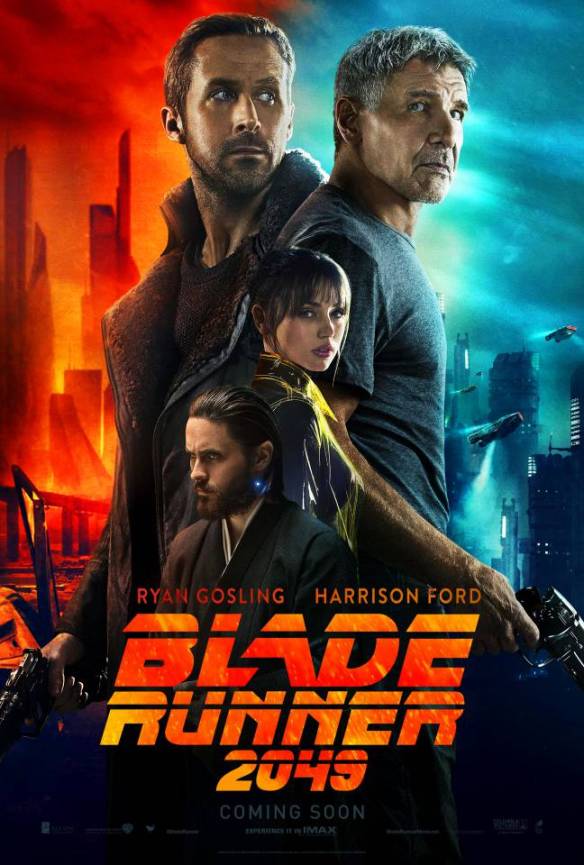
Like with most sequels, the main draw for fans is the chance to see familiar faces from the original and 2049 doesn’t disappoint too much. Judging from the posters, trailers, interviews, etc. it was clear Harrison Ford would make a return, but unfortunately it wasn’t until after the majority of the duration of the film had passed. Nevertheless, the reappearance of Ford’s character Deckard was memorable, found by Agent K as a disheveled hermit in an abandoned casino surrounded by copious amounts of alcohol and ancient pop culture detritus. Deckard is apparently as much of a drinker as in the first film, but now not just to block out the pain of the past and present but to escape to an idealized past. Though his involvement in the plot seemed too brief it nevertheless plays a pivotal role in resolving the central mystery of the film and providing additional metacommentary.

Ford’s performance is arguably more compelling than his work in the original, though his character’s lack of charisma in the first film could be seen as intentional. Deckard’s character arc in the film, as well as that of Ford’s last two iconic roles from the 80s he reprised, cements his status as our culture’s archetype for the deadbeat father. This seems inevitable in hindsight because for a generation of latchkey kids (many with actual deadbeat dads), stars such as Harrison Ford were virtually surrogate father figures. Thus, it makes sense that the beloved characters Ford drifted away from for so long would be written as variations of a long absent deadbeat parent in their last installments.

An interesting detail about the way Deckard was characterized in the film was how he seemed more in line with a typical baby-boomer today than the gen x-er one would be at that age 32 years from now.  For example, people in their seventies today are probably more likely to be nostalgic for Elvis and Sinatra than a seventy-something person in 2049 who in our actual timeline would have more likely spent formative years listening to grunge or hiphop. A possible subtextual meaning might be that like false memories, nostalgia for media of enduring cultural value transcends lived experience. The referencing of “real” pop-culture figures within the world of the film seemed anachronistic at first, but the way it was done was interesting and worked with the themes and aesthetic (I suppose it’s preferable to having something like Beastie Boys’ “Sabotage” shoe-horned into the film like in the Star Trek reboots). Getting back to the point, in the original Blade Runner, nostalgia permeated the film through its themes, production design, costumes and soundtrack. In Blade Runner 2049, nostalgia is a subtext of repeated callbacks to the original film, Agent K’s idealized retro relationship with his AI girlfriend Joi and Deckard’s hideout within the ruins of a city once associated with fun and glamour. The simulacrum of iconic figures from the past like Elvis and Marilyn Monroe (and Ford) haunting the deserted casino like ghosts reinforces the idea of media and culture’s ability to “implant” memories and resultant nostalgia.

As for the finale, I was disappointed that it was so far from the unconventional conclusion of the showdown between Roy Batty and Deckard. One could argue it’s a reflection of the state of the world (in and of film and reality), but it’d be nice to have a little more creativity and risk-taking. Though viscerally exciting and suspenseful, it wasn’t distinguishable enough from countless modern action films to be truly memorable. More satisfying was the epilogue which paralleled the contemplative nature of the original while reconnecting to the film’s recurring themes.

In a sense, the writers and director of Blade Runner 2049 were in a catch-22 situation. Creating a film too unlike or similar to the original Blade Runner would provoke criticism from fans. What director Denis Villeneuve and co-writers Hampton Fancher and Michael Green have managed to pull off is a balancing act of a film that’s unique in many ways yet interwoven with the original; nostalgic, but not in an obvious or overly sentimental way. Both have their flaws, but while I admire the thought and craft put into the sequel, I prefer the originality, tone, texture and atmosphere of Blade RunnerBlade Runner 2049 will likely satisfy most sci-fi fans, but I’m not sure it proves a sequel was necessary or that it stands alone as a classic.

Though not given the recognition it deserved in its time, Blade Runner was a groundbreaking and visionary film upping the bar for intellectual depth, moral complexity, production design and special effects to a degree not seen since 2001: a Space Odyssey. Its influence can be spotted in countless dystopian science fiction films made since. Though it’s too early to tell how influential Blade Runner 2049 will be, it doesn’t seem to have pushed the genre forward to a similar extent (of course contemporaneous opinions can seem wildly off the mark in hindsight). Regardless, it’s an above-average science fiction film by any reasonable standard so it’s unfortunate that judging from disappointing initial box-office reports, it seems to be following in the footsteps of the first Blade Runner pretty closely in that regard. Time will tell whether it achieves a similar cult status in years to come. Perhaps in 35 years?


 

Manufacturing Panic: Social Engineering, Domination and Control

By S.C. Hickman

Source: Techno Occulture

In the 21st century, the social engineering of dread and longing have evolved into a bio-political arena of terror and a psycho-political culture of internalized domination. The globally deployed technology of the spectacle transforms to a creative panic industry, the pacification of the self and the silencing of multitudes. With no visible alternatives to universal pancapitalism there seems to be no need for payoffs for the disenchanted, no necessity to bribe the dissenting segments of the population and no incentive to grant extension of freedoms.1

Instead of peddling hope and visions of mutually shared commonwealth, authority is maintained by the production of synthetic fear and the need to secure property against some other. Deimos and Phobos, the gods of panic, angst and terror dominate the omni-directional realm of geo-psychological strategies in an asymmetric world war against invisible enemies without qualities. Market concentrations benefit neo-feudal power structures that know how to use access to media, private security and intelligence services to advance their interests. Austerity, power, and impersonal anonymity interface with a world replete with vast global migrations, desperation, and panic victims who willingly comply and give up liberties for shared security. An Orwellian world of competing agencies, wars, famines, and pestilence drive the panic cities of current criminal elements to traffic in sex, drugs, and war.

Private oligarchic networks of finance and business cartels cultivate relations to governmental entities controlling state agencies and military units. Media narratives and public relations strategies transform synthetic fear into advantages that produce windfalls of power and profit. This theater of fear is a skillful interplay of compartmentalized information units, privatized command centers, loyal officials and gatekeepers as well as professional Special Forces. Technocommercial Black-Ops programs that infiltrate both governmental and public spheres through experimental use of technics and pharmakon in collusion with DARPA and other shadow or Deep State agencies across the globe provide a base infrastructure for a 21st century society of control. Productions of artificial angst call for scenarios of counter-terrorist theater rehearsals and paramilitary actors as well as the professional staging of scapegoats and dupes. The dark networks draw on privatized intelligence units, so called “asteroids”, business entities which provide cover for compartmentalized operations.2

Space was formerly known as heaven and manned space flight from earth could be understood as mechanical equivalent to an ascent to divinity. Johannes Kepler suspected paradise to be located on the moon and Konstantin Tsiolkowsky, the Russian pioneer of modern rocket science, saw manned space flight as a freeway to the supernatural. In his novel “Gravity’s Rainbow” Thomas Pynchon contemplates the ambiguous interrelations between sex, rockets and magic.

Jack Parsons, a key figure in American rocketry, lost his reputation and security clearance in obsessive pursuit of occult rituals and sexual mumbo-jumbo before he diffused into space in a lab explosion in 1952. A crater on the dark side of the moon is named in memory of Parsons, a tribute to the shady cofounder of the famed Jet Propulsion Laboratory (JPL). The 19th century spiritualist pseudoscience of a world of ghosts and occult belief in spirits, a complex adaptation to modernity, has morphed into 20th century sciences. From social theories and “optimization” of the workplace, from operations research to scientific communication and applied psychology, many genres of academic disciplines and the influence business are rooted in the twilight zone of the netherworlds.

When Norbert Wiener, who developed his work on cybernetics from ballistics research, writes that “Communication and control belong to the essence of man’s inner life, even as they belong to his life in society” he evokes the ancient art of assessing the human personality and exploiting motivations. Developed out of clandestine mind control programs in the 1960’s, the methodical application of Personality Assessment Systems became standard operating procedure in business and intelligence. Systems of discipline and control which took shape in the 19th century on the basis of earlier procedures have mutated into new and aggressive forms, beyond simplistic theories of state and sovereignty. In the past, the science of power branched into the twin vectors of political control and control of the self.

In the 21st century the technologies of material control and subjective internalization are in a process of converging. The traditional twin operations, with which the authorities aim to win the hearts and minds, the binding maneuvers of law enforcement and the dazzling illusionist control of the imagination, are transforming into each other. Not unlike werewolves using the powers of the moon for a violent metamorphosis, contemporary agencies of power turn into shape shifters and fluctuating modes of dominance. Star Wars technology shape-shifts into applications of creative industries, into the domain of desire, imagination and mediated lunacy.

Technologies of individualization bound to controllable identities and the global machinery of homogenization are superimposing to a double-bind of contemporary power structures. The renaissance heretic Giordano Bruno anticipates these developments in his visionary treatise “De Vinculis in Genere” – a general account of bonding – on operational phantasms and the libidinal manipulation of the human spirit. The disputatious philosopher of an infinite universe, beyond his unique investigation into the imaginary and the persuasion of masses and the individual, also challenged the ontological separation between the spheres of the heavens and the sublunary world of his time.

Today, in a technological marriage of heaven and earth, there is a full spectrum military entertainment fusion of global conflict management. A strategic analysis of the enforced colonization of space and mind will certainly provide a more comprehensive understanding of the parameters of life and death on planet Earth. The extraterrestrial highway in the United States, is near the zone 51, a top secret area of the American army. In this zone “black projects” subjected to the secrecy defense are carried out. In 1994 a Congressional subcommittee revealed that up to 500,000 Americans were endangered by secret defense related tests between 1940 and 1974. They included covert experiments with radioactive materials, mustard gas, LSD, and biological agents.3

Disneyland and the global media sightings of men on the moon are exemplary for the universal power of imagination management and the spectacle. Receptiveness for the spectacle is deeply embedded in human desires for excitement, stimulation, knowledge acquisition and the construction of self esteem. Largely based on the biocybernetic exploitation of human response mechanisms that influence emotion, excitement and thrill, the technological spectacle in its play with danger and disorientation is rooted in the biology of ancient neural patterns. But its arena has been dramatically extended through technology. The machinery of the spectacle generates affect by triggering failures of orientation and control. This can be loss of physical balance, a rollercoaster ride or cognitive dissonance. The intensity of affect is directly correlated with the depth of disorientation and the more that vital human response structures are touched, the deeper the effect. Contextual parameters of relatively secure environments allow appreciating these disorientations as hedonistic experiences instead of discomfort and panic. These mechanisms trigger delight and numinous experiences, moving and enthusing audiences.

Aldous Huxley once remarked that there are two kinds of propaganda— rational propaganda in favor of action that is consonant with the enlightened self-interest of those who make it and those to whom it is addressed, and non-rational propaganda that is not consonant with anybody’s enlightened self-interest, but is dictated by, and appeals to, passion. 4

In the years and decades ahead both invasive and non-invasive technologies will enslave the uneducated masses, luring them with technologies of delight or fear to do the bidding of the Oligarchs without little or any resistance since for the most part people will willingly give up there freedoms for comfort, security, and happiness. Of course not all will give into such notions, nor condone the power of persuasion through both extrinsic propaganda and public relations, nor intrinsically through technological pharmakon or invasive forms of implants or nanobots. But these resistant anti-bodies will like any virus be hunted down and annihilated in a society that will have become a unified fascist enclave, a mindless world of automated machines both inorganic and organic. For in the end there will be no barriers between them, only the merger and enhancement of their twined potentials. This is the dark truth-condition of our future… can we stop it?


  1. Konrad Becker, Hypno Politics, Hyper State Control, Law Entrainment and the Symbolic Order. Center for Cognitive Liberty (2015)
  2. Lofgren, Mike. The Deep State: The Fall of the Constitution and the Rise of a Shadow Government. Penguin Books (January 5, 2016); Englehardt, Tom. Shadow Government: Surveillance, Secret Wars, and a Global Security State in a Single-Superpower World. Haymarket Books (September 15, 2014)
  3. Valentine, Douglas. The CIA as Organized Crime: How Illegal Operations Corrupt America and the World. Clarity Press (December 31, 2016)
  4. Huxley, Aldous. Brave New World Revisited. Harper Perennial; Reprint edition (July 1, 2014)

As Babies are Prescribed Pharmaceuticals, Have We Reached Dystopia?

Tablets Pills Baby

By Joe Jarvis

Source: The Daily Bell

Would you let a five-year-old smoke a joint? I certainly hope not. Yet that would probably be less harmful than loading kids up on pharmaceuticals.

Currently, over a million American children UNDER SIX YEARS OLD are taking psychiatric drugs. Babies are literally being doped up by the pharmaceutical industry. Over 274,000 babies UNDER ONE-YEAR-OLD are given drugs, mostly for anxiety.

Anxiety drugs for babies. Have they tried motherly love? Or is that just an old fashioned, outdated concept?

You know, I like to mention society’s similarity to Orwell’s 1984. And surely the growing police state, war on drugs, and endless military campaigns–where the enemy seems to change daily–are reminiscent of the fictional dictatorship of Big Brother.

But it seems the powers that be are working tirelessly to blend together the dystopia of 1984, with that of Aldous Huxley’s Brave New World.

In that dystopia, there is no police state or war. Society has been perfectly designed by scientists, inspired by Ford’s assembly line. Babies are grown in the lab, cloned to all look alike, depending on their class. Parents are an embarrassing relic of the past. How silly to think a child needs family when they have the state!

The lower castes are deprived of oxygen as embryos to stunt their mental development. In America, they use fluoride in the drinking water instead.

In Brave New World, children listen to 24-hour propaganda in their cribs. Betas hear:

Alpha children wear grey. They work much harder than we do, because they’re so frightfully clever. I’m really awfully glad I’m a Beta, because I don’t work so hard. And then we are much better than the Gammas and Deltas. Gammas are stupid. They all wear green, and Delta children wear khaki. Oh no, I don’t want to play with Delta children. And Epsilons are still worse.

White pride, black pride, gay pride, national pride. Pride is not meant for accidents of birth. You should be proud of accomplishments and achievements, not genetics and geography. Perhaps someone has been whispering in these radicalized children’s ears.

And how jealous the Department of Education must be of the incubators of Brave New World! They have to sometimes wait years to indoctrinate children. But at least the government gets to drug them up at a young age! And if the TV is left on, most of the programming is done for them.

Of course, the adults are drugged up in Brave New World as well, just like in America. If anyone feels the least bit anxious, nervous, sad–or any other troublesome emotion–they get “soma.” It’s the perfect mix of drugs with only pleasant feelings and no ill side effects.

The 1 in 6 Americans on antidepressants, antipsychotics, and anti-anxiety medication still have to put up with side effects.

The 50 million plus Americans on psychiatric medication sometimes kill themselves, or go mad and kill others. I guess the government is still working out the kinks. Or it’s just another creative blending of 1984 and Brave New World. In the former, the proles must be properly terrified.

And there is one more thing I can remember from Brave New World that strikes eerily similar to modern America.

At what age does the public education system start teaching sex ed? Kindergarteners in some states receive “age appropriate”–according to the government–sexual education. Some studies suggest teen pregnancies rise in areas where sex ed is taught at younger ages.

How young is too young for a sex change? Kids can now choose between 43 genders, or make up a new one! It’s like Mr. Potato head, but with their own bodies. And they will be given corresponding drugs to enhance the “natural” changes.

In the classrooms of Brave New World:

“We had Elementary Sex for the first forty minutes,” she answered. “But now it’s switched over to Elementary Class Consciousness.”

The Director walked slowly down the long line of cots. Rosy and relaxed with sleep, eighty little boys and girls lay softly breathing…

He let out the amazing truth. For a very long period before the time of Our Ford, and even for some generations afterwards, erotic play between children had been regarded as abnormal (there was a roar of laughter); and not only abnormal, actually immoral (no!): and had therefore been rigorously suppressed.

Drugging the population, programming citizens with propaganda, sexualizing children, creating class divisions.

These dystopian novels were meant to be warnings, not instruction manuals.


Kafka Warned Us

By

Source: CounterPunch

Kafka’s The Trial can be read in retrospect as a prelude to the Twentieth/Twenty-First century. Although probably not written as prophecy, Kafka’s short unfinished book nevertheless provides a road map to the terrors of the current Surveillance State.

As readers of CounterPunch are all too familiar, modern man, as a single individual, is at the mercy of the modern state and those who, lurking in semi-secrecy, direct it.

Kafka’s The Trial superbly conveys the unease of our current existential situation.

Early one morning, The Trial’s main protagonist, Joseph K, awakes to find that, totally unexpectedly, he has been arrested. Throughout the book he endeavors to find the reason for his arrest without any definite success.

However, what he does discover is a vast semi-secret bureaucracy/organizaton whose inner workings and outward displays of power and decision making remain opaque at best.

Initally, Joseph K, believes that he lives in a “Rechtsstaat” (a state where the rule of law is respected) and thus where it is expected that all civilized norms and laws are upheld.

Yet, he soon comes to see that he has lived in a state of fundamental error and illusion about the true nature of his existence.

What appeared to him as a well ordered and just state is, all of a sudden, revealed to be a capricious omnipotent octopus capable of strangling (in this case literally) anyone deemed to be, for whatever reason, expendable.

All law is suspended or, at least, made a mockery of. All that remains are the inner, turgid demands of power.

Joseph K. is convinced of his innocence. But his conviction is no match for the monolithic power that stands against him. He is eventually crushed, if not by his enemy’s repetitive legal machinations, then by his fatalistic far-reaching administrative power.

In the end, the “Organization” which Joseph K has confronted is almighty and can be controlled by neither appeals to law, logic, or custom. In this, modern man is in a similar situation.

He stands, at any moment, beneath the mercy of a gigantic machinery that, if it wills, can almost casually set into motion his utter annihilation. The devastation and erasure of ones past, present, and future self is an ever-present possible function of the modern state. Advances in technology and organization make such a function all the more easier.

How to combat this greatest threat to humankind’s liberty will make the difference of whether or not future generations live in a world of securely grounded freedom or if they will succumb “like a dog” to the increasingly totalitarian powers of what we call today: the Surveillance State.

Saturday Matinee: Americathon

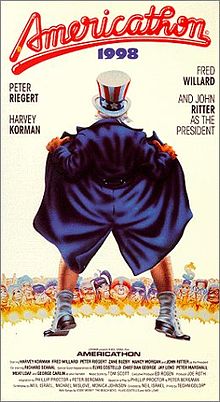
“Americathon” (1978) is, like Idiocracy, a dystopian comedy with prophetic predictions such as the fall of the USSR, privatization of public assets, smoking being banned, masses of homeless people living in cars, and the dominance of reality TV, but set in the then future year of 1998. It was directed by Neal Israel, based on a play by Firesign Theatre alumni Phil Proctor and Peter Bergman with narration by George Carlin. In Americathon’s vision of the future, the U.S. has passed peak oil and the government is on the brink of bankruptcy. In order to avoid having the country foreclosed and repossessed by the original owners, president Chet Roosevelt (John Ritter) organizes a national telethon with hilarious results. Features surprising appearances by Elvis Costello, Meat Loaf, Cybill Shepherd and Howard Hesseman.

Watch the full film here.

Freedom Is Not Necessarily The Absence Of Tyranny

By Brandon Smith

Source: Alt-Market

Is it true that freedom is an overly idealized concept? Perhaps, but it is one of the few concepts worthy of idealization. It is so worthy, that it is worth dying for.

Since the dawn of recorded history human beings have fought and sacrificed to attain freedom. It is an inherent psychological construct. It is a principle that is rooted not only in the mind of man, but his spirit or soul. Scientists in the realm of the mind have struggled for generations to understand where it comes from — others have sought to dismiss it as a fanciful notion or societal construct. Nihilists claim it doesn’t really exist, while other people center their entire lives on the proliferation of it. The concept of freedom, love it or hate it, is central to all cultures and all civilizations. The most common dismissal of the idea of freedom that I have seen is the argument that none of us is really free because “tyranny exists”. Tyranny is a constant, therefore, in the view of the nihilists, freedom cannot exist. I believe this dim way of thinking stems from a misconception of what freedom is and where it comes from.

Freedom, first and foremost, begins in the mind, or the heart; whatever you are inclined to put more stock in. To think critically or to imagine wildly is indeed to be free. Tyranny, by extension, rises from the mire and muck in the physical world around us and ends in the mind and the heart. If one is free of mind, then one is never truly enslaved.

I have heard so many times the ignorant accusation that freedom requires action before consequence. That is to say, if you have suffered the consequences of a tyrannical system, then you have already failed to prevent your own enslavement. This is not how freedom functions. It has never worked this way.

There is no such thing as a world without the consequences of tyranny. Tyrants are everywhere, always. There are little tyrants in our everyday lives, and big tyrants that pull strings from behind the curtains and from the darker places. There are people reading this article right now that think they are liberty-minded, but act like tyrants towards those around them. There are people who think they are slaves when one simple choice or action could easily make them free. There are people who see private property as tyranny and seek to supplant it….with an even greater tyranny of entitlement and socialism. And, there are people who think freedom means freedom for them, but not for others. Each tyrant takes time to understand and remove from our lives. Some we simply need to walk away from; others need to be destroyed.

The point is, we are forever dealing with tyranny, and many of us are forever working to topple it. As long as we are able to pursue that goal, we are still free. The true slaves are those that have given up completely out of laziness or fear. Tyranny is always present, after all; why take a bath today when you are just going to end up soiled again tomorrow?

The idea that one can do nothing in the face of the machine is an old idea proven wrong time and time again, yet, it is also a very easy and comfortable lie to live in. Struggle is difficult. Sacrifice is foreboding and ugly. There are a million-and-one excuses and rationalizations as to why it is better to “accept fate” or circumstances. There is always another excuse that can be used to paper over cowardice.

Tyrants can, in fact, win and keep winning for the length of an epoch, exactly because of the logical fallacy that they cannot be resisted or be beaten. It is the self-fulfilling prophecy of nihilism that makes tyranny possible. Without it, tyrants inevitably fail and fall.

The great monster of our time that must be slayed is the monster of organized conspiracy. Past generations have confronted and defeated appendages of this monster, but they never beheaded it, and this is why our particular brand of tyranny persists. It is not enough for us to fight the tentacles of the beast anymore — it is the job of the freedom fighters of our era to stab at the brains of the wretched thing.

I am of course speaking of the banking cabal, the cult of financiers and elites that make up the globalist hierarchy. They pervade the halls of numerous institutions and think tanks, from the Federal Reserve and the Council on Foreign Relations to the International Monetary Fund and the Bank for International Settlements. They sit in positions of great political influence and hold council (and some would say considerable sway) over world leaders. They write “theoretical” policies which are quickly adopted by governments and made into law. They are primary stockholders and owners of our mainstream media. Their slithering fingers are wrapped around academia and many scientific communities. They insinuate themselves into every foundation of thought, because thought is what they most wish to control.

They prefer to divide and conquer, to pit one group against another, or to give their ideological enemies enough rope to hang themselves with. If they can’t rule the psyche of a society or succeed in 4th generation warfare, they will fall back to the old standard of brute force. In fact, they might just do that anyway, because what tyrant doesn’t love instilling abject terror every once in a while?

And yet, these “elites” stand on a razor’s edge. Despite all their supposed power, despite all their wealth, despite the vast spiderwebs they weave, all of it can be turned to ash in an instant and they know it. Empires like this rely on anonymity, and they are anonymous no longer. The cabal is out in the open; they have to be.

To shift the world into true globalism and true centralization requires actions which can be masked from some people but not all people. They believe the intricate digital networks they have funded will buy them total information awareness, but these same networks also provide us with the tools to understand who they are and what they want. This double-edged sword of full spectrum data creates a Catch-22 timeline. The longer the globalists wait to implement the one world system they desire, the more time we have to educate millions of people. The faster they implement their one-world system, the more likely they are to make a mistake.

Time is running out. Time is working against them. Time is the master here, and the globalists are nothing but paper boats on a tidal wave.

This organized conspiracy increases its odds of success through psychological manipulation. There will come a time, perhaps sooner rather than later, when banking elites and their political allies can no longer stand outside the game unscathed. Risk is coming. So, they must encourage as much self-defeat in the minds of freedom champions as possible.

They will conjure crisis and catastrophe, they will conjure puppet enemy after puppet enemy, they will exploit useful idiots with collectivist views as cannon fodder, they will engineer conflicts between East and West. They will try to grind us down and break the legs of our resolve.

However, as long as there are people who know who the globalists are that are willing to hunt them down, the globalists cannot win. For what they desperately want is to stand out in the sun with criminal impunity, and without fear. They want to be untouchable. They want to be gods.

Real gods do not suffer consequences, and these people will suffer consequences.

The nihilists will cry, “When?! How?! Never!” But this is the nature of freedom. Freedom is in the fighting; winning is transitory. Tyranny can be subtle and it can be blunt, freedom is the same way. If you think because there is no shooting going on yet that a war is not happening, then you do not understand the nature of warfare.

Yes, it is possible that the fall of one globalist cabal might give rise to another, and another. But we are free to be there and to fight again. As long as we fight, we prevail. When we abandon the fight completely, that is when true slavery begins. Today, we fight using information versus propaganda, and we must be adept at this. We also must be adept at other forms of combat as the conflict escalates.

There will never be total absence of tyranny. The naysayers against the principle of freedom are delusional, or maybe they know such a standard is unattainable and this will make them forever “right.” When will the fight begin? It already has. It has been going on since time immemorial and we are merely here to continue it. This might seem like a task for Sisyphus – an endless circular nightmare. I look at it another way: We are a changing of the guard. We have inherited a responsibility beyond all responsibilities. In this age, we are the freedom fighters, and if we fail now then we pass an even more difficult horror on to some other generation down the line.

In my view this is unacceptable. The opportunity to end one longstanding tyranny is now. We must counter using information as long as is needed, and we must wake up as many people as possible, so when the time comes to storm the castle, the shared sacrifice is that much easier to bear. If you have taken up this fight in one form or another never let anyone tell you you are not free. Your ability to think and to act is concrete proof otherwise.

What Country Is This? Forced Blood Draws, Cavity Searches and Colonoscopies

By John W. Whitehead

Source: The Rutherford Institute

“The Fourth Amendment was designed to stand between us and arbitrary governmental authority. For all practical purposes, that shield has been shattered, leaving our liberty and personal integrity subject to the whim of every cop on the beat, trooper on the highway and jail official.”—Herman Schwartz, The Nation

Our freedoms—especially the Fourth Amendment—are being choked out by a prevailing view among government bureaucrats that they have the right to search, seize, strip, scan, shoot, spy on, probe, pat down, taser, and arrest any individual at any time and for the slightest provocation.

Forced cavity searches, forced colonoscopies, forced blood draws, forced breath-alcohol tests, forced DNA extractions, forced eye scans, forced inclusion in biometric databases: these are just a few ways in which Americans are being forced to accept that we have no control over our bodies, our lives and our property, especially when it comes to interactions with the government.

Worse, on a daily basis, Americans are being made to relinquish the most intimate details of who we are—our biological makeup, our genetic blueprints, and our biometrics (facial characteristics and structure, fingerprints, iris scans, etc.)—in order to clear the nearly insurmountable hurdle that increasingly defines life in the United States: we are now guilty until proven innocent.

Such is life in America today that individuals are being threatened with arrest and carted off to jail for the least hint of noncompliance, homes are being raided by police under the slightest pretext, property is being seized on the slightest hint of suspicious activity, and roadside police stops have devolved into government-sanctioned exercises in humiliation and degradation with a complete disregard for privacy and human dignity.

Consider, for example, what happened to Utah nurse Alex Wubbels after a police detective demanded to take blood from a badly injured, unconscious patient without a warrant.

Wubbels refused, citing hospital policy that requires police to either have a warrant or permission from the patient in order to draw blood. The detective had neither. Irate, the detective threatened to have Wubbels arrested if she didn’t comply. Backed up by her supervisors, Wubbels respectfully stood her ground only to be roughly grabbed, shoved out of the hospital, handcuffed and forced into an unmarked car while hospital police looked on and failed to intervene (take a look at the police body camera footage, which has gone viral, and see for yourself).

Michael Chorosky didn’t have an advocate like Wubbels to stand guard over his Fourth Amendment rights. Chorosky was surrounded by police, strapped to a gurney and then had his blood forcibly drawn after refusing to submit to a breathalyzer test. “What country is this? What country is this?” cried Chorosky during the forced blood draw.

What country is this indeed?

Unfortunately, forced blood draws are just the tip of the iceberg when it comes to the indignities and abuses being heaped on Americans in the so-called name of “national security.”

Forced cavity searches, forced colonoscopies and forced roadside strip searches are also becoming par for the course in an age in which police are taught to have no respect for the citizenry’s bodily integrity whether or not a person has done anything wrong.

For example, 21-year-old Charnesia Corley was allegedly being pulled over by Texas police in 2015 for “rolling” through a stop sign. Claiming they smelled marijuana, police handcuffed Corley, placed her in the back of the police cruiser, and then searched her car for almost an hour. No drugs were found in the car.

As the Houston Chronicle reported:

Returning to his car where Corley was held, the deputy again said he smelled marijuana and called in a female deputy to conduct a cavity search. When the female deputy arrived, she told Corley to pull her pants down, but Corley protested because she was cuffed and had no underwear on. The deputy ordered Corley to bend over, pulled down her pants and began to search her. Then…Corley stood up and protested, so the deputy threw her to the ground and restrained her while another female was called in to assist. When backup arrived, each deputy held one of Corley’s legs apart to conduct the probe.

The cavity search lasted 11 minutes. This practice is referred to as “rape by cop.”

Although Corley was charged with resisting arrest and with possession of 0.2 grams of marijuana, those charges were subsequently dropped.

David Eckert was forced to undergo an anal cavity search, three enemas, and a colonoscopy after allegedly failing to yield to a stop sign at a Wal-Mart parking lot. Cops justified the searches on the grounds that they suspected Eckert was carrying drugs because his “posture [was] erect” and “he kept his legs together.” No drugs were found.

During a routine traffic stop, Leila Tarantino was subjected to two roadside strip searches in plain view of passing traffic, while her two children—ages 1 and 4—waited inside her car. During the second strip search, presumably in an effort to ferret out drugs, a female officer “forcibly removed” a tampon from Tarantino. No contraband or anything illegal was found.

Thirty-eight-year-old Angel Dobbs and her 24-year-old niece, Ashley, were pulled over by a Texas state trooper on July 13, 2012, allegedly for flicking cigarette butts out of the car window. Insisting that he smelled marijuana, the trooper proceeded to interrogate them and search the car. Despite the fact that both women denied smoking or possessing any marijuana, the police officer then called in a female trooper, who carried out a roadside cavity search, sticking her fingers into the older woman’s anus and vagina, then performing the same procedure on the younger woman, wearing the same pair of gloves. No marijuana was found.

Sixty-nine-year-old Gerald Dickson was handcuffed and taken into custody (although not arrested or charged with any crime) after giving a ride to a neighbor’s son, whom police suspected of being a drug dealer. Despite Dickson’s insistence that the bulge under his shirt was the result of a botched hernia surgery, police ordered Dickson to “strip off his clothes, bend over and expose all of his private parts. No drugs or contraband were found.”

Meanwhile, four Milwaukee police officers were charged with carrying out rectal searches of suspects on the street and in police district stations over the course of several years. One of the officers was accused of conducting searches of men’s anal and scrotal areas, often inserting his fingers into their rectums and leaving some of his victims with bleeding rectums.

It’s gotten so bad that you don’t even have to be suspected of possessing drugs to be subjected to a strip search.

A North Carolina public school allegedly strip-searched a 10-year-old boy in search of a $20 bill lost by another student, despite the fact that the boy, J.C., twice told school officials he did not have the missing money. The assistant principal reportedly ordered the fifth grader to disrobe down to his underwear and subjected him to an aggressive strip-search that included rimming the edge of his underwear. The missing money was later found in the school cafeteria.

Suspecting that Georgia Tech alum Mary Clayton might have been attempting to smuggle a Chick-Fil-A sandwich into the football stadium, a Georgia Tech police officer allegedly subjected the season ticket-holder to a strip search that included a close examination of her underwear and bra. No contraband chicken was found.

What these incidents show is that while forced searches may span a broad spectrum of methods and scenarios, the common denominator remains the same: a complete disregard for the rights of the citizenry.

In fact, in the wake of the U.S. Supreme Court’s ruling in Florence v. Burlison, any person who is arrested and processed at a jail house, regardless of the severity of his or her offense (i.e., they can be guilty of nothing more than a minor traffic offense), can be subjected to a strip search by police or jail officials without reasonable suspicion that the arrestee is carrying a weapon or contraband.

Examples of minor infractions which have resulted in strip searches include: individuals arrested for driving with a noisy muffler, driving with an inoperable headlight, failing to use a turn signal, riding a bicycle without an audible bell, making an improper left turn, and engaging in an antiwar demonstration (the individual searched was a nun, a Sister of Divine Providence for 50 years).

Police have also carried out strip searches for passing a bad check, dog leash violations, filing a false police report, failing to produce a driver’s license after making an illegal left turn, having outstanding parking tickets, and public intoxication. A failure to pay child support can also result in a strip search.

As technology advances, these searches are becoming more invasive on a cellular level, as well.

For instance, close to 600 motorists leaving Penn State University one Friday night were stopped by police and, without their knowledge or consent, subjected to a breathalyzer test using flashlights that can detect the presence of alcohol on a person’s breath. These passive alcohol sensors are being hailed as a new weapon in the fight against DUIs. (Those who refuse to knowingly submit to a breathalyzer test are being subjected to forced blood draws. Thirty states presently allow police to do forced blood draws on drivers as part of a nationwide “No Refusal” initiative funded by the federal government. Not even court rulings declaring such practices to be unconstitutional in the absence of a warrant have slowed down the process. Now police simply keep a magistrate on call to rubber stamp the procedure over the phone.)

The National Highway Safety Administration, the same government agency that funds the “No Refusal” DUI checkpoints and forcible blood draws, is also funding nationwide roadblocks aimed at getting drivers to “voluntarily” provide police with DNA derived from saliva and blood samples, reportedly to study inebriation patterns. In at least 28 states, there’s nothing voluntary about having one’s DNA collected by police in instances where you’ve been arrested, whether or not you’re actually convicted of a crime. All of this DNA data is being fed to the federal government.

Airline passengers, already subjected to virtual strip searches, are now being scrutinized even more closely, with the Customs and Border Protection agency tasking airport officials with monitoring the bowel movements of passengers suspected of ingesting drugs. They even have a special hi-tech toilet designed to filter through a person’s fecal waste.

Iris scans, an essential part of the U.S. military’s boots-on-the-ground approach to keeping track of civilians in Iraq and Afghanistan, are becoming a de facto method of building the government’s already mammoth biometrics database. Funded by the Dept. of Justice, along with other federal agencies, the iris scan technology is being incorporated into police precincts, jails, immigration checkpoints, airports and even schools. School officials—from elementary to college—have begun using iris scans in place of traditional ID cards. In some parts of the country, parents wanting to pick their kids up from school have to first submit to an iris scan.

As for those endless pictures everyone so cheerfully uploads to Facebook (which has the largest facial recognition database in the world) or anywhere else on the internet, they’re all being accessed by the police, filtered with facial recognition software, uploaded into the government’s mammoth biometrics database and cross-checked against its criminal files. With good reason, civil libertarians fear these databases could “someday be used for monitoring political rallies, sporting events or even busy downtown areas.”

While the Fourth Amendment was created to prevent government officials from searching an individual’s person or property without a warrant and probable cause—evidence that some kind of criminal activity was afoot—the founders could scarcely have imagined a world in which we needed protection against widespread government breaches of our privacy, including on a cellular level.

Yet that’s exactly what we are lacking and what we so desperately need.

Unfortunately, the indignities being heaped upon us by the architects and agents of the American police state—whether or not we’ve done anything wrong—are just a foretaste of what is to come.

As I make clear in my book Battlefield America: The War on the American People, the government doesn’t need to tie you to a gurney and forcibly take your blood or strip you naked by the side of the road in order to render you helpless. It has other methods—less subtle perhaps but equally humiliating, devastating and mind-altering—of stripping you of your independence, robbing you of your dignity, and undermining your rights.

With every court ruling that allows the government to operate above the rule of law, every piece of legislation that limits our freedoms, and every act of government wrongdoing that goes unpunished, we’re slowly being conditioned to a society in which we have little real control over our bodies or our lives.

You Want a Picture of the Future? Imagine a Boot Stamping on Your Face

By John W. Whitehead

Source: The Rutherford Institute

“The Internet is watching us now. If they want to. They can see what sites you visit. In the future, television will be watching us, and customizing itself to what it knows about us. The thrilling thing is, that will make us feel we’re part of the medium. The scary thing is, we’ll lose our right to privacy. An ad will appear in the air around us, talking directly to us.”—Director Steven Spielberg, Minority Report

We have arrived, way ahead of schedule, into the dystopian future dreamed up by such science fiction writers as George Orwell, Aldous Huxley, Margaret Atwood and Philip K. Dick.

Much like Orwell’s Big Brother in 1984, the government and its corporate spies now watch our every move.

Much like Huxley’s A Brave New World, we are churning out a society of watchers who “have their liberties taken away from them, but … rather enjoy it, because they [are] distracted from any desire to rebel by propaganda or brainwashing.”

Much like Atwood’s The Handmaid’s Tale, the populace is now taught to “know their place and their duties, to understand that they have no real rights but will be protected up to a point if they conform, and to think so poorly of themselves that they will accept their assigned fate and not rebel or run away.”

And in keeping with Philip K. Dick’s darkly prophetic vision of a dystopian police state—which became the basis for Steven Spielberg’s futuristic thriller Minority Report which was released 15 years ago—we are now trapped into a world in which the government is all-seeing, all-knowing and all-powerful, and if you dare to step out of line, dark-clad police SWAT teams and pre-crime units will crack a few skulls to bring the populace under control.

Minority Report is set in the year 2054, but it could just as well have taken place in 2017.

Seemingly taking its cue from science fiction, technology has moved so fast in the short time since Minority Report premiered in 2002 that what once seemed futuristic no longer occupies the realm of science fiction.

Incredibly, as the various nascent technologies employed and shared by the government and corporations alike—facial recognition, iris scanners, massive databases, behavior prediction software, and so on—are incorporated into a complex, interwoven cyber network aimed at tracking our movements, predicting our thoughts and controlling our behavior, Spielberg’s unnerving vision of the future is fast becoming our reality.

Both worlds—our present-day reality and Spielberg’s celluloid vision of the future—are characterized by widespread surveillance, behavior prediction technologies, data mining, fusion centers, driverless cars, voice-controlled homes, facial recognition systems, cybugs and drones, and predictive policing (pre-crime) aimed at capturing would-be criminals before they can do any damage.

Surveillance cameras are everywhere. Government agents listen in on our telephone calls and read our emails. Political correctness—a philosophy that discourages diversity—has become a guiding principle of modern society.

The courts have shredded the Fourth Amendment’s protections against unreasonable searches and seizures. In fact, SWAT teams battering down doors without search warrants and FBI agents acting as a secret police that investigate dissenting citizens are common occurrences in contemporary America.

We are increasingly ruled by multi-corporations wedded to the police state. Much of the population is either hooked on illegal drugs or ones prescribed by doctors. And bodily privacy and integrity has been utterly eviscerated by a prevailing view that Americans have no rights over what happens to their bodies during an encounter with government officials, who are allowed to search, seize, strip, scan, spy on, probe, pat down, taser, and arrest any individual at any time and for the slightest provocation.

All of this has come about with little more than a whimper from a clueless American populace largely comprised of nonreaders and television and internet zombies. But we have been warned about such an ominous future in novels and movies for years.

The following 15 films may be the best representation of what we now face as a society.

Fahrenheit 451 (1966). Adapted from Ray Bradbury’s novel and directed by Francois Truffaut, this film depicts a futuristic society in which books are banned, and firemen ironically are called on to burn contraband books—451 Fahrenheit being the temperature at which books burn. Montag is a fireman who develops a conscience and begins to question his book burning. This film is an adept metaphor for our obsessively politically correct society where virtually everyone now pre-censors speech. Here, a brainwashed people addicted to television and drugs do little to resist governmental oppressors.

2001: A Space Odyssey (1968). The plot of Stanley Kubrick’s masterpiece, as based on an Arthur C. Clarke short story, revolves around a space voyage to Jupiter. The astronauts soon learn, however, that the fully automated ship is orchestrated by a computer system—known as HAL 9000—which has become an autonomous thinking being that will even murder to retain control. The idea is that at some point in human evolution, technology in the form of artificial intelligence will become autonomous and that human beings will become mere appendages of technology. In fact, at present, we are seeing this development with massive databases generated and controlled by the government that are administered by such secretive agencies as the National Security Agency and sweep all websites and other information devices collecting information on average citizens. We are being watched from cradle to grave.

Planet of the Apes (1968). Based on Pierre Boulle’s novel, astronauts crash on a planet where apes are the masters and humans are treated as brutes and slaves. While fleeing from gorillas on horseback, astronaut Taylor is shot in the throat, captured and housed in a cage. From there, Taylor begins a journey wherein the truth revealed is that the planet was once controlled by technologically advanced humans who destroyed civilization. Taylor’s trek to the ominous Forbidden Zone reveals the startling fact that he was on planet earth all along. Descending into a fit of rage at what he sees in the final scene, Taylor screams: “We finally really did it. You maniacs! You blew it up! Damn you.” The lesson is obvious here, but will we listen? The script, although rewritten, was initially drafted by Rod Serling and retains Serling’s Twilight Zone-ish ending.

THX 1138 (1970). George Lucas’ directorial debut, this is a somber view of a dehumanized society totally controlled by a police state. The people are force-fed drugs to keep them passive, and they no longer have names but only letter/number combinations such as THX 1138. Any citizen who steps out of line is quickly brought into compliance by robotic police equipped with “pain prods”—electro-shock batons. Sound like tasers?

A Clockwork Orange (1971). Director Stanley Kubrick presents a future ruled by sadistic punk gangs and a chaotic government that cracks down on its citizens sporadically. Alex is a violent punk who finds himself in the grinding, crushing wheels of injustice. This film may accurately portray the future of western society that grinds to a halt as oil supplies diminish, environmental crises increase, chaos rules, and the only thing left is brute force.

Soylent Green (1973). Set in a futuristic overpopulated New York City, the people depend on synthetic foods manufactured by the Soylent Corporation. A policeman investigating a murder discovers the grisly truth about what soylent green is really made of. The theme is chaos where the world is ruled by ruthless corporations whose only goal is greed and profit. Sound familiar?

Blade Runner (1982). In a 21st century Los Angeles, a world-weary cop tracks down a handful of renegade “replicants” (synthetically produced human slaves). Life is now dominated by mega-corporations, and people sleepwalk along rain-drenched streets. This is a world where human life is cheap, and where anyone can be exterminated at will by the police (or blade runners). Based upon a Philip K. Dick novel, this exquisite Ridley Scott film questions what it means to be human in an inhuman world.

Nineteen Eighty-Four (1984). The best adaptation of Orwell’s dark tale, this film visualizes the total loss of freedom in a world dominated by technology and its misuse, and the crushing inhumanity of an omniscient state. The government controls the masses by controlling their thoughts, altering history and changing the meaning of words. Winston Smith is a doubter who turns to self-expression through his diary and then begins questioning the ways and methods of Big Brother before being re-educated in a most brutal fashion.

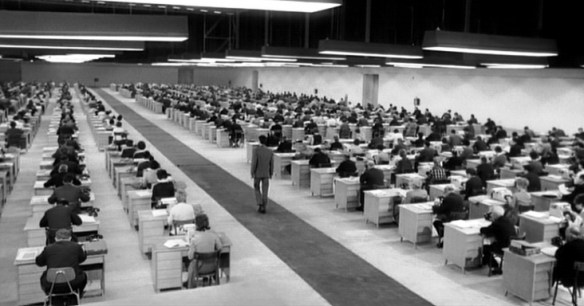
Brazil (1985). Sharing a similar vision of the near future as 1984 and Franz Kafka’s novel The Trial, this is arguably director Terry Gilliam’s best work, one replete with a merging of the fantastic and stark reality. Here, a mother-dominated, hapless clerk takes refuge in flights of fantasy to escape the ordinary drabness of life. Caught within the chaotic tentacles of a police state, the longing for more innocent, free times lies behind the vicious surface of this film.

They Live (1988). John Carpenter’s bizarre sci-fi social satire action film assumes the future has already arrived. John Nada is a homeless person who stumbles across a resistance movement and finds a pair of sunglasses that enables him to see the real world around him. What he discovers is a world controlled by ominous beings who bombard the citizens with subliminal messages such as “obey” and “conform.” Carpenter manages to make an effective political point about the underclass—that is, everyone except those in power. The point: we, the prisoners of our devices, are too busy sucking up the entertainment trivia beamed into our brains and attacking each other up to start an effective resistance movement.

The Matrix (1999). The story centers on a computer programmer Thomas A. Anderson, secretly a hacker known by the alias “Neo,” who begins a relentless quest to learn the meaning of “The Matrix”—cryptic references that appear on his computer. Neo’s search leads him to Morpheus who reveals the truth that the present reality is not what it seems and that Anderson is actually living in the future—2199. Humanity is at war against technology which has taken the form of intelligent beings, and Neo is actually living in The Matrix, an illusionary world that appears to be set in the present in order to keep the humans docile and under control. Neo soon joins Morpheus and his cohorts in a rebellion against the machines that use SWAT team tactics to keep things under control.

Minority Report (2002). Based on a short story by Philip K. Dick and directed by Steven Spielberg, the setting is 2054 where PreCrime, a specialized police unit, apprehends criminals before they can commit the crime. Captain Anderton is the chief of the Washington, DC, PreCrime force which uses future visions generated by “pre-cogs” (mutated humans with precognitive abilities) to stop murders. Soon Anderton becomes the focus of an investigation when the precogs predict he will commit a murder. But the system can be manipulated. This film raises the issue of the danger of technology operating autonomously—which will happen eventually if it has not already occurred. To a hammer, all the world looks like a nail. In the same way, to a police state computer, we all look like suspects. In fact, before long, we all may be mere extensions or appendages of the police state—all suspects in a world commandeered by machines.

V for Vendetta (2006). This film depicts a society ruled by a corrupt and totalitarian government where everything is run by an abusive secret police. A vigilante named V dons a mask and leads a rebellion against the state. The subtext here is that authoritarian regimes through repression create their own enemies—that is, terrorists—forcing government agents and terrorists into a recurring cycle of violence. And who is caught in the middle? The citizens, of course. This film has a cult following among various underground political groups such as Anonymous, whose members wear the same Guy Fawkes mask as that worn by V.

Children of Men (2006). This film portrays a futuristic world without hope since humankind has lost its ability to procreate. Civilization has descended into chaos and is held together by a military state and a government that attempts to keep its totalitarian stronghold on the population. Most governments have collapsed, leaving Great Britain as one of the few remaining intact societies. As a result, millions of refugees seek asylum only to be rounded up and detained by the police. Suicide is a viable option as a suicide kit called Quietus is promoted on billboards and on television and newspapers. But hope for a new day comes when a woman becomes inexplicably pregnant.

Land of the Blind (2006). This dark political satire is based on several historical incidents in which tyrannical rulers were overthrown by new leaders who proved just as evil as their predecessors. Maximilian II is a demented fascist ruler of a troubled land named Everycountry who has two main interests: tormenting his underlings and running his country’s movie industry. Citizens who are perceived as questioning the state are sent to “re-education camps” where the state’s concept of reality is drummed into their heads. Joe, a prison guard, is emotionally moved by the prisoner and renowned author Thorne and eventually joins a coup to remove the sadistic Maximilian, replacing him with Thorne. But soon Joe finds himself the target of the new government.

All of these films—and the writers who inspired them—understood what many Americans, caught up in their partisan, flag-waving, zombified states, are still struggling to come to terms with: that there is no such thing as a government organized for the good of the people. Even the best intentions among those in government inevitably give way to the desire to maintain power and control at all costs.

Eventually, as I point out in my book Battlefield America: The War on the American People, even the sleepwalking masses (who remain convinced that all of the bad things happening in the police state—the police shootings, the police beatings, the raids, the roadside strip searches—are happening to other people) will have to wake up.

Sooner or later, the things happening to other people will start happening to us and our loved ones.

When that painful reality sinks in, it will hit with the force of a SWAT team crashing through your door, a taser being aimed at your stomach, and a gun pointed at your head. And there will be no channel to change, no reality to alter, and no manufactured farce to hide behind.

As George Orwell warned, “If you want a picture of the future, imagine a boot stamping on a human face forever.”