Technocensorship: When Corporations Serve As a Front for Government Censors

By John & Nisha Whitehead

Source: The Rutherford Institute

“Once a government is committed to the principle of silencing the voice of opposition, it has only one way to go, and that is down the path of increasingly repressive measures, until it becomes a source of terror to all its citizens and creates a country where everyone lives in fear. We must, therefore, be on our guard against extremists who urge us to adopt police state measures. Such persons advocate breaking down the guarantees of the Bill of Rights in order to get at the communists. They forget that if the Bill of Rights were to be broken down, all groups, even the most conservative, would be in danger from the arbitrary power of government.”—Harry S. Truman, Special Message to the Congress on the Internal Security of the United States (August 8, 1950)

Nothing good can come from allowing the government to sidestep the Constitution.

Unfortunately, the government has become an expert at disregarding constitutional roadblocks intended to protect the rights of the citizenry.

When these end-runs don’t suffice, the government hides behind the covert, clandestine, classified language of national security; or obfuscates, complicates, stymies, and bamboozles; or creates manufactured diversions to keep the citizenry in the dark; or works through private third parties not traditionally bound by the Constitution.

This last tactic is increasingly how the government gets away with butchering our freedoms, by having its corporate partners serve as a front for its nefarious deeds.

This is how the police state has managed to carry out an illegal secret dragnet surveillance program on the American people over the course of multiple presidential administrations.

Relying on a set of privacy loopholes, the White House (under Presidents Obama, Trump and now Biden) has been sidestepping the Fourth Amendment by paying AT&T to allow federal, state, and local law enforcement to access—without a warrant—the phone records of Americans who are not suspected of a crime.

The government used a similar playbook to get around the First Amendment, packaged as an effort to control the spread of speculative or false information in the name of national security.

As the House Judiciary Select Subcommittee on Weaponization of the Federal Government revealed, the Biden administration worked in tandem with social media companies to censor content related to COVID-19, including humorous jokes, credible information and so-called disinformation.

Likening the government’s heavy-handed attempts to pressure social media companies to suppress content critical of COVID vaccines or the election to “an almost dystopian scenario,” Judge Terry Doughty warned that “the United States Government seems to have assumed a role similar to an Orwellian ‘Ministry of Truth.’

Restricting access to social media has become a popular means of internet censorship.

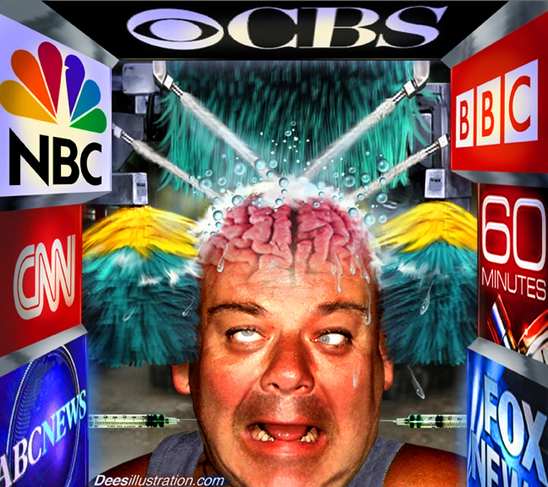
Dare to voice politically incorrect views in anything louder than a whisper on social media and you might find yourself suspended on Twitter, shut out of Facebook, and banned across various social media platforms. This authoritarian intolerance masquerading as tolerance, civility and love is what comedian George Carlin referred to as “fascism pretending to be manners.”

Social media censorship runs the gamut from content blocking, throttling, and filtering to lockouts, shutdowns, shadow banning and de-platforming.

In fact, these tactics are at the heart of several critical cases before the U.S. Supreme Court over who gets to control, regulate or remove what content is shared on the internet: the individual, corporate censors or the government.

Yet what those who typically champion the right of corporations to be free from government meddling get wrong about these cases is that there can be no free speech when corporations such as Facebook, Google or YouTube become a front for—or extensions of—government censors.

This is the very definition of technocensorship.

On paper—under the First Amendment, at least—we are technically free to speak.

In reality, however, we are now only as free to speak as a government official—or corporate entities such as Facebook, Google or YouTube—may allow.

Clothed in tyrannical self-righteousness, technocensorship is powered by technological behemoths (both corporate and governmental) working in tandem to achieve a common goal: to muzzle, silence and altogether eradicate any speech that runs afoul of the government’s own approved narrative.

This is political correctness taken to its most chilling and oppressive extreme.

This authoritarian impulse to censor and silence “dangerous” speech masquerading as tolerance, civility and a concern for safety (what comedian George Carlin referred to as “fascism pretending to be manners”) is the end result of a politically correct culture that has become radicalized, institutionalized and tyrannical.

You see, the government is not protecting us from “dangerous” disinformation campaigns. It is laying the groundwork to insulate us from “dangerous” ideas that might cause us to think for ourselves and, in so doing, challenge the power elite’s stranglehold over our lives.

Thus far, the tech giants have been able to sidestep the First Amendment by virtue of their non-governmental status, but it’s a dubious distinction at best when they are marching in lockstep with the government’s dictates.

As Philip Hamburger and Jenin Younes write for The Wall Street Journal: “The First Amendment prohibits the government from ‘abridging the freedom of speech.’ Supreme Court doctrine makes clear that government can’t constitutionally evade the amendment by working through private companies.”

It remains to be seen whether the Supreme Court can see itself clear to recognizing that censorship by social media companies acting at the behest of the government runs afoul of the First Amendment.

Bottom line: either we believe in free speech or we don’t.

The answer to the political, legal and moral challenges of our day should always be more speech, not less.

Any individual or group—prominent or not—who is censored, silenced and made to disappear from Facebook, Twitter, YouTube and Instagram for voicing ideas that are deemed politically incorrect, hateful, dangerous or conspiratorial should be cause for alarm across the entire political spectrum.

To ignore the long-term ramifications of such censorship is dangerously naïve, because whatever powers the government and its corporate operatives are allowed to claim now will eventually be used against the populace at large.

These social shunning tactics borrow heavily from the mind control tactics used by authoritarian cults as a means of controlling its members. As Dr. Steven Hassan writes in Psychology Today: “By ordering members to be cut off, they can no longer participate. Information and sharing of thoughts, feelings, and experiences are stifled. Thought-stopping and use of loaded terms keep a person constrained into a black-and-white, all-or-nothing world. This controls members through fear and guilt.”

This mind control can take many forms, but the end result is an enslaved, compliant populace incapable of challenging tyranny.

As Rod Serling, creator of The Twilight Zone, once observed, “We’re developing a new citizenry, one that will be very selective about cereals and automobiles, but won’t be able to think.”

The problem is that we’ve allowed ourselves to be persuaded that we need someone else to think and speak for us, and we’ve bought into the idea that we need the government and its corporate partners to shield us from that which is ugly or upsetting or mean. The result is a society in which we’ve stopped debating among ourselves, stopped thinking for ourselves, and stopped believing that we can fix our own problems and resolve our own differences.

In short, we have reduced ourselves to a largely silent, passive, polarized populace incapable of working through our own problems and reliant on the government to protect us from our fears.

As Nat Hentoff, that inveterate champion of the First Amendment, once observed, “The quintessential difference between a free nation, as we profess to be, and a totalitarian state, is that here everyone, including a foe of democracy, has the right to speak his mind.”

What this means is championing the free speech rights of those with whom we might disagree.

That’s why James Madison, the author of the Bill of Rights, fought for a First Amendment that protected the “minority” against the majority, ensuring that even in the face of overwhelming pressure, a minority of one—even one who espouses distasteful viewpoints—would still have the right to speak freely, pray freely, assemble freely, challenge the government freely, and broadcast his views in the press freely. He understood that freedom for those in the unpopular minority constitutes the ultimate tolerance in a free society.

The government has no tolerance for freedom or free speech of any kind that challenges its chokehold on power.

At some point or another, depending on how the government and its corporate allies define what constitutes “disinformation,” “hate” or “extremism, “we the people” might all be considered guilty of some thought crime or speech transgression or other.

Yet as I make clear in my book Battlefield America: The War on the American People and in its fictional counterpart The Erik Blair Diaries, it’s a slippery slope from censoring so-called illegitimate ideas to silencing truth.

Eventually, as George Orwell predicted, telling the truth will become a revolutionary act.

Ultimately, the government’s war on free speech—and that’s exactly what it is—is a war that is driven by a government fearful of its people.

As President John F. Kennedy observed, “[A] nation that is afraid to let its people judge the truth and falsehood in an open market is a nation that is afraid of its people.”
The State of Our Nation No One’s Talking About: Tyranny Is Rising as Freedom Falls

By John & Nisha Whitehead

Source: The Rutherford Institute

“Never has our future been more unpredictable, never have we depended so much on political forces that cannot be trusted to follow the rules of common sense and self-interest—forces that look like sheer insanity, if judged by the standards of other centuries.”—Hannah Arendt, The Origins of Totalitarianism

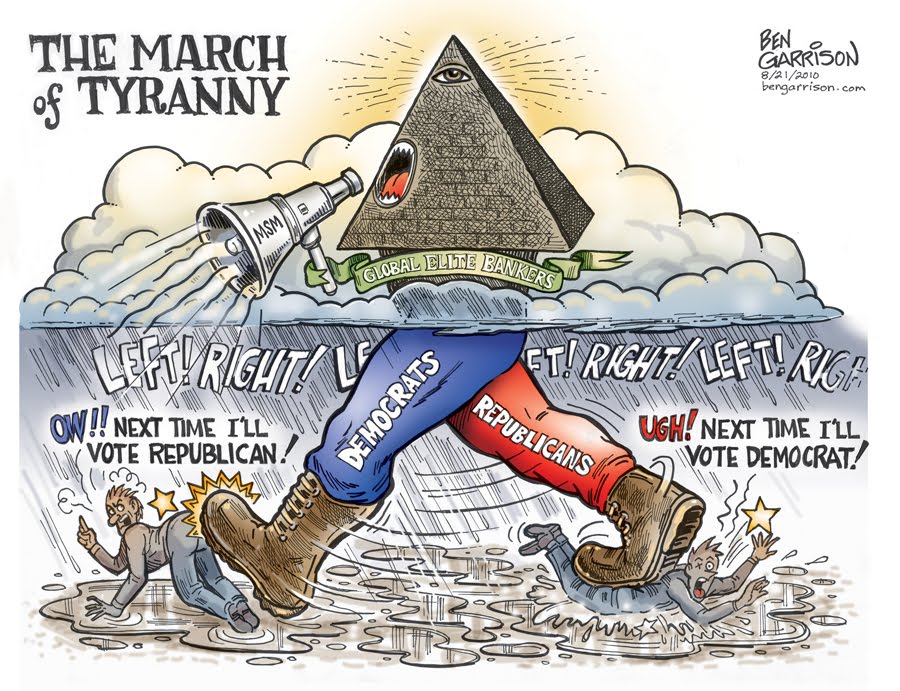
Day by day, tyranny is rising as freedom falls.

The U.S. military is being used to patrol subway stations and police the U.S.-Mexico border, supposedly in the name of national security.

The financial sector is being used to carry out broad surveillance of Americans’ private financial data, while the entertainment sector is being tapped to inform on video game enthusiasts with a penchant for violent, potentially extremist content, all in an alleged effort to uncover individuals subscribing to anti-government sentiments

Public and private venues are being equipped with sophisticated surveillance technologies, including biometric and facial recognition software, to track Americans wherever they go and whatever they do. Space satellites with powerful overhead surveillance cameras will render privacy null and void.

This is the state of our nation that no is talking about—not the politicians, not the courts, and not Congress: the government’s power grabs are growing bolder, while the rights of the citizenry continue to be trampled underfoot.

Hitler is hiding in the shadows, while the citizenry—the only ones powerful enough to stem the authoritarian tide that threatens to lay siege to our constitutional republic—remain easily distracted and conveniently diverted by political theatrics and news cycles that change every few days.

This sorry truth has persisted no matter which party has controlled Congress or the White House.  

These are dangerous times.

Yet while the presidential candidates talk at length about the dangers posed by the opposition party, the U.S. government still poses the gravest threat to our freedoms and way of life.

Police shootings of unarmed individuals, invasive surveillance, roadside blood draws, roadside strip searches, SWAT team raids gone awry, the military industrial complex’s costly wars, pork barrel spending, pre-crime laws, civil asset forfeiture, fusion centers, militarization, armed drones, smart policing carried out by AI robots, courts that march in lockstep with the police state, schools that function as indoctrination centers, bureaucrats that keep the Deep State in power: these are just a few of the ways in which the police state continues to flex its muscles in a show of force intended to intimidate anyone still clinging to the antiquated notion that the government answers to “we the people.”

Consider for yourself the state of our nation:

Americans have little protection against police abuse. The police and other government agents have been generally empowered to probe, poke, pinch, taser, search, seize, strip and generally manhandle anyone they see fit in almost any circumstance, all with the general blessing of the courts. It is no longer unusual to hear about incidents in which police shoot unarmed individuals first and ask questions later. What is increasingly common, however, is the news that the officers involved in these incidents get off with little more than a slap on the hands.

Americans are little more than pocketbooks to fund the police state. If there is any absolute maxim by which the federal government seems to operate, it is that the American taxpayer always gets ripped off. This is true, whether you’re talking about taxpayers being forced to fund high-priced weaponry that will be used against us, endless wars that do little for our safety or our freedoms, or bloated government agencies with their secret budgets, covert agendas and clandestine activities.

Americans are no longer innocent until proven guilty. We once operated under the assumption that you were innocent until proven guilty. Due in large part to rapid advances in technology and a heightened surveillance culture, the burden of proof has been shifted so that the right to be considered innocent until proven guilty has been usurped by a new norm in which all citizens are suspects. Indeed, the government—in cahoots with the corporate state—has erected the ultimate suspect society. In such an environment, we are all potentially guilty of some wrongdoing or other.

Americans no longer have a right to self-defense. While the courts continue to disagree over the exact nature of the rights protected by the Second Amendment, the government itself has made its position extremely clear. When it comes to gun rights in particular, and the rights of the citizenry overall, the U.S. government has adopted a “do what I say, not what I do” mindset. Nowhere is this double standard more evident than in the government’s attempts to arm itself to the teeth, all the while viewing as suspect anyone who dares to legally own a gun, let alone use one in self-defense. Indeed, while it still technically remains legal to own a firearm in America, possessing one can now get you pulled over, searched, arrested, subjected to all manner of surveillance, treated as a suspect without ever having committed a crime, shot at, and killed.

Americans no longer have a right to private property. If government agents can invade your home, break down your doors, kill your dog, damage your furnishings and terrorize your family, your property is no longer private and secure—it belongs to the government. Likewise, if government officials can fine and arrest you for growing vegetables in your front yard, praying with friends in your living room, installing solar panels on your roof, and raising chickens in your backyard, you’re no longer the owner of your property.

Americans no longer have a say about what their children are exposed to in school. Incredibly, the government continues to insist that parents essentially forfeit their rights when they send their children to a public school. This growing tension over whether young people, especially those in the public schools, are essentially wards of the state, to do with as government officials deem appropriate, in defiance of the children’s constitutional rights and those of their parents, is at the heart of almost every debate over educational programming, school discipline, and the extent to which parents have any say over their children’s wellbeing in and out of school.

Americans are powerless in the face of militarized police forces. With local police agencies acquiring military-grade weaponry, training and equipment better suited for the battlefield, Americans are finding their once-peaceful communities transformed into military outposts patrolled by a standing military army.

Americans no longer have a right to bodily integrity. The debate over bodily integrity covers broad territory, ranging from abortion and euthanasia to forced blood draws, biometric surveillance and basic healthcare. Forced vaccinations, forced cavity searches, forced colonoscopies, forced blood draws, forced breath-alcohol tests, forced DNA extractions, forced eye scans, forced inclusion in biometric databases: these are just a few ways in which Americans continue to be reminded that we have no control over what happens to our bodies during an encounter with government officials.

Americans no longer have a right to the expectation of privacy. Despite the staggering number of revelations about government spying on Americans’ phone calls, Facebook posts, Twitter tweets, Google searches, emails, bookstore and grocery purchases, bank statements, commuter toll records, etc., Congress, the president and the courts have done little to nothing to counteract these abuses. Instead, they seem determined to accustom us to life in this electronic concentration camp.

Americans no longer have a representative government. We have moved beyond the era of representative government and entered the age of authoritarianism, where all citizens are suspects, security trumps freedom, and so-called elected officials represent the interests of the corporate power elite. This topsy-turvy travesty of law and government has become America’s new normal.

Americans can no longer rely on the courts to mete out justice. The U.S. Supreme Court was intended to be an institution established to intervene and protect the people against the government and its agents when they overstep their bounds. Yet through their deference to police power, preference for security over freedom, and evisceration of our most basic rights for the sake of order and expediency, the justices of the Supreme Court have become the architects of the American police state in which we now live, while the lower courts have appointed themselves courts of order, concerned primarily with advancing the government’s agenda, no matter how unjust or illegal.

I haven’t even touched on the corporate state, the military industrial complex, SWAT team raids, invasive surveillance technology, zero tolerance policies in the schools, overcriminalization, or privatized prisons, to name just a few, but what I have touched on should be enough to show that the landscape of our freedoms has already changed dramatically from what it once was and will no doubt continue to deteriorate unless Americans can find a way to wrest back control of their government and reclaim their freedoms.

This steady slide towards tyranny, meted out by militarized local and federal police and legalistic bureaucrats, has been carried forward by each successive president over the past seventy-plus years regardless of their political affiliation.

The more things change, the more they stay the same.

We are walking a dangerous path right now.

Having allowed the government to expand and exceed our reach, we find ourselves on the losing end of a tug-of-war over control of our country and our lives. And for as long as we let them, government officials will continue to trample on our rights, always justifying their actions as being for the good of the people.

Yet the government can only go as far as “we the people” allow. Therein lies the problem.

The pickle we find ourselves in speaks volumes about the nature of the government beast we have been saddled with and how it views the rights and sovereignty of “we the people.”

Now you don’t hear a lot about sovereignty anymore. Sovereignty is a dusty, antiquated term that harkens back to an age when kings and emperors ruled with absolute power over a populace that had no rights. Americans turned the idea of sovereignty on its head when they declared their independence from Great Britain and rejected the absolute authority of King George III. In doing so, Americans claimed for themselves the right to self-government and established themselves as the ultimate authority and power.

In other words, in America, “we the people”— sovereign citizens—call the shots.

So when the government acts, it is supposed to do so at our bidding and on our behalf, because we are the rulers.

That’s not exactly how it turned out, though, is it?

In the 200-plus years since we boldly embarked on this experiment in self-government, we have been steadily losing ground to the government’s brazen power grabs, foisted upon us in the so-called name of national security.

We have relinquished control over the most intimate aspects of our lives to government officials who, while they may occupy seats of authority, are neither wiser, smarter, more in tune with our needs, more knowledgeable about our problems, nor more aware of what is really in our best interests.

The government has knocked us off our rightful throne. It has usurped our rightful authority. It has staged the ultimate coup. Its agents no longer even pretend that they answer to “we the people.”

Worst of all, “we the people” have become desensitized to this constant undermining of our freedoms.

How do we reconcile the Founders’ vision of the government as an entity whose only purpose is to serve the people with the police state’s insistence that the government is the supreme authority, that its power trumps that of the people themselves, and that it may exercise that power in any way it sees fit (that includes government agents crashing through doors, mass arrests, ethnic cleansing, racial profiling, indefinite detentions without due process, and internment camps)?

They cannot be reconciled. They are polar opposites.

We are fast approaching a moment of reckoning where we will be forced to choose between the vision of what America was intended to be (a model for self-governance where power is vested in the people) and the reality of what it has become (a police state where power is vested in the government).

We are repeating the mistakes of history—namely, allowing a totalitarian state to reign over us.

Former concentration camp inmate Hannah Arendt warned against this when she wrote:

“No matter what the specifically national tradition or the particular spiritual source of its ideology, totalitarian government always transformed classes into masses, supplanted the party system, not by one-party dictatorships, but by mass movement, shifted the center of power from the army to the police, and established a foreign policy openly directed toward world domination.”

So where does that leave us?

Aldous Huxley predicted that eventually the government would find a way of “making people love their servitude, and producing dictatorship without tears, so to speak, producing a kind of painless concentration camp for entire societies, so that people will in fact have their liberties taken away from them, but will rather enjoy it, because they will be distracted from any desire to rebel by propaganda or brainwashing, or brainwashing enhanced by pharmacological methods. And this seems to be the final revolution.”

The answer? Get un-brainwashed, as I make clear in my book Battlefield America: The War on the American People and in its fictional counterpart The Erik Blair Diaries,

Stop allowing yourself to be distracted and diverted.

Learn your rights.

Stand up for the founding principles.

Make your voice and your vote count for more than just political posturing.

Never cease to vociferously protest the erosion of your freedoms at the local and national level.

Most of all, do these things today.

The Global Deep State: A Fascist World Order Funded by the American Taxpayer

By John & Nisha Whitehead

Source: The Rutherford Institute

“The madmen are in power.”— Philip K. Dick, The Man in the High Castle

The debate over U.S. foreign aid is a distraction.

That’s not to say that the amount of taxpayer money flowing to foreign countries in the form of military and economic assistance is insignificant. Even at less than 1% of the federal budget, the United States still spends more on foreign aid than any other nation.

The latest foreign aid spending bill includes $95 billion for Ukraine, Israel and Taiwan.

Since World War II, the U.S. has given more foreign aid to Israel than any other country ($318 billion), with the bulk of those funds designated for Israel’s military efforts.

Even so, more than 150 countries around the world receive U.S. taxpayer-funded assistance.

As Forbes reports, “U.S. foreign aid dwarfs the federal funds spent by 48 out of 50 state governments annually. Only the state governments of California and New York spent more federal funds than what the U.S. sent abroad each year to foreign countries.”

Whether or not that some of that foreign aid is used for legitimate purposes, the global welfare system itself is riddled with corruption and waste. As Adam Andrzejewski rightly asks, “Do taxpayers instinctively know that they are funding choir directors in Turkmenistan, filmmakers in Peru, aid for poultry farmers Tanzania, and sex education workshops for prostitutes in Ethiopia?”

The problem is not so much that taxpayers are unaware of how their hard-earned dollars are being spent. Rather, “we the people” continue to be told that we have no say in the matter.

We have no real say in how the government runs, or how our taxpayer funds are used, but that doesn’t prevent the government from fleecing us at every turn and forcing us to pay for endless wars that do more to fund the military industrial complex than protect us, pork barrel projects that produce little to nothing, and a police state that serves only to imprison us within its walls.

This financial tyranny persists whether it’s a Democrat or Republican at the helm.

At a time when the government is spending money it doesn’t have on programs it can’t afford, the national debt continues to grow, our infrastructure continues to deteriorate, and our borders continue to be breached.

What is going on?

The “government of the people, by the people, for the people” has been overtaken by a shadow government—a corporatized, militarized, entrenched global bureaucracy—that is fully operational and running the country.

This powerful international cabal made up of international government agencies and corporations—let’s call it the Global Deep State—is just as real as the corporatized, militarized, industrialized American Deep State, and it poses just as great a threat to our rights as individuals under the U.S. Constitution, if not greater.

Clearly, we have entered into a new world order: fascism on a global scale.

It remains unclear whether the American Deep State (“a national-security apparatus that holds sway even over the elected leaders notionally in charge of it”) answers to the Global Deep State, or whether the Global Deep State merely empowers the American Deep State. However, there is no denying the extent to which they are intricately and symbiotically enmeshed and interlocked.

Consider the extent to which our lives and liberties are impacted by this international convergence of governmental and profit-driven corporate interests in the surveillance state, the military industrial complex, the private prison industry, the intelligence sector, the security sector, the technology sector, the telecommunications sector, the transportation sector, and in recent years, the pharmaceutical-health sector.

All of these sectors are dominated by mega-corporations operating on a global scale and working through government channels to increase their profit margins. The profit-driven policies of these global corporate giants influence everything from legislative policies to economics to environmental issues to medical care.

Global Disease

The COVID-19 pandemic propelled us into a whole new global frontier in which those hoping to navigate this interconnected and highly technological world of contact tracing, vaccine passports and digital passes find themselves grappling with issues that touch on deep-seated moral, political, religious and personal questions for which there may be no clear-cut answers.

Our ability to access, engage and move about in the world has now become dependent on which camp we fall into: those who have been vaccinated against whatever the powers-that-be deem to be the latest Disease X versus those who have not.

This is what M.I.T. professor Ramesh Raskar refers to as the new “currency for health,” an apt moniker given the potentially lucrative role that Big Business (Big Pharma and Big Tech, especially) will play in establishing this pay-to-play marketplace. The airline industry has been working on a Travel Pass. IBM is developing a Digital Health Pass. And the U.S. government has been all-too-happy to allow the corporate sector to take the lead.

“It is the latest status symbol. Flash it at the people, and you can get access to concerts, sports arenas or long-forbidden restaurant tables. Some day, it may even help you cross a border without having to quarantine,” writes Heather Murphy for the New York Times. “The new platinum card of the Covid age is the vaccine certificate.”

Global Surveillance

Spearheaded by the National Security Agency, which has shown itself to care little for constitutional limits or privacy, the surveillance state has come to dominate our government and our lives.

Yet the government does not operate alone. It cannot. It requires an accomplice. Thus, the increasingly complex security needs of our massive federal government, especially in the areas of defense, surveillance and data management, have been met within the corporate sector, which has shown itself to be a powerful ally that both depends on and feeds the growth of governmental bureaucracy.

Take AT&T, for instance. Through its vast telecommunications network that crisscrosses the globe, AT&T provides the U.S. government with the complex infrastructure it needs for its mass surveillance programs. According to The Intercept:

“The NSA considers AT&T to be one of its most trusted partners and has lauded the company’s ‘extreme willingness to help.’ It is a collaboration that dates back decades. Little known, however, is that its scope is not restricted to AT&T’s customers. According to the NSA’s documents, it values AT&T not only because it ‘has access to information that transits the nation,’ but also because it maintains unique relationships with other phone and internet providers. The NSA exploits these relationships for surveillance purposes, commandeering AT&T’s massive infrastructure and using it as a platform to covertly tap into communications processed by other companies.”

Now magnify what the U.S. government is doing through AT&T on a global scale, and you have the “14 Eyes Program,” also referred to as the “SIGINT Seniors.” This global spy agency is made up of members from around the world (United States, United Kingdom, Australia, Canada, New Zealand, Denmark, France, Netherlands, Norway, Germany, Belgium, Italy, Sweden, Spain, Israel, Singapore, South Korea, Japan, India and all British Overseas Territories).

Surveillance is just the tip of the iceberg when it comes to these global alliances, however.

Global War Profiteering

War has become a huge money-making venture, and America, with its vast military empire and its incestuous relationship with a host of international defense contractors, is one of its biggest buyers and sellers.

The American military-industrial complex has erected an empire unsurpassed in history in its breadth and scope, one dedicated to conducting perpetual warfare throughout the earth. For example, while erecting a security surveillance state in the U.S., the military-industrial complex has perpetuated a worldwide military empire with American troops stationed in 177 countries (over 70% of the countries worldwide).

Although the federal government obscures so much about its defense spending that accurate figures are difficult to procure, we do know that since 2001, the U.S. government has spent more than $1.8 trillion in the wars in Afghanistan and Iraq (that’s $8.3 million per hour). That doesn’t include wars and military exercises waged around the globe, which are expected to push the total bill upwards of $12 trillion by 2053.

The illicit merger of the global armaments industry and the Pentagon that President Dwight D. Eisenhower warned us against more than 50 years ago has come to represent perhaps the greatest threat to the nation’s fragile infrastructure today. America’s expanding military empire is bleeding the country dry at a rate of more than $15 billion a month (or $20 million an hour)—and that’s just what the government spends on foreign wars. That does not include the cost of maintaining and staffing the 1000-plus U.S. military bases spread around the globe.

Incredibly, although the U.S. constitutes only 5% of the world’s population, America boasts almost 50% of the world’s total military expenditure,  spending more on the military than the next 19 biggest spending nations combined. In fact, the Pentagon spends more on war than all 50 states combined spend on health, education, welfare, and safety. There’s a good reason why “bloated,” “corrupt” and “inefficient” are among the words most commonly applied to the government, especially the Department of Defense and its contractors. Price gouging has become an accepted form of corruption within the American military empire.

It’s not just the American economy that is being gouged, unfortunately.

Driven by a greedy defense sector, the American homeland has been transformed into a battlefield with militarized police and weapons better suited to a war zone. President Biden, marching in lockstep with his predecessors, has continued to expand America’s military empire abroad and domestically in a clear bid to pander to the powerful money interests (military, corporate and security) that run the Deep State and hold the government in its clutches.

Global Policing

Glance at pictures of international police forces and you will have a hard time distinguishing between American police and those belonging to other nations. There’s a reason they all look alike, garbed in the militarized, weaponized uniform of a standing army.

There’s a reason why they act alike, too, and speak a common language of force: they belong to a global police force.

For example, Israel—one of America’s closest international allies and one of the primary yearly recipients of more than $3 billion in U.S. foreign military aid—has been at the forefront of a little-publicized exchange program aimed at training American police to act as occupying forces in their communities. As The Intercept sums it up, American police are “essentially taking lessons from agencies that enforce military rule rather than civil law.”

This idea of global policing is reinforced by the Strong Cities Network program, which trains local police agencies across America in how to identify, fight and prevent extremism, as well as address intolerance within their communities, using all of the resources at their disposal. The cities included in the global network include New York City, Atlanta, Denver, Minneapolis, Paris, London, Montreal, Beirut and Oslo.

The objective is to prevent violent extremism by targeting its source: racism, bigotry, hatred, intolerance, etc. In other words, police—acting as extensions of the United Nations—will identify, monitor and deter individuals who exhibit, express or engage in anything that could be construed as extremist.

Of course, the concern with the government’s anti-extremism program is that it will, in many cases, be utilized to render otherwise lawful, nonviolent activities as potentially extremist.

Keep in mind that the government agencies involved in ferreting out American “extremists” will carry out their objectives—to identify and deter potential extremists—in concert with fusion centers (of which there are 78 nationwide, with partners in the private sector and globally), data collection agencies, behavioral scientists, corporations, social media, and community organizers and by relying on cutting-edge technology for surveillance, facial recognition, predictive policing, biometrics, and behavioral epigenetics (in which life experiences alter one’s genetic makeup).

This is pre-crime on an ideological scale and it’s been a long time coming.

Are you starting to get the picture now?

The government and its global partners have struck a deal that puts the American people on the losing end of the bargain.

On almost every front, whether it’s the war on drugs, or the sale of weapons, or regulating immigration, or establishing prisons, or advancing technology, or fighting a pandemic, if there is a profit to be made and power to be amassed, our freedoms are being eroded while the Global Deep State becomes more entrenched.

We’ve been losing our freedoms so incrementally for so long—sold to us in the name of national security and global peace, maintained by way of martial law disguised as law and order, and enforced by a standing army of militarized police and a political elite determined to maintain their powers at all costs—that it’s hard to pinpoint exactly when it all started going downhill, but we’re certainly on that downward slope now, and things are moving fast.

Given the dramatic expansion, globalization and merger of governmental and corporate powers, we’re not going to recognize this country 20 years from now.

As I make clear in my book Battlefield America: The War on the American People and in its fictional counterpart The Erik Blair Diaries, the U.S. government will not save us from the chains of the Global Deep State. It’s too busy selling us to the highest bidder.

2024 Is the New 1984: Big Brother and the Rise of the Security Industrial Complex

By John & Nisha Whitehead

Source: The Rutherford Institute

“Big Brother is Watching You.”―George Orwell, 1984

2024 is the new 1984.

Forty years past the time that George Orwell envisioned the stomping boot of Big Brother, the police state is about to pass off the baton to the surveillance state.

Fueled by a melding of government and corporate power—the rise of the security industrial complex—this watershed moment sounds a death knell for our privacy rights.

An unofficial fourth branch of government, the Surveillance State came into being without any electoral mandate or constitutional referendum, and yet it possesses superpowers, above and beyond those of any other government agency save the military.

It operates beyond the reach of the president, Congress and the courts, and it marches in lockstep with the corporate elite who really call the shots in Washington, DC.

This is the new face of tyranny in America: all-knowing, all-seeing and all-powerful.

Tread cautiously.

Empowered by advances in surveillance technology and emboldened by rapidly expanding public-private partnerships between law enforcement, the Intelligence Community, and the private sector, the Surveillance State is making the fictional world of 1984, Orwell’s dystopian nightmare, our looming reality.

1984 portrays a global society of total control in which people are not allowed to have thoughts that in any way disagree with the corporate state. There is no personal freedom, and advanced technology has become the driving force behind a surveillance-driven society. Snitches and cameras are everywhere. People are subject to the Thought Police, who deal with anyone guilty of thought crimes. The government, or “Party,” is headed by Big Brother who appears on posters everywhere with the words: “Big Brother is watching you.”

Indeed, in our present age of ubiquitous surveillance, there are no private lives.

Everything is increasingly public.

What we are witnessing, in the so-called name of security and efficiency, is the creation of a new class system comprised of the watched (average Americans such as you and me) and the watchers (government bureaucrats, technicians and private corporations).

We now find ourselves in the unenviable position of being monitored, managed and controlled by our technology, which answers not to us but to our government and corporate rulers.

This is the fact-is-stranger-than-fiction lesson that is being pounded into us on a daily basis.

In this way, 1984, which depicted the ominous rise of ubiquitous technology, fascism and totalitarianism, has become an operation manual for the omnipresent, modern-day surveillance state.

There are roughly one billion surveillance cameras worldwide and that number continues to grow, thanks to their wholehearted adoption by governments (especially law enforcement and military agencies), businesses, and individual consumers.

Surveillance cameras mounted on utility poles, traffic lights, businesses, and homes. Ring doorbells. GPS devices. Dash cameras. Drones. Store security cameras. Geofencing and geotracking. FitBits. Alexa. Internet-connected devices. 

Stingray devices, facial recognition technology, body cameras, automated license plate readers, gunshot detection, predictive policing software, AI-enhanced video analytics, real-time crime centers, fusion centers: all of these technologies and surveillance programs rely on public-private partnerships that together create a sticky spiderweb from which there is no escape.

With every new surveillance device we welcome into our lives, the government gains yet another toehold into our private worlds.

As the cost of these technologies becomes more affordable for the average consumer, an effort underwritten by the tech industry and encouraged by law enforcement agencies and local governing boards, which in turn benefit from access to surveillance they don’t need to include in their budgets, big cities, small towns, urban, suburban and rural communities alike are adding themselves to the surveillance state’s interconnected grid.

What this adds up to for government agencies (that is, FBI, NSA, DHS agents, etc., as well as local police) is a surveillance map that allows them to track someone’s movements over time and space, hopscotching from doorbell camera feeds and business security cameras to public cameras on utility poles, license plate readers, traffic cameras, drones, etc.

It has all but eliminated the notion of privacy enshrined in the  Fourth Amendment and radically re-drawn the line of demarcation between our public and private selves.

The police state has become particularly adept at sidestepping the Fourth Amendment, empowered by advances in surveillance technology and emboldened by rapidly expanding public-private partnerships between law enforcement, the Intelligence Community, and the private sector.

Over the past 50-plus years, surveillance has brought about a series of revolutions in how governments govern and populations are policed to the detriment of us all. Cybersecurity expert Adam Scott Wandt has identified three such revolutions.

The first surveillance revolution came about as a result of government video cameras being installed in public areas. There were a reported 51 million surveillance cameras blanketing the United States in 2022. It’s estimated that Americans are caught on camera an average of 238 times every week (160 times per week while driving; 40 times per week at work; 24 times per week while out running errands and shopping; and 14 times per week through various other channels and activities). That doesn’t even touch on the coverage by surveillance drones, which remain a relatively covert part of police spying operations.

The second revolution occurred when law enforcement agencies started forging public-private partnerships with commercial establishments like banks and drug stores and parking lots in order to gain access to their live surveillance feeds. The use of automatic license plate readers (manufactured and distributed by the likes of Flock Safety), once deployed exclusively by police and now spreading to home owners associations and gated communities, extends the reach of the surveillance state that much further afield. It’s a win-win for police budgets and local legislatures when they can persuade businesses and residential communities to shoulder the costs of the equipment and share the footage, and they can conscript the citizenry to spy on each other through crowdsourced surveillance.

The third revolution was ushered in with the growing popularity of doorbell cameras such as Ring, Amazon’s video surveillance doorbell, and Google’s Nest Cam.

Amazon has been particularly aggressive in its pursuit of a relationship with police, enlisting them in its marketing efforts, and going so far as to hosting parties for police, providing free Ring doorbells and deep discounts, sharing “active camera” maps of Ring owners, allowing access to the Law Enforcement Neighborhood Portal, which enables police to directly contact owners for access to their footage, and coaching police on how to obtain footage without a warrant.

Ring currently partners with upwards of 2,161 law enforcement agencies and 455 fire departments, and that number grows exponentially every year. As Vice reports, “Ring has also heavily pursued city discount programs and private alliances with neighborhood watch groups. When cities provide free or discounted Ring cameras, they sometimes create camera registries, and police sometimes order people to aim Ring cameras at their neighbors, or only give cameras to people surveilled by neighborhood watches.”

In November 2022, San Francisco police gained access to the live footage of privately owned internet cameras as opposed to merely being able to access recorded footage. No longer do police even have to request permission of homeowners for such access: increasingly, corporations have given police access to footage as part of their so-called criminal investigations with or without court orders.

The fourth revolutionary shift may well be the use of facial recognition software and artificial intelligence-powered programs that can track people by their biometrics, clothing, behavior and car, thereby synthesizing the many strands of surveillance video footage into one cohesive narrative, which privacy advocates refer to as 360 degree surveillance.

While the guarantee of safety afforded by these surveillance nerve centers remains dubious, at best, there is no disguising their contribution in effecting a sea change towards outright authoritarianism.

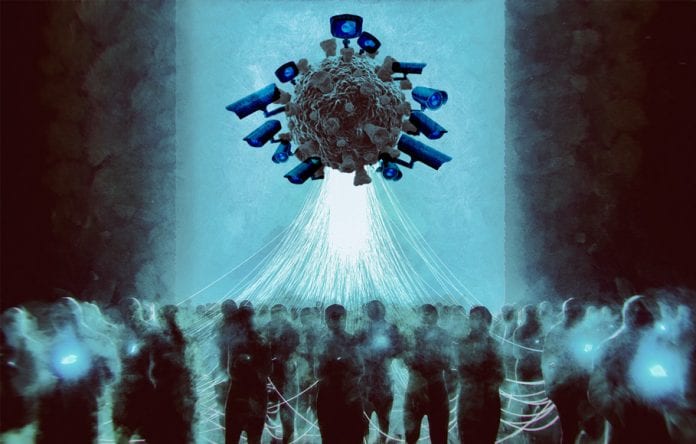
For instance, as an in-depth investigative report by the Associated Press concludes, the very same mass surveillance technologies that were supposedly so necessary to fight the spread of COVID-19 are now being used to stifle dissent, persecute activists, harass marginalized communities, and link people’s health information to other surveillance and law enforcement tools.

As the AP reports, federal officials have also been looking into how to add “‘identifiable patient data,’ such as mental health, substance use and behavioral health information from group homes, shelters, jails, detox facilities and schools,” to its surveillance toolkit.

These cameras—and the public-private eyes peering at us through them—are re-engineering a society structured around the aesthetic of fear and, in the process, empowering “people to not just watch their neighborhood, but to organize as watchers,” creating not just digital neighborhood watches but digital gated communities.

Finally, there is a repressive, suppressive effect to surveillance that not only acts as a potentially small deterrent on crime but serves to monitor and chill lawful First Amendment activity.

As Matthew Feeney warns in the New York Times, “In the past, Communists, civil rights leaders, feminists, Quakers, folk singers, war protesters and others have been on the receiving end of law enforcement surveillance. No one knows who the next target will be.

No one knows, but it’s a pretty good bet that the surveillance state will be keeping a close watch on anyone seen as a threat to the government’s chokehold on power.

After all, as I make clear in my book Battlefield America: The War on the American People and in its fictional counterpart The Erik Blair Diaries, the Surveillance State never sleeps.

Criminality in the White House: The Rise of the Political Psychopath

By John & Nisha Whitehead

Source: The Rutherford Institute

“When the President does it, that means that it is not illegal.”—Richard Nixon

Many years ago, a newspaper headline asked the question: “What’s the difference between a politician and a psychopath?

The answer, then and now, remains the same: None.

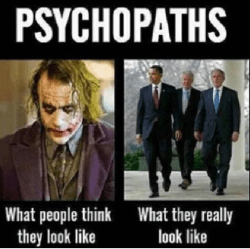
There is no difference between psychopaths and politicians.

Nor is there much of a difference between the havoc wreaked on innocent lives by uncaring, unfeeling, selfish, irresponsible, parasitic criminals and elected officials who lie to their constituents, trade political favors for campaign contributions, turn a blind eye to the wishes of the electorate, cheat taxpayers out of hard-earned dollars, favor the corporate elite, entrench the military industrial complex, and spare little thought for the impact their thoughtless actions and hastily passed legislation might have on defenseless citizens.

Psychopaths and politicians both have a tendency to be selfish, callous, remorseless users of others, irresponsible, pathological liars, glib, con artists, lacking in remorse and shallow.

Charismatic politicians, like criminal psychopaths, exhibit a failure to accept responsibility for their actions, have a high sense of self-worth, are chronically unstable, have socially deviant lifestyles, need constant stimulation, have parasitic lifestyles and possess unrealistic goals.

It doesn’t matter whether you’re talking about Democrats or Republicans.

Political psychopaths are all largely cut from the same pathological cloth, brimming with seemingly easy charm and boasting calculating minds. Such leaders eventually create pathocracies: totalitarian societies bent on power, control, and destruction of both freedom in general and those who exercise their freedoms.

Once psychopaths gain power, the result is usually some form of totalitarian government or a pathocracy. “At that point, the government operates against the interests of its own people except for favoring certain groups,” author James G. Long notes. “We are currently witnessing deliberate polarizations of American citizens, illegal actions, and massive and needless acquisition of debt. This is typical of psychopathic systems, and very similar things happened in the Soviet Union as it overextended and collapsed.”

In other words, electing a psychopath to public office is tantamount to national hara-kiri, the ritualized act of self-annihilation, self-destruction and suicide. It signals the demise of democratic government and lays the groundwork for a totalitarian regime that is legalistic, militaristic, inflexible, intolerant and inhuman.

Incredibly, despite clear evidence of the damage that has already been inflicted on our nation and its citizens by a psychopathic government, voters continue to elect psychopaths to positions of power and influence.

Indeed, a study from Southern Methodist University found that Washington, DC—our nation’s capital and the seat of power for our so-called representatives—ranks highest on the list of regions that are populated by psychopaths.

According to investigative journalist Zack Beauchamp, “In 2012, a group of psychologists evaluated every President from Washington to Bush II using ‘psychopathy trait estimates derived from personality data completed by historical experts on each president.’ They found that presidents tended to have the psychopath’s characteristic fearlessness and low anxiety levels — traits that appear to help Presidents, but also might cause them to make reckless decisions that hurt other people’s lives.”

The willingness to prioritize power above all else, including the welfare of their fellow human beings, ruthlessness, callousness and an utter lack of conscience are among the defining traits of the sociopath.

When our own government no longer sees us as human beings with dignity and worth but as things to be manipulated, maneuvered, mined for data, manhandled by police, conned into believing it has our best interests at heart, mistreated, jailed if we dare step out of line, and then punished unjustly without remorse—all the while refusing to own up to its failings—we are no longer operating under a constitutional republic.

Instead, what we are experiencing is a pathocracy: tyranny at the hands of a psychopathic government, which “operates against the interests of its own people except for favoring certain groups.”

Worse, psychopathology is not confined to those in high positions of government. It can spread like a virus among the populace. As an academic study into pathocracy concluded, “[T]yranny does not flourish because perpetuators are helpless and ignorant of their actions. It flourishes because they actively identify with those who promote vicious acts as virtuous.”

People don’t simply line up and salute. It is through one’s own personal identification with a given leader, party or social order that they become agents of good or evil.

Much depends on how leaders “cultivate a sense of identification with their followers,” says Professor Alex Haslam. “I mean one pretty obvious thing is that leaders talk about ‘we’ rather than ‘I,’ and actually what leadership is about is cultivating this sense of shared identity about ‘we-ness’ and then getting people to want to act in terms of that ‘we-ness,’ to promote our collective interests. . . . [We] is the single word that has increased in the inaugural addresses over the last century . . . and the other one is ‘America.’”

The goal of the modern corporate state is obvious: to promote, cultivate, and embed a sense of shared identification among its citizens. To this end, “we the people” have become “we the police state.”

We are fast becoming slaves in thrall to a faceless, nameless, bureaucratic totalitarian government machine that relentlessly erodes our freedoms through countless laws, statutes, and prohibitions.

Any resistance to such regimes depends on the strength of opinions in the minds of those who choose to fight back. What this means is that we the citizenry must be very careful that we are not manipulated into marching in lockstep with an oppressive regime.

Writing for ThinkProgress, Beauchamp suggests that “one of the best cures to bad leaders may very well be political democracy.”

But what does this really mean in practical terms?

It means holding politicians accountable for their actions and the actions of their staff using every available means at our disposal: through investigative journalism (what used to be referred to as the Fourth Estate) that enlightens and informs, through whistleblower complaints that expose corruption, through lawsuits that challenge misconduct, and through protests and mass political action that remind the powers-that-be that “we the people” are the ones that call the shots.

Remember, education precedes action. Citizens need to the do the hard work of educating themselves about what the government is doing and how to hold it accountable. Don’t allow yourselves to exist exclusively in an echo chamber that is restricted to views with which you agree. Expose yourself to multiple media sources, independent and mainstream, and think for yourself.

For that matter, no matter what your political leanings might be, don’t allow your partisan bias to trump the principles that serve as the basis for our constitutional republic. As Beauchamp notes, “A system that actually holds people accountable to the broader conscience of society may be one of the best ways to keep conscienceless people in check.”

That said, if we allow the ballot box to become our only means of pushing back against the police state, the battle is already lost.

Resistance will require a citizenry willing to be active at the local level.

Yet if you wait to act until the SWAT team is crashing through your door, until your name is placed on a terror watch list, until you are reported for such outlawed activities as collecting rainwater or letting your children play outside unsupervised, then it will be too late.

This much I know: we are not faceless numbers.

We are not cogs in the machine.

As I make clear in my book Battlefield America: The War on the American People and in its fictional counterpart The Erik Blair Diaries, we are not slaves.

We are human beings, and for the moment, we have the opportunity to remain free—that is, if we tirelessly advocate for our rights and resist at every turn attempts by the government to place us in chains.

The Founders understood that our freedoms do not flow from the government. They were not given to us only to be taken away by the will of the State. They are inherently ours. In the same way, the government’s appointed purpose is not to threaten or undermine our freedoms, but to safeguard them.

Until we can get back to this way of thinking, until we can remind our fellow Americans what it really means to be free, and until we can stand firm in the face of threats to our freedoms, we will continue to be treated like slaves in thrall to a bureaucratic police state run by political psychopaths.

Daydreaming While Reading Jonathan Crary’s 24/7: Late Capitalism and the Ends of Sleep

By Edward Curtin

Source: Behind the Curtain

“Sleep that knits up the raveled sleave of care, The death of each day’s life, sore labor’s bath, Balm of hurt minds, great nature’s second course, Chief nourisher in life’s feast.”   – Shakespeare, Macbeth

People often laugh when I tell them that I go to sleep at 8:15 P.M.  They laugh harder when I say it’s been a lifetime habit, with unavoidable exceptions of course.  And that I wake up long before dawn.  Not because I am a dairy farmer or a baker, but because I love to sleep and all the best things I have written have been written in my dreams and refined during reveries while walking or in the early morning when all is silent still and I am alone with my musings.  I have always felt that sleeping and being awake were a seamless whole, contrary to the go-getters’ attitude that sleep and dreams are a waste of time, and I have been blessed with the ability to fall asleep as soon as I crawl into my crib and usually to remember my dreams in detail when I wake.

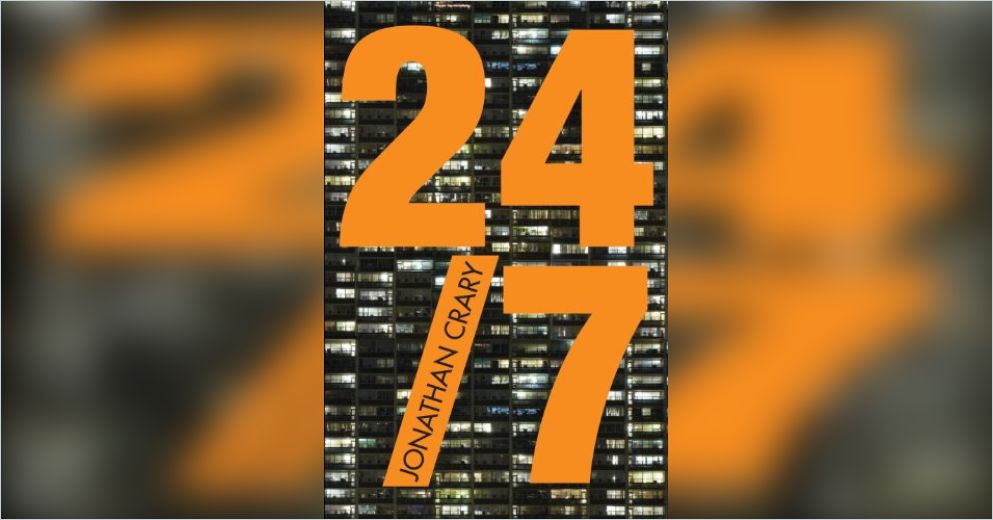
Jonathan Crary, the Meyer Schapiro Professor of Modern Art and Theory at Columbia University, agrees that sleep is profoundly important and under assault today.  To enter his book, 24/7, Late Capitalism and the Ends of Sleep, (which was first published in 2014) is for me to discover a kindred spirit, but also to enter a mind so capacious and profound that I wish to share his insights while I dream in words.

If what William Wordsworth (what a name!) wrote in 1802 was true then,

The world is too much with us; late and soon,
Getting and spending, we lay waste our powers;—
Little we see in Nature that is ours;
We have given our hearts away, a sordid boon!

what possibly could one say about today?  That shopping or thinking about shopping – things or propaganda or the latest useless buzz – is all we know?  That we have become completely insane, bamboozled by a capitalist techno-electronic madness that has not only seized our hearts but convinced our minds that it is good to spend our lives – our sleep and dreams and time and praxis – in tending to machines that destroy our souls night and day without interruption.

When fifty plus years ago the monk Thomas Merton wrote that “someday they will sell us the rain,” he could today add that the hard rain that Dylan sung of then has already fallen and they now need not sell us anything because we have eaten the bitter fruit of our own corruption.  People say they want peace while they fill their nights and days with digital dreams, eliminating what Crary calls “fugitive anonymity” for the bait of 24/7 capitalist drug addiction and being “with it.”  All the clichés have it that peace begins with “you,” yet you has become them or it, the tech-life 24/7.  I hear Sinatra singing Cole Porter’s lyrics today as

Night and day, you are the one
Only you ‘neath the moon or under the sun
Whether near to me or far
It’s no matter, cell phone, where you are
I think of you day and night

And such love is reciprocated, of course, as the electronic machines help so many distracted and restless souls make it through the night.  Sort of.  Not the kind of help Kris Kristofferson sang about, but a fleshless flashing gizmo colder than a frozen heart.

It is well known that sleep disorders are widespread today with technologically produced sleep drugs (and now marijuana) used by vast numbers of people. Such drug-induced sleep, the flip side of the frenetic passivity that precedes and follows it, occurs within a larger 24/7 sleepless framework that Crary accurately notes happens “ . . . within the globalist neoliberal paradigm, [for] sleeping is for losers.”   Yet what’s to be won is never enunciated because the winners’ faces are always well-hidden as they execute the prodigious capitalist machine of control that creates docility and separation in people who find the machine life irresistible – even as it drains them of easy-going vitality and the joy of dawdling, even for an idle while.  Doing nothing has become a crime.

Last night I stepped outside an hour after sunset and was startled by a massive full moon eyeing me as it rose over the eastern hills.  Here where I dwell there are no city or factory lights to block the moon and stars as they illuminate our nights.  But most people are not so lucky, for what our ancestors once took for granted – that we are part of nature, part of the Tao – has been lost for so many as artificial lights, urbanization, and a 24/7 linguistic mind-control ideology block the thrill of being transfixed by the moon’s loving gaze, an invitation to taste the sweetness of the north wind’s cookie.  Maybe the sight of her face might rattle the televised images lodged in people’s “memories” of mechanical misbegotten men in ghost suits trampling her peaceful countenance.

The 24/7 digital life, essential to neo-liberal financialized capitalism with its day and night markets and infrastructure that allow for continuous consumption and work – total availability – is the culmination of a long process that began with the invention of artificial lighting that allowed the English cotton mills to run 24/7.  Crary brilliantly illustrates this point through the 1782 painting, Arkwright’s Cotton Mills by Night, by the British artist James Derby.  This painting shows the windows of the massive mills lit like pin-points in the rural night, watched over by a full moon that illuminates the sky.  Incongruous time indeed!  He writes, “The artificial lighting of the factories announces the rationalized deployment of an abstract relation between time and work, severed from the cyclical temporalities of lunar and solar movements.”  This radical break from the traditional relation between time and work and the earth was later noted by Karl Marx as essential to the advance of capitalism since it disconnected the laboring individual from all interdependent connections to family, community, etc. while reorienting people’s feelings for time.  The English art critic John Berger, who knew that time with its corollary to place was a key to understanding so much history, put it this way: “Every ruling minority needs to numb and, if possible, to kill the time-sense of those it exploits.  This is the authoritarian secret of all methods of imprisonment.”

Dreaming of imprisonment, I just remembered that although it seems like a delusion from so far away and long ago, I once worked in a factory by day with its huge blast furnaces, in a NYC Police precinct jail on the 4-12 P.M. shift, and all-night as a nightwatchman.   All good lessons in how American society works, although I hated them all and labored simply for the pay.  But each in its own way taught me about imprisonment, especially the watchman’s job, since it involved a jolting sense of time and staying awake all night and sleeping by day.  I was always exhausted and felt I was violating my deepest nature.

Sleep deprivation is a central component of the torturers’ methods, as so many victims of the U.S. war machine have learned.  And the Pentagon (DARPA) has spent vast sums trying to create a sleepless soldier who can go at least seven days without sleep.  As Crary notes: “ . . . scientists in various labs are conducting experimental trials of sleeplessness techniques, including neurochemicals, gene therapy, and transcranial magnetic stimulation.”   The war against sleep is being waged on many fronts by well-armed maniacs intent on controlling human beings for nefarious ends.  To control sleep is to control time is to confound minds, which is the goal.

Ovid, the most sensual of Roman poets, would be shocked, I imagine, to learn that Morpheus, the god of sleep and dreams from his Metamorphoses, would be attacked so relentlessly by today’s madmen who never heard of his poetry.  My mind drifts to my college days translating Ovid under a weeping willow.  “My cause is better: no-one can claim that I ever took up arms against you,” he wrote and I read.  These words come back to me as I muse on the arms taken today against sleep, but I’m not sure if it’s Ovid or Bob Dylan’s lyrics in his song Workingman’s Blues #2 (from the album Modern Times) that fly to mind, for Dylan also sings “No-one can ever claim/ That I took up arms against you.”

Poor Morpheus, so many people in these modern times yearn for your arms but instead of that balm, they toss and turn in a time out of mind and out of sleep.

Crary tells us that the amount of sleep the average North American adult gets has gone from ten hours in the early twentieth century to eight hours a generation ago to six-and-a-half today.  And although people will always have to sleep, I think we can expect further reductions.  To say it is a form of torture is probably an exaggeration, but not by much.  He writes:

Behind the vacuity of the catchphrase, 24/7 is a static redundancy that disavows its relation to the rhythmic and periodic textures of human life. . . . A 24/7 environment has the semblance of a social world, but it is actually a non-social model of machinic performance and a suspension of living that does not disclose the human cost required to sustain its effectiveness. . . . 24/7 is a time of indifference, against which the fragility of human life is increasingly inadequate and within which sleep has no necessity or inevitability.  In relation to labor, it renders plausible, even normal, the idea of working without pause, without limits.  It is aligned with what is inanimate, inert, or unageing.  As an advertising exhortation it decrees the absoluteness of availability, and hence the ceaselessness of needs and their incitement, but also their perpetual non-fulfillment.

In other words, 24/7 is a form of linguistic mind control tied to cell phones, computers, and the digital life of the Internet whose purpose is to convince people that sleep and the human body is somehow unnatural and the future lies with people accepting their marriage to machines in a disenchanted and transhuman world.  It is a lie, of course, for if that is a future people accept, there will be no future, just a desert.  “Deleuze and Guattari went to the point of comparing the order-word [24/7] to a ‘death sentence,’” writes Crary. Such an order-word or imperative is similar in this respect to the term “9/11” which was coined to send an instant message that emergencies will now be endless so we will have to monitor you forevermore.  Keep your cell phone ready.  Be on your toes, stay alert, the terrorists come at all hours – keep awake!

Crary makes a profoundly important point at a time when there is much justifiable focus on propaganda and the lies of governments and the media.  This is the power of habit involved in the acceptance of the naturalness of various devices – today, electronic screens that are omnipresent – that we semi-automatically accept as normal.  He says, “In this sense, they are part of larger strategies of power in which the aim is not mass-deception, but rather states of neutralization and inactivation, in which one is dispossessed of time.  But even within habitual repetitions there remains a thread of hope – a knowingly false hope – that one more click or touch might open onto something to redeem the overwhelming monotony in which one is immersed.  One of the forms of disempowerment within 24/7 environments is the incapacitation of daydream or any mode of absent-minded introspection that would otherwise occur in intervals of slow or vacant time.”

This is part of a modern process of psychological reductionism and a changed understanding of the nature of wishes that have excluded dreaming and daydreaming from any connection to a traditional magico-theological framework.  Science and especially the neuro-sciences have reduced all life to what is empirically provable, attenuating life and the creation of art in the service of human life.  Crary uses Jean Paul Satre’s inelegant but insightful neologism, “practico-inert,” to explain people’s inability to see the nature of the social worlds they are part of with any clarity.  “The practico-inert was thus Sartre’s way [in Critique of Dialectical Reason] of designating the sedimented, institutional everyday world constituted out of human energy but manifested as the immense accumulation of routine passive activity.”

To repeat, this frenetic passivity serves to obscure the negative historical reality of life in a 24/7 electronic spectacle that is advertised as amazingly empowering but is the reverse.

For direct experience has fallen on hard times as life today has come to be mediated through electronic gadgets.  Surprises must be googled in advance or photographed to prove their reality.  Living is never easy, not in the summertime or any other season. Tension, inattention, exhaustion, and constant busyness are the order of the day.  This should be self-evident but isn’t.  People feel it but can’t see it.

Commenting on the dying art of storytelling, Walter Benjamin, in an essay called “The Storyteller,” said the following about people’s ability to listen and remember stories that they can integrate into their own experience so they can pass them on:

This process of assimilation, which takes place in depth, requires a state of relaxation, which is becoming rarer and rarer [written in 1936].  If sleep is the apogee of physical relaxation, boredom is the apogee of mental relaxation.  Boredom is the dream bird that hatches the egg of experience.  A rustling in the leaves drives him away.  His nesting places – the activities that are intimately associated with boredom – are already extinct in the cities and are declining in the country as well.  With this the gift of listening is lost and the community of listeners disappears.  [my emphasis]

We have gone beyond rustling in the bushes to a cacophonous electronic world that makes one deaf to all else.  That it will come crashing down around our ears is hard to imagine, but it will.  It already has in the damage that it’s done.

Once upon a time . . . well, I will spare you.  It might just seem like the dream of a ridiculous man, or something Dostoevsky would write, not your normal story or even daydream.

So read Jonathan Crary’s brilliant, 24/7: Late Capitalism and the Ends of Sleep and its sequel, Scorched Earth: Beyond the Digital Age to a Post-Capitalist World.  They will get you to think about your sleep habits and whether or not you are ever turned off and tuned out but just sometimes only in “sleep mode.”

Apocalypse Now: The Government’s Use of Controlled Chaos to Maintain Power

By John & Nisha Whitehead

Source: The Rutherford Institute

Figure One: Just stop a few of their machines and radios and telephones and lawn mowers…throw them into darkness for a few hours and then you just sit back and watch the pattern. 

Figure Two: And this pattern is always the same? 

Figure One: With few variations. They pick the most dangerous enemy they can find…and it’s themselves. And all we need do is sit back…and watch…and let them destroy themselves. — “The Monsters Are Due on Maple Street,” Twilight Zone

Will 2024 be the year the Deep State’s exercise in controlled chaos finally gives way to an apocalyptic dismantling of our constitutional republic, or what’s left of it?

All the signs seem to point in this direction.

For years now, the government has been pushing us to the brink of a national nervous breakdown.

This breakdown—triggered by polarizing circus politics, media-fed mass hysteria, militarization and militainment (the selling of war and violence as entertainment), a sense of hopelessness and powerlessness in the face of growing corruption, the government’s alienation from its populace, and an economy that has much of the population struggling to get by—has manifested itself in the polarized, manipulated mayhem, madness and tyranny that is life in the American police state today.

Why is the Deep State engineering this societal madness? What’s in it for the government?

What is playing out before us is a chilling lesson in social engineering that keeps the populace fixated on circus politics and conveniently timed spectacles, distracted from focusing too closely on the government’s power grabs, and incapable of standing united in defense of our freedoms.

It’s not conspiratorial.

It’s a power play.

Rod Serling, the creator of the Twilight Zone, understood the dynamics behind this power play.

In the Twilight Zone episode, “The Monsters Are Due on Maple Street,” Serling imagined a world in which the powers-that-be carry out a social experiment to see how long it would take before the members of a small American neighborhood, frightened by a sudden loss of electric power and caught up in fears of the unknown, will transform into an irrational mob and turn on each other.

It doesn’t take long at all.

Likewise, in Netflix’s apocalyptic thriller Leave the World Behind (produced by Barack and Michelle Obama’s studio), unexplained crises lead to a technological blackout that leaves the populace disconnected, disoriented, isolated, suspicious, and under attack from mysterious ailments and each other.

As one of Leave the World’s characters speculates, the culprit behind the escalating catastrophes, which range from WiFi outages and mysterious health ailments to cities under siege from rogue forces, may be the result of a military campaign intended to destabilize a nation by forcing people to turn against each other.

It’s really not so far-flung a scenario when you consider some of the many ways the government already has the ability to manufacture crises in order to sow fear, fuel hysteria, destabilize the nation and institute martial law.

The government has the tools and the know-how to manufacture health crises. Long before COVID-19 locked down the nation, the U.S. government was creating lethal viruses and unleashing them on an unsuspecting public.

The government has the tools and the know-how to manufacture civil unrest and political upheaval. Since the days of J. Edgar Hoover, the FBI has been using agent provocateurs to infiltrate activist groups in order to “expose, disrupt, misdirect, discredit and otherwise neutralize” them.

The government has the tools and the know-how to manufacture economic instability. As the national debt continues to rise upwards of $34 trillion, with little attempt by federal agencies to curtail spending, it stands as the single-most pressing threat to the economy.

The government has the tools and the know-how to manufacture environmental disasters. Deployed in 1947, Project Cirrus, an early precursor to HAARP, the government’s weather-altering agency, attempted to disable a hurricane as it was moving out to sea. Instead of weakening the storm, however, the government steered it straight into Georgia, resulting in millions of dollars in damaged properties.

The government has the tools and the know-how to manufacture communications blackouts. Internet and cell phone kill switches enable the government to shut down communications at a moment’s notice. It’s a practice that has been used before in the U.S. In 2005, cell service was disabled in four major New York tunnels (reportedly to avert potential bomb detonations via cell phone). In 2009, those attending President Obama’s inauguration had their cell signals blocked (again, same rationale). And in 2011, San Francisco commuters had their cell phone signals shut down (this time, to thwart any possible protests over a police shooting of a homeless man).

The government has the tools and the know-how to manufacture terrorist attacks. Indeed, the FBI has a pattern and practice of entrapment that involves targeting vulnerable individuals, feeding them with the propaganda, know-how and weapons intended to turn them into terrorists, and then arresting them as part of an elaborately orchestrated counterterrorism sting.

The government has the tools and the know-how to manufacture propaganda aimed at mind control and psychological warfare. Not long ago, the Pentagon was compelled to order a sweeping review of clandestine U.S. psychological warfare operations (psy ops) conducted through social media platforms. The investigation came in response to reports suggesting that the U.S. military had been creating bogus personas with AI-generated profile pictures and fictitious media sites on Facebook, Twitter and Instagram in order to manipulate social media users. Of the many weapons in the government’s vast arsenal, psychological warfare (or psy ops) can take many forms: mind control experiments, behavioral nudging, propaganda. In fact, the CIA spent nearly $20 million on its MKULTRA program, reportedly as a means of programming people to carry out assassinations and, to a lesser degree, inducing anxieties and erasing memories, before it was supposedly shut down.

We must never forget that the government no longer exists to serve its people, protect their liberties and ensure their happiness.

Rather, “we the people” are the unfortunate victims of the diabolical machinations of a make-works program carried out on an epic scale whose only purpose is to keep the powers-that-be permanently (and profitably) employed.

This is how tyranny rises and freedom falls.

Almost every tyranny being perpetrated by the U.S. government against the citizenry—purportedly to keep us safe and the nation secure—has come about as a result of some threat manufactured in one way or another by our own government.

Think about it: Cyberwarfare. Terrorism. Bio-chemical attacks. The nuclear arms race. Surveillance. The drug wars. Domestic extremism. The COVID-19 pandemic.

In almost every instance, the U.S. government has in its typical Machiavellian fashion sown the seeds of terror domestically and internationally in order to expand its own totalitarian powers.

Consider that this very same government has taken every bit of technology sold to us as being in our best interests—GPS devices, surveillance, nonlethal weapons, etc.—and used it against us, to track, trap and control us.

Are you getting the picture yet?

The U.S. government isn’t protecting us from threats to our freedoms.The U.S. government is creating the threats to our freedoms.

It’s telling that in Leave the World Behind, before disaster strikes, the main characters—on their way to a family vacation—are utterly oblivious, connected to their electronic devices and insulated from each other and the world around them. Adding to the disconnect, the family’s teen daughter, Rose, is fixated on binge-watching episodes of Friends, even as the world falls apart around them. As TV critic Jen Chaney explains, the sitcom’s presence in the story “underlines how human beings crave escapism at the expense of embracing the actual present, a different way of ‘leaving the world behind.’

We’re in a similar escapist bubble, suffering from a “crisis of the now,” which keeps us distracted, deluded, amused, and insulated from reality.

Professor Jacques Ellul studied this phenomenon of overwhelming news, short memories and the use of propaganda to advance hidden agendas. “One thought drives away another; old facts are chased by new ones,” wrote Ellul.

“Under these conditions there can be no thought. And, in fact, modern man does not think about current problems; he feels them. He reacts, but he does not understand them any more than he takes responsibility for them. He is even less capable of spotting any inconsistency between successive facts; man’s capacity to forget is unlimited. This is one of the most important and useful points for the propagandists, who can always be sure that a particular propaganda theme, statement, or event will be forgotten within a few weeks.”

Yet in addition to being distracted by our electronic devices and diverted by bread-and-circus entertainment spectacles, we are also being polarized by political theater, which aims to keep us divided and at war with each other.

This is the underlying cautionary tale of Leave the World Behind and “The Monsters Are Due on Maple Street”: we are being manipulated by forces beyond our control.

A popular meme circulating a while back described it this way:

“If you catch 100 red fire ants as well as 100 large black ants, and put them in a jar, at first, nothing will happen. However, if you violently shake the jar and dump them back on the ground the ants will fight until they eventually kill each other. The thing is, the red ants think the black ants are the enemy and vice versa, when in reality, the real enemy is the person who shook the jar. This is exactly what’s happening in society today. Liberal vs. Conservative. Black vs. White. Pro Mask vs. Anti Mask. The real question we need to be asking ourselves is who’s shaking the jar … and why?”

As I make clear in my book Battlefield America: The War on the American People and in its fictional counterpart The Erik Blair Diaries, the government has never stopped shaking the jar.

When Black Mirror’s Dystopia Becomes Our Reality

Exploring the Impact of Black Mirror’s Predictive Technologies on Society and Ethics

By Nolan Clarke

Source: Medium

In the eerie twilight between fiction and reality, the anthology series “Black Mirror” has captivated audiences with its unnerving portrayal of technological advancements and their potential consequences. As we stand on the brink of a new era, it’s both fascinating and disconcerting to contemplate which of these technologies might soon transcend the screen and become part of our everyday lives. In this exploration, we delve into the dark corridors of possibility, uncovering the most disturbing technologies from “Black Mirror” that could become real in the near future.

The Grains of Memory: ‘The Entire History of You’

In the episode ‘The Entire History of You’, characters have ‘grains’ implanted behind their ears, recording everything they see and hear. This technology is not too far off from the reality we are inching towards with the continuous advancement in augmented reality (AR) and wearable tech. Companies like Google and Facebook are already experimenting with AR glasses. Imagine a world where every conversation and every event in your life is recorded, rewound, and scrutinized. The implications for privacy and mental health are profound, opening up a pandora’s box of ethical dilemmas.

The Echoes of Social Acceptance: ‘Nosedive’

In ‘Nosedive’, society is ruled by social ratings, with every interaction affecting one’s societal status. This dystopian vision mirrors the existing social credit systems and online rating platforms. China’s social credit system, for instance, rewards or punishes citizens based on their behavior. The psychological impact of living in a society where one’s worth is constantly judged and quantified is alarming, leading to a performative existence devoid of authenticity.

The Haunting Presence of the Dead: ‘Be Right Back’

This episode brings to life an AI that imitates the deceased, based on their online presence. With advancements in AI and deep learning, creating digital personas of the departed is not far-fetched. Companies are already developing chatbots based on deceased individuals’ online data. The moral implications are significant, raising questions about grief, closure, and the ethics of digitally resurrecting the dead.

The Tyranny of Surveillance: ‘Arkangel’

‘Arkangel’ presents a future where children are monitored through neural implants, giving parents omnipresent surveillance capabilities. This reflects the growing trend of helicopter parenting and the use of technology to track children. With GPS trackers and smartphone monitoring apps already prevalent, the leap to neural implants doesn’t seem too distant. The invasion of privacy and loss of childhood independence are stark reminders of the dangers of over-surveillance.

The Price of Convenience: ‘Crocodile’

In ‘Crocodile’, memories can be externally accessed and displayed. With tech giants already exploring brain-computer interfaces, the concept of accessing thoughts or memories isn’t purely fictional. Neuralink, for instance, aims to create devices that can be implanted in the human brain. The ethical implications of such technology are immense, potentially threatening the very sanctity of our thoughts and experiences.

The Dark Side of Entertainment: ‘White Bear’

‘White Bear’ shows a world where punishment is turned into a form of entertainment. While this may seem extreme, the proliferation of reality TV and online shaming cultures points towards a society increasingly desensitized to the exploitation of human suffering for entertainment. The blurring lines between justice and voyeurism highlight a disturbing aspect of human nature.

Conclusion: A Reflection on Our Path Forward

As these “Black Mirror” technologies creep from fiction to reality, we must tread cautiously, balancing innovation with ethical responsibility. We stand at a crossroads, where the choices we make today will shape the morality and humanity of our technological tomorrow. In the end, it’s not just about the technology we create, but the reflection of ourselves that we see in it — a black mirror showing us who we might become if we’re not careful.