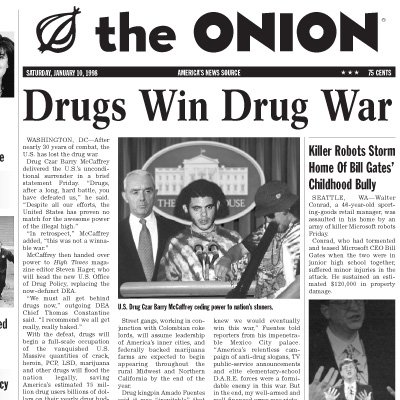
Why We Can’t Wage War on Drugs

drugs-win-war-on-drugs

The war on drugs was always a war against an idea. But ideas have a shelf-life, too, and this one has lost its potency

By Mike Jay

Source: Aeon Magazine

When the US President Richard Nixon announced his ‘war on drugs’ in 1971, there was no need to define the enemy. He meant, as everybody knew, the type of stuff you couldn’t buy in a drugstore. Drugs were trafficked exclusively on ‘the street’, within a subculture that was immediately identifiable (and never going to vote for Nixon anyway). His declaration of war was for the benefit of the majority of voters who saw these drugs, and the people who used them, as a threat to their way of life. If any further clarification was needed, the drugs Nixon had in his sights were the kind that were illegal.

Today, such certainties seem quaint and distant. This May, the UN office on drugs and crime announced that at least 348 ‘legal highs’ are being traded on the global market, a number that dwarfs the total of illegal drugs. This loosely defined cohort of substances is no longer being passed surreptitiously among an underground network of ‘drug users’ but sold to anybody on the internet, at street markets and petrol stations. It is hardly a surprise these days when someone from any stratum of society – police chiefs, corporate executives, royalty – turns out to be a drug user. The war on drugs has conspicuously failed on its own terms: it has not reduced the prevalence of drugs in society, or the harms they cause, or the criminal economy they feed. But it has also, at a deeper level, become incoherent. What is a drug these days?

Consider, for example, the category of stimulants, into which the majority of ‘legal highs’ are bundled. In Nixon’s day there was, on the popular radar at least, only ‘speed’: amphetamine, manufactured by biker gangs for hippies and junkies. This unambiguously criminal trade still thrives, mostly in the more potent form of methamphetamine: the world knows its face from the US TV series Breaking Bad, though it is at least as prevalent these days in Prague, Bangkok or Cape Town. But there are now many stimulants whose provenance is far more ambiguous.

Pharmaceuticals such as modafinil and Adderall have become the stay-awake drugs of choice for students, shiftworkers and the jet-lagged: they can be bought without prescription via the internet, host to a vast and vigorously expanding grey zone between medical and illicit supply. Traditional stimulant plants such as khat or coca leaf remain legal and socially normalised in their places of origin, though they are banned as ‘drugs’ elsewhere. La hoja de coca no es droga! (the coca leaf is not a drug) has become the slogan behind which Andean coca-growers rally, as the UN attempts to eradicate their crops in an effort to block the global supply of cocaine. Meanwhile, caffeine has become the indispensable stimulant of modern life, freely available in concentrated forms such as double espressos and energy shots, and indeed sold legally at 100 per cent purity on the internet, with deadly consequences. ‘Legal’ and ‘illegal’ are no longer adequate terms for making sense of this hyperactive global market.

The unfortunate term ‘legal highs’ reflects this confusion. It has become a cliché to note its imprecision: most of the substances it designates are not strictly legal to sell, while at the same time it never seems to include the obvious candidates – alcohol, caffeine and nicotine. The phrase hasn’t quite outgrown its apologetic inverted commas, yet viable alternatives are thin on the ground: ‘novel psychoactive substance’ (NPS), the clunky circumlocution that is preferred in drug-policy circles, is unlikely to enter common parlance. ‘Legal highs’, for all its inaccuracies, points to a zone beyond the linguistic reach of the war on drugs, that fervid state of mind in which any separation between ‘drugs’ and ‘illegal’ seems like a contradiction in terms. Then again, if that conceptual link breaks down, what does become of the old idea of drugs? When the whiff of criminality finally disperses, what are we left with?

I said ‘old idea’, but the word ‘drug’, at least in the sense that has been familiar throughout our lifetimes, turns out to be a recent coinage, peculiar to the 20th century. The word itself is, of course, centuries old: as a general term for any medication or chemical remedy, it dates back to the 14th century. But its more specific sense – as in ‘drug addict’, ‘drug control’ or ‘drug culture’ – can be dated quite precisely to the years around 1900. And on examination, it proves to be a curious hybrid, bridging two quite separate meanings.

The first is psychoactivity. A ‘drug’ is a substance that acts on the mind, changing the way we think or feel. But this descriptive meaning also carries a strong suggestion of judgment, less easily defined but unmistakably negative. ‘Drug’, in this sense, is a label to be avoided. Thus, according to the industries that produce and promote them, alcohol and tobacco are not drugs; cannabis advocates insist it is not a drug but a herb; and LSD enthusiasts say that it is not a drug but a sacrament. Indigenous users of coca, betel nut or ayahuasca are appalled at the suggestion these substances might be drugs. A cup of tea is psychoactive, but we would only call it a drug if we wished to make a point. An indeterminate white powder bought off the internet, on the other hand, might be legal, but it is undoubtedly still a drug.

Before the 20th century, it would have been difficult to express this idea. Many of today’s ‘drugs’, such as cannabis, cocaine and morphine, were sold in any high-street pharmacy. ‘Heroin’, for instance, emerged in 1898 as Bayer Pharmaceuticals’ new brand of over-the-counter cough medicine. Did the authorities simply turn a blind eye to the dangers that these substances posed? They did not: opium was classified as a poison because of its overdose risk, and cannabis was known to cause mental disturbance in some users. Yet these properties did not confer any exceptional status. And why should they? Even today, there are still plenty of prescription medicines that are toxic, habit-forming or that have deliriant side-effects. What made the drug-drugs special? In the 20th century, they came to be defined by their illegality, but of course they could not have been created by it. Only once certain hostile perceptions about drugs were in place could it make sense to ban them. What caused the perceptions?

We might start with the temperance movement. In the 19th century, alcohol was being recognised as a causal factor in all sorts of social ills, and so temperance campaigns promoted sobriety as the path to personal health, moral virtue and social respectability. Progressive social reformers joined forces with doctors and religious authorities to condemn the habitual intoxication of previous generations. Other intoxicating drugs might not have presented such a widespread problem, but they all got swept up in the same mixture of medical, moral and social opprobrium.

By the late 19th century, consumer groups were campaigning against the heavy doses of opiates and cocaine concealed in patent medicines

Global trade, meanwhile, made imported drugs such as opium and cocaine cheap and abundant; industry refined them into newly potent forms, which an energetic and largely unregulated business sector advertised and distributed to a booming consumer market. At the same time, the hypodermic syringe was transforming medical practice. It allowed doctors – and, increasingly, the general public – to inject large quantities of pure and potentially dangerous opiates such as morphine. This brought a breakthrough in pain relief, but also new risks such as abscesses and blood poisoning and, for some patients, compulsive and self-destructive overuse.

By the late 19th century, consumer groups were campaigning against the heavy doses of opiates and cocaine concealed in patent medicines, and doctors were diagnosing addiction as a medical pathology with serious social consequences. The first uses of ‘drug’ in its modern sense date from this era: in its earliest occurrences, it stood as an abbreviation of phrases such as ‘addictive drug’ or ‘dangerous drug’. Doctors advised governments and the public that injections of powerful narcotics should be confined to professionals. Use without medical supervision was classified as ‘abuse’.

Largely couched in medical terms as it was, the whole notion of ‘drugs’ carried moral and cultural implications from the start. Within the temperance debate, intoxication was an evil in itself and abstinence a corresponding virtue. Also, a good many of the substances that caused concern in the West were associated with immigrant communities: opium in the Chinese districts of San Francisco or London’s docklands, cocaine among the black communities of the southern US. In the racially charged debates of the day, these substances were presented as the ‘degenerate habits’ of ‘inferior races’, a ‘plague’ or ‘contagion’ that might infect the wider population. Such ideas might no longer be explicit, but the drug concept certainly carries a murky sense of the foreign and alien even now. That’s why it rarely applies to the psychoactive substances that we see as part of normal life, whether caffeine in the west, coca in the Andes, or ayahuasca in the Amazon.

During the first years of the 20th century, opium, morphine and cocaine became less socially acceptable, rather as tobacco has in our era. Their use was now viewed through the prism of medical harm, and their users correspondingly started to seem feckless or morally weak. The drugs themselves became, in a sense, ‘legal highs’: not technically prohibited but retreating into the shadows, available only under the counter or from those in the know. And then, once their sale was formally banned in the years around the Great War, ‘drugs’ became a term with legal weight: a specified list of substances that were not merely medically dangerous or culturally foreign, but confined to the criminal classes.

The banning of drugs occasioned strikingly little public debate, certainly compared with the prohibition of alcohol in the US. Then again, the ‘drug problem’ was pretty marginal at that point, and confined to subcultures (ethnic, bohemian, criminal) without a public voice. The only organised resistance to this new language of condemnation came from the pharmaceutical industry, concerned that its legitimate trade was being tarnished by unfortunate associations. What’s now the American Pharmacists Association, pressured by its major corporate sponsors such as Johnson & Johnson, complained about the casual use of terms such as ‘drug evil’, ‘drug fiend’ and ‘drug habit’, and lobbied newspapers to specify the drugs in question as ‘narcotics’ or ‘opiates’.

But ‘drugs’ was too vague and too useful to replace with more precise terms. It conveyed not simply particular chemicals, but a moral position on the use of them by certain people and for certain purposes. This position was eventually enshrined in the legal frameworks that emerged to prohibit them. The 1961 UN Single Convention on Narcotic Drugs, the founding document of the international drug laws, is unique among UN conventions in using the word ‘evil’ to describe the problem it seeks to address.

Legislators celebrated the 1961 Convention as the culmination of a 50-year battle to prohibit drugs, a battle that had begun at the Hague Opium Conference of 1911. Yet with hindsight, 1961 was the moment at which the consensus around the evils of drugs began to fracture. An adventurous postwar generation, the first to be raised as truly global consumers, was awakening to the realisation that alcohol was not the world’s only intoxicant. An international underground was beginning to spread news of hashish-smoking in Morocco and LSD synthesised in Swiss laboratories, as well as Benzedrine pills that propelled truck drivers through the night, and hallucinogenic mushrooms in Mexican mountain villages. For many, the resounding denunciations of drugs as dangerous, foreign and criminal no longer rang quite true. Within a booming youth culture, controlled substances were becoming the talismans of a new morality, an entire view of life that valorised pleasure, experiment and self-discovery.

In a sense, Nixon’s war on drugs was lost before it was even announced. It could have succeeded only by uniting an already polarised society in the belief that drugs were a genuine threat to civilisation, and that there was a genuine possibility of returning to a world without them. These propositions grew ever harder to sell over the intervening decades, as drug use became increasingly normal, while the vast sums of money spent trying to control it not only failed to reduce it, but actually created a global criminal market on a scale that Nixon could never have imagined.

psychiatric diagnoses such as low self-esteem and social anxiety open the door to new ‘feel-good’ drugs designed to enhance confidence and happiness

The problem is not just one of unintended consequences. As the war on drugs has dragged on, the medical, moral and cultural certainties that interlocked so tightly to create the very concept of ‘drugs’ have been drifting out of focus. In medical terms, the category rested on a clear distinction between sanctioned ‘use’ and criminal ‘abuse’. Yet today’s consumers are in practice free to make this distinction themselves. The arrival of online pharmacies means we can all take our chances with the prescription drugs of our choice: generic, pirated, off-label, out of date or semi-legitimately dispensed by doctors and pharmacists on the other side of the world. As a result, the line between pharmaceutical and illicit drugs is blurring. Recent studies in the US have found opiate users moving from prescription drugs such as OxyContin and Vicodin to street heroin and back again, depending on price and availability. As new ‘legal highs’ with opiate-like effects come on-stream, any such line may eventually become impossible to draw.

Within the pharmaceutical industry as a whole, other pressures and trends are conspiring to soften the distinction between recreation and medicine, ‘feeling good’ and ‘feeling better’. Smart drugs and nootropics promise to make us feel ‘better than well’; the broadening of psychiatric diagnoses to encompass conditions such as low self-esteem and social anxiety opens the door to new ‘feel-good’ drugs designed to enhance confidence and happiness. Pop-science catchphrases such as ‘serotonin-booster’ might apply equally to antidepressants or to MDMA. At the cutting edge of brain research, neural network studies are pointing the way towards implants for deep-brain stimulation or brain-embedded fibre-optic cables: a brave new world in which moods and perceptions might be controlled electronically and drugs, good or bad, would be redundant.

At the same time, the cultural landscape in which ‘drugs’ were defined is receding from view. Nixon launched his war on drugs in a country where even cannabis was a profoundly alien substance to almost everybody over the age of 30; today, most Westerners below retirement age recognise drugs, for better or worse, as part of the culture in which they grew up. We have long been comfortable global consumers, seeking out the novel and exotic in everything from food to travel, music to spirituality; our appetite for intoxicants participates in this pursuit of novel sensations, and is explicitly linked to it by corporate advertising that uses the visual lexicon of mind-expanding drugs to sell us everything from energy drinks to smartphones. ‘Drugs’, in its original sense, drew on a reflexive distaste for the culturally alien. This distaste has itself become alien to the inhabitants of the 21st century.

As drugs have swirled into this kaleidoscope of lifestyle and consumer choices, the identity of the ‘drug user’ has slipped out of view. A unitary class of ‘drugs’ depended for its coherence on an identifiable class of users, clearly recognised as deviant. But drug use has long ceased to function as a reliable indicator of class, ethnicity, age, political views or any criminality beyond itself. Plenty of drug users self-identify with confidence these days and, if conspicuous drug ‘scenes’ are easily located, the majority of drug use nevertheless takes place outside them. Buying and selling, the point of greatest visibility and risk for the user, has been rendered virtual: the shady street deals of the past can now be conducted online via PayPal or bitcoin, the incriminating package delivered through the letterbox in an innocuous Jiffy bag.

Though its medical and cultural underpinnings might be shifting, the category of drugs is still firmly defined by the law. At their margins, the drug laws could be starting to reflect the reality of what we might call a post-drug world, but it seems unlikely that they will drive the process. When the drug laws were first passed a century ago, they reflected a cultural shift that had already taken place; we can expect them to be dismantled only after the landscape of a post-drug world is plain for all to see. But even now, it is not hard to discern in outline. Alcohol prohibition, when it eventually collapsed, was superseded by a patchwork of regulatory controls – licensing, insurance, tax – that either existed already or were devised on the basis of pragmatic policy goals.

We can envisage a similar patchwork for a day – however close or distant – when drugs are removed from the ambit of criminal law. In so far as any drug presents medical risks, it requires regulation to minimise them, and a well-established spectrum, from labelling to licensing to prescription, already exists for this purpose. In so far as they constitute a luxury market, we might expect them to be taxed. As with alcohol, in some jurisdictions they might remain illegal by broad popular consent. The prohibition of drugs, including alcohol, was an emergency measure that overrode the logic of pragmatism. The alternative is not another leap in the dark, but a return to the routine regulatory calculus.

But what lies beyond the idea of ‘drugs’ itself? The simple answer is that there is nothing to replace. Behind the term lies a disparate group of chemicals whose varied effects – stimulant, narcotic, psychedelic, euphoriant – offer a more accurate language of description. Value-laden terms, both positive and negative, would doubtless emerge to complement them. A post-drug world would require not a new language but the recovery of an older one. The category of ‘drugs’ was an attempt, characteristic of its historical moment, to separate out good chemicals from bad ones. But as we have known since antiquity, good and evil, virtue and vice are not inherent in a plant or a molecule. Pedanius Dioscorides, the great classical authority on medicine, maintained that no substance is intrinsically good: it all depends on the dose at which it is administered, the use to which it is put, and the intentions behind that use. The Greek term pharmakon could mean both a medicine and a poison: there was no such thing as a harmless remedy, since anything with the power to heal also had the power to harm. All drugs, psychoactive or otherwise, are a technology, a prosthetic that extends our physical and mental reach. Like so many of the other technologies that are transforming our world, their benefits and dangers must ultimately be understood as extensions of ourselves.

America’s “War on Drugs” Has Triggered a “Humanitarian Crisis” in Central American. Children Converging at the US Border

war-on-drugs

By Joachim Hagopian

Source: Global Research

Since 2011 the US has not only continued “losing” its war on drugs while militarizing so called anti-drug police forces throughout Central America (not unlike the secret dirty wars of yesteryear), during this exact same time period murderous violence in Central America has skyrocketed.

Meanwhile, since 2011 simultaneous effects from US foreign policy in the region have only promoted more drug trafficking as well as child trafficking in the form of the massive proliferation of children from Central America (currently 73% from Central America while just 25% are now coming from Mexico) crossing the Mexican border into the US unaccompanied by adults. Just five years ago these percentages were nearly reversed when only 17% of unaccompanied minors originated in Central America and 82% were from Mexico. These four co-occurring developments, the US militarization of the region, nonstop increasing flow of drugs into US, the intensifying, out of control drug cartel-gang violence and influx of young children pouring into the US are all interconnected and intentionally driven by US foreign policy. Either by calculated design or minimally by complicity, America has thousands and thousands of children crossing our border. 

None of these phenomena deviate in the least from the oligarch-US-EU-NATO global agenda to destabilize all nations throughout every region on earth through a unified, consistent policy of militarization and globalization that in turn lead directly to political destabilization, racial and class warfare, economic impoverishment, increased violence, war, civil breakdown and ultimate societal and national collapse. This then further creates undermining crises conditions ripe for predatory world bank-IMF loans that cause national bankruptcy and extreme economic hardship accompanied by a full frontal assault unimpeded by transnational corporations to systematically move in for the kill, raping, pillaging, plundering and privatizing every nation on the planet.

The agenda to “balkanize” as in the West’s 1990’s model of breaking up Yugoslavia into 13 small ineffectual, defenseless pieces is currently being executed in Iraq with the formation of three separate states controlled by the Kurds in the north and the Sunni and Shiite sections dividing the rest of the country. Again, this formulaic divide and conquer strategy has proven 100% effective in weakening each nation and region’s sovereignty and autonomy that in turn facilitate and maximize exploitation, ensuring ultimate materialization of the oligarchs’ New World Order agenda.

This parallel process is unfolding in both Latin America and the US. The CIA controls and manages global drug smuggling from the Afghan poppy fields to the coca plantations run by Central-South American-Mexican drug cartels that supply and feed the constant demand for illicit drugs into both North America as well as Europe. Worldwide drug distribution operates under the convenient cover of the tax funded US war on drugs just like the tax funded US war on terror. They are designed to continue on indefinitely as the long as the US government is able to persist in getting away with this global theft, death and destruction on such an unparalleled, unprecedented, monumental scale.

Ever since the Iran-Contra Affair of the 1980’s when CIA got caught red-handed running drugs for guns during the Reagan years, and financing, arming, and training death squad commandos throughout Central America, the US government has always played an integral and active role in covert drug smuggling operations generating over the decades trillions in drug money revenue laundered through the central banking cabal. San Jose Mercury journalist Gary Webb exposed their “Dark Alliance” operations and paid for it with his life in December 2004. That is how powerful and heavily invested the US government is through its CIA cover in the international drug trade.

The fact remains that to this day, the CIA meets regularly with informants and representatives from selected Latin American drug cartels, making deals to gain incriminating information on rival cartels while assuring favored ones a free pass of drugs entering North America (an example is using the Sinaloa cartel to get to the Juarez cartel). Numerous inside US government officials including current Secretary of State (then Senator) John Kerry, and both CIA as well as the Drug Enforcement Administration (DEA) whistleblowers, corroborated further by various Mexican government officials and high ranking cartel players all admit how the CIA manages the highly lucrative international drug smuggling business. In fact, El Universal reports that more than 2,000 US officials that include Border Patrol agents, police officers among other agency officials are currently being investigated this year for their ties to organized crime, proving widespread grand scale corruption. Thus, despite common knowledge that the so called war on drugs is a complete and utter failure as defined by its abysmal record in actual interdiction and cutoff of any drug flow into America, with inside US assistance, the prolonged war on drugs has only steadily increased the narco supply during the four plus decades since Nixon declared war on drugs way back in 1971.

That is why President Obama calling upon Congress last week to implement the same policy toward unaccompanied children from Central America as those from Mexico is a hypocritically disingenuous way to sweep what he himself calls “a humanitarian crisis” swiftly and conveniently under the rug by making their deportation instantaneous after a brief Border Patrol interview. Obama knows full well why since last October 52,000 kids mostly from El Salvador, Honduras and Guatemala have been showing up at our doorstep in droves in recent months. In a joint press conference with the Costa Rican president during a brief visit to the Central American country in May 2013, President Obama made the statement:


“But we also have to recognize that problems like narco-trafficking arise in part when a country is vulnerable because of poverty, because of institutions that are not working for the people, because young people don’t see a brighter future ahead.”

Obama understands the plain and simple truth very well – Central America’s weak and corrupt governments that the US supports cannot protect the children from the rampant murder and rape that befall this young, most defenseless population. Desperate parents wanting to protect their children from death are sending them to seek political asylum even in such poor neighboring nations as Nicaragua as well as Belize, Mexico, Panama and Costa Rica also in record numbers (rising by 712 percent). The spiked violence in their own countries has them not just swarming to the US but seeking safety in any and all surrounding nations throughout the region. Their arrival in America has nothing to do with sponging off US social services or gaining an economic advantage as some would have the American public believe.

With 52,000 already in the US, a projected 90,000 children are expected for the fiscal 2014 year. Because the bulk of the migrant kids have been apprehended at the eastern Mexico-Texas Rio Grande border, quickly overwhelming the facilities there, busloads and planeloads of thousands of children have been transported to Arizona and most recently California. Initial reports from the facility in Nogales, Arizona raised humanitarian issues of overcrowding. The Border Patrol has not allowed media inside the facility. Vehement protests in Murrieta, California where the three California planeloads were originally scheduled had to be re-routed to San Diego. Many of the children in these groups now in San Diego already have adult sponsors or family members. Others will need local housing.

Meanwhile, during the last decade that the US has funded the militarization of Latin American security forces, violence in Mexico and Central America has increased exponentially, at times committed by the security forces themselves, not just by the criminal thugs from drug cartels. Human rights violations perpetrated by both the cartels as well as the government security forces are reminiscent of the dirty secret civil wars of the 1980’s. In short, US funded militarization dating back to the Bush regime has only inflicted substantial collateral damage on the civilian populations and neither diminished the drug cartel empires nor diminished the flow of drug trafficking into the US. Under Obama’s watch, well over $2.5 billion US tax dollars were allocated for beefing up Latin American security forces. The bottom line is that the corrupt governments from Mexico and Central America are too often colluding with the drug cartels, which in turn do business covertly with various US governmental agencies. The result – enormous US tax waste, financial malfeasance, increasingly unsafe drug war zones in Latin America and uninterrupted drug flow passage into North America.

Incredibly in the face of glaring evidence of policy failure and the bloodbath spillage of increasing violence and terror in Mexico and Central America that is the direct result, the State Department’s head of the Bureau of International Narcotics and Law Enforcement Affairs, William Brownfield, recently told the Associated Press that “the bloodshed tends to occur and increase when these trafficking organizations…come under some degree of pressure.” More boldface government lies in a feeble and vain effort to justify US caused death and destruction.

Current immigration laws distinguish between the policy for handling unaccompanied Mexican children at the US border and unaccompanied children from other nations. Standing protocol has children from Mexico interviewed by a Border Patrol agent to discern if grounds for potential political asylum are present. If the interviewer concludes that conditions are not met, the child is then deported back to Mexico immediately. Last week Obama requested that Congress make the policy for handling the children from Central America the same as Mexico’s, which would rescind current existing laws voted into place during the Bush administration specifically designed to protect potential asylum seeking youth from other countries. After taking lots of flack and criticism for his rigidly harsh and hypocritical stand all week, today Obama backed down away from that hard-line position. Instead, the White House announced today that the current children in federal custody from Central America will be processed under existing law and given due process that ensures the children will be granted opportunity for an immigration hearing that might lead to legal asylum. However in a seemingly hollow, face saving gesture, it was also announced today that “most of the children will be deported.” And Obama aims still to expedite legislation for removal of all future undocumented children at the border regardless of their national origin or danger at home.

Also $2 billion in additional emergency funding was requested this week to deal with the growing crisis. The funding will be allocated for more immigration judges along with legal aid and detainment facilities to provide adequate housing and care for the children.

Public announcements in Central America are already being aired on television in attempt to dissuade parents from sending their children to the US. Yet that may be a hard sell when parents observe their children already in the US being allowed to stay in America, especially when other family members already are living in America.

Many Americans who have never experienced the dangerously dire conditions that families in Central American nations face every single day cannot possibly grasp how parents can be so “coldhearted” as to ship their children away. But it is all relative. Their option of trying to keep their kids safe in their own country is simply weaker than the calculated risk involved in sending them 1500 miles or more north to America to face an unknown, uncertain future there.

Two reputable investigations found that a high percentage of the children meet the necessary criteria to qualify for political asylum. The United Nations agency, the High Commissioner for Refugees (UNHCR), assessed 404 young people who left Latin America and found that 58 percent of the minors were seeking international asylum because their own nations failed to protect them. A 2012 report from the Vera Institute determined that at least 40 percent warranted consideration for asylum. With the worsening conditions in Central America just in the last two years, that percentage would undoubtedly be higher now. A look at current life conditions in the children’s homelands of these three “Northern Triangle” Central American nations might shed light to explain why parents in desperation are so willing to send their offspring to far away foreign lands.

Displacement of families in Central America due to systematic criminal violence and extortion by drug cartels and local gangs are extremely commonplace. So is murder. The murder rates in Mexico, Honduras, Guatemala and El Salvador have skyrocketed, largely due to oppressive national security forces as well as highly organized street gangs and very powerful drug cartels. All are murdering innocent people at will. In Mexico alone since 2006, the war on drugs has killed150,000 people. Known as the murder capital of the world, Honduras has 85 to 91 killings per 100,000 people and a daily rate of 19 murders a day. Out of the 52,000 unaccompanied children at the border since last October, over 15,000 are from Honduras.

After the military coup in 2009, trafficking gangs diverted their weapons and narco-routes from South America through Honduras into Mexico. An estimated three-quarters of all US-bound cocaine passes through Honduras. Two out of three people in the country live in poverty. The two transnational gangs imported from California prisons – Mara Salvatrucha and Barrio 18 gangs compete in turf wars and control the cities. Gang members recruit children as young as kindergarteners. They will kill those young people who refuse to become members and will target “girlfriends” that are customarily raped by one or more members. Because 40% of the Honduran population is under 15 years of age, they are extremely vulnerable to being forced into violent and destructive gang life. This is the primary reason why parents send their children away seeking refuge in other safer countries.

El Salvador suffered from a US induced civil war from 1980 to 1992. Infamous death squads financed, armed and trained by US Special Operations forces murdered nearly 40,000 people. As a result, two million Salvadorans reside in the US, the third largest Hispanic group behind Mexicans and Puerto Ricans. This is another reason many families in El Salvador with relatives in the US are sending their children to America. And with the US policy re-militarizing El Salvador’s national security forces ostensibly to fight drug cartels and gangs, a reactivation of the ruthless killing of citizens en masse once again has become the norm. Elizabeth Kennedy, a Fulbright researcher working in the country, has stated that the current homicide rates are even more than during the civil war, and that assault, rape, disappearance and extortion are at higher rates than ever before. El Salvador murder rate ranks at number two in the world behind Honduras. Nearly 11,500 youth from El Salvador comprise the 52,000 children apprehended at the border.

Guatemala sustained a civil war from 1960 to 1996. For multiple generations war, violence and rape are all Guatemalans have known. Ethnic cleansing of Mayan Indians and mass murder over such a prolonged period has given rise to a lawless drug trafficking operation that is an organized crime syndicate. In 2012 this small nation incurred nearly 100 murders a week. Rape and teenage pregnancy are among the highest in the Northern Triangle. Nearly 13,000 of the 52,000 migrant children are from Guatemala.

Another high risk for children in central America is falling victims to human trafficking, prostitution, and child slavery that have become a major global problem. The regional crime syndicates not only traffic drugs but humans as well. Just from all these horrific, highly disturbing Central American statistics, young family members seeking safety and escape in other countries appears not only understandable but a prudent decision as well.

Extracted from the UN Commissioner report, 17-year old Alfonso offers the following compelling testimony:

“The problem was that where I studied there were lots of M-18 gang members, and where I lived was under control of the other gang, the MS-13. The M-18 gang thought I belonged to the MS-13. They had killed the two police officers who protected our school. They waited for me outside the school. It was a Friday, the week before Easter, and I was headed home. The gang told me that if I returned to school, I wouldn’t make it home alive. The gang had killed two kids I went to school with, and I thought I might be the next one. After that, I couldn’t even leave my neighborhood. They prohibited me. I know someone whom the gangs threatened this way. He didn’t take their threats seriously. They killed him in the park. He was wearing his school uniform. If I hadn’t had these problems, I wouldn’t have come here.”

Unfortunately the issue of so many children converging at the US border has been politicized (like everything else in Washington) and used as a hot potato weapon against any chance of passing much needed, long overdue immigration reform. And during an election year when politicians play it safe and focus exclusively on getting reelected, what to do with unwanted kids at the border has put the nail in the coffin. No attempt to even deal with such a volatile and divisive issue will be forthcoming from Congress and status quo inactivity only buys more time of business as usual deportations that continue breaking up thousands of immigrant families.

Since 2009 Obama, Homeland Security and the Border Patrol have teamed up with local law enforcement agencies throughout the US and began an accelerated and unprecedented campaign of deporting parents as undocumented immigrants, ruthlessly ripping families apart, creating orphans of their children as legal US born citizens. Obama removes illegal immigrants at nine times the rate of just twenty years ago, far more than any other president. Two million of the undocumented have in fact been removed already. Regardless of how long a person may be residing in America, and regardless of having a family here, being a law biding, productive citizen, it makes no difference. Victims of the US militarized police state are only being sent back to militarized Latin American police states funded and largely created by the US where the deported are frequently persecuted, tortured and murdered. The hardship and tragedy brought down on so many hardworking, taxpaying families are anything but humane and compassionate. But then American Empire aggression has never been humane and compassionate.

Another oligarch plan is to homogenize all regions of the earth through massive migrant immigration globally. This systematic leveling of the so called playing field between the developed Western world (North America and Europe) and the developing Third World is simply part of the plan leading to the New World Order. Hence, the globalized aggressive attack and disintegration of the middle class around the world is designed to lower the standard of living in the West, homogenizing a destabilized worldwide lower standard of living that will facilitate maximum control over a desperate, struggling global population. With this bigger picture in mind, current policies promoting mass migrant immigration perceived by the likely majority in the host nation as unwanted guests and an additional burden, in effect stirs up tension and conflict between ethnicities and classes, acting as more evidence of the divide and conquer tactic. By design, the present humanitarian crisis at the US border is US made.

Joachim Hagopian is a West Point graduate and former US Army officer. He has written a manuscript based on his unique military experience entitled “Don’t Let The Bastards Getcha Down.” It examines and focuses on US international relations, leadership and national security issues. After the military, Joachim earned a masters degree in Clinical Psychology and worked as a licensed therapist in the mental health field for more than a quarter century. He now concentrates on his writing.


Related Podcast: Peter Dale Scott covers CIA drug trafficking and the Deep State on “Guns and Butter” (7/9/14):

http://archives.kpfa.org/data/20140709-Wed1300.mp3

Why It’s Worth Paying More for Legal Pot

By Dominic Holden

Source: The Stranger

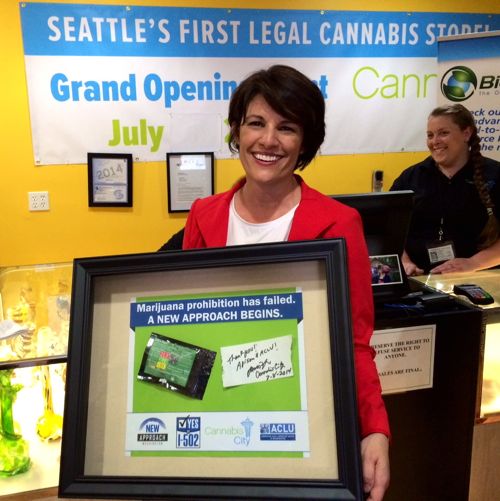
I bought a bag of marijuana today at Cannabis City, Seattle’s first legal retail pot store, just after they opened at noon. (Surprisingly for a pot store, they opened on time.) It was a different experience from every other time I’ve bought pot—and I’ve bought a lot of pot before—not just because there were dozens of TV crews swarming outside. What legalization provides, prohibition never could: explicit certainty about what I purchased, what it contains, what it doesn’t contain, where it came from, where the money goes, and the promise that every time I purchase this product it will be essentially the same.

Here’s the excellent pot, the bag, a receipt, and a very detailed label:

thumb-1404869035-pot_and_receipt

$40 gets you two grams of pot and more information about your stash than you’ve ever had before.

Consumers will decide whether all that certainty is worth the price; the two-gram bag was $40, including $10 in tax, which is generally higher than street prices.

Some people already say it’s not worth it. Standing beyond the media frenzy was John Stuart, 24, who was wearing a pair of pot-leaf-print shorts and a Marilyn Manson t-shirt. His friend had a white pit bull on a rope. Were they waiting to buy pot inside? “No, because I got a medical-marijuana card and it’s way too expensive at Cannabis City,” said Stuart. “You could go to Westlake Park and get it for $10 a gram. That’s a lot cheaper than going to the store.”

But the pot Stuart can buy in a dispensary or in a park will never be like this. The glut of information on that label represents something between government overreach and a pot-lover’s dream come true.

The largest typeface on the label details the precise composition of the drug. This strain is called OG’s Pearl, which contains exactly 21.5 percent THC (the predominant set of psychoactive chemicals in cannabis). The label then lists the CBD, a more narcotic chemical found in marijuana, and the nonpsychoactive CBG. The label goes on: These buds are 80 percent indica-type cannabis (as opposed to the more stimulating sativa, which presumably makes up the other 20 percent). It lists the moisture content (6.25 percent), the day it was harvested (June 2), the day it was tested (June 23), where it was grown (Kitsap County), how it was grown (indoors), and who grew it (Nine Point Growth Industries).

If I like this product, I can buy it again and it will reliably be the same thing. If the product changes—how or where it’s grown, whether there are shifts in chemical composition at the next harvest—it will be right there on the label.

This chunk of vegetation, like all the pot legally sold in Washington, was tracked from the time it was a baby clone to a full-grown plant, then tracked from harvest and into this package. And because it’s so closely tracked, consumers have unprecedented certainty that it’s not tainted with contaminants (other drugs, sketchy fertilizers, tobacco juice, mold, soap, etc.).

It’s also a guaranteed weight—you’re not going to get shorted on your deal—and you know your money is paying for legit, in-state jobs, not funding some murderous interstate cartel.

But if Mr. Stuart buys pot in the park, it’s all but certain he’ll have no idea what he’s really getting (or where his money goes). Even dispensaries will lie through their teeth about what they’re selling—I know because it was once my job to tell that lie.

In my 20s, I worked briefly as an assistant manager in a marijuana dispensary in California. Each morning, growers would deliver massive sacks of weed to the back door, and we’d haul them to an upstairs office for inventory purposes. It turns out, one of my jobs there was to name the strains. People talk a lot about pot strains like they’re of hallowed pedigree, and some of them are legit examples of growers developing a unique variety (classics like White Widow or Blueberry, or newer strains like Jack Herer). But a lot of strain names? They’re totally fabricated. There’s always pothead lore about how one strain is stronger, how it makes you happy, how it’s got a “really mellow vibe,” or it’s “good for sleep.” But most of that is bullcrap. At the dispensary I worked for, part of my job was to fabricate names as a marketing ploy. I’d just make ’em up. I called them Einstein, Alligator, Beethoven, Plato—any name I’d think could sell. And if the name was marketable and we’d run out of that type of pot? We’d find another type of pot and call it the same name. Long story short: Under prohibition, the name’s meaningless. The place you bought it didn’t guarantee its provenance. You never knew what you were getting from one bag to the next.

With the standards we have in Washington, we don’t have punk-ass kids (like me) making up stuff about your weed and you don’t have to guess what you’re smoking. The question is: Do we have enough legal pot to keep this system running?

1404863612-holcomb_and_pot

ALISON HOLCOMB: Beaming for bud.

Alison Holcomb, who sponsored the initiative that legalized marijuana, bought a bag of pot herself today. She acknowledged the shortages of ready-to-use marijuana, as we wrote about over here, and said the first day was not as critical as the state being able to license enough growers to maintain a supply chain: “It is critical that we can sustain stores, instead of seeing them going under due to lack of product to sell to customers.”

But she added that the stores we have are better than what she expected. “When we drafted the initiative [in 2011], we were thinking of the state-run liquor stores,” said Holcomb. But unlike the austere state booze outlets, which were nixed by voters, the Cannabis City showroom has hardwood floors, wooden paneling, and illuminated display cases. “This is warmer and more inviting than what we envisioned,” said Holcomb. (It’s also a helluva lot nicer than buying pot in an alley or at some chatty dealer’s apartment.)

Cannabis City owner James Lathrop was beside himself with self-satisfaction. “I declare this war over,” he told the crowd. (Good for him, but tell that to people in the other 48 states.)

However, Lathrop, Holcomb, and others also provided something with legal pot you’ll never see from a street dealer: a level-headed warning in writing.

Every customer was handed an informational “consumer’s guide” pamphlet with “what you should know” about pot use in a Washington State. It warns about the potency of edibles (which aren’t in stores yet), the law about driving stoned (don’t do it), and the rules about where you can consume it (in private places, but not in hotels that ban smoking).

That pamphlet—free of fear-mongering—represents a tiny but critical revolution in drug education: It’s produced by the Washington State Liquor Control Board, a state agency, but it’s sponsored by and features the logos of the ACLU, the National Organization for the Reform of Marijuana Laws, and the Marijuana Business Association. This pamphlet is evidence of government critics co-opting government.

This is the end of “Just Say No” in our state. That was an era of the government lying about the harms of pot and promising you that one toke led to a lifetime of addiction, while pro-pot forces generally exaggerated the benefits and downplayed the risks. More and more, both sides are settling on the facts and providing all the information—sometimes more than you know what to do with, right on the label—for users make up their own minds. You know you’re buying local.

So if it costs a few bucks more per gram, it’s worth it.

Editor’s note: while I agree with much of the author’s arguments, there is something to be said for supporting blackmarket pot as well. In cases where you and the dealer develop friendship and trust you can get comparable consistency of quality. Though it may not always be the exact same strain, it can be a pleasant surprise to try something new. You may also have an opportunity to experience other illegal substances if you choose (but always do the research first). If/when cannabis becomes as commercialized as foods and tobacco, you may not be able to trust the labels on the package anyway. And why not show loyalty towards those who have provided quality service through the dark days of prohibition at the risk of their freedom and security?

In Defense of Cognitive Liberty

741-hz-consciousness-expansion-is-bes-airl-hear-the-messages-of-the-universe-in-your-mind

Though the Drug War’s disproportionately harmful effects on the poor and people of color seem to have been one of its major functions from the start, it has also been a war against cognitive liberty for everyone. On the DoseNation podcast, chemist Casey William Hardison shares an inspiring personal account of how psychedelics transformed his life for the better, and how he successfully fought a system which imprisoned him for pursuing his passion:

If the state was truly concerned for the health and safety of drug users, they would do more to give accurate information to the public and make treatment of addictions accessible (including addictions to alcohol, cigarettes, and pharmaceutical drugs). Instead, the state seems particularly concerned about drugs which can potentially lead to an expansion of consciousness. But why is cognitive liberty such a threat? Terence McKenna shares his thoughts on the revolutionary potential of the psychedelic movement in this excerpt of a speech delivered at the Esalen Institute in 1989:

The provisional model (psychedelic/open-ended partnership) way of doing things is the only style that can perhaps seize the controls of this sinking submarine and get it back to the surface so that we can figure out what should be done. If we continue as we have, then we’re doomed. And the judgement of some higher power on that will be: “They didn’t even struggle. They went to the boxcars with their suitcases and they didn’t even struggle.” This is too nightmarish to contemplate. We’re talking about the fate of a whole planet.

Why are people so polite? Why are they so patient? Why are they so forgiving of gangsterism and betrayal? It’s very difficult to understand. I believe it’s because the dominator culture is increasingly more and more sophisticated in its perfection of subliminal mechanisms of control. And I don’t mean anything grandiose and paranoid. I just mean that through press releases and soundbites and the enforced idiocy of television, the drama of a dying world has been turned into a soap opera for most people. And they don’t understand that it’s their story and that they will eat it in the final act if somewhere between here and the final act they don’t stand up on their hind legs and howl.

So this whole effort to bring the psychedelic experience back into prominence is an effort to empower individuals and to get them to see that we are bled of our authenticity by vampirish institutions that will never of their own accord leave us alone. There must be a moment when the machinery and the working of the machinery become so odious that people are willing to strive forward and throw sand on the track and force a reevaluation of the situation. And it’s not done through organizing. It’s not done through vanguard parties or cadres of intellectual elites. It’s done through just walking away from all of that. Claiming your identity, claiming your vision, your being, your intuition, and then acting from that without regret. Cleanly, without regret.

While I think the value of organizing should not be underestimated, he speaks eloquently for cognitive empowerment and inner transformation as a path towards cultural and systemic change.

Listen to the full speech at the Psychedelic Salon podcast:


More info on why drug prohibition does nothing to curb drug use and addiction and actually increases societal harm:

Building Bridges: Top 10 Issues That 99% Can Agree On

building_bridges

On a recent episode of PBS Newshour, Jeffrey Brown hosted a roundtable discussion exploring the dangers of polarized politics for American Governance. The guests were Eric Liu, Steven Hayward and Beverly Gage. Most of the discussion was an analysis of the recent government shutdown from a typical left vs. right perspective, but I thought their view of reactions of average citizens was interesting:

JEFFREY BROWN: And so, Eric Liu, let me ask you, because I know you’re very — you’re trying to engage people in the act of citizenship. What do you see the effect of all of this? Are they more engaged? Are they just more disgusted and turned off?

ERIC LIU: Well, I don’t think those are mutually exclusive. There is disgust.

(LAUGHTER)

ERIC LIU: But, because of the disgust, there’s actually more engagement.

And that’s true on both the left and the right. Look, I think the reality is, when Steven was speaking a moment ago about the kind of encroachment of ever-growing and ever-larger government, we can have reasonable debates in this country about what the proper size and scope of government ought to be, but we ought to regard those debates not as “on/off, yes/no, my way or we shut the whole thing down” kind of debates.

…so people from both left and right watching these last two weeks are ready for something different.

They’re ready to actually hear each other and see one another and not the caricatures of one another, and try to figure out, well, where is it that we can manage to agree on the role of government, and where we can’t agree, how can we recognize that to be a citizen isn’t just a single-shot sudden death game. It’s infinite repeat play, and you’re going to win some, and I’m going to win some.

JEFFREY BROWN: All right, let me ask Steven Hayward to respond to this.

Do you see the result of this as people ready to work together or more divisions that ever more polarizes?

STEVEN HAYWARD: Well, I think there’s two things to think about here.

One is, is we have divided government once again. The voters, God bless them, have a lot of cognitive dissonance. Right? In the last week, what you saw is people say, I don’t like Obamacare, but I don’t want the government shut down. I don’t want it to be a matter of a budget fight the way it’s become. And that’s why Republicans lost this proximate battle.

But if you look at some of the poll numbers right now, I think they ought to be very worrying for everybody, but I think more worrying ultimately for liberals, for this reason. You have seen record high numbers of people who now say — I think 65 percent in one poll — that government is a threat to their rights.

You have seen a long-term trend going back really to the 1960s of the number of people saying they have confidence that the federal government will do the right thing down in 15 percent, 20 percent, when it used to be in the ’50s up around 60 to 70 percent. And to the extent that if you’re liberal and that you believe in political solutions to our social problems or government engagement with our problems, you want the public to have confidence in the federal government’s capacities.

And so it seems to me that, as much as this might have been a train wreck for Republicans, the long-term effect of this might not necessarily play out that way.

JEFFREY BROWN: Well, Beverly, when you look back at political — what could be called political crises of the past, what does it — what happens in terms of public response to those?

BEVERLY GAGE: Well, I think to some degree, Steven’s quite right, in that I would kind of like to subscribe to Eric’s view that we’re going to have a much more serious conversation, a much more bipartisan conversation.

But I think it’s equally possible that you’re actually going to see people throw their hands up and say, oh, it’s all such a mess. I don’t really want to make sense of it. I don’t want to deal with it. And, in that way, it sort of serves an anti-government message, and in some ways, even serves sort of the Tea Party message in ways that maybe were intended and maybe weren’t.

But I think there’s also a danger for the Republican Party in all of this, which is to say that these divisions that we’re seeing right now within the Republican Party between moderates and Tea Party conservatives and also between a sort of establishment business class, which is very, very alarmed about what’s happening, and this more right-wing part of the party, that actually may in fact spell destruction for the Republican Party.

Those are divisions that have been there for a long time. They have often been papered over. But when you’re on the brink of financial catastrophe in the way that we were, we may not see them be papered over, and we may in fact see some sort of political realignment coming out of this.

You can read the complete transcript here: http://www.pbs.org/newshour/bb/politics/july-dec13/governing_10-17.html

All three guests made good points, though the views of conservatives and liberals are typically generalized in such discussions and I think issues of most concern to citizens on a grassroots level are often not the ones being debated enough in Washington D.C. There definitely needs to be more political discussion between left and right not just within government but among the general public. Increased communication and education is the best defense against “divide and conquer” tactics but of course this is easier said than done because politics has become a taboo subject for many, mainly due to fear of getting into heated arguments. But perhaps this fear is unwarranted because there’s many issues that the left and right can agree on (though motives and priorities may differ). These are just some of the more topical examples:

  1. End the Wars – As demonstrated by widespread negative reaction to war threats against Syria, people are perhaps becoming more aware of political trickery thus becoming harder to persuade. Also, as living standards drop for more people, the connection between costly foreign policy and the nation’s declining economy and infrastructure has never been more obvious.
  2. Stop the Surveillance State – Privacy is a universal human need. Mass spying on citizens is illegal and unethical whether online or through drones and informants.
  3. End Unjust Trade Agreements – Agreements such as NAFTA and the Trans-Pacific Partnership (TPP) hurt working people and endangers health and safety, the environment, and national sovereignty.
  4. End the Fed – We’ve endured 100 years of a “Federal” Reserve run by private bankers and all we have to show for it is a debt of tens of trillions of dollars. It will never be paid off as long as we continue to use interest-bearing federal reserve notes as currency.
  5. Create Affordable Health Care – It can be argued that Obamacare is an incremental improvement but everyone knows it’s not enough and is far more beneficial for greedy insurance companies than the poor.
  6. End the Drug War – We can all agree the Drug War is a colossal failure (when it comes to the stated purpose of reducing drug addiction). It has only increased incarceration rates while enriching the prison-industrial complex and drug cartels. We need to adopt policies that have proven to be effective such as legalization, decriminalization and harm-reduction.
  7. Stop GMOs – GMOs are unnecessary, physically and economically harmful to farmers, may have potentially catastrophic effects on the ecosystem, and only serves to increase profits for companies like Monsanto.
  8. End Obscene Economic Inequality – Complete economic equality might not be possible, but when economic inequality reaches absurd and unsustainable levels as they have today, obviously something needs to change.
  9. Protect Internet Freedom – Legislation such as the NDAA, SOPA and PIPA indicate that government and corporations are threatened by the internet. Attacks against internet freedom are attacks against freedom of speech, freedom of information and cognitive liberty.
  10. Ignore Corporate News – Another point of agreement between right and left is the corporate news media’s increasing irrelevancy and bias. Today it is not so much a liberal or conservative bias as it is a neoliberal and neoconservative bias.

A Green Beacon of Hope

0

Aesliip shares some of his adventures at the first Seattle Cannabis Cup at the Weedist. The event is organized by High Times magazine and is sort of a trade show for cannabis growers and medical dispensaries as well as a competition awarding a prestigious prize for growers. The Cup is traditionally held in Amsterdam, but since the passing of legislation in Colorado and Washington that legalizes recreational cannabis use, it is now being brought to the U.S. Here’s a sampling of what Aesliip observed:

The various booths had every kind of marijuana in every form you could think of. It was like a candy store; and there were tons of free samples. As I mentioned before, you could get dab samples at almost every booth, but there were also bong samples, tincture samples, and edible samples. I wanted to sample everything but I was also trying to not fall asleep on the sidewalk.

Cannabis Cup Seattle - WeedistI sampled a fair bit, though, especially when 4:20 came around. The California Finest booth was tossing out free individually wrapped joints, brownies, and random apparel into the crowd.

I caught one of the joints with my index finger and thumb which was awesome because one, I was stoked that I caught one and two, that’s how you hold a joint. I promptly opened it and lit up, as did many others who had caught the flying joints. Within a few minutes there had to be like 10 or more joints being passed around the small crowd, which I thought was hilarious.

Read the full story here: http://www.weedist.com/2013/09/adventures-seattle-cannabis-cup-2013/

I never would have thought such an event would be possible on U.S. soil. It shows just how relatively quickly public perception can change, how decades of propaganda are no match for genuine education and experience, and how in some cases even the feds are powerless to stop social/cultural movements. Mass cannabis legalization has the potential to help heal the nation physically, psychologically, economically and spiritually, as long as it isn’t co-opted, monopolized, chemically processed, genetically modified, etc.

Guy Evans and Cuban wrestler and rapper Konnan talk about the drug war at the Smells Like Human Spirit podcast. It’s an interesting conversation that connects the issue to Mexican gang wars, the corrupt political system and the prison-industrial complex before going on related tangents such as the military-industrial complex, foreign wars, the Occupy movement and the surveillance state.

Show link: http://www.smellslikehumanspirit.com/2013/09/konnanmlw.html

Bill Hicks – Revelations

Video

The complete video of one of Bill Hick’s greatest shows. Filmed at the Dominion Theater, London in late 1992 (1:15):

It’s the Law

privacyNOT

Interesting commentary by James E. Miller, editor-in-chief of the Ludwig von Mises Institute of Canada. It connects recent current events in a logical narrative and offers a plausable explanation for the apparant wind-down of the war on (some) drugs.

excerpt:

With today’s nation-state, the monopoly on law enforcement has eroded the traditional notion of justice. Certainly various levels of government still prosecute those who commit malum in se wrongs. But the granting of sole discretion over societal function to the state has brought about a litany of prohibitions on otherwise harmless actions. The most widespread and destructive example of this gross perversion of law has been the American drug war. In major metropolitan areas, large numbers of users of substances designated harmful to public tranquility are fined, detained, and imprisoned. The very act of ingesting mentally-altering narcotics constitutes no harm absent the self-imposed kind. The outlawing of drug use superimposes control of the individual, and makes him beholden to the political class. As Will Grigg posits, the malum prohibitum on narcotics is a subset of human slavery as the premise denies complete self-ownership.

In an act of supposed moral revelation, U.S. Attorney General Eric Holder recently announced the federal government would begin relaxing indictments of low-level, nonviolent possessors of drugs. In a speech before the sleazebag of litigating opportunists known as the American Bar Association, the nation’s top mob enforcer declared “too many Americans go to too many prisons for far too long and for no good law enforcement reason.” The mandatory minimum sentencing laws passed by Congress will simply go ignored.

The gullible reader might assume the odious basis for the war on drugs may finally be visible to the heavily armed buffoons who raid private homes and the sloth-resembling chief law enforcer, but that would be a naive supposition. The wind down has little to do with morality and everything to do with cost. Imprisoning thousands of junkies takes a great deal of resources. With a corpulent debt financing military adventurism and welfare pocket-padding, Holder and the rest of the federal government racket are feeling the squeeze.

The very same penalty relaxation occurred at the height of the Great Depression. While Franklin Roosevelt busied himself with turning American business into a quasi-fascist state, he was intelligent enough to recognize the civil demolition wrought by alcohol prohibition. As the black market for booze paved the way for organized crime during the roaring 1920s, the stock market crash left state and local governments hamstrung by a lack of tax revenue. If action was not taken, thousands of wealth-sucking bureaucrats would be thrown to the streets. So the Democratic Party endorsed making America wet again, while nominating the craze-minded Roosevelt in 1932. After the Twenty-first Amendment to the Constitution was ratified, excise taxes were levied on wine and spirits. As economists Mark Thornton and Chetley Weise document, the resulting tax receipts staved off what would have been shriveling bankruptcy.

Rarely does the state cede authority when it comes to corralling the citizenry. The only barrier that stands between government domineering is always the cost of its behemoth, sluggish operation. The relaxation of penalties for drug ingestion is demonstrative of this rule. At the same time, it is a mockery of the concept of reasoned law. If using narcotics were truly an affront to the natural order, there would be no leniency. The immoral act would be opposed root and branch, similar to rape or murder. Current legal prohibitions on various forms of opiates are not grounded in justice but are merely a form of societal control. In the classic bootleggers and baptists sense, these restrictions enrich those who profit from sale, distribution, and incarceration while satisfying the warped psyche of taskmaster puritans.
To read the complete essay, visit the Ludwig von Mises link or the repost at Zerohedge.com.