Billionaires, Bunkers and Brain Damage

“The rich are not like us”

By Mickey Z.

Source: Dissident Voice

Douglas Rushkoff has an article (based on his latest book) called “The super-rich ‘preppers’ planning to save themselves from the apocalypse,” in The Observer.

This excerpt gives you an idea of how the barbaric brain of a billionaire operates:

Finally, the CEO of a brokerage house explained that he had nearly completed building his own underground bunker system, and asked: “How do I maintain authority over my security force after the event?” The event. That was their euphemism for the environmental collapse, social unrest, nuclear explosion, solar storm, unstoppable virus, or malicious computer hack that takes everything down.

This single question occupied us for the rest of the hour. They knew armed guards would be required to protect their compounds from raiders as well as angry mobs. One had already secured a dozen Navy Seals to make their way to his compound if he gave them the right cue. But how would he pay the guards once even his crypto was worthless? What would stop the guards from eventually choosing their own leader?

The billionaires considered using special combination locks on the food supply that only they knew. Or making guards wear disciplinary collars of some kind in return for their survival. Or maybe building robots to serve as guards and workers – if that technology could be developed “in time.” It’s as if they want to build a car that goes fast enough to escape from its own exhaust

I tried to reason with them. I made pro-social arguments for partnership and solidarity as the best approaches to our collective, long-term challenges. The way to get your guards to exhibit loyalty in the future was to treat them like friends right now, I explained. Don’t just invest in ammo and electric fences, invest in people and relationships. They rolled their eyes at what must have sounded to them like hippy philosophy.

After reading that, you may be wondering if the rich are brain-damaged. To which I reply: Why weren’t you thinking that all along and yes, they are brain-damaged. Some studies to consider:

There’s plenty more where that came from but, of course, all such “research” must be viewed with healthy skepticism. Personally, since I’m justifiably wary of “studies,” I’ll just look around to see — with my own three eyes — how the wealthiest humans on the planet have behaved since, well… forever.

Or consider the words of the immortal Dorothy Parker: “If you want to know what God thinks of money, just look at the people he gave it to.”

Translation: The billionaires are not going to save you — or ever help you. They’re running scared to get their brain-damaged butts into bunkers.

So, connect with your peers. Connect across “party” lines and ideological hive minds. Toss away your purity litmus tests and find common ground.

What will save us is what always saves us: community, resilience, compassion, open-mindedness, innovation, and imagination.

THE ELITES WHO ARE JUST SO OVER HUMANITY

The depth of anti-humanist sentiment related by Douglas Rushkoff in his latest book, Survival of the Richest, is harrowing and illuminating.

By Chris Barsanti

Source: PopMatters

Some things can be horrifying even if unsurprising. One such moment is the opening anecdote in Douglas Rushkoff’s Survival of the Richest: Escape Fantasies of the Tech Billionaires. In 2017, Rushkoff was paid an exorbitant fee to travel to a remote high-end resort where (he thought) he would do his usual thing: Talk about the future to investment bankers looking for a way to game the next trend.

What happened was far stranger. Rather than give a speech, Rushkoff sat at a conference room table with five fantastically rich guys from “the upper echelon of the tech investing and hedge fund world” and tried to answer their questions about how they could survive the impending apocalypse.

The scene is comical, in a Dr. Strangelove way. Assuming the world is racing toward an inevitable societal collapse they called “the Event”, the men thought it best to talk survival tactics with a self-described “Marxist media theorist” and professor at Queens/CUNY. Rather than acting like masters of the universe, they were nervous about being caught out when the Event came. They worried whether New Zealand or Alaska was the right location for their doomsday bunker; could their security guards keep the hungry mobs at bay; if an all-robot staff could be better. Rushkoff explains what seemed to lie behind these unnamed One Percenter preppers’ anxieties:

Taking their cue from Tesla founder Elon Musk colonizing Mars, Palantir’s Peter Thiel reversing the aging process, or artificial intelligence developers Sam Altman and Ray Kurzweil uploading their minds into supercomputers, they were preparing for a digital future that had less to do with making the world a better place than it did with transcending the human condition altogether. Their extreme wealth and privilege served only to make them obsessed with insulating themselves from the very real and present danger of climate change, rising sea levels, mass migrations, global pandemics, nativist panic, and resource depletion. For them, the future of technology is about only one thing: escape from the rest of us.– Douglass Rushkoff

Rushkoff calls this thinking “the Mindset”. He defines it as an “atheistic and materialistic scientism” that launders a desire for control and conquest through quasi-religious adherence to digital code and the power of the market. Expanding on his original article from 2018 (Medium)—which ironically led to his being swamped by requests from disaster-related industries to get in touch with the anonymous five they thought needed their services—Rushkoff spends the rest of Survival of the Richest explaining where the Mindset came from, how dangerous it is, and what he thinks should replace it.

Nothing that Rushkoff writes in this clipped, angry book should surprise most readers. Nobody who has spent any time tracking the pronouncements and feuds of the more futurist-minded tech elites would think many had a high opinion of or interest in improving the daily lot of carbon-based life forms. Though predictable and at times a bit too broadly defined, the depth of anti-humanist sentiment related by Rushkoff is still harrowing and illuminating.

The phenomenon of powerful men thinking themselves separate from the great unwashed and unbound by common morality is as old as human history. Although this of-the-moment book contains little context dating back more than three decades, Rushkoff does not try to claim everything about the Mindset is new. He points instead to how illogical power fantasies have merged with an Ayn Randian cult of the solitary hero and been nurtured by the Web’s seductive capacity for self-aggrandizing mythmaking. Given how much he may have contributed to those seductions, he is the right messenger.

Among the first public intellectuals to grapple seriously with the digital revolution as it washed over society in the 1990s, Rushkoff remains a go-to expert for Internet prognostication. Unlike many tech evangelizers, though, he later had second thoughts. Some of the more revealing sections in Survival of the Richest come from when the author turns his focus on himself.

Readers of a mindset will likely feel a certain wistfulness as Rushkoff writes about the early punk years of cyberspace. Just as underground music was bursting into the mainstream and indie bands were making real money, outlaw hackers were suddenly at the forefront of a technological revolution. In 1994, Rushkoff published two books: The GenX Reader, a heady anthology of alt-cultural tropes (part of the Slacker screenplay, Dan Clowes and Peter Bagge comics) that could already see the commodification of generational rebellion to come; and Cyberia, a quasi-utopian paean about the psychedelia-inspired confluence of programmers, Deadheads, libertarians, Wiccans, and ravers who seemed to be leading the nascent Web towards a consciousness- and freedom-expanding future. The 1996 “Declaration of Independence of Cyberspace,” announced ironically enough at the first ever World Economic Forum in Davos, proclaimed a borderless world where governments had no sovereignty.

Rushkoff looks back now with clearer eyes:

Deregulation sounded good at the time. We were just ravers and cyberpunks, paranoid about the government arresting us for drugs … We didn’t realize that banishing the government from the internet would create a free zone for corporate colonization. We hadn’t yet discovered that government and business balance each other out—a bit like fungus and bacteria. Get rid of one, and the other runs rampant.

In Rushkoff’s cultural history, the experimental tribal ethos of the Web’s heady early days was co-opted by business interests who saw a new frontier to monetize; less Mondo 2000, more AOL CD-ROMs. Online libertarianism seemed to evolve from a confederacy of rule-breaking rebels and pioneers to anger-prone grumps so dissatisfied with their fellow man that they started planning unintentionally funny “seasteading” ocean communities, taking their toys and leaving. Wealthy futurists imagine uploading themselves onto a cloud server, revealing a depressingly simplistic view of human consciousness and a grand view of themselves as transcendent immortals. As technology and behavioral science became more finely tooled at predicting consumer behavior, it also exacerbates hate and loneliness, assisting the all-too-easy COVID-19 pandemic pivot to increasingly tech-mediated relationships.

For the Mindset’s “tech titans and billionaire inventors”, per Rushkoff, there is no problem that technology cannot solve. And the problems are often human in form. Suppose that were true, and the world was spiraling towards a collapse (which the online tools superpowered by elites could be accelerating). In that case, the believers might wonder, why not use technology to scarper off to their Bond villain bunkers?

Rushkoff’s critique expands from what he calls this amoral “sociopathic” attitude toward the state of capitalism. Combining the digital-communitarian ethos of Cory Doctorow with the acerbic skepticism of Naomi Klein, Rushkoff does not trust that a more enlightened kind of capitalism can save the world. His argument against eternal economic growth has merit. But Rushkoff is on firmer ground when defining technological-sociological phenomena like the Mindset. That is not to say there is no case for a more sustainable economy, but Rushkoff breezes too quickly past the challenges resulting from that massive transition. Being necessary does not make a thing easy.

As with many jeremiads of this kind, Survival of the Richest loses some of its impact when delivering suggestions for how to push back (don’t give in to the inevitability of doom, buy local, fight for anti-monopoly laws). That is partly because it is difficult for them to seem equal to the magnitude of the problem. But for Rushkoff, the smallness of the solutions is part of the point: “We can still be individuals; we just need to define our sense of self a bit differently than the algorithms do.”

Eternity, nature, society and the absurd fantasies of the rich

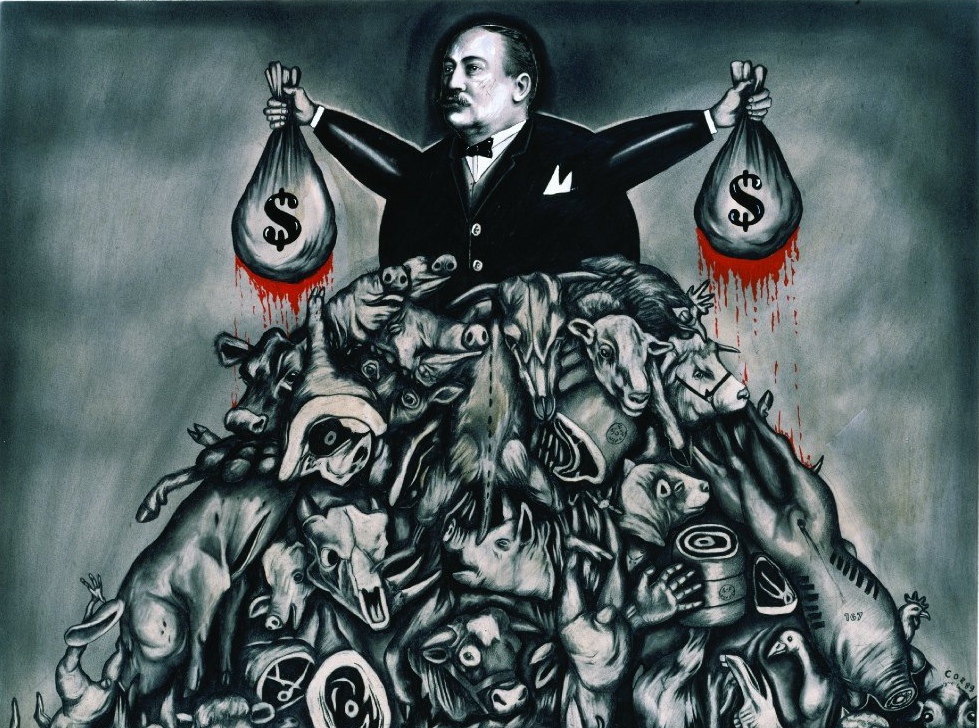
Fragment of “Butcher to the World” by Sue Coe.

By Kurt Cobb

Source: Resilience

Professor and author Douglas Rushkoff recently wrote about a group of wealthy individuals who paid him to answer questions about how to manage their lives after what they believe will be the collapse of society. He only knew at the time he was engaged that the group wanted to talk about the future of technology.

Rushkoff afterwards explained that the group assumed they would need armed guards after this collapse to defend themselves. But they rightly wondered in a collapsed society how they could even control such guards. What would they pay those guards with when the normal forms of payment ceased to mean anything? Would the guards organize against them?

Rushkoff provides a compelling analysis of a group of frightened wealthy men trying to escape the troubles of this world while alive and wishing to leave a decaying body behind when the time comes and transfer their consciousness digitally into a computer. (I’ve written about consciousness and computers previously.)

Here I want to focus on what I see as the failure of these people to understand the single most salient fact about their situations: Their wealth and their identities are social constructs that depend on thousands if not millions of people who are employees; customers; employees of vendors; government workers who maintain and run the law courts, the police force, the public physical infrastructure, legislative bodies, the administrative agencies and the educational institutions—and who thereby maintain public order, public health and public support for our current systems.

Those wealthy men aren’t taking all this with them when they die. And, while they are alive, their identities will shift radically if the intellectual, social, economic and governmental infrastructure degrades to the point where their safety is no longer guaranteed by at least minimal well-being among others in society. If the hunt for diminishing food and other resources comes to their doors, no army of guards will ultimately protect them against the masses who want to survive just as badly but lack the means.

One would think that pondering this, the rich who are capable of pondering it would have an epiphany: Since their security and well-being ultimately hinges on the security and well-being of all, they ought to get started helping to create a society that provides that in the face of the immense challenges we face such as climate change, resource depletion, possible epidemics, growing inequality and other devils waiting in the wings of the modern world. (In fairness, some do understand this.)

At least one reason for the failure of this epiphany to occur is described by author and student of risk Nassim Nicholas Taleb. Taleb describes how the lives the rich become increasingly detached from the rest of society as arbiters of taste for the wealthy convince them that this detachment is the reward of wealth. The rich visit restaurants that include only people like themselves. They purchase larger and larger homes with fewer and fewer people in them until they can spend whole days without seeing another person. For the wealthiest, neighbors are a nuisance. Better to surround oneself with a depopulated forest than people next door.

The rich are convinced by this experience that they are lone heroes and at the same time lone victims, pilloried by the media as out of touch and heartless. These self-proclaimed victims may give to the Cato Institute to reinforce the idea that the individual can go it alone and should. They themselves have done it (or at least think they have). Why can’t everyone else?

The wealthier they are, the more their fear and paranoia mounts that others not so wealthy will try to take their wealth; or that impersonal forces in the marketplace will destroy it or at least diminish it significantly; or that government will be taken over by the mob and expropriate their wealth through high taxes or outright seizure. And, of course, there are the natural disasters of uncontrolled climate change and plague, just to name two.

It’s no wonder some of the super rich are buying luxury bunkers to ride out the apocalypse. These bunkers come with an array of amenities  that include a cinema, indoor pool and spa, medical first aid center, bar, rock climbing wall, gym, and library. High-speed internet is included though one wonders how it will work after the apocalypse.

But strangely, even in these luxury bunkers built in former missile silos, dependence on and trust in others cannot be avoided. The units are actually condominiums. And while they contain supplies and ammunition said to be enough for five years, it will be incumbent on the owners, whether they like it not, to become intimately acquainted with their neighbors in order to coordinate a defense of the compound should that need arise.

The irony, of course, is that this is precisely the kind of communal entanglement which their wealth is supposed to allow them to avoid. Society, it seems, is everywhere you go. You cannot avoid it even when eternity is advancing on your door. And, you cannot escape with your consciousness into a computer (assuming that will one day be possible) if there’s no stable technical society to tend to computer maintenance and no power to keep the computer on.

It turns out that we are here for a limited time and that trusting and reciprocal relationships with others are ultimately the most important possessions we have—unless we are too rich or too frightened to realize it.

Reimagining Money

What if markets were designed to build trust instead of wealth?

By Douglas Rushkoff

(The Atlantic)

Bitcoin was conceived as a modern solution to an ages-old problem: How can two parties agree on and verify an exchange of value? In this sense, Bitcoin is an effective technology, in that it trains the massive processing power of distributed personal computers on the same situation that paper currency was built to resolve. But in important ways, Bitcoin transposes some of the shortcomings of traditional currency onto the digital realm. It ignores a whole host of questions about the potential to reimagine what money can be designed to emphasize: What sorts of money will encourage admirable human behavior? What sorts of money systems will encourage trust, reenergize local commerce, favor peer-to-peer value exchange, and transcend the growth requirement? In short, how can money be less an extractor of value and more a utility for its exchange?Around the world, people have proposed experimental, tentative answers to these questions. What follows are three ways that people have toyed with rearranging the priorities of transactions—all of which would encourage a radical reimagination of what money is and can do.

The simplest approach to limiting the delocalizing, extractive power of central currency is for communities to adopt their own local currencies, pegged or tied in some way to a central currency. One of the first and most successful contemporary efforts is the Massachusetts BerkShare, which was developed to help keep money from flowing out of the Berkshire region.

One hundred BerkShares cost $95 and are available at local banks throughout the region. Participating local merchants then accept them as if they were dollars—offering their customers what amounts to a 5-percent discount for using the local money. Although it amounts to selling goods at a perpetual discount, merchants can in turn spend their local currency at other local businesses and receive the same discounted rate. Nonlocals and tourists purchase goods with dollars at full price, and those who bother to purchase items with BerkShares presumably leave town with a bit of unspent local money in their pockets.

The 5-percent local discount may seem like a huge disadvantage to take on—but only if businesses think of themselves as competing individuals. In the long term, the discount is more than compensated for by the fact that BerkShares can circulate only locally. They remain in the region and come back to the same stores again and again. Even if nonlocal stores, such as Walmart, agree to accept the local currency, they can’t deliver it up to their shareholders or trap it in static savings. The best Walmart can do is use it to pay their local workers or purchase supplies and services from local merchants.

* * *

Unlike local discount currencies, cooperative community currencies don’t need to be pegged to the dollar at all. They are not purchased into existence but are worked into circulation. They are best thought of less like money than like exchanges.

The simplest form of cooperative currency is a favor bank, such as those founded in Greece and other parts of southern Europe during the Euro crisis. Incapable of finding work or sourcing Euros, people in many places lost the ability to transact. Even though a majority of what they needed could be produced locally, they had no cash with which to trade. So they built simple, secure trading websites—mini-eBays—where people offered their goods and services to others in return for the goods and services they needed. The sites did not record value amounts so much as keep general track of who was providing what to the community and coordinate fair exchanges. This casual, transparent solution works particularly well in a community where people already know one another and freeloaders can be pressured to contribute.

Larger communities have been using “time dollars,” a currency system that keeps track of how many hours people contribute to one another. Again, a simple exchange is set up on a website, where people list what they need and what they can contribute. The bigger and more anonymous a community, the more security and verification is required. Luckily, dozens of startups and nonprofit organizations have been developing apps and website kits via which local or even nonlocal communities can establish and run their own currencies.

Time exchanges tend to work best when everybody values their time the same way or is providing the same service. Time dollars are extremely egalitarian, valuing each person’s time the same as anyone else’s. An “hour” is worth one hour of work, whether it is performed by a plumber or a psychotherapist.

The Japanese recession gave rise to one of the most successful time exchanges yet, called Fureai Kippu, or “Caring Relationship Tickets.” People no longer had enough cash to pay for their parents’ or grandparents’ health-care services—but because they had moved far away from home to find jobs, they couldn’t take care of their relatives themselves either. The Fureai Kippu exchange gave people the ability to bank hours of eldercare by taking care of old people in their communities, which they could then spend to get care for their own relatives far away. So one person might provide an hour of bathing services for an elder in her neighborhood in return for someone preparing meals for her grandfather who lives in another city. As the Caring Relationship Tickets became accepted things of value, people began using them for a variety of services.

Although a person can do a bunch of work in order to bank enough hours to get a whole bunch of services, most time exchanges put a limit on how many hours members can accumulate. They also put a limit on how many hours a person can owe. This way a freeloader can be removed from the system, and the entire community can absorb the cost of the unearned hours pretty easily.

* * *

How might traditional banks participate effectively in the financial rehabilitation of the communities they serve? Here’s just one possibility:

Sam’s Pizzeria is thriving as a local business, and Sam needs $200,000 to expand the dining room and build a second restroom. Normally, the bank would evaluate his business and credit and then either reject his loan request or give him the money at around 8 percent interest. The risk is that he won’t get enough new business to fill the new space, won’t be able to pay back the loan, and will go out of business. Indeed, part of the cost of the loan is that speculative risk.

In another approach, the banker could make Sam a different offer. The bank could agree to put up $100,000 toward the expansion project at 8 percent if Sam is able to raise the other $100,000 from his community in the form of market money: Sam is to sell digital coupons for $120 worth of pizza at the expanded restaurant at a cost of $100 per coupon. The bank can supply the software and administrate the escrow. If Sam can’t raise the money, then it proves the community wasn’t ready, and the bank can return everyone’s money.

If he does raise the money, then the bank has gained the security of a terrific community buy-in. Sam got his money more cheaply than if he borrowed the whole sum from the bank, because he can pay back the interest in retail-priced pizza. The community lenders have earned a fast 20 percent on their money—far more than they could earn in a bank or mutual fund. And it’s an investment that pays all sorts of other dividends: a more thriving downtown, more customers for other local businesses, better real-estate values, a higher tax base, better public schools, and so on. These are benefits one can’t see when buying stocks or abstract derivatives. Meanwhile, all the local “investors” now have a stake in the restaurant’s staying open at least long enough for them to cash in all their coupons. That’s good motivation to publicize it, take friends out to eat there, and contribute to its success.

For its part, the bank has diversified its range of services, bet on the possibility that community currencies will gain traction, and demonstrated a willingness to do something other than extract value from a community. The bank becomes a community partner, helping a local region invest in itself. The approach also provides the bank with a great hedge against continued deflation, hyperinflation, or growing consumer dissatisfaction with Wall Street and centrally issued money. If capital lending continues to contract as a business sector, the bank has already positioned itself to function as more of a service company—providing the authentication and financial expertise small businesses still need to thrive.

The bank transforms itself from an agent of debt to a catalyst for distribution and circulation. Like money in a digital age, it becomes less a thing of value in itself than a way of fostering the value creation and exchange of others.


This article has been adapted from Throwing Rocks at the Google Bus: How Growth Became the Enemy of Prosperity.

Saturday Matinee: Grant Morrison: Talking with Gods

Notes from GrantMorrisonMovie.com:

Grant Morrison is one of the most popular writers in comics, and one of the most controversial. He is the Rock Star of Comics, a philosopher and chaos magician, who has used his comics to change both himself and his audience. He is a man living on the border between FICTION and REALITY, and this is his STORY.

The film was produced in close collaboration with Morrison and features extensive interviews with him, as well as never before seen photos and documents spanning his childhood to the present day.

Complimenting Morrison’s own words are interviews with his closest collaborators and friends, including Frank Quitely, Douglas Rushkoff, Cameron Stewart, Phil Jimenez, Mark Waid, Geoff Johns, Jill Thompson and many more. The film makes extensive use of found and abstract footage to make the documentary feel like a Morrison comic.

Rushkoff on the Economy

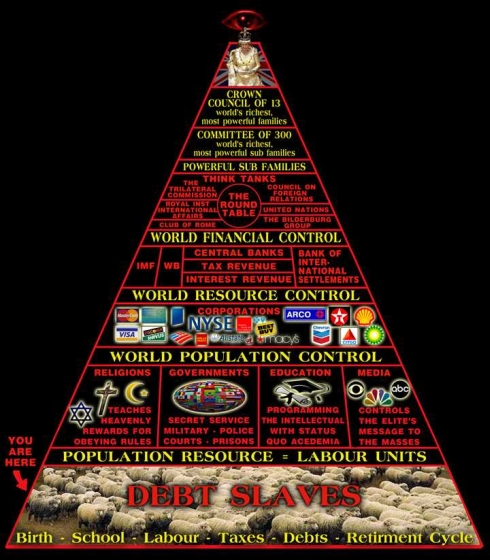
pyramid_of_power

I’ve been reading Douglas Rushkoff’s “Present Shock: When Everything Happens Now” and have by coincidence just reached a chapter of the book covering the topic of currencies and the economy as Washington D.C. attempts to avoid another default. I found similar writings from Rushkoff on the same topic in two articles published by Arthur Magazine. As can be seen from these excerpts, they’re helpful for understanding our current situation:

Local currencies favored local transactions, and worked against the interests of large corporations working from far away. In order to secure their own position as well as that of their chartered monopolies, monarchs began to make local currencies illegal, and force locals to instead use “coin of the realm.” These centralized currencies worked the opposite way. They were not earned into existence, they were lent into existence by a central bank. This meant any money issued to a person or business had to be paid back to the central bank, with interest.

What does that do to an economy? It bankrupts it. Think of it this way: A business borrows 1000 dollars from the bank to get started. In ten years, say, it is supposed to pay back 2000 to the bank. Where does the other 1000 come from? Some other business that has borrowed 1000 from the bank. For one business to pay back what it owes, another must go bankrupt. That, or borrow yet another 1000, and so on.

An economy based on an interest-bearing centralized currency must grow to survive, and this means extracting more, producing more and consuming more. Interest-bearing currency favors the redistribution of wealth from the periphery (the people) to the center (the corporations and their owners). Just sitting on money—capital—is the most assured way of increasing wealth. By the very mechanics of the system, the rich get richer on an absolute and relative basis.

The biggest wealth generator of all was banking itself. By lending money at interest to people and businesses who had no other way to conduct transactions or make investments, banks put themselves at the center of the extraction equation. The longer the economy survived, the more money would have to be borrowed, and the more interest earned by the bank.

[…]Commerce is good. Commerce is not the problem. Monopolies are.

Except in a few rare cases, corporate charters and centralized currency were never intended to promote commerce. They were intended to prevent locals and non-chartered entities from creating and exchanging value. They are not extensions of the free market, but efforts at extracting value from the free market. Corporate monopoly charters were extended to a king’s favorite companies in return for shares. Then, no one else was allowed to do business in that industry. Centralized currency forced businesses to run their revenue through the king’s coffers. Likewise, in its current form, centralized currency is more akin to a ponzi scheme of interest rates, each borrower paying up to the banker above him.

Both of these innovations—corporate charters and centralized currency—tend towards resource exploitation rather than innovation. They are extractive in nature, not productive. And, more importantly, these particular innovations cause wealth to end up being generated through speculation rather than creation. They cause scarcity, not abundance. Over time, it becomes easier to make money by having money than by doing anything. And this was the pure, stated intent of centralized currency and banking in the early Renaissance: to keep the wealthy wealthy, in the face of a rising merchant class.

This isn’t some extremist perspective. It’s just historical fact, though largely forgotten and seemingly refuted by our collective false memory of the Renaissance’s greatness. If you’re interested in finding out more about this, or seeing the evidence on which my research is based, take a look at the best historians writing about the era: Fernand Braudel (The Wheels of Commerce: Civilization and Capitalism: 15th-18th Century, Volume 2, Univ. of California Press, 1992), Carlo M. Cipolla (Before the Industrial Revolution: European Society and Economy, 1000-1700, WW Norton, 1994) or Bernard A. Lietaer, whose book On Human Wealth used to be available for free download off his site, but doesn’t seem to be anymore. In these books, you can find out about the sustainable local economic systems of the Late Middle Ages, learn that the Black Plague actually began after mandated centralized currency had impoverished Europe, and find support of my contention that cathedrals were built with local money before the Renaissance, not Vatican money during the Renaissance.

I highly recommend checking out both articles here (as well as his most recent book “Present Shock”):

http://arthurmag.com/2009/03/16/let-it-die-rushkoff-on-the-economy/

http://arthurmag.com/2009/03/23/hack-money-hack-banking-rushkoff-on-the-economy/

More voices of sanity (Nicole Voss and Laurence Boomert) calling for an overhaul of the monetary system can be heard on the C-Realm podcast :