Polarity and the Genetic Cellular Database

maxresdefault

By rahkyt

Source: Sacred Space in Time

We are not alone in this world. None of us. We are alone in this world. All of us. We are connected to each other. All of us. We are not connected to each other. None of us.

Each statement is true. Each is also, false.

This is the expression of polarity and has to do with perspective and scope. Where we each come from in engaging an issue. I cannot gauge your perspective nor can you gauge mine from a few simple conversations. It takes exploration at depth to truly understand where another is coming from.

We are each the sum total of our genetic cellular database. That is the collective totality of experience as encoded in our genes through the entirety of not only human history but all history of life. To make this idea relatable, consider your most recent ancestors. They are there. Here. With me. With you. Here. Now. Connected because they are a part of us. Their traumas and challenges are there. Here. Their joys and happiness are there. Here. Their sins and their transcendent impulses are there. Here.

Out thoughts are not all our own. We are collectives. Within us are smaller biological collectives with their own needs. Viruses and bacteria that have colonized different parts of our bodies and that communicate with us with electrical impulses that we interpret as imagery and claim as our own. Our sense of danger is often heavily influenced by these colonies as they react to perceived danger and thrill us in order to save themselves.

We are planets and universes unto ourselves.  Orbiting each other, pulled in by gravitational perturbations, repelled and attracted by magnetic flows of interpersonal energy. Our connections are quantum-based and sublime, mysterious and etheric energetics bind us in space, time and beyond. Consideration of this reality opens up fields of infinite potentiality and boundless creativity.

Reconciling these databases is one of the jobs of material incarnation. Equalizing the individual and the collective. Working through imbalances imprinted into genomes across centuries. Making the choices that our ancestors did not. Or reinforcing them with our own. Influencing our families, friends, communities and nations in manners most expressive of our internal, spiritual barometers.

Following our paths – regardless of whether they be dark or light – and manifesting our individual fate in the context of our collective destiny. All choices are valid. All happenings are “meant-to-be”.

All manifestations are necessary.

This reality offends the sensibilities of most but it is the world we live in. By dint of infinite human creativity we build material realities that attempt to modify or sublimate natural law in favor of human desire. Then we moan and complain when these institutions and mores are determined to be rife with corruption. In the attempt to create ‘more perfect unions’ it is forgotten that union within leads to union without. That until the inner landscape – the genetic cellular database – is reconciled, the outer landscape will remain chaotic and corrupt.

We are not our bodies. All of us. We are our bodies. None of us. We live for ourselves. None of us. We live for others. All of us.

Each statement is false. Each is also, true.

The world wide cage

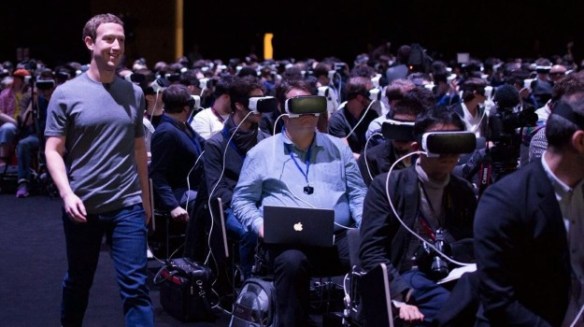
zuckerberg_VR_people-625x350

Technology promised to set us free. Instead it has trained us to withdraw from the world into distraction and dependency

By Nicholas Carr

Source: Aeon

It was a scene out of an Ambien nightmare: a jackal with the face of Mark Zuckerberg stood over a freshly killed zebra, gnawing at the animal’s innards. But I was not asleep. The vision arrived midday, triggered by the Facebook founder’s announcement – in spring 2011 – that ‘The only meat I’m eating is from animals I’ve killed myself.’ Zuckerberg had begun his new ‘personal challenge’, he told Fortune magazine, by boiling a lobster alive. Then he dispatched a chicken. Continuing up the food chain, he offed a pig and slit a goat’s throat. On a hunting expedition, he reportedly put a bullet in a bison. He was ‘learning a lot’, he said, ‘about sustainable living’.

I managed to delete the image of the jackal-man from my memory. What I couldn’t shake was a sense that in the young entrepreneur’s latest pastime lay a metaphor awaiting explication. If only I could bring it into focus, piece its parts together, I might gain what I had long sought: a deeper understanding of the strange times in which we live.

What did the predacious Zuckerberg represent? What meaning might the lobster’s reddened claw hold? And what of that bison, surely the most symbolically resonant of American fauna? I was on to something. At the least, I figured, I’d be able to squeeze a decent blog post out of the story.

The post never got written, but many others did. I’d taken up blogging early in 2005, just as it seemed everyone was talking about ‘the blogosphere’. I’d discovered, after a little digging on the domain registrar GoDaddy, that ‘roughtype.com’ was still available (an uncharacteristic oversight by pornographers), so I called my blog Rough Type. The name seemed to fit the provisional, serve-it-raw quality of online writing at the time.

Blogging has since been subsumed into journalism – it’s lost its personality – but back then it did feel like something new in the world, a literary frontier. The collectivist claptrap about ‘conversational media’ and ‘hive minds’ that came to surround the blogosphere missed the point. Blogs were crankily personal productions. They were diaries written in public, running commentaries on whatever the writer happened to be reading or watching or thinking about at the moment. As Andrew Sullivan, one of the form’s pioneers, put it: ‘You just say what the hell you want.’ The style suited the jitteriness of the web, that needy, oceanic churning. A blog was critical impressionism, or impressionistic criticism, and it had the immediacy of an argument in a bar. You hit the Publish button, and your post was out there on the world wide web, for everyone to see.

Or to ignore. Rough Type’s early readership was trifling, which, in retrospect, was a blessing. I started blogging without knowing what the hell I wanted to say. I was a mumbler in a loud bazaar. Then, in the summer of 2005, Web 2.0 arrived. The commercial internet, comatose since the dot-com crash of 2000, was up on its feet, wide-eyed and hungry. Sites such as MySpace, Flickr, LinkedIn and the recently launched Facebook were pulling money back into Silicon Valley. Nerds were getting rich again. But the fledgling social networks, together with the rapidly inflating blogosphere and the endlessly discussed Wikipedia, seemed to herald something bigger than another gold rush. They were, if you could trust the hype, the vanguard of a democratic revolution in media and communication – a revolution that would change society forever. A new age was dawning, with a sunrise worthy of the Hudson River School.

Rough Type had its subject.

The greatest of the United States’ homegrown religions – greater than Jehovah’s Witnesses, greater than the Church of Jesus Christ of Latter-Day Saints, greater even than Scientology – is the religion of technology. John Adolphus Etzler, a Pittsburgher, sounded the trumpet in his testament The Paradise Within the Reach of All Men (1833). By fulfilling its ‘mechanical purposes’, he wrote, the US would turn itself into a new Eden, a ‘state of superabundance’ where ‘there will be a continual feast, parties of pleasures, novelties, delights and instructive occupations’, not to mention ‘vegetables of infinite variety and appearance’.

Similar predictions proliferated throughout the 19th and 20th centuries, and in their visions of ‘technological majesty’, as the critic and historian Perry Miller wrote, we find the true American sublime. We might blow kisses to agrarians such as Jefferson and tree-huggers such as Thoreau, but we put our faith in Edison and Ford, Gates and Zuckerberg. It is the technologists who shall lead us.

Cyberspace, with its disembodied voices and ethereal avatars, seemed mystical from the start, its unearthly vastness a receptacle for the spiritual yearnings and tropes of the US. ‘What better way,’ wrote the philosopher Michael Heim in ‘The Erotic Ontology of Cyberspace’ (1991), ‘to emulate God’s knowledge than to generate a virtual world constituted by bits of information?’ In 1999, the year Google moved from a Menlo Park garage to a Palo Alto office, the Yale computer scientist David Gelernter wrote a manifesto predicting ‘the second coming of the computer’, replete with gauzy images of ‘cyberbodies drift[ing] in the computational cosmos’ and ‘beautifully laid-out collections of information, like immaculate giant gardens’.

The millenarian rhetoric swelled with the arrival of Web 2.0. ‘Behold,’ proclaimed Wired in an August 2005 cover story: we are entering a ‘new world’, powered not by God’s grace but by the web’s ‘electricity of participation’. It would be a paradise of our own making, ‘manufactured by users’. History’s databases would be erased, humankind rebooted. ‘You and I are alive at this moment.’

The revelation continues to this day, the technological paradise forever glittering on the horizon. Even money men have taken sidelines in starry-eyed futurism. In 2014, the venture capitalist Marc Andreessen sent out a rhapsodic series of tweets – he called it a ‘tweetstorm’ – announcing that computers and robots were about to liberate us all from ‘physical need constraints’. Echoing Etzler (and Karl Marx), he declared that ‘for the first time in history’ humankind would be able to express its full and true nature: ‘we will be whoever we want to be.’ And: ‘The main fields of human endeavour will be culture, arts, sciences, creativity, philosophy, experimentation, exploration, adventure.’ The only thing he left out was the vegetables.

Such prophesies might be dismissed as the prattle of overindulged rich guys, but for one thing: they’ve shaped public opinion. By spreading a utopian view of technology, a view that defines progress as essentially technological, they’ve encouraged people to switch off their critical faculties and give Silicon Valley entrepreneurs and financiers free rein in remaking culture to fit their commercial interests. If, after all, the technologists are creating a world of superabundance, a world without work or want, their interests must be indistinguishable from society’s. To stand in their way, or even to question their motives and tactics, would be self-defeating. It would serve only to delay the wonderful inevitable.

The Silicon Valley line has been given an academic imprimatur by theorists from universities and think tanks. Intellectuals spanning the political spectrum, from Randian right to Marxian left, have portrayed the computer network as a technology of emancipation. The virtual world, they argue, provides an escape from repressive social, corporate and governmental constraints; it frees people to exercise their volition and creativity unfettered, whether as entrepreneurs seeking riches in the marketplace or as volunteers engaged in ‘social production’ outside the marketplace. As the Harvard law professor Yochai Benkler wrote in his influential book The Wealth of Networks (2006):

This new freedom holds great practical promise: as a dimension of individual freedom; as a platform for better democratic participation; as a medium to foster a more critical and self-reflective culture; and, in an increasingly information-dependent global economy, as a mechanism to achieve improvements in human development everywhere.

Calling it a revolution, he said, is no exaggeration.

Benkler and his cohort had good intentions, but their assumptions were bad. They put too much stock in the early history of the web, when the system’s commercial and social structures were inchoate, its users a skewed sample of the population. They failed to appreciate how the network would funnel the energies of the people into a centrally administered, tightly monitored information system organised to enrich a small group of businesses and their owners.

The network would indeed generate a lot of wealth, but it would be wealth of the Adam Smith sort – and it would be concentrated in a few hands, not widely spread. The culture that emerged on the network, and that now extends deep into our lives and psyches, is characterised by frenetic production and consumption – smartphones have made media machines of us all – but little real empowerment and even less reflectiveness. It’s a culture of distraction and dependency. That’s not to deny the benefits of having easy access to an efficient, universal system of information exchange. It is to deny the mythology that shrouds the system. And it is to deny the assumption that the system, in order to provide its benefits, had to take its present form.

Late in his life, the economist John Kenneth Galbraith coined the term ‘innocent fraud’. He used it to describe a lie or a half-truth that, because it suits the needs or views of those in power, is presented as fact. After much repetition, the fiction becomes common wisdom. ‘It is innocent because most who employ it are without conscious guilt,’ Galbraith wrote in 1999. ‘It is fraud because it is quietly in the service of special interest.’ The idea of the computer network as an engine of liberation is an innocent fraud.

I love a good gizmo. When, as a teenager, I sat down at a computer for the first time – a bulging, monochromatic terminal connected to a two-ton mainframe processor – I was wonderstruck. As soon as affordable PCs came along, I surrounded myself with beige boxes, floppy disks and what used to be called ‘peripherals’. A computer, I found, was a tool of many uses but also a puzzle of many mysteries. The more time you spent figuring out how it worked, learning its language and logic, probing its limits, the more possibilities it opened. Like the best of tools, it invited and rewarded curiosity. And it was fun, head crashes and fatal errors notwithstanding.

In the early 1990s, I launched a browser for the first time and watched the gates of the web open. I was enthralled – so much territory, so few rules. But it didn’t take long for the carpetbaggers to arrive. The territory began to be subdivided, strip-malled and, as the monetary value of its data banks grew, strip-mined. My excitement remained, but it was tempered by wariness. I sensed that foreign agents were slipping into my computer through its connection to the web. What had been a tool under my own control was morphing into a medium under the control of others. The computer screen was becoming, as all mass media tend to become, an environment, a surrounding, an enclosure, at worst a cage. It seemed clear that those who controlled the omnipresent screen would, if given their way, control culture as well.

‘Computing is not about computers any more,’ wrote Nicholas Negroponte of the Massachusetts Institute of Technology in his bestseller Being Digital (1995). ‘It is about living.’ By the turn of the century, Silicon Valley was selling more than gadgets and software: it was selling an ideology. The creed was set in the tradition of US techno-utopianism, but with a digital twist. The Valley-ites were fierce materialists – what couldn’t be measured had no meaning – yet they loathed materiality. In their view, the problems of the world, from inefficiency and inequality to morbidity and mortality, emanated from the world’s physicality, from its embodiment in torpid, inflexible, decaying stuff. The panacea was virtuality – the reinvention and redemption of society in computer code. They would build us a new Eden not from atoms but from bits. All that is solid would melt into their network. We were expected to be grateful and, for the most part, we were.

Our craving for regeneration through virtuality is the latest expression of what Susan Sontag in On Photography (1977) described as ‘the American impatience with reality, the taste for activities whose instrumentality is a machine’. What we’ve always found hard to abide is that the world follows a script we didn’t write. We look to technology not only to manipulate nature but to possess it, to package it as a product that can be consumed by pressing a light switch or a gas pedal or a shutter button. We yearn to reprogram existence, and with the computer we have the best means yet. We would like to see this project as heroic, as a rebellion against the tyranny of an alien power. But it’s not that at all. It’s a project born of anxiety. Behind it lies a dread that the messy, atomic world will rebel against us. What Silicon Valley sells and we buy is not transcendence but withdrawal. The screen provides a refuge, a mediated world that is more predictable, more tractable, and above all safer than the recalcitrant world of things. We flock to the virtual because the real demands too much of us.

‘You and I are alive at this moment.’ That Wired story – under headline ‘We Are the Web’ – nagged at me as the excitement over the rebirth of the internet intensified through the fall of 2005. The article was an irritant but also an inspiration. During the first weekend of October, I sat at my Power Mac G5 and hacked out a response. On Monday morning, I posted the result on Rough Type – a short essay under the portentous title ‘The Amorality of Web 2.0’. To my surprise (and, I admit, delight), bloggers swarmed around the piece like phagocytes. Within days, it had been viewed by thousands and had sprouted a tail of comments.

So began my argument with – what should I call it? There are so many choices: the digital age, the information age, the internet age, the computer age, the connected age, the Google age, the emoji age, the cloud age, the smartphone age, the data age, the Facebook age, the robot age, the posthuman age. The more names we pin on it, the more vaporous it seems. If nothing else, it is an age geared to the talents of the brand manager. I’ll just call it Now.

It was through my argument with Now, an argument that has now careered through more than a thousand blog posts, that I arrived at my own revelation, if only a modest, terrestrial one. What I want from technology is not a new world. What I want from technology are tools for exploring and enjoying the world that is – the world that comes to us thick with ‘things counter, original, spare, strange’, as Gerard Manley Hopkins once described it. We might all live in Silicon Valley now, but we can still act and think as exiles. We can still aspire to be what Seamus Heaney, in his poem ‘Exposure’, called inner émigrés.

A dead bison. A billionaire with a gun. I guess the symbolism was pretty obvious all along.

Why Are There So Many Psychopaths in Positions of Power?

what-people-think-psychopaths-are-streetdemocracy

By Anna LeMind

Source: Waking Times

A 2010 study that examined a sample of 203 individuals from different companies’ management development programs revealed something interesting. It was found that about 3% of business managers scored in the psychopath range while the incidence of psychopathy in the general population is approximately 1%. So why are there so many psychopaths in senior management positions?

The Study

A more recent study, published in 2014 in the Journal of Forensic Psychiatry and Psychology, shed new light on the behavior of psychopaths, which could explain this phenomenon.

During an experiment, a group of people were given a standard test of psychopathy. At the same time, the participants were shown a series of picture aimed to test their levels of empathy. For this purpose, the researchers measured their galvanic skin response to examine their emotional reaction to the shown pictures.

The research showed that psychopaths with average or high levels of intelligence were able to control their galvanic skin response. As a result of this, their responses appeared normal. At the same time, psychopaths with low IQ exhibited abnormal test results, which are typical for individuals with psychopathic tendencies.

What the Results Mean

Psychopaths are great manipulators, and this research provides new evidence for that. The results of the study suggest that psychopaths with high IQs are able to hide their true identity, faking their emotional responses and probably personality traits as well. As a result, they often show a different picture of themselves and trick others into believing this is their real self.

Carolyn Bate, the first author of the study, said:

“The ones who are at the top of businesses are often charming and intelligent, but with emotional deficits, as opposed to psychopaths who are quite erratic and tend to commit gruesome crimes and are often caught and imprisoned.”

She also thinks that psychopaths in positions of power could be far more than 3%, because if people are aware they are psychopathic they can also lie – they are quite manipulative and lack empathy.”

These findings are quite interesting to consider and could apply to other spheres except for the business world. I’m sure that if psychologists had the opportunity to study those in positions of political power, the figure would go beyond 3%. Being manipulative and able to fake one’s emotions is a quality that certainly helps one become a successful politician. Not even to mention that in order to reach the highest levels of political power, some lack of empathy and conscience is a must.

Dr. Paul Babiak writes in his book, Snakes in Suits: When Psychopaths Go to Work:

They are masters of impression management; their insight into the psyche of others combined with a superficial – but convincing – verbal fluency allows them to change their situation skillfully as it suits the situation and their game plan.”

Doesn’t this sound like most of our politicians? They are just playing their game, tricking people into believing that their concerns about the world and society are sincere. They pretend to care while in reality, they only want more power and money. And we don’t even need a study to know this for sure.

The Lid is Off

tumblr_lsjs8cqofc1qanyg8

By Charles Eisenstein

Source: CharlesEisenstein.net

It is getting harder to keep a secret these days. The collective shadow of our society, once safely relegated to the dark basement of the unmentionable, is now exposed to daylight, forcing us to face our contradictions. I’ll offer three examples: Donald Trump’s leaked recordings, Hillary Clinton’s emails and Wall Street speeches, and the endless procession of videos of police brutality.

Once upon a time, “locker room talk” like Donald Trump’s lewd and degrading remarks leaked to the media would have stayed safely sequestered from public view. Misogynistic locker room banter existed, as it were, in an alternate universe. What was said on the golf course or the barroom didn’t register as part of a man’s public reputation; in those places, men were free to say things that would be unforgivable in public. The coexistence of these two realms was seldom questioned. As a high school and college athlete, I remember hearing the kinds of things Trump has said, and they were quite unremarkable in that context. A boy could say the most brutish, repellent things in the locker room without damage to his reputation outside it. Respectable society would never find out. Likewise, when reporters and politicians mingled outside the public performances of their roles, an unwritten understanding kept their conversations safely off the record. I imagine Donald Trump feeling a sense of betrayal at the revelation of his remarks, as if a boy reported to another boy’s girlfriend what he said about her in the locker room.

I think this division into two realms extended to internal, psychological divisions in the individuals making the degrading boasts and comments about women. In polite company, they became people who did not harbor such thoughts. The locker room alter-ego was safely contained in a different psychic compartment. I can imagine a Donald Trump being sincerely – sincerely! – scandalized to hear in polite company the very things he himself said in the safety of the mens’-only field of misogyny. I can imagine him condemning what was said in all earnestness, with zero awareness of hypocrisy.

So it is that rape culture is allowed to persist. It needs a shadow zone. The locker room conversations that objectify and degrade women and contribute to rape culture need a “locker room” in which to happen, a wall of separation between it and the larger realm of general social acceptability.

This wall of separation is breaking down, thanks in large part to the ubiquity of recording technology and the impossibility of stopping the distribution of the recordings on the Internet. Contradictions, whether personal or social, that could once remain hidden are coming unstoppably to light. It is getting harder to uphold a divided self.

As with sex, so with money. Hillary Clinton is having a hard time maintaining a wall of separation between her public posture of economic populism and her decades-long ministration to the needs of Wall Street. In former times a politician’s speeches to elite insiders would exist in an inviolably separate realm from his or her public image. In inside circles of power, the politician would be free to express himself directly. No concealment of his allegiances was necessary, because no one outside the political and corporate elite was listening. So of course, Hillary Clinton was loathe to release the transcripts of her speeches to Wall Street banks. Those speeches were the equivalent of locker room talk, which is supposed to stay in the locker room. Here, though, the context is financial domination rather than sexual domination.

Something similar applies to Clinton’s infamous deleted emails. There is nothing new about the contrast between the public presentation of governance and its ugly inner workings. The exercise of political power has never been pretty. The backroom deals, the threats and coercion, the buying of favors… all the nastiness that the email scandal hints at is characteristic of politics as we know it. The difference today is that it can no longer be confined to the back room. In other words, it is getting harder to maintain the appearance of democracy in a reality of oligopoly.

It is perhaps necessary that Clinton and Trump are both such extreme expressions of the suppressed shadow of our culture, presenting itself in unambiguous form for clearing. Liberal pundits have repeatedly observed that the bigoted sentiments Donald Trump expresses are merely the undisguised version of what Republicans have been saying in code for a long time. The hidden erupts into view. Clinton, meanwhile, is no ordinary establishment politician; she is the very epitome of the establishment, embodying its insincerity, lack of imagination, normalized corruption, and narrow technocratic commitment to preserving the status quo.

This is not meant as a personal criticism. My purpose here is not to condemn Hillary or the Donald; it is to illuminate the dissolving of the insulating compartments that allow contradictions and hypocrisy to exist. Probably in person, each of them is a complex individual like you and me, a mixture of beauty and pain, playing the roles laid out for them. I imagine that in their most private moments neither fully identifies with those roles nor believes in the game into which they have been thrust, any more than you or I believe in it. The elites usually precede the people into cynicism. In any event, our current moment of social evolution is calling each of them, in their public roles, to be an avatar of a cultural shadow archetype, presented to us in extreme form so that it cannot be ignored.

Clinton and Trump are a product of their conditions, playing the “game of thrones” according to the secret rules of the insiders, in a system that has long allowed, encouraged, and in some ways nearly required hypocrisy. That system is coming to an end. We are entering by fits and starts an era of transparency in which, we may someday hope, secret rules and hypocrisy will have no purchase.

Another arena with a longstanding division between sanitized public presentation and gritty reality is law enforcement. As with misogyny and political corruption, there is nothing new about police brutality and nothing new about its disproportionate application to brown-skinned people. For a long time though, it was sequestered in the realm of the unmentionable, relegated to the left-wing margins of political discourse or the statistics of academic papers. No longer. The advent of ubiquitous cell phone video cameras and other video surveillance has lifted the lid off the dark political unconscious and exposed its contents to light.

Here again, this exposure is making the two contradictory functions of the police – serving and protecting, and bullying and abusing – impossible to maintain simultaneously. It is only possible if the latter function is well hidden in the shadows.

I could go on to make similar points about drone strikes, refugee camps, clearcuts, and all the other injury and injustice that technology and social media are bringing into view. For a long time, propriety and ideology have buffered normalcy from the ugly inner workings of its maintenance. For example, the ideology of development has buffered us from the horrors of Third World sweatshops, strip mines, dispossession of land, and so forth. Lurid caricatures of violent criminals hides the grinding injustice of the legal system. The triumphal narrative of exploration and progress obscures the genocide of indigenous cultures. These various buffers, which allow contradictions to stand, have been necessary to operate a civilization built on exploitation and ecocide. Open up any social institution – politics, finance, business, education, medicine, academia, and even philanthropy – and you will find within it the same ugly machinations of power.

Today these buffers are disintegrating, despite the best efforts of established power to maintain secrecy, prosecute whistle-blowers, and control information. We might thank technology for bringing the dark underbelly of our system to light, but I think something larger is afoot. The trend toward transparency that is happening on the systems level is also happening in our personal relationships and within ourselves. Invisible inconsistencies, hiding, pretense, and self-deception show themselves as the light of attention turns inward. The tools of self-examination are proliferating on every level, from the personal to the collective. Herein is a link between the political developments I’ve described and the world of self-help, spirituality, or consciousness. At its best, these comprise ways of shedding light onto our internal contradictions and blockages in order to create a kind of inner transparency. On the interpersonal level too, a lot of work around partnership and community also aims for transparency, for example to expose hidden resentments, repressed desires, and unconscious conflicts. Illuminating the contradictions between the story and the actuality of a relationship brings the possibility of healing.

When previously hidden contradictions rise to consciousness and collide, the result is first denial and rage, followed by cognitive dissonance and the breakdown of normalcy. We see that happening today in the public sphere. That process can be disorienting, even paralyzing, as familiar orienting certitudes turn false. Who are we as a people? What is reliable? What is possible? What is real? We aren’t what we thought we were, and it isn’t what we thought it was. This confusion is a good thing. It is a sign of liberation from the old story that confined us. The exposure and clearing of hidden contradictions brings us to a higher degree of integrity, and frees up prodigious amounts of energy that had been consumed in the maintenance of illusions. What will our society be capable of, when we are no longer wallowing in pretense?

Electoral Politics and the Illusion of Control

what-corporate-america-wants

By William Hawes

Source: Dissident Voice

We have all been told a lie. The lie that says democracy can be maintained only through voting, through purely representative, parliamentarian means. When the founding fathers set up the Constitution and Bill of Rights, they were wary of any truly popular, working and middle class control of the United States. Our government was to be run as a republic, designed by elites, for the elites. Our three branches of government were not simply invented for checks and balances: another reason was to stymie any massively popular mandates that would go against the interests of the oligarchy.

Today, the checks and balances used ostensibly to prevent tyranny are being used against us: even though a high majority (65%) is against government surveillance which violates privacy, and 78% want Citizens United overturned, we are stuck with a broken system and statesmen bought off by corporations. Even though 80% of eligible citizens didn’t vote in the 2014 elections, this year our out-of-touch pundits and mass media puppets prattle on unceasingly about our democracy, still misguidedly believing these candidates represent the will of the people.

Just sixteen years ago, our very own electoral system, in the form of a gilded cage, shut down the popular will of the people, as Al Gore won about 500,000 more votes than George W. Bush, yet still lost. Although the decision was made over 200 years ago, we have decided that the antiquated Electoral College system should still be used today.

More broadly, our never-ending election cycle serves as a palliative for ordinary Americans, but does nothing to cure the underlying disease and rot within our political system. Progressive liberals can take pleasure in Sanders’ statements supporting a raise in the minimum wage, debt relief for students, fighting income inequality, etc. Yet Sanders has no broad coalition in Congress to advance his agenda and to fight his “revolution”. Isolationist, non-interventionist conservatives can take pride in Trump’s support of Russia’s fight against ISIS in Syria, and his token rhetoric towards re-working unfair free trade agreements and bringing back jobs. Yet Trump’s pandering towards racists and xenophobes will only accelerate the descent towards fascism that the US has been slipping into for decades.

The second lie we’ve been told, or assumed implicitly, is that we are in control of our national destiny. Through the vote, we can supposedly make a clean slate every four years, to make up for the misdeeds of our past political leaders. The truth is much murkier. Our national security state and intelligence services have been built up to Leviathan levels, and presidential candidates are instantly discredited and marginalized for suggesting even small decreases in military spending. Corporate lobbyists and the conglomerate multinationals control the political landscape, determining the limits of discourse and shutting down anyone who exceeds the boundaries. Absurdly, third party candidates, some of the only ones with fresh ideas to invigorate our democracy, are demonized. Mainstream media coverage reinforces these imaginary limits of discussion, and Independents, Greens, Socialists, and Libertarians are relegated to the sidelines.

As the neoliberal order reinforces and deepens material poverty and intellectual ignorance, public discourse narrows without totalitarian overt manipulation. This makes issues seem as if they are progressing naturally, when public debate and consent is in actuality homogenized and conformist. This is analogous to the concept known to scientists as “shifting baselines”: here it applies to a public that accepts deeper cuts to social services, increases in privatizations, and increased militarization and policing of the public sphere, because the momentum seems inexorable and immutable. The establishment uses rhetorical threats and excuses to further corporate agendas and destroy civil society, all in the name of maintaining “economic growth” and upholding “law and order”.

The truth is that only by staring into the abyss can we collectively begin to dig ourselves out of our self-dug graves. The US has been in an unofficial recession since 2008. Millions of Americans live paycheck to paycheck, with minimal society safety nets, leading to insecurity, uncertainty and cynicism towards the future, and crippling anxiety. Politicians routinely show they do not care about the working class and the poor when they speak to the “middle class”, whatever that means anymore. Our leaders are handpicked by Wall Street billionaires, and/or defense and fossil fuel industrialists. Abroad, covert war is ongoing in a dozen or more countries in Asia and North Africa.

With so many minds confined to the hypnotic and myopic gaze focused on high technology, mass media, and our official “leaders”, 21st century man falls further into enslavement every day. As Fromm would say, we Escape from Freedom into self-indulgence and apathy, leaving hard decisions to technocrats and oligarchs. Control over our food, medicine, intellectual property, and basic social and environmental rights are consolidated into a handful of multinational corporations who inundate us with false needs through advertising and propaganda. Computer algorithms tell us what to buy, and social media manipulates our emotions, fulfilling the preaching of techno-dystopian prophets who warn of non-human intelligence guiding humanity towards dark futures.

Revolutionary fervor lurks under the surface, yet whether a popular progressive movement can blossom remains to be seen. Conversely, a missed revolution could easily result in an authoritarian and fascist takeover by the reactionary far-right. One thing we know for certain is that continuing under this two-party charade will only lead us to our doom.

Average citizens have never had any control of the republic since its founding. A complete constitutional overhaul is needed, and forms of direct, consensus, and deliberative democracy must be woven into a hybrid system. Elections should be funded by the public, with no corporate money allowed, shorter election cycles, and no discrimination towards third parties, unlike the current Commission on Presidential Debates. State governments should gain power, and federal programs reigned in and redefined towards streamlined regulation and oversight. Tax subsidies should be stripped from the fossil fuel industries entirely and redirected towards the best scientists and engineers in the field of renewable energy.

What is desperately needed is a shift in worldview to promote government that sees its job as not simply to tax and legislate, but to also support healthy life-world systems. Also, promoting humble and dedicated leaders who are stewards of community and the Earth, who do not insist on blatant exploitation of distant nations and pillaging resources, would go a long way. This cannot be done within the confines of the Democratic and Republican parties, who thrive on domination, coercion, control, and manipulation of public interests.

To break the cycle, we must collectively embrace our frailties and limitations. The deadly, patriarchal energy technologies such as the petrochemical industries and nuclear energy must be shut down. We must learn from the man-made tragedies of Bhopal, Katrina, Chernobyl, and Fukushima, and dismantle dangerous plants and factories, and begin to move humanity away from areas susceptible to natural disasters and coastal flooding. The US, Russia, and the nuclear nations must formally apologize for the atmospheric nuclear testing in the fifties and sixties which will kill millions from cancer, and ban nuclear weapons for good.

Learning to relinquish control and learning to keep one’s ego in check are two of the ultimate tests our leaders must accept. As the Tao Te Ching says:

Therefore the sages:
Manage the work of detached actions
Conduct the teaching of no words
They work with myriad things but do not control
They create but do not possess
They act but do not presume
They succeed but do not dwell on success
It is because they do not dwell on success
That it never goes away.1

  1. Tao Te Ching: Annotated and Explained. Derek Lin. SkyLight Paths. 2006.  Translation by Derek Lin. [↩]


William Hawesis a writer specializing in politics and the environment. You can find his e-book of collected essays here. His articles have appeared online at Global Research, Countercurrents, Dissident Voice, and Counterpunch. You can email him at wilhawes@gmail.com Read other articles by William.

Cutting the Cords of Empire: The Spectacle of US Elections

the-powers-that-be-deep-state

By William Hawes

Source: Global Research

“The more powerful the class, the more it claims not to exist.” -Guy Debord, The Society of the Spectacle

It’s almost time for our quadrennial political distraction, masquerading as the US presidential election. As opposed to previous elections, this one feels quite different. Even with Obama/Romney in 2012, important, basic economic issues were discussed, health care reform was questioned, and foreign policy was given its due.

However, this time, the spectacle of the personalities seems to dominate the conversation: Mrs. Clinton is somehow on a feminist crusade, an inspiration for women everywhere. Going unmentioned are her irredeemable backers, such as the genocidal Henry Kissinger and Madeleine Albright. As for Trump, his version of America is as naïve, narrow-minded, and delusional as a Leave It to Beaver episode, or a Captain America comic book. In the background, the monstrosity of global capitalism goes unquestioned, and the cries from victims of US institutional racism and structural violence go unheard.

Global warming, broad economic policy, and nuanced foreign policy are simply too much to ask of these candidates. Their stupidity knows no end; their corruption and depravity know no bounds, and many of both of their supporters, as well as media, political, and corporate backers and sycophants can be considered “deplorable”. Many supporters of the two-party system do not bother to think about the damage either potential president would do to people outside the US. Many backers of Trump and Clinton have little to no basic knowledge of world cultures and history.

What are the cords that connect us to these “leaders”, to our American Empire? They are the same ones that the Industrial Revolution, the basis of our civilization, has implanted in each of us since birth, as Alvin Toffler explains in The Third Wave. As our social world became modeled on the factory floors developed in the 18th and 19th centuries, a set of unspoken principles were ironed out, and transferred to the political, social, and economic realms. (1)  As we shall see, these principles spread unchecked, and have infiltrated political discourse and social hierarchies. Toffler identifies these implicit rules as:

1) Standardization: Industry, production, and factory life revolved around endless loops and inputs of metals, fabrics, coal, oil, and specialized parts for trains, cars, etc. The simplification and standard mechanical parts used were mirrored and reflected in the culture at large: eventually, markets, the media, radio and TV, and even great art and literature succumbed to commoditization and homogenization. We now have mass marketing, public relations, and “electioneering”, where our duopoly controls all branches of government.

2) Specialization: With the explosion in the fields of science and engineering, specialized techniques were taught to develop, invent, and maintain mechanical and electric equipment. Yet again, this philosophy infected the general society:  only bureaucrats are able to work in the halls of power, only industrial experts are able to administer federal agencies, creating the disgraceful revolving door phenomena in Washington.

3) Synchronization: As more people flocked into cities with gleaming promises of steady, factory jobs, time and punctuality became of prime importance. Punching timecards and meeting quotas were necessary: there was no room for leeway, as assembly lines demanded strict timelines. The time demands of labor leaked into white-collar work as well: in banking and finance, railroads, time zones, and office jobs, advanced scheduling became the norm. Eventually, synchronization of the political system gained traction, and the imperial system came to resemble a deathly machine, marching in time to bloody footsteps: military, immoral diplomacy and ideology, and industry worked together to lord over Latin America with the Monroe Doctrine, annihilate Native Americans using Manifest Destiny, even as today, the excuse of the “War on Terror” is used to exterminate entire populations in Afghanistan, Iraq, Syria, Libya, and elsewhere.

4) Concentration: Think of the vast oil and coal stored underground for millions of years, only to be strip-mined, taken up by rigs, and transported by rail and tanker into vast refineries: concentration of energy. Further, every class of people became absorbed and intensified in the industrial system: workers into factories, children into schools, mentally ill into institutions, finance concentrated into New York, London, and Paris. Mega-mergers of corporations: today, it is the Apple, Google, Shell, and BP’s of the world who have coffers of blood money held tidily in banks throughout the world. Further, the concentration of technocrats who we supposedly need to run our societies: in the West, the military-industrialists, just as the Soviets were once told the nomenklatura was necessary.

5) Maximization: Firms were encouraged to grow as large as possible, and expand into as many fields as possible. Companies in Japan in the mid-twentieth century would actually have workers sing of the glory and greatness of their employer. Today, 62 people have the same wealth as half the world’s population. This is concentration and maximizing at its most obscene. Of course, you won’t hear Clinton, Trump, or anyone in Washington talking about this. Maximizing GDP, corporate profits, fossil fuel use, and flexing imperial muscle is what the Feds do best.

6) Centralization: Connected to the first five rules of empire stated above, centralizing power, wealth, and using knowledge for private gain is required to uphold the industrial state. Taxation, subsidies for industry, political debates via the sham Committee on Presidential Debates, the backroom shenanigans of the DNC and RNC, and cloak and dagger lobbying and bribery now dominate our system of government. Further, the Leviathan of state-sanctioned violence now lords over the world from the Pentagon and NATO, and the centralization of information runs through fiber-optic cables straight to the infernal, yet temperature-controlled offices of the CIA and NSA.

The elections have adopted all the patterns of the industrial, imperial state: we have standardized TV, scripted questions, airbrushed candidates, and childlike debates. We’ve seen specialized tactics of gerrymandering, vote-rigging, PR bullshit, and strategists whose careers accomplish nothing for the public good. We all know of the synchronization of Wall Street, defense and oil companies. The concentration of power in the hands of the few hardly needs mention: here’s the study by Princeton and Northwestern professors who conclude that the US is an oligarchy, not a democracy. We’ve witnessed the maximization of endless primaries, debates, press conferences, and town-hall meetings ad infinitum. The centralization of political ideology (triangulation in Clintonite terms, Machiavellian to a rational person) and the limitations of discourse that our candidates display are all too clear.

These are the iron chains holding us down, shackling us in Plato’s cave: our candidates are figureheads, shadows on the wall; they are puppets of the super-elite. The central position they carve out in the mainstream is really a pit, an abyss: one that we all find ourselves in, as we continue to vote for those who don’t fight for our interests.

The two best options for this election seem to be: voting for Jill Stein, or boycotting the election, as Joel Hirschhorn advocates. As for our obscene election cycles, I believe Zach de la Rocha summed it up best:

  A spectacle monopolized

The camera’s eyes on choice disguised

Was it cast for the mass who burn and toil?

Or for vultures who thirst for blood and oil?

William Hawes is a writer specializing in politics and environmental issues. His articles have appeared online at Global Research, Counterpunch, Dissident Voice, The World Financial Review, Gods & Radicals, and Countercurrents. He is author of the e-book Planetary Vision: Essays on Freedom and EmpireYou can reach him at wilhawes@gmail.com

Notes:

1.) Alvin Toffler. The Third Wave. Bantam, 1980. p. 46-60.


Charlie Kaufman on Zombie Ants, Mind Control, and Consumerist Culture

By The Unknown

Source: High Existence

Charlie Kaufman has one of the most inventive and original minds in Hollywood. That’s probably why he has eluded mainstream success.

Mr. Kaufman is perhaps best known for writing the modern classic Eternal Sunshine of the Spotless Mind, for which he was awarded an Oscar for best original screenplay. He’s also the writer of Being John Malkovich, Adaptation, Anomalisa, and the writer-director of the little-known but brilliant Synecdoche, New York, which Roger Ebert named the “best film of the decade” (2000-2010).

In the words of fellow writer Jeremy Brock:

One of the few screenwriters to transcend his profession, Charlie Kaufman is responsible for some of the most unique, daring, and inventive screenplays in contemporary cinema. […] His films deal with identity, mortality, relationships, and the meaning or purpose of life. They are metaphysical, self-reflexive, hyper-aware, often using surrealist conceits to explore our fundamental anxieties. It is in this tradition of finding new, startling, and funny ways of exploring human psychology that Charlie Kaufman sits comfortably amongst the world’s greatest living writers.

Fans love him. Critics adore him. Mainstream audiences… ignore him.

And that’s a shame.

In a world filled with sequels, prequels, remakes, and reboots, creativity is dying in Hollywood.Worse than dying, I’d argue that creativity is being tied up, beaten, tortured, mocked, murdered, then thrown in a gutter and pissed on.

You could argue that I’m cynical.

You could also argue that I’m tired of being patronized by the regurgitated garbage Hollywood pukes up and tries to spoon feed us. We all know the difference between food and vomit, and Hollywood’s been steadily feeding us barf for the last ten years while distracting us with silly airplane noises like we’re babies.

But I’m getting sidetracked.

This isn’t about my personal disdain for Hollywood; this is about Charlie Kaufman’s views on consumerism, and Charlie Kaufman is much more polite, intelligent, and eloquent than I am.

I stumbled across a speech Charlie Kaufman delivered at a BAFTA lecture in 2011 and absolutely loved it.

Mr. Kaufman was supposed to deliver a speech about screenwriting, but gave the audience much more. The full speech covers a broad range of topics, but I spliced together a few of my favorites — Zombie Ants, Mind Control, and Consumerist Culture — and created the video below.

Watch and listen as Charlie Kaufman dissects and diagnoses the fallacies of our present-day culture, but rather than react with juvenile indignation (as I did in my brief rant earlier), he responds with poignant words of heartbroken yet hopeful wisdom.

Enjoy!

War Pabulum: The Perils of War as a Master Narrative


photo posted on post-gazette.com

By W.J. Astore

Source: Bracing Views

I was reading the novelist Ursula K. Le Guin and came across the following commentary by her:

“A hero whose heroism consists of killing people is uninteresting to me, and I detest the hormonal war orgies of our visual media … War as a moral metaphor is limited, limiting, and dangerous.  By reducing the choices of action to ‘a war against’ whatever-it-is, you divide the world into Me or Us (good) and Them or It (bad) and reduce the ethical complexity and moral richness of our life to Yes/No, On/Off.  This is puerile, misleading, and degrading.  In stories, it evades any solution but violence and offers the reader mere infantile reassurance.  All too often the heroes of such fantasies behave exactly as the villains do, acting with mindless violence, but the hero is on the ‘right’ side and therefore will win.”

This passage is copyrighted 2012, and surely Le Guin is commenting in part on the American political and war scene, even if these comments came as an afterword to her novel “A Wizard of Earthsea.”

The stories we tell ourselves – our driving narratives and metaphors – are very powerful.  I learned this almost three decades ago from one of my professors at Johns Hopkins.  We were talking about the scientific revolution, the label applied after the fact by historians to the era of Copernicus, Kepler, Galileo, and Newton.  Did that era truly deserve the label of a “revolution” in thought?  On one level, yes.  A heliocentric vision replaced a geocentric one.  Newtonian physics replaced Aristotelian metaphysics.  But on another level, the label was misleading.  If you view this era only through a “revolutionary” lens, everything gets magnified and refracted through it.  You’re always looking for evidence of the “revolution” that you know is there.  The revolutionary narrative/metaphor, in other words, restricts and distorts your vision.  It also tends to answer questions before they’re even asked.  Certain historical figures get labeled as “revolutionaries,” others as “reactionaries,” some as winners, others as losers, almost without having to think about it.

That’s disturbing enough for a historian dealing with the “dead” past.  Think about how that distortion, that resort to easy categorization, applies to the living, to the present, in “wartime.”  Viewing everything through a war lens both restricts and distorts our vision.  We quickly force people to take sides, or we assign them a side regardless of their complexity (“You’re either for us or against us,” as George W. Bush noted in the aftermath of 9/11).  Just as quickly, the “heroes” adopt the violent methods of the bad guys (witness the bombing, the invasions, the use of torture, performed by the U.S. in the stated cause of “liberation”).  No ethical complexity is tolerated since “our” troops are on the right side (so we think).  Even when they embrace violence and lose control, deadly mistakes and even war crimes are readily excused as aberrations that should be forgotten, rare exceptions that do nothing to besmirch America’s exceptional and heroic nature.

The power of narratives is remarkable.  The United States continues to be driven by one that’s dominated by power, violence, and war.  Is it any wonder, then, that the two major party candidates for the presidency, Hillary Clinton and Donald Trump, fit so easily and readily into this narrative?  Hillary plans to continue to wage war even more aggressively than Obama has, and Trump is all about violent solutions and an “Us” versus “Them” mentality.  (Build a wall!  Biggest, baddest military!  Make America great again!  Punch the protesters!    Extreme vetting!  Throw the illegals out!)

Until we change our national narrative from one of constant war and violence to something more pacific and modulated, our political scene will continue to be, to borrow Le Guin’s words, puerile and misleading and degrading, with candidates serving up heroic violence as pabulum, as infantile reassurance.