‘Deaths of despair’ soaring among Gen Z & millennials: ‘It’s the economy, stupid’

By Helen Buyniski

Source: RT.com

Young Americans are killing themselves in record numbers, the victims of a confluence of economic and sociological factors that have singled them out – even above a nationwide surge in so-called “deaths of despair.”

Suicide rates among teens and young adults aged 15 to 24 – the older end of “Generation Z” – spiked in 2017, reaching their highest point since 2000, according to a study published Tuesday in the Journal of the American Medical Association (JAMA). They’ve risen 51 percent in the past 10 years, buoyed by rising rates of anxiety and depression along with social media and drug use, and the figures may be even higher, since some intentional overdoses are not counted as suicides.

Young men saw the steepest rise in deaths, according to the JAMA study, though women are catching up to them at an alarming pace. Teens and young adults report higher rates of anxiety and depression than previous generations, and multiple studies in recent years have shown that social media use exacerbates both conditions, creating a self-perpetuating feedback loop that can have tragic consequences.

But Generation Z is simply following in the footsteps of its predecessors. The much-maligned millennial generation, defined by the Census Bureau as those born between 1982 and 2000 (meaning some are included in the JAMA study), are also killing themselves in record numbers. Drug-related deaths among ages 18 to 34 have increased 108 percent since 2007, while alcohol-related deaths are up 69 percent and suicides are up 35 percent, according to a report published last week by Trust for America’s Health. While millennials have long been written off as entitled, spoiled snowflakes, the media and society are belatedly realizing that they aren’t just layabouts unmotivated to exit their parents’ basement – this “despair” has a cause, and it’s primarily economic.

The rise of millennial and Gen Z “deaths of despair” can be traced to the yawning gap between reality and expectations. Raised on the myths of the American Dream, these are the first Americans to experience a markedly lower standard of living than their parents, the Baby Boomers who grew prosperous on the fruits of the postwar economic boom. The national debt has ballooned, driven by two decades of an unwinnable war whose cost is poised to top $6 trillion, and the Pentagon’s budget has swollen to an unprecedented size even as cuts to social services have decimated what little social safety net Americans could once count on. Multiple rounds of tax cuts for the wealthy and corporations destroyed the government’s revenue base, and perhaps unsurprisingly, economic inequality has grown to exceed even the rates seen during the Great Depression.

And even these concerns are beside the point for a generation that left college already shackled with student loan debt that can run into the hundreds of thousands of dollars and cannot be canceled even by declaring bankruptcy. Millennials who graduated in the aftermath of the 2008 crash entered the “real world” to find no jobs waiting for them. Lucky if they could find an unpaid internship or a waitressing gig, they were forced to retreat back into their parents’ basements, a crushing blow for anyone but particularly for a generation told since birth that they were special, that they could do anything they wanted, that the world was their oyster.

The US, perhaps uniquely in the developed world, views poverty as a sin, and many millennials suffer in silence, believing they are the only ones in their peer group to “flunk out” of the “real world.” Instead of finding support from friends and family, they take advantage of the ready availability of alcohol and opioids, a factor that has caused the number of “deaths of despair” to skyrocket. Some economically-depressed states, like West Virginia, have seen drug overdoses increase more than fivefold in the last 12 years, according to a report published earlier this month by the Commonwealth Fund, and many more have seen their number double and triple. That pharmaceutical companies flooded the market with opioids at the same time the rise of social media devastated the quality and complexity of human relationships is a particularly deadly coincidence.

Since 1996, the average net worth of “consumers” under 35 has declined 35 percent, according to management consultancy Deloitte. Advertisers are starting to realize that targeting this group, while it may seem like a savvy marketing decision – they constitute a quarter of the US population, after all – doesn’t make sense, since they can’t afford to buy anything. Student debt is up 160 percent since 2004 for the under-30 population, and the home-ownership rate for millennials is only 37 percent – fully eight percentage points lower than their parents. Fully 89 percent would like to own a home, according to a survey conducted last year, but nearly half have zero dollars in savings – let alone the 20 percent most mortgages require for a down payment.

Young people aren’t the only ones afflicted by the “deaths of despair” phenomenon. Life expectancy nationwide is down for the third year in a row, and a report from Trust for America’s Health published last year projects that this “epidemic” – which they define as drug and alcohol deaths plus suicide – is on track to kill more than 1.6 million people by 2025 if it continues to grow at its current rate. As the Baby Boomers start to retire only to find they cannot live on their meager savings – assuming they still have any – they, too, are killing themselves more often, with suicide rates up 40 percent from 2007 to 2015.

This is not only a young people’s problem, nor is it an easy one to solve, but acknowledging the systemic poverty afflicting the “richest country in the world” – where two-thirds of the population doesn’t have enough saved to cover a $500 crisis – is a good place to start.

How Evil Wins: The Hypocritical Double Standards of Political Outrage

By John W. Whitehead

Source: The Rutherford Institute

“She was asked what she had learned from the Holocaust, and she said that 10 percent of any population is cruel, no matter what, and that 10 percent is merciful, no matter what, and that the remaining 80 percent could be moved in either direction.”—Kurt Vonnegut

Please spare me the media hysterics and the outrage and the hypocritical double standards of those whose moral conscience appears to be largely dictated by their political loyalties.

Anyone who believes that the injustices, cruelties and vicious callousness of the U.S. government are unique to the Trump Administration has not been paying attention.

No matter what the team colors might be at any given moment, the playbook remains the same. The leopard has not changed its spots. Scrape off the surface layers and you will find that the American police state that is continuing to wreak havoc on the rights of the people under the Trump Administration is the same police state that wreaked havoc on the rights of the people under every previous administration.

Brace yourselves.

While we squabble over which side is winning this losing battle, a tsunami approaches.

Case in point: in Charlottesville, Va.—home of Thomas Jefferson, the author of the Declaration of Independence, champion of the Bill of Rights, and the nation’s third president—city councilors in a quest for so-called “equity” have proposed eliminating Jefferson’s birthday as a city holiday (which has been on the books since 1945) and replacing it with a day that commemorates the liberation of area slaves following the arrival of Union troops under Gen. Philip Sheridan.

In this way, while the populace wages war over past injustices, injustice in the here and now continues to trample innocent lives underfoot. In Charlottesville, as in the rest of the country, little is being done to stem the tide of the institutional racism that has resulted in disproportionate numbers of black Americans being stopped, frisked, shot at, arrested and jailed.

Just recently, in fact, Phoenix police drew their guns, shouted profanities, assaulted and threatened to shoot a black couple whose 4-year-old daughter allegedly stole a doll from a dollar store. The footage of the incident—in which the cops threaten to shoot the pregnant, young mother in the head in the presence of the couple’s 1- and 4-year-old daughters—is horrifying in every way.

Tell me again why it’s more important to spend valuable political capital debating the birthdays of dead presidents rather than proactively working to put a stop to a government mindset that teaches cops it’s okay to treat citizens of any color with brutality and a blatant disregard for their rights?

It doesn’t matter that Phoenix and Charlottesville are 2100 miles apart. The lethal practices of the American police state are the same all over.

No amount of dissembling can shield us from the harsh reality that the danger in our midst is posed by an entrenched government bureaucracy that has no regard for the Constitution, Congress, the courts or the citizenry.

We’ve got to get our priorities straight if we are to ever have any hope of maintaining any sense of freedom in America. As long as we allow ourselves to be distracted, diverted, occasionally outraged, always polarized and content to view each other—rather than the government—as the enemy, we’ll never manage to present a unified front against tyranny (or government corruption and ineptitude) in any form.

Mind you, by “government,” I’m not referring to the highly partisan, two-party bureaucracy of the Republicans and Democrats. Rather, I’m referring to “government” with a capital “G,” the entrenched Deep State that is unaffected by elections, unaltered by populist movements, and has set itself beyond the reach of the law.

This is the hidden face of a government that has no respect for the freedoms of its citizenry.

So stop with all of the excuses and the hedging and the finger-pointing and the pissing contests to see which side can out-shout, out-blame and out-spew the other. Enough already with the short- and long-term amnesia that allows political sycophants to conveniently forget the duplicity, complicity and mendacity of their own party while casting blame on everyone else.

This is how evil wins.

This is how freedom falls and tyranny rises.

This is how good, generally decent people—having allowed themselves to be distracted with manufactured crises, polarizing politics, and fighting that divides the populace into warring us vs. them camps—fail to take note of the looming danger that threatens to wipe freedom from the map and place us all in chains.

Anytime you have an entire nation so mesmerized by the antics of the political ruling class that they are oblivious to all else, you’d better beware. Anytime you have a government that operates in the shadows, speaks in a language of force, and rules by fiat, you’d better beware. And anytime you have a government so far removed from its people as to ensure that they are never seen, heard or heeded by those elected to represent them, you’d better beware.

The world has been down this road before.

As historian Milton Mayer recounts in his seminal book on Hitler’s rise to power, They Thought They Were Free:

Most of us did not want to think about fundamental things and never had. There was no need to. Nazism gave us some dreadful, fundamental things to think about—we were decent people‑—and kept us so busy with continuous changes and ‘crises’ and so fascinated, yes, fascinated, by the machinations of the ‘national enemies’, without and within, that we had no time to think about these dreadful things that were growing, little by little, all around us.

We are no longer living the American Dream. We’re living the American Lie.

Indeed, Americans have been lied to so sincerely, so incessantly, and for so long by politicians of all stripes—who lie compulsively and without any seeming remorse—that they’ve almost come to prefer the lies trotted out by those in government over less-palatable truths.

The American people have become compulsive believers: left-leaning Americans are determined to believe that the world has become a far more dangerous place under Trump, while right-leaning Americans are equally convinced that Trump has set us on a path to prosperity and security.

Nothing has changed.

The police state is still winning. We the people are still losing.

In fact, the American police state has continued to advance at the same costly, intrusive, privacy-sapping, Constitution-defying, heartbreaking, soul-scorching, relentless pace under the current Tyrant-in-Chief as it did under those who occupied the White House before him (Obama, Bush, Clinton, etc.).

Police haven’t stopped disregarding the rights of citizens. Having been given the green light to probe, poke, pinch, taser, search, seize, strip, shoot and generally manhandle anyone they see fit in almost any circumstance, all with the general blessing of the courts, America’s law enforcement officials are no longer mere servants of the people entrusted with keeping the peace. Indeed, they continue to keep the masses corralled, under control, and treated like suspects and enemies and slaves rather than citizens.

SWAT teams haven’t stopped crashing through doors and terrorizing families. Nationwide, SWAT teams continue to be employed to address an astonishingly trivial array of criminal activities or mere community nuisances including angry dogs, domestic disputes, improper paperwork filed by an orchid farmer, and misdemeanor marijuana possession. With more than 80,000 SWAT team raids carried out every year on unsuspecting Americans for relatively routine police matters and federal agencies laying claim to their own heavily armed law enforcement divisions, the incidence of botched raids and related casualties continue to rise.

The Pentagon and the Department of Homeland Security haven’t stopped militarizing and federalizing local police. Police forces continue to be transformed into heavily armed extensions of the military, complete with jackboots, helmets, shields, batons, pepper-spray, stun guns, assault rifles, body armor, miniature tanks and weaponized drones. In training police to look and act like the military and use the weapons and tactics of war against American citizens, the government continues to turn the United States into a battlefield and “we the people” into enemy combatants.

Schools haven’t stopped treating young people like hard-core prisoners. School districts continue to team up with law enforcement to create a “schoolhouse to jailhouse track” by imposing a “double dose” of punishment for childish infractions: suspension or expulsion from school, accompanied by an arrest by the police and a trip to juvenile court. In this way, the paradigm of abject compliance to the state continues to be taught by example in the schools, through school lockdowns where police and drug-sniffing dogs enter the classroom, and zero tolerance policies that punish all offenses equally and result in young people being expelled for childish behavior.

For-profit private prisons haven’t stopped locking up Americans and immigrants alike at taxpayer expense. States continue to outsource prison management to private corporations out to make a profit at taxpayer expense. And how do you make a profit in the prison industry? Have the legislatures pass laws that impose harsh penalties for the slightest noncompliance in order keep the prison cells full and corporate investors happy.

Censorship hasn’t stopped. First Amendment activities continue to be pummeled, punched, kicked, choked, chained and generally gagged all across the country. The reasons for such censorship vary widely from political correctness, safety concerns and bullying to national security and hate crimes but the end result remained the same: the complete eradication of what Benjamin Franklin referred to as the “principal pillar of a free government.”

The courts haven’t stopped marching in lockstep with the police state. The courts continue to be dominated by technicians and statists who are deferential to authority, whether government or business. Indeed, the Supreme Court’s decisions in recent years have most often been characterized by an abject deference to government authority, military and corporate interests.

Government bureaucrats haven’t stopped turning American citizens into criminals. The average American now unknowingly commits three felonies a day, thanks to an overabundance of vague laws that render otherwise innocent activity illegal, while reinforcing the power of the police state and its corporate allies.

The surveillance state hasn’t stopped spying on Americans’ communications, transactions or movements. On any given day, whether you’re walking through a store, driving your car, checking email, or talking to friends and family on the phone, you can be sure that some government agency, whether it’s your local police, a fusion center, the National Security Agency or one of the government’s many corporate partners, is still monitoring and tracking your every move.

The TSA hasn’t stopped groping or ogling travelers. Under the pretext of protecting the nation’s infrastructure (roads, mass transit systems, water and power supplies, telecommunications systems and so on) against criminal or terrorist attacks, TSA task forces (comprised of federal air marshals, surface transportation security inspectors, transportation security officers, behavior detection officers and explosive detection canine teams) continue to do random security sweeps of nexuses of transportation, including ports, railway and bus stations, airports, ferries and subways, as well as political conventions, baseball games and music concerts. Sweep tactics include the use of x-ray technology, pat-downs and drug-sniffing dogs, among other things.

Congress hasn’t stopped enacting draconian laws such as the USA Patriot Act and the NDAA. These laws—which completely circumvent the rule of law and the constitutional rights of American citizens, continue to re-orient our legal landscape in such a way as to ensure that martial law, rather than the rule of law, our U.S. Constitution, becomes the map by which we navigate life in the United States.

The Department of Homeland Security hasn’t stopped being a “wasteful, growing, fear-mongering beast.” Indeed, this is the agency that is notorious for militarizing the police and SWAT teams; spying on activists, dissidents and veterans; stockpiling ammunition; distributing license plate readers; contracting to build detention camps; tracking cell-phones with Stingray devices; carrying out military drills and lockdowns in American cities; using the TSA as an advance guard; conducting virtual strip searches with full-body scanners; carrying out soft target checkpoints; directing government workers to spy on Americans; conducting widespread spying networks using fusion centers; carrying out Constitution-free border control searches; funding city-wide surveillance cameras; and utilizing drones and other spybots.

The military industrial complex hasn’t stopped profiting from endless wars abroad. America’s expanding military empire continues to bleed the country dry at a rate of more than $15 billion a month (or $20 million an hour). The Pentagon spends more on war than all 50 states combined spend on health, education, welfare, and safety. Yet what most Americans fail to recognize is that these ongoing wars have little to do with keeping the country safe and everything to do with enriching the military industrial complex at taxpayer expense.

The Deep State’s shadow government hasn’t stopped calling the shots behind the scenes. Comprised of unelected government bureaucrats, corporations, contractors, paper-pushers, and button-pushers who are actually calling the shots behind the scenes, this government within a government continues to be the real reason “we the people” have no real control over our so-called representatives. It’s every facet of a government that is no longer friendly to freedom and is working overtime to trample the Constitution underfoot and render the citizenry powerless in the face of the government’s power grabs, corruption and abusive tactics.

And the American people haven’t stopped acting like gullible sheep. In fact, many Americans have been so carried away by their blind rank-and-file partisan devotion to their respective political gods that they have lost sight of the one thing that has remained constant in recent years: our freedoms are steadily declining. And it doesn’t really matter whether it’s a Democrat or a Republican at the helm, because the bureaucratic mindset on both sides of the aisle now seems to embody the same philosophy of authoritarian government.

So you can try to persuade yourself that you are free, that you still live in a country that values freedom, and that it is not too late to make America great again, but to anyone who has been paying attention to America’s decline over the past 50 years, it will be just another lie.

The German people chose to ignore the truth and believe the lie.

They were not oblivious to the horrors taking place around them. As historian Robert Gellately points out, “[A]nyone in Nazi Germany who wanted to find out about the Gestapo, the concentration camps, and the campaigns of discrimination and persecutions need only read the newspapers.”

The warning signs were definitely there, blinking incessantly like large neon signs.

“Still,” Gellately writes, “the vast majority voted in favor of Nazism, and in spite of what they could read in the press and hear by word of mouth about the secret police, the concentration camps, official anti-Semitism, and so on. . . . [T]here is no getting away from the fact that at that moment, ‘the vast majority of the German people backed him.’”

Half a century later, the wife of a prominent German historian, neither of whom were members of the Nazi party, opined: “[O]n the whole, everyone felt well. . . . And there were certainly eighty percent who lived productively and positively throughout the time. . . . We also had good years. We had wonderful years.”

In other words, as long as their creature comforts remained undiminished, as long as their bank accounts remained flush, as long as they weren’t being discriminated against, persecuted, starved, beaten, shot, stripped, jailed and turned into slave labor, life was good.

Life is good in America, too.

Life is good in America as long as you’re not one of the hundreds of migrant children (including infants, toddlers, preschoolers) being detained in unsanitary conditions by U.S. Border Patrol without proper access to food and water, made to sleep on concrete floors, go without a shower for weeks on end, and only allowed to brush your teeth once every 10 days.

Life is good in America as long as you don’t have to come face to face with a trigger-happy cop hyped up on the power of the badge, trained to shoot first and ask questions later, and disposed to view people of color as a suspect class.

Life is good in America as long as you’re able to keep sleep-walking through life, cocooning yourself in political fantasies that depict a world in which your party is always right and everyone else is wrong, and distracting yourself with bread-and-circus entertainment that bears no resemblance to reality.

Life is good in America as long as you’ve got enough money to spare that you don’t mind being made to pay through the nose for the government’s endless wars, subsidization of foreign nations, military empire, welfare state, roads to nowhere, bloated workforce, secret agencies, fusion centers, private prisons, biometric databases, invasive technologies, arsenal of weapons, and every other budgetary line item that is contributing to the fast-growing wealth of the corporate elite at the expense of those who are barely making ends meet—that is, we the 99%.

Life is good in America for the privileged few, but as I make clear in my book Battlefield America: The War on the American People, it’s getting worse by the day for the rest of us.

Orwell’s 1984 no longer reads like fiction. It’s the reality of our times

By Robert Bridge

Source: RT.com

70 years ago, the British writer George Orwell captured the essence of technology in its ability to shape our destinies in his seminal work, 1984. The tragedy of our times is that we have failed to heed his warning.

No matter how many times I read 1984, the feeling of total helplessness and despair that weaves itself throughout Orwell’s masterpiece never fails to take me by surprise. Although usually referred to as a ‘dystopian futuristic novel’, it is actually a horror story on a scale far greater than anything that has emerged from the minds of prolific writers like Stephen King or Dean Koontz. The reason is simple. The nightmare world that the protagonist Winston Smith inhabits, a place called Oceania, is all too easily imaginable. Man, as opposed to some imaginary clown or demon, is the evil monster.

In the very first pages of the book, Orwell demonstrates an uncanny ability to foresee future trends in technology. Describing the protagonist Winston Smith’s frugal London flat, he mentions an instrument called a ‘telescreen’, which sounds strikingly similar to the handheld ‘smartphone’ that is enthusiastically used by billions of people around the world today.

Orwell describes the ubiquitous device as an “oblong metal plaque like a dulled mirror” affixed to the wall that “could be dimmed, but there was no way of shutting it off completely.” Sound familiar? It is through this gadget that the rulers of Oceania are able to monitor the actions of its citizens every minute of every day. At the same time, the denizens of 1984 were never allowed to forget they were living in a totalitarian surveillance state, under the control of the much-feared Thought Police. Massive posters with the slogan ‘Big Brother is Watching You’ were as prevalent as our modern-day advertising billboards. Today, however, such polite warnings about surveillance would seem redundant, as reports of unauthorized spying still gets the occasional lazy nod in the media now and then.

In fact, just in time for 1984’s anniversary, it has been reported that the National Security Agency (NSA) has once again been illicitly collecting records on telephone calls and text messages placed by US citizens. This latest invasion of privacy has been casually dismissed as an “error” after an unnamed telecommunications firm handed over call records the NSA allegedly “hadn’t requested” and “weren’t approved” by the Foreign Intelligence Surveillance Court. In 2013, former CIA employee Edward Snowden blew the whistle on the NSA’s intrusive surveillance operations, yet somehow the government agency is able to continue – with the help of the corporate sector – vacuuming up the private information of regular citizens.

Another method of control alluded to in 1984 fell under a system of speech known as ‘Newspeak’, which attempted to reduce the language to ‘doublethink’, with the ulterior motive of controlling ideas and thoughts. For example, the term ‘joycamp’, a truncated term every bit as euphemistic as the ‘PATRIOT Act’, was used to describe a forced labor camp, whereas a ‘doubleplusgood duckspeaker’ was used to praise an orator who ‘quacked’ correctly with regards to the political situation.

Another Newspeak term, known as ‘facecrime’, provides yet another striking parallel to our modern situation. Defined as “to wear an improper expression on your face (to look incredulous when a victory was announced, for example) was itself a punishable offense.” It would be difficult for the modern reader to hear the term ‘facecrime’ and not connect it with ‘Facebook’, the social media platform that regularly censors content creators for expressing thoughts it finds ‘hateful’ or inappropriate. What social media users need is an Orwellian lesson in ‘crimestop’, which Orwell defined as “the faculty of stopping short, as though by instinct, at the threshold of any dangerous thought.” Those so-called unacceptable ‘dangerous thoughts’ were determined not by the will of the people, of course, but by their rulers.

And yes, it gets worse. Just this week, Mark Zuckerberg’s ‘private company’ agreed to give French authorities the “identification data” of Facebook users suspected of spreading ‘hate speech’ on the platform, in what would be an unprecedented move on the part of Silicon Valley.

‘Hate speech’ is precisely one of those delightfully vague, subjective terms with no real meaning that one would expect to find in the Newspeak style guide. Short of threatening the life of a person or persons, individuals should be free to criticize others without fear of reprisal, least of all from the state, which should be in the business of protecting free speech at all cost.

Another modern phenomenon that would be right at home in Orwell’s Oceania is the obsession with political correctness, which is defined as “the avoidance of forms of expression or action that are perceived to exclude, marginalize, or insult groups of people who are socially disadvantaged or discriminated against.” But since so many people today identify with some marginalized group, this has made the intelligent discussion of controversial ideas – not least of all on US college campuses, of all places – exceedingly difficult, if not downright dangerous. Orwell must be looking down on all of this madness with much surprise, since he provided the world with the best possible warning to prevent it.

For anyone who entertains expectations for a happy ending in 1984, be prepared for serious disappointment (spoiler alert, for the few who have somehow not read this book). Although Winston Smith manages to finally experience love, the brief romance – like a delicate flower that was able to take root amid a field of asphalt – is crushed by the authorities with shocking brutality. Not satisfied with merely destroying the relationship, however, Smith is forced to betray his ‘Julia’ after undergoing the worst imaginable torture at the ‘Ministry of Love’.

The book ends with the words, “He had won the victory over himself. He loved Big Brother.” Will we too declare, like Winston Smith, our love for ‘Big Brother’ above all else, or will we emerge victorious against the forces of a technological tyranny that appears to be just over the horizon? Or is Orwell’s 1984 just really good fiction and not the instruction manual for tyrants many have come to fear it is?

An awful lot is riding on our answers to those questions, and time is running out.

The Heart of Darkness: The Sexual Predators Within America’s Power Elite

By John W. Whitehead

Source: The Rutherford Institute

“As political and economic freedom diminishes, sexual freedom tends compensating to increase. And the dictator (unless he needs cannon fodder and families with which to colonize empty or conquered territories) will do well to encourage that freedom.”—Aldous Huxley, Brave New World

Power corrupts.

Anyone who believes differently hasn’t been paying attention.

Politics, religion, sports, government, entertainment, business, armed forces: it doesn’t matter what arena you’re talking about, they are all riddled with the kind of seedy, sleazy, decadent, dodgy, depraved, immoral, corrupt behavior that somehow gets a free pass when it involves the wealthy and powerful elite in America.

In this age of partisan politics and a deeply polarized populace, corruption—especially when it involves sexual debauchery, depravity and predatory behavior—has become the great equalizer.

Take Jeffrey Epstein, the hedge fund billionaire / convicted serial pedophile recently arrested on charges of molesting, raping and sex trafficking dozens of young girls.

It is believed that Epstein operated his own personal sex trafficking ring not only for his personal pleasure but also for the pleasure of his friends and business associates. According to The Washington Post, “several of the young women…say they were offered to the rich and famous as sex partners at Epstein’s parties.” At various times, Epstein ferried his friends about on his private plane, nicknamed the “Lolita Express.”

This is part of America’s seedy underbelly.

As I documented in the in-depth piece I wrote earlier this year, child sex trafficking—the buying and selling of women, young girls and boys for sex, some as young as 9 years old—has become big business in America. It is the fastest growing business in organized crime and the second most-lucrative commodity traded illegally after drugs and guns.

Adults purchase children for sex at least 2.5 million times a year in the United States.

It’s not just young girls who are vulnerable to these predators, either.

According to a 2016 investigative report, “boys make up about 36% of children caught up in the U.S. sex industry (about 60% are female and less than 5% are transgender males and females).”

Who buys a child for sex?

Otherwise ordinary men from all walks of life. “They could be your co-worker, doctor, pastor or spouse,” writes journalist Tim Swarens, who spent more than a year investigating the sex trade in America.

Ordinary men, yes.

But then there are the extra-ordinary men, such as Jeffrey Epstein, who belong to a powerful, wealthy, elite segment of society that operates according to their own rules or, rather, who are allowed to sidestep the rules that are used like a bludgeon on the rest of us.

These men skate free of accountability by taking advantage of a criminal justice system that panders to the powerful, the wealthy and the elite.

Over a decade ago, when Epstein was first charged with raping and molesting young girls, he was gifted a secret plea deal with then-U.S. Attorney Alexander Acosta, President Trump’s current Labor Secretary, that allowed him to evade federal charges and be given the equivalent of a slap on the wrist: allowed to “work” at home six days a week before returning to jail to sleep. That secret plea deal has since been ruled illegal by a federal judge.

Yet here’s the thing: Epstein did not act alone.

I refer not only to Epstein’s accomplices, who recruited and groomed the young girls he is accused of raping and molesting, many of them homeless or vulnerable, but his circle of influential friends and colleagues that at one time included Bill Clinton and Donald Trump. Both Clinton and Trump, renowned womanizers who have also been accused of sexual impropriety by a significant number of women, were at one time passengers on the Lolita Express.

As the Associated Press points out, “The arrest of the billionaire financier on child sex trafficking charges is raising questions about how much his high-powered associates knew about the hedge fund manager’s interactions with underage girls, and whether they turned a blind eye to potentially illegal conduct.”

In fact, a recent decision by the Second Circuit Court of Appeals allowing a 2,000-page document linked to the Epstein case to be unsealed references allegations of sexual abuse involving “numerous prominent American politicians, powerful business executives, foreign presidents, a well-known Prime Minister, and other world leaders.”

This is not a minor incident involving minor players.

This is the heart of darkness.

Sex slaves. Sex trafficking. Secret societies. Powerful elites. Government corruption. Judicial cover-ups.

Once again, fact and fiction mirror each other.

Twenty years ago, Stanley Kubrick’s final film Eyes Wide Shut provided viewing audiences with a sordid glimpse into a secret sex society that indulged the basest urges of its affluent members while preying on vulnerable young women. It is not so different from the real world, where powerful men, insulated from accountability, indulge their base urges.

These secret societies flourish, implied Kubrick, because the rest of us are content to navigate life with our eyes wide shut, in denial about the ugly, obvious truths in our midst.

In so doing, we become accomplices to abusive behavior in our midst.

This is how corruption by the power elite flourishes.

For every Epstein who is—finally—called to account for his illegal sexual exploits after years of being given a free pass by those in power, there are hundreds (perhaps thousands) more in the halls of power and wealth whose predation of those most vulnerable among us continues unabated.

While Epstein’s alleged crimes are heinous enough on their own, he is part of a larger narrative of how a culture of entitlement becomes a cesspool and a breeding ground for despots and predators.

Remember the “DC Madam” who was charged with operating a phone-order sex business? Her clients included thousands of White House officials, lobbyists, and Pentagon, FBI, and IRS employees, as well as prominent lawyers, none of whom were ever exposed or held accountable.

Power corrupts.

Worse, as 19th-century historian Lord Acton concluded, absolute power corrupts absolutely.

It doesn’t matter whether you’re talking about a politician, an entertainment mogul, a corporate CEO or a police officer: give any one person (or government agency) too much power and allow him or her or it to believe that they are entitled, untouchable and will not be held accountable for their actions, and those powers will eventually be abused.

We’re seeing this dynamic play out every day in communities across America.

A cop shoots an unarmed citizen for no credible reason and gets away with it. A president employs executive orders to sidestep the Constitution and gets away with it. A government agency spies on its citizens’ communications and gets away with it. An entertainment mogul sexually harasses aspiring actresses and gets away with it. The U.S. military bombs a civilian hospital and gets away with it.

Abuse of power—and the ambition-fueled hypocrisy and deliberate disregard for misconduct that make those abuses possible—works the same whether you’re talking about sex crimes, government corruption, or the rule of law.

It’s the same old story all over again: man rises to power, man abuses power abominably, man intimidates and threatens anyone who challenges him with retaliation or worse, and man gets away with it because of a culture of compliance in which no one speaks up because they don’t want to lose their job or their money or their place among the elite.

It’s not just sexual predators that we have to worry about.

For every Jeffrey Epstein (or Bill Clinton or Harvey Weinstein or Roger Ailes or Bill Cosby or Donald Trump) who eventually gets called out for his sexual misbehavior, there are hundreds—thousands—of others in the American police state who are getting away with murder—in many cases, literally—simply because they can.

The cop who shoots the unarmed citizen first and asks questions later might get put on paid leave for a while or take a job with another police department, but that’s just a slap on the wrist. The shootings and SWAT team raids and excessive use of force will continue, because the police unions and the politicians and the courts won’t do a thing to stop it.

The war hawks who are making a profit by waging endless wars abroad, killing innocent civilians in hospitals and schools, and turning the American homeland into a domestic battlefield will continue to do so because neither the president nor the politicians will dare to challenge the military industrial complex.

The National Security Agency that carries out warrantless surveillance on Americans’ internet and phone communications will continue to do so, because the government doesn’t want to relinquish any of its ill-gotten powers and its total control of the populace.

Unless something changes in the way we deal with these ongoing, egregious abuses of power, the predators of the police state will continue to wreak havoc on our freedoms, our communities, and our lives.

Police officers will continue to shoot and kill unarmed citizens. Government agents—including local police—will continue to dress and act like soldiers on a battlefield. Bloated government agencies will continue to fleece taxpayers while eroding our liberties. Government technicians will continue to spy on our emails and phone calls. Government contractors will continue to make a killing by waging endless wars abroad.

And powerful men (and women) will continue to abuse the powers of their office by treating those around them as underlings and second-class citizens who are unworthy of dignity and respect and undeserving of the legal rights and protections that should be afforded to all Americans.

As Dacher Keltner, professor of psychology at the at the University of California, Berkeley, observed in the Harvard Business Review, “While people usually gain power through traits and actions that advance the interests of others, such as empathy, collaboration, openness, fairness, and sharing; when they start to feel powerful or enjoy a position of privilege, those qualities begin to fade. The powerful are more likely than other people to engage in rude, selfish, and unethical behavior.”

After conducting a series of experiments into the phenomenon of how power corrupts, Keltner concluded: “Just the random assignment of power, and all kinds of mischief ensues, and people will become impulsive. They eat more resources than is their fair share. They take more money. People become more unethical. They think unethical behavior is okay if they engage in it. People are more likely to stereotype. They’re more likely to stop attending to other people carefully.”

Power corrupts.

And absolute power corrupts absolutely.

However, it takes a culture of entitlement and a nation of compliant, willfully ignorant, politically divided citizens to provide the foundations of tyranny.

As researchers Joris Lammers and Adam Galinsky found, those in power not only tend to abuse that power but they also feel entitled to abuse it: “People with power that they think is justified break rules not only because they can get away with it, but also because they feel at some intuitive level that they are entitled to take what they want.”

As I point out in my book Battlefield America: The War on the American People, for too long now, Americans have tolerated an oligarchy in which a powerful, elite group of wealthy donors is calling the shots. They have paid homage to patriotism while allowing the military industrial complex to spread death and destruction abroad. And they have turned a blind eye to all manner of wrongdoing when it was politically expedient.

We need to restore the rule of law for all people, no exceptions.

Here’s what the rule of law means in a nutshell: it means that everyone is treated the same under the law, everyone is held equally accountable to abiding by the law, and no one is given a free pass based on their politics, their connections, their wealth, their status or any other bright line test used to confer special treatment on the elite.

This culture of compliance must stop.

The empowerment of petty tyrants and political gods must end.

The state of denial must cease.

Let’s not allow this Epstein sex scandal to become just another blip in the news cycle that goes away all too soon, only to be forgotten when another titillating news headline takes its place.

Sex trafficking, like so many of the evils in our midst, is a cultural disease that is rooted in the American police state’s heart of darkness. It speaks to a far-reaching corruption that stretches from the highest seats of power down to the most hidden corners and relies on our silence and our complicity to turn a blind eye to wrongdoing.

If we want to put an end to these wrongs, we must keep our eyes wide open.

WHY WE’RE A CULTURE OF ADDICTS

By Leslie Garrett

Source: Waking Times

If there’s one constant among addicts of all types, it’s shame. It’s what makes us lie and hide. It’s what keeps us from asking for help – though we don’t think we need it because we’re also good at lying to ourselves.

About why we eat. Or shop. Or gamble. Or drink.

Dr. Gabor Maté knows the feeling well. Maté, a renowned doctor, speaker, and author, has seen it in the heroin-addicted men and women he treats in Vancouver’s Downtown Eastside. He sees it in the behavior of well-respected workaholics. The cosmetic surgery junkies. The power seekers. The ‘I Brake for Garage Sales’ shoppers.

He’s seen it in the mirror.

Maté, author of the groundbreaking book In the Realm of the Hungry Ghosts: Close Encounters with Addiction, believes shame is behind our unwindable ‘war on drugs.’ Our ‘tough on crime’ policies. Our judgment of addicts. Our marginalization of street junkies.

Maté knows, as so many of our spiritual teachers have tried to teach us, that our judgments of others are really all about us.

Maté, who serves as resident doctor at The Portland Hotel, a Vancouver housing project for adults coping with mental illness, addiction, and other challenges, saw himself in the stories of the women and men who, day after day, came to see him for treatment and who slowly, over years, revealed to him their pain.

Those of us still hiding and denying? Gabor Maté sees us too.

Haunted

Gabor Maté was born into the Jewish ghetto of Budapest in 1944, just weeks before the Nazis seized Hungary, to a loving but overwhelmed mother and an absent father, who had been sent to a forced-labor camp. Just months later, his grandparents were killed at Auschwitz. At a year old, he was handed by his mother to a gentile stranger who was assigned his safety.

Maté understands now that those early experiences – or, more accurately, his mother’s frantic state of mind – guided the neural circuitry in his still-developing brain. Impaired circuitry that virtually prescribed a future of addiction and its close cousin, attention-deficit disorder (ADD).

Over years of hearing the stories of street drug users, examining his own past, and putting it together with his medical training, Maté became convinced that – as he says in a recent interview:

both addiction and ADD are rooted in childhood loss and trauma.

It’s a novel – and surprisingly controversial – approach, examining not the addiction but the pain behind it. Fighting not the substance but the circumstances that lead someone to seek out that self-soothing.

Circumstance Over Substance

Addiction, says Maté, is nothing more than an attempt to self-medicate emotional pain.

Absolutely anything can become an addiction… It’s not the external behaviors, it’s our relationship to it.

Maté calls addicts ‘hungry ghosts,’ a reference to one of the six realms of the Buddhist Circle of Life. These hungry ghosts are depicted with large empty bellies, small mouths, thin necks — starving for external satisfaction, seeking to fill but never being full, desperate to be soothed.

We all know that realm, he says, at least some of the time. The only difference between the identified addict and the rest of us is a matter of degrees.

It’s a view that has earned him some critics, not least of which is the Canadian Conservative government, which has sought to shut down the safe-injection site he helps oversee. The conventional medical community certainly hasn’t embraced his ideas. Addiction is typically viewed through one of two lenses: as a genetic component or as a moral failure.

Both, says Maté, are wrong.

And he says he’s got the brain science to prove it.

“A Warm, Soft Hug”

Maté points to a host of studies that clearly show how neural circuitry is developed in early childhood. Human babies, more than any other mammals, do most of their maturing outside the womb, which means that their environment plays a larger role in brain development than in any other species.

Factor in an abusive, or at least stressful, childhood environment and you’ve produced impaired brain circuitry – a brain that seeks the feel-good endorphins and stimulating dopamine that it is unable, or poorly able, to produce on its own. A brain that experiences the first rush of heroin as a “warm, soft hug,” as a 27-year-old sex trade worker described it to Maté.

It’s the adversity that creates this impaired development, says Maté, not the genetics emphasized by the medical community.

And our response to addicts – criminalization, marginalization, ostracism – piles on that adversity, fueling the addictive behavior.

The good news is that addiction can be prevented, but only if you start early. Maté writes in Hungry Ghosts:

[Prevention] needs to begin in the crib, and even before then… in the social recognition that nothing is more important for the future of our culture than the way children develop.

What about those children who are now addicted adults? Unprecedented brain research has revealed that brains can, essentially, be rewired. He continues:

Our brains are resilient organs… Some important circuits continue to develop throughout our entire lives, and they may do so even in the case of a hard-core drug addict whose brain ‘never had a chance’ in childhood.

What’s more, Maté, unlike many of his medical counterparts, factors in our potential for recovery, even transformation:

something else in us and about us: it is called by many names, ‘spirit’ being the most democratic and least denominational.

The Illusion of Choice

We’d like to think that addicts have a choice, that they can just choose to stop — even if it’s hard.

But Maté insists that the ability to choose is limited by the addict’s physiology and personal history. He states:

The more you’re driven by unconscious mechanisms, because of earlier defensive reaction to trauma, the less choice you actually have… Most people have much less choice in things than we actually recognize.

These unconscious impulses are why we find ourselves with our hands in a bag of chocolate after an argument with our spouse. It’s why we’re on Craigslist arranging a sexual encounter while our wife sleeps beside us. It’s why a respected medical doctor finds himself lying to his wife. Again.

“‘Have you been obsessing and buying?’ she’s asked me a number of times in the past few weeks,” Maté writes in Hungry Ghosts. “I look directly at my life partner of thirty-nine years and I lie. I tell myself I don’t want to hurt her. Nonsense. I fear losing her affection. I don’t want to look bad in her eyes. I’m afraid of her anger. That’s what I don’t want.”

For years, Maté struggled with a shopping addiction, spending thousands of dollars on classical music CDs in a single spree, then unable to resist the impulse to do it again weeks later after promising his wife he’d stop. It’s an addiction he refers to as wearing ‘dainty white gloves’ compared to the grinding drug abuse of his Downtown Eastside patients.

But, he writes, “I’ve come to see addiction not as a discrete, solid entity – a case of either you’ve got it or you don’t got it – but as a subtle and extensive continuum.”

Unless we become fully aware of the drivers of our addiction, he says, we’ll continue to live a life in which ‘choice’ is an illusion.

“Passion Creates, Addiction Consumes”

Is there a difference between a drug addiction and being hooked on a behavior — like sex? The medical community continues to debate the question, but Maté is adamant.

All addictions, whether to drugs or to behaviors such as compulsive sexual acting out, involve the same brain circuits, the same brain chemicals and evoke the same emotional dynamics… Behavior addictions trigger substances internally. So (behavior addicts) are substance addicts.

Where do we draw the line between addiction and, well, passion? What about the Steve Jobs of the world, who drive themselves — and others — to push harder, work longer, produce more and do everything better?

Daniel Maté, Gabor’s son and an editor of his books, says:

A lot of people make wonderful contributions to the world at their own cost… We often lionize unhealthy things.

To determine whether we’re serving a passion or feeding an addiction, Daniel Maté suggests that it comes down to a simple question, answered honestly: Are you free or are you not free?

His father takes it further.

What function is the addiction performing in your life? What questions is it answering . . . and how do we restore that?

Or, as he writes in Hungry Ghosts, “Passion creates, addiction consumes.”

Compassion for the Addict — and Ourselves

Responding to addiction requires us not only to care for the body and mind but also the soul, Maté says. The spiritual element of his practice is critical, he says, not only to understand the hard-core street addict but also our own struggle.

We lack compassion for the addict precisely because we are addicted ourselves in ways we don’t want to accept and because we lack self-compassion. – Gabor Maté

And so we treat the addict as an ‘other’ – this criminal, this person making poor choices – to whom we can feel superior.

Compassion is understanding, and to understand is to forgive.

We need, he says, to turn compassion into policy.

Maté summed it up nicely in a 2010 talk at Reed College:

To . . . point the finger at that street-corner drug addict who’s in that position because of that early trauma is blind to say the very least… I think that if we developed a more compassionate view of addiction and a more deep understanding of the addict and if we recognized the similarities between the ostracized addict at the social periphery and the rest of society, and if we did so with compassion both for them and for the rest of us, we would not only have more efficient, more successful drug treatment programs, we would also have a better society.

Technotyranny: The Iron-Fisted Authoritarianism of the Surveillance State

By John W. Whitehead

Source: Activist Post

“There will come a time when it isn’t ‘They’re spying on me through my phone’ anymore. Eventually, it will be ‘My phone is spying on me.’” ― Philip K. Dick

Red pill or blue pill? You decide.

Twenty years after the Wachowskis’ iconic 1999 film, The Matrix, introduced us to a futuristic world in which humans exist in a computer-simulated non-reality powered by authoritarian machines—a world where the choice between existing in a denial-ridden virtual dream-state or facing up to the harsh, difficult realities of life comes down to a red pill or a blue pill—we stand at the precipice of a technologically-dominated matrix of our own making.

We are living the prequel to The Matrix with each passing day, falling further under the spell of technologically-driven virtual communities, virtual realities and virtual conveniences managed by artificially intelligent machines that are on a fast track to replacing us and eventually dominating every aspect of our lives.

Science fiction has become fact.

In The Matrixcomputer programmer Thomas Anderson a.k.a. hacker Neo is wakened from a virtual slumber by Morpheus, a freedom fighter seeking to liberate humanity from a lifelong hibernation state imposed by hyper-advanced artificial intelligence machines that rely on humans as an organic power source. With their minds plugged into a perfectly crafted virtual reality, few humans ever realize they are living in a dream world.

Neo is given a choice: to wake up and join the resistance, or remain asleep and serve as fodder for the powers-that-be. “You take the blue pill and the story ends. You wake in your bed and believe whatever you want to believe,” Morpheus says to Neo in The Matrix. “You take the red pill and you stay in Wonderland, and I show you how deep the rabbit hole goes.

Most people opt for the red pill.

In our case, the red pill—a one-way ticket to a life sentence in an electronic concentration camp—has been honey-coated to hide the bitter aftertaste, sold to us in the name of expediency and delivered by way of blazingly fast Internet, cell phone signals that never drop a call, thermostats that keep us at the perfect temperature without our having to raise a finger, and entertainment that can be simultaneously streamed to our TVs, tablets and cell phones.

Yet we are not merely in thrall with these technologies that were intended to make our lives easier. We have become enslaved by them.

Look around you. Everywhere you turn, people are so addicted to their internet-connected screen devices—smart phones, tablets, computers, televisions—that they can go for hours at a time submerged in a virtual world where human interaction is filtered through the medium of technology.

This is not freedom.

This is not even progress.

This is technological tyranny and iron-fisted control delivered by way of the surveillance state, corporate giants such as Google and Facebook, and government spy agencies such as the National Security Agency.

We are living in a virtual world carefully crafted to resemble a representative government, while in reality we are little more than slaves in thrall to an authoritarian regime, with its constant surveillance, manufactured media spectacles, secret courts, inverted justice, and violent repression of dissent.

So consumed are we with availing ourselves of all the latest technologies that we have spared barely a thought for the ramifications of our heedless, headlong stumble towards a world in which our abject reliance on internet-connected gadgets and gizmos is grooming us for a future in which freedom is an illusion.

It’s not just freedom that hangs in the balance. Humanity itself is on the line.

Indeed, while most people are busily taking selfies, Google has been busily partnering with the NSA, the Pentagon, and other governmental agencies to develop a new “human” species.

Essentially, Google—a neural network that approximates a global brain—is fusing with the human mind in a phenomenon that is called “singularity.” Google will know the answer to your question before you have asked it, said transhumanist scientist Ray Kurzweil. “It will have read every email you will ever have written, every document, every idle thought you’ve ever tapped into a search-engine box. It will know you better than your intimate partner does. Better, perhaps, than even yourself.”

But here’s the catch: the NSA and all other government agencies will also know you better than yourself. As William Binney, one of the highest-level whistleblowers to ever emerge from the NSA said, “The ultimate goal of the NSA is total population control.”

Cue the dawning of the Age of the Internet of Things, in which internet-connected “things” will monitor your home, your health and your habits in order to keep your pantry stocked, your utilities regulated and your life under control and relatively worry-free.

The key word here is control.

In the not-too-distant future, “just about every device you have — and even products like chairs, that you don’t normally expect to see technology in — will be connected and talking to each other.”

By 2020, there will be 152 million cars connected to the Internet and 100 million Internet-connected bulbs and lamps. By 2021, it is estimated there will be 240 million wearable devices such as smartwatches, keeping users connected it real time to their phones, emails, text messages and the Internet. By 2022, there will be 1.1 billion smart meters installed in homes, reporting real-time usage to utility companies and other interested parties.

This “connected” industry—estimated to add more than $14 trillion to the economy by 2020—is about to be the next big thing in terms of societal transformations, right up there with the Industrial Revolution, a watershed moment in technology and culture.

Between driverless cars that completely lacking a steering wheel, accelerator, or brake pedal and smart pills embedded with computer chips, sensors, cameras and robots, we are poised to outpace the imaginations of science fiction writers such as Philip K. Dick and Isaac Asimov. (By the way, there is no such thing as a driverless car. Someone or something will be driving, but it won’t be you.)

The aim of these internet-connected devices, as Nest proclaims, is to make “your house a more thoughtful and conscious home.” For example, your car can signal ahead that you’re on your way home, while Hue lights can flash on and off to get your attention if Nest Protect senses something’s wrong. Your coffeemaker, relying on data from fitness and sleep sensors, will brew a stronger pot of coffee for you if you’ve had a restless night.

Internet-connected techno gadgets as smart light bulbs can discourage burglars by making your house look occupied, smart thermostats will regulate the temperature of your home based on your activities, and smart doorbells will let you see who is at your front door without leaving the comfort of your couch.

Nest, Google’s $3 billion acquisition, has been at the forefront of the “connected” industry, with such technologically savvy conveniences as a smart lock that tells your thermostat who is home, what temperatures they like, and when your home is unoccupied; a home phone service system that interacts with your connected devices to “learn when you come and go” and alert you if your kids don’t come home; and a sleep system that will monitor when you fall asleep, when you wake up, and keep the house noises and temperature in a sleep-conducive state.

It’s not just our homes that are being reordered and reimagined in this connected age: it’s our workplaces, our health systems, our government and our very bodies that are being plugged into a matrix over which we have no real control.

Moreover, given the speed and trajectory at which these technologies are developing, it won’t be long before these devices are operating entirely independent of their human creators, which poses a whole new set of worries.

As technology expert Nicholas Carr notes, “As soon as you allow robots, or software programs, to act freely in the world, they’re going to run up against ethically fraught situations and face hard choices that can’t be resolved through statistical models. That will be true of self-driving cars, self-flying drones, and battlefield robots, just as it’s already true, on a lesser scale, with automated vacuum cleaners and lawnmowers.”

For instance, just as the robotic vacuum, Roomba, “makes no distinction between a dust bunny and an insect,” weaponized drones will be incapable of distinguishing between a fleeing criminal and someone merely jogging down a street.

For that matter, how do you defend yourself against a robotic cop—such as the Atlas android being developed by the Pentagon—that has been programmed to respond to any perceived threat with violence?

Unfortunately, in our race to the future, we have failed to consider what such dependence on technology might mean for our humanity, not to mention our freedoms.

Ingestible or implantable chips are a good example of how unprepared we are, morally and otherwise, to navigate this uncharted terrain. Hailed as revolutionary for their ability to access, analyze and manipulate your body from the inside, these smart pills can remind you to take your medication, search for cancer, and even send an alert to your doctor warning of an impending heart attack.

Sure, the technology could save lives, but is that all we need to know? Have we done our due diligence in dealing with the ramifications of giving the government and its cronies access to such intrusive programs? For example, asks reporter Ariana Eunjung Cha, “How will patients be assured that the technology won’t be used to compel them to take medications they don’t really want to take? Could what started as a voluntary experiment be turned into a compulsory government identification program that could erode civil liberties?

Let me put it another way.

If you were shocked by Edward Snowden’s revelations about how NSA agents have used surveillance to spy on Americans’ phone calls, emails and text messages, can you imagine what unscrupulous government agents could do with access to your internet-connected car, home and medications?

All of those internet-connected gadgets we just have to have (Forbes refers to them as “(data) pipelines to our intimate bodily processes”)—the smart watches that can monitor our blood pressure and the smart phones that let us pay for purchases with our fingerprints and iris scans—are setting us up for a brave new world where there is nowhere to run and nowhere to hide.

Imagine what a SWAT team could do with the ability to access, monitor and control your internet-connected home: locking you in, turning off the lights, activating alarms, etc.

Thus far, the public response to concerns about government surveillance has amounted to a collective shrug.

After all, who cares if the government can track your whereabouts on your GPS-enabled device so long as it helps you find the fastest route from Point A to Point B? Who cares if the NSA is listening in on your phone calls and downloading your emails so long as you can get your phone calls and emails on the go and get lightning fast Internet on the fly? Who cares if the government can monitor your activities in your home by tapping into your internet-connected devices—thermostat, water, lights—so long as you can control those things with the flick of a finger, whether you’re across the house or across the country?

It’s hard to truly appreciate the intangible menace of technology-enabled government surveillance in the face of the all-too-tangible menace of police shootings of unarmed citizens, SWAT team raids, and government violence and corruption.

However, both dangers are just as lethal to our freedoms if left unchecked.

Consider that on any given day, the average American going about his daily business is monitored, surveilled, spied on and tracked in virtually every way by both government and corporate eyes and ears.

Whether you’re walking through a store, driving your car, checking email, or talking to friends and family on the phone, you can be sure that some government agency, whether the NSA or some other entity, will be listening in and tracking your behavior.

This doesn’t even begin to touch on the corporate trackers that monitor your purchases, web browsing, Facebook posts and other activities taking place in the cyber sphere.

In other words, there is no form of digital communication that the government cannot and does not monitor: phone calls, emails, text messages, tweets, Facebook posts, internet video chats, etc., are all accessible, trackable and downloadable by federal agents.

The government and its corporate partners-in-crime have been bypassing the Fourth Amendment’s prohibitions for so long that this constitutional bulwark against warrantless searches and seizures has largely been rendered antiquated and irrelevant.

We are now in the final stage of the transition from a police state to a surveillance state.

Having already transformed local police into extensions of the military, the Department of Homeland Security, the Justice Department and the FBI are in the process of turning the nation’s police officers into techno-warriors, complete with iris scanners, body scanners, thermal imaging Doppler radar devices, facial recognition programs, license plate readers, cell phone Stingray devices and so much more.

Add in the fusion centers and real-time crime centers, city-wide surveillance networks, data clouds conveniently hosted overseas by Amazon and Microsoft, drones equipped with thermal imaging cameras, and biometric databases, and you’ve got the makings of a world in which “privacy” is reserved exclusively for government agencies.

In other words, the surveillance state that came into being with the 9/11 attacks is alive and well and kicking privacy to shreds in America. Having been persuaded to trade freedom for a phantom promise of security, Americans now find themselves imprisoned in a virtual cage of cameras, wiretaps, sensors and watchful government eyes.

Just about every branch of the government—from the Postal Service to the Treasury Department and every agency in between—now has its own surveillance sector, authorized to spy on the American people.

And of course that doesn’t even begin to touch on the complicity of the corporate sector, which buys and sells us from cradle to grave, until we have no more data left to mine. Indeed, Facebook, Amazon and Google are among the government’s closest competitors when it comes to carrying out surveillance on Americans, monitoring the content of your emails, tracking your purchases and exploiting your social media posts.

“Few consumers understand what data are being shared, with whom, or how the information is being used,” reports the Los Angeles Times. “Most Americans emit a stream of personal digital exhaust — what they search for, what they buy, who they communicate with, where they are — that is captured and exploited in a largely unregulated fashion.”

It’s not just what we say, where we go and what we buy that is being tracked.

We’re being surveilled right down to our genes, thanks to a potent combination of hardware, software and data collection that scans our biometrics—our faces, irises, voices, genetics, even our gait—runs them through computer programs that can break the data down into unique “identifiers,” and then offers them up to the government and its corporate allies for their respective uses.

For instance, imagine what the NSA could do (and is likely already doing) with voiceprint technology, which has been likened to a fingerprint. Described as “the next frontline in the battle against overweening public surveillance,” the collection of voiceprints is a booming industry for governments and businesses alike. As The Guardian reports, “voice biometrics could be used to pinpoint the location of individuals. There is already discussion about placing voice sensors in public spaces, and … multiple sensors could be triangulated to identify individuals and specify their location within very small areas.”

The NSA is merely one small part of a shadowy permanent government comprised of unelected bureaucrats who march in lockstep with profit-driven corporations that actually runs Washington, DC, and works to keep us under surveillance and, thus, under control. For example, Google openly works with the NSA, Amazon has built a massive $600 million intelligence database for CIA, and the telecommunications industry is making a fat profit by spying on us for the government.

In other words, Corporate America is making a hefty profit by aiding and abetting the government in its domestic surveillance efforts.

Control is the key here.

Total control over every aspect of our lives, right down to our inner thoughts, is the objective of any totalitarian regime.

George Orwell understood this. His masterpiece, 1984, portrays a global society of total control in which people are not allowed to have thoughts that in any way disagree with the corporate state. There is no personal freedom, and advanced technology has become the driving force behind a surveillance-driven society. Snitches and cameras are everywhere. And people are subject to the Thought Police, who deal with anyone guilty of thought crimes. The government, or “Party,” is headed by Big Brother, who appears on posters everywhere with the words: “Big Brother is watching you.”

Make no mistake: the Internet of Things is just Big Brother in a more appealing disguise.

Now there are still those who insist that they have nothing to hide from the surveillance state and nothing to fear from the police state because they have done nothing wrong. To those sanctimonious few, secure in their delusions, let this be a warning: the danger posed by the American police state applies equally to all of us, lawbreaker and law-abider alike.

In an age of too many laws, too many prisons, too many government spies, and too many corporations eager to make a fast buck at the expense of the American taxpayer, there is no safe place and no watertight alibi.

We are all guilty of some transgression or other.

Eventually, as I make clear in my book Battlefield America: The War on the American People, we will all be made to suffer the same consequences in the electronic concentration camp that surrounds us.

Zuck’s New Scam

Don’t buy into Facebook’s pivot to privacy

By Lizzie O’Shea

Source: The Baffler

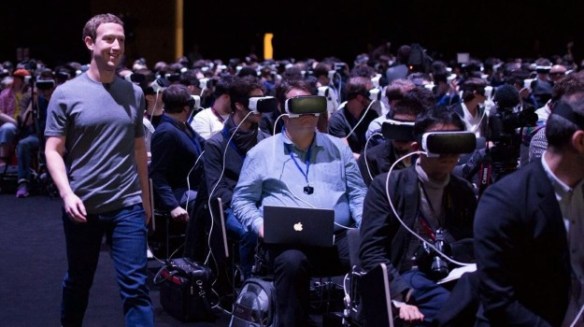
THE RHETORIC AT FACEBOOK—the largest social media platform in the world—is changing. In 2010, Mark Zuckerberg claimed that privacy was no longer a “social norm.” Today, the same man is asserting that “the future is private.” This was the buzz phrase at the company’s developer conference last month, F8, as the platform reoriented away from the newsfeed toward private chats, groups, and stories. Has Mark Zuckerberg been occupied by a parasitic fungus and become a zombie?

There is something stunning about this cultural shift in a corporation that holds such significant global power. It shows that when people speak up and agitate around privacy and data mining it can have a material effect. The idea that people don’t care about privacy, that they are willing to give it all away for the convenience of free services, has been debunked. Facebook specifically has been unable to ignore the waves of criticism it has experienced of late. The capitalist behemoths of the digital age often seem untouchable, and it is easy to forget that they operate in a social context. Like any powerful actor in society, Facebook is subject to the influence of organized people who will not shut up.

Nonetheless, it’s also important to be wary: savvy marketing is not the same as progress. The company is still fundamentally motivated by growth and profit. The presentations at F8 were focused on getting people onto Facebook-owned apps (including Instagram and WhatsApp) and building a sticky web around this engagement so they need never leave. You will shortly be able to buy things, find a date, even apply for a job—all directly through Facebook. Throughout these processes, Facebook will be able to grow its library of behavioral surplus, and in doing so, continue to expand its core business as the most effective and sophisticated supplier of advertising space in human history.

This context can help us better understand Zuckerberg’s privacy turn. Lest you feel uncomfortable about living more of your digital life through Facebook, they want to remind you that they are sufficiently forward thinking and benevolent to respect your privacy. As your adherence to the platform inches toward total, you can be sure the Facebook team is creating “a place where you are safe and supported.”

Well, sorry, Mark, your idea of privacy isn’t the same as mine. Privacy is too often framed in these discussions in highly superficial terms. It is about tinkering with the ways users engage with a platform as a matter of consumer choice. Mark wants you to be able to easily exclude people from seeing your messages and stories—unless that person happens to be him. This vision of privacy doesn’t hold any power because it does not challenge the definitive power framework for users of social media.

Privacy has necessarily become an expansive concept in the digital age, given the myriad ways in which technology occupies more of our personal spaces. To that end: the right to privacy includes the right to exist outside of the market. It is the right to enjoy spaces without feeling as though your presence is being used by marketers to predict your future.

In her recent book, Surveillance Capitalism, Shoshana Zuboff, writes about how these platform collect data and feed it into sophisticated algorithms, to be fabricated into prediction products that anticipate what you will do now, next, and later. Our participation becomes fodder for the “behavioral futures market,” and in turn, this has an influence on our psychology and sense of self. Private groups on Facebook might be slightly more comforting cyber spaces, but the essential topography remains the same. The fancy developer conferences and user products continue to be funded in a specific way. The logic of surveillance capitalism cannot be circumnavigated via a new company slogan. If anything, Zuckerberg’s privacy talk is an endorsement of this model. As Bernard Harcourt points out, “the watching works best not when it is internalized, but when it is absentmindedly forgotten.”

It need not be so: we can expropriate this moment. A better understanding of privacy will not be limited to design concepts generated by highly profitable social media platforms. It needs to encompass how privacy is an essential component of our agency as human beings. Agency, to be explored and expressed fully, requires that we have space outside the influence of capitalism—to have freedom from market forces seeking to manipulate our unconscious. Privacy demands that human emotions like shame, joy, guilt, and desire be explored without someone seeking to profit from the process without us noticing.

The unconscious exists as “neither individual nor collective,” writes the philosopher Mladen Dolar, but rather “precisely between the two, in the very establishment of the ties between an individual (becoming a subject) and a group to which s/he would belong.” In other words, there is a dialectic process at play between the social forces that shape us and our own personality. The baron capitalists of the data era seek to monetize this space—the right to privacy is the theoretical foundation for resistance. We need to elevate privacy to its full rhetorical potential, and recognize how it is both paradoxically individual and collective, and is defined not by consumer choice but agency. And privacy is therefore something that Facebook cannot offer—unless the company is prepared to change their entire business model.

Saturday Matinee: Koyaanisqatsi

Young Life Out Of Balance: The Impact and Legacy of ‘Koyaanisqatsi’

By Michael Grasso

Source: We Are the Mutants

Throughout the latter half of the 1970s, ex-seminarian/political activist Godfrey Reggio and cinematographer Ron Fricke shot, assembled, and edited film footage from all over the United States—from the yawning chasms of southwestern American deserts to the teeming mechanized metropolises of New York and Los Angeles—creating a feature film that would speak to the overwhelming complexity of late 20th century life in the West. This film, Koyaanisqatsi, debuted at American film festivals in 1982 and quickly became an arthouse (and eventual home video) favorite. The frequently eerie score for the film, composed by Philip Glass, provides the only aural accompaniment for this 86-minute montage showing the collision of nature and technology, of mankind and the planet. The word koyaanisqatsi, Hopi for “corrupted life” or “life out of balance,” provided a mission statement for the film; while Reggio has been cagey about not wanting to either imply or explicitly provide any specific meaning for the film, both the title and the Hopi prophecies of doom sung over the film’s final act make Koyaanisqatsi‘s point of view more or less explicit: something is dreadfully and fundamentally wrong with the way the settler inhabitants of America and the industrialized world as a whole relate to both the planet and themselves.

Koyaanisqatsi arrived with much fanfare as part of the PBS “Great Performances” anthology series in March of 1985. Given my love of all things PBS, I was absolutely there to see it in one of its initial broadcasts or repeats in ’85 or ’86. I’d heard about it most likely due to the hype around the film’s arrival on broadcast television for the first time. I do remember watching it at night, alone, possibly while my parents were out or in bed. When I found Koyaanisqatsi on a streaming service this year, I realized that I hadn’t watched it in its entirety since I was 10 years old. As I watched, I found myself thinking about how 10-year-old Mike responded to these overwhelming images. The process of meaning-making for a 10-year-old kid watching a film containing a sophisticated symbolic critique of modern life fascinated me. I decided to watch Koyaanisqatsi in 2019 with a close eye towards the images and sounds that had stuck with me subconsciously in the intervening third of a century, the sequences that offered today’s me a direct connection to my younger self. In childhood I was surrounded by films, cartoons, and other educational programming that transmitted the profundity and complexity of human existence and the universe directly into my growing brain. What did Koyaanisqatsi‘s sensory bombardment, its sometimes overwhelming contrasting of nature and technology mean to me then? And how did that meaning change for me as an adult, now fully conscious of and conversant with the issues Reggio raises?

It’s absolutely the first 15 minutes of the film that I remember most vividly from childhood. It begins with the juxtaposition of ancient petroglyphs at Horseshoe Canyon in Utah against slow-motion, almost abstract closeups of the Apollo 11 launch in 1969. This kind of meaning-through-montage connected with me on an intimate level at the age of 10; this was precisely the kind of respect for the pageant of human “progress” that electronic media teachers such as Carl Sagan had inculcated in me in my early years. Sagan did not necessarily privilege the Western, “scientific” worldview in his works; understanding that the ancient astronomers of the American West were precisely as clever as their European and Asian counterparts was an important part of Sagan’s pedagogy. And in this sweeping montage of the natural environment of the American West, Reggio offers a simultaneously calming and stunning view of the untouched majesty of nature. This is the same “blank screen” of desert that would thrill Baudrillard during his sojourn in North America at about exactly the same time. Even on a relatively tiny 1980s television screen, these aerial shots were breathtaking; it wouldn’t be until I first saw an IMAX projection in 1987 when the Omni Theater opened at Boston’s Museum of Science that I felt something similarly awe-inspiring.

These images of nature and the elements—earth and clouds and crashing waves—soothe the viewer; Glass’s musical accompaniments for these sections are tellingly titled “Organic” and “Cloudscape.” But just as we are lulled into a sense of security and a naturally human sense of awe at the landscape, Reggio (and Glass) throw us violently out of our idyll, showing us what man has done to these landscapes. We see engineering on a massive scale: strip mining, power plants with huge cooling lakes, massive dam projects. Glass’s hectic, pulsing aria, titled “Resource,” says it all. Natural rhythms and flows are subsumed under black clouds of pollution from earth-moving equipment; natural landscapes carved by millions of years of river and wind are carved into regularly-repeating, Cartesian geometry. “Resource” is horrifying, punishing: every trumpet blast announces the coming of something horrible. Again I am reminded of Cosmos: Sagan opines in Episode 5, “Blues for a Red Planet,” where Sagan imagines how an alien species will be able to determine that an intelligent species inhabits Earth—by how we change and adjust our natural environment. To Sagan, this is a largely joyful sign of our ingenuity and a necessary contrast with the natural “canals” of Mars. To Reggio, these marks are a constant, painful scarring, and his depiction of them on-screen has an immediate and negative emotional impact on the viewer, even a young one. Pollution was, of course, something I’d been made aware of from an early age: not just from the constant bombardment of PSAs on television, but from the plumes rising from the smokestacks every time I’d cross the Tobin Bridge in the family station wagon to go into Boston.

For much of “Resource” we are denied the opportunity to see sky: despite the grandeur of the landscapes, the camera angles and editing completely remove the context of said landscape with its cycles with nature and climate. The only blue we are offered is the reflection of the sky in the slightly sinister pools of the power plants’ cooling waters. And it’s here that we start to see humans for the first time as well, first dwarfed by the enormity of the dams and power plants around them, then briefly a few individuals populating the background of a sequence in a metal foundry. These figures are the reason behind all the scarring and carving of industry. Here is mankind. The glowing metal of the foundry reminds us of the original technological myth: fire tamed by Promethean man.

And there Reggio brings forth the myth’s ultimate expression: nukes. Stock footage of nuclear explosions would not be a symbol that needed much in the way of interpreting for a 10-year-old still scared bone-deep of the prospect of nuclear war. In this section we begin to see how all of these technological “advances” impact humanity. We see beachgoers enjoying a hot sunny beach—but with a huge looming power plant behind them. We see the mighty Boeing 747 taxiing on a runway, another testament to human ingenuity—sheathed and shimmering in an uncanny petroleum haze. Highways and cloverleaf overpasses are shown, overflowing with traffic; new cars are lined up in a holding yard, soon juxtaposed with Soviet tanks, American fighter jets, ICBMs, and more Apollo footage. Production and consumption, the war machine, and the nuclear arms race: all part of the same insane global system. The film footage of cluster bomb blasts, de rigueur as a signifier of the American war machine since the days of Vietnam and thus intimately familiar to 1985 me from various expressions on television and in pop culture, have a new and shocking impact when shown as part of the unnatural system that digs resources from the ground and turns them into immediate, instant death.

For many, the segment near the center-point of the film where the viewer is treated to an aerial survey of the abandoned Pruitt-Igoe housing projects in St. Louis is the film’s most brutal and emotional. Bookended in Koyaanisqatsi by other images of the failure of social housing in the South Bronx, and very much of a piece with the worldwide midcentury penchant for Brutalist “urban renewal”, the tale of Pruitt-Igoe would be resolutely familiar to an adult in the early 1980s. For me at 10, a sheltered white kid who’d grown up entirely in the suburbs, the sequence’s eerie ruined majesty held complete mystery. What were these huge repeating buildings shaped like boxes? Why were they in such disrepair? And why were they being totally and completely annihilated with explosives in such a dramatic fashion? I was insulated through much of my youth (by express design of the white power structure, as it turns out) from the living and educational conditions of Black Americans in both my own home city of Boston and around the country. The wages of centuries of American apartheid were nothing but a vague unease at the periphery of my consciousness. The power demonstrated in both choosing to build and choosing to destroy these buildings, over a period of a mere three decades—little more than one human generation—was accurately and shockingly conveyed by the film, but its ultimate meaning was lost to me. As an adult, with all the context and knowledge present upon my re-viewing of the film, “Pruitt-Igoe” stands as a testament to midcentury liberalism’s best intentions, naturally sabotaged by the white violence inherent in American capitalism. This is the one sequence of Koyaanisqatsi that I look back on today and wish I’d had an adult—a wise, sensitive adult—to guide me through.

At the film’s halfway point, we really begin to see mass man. At first in slow motion, urban crowd “B-roll” shots of a type I would have been intimately familiar with from television in 1985, shot in slow-motion, cut with close-ups of individual human beings in front of vivid backgrounds: the whooshing of an urban subway, a military officer in front of a jet engine, a group of casino workers with the lights of Las Vegas flashing behind them. In a concerted way, these “portraits” arrest us as viewers after the sensory assault of the first 40 minutes of the film, getting us to begin seeing the individuals behind the mass movements and incomprehensible destruction we’ve seen so far. As an adult I find them almost unbearably poignant; I found myself wondering what happened to all these folks after Reggio and Fricke finished filming them. As a kid, their slightly outdated fashions (from the mid-to-late-’70s, by the looks of it) consigned them to the more recent past of the only context I could understand: sitcom reruns in syndication, that forever-lagging-behind-the-present that ensured I was in some ineffable way a nostalgic even at the age of 10.

“The Grid” is the section of Koyaanisqatsi where Reggio and Fricke first use time-lapse photography for, I would argue, its greatest achievement in film history. As much as we’ve been given a key to understanding the impact of technology and so-called progress on the natural world, this section, full of glittering cityscapes and the pulsating grid of traffic in Los Angeles at night, are heartbreakingly beautiful. The flow of traffic through midtown Manhattan, so expertly regulated by traffic lights, is yet somehow unnatural; these highway and street scenes, sped up, remind us (and certainly would have reminded the young me who’d grown up with educational programming) of microphotography of blood cells in arteries and capillaries, but somehow off: constantly halting and resolutely inorganic. In contrast, one of the film’s trademark shots (featured on the home video box and posters) of the moon’s movement through the sky as it is eclipsed by an office block is so sure in the lens of Fricke’s innovative time-lapse cameras, so machine-precise, far outstripping in elegance and power the stuttering processes of automobile and pedestrian traffic regulated by human-created technology.

Possibly the most homely, familiar, and comforting section of the film involves the juxtaposition of manufacturing, industry, and food processing with the crazy-quilt of consumption that completes industrial capitalism’s cycle. Hot dogs and Twinkies, blue jeans and televisions and automobiles roll off of assembly lines; as an adult in 2019 all I could think was “look at all those human workers!” There were so few robots in sight in each of these sequences, and the factory workers themselves looked so humble yet so proud. I also thought back to me at age 10, and how Mister Rogers’ Neighborhood would have primed me to look at these time-lapse sequences of production as something wondrous, something to be proud of. The flip side of all this production is seen in Koyaanisqatsi‘s views of Americans enjoying their leisure time: playing video games (I spotted Ms. Pac-Man, Q*bert, and Defender among many other video cabinets in the arcade sequence), bowling, going to the movies, visiting the mall food court, and especially watching television. The time-lapse photography zips through banks of televisions airing the prime-time advertisements and network news breaks of the kind I’m obsessed with and hunt down on YouTube in 2019. As a kid, this would have been the segment of the film that would’ve been the most immediate and identifiable to me. The people in these sections looked like me: they were suburban, not urban, dressed in casual clothes, not hats and suits and trenchcoats. They were young! There were younger kids sipping on milkshakes and having burgers with their families at the mall. These people were me. Did I understand how my consumption made me an accomplice to the black billowing smoke and scarred landscapes seen earlier in the film? At that age, I’m sure not.

Reggio always returns to people, not only to give the viewer (whether 10 years old or 43 years old) that sense of identification, a sense of their stakes in the modern “life out of balance,” but to return to the dignity of the individual human being. Reggio’s intellectual origins both in post-Vatican II Catholic conceptions of social justice and human dignity as well as Christian eco-anarchism demands this kind of attention to the individual humans behind these teeming visual landscapes. The final sequence is titled “Prophecies.” Glass’s musical accompaniment for this final sequence features a chorus singing three Hopi prophecies, interpreted by academic consultants Michael Lowatewama and Ekkehart Malotki, and translated on-screen at the end of the film. These prophecies are ones that would be familiar to anyone raised in the Western Christian tradition: tales of the death of the world thanks to mysterious poisons falling from the sky. As the choir chants these predictions of chaos and confusion, we see people wandering the streets, crushed by their surroundings: a homeless man gazing down at the change in his hand, a sick man put onto a litter by EMTs, someone in a hospital with a bloody wound resulting from an intravenous injection of fluids. The combination of Hopi prophecy on the soundtrack with the kind of lost people that Christ tried to minister to is devastatingly effective; even as a child, this section evoked pity and empathy in me rather than the disgust from seeing out of control pollution or technology. Bookending this is a lengthy sequence in slow-motion of an Atlas-Centaur rocket disaster, one of its thrusters tumbling back to earth slowly. The name of the star might have been Wormwood, but a year after this PBS airing, both a Challenger disaster and a nuclear disaster at another Wormwood half a world away would offer yet another Promethean lesson to both the U.S. and the Soviet Union.

I can’t remember exactly what I felt like immediately after viewing Koyaanisqatsi all those years ago, but its indelible images and sounds remained firmly in my subconscious all through my adolescence and adulthood. Now I’m middle-aged, the same age as all those scurrying New York City businessmen who seemed so weirdly uniform and alien to me as a kid. As I watch now, I of course am able to see that we are all lost in the life out of balance now. I wouldn’t call Reggio prophetic because anyone with eyes to see and ears to hear knew what was happening to us in the years since the end of the Second World War. And while art can absolutely point out injustice, fraud, exploitation, and abuse, it can very easily be used to recuperate these ideas into a more comfortable idea of the inevitability of “progress.” I don’t feel like any later misuse of Reggio’s praxis is his fault per se; whether or not he expressly provides meaning for us, his words and actions in the years following Koyaanisqatsi‘s release are clear and obvious.

I’ve never bothered to watch the two “Qatsi” sequels released in the years following the original. Their dual focuses were on life in the developing world and “life as war,” focusing on the modern world’s war with itself over technology. I’m not sure if they could achieve the mythic status and impact which Koyaanisqatsi had on my developing brain as a kid. Was 10 years old too young to consider these kinds of issues of modern life? I’m not sure. All I know is that I’m grateful I was given the opportunity to internalize these images and thoughts, to consider my place on a planet, both blessed and cursed by my surroundings, to ponder my role both as an individual and as part of a societal collective. While the televisual instruction of my childhood idols Sagan and Rogers may have in some small part normalized the mindset that brought us to this point (all while being steadfast advocates of social justice and peace, of course), Reggio’s camera, untouched by words, conveys the meaning of this life out of balance directly, resolutely, fearlesssly. A prophet Reggio himself may not be, but his filmic prophecy, and through it the prophecy of the Hopi, lives on.


Watch the full film on Kanopy here: https://www.kanopy.com/product/koyaanisqatsi