Let Our Vision Overcome The Narratives

By Doug “Uncola” Lynn

Source: The Burning Platform

When “taking the vax” became a means to signal ones virtue as part of the moral high ground, the right side of history, etc. many people were indulging themselves by taking the vaxx. It became not just an act of personal health or even collective health but a signal, a ritual of their faith in something much bigger and much more sinister.

The origin of that faith and purpose of that ritual should not be ignored. Especially given how by nature of the vaxx being a moral position many of those people entered into that contract full knowing that those of us who refused would be indicted by that same moral position.

– Comment by Dangerous Variant,  Dec 13, 2021

Those who can make you believe absurdities, can make you commit atrocities.

― Voltaire

Where there is no vision, the people perish

– Proverbs 29:18

I read an opinion column early in the new year written by a local woman scolding The Unvaccinated in my area. Ironically, she addressed her article to the “my body, my choice” crowd and argued those who don’t get vaccinated should have their health insurance capped. She claimed taxpayers should not be burdened by those too selfish to care about overwhelmed health care systems or for those who are oppressing future generations.

Where does one even start?

The Irish author and satirist, Jonathan Swift, once wrote:  “Reasoning will never make a man correct an ill opinion, which by reasoning he never acquired”.  Obviously, that particular maxim applies to the fairer sex as well.

People act upon what they believe and this is, in fact, the very definition of “faith”.  For even the Bible says faith (i.e. belief) without works (i.e. action) is dead.  It means the woman’s article was written and published as the result of her faith in the Covid narrative; and reason be damned.

Certainly, the Covid Deceived have been made to fear. And they were tricked by the most powerful people and organizations on the planet. But their faith is more akin to superstition – cult-like and hypnotic; the end result of media-induced propaganda programming psychosis.

It’s been said that neurotics build castles in the air and psychotics live in them. Except a majority today reside in mental castles that were, in fact, constructed by psychotics. Yet the masses have entered those castles on their own volition and it means Voltaire was right: Those who can make you believe absurdities, can make you commit atrocities.

Hasn’t this been the story of mankind since time immemorial?

In the middle of December 2021, blogger Jim Quinn (TheBurningPlatform.com) posted an article entitled “They Needed the Omicron Variant”  and included a total of 37 bullet-points…“mile-markers”, if you will, on the road to The Great Reset – and concluded with these words:

As Euripides warned centuries ago, when the mob is persuaded by the honeyed words of evil men, great woes befall the state. Gates, Soros, Schwab, Fauci and Biden are evil men attempting to remake the world in a way that benefits them and their Davos co-conspirators. We will not comply. We will not obey. We will not give up our freedoms and liberties without a fight to the finish.

Irrespective of the financial elite’s motivations, the simple truth is this:  They have successfully pulled it off.  As of this writing, the U.S. Supreme Court has yet not decided on the Biden/OSHA-mandated Covid vaccinations but these will either be upheld or not.

If the mandates were upheld prior to this article’s post, then it would have been titled:  “Let Our Vision Overcome False Narratives & Unjust Laws”.

But, even if the OSHA mandates are struck down by the Supreme Court, or get overridden by state lawmakers with common sense, be assured those administering The Great Reset have more tricks up their sleeves.  Just this week, Dr. Robert Malone, an early pioneer of mRNA technology, has warned of an “Ebola-Like Hemorrhagic Fever Virus Now Spreading In China”.

So, bearing all that in mind, I believe it would be dangerous to underestimate those administering the New World Order… or to overestimate the wisdom and intestinal fortitude of a majority of Americans; and, by extension, the entire global citizenry.

To the financial elite, the masses are viewed as a means to an end. Their end, that is. Or, stated another way, the plebeians are viewed as base material  – simple resources to get the “elite” where they are going.

On the popular entertainment streaming service, Netflix, the elitist worldview is revealed in the “Squid Game” series. The show is rife with symbols and messages that are, perhaps, most aptly deciphered at The Vigilant Citizen.com:

The outline of this game is also the main logo of the series. The reason: It perfectly illustrates the core philosophy of Squid Game and, by extension, the elite. The rectangle represents the masses. The circle at the bottom of it represents those who are poor and heavily in debt. The triangle above the rectangle represents the elite ruling over the masses. The upper circle represents the all-powerful occult elite that controls the world.

Appropriately enough, the narrator explains that the children who play Squid Game must make their way to the upper circle to win.

Win or lose. Zero sum gain.  Rich versus poor. Us against them. Polemics.  Dialectics: A life and death game where the winners win the world.

In the end, though, the game is about survival.  Both the financial elite and the masses have near-reptilian instincts to survive. The innate survival mechanisms range from cold calculation to obvious ignorance dependent upon one’s position in the pyramid; as the masses are kept constantly confused, in the dark, and at each other’s throats.  Until, that is, mission accomplished. Game over.

Belief materializes through perspective and perspective derives from context and context is defined by narrative.  Surely, it all distills down to the stories in people’s heads. In fact, that is exactly how shit happens.

On January 6, 2022 one of my liberal acquaintances, an enthusiastic reader of the New York Times, expressed to me his gratitude that our “democracy survived”.

I calmly showed him how our democracy has NOT actually survived and he hasn’t broached the topic with me since. In any event, the keys of truth were given and he will either escape the imaginary castle in his head, or simply build a bigger moat.

What this guy will likely never understand, however, is that his insanities and absurdities were generated on purpose – the result of carefully crafted, and, quite often, chaotically circulated, narratives.  Irrationality has become the essence of madness as logic, truth, and reality have been upended into Clown World.

So how do we fight back? And how do we win?

In the thread of a previous blog post, a commenter by the name of “Stucky” had this to say:

Hope works remarkably well when it is part of one’s Belief System.

….But, hope sucks when it’s a strategy

I agree. Hope alone cannot restore the Old Normal.  In fact, nothing will at this point. But be assured of this:  If we don’t resist, we are guaranteed to lose our liberties initially, and, later, our very lives.

One simple offensive strategy might be to generate different stories, fresh metaphors, and new allegories, to replace the elite-constructed narratives that have become the castlesfortresses, and high towers, in people’s heads.  An example could be to challenge Big Pharma’s financial mining of the human immune system through endless Covid booster “subscriptions” with a metaphor describing mandatory organ donation by the state and in the service of The Collective.

Another method could involve sharing these websites (below) that give voice to the Covid vaccine-injured:

www.realnotrare.com

www.1000covidstories.com

In my own locality, I have been hammering away at the foundational premises and assumptions underlying the Covid Agenda as follows:

– If the vaccines don’t stop infection or transmission, then what/who is behind the apparent agenda for vaccine passports?

 – And, if the shots work, then why are boosters needed?

By so doing, I would like to express my gratitude to those who have become the tip of the spear, so to speak, in the War Against Covid Propaganda:  Brave souls like Robert F. Kennedy, Dr. Peter McCullough, Professor John Ioannidis, Dr. Christina Parks, Dr. Judy Mikovits, Catherine Austin Fitts, Joseph Mercola, and the entire “Disinformation Dozen”, as well as ALL of the writers, bloggers, and commenters posting here on the alternative internet.

Robert F. Kennedy’s book, “The Real Anthony Fauci: Bill Gates, Big Pharma, and the Global War on Democracy and Public Health”, could be an effective weapon in converting progressives in the propaganda war because Kennedy is RFK’s son and JFK’S nephew. He has, additionally, been a champion of liberal causes including environmentalism.

The enemy of my enemy is my friend, so it was gratifying to see Kennedy’s take-down of the global medical cabal become a well-reviewed best seller this past Christmas season.

The Covid narrative is insane and illogical…and maybe that’s no accident

Maybe forcing people to believe your lies, even after you admit you’re lying, is the purest form of power.


By Kit Knightly

Source: Off-Guardian

Not merely the validity of experience, but the very existence of external reality was tacitly denied by their philosophy. The heresy of heresies was common sense.”
George Orwell, 1984

The “Covid pandemic” narrative is insane. That is long-established at this point, we don’t really need to go into how or why here. Read our back catalogue.

The rules are meaningless and arbitrary, the messaging contradictory, the very premise nonsensical.

Every day some new insanity is launched out into the world, and while many of us roll our eyes, raise our voices, or just laugh…many more accept it, believe it, allow it to continue.

Take the situation in Canada right now, where the government has enforced a vaccine mandate on healthcare workers, meaning in British Columbia alone over 3000 hospital staff were on unpaid leave by November 1st.

How have local governments responded to staff shortages?

They are asking vaccinated employees who have tested positive for Covid to work.

Whether or not you believe the test means anything, they notionally do. In the reality they try to sell us every day, testing positive means you are carrying a dangerous disease.

So they are requesting people allegedly carrying a “deadly virus” work, rather than letting perfectly healthy unvaccinated people simply have their jobs back.

This is insanity.

But could anything more perfectly illustrate the priorities of those running the game?

We already know it’s not about a virus, it’s not about protecting the health service and it’s not about saving lives. Every day the people running the “pandemic” admit as much by their actions, and even their words.

Rather, it seems to be about enforcing rules that make little to no sense, requiring conformity at the price of reason, drawing arbitrary lines in the sand and demanding people respect them, making people believe “facts” that are provably untrue.

But why? Why is the story of Covid irrational and contradictory? Why are we told on the one hand to be afraid, and on the other that there is nothing to be afraid of?

Why is the “pandemic” so completely insane?

You could argue that it’s simple happenstance. The by-product of a multi-focused evolving narrative, a story being told by a thousand authors all at once, each concerned with covering their own little patch of agenda. A car with multiple drivers fighting over a single steering wheel.

There’s probably some truth to that.

But it’s also true that control, true control, can only be achieved with a lie.

In clinical psychology one of the diagnostic signs of the psychopath is that they tell elaborate lies, compulsively. Many times they will tell a lie even if the truth would be more beneficial.

Nobody knows why they do this, but I have a theory, and it applies to the swarming groups of little rat minds running the sewers of power as much as it does any individual monstrosity.

If you want to control people, you need to lie to them, that’s the only way to guarantee you have power.

If you are standing in the road, and I yell “look out, there’s a car a coming”, and you move just as a car whips past, I will never know if you moved because I said so, or because there actually was a car.

If my interest is in making sure you don’t get hurt, this would not matter to me either way.

But, what if my only true aim is the gratification of watching you do what I say, simply because I said it?

…well, then I need to scream out a warning of a car that does not exist, and watch you dodge an imaginary threat. Or, indeed, tell you there is no car, and watch you get run over.

Only by doing this can I see my words mean more to you than perceivable reality, and only then do I know I’m truly in control.

You can never control people with the truth, because the truth has an existence outside yourself that cannot be altered or directed. It may be the truth itself that controls people, not you.

You can never force people to obey rules that make sense, because they may be obeying reason, not your force.

True power lies in making people afraid of something that does not exist, and making them abandon reason in the name of protecting themselves from the invented threat.

To guarantee you have control, you must make people see things that are not there, make people live in a reality you build around them, and force people to follow arbitrary, contradictory rules that change day by day.

To truly test their loyalty, their hypnosis, you could even tell them there’s nothing to be afraid of anymore, but they need to follow the rules anyway.

Maybe that’s the point. Maybe the story isn’t supposed to be believable. Maybe the rules aren’t meant to make sense, they are meant to be obeyed.

Maybe the more contradictory & illogical the regulations become, the more your compliance is valued.

Maybe if you can force a person to abandon their judgment in favour of your own, you have total control over their reality.

We started with an Orwell quote, so let’s end with one too:

Power is in tearing human minds to pieces and putting them together again in new shapes of your own choosing.”

Isn’t that what we’re seeing now? What we’ve been seeing since the beginning?

People being mind broken into being afraid of something they are told isn’t frightening, following rules they are told are not necessary, taking “medicine” they are told does not work.

Maybe forcing people to believe your lies, even as you admit you are lying, is the purest expression of power.

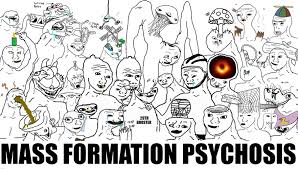
Why Should Preppers Care About Mass Formation Psychosis?

By Jeff Thompson

Source: The Organic Prepper

Mass formation psychosis.

That’s the buzz phrase that has rocked the internet the past two days. This comes about after the inventor of mRNA vaccine technology, Dr. Robert Malone, used the phrase to describe the current state of society on Joe Rogan’s podcast.

Immediately, search engines began to alter their algorithms so that only those narratives which fit the great MSM, Silicon Valley, globalist/communist narrative were shown.

But let’s take a step back from the scientific jargon for a moment, if you will. Because the fact of the matter is that you’ve already a fundamental and inherent understanding of what mass formation psychosis is.

Daisy wrote about this when she described the “othering” taking place within society.

Americans can feel it. There’s no denying that there has been active discrimination, violence, in many cases “lawful” against the Americans who are pro-freedom/pro-Constitution/pro-human dignity. But perhaps I’m being redundant here, for a true American is all of those things.

And it’s getting worse.

You can feel it. Think about this. Have you ended up in an altercation with somebody over masks throughout the past two years? Or, have you been denied entry to a building because of your jab status or refusal to mask? Did cops use “trespassing” as the limp excuse for discriminating against you when you weren’t willing to wear the yellow star?

That’s what mass formation psychosis is. It’s a society-wide brainwashing.

Dr. Robert Malone actually says that this is what has been used against the global population throughout the past two years.

How do you end up with a “civilized” nation such as Germany turning into a state-run murder machine? Furthermore, how does a nation filled with the likes of Goethe, Mozart, and Bach turn into a world where those with wheelchairs are pushed out of third-story windows, where babies are swung by the feet to crack against the trees? How do the people who are renown for precision machinery turn to using that ability to hunt down women and pump Zyklon B into their lungs?

At what point do the doctors decide that sewing twins together is ok?

You use mass formation psychosis.

According to Dr. Malone, this is exactly what happened in Germany. And if we look at other genocides throughout history, we’ll likely see the same.

Just what is necessary for mass formation psychosis to take place though? Four separate variables which combine to create a monster. They are:

  1. The lack of a social bond.
  2. Free-floating anxiety
  3. A feeling of not having any purpose
  4. People who are confused and can’t make sense of anything around them [source]

To be clear, the theory of mass formation psychosis was developed by Dr. Matias Desmet, a professor, psychologist, and statistician, at the University of Ghent in Belgium. [source]

Dr. Desmet has been shouting for the past two years that this is what he’s currently seeing (particularly on Daily Expose, which you should be reading), but it appears as if this recent podcast is what has served as the springboard for his theory becoming a part of the common vernacular.

But what do the four aspects of mass formation psychosis mean?

Returning to the four aspects though, each of them requires a sizeable segment of society. If only a small percentage of a population experiences these factors, mass formation cannot take place by definition. From Desmet’s research, it appears as if 30% is the magic number.

Once 30% of a nation’s population has fallen into the four factors of mass formation psychosis, very troubling times are on the horizon.

The lack of a social bond is one of the first factors which must be met. Individuals need to be severely isolated from one another, creating a feeling of loneliness. It appears that solitary confinement isn’t as healthy for people as one may initially think, huh?

Perhaps by robbing people of their faces, this isolation can even be forced upon one when they’re out in public. Why have so many ancient warriors utilized covering the face when they went into combat? Because it takes away the human aspect of the person right in front of one. Instead of a man – who could be killed – now standing in front of you with katana raised high, it was a bizarre looking monster.

Dehumanization bred fear. It was a form of psychological warfare.

The free-floating anxiety revolves around generating massive amounts of panic and fear over something that people really have a hard time of putting their finger on. Sure, people may be afraid of the typhus which are alleged to carry (as propaganda stated throughout 1930s Germany), but there’s something even deeper than that as well.

It’s the constant state of being unsure. Of not knowing when one is going to be potentially harmed. In the Cold War this would have been the daily pressure of a nuclear attack. Children are taught to shelter under their desk, bomb shelters are being built in the city hall, and the news is telling about some type of missile crisis out in Cuba.

In modern day, it’s the fear that walking down the grocery store is what’s going to be the death of you. You just touched a door. Was it clean? Have you touched your face lately? Did you hear about Sally? She tested positive. So-and-so is in the hospital.

All of this has created two solid years of mass panic as people have become afraid of the world around them.

The third variable is the need for 30% of the population to feel as if what they’re doing has no purpose or meaning. People are upset that what they’re doing doesn’t even seem to matter. There’s got to be more out there – a bigger purpose -but nobody can really figure out just what.

And this brings us to the fourth point. People aren’t able to make sense of anything in the world around them. Perhaps their government leaders have consistently flip-flopped on telling them what they are or are not to do. One day it’s perfectly safe to stand beside your neighbor. Now, you must stand six feet away. Tomorrow, you better avoid them completely because they haven’t taken their morning anal swab yet.

All of this combined churns a nation into what Malone states is a “constant state of hysterical anxiety.”

What happens when this succeeds?

For starters, those affected by the variables start to join together. They begin to feel as if they need to strive together to reach this common goal, of defeating that which is filling them with angst, and many times this pushes them against another sizeable segment of the population.

During the Holocaust, it was the need to create the “superman”, to rid the world of genetic disease, to get rid of the infirm and crippled which led to the extermination of millions at the likes of Dauchau, Auschwitz, and more.

Media can then be used to push this agenda even further

It can continue to fan the flames of fear while telling the affected what it is they need to do – who they need to push back against. The leaders of this movement “become revered – unable to do wrong.”

As Malone states, “one of the aspects of that phenomenon [mass formation psychosis] is that the people that they identify as their leaders, the ones typically that come in and say you have this pain and I can solve it for you. I and I alone….Then they will follow that person. It doesn’t matter whether they lied to them or whatever. The data is irrelevant.”

Anybody that speaks against Dear Leader is fought back against in unison by the affected. They are silenced, stripped of their jobs, or even acted against with violence.

This all takes place as those affected become almost hypnotized, in a sense. People will outright refuse any logic presented them. It doesn’t matter if the facts just don’t line up. Anything which counters the narrative which they’ve been hypnotized by is automatically rejected.

And when this happens, the seeds of totalitarianism, are sown. A despot can now spring forth, giving the brainwashed all the “righteous indignation” they need to commit atrocities they wouldn’t have even dreamed of participating in just years prior.

That is how you get a “civilized” society to engage in the heinous acts mentioned prior. Selco talks about this in his article about the media bombarding them with hate and fear.

(To learn how to become better prepared for this type of society, check out our free QUICKSTART Guide.)

But it’s not hopeless.

The interesting thing about this research is that Dr. Malone points out mass formation psychosis follows a general distribution. This means that 30% of a nation will be brainwashed. Approximately, 40% will be those who ride the fence – unable to really make up their minds as to what they want to do, or those who are too afraid to voice their opinions.

And then there are those who refuse to bow to evil. That is the remaining 30%.

As Dr. Mattias Desmet points out, this sane 30% is that which can turn the tide for good. By speaking out, they can embolden more of the 40% of the fence riders to find the courage to speak out against evil.

But this only happens when one uses their voice.

Continue to speak out. If other voices are available in the public space, then the mass hypnosis will be disturbed.” – Professor Doctor Mattias Desmet. [source]

Why Don’t People “Trust The Science?” Because Scientists Are Often Caught Lying

By Brandon Smith

Source: Alt-Market.us

There has been an unfortunate shift in Western educational practices in the past few decades away from what we used to call “critical thinking.” In fact, critical thinking was once a fundamental staple of US colleges and now it seems as though the concept doesn’t exist anymore; at least not in the way it used to. Instead, another form of learning has arisen which promotes “right thinking”; a form of indoctrination which encourages and rewards a particular response from students that falls in line with ideology and not necessarily in line with reality.

It’s not that schools directly enforce a collectivist or corporatist ideology (sometimes they do), it’s more that they filter out alternative viewpoints as well as facts and evidence they do not like until all that is left is a single path and a single conclusion to any given problem. They teach students how to NOT think by presenting thought experiments and then controlling the acceptable outcomes.

For example, a common and manipulative thought experiment used in schools is to ask students to write an “analysis” on why people do not trust science or scientists these days. The trick is that the question is always presented with a built-in conclusion – That scientists should be trusted, and some people are refusing to listen, so let’s figure out why these people are so stupid.

I have seen this experiment numerous times, always presented in the same way. Not once have I ever seen a college professor or public school teacher ask students: “Should scientists today be trusted?”

Not once.

This is NOT analysis, this is controlled hypothesis. If you already have a conclusion in mind before you enter into a thought experiment, then you will naturally try to adjust the outcome of the experiment to fit your preconceived notions. Schools today present this foolishness as a form of thinking game when it is actually propaganda. Students are being taught to think inside the box, not outside the box. This is not science, it is anti-science.

Educational programming like this is now a mainstay while actual science has taken a backseat. Millions of kids are exiting public schools and universities with no understanding of actual scientific method or science in general. Ask them what the equations for Density or Acceleration are, and they’ll have no clue what your are talking about. Ask them about issues surrounding vaccination or “climate change”, and they will regurgitate a litany of pre-programmed responses as to why the science cannot be questioned in any way.

In the alternative media we often refer to this as being “trapped in the Matrix,” and it’s hard to think of a better analogy. People have been rewarded for so long for accepting the mainstream narrative and blindly dismissing any other information that when they are presented with reality they either laugh at it arrogantly or recoil in horror. The Matrix is so much more comfortable and safe, and look at all the good grades you get when you say the right things and avoid the hard questions and agree with the teacher.

Given the sad state of science in the West these days surrounding the response to covid as well as the insane and unscientific push for forced vaccinations, I thought it would be interesting to try out this thought exercise, but from an angle that is never allowed in today’s schools:

Why don’t people trust the science and scientists anymore?

This is simple: Because many scientists have been caught lying and misrepresenting their data to fit the conclusions they want rather than the facts at hand. Science is often politicized to serve an agenda. This is not conspiracy theory, this is provable fact.

That’s not to say that all science is to be mistrusted. The point is, no science should be blindly accepted without independent examination of ALL the available facts. This is the whole point of science, after all. Yes, there are idiotic conspiracy theories out there when it comes to scientific analysis, but there are a number of scams in the world of science as well.

The usual false claim is that the average person is ignorant and that they don’t have the capacity to understand scientific data. I do find it interesting that this is the general message of the trust-science thought experiment. It fits right in line with the mainstream and government narrative that THEIR scientists, the scientists they pay for and that corporations pay for, are implicitly correct and should not be questioned. They are the high priests of the modern era, delving into great magics that we dirty peasants cannot possibly grasp. It is not for us to question “the science”, it our job to simply embrace it like a religion and bow down in reverence.

Most people have the capacity to sift through scientific data as long as it’s transparent. When the facts are obscured or spun or omitted this causes confusion, and of course only the establishment scientists can untangle the mess because they are the ones that created it. Let’s look at a couple of examples directly related to human health…

GMO Crops And The Corporate Money Train

The propaganda surrounding Genetically Modified Organisms is relentless and pervasive, with the overall thrust being that they are perfectly safe and that anyone who says otherwise is a tinfoil hat crackpot. And certainly, there a hundreds if not thousands of studies which readily confirm this conclusion. So, case closed, right?

Not quite. Here is where critical thinking is so useful and where reality escapes the indoctrinated – Who paid for these studies, and do they have a vested interest in censoring negative data on GMOs?

Well, in the vast majority of cases GMO studies are funded by two sources – GMO industry giants like Monsanto, Dupont and Syngenta, or, government agencies like the FDA and EPA. Very few studies are truly independent, and this is the problem. Both the government and corporations like Monsanto have a vested interest in preventing any critical studies from being released on GMO’s.

Monsanto has been caught on numerous occasions hiding the dangerous health effects of its products, from Agent Orange to the RGBH growth hormone used in dairy cows. They have been caught compiling illegal dossiers on their critics. The industry has been caught multiple times paying off academics and scientists to produce studies on GMOs with a positive spin and even to attack other scientists that are involved in experiments that are critical of GMOs. Research shows that at least half of all GMO studies are funded by the GMO industry, while the majority of the other half are funded by governments.

There has also long been a revolving door between GMO industry insiders and the FDA and EPA; officials often work for Monsanto and then get jobs with the government, then go back to Monsanto again. The back scratching is so egregious that the government even created special legal protections for GMO companies like Monsanto under what is now known as the Monsanto Protection Act (Section 735 of Agricultural Appropriations Bill HR 993) under the Obama Administration in 2013. This essentially makes GMO companies immune to litigation over GMOs, and the same protections have been renewed in different bills ever since.

Beyond the revolving door, the government has approved many GMO products with little to no critical data to confirm their safety. Not only that, but in most cases the government has sovereign immunity from litigation, even if they’ve been negligent. Meaning, if any of these products is proven to cause long term health damage the government cannot be sued for approving them unless there are special circumstances.

If they could be held liable, you would be damn sure the FDA would be running every conceivable test imaginable to make sure GMOs are definitively safe without any bias attached, but this is not the case. Instead, the government actively propagandizes for GMO companies and uses hired hatchet men to derail any public criticism.

I, for one, would certainly like to know for sure if GMOs are harmful to the human body in the long term, and there is certainly science to suggest that this might be the case. There have been many situations in which specific GMO foods were removed from the market because of potentially harmful side effects. Endogenous toxins of plants with modified metabolites are a concern, along with “plant incorporated protectants” (plants designed to produce toxins which act as a pesticides).

There is data that tells us to be wary, but nothing conclusive. Why? Because billions of dollars are being invested by corporations into research designed to “debunk” any notion of side effects. If the same amount of funding was put into independent studies with no bias, then we might hear a different story about the risks of GMOs. All the money is in dismissing the risks of GMOs; there’s almost no money in studying them honestly.

The science appears to be rigged to a particular outcome or narrative, and that is lying. Science is supposed to remain as objective as possible, but how can it be objective when it is being paid for by people with an agenda? The temptation to sell out is extreme.

Covid Vaccines And The Death Of Science

I bring up the example of GMO’s because I think it is representative of how science can be controlled to produce only one message while excluding all other analysis. We don’t really know for sure how dangerous GMOs are because the majority of data is dictated by the people that profit from them and by their friends in government. The lack of knowing is upheld as proof of safety – But this is not scientific. Science and medicine would demand that we err on the side of caution until we know for sure.

The same dynamic exists in the world of covid vaccines. Big Pharma has a vested interest in ensuring NO negative information is released about the mRNA vaccines because there is a perpetual river of money to be made as long as the vax remains approved for emergency use by the FDA. It may be important to note that the FDA has said it will take at least 55 YEARS to release all the data it has on the Pfizer covid vaccines, which suggests again that there is a beneficial collusion between the government and corporate behemoths.

In the meantime, anyone that questions the efficacy or safety of the vax is immediately set upon by attack dogs in the media, most of them paid with advertising dollars from Big Pharma. These attacks are not limited to the alternative media; the establishment has also gone after any scientist or doctor with questions about vaccine safety.

There are clear and openly admitted ideological agendas surrounding covid science which have nothing to do with public health safety and everything to do with political control. When you have the head of the World Economic Forum applauding the covid pandemic as a perfect “opportunity” to push forward global socialist centralization and erase the last vestiges of free markets and individual liberty, any rational person would have to question if the covid science is also being rigged to support special interests.

Luckily, the covid issue is so massive that it is impossible for them to control every study. Instead, the establishment ignores the studies and data they don’t like.

The virus is being hyped as a threat to the majority of the public and as a rationale for 100% vaccination rates, by force if needed. Yet, the median Infection Fatality Rate of covid is only 0.27%. This means that on average 99.7% of the population at any given time has nothing to fear from the virus. This is confirmed by dozens of independent medical studies, but when was the last time you heard that number discussed by mainstream government scientists like Anthony Fauci?

I’ve never heard them talk about it. But how is it scientific to ignore data just because it doesn’t fit your political aims? Again, deliberate omission of data is a form of lying.

What about the multiple studies indicating that natural immunity is far superior in protection to the mRNA vaccines? What about the fact that the countries with the highest vaccination rates also have the highest rates of infections and their hospitalizations have actually increased? What about the fact that the states and countries with the harshest lockdown and mask mandates also have the highest infection rates? What about the fact that the average vaccine is tested for 10-15 years before being approved for human use, while the covid mRNA vaccines were put into production within months? That is to say, there is NO long term data to prove the safety of the covid vax.

These are easily observable scientific facts, but we never hear about them from corporate scientists or government scientists like Fauci? Instead, Fauci argues that criticism of his policies is an attack on him, and attacking him is the same as “attacking science.” In other words, Fauci believes HE IS the science.

And doesn’t that just illustrate how far science has fallen in the new millennium. Real scientists like Kary Mullis, the inventor of the PCR test, call Fauci a fraud, but they are ignored while Fauci is worshiped. I can’t even get into climate change “science” here, I would have to write an entire separate article about the fallacies perpetrated by global warming academics (did you know that global temperatures have only increased by 1 degree Celsius in the past century? Yep, just 1 degree according to the NOAA’s own data, yet, institutions like the NOAA continue to claim the end of the world is nigh because of global warming).

The stringent bottleneck on science today reminds me of the Catholic church under Pope Innocent III when church authorities forbade common people from owning or reading a bible. These laws remained in effect well into the 13th century. Instead, the peasants were to go to church and have the texts read to them by specific clergy. Often the bible readings were done in Latin which most people did not speak, and interpreted however the church wished.

It was only the invention of the printing press in the 1400s that changed the power dynamic and allowed bibles to be widely distributed and information to spread without church oversight. Much like the creation of the internet allows the public to access mountains of scientific data and methodologies at their fingertips. The free flow of information is an anathema according to the establishment; they argue that only they have the right to process information for public consumption.

Cultism requires excessive control of data and the complete restriction of outside interpretations. As information becomes openly available the public is then able to learn the whole truth, not just approved establishment narratives.

Science is quickly becoming a political religion rather than a bastion of critical thought. Conflicting data is ignored as “non-science” or even censored as “dangerous.” Government and corporate paid studies are treated as sacrosanct. Is it any wonder that so many people now distrust the science? Any reasonable person would have questions and suspicions. Those who do not have been indoctrinated into a cult they don’t even know they are a part of.

The end of childhood play

By Brian Kaller

Source: resilience

Recorded history is the history of adults–generals, statesmen, explorers and scientists–but all of those adults began their path as children. And running beneath this official history is the unofficial history of childhood games and rituals, many of which were passed down for generations; children inhabited a separate universe of traditions, contests, solemn rituals and codes of honour, like a Viking horde living in your house unnoticed. It was in this world that every future general first learned to lead, every future scientist first turned over logs to delight in the tiny nightmares underneath, and every future explorer first plucked up the courage to enter the haunted woods. Elderly people here in Ireland, who grew up without electricity or many cars, still remember the feral exploration and creative play that was once the birthright of every child.

“Children today don’t have to think much about games given to them – we made up our own,” said one elder. “We played spin the top, marbles, hoop the hoop, hop scotch, conkers, kick the can, scut the whip, jackstones, and box the fox. Hop scotch has survived to some extent, but only among girls … Even when the dark evenings closed in we played ‘Battle In, Battle Out,’ and ‘Jack jack show the light.’”

The games varied widely from person to person; villages only a few miles away could apparently have very different game-traditions. City streets, perhaps because they drew families from so many rural villages, seem to have been a vast melting pot of such games; when British novelist Norman Douglas published his whimsical overview of the children’s games of London in 1916, he spent dozens of pages–most of the book–just listing games. Not dozens of games, mind you–dozens of pages of lists of games, any of which could be as complex as any video game today and most of which were known to most children.

The games, rhymes, and rituals children invented were so ubiquitous, and so often out of sight of adults, that they were little remarked upon or recorded, and only now, when they have almost disappeared, can we look back and see how remarkable they were. In the 1950s the husband-and-wife team of Peter and Iona Opie interviewed children on playgrounds around the UK and found that, instead of being silly and spontaneous, children’s rhymes and stories actually preserved historical traditions their parents had lost.

“Boys continue to crack jokes that Swift collected from his friends in Queen Anne’s time,” Opie wrote. “They ask riddles which were posed when Henry VIII was a boy. . . . They learn to cure warts . . . after the manner which Francis Bacon learned when he was young. . . . They rebuke one of their number who seeks back a gift with a couplet known in Shakespeare’s day. . . . and they are [perpetuating stories] which were gossip in Elizabethan times.” They re-discovered the observation of Queen Anne’s physician John Arbuthnot, who said that “nowhere was tradition preserved pure and uncorrupt but amongst school-boys, whose games and plays are delivered down invariably from one generation to another.”

This is especially remarkable since most of these rituals were not taught by parents or grandparents, who might have learned them decades earlier, but by other children who could only have known them for a few years. Since they were re-transmitted over years rather than decades, their transmission signal should have decayed more quickly. Instead, the children proved stronger at retaining historical knowledge than most adults–not in the sense of reciting facts, but in treasuring their past.

Some of their superstitions, like a blister as proof of lying, date back at least to the 1500s, and they chanted a rhyme that apparently dates back to the era of France’s Henry IV in 1610. Most interestingly, country children still wore oak leaves or an acorn in their button-holes on 29 May to remember the return of Charles II in 1651–and could explain why they did so–at a time when few adults remembered the date.

Keep in mind, also, that few people were writing in the 1500s, most writing was not about children’s games, and much of what was written then has been lost–so if a ritual was first recorded in the 1500s, it could well be much older. Oral traditions can endure for thousands or even tens of thousands of years; Australian Aborigines have traditions about the sea level changing that seem to date from the last Ice Age. No one knows if any children’s rhymes and games date back so far, but Douglas believed that one chant stretched back to the time of Nero, and the Opies seemed to agree.

Their games and rituals were still very local, even in the 1950s when mass media was already washing away the local cultures of villages and neighbourhoods. “While some children roll eggs at Easter,” the Opies wrote, “or nettle the legs of classmates on the 29th of May, or leave little gifts on people’s doorsteps on St. Valentine’s Day, or act under the delusion that they are above the law on a night in November, other children, sometimes living only the other side of a hill, will have no knowledge of these activities.”

Here, too, Ireland held onto this heritage later than most countries, and a radio documentary of children playing in a Dublin school-yard in 1977 showed them using their own complicated musical chants. They weren’t all local traditions–one chant cited Shirley Temple, “the girl with the curly hair”–but even that showed the staying power of these songs, as this was two generations after she had been famous.

The Opies also noted that children spontaneously adopted a “code of oral legislation”–cultural institutions for testing truthfulness, swearing affirmation, making bets and bargains, and determining the ownership of property–the adult legal code in miniature. These codes universally included a practice absent from adult law, however–that of asking for respite, what we recognize as “calling time out,” and what today’s children reportedly call “pause,” a usage imported from video games.

“Throughout history, bands of children gathered and roamed city streets and countrysides, forming their own societies each with its own customs, legal rules and procedures, parodies, politics, beliefs, and art,” the blog Carcinisation pointed out. “With their rhymes, songs, and symbols, they created and elaborated the meaning of their local landscape and culture, practicing for the adult work of the same nature. We are left with only remnants and echoes of a once-magnificent network of children’s cultures, capable of impressive feats of coordination.”

This seems to have been true of all human cultures–anthropologists report it in hunter-gather tribes, and Zechariah 8:5 said that “the streets of the city shall be full of boys and girls playing.” Certainly it was true among people I knew in Ireland or the USA in living memory. To see how recently outdoor play was assumed, look at a map of most American cities; anything built before World War II is typically a grid for easy transport, but post-war suburban streets curl like tossed spaghetti and end in cul-de-sacs in order to do the opposite, to slow and discourage traffic to be “safe for families.” The sprawl that covers much of America looks the way it does because it was made to be safe for children to play in the street–which in 1945 was exactly what they would be doing.

If the returning GIs who first moved into these homes could be transported to the present day, however, they would be puzzled. Aside from the fact that the future never happened–no flying cars or robot butlers–the most glaring difference would be the absence of any children. To a time traveler it would seem like the beginning of a Twilight Zone episode, and they’d would demand to know what happened–was there a plague? An alien invasion? Are the children grown from pods now? Are they marched to an altar and sacrificed to a dark god? Or is this some horrific science-fiction future where children grow up staring at glowing rectangles, and are drugged when they get restless?

“Even the idea of a children’s game seems to be slipping from our grasp,” Neil Postman wrote in 1982. “A children’s game, as we used to think of it, requires no instructors or umpires or spectators; it uses whatever space and equipment are at hand; it is played for no other reason than pleasure. . . . Who has seen anyone over the age of nine playing Jacks, Johnny on the Pony, Blindman’s Buff, or ball-bouncing rhymes? . . . Even Hide-and-Seek, which was played in Periclean Athens more than two thousand years ago, has now almost completely disappeared from the repertoire of self-organized children’s amusements. Children’s games, in a phrase, are an endangered species.”

The decline began a few generations ago, when television steamrolled over children’s cultural traditions, and that screen has now multiplied into a billion hand-held ones. When children everywhere carry all the world’s pornography in their pocket, as well as electronic games psychologically designed to addict people as powerfully as heroin, few future leaders will organise their mates, and few budding scientists will turn over any logs. Moreover, children today grow up under effective house arrest, as local ordinances, paranoid neighbours and police conspire to prohibit children from venturing far outside. They grow up learning no lessons, organising no peers, and exploring no territory, unless it be shifting electrons around a screen, and the screen becomes their world.

This unnatural state takes all the power of modern society to maintain, and it does not have to be inevitable or permanent; even now some parents keep their children unplugged and gather with other parents who do the same. If they don’t live near the country themselves, they might visit family who do. They teach small children some games from old books, and let the children take it from there. How this guerrilla action proceeds will depend on the situation, but it needs to be done. Otherwise, today’s children will live in a country filled with the most dependent and least self-sufficient humans who ever lived, polarised and paralysed by their screens, and facing a difficult future. We will need a new generation of people who can strategise, negotiate, and work together again, and to do that we need children to experience childhood once more.

Déjà Vu All Over Again

The Matrix, resurrected

By John Semley

Source: The Baffler

MIDWAY THROUGH 1999’S THE MATRIX, Keanu Reeves’s hacker-cum-cyberpunk-messiah Neo sees a black cat shivering in a doorway. Then, he sees it again. “Woah,” he utters, in that trademark, flat Keanu Reeves way. “Déjà vu . . . ” The phenomenon, Trinity (Carrie-Anne Moss) tells him, means big trouble. In the titular world-scale digital simulation in which the bulk of the film unfolds, déjà vu signals a computer glitch: a case of the simulation tweaking its code in real time.

One can’t help but be reminded of this idea watching The Matrix Resurrections, a long-gap sequel to the original sci-fi trilogy, which ended with Reeves’s Neo striking a détente between the machine overlords that enslaved mankind within a counterfeit reality and the fleshy human resistors who opposed them. The new film opens as the original does, following a heavily-armed SWAT team as they swarm a seedy motel room where a leather-clad hacker is plonking away at a computer terminal. The scene expands to introduce a new character, Bugs (Jessica Henwick), who notes to her compatriot that this familiar scene is a training module, designed to hone the skills of the digital heavies who patrol the parameters of the matrix. Or rather, a version of it that exists within the original matrix. It’s sixty years after the events of the last film, and nearly twenty years after its release. Things have gotten deeper—if only slightly.

The simulation now includes a popular video game trilogy—called, of course, The Matrix—that re-stages the events of the original films. Neo, too, is back, in his guise as Thomas Anderson. This time he’s not a computer programmer but a video game designer, whose “great ambition was to make a game indistinguishable from reality.” He’s the chief architect of the Matrix game trilogy, which has just seen a sequel green-lit within the fiction of both the matrix and The Matrix. (Matrix Resurrections was itself promoted with a tie-in video game demo, The Matrix Awakens.) Like William James’s image of our world resting on an infinite regress of rocks, it seems like it’s matrixes all the way down.

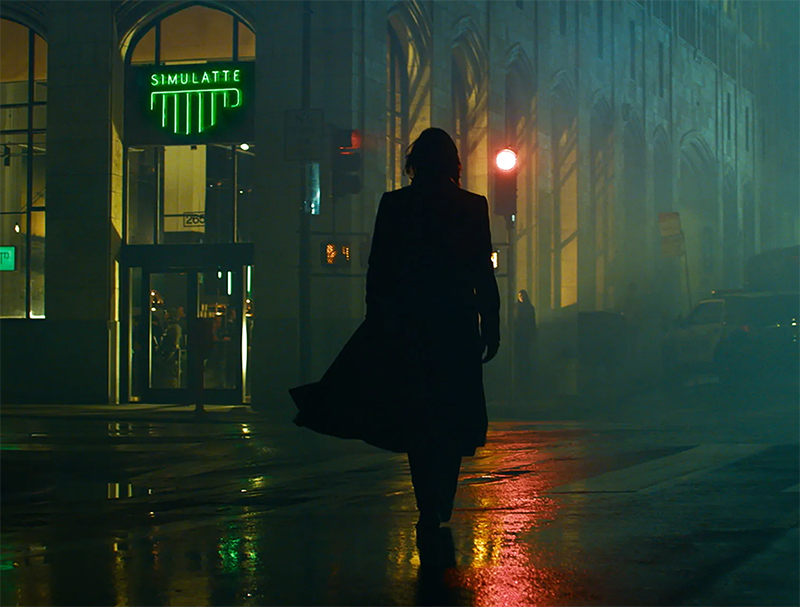
The planned game sequel prompts much hand-wringing. Characters bat ideas back and forth in an open-concept office, trying to get to the heart of what made the original Matrix work. Resurrections abounds with this sort of dorky meta-humor. There are jokes about the game design firm’s parent company being Warner Bros. (the actual film’s producer) and jokes about déjà vu. A fourth-wave coffee shop is called “Simulatte.” That kind of thing. It’s the sort of stuff that elicits barking, staccato guffaws from in-the-know audience members that quickly fade into barely bemused titters. It’s meant to be cute, but it’s mostly annoying.

Still, the film is not without its charms. Some of the early action scenes crack along reliably, playing with inversions of gravity and time, like a fleeter Christopher Nolan flick. And the notion of revisiting the world of the matrix is not without appeal. After all, the original film forecasted a world of digital disenfranchisement that is now, under the auspices of our current Silicon Valley overlords, regarded as aspirational. (In a telling touch, Resurrections moves the action from an implied Chicago to the Bay Area, explicitly marked by familiar landmarks and San Francisco PD cruisers.) And with its image of two pills representing diverging ideological bents, The Matrix provided a ready-made vocabulary that has been embraced in our real world, where everyone is redpilledblackpilledDanpilled, or Tedpilled. But Resurrections never manages to meaningfully intervene in the very conditions it seems to be diagnosing—and which the series had already diagnosed, decades ago. Like postmodernity itself, the state of digital dependency dramatized by The Matrix cannot be alleviated. It can only be mediated, with increasing levels of irony and winking self-awareness.

To wit: Resurrections is not about digitization, or the metaphysics of reality, or the broken promise of the cyberpunk genre. It is about movie reboots. Here, Neo must be liberated again, literally remaking his quest from the original film, with the obstacles re-skinned and old foes appearing in new guises (Jonathan Groff, playing the meddling computer program Smith, is a hunkier, paler imitation of the menacing Hugo Weaving). Characters snipe about how humanity is merely reframing the same handful of archetypal themes and ideas. “We’re still telling the same stories we’ve always told,” says one game designer, sounding like he’s been watching too many Jordan Peterson YouTubes. “Just with different names, different faces.” This may well be true. But it also feels like a cop-out. Especially because the original Matrix, as imagined by sororal duo Lilly and Lana Wachowski, felt genuinely inventive. It blended Terminator-styled dystopian sci-fi with Hong Kong wire-fu action and state-of-the-art special effects, all draped in the industrial liveries of a turn-of-the-millennium goth club. It may not have been wholly new. But it was thrilling remix. It spoke to the ennui of America at the “end of history.” It captured the soul-deadening, Dilbert-esque daily doldrums explored in films like Fight Club and Office Space. It also played straight to the anxiety around “Y2K” and the mounting cultural panic that home computers and toaster ovens might break down or turn against their owners. The Matrix felt like it was speaking to its time. Now, movies seem to chatter only among themselves.

There’s plenty of precedent here, of course: Ready Player Onethe recent Space Jam sequel; and the new Spider-Man movie, which draws together two decades worth of sticky narrative threads spun across three distinct franchises. Corporate wheeling-and-dealing is increasingly allegorized onscreen, to the point that many blockbusters are now about their own production. Within ten years, we’ll see Aaron Sorkin hoisting an Oscar overhead, rewarded by his peers for helming a chatty drama about the backroom legal finagling that saw a Star Wars-branded lightsaber licensed to the movie Free Guy. Hollywood is already lodged in the post-postmodern rabbit hole, with little to show for it. The culture is glitching, looping, stuck in some long, static interregnum, like a radio drifting between channels. If a new Matrix movie felt grimly inevitable in such a climate, it also had great potential.

And I suppose it’s nice that director Lana Wachowski (going solo this time) returned to wield some control over a story that would otherwise be expropriated however-which-way by the studio. But she has only a passing interest in the new convolutions of the simulation itself. Wachowski is more invested in revisiting Neo and Trinity’s wrenching, realities-spanning romance. Rather than the heady ideas at play in the premise—which have been by-and-large replaced by geeky in-jokes—she wants to explore (again) the profound power of love as some supernatural force. At its worst, the Wachowski worldview recalls that classic Simpsons joke: the secret ingredient is always capital-l Love.

This strain of touchy-feely sci-fi certainly has its admirers, and I sometimes count myself among them. But I find the Wachowskis’ sappiness (however earnest) more tolerable when enlivened by their stylistic and technical inventiveness. The rote, underdog rhythms of Speed Racer (2008) only work because they unfold within an aesthetic landscape that splits the difference between La Chinoise and Paper MarioThe Matrix’s heavy hooey about fate and choice and freeing one’s mind is leavened because, well, the movie is entertaining as hell. But now, the ideas are stale (2003’s The Matrix Reloaded already introduced the concept of its story being a remake), and the action settles into tedium: graceful bullet-time ballets are replaced by crunchy, John Wick-style fights and repetitive CGI set pieces that see Neo stopping hails of bullets with his hands, over and over and over again.

Perhaps there’s something modestly clever in the major meta-gesture of this newest Matrix—in its idea of the matrix reproducing its own destruction in the form of an interactive video game. After all, the notion that the very systems that delude us offer self-contained safe spaces for relieving those delusions is apt. Like capital, the matrix survives by evolving quicker than the forces that oppose it. If we take this message seriously, then the goodly thing to do is to ignore The Matrix Resurrections and all corporatized entertainments. To put down Twitter and TikTok and smooch our spouses; build a snowman with the kiddies; clink some beers with a gaggle of good buddies.

That we should all invest not in our virtual existences, but the fleshy, loving, contingent relationships of real life, is a perfectly decent message. That the Wachowskis have been repeating this tired line for two decades speaks despairingly to the conditions of our own, present-day dystopia. Resurrections is suspended between cyberpunk trappings that were already shopworn circa 1999 and the intellectual prison of high-concept meta-mongering. It is a movie of the interregnum, one that could have been auto-generated by it. In this way, The Matrix does manage to speak to the times. Again.

The American Third World: We’ll Soon Be Living in It

By Fabian Ommar

Source: Activist Post

It’s that time of the year, and instead of following tradition and making new predictions and forecasts (which we preppers do all the time anyways), I usually look back into the recent past, review my (and other’s) work and previous analyses, what transpired (or not), where my perspectives need adjustment and where, and so forth.

I decided to review and expand on a few topics addressed previously here and see where we are on those. In April, I wrote about the thirdworldization of the United States, as both it, and the rest of the First World, is gradually shifting towards the Third World.

It’s not only happening, but accelerating. And the entire world is going that way, too – or soon it will, judging by the signs. These things have a delay and don’t happen linearly, but in waves.

Thirdworldization 2.0 – When the First World becomes the Third World

Let’s see some more about how life can be in places constantly suffering with economic crises, political upheavals, moral degeneracy, authority demoralization, institutional failure and social decadence.

For anyone who’s never lived in such a context, understanding the dynamics of the system and societies in the Third World (or any place in which the order has changed drastically, yet not totally evaporated), can be a good way to prepare for what’s already underway.

The current crisis is global and unlike others seen in recent times

Notwithstanding the crap lining up just waiting to hit the fan – a pandemic, a debt time-bomb, geopolitical tensions, and lots more – the capacity to deal with all that is at an all-time low. Even wealthy nations look exhausted, depleted and lost like never before.

There’s zero willingness to cooperate and coordinate a solution, despite authorities’ constant and oddly similar declarations to the contrary. Speaking of the leadership currently in charge, it’s as mediocre, misguided, and uninspiring as it can possibly be.

And this is everywhere. We’re screwed.

It’s impossible to say for sure whether or not all that will end up in a full-blown SHTF of some kind, much less when. It can take a year, or ten. What’s certain is this: until things reach that catalyst point, degradation will force large swaths of populations worldwide, in most if not all countries, to take a few steps back in many fronts.

As I said before, it’s already happening.

The Third World will get much worse, and the First World will become a lot like the Third.

This is not SHTF as some might see it, but a middle-of-the-road-yet-still-gloomy scenario. Many in Preppersphere can’t conceive of anything less than the Apocalypse. Fine, to each their own. Besides, preparing for the worst means covering for everything less, so in principle it’s not a bad strategy, right?

I live in Brazil, but have visited the US, EU, and a few other countries and continents, even having lived abroad for a period during the 1990s. I’ve experienced both realities under different circumstances and gained some perspective on the contrasts between advanced societies, and ones with broken, inefficient, and corrupt institutions, and with weak social contracts.

That’s what I’m here to share. I’ll continue to raise awareness to what society converts into long before TEOTWAWKI happens, and try to help others prepare and deal with that. I do this not only because this is where I have some degree of knowledge, but also because that is what I see happening.

It’s hard to make progress in a ‘quicksand environment.’

In developed countries, people frame their decisions and take action based on reasonable probabilities, and the assumption that certain basic conditions of the social contract won’t change radically or suddenly, depending on who’s in charge or some other spurious reason.

A functional checks-and-balances system warrants the stability of laws, regulations, the tax regime, while the political rules and institutions create a favorable environment for investment and risk taking by people, families, and businesses. That’s what promotes the development and advancement of a country.

That’s perhaps the most important thing to understand about (and consequently prepare for) thirdworldization: it’s not just that things change, but how they change. Thirdworldization is the present and constant possibility that things can get done, undone, and again, at any moment, in unpredictable ways, without debate or warning.

How do you make plans for the future in such context?

Instability and uncertainty make life in general much harder to navigate in the Third World.

If the goalposts are constantly moving, everyone will act short or near term as a way to adapt and survive. The harder and more unstable the context, the faster you must both adapt and act (what is SHTF if not chaos?). So, there’s a silver lining to living like this, but also a price: it’s riskier, more stressful, tiresome, and frustrating.

I won’t say it’s hell, because it’s not.

Most people don’t live 24/7 in fear or under serious risk, not even in severely hit places. It’s not a full-scale SHTF. Life’s just more fluid, more challenging, and not as predictable and calm as in more civilized nations. Actions and consequences don’t follow a linear, predictable path.

Look around and see the sweeping anxiety and depression everywhere. I’d argue it’s not being caused by the pandemic, or even the economy going kaput, but by the appetite of governments everywhere to change basic rules and destroy freedom and individual liberty in the name of an emergency. When you combine this with people’s willingness to forfeit their rights, privacy and liberties in the name of illusory safety you end up with our current world.

That’s what I mean by the world going the way of the Third World.

Observing and understanding the real nature of fluidity in everyday life of a dysfunctional society can be critical, because dysfunctional is exactly what the world is fast becoming.

I’ll give some examples to illustrate what I’m talking about…

What does the path to authoritarianism look like?

The executive, legislative, and judiciary overstepping each other is common in banana republics. Every country can have a bill of rights, but it’s the separation of powers that make the constitution effective. Without a checks-and-balances system, rights are just words on a piece of paper.

This creates both confusion and infighting while simultaneously eroding confidence in the government’s institutions. People lose reference, politicians tend to abuse this strategy more and more, and from there it’s only downhill. It’s the exact script dictators and populists everywhere follow every single time to not only take power but to try to keep it forever.

For a long time this was something unacceptable and unseen in advanced nations. Despite this, though, it’s still been happening for some time now only having escalated in the last couple decades. Since 2020 it’s exploded, and it’s now eroding political and social stability in various developed countries.

And this is not only about inflated presidents declaring wars and contracting treaties and other actions without congressional approval, but also the government ceding increasing powers to agencies – NGOs and others organizations of unprepared, unelected tyrants aligned with the elites, eager to interfere and micromanage both society and people’s lives, as they steal people’s inherent rights and freedoms.

We now have moral ambiguity from top to bottom.

As we go lower down the scale into a full-fledged Third World nation, everyday life begins to border on the bizarre. In developing countries, the public administration is a cesspool of incompetence, poor planning, lack of vision, populism and corruption which drains precious resources and wealth from what would otherwise be a productive population.

The bureaucracy can reach paralyzing levels. The tax regime is so complex and illogical that it’s almost impossible to comply, even if you want to. The regulations are unstable and mutating. Besides punishing the population, these regulations lower the appetite of people and businesses to invest and take risk. The economy becomes less dynamic, less competitive and, eventually, it crawls.

Finally, when the government, institutions, and other authorities begin to become ambiguous with their defining the rules they create and enforce, people start thinking “why should I follow any of that?”

And once this happens, then it’s only a matter of time for disorder to increase and morality to collapse. That’s what a slow-burning SHTF means, after all: a  semi-functional system where everything is fluid and the laws have little practical effect.

There’s little guns can do to solve bigger issues.

But let’s switch gears a little to explain something related: guns are important and can save us in some specific situations. But they can’t help with any of the stuff I’m talking about.

Who are we gonna shoot? The politicians? The corrupt cops? The lazy public workers? The stupid laws? That would solve nothing. All it would mean would be civil war, which only makes everything worse.

Things might get to that point, but it’s a completely different dynamic. When the system is up, shooting someone can land you in jail – even in the Third World.

“How’s that any different from anywhere else?” you might ask. In many ways, this starts with an ineffective investigation apparatus: here only about 6% of intentional homicides are solved, in comparison to an average of 65% in US, 80% in France, and 90% in UK.

Translating, it’s a lot more discouraging to commit a crime in the First World than in the Third. But then other distortions and inequalities come into play. The rich and/or connected almost never go to jail, no matter the crime.

And this leads to the second big difference: the slow and utterly unfair justice system that punishes the entire society, by not punishing the deserving, as it should.

And then there’s the infamous Third World penitentiary system…

These are true SHTF microcosms. No prison anywhere is paradise, obviously. But do you have any idea how bad and dangerous a Third World jail is? If having forty dangerous inmates in a small cubicle originally designed to hold four gives you chills, you understand why honest citizens (especially preppers) are so reluctant to brag about firearms and shooting others in developing countries.

In there, one can get raped, beat up, killed. Or co-opted by one of the many factions that command organized crime, to whom you’ll belong for protection, for the right to live, or even to keep your relatives from being abused, tortured, or killed outside.

Instead of rehabilitating prisoners, this system turns them into even better (that is, worse) criminals.

Mass escapes are also commonplace in Third World prisons. So are violent riots and rebellions in which enemy factions fight, torture, kill and literally rip apart their rivals, as a way to display ruthlessness and inflict fear into opponents. Sure, these things also happen in First World prisons, but not with nearly the same frequency, brutality, or impunity.

There are many ways to get unwillingly involved in this mess of a system, too.

As the situation worsens, so does the entire system. If you do everything right, lay low and get lucky, you may be well. It’s not guaranteed though. Something crazy can happen by pure chance or opportunity, and you’re suddenly involved in something you didn’t ask for, but can’t avoid or escape anymore.

For instance, one day the cops or some government agent – inspection, fiscal, whatever – pay a visit to your small shop or business and ask for a “collaboration”, for… reasons. You pay, of course. It’s extortion, but you don’t want to upset the “law” – and the system can’t protect you from itself.

Now you’re a cash cow.

You go for a jog in the streets and 99% of the time nothing happens. One day you get mugged, or your wife or daughter get groped while riding a bicycle, and there’s little you can do (if you thought “guns!”, go back a couple paragraphs and read what I said about those again).

And then, there’s the organized crime…

I could talk about organized crime for forever, discussing how it grows and spreads based on the same principles and practices that high-profile corporations use to grow and spread. How it infiltrates all levels of society, by corruption, intimidation, lobbying, or even by financing people to occupy strategic positions. How it gets involved with politicians, legitimate businesses, the media – until it’s just one big thing with tentacles everywhere.

Instead, I’ll do you all a big favor and just point to a couple of movies that not only show in true, raw, vivid colors how this whole mechanism works, but do it in a very entertaining and thrilling way. Elite Squad (1997) and its sequel, The Enemy Within (2010) are two of most brilliant and well-made Brazilian movies ever (both rated 8.0 on IMDB).

Apart from superb action flicks, they’re blunt, brutal, realistic portraits of crime, drug fighting/trafficking, institutional corruption, and overall social and moral decadence. They explain how crime evolves and takes over the system – how it gets “institutionalized”. It’s shocking, revealing, and educational.

There’s a reason I keep returning to the topic of crime.

Crime and violence are insidious and pervasive – the first evidence of collapse – while at the same time both the cause and consequence of deeper issues. Crime is the antecedent to (serious) shortages, and skyrockets when the grid goes down. It becomes both a collective and an individual problem. It affects us directly, and indirectly, physically and mentally – an itch no one can scratch.

Look how fast crime has grown in the US and around the world just in the past few months. I’m not talking about a 2% increment, but something in the two or even three figures in some places – and again, in months. For many, especially the part of society living in safe and civilized regions, crime may seem like something distant, numbers and statistics presented in the news.

That all changes when it comes to our door, and then the cat is definitely out of the bag.

To conclude, there’s been a lot of talk about the possibility of civil war in the United States. I think that it can happen, but not necessarily like 1871. It could be a mix of guerrilla warfare and crime, for instance. Or we could witness a steep, sudden, and widespread rise in crime and violence. In Haiti, gangs rule the country and casualties are high. It affects everyday life and impacts the whole population, the economy, everything. It may not be declared, but its de facto a civil war.

Abandoning innocence

When everything is good and there’s a surplus, collaboration happens easily and even spontaneously. With all the challenges and hardships we’re facing, people are entering survival mode everywhere. Becoming more knowledgeable about the dynamics of living in a dysfunctional society can build psychological preparations to live in a fluid and unstable world.

I acknowledge none of what I talked about here is prerogative of Third World or collapsed countries. Disorder, corruption and malfeasance are part of human nature and exist everywhere. But again, it’s certainly more widespread and violent where it’s not contained, and – this is critical – not punished.

And that’s precisely in proportion to the level of institutional efficiency, solidity and civil cohesion. Once these decay, the doors to social maladies are held wide open. And wherever this happens, a similar scenario unfolds.

It’s happening everywhere.

THE THRESHOLD OF EXHAUSTION: OUR TIME FOR REGATHERING & RECALIBRATION

By Kingsley L. Dennis

Source: Waking Times

Decades of expansionist practices and beliefs have brought us to a new threshold. It is not yet the threshold between human and spirit, as some would have preferred, but a threshold of exhaustion.

The modern age of post-industrialization has been feeding an acceleration cycle that is built upon continual expansion and consumption. These expansionist policies are mostly a result of the neo-capitalist thirst for ever increasing profits. And these ever-increasing returns have been predicated upon continuous wars, expanded trading (e.g. globalization), and the ongoing patterns of consumption. Modern world expansion has plundered and exhausted the world’s physical resources and has exploited the nervous system of humanity, bringing it to a psycho-fragility and biological burnout. The global brain is entering a state of dementia at the same time it is encountering competition from the automated global brain. This current human, and yet inhumane, thrust have brought the present generations to a threshold of exhaustion. We have saturated our limits of attention and are becoming quickly overwhelmed by the smallest of impacts. The human psyche is becoming over-sensitive to environmental stimuli that is now bombarding us from every media channel we can cram onto our devices. Humanity has forged a new environment for itself within the last century – and especially in the last decades – that pushes us further away from a natural context and towards an artificial, unnatural construct. Many people, or at least those within industrialized cultures, are now perceiving reality from within a bubble of stimulation. An overload of images, sounds, pixels, digitization, and the real-time ‘always on’ lifestyles that now wrap around us have created an unprecedented level of electromagnetic smog. We have slipped into an electronic ecosystem without being consciously aware of what was happening until we were already embedded deeply within it. This new electrocuted environment shifts humans from a state of self-perception into a mode of info-stimulation. Our minds and bodies are being re-tuned and recalibrated to exist within a state of permanent excitement.

Human life is now for many people an experience of hyper-expression. The human inner life is being pulled out of us and sprawled upon the external chaotic mediascape. No wonder we are witnessing so many cases of nervous system exhaustion. Our nervous systems are being exploited until the point of near explosion. The sad part here is that a medical industry has been established to cater to this by profit-centred chemicalization of our bodies and minds. It is no longer the jagged pill we should be cautious of but the plethora of smooth pills we are constantly offered that many people are only too willing to pop. The human nervous system (the body-mind) has reached a point of saturation: too much noise, too many nervous stimulations, too much vibrational dissonance: people are quite literally cracking up. There is a subtle state of traumatization that has entered as a low-level hum within our global vibration. Many people have become entrained into this hum. It is creating an underlying sense of anxiety, unease, uncertainty, and restless nervousness. Something is afoot. Many of us feel this, and yet cannot quite place it. There is a presence in the room – yet it is out of visible sight. A moment of regathering is now required.

A moment of regathering is necessary as individually and collectively we are becoming out-of-synch with our vibrational alignment. Technology has created some of this dissonance, although not all. Over the years, humanity has been given nudges to assist its re-alignment. But now, something stronger is required: ‘you have not been inclined to feel that nudge. Now, it has to be more so of a blow rather than a nudge.’[i] As a species we are not yet sufficiently unified, or connected, to be making the best use from technology. We can see this clearly from the behaviour we witness online and in social media. We are still too splintered for our technologies to be of most use to us. If we are not aligned, then there is the danger that any technologies we develop will create further dissonance and dysfunction. Humanity needs to respond to this situation, but by awareness and vibrational re-alignment, and not by taking itself further away from life: ‘it is never about ridding life of yourselves: sitting upon a hilltop void of self, void of world, no.’[ii] What we need is to strip it all away – to strip back our socially constructed lives into a way of living that is closer to the essential. We need to allow the expansive vibrational essence to flow through us: ‘allow this vibrational essence to flow through your being, birthing a new vibrational signature – a non-splintered one, a unified one.’[iii] Humanity needs to take off its bandages and to allow its wounds to heal. It is time to shift into a more harmonized species vibration; this is crucial now. A more aligned and vibrationally resonant humanity can emerge from this – ‘one consciousness at a time, one vibrational alignment at a time.’ And this is where human beings can be of purpose, both physically in their everyday lives and in alignment with the resonance of pure consciousness.

Human life is also about the expanding of our field of consciousness; to allow pure consciousness to manifest through the physical human being. The physical being is biologically encased, yet this does not mean that we should be encased in our limitations of consciousness. Humanity has already explored far and wide. We have gone deep into the oceans, far across the Earth, and high up into the atmosphere and into orbit. Yet if we don’t explore and reach ourselves first, then we shall have found nothing: ‘You can only ever but find yourselves. But if so coming from a splintered mind, you are finding everything else but yourselves.’[iv] It is time to unclose the closed; to reveal the unrevealed. How can we be going towards the “post-human” if we have not yet arrived at the fully human? By coming back to our essential selves, new pathways shall open up for us – a new resonance shall be gained. A new sight shall be revealed: ‘they will be new to the eyes that have not yet been open but old news to those that have been awake.’[v] The human is both within being and becoming – between stillness and movement. This is the flow of evolution and has always been so. Consciousness has always been in flow through humanity, yet it manifests in relation to the pathways that have been created. It is now time for new pathways to be established, so that pure consciousness can flow more abundantly. It is time now for a genuine human recalibration into a consciousness vibration – not into an artificial electro-smog vibration.

By recalibrating and re-wiring, then we are also dropping old patterns (patterning) and habits. As connections and patterns are internally shifted, so too will this affect our outer lives. To shift the outer, we must first shift the inner: ‘opening up for new pathways to be formed which are more of resonation to your being and to that of which is trying to manifest in form.’[vi] This is our moment for regathering and recalibration. It is the time for a readjustment and return to humanity’s home resonance. It is time for all of us to find The Way Back Home. We have been taught to be in a constant struggle of extremes; to be thrust between spurts of action and sudden, constant rest. In this way, we are actually flat-lining life: ‘You are straightening it out, and also it goes for the other end of constant rest. It has to be of resonance – of movement, of rest, of breath.’[vii] The energy is always there, available for us, only that it needs to be in resonance to the ‘mechanism or organism that is receiving such vibrations.’ And right now, the human organism requires some recalibration so that more expanded energy, consciousness, and awareness, can come forth through us. If a person is in dissonance, out of balance with themselves, rather than align with the energies of expanded consciousness they will more likely be sucked into the ecosystem of electro-energies. These energies are sub-nature. They are part of living existence, yet they are a lower form of life vibration. Electricity, said Rudolf Steiner, is light in a sub-material state. That is, it is a form of light that has fallen below the level of nature and has become what he termed ‘sub-nature.’ It is because of this that Steiner warned humankind to be cautious not to build cultures dependent or based on electricity. An electro-ecosystem will only serve to draw us away from our natural eco-system and into a lower vibrational state of sub-nature.

Modern living, as we can bear witness to, has de-sensitized many of us to natural energies of Nature. And the shift into increased digitization has only emphasized this. To attune ourselves to natural, vital life-forces we need to become closer to our natural environments. We need to spend more time outside, being in touch with the soil – to let our hands and feet be grounded by earthly energies. We shouldn’t be afraid of earthly dirt or the bacteria in the soil; not to be squeamish at the stains of bugs. What we need is an openness to a state of receptivity and rebalance. We have to make time for allowance – to allow ourselves to Be, to be present, and to be receptive to life’s vital forces. In this way, we can begin to overcome our collective de-sensitization and to allow the finer vibrational energies of the vital life-forces to flow through us into this beautiful world we have the privilege of experiencing.

By reaching the threshold of exhaustion, we can now take this opportunity to cross over into a different threshold – a threshold into a new phase where the human being merges with the vital life-forces of pure consciousness. A new phase is incoming. We only have to be balanced, stable, and in-synch for this new allowance.

Endnotes

All citations (listed below) were taken from the ABE communications as published in my previous book UNIFIED: Cosmos, Life, Purpose – Communicating with the Unified Source Field & How This Can Guide Our Lives and The Way Back Home: The ABE Conversations (Vol.1). The reference notes refer to Section 5 and the Question number.

[i] (S.5.Q11)

[ii] (S.5.Q11)

[iii] (S.5.Q11)

[iv] (S.5.Q14)

[v] (S.5.Q15)

[vi]  (S.5.Q19)

[vii] (S.5.Q23)

Opening image: Pedro Duran – http://piedrasenequilibrio.com/