
This Is Our Neoliberal Nightmare: Hillary Clinton, Donald Trump, and Why the Market and the Wealthy Win Every Time

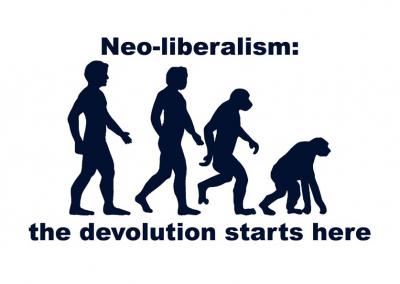
neo_liberalism_devolution_via_permanentculturenow.com_

The rage driving our politics stems from cruelty of capitalism. So why do we vote for those who worship the market?

By Anis Shivani

Source: AlterNet

Over the last fifteen years, editors often asked me not to mention the word “neoliberalism,” because I was told readers wouldn’t comprehend the “jargon.” This has begun to change recently, as the terminology has come into wider usage, though it remains shrouded in great mystery.

People throw the term around loosely, as they do with “fascism,” with the same confounding results. Imagine living under fascism or communism, or earlier, classical liberalism, and not being allowed to acknowledge that particular frame of reference to understand economic and social issues. Imagine living under Stalin and never using the communist framework but focusing only on personality clashes between his lieutenants, or likewise for Hitler or Mussolini or Mao or Franco and their ideological systems! But this curious silence, this looking away from ideology, is exactly what has been happening for a quarter century, since neoliberalism, already under way since the early 1970s, got turbocharged by the Democratic party under the Democratic Leadership Council (DLC) and Bill Clinton. We live under an ideology that has not been widely named or defined!

Absent the neoliberal framework, we simply cannot grasp what is good or bad for citizens under Cruz versus Trump, or Clinton versus Sanders, or Clinton versus Trump, away from the distraction of personalities. To what extent does each of them agree or disagree with neoliberalism? Are there important differences? How much is Sanders a deviation? Can we still rely on conventional distinctions like liberal versus conservative, or Democrat versus Republican, to understand what is going on? How do we grasp movements like the Tea Party, Occupy, and now the Trump and Sanders insurgencies?

Neoliberalism has been more successful than most past ideologies in redefining subjectivity, in making people alter their sense of themselves, their personhood, their identities, their hopes and expectations and dreams and idealizations. Classical liberalism was successful too, for two and a half centuries, in people’s self-definition, although communism and fascism succeeded less well in realizing the “new man.”

It cannot be emphasized enough that neoliberalism is not classical liberalism, or a return to a purer version of it, as is commonly misunderstood; it is a new thing, because the market, for one thing, is not at all free and untethered and dynamic in the sense that classical liberalism idealized it. Neoliberalism presumes a strong state, working only for the benefit of the wealthy, and as such it has little pretence to neutrality and universality, unlike the classical liberal state.

I would go so far as to say that neoliberalism is the final completion of capitalism’s long-nascent project, in that the desire to transform everything—every object, every living thing, every fact on the planet—in its image had not been realized to the same extent by any preceding ideology. Neoliberalism happens to be the ideology—unlike the three major forerunners in the last 250 years—that has the fortune of coinciding with technological change on a scale that makes its complete penetration into every realm of being a possibility for the first time in human history.

From the early 1930s, when the Great Depression threatened the classical liberal consensus (the idea that markets were self-regulating, and the state should play no more than a night-watchman role), until the early 1970s, when global instability including currency chaos unraveled it, the democratic world lived under the Keynesian paradigm: markets were understood to be inherently unstable, and the interventionist hand of government, in the form of countercyclical policy, was necessary to make capitalism work, otherwise the economy had a tendency to get out of whack and crash.

It’s an interesting question if it was the stagflation of the 1970s, following the unhitching of the United States from the gold standard and the arrival of the oil embargo, that brought on the neoliberal revolution, with Milton Friedman discrediting fiscal policy and advocating a by-the-numbers monetarist policy, or if it was neoliberalism itself, in the form of Friedmanite ideas that the Nixon administration was already pursuing, that made stagflation and the end of Keynesianism inevitable.

It should be said that neoliberalism thrives on prompting crisis after crisis, and has proven more adept than previous ideologies at exploiting these crises to its benefit, which then makes the situation worse, so that each succeeding crisis only erodes the power of the working class and makes the wealthy wealthier. There is a certain self-fulfilling aura to neoliberalism, couched in the jargon of economic orthodoxy, that has remained immune from political criticism, because of the dogma that was perpetuated—by Margaret Thatcher and her acolytes—that There Is No Alternative (TINA).

Neoliberalism is excused for the crises it repeatedly brings on—one can think of a regular cycle of debt and speculation-fueled emergencies in the last forty years, such as the developing country debt overhang of the 1970s, the savings and loan crisis of the 1980s, the Asian currency crisis of the 1990s, and the subprime mortgage crisis of the 2000s—better than any ideology I know of. This is partly because its very existence as ruling ideology is not even noted by the population at large, which continues to derive some residual benefits from the welfare state inaugurated by Keynesianism but has been led to believe by neoliberal ideologues to think of their reliance on government as worthy of provoking guilt, shame, and melancholy, rather than something to which they have legitimate claim.

It is not surprising to find neoliberal multiculturalists—comfortably established in the academy—likewise demonizing, or othering, not Muslims, Mexicans, or African Americans, but working-class whites (the quintessential Trump proletariat) who have a difficult time accepting the fluidity of self-definition that goes well with neoliberalism, something that we might call the market capitalization of the self.

George W. Bush’s useful function was to introduce necessary crisis into a system that had grown too stable for its own good; he injected desirable panic, which served as fuel to the fire of the neoliberal revolution. Trump is an apostate—at least until now—in desiring chaos on terms that do not sound neoliberal, which is unacceptable; hence Jeb Bush’s characterization of him as the “candidate of chaos.” Neoliberalism loves chaos, that has been its modus operandi since the early 1970s, but only the kind of chaos it can direct and control.

To go back to origins, the Great Depression only ended conclusively with the onset of the second world war, after which Keynesianism had the upper hand for thirty-five years. But just as the global institutions of Keynesianism, specifically the IMF and the World Bank, were being founded at the New Hampshire resort of Bretton Woods in 1944, the founders of the neoliberal revolution, namely Friedrich Hayek, Ludwig von Mises, Milton Friedman, and others were forming the Mount Pelerin Society (MPS) at the eponymous Swiss resort in 1947, creating the ideology which eventually defeated Keynesianism and gained the upper hand during the 1970s.

So what exactly is neoliberalism, and how is it different from classical liberalism, whose final manifestation came under Keynesianism?

Neoliberalism believes that markets are self-sufficient unto themselves, that they do not need regulation, and that they are the best guarantors of human welfare. Everything that promotes the market, i.e., privatization, deregulation, mobility of finance and capital, abandonment of government-provided social welfare, and the reconception of human beings as human capital, needs to be encouraged, while everything that supposedly diminishes the market, i.e., government services, regulation, restrictions on finance and capital, and conceptualization of human beings in transcendent terms, is to be discouraged.

When Hillary Clinton frequently retorts—in response to demands for reregulation of finance, for instance—that we have to abide by “the rule of law,” this reflects a particular understanding of the law, the law as embodying the sense of the market, the law after it has undergone a revolution of reinterpretation in purely economic terms. In this revolution of the law persons have no status compared to corporations, nation-states are on their way out, and everything in turn dissolves before the abstraction called the market.

One way to sum up neoliberalism is to say that everything—everything—is to be made over in the image of the market, including the state, civil society, and of course human beings. Democracy becomes reinterpreted as the market, and politics succumbs to neoliberal economic theory, so we are speaking of the end of democratic politics as we have known it for two and a half centuries. As the market becomes an abstraction, so does democracy, but the real playing field is somewhere else, in the realm of actual economic exchange—which isnot, however, the market. We may say that all exchange takes place on the neoliberal surface.

Neoliberalism is often described—and this creates a lot of confusion—as “market fundamentalism,” and while this may be true for neoliberal’s self-promotion and self-presentation, i.e., the market as the ultimate and only myth, as were the gods of the past, I would argue that in neoliberalism there is no such thing as the market as we have understood it from previous ideologies.

The neoliberal state—actually, to utter the word state seems insufficient here, I would claim that a new entity is being created, which is not the state as we have known it, but an existence that incorporates potentially all the states in the world and is something that exceeds their sum—is all-powerful, it seeks to leave no space for individual self-conception in the way that classical liberalism, and even communism and fascism to some degree, were willing to allow.

There are competing understandings of neoliberal globalization, when it comes to the question of whether the state is strong or weak compared to the primary agent of globalization, i.e., the corporation, but I am taking this logic further, I am suggesting that the issue is not how strong the state is in the service of neoliberalism, but whether there is anything left over beyond the new definition of the state. Another way to say it is that the state has become the market, the market has become the state, and therefore both have ceased to exist in the form we have classically understood them.

Of course the word hasn’t gotten around to the people yet, hence all the confusion about whether Hillary Clinton is more neoliberal than Barack Obama, or whether Donald Trump will be less neoliberal than Hillary Clinton. The project of neoliberalism—i.e., the redefinition of the state, the institutions of society, and the self—has come so far along that neoliberalism is almost beyond the need of individual entities to make or break its case. Its penetration has gone too deep, and none of the democratic figureheads that come forward can fundamentally question its efficacy.

I said almost. The reason why Bernie Sanders, self-declared democratic socialist, is so threatening to neoliberalism is that he has articulated a conception of the state, civil society, and the self that is not founded in the efficacy and rationality of the market. He does not believe—unlike Hillary Clinton—that the market can tackle climate change or income inequality or unfair health and education outcomes or racial injustice, all of which Clinton propagates. Clinton’s impending “victory” (whatever machinations were involved in engineering it) will only strengthen neoliberalism, as the force that couldn’t be defeated even when the movement was as large and transcendent as Sanders’s. Although Sanders doesn’t specify “neoliberalism” as the antagonist, his entire discourse presumes it.

Likewise, while Trump supporters want to take their rebellion in a fascist direction, their discomfort with the logic of the market is as pervasive as the Sanders camp, and is an advance, I believe, over the debt and unemployment melancholy of the Tea Party, the shame that was associated with that movement’s loss of identity as bourgeois capitalists in an age of neoliberal globalization. The Trump supporters, I believe, are no longer driven by shame, as was true of the Tea Party, and as has been true of the various dissenting movements within the Republican party, evangelical or otherwise, in the recent past. Rather, they have taken the shackles off and are ready for a no-holds barred “politically incorrect” fight with all others: they want to be “winners,” even at the cost of exterminating others, and that is not the neoliberal way, which doesn’t acknowledge that there can be winners and losers in the neoliberal hyperspace.

In the current election campaign, Hillary Clinton has been the most perfect embodiment of neoliberalism among all the candidates, she is almost its all-time ideal avatar, and I believe this explains, even if not articulated this way, the widespread discomfort among the populace toward her ascendancy. People can perceive that her ideology is founded on a conception of human beings striving relentlessly to become human capital (as her opening campaign commercialso overtly depicted), which means that those who fail to come within the purview of neoliberalism should be rigorously ostracized, punished, and excluded.

This is the dark side of neoliberalism’s ideological arm (a multiculturalism founded on human beings as capital), which is why this project has become increasingly associated with suppression of free speech and intolerance of those who refuse to go along with the kind of identity politics neoliberalism promotes.

And this explains why the 1990s saw the simultaneous and absolutely parallel rise, under the Clintons, of both neoliberal globalization and various regimes of neoliberal disciplining, such as the shaming and exclusion of former welfare recipients (every able-bodied person should be able to find work, therefore under TANF welfare was converted to a performance management system designed to enroll everyone in the workforce, even if it meant below-subsistence wages or the loss of parental responsibilities, all of it couched in the jargon of marketplace incentives).

The actual cost to the state of the AFDC program was minimal, but its symbolism was incalculable. The end of welfare went hand in hand with the disciplinary “crime bill” pushed by the Clintons, leading to an epidemic of mass incarceration. Neoliberalism, unlike classical liberalism, does not permit a fluidity of self-expression as an occasional participant in the market, and posits prison as the only available alternative for anyone not willing to conceive of themselves as being present fully and always in the market.

I believe that the generation of people—in their forties or older—supporting Hillary have already internalized neoliberal subjectivity, which they like to frame as realism or pragmatism, refusing for instance to accept that free college or health care are even theoretical possibilities. After all, they have maintained a measure of success in the past three or four decades after conceptualizing themselves as marketplace agents. Just as the Tea Party supporters found it intolerable that government should help irresponsible homeowners by bailing them out of unsustainable debt, the Clinton supporters hold essentially the same set of beliefs toward those who dare to think of themselves outside the discipline of the market.

I spoke of the myth of the market, as something that has no existence in reality, because none of the elements that would have to exist for a market to work are actually in place; this is even more true for neoliberalism than it was for the self-conscious annihilation of the market by communism, because at least in that system the market, surreptitiously, as in various Eastern European countries, kept making an appearance. But when the market takes neoliberal shape, i.e., the classical conceptions of the buyer and seller as free agents are gone, then radical inequality is the natural outcome. And inequality in the last four decades, as statistics for the U.S. and everywhere neoliberalism has made inroads prove beyond a doubt, has exploded, thereby invalidating neoliberalism’s greatest claim to legitimacy, that it brings about a general increase in welfare. So neoliberalism, to the extent that the inequality discourse has made itself manifest recently, must insist all the more vocally on forms of social recognition, what Clinton, for example, likes to call the “fall of barriers.”

Neoliberalism likes to focus on public debt—in the Clinton years debt reduction became a mania, though George W. Bush promptly spent all the accumulated surpluses on tax cuts for the wealthy and on wars of choice—rather than inequality, because the only way to address inequality is through a different understanding of public debt; inequality can only be addressed through higher taxation, which has by now been excluded from the realm of acceptable discourse—except when Sanders, Trump, or Jeremy Corbyn in England go off script.

So to recapitulate neoliberalism’s comprehensive success, let us note that we have gone from a liberal, Keynesian, welfare state to a neoliberal, market-compliant, disciplinary state.

Neoliberalism expects—and education at every level has been redesigned to promote this—that economic decision-making will be applied to all areas of life (parenthood, intimacy, sexuality, and identity in any of its forms), and that those who do not do so will be subject to discipline. Everyone must invest in their own future, and not pose a burden to the state or anyone else, otherwise they will be refused recognition as human beings.

This supposed economic “rationality” (though it is the greatest form of irrationality) applies to civil society as much as the state, so that none of the ideals of classical liberalism, or previous ideologies rooted in humanism, are valid any longer, the only value is the iteration of the market (as myth, not reality); in other words, neoliberalism, unlike the elevation of the individual in classical liberalism or the state in fascism or the collectivity in communism, has erected something, the market, that has no real existence, as the only god to serve! And it is just like a god, with an ethereal, unchallengeable, irrefutable, ubiquitous presence. Whatever in state policy does not serve market-conformity is to be banned and banished from memory (the secular scriptures are to be rewritten), which explains neoliberalism’s radical narrowing of public discourse, including the severance of identity politics from any class foundation.

Neoliberalism will continue to perpetuate reduced opportunity, because one of its characteristics—as in any system that wants to thrive on the world stage—is to constantly refine the field upon which the human subject can operate.

As such, those displaced workers who have suffered the most from the erosion of the old industries in the former manufacturing centers of the world are not even factors to contend with, they are invisible and cannot be part of the policy equation. To the extent that their actual presence is reckoned with, the economy can be said to have crashed; but the problem doesn’t arise because of the management of unemployment or underemployment statistics, unlike a housing crash which is palpable and cannot escape statistical definition.

The danger for neoliberalism—as is clear from the support of millions of displaced human beings for Trump—is that with each crisis neoliberalism sheds more workers, makes individuals and firms more “disciplined,” narrows the scope of opportunity even further. At times, the disciplining of the non-neoliberal other—as with the killing of Michael Brown or Eric Garner—explodes to surface consciousness in an unsavory way, so an expert manager like Clinton or Obama is required to tamp down the emotions of such unruly entities as Black Lives Matter which arise in response. If climate change, according to Clinton and her cohort, can and should have market solutions, then surely racial disparity, or police violence, should also have market solutions and no others; it is here that neoliberal multiculturalism, operating in the academy, is so insidious, because at the elite level it functions to validate market discourse, it does not step outside it.

The present breakdown of both major political parties can be explained by the frustration that has built up in the body politic over the past decade, because after the crash there was no sustained intellectual movement to question the myth of the market. The substitution of economic justice with identity politics is something Ralph Nader, Howard Dean, and now Bernie Sanders have contested in a humane manner, while the same process is at work, admittedly in an inhumane way, in the Trump phenomenon.

Thus, also, Hillary Clinton’s animus against free college education; that form of expansion of opportunity, which was a reality from the 1950s to the 1980s, cannot be allowed to return, human beings are supposed to invest in their own future earnings potential, they are not entitled to a transcendent experience without barriers manifesting in discipline and self-correction. Education, like everything else, including one’s own health, becomes an expensive consumer good, not a right, no longer an experience that might lead to a consciousness beyond the market but something that should be fully encapsulated by the market. If one is a capable market player, education as we have classically understood it becomes redundant.

Unlike the interregnum between 1945-1973, the rising tide—no matter the befuddlements Arthur Laffer and his fellow Reaganite ideologues proffered—does not lift all boats today, it is outside the logic of neoliberalism that it do so, so the idea of reforming neoliberalism, or what is often called “globalization with a human face,” is a rhetorical distraction. All of the policy innovations—interpreted as “socialism” by the Tea Partiers—offered by Barack Obama fall within the purview of neoliberalism, above all the Affordable Care Act, whose genesis was hatched in neoliberal think tanks decades ago.

It is important to note that neoliberal economic restructuring necessarily means social restructuring, i.e., a movement toward disciplinarity and away from liberalism; the disciplinarity can take a Bushian, Clintonian, or Trumpian form, but these are manifestations of the same tendency.

When wage growth is decoupled from economic growth (as it has been since Friedman and others inaugurated the revolution in the early 1970s), this means that the human subject is ripe for discipline. Furthermore, wage fairness cannot be rationally discussed (hence the obfuscation surrounding the $15 minimum wage orchestrated by Clinton and others) because the concept of the market has been disembedded from society; the market as abstraction, not a concrete reality, makes any notion of reform or restructuring impossible. Like the minimum wage, something like free child care also remains outside the bounds of discourse, because public policy cannot accommodate discussions that do not take the self-regulating market as unassailable myth.

What neoliberalism can accommodate is relentless tax cuts (Trump has already offered his huge tax cut plan, as Bush did as his first order of business), which only exacerbate the problem, leading to increasing concentrations of wealth. It has to be said, though, that Ted Cruz more comfortably fit the neoliberal paradigm, with his familiar calls for lower taxes along with reduced regulation and further limits on social welfare, whereas Trump shows, for now, some elements of apostasy. If neoliberalism were to get a Cruz, it would have no problem working with him, or rather, Cruz would have had no problem executing neoliberalism, beyond the surface dissimilarities from Hillary Clinton.

As Sanders has consistently noted, economic inequality leads to political inequality, which means that democracy, after a certain point, becomes only theoretical (viz. Citizens United and the electoral influence of such powerful entities as the Koch brothers). Both processes—economic inequality and political inequality—have accelerated after each downturn in the forty-five-year history of neoliberalism, therefore a downturn is always exciting, and even preordained, for a Bush, a Trump, or a Clinton. Again, economic inequality and political polarity (polarity is simply a manifestation of democracy having become dysfunctional) strongly correlate, and both have come to a head in this election.

Neoliberalism’s task, from this point on, is to mask and manage the increasing inequalities that are likely to befall humanity, especially as the planet reaches a crisis point in its health. In a way, George W. Bush threw a wrench—he was a perverted Keynesian in a way, believing in war to prime the pump, or inflating unsustainable bubbles, or spending exorbitantly on grandiose gestures—into the process of neoliberal globalization that was going very smoothly indeed under Bill Clinton and would likely have flourished under Al Gore as well. With Hillary Clinton, the movement will be toward further privatization of social welfare, “reforming” it along market principles, as has been true of every neoliberal avatar, whether it was Bill Clinton’s incentives to work in the performance management makeover of welfare, George Bush’s proposed private social security accounts, Mitt Romney’s proposed private health care accounts, or the school vouchers that tempt all of them from time to time.

What remains to be seen is the extent to which the millennial generation might be capable of thinking outside the neoliberal paradigm, i.e., they don’t just want more of what neoliberal promises to give them yet fails to deliver, but want things that neoliberalism does not or cannot promise. On this rests the near-term future of the neoliberal project.

Beyond Sanders himself, the key question is the ability of the millennial generation to conceive of themselves outside the neoliberal subjectivity they have been pushed to internalize. They have been encouraged to think of themselves as capital producers, turning their intellectuality into social media popularity for the benefit of capital, in the service of the same abstract market that has no place, no role, no definition beyond the fallen liberal calculus. Does the millennial generation believe, even about its most intimate core, that everything has been privatized?

I am not necessarily making a pessimistic prediction. I am merely outlining the strength of an opponent that has refused to be named for forty-five years, although it has been the ruling ideology that long! In defining neoliberalism, I have sought to distance myself from the distraction of personalities, and tried to expose the dark side of our politics which we can only see when we name and understand the ideology as such. We are up against a system that is so strong that it has survived, for the most part, the last crash, as citizens couldn’t get their heads around the idea of nationalizing banks or health care.

It is existentially imperative to ponder what happens beyond Sanders, because neoliberalism has its end-game in sight, letting inequality continue to escalate past the crash point (meaning the point where the economy works for most people), past any tolerable degradation of the planet (which is being reconceptualized in the shape of the market).

What, indeed, does happen beyond Sanders, because as we have seen Hillary Clinton is one of the founders of neoliberal globalization, one of its central historical figures (having accelerated the warehousing of the poor, the attack on trade unions, and the end of welfare and of regulatory prowess), while Trump is an authoritarian figure whose conceptions of the state and of human beings within the state are inconsistent with the surface frictionlessness neoliberalism desires? To go back to Hillary Clinton’s opening campaign commercial, to what extent will Americans continue to believe that the self must be entrepreneurially leveraged toward maximum market gains, molded into mobile human capital ever ready to serve the highest bidder?

As to whether a non-neoliberal globalization is possible and what that might look like on the international stage after a quarter-century of Clinton, Bush, and Obama—which is essentially the frustration Trump is tapping into—I’ll take that up in a follow-up essay, which will further clarify the differences between Sanders versus Clinton, and Trump versus Clinton.

I would suggest that it is not that globalization causes or has caused neoliberalism, but that neoliberalism has pushed a certain form of globalization that suits its interests. This is a crucial distinction, on which everything else hinges. The neoliberal market doesn’t actually exist; at the moment it is pure abstraction; what is actually filling up economic and political space can only be discussed when we step away from this abstraction, as Sanders has so ably done, and as the Occupy and Black Lives Matter movements tentatively set in motion.


Anis Shivani is the author of several books of fiction, poetry, and criticism, including, most recently, My Tranquil War and Other Poems. His novel Karachi Raj (HarperCollins/Fourth Estate) was released this summer. His next book is the poetry collection Whatever Speaks on Behalf of Hashish, out in October.

Welcome to 1984

1984

By Chris Hedges

Source: truthdig

The artifice of corporate totalitarianism has been exposed. The citizens, disgusted by the lies and manipulation, have turned on the political establishment. But the game is not over. Corporate power has within its arsenal potent forms of control. It will use them. As the pretense of democracy is unmasked, the naked fist of state repression takes its place. America is about—unless we act quickly—to get ugly.

“Our political system is decaying,” said Ralph Nader when I reached him by phone in Washington, D.C. “It’s on the way to gangrene. It’s reaching a critical mass of citizen revolt.”

This moment in American history is what Antonio Gramsci called the “interregnum”—the period when a discredited regime is collapsing but a new one has yet to take its place. There is no guarantee that what comes next will be better. But this space, which will close soon, offers citizens the final chance to embrace a new vision and a new direction.

This vision will only be obtained through mass acts of civic mobilization and civil disobedience across the country. Nader, who sees this period in American history as crucial, perhaps the last opportunity to save us from tyranny, is planning to rally the left for three days, from May 23 to May 26 at Constitution Hall in Washington, D.C., in what he is calling “Breaking Through Power” or “Citizen’s Revolutionary Week.” He is bringing to the capital scores of activists and community leaders to speak, organize and attempt to mobilize to halt our slide into despotism.

“The two parties can implode politically,” Nader said. “They can be divided by different candidates and super PACs. But this doesn’t implode their paymasters.”

“Elections have become off-limits to democracy,” he went on. “They have become off-limits to democracy’s fundamental civil community or civil society. When that happens, the very roots shrivel and dry up. Politics is now a sideshow. Politics does not bother corporate power. Whoever wins, they win. Both parties represent Wall Street over Main Street. Wall Street is embedded in the federal government.”

Donald Trump, like Hillary Clinton, has no plans to disrupt the corporate machinery, although Wall Street has rallied around Clinton because of her predictability and long service to the financial and military elites. What Trump has done, Nader points out, is channel “the racist, right-wing militants” within the electorate, embodied in large part by the white working poor, into the election process, perhaps for one last time.

Much of the left, Nader argues, especially with the Democratic Party’s blatant rigging of the primaries to deny Bernie Sanders the nomination, grasps that change will come only by building mass movements. This gives the left, at least until these protofascist forces also give up on the political process, a window of opportunity. If we do not seize it, he warns, we may be doomed.

He despairs over the collapse of the commercial media, now governed by the primacy of corporate profit.

“Trump’s campaign has enormous appeal to the commercial mass media,” Nader said. “He brought huge ratings during the debates. He taunted the networks. He said, ‘I’m boycotting this debate. It’s going to cost you profit.’ Has this ever happened before in American history? It shows you the decay, the commercialization of public elections.”

The impoverished national discourse, fostered by a commercial mass media that does not see serious political debate as profitable and focuses on the trivial, the salacious and the inane, has empowered showmen and con artists such as Trump.

“Trump speaks in a very plain language, at the third-grade level, according to some linguists,” Nader said. “He speaks like a father figure. He says, ‘I’ll get you jobs. I’ll bring back industry. I’ll bring back manufacturing. I’ll protect you from immigrants.’ The media never challenges him. He is not asked, ‘How are we going do all of this? What is step one? Step two? Is the White House going to ignore the Congress and the courts?’ He astonishes his audience. He amazes them with his bullying, his lying, his insults, like ‘Little Marco,’ the wall Mexico is going to pay for, no more entry in the country by Muslims—a quarter of the human race—until we figure it out. The media never catches up with him. He is always on the offensive. He is always news. The commercial media wants the circus. It gives them high ratings and high profit.”

The focus on info-entertainment has left not only left the public uninformed and easily manipulated but has locked out the voices that advocate genuine reform and change.

“The commercial media does not have time for citizen groups and citizen leaders who are really trying to make America great, whether by advancing health safety or economic well-being,” Nader bemoaned. “These groups are overwhelmed. They’re marginalized. They’re kept from nourishing the contents of national, state and local elections. Look at the Sunday news shows. No one can get on to demonstrate that the majority of the people want full Medicare for all with the free choice of doctors and hospitals, not only more efficient but more life-saving. There was a major press conference a few days ago at the National Press Club. The leading advocates of full Medicare for all, or single-payer, were there, Dr. Steffie Woolhandler and Dr. Sidney Wolfe, the heads of Physicians for a National Health Program. This is a group with about 15,000 physicians on board. Nobody came. There was a stringer for an indie media outlet and the corporate crime reporter. There are all kinds of major demonstrations, 1,300 arrests outside the Congress protesting the corruption of money in politics. Again no coverage, except a little on NPR and on ‘Democracy Now!’ ”

“The system is gamed,” he said. “The only way out of it is to mobilize the civil society.

“We are organizing the greatest gathering of accomplished citizen advocacy groups on the greatest number of redirections and reforms ever brought together in American history under one roof,” he said of his upcoming event. “The first day is called Breaking Through Power, How it Happens. We have 18 groups who have demonstrated it with tiny budgets for over three decades on issues such as road safety, removing hundreds of hazardous or ineffective pharmaceuticals from the market, changing food habits from junk food to nutrition and rescuing people from death row who were falsely convicted of homicides. What if we tripled the budgets and the staffs of these groups? Eighteen of these groups have a total budget that is less than what one of dozens of CEOs make in a year.”

Nader called on Sanders to join in the building of a nationwide civic mobilization. He said that while Clinton may borrow some of his rhetoric, she and the Democratic Party establishment would not incorporate Sander’s populist appeals against Wall Street into the party platform. If Sanders does not join a civic mobilization, Nader warned, there would be “a complete disintegration of his movement.”

Nader also said he was worried that Clinton’s high negativity ratings, along with potential scandals, including the possible release of her highly paid speeches to corporations such as Goldman Sachs, could see Trump win the presidency.

“I have her lecture contract with the Harry Walker lecture agency,” he said. “She had a clause in the contract with these business sponsors, which basically said the doors will be closed. There will be no press. You will pay $1,000 for a stenographer to give me, for my exclusive use, a stenographic record of what I said. You will pay me $5,000 a minute. She has it all. She can’t say, ‘We will look into it or we’ll see if we can find it.’ She has been dissembling. And her latest rant is, ‘I’ll release the transcripts if everyone else does.’ ‘Who is everybody else?’ as Bernie Sanders rebutted. He doesn’t give highly paid speeches behind closed doors to Wall Street firms, business executives or business trade groups. Trump doesn’t give quarter-of-a-million-dollar speeches behind closed doors to business. So by saying ‘I will release all of my transcripts if everyone else does,’ she makes a null and void assertion. This is characteristic of the Clintons’ dissembling and slipperiness. It’s transcripts for Hillary. It’s tax returns for Trump.”

While Nader supports the building of third parties, he cautions that these parties—he singles out the Green Party and the Libertarian Party—will go nowhere without mass mobilization to pressure the centers of power. He called on the left to reach out to the right in a joint campaign to dismantle the corporate state. Sanders could play a large role in this mobilization, Nader said, because “he is in the eye of the mass media. He is building this rumble from the people.”

“What does he have to lose?” Nader asked of Sanders. “He’s 74. He can lead this massive movement. I don’t think he wants to let go. His campaign has exceeded his expectations. He is enormously energized. If he leads the civic mobilization before the election, whom is he going to help? He’s going to help the Democratic Party, without having to go around being a one-line toady expressing his loyalty to Hillary. He is going to be undermining the Republican Party. He is going to be saying to the Democratic Party, ‘You better face up to the majoritarian crowds and their agenda, or you’re going to continue losing in these gerrymandered districts to the Republicans in Congress.’ These gerrymandered districts can be overcome with a shift of 10 percent of the vote. Once the rumble from the people gets underway, nothing can stop it. No one person can, of course, lead this. There has to be a groundswell, although Sanders can provide a focal point”

Nader said that a Clinton presidency would further enflame the right wing and push larger segments of the country toward extremism.

“We will get more quagmires abroad, more blowback, more slaughter around the world and more training of fighters against us who will be more skilled to bring their fight here,” he said of a Clinton presidency. “Budgets will be more screwed against civilian necessities. There will be more Wall Street speculation. She will be a handmaiden of the corporatists and the military industrial complex. There comes a time, in any society, where the rubber band snaps, where society can’t take it anymore.”

Neocons and Neolibs: How Dead Ideas Kill

hillary-aipac

By Robert Parry

Source: Consortium News

For centuries hereditary monarchy was the dominant way to select national leaders, evolving into an intricate system that sustained itself through power and propaganda even as its ideological roots shriveled amid the Age of Reason. Yet, as monarchy became a dead idea, it still killed millions in its death throes.

Today, the dangerous “dead ideas” are neoconservatism and its close ally, neoliberalism. These are concepts that have organized American foreign policy and economics, respectively, over the past several decades – and they have failed miserably, at least from the perspective of average Americans and people of the nations on the receiving end of these ideologies.

Neither approach has benefited mankind; both have led to untold death and destruction; yet the twin “neos” have built such a powerful propaganda and political apparatus, especially in Official Washington, that they will surely continue to wreak havoc for years to come. They are zombie ideas and they kill.

Yet, the Democratic Party is poised to nominate an adherent to both “neos” in the person of Hillary Clinton. Rather than move forward from President Barack Obama’s unease with what he calls the Washington “playbook,” the Democrats are retreating into its perceived safety.

After all, the Washington Establishment remains enthralled to both “neos,” favoring the “regime change” interventionism of neoconservatism and the “free trade” globalism of neoliberalism. So, Clinton has emerged as the clear favorite of the elites, at least since the field of alternatives has narrowed to populist billionaire Donald Trump and democratic socialist Bernie Sanders.

Democratic Party insiders appear to be counting on the mainstream news media and prominent opinion-leaders to marginalize Trump, the presumptive Republican nominee, and to finish off Sanders, who faces long odds against Clinton’s delegate lead for the Democratic nomination, especially among the party regulars known as “super-delegates.”

But the Democratic hierarchy is placing this bet on Clinton in a year when much of the American electorate has risen up against the twin “neos,” exhausted by the perpetual wars demanded by the neoconservatives and impoverished by the export of decent-paying manufacturing jobs driven by the neoliberals.

Though much of the popular resistance to the “neos” remains poorly defined in the minds of rebellious voters, the common denominator of the contrasting appeals of Trump and Sanders is that millions of Americans are rejecting the “neos” and repudiating the establishment institutions that insist on sustaining these ideologies.

The Pressing Question

Thus, the pressing question for Campaign 2016 is whether America will escape from the zombies of the twin “neos” or spend the next four years surrounded by these undead ideas as the world lurches closer to an existential crisis.

The main thing that the zombie “neos” have going for them is that the vast majority of Very Important People in Official Washington have embraced these concepts and have achieved money and fame as a result. These VIPs are no more likely to renounce their fat salaries and overblown influence than the favored courtiers of a King or Queen would side with the unwashed rabble.

The “neo” adherents are also very skilled at framing issues to their benefit, made easier by the fact that they face almost no opposition or resistance from the mainstream media or the major think tanks.

The neoconservatives have become Washington’s foreign policy establishment, driving the old-time “realists” who favored more judicious use of American power to the sidelines.

Meanwhile, the neoliberals dominate economic policy debates, treating the “markets” as some new-age god and “privatization” of public assets as scripture. They have pushed aside the old New Dealers who called for a robust government role to protect the people from the excesses of capitalism and to build public infrastructure to benefit the nation as a whole.

The absence of any strong resistance to the now dominant “neo” ideologies is why we saw the catastrophic “group think” over Iraq’s WMD in 2003 and why for many years no one of great significance dared question the benefits of “free trade.”

After all, both strategies benefited the elites. Neoconservative warmongering diverted trillions of dollars into the Military-Industrial Complex and neoliberal job outsourcing has made billions of dollars for individual corporate executives and stock investors on Wall Street.

Those interests have, in turn, kicked back a share of the proceeds to fund Washington think tanks, to finance news outlets, and to lavish campaign donations and speaking fees on friendly politicians. So, for the insiders, this game has been a case of win-win.

The Losers

Not so much for the “losers,” those average citizens who have seen the Great American Middle Class hollowed out over the past few decades, watched America’s public infrastructure decay, and worried about their sons and daughters being sent off to fight unnecessary, perpetual and futile wars.

But inundated with clever propaganda – and scrambling to make ends meet – most Americans see the reality as if through a glass darkly. Many of them, as Barack Obama indelicately said during the 2008 campaign, “cling to guns or religion.” They have little else – and many are killing themselves with opiates that dull their pain or with those guns that they see as their last link to “freedom.”

What is clear, however, is that large numbers don’t trust – and don’t want – Hillary Clinton, who had a net 24-point unfavorable rating in one recent poll. It turns out that another indelicate Obama comment from Campaign 2008 may not have been true, when he vouched that “you’re likable enough, Hillary.” For many Americans, that’s not the case (although Trump trumped Clinton with a 41-point net negative).

If the Democrats do nominate Hillary Clinton, they will be hoping that the neocon/neolib establishment can so demonize Donald Trump that a plurality of Americans will vote for the former Secretary of State out of abject fear over what crazy things the narcissistic billionaire might do in the White House.

Trump’s policy prescriptions have been all over the place – and it is hard to know what reflects his actual thinking (or his genuine ignorance) as opposed to what constitutes his skillful showmanship that made him the “survivor” in the real-life reality TV competition for the Republican nomination.

Does Trump really believe that global warming is a hoax or is he just pandering to the know-nothing element of the Republican Party? Does he actually consider Obama’s Iran nuclear deal to be a disaster or is he just playing to the hate-Obama crowd on the Right?

Opposing the ‘Neos’

But Trump is not a fan of the “neos.” He forthrightly takes on the neocons over the Iraq War and excoriates ex-Secretary of State Clinton for her key role in another “regime change” disaster in Libya. Further, Trump calls for cooperation with Russia and China rather than the neocon-preferred escalation of tensions.

In his April 27 foreign policy speech, Trump called for “a new foreign policy direction for our country – one that replaces randomness with purpose, ideology with strategy, and chaos with peace. …It’s time to invite new voices and new visions into the fold. …

“My foreign policy will always put the interests of the American people, and American security, above all else. That will be the foundation of every decision that I will make. America First will be the major and overriding theme of my administration.”

Such comments – suggesting that “new voices” are needed and that “ideology” should be cast aside – were fighting words for the neocons, since it is their voices that have drowned out all others and their ideology that has dominated U.S. foreign policy in recent years.

To make matters worse, Trump outlined an “America First” strategy in contrast to neocon demands that the U.S. military be dispatched abroad to advance the interests of Israel and other “allies.” Trump is not interested in staging “regime changes” to eliminate leaders who are deemed troublesome to Israel.

The real estate tycoon also has made criticism of “free trade” deals a centerpiece of his campaign, arguing that those agreements have sold out American workers by forcing them to compete with foreign workers receiving a fraction of the pay.

Sen. Sanders has struck similar themes in his insurgent Democratic campaign, criticizing Hillary Clinton’s longtime support for “free trade” and her enthusiasm for “regime change” wars, such as those in Iraq and Libya.

Examining her long record in public life, there can be little doubt that Clinton is a neocon on foreign policy and a neolib on economic strategies. She stands firmly with the consensus of Official Washington’s establishment, which is why she has enjoyed its warm embrace.

She has followed Wall Street’s beloved neoliberal attitude toward “free trade,” which has been very good for multinational corporations as they shipped millions of U.S. manufacturing jobs to low-wage countries. (She has only cooled her ardor for trade deals to stanch the flow of Democratic voters to Bernie Sanders.)

Wars and More Wars

On foreign policy, Clinton has consistently supported neoconservative wars, although she might shy from the neocon label per se, preferring its less noxious synonym “liberal interventionist.”

But as arch-neocon Robert Kagan, who has recast himself as a “liberal interventionist,” told The New York Times in 2014, “I feel comfortable with her on foreign policy. If she pursues a policy which we think she will pursue it’s something that might have been called neocon, but clearly her supporters are not going to call it that; they are going to call it something else.”

Summing up the feeling of thinkers like Kagan, the Times reported that Clinton “remains the vessel into which many interventionists are pouring their hopes.”

In February 2016, distraught over the rise of Trump, Kagan, whose Project for the New American Century wrote the blueprint for George W. Bush’s Iraq War, openly threw his support to Clinton, announcing his decision in a Washington Post op-ed.

And Kagan is not mistaken when he views Hillary Clinton as a fellow-traveler. She has often marched in lock step with the neocons as they have implemented their aggressive “regime change” schemes against governments and political movements that don’t toe Washington’s line or that deviate from Israel’s goals in the Middle East.

She has backed coups, such as in Honduras (2009) and Ukraine (2014); invasions, such as Iraq (2003) and Libya (2011); and subversions such as Syria (from 2011 to the present) all with various degrees of disastrous results. [For more details, see Consortiumnews.com’s “Yes, Hillary Clinton Is a Neocon” and “Would a Clinton Win Mean More Wars?”]

Seeking ‘Coercion’

A glimpse of what a Clinton-45 presidency might do could be seen in a recent Politico commentary by Dennis Ross, a former special adviser to Secretary of State Clinton now working at the staunchly pro-Israel Washington Institute for Near East Policy.

In the article, Ross painted a surreal world in which the problems of the Middle East have been caused by President Obama’s hesitancy to engage militarily more aggressively across the region, not by the neocon-driven decision to invade Iraq in 2003 and the similar schemes to overthrow secular governments in Libya and Syria in 2011, leaving those two countries in ruin.

Channeling the desires of right-wing Israeli Prime Minister Benjamin Netanyahu, Ross called for the United States to yoke itself to the regional interests of Israel, Saudi Arabia and other members of the Gulf Cooperation Council (GCC) in their rivalry against Shiite-led Iran.

Ross wrote: “Obama believes in the use of force only in circumstances where our security and homeland might be directly threatened. His mindset justifies pre-emptive action against terrorists and doing more to fight the Islamic State. But it frames U.S. interests and the use of force to support them in very narrow terms. …

“The Saudis acted in [invading] Yemen in no small part because they feared the United States would impose no limits on Iranian expansion in the area, and they felt the need to draw their own lines.”

To counter Obama’s hesitancy to apply military force, Ross calls for a reassertion of a muscular U.S. policy in the Middle East, much along the lines that the neocon establishment and Hillary Clinton also favor, including:

–Threatening Iran with “blunt, explicit language on employing force, not sanctions” if Iran deviates from the Obama-negotiated agreement to constrain its nuclear program (the bomb-bomb-bomb-Iran zombie lives!);

–“Contingency planning with GCC states and Israel … to generate specific options for countering Iran’s growing use of Shiite militias to undermine regimes in the region”;

–A readiness to arm Sunni tribes in Iraq if Iraq’s prime minister doesn’t;

–Establish “safe havens with no-fly zones” inside Syria if Russian President Vladimir Putin does not force Syrian President Bashar al-Assad to step down.

Employing the classic tough talk of the neocons, Ross concludes, “Putin and Middle Eastern leaders understand the logic of coercion. It is time for us to reapply it.”

One might note the many logical inconsistencies of Ross’s arguments, including his failure to note that much of Iran’s supposed meddling in the Middle East has involved aiding the Syrian and Iraqi governments in their battle against the Islamic State and Al Qaeda. Or that Russia’s intervention in Syria also has been to support the internationally recognized government in its fight against Sunni extremists and terrorists.

But the significance of Ross’s prescription to “reapply” U.S. “coercion” across the region is that he is outlining what the world can expect from a Clinton-45 presidency.

Clinton made many of the same points in her speech before the American Israel Public Affairs Committee and in debates with Bernie Sanders. If she stays on that track as president, there would be at least a partial U.S. military invasion of Syria, a very strong likelihood of war with Iran, and an escalation of tensions (and possible war) with nuclear-armed Russia.

The logic of how all that is supposed to improve matters is lost amid the classic neocon growling about showing toughness or reapplying “coercion.”

So, the Democratic Party seems to be betting that Hillary Clinton’s flood of ugly TV ads against Trump can frighten the American people enough to give the neocons and the neolibs one more lease on the White House – and four more years to wreak their zombie havoc on the world.


Investigative reporter Robert Parry broke many of the Iran-Contra stories for The Associated Press and Newsweek in the 1980s. You can buy his latest book, America’s Stolen Narrative, either in print here or as an e-book (from Amazon and barnesandnoble.com).

MEET HILLARY’S CAMPAIGN CHAIR: “Moneyman” John Podesta and his Revolving Door

By Gustav Wynn

Source: OpEdNews.com

If you haven’t heard yet about John Podesta, don’t be surprised – the major media’s radio silence belies his power and influence, working both inside and outside the US government to bundle campaign money and influence policy. Outside the US, his family’s lobbying firm is a magnet for gobs of cash coming from Saudi Arabia, Russia, Iraq, Azerbaijan, Qatar and many others hoping to curry favor on the inside track.

The above video demonstrates the bluntness of Mr. Podesta, one time chief of staff to Bill Clinton, as he lay out his ill-fated scheme for public education, raining aggressive standardized testing policies, Common Core and charter schools onto the states through an avalanche of money. Buddied up with Jeb Bush, this 42 minute conference unpacked in 2012 how the Race to the Top initiative would transform every 3rd-8th grade public school into testing factories built on unproven, secret logarithmic formulas to rank students, teachers and schools.

PEARSON PAYDAY: The clip shows Bush and Podesta laughing about how strongly they agreed that billionaire philanthropists, corporations, hedge fund managers and political action committees should pump money into “infrastructure” for education reform. The plot would succeed, farming out major education functions to testing firms and consultants as schools lost student funding, precious learning time, arts, sports and counseling services.

Part of the plan was to generate PR and “communications” through advocacy organizations, but the heavy lifting came as hedge funders flooded statehouses with campaign cash. Once elected, Podesta’s revolving door came into use, dispatching staffers to write the policy for busy politicians. He founded Center for American Progress, the think tank Politico calls Hillary’s “policy shop” and hired a slew of former Dept of Education officials to write articles.

The implementation of Common Core has been roundly panned, with Hillary Clinton herself deeming it a botch-job after it led to explosive test refusals across the states, led in striking fashion by New York. Podesta noted in the video that education “reform” would go through ups and downs, insisting the donors anticipate fierce, sustained resistance.

He accurately described how teachers would reject his corporatization, but he left out how parents and students would opt-out of exams en masse, turning the resultant data into “swiss cheese” and thereby, making expectations of standardization pointless. Yet Hillary doubled down just last week, saying she would encourage her granddaughter to take the Common Core exams. This signals to education reformers to keep funding candidates and keep promoting the “valuable data” claim.

DEEDS, NOT WORDS: Hillary promised last month to end the revolving door onstage in televised debates, but her closest advisers took funding from the Gates, Waltons and Wall Street to promote privatization. Her current staff includes lobbyists for Keystone XL, private prisons and big finance firms.

The idea that she takes Wall Street money yet would still be tough on them defies common sense, as did the claim Obama was tough on banks after he took their millions. Like David Dayen, those following the issue know Obama went exceedingly soft on banks, failing to prosecute securities fraud, robosigning and granting backdoor immunity deals that only cut in the government on the heist.

Hillary says she needs corporate cash to compete with Republicans, but this was proven wrong by Bernie, raising record-breaking amounts at the same time making PAC money a liability. Hillary’s lack of vision shows how little faith she had in working class Americans.

podesta---king-png_3098_20160417-66

THE ESTABLISHMENT HELPS IT’S OWN: But it also shows how entrenched Hillary is in the money-fueled status quo. Podesta has been running SuperPACs since the Obama years, but was also given powerful advisory positions in the White House, picking Obama’s cabinet members and advising on education and environmental issues.

Podesta’s family lobbies for a variety of corporate interests, foreign governments and fossil fuel producers, including Sberbank, the biggest state-influenced bank in Russia, who was looking to avoid sanctions following the occupation of Crimea. The same bank was just found to have shell corporations in the Panama Papers.

The major media won’t report this, but here, Salon exposes how foreign entities ply The Podesta Group with rich lobbying fees, notably Saudi royalty, the governments of Iraq and Kuwait, Qatari liquid natural gas producers and many US corporations including Walmart, Monsanto and Lockheed Martin.

The Podesta Group was founded by John Podesta but is now run by Tony Podesta, also a large bundler for Hillary. The firm was instrumental in brokering unconscionable deals as Clinton administration officials like Madeline Albright and Wesley Clark actually acquired major telecoms in Kosovo, capitalizing on their diplomatic contacts. The revolving door is still in full swing today. Dubbing John Podesta the “Hillary moneyman”, reporter Michael Isikoff listed a number of foreign lobbyists who also bundle big bucks for Hillary including some who served with her at the State Dept.

ABOVE REPROACH: The Podestas maintain that the millions the firm receives do not affect John’s work on policy matters. John also told Politico that speeches the Clintons gave to Wall Street and overseas conglomerates don’t affect their decisions. Podesta himself advised Bill Clinton to repeal Glass-Steagall, in a hasty 3-day decision that is today seen as a contributing cause of the 2008 fiscal crisis, only to lobby for Bank of America and others after leaving office.

Writing for The Nation in 2013, Ken Silverstein described CAP as an uncommonly secretive revolving door to the Obama White House, basically an unregistered lobby shop promising access to important officials for large contributions. CAP took exception, yet refused to disclose donors or basic financial statements.

Time and again, the Podesta’s controversial deeds never seem to reflect back on Hillary. For example, John co-hosted this recent fundraiser with an NRA lobbyist, another with a big pharma lobbyist, and nuclear power producers. Tony’s wife Heather, also a major bundler, lobbies for the health insurance industry.

PRO-UNION, THIS WEEK: In NY, Hillary visited the picket line of striking Verizon workers but she has taken major campaign cash from Verizon. She also took over $330k from the Waltons, the largest anti-union employer in the US. But Hillary’s union support is decidedly top-down. Here the NY Post, Fox News, Jacobin, the LA Times, Slate, and union teachers themselves disapprove of the extremely early endorsement of Clinton by the AFT, followed later by the NEA.

MEDIA MALPRACTICE: The fix will not be televised. CNN’s parent corp is a top donor to Hillary’s campaign which is hard to ignore seeing their “Bernie Blackout”. Here a CNN anchor actually tells Amy Goodman that Bernie’s speech was censored because he didn’t win more states than Hillary.

In order to paint Hillary’s win as a foregone conclusion, media regularly reports delegate totals including superdelegates which are subject to change. But the media didn’t cover Bernie at all for 2-3 months until Rachel Maddow and Chris Hayes started reporting his large crowds. The NY Times was caught stealth-editing a positive Bernie article after it was shared widely. The WaPo’s bias was evident as they publushed 16 anti-Bernie articles right before Super Tuesday.

THANKS HILLARY: Since the first Citizens United ruling in January 2012, media firms have enjoyed over $5 billion per year in expanded ad spending. Ironically, the case began as a lawsuit pitting Citiens United, a right wing organization against Hillary Clinton who wanted to block them from distributing DVDs called Hillary The Movie. The Supreme Court however greatly expanded the scope of the case to categorize almost all political spending in national races as “free speech”.

Later that year, a second Citizens United ruling made unlimited, anonymous spending legal in all political races, including state and local contests. So what started as a bitter vendetta against Hillary became a key ruling greenlighting uncontrollable money orgies during elections, particularly encouraging negative ads as “independent” expenditures are less controversial. The prohibition against coordination between PACs and campaigns has become something of an open joke, but the greater irony is the way Hillary now harnesses the PAC money and unlimited spending as the frontrunner.

THE SUPERDELEGATE FIX: Leaving little to chance, Hillary “bought” hundreds of superdelegates in 2015 before Bernie was even running. The Hillary Victory Fund is a PAC run by her campaign and the DNC which uses the campaign finance loophole created by the awful McKutcheon SCOTUS decision.

Hillary’s wealthy supporters max out contributions to 33 different state parties who then transfer the money to Hillary. It’s legal but this is money laundering. Then, the fund distributes less than a third of the donations to local candidates, securing the votes of superdelegates long before a single primary vote was cast.

They double the money by maxing out spouses, and then double it again by doing it in calendar years 2015 and 2016. So even though we have limits, Hillary found a way to get $25 million from her core contributors and hundred of superdelegates committed. This is how the game was rigged before votes were cast. Wyoming showed us that people’s votes don’t matter, Bernie won by 12% but got 7 delegates to Hillary’s 11.

As the primary progresses, many voters are realizing how byzantine and unfair party primaries are, with many controls on the idea of one person-one vote, not the least of which has been voting improprieties such as the hours-long lines in Arizona, reports of unrequested party affiliation switching in NY, PA and elsewhere.

The bottom line here is class war, with the 1% doing their all to secure a win for the most corporatist candidate they can. An anti-establishment Republican voter backlash has led to unimaginable success by Donald Trump, but so too have Democratic voters flocked to Bernie Sanders as 2016 increasingly becomes an election about rejecting money-in-politics. We can only hope the truth somehow gets out to the largest voting block in the country – the non-voter – to motivate them to get active and defend the middle class.


About the Author:

(OpEdNews Contributing Editor since October 2006) Inner city schoolteacher from New York, mostly covering media manipulation. I put election/finance reform ahead of all issues but also advocate for fiscal conservatism, ethics in journalism and curbing overpopulation. I enjoy open debate, history, the arts and hope to adopt a third child. Gustav Wynn is a pseudonym, but you knew that.

Related Video:

The Media and the Corporate State

THINK_for_yourself_Question_Everything_Anonymous_raising_awareness__113654

By Kevin Carson

Source: Center for a Stateless Society

In an interview with Cenk Uygur March 23, Bernie Sanders noted, “The media is an arm of the ruling class of this country,” going on to point out its concentrated corporate ownership (for example, Disney’s ownership of ABC, Comcast’s of NBC, etc). This corporate media has a vested interest in not covering real news in a way that examines the root causes of problems. Such coverage might lead to radical threats to the power structure. Of course he’s quite right. And it’s not a situation that came about by accident; the state played a central role in bringing it about.

The mainstream media — network news shows, cable news networks, major newspapers and wire services — is part of an interlocking set of governing institutions that also includes government agencies, large corporations, and universities, think tanks and charitable foundations. These institutions share a common organizational style — top-down hierarchies and enormous managerial bureaucracies, Weberian rules, million-dollar executives — and tend to shuffle their personnel back and forth from one such institution to the other.

This whole interlocking complex of institutions goes back to the rise of such institutions in the late 19th century as the dominant organizational form — a top-down transformation of the American economy and society that the state and the plutocratic interests controlling it imposed on the country.

From the beginning of radio, the state’s regulatory approach fostered a cartelized system of nationwide media networks. The FCC licensing system permitted a limited number of radio stations compared to what the spectrum permitted. Had the full spectrum been opened up on a first-come first-served basis, with something like the common law of riparian rights preventing new stations from broadcasting on frequencies that might disrupt broadcasts of existing stations, there would have been many more stations. And had the spectrum been open to all homesteaders, there would have been a variety of participants including amateurs and hobbyists, and community and labor groups. For that matter the FCC itself might have awarded its licenses to such a variety of groups; but instead it awarded them almost entirely to commercial interests. And given a limited number of salable licenses, they inevitably appreciated in value just like taxicab medallions, so that only plutocratic interests could afford them.

But before the mass broadcast media ever came into existence, there was already a nationwide advertising market in place fostered by the corporate centralization of the economy, and a complex of corporate and government institutions to influence the content of media.

The existence of a nationwide advertising market, coupled with “intellectual property” in content and rebroadcast rights, further reinforced the concentration of broadcast media into nationwide networks.

And the pre-existence of an interlocking system of corporate, state and civil society institutions into which the media could be assimilated, created the systemic pressures and filters behind what Noam Chomsky and Edward Herman called the media’s “Propaganda Model.” This doesn’t just mean the cruder forms of influence like direct advertiser vetoes of stories, or even editorial fear of offending advertisers — although that obviously plays a real part in filtering content. More important is the common class background and affinity, and common social ties of those in charge of the media and governing institutions, and the symbiotic organizational structures of the institutions themselves.

Network executives, talk show hosts, and newspaper publishers and editors travel in the same social circle as the powerful state and corporate figures whom they’re theoretically supposed to serve as watchdogs over. So you have “responsible” and “patriotic” news organizations refusing to report on government war crimes, and people like publisher Katherine Graham of the Washington Post telling an appreciative audience of CIA spooks that “there are some things the public doesn’t need to know.”

You have a “professional” journalistic culture, since Walter Lippmann’s time, dominated by the same managerial ethos as other governing institutions, seeing their job as simply reporting “objectively” what “both sides” say without regard to facts. And given the limited (and dwindling) resources for actual reporting, you have the majority of TV news anchor scripts and newspaper column inches taken up either by quotes from public figures or the output of public spokespersons and corporate and state PR departments. You have wire service correspondents in countries where the U.S. is backing local death squads or military coups, sitting in hotel rooms writing their copy directly from U.S. embassy handouts.

The cumulative effect of all these filters, without much central direction, is a sort of “invisible hand” mechanism with exactly the result Chomsky and Herman described:  a corporate media that reports news from the perspective of the state and the corporations in control of it almost the same as if they were officially censoring it.

So Sanders is right: the media is an arm of the ruling class — and the state is at the heart of it.

The Psychopathy of Greed

psychos_in_power

By Zen Gardner

Source: ZenGardner.com

I always find it interesting that people blame corporate greed for our overall condition. Sure it’s a major factor at one level, but it’s just an obvious outcropping of something much, much deeper. Sadly not that many are willing to go there.

That the entire world system is built on a capitalist system in one form or another is mind boggling. Defying our innate conscious awareness to the contrary, the signal has been given and repeatedly endorsed as well as crassly promoted that we need to gain off of each other, in each and every transaction, every exchange, in a no holds barred, dog eat dog environment.

One look at the marketing world and you get the picture. And the supposed “fittest” come out on top.

This is how and why the populace acquiesces to domination by the few. “They’re just good at what they do. They’re smarter and more motivated than the rest of us so surely they deserve to be winners in the game.”

Humanity’s being told how the game works and that this is your only option. “It’s just the way it is, so get to work and earn your salary, then invest in the game and try to get ahead and make a name and lots of money for yourself.” At which point the sharks devour the unsuspecting guppy.

Group absolved endemic greed doesn’t make it right, however justified, by any stretch of the imagination.

The Corporate “Growth” Model

It’s fully accepted that corporations need to grow. For their good, for our good, or so we’re told. It’s a fear based econo-survivalist psychological scam. Who says they need to constantly make more, for their investors’ interests or otherwise? Yet this is considered healthy in a capitalistic system, under the guise of increased jobs and benefits and a prosperous economy.

Do the employees really benefit? Do the consumers who go increasingly into debt trying to catch the materialist carrot benefit? Who really benefits?

Yet this model is accepted carte blanche as a driving force for a healthy economy. If you stand back to think about it outside of all this financial gibberish it’s completely destructive, enslaving insanity for the good of the few. And yet this model is mimicked as if it’s the paradigm of truth through every level of Pavlovian entrained economic and interpersonal commerce engagement.

Getting to the Root of the Problem

The entire system is built on a background of assumed scarcity, that there’s not enough to go around so unless you push and shove your way into a place where you “earn” your keep and beat those around you you’ll be hung out to dry.

Clever bastards. All while they sit at the top of the food chain devouring their prey.

What’s even more surreal is how those who “succeed” in making a lot of money are then considered authorities on any and every subject. Just look the Rockefeller family, one such clusterfuck among many, screwing their way up the capitalist ladder who then set up think tanks, foundations and whatnot to influence the course of humanity according to their whims.

What or who made them the “wise ones” to rule over us? Guess what: Endorsed greed, abject avarice and the resultant intoxicating money and power in the hands of a few.

Look at creeps like George Soros or Bill Gates and a plethora of other unelected plutocrats, inserted intellectuals and accepted moral and geopolitical authorities like the Pope, lap dog Kissinger or voice pet Brzezinski and the panorama of puppet heads of state. It’s insane. Never mind the Rothchilds, Carnegies, Morgans, the so-called royal families of Europe such as the Windsors and House of Orange-Nassau of the Netherlands, the Vatican or whomever is hoarding the really big bucks.

The message is the same: in their minds we and our world are owned. And they ain’t sharing nothing with the rest of us. Why? Apparently we don’t deserve it. Do you like that fate and outcome? “Everyone else is accepting it, so it must be OK”…reasons the stilted servant.

Greed – A Name You Can Trust

You’ve all heard the outlandish statistics about how few have so much in this world. Yet it is by and large accepted by quiet submission, incredible as that may seem. The problem is humanity’s acquiescence to a rigged system. While the wealth of some of these bloodline families, banking moguls and mega rich corporate thugs could feed the poor of the earth many times over, they sit on their booty and only get more oppressive.

This brings us to the psychopathy of greed, amongst many other issues. Greed is insatiable. It is a vampiristic dynamic. It only sucks and is never satisfied. Wealth soon takes a back seat to power and control, their ultimate aphrodisiac. This is what it all leads to. And this reptilian, archontic urge is never satisfied, it always wants more. At any cost to the hosts of these parasites.

The issue is that psychopathy, especially in positions of power, is not just rampant but so readily accepted. That’s where the problem exponentially compounds.

This is the heartbreaking aspect to all of this, how humanity has bought into their program and replicates these unnatural urges at every level of society, which of course their system is designed to do. And while the masses abuse each other in this same lower vibrational parasitic frequency, no one is conscious enough to realize their oppressive trendsetters are feeding off of all of humanity by the very meme they’ve put into place.

If people woke up to that one fact we’d have an overnight revolution of disengagement causing a massive resetting of how society should and could cooperate.

Conclusion – The 5 Step Program

Parasitic forces build parasitic institutions, and encourage the same in others while maintaining their dominance. Be it corporatism, capitalism, communism and socialism, fractional banking or base line competition for resources and day to day needs, this system is rigged to the core.

Agreeing to help foment this dog eat dog mentality under the guise of survival or “rightful competition” only perpetrates the problem.

To become free and help build the better world we know exists requires conscious disconnection with this systemic disease. It begins in both small and big steps. But the underlying propellant towards change is identifying the problem for what it is. A parasitic disease, promulgated by those who stand to gain, and realizing their mindset is a pathological, direly destructive one that seeks to exert its twisted idea of oligarchical as well as personal control at any expense.

Step Up

First, do your part. Realize what is transpiring before your eyes, no matter how horrid it may first appear.

Second, disengage. In any and every way possible. Just take steps in that direction and the mounting freedom it engenders will empower you to take the next step.

Third, tell others – like a house afire. Use wisdom but never hold back. The hour is late as they are entering their last phases of implementable programs and are getting desperate to throttle humanity’s awakening.

Fourth – stand strong in your convictions. Feed those convictions, strengthen them, and encourage the same in others, as the mainstream of society is a nasty polluted river we must avoid, resist, oppose and most of all penetrate and reverse with everything in us.

Fifth – Stand fast in your convictions. Live a life committed to your newfound awakened understanding….fearlessly. This presence of awakened individuals does more than we’ll ever know.

See greed for what it is, but most of all don’t comply with their fabricated hierarchical world of abuse. It’s fraudulent, manipulative, destructive and a de facto form of voluntary enslavement.

See the world for what it has become. But more importantly, see the world as it should be and operate within that paradigm. Their fabricated world of lies will then crumble at our feet.

Much love, Zen

ZenGardner.com

The Asshole Factory

index

Our economy doesn’t make stuff anymore. So what does it make?

By Umair Haque

Source: Medium

My good friend Mara has not one but two graduate degrees. From fine, storied universities. Surprise, surprise: the only “job” she was able to find was at a retail store.

Hey—it’s only minimum wage, but at least she’s working, right? And at a major-league, blue-chip company, An American icon; an institution; a name every man, woman, and child in this country knows; an historic company that rings of the American Dream the world over, besides. Surely, if nothing else, it’s a start.

Perhaps you’re right. Maybe it isn’t the start she always dreamed of…but at least it is one. If so…then awaits her at the finish?

What is Mara’s job like? Her sales figures are monitored…by the microsecond. By hidden cameras and mics. They listen to her every word; they capture her every movement; that track and stalk her as if she were an animal; or a prisoner; or both. She’s jacked into a headset that literally barks algorithmic, programmed “orders” at her, parroting her own “performance” back to her, telling her how she compares with quotas calculated…down to the second…for all the hundreds of items in the store…which recites “influence and manipulation techniques” to her…to use on unsuspecting customers…that sound suspiciously like psychological warfare. It’s as if the NSA was following you around……and it was stuck in your head…telling you what an inadequate failure you were…psychologically waterboarding you…all day long…every day for the rest of your life.

Mara’s boss sits in the back. Monitoring all twelve, or fifteen, or twenty people that work in the store. On a set of screens. Half camera displays, half spreadsheets; numbers blinking in real-time. Glued to it like a zombie. Chewing slowly with her mouth open. Jacked into a headset. A drone-pilot… piloting a fleet of human drones…pressure-selling disposable mass-made shit…as if it were luxury yachts…through robo-programmed info-warfare…like zombies…to other zombies…who look stunned…like they just got laser blasted, cluster-bombed, shock-and-awed…

WTF?

It’s bananas. The whole scene is like a maximum-security mental asylum designed by sadomasochists in a sci-fi movie. If Jeffrey Dahmer, Rasputin, and Michael Bay designed a “store” together, they couldn’t do any better. Her “job” will begin to drive her crazy—paranoid, depressed, deluded—in a matter of years if she continues doing it. No human psyche can bear that kind of relentless, systematic abuse.

Now. Note what all the technology and bureaucracy that wonderful, noble company has invested hundreds of millions in doesn’t ask her to do. Learn. Think. Reflect. Teach. Inspire. Lead. Connect. Imagine. Create. Grow. Dream. Actually…serve customers. Heaven forbid. It just beats her over the head, over and over again, three times a minute, every twenty seconds, with how much she hasn’t sold; hasn’t made; hasn’t produced. For her shitty .0003% commission. According to the quota that’s been set for her. By her boss. For his boss. For their boss. And so on all the way up the food chain.

See my point? Mara’s job isn’t to benefit customers. It isn’t to educate, understand, listen to, or even to chat with them. It isn’t to stop them from buying what they don’t want; to help them find what they might need; to match them with the right stuff. Nope. It’s merely to push more and more and more and more shit at them…faster, meaner, and dumber than any sane person would think is humanly possible…using advanced military technology and techniques… programmed to abuse her…so she can wage advanced psychological warfare…on her customers. And they were just suckers, gaping maws, fools, marks. And be yelled at…by a robot…if she doesn’t.

Really? This is the best our economy can do? To take the stuff of 21st century warfare and use them them to…rack up the profit? To turn a bright young woman with two grad degrees…into a Superprofitable Human Weapon of Mass Consumption…a half-crazed algorithmically-programmed asshole…a human drone…so even bigger, actually crazy assholes…can get super-rich…by slinging entire supertankers full of junk…at people getting poorer at four thousand percent interest a year…by using drones and bots to wage psy-warfare against them…so they’re conned into buying too much?

The economy doesn’t make stuff anymore. That much you know. So what does it make?

It makes assholes.

The Great Enterprise of this age is the Asshole Industry.

And that’s not just a tragedy. It is something approaching the moral equivalent of a crime. For it demolishes human potential in precisely the same way as locking someone innocent up, and throwing away the key.

Consider Mara again. Who in Christ’s name would design such an inhuman system? Whose sick joke of an idea is a “store” like that? What do you even call it? Because it’s surely not a “store”.

Only a monstrous asshole of the highest order could assemble such a demonically vampiric bullshit machine to prey on…everyone. Customers, managers, workers alike. Such a carefully sophisticated engine of human misery; of finessed cruelty; all to rake in a few extra pennies an hour, at the expense of dignity, intelligence, creativity, commitment, fairness, craft, service, sovereignty…sanity.

The store is an Asshole Factory.

Allow me to explain.

What happens to Mara when she’s “doing her job”? Think about it for a second. She turns into precisely the kind of asshole that the heartless dweebs who thought up this infernal torture-machine no doubt already are. Not because she wants to. But because she has to.

That’s exactly what the store was designed to do. Turn everyone into the same kind of asshole as the assholes that made it, run it, and benefit from it…want everyone to be.

The store is an Asshole Factory.

Our world is now full of Asshole Factories. That’s what the stores, offices, industrial parks, skyscrapers, malls, low-rise blocks, gleaming headquarters, whimsically designed corporate campuses, really are.

It’s the grand endeavor of today. We don’t make stuff anymore. We make assholes. The Great Enterprise of this age is the Asshole Industry.

Consider, for a moment, my tiny hypothesis.

Have you noticed, lately, that people seem to be more, well, assholish…than before? That everywhere you go, people seem to be meaner, nastier, dumber, angrier, more brutish?

Why?

It is the last and greatest industry left in an economy that has been impoverished, emptied, hollowed out, drained.

The Great Enterprise of the Age of Stagnation is the wholesale manufacture not of great, world-shaking, ground-breaking ideas, inventions, concerns…but of bigger and bigger assholes.

The chain-store; the mall; the hypermarket. The corporation; the firm; the partnership. B-school; law school; med school. The boardroom; the backroom; the trading floor.

These are, by and large, Asshole Factories. They don’t make people. Capable of great things. Who create and build and touch and soar. They make assholes.

They are designed to disinfect us of our fragility. To cleanse us of our flaws. To disinfect us of weakness. Love, grace, mercy, longing, forgiveness, passion, truth, nobility, dreams. Their objective is to stamp all that out; to eradicate it; to erase it. To replace it with calculation, ruthlessness, self-concern; gluttony; cruelty; anxiety, despair. By using the most sophisticated technology ever made to subjugate, oppress, and goad us into being little torturers ourselves.

And in so doing, they emotionally sterilize us. They psychically traumatize us. They intellectually castrate us. They socially neuter us. They cheat us of greatness. That is how they turn us into assholes.

They are designed to deprive us into depriving everyone else of the lives we could and have, at our highest and truest and noblest.

The assholes haven’t just taken our incomes, our savings, our careers, our educations. They’ve taken something far more precious; something priceless. It is our lives—the full, true lives we should be living—that have been taken from us. And in the gaping void where the lives we should be living are, the assholes have deftly inserted carbon copies of…themselves.

When you think about it that way…is it any wonder that society seems to be stuck? That the economy seems headed into oblivion? That life for so pretty much anyone under the age of 35 and/or worth less than $20 million or so appears to be going…nowhere?

Remember my friend Mara? She’s probably being piloted like a drone…yelled at by a bot…three times a minute…into waging advanced techniques of psycho-war…designed to traumatize prisoners…over and over and over again…right this very second…

Until she’s cleansed. Perfect. Flawless. Pure. Another gleaming, brand-new asshole, rolling proudly off the assembly line of the Asshole Factory.

We’re obedient constructivists. Pragmatists. Rationalists. So you probably want to know: what can we do about it?

It’s pretty simple.

Don’t be an asshole. Remember the Asshole Factories? Here’s a secret: they’re churning out assholes by the millions. And so should you bravely decide to be an asshole, what you’ll really be is just another interchangeable, forgettable, rapidly depreciating commodity.

So who should you be?

Be yourself. The person you were meant to be. Whether you believe in heaven or the inferno, freedom or fate, the simple fact is: each and every one of us was put here to be something greater than Just Another Asshole stealing pennies from his neighbors to pay off Even Bigger Assholes.

So let me say it again. Don’t be an asshole. Be yourself. The miracle of being that you were meant to be. A person that, consumed with passion, seared with happiness, aglow with meaning, brings forth all that is great, noble, and true in the world, and so, with love, mercy, and wisdom, lifts every life that you meet into the light.

Thank you and goodbye.

They Live, We Sleep: A Dictatorship Disguised as a Democracy

leadtheylive1

By John W. Whitehead

Source: The Rutherford Institute

“You see them on the street. You watch them on TV. You might even vote for one this fall. You think they’re people just like you. You’re wrong. Dead wrong.”—They Live

We’re living in two worlds, you and I.

There’s the world we see (or are made to see) and then there’s the one we sense (and occasionally catch a glimpse of), the latter of which is a far cry from the propaganda-driven reality manufactured by the government and its corporate sponsors, including the media.

Indeed, what most Americans perceive as life in America—privileged, progressive and free—is a far cry from reality, where economic inequality is growing, real agendas and real power are buried beneath layers of Orwellian doublespeak and corporate obfuscation, and “freedom,” such that it is, is meted out in small, legalistic doses by militarized police armed to the teeth.

All is not as it seems.

This is the premise of John Carpenter’s film They Live (1988), in which two migrant workers discover that the world’s population is actually being controlled and exploited by aliens working in partnership with an oligarchic elite. All the while, the populace—blissfully unaware of the real agenda at work in their lives—has been lulled into complacency, indoctrinated into compliance, bombarded with media distractions, and hypnotized by subliminal messages beamed out of television and various electronic devices, billboards and the like.

It is only when homeless drifter John Nada (played to the hilt by the late Roddy Piper) discovers a pair of doctored sunglasses—Hoffman lenses—that Nada sees what lies beneath the elite’s fabricated reality: control and bondage.

When viewed through the lens of truth, the elite, who appear human until stripped of their disguises, are shown to be monsters who have enslaved the citizenry in order to prey on them. Likewise, billboards blare out hidden, authoritative messages: a bikini-clad woman in one ad is actually ordering viewers to “MARRY AND REPRODUCE.” Magazine racks scream “CONSUME” and “OBEY.” A wad of dollar bills in a vendor’s hand proclaims, “THIS IS YOUR GOD.”

When viewed through Nada’s Hoffman lenses, some of the other hidden messages being drummed into the people’s subconscious include: NO INDEPENDENT THOUGHT, CONFORM, SUBMIT, STAY ASLEEP, BUY, WATCH TV, NO IMAGINATION, and DO NOT QUESTION AUTHORITY.

This indoctrination campaign engineered by the elite in They Live is painfully familiar to anyone who has studied the decline of American culture. A citizenry that does not think for themselves, obeys without question, is submissive, does not challenge authority, does not think outside the box, and is content to sit back and be entertained is a citizenry that can be easily controlled.

In this way, the subtle message of They Live provides an apt analogy of our own distorted vision of life in the American police state, what philosopher Slavoj Žižek refers to as dictatorship in democracy, “the invisible order which sustains your apparent freedom.”

We’re being fed a series of carefully contrived fictions that bear no resemblance to reality. The powers-that-be want us to feel threatened by forces beyond our control (terrorists, shooters, bombers). They want us afraid and dependent on the government and its militarized armies for our safety and well-being. They want us distrustful of each other, divided by our prejudices, and at each other’s throats. Most of all, they want us to continue to march in lockstep with their dictates.

Tune out the government’s attempts to distract, divert and befuddle us and tune into what’s really going on in this country, and you’ll run headlong into an unmistakable, unpalatable truth: the moneyed elite who rule us view us as expendable resources to be used, abused and discarded.

In fact, a 2014 study conducted by Princeton and Northwestern University concluded that the U.S. government does not represent the majority of American citizens. Instead, the study found that the government is ruled by the rich and powerful, or the so-called “economic elite.” Moreover, the researchers concluded that policies enacted by this governmental elite nearly always favor special interests and lobbying groups.

In other words, we are being ruled by an oligarchy disguised as a democracy, and arguably on our way towards fascism—a form of government where private corporate interests rule, money calls the shots, and the people are seen as mere subjects to be controlled.

Consider this: it is estimated that the 2016 presidential election could cost as much as $5 billion, more than double what was spent getting Obama re-elected in 2012.

Not only do you have to be rich—or beholden to the rich—to get elected these days, but getting elected is also a surefire way to get rich. As CBS News reports, “Once in office, members of Congress enjoy access to connections and information they can use to increase their wealth, in ways that are unparalleled in the private sector. And once politicians leave office, their connections allow them to profit even further.”

In denouncing this blatant corruption of America’s political system, former president Jimmy Carter blasted the process of getting elected—to the White House, governor’s mansion, Congress or state legislatures—as “unlimited political bribery… a subversion of our political system as a payoff to major contributors, who want and expect, and sometimes get, favors for themselves after the election is over.”

Rest assured that when and if fascism finally takes hold in America, the basic forms of government will remain. As I point out in my book Battlefield America: The War on the American People, fascism will appear to be friendly. The legislators will be in session. There will be elections, and the news media will continue to cover the entertainment and political trivia. Consent of the governed, however, will no longer apply. Actual control will have finally passed to the oligarchic elite controlling the government behind the scenes.

By creating the illusion that it preserves democratic traditions, fascism creeps slowly until it consumes the political system. And in times of “crisis,” expediency is upheld as the central principle—that is, in order to keep us safe and secure, the government must militarize the police, strip us of basic constitutional rights, criminalize virtually every form of behavior, and build enough private prisons to house all of us nonviolent criminals.

Clearly, we are now ruled by an oligarchic elite of governmental and corporate interests. We have moved into “corporatism” (favored by Benito Mussolini), which is a halfway point on the road to full-blown fascism.

Vast sectors of the economy, government and politics are managed by private business concerns, otherwise referred to as “privatization” by various government politicians. Just study modern government policies. “Every industry is regulated. Every profession is classified and organized,” writes economic analyst Jeffrey Tucker. “Every good or service is taxed. Endless debt accumulation is preserved. Immense doesn’t begin to describe the bureaucracy. Military preparedness never stops, and war with some evil foreign foe, remains a daily prospect.”

In other words, the government in America today does whatever it wants.

Corporatism is where the few moneyed interests—not elected by the citizenry—rule over the many. In this way, it is not a democracy or a republican form of government, which is what the American government was established to be. It is a top-down form of government and one which has a terrifying history typified by the developments that occurred in totalitarian regimes of the past: police states where everyone is watched and spied on, rounded up for minor infractions by government agents, placed under police control, and placed in detention (a.k.a. concentration) camps.

For the final hammer of fascism to fall, it will require the most crucial ingredient: the majority of the people will have to agree that it’s not only expedient but necessary. But why would a people agree to such an oppressive regime? The answer is the same in every age: fear.

Fear makes people stupid.

Fear is the method most often used by politicians to increase the power of government. And, as most social commentators recognize, an atmosphere of fear permeates modern America: fear of terrorism, fear of the police, fear of our neighbors and so on.

The propaganda of fear has been used quite effectively by those who want to gain control, and it is working on the American populace.

Despite the fact that we are 17,600 times more likely to die from heart disease than from a terrorist attack; 11,000 times more likely to die from an airplane accident than from a terrorist plot involving an airplane; 1,048 times more likely to die from a car accident than a terrorist attack, and 8 times more likely to be killed by a police officer than by a terrorist, we have handed over control of our lives to government officials who treat us as a means to an end—the source of money and power.

We have allowed ourselves to become fearful, controlled, pacified zombies.

In this regard, we’re not so different from the oppressed citizens in They Live. Most everyone keeps their heads down these days while staring zombie-like into an electronic screen, even when they’re crossing the street. Families sit in restaurants with their heads down, separated by their screen devices and unaware of what’s going on around them. Young people especially seem dominated by the devices they hold in their hands, oblivious to the fact that they can simply push a button, turn the thing off and walk away.

Indeed, there is no larger group activity than that connected with those who watch screens—that is, television, lap tops, personal computers, cell phones and so on. In fact, a Nielsen study reports that American screen viewing is at an all-time high. For example, the average American watches approximately 151 hours of television per month.

The question, of course, is what effect does such screen consumption have on one’s mind?

Psychologically it is similar to drug addiction. Researchers found that “almost immediately after turning on the TV, subjects reported feeling more relaxed, and because this occurs so quickly and the tension returns so rapidly after the TV is turned off, people are conditioned to associate TV viewing with a lack of tension.” Research also shows that regardless of the programming, viewers’ brain waves slow down, thus transforming them into a more passive, nonresistant state.

Historically, television has been used by those in authority to quiet discontent and pacify disruptive people. “Faced with severe overcrowding and limited budgets for rehabilitation and counseling, more and more prison officials are using TV to keep inmates quiet,” according to Newsweek.

Given that the majority of what Americans watch on television is provided through channels controlled by six mega corporations, what we watch is now controlled by a corporate elite and, if that elite needs to foster a particular viewpoint or pacify its viewers, it can do so on a large scale.

If we’re watching, we’re not doing.

The powers-that-be understand this. As television journalist Edward R. Murrow warned in a 1958 speech:

We are currently wealthy, fat, comfortable and complacent. We have currently a built-in allergy to unpleasant or disturbing information. Our mass media reflect this. But unless we get up off our fat surpluses and recognize that television in the main is being used to distract, delude, amuse, and insulate us, then television and those who finance it, those who look at it, and those who work at it, may see a totally different picture too late.

This brings me back to They Live, in which the real zombies are not the aliens calling the shots but the populace who are content to remain controlled.

When all is said and done, the world of They Live is not so different from our own. As one of the characters points out, “The poor and the underclass are growing. Racial justice and human rights are nonexistent. They have created a repressive society and we are their unwitting accomplices. Their intention to rule rests with the annihilation of consciousness. We have been lulled into a trance. They have made us indifferent to ourselves, to others. We are focused only on our own gain.”

We, too, are focused only on our own pleasures, prejudices and gains. Our poor and underclasses are also growing. Racial injustice is growing. Human rights is nearly nonexistent. We too have been lulled into a trance, indifferent to others.

Oblivious to what lies ahead, we’ve been manipulated into believing that if we continue to consume, obey, and have faith, things will work out. But that’s never been true of emerging regimes. And by the time we feel the hammer coming down upon us, it will be too late.