A Monster Eating the Nation

By James Howard Kunstler

Source: Kunstler.com

Is there any question now that the Deep State is preparing to expel President Donald Trump from the body politic like a necrotic organ? The Golden Golem of Greatness has floundered pretty badly on the job, it’s true, but his mighty adversaries in the highly politicized federal agencies want him to fail spectacularly, and fast, they have a lot of help from the NY Times / WashPo / CNN axis of hysteria, as well as such slippery swamp creatures as Lindsey Graham.

There are more problematic layers in this matter than in a Moldavian wedding cake. America has been functionally ungovernable for quite a while, well before Trump arrived on the scene. His predecessor managed to misdirect the nation’s attention from the cumulative dysfunction with sheer charm and supernatural placidity — NoDrama Obama. But there were a few important things he could have accomplished as chief exec, such as directing his attorney general to prosecute Wall Street crime (or fire the attorney general and replace him with someone willing to do the job). He could have broken up the giant TBTF banks. He could have aggressively sponsored legislation to overcome the Citizens United SOTUS decision (unlimited corporate money in politics) by redefining corporate “citizenship.” Stuff like that. But he let it slide, and the nation slid with him down a greasy chute of political collapse.

Which we find embodied in Trump, a sort of tragicomic figure who manages to compound all of his weaknesses of character with a childish impulsiveness that scares folks. It is debatable whether he has simply been rendered incompetent by the afflictions heaped on by his adversaries, or if he is just plain incompetent in, say, the 25th Amendment way. I think we’ll find out soon enough, because impeachment is a very long and arduous path out of this dark place.

The most curious feature of the current crisis, of course, is the idiotic Russia story that has been the fulcrum for levering Trump out of the White House. This was especially funny the past week with the episode involving Russian Foreign Minister Lavrov and Ambassador Kislyak conferring with Trump in the White House about aviation security around the Middle East. The media and the Lindsey Graham wing of the Deep State acted as if Trump had entertained Focalor and Vepar, the Dukes of Hell, in the oval office.

Why do you suppose nations employ foreign ministers and ambassadors, if not to conduct conversations at the highest level with other national leaders? And might these conversations include matters of great sensitivity, that is, classified information? If you doubt that then you have no understanding of geopolitics or history.

The General Mike Flynn story is especially a crack-up. Did he accept a twenty thousand dollar speaking fee from the Russian news outlet RT in his interlude as a private citizen? How does that compare to the millions sucked in by the Clinton Foundation in pay-to-play deal when Madame was secretary of state? Or her six-figure speeches to Goldman Sachs and their ilk. Are private citizens forbidden to accept speaking fees or consulting fees from countries that we are not at war with? I’d like to know how many other alumni of the Bill Clinton, Bush-II and Obama admins have hired themselves out on this basis. Scores and scores, I would bet.

Trump’s adversaries might not get any traction on the Russia story, but they may enrage the rogue elephant Trump enough in the process that he will appear sufficiently incompetent to run him over with the 25th Amendment, and I think that is the plan for now. Of course, there are some jokers in the deck. A really striking one is the story of murdered DNC staffer Seth Rich last July. He was shot in the back on the street outside his apartment one night by persons as yet unknown, and twelve days later over 40,000 DNC emails landed at Wikileaks. His laptop is reportedly in the possession of the DC cops — if it hasn’t been dumped in the Potomac. I’m generally allergic to conspiracy theories, but this looks like an especially ugly story, which might ultimately be clarified if-or-when Julian Assange of Wikileaks ever divulges the source of that data dump. Anyway, the new Special Counsel at the DOJ, former FBI Director Robert Mueller, may have to venture down that dark trail.

One way or another, though, the Deep State is determined to drive Trump from office. In the final rounds of this struggle, Trump might conceivably undertake a sudden swamp-draining operation: the firing of a great many politicized Intelligence Community officers, especially the ones legally culpable for leaking classified information to media — another area that Mr. Mueller could also shine a light on. The colossal security apparatus of this country — especially the fairly new giant NSA — has become a monster eating America. Somebody needs to literally cut it down to size. Perhaps that’s the Deep State’s main motive in moving heaven and earth to dump Trump.

When they do, of course, they are libel to foment an insurrection every bit as ugly as the dust-up that followed the shelling of Fort Sumter. Trump, whatever you think of him — and I’ve never been a fan, to put it mildly — was elected for a reason: the ongoing economic collapse of the nation, and the suffering of a public without incomes or purposeful employment. That part of the common weal is liable to completely whirl down the drain later this year in something like a currency crisis or a depressionary market meltdown engineered by yet another Deep State player, the Federal Reserve. That and the ejection of Trump could coincide with disastrous results.

The Russian Hacking Fiasco

By Mike Whitney

Source: CounterPunch

There’s no proof that Russia hacked the US elections.

There’s no proof that Russian officials or Russian agents colluded with members of the Trump campaign.

There’s no proof that Russia provided material support of any kind for the Trump campaign or that Russian agents hacked Hillary Clinton’s emails or that Russian officials provided Wikileaks with emails that were intended to sabotage Hillary’s chances to win the election.

So far, no one in any of the 17 US intelligence agencies has stepped forward and verified the claims of Russian meddling or produced a scintilla of hard evidence that Russia was in anyway involved in the 2016 elections.

No proof means no proof.  It means that the people and organizations that are making these uncorroborated claims have no basis for legal action, no presumption of wrongdoing, and no grounds for prosecution. They have nothing. Zilch.  Their claims, charges and accusations are like the soap bubbles we give to our children and grandchildren. The brightly-colored bubbles wobble across the sky for a minute or two and then, Poof, they vanish into the ether. The claims of Russia hacking are like these bubbles. They are empty, unsubstantiated rumors completely devoid of substance. Poof.

It has been eight months since the inception of this unprecedentedly-pathetic and infinitely-irritating propaganda campaign, and in those eight months neither the media nor the politicos nor the Intel agents who claim to be certain that Russia meddled in US elections, have produced anything that even remotely resembles evidence. Instead, they have trotted out the same lie over and over again ad nauseam from every newspaper, every tabloid and every televised news program in the country. Over and over and over again. The media’s persistence is nearly as impressive as its cynicism, which is the one quality that they seem to have mastered. The coverage has been relentless, ubiquitous, pernicious and mendacious. The only problem is that there’s not a grain of truth to any of it. It is all 100 percent, unalloyed baloney.

So it doesn’t matter how many Democratic senators and congressmen disgrace themselves by lighting their hair on fire and howling about “evil Putin” or the imaginary “threats to our precious democracy”. Nor does it matter how many hyperbolic articles appear in media alleging sinister activities and espionage by diabolical Moscow Central.  It doesn’t matter because there is have absolutely zero solid evidence to support their ludicrous and entirely politically-based claims.

Whether Russia was involved in the US elections or not, is a matter of pure speculation. But speculation is not sufficient grounds for appointing a special prosecutor, nor are the lies and misinformation that appear daily in our leading newspapers, like the dissembling New York Times, the dissembling Washington Post and the dissembling Wall Street Journal. The call for a special prosecutor is not based on evidence, it is based on politics, the politics of personal destruction. The Democrats and the media want this tool so they can rummage through whatever private information or paperwork anyone in the Trump administration might possess. So while they might not dig up anything relevant to the Russia hacking investigation, they will certainly gather enough sordid or suspicious information to annihilate the people in their crosshairs. And that’s precisely what the special prosecutor provision is designed to do; it provides the  administration’s rivals with the weapons they need to conduct a massive fishing expedition aimed at character assassination and, ultimately, impeachment.

But, why?

Because Donald Trump had the audacity to win an election that was earmarked for establishment favorite and globalist warmonger-in-chief, Hillary Clinton. That’s what this witch hunt is all about, sour grapes.

But why has Russia been chosen as the target in this deep state-media scam? What has Russia done to deserve all the negative press and unsupported claims of criminal meddling?

That’s easy. Just look at a map. For the last 16 years, the US has been rampaging across North Africa, the Middle East and Central Asia. Washington intends to control critical oil and natural gas reserves in the ME, establish military bases across Central Asia, and remain the dominant player in an area of that is set to become the most populous and prosperous region of the world. It’s the Great Game all over again, only this time-around, Uncle Sam is in the drivers seat not the Queen of England.

But one country has upset that plan, blocked that plan, derailed that plan.

Russia.

Russia has stopped Washington’s murderous marauding and genocidal depredations in Ukraine and Syria, which is why the US foreign policy establishment is so pissed-off.  US elites aren’t used to obstacles.

For the last quarter of a century– since the fall of the Berlin Wall and the dissolution of the Soviet Union– the world had been Washington’s oyster. If the president of the United States  wanted to invade a country in the Middle East, kill a million people, and leave the place in a smoldering pile of rubble, then who could stop him?

Nobody.  Because Washington owns this fu**ing planet and everyone else is just a visitor.

Capisce?

But now all that’s changed. Now evil Putin has thrown up a roadblock to US hegemony in Syria and Ukraine. Now Washington’s landbridge to Central Asia has been split in two, and its plan to control vital pipeline corridors from Qatar to the EU is no longer viable. Russia has stopped Washington dead-in-its tracks and Washington is furious.

The anti-Russia hysteria in the western media is equal to the pain the US foreign policy establishment is currently experiencing. And the reason the foreign policy establishment is in so much pain, is because they are not getting their way.  It’s that simple. Their global strategy is in a shambles because Russia will not let them topple the Syrian government, install their own puppet regime, redraw the map of the Middle East, run roughshod over international law, and tighten their grip on another battered war-torn part of the world.

So now Russia must pay. Putin must be demonized and derided. The American people must be taught to hate Russia and all-things Russian. And, most of all, Russia must be blamed for anything and everything under the sun, including the firing of a completely worthless sack of sh** FBI Director, James Comey, who– at various times in his career– “approved or defended some of the worst abuses of the Bush administration….including  torture, warrantless wiretapping, and indefinite detention.” (ACLU)

This is the low-down, good-for-nothing scalawag that the Democrats are now defending tooth in nail.

It’s pathetic.

Russia has become the all-purpose punching bag because Washington’s plans for global domination have gone up in smoke.

The truth is,  Putin’s done us all a big favor.


MIKE WHITNEY lives in Washington state. He is a contributor to Hopeless: Barack Obama and the Politics of Illusion (AK Press). Hopeless is also available in a Kindle edition. He can be reached at fergiewhitney@msn.com.

Forbidden Questions? 24 Key Issues That Neither the Washington Elite Nor the Media Consider Worth Their Bother

By Andrew J. Bacevich

Source: TomDispatch.com

Donald Trump’s election has elicited impassioned affirmations of a renewed commitment to unvarnished truth-telling from the prestige media.  The common theme:  you know you can’t trust him, but trust us to keep dogging him on your behalf.  The New York Times has even unveiled a portentous new promotional slogan: “The truth is now more important than ever.” For its part, the Washington Post grimly warns that “democracy dies in darkness,” and is offering itself as a source of illumination now that the rotund figure of the 45th president has produced the political equivalent of a total eclipse of the sun. Meanwhile, National Public Radio fundraising campaigns are sounding an increasingly panicky note: give, listener, lest you be personally responsible for the demise of the Republic that we are bravely fighting to save from extinction.

If only it were so.  How wonderful it would be if President Trump’s ascendancy had coincided with a revival of hard-hitting, deep-dive, no-holds-barred American journalism.  Alas, that’s hardly the case.  True, the big media outlets are demonstrating both energy and enterprise in exposing the ineptitude, inconsistency, and dubious ethical standards, as well as outright lies and fake news, that are already emerging as Trump era signatures.  That said, pointing out that the president has (again) uttered a falsehood, claimed credit for a nonexistent achievement, or abandoned some position to which he had previously sworn fealty requires something less than the sleuthing talents of a Sherlock Holmes.  As for beating up on poor Sean Spicer for his latest sequence of gaffes — well, that’s more akin to sadism than reporting.

Apart from a commendable determination to discomfit Trump and members of his inner circle (select military figures excepted, at least for now), journalism remains pretty much what it was prior to November 8th of last year: personalities built up only to be torn down; fads and novelties discovered, celebrated, then mocked; “extraordinary” stories of ordinary people granted 15 seconds of fame only to once again be consigned to oblivion — all served with a side dish of that day’s quota of suffering, devastation, and carnage.  These remain journalism’s stock-in-trade.  As practiced in the United States, with certain honorable (and hence unprofitable) exceptions, journalism remains superficial, voyeuristic, and governed by the attention span of a two year old.

As a result, all those editors, reporters, columnists, and talking heads who characterize their labors as “now more important than ever” ill-serve the public they profess to inform and enlighten.  Rather than clearing the air, they befog it further.  If anything, the media’s current obsession with Donald Trump — his every utterance or tweet treated as “breaking news!” — just provides one additional excuse for highlighting trivia, while slighting issues that deserve far more attention than they currently receive.

To illustrate the point, let me cite some examples of national security issues that presently receive short shrift or are ignored altogether by those parts of the Fourth Estate said to help set the nation’s political agenda. To put it another way: Hey, Big Media, here are two dozen matters to which you’re not giving faintly adequate thought and attention.

1. Accomplishing the “mission”: Since the immediate aftermath of World War II, the United States has been committed to defending key allies in Europe and East Asia.  Not long thereafter, U.S. security guarantees were extended to the Middle East as well.  Under what circumstances can Americans expect nations in these regions to assume responsibility for managing their own affairs?  To put it another way, when (if ever) might U.S. forces actually come home?  And if it is incumbent upon the United States to police vast swaths of the planet in perpetuity, how should momentous changes in the international order — the rise of China, for example, or accelerating climate change — affect the U.S. approach to doing so?

2. American military supremacy: The United States military is undoubtedly the world’s finest.  It’s also far and away the most generously funded, with policymakers offering U.S. troops no shortage of opportunities to practice their craft.  So why doesn’t this great military ever win anything?  Or put another way, why in recent decades have those forces been unable to accomplish Washington’s stated wartime objectives?  Why has the now 15-year-old war on terror failed to result in even a single real success anywhere in the Greater Middle East?  Could it be that we’ve taken the wrong approach?  What should we be doing differently?

3. America’s empire of bases: The U.S. military today garrisons the planet in a fashion without historical precedent.  Successive administrations, regardless of party, justify and perpetuate this policy by insisting that positioning U.S. forces in distant lands fosters peace, stability, and security.  In the present century, however, perpetuating this practice has visibly had the opposite effect.  In the eyes of many of those called upon to “host” American bases, the permanent presence of such forces smacks of occupation.  They resist.  Why should U.S. policymakers expect otherwise?

4. Supporting the troops: In present-day America, expressing reverence for those who serve in uniform is something akin to a religious obligation.  Everyone professes to cherish America’s “warriors.”  Yet such bountiful, if superficial, expressions of regard camouflage a growing gap between those who serve and those who applaud from the sidelines. Our present-day military system, based on the misnamed All-Volunteer Force, is neither democratic nor effective.  Why has discussion and debate about its deficiencies not found a place among the nation’s political priorities? 

5. Prerogatives of the commander-in-chief: Are there any military actions that the president of the United States may not order on his own authority?  If so, what are they?  Bit by bit, decade by decade, Congress has abdicated its assigned role in authorizing war. Today, it merely rubberstamps what presidents decide to do (or simply stays mum).  Who does this deference to an imperial presidency benefit?  Have U.S. policies thereby become more prudent, enlightened, and successful?

6. Assassin-in-chief: A policy of assassination, secretly implemented under the aegis of the CIA during the early Cold War, yielded few substantive successes.  When the secrets were revealed, however, the U.S. government suffered considerable embarrassment, so much so that presidents foreswore politically motivated murder. After 9/11, however, Washington returned to the assassination business in a big way and on a global scale, using drones.  Today, the only secret is the sequence of names on the current presidential hit list, euphemistically known as the White House “disposition matrix.” But does assassination actually advance U.S. interests (or does it merely recruit replacements for the terrorists it liquidates)?  How can we measure its costs, whether direct or indirect?  What dangers and vulnerabilities does this practice invite?

7. The war formerly known as the “Global War on Terrorism”: What precisely is Washington’s present strategy for defeating violent jihadism?  What sequence of planned actions or steps is expected to yield success? If no such strategy exists, why is that the case?  How is it that the absence of strategy — not to mention an agreed upon definition of “success” — doesn’t even qualify for discussion here?

8. The campaign formerly known as Operation Enduring Freedom: The conflict commonly referred to as the Afghanistan War is now the longest in U.S. history — having lasted longer than the Civil War, World War I, and World War II combined. What is the Pentagon’s plan for concluding that conflict?  When might Americans expect it to end?  On what terms?

9. The Gulf: Americans once believed that their prosperity and way of life depended on having assured access to Persian Gulf oil.  Today, that is no longer the case.  The United States is once more an oil exporter. Available and accessible reserves of oil and natural gas in North America are far greater than was once believed. Yet the assumption that the Persian Gulf still qualifies as crucial to American national security persists in Washington. Why?

10. Hyping terrorism: Each year terrorist attacks kill far fewer Americans than do auto accidents, drug overdoses, or even lightning strikes.  Yet in the allocation of government resources, preventing terrorist attacks takes precedence over preventing all three of the others combined. Why is that?

11. Deaths that matter and deaths that don’t: Why do terrorist attacks that kill a handful of Europeans command infinitely more American attention than do terrorist attacks that kill far larger numbers of Arabs? A terrorist attack that kills citizens of France or Belgium elicits from the United States heartfelt expressions of sympathy and solidarity.  A terrorist attack that kills Egyptians or Iraqis elicits shrugs.  Why the difference?  To what extent does race provide the answer to that question?

12. Israeli nukes: What purpose is served by indulging the pretense that Israel does not have nuclear weapons?

13. Peace in the Holy Land: What purpose is served by indulging illusions that a “two-state solution” offers a plausible resolution to the Israeli-Palestinian conflict?  As remorselessly as white settlers once encroached upon territory inhabited by Native American tribes, Israeli settlers expand their presence in the occupied territories year by year.  As they do, the likelihood of creating a viable Palestinian state becomes ever more improbable. To pretend otherwise is the equivalent of thinking that one day President Trump might prefer the rusticity of Camp David to the glitz of Mar-a-Lago.

14. Merchandizing death: When it comes to arms sales, there is no need to Make America Great Again.  The U.S. ranks number one by a comfortable margin, with long-time allies Saudi Arabia and Israel leading recipients of those arms.  Each year, the Saudis (per capita gross domestic product $20,000) purchase hundreds of millions of dollars of U.S. weapons.  Israel (per capita gross domestic product $38,000) gets several billion dollars worth of such weaponry annually courtesy of the American taxpayer.  If the Saudis pay for U.S. arms, why shouldn’t the Israelis? They can certainly afford to do so.

15. Our friends the Saudis (I): Fifteen of the 19 hijackers on September 11, 2001, were Saudis.  What does that fact signify?

16. Our friends the Saudis (II): If indeed Saudi Arabia and Iran are competing to determine which nation will enjoy the upper hand in the Persian Gulf, why should the United States favor Saudi Arabia?  In what sense do Saudi values align more closely with American values than do Iranian ones?

17. Our friends the Pakistanis: Pakistan behaves like a rogue state.  It is a nuclear weapons proliferator.  It supports the Taliban.  For years, it provided sanctuary to Osama bin Laden.  Yet U.S. policymakers treat Pakistan as if it were an ally.  Why?  In what ways do U.S. and Pakistani interests or values coincide?  If there are none, why not say so?

18. Free-loading Europeans: Why can’t Europe, “whole and free,” its population and economy considerably larger than Russia’s, defend itself?  It’s altogether commendable that U.S. policymakers should express support for Polish independence and root for the Baltic republics.  But how does it make sense for the United States to care more about the wellbeing of people living in Eastern Europe than do people living in Western Europe?

19. The mother of all “special relationships”: The United States and the United Kingdom have a “special relationship” dating from the days of Franklin Roosevelt and Winston Churchill.  Apart from keeping the Public Broadcasting Service supplied with costume dramas and stories featuring eccentric detectives, what is the rationale for that partnership today?  Why should U.S. relations with Great Britain, a fading power, be any more “special” than its relations with a rising power like India?  Why should the bonds connecting Americans and Britons be any more intimate than those connecting Americans and Mexicans?  Why does a republic now approaching the 241st anniversary of its independence still need a “mother country”?

20. The old nuclear disarmament razzmatazz: American presidents routinely cite their hope for the worldwide elimination of nuclear weapons.  Yet the U.S. maintains nuclear strike forces on full alert, has embarked on a costly and comprehensive trillion-dollar modernization of its nuclear arsenal, and even refuses to adopt a no-first-use posture when it comes to nuclear war.  The truth is that the United States will consider surrendering its nukes only after every other nation on the planet has done so first.  How does American nuclear hypocrisy affect the prospects for global nuclear disarmament or even simply for the non-proliferation of such weaponry?

21. Double standards (I): American policymakers take it for granted that their country’s sphere of influence is global, which, in turn, provides the rationale for the deployment of U.S. military forces to scores of countries.  Yet when it comes to nations like China, Russia, or Iran, Washington takes the position that spheres of influence are obsolete and a concept that should no longer be applicable to the practice of statecraft.  So Chinese, Russian, and Iranian forces should remain where they belong — in China, Russia, and Iran.  To stray beyond that constitutes a provocation, as well as a threat to global peace and order.  Why should these other nations play by American rules?  Why shouldn’t similar rules apply to the United States?

22. Double standards (II): Washington claims that it supports and upholds international law.  Yet when international law gets in the way of what American policymakers want to do, they disregard it.  They start wars, violate the sovereignty of other nations, and authorize agents of the United States to kidnap, imprison, torture, and kill.  They do these things with impunity, only forced to reverse their actions on the rare occasions when U.S. courts find them illegal.  Why should other powers treat international norms as sacrosanct since the United States does so only when convenient? 

23. Double standards (III): The United States condemns the indiscriminate killing of civilians in wartime.  Yet over the last three-quarters of a century, it killed civilians regularly and often on a massive scale.  By what logic, since the 1940s, has the killing of Germans, Japanese, Koreans, Vietnamese, Laotians, Cambodians, Afghans, and others by U.S. air power been any less reprehensible than the Syrian government’s use of “barrel bombs” to kill Syrians today?  On what basis should Americans accept Pentagon claims that, when civilians are killed these days by U.S. forces, the acts are invariably accidental, whereas Syrian forces kill civilians intentionally and out of malice?  Why exclude incompetence or the fog of war as explanations?  And why, for instance, does the United States regularly gloss over or ignore altogether the noncombatants that Saudi forces (with U.S. assistance) are routinely killing in Yemen?

24. Moral obligations: When confronted with some egregious violation of human rights, members of the chattering classes frequently express an urge for the United States to “do something.”  Holocaust analogies sprout like dandelions.  Newspaper columnists recycle copy first used when Cambodians were slaughtering other Cambodians en masse or whenever Hutus and Tutsis went at it.  Proponents of action — typically advocating military intervention — argue that the United States has a moral obligation to aid those victimized by injustice or cruelty anywhere on Earth.  But what determines the pecking order of such moral obligations?  Which comes first, a responsibility to redress the crimes of others or a responsibility to redress crimes committed by Americans?  Who has a greater claim to U.S. assistance, Syrians suffering today under the boot of Bashar al-Assad or Iraqis, their country shattered by the U.S. invasion of 2003?  Where do the Vietnamese fit into the queue?  How about the Filipinos, brutally denied independence and forcibly incorporated into an American empire as the nineteenth century ended?  Or African-Americans, whose ancestors were imported as slaves?  Or, for that matter, dispossessed and disinherited Native Americans?  Is there a statute of limitations that applies to moral obligations?  And if not, shouldn’t those who have waited longest for justice or reparations receive priority attention?

Let me suggest that any one of these two dozen issues — none seriously covered, discussed, or debated in the American media or in the political mainstream — bears more directly on the wellbeing of the United States and our prospects for avoiding global conflict than anything Donald Trump may have said or done during his first 100 days as president.  Collectively, they define the core of the national security challenges that presently confront this country, even as they languish on the periphery of American politics.

How much damage Donald Trump’s presidency wreaks before it ends remains to be seen.  Yet he himself is a transient phenomenon.  To allow his pratfalls and shenanigans to divert attention from matters sure to persist when he finally departs the stage is to make a grievous error.  It may well be that, as the Times insists, the truth is now more important than ever.  If so, finding the truth requires looking in the right places and asking the right questions.


Andrew J. Bacevich, a TomDispatch regular, is the author of America’s War for the Greater Middle East: A Military History, now out in paperback. His next book will be an interpretive history of the United States from the end of the Cold War to the election of Donald Trump.

How to get rid the bastards before they murder us all

march_of_tyranny

By Jack Balkwill

Source: Intrepid Report

If most Americans knew what was happening in our extremely corrupt government, there would be a bloody riot, and most of the Democrats and Republicans would be slaughtered with as little mercy as they’ve shown the American public.

Through their actions, Democrats and Republicans have caused the deaths of millions from unsafe products, unsafe workplaces, lack of minimal health care, unnecessary wars, and other malfeasance resulting from their serving the vile capitalists who finance their elections.

True, a fourth of the electorate vote Democrat, and another fourth Republican, because they see no other hope. Delusions of “lesser evils” lead them to line up, lambs to the slaughter, hoping that the stinking pile of dung for whom they vote will enable less horror than the other stinking pile of dung.

Half of the electorate routinely do not vote, understanding that, in our system, decent candidates are not allowed air time by the corporate-viewpoint media, nor allowed the mountains of cash given to the Democrats and Republicans with which to purchase additional media exposure for deceitful campaign ads.

If a candidate of the people did find a way to be recognized, he or she would not be allowed into the controlled debates. Ballot access is another way the establishment blocks democracy from breaking out in the Land of the Free. The ruling plutocratic oligarchs have pretty much covered all the bases to snuff out any hope for an iota of democracy.

In many of our elections, far more than half of eligible voters do not cast ballots. Propaganda control by mainstream media tell us this is because those who do not cast votes are satisfied, when anybody with an IQ higher than their shoe size knows it’s a lie. “Let’s see now,” these potential voters ponder, should I vote for the guy who’ll stick a knife in my left hand, or the one who will put an ice pick through my right foot?

I’ve watched for decade after decade as young people voted for “lesser evil” scum, saying they will do better next time. Next time they do the same thing. The system is evil itself, if anything is evil, encouraging the hopeless to vote for scumbags with the hope to stop other scumbags from winning.

It is a part of American capitalism, where everything of importance is controlled and nobody is supposed to notice that it only works for the capitalists—those few who control most of the capital. American capitalism is so badly broken that it requires the world’s largest prison system to make it barely chug along. It requires thousands dying for a lack of health care each year, higher numbers than in any industrialized nation. It requires the highest homelessness and hunger among major industrialized nations.

And the corporate media, fawning lap dogs that they are, never notice any of it. If a corporate-paid journalist did, they would soon find themselves to be among the unemployed. Capitalism loves unemployment because it draws down wages, allowing the capitalists to increase their profits, the only thing that works in capitalism. That is why our submissive government lies about unemployment figures constantly, always giving the numbers as half or less than half of the true misery index.

When people begin to minimally get jobs, the Federal Reserve raises interest rates to increase unemployment and maintain the wealth disparity. As the poor are wiped out by the millions, no billionaire is allowed to lose a penny in the rigged system.

The problem in doing something about it is that the doors have just about all been shut by corrupt laws. There are groups of voters who have more right to be upset than others, but they are locked out of the system to prevent an outbreak of democracy.

For example, in most states convicted felons are not allowed to vote, even though they have officially “paid for their crime.” These people are ripe for voting for a people’s party, and the establishment knows it, so bars them. Unemployed, they may have sold some pot to feed their kids, the only real shot there is for many at the bottom of an economy in which more illegal drugs are sold than in any other nation.

And I’ve tried for decades to change the law in Virginia so that homeless people can vote. Long ago I was feeding homeless people on the street, spooning out grits in freezing cold, watching people with ice around their faces crawl out from doorways where they slept and thinking, “What if I could bring registration forms, get them to sign up and encourage them to vote for the Greens?”

I even found a legislator, a Black woman named Mary Christian, to sponsor me to speak before the Constitution Committee of the House of Delegates, the oldest legislature in North America, and ask that they allow homeless people to vote. To make a long story short, I failed in that attempt.

Didn’t know that homeless people can’t vote? Check your state and you will probably find it’s near impossible there as well. In Virginia, if you are caught with a false address on your registration, you are subject to a year in jail and a $10,000 fine. If you are homeless, and you register as living in the building whose doorway you slept in last night, chances are you won’t be there the next night after a cop tells you to move along.

The establishment knows who could be trouble, and has already enacted laws to make democratic participation hell for millions of Americans.

Most Americans live in ignorance of almost anything of importance to them, knowing only the myths given to them by the corporate media. That is what makes it so difficult to organize them—their heads are filled with propaganda. “But if I don’t vote for Hitler, Satan will get in. . . .”

So, in my entire life of trying to find ways to disrupt the system and make it work for the people, I always come back to the one thing that holds promise, and that is to find a way to get information to the masses around the corporate-viewpoint media. It is that mainstream media which keeps the masses ignorant and in thrall.

I hate to agree with Donald Trump, but he’s right that the mainstream media is the enemy of the people. They have been all my 72 years, but it is getting worse.

Once there were big dreamers in our government who came up with National Public Radio and the Public Broadcasting System, which were a great idea. The idea was to allow opinions around the corporate media, so that the public could get a second opinion.

But good ideas soon hit a meat grinder in our system. The scum who run the country had their bought-and-paid-for politicians cut funding, forcing NPR and PBS to take more and more corporate money, until they became a clone of ABC, NBC, CBS, CNN, FOX, etc.

If we had one TV channel of our own, we could destroy the entire house of cards. Years ago I wrote about it and it appears we need a Social Justice Network more than ever today. The thing the establishment fears most is information and democracy, and a Social Justice Network could bring us both, by opening the eyes of the public to the scam that keeps a boot on their backs. Ignorant people are controlled people.


Jack Balkwill has been published from the little read Rectangle, magazine of the English Honor Society, to the (then) millions of readers USA Today and many progressive publications/web sites such as Z Magazine, In These Times, Counterpunch, This Can’t Be Happening, Intrepid Report, and Dissident Voice. He is author of “An Attack on the National Security State,” about peace activists in prison.

Saturday Matinee: Shadows of Liberty

Synopsis from ShadowsofLiberty.org:

Shadows Of Liberty reveals the extraordinary money and power behind the news media dictating censorship, cover‐ups and corporate control.

Filmmaker Jean‐Philippe Tremblay takes an intrepid journey through the dark corridors of the American media landscape where global conglomerates call the shots. For decades their overwhelming influence has distorted journalism and compromised its values.

In highly revealing stories, renowned journalists, activists and academics give insider accounts of a broken media system. Controversial news reports are suppressed, people are censored for speaking out, and lives are shattered as the arena for public expression is turned into a private profit zone.

Tracing the story of media manipulation through the years, Shadows Of Liberty poses a crucial question: why have we let a handful of powerful private corporations write the news? We’re left in no doubt, ‘…what will save us is when we really know what’s going on, media not filtered through the lens or the microphone of a corporation.’

A valiant verbal warrior demythologizes the CIA

valentinecover-400x600

By Edward Curtin

Source: Intrepid Report

“Once there is a suspicion that a religion is a myth, its power has gone.”—Alan Watts, The Wisdom of Insecurity

Like Odysseus, Douglas Valentine is a wily warrior who managed to enter the enemy’s stronghold disguised as a gift. Not Troy, and not within a wooden horse, but in the guise of a nice young “Nobody,” he was able, thirty or so years ago, to breach the walls of the CIA through William Colby, a former director of the Central Intelligence Agency. The guileful thing he brought was his proposal to demystify the Phoenix program, “the controversial CIA assassination program that resulted in the deaths of thousands of civilians during the Vietnam War,” with which Colby was notably associated.

Colby naively assumed “demystify” meant justify, so he welcomed Valentine into his inner sanctum. As in days of yore, Colby, and the CIA officers he referred Valentine to, were so disarmed by the bright young trickster that they divulged their secrets without being asked, defeating themselves in the boastful ways of men drunk on their own youthful exploits. Wanting to be heroes in their own myths, they became unwitting accomplices in their own besmirchment. So much for intelligence.

When the Trojan Horse that became Valentine’s 1990 book, The Phoenix Program: America’s Use of Terror in Vietnam, was opened, and many truths rushed out to slay them, they reacted with shocked outrage that they had been double-crossed by an amateur counterspy.

Legends fall, of course, battles are lost, but when the self-anointed heroic warriors of the CIA fell, they summoned their acolytes and media scribes to silence the counterspy who did not love them. It was not the Valentine that these spurned lovers were expecting.

In this case, their defender was the media celebrity reporter, Morley Safer, who had reported from Vietnam and was friendly with William Colby. Safer owed Colby a favor. When he was in Vietnam, Safer had accepted Colby’s Mephistophelian offer to take a tour of the infamous Phoenix program’s interrogation centers and meet the counterterrorism teams, but with one stipulation. In Safer’s words, delivered to a conference in 2010: “I showed up and [Colby] said, ‘Okay, here are the rules. . . . You can’t take notes and you can’t report anything you hear. . . . to this day, I still feel constrained in terms of talking about’” (what he saw and heard).

Valentine: “And like Don Corleone dispensing favors in The Godfather, Colby knew that one day Safer would be obligated to return it. That is how the CIA, as the organized crime branch of the US government, functions like the Mafia through its old boy network of complicit media hacks.”

So The New York Times, which Valentine had criticized in his book for not reporting the truth about the CIA’s Phoenix program, had Safer write a book review of The Phoenix Program: America’s Use of Terror in Vietnam. He wrote a scathing review in which he said the book was “as turgid and dense and often incomprehensible book as I have ever had the misfortune to open.” Thus Valentine’s work was disappeared like the Vietnamese victims of the Phoenix program. (Safer’s “misfortune,” however, became our fortune when in 2014 Open Roads publishers announced a “Forbidden Bookshelves” series and resurrected Valentine’s exposé in a new edition.)

In his latest book, The CIA as Organized Crime: How Illegal Operations Corrupt America And The World, Valentine explains it thus: “But the left’s leadership is part of the CIA’s old boy network and like all American intellectuals, they look to the Times for direction and validation. So the word went out to ignore the book, not just because it revealed CIA secrets, but because it identified the media, and the Times in particular, as the reason why the public can’t see the CIA clearly for what it is: a criminal conspiracy on behalf of wealthy capitalists.”

But Valentine had been “neutralized,” and over the next quarter century the CIA, through its placement of its people throughout the media, including Hollywood and television, resurrected its mythic image—phoenix-like—from the fleeting and rarely examined ashes Valentine had reduced it to. Using what the CIA officer Frank Wisner called the agency’s “Mighty Wurlitzer”—its deep penetration of the news and cultural apparatus—it played the American people to a tune of CIA heroes defending the “homeland” from mad Muslim terrorists and evil drug dealers besieging the U.S. citadel through deception and direct attack. Movies, television shows, cognitive infiltration of the mainstream media across platforms repeated the message over and over again: We are the good guys in this mythic battle of good against evil. We are defenders of the “Homeland.”

But over these years Valentine had not disappeared, despite the CIA’s wish that he had. It took him fifteen years to recover from his “neutralization,” and then he wrote two books—The Strength of the Wolf and The Strength of the Pack—that examine the nexus between the CIA, the Federal Bureau of Narcotics, and the Drug Enforcement Administration in which he explains in documented detail how the CIA hijacked drug enforcement as it became a prime player in international drug trafficking. Joining hands with organized crime and corrupting law enforcement, the drug running and murder that was crucial to the CIA’s Phoenix program went international.

Most importantly, the Phoenix program’s organizational structure became the template for these world-wide bloody operations: among them, the Salvadoran Option, undertakings throughout South and Central America, the Middle-East, and later the war on terror, “the greatest covert op ever.” And the Phoenix became the conceptual model for The Department of Homeland Security, as “both are based on the principle that governments can manage societies through implicit and explicit terror.”

Valentine shows how the federal drug agencies protect the CIA’s drug running assets and operations, and spread addiction throughout the “homeland.” This is accomplished by CIA agents posing as federal narcotics agents. “The DEA has a public affairs branch staffed by creative writers who filter out anything bad and tell you only what the bosses want you to know. The media echoes what the DEA and the CIA PR people say. But it’s a big lie and it’s pervasive.”

But those important books had little effect on a drug addled population. They appeared in the midst of the dramatic rise in the use of “legal” pharmaceutical drugs (see Deadly Medicines and Organized Crime: How Big Pharma Has Corrupted Healthcare by Dr. Peter C. Gotzsche) and the epidemic of heroin (Greek, heros, hero + German chemical suffix, ine, coined in 1898 by the Bayer Company as a morphine substitute) that has reduced so many people to walking zombies, while minorities have long had their neighborhoods devastated by CIA facilitated crack cocaine. The zombie myth itself has become a staple of American culture—pure entertainment for a brain devouring and brain dead population—entertainment for dummies. It is no wonder. Because from 1990 when Valentine’s The Phoenix Program was trashed by the Times until today, the U.S. government and the scientific/media establishment have worked to convince Americans that all our lives revolve around our brains and that the answers to our problems lie with more brain research, drugs, genetic testing, etc. It’s been a quarter century deluge of propaganda of scientific materialism and biological determinism that we are not free but victims of our genes, neurotransmitters, brains/computers, and chemicals. Having lost our minds and fixated on our brains as instructed, we have chosen to be determined to be determined, not free. It is not coincidental that the U.S. government, beginning with ex-CIA Director and then President George H.W. Bush, declared the 1990s the decade of brain research, followed up with 2000–2010 as the decade of the behavior project, and our present decade being devoted to mapping the brain and artificial intelligence, organized by the Office of Science and Technology Project and the Defense Advanced Research Projects Agency. Brains and drugs, Big Pharma and the CIA, drug running and drug dealing, deaths at home and deaths abroad—a neat circle that has corrupted the country at the deepest levels.

This corruption is dependent on the creation of fictions that penetrate public consciousness to the level of myth. “The government,” Valentine writes, “is creating conditions across the board that are conducive to taking drugs. The pharmaceutical industry is part of the problem, along with its co-conspirators in the advertising industry; every time you turn on the TV there’s a commercial telling you to take a pill. The next commercial says don’t take that pill, take this pill. This is the free market at work, sucking the life out of people.”

But myths rise and fall, and recently the CIA’s invincibility has come under increased scrutiny. As the Greeks warned us long ago, hubris leads to humiliation. Today, more and more Americans are learning, through independent Internet sources and a growing list of books, how to deconstruct the ways the CIA “uses language and mythology to control political and social movements.” The fight is on.

Valentine, a warrior of astute knowledge from his wanderings in the CIA’s labyrinth, has reemerged with his new guidebook to the Minotaur’s deadly ways. The CIA As Organized Crime is a tour de force, a counterpuncher’s no-holds-barred passionate battle to reverse “the terrible truth . . . that a Cult of Death rules America and is hell-bent on world domination.” Unlike many writers, he holds back nothing. He names names. He is adamantine in his accusations against those he considers accomplices—in particular, “the compatible left”—“liberals and pseudo-intellectual status seekers who are easily influenced”—in the CIA/media/elite’s efforts at domination and mind-control. He claims that media celebrities of the left serve the function of pacifying the liberal bourgeoisie in these enterprises.

But knowing how leads on to way and one can easily get lost in a labyrinth, let me not tell the story of the man, Valentine, skilled in all ways of contending with such a formidable foe as the CIA. Better to give you a sampling of his words that explain what he has learned in his long wanderings in these strange and sick worlds.

“I have a very broad approach. . . . psychological, political, anthropological, sociological, historical, philosophical. When I look at a subject I look at it comprehensively from all those different points of view. Literary criticism teaches the power of symbolic transformation, or processing experience into ideas, into meaning. . . . one must, above all, understand the archetypal power of the myth of the hero. That way you can transform, through words, Joe the Plumber or even a mass murderer, into a national hero. When I decided to research and write about the CIA’s Phoenix program, that was how I went at it.”

“They [CIA] create the myths we believe. If we were allowed to understand the CIA, we’d realize it’s a criminal organization that is corrupting governments and societies around the world. It’s murdering civilians who haven’t done anything wrong.”

“Nowadays, the only way you can discern what’s going on is by studying and understanding the historical arc of these bureaucracies. Where did the CIA come from? Where is it going? If you look at it historically, you can see beyond the spin and it becomes demystified. And that is not a happy story. As power gets more concentrated in the security services, the media is no longer simply compliant, it’s functioning as their public relations arm. It simply ignores anything that contradicts the official line.”

“The most important fiction of all is the need for secrecy to preserve our national security.”

“If you want to understand the CIA, you have to understand how it’s organized. . . . The media organizes itself the way the CIA does.”

“Journalism in the US is a traditional cover for CIA officers. And when the owners of the media aren’t covering for the CIA, they’re selling commercial time slots to the multi-national corporations that in turn are selling you commodities made in sweatshops in foreign nations that have been subverted by the CIA. You could almost say there is no such thing as factual reporting. . . . The CIA and the media are part of the same criminal conspiracy. You’re never going to learn anything substantive by reading what mainstream reporters dish out about the CIA. You can’t take a journalism course in CIA Criminal Conspiracies 101.”

“I’m sure the anthrax scare after 9/11 was a CIA provocation designed to justify a mail intercept program codenamed HTLINGUAL.”

“The CIA and the military hire the smartest anthropologists, sociologists, and psychologists to figure out how to do this stuff [social engineering]. . . . That’s why you need a broad historical view. If you focus on just what’s happening now, you’re shocked every day by what you see.”

“When the United States took over drug law enforcement in Afghanistan, opium production increased dramatically. All of a sudden Afghan heroin is flooding the US and Europe. It still is. You can say it’s a coincidence, except all the opium warlords are on the CIA payroll. The DEA sends six hundred agents to Afghanistan to make sure nobody knows about it.”

“Phoenix is the conceptual model for the DHS [Department of Homeland Security]. Both are based on the principle that governments can manage societies through implicit and explicit terror. The strategic goal is to widen the gap between the elites and the mass of the citizenry, while expunging anyone who cannot be ideologically assimilated.”

“Through their control of the media, political and bureaucratic systems, America’s secret rulers engage in terrorism abroad and at home for economic purposes. . . . The objective is to maximize profits and concentrate wealth and political power in fewer and fewer hands. The global War on Terror and its domestic homeland security counterpart are flip sides of the same coin. They are the capitalist ideology applied to foreign and domestic security policy. And like the capitalist system it serves, an unstated national security policy is consolidated in fewer and fewer ideologically correct hands as the empire expands and its contradictions become more apparent.”

This sampling of Valentine’s insights should be enough to show the depth and breadth of his demythologization of this “religious” cult of death that is the CIA. Yet myths die hard. And even when they do, they often rise again, especially when one controls the levers of a society’s storytelling powers, as does the CIA to a great extent through its incestuous coupling with the mainstream corporate media. That is why it is so important for people to take the time to read Valentine’s work.

While The CIA As Organized Crime is filled with detailed information labyrinthine in its complexity, his primary goal is to help us grasp the big picture, to see how the myth and the mythmaking work and how we might break through these fictions. He repeatedly reminds us that we are truly caught in the belly of the whale, in the underworld that will overwhelm us if we do not make the sustained effort to get beyond the blur of daily events and understand how the illusionists who are deluding us create and structure their evil propaganda.

Perhaps the only way to heaven is through hell, as Dante told us. Virgil was his guide. The valiant Valentine can be ours, if we are willing to accompany him on the journey.

The Deep State’s Dominant Narratives and Authority Are Crumbling

By Charles Hugh Smith

Source: Of Two Minds

This is why the Deep State is fracturing: its narratives no longer align with the evidence.

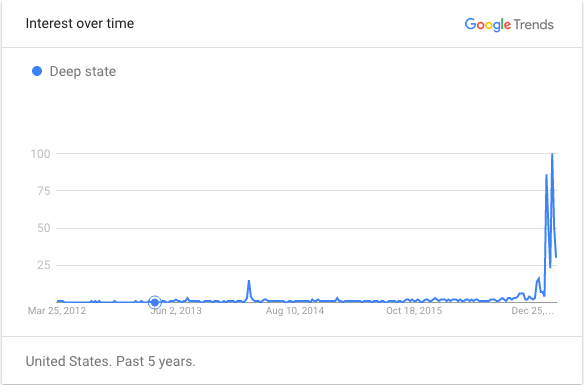
As this chart from Google Trends illustrates, interest in the Deep State has increased dramatically in 2017. The term/topic has clearly moved from the specialist realm to the mainstream. I’ve been writing about the Deep State, and specifically, the fractures in the Deep State, for years.

Amusingly, now that “Progressives” have prostituted themselves to the Security Agencies and the Neocons/Neoliberals, they are busy denying the Deep State exists. For example, There is No Deep State (The New Yorker).

In this risible view, there is no Deep State “conspiracy” (the media’s favorite term of dismissal/ridicule), just a bunch of “good German” bureaucrats industriously doing the Empire’s essential work of undermining democracies that happen not to prostrate themselves at the feet of the Empire, murdering various civilians via drone strikes, surveilling the U.S. populace, planting bugs in new iPhones, issuing fake news while denouncing anything that questions the dominant narratives as “fake news,” arranging sweetheart deals with dictators and corporations, and so on.

The New Yorker is right about one thing–the Deep State is not a “conspiracy:” it is a vast machine of control that is largely impervious to the views or demands of elected representatives or the American people. The key to understanding this social-political-economic control is to grasp that control of the narratives, expertise and authority is control of everything. Allow me to illustrate how this works.

The typical politician has a busy daily schedule of speaking at the National Motherhood and Apple Pie Day celebration, listening to the “concerns” of important corporate constituents, attending a lunch campaign fundraiser, meeting with lobbyists and party committees, being briefed by senior staff, and so on.

Senior administrators share similarly crowded schedules, minus the fundraising but adding budget meetings, reviewing employee complaints and multiple meetings with senior managers and working groups.

Both senior elected officials and senior state administrators must rely on narratives, expertise and authority because they have insufficient time and experience to do original research and assessment.

Narratives create an instant context that “makes sense” of various data points and events. Narratives distill causal factors into an explanatory story with an implicit teleology–because of this and that, the future will be thus and so.

For example: because Iraq has weapons of mass destruction (WMD), the future promises the terrible likelihood (more than a possibility, given Iraqi deployment of poison gas in the Iraq-Iran War) that America or its allies will be devastated by Iraqi weapons of mass destruction. This teleology leads to the inescapable need to eliminate Iraq’s weapons of mass destruction by any means necessary, and remove the political will to use them by removing Iraq’s leader from power.

Politicos and senior administrators rely on expertise and authority as the basis of deciding whether something is accurate and actionable. Professional specialists are assumed to have the highest available levels of expertise, and their position in institutions that embody the highest authority give their conclusions the additional weight of being authoritative. The experts’ conclusion doesn’t just carry the weight of expertise, it has been reviewed by senior officials of the institution, and so it also carries the weight of institutional authority.

So when the C.I.A. briefing by its experts claims Iraq has WMD, and the briefing includes various threads of evidence that the institution declares definitive, who is a non-expert to challenge this conclusion and teleology? On what technical basis does the skeptic reject the expertise and authority of the institution?

We can now define the Deep State with some precision. The Deep State is fundamentally the public-private centralized nodes that collect, archive and curate dominant narratives and their supporting evidence, and disseminate these narratives (and their implicit teleologies) to the public via the media and to the state agencies via formal and informal inter-departmental communication channels.

By gaining control of the narratives, evidence, curation and teleology, each node concentrates power. the power to edit out whatever bits contradict the dominant narrative is the source of power, for once the contradictory evidence is buried or expunged, it ceases to exist.

For example, the contradictory evidence in the Pentagon Papers was buried by being declared Top Secret. The bureaucratic means to bury skeptical (i.e. heretical) views or evidence are many. Sending the authors to figurative Siberia is remarkably effective, as is burying the heretical claims in a veritable mountain of data that few if any will ever survey.

Curation is a critical factor in maintaining control of the narrative and thus of control; the evidence is constantly curated to best support the chosen narrative which in turn supports the desired teleology, which then sets the agenda and the end-game.

The senior apparatchiks of the old Soviet Union were masters of curation; when a Soviet leader fell from favor, he was literally excised from the picture–his image was erased from photos.

This is how narratives are adjusted to better fit the evidence. Thus the accusation that “the Russians hacked our election” has been tabled because it simply doesn’t align with any plausible evidence. That narrative has been replaced with variants, such as “the Russians hacked the Democratic National Committee.” Now that this claim has also been shown to be false, new variants are popping up weekly, with equally poor alignment with evidence.

The primary claim of each Deep State node is that its expertise and authority cannot be questioned. In other words, while the dominant narrative can be questioned (but only cursorily, of course), the expertise and authority of the institutional node cannot be questioned.

This is why the Deep State is fracturing: the expertise and authority of its nodes are delaminating because its narratives no longer align with the evidence. If various Security Agencies sign off on the narrative that “Russia hacked our election” (a nonsense claim from the start, given the absurd imprecision of the “hacking”–hacking into what? Voting machines? Electoral tallies?), and that narrative is evidence-free and fact-free, i.e. false, then the expertise and authority of those agencies comes into legitimate question.

Once the legitimacy of the expertise and authority is questioned, control of the narrative is imperiled. The control of the narrative is control of the teleology, the agenda and the end-game–in other words, everything. If the institution loses control of the dominant narrative, it loses its hold on power.

This is why the Deep State is in turmoil–its narratives no longer make sense, or are in direct conflict with other nodes’ narratives or have been delegitimized by widening gaps between “definitive” claims and actual evidence.

There is indeed a Deep State, but its control of dominant narratives, and thus its source of control and power, is crumbling. The gap between the narratives and the evidence that supports them has widened to the point of collapse.


The Democrats’ Dangerous Diversion

By Nicolas J S Davies

Source: Consortium News

The current debate over “fake news” has reminded me of a conversation I had several years ago with a former citizen of East Germany, now living in the United States. He explained that, in East Germany, everybody knew that what the media told them about their own country was a bunch of lies and propaganda. So they assumed that what the media told them about the West was just propaganda, too.

Now living in the U.S., he had come to realize that a lot of what the East German media said about life in the U.S. was actually true. There really are people living on the street, people with no access to healthcare, widespread poverty, a lack of social welfare and public services, and many other problems, as the East German media accurately reported, and as the Chinese government also noted in its latest report on human rights in the U.S.

My friend wished he and his countrymen had understood the difference between what their media told them about their country and what they reported about the West. Then they could have made more intelligent choices about which aspects of life in the West to adopt, instead of allowing Western experts to come in and impose the entire neoliberal model on their country.

In the West, of course, the state media of East Germany and other Communist countries were held up to ridicule. I remember hearing that people in the U.S.S.R. would open their newspapers in the morning and have a good laugh at the latest “fake news” in Pravda. But, as my German friend eventually understood, there was some truth amongst the propaganda, and the hidden danger of such a corrupted media system is that people end up not knowing what to believe, making informed democratic choices almost impossible.

In the end, people all over Eastern Europe were cornered into a false choice between two ideological systems that both came as top-down package deals, instead of being able to take charge of their own societies and democratically decide their own future.

In the U.S., we live under a two-party political system, not a one-party system as in East Germany, and our media reflect that. As each of our two main political parties and our media have fallen more totally under the sway of unbridled plutocratic interests, our mass media has devolved into a bifurcated version of what my friend observed in East Germany, triply corrupted by commercial interests, partisan bias and ideological and nationalist propaganda.

Down the Rabbit Hole 

Since the 2016 election campaign, our political system seems to have devolved into something like the nonsense world of Lewis Carroll’s Alice In Wonderland, with Donald Trump as the Queen of Hearts, Hillary Clinton as Humpty Dumpty, the Republicans and Democrats as Tweedledum and Tweedledee, the election as the Caucus Race (which Lewis Carroll based on U.S. political caucuses) and the whipsawed American public as the permanently baffled Alice.

In Lewis Carroll’s Caucus Race, an assortment of creatures ran randomly around a racetrack with no start or finish line, until the Dodo called the race over, declared them all winners and told Alice (the public?) she had to give them all prizes.

In similar fashion, the 2016 election between two of the most unpopular presidential candidates in U.S. history seems to have no finish line, but to live on in round-the-clock campaigns to corral the public into one of its two camps. The artificial, top-down nature of both these campaigns should be a warning that, like the election campaigns they grew out of, they are designed to corral, control and direct masses of people, not to offer real solutions to any of the serious problems facing our country and the world.

On one hand, we have President Trump, Republican Congressional leaders, Breitbart, Fox News and Rush Limbaugh, spouting nonsense worthy of Lewis Carroll, even in major presidential speeches, while dismissing criticism as “fake news.”

The Trump camp will never acknowledge that only a quarter of voting-age Americans voted for him, nor that even less of us share his views or the interests he represents. In this corrupt two-party system, no effort or expense is spared to persuade the public that we must vote for one of the two major party presidential candidates, whether we agree with either of them or not. But that cuts both ways, leaving most of the public unrepresented no matter who wins, and depriving any new government of a genuine popular mandate.

But Republican leaders play a more straightforward winner-take-all game than the Democrats. So they will try to ride Trump’s victory and their Congressional majorities as far as they will take them on all fronts: more tax breaks for the wealthy and corporations; more draconian cuts in social spending; more privatization of healthcare, education and other public services; more detention and deportation of immigrants; a more aggressive police response to social problems and public protest; more destruction of the natural world and the climate; and more increases in a military budget that already broke post-WWII records under Bush and Obama, to fuel a more openly aggressive and dangerous war policy – in other words, more of all the things that most Americans would agree we have already had too much of.

On the other side, Democratic Party leaders and the CIA, supported by the New York Times, the Washington Post, CNN and MSNBC, have conjured up unproven charges that Russia stole the election for Trump as the heart of their campaign against him. In Trump, history has handed them a political opponent with a piñata of vulnerabilities, from unprecedented conflicts of interest to policies that benefit only his own wealthy class to willful ignorance of how almost everything he is responsible for as president really works.

And yet the cabal formerly known as the Clinton campaign shows little interest in pointing out that our new Emperor has no clothes on, let alone in seriously resisting his repressive, plutocratic policies, and is instead obsessed with convincing the public that a birthmark on his naked bum looks like a hammer and sickle.

A Saving Grace?

Paradoxically, if Trump really reduced tensions between the U.S. and Russia, as his hawkish Democratic opponents fear, that could be the saving grace of his entire presidency. George W. Bush’s and Barack Obama’s regime change wars, NATO expansion and the U.S.-backed coup in Ukraine have ignited a new Cold War that many respected scientists believe has raised the risk of human mass extinction to its highest level since the 1950s.

In the pursuit of false security based on post-Cold War triumphalism and a fleeting mirage of military supremacy, our corrupt leaders have jeopardized not just our security but our very existence, leaving us at two and a half minutes to midnight on the Bulletin of the Atomic Scientists (BAS)Doomsday Clock.

As Jonathan Marshall at Consortiumnews.com reported on March 10, experts from the Federation of American Scientists, the Natural Resources Defense Council and MIT wrote in a recent BAS article that new “super-fuzes” installed on U.S. nuclear warheads since 2009 have significantly increased the danger of nuclear war by giving the U.S. the ability to destroy all Russia’s fixed land-based nuclear missiles with only a fraction of U.S. own weapons.

Coupled with President Obama’s deployment of a formerly illegal ABM (anti-ballistic missile) system on Aegis missile destroyers and at bases in Eastern Europe, the authors wrote that this upgrade to U.S. nuclear warheads is “exactly what one would expect to see if a nuclear-armed state were planning to have the capacity to fight and win a nuclear war by disarming enemies with a surprise first strike.” They concluded that “Russian planners will almost surely see the advance in fuzing capability as empowering an increasingly feasible U.S. preemptive nuclear strike capability.”

In the case of a suspected Russian nuclear missile launch, the U.S. satellite-based early warning system can give President Trump 30 minutes to judge whether we are really facing a nuclear attack or not. But Russia’s land-based early warning system is not so generous. In the case of a suspected U.S. nuclear launch targeting Russia, President Putin would have as little as 7 to 13 minutes to decide whether Russia was really under nuclear attack and whether to retaliate.

In the midst of escalating tensions over Syria, Ukraine, Iran or some other new crisis, a realistic fear of a U.S. first strike could force a hasty decision by Russian officials and seal the fate of humanity. The BAS authors believe that this predicament leaves Russia little choice but to pre-delegate its nuclear launch authority to lower levels of command, increasing the risk of an accidental or mistaken launch of nuclear weapons.

In an epitome of understatement, they point out that, “Forcing this situation upon the Russian government seems likely to be detrimental to the security interests of the United States and its Western allies.”

While U.S. officials are largely silent about the dangers of these developments in U.S. nuclear weapons policy, President Putin has spoken frankly about them and expressed dismay that the U.S. has rejected every Russian offer of cooperation to reduce these risks. Talking to a group of journalists at the St. Petersburg International Economic Forum in June 2016, he concluded, “I don’t know how this is all going to end. … What I do know is that we will need to defend ourselves.”

But despite the existential dangers of deteriorating relations with Russia, Democratic Party leaders have grasped the CIA’s unproven “assessments” that Russia may have tried to influence the outcome of the U.S. election as a lifeline by which to salvage their positions of power after their party’s electoral implosion.

Since the leadership of the Democratic Party was taken over by the corporate-backed Democratic Leadership Council (DLC) a generation ago, it has followed an unwritten rule that it must never accept responsibility for losing an election, nor respond to signs of public disaffection with any weakening of its commitment to pro-corporate, neoliberal policies. In its desperation to prevent the democratic reform of the Democratic Party, it is aggressively tarring nuclear-armed Russia with the same brush it used to tar and feather Ralph Nader after the 2000 election.

The mortal aversion of Democratic Party leaders to progressive reform suggests that they prize their own control of the party even above winning elections, the rational purpose of any political party. Their ugly smear campaign against Keith Ellison, the progressive candidate for Democratic National Committee (DNC) chair, mirrored the DNC’s corrupt campaign to undermine Sen. Bernie Sanders in the Democratic primaries and the DLC cabal’s bare-knuckles response to progressive challengers for the past 30 years.

For the DLC Democrats to snatch defeat from the jaws of the long-term victory that the country’s shifting demographics seem to guarantee their party requires a truly historic level of corruption.

Their unshakable commitment to fight tooth and nail for the interests of their wealthy campaign contributors over those of poorer, younger and darker-skinned voters in every election, every national, state and local party committee and on every issue, even as they pretend they are doing the exact opposite, could only be a viable political strategy in Lewis Carroll’s Wonderland. In the real world, their demonstrated disdain for the people from whose votes they derive their power is a strategy for political suicide.

Different Kind of Politics

These corrupt party leaders and their corporate media cheerleaders dare not remind us that Bernie Sanders’s candidacy for president inspired more enthusiasm and drew bigger crowds than Trump’s or Clinton’s, despite one eightieth of the early media promotion lavished on Trump by some corporate media and the fact that almost the entire Democratic Party establishment lined up against him.

For decades, DLC Democrats have run on vague messages about “values” to avoid being cornered into explicit progressive policy positions that might alienate their wealthy patrons. Sanders was greeted with open arms by younger voters ready for a renaissance of real politics based on actual policies that solve real problems, like universal healthcare, free college tuition, progressive taxation to pay for it all and a more cautious approach to U.S.-backed “regime change” in other countries.

By contrast, an analysis of campaign messaging by the Wesleyan Media Project found that “Clinton’s message was devoid of policy discussions” when compared to other recent presidential campaigns, including even Trump’s, and that this was a critical factor in her failure.

According to opinion polls, Bernie Sanders may now be the most popular politician in America. Polls consistently showed that Sanders was likely to beat Trump in the general election if the Democratic Party allowed him to get that far, but the DNC fundraising machine pulled out every trick in the book to make sure that didn’t happen. If truth be told, Sanders’s success was probably a more accurate reflection of the evolving political views of a majority of Americans in 2016 than the billion-dollar auction of the presidency between the Game Show King and the Queen of Chaos.

These two camps represent factions of the powerful interests that have controlled American politics for decades, from the military-industrial complex and the CIA to the dirty energy and for-profit “healthcare” industries, to say nothing of the commercial media industry itself, which covered this election all the way to the bank and for whom the show must go on and on and on … and on.

Lies of Both Sides.

Like the people of East Germany in the 1980s, we now face the challenge of a society in crisis, compounded by a treacherous media environment, with not just one, but two competing camps presenting us with false, self-serving interpretations of the multi-faceted crisis their corruption has spawned. While they compete for our trust, they share a common interest in insisting that one of the two mythological worldviews they have staked out must be right.

But as Cornel West recently told the students at my local high school in Miami in a Black History Month speech, “You don’t have to choose between the lies on one side and the lies on the other side.” So the question becomes where to turn for something other than lies, and how to recognize the truth when we stumble across it.

The paradox of our Internet age is that we nearly all have access to a wider range of media than ever before, yet we are still exposed and susceptible to corporate, partisan and ideological propaganda. In theory, we no longer have to be victims of for-profit media whose business models prioritize their profits over their duty to inform the public. But in reality, we do not form our views of the world as independently as we think we do.

This is easier to grasp in the case of commercial advertising than in the arena of political or ideological indoctrination. There is a well-known dictum in the business world that goes, “I know that half the money we spend on advertising is wasted. I just don’t know which half.” The flip-side of this is that the other half is not wasted.

So the advertising industry in the United States spends $220 billion per year, $700 for each man, woman and child in the country, to sell us products and services. And yet we still like to think that we make independent, rational choices about our spending, based on enlightened self-interest and cultivated tastes, not on the work of copywriters churning out pitches, images and jingles in ad agency cubicles.

One of the by-products of the mass monetization of American politics since the 1980s is that politics has become a profitable new arena for advertising, marketing and public relations firms. Its practitioners apply the techniques and experience they’ve developed in other areas to the world of politics, helping politicians and parties to convert the money they raise from wealthy campaign contributors into votes, and ultimately into power over all our lives. So we should be just as wary of political marketing and advertising as of the commercial variety. We should also be more humble in recognizing our own vulnerability to these profitable forms of persuasion and deception.

My copy of Alice in Wonderland has a quotation from James Joyce in the front of the book: “Wipe your glasses with what you know.” What we know is often our best protection against being misled by advertisers, politicians and pundits, if we will only remember what we know and trust it over the misinformation that surrounds us.

“Wiping our glasses with what we know” can provide a reality check on the current Russophobia campaign. We know very well that the U.S. and Russia possess the bulk of the world’s nuclear weapons, and that war between our two countries would likely mean death for ourselves and our families and the end of life as we know it for people everywhere.

We also know that it is our country and its allies, not Russia, that have launched invasions, military occupations, bombing campaigns, coups and drone wars against at least ten countries in the past 20 years, while Russia only recently become engaged in two of these conflict zones when its interests were directly impacted by our actions.

So we can see that the greatest danger in this relationship is not the threat of some unprovoked and unprecedented act of Russian aggression. The more real and serious danger is that a confrontation with Russia over one of the hot spots we have ignited will lead to an escalation of tensions in which a mistake, a misunderstanding, a miscalculation, a bluff called, a “red line” crossed or some other kind of failed brinksmanship will trigger a war that will escalate to the use of nuclear weapons, and from there to Armageddon.

Even with the lines of communication set up after the Cuban missile crisis and the stabilization of the Cold War balance of terror by the principle of Mutually Assured Destruction (MAD), we now know that we came very close to Armageddon many times, including simply by accident.

Instead of being corralled by either side in the “Russia did it” campaign, we should be urging our leaders to sit down and talk seriously with Russia’s leaders, to stop taking dangerous actions that exacerbate tensions, uncertainties and mutual isolation, and to return to serious negotiations to leave our children and grandchildren a peaceful world, free of nuclear weapons, where these dangers will no longer threaten them.

Amid lies and distortions on all sides, the corruption of politics and media by commercial interests and the billion dollars per year our government spends directly on public relations and propaganda, James Joyce’s advice can still serve us well. Make sure to wipe your glasses with what you know as you read or watch “news” from any source or listen to politicians of any party, and we may just find a way out of this rabbit hole before the roof crashes in on us.


Nicolas J S Davies is the author of Blood On Our Hands: the American Invasion and Destruction of Iraq.  He also wrote the chapters on “Obama at War” in Grading the 44th President: a Report Card on Barack Obama’s First Term as a Progressive Leader.