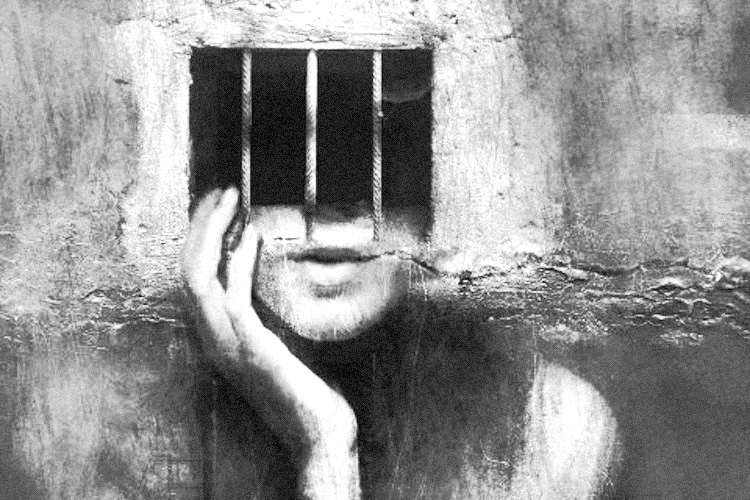
Don’t Let Them Memory-Hole This 

By Jeffrey A. Tucker

Source: Brownstone Institute

On a video podcast the other day, I made reference to the lockdown orders of March 2020. The host turned off the recording. He said it was fine to talk about this subject but from now on please refer to “the events of March 2020” with no specifics. 

Otherwise, it will be taken down by YouTube and Facebook. He needs those platforms for reach, and reach is necessary for his business model. 

I complied, but I was spooked. Are we really now in the position that talking about what happened to us is verboten on mainstream venues? Sadly, that seems to be where we headed. In big and small ways, and throughout the culture and the whole world, we are bit by bit being trained to forget and hence not learn and thus repeat the whole thing. 

This makes no sense since nearly every public issue in play today traces to those fateful days and the fallout thereof, including censorship, the entrenchment of industry-government oligarchs, the corruption of media and tech, the educational upheaval, the abuse of courts and law, and the developing financial and banking crisis. 

And yet hardly anyone wants to speak about the topic frankly. It is too upsetting. There is too much at stake. We cannot risk being canceled, the single greatest fear of every aspirational professional in today’s world. Plus too many powerful people were in on it and don’t want to admit it. It would appear that the whole subject is being memoryholed in ways of which they all approve. 

For nearly two years, or longer, respectable intellectuals knew not to dissent from the prevailing norms and challenge the whole machinery. This was true of Washington think tanks, which went on their merry way from March 2020 either celebrating the “public health response” or just remaining quiet. The same was true of the leadership of major political parties and third parties. 

Most religious leaders stayed quiet too, even as their doors were padlocked for as long as 2 holiday seasons. Civic organizations played along. If you thought that the job of the ACLU was to defend civil liberties, you were wrong: they one day decided that lockdowns, mandatory masks, and forced shots were essential to their mission. 

So many were compromised over 3 years. These same people now just want the whole subject to go away. We find ourselves in an odd position, having experienced the biggest trauma in our lives and in many generations and yet there is precious little open talk about it. Brownstone was established to fill this void but we’ve become a target as a result. 

The search engines have been gamed for the better part of 3 years to keep the science channeled in only one direction. If web platforms step out of line, it is easy enough for search engines and social-media companies to tag them as problematic and thus throttle their reach. But for Substackers – and they are being targeted now too – it would be hard to find out anything other than what the oligarchs want you to believe. 

This silent treatment is filtering down to every aspect of our lives and becoming entrenched in the political culture too. Here is an example from this week. 

When Donald Trump returned from his theatrical and ridiculous indictment on nothing in New York, he flew immediately back to Mar-a-Lago where he told his story to people gathered in a pastiche-baroque ballroom. He told of the fake news, the attempted impeachments for Russia and Ukraine, the plots and schemes, and onward to the fake ballots and the FBI raid on his home, and now this preposterous new thing. 

It was a solid narrative overall. But his story left out a hugely important detail. He said not one word about Covid lockdowns and Operation Warp Speed that was supposed to be the great fix for the virus but flopped. This was a rather important detail to leave out since it wrecked the economy, the Bill of Rights, education, and led to a massive demographic upheaval in addition to the continuing fallout in terms of culture, economics, and everything else. 

It also caused him to lose the presidency, whether because the shock resulted in mass demoralization (this was certainly not a path to making America great again) or because of the mail-in ballots made possible by Covid restrictions, or probably both. However you look at it, it was the most disastrous decision of his presidency or possibly any presidency in history. 

How in the world are we just supposed to pretend that this did not happen? And yet he is playing along simply because he does not want to admit error. He thinks it makes him appear weak. Nor does he still slam the successor presidency for mask and shot mandates even though hundreds of millions were affected by them. He would rather not bring up the topic at all, lest doing so raises questions about his own judgment in those fateful days of March 2020. 

Meanwhile, the DNC does not want to admit that it celebrated and built on Trump’s biggest disaster while the RNC does not want to discuss that the policies they decry from the DNC actually began under the RNC. And so you have a kind of “mutually assured destruction” pact between them that needs no plot or contract. In silencing all talk about this, each party is only doing what is in its interest. 

We can fully expect that these issues will be locked out of the campaign narratives in 2024 just as they were in 2020 and 2022. Everyone seems to agree: the less said the better. And this is precisely why the announced candidacy of Robert Kennedy, Jr., has triggered the usual and expected gaslighting from the mainstream media. The plan is to flog him into marginalization. And if that doesn’t work, they will flog and flog again. 

We are seeing a real-time example of how history is really written. The narrative is more self-serving than we knew. If all the power centers in society get something tremendously wrong, an informal conspiracy of silence develops around it, with the hope of just wiping it from the history books. 

As Michael Senger has written, “Lockdowns met little resistance in part because they reinforced existing power structures. The rich got richer, the Zoom class got a vacation, workers got stimulus, while some business owners, their employees, and the most vulnerable had to sacrifice everything for this fantasy.” 

And we can add to that: government gained vastly more power. In fact, Covid became the template for the biggest expansion of government power over the population in world history, more effective than ancient myths about god-like rulers, heresy trials and witch burnings of the Middle Ages, sedition purges of the 18th and 19th centuries, red scares of the 20th centuries, the Cold War, or even the wars on terror. Fear of infectious disease was more effective than all of them for ratcheting up despotism. 

When something works this well for the most powerful people in society, why not just keep quiet about it?

The tellers of tales can write stories but they cannot invent their own realities. There will be no restoration of liberty, rights, and truth until we come to terms with what happened, why, and how to prevent it in the future. Playing along with this conspiracy of silence surrounding a policy that effectively blotted out every advance in human rights since the Magna Carta is a disastrous error that could lead to the entrenchment of a new dark age. 
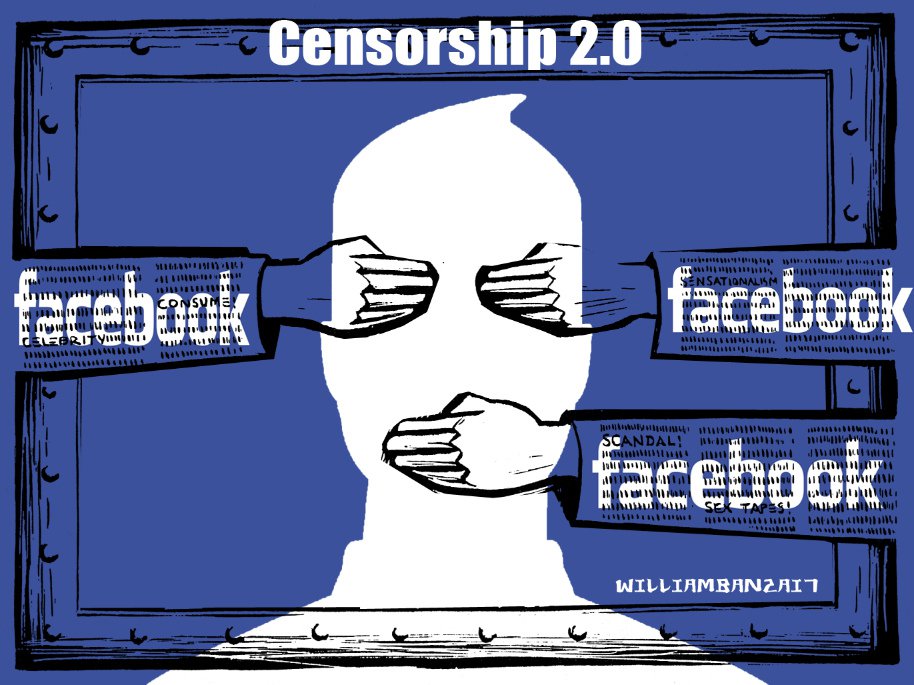
The Loss Of Free Speech Was Predictable And Preventable

By Patrick Wood

Source: Technocracy News & Trends

As technology has disrupted key elements of society, Technocrats have taken advantage of the chaos to not only implement their own agenda but also to erect barriers to competition or resistance. If this had been recognized early enough, it could have been easily blocked. Now, the mere barriers have hardened into fortresses.⁃ TN Editor

The First Amendment is at a critical juncture. Recent congressional hearings on the Twitter Files brought the matter into full public view. Freedom of speech and of the press are hanging by a precarious thread. Do we want a future in which information flows freely, or one in which an information elite controls those flows “for our own good?” The choices we make over the next few years will determine which of those futures we get.

It’s tragic that we have let the problem reach this dangerous state. What heightens the tragedy, however, is that the war against America’s most cherished freedoms was predictable and preventable. If those of us who value freedom want to win, we’re going to need a strategy grounded in a clear understanding of what’s happening and why.

The Twitter Files story is shocking. Allegations that big tech and social media manipulate information have been around for as long as we’ve had tech and social media companies. Allegations of bias among the mainstream media are even older. In recent years, however, both the allegations and the supporting evidence have ratcheted upward to unprecedented levels.

When Elon Musk acquired Twitter, he opened his company’s internal archives to scrutiny. He assembled a team of journalists with a curious pedigree: registered Democrats with a distaste for Donald Trump and his supporters, whose track records skewed considerably left of center, and whose recent work has demonstrated deep concern about the politicization of journalism.

Musk gave them unfettered access. They found a deep, broad, and disturbing pattern of collaboration between big government and big tech designed to promote “official stories” on multiple issues, throttle competing theories and arguments, and sanction those who dared to question government propaganda.

When two of those journalists – Matt Taibbi and Michael Shellenberger – testified before Congress, their Democratic inquisitors sought to belittle their credentials, question their motives, and tar them as part of some Republican-funded, far-right conspiracy. The still-left-leaning journalists are trying to absorb their shock at the depths to which the formerly civil-libertarian left has fallen.

Far from shocking, however, that fall was predictable – and predicted. In 2001, amidst the public disgust with tech companies following the collapse of the dotcom bubble, I set out to make sense of life during the transition from the late industrial age to the early information age. I analyzed what I called the first four front-page stories of the information age: the dotcom bubble, the Microsoft antitrust trial, the rise of open-source software, and the Napster-driven wars over digital music. Contrary to popular opinion of the time, I believed that these stories were far from distinct. I saw them as four manifestations of a single underlying phenomenon. My goal was to understand that phenomenon.

I found it. It appeared most clearly in the digital music arena, but it ran through all four stories – and through much that has happened since. It appears just as clearly in today’s war on free speech. It involves an entirely predictable pattern of opportunity, action, and reaction.

The starting point is digitization and quantification. The Internet changed the economics of information. Throughout human history, information was scarce, hard to acquire, and expensive to process. Skilled professionals – spies, scholars, lawyers, accountants, clerics, doctors – could command a premium for their knowledge. When the Internet went public, anything that could be digitized and quantified suddenly flowed freely. Information was there for the asking. The premium shifted to filtering – the ability to discard unwanted information and arrange what remained.

Economic shifts generate massive opportunities for creative, entrepreneurial people and bring glorious benefits to millions of consumers. The Internet was no exception in this regard, and neither was the predictable backlash against it. Anything that benefits new businesses and empowers consumers is a warning shot across the bow of powerful incumbents who’d grown accustomed to serving those consumers in a predictable, profitable, manner.

In the music industry, anything that let individual consumers share digital music files reduced the revenues, profits, power, and control of record labels. Pre-digitization, these powerful incumbents determined what music got recorded and how it was packaged, distributed, presented, and priced. It was a comfortable business model that gave us the music industry “as we knew it.” The Internet undermined it entirely.

Powerful incumbents never fade quietly into the night when challenged. They fight, using whatever weapons they can muster. In our society, the most effective ways to undermine new technological and economic opportunities tend to lie in law, regulation, and public policy. The record labels fought – largely successfully – to apply and reinterpret existing laws and to change laws in ways favorable to their interests.

There’s the pattern: Technology creates opportunities. New businesses exploit those opportunities. Consumers benefit. Powerful incumbents fear their loss of control. Threatened incumbents seek allies in government. Government changes laws and regulations to protect incumbent interests. Media campaigns “educate” the public on the merits of the new policies. The new laws ensure that the next wave of technological change runs largely through the powerful incumbents, rather than against them.

By 2003, I had distilled this pattern, showed numerous ways that it had already unfolded, predicted that it would soon hit parts of our economy and our lives far more significant than the music industry, and suggested some ways that we might prepare ourselves for the coming battles.

It took another two years to get my analysis published. It went largely unnoticed. Twelve years later, then-Senator Ben Sasse described the ways that this pattern had forever disrupted the dynamics of employment. This, too, went largely unnoticed.

Today, we see that disruptive pattern threatening the most basic of our civil liberties. Its manifestation in the arenas of speech, propaganda, and censorship is clear. Consider how each step in the process I identified above has played out here:

Technology creates opportunities. The Internet opened entirely new vistas for the creation and exchange of ideas, information, theories, opinions, propaganda, and outright lies.

New businesses exploit those opportunities. The companies founded since 1995 that created and control the world’s most important conduits for information have joined the ranks of history’s most powerful entities.

Consumers benefit. The centrality of these communication systems to our lives (for better or for worse) proves that they confer real value.

Powerful incumbents fear their loss of control. The twin political shocks of 2016 – Brexit and Donald Trump – highlighted the extent to which official channels had lost control of the narrative. With the entirety of elite media, government, big business, and the intelligentsia aligned behind Remain and Hillary, the newly empowered masses understood – for the first time – that there were viable alternatives to the official story.

Threatened incumbents seek allies in government. A coalition of elite forces assembled quickly, laser-focused on stomping out the populist threat. Masses empowered to conduct their own analyses, draw their own conclusions, and share their opinions among themselves threatened the stability of the power structure “as we know it.”

Government changes laws and regulations to protect incumbent interests. Prior to Musk’s Twitter, the entirety of Silicon Valley committed itself to “protecting” the public from “disinformation,” roughly defined as anything that threatened to undermine an official, sanctioned narrative. Allies throughout the administrative state, Congress, and the Biden White House are working to embed those “protections” in law.

Media campaigns “educate” the public on the merits of the new policies. The same mainstream media that vilified Napster, Grokster, and Peer-to-Peer (P2P) file sharing is now working to turn public opinion against the evil purveyors of alleged “disinformation.”

Will the information age be an era of informed, empowered citizens – or an era of a dominant, information-controlling elite? Stay tuned. That’s the question we need to answer.

Fiscal Insanity: The Government Borrows $6 Billion a Day, and We’re Stuck with the Bill

By John & Nisha Whitehead

Source: The Rutherford Institute

We’re not living the American dream.

We’re living a financial nightmare.

The U.S. government is funding its existence with a credit card.

The government—and that includes the current administration—is spending money it doesn’t have on programs it can’t afford, and “we the taxpayers” are the ones being forced to foot the bill for the government’s fiscal insanity.

According to the number crunchers with the Committee for a Responsible Federal Budget, the government is borrowing roughly $6 billion a day.

As the Editorial Board for the Washington Post warns:

“The nation has reached a hazardous moment where what it owes, as a percentage of the total size of the economy, is the highest since World War II. If nothing changes, the United States will soon be in an uncharted scenario that weakens its national security, imperils its ability to invest in the future, unfairly burdens generations to come, and will require cuts to critical programs such as Social Security and Medicare. It is not a future anyone wants.

Let’s talk numbers, shall we?

The national debt (the amount the federal government has borrowed over the years and must pay back) is $31 trillion and will grow another $19 trillion by 2033. That translates to roughly $246,000 per taxpayer or $94,000 for every single person in the country.

The bulk of that debt has been amassed over the past two decades, thanks in large part to the fiscal shenanigans of four presidents, 10 sessions of Congress and two wars.

It’s estimated that the amount this country owes is now 130% greater than its gross domestic product (all the products and services produced in one year by labor and property supplied by the citizens).

In other words, the government is spending more than it brings in.

The U.S. ranks as the 12th most indebted nation in the world, with much of that debt owed to the Federal Reserve, large investment funds and foreign governments, namely, Japan and China.

Interest payments on the national debt are estimated to top $395 billion this year, which is significantly more than the government spends on veterans’ benefits and services, and according to Pew Research Center, more than it will spend on elementary and secondary education, disaster relief, agriculture, science and space programs, foreign aid, and natural resources and environmental protection combined.

According to the Committee for a Reasonable Federal Budget, the interest we’ve paid on this borrowed money is “nearly twice what the federal government will spend on transportation infrastructure, over four times as much as it will spend on K-12 education, almost four times what it will spend on housing, and over eight times what it will spend on science, space, and technology.”

In ten years, those interest payments will exceed our entire military budget.

This is financial tyranny.

We’ve been sold a bill of goods by politicians promising to pay down the national debt, jumpstart the economy, rebuild our infrastructure, secure our borders, ensure our security, and make us all healthy, wealthy and happy.

None of that has come to pass, and yet we’re still being loaded down with debt not of our own making while the government remains unrepentant, unfazed and undeterred in its wanton spending.

Indeed, the national deficit (the difference between what the government spends and the revenue it takes in) remains at more than $1.5 trillion.

If Americans managed their personal finances the way the government mismanages the nation’s finances, we’d all be in debtors’ prison by now.

Despite the government propaganda being peddled by the politicians and news media, however, the government isn’t spending our tax dollars to make our lives better.

We’re being robbed blind so the governmental elite can get richer.

In the eyes of the government, “we the people, the voters, the consumers, and the taxpayers” are little more than pocketbooks waiting to be picked.

“We the people” have become the new, permanent underclass in America.

Consider: The government can seize your home and your car (which you’ve bought and paid for) over nonpayment of taxes. Government agents can freeze and seize your bank accounts and other valuables if they merely “suspect” wrongdoing. And the IRS insists on getting the first cut of your salary to pay for government programs over which you have no say.

We have no real say in how the government runs, or how our taxpayer funds are used, but we’re being forced to pay through the nose, anyhow.

We have no real say, but that doesn’t prevent the government from fleecing us at every turn and forcing us to pay for endless wars that do more to fund the military industrial complex than protect us, pork barrel projects that produce little to nothing, and a police state that serves only to imprison us within its walls.

If you have no choice, no voice, and no real options when it comes to the government’s claims on your property and your money, you’re not free.

It wasn’t always this way, of course.

Early Americans went to war over the inalienable rights described by philosopher John Locke as the natural rights of life, liberty and property.

It didn’t take long, however—a hundred years, in fact—before the American government was laying claim to the citizenry’s property by levying taxes to pay for the Civil War. As the New York Times reports, “Widespread resistance led to its repeal in 1872.”

Determined to claim some of the citizenry’s wealth for its own uses, the government reinstituted the income tax in 1894. Charles Pollock challenged the tax as unconstitutional, and the U.S. Supreme Court ruled in his favor. Pollock’s victory was relatively short-lived. Members of Congress—united in their determination to tax the American people’s income—worked together to adopt a constitutional amendment to overrule the Pollock decision.

On the eve of World War I, in 1913, Congress instituted a permanent income tax by way of the 16th Amendment to the Constitution and the Revenue Act of 1913. Under the Revenue Act, individuals with income exceeding $3,000 could be taxed starting at 1% up to 7% for incomes exceeding $500,000.

It’s all gone downhill from there.

Unsurprisingly, the government has used its tax powers to advance its own imperialistic agendas and the courts have repeatedly upheld the government’s power to penalize or jail those who refused to pay their taxes.

While we’re struggling to get by, and making tough decisions about how to spend what little money actually makes it into our pockets after the federal, state and local governments take their share (this doesn’t include the stealth taxes imposed through tolls, fines and other fiscal penalties), the government continues to do whatever it likes—levy taxes, rack up debt, spend outrageously and irresponsibly—with little thought for the plight of its citizens.

To top it all off, all of those wars the U.S. is so eager to fight abroad are being waged with borrowed funds. As The Atlantic reports, “U.S. leaders are essentially bankrolling the wars with debt, in the form of purchases of U.S. Treasury bonds by U.S.-based entities like pension funds and state and local governments, and by countries like China and Japan.”

Of course, we’re the ones who have to repay that borrowed debt.

For instance, American taxpayers have been forced to shell out more than $5.6 trillion since 9/11 for the military industrial complex’s costly, endless so-called “war on terrorism.” That translates to roughly $23,000 per taxpayer to wage wars abroad, occupy foreign countries, provide financial aid to foreign allies, and fill the pockets of defense contractors and grease the hands of corrupt foreign dignitaries.

Mind you, that’s only a portion of what the Pentagon spends on America’s military empire.

The United States also spends more on foreign aid than any other nation, with nearly $300 billion disbursed over a five-year period. More than 150 countries around the world receive U.S. taxpayer-funded assistance, with most of the funds going to the Middle East, Africa and Asia. That price tag keeps growing, too.

As Forbes reports, “U.S. foreign aid dwarfs the federal funds spent by 48 out of 50 state governments annually. Only the state governments of California and New York spent more federal funds than what the U.S. sent abroad each year to foreign countries.”

Most recently, the U.S. has allocated nearly $115 billion in emergency military and humanitarian aid for Ukraine since the start of the Russia invasion.

As Dwight D. Eisenhower warned in a 1953 speech, this is how the military industrial complex continues to get richer, while the American taxpayer is forced to pay for programs that do little to enhance our lives, ensure our happiness and well-being, or secure our freedoms.

This is no way of life.

Yet it’s not just the government’s endless wars that are bleeding us dry.

We’re also being forced to shell out money for surveillance systems to track our movements, money to further militarize our already militarized police, money to allow the government to raid our homes and bank accounts, money to fund schools where our kids learn nothing about freedom and everything about how to comply, and on and on.

There was a time in our history when our forebears said “enough is enough” and stopped paying their taxes to what they considered an illegitimate government. They stood their ground and refused to support a system that was slowly choking out any attempts at self-governance, and which refused to be held accountable for its crimes against the people. Their resistance sowed the seeds for the revolution that would follow.

Unfortunately, in the 200-plus years since we established our own government, we’ve let bankers, turncoats and number-crunching bureaucrats muddy the waters and pilfer the accounts to such an extent that we’re back where we started.

Once again, we’ve got a despotic regime with an imperial ruler doing as they please.

Once again, we’ve got a judicial system insisting we have no rights under a government which demands that the people march in lockstep with its dictates.

And once again, we’ve got to decide whether we’ll keep marching or break stride and make a turn toward freedom.

But what if we didn’t just pull out our pocketbooks and pony up to the federal government’s outrageous demands for more money?

What if we didn’t just dutifully line up to drop our hard-earned dollars into the collection bucket, no questions asked about how it will be spent?

What if, instead of quietly sending in our tax checks, hoping vainly for some meager return, we did a little calculating of our own and started deducting from our taxes those programs that we refuse to support?

As I make clear in my book Battlefield America: The War on the American People and in its fictional counterpart The Erik Blair Diaries, if we don’t have the right to decide what happens to our hard-earned cash, then we don’t have any rights at all.

Don’t Bow Down to a Dictatorial Government. America Is a Prison Disguised as Paradise

By John & Nisha Whitehead

Source: The Rutherford Institute

“If all that Americans want is security, they can go to prison. They’ll have enough to eat, a bed and a roof over their heads. But if an American wants to preserve his dignity and his equality as a human being, he must not bow his neck to any dictatorial government.”— President Dwight D. Eisenhower

The government wants us to bow down to its dictates.

It wants us to buy into the fantasy that we are living the dream, when in fact, we are trapped in an endless nightmare of servitude and oppression.

Indeed, with every passing day, life in the American Police State increasingly resembles life in the dystopian television series The Prisoner.

First broadcast 55 years ago in the U.S., The Prisonerdescribed as “James Bond meets George Orwell filtered through Franz Kafka”—confronted societal themes that are still relevant today: the rise of a police state, the loss of freedom, round-the-clock surveillance, the corruption of government, totalitarianism, weaponization, group think, mass marketing, and the tendency of human beings to meekly accept their lot in life as prisoners in a prison of their own making.

Perhaps the best visual debate ever on individuality and freedom, The Prisoner centers around a British secret agent who abruptly resigns only to find himself imprisoned in a virtual prison disguised as a seaside paradise with parks and green fields, recreational activities and even a butler.

While luxurious, the Village’s inhabitants have no true freedom, they cannot leave the Village, they are under constant surveillance, all of their movements tracked by militarized drones, and stripped of their individuality so that they are identified only by numbers.

“I am not a number. I am a free man,” is the mantra chanted in each episode of The Prisoner, which was largely written and directed by Patrick McGoohan, who also played the title role of Number Six, the imprisoned government agent.

Throughout the series, Number Six is subjected to interrogation tactics, torture, hallucinogenic drugs, identity theft, mind control, dream manipulation, and various forms of social indoctrination and physical coercion in order to “persuade” him to comply, give up, give in and subjugate himself to the will of the powers-that-be.

Number Six refuses to comply.

In every episode, Number Six resists the Village’s indoctrination methods, struggles to maintain his own identity, and attempts to escape his captors. “I will not make any deals with you,” he pointedly remarks to Number Two, the Village administrator a.k.a. prison warden. “I’ve resigned. I will not be pushed, filed, stamped, indexed, debriefed or numbered. My life is my own.”

Yet no matter how far Number Six manages to get in his efforts to escape, it’s never far enough.

Watched by surveillance cameras and other devices, Number Six’s attempts to escape are continuously thwarted by ominous white balloon-like spheres known as “rovers.”

Still, he refuses to give up.

“Unlike me,” he says to his fellow prisoners, “many of you have accepted the situation of your imprisonment, and will die here like rotten cabbages.”

Number Six’s escapes become a surreal exercise in futility, each episode an unfunny, unsettling Groundhog’s Day that builds to the same frustrating denouement: there is no escape.

As journalist Scott Thill concludes for Wired, “Rebellion always comes at a price. During the acclaimed run of The Prisoner, Number Six is tortured, battered and even body-snatched: In the episode ‘Do Not Forsake Me Oh My Darling,’ his mind is transplanted to another man’s body. Number Six repeatedly escapes The Village only to be returned to it in the end, trapped like an animal, overcome by a restless energy he cannot expend, and betrayed by nearly everyone around him.”

The series is a chilling lesson about how difficult it is to gain one’s freedom in a society in which prison walls are disguised within the seemingly benevolent trappings of technological and scientific progress, national security and the need to guard against terrorists, pandemics, civil unrest, etc.

As Thill noted, “The Prisoner was an allegory of the individual, aiming to find peace and freedom in a dystopia masquerading as a utopia.”

The Prisoner’s Village is also an apt allegory for the American Police State, which is rapidly transitioning into a full-fledged Surveillance State: it gives the illusion of freedom while functioning all the while like a prison: controlled, watchful, inflexible, punitive, deadly and inescapable.

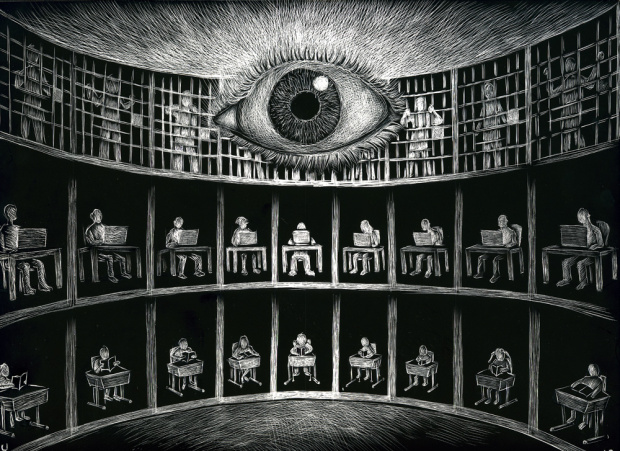
The American Surveillance State, much like The Prisoner’s Village, is a metaphorical panopticon, a circular prison in which the inmates are monitored by a single watchman situated in a central tower. Because the inmates cannot see the watchman, they are unable to tell whether or not they are being watched at any given time and must proceed under the assumption that they are always being watched.

Eighteenth century social theorist Jeremy Bentham envisioned the panopticon prison to be a cheaper and more effective means of “obtaining power of mind over mind, in a quantity hitherto without example.”

Bentham’s panopticon, in which the prisoners are used as a source of cheap, menial labor, has become a model for the modern surveillance state in which the populace is constantly being watched, controlled and managed by the powers-that-be while funding its existence.

Nowhere to run and nowhere to hide: this is the mantra of the architects of the Surveillance State and their corporate collaborators.

Government eyes are watching you.

They see your every move: what you read, how much you spend, where you go, with whom you interact, when you wake up in the morning, what you’re watching on television and reading on the internet.

Every move you make is being monitored, mined for data, crunched, and tabulated in order to amass a profile of who you are, what makes you tick, and how best to control you when and if it becomes necessary to bring you in line.

When the government sees all and knows all and has an abundance of laws to render even the most seemingly upstanding citizen a criminal and lawbreaker, then the old adage that you’ve got nothing to worry about if you’ve got nothing to hide no longer applies.

Apart from the obvious dangers posed by a government that feels justified and empowered to spy on its people and use its ever-expanding arsenal of weapons and technology to monitor and control them, we’re approaching a time in which we will be forced to choose between bowing down in obedience to the dictates of the government—i.e., the law, or whatever a government official deems the law to be—and maintaining our individuality, integrity and independence.

When people talk about privacy, they mistakenly assume it protects only that which is hidden behind a wall or under one’s clothing. The courts have fostered this misunderstanding with their constantly shifting delineation of what constitutes an “expectation of privacy.” And technology has furthered muddied the waters.

However, privacy is so much more than what you do or say behind locked doors. It is a way of living one’s life firm in the belief that you are the master of your life, and barring any immediate danger to another person (which is far different from the carefully crafted threats to national security the government uses to justify its actions), it’s no one’s business what you read, what you say, where you go, whom you spend your time with, and how you spend your money.

Unfortunately, George Orwell’s 1984—where “you had to live—did live, from habit that became instinct—in the assumption that every sound you made was overheard, and, except in darkness, every movement scrutinized”—has now become our reality.

We now find ourselves in the unenviable position of being monitored, managed, corralled and controlled by technologies that answer to government and corporate rulers.

Consider that on any given day, the average American going about his daily business will be monitored, surveilled, spied on and tracked in more than 20 different ways, by both government and corporate eyes and ears.

A byproduct of this new age in which we live, whether you’re walking through a store, driving your car, checking email, or talking to friends and family on the phone, you can be sure that some government agency is listening in and tracking your behavior.

This doesn’t even begin to touch on the corporate trackers that monitor your purchases, web browsing, Facebook posts and other activities taking place in the cyber sphere.

Stingray devices mounted on police cars to warrantlessly track cell phones, Doppler radar devices that can detect human breathing and movement within in a home, license plate readers that can record up to 1800 license plates per minutesidewalk and “public space” cameras coupled with facial recognition and behavior-sensing technology that lay the groundwork for police “pre-crime” programspolice body cameras that turn police officers into roving surveillance cameras, the internet of things: all of these technologies (and more) add up to a society in which there’s little room for indiscretions, imperfections, or acts of independence—especially not when the government can listen in on your phone calls, read your emails, monitor your driving habits, track your movements, scrutinize your purchases and peer through the walls of your home.

As French philosopher Michel Foucault concluded in his 1975 book Discipline and Punish, “Visibility is a trap.”

This is the electronic concentration camp—the panopticon prison—the Village—in which we are now caged.

It is a prison from which there will be no escape. Certainly not if the government and its corporate allies have anything to say about it.

As Glenn Greenwald notes:

“The way things are supposed to work is that we’re supposed to know virtually everything about what [government officials] do: that’s why they’re called public servants. They’re supposed to know virtually nothing about what we do: that’s why we’re called private individuals. This dynamic – the hallmark of a healthy and free society – has been radically reversed. Now, they know everything about what we do, and are constantly building systems to know more. Meanwhile, we know less and less about what they do, as they build walls of secrecy behind which they function. That’s the imbalance that needs to come to an end. No democracy can be healthy and functional if the most consequential acts of those who wield political power are completely unknown to those to whom they are supposed to be accountable.”

None of this will change, no matter which party controls Congress or the White House, because despite all of the work being done to help us buy into the fantasy that things will change if we just elect the right candidate, we’ll still be prisoners of the Village.

So how do you escape? For starters, resist the urge to conform to a group mind and the tyranny of mob-think as controlled by the Deep State.

Think for yourself. Be an individual.

As McGoohan commented in 1968, “At this moment individuals are being drained of their personalities and being brainwashed into slaves… As long as people feel something, that’s the great thing. It’s when they are walking around not thinking and not feeling, that’s tough. When you get a mob like that, you can turn them into the sort of gang that Hitler had.”

You want to be free? Remove the blindfold that blinds you to the Deep State’s con game, stop doping yourself with government propaganda, and break free of the political chokehold that has got you marching in lockstep with tyrants and dictators.

As I make clear in my book Battlefield America: The War on the American People and in its fictional counterpart The Erik Blair Diaries, until you come to terms with the fact that the government is the problem (no matter which party dominates), you’ll never stop being prisoners.

Distract, Divide and Conquer: The Painful Truth About the State of Our Union

By John & Nisha Whitehead

Source: The Rutherford Institute

Step away from the blinders that partisan politics uses to distract, divide and conquer, and you will find that we are drowning in a cesspool of problems that individually and collectively threaten our lives, liberties, prosperity and happiness.

These are not problems the politicians want to talk about, let alone address, yet we cannot afford to ignore them much longer.

Foreign interests are buying up our farmland and holding our national debt. As of 2021, foreign persons and entities owned 40.8 million acres of U.S. agricultural land, 47% of which was forestland, 29% in cropland, and 22% in pastureland. Foreign land holdings have increased by an average of 2.2 million acres per year since 2015. Foreign countries also own $7.4 trillion worth of U.S. national debt, with Japan and China ranked as our two largest foreign holders of our debt.

Corporate and governmental censorship have created digital dictators. While the “Twitter files” revealed the lengths to which the FBI has gone to monitor and censor social media content, the government has been colluding with the tech sector for some time now in order to silence its critics and target “dangerous” speech in the name of fighting so-called disinformation. The threat of being labelled “disinformation” is being used to undermine anyone who asks questions, challenges the status quo, and engages in critical thinking.

Middle- and lower-income Americans are barely keeping up. Rising costs of housing, food, gas and other necessities are presenting nearly insurmountable hurdles towards financial independence for the majority of households who are scrambling to make ends meet. Meanwhile, mounting layoffs in the tens of thousands are adding to the fiscal pain.

The government is attempting to weaponize mental health care. Increasingly, in communities across the nation, police are being empowered to forcibly detain individuals they believe might be mentally ill, even if they pose no danger to others. While these programs are ostensibly aimed at getting the homeless off the streets, when combined with the government’s ongoing efforts to predict who might pose a threat to public safety based on mental health sensor data (tracked by wearable data and monitored by government agencies such as HARPA), the specter of mental health round-ups begins to sound less far-fetched.

The military’s global occupation is spreading our resources thin and endangering us at home. America’s war spending and commitment to policing the rest of the world are bankrupting the nation and spreading our troops dangerously thin. In 2022 alone, the U.S. approved more than $50 billion in aid for Ukraine, half of which went towards military spending, with more on the way. The U.S. also maintains some 750 military bases in 80 countries around the world.

Deepfakes, AI and virtual reality are blurring the line between reality and a computer-generated illusion. Powered by AI software, deepfake audio and video move us into an age where it is almost impossible to discern what is real, especially as it relates to truth and disinformation. At the same time, the technology sector continues to use virtual reality to develop a digital universe—the metaverse—that is envisioned as being the next step in our evolutionary transformation from a human-driven society to a technological one.

Advances in technology are outstripping our ability to protect ourselves from its menacing side, both in times of rights, humanity and workforce. In the absence of constitutional protections in place to guard against encroachments on our rights in the electronic realm, we desperately need an Electronic Bill of Rights that protects “we the people” from predatory surveillance and data-mining business practices.

The courts have aligned themselves with the police state. In one ruling after another, the courts have used the doctrine of qualified immunity to shield police officers from accountability for misconduct, tacitly giving them a green light to act as judge, jury and executioner on the populace. All the while, police violence, the result of training that emphasizes brute force over constitutional restraints, continues to endanger the public.

The nation’s dependence on foreign imports has fueled a $1 trillion trade deficit. While analysts have pointed to the burgeoning trade deficit as a sign that the U.S. economy is growing, it underscores the extent to which very little is actually made in America anymore.

World governments, including the U.S., continue to use national crises such as COVID-19 to expand their emergency powers. None are willing to relinquish these powers when the crisis passes. According to the Brennan Center for Justice, the U.S. government still has 42 declared national emergencies in effect, allowing it to sidestep constitutional protocols that maintain a system of checks and balances. For instance, the emergency declared after the 9/11 has yet to be withdrawn.

The nation’s infrastructure is rapidly falling apart. Many of the country’s roads, bridges, airports, dams, levees and water systems are woefully outdated and in dire need of overhauling, and have fallen behind that of other developed countries in recent years. The American Society of Civil Engineers estimates that crumbling infrastructure costs every American household $3,300 in hidden costs a year due to lost time, increased fuel consumption while sitting in traffic jams, and extra car repairs due to poor road conditions.

The nation is about to hit a healthcare crisis. Despite the fact that the U.S. spends more on health care than any other high-income country, it has the worst health outcomes than its peer nations. Experts are also predicting a collapse in the U.S. health care system as the medical community deals with growing staff shortages and shuttered facilities.

These are just a small sampling of the many looming problems that threaten to overwhelm us in the near future.

Thus far, Americans seem inclined to just switch the channel, tune out what they don’t want to hear, and tune into their own personal echo chambers.

Yet as I make clear in my book Battlefield America: The War on the American People and in its fictional counterpart The Erik Blair Diaries, no amount of escapism can shield us from the harsh reality that the danger in our midst is posed by an entrenched government bureaucracy that has no regard for the Constitution, Congress, the courts or the citizenry.

360 Degree Surveillance: How Police Use Public-Private Partnerships to Spy on Americans

By John & Nisha Whitehead

Source: The Rutherford Institute

We live in a surveillance state founded on a partnership between government and the technology industry.”— Law Professor Avidan Y. Cover

In this age of ubiquitous surveillance, there are no private lives: everything is public.

Surveillance cameras mounted on utility poles, traffic lights, businesses, and homes. License plate readers. Ring doorbells. GPS devices. Dash cameras. Drones. Store security cameras. Geofencing and geotracking. FitBits. Alexa. Internet-connected devices.  

There are roughly one billion surveillance cameras worldwide and that number continues to grow, thanks to their wholehearted adoption by governments (especially law enforcement and military agencies), businesses, and individual consumers.

With every new surveillance device we welcome into our lives, the government gains yet another toehold into our private worlds.

Indeed, empowered by advances in surveillance technology and emboldened by rapidly expanding public-private partnerships between law enforcement, the Intelligence Community, and the private sector, police have become particularly adept at sidestepping the Fourth Amendment.

As law professor Avidan Y. Cover explains:

A key feature of the surveillance state is the cooperative relationship between the private sector and the government. The private sector’s role is vital to the surveillance both practically and legally. The private sector, of course, provides the infrastructure and tools for the surveillance… The private sector is also critical to the surveillance state’s legality. Under the third-party doctrine, the Fourth Amendment is not implicated when the government acquires information that people provide to corporations, because they voluntarily provide their information to another entity and assume the risk that the entity will disclose the information to the government. Therefore, people do not have a reasonable expectation of privacy in their calling data, or potentially even their emails. As a result, the government does not normally need a warrant to obtain information transmitted electronically. But the Fourth Amendment is not only a source of protection for individual privacy; it also limits government excess and abuse through challenges by the people. The third-party doctrine removes this vital and populist check on government overreach.

Critical to this end run around the Fourth Amendment’s prohibitions against unreasonable searches and seizures by government agents is a pass play that allows police to avoid public transparency requirements (open bids, public meetings, installation protocols) by having private companies and individuals do the upfront heavy lifting, leaving police to harvest the intel on the back end.

Stingray devices, facial recognition technology, body cameras, automated license plate readers, gunshot detection, predictive policing software, AI-enhanced video analytics, real-time crime centers, fusion centers: all of these technologies and surveillance programs rely on public-private partnerships that together create a sticky spiderweb from which there is no escape.

As the cost of these technologies becomes more affordable for the average consumer, an effort underwritten by the tech industry and encouraged by law enforcement agencies and local governing boards, which in turn benefit from access to surveillance they don’t need to include in their budgets, big cities, small towns, urban, suburban and rural communities alike are adding themselves to the surveillance state’s interconnected grid.

What this adds up to for government agencies (that is, FBI, NSA, DHS agents, etc., as well as local police) is a surveillance map that allows them to track someone’s movements over time and space, hopscotching from doorbell camera feeds and business security cameras to public cameras on utility poles, license plate readers, traffic cameras, drones, etc.

It has all but eliminated the notion of privacy and radically re-drawn the line of demarcation between our public and private selves.

Over the past 50 years, surveillance has brought about a series of revolutions in how governments govern and populations are policed to the detriment of us all. Cybersecurity expert Adam Scott Wandt has identified three such revolutions.

The first surveillance revolution came about as a result of government video cameras being installed in public areas. There were a reported 51 million surveillance cameras blanketing the United States in 2022. It’s estimated that Americans are caught on camera an average of 238 times every week (160 times per week while driving; 40 times per week at work; 24 times per week while out running errands and shopping; and 14 times per week through various other channels and activities). That doesn’t even touch on the coverage by surveillance drones, which remain a relatively covert part of police spying operations.

The second revolution occurred when law enforcement agencies started forging public-private partnerships with commercial establishments like banks and drug stores and parking lots in order to gain access to their live surveillance feeds. The use of automatic license plate readers (manufactured and distributed by the likes of Flock Safety), once deployed exclusively by police and now spreading to home owners associations and gated communities, extends the reach of the surveillance state that much further afield. It’s a win-win for police budgets and local legislatures when they can persuade businesses and residential communities to shoulder the costs of the equipment and share the footage, and they can conscript the citizenry to spy on each other through crowdsourced surveillance.

The third revolution was ushered in with the growing popularity of doorbell cameras such as Ring, Amazon’s video surveillance doorbell, and Google’s Nest Cam.

Amazon has been particularly aggressive in its pursuit of a relationship with police, enlisting them in its marketing efforts, and going so far as to hosting parties for police, providing free Ring doorbells and deep discounts, sharing “active camera” maps of Ring owners, allowing access to the Law Enforcement Neighborhood Portal, which enables police to directly contact owners for access to their footage, and coaching police on how to obtain footage without a warrant.

Ring currently partners with upwards of 2,161 law enforcement agencies and 455 fire departments, and that number grows exponentially every year. As Vice reports, “Ring has also heavily pursued city discount programs and private alliances with neighborhood watch groups. When cities provide free or discounted Ring cameras, they sometimes create camera registries, and police sometimes order people to aim Ring cameras at their neighbors, or only give cameras to people surveilled by neighborhood watches.”

In November 2022, San Francisco police gained access to the live footage of privately owned internet cameras as opposed to merely being able to access recorded footage. No longer do police even have to request permission of homeowners for such access: increasingly, corporations have given police access to footage as part of their so-called criminal investigations with or without court orders.

We would suggest a fourth revolutionary shift to be the use of facial recognition software and artificial intelligence-powered programs that can track people by their biometrics, clothing, behavior and car, thereby synthesizing the many strands of surveillance video footage into one cohesive narrative, which privacy advocates refer to as 360 degree surveillance.

Finally, Wandt sees autonomous cars equipped with cameras that record everything around them as yet another revolutionary expansion of surveillance to be tapped by police.

Yet in the present moment, it’s those public-private partnerships that signify a watershed moment in the transition from a police state to a surveillance state and sound a death knoll for our privacy rights. This fusion of government power and private power is also at the heart of the surveillance state’s growing stranglehold on the populace.

As always, these intrusions into our personal lives are justified in the name of national security and fighting crime. Yet while the price to be paid for having the government’s so-called protection is nothing less than our right to privacy, the guarantee of safety remains dubious, at best.

As a study on camera surveillance by researchers at City University of New York concluded, the presence of cameras were somewhat effective as a deterrent for crimes such as car burglaries and property theft, but they had no significant effect on violent crimes.

On the other hand, when you combine overcriminalization with wall-to-wall surveillance monitored by police in pursuit of crimes, the resulting suspect society inevitably gives way to a nation of criminals. In such a society, we are all guilty of some crime or other.

The predatory effect of these surveillance cameras has also yet to be fully addressed, but they are vulnerable to being hacked by third parties and abused by corporate and government employees.

After all, power corrupts. We’ve seen this abuse of power recur time and time again throughout history. For instance, as an in-depth investigative report by the Associated Press concludes, the very same mass surveillance technologies that were supposedly so necessary to fight the spread of COVID-19 are now being used to stifle dissent, persecute activists, harass marginalized communities, and link people’s health information to other surveillance and law enforcement tools. As the AP reports, federal officials have also been looking into how to add “‘identifiable patient data,’ such as mental health, substance use and behavioral health information from group homes, shelters, jails, detox facilities and schools,” to its surveillance toolkit.

These cameras—and the public-private eyes peering at us through them—are re-engineering a society structured around the aesthetic of fear and, in the process, empowering “people to not just watch their neighborhood, but to organize as watchers,” creating not just digital neighborhood watches but digital gated communities.

Finally, there is a repressive, suppressive effect to surveillance that not only acts as a potentially small deterrent on crime but serves to monitor and chill lawful First Amendment activity. As Matthew Feeney warns in the New York Times, “In the past, Communists, civil rights leaders, feminists, Quakers, folk singers, war protesters and others have been on the receiving end of law enforcement surveillance. No one knows who the next target will be.

No one knows, but it’s a pretty good bet that the surveillance state will be keeping a close watch on anyone seen as a threat to the government’s chokehold on power.

It’s George Orwell’s 1984 on a global scale.

As I make clear in my book Battlefield America: The War on the American People and in its fictional counterpart The Erik Blair Diaries, Orwell’s dystopian nightmare has become our looming reality.

Don’t Trust the Government with Your Privacy, Property or Your Freedoms

By John & Nisha Whitehead

Source: The Rutherford Institute

How do you trust a government that continuously sidesteps the Constitution and undermines our rights? You can’t.

When you consider all the ways “we the people” are being bullied, beaten, bamboozled, targeted, tracked, repressed, robbed, impoverished, imprisoned and killed by the government, one can only conclude that you shouldn’t trust the government with your privacy, your property, your life, or your freedoms.

Consider for yourself.

Don’t trust the government with your privacy, digital or otherwise. In the two decades since 9/11, the military-security industrial complex has operated under a permanent state of emergency that, in turn, has given rise to a digital prison that grows more confining and inescapable by the day. Wall-to wall surveillance, monitored by AI software and fed to a growing network of fusion centers, render the twin concepts of privacy and anonymity almost void. By conspiring with corporations, the Department of Homeland Security “fueled a massive influx of money into surveillance and policing in our cities, under a banner of emergency response and counterterrorism.” For instance, all across the country, police are installing Flock Safety license plate readers as part of a public-private partnership program between police and the surveillance industry. These cameras, which upload data in real time to fusion crime centers, signal a turning point in the transition from a police state to a police-driven surveillance state.

Don’t trust the government with your property. In yet another effort to legitimize warrantless searches, police are employing “hit-and-hold” tactics in which police enter a home, carry out an initial sweep of the property, handcuff the occupants, then wait for official search warrants to be secured and applied retroactively. In the meantime, police have managed to bypass the Fourth Amendment. The rationale, to prevent possible destruction of evidence, is the same one used to deadly effect with no-knock raids. If government agents can invade your home, break down your doors, kill your dog, damage your furnishings and terrorize your family, your property is no longer private and secure—it belongs to the government. Hard-working Americans are having their bank accounts, homes, cars electronics and cash seized by police under the assumption that they have allegedly been associated with some criminal scheme.

Don’t trust the government with your finances. The U.S. government—and that includes the current administration—is spending money it doesn’t have on programs it can’t afford, and “we the taxpayers” are being forced to foot the bill for the government’s fiscal insanity. The national debt is $31.3 trillion and growing, and we’re paying more than $300 billion in interest every year on that public debt, yet there seems to be no end in sight when it comes to the government’s fiscal insanity. According to Forbes, Congress has raised, extended or revised the definition of the debt limit 78 times since 1960 in order to allow the government to essentially fund its existence with a credit card.

Don’t trust the government with your health. For all intents and purposes, “we the people” have become lab rats in the government’s secret experiments, which include MKULTRA and the U.S. military’s secret race-based testing of mustard gas on more than 60,000 enlisted men. Indeed, you don’t have to dig very deep or go very back in the nation’s history to uncover numerous cases in which the government deliberately conducted secret experiments on an unsuspecting populace—citizens and noncitizens alike—making healthy people sick by spraying them with chemicals, injecting them with infectious diseases and exposing them to airborne toxins. Unfortunately, the public has become so easily distracted by the political spectacle out of Washington, DC, that they are altogether oblivious to the grisly experiments, barbaric behavior and inhumane conditions that have become synonymous with the U.S. government, which has meted out untold horrors against humans and animals alike.

Don’t trust the government with your life: At a time when growing numbers of unarmed people have been shot and killed for just standing a certain way, or moving a certain way, or holding something—anything—that police could misinterpret to be a gun, or igniting some trigger-centric fear in a police officer’s mind that has nothing to do with an actual threat to their safety, even the most benign encounters with police can have fatal consequences. The number of Americans killed by police continues to grow, with the majority of those killed as a result of police encounters having been suspected of a non-violent offense or no crime at all, or during a traffic violation. According a report by Mapping Police Violence, police killed more people in 2022 than any other year within the past decade. In 98% of those killings, police were not charged with a crime.

Don’t trust the government with your freedoms. For years now, the government has been playing a cat-and-mouse game with the American people, letting us enjoy just enough freedom to think we are free but not enough to actually allow us to live as a free people. Freedom no longer means what it once did. This holds true whether you’re talking about the right to criticize the government in word or deed, the right to be free from government surveillance, the right to not have your person or your property subjected to warrantless searches by government agents, the right to due process, the right to be safe from militarized police invading your home, the right to be innocent until proven guilty and every other right that once reinforced the founders’ belief that this would be “a government of the people, by the people and for the people.” On paper, we may be technically free, but in reality, we are only as free as a government official may allow.

Whatever else it may be—a danger, a menace, a threat—the U.S. government is certainly not looking out for our best interests, nor is it in any way a friend to freedom.

Remember the purpose of a good government is to protect the lives and liberties of its people.

Unfortunately, what we have been saddled with is, in almost every regard, the exact opposite of an institution dedicated to protecting the lives and liberties of its people.

As I make clear in my book Battlefield America: The War on the American People and in its fictional counterpart The Erik Blair Diaries, “we the people” should have learned early on that a government that repeatedly lies, cheats, steals, spies, kills, maims, enslaves, breaks the laws, overreaches its authority, and abuses its power at almost every turn can’t be trusted.

ABOUT JOHN W. WHITEHEAD

Constitutional attorney and author John W. Whitehead is founder and president of The Rutherford Institute. His most recent books are the best-selling Battlefield America: The War on the American People, the award-winning A Government of Wolves: The Emerging American Police State, and a debut dystopian fiction novel, The Erik Blair Diaries. Whitehead can be contacted at staff@rutherford.org. Nisha Whitehead is the Executive Director of The Rutherford Institute. Information about The Rutherford Institute is available at www.rutherford.org.

Why Orwell matters

His defence of freedom flies in the face of all that is woke and regressive today.

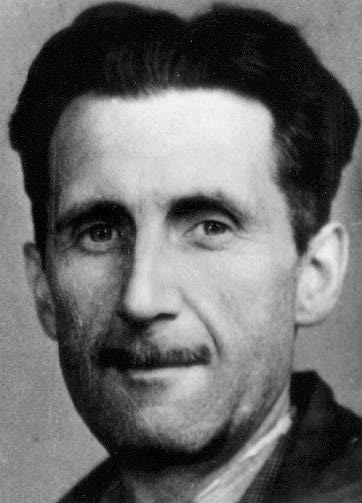
George Orwell aka Eric Blair (25 June 1903 – 21 January 1950)

By Bruno Waterfield

Source: Spike Online

Most people think that George Orwell was writing about, and against, totalitarianism – especially when they encounter him through the prism of his great dystopian novel, Nineteen Eighty-Four.

This view of Orwell is not wrong, but it can miss something. For Orwell was concerned above all about the particular threat posed by totalitarianism to words and language. He was concerned about the threat it posed to our ability to think and speak freely and truthfully. About the threat it posed to our freedom.

He saw, clearly and vividly, that to lose control of words is to lose control of meaning. That is what frightened him about the totalitarianism of Nazi Germany and Stalinist Russia – these regimes wanted to control the very linguistic substance of thought itself.

And that is why Orwell continues to speak to us so powerfully today. Because words, language and meaning are under threat once more.

Totalitarianism in Orwell’s time

The totalitarian regimes of Nazi Germany and Stalin’s Soviet Union represented something new and frightening for Orwell. Authoritarian dictatorships, in which power was wielded unaccountably and arbitrarily, had existed before, of course. But what made the totalitarian regimes of the 20th century different was the extent to which they demanded every individual’s complete subservience to the state. They sought to abolish the very basis of individual freedom and autonomy. They wanted to use dictatorial powers to socially engineer the human soul itself, changing and shaping how people think and behave.

Totalitarian regimes set about breaking up clubs, trade unions and other voluntary associations. They were effectively dismantling those areas of social and political life in which people were able to freely and spontaneously associate. The spaces, that is, in which local and national culture develops free of the state and officialdom. These cultural spaces were always tremendously important to Orwell. As he put it in his 1941 essay, ‘England Your England’: ‘All the culture that is most truly native centres round things which even when they are communal are not official – the pub, the football match, the back garden, the fireside and the “nice cup of tea”.’

Totalitarianism may have reached its horrifying zenith in Nazi Germany and Stalin’s USSR. But Orwell was worried about its effect in the West, too. He was concerned about the Sovietisation of Europe through the increasingly prominent and powerful Stalinist Communist Parties. He was also worried about what he saw as Britain’s leftwing ‘Europeanised intelligentsia’, which, like the Communist Parties of Western Europe, seemed to worship state power, particularly in the supranational form of the USSR. And he was concerned above all about the emergence of the totalitarian mindset, and the attempt to re-engineer the deep structures of mind and feeling that lie at the heart of autonomy and liberty.

Orwell could see this mindset flourishing among Britain’s intellectual elite, from the eugenics and top-down socialism of Fabians, like Sidney and Beatrice Webb and HG Wells, to the broader technocratic impulses of the intelligentsia in general. They wanted to remake people ‘for their own good’, or for the benefit of the race or state power. They therefore saw it as desirable to force people to conform to certain prescribed behaviours and attitudes. This threatened the everyday freedom of people who wanted, as Orwell put it, ‘the liberty to have a home of your own, to do what you like in your spare time, to choose your own amusements instead of having them chosen for you from above’.

In the aftermath of the Second World War, this new intellectual elite started to gain ascendancy. It was effectively a clerisy – a cultural and ruling elite defined by its academic achievements. It had been forged through higher education and academia rather than through traditional forms of privilege and wealth, such as public schools.

Orwell was naturally predisposed against this emergent clerisy. He may have attended Eton, but that’s where Orwell’s education stopped. He was not part of the clerisy’s world. He was not an academic writer, nor did he position himself as such. On the contrary, he saw himself as a popular writer, addressing a broad, non-university-educated audience.

Moreover, Orwell’s antipathy towards this new elite type was long-standing. He had bristled against the rigidity and pomposity of imperial officialdom as a minor colonial police official in Burma between 1922 and 1927. And he had always battled against the top-down socialist great and good, and much of academia, too, who were often very much hand in glove with the Stalinised left.

The hostility was mutual. Indeed, it accounts for the disdain that many academics and their fellow travellers continue to display towards Orwell today.

The importance of words

Nowadays we are all too familiar with this university-educated ruling caste, and its desire to control words and meaning. Just think, for example, of the way in which our cultural and educational elites have turned ‘fascism’ from a historically specific phenomenon into a pejorative that has lost all meaning, to be used to describe anything from Brexit to Boris Johnson’s Tory government – a process Orwell saw beginning with the Stalinist practice of calling Spanish democratic revolutionaries ‘Trotsky-fascists’ (which he documented in Homage to Catalonia (1938)).

Or think of the way in which our cultural and educational elites have transformed the very meanings of the words ‘man’ and ‘woman’, divesting them of any connection to biological reality. Orwell would not have been surprised by this development. In Nineteen Eighty-Four, he shows how the totalitarian state and its intellectuals will try to suppress real facts, and even natural laws, if they diverge from their worldview. Through exerting power over ideas, they seek to shape reality. ‘Power is in tearing human minds to pieces and putting them together in new shapes of your own choosing’, says O’Brien, the sinister party intellectual. ‘We control matter because we control the mind. Reality is inside the skull… You must get rid of these 19th-century ideas about the laws of nature.’

In Nineteen Eighty-Four, the totalitarian regime tries to subject history to similar manipulation. As anti-hero Winston Smith tells his lover, Julia:

‘Every record has been destroyed or falsified, every book has been rewritten, every picture has been repainted, every statue and street and building has been renamed, every date has been altered. And that process is continuing day by day and minute by minute. History has stopped. Nothing exists except an endless present in which the Party is always right.’

As Orwell wrote elsewhere, ‘the historian believes that the past cannot be altered and that a correct knowledge of history is valuable as a matter of course. From the totalitarian point of view history is something to be created rather than learned.’

This totalitarian approach to history is dominant today, from the New York Times’ 1619 Project to statue-toppling. History is something to be erased or conjured up or reshaped as a moral lesson for today. It is used to demonstrate the rectitude of the contemporary establishment.

But it is language that is central to Orwell’s analysis of this form of intellectual manipulation and thought-control. Take ‘Ingsoc’, the philosophy that the regime follows and enforces through the linguistic system of Newspeak. Newspeak is more than mere censorship. It is an attempt to make certain ideas – freedom, autonomy and so on – actually unthinkable or impossible. It is an attempt to eliminate the very possibility of dissent (or ‘thoughtcrime’).

As Syme, who is working on a Newspeak dictionary, tells Winston Smith:

‘The whole aim… is to narrow the range of thought. In the end we shall make thoughtcrime literally impossible, because there will be no words in which to express it. Every year fewer and fewer words, and the range of consciousness always a little smaller… Has it ever occurred to you, Winston, that by the year 2050, at the very latest, not a single human being will be alive who could understand such a conversation as we are having now?’

The parallels between Orwell’s nightmarish vision of totalitarianism and the totalitarian mindset of today, in which language is policed and controlled, should not be overstated. In the dystopia of Nineteen Eighty-Four, the project of eliminating freedom and dissent, as in Nazi Germany or Stalinist Russia, was backed up by a brutal, murderous secret police. There is little of that in our societies today – people are not forcibly silenced or disappeared.

However, they are cancelled, pushed out of their jobs, and sometimes even arrested by the police for what amounts to thoughtcrime. And many more people simply self-censor out of fear of saying the ‘wrong’ thing. Orwell’s concern that words could be erased or their meaning altered, and thought controlled, is not being realised in an openly dictatorial manner. No, it’s being achieved through a creeping cultural and intellectual conformism.

The intellectual turn against freedom

But then that was always Orwell’s worry – that intellectuals giving up on freedom would allow a Big Brother Britain to flourish. As he saw it in The Prevention of Literature (1946), the biggest danger to freedom of speech and thought came not from the threat of dictatorship (which was receding by then) but from intellectuals giving up on freedom, or worse, seeing it as an obstacle to the realisation of their worldview.

Interestingly, his concerns about an intellectual betrayal of freedom were reinforced by a 1944 meeting of the anti-censorship organisation, English PEN. Attending an event to mark the 300th anniversary of Milton’s Areopagitica, Milton’s famous 1644 speech making the case for the ‘Liberty of Unlicenc’d Printing’, Orwell noted that many of the left-wing intellectuals present were unwilling to criticise Soviet Russia or wartime censorship. Indeed, they had become profoundly indifferent or hostile to the question of political liberty and press freedom.

‘In England, the immediate enemies of truthfulness, and hence of freedom of thought, are the press lords, the film magnates, and the bureaucrats’, Orwell wrote, ‘but that on a long view the weakening of the desire for liberty among the intellectuals themselves is the most serious symptom of all’.

Orwell was concerned by the increasing popularity among influential left-wing intellectuals of ‘the much more tenable and dangerous proposition that freedom is undesirable and that intellectual honesty is a form of anti-social selfishness’. The exercise of freedom of speech and thought, the willingness to speak truth to power, was even then becoming seen as something to be frowned upon, a selfish, even elitist act.

An individual speaking freely and honestly, wrote Orwell, is ‘accused of either wanting to shut himself up in an ivory tower, or of making an exhibitionist display of his own personality, or of resisting the inevitable current of history in an attempt to cling to unjustified privilege’.

These are insights which have stood the test of time. Just think of the imprecations against those who challenge the consensus. They are dismissed as ‘contrarians’ and accused of selfishly upsetting people.

And worst of all, think of the way free speech is damned as the right of the privileged. This is possibly one of the greatest lies of our age. Free speech does not support privilege. We all have the capacity to speak, write, think and argue. We might not, as individuals or small groups, have the platforms of a press baron or the BBC. But it is only through our freedom to speak freely that we can challenge those with greater power.

Orwell’s legacy

Orwell is everywhere today. He is taught in schools and his ideas and phrases are part of our common culture. But his value and importance to us lies in his defence of freedom, especially the freedom to speak and write.

His outstanding 1946 essay, ‘Politics and the English Language’, can actually be read as a freedom manual. It is a guide on how to use words and language to fight back.

Of course, it is attacked today as an expression of privilege and of bigotry. Author and commentator Will Self cited ‘Politics and the English Language’ in a 2014 BBC Radio 4 show as proof that Orwell was an ‘authoritarian elitist’. He said: ‘Reading Orwell at his most lucid you can have the distinct impression he’s saying these things, in precisely this way, because he knows that you – and you alone – are exactly the sort of person who’s sufficiently intelligent to comprehend the very essence of what he’s trying to communicate. It’s this the mediocrity-loving English masses respond to – the talented dog-whistler calling them to chow down on a big bowl of conformity.’

Lionel Trilling, another writer and thinker, made a similar point to Self, but in a far more insightful, enlightening way. ‘[Orwell] liberates us’, he wrote in 1952:

‘He tells us that we can understand our political and social life merely by looking around us, he frees us from the need for the inside dope. He implies that our job is not to be intellectual, certainly not to be intellectual in this fashion or that, but merely to be intelligent according to our lights – he restores the old sense of the democracy of the mind, releasing us from the belief that the mind can work only in a technical, professional way and that it must work competitively. He has the effect of making us believe that we may become full members of the society of thinking men. That is why he is a figure for us.’

Orwell should be a figure for us, too – in our battle to restore the democracy of the mind and resist the totalitarian mindset of today. But this will require having the courage of our convictions and our words, as he so often did himself. As he put it in The Prevention of Literature, ‘To write in plain vigorous language one has to think fearlessly’. That Orwell did precisely that was a testament to his belief in the public just as much as his belief in himself. He sets an example and a challenge to us all.