Are Globalists Losing Ground?

Source: News Junkie Post

Death might be the ultimate equalizer, but in the case of David Rockefeller, considerable wealth brought unacceptable privilege and made  survival to illness obscene by any moral or even medical ethics standards. On August 24, 2016, David Rockefeller received his 7th heart transplant which made him, besides being the grandson of the United States’ richest man and first billionaire, the worldwide record holder for number of heart transplants. Coincidentally, musician Chuck Berry passed away a couple of days before David Rockefeller. While Chuck Berry’s lust for life will be a legacy of pure joy for generations to come, not only on earth but even far in the cosmos, David Rockefeller’s refusal to let life take its natural course came from greed and a lust for power. Rockefeller was the ultimate symptom of the sickness of our world, where quantity matters, and quality does not.

Even though Rockefeller was a key figure and, in many regards, one of the founding fathers of the globalist world order project, the speculations that his death is a major blow to the financial elite is a pie in the sky. The self-proclaimed Masters of the Universe of Wall Street are as arrogant as ever, all of them young crocodiles ready to feast on the carcasses of the old ones. Despite Rockefeller’s passing, the giant Hydra of the globalist swamp still thrives: one of the many heads was lost, a few will grow to take its place. This notion that a board matters more than an organ or an individual is, after all, part of the precept of the globalist doctrine, which David Rockefeller helped to structure in the early 1950s. Setting up networks, groups, or councils of his elite peers was always the Rockefellers’ philosophy, and it became the redoubtable strength of the one-world-order project.

Like all prominent members of  the  globalist syndicate, David Rockefeller had nothing but contempt for the common mortal. Machiavellian plans to manipulate the public opinion, like one would mold a slab of clay, came easily to him. “We are on the verge of a global transformation. All we need is the right major crisis and the nations will accept the New World Order,” said David Rockefeller on September 14, 1994 at a United Nations meeting. Seven years later, almost to the day, the right major crisis would occur in New York City at the World Trade Center.

Under David Rockefeller as CEO, Chase Bank grew through a network of correspondent banks, including some in the former Soviet Union and in China in the early 1970s. Chase reached a network of about 50,000 banks, and it is the largest financial consortium in the world. As a key player in the globalist order, Rockefeller was instrumental in setting up the Chase International Advisory Committee (IAC) in the early 1960s. He was the IAC Chairman until 1999. The IAC was renamed International Council, after Chase’s merger with JP Morgan, and by 2005 included 25 members of the global elite from 20 different countries. This exclusive financial club has included Henry Kissinger, Riley Bechtel, George Shultz, Gianni Agnelli, John Loudon (CEO of Shell), David Packard, Henry Ford II, and current chairman Tony Blair. Ultimate oligarch globalist David Rockefeller was also the driving force behind the creation of the Bilderberg group, where he served for decades as gatekeeper, being the only member of the advisory board. It is through those various channels and groups of people that David Rockefeller quietly but efficiently influenced not only United States domestic and foreign policies but also world affairs.

Rockefeller has been a behind-the-scene adviser of every US president since Dwight Eisenhower. Needless to say, his half-a-century friendship with Henry Kissinger was highly beneficial for both in world affairs. The two men met in 1954, and at first the patronage of Rockefeller was critical to Kissinger’s rise as a top policy adviser. To David Rockefeller’s credit, he was always upfront about his globalist agenda. “Some even believe we are part of a secret cabal working against the best interest of the United States, characterizing my family and me as ‘Internationalists’, and of conspiring with others around the world to build a more integrated global political and economic structure: one world, if you will. If that’s the charge, I stand guilty and I am proud of it,” wrote David Rockefeller in his memoirs.

Just like relatively newcomer George Soros, Rockefeller was extremely media savvy, and few news outlets dared to cross the billionaire, who, despite his relatively modest fortune of 3 billion, which is suspected to be highly under-reported, had a lot more sway and political power than his high-tech billionaire colleagues reported to be vastly richer. Rockefeller was a major force personally in the corridors of international power since the early 50s and, through his family network, for more than a century. In the globalist Orwellian construct, David Rockefeller had seniority, not only in age but also in influence, over Henry Kissinger and George Soros. Some fringe anti-globalist conspiracy theorists have recently claimed that George Soros doesn’t really exist and is another persona invented by David Rockefeller. This is nonsense, of course, and just as counterproductive as the characterization of globalists such as Soros, Rockefeller, and Kissinger as anti-Christ blood sucking vultures by Christian fundamentalists who support Trump. As a matter of fact, this type of lunacy is detrimental to valid rational critiques in the fight against a world order that, if successful in its final takeover still in progress, would enslave most humans for the benefit of a few thousand worldwide. This is what we are dealing with here: a prosaic fight for freedom and decent survival for all, not some chimeras extracted from fairy tales.

David Rockefeller was not Satan, but he was, just like his colleague and globalist partner-in-crime George Soros, a consummate kingmaker and puppet master. As such, Rockefeller played a big role in Bill Clinton’s rise to power. In 1991, when Clinton was Governor of Arkansas, Rockefeller invited him to the secretive Bilderberg group meeting, which took place that year in Baden-Baden, Germany. It was there that Rockefeller made the statement: “We are grateful to The Washington Post, The New York Times, Time Magazine and other great publications whose directors have attended our meetings and respected their promises of discretion for almost forty years. It would have been impossible for us to develop our plan for the world if we had been subjected to the lights of publicity during those years. But the world is now more sophisticated and prepared towards a world government. The supranational sovereignty of an intellectual elite and world bankers is preferable to the national auto-determination practiced in past centuries.” During the 26 years since David Rockefeller gave this speech, the lead globalists, their giant corporations, especially those of the military-industrial complex, as well as their obedient political helpers worldwide have worked hard to implement their plan to dismantle national sovereignty.

The BREXIT vote in the United Kingdom and election of Trump in the US were a reaction against the looming monstrosity of a world government dominated by a rarefied oligarchy, but at this juncture the globalists are alive and kicking, as the anti-establishment drain-the-swamp rhetoric seems to be not much more than a flash in a pan. Personality issues, spying rumors, accusations of collusion with a foreign government, and the threat of a so-called deep state are amplified by news outlets, fake and real. It is hard to tell the difference. These supposed issues have fostered a climate of fear and paranoia and been a distraction from real policy issues. Despite a Republican majority in the Congress, the Trump administration has so far essentially ruled by executive orders, some of which have been almost immediately challenged by courts. Level of wealth, rather than competence at a specific job, seems to be the criterion for being hired in the Trump administration. Judging by the facts alone, America Empire Inc. might have a new CEO, but the same people appear to be in control of the board, and if he were still alive, David Rockefeller’s voice would be heard on this. President Donald Trump’s budget proposal tells the story accurately: while most areas of the meager American social safety net could experience a cut, the Pentagon budget would increase by 10 percent. Mr. Trump has always been about money and business. As such, he understands that the military-industrial complex should remain the core division of America Empire Inc. So much for draining the swamp.


Gilbert Mercier is the author of The Orwellian Empire. Composite one by David Blackwell; cartoons four and six Frits Ahlefeldt; composite five by Tom Blackwell; photograph eight by Paolo Di Tommaso; and photograph nine Zach Korb. Part of this article was published as an interview with Sputnik.

Something Is Happening

collapse-era

By William Hawes

Source: Gods & Radicals

SOMETHING IS HAPPENING HERE, but you don’t know what it is: Do you? No one knows, really, as this something is still evolving. As we look back to 2016, though, it is abundantly clear that history has awoken from its slumber. We’ve had a couple events in the West last year: Brexit and Trump.

Politically-charged, dynamic events (as Alain Badiou might define them) have been rare in the West since the fall of the Berlin Wall and the disintegration of the USSR. Capitalism made it seem as if neoliberalism was winning in the 1990s, even as the US wantonly murdered in Iraq and took perverse pleasure in helping to dismember Yugoslavia, among other things.

In fact, one could argue there have only been four notable Western political events in the post-Cold War era: the 9/11 attacks, the 2003 protests against the Iraq War, the 2008 banking crisis and following protest movements of 2011 (Occupy and 15-M Movement), and the populist, anger-driven aforementioned events of 2016.

You see, authentic, spontaneous political events (in the form of uprisings or popular revolts against the elite) are a no-no in the West. History is supposed to have ended, remember? Max Weber called this the Iron Cage, and for good reason.

Now, though, the meaninglessness and rootlessness of our lives trapped inside the cage have become too obvious to ignore, for most of us. As each day passes, our political discourse glosses over how lazy, ignorant, mean-spirited, and numb our society has become. We import luxuries from all over the globe, but can’t be bothered to cook or grow our own food, assemble our own electronics, expand renewable energy projects, provide clean water to inner cities, organize high-speed transport, or educate our youth without drowning them in debt, etc.

So, many have lashed out against the system, and our more vulnerable members of society, in anger, defiance, out of sheer ignorance. Could it be because, deep down, we know how helpless, sheltered, and out-of-touch our society is, compared to the rest of the world? What are the root causes of this disintegration of public discourse?

One cause is our utter dependency on the capitalist system to clothe, feed, and shelter us. What we used to inherit from our mothers and fathers, important agricultural knowledge, artisanal and cultural wisdom, a sense of place and belonging, have all been traded in for money, the privilege to be exploited by capitalism, toiling in jobs that alienate us from ourselves, families, the Earth. Paper bills and electronic bank accounts are a pitiful substitute for self-reliance. This loss, this grief, isn’t allowed to be expressed in public. Logical positivism tells us that progress will prevail, the future will be better than the past, and anyone who thinks otherwise must be some sort of Luddite.

Since real income has fallen and social services have been slashed in the last 40-plus years, many have seen their loved ones’ lives cut short (lack of access to health care and quality food and produce, air and water pollution), their dreams defiled (steady jobs gone, factories shuttered), their entertainment homogenized and dangerous (sports mania has become normalized, “Go Team!”, alcohol, painkiller, and opiate addiction is rampant), their hopes for the future shattered (community and public space swallowed by corporations).

There are those, as well, still too plugged into the system (both Trump and Clinton voters), too attached to their gadgets, to the hum of their slave-labor appliances, to the glow emanating from their screens. They will cry incessantly about the turning away of Muslims from flights, but there is only silence for the millions killed abroad by the US war machine. Mainstream liberals are just as likely as the meanest, most selfish conservatives to fall prey to emotional pleas, demagoguery, and pathetic attempts to see themselves as victims in this Age of Anger.

The urge to resort to the myth of a righteous, homogenous, “pure” social group, to denigrate the other, is strong in such dire, despondent situations. In America, though, material poverty cannot be said to be the only, or even the main causal factor, behind this return of nativism and tribalism. Rather, it is undoubtedly a spiritual malaise that has swept over the West. Ever since the rise of the Industrial Revolution, it has been technology which has provided the underlying weltanschauung for our culture. Sprouting from this, an inhuman and Earth-destroying morality has formed. Jacques Ellul explains:

“A principal characteristic of technique … is its refusal to tolerate moral judgments. It is absolutely independent of them and eliminates them from its domain. Technique never observes the distinction between moral and immoral use. It tends on the contrary, to create a completely independent technical morality.” (1)

Thus, Western society, through the use of mass-produced electronics and disseminated in what some call our “Information Age”, has now seemingly accelerated the pace of change and ecological destruction beyond the scope of any group or nation which could possibly control it. We are then confronted with the thought that only an economic collapse or series of natural disasters could possibly provide the impetus for revolutionary change to occur. This only leaves us feeling helpless, depressed, and passive in the face of government oppression and capitalist exploitation.

Not only that, but capitalism has quite literally dulled our senses and disconnected us from our source of being, planet Earth. Don’t believe me? Read this amazing paper on how Polynesian wayfinders discovered islands thousands of miles apart without any modern technology. This is part of what Morris Berman means by Coming to our Senses. To re-establish our unity with nature, the Western notion of an ego-driven, domineering and reductionist search for truth, meaning, and creativity must be thrown out. Here, Berman invokes Simone Weil:

“‘decreate’ yourself in order to create the work, as God (Weil says) diminished Himself in order to create the world. It would be more accurate to say that you don’t create the work, but rather you step out of the way and let it happen.” (2)

This isn’t really discussed among wide swaths of leftists, the social-justice crowd, or with mainstream liberals. It’s anathema to a materialistic, dead world where freedom has been traded for comforting lies, money has been substituted for the ability to provide for ourselves and our communities, and the abundance and resiliency (truly a miracle!) of the Earth is taken for granted as we chase our next fix for consumer goods, our next chance for drugs or gadgets to dim our perception.

What you’re not supposed to say in public, of course, is that our world is falling apart, and we are doing nothing to stop it. The reactions are too raw, the reality too grim, even as we know, for example, that 10% or more of the total species on Earth will be gone by 2050.

Yet we can do something: there is an opening now in political discourse which has been previously denied to us. The Republican and Democratic parties have thoroughly delegitimized themselves by offering up Trump and Clinton as their figureheads: these were widely considered the most widely disliked candidates in recent memory, if not the history of our republic. There is room for Libertarians, Greens, and Socialists to gain power: yet only if they avoid their own regrettable sectarianism, organize, and promote an inclusive, broad-based platform.

To do so, citizens will have to gain some perspective on their lives. A slow pace of life needs to be seen as a virtue, not a sin: many on the right and left are quick to denounce the hedonism of the jet-setting, parasitic globalists, the Davos men; yet refuse to see their own lifestyles and actions as smaller examples of such outlandish consumption.

If we are open to life and our environment as part of a greater whole, an unfathomable mystery, we can refuse our culture’s siren songs of death, misery, and destruction. While modern technology can be useful if reined in by an Earth-conscious, responsible morality, some things are better left unknown, undiscovered, if it risks destroying the Earth in order to find the answer. Rather than running a cost/benefit analysis to determine the land’s worth, some aspects of the planet and the universe are better Left Sacred.

Also, acknowledging our mortality, and accepting the basic fact that death could come for you at any moment, can liberate our souls and propel them to unimaginable heights. Joe Crookston explains this quite well:

“And then when I turn dry and brown
I’ll lay me down to rest
I’ll turn myself around again
As part of an eagle’s nest
And when that eagle learns to fly
I’ll flutter from that tree
I’ll turn myself around again
As part of the mystery”


Notes:
1.) Ellul, Jacques. The Technological Society. Vintage Books, 1964. p. 97.
2.) Berman, Morris. Coming to Our Senses: Body and Spirit in the Hidden History of the West. Simon & Schuster, 1989. p. 337


William Hawes is a writer specializing in politics and environmental issues. His articles have appeared online at Global Research, Countercurrents, Dissident Voice, The World Financial Review, Gods & Radicals, and Counterpunch. He is author of the ebook Planetary Vision: Essays on Freedom and Empire. You can reach him at wilhawes@gmail.com

The Age of Disintegration

images

Neoliberalism, Interventionism, the Resource Curse, and a Fragmenting World

By Patrick Cockburn

Source: TomDispatch.com

We live in an age of disintegration. Nowhere is this more evident than in the Greater Middle East and Africa. Across the vast swath of territory between Pakistan and Nigeria, there are at least seven ongoing wars — in Afghanistan, Iraq, Syria, Yemen, Libya, Somalia, and South Sudan. These conflicts are extraordinarily destructive. They are tearing apart the countries in which they are taking place in ways that make it doubtful they will ever recover. Cities like Aleppo in Syria, Ramadi in Iraq, Taiz in Yemen, and Benghazi in Libya have been partly or entirely reduced to ruins. There are also at least three other serious insurgencies: in southeast Turkey, where Kurdish guerrillas are fighting the Turkish army, in Egypt’s Sinai Peninsula where a little-reported but ferocious guerrilla conflict is underway, and in northeast Nigeria and neighboring countries where Boko Haram continues to launch murderous attacks.

All of these have a number of things in common: they are endless and seem never to produce definitive winners or losers. (Afghanistan has effectively been at war since 1979, Somalia since 1991.) They involve the destruction or dismemberment of unified nations, their de facto partition amid mass population movements and upheavals — well publicized in the case of Syria and Iraq, less so in places like South Sudan where more than 2.4 million people have been displaced in recent years.

Add in one more similarity, no less crucial for being obvious: in most of these countries, where Islam is the dominant religion, extreme Salafi-Jihadi movements, including the Islamic State (IS), al-Qaeda, and the Taliban are essentially the only available vehicles for protest and rebellion. By now, they have completely replaced the socialist and nationalist movements that predominated in the twentieth century; these years have, that is, seen a remarkable reversion to religious, ethnic, and tribal identity, to movements that seek to establish their own exclusive territory by the persecution and expulsion of minorities.

In the process and under the pressure of outside military intervention, a vast region of the planet seems to be cracking open. Yet there is very little understanding of these processes in Washington. This was recently well illustrated by the protest of 51 State Department diplomats against President Obama’s Syrian policy and their suggestion that air strikes be launched targeting Syrian regime forces in the belief that President Bashar al-Assad would then abide by a ceasefire. The diplomats’ approach remains typically simpleminded in this most complex of conflicts, assuming as it does that the Syrian government’s barrel-bombing of civilians and other grim acts are the “root cause of the instability that continues to grip Syria and the broader region.”

It is as if the minds of these diplomats were still in the Cold War era, as if they were still fighting the Soviet Union and its allies. Against all the evidence of the last five years, there is an assumption that a barely extant moderate Syrian opposition would benefit from the fall of Assad, and a lack of understanding that the armed opposition in Syria is entirely dominated by the Islamic State and al-Qaeda clones.

Though the invasion of Iraq in 2003 is now widely admitted to have been a mistake (even by those who supported it at the time), no real lessons have been learned about why direct or indirect military interventions by the U.S. and its allies in the Middle East over the last quarter century have all only exacerbated violence and accelerated state failure.

A Mass Extinction of Independent States

The Islamic State, just celebrating its second anniversary, is the grotesque outcome of this era of chaos and conflict. That such a monstrous cult exists at all is a symptom of the deep dislocation societies throughout that region, ruled by corrupt and discredited elites, have suffered. Its rise — and that of various Taliban and al-Qaeda-style clones — is a measure of the weakness of its opponents.

The Iraqi army and security forces, for example, had 350,000 soldiers and 660,000 police on the books in June 2014 when a few thousand Islamic State fighters captured Mosul, the country’s second largest city, which they still hold. Today the Iraqi army, security services, and about 20,000 Shia paramilitaries backed by the massive firepower of the United States and allied air forces have fought their way into the city of Fallujah, 40 miles west of Baghdad, against the resistance of IS fighters who may have numbered as few as 900. In Afghanistan, the resurgence of the Taliban, supposedly decisively defeated in 2001, came about less because of the popularity of that movement than the contempt with which Afghans came to regard their corrupt government in Kabul.

Everywhere nation states are enfeebled or collapsing, as authoritarian leaders battle for survival in the face of mounting external and internal pressures. This is hardly the way the region was expected to develop. Countries that had escaped from colonial rule in the second half of the twentieth century were supposed to become more, not less, unified as time passed.

Between 1950 and 1975, nationalist leaders came to power in much of the previously colonized world. They promised to achieve national self-determination by creating powerful independent states through the concentration of whatever political, military, and economic resources were at hand. Instead, over the decades, many of these regimes transmuted into police states controlled by small numbers of staggeringly wealthy families and a coterie of businessmen dependent on their connections to such leaders as Hosni Mubarak in Egypt or Bashar al-Assad in Syria.

In recent years, such countries were also opened up to the economic whirlwind of neoliberalism, which destroyed any crude social contract that existed between rulers and ruled. Take Syria. There, rural towns and villages that had once supported the Baathist regime of the al-Assad family because it provided jobs and kept the prices of necessities low were, after 2000, abandoned to market forces skewed in favor of those in power. These places would become the backbone of the post-2011 uprising. At the same time, institutions like the Organization of Petroleum Exporting Countries (OPEC) that had done so much to enhance the wealth and power of regional oil producers in the 1970s have lost their capacity for united action.

The question for our moment: Why is a “mass extinction” of independent states taking place in the Middle East, North Africa, and beyond? Western politicians and media often refer to such countries as “failed states.” The implication embedded in that term is that the process is a self-destructive one. But several of the states now labeled “failed” like Libya only became so after Western-backed opposition movements seized power with the support and military intervention of Washington and NATO, and proved too weak to impose their own central governments and so a monopoly of violence within the national territory.

In many ways, this process began with the intervention of a U.S.-led coalition in Iraq in 2003 leading to the overthrow of Saddam Hussein, the shutting down of his Baathist Party, and the disbanding of his military. Whatever their faults, Saddam and Libya’s autocratic ruler Muammar Gaddafi were clearly demonized and blamed for all ethnic, sectarian, and regional differences in the countries they ruled, forces that were, in fact, set loose in grim ways upon their deaths.

A question remains, however: Why did the opposition to autocracy and to Western intervention take on an Islamic form and why were the Islamic movements that came to dominate the armed resistance in Iraq and Syria in particular so violent, regressive, and sectarian? Put another way, how could such groups find so many people willing to die for their causes, while their opponents found so few? When IS battle groups were sweeping through northern Iraq in the summer of 2014, soldiers who had thrown aside their uniforms and weapons and deserted that country’s northern cities would justify their flight by saying derisively: “Die for [then-Prime Minister Nouri] al-Maliki? Never!”

A common explanation for the rise of Islamic resistance movements is that the socialist, secularist, and nationalist opposition had been crushed by the old regimes’ security forces, while the Islamists were not. In countries like Libya and Syria, however, Islamists were savagely persecuted, too, and they still came to dominate the opposition. And yet, while these religious movements were strong enough to oppose governments, they generally have not proven strong enough to replace them.

Too Weak to Win, But Too Strong to Lose

Though there are clearly many reasons for the present disintegration of states and they differ somewhat from place to place, one thing is beyond question: the phenomenon itself is becoming the norm across vast reaches of the planet.

If you’re looking for the causes of state failure in our time, the place to start is undoubtedly with the end of the Cold War a quarter-century ago. Once it was over, neither the U.S. nor the new Russia that emerged from the Soviet Union’s implosion had a significant interest in continuing to prop up “failed states,” as each had for so long, fearing that the rival superpower and its local proxies would otherwise take over. Previously, national leaders in places like the Greater Middle East had been able to maintain a degree of independence for their countries by balancing between Moscow and Washington. With the break-up of the Soviet Union, this was no longer feasible.

In addition, the triumph of neoliberal free-market economics in the wake of the Soviet Union’s collapse added a critical element to the mix. It would prove far more destabilizing than it looked at the time.

Again, consider Syria. The expansion of the free market in a country where there was neither democratic accountability nor the rule of law meant one thing above all: plutocrats linked to the nation’s ruling family took anything that seemed potentially profitable. In the process, they grew staggeringly wealthy, while the denizens of Syria’s impoverished villages, country towns, and city slums, who had once looked to the state for jobs and cheap food, suffered. It should have surprised no one that those places became the strongholds of the Syrian uprising after 2011. In the capital, Damascus, as the reign of neoliberalism spread, even the lesser members of the mukhabarat, or secret police, found themselves living on only $200 to $300 a month, while the state became a machine for thievery.

This sort of thievery and the auctioning off of the nation’s patrimony spread across the region in these years. The new Egyptian ruler, General Abdel Fattah al-Sisi, merciless toward any sign of domestic dissent, was typical. In a country that once had been a standard bearer for nationalist regimes the world over, he didn’t hesitate this April to try to hand over two islands in the Red Sea to Saudi Arabia on whose funding and aid his regime is dependent. (To the surprise of everyone, an Egyptian court recently overruled Sisi’s decision.)

That gesture, deeply unpopular among increasingly impoverished Egyptians, was symbolic of a larger change in the balance of power in the Middle East: once the most powerful states in the region — Egypt, Syria, and Iraq — had been secular nationalists and a genuine counterbalance to Saudi Arabia and the Persian Gulf monarchies. As those secular autocracies weakened, however, the power and influence of the Sunni fundamentalist monarchies only increased. If 2011 saw rebellion and revolution spread across the Greater Middle East as the Arab Spring briefly blossomed, it also saw counterrevolution spread, funded by those oil-rich absolute Gulf monarchies, which were never going to tolerate democratic secular regime change in Syria or Libya.

Add in one more process at work making such states ever more fragile: the production and sale of natural resources — oil, gas, and minerals — and the kleptomania that goes with it. Such countries often suffer from what has become known as “the resources curse”: states increasingly dependent for revenues on the sale of their natural resources — enough to theoretically provide the whole population with a reasonably decent standard of living — turn instead into grotesquely corrupt dictatorships. In them, the yachts of local billionaires with crucial connections to the regime of the moment bob in harbors surrounded by slums running with raw sewage. In such nations, politics tends to focus on elites battling and maneuvering to steal state revenues and transfer them as rapidly as possible out of the country.

This has been the pattern of economic and political life in much of sub-Saharan Africa from Angola to Nigeria. In the Middle East and North Africa, however, a somewhat different system exists, one usually misunderstood by the outside world. There is similarly great inequality in Iraq or Saudi Arabia with similarly kleptocratic elites. They have, however, ruled over patronage states in which a significant part of the population is offered jobs in the public sector in return for political passivity or support for the kleptocrats.

In Iraq with a population of 33 million people, for instance, no less than seven million of them are on the government payroll, thanks to salaries or pensions that cost the government $4 billion a month. This crude way of distributing oil revenues to the people has often been denounced by Western commentators and economists as corruption. They, in turn, generally recommend cutting the number of these jobs, but this would mean that all, rather than just part, of the state’s resource revenues would be stolen by the elite. This, in fact, is increasingly the case in such lands as oil prices bottom out and even the Saudi royals begin to cut back on state support for the populace.

Neoliberalism was once believed to be the path to secular democracy and free-market economies. In practice, it has been anything but. Instead, in conjunction with the resource curse, as well as repeated military interventions by Washington and its allies, free-market economics has profoundly destabilized the Greater Middle East. Encouraged by Washington and Brussels, twenty-first-century neoliberalism has made unequal societies ever more unequal and helped transform already corrupt regimes into looting machines. This is also, of course, a formula for the success of the Islamic State or any other radical alternative to the status quo. Such movements are bound to find support in impoverished or neglected regions like eastern Syria or eastern Libya.

Note, however, that this process of destabilization is by no means confined to the Greater Middle East and North Africa. We are indeed in the age of destabilization, a phenomenon that is on the rise globally and at present spreading into the Balkans and Eastern Europe (with the European Union ever less able to influence events there). People no longer speak of European integration, but of how to prevent the complete break-up of the European Union in the wake of the British vote to leave.

The reasons why a narrow majority of Britons voted for Brexit have parallels with the Middle East: the free-market economic policies pursued by governments since Margaret Thatcher was prime minister have widened the gap between rich and poor and between wealthy cities and much of the rest of the country. Britain might be doing well, but millions of Britons did not share in the prosperity. The referendum about continued membership in the European Union, the option almost universally advocated by the British establishment, became the catalyst for protest against the status quo. The anger of the “Leave” voters has much in common with that of Donald Trump supporters in the United States.

The U.S. remains a superpower, but is no longer as powerful as it once was. It, too, is feeling the strains of this global moment, in which it and its local allies are powerful enough to imagine they can get rid of regimes they do not like, but either they do not quite succeed, as in Syria, or succeed but cannot replace what they have destroyed, as in Libya. An Iraqi politician once said that the problem in his country was that parties and movements were “too weak to win, but too strong to lose.” This is increasingly the pattern for the whole region and is spreading elsewhere. It carries with it the possibility of an endless cycle of indecisive wars and an era of instability that has already begun.


Patrick Cockburn is a Middle East correspondent for the Independent of London and the author of five books on the Middle East, the latest of which isChaos and Caliphate: Jihadis and the West in the Struggle for the Middle East(OR Books).

Democracy Is Dead

democracydictatormini_pic

Source: News Junkie Post

From the west to the east, and the south to the north of our global horizon, it is the same tableau: the horrendous killing fields of disaster capitalism where its cohorts of 18-wheelers, heavy road machinery and police patrol cars roam the landscape continuously and are turning us and the better principles of our humanity into countless road kills. Hell on Earth is to be our common fate, and we might have already reached a point of no return. The corporate hyenas and political vultures that generally constitute the global elite are joyfully feeding on the carcasses of justice and morality; rationality and empathy; common sense and the notion of public good; sound governance without corruption and equality before the law; and last but not least, freedom and fair governance through democracy.

Comparing this small group of depraved elite sociopaths, with not a trace of compassion or even consciousness to the scavengers of the natural world, is actually unfair to vultures and hyenas. Scavengers in nature have an important function in the ecosystem for their role of recycling waste. On the other hand, the few thousand rulers of global corporate imperialism are parasites weakening our common life force. If vultures are the useful garbage collectors of the natural world, the corrupt rulers of globalization are tics and leeches gorging on our blood. The British exit vote from the European Union, known as Brexit, has to be understood in the context of rejection of globalization. The global corporate world order has only worked for its masters but certainly not for the vast majority of the people, who are becoming the serfs of a new feudalism.

Calling the vote in favor of Brexit xenophobic doesn’t address the issues at stake. Cheap labor coming from Eastern Europe has served the interests of corporations and the rich very well, but it has had a negative impact on the welfare of British-born workers. This problem is general across the EU. The purpose of the EU was never to be a capitalist paradise where a free circulation of people, money, goods, and services would cater to the needs of multinational corporations, and where people ultimately would be uprooted to become the slaves of the so-called free market. The EU project was not centered on economic considerations but instead on cultural and social-value notions. It was a way out of the nightmare eras of World War I and World War II for founding members France and Germany. The formation of the EU was about a resolute rejection of war to embrace lasting peace. Other countries might follow the British people in their intention of leaving supra-national entities such as the EU. Paradoxically, the United Kingdom itself might disintegrate with the independence of Scotland, Wales, and Northern Ireland.

Globalists of all stripes are calling this nationalist revival narrow-minded and obscurantist. Their leading argument is that global problems such as climate change, overpopulation, and poverty require institutions with global authority. But what they should keep in mind is that those various supra-national institutions or entities, which started with stated good intentions, such as the United Nations, the World Bank, and the International Monetary Fund (IMF), not only have failed to solve any global problems but have, by their corrupt nature made them worse. In the case of the supra-national North Atlantic Treaty Organization (NATO), there is no pretense of being a do-gooder. The armed fist of the Orwellian empire is in the business of globalization of war with decisions made in Washington, DC.  In Orwellian times, many supra-national organizations behave like corporations under humanitarian pretenses, when they are in fact parasitic organisms depleting our strength. Meanwhile, no one represents We The People at all. In the world of humanitarianism for profit, public servants have vanished and been replaced by corrupt incompetent groups operating like crime families.

All members of the fake left advocate that the system must be changed progressively from within and that a collapse would be mainly a disaster for the poor and weak. This notion is as valid as to claim that a building destroyed by an earthquake is in need of some fresh window dressing. Regardless of the global elite’s arrogance, a systemic collapse is on its way and will exponentially take hold of the planet within two or three decades. The super-rich will eventually have nowhere to run or hide, and no private armies to protect them from the wrath of nature. Forcefully resisting the brand of globalization imposed on us by the thugs and slave drivers of disaster capitalism is a moral obligation all world citizens should embrace. When people in power live in the castle of their own lies, it is time to dismantle the fortress. When governance has lost all moral ground and reason, it is time to call for a revolution.

If, as human beings, we could understand that We The People should be all of us, regardless of geographic location, then perhaps the concept of globalization would serve a purpose and be beneficial. No workers in Europe and the United States should tolerate that people in places like Haiti, Vietnam, Bangladesh, and Honduras be paid slave wages; otherwise, down the line they will either lose their jobs or be exploited by the same corporations. Under the globalization of the plantation owners, the people are living in chains. Once upon a time, words like freedom, liberty, and democracy had meaning. They have largely been gutted out and are just empty shells, ghosts in a play of smoke and mirrors animated by the sinister masters of ceremony of the universal rat race. A first necessary step to take would be for all people still able to exercise free will and critical thinking to understand that what government and political representation has become is precisely the opposite of democracy. Voting under these kinds of circumstances is as delusional as giving substance to the figments of our own imaginations. When democracy is dead, it is time to boycott elections.


Gilbert Mercier is the author of The Orwellian Empire.

#Brexit confirms: the neoliberal center cannot hold

eu-broken1-701x351

By Jerome Roos

Source: ROAR Magazine

The post-Brexit pandemonium has less to do with Britain’s relationship to Europe than it has with elites losing control over the monsters they have created.

Britain finds itself in a general state of pandemonium. The UK is in the midst of a full-blown constitutional crisis, Prime Minister David Cameron has resigned, and both the country’s governing party and the opposition are in the throngs of a fierce internal power struggle.

As the cheerleaders of the leave campaign dither with no clear plan on how to move forward, the financial consequences continue to ripple through the City: within days, the pound collapsed to its lowest level since 1985, the government’s credit rating was slashed by two full points, and world markets were sent into a tailspin, with a record $3 trillion shaved off stock values on Friday and Monday alone. As if things could not get any worse, recent days have also seen reports of an epidemic of hate crimes spreading across the UK.

Reading the headlines, one could easily be forgiven for experiencing the creeping sensation of living through the postmodern equivalent of the apocalypse: the financial press is providing minute-to-minute coverage of the “battering” of world markets; liberal establishment columnists repeatedly declare this to be Britain’s and Europe’s “worst crisis” since the Second World War; and the New York Times has already held Brexit up as the telltale sign of a world order that is slowly falling apart.

To top it all off, a hysterical Tony Blair took to the same pages last weekend to make a desperate plea in defense of globalization and for more of his failed Third Way recipe, proclaiming in characteristic platitudes that “the center must hold” ­— as if Yeats’ “blood-dimmed tide” and “mere anarchy” were about to be loosed upon the world once more.

The immediate cause for all the commotion is clear: Cameron’s risky bet to hold a referendum on Britain’s EU membership has backfired disastrously. The unexpected victory for the leave camp has shaken both Unions to their very core, dividing left and right on either side of the Channel and burning all bridges between them. There is no denying the historic nature of these developments; the world is a different place after last Thursday, and it is clear that Europe and Britain now find themselves in uncharted territory.

Yet the unspeakable truth is that, at a deeper level, the financial fallout and political pandemonium of recent days has less to do with Britain’s place in Europe than it has with the widening gulf between political elites and European citizens more generally. While racism and anti-immigrant sentiment have been central to the leave campaign from the very start, it is difficult to believe that all 52 percent of Britons who voted leave are committed fascists. Many of these people are ordinary working class folks who are simply fed up with the erosion of their living standards, the disintegration of their communities, and the lack of responsiveness of their political representatives and the unaccountable technocracy that has “taken control” over their lives. Brexit was first and foremost a political statement by the dispossessed and disempowered.

The reason this statement has proven so explosive is because the referendum happened to sit on the convergence point of a number of profoundly unstable social and political fault-lines, all of which were shaking well before Brexit, all of which would have trembled even in the absence of Brexit, and all of which will continue to quake and thunder for a very long time after Brexit. It is highly unlikely that a victory for remain would have produced a very different outcome in the long run — it would certainly not have stemmed any of the discontent, pacified any of the social tensions, or resolved any of the political conflicts that underlie the referendum’s shock outcome.

While Brexit clearly hands victory to the bigots of UKIP and the Tory right, a victory for remain would simply have perpetuated the anti-democratic neoliberal masochism that produced the motivation for people to align themselves with these bigots in the first place. In this light, we have to stop seeing the rabid nationalism of the far-right and the neoliberal cosmopolitanism of the pro-EU camp as polar opposites — in reality, the former is the logical outgrowth of the latter; its deformed Siamese twin in flesh and blood. The only thing the pro-EU camp was able to offer British voters was a continuation of the structural conditions that led to Brexit, combined with fanatical fear-mongering over the consequences of that outcome.

Ultimately, the British vote to leave the EU, whether it eventually materializes or not (and there is no guarantee that it will), is symptomatic of a much deeper and much more debilitating crisis: a structural crisis of democratic capitalism that has in recent years evolved from a global financial crisis into a deepening legitimation crisis of the political establishment, which is now in turn exploding into a full-blown crisis of governability of the existing social and political order. The fault-lines currently opening up in British and European politics would have eventually laid waste to the stability of the continent’s postwar order regardless of the outcome of this particular referendum. Brexit will simply speed up that ongoing process of political decomposition.

It is important to remember in this respect that David Cameron did not call this referendum because he truly cared about the opinion of ordinary people on the EU. Like Alexis Tsipras last year, he called the referendum in a risky and desperate gambit to keep his flailing party together — to silence the Tories’ eurosceptic right wing, disarm the constant backbencher challenges to his leadership, and inoculate the government against future defections to UKIP. This vote was never really about the EU; it was about one of the figureheads of Europe’s crumbling neoliberal center trying to reassert his hold over a party that was once the stable bedrock of the UK’s landed aristocracy and its metropolitan bourgeoisie, but that is now rapidly disintegrating in the face of a resurgent reactionary right.

The ongoing coup against Jeremy Corbyn similarly has little to do with Europe. As an article in the Telegraph from June 13 confirms, Labour MPs and the Blairite wing of the party have been plotting an anti-Corbyn revolt for weeks, if not months, aiming to bring down their leftist leader in “a 24-hour blitz” after the referendum, regardless of its outcome. Again, this is not about the EU; it is about the incompetent lackeys of a crumbling neoliberal center trying to reclaim their hold over a party that was once Europe’s most enthusiastic cheerleader of neoliberalism, financialization and overseas military intervention, but that is now rapidly disintegrating — or realigning itself — in the face of an insurgent “hard” left.

In this respect, Blair’s apocalyptic reference to Yeats in his New York Times opinion piece was awkwardly on point: things are falling apart; the center cannot hold. This is the crux of the matter, and it helps explain the hysterical doomsday discourse of the centrist establishment: their globalized post-democratic fantasy world is crumbling before their very eyes, as their once-passive voter-cum-consumer base is suddenly gobbled up and mobilized by a motley crew of “angry populists” who thrive on the electoral spoils of a crippling legitimation crisis and feast on the popular discontent sowed by years of austerity and decades of neoliberal restructuring.

The answer to the steady disintegration of the established political order clearly cannot be more of the same. Against Blair’s hopeless cries that “the center must hold”, and against the thinly-veiled conspiracies of his neoliberal acolytes in Parliament — who are now closing in on Jeremy Corbyn in a last-ditch attempt to reclaim the Labour Party and destroy from within, once and for all, the only political force that could possibly pose an electoral counterweight to the far-right in this defining moment in British history — against all of these turncoats, the left must stand firm and insist: the center will fall.

But to avoid ceding the resulting void to the racists and reactionaries, the weakened and dispersed forces of the left will need to rally in face of the historic battles now coming their way. Despair as one may, this means the choice is now fairly straightforward: it’s Corbyn or nothing. Not because the embattled Labour leader will bring democratic socialism or fully automated luxury communism to a newly independent Britain, but because this decent, principled leftist is now the only bulwark still standing between ordinary working people of all colors, and the monsters that are about to be unleashed on them.

About the author:

Jerome Roos is the founder and editor of ROAR Magazine, and a researcher in International Political Economy at the European University Institute. For more on his research and writings, visit jeromeroos.com.

LONDON CALLING! The DNC in England on ‘hols’

By Daniel Hopsicker

Source: MadCowNews

Primaries polished off, the Democratic National Committee has apparently decided to pop over to swinging London on holiday.  Because what’s happening right now in Great Britain explains how Bernie Sanders somehow “lost” the California Democratic primary to a candidate who couldn’t fill a high school auditorium there without trucking in busloads of middle-aged white women wearing boxy pantsuits and smug smiles.

What’s happening in London puts what happened in California in the context of globalization.

hols

Voting in the “Brisket” Referendum

They were voting on “Brisket,” the surprisingly highly-contested election about choosing the Best BBQ in the UK.

In the end, newspaper columnists were shocked by the voter’s bad taste. Members of the commentariat were said to be absolutely appalled, especially at a few sneers and dirty looks conflated into a rise in racist and anti-immigrant hate crimes, like the non-existent chairs that weren’t thrown after the Nevada Democratic convention.

Disinformation acknowledges no borders, knows no terrestrial bounds!

“The Brexit vote has precipitated the deepest political crisis in Britain in a generation. The nation is divided and the climate is lurching dangerously towards the far right. At this critical moment for the future of the country, the Blairites have opportunistically mounted an anti-Corbyn coup. They have been incubating this coup from day one despite Corbyn’s overwhelming mandate.”

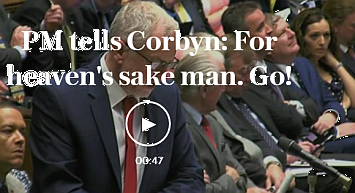
Some guy Americans have never heard of—or if they’ve heard of him don’t know how to pronounce his name— named Jeremy Corbyn, head of the Labor Party (only they spell it “Labour,” like teen-aged girls spelling their names cute: “That Cyndy! She’s special!”

Dozens of Labour Members of Parliament (confusing, don’t they know “MP’” stands for Military Police?) want this Corbyn guy to resign.

It seems they never liked him from the get-go, and would have shrugged him off long before now, except he won a massive victory from the Party’s rank-and-file in an election.

And now he won’t go!

mod

I thought, OMG! He’s just like Bernie!

And that’s when everything began to make sense.

The ‘objective correlative’ 

Remember how just after the California primary everything looked very “Through the Looking Glass? Remember? Bernie Sanders drawing monster crowds all up and down California… and then going on to “defeat” in the Democratic Presidential primary?

Losing to a candidate who couldn’t fill a third-grade classroom without sprinkling the crowd with California Democratic officials?

hill

Sure ya do, mate.


“Mister Peabody Almost Goes to Washington”

We’ve all seen the movie. A candidate barnstorms across the state. Draws multitudes. Enthusiastic slogans chanted all around.

11

Election night is always the next scene in the montage. Basking in the approval of an excited crowd at a victory party roaring in celebration. The candidate waves for quiet (who are they kidding? Everyone knows they don’t mean it.)

But not this time. Not in California. Lucy picked up the football, took it home. It was DEFLATE-GATE  writ large.


Romeo wakes up, sees Juliet dead, tears all around. 

Many thought, “I must be dreamin’. This can’t be real.” Because there was no “objective correlative” to help bring sense to the experience. No recognizable human moment, as in “Romeo wakes up, sees Juliet dead, tears all around.”

bb

On Youtube, a baby struggles to stand; we all smile. Watch a toddler stumble across a room, swaying side to side like a drunk on a gambling cruise unexpectedly caught in high seas.

We silently urge the drooling little thing on. “Trust your tiny gyroscope, diapered one. In your forehead. Behind your Third Eye.”

There was no recognizable human moment in California, nor many of the other Democratic primaries.

Just a sinking feeling that—once again—we’ve been had.


Hey! That sinking feeling! Stay outta London 

But the jury’s still out on London.

“A massive show of support for Jeremy Corbyn has left the coup coalition of media pundits and disgruntled MPs with their jaws to the floor. With only 24 hours notice, over 10,000 people marched on parliament square to reinforce the Labour leader’s unprecedented democratic mandate.”

sup

Being Britain, things quickly got snarky.

gotime


We wish them well. They’re a plucky bunch. Some have even had their lips surgically removed, which must be a pretty painful procedure.

lip

Brexit Is What Happens When the Pie Is Shrinking

brexit-uk-leaving-eu

By Charles Hugh Smith

Source: Of Two Minds

This process of withdrawal into the relative safety of internally cohesive groups and group identities is intrinsically messy in globalized, multicultural societies.

A great many narratives are drifting around the Brexit pool: a return to sovereignty, class war, “controlled demolition,” nothing-but-another-political-Kabuki- spectacle, end of the European Union, etc.

I think it boils down to something much simpler: the pie is shrinking, and the illusion that it’s about to start growing has been shattered. For many communities in the developed world, the pie started shrinking in the 1970s, and has been shrinking (despite the narrative of “45 years of strong growth”) since then.

Labor’s share of the GDP has been declining for 45 years. Occasional blips higher during debt-fueled bubbles quickly fade when the bubble du jour pops, and the decline of labor’s share of the economy resumes its trendline decline.

wages-GDP5-16a

Since 2008, the only group who feels the pie is growing is the class that has benefited from the unparalleled expansion of debt and leverage, financialization, globalization and central planning–roughly 20% of the work force, with the top 5% gathering most of the gains in income and wealth, and the top .1% gathering most of the increase in wealth. (See chart below)

For seven long years, the citizenry has been told the economy is expanding and therefore they’re “doing better.” But this narrative is not supported by their actual lived experience. Inflation is woefully under-reported by official statistics, and the rosy “rising employment” narrative is based largely on part-time jobs in hospitality and food services (bartenders, waiters, etc.) that are highly contingent on the spending of the top 10%.

While supporters of the status quo are quick to deride supporters of Brexit, the cold reality is the economic pie is shrinking, and Brexit is a direct result of that reality.

A shrinking economic pie generates widespread insecurity that pressures every status quo arrangement as people circle the wagons in an attempt to protect their remaining slice of the pie from others’ claims for a larger piece of the dwindling pie.

The general media line is that the Brexit vote arose out of anger with the status quo’s inequalities and asymmetries of wealth and power. While this is largely self-evident, it isn’t the most fundamental dynamic at work. I see Brexit as a reflection of our naturally-selected defensive response to insecurity and instability: circle the wagons.

By circle the wagons, I mean our tendency to withdraw into an internally cohesive group with defined membership and boundaries.

The largest such political group is the nation-state, and so it is natural for people with strong national identities to circle the wagons around their national identity.

We can also expect people to circle the wagons around ethnic, religious, localized and economic-social class identities. (Some people might feel more kinship with other fans of Manchester United than they do with any religion, ethnicity or state.)

As people identify themselves as members of the class that has not benefited from neoliberal/globalized crony capitalism, the ruling Elites become the “other,” i.e. “foreigners” with whom we have little contact, people who “aren’t like us”– in effect, an “enemy class” that is inherently opposed to our self-interests.

This process of withdrawal into the relative safety of internally cohesive groups and group identities is intrinsically messy in globalized, multicultural societies. No wonder populations are dividing into camps of increasingly angry people with little interest in compromise. Our instinct is to seek clear delineations of “us” and “them” and to seek the relative comfort of “us,” which in a multicultural nation, can contain quite a mixed bag of people who nonetheless feel a shared identity.

Much to the chagrin of political parties whose success is based solely on “identity politics,” the emerging group identities are not conforming to the political classes’ conventional fault lines. “Us” for many people includes everyone who isn’t a protected insider of the status quo, and “the enemy” is any protected insider of the status quo.

That includes virtually the entire political class, the entire class of state nomenklatura/technocrats, the entire banking sector and the wealthy class that’s benefited so handsomely from the globalized, debt-leverage bubbles and state / central bank support that characterize this era of neoliberal/globalized crony capitalism.

wage-inequality3-16a

wealth-distribution10-15a

A Radically Beneficial World: Automation, Technology and Creating Jobs for All is now available as an Audible audio book.


What is the Big Lesson of the UK ‘Brexit’ Vote for Americans? It Was Done With Paper Ballots

UKandUSvoting.preview

Voting in the UK is done on paper ballots, as her in the ‘Brexit’ referendum. In the US many vote on easily hacked computers that leave no paper trail.

By Dave Lindorff

Source: This Can’t Be Happening

The decision by a majority of UK voters to reject membership in the European Union in Wednesday’s hotly-contested referendum has been a devastating defeat for the corporatist domination of the European political and economic scene. It throws the corporate duopoly in the UK into turmoil, and also has the EU bureaucrats and the banking elite in Brussels and the financial capitals of Europe in a panic, lest other countries’ voters, as in Spain and Italy, or even France and the Netherlands, decide to follow suit. (Spain has a national election tomorrow which could be heavily influenced by the British referendum outcome, since if the united left wins, it could eventually lead to Spain’s exit from the EU.)

But for the US, which is not a party to the EU, there is also a huge lesson: ‘Brexit,’ despite being opposed by the political establishment — Conservative and Labor — and by the corporate elite of London’s City, the financial capital of Europe, won this vote. And the reason the opponents of UK membership in the EU were able to win against all that powerful opposition, has, in no small part, to do with the fact that all the voting was done on paper ballots.

Compare that to the US, where voting, for the vast majority of people, is done on machines, in many cases electronic machines that leave no paper trail of individual votes, or even of vote totals per machine. We are always hearing reports of faulty — or hacked — machines that are “flipping” votes, so that someone can cast a vote for a Democratic candidate or party slate and see it switched to Republican, reports of entire tallies for a day’s voting being simply lost, machines that don’t work, forcing would be voters to wait for hours to vote on a limited number of machines that supposedly are working, limited polling places because county or city governments claim they can’s afford to buy an adequate number of machines, a shortage of paper ballots when machines fail, etc.

The list of excuses goes on and on. And why, one might ask, does America vote by electronic machines instead of on readily verifiable paper ballots? The only possible reason is pressure from the corporate media, whose sole interest in our elections is the “horse race” leading to a meaningless competition to get the results out first. Why should it matter though, if you think about it, whether we learn the results of an election an hour or two after the voting ends, or the next day, or even several days after the voting? Why, in fact, do we allow news organizations like AP or the New York Times to “call” elections based on faulty algorithms that are based on extrapolations of early counts in specific targeted voting districts?

Most recently, we witnessed the outrage of AP calling the Democratic national presidential primary for Hillary Clinton the morning that California and six other states totaling 15% of the total delegate count in the nation were holding primaries and then announcing the victory in California that evening when less than half of the votes cast had actually been counted (the rest were paper ballots — both mailed-in ones, and over a million “provisional” ballots that were given to voters who had registered close to election day, and whose registrations had not been provided in time to local voting district officials. As those votes are counted — and they are still being counted today, some two and a half weeks after the voting! — it is becoming clear that far from a rout by Hillary Clinton, the vote between Clinton and Sanders was very close, as will be the delegate count for each candidate.

A number of analysts have pointed out that there is serious evidence of vote rigging in the Democratic primary in favor of Clinton, with most of the states that she won outside of the deep South which had electronic voting machines having exit polls that showed Sanders should have won. There is no way to check those votes, however, because the machines don’t have a paper trail.

And that’s not all. The primary, like elections in prior years, has been rife with other examples of interfering with the right of Americans to cast their votes. There was massive voter suppression in New York’s Democratic primary, for example, with entire neighborhoods in Brooklyn and other jurisdictions — all of them likely to have favored Bernie Sanders — finding that their voter registration records had been wiped, making them ineligible to vote. Other venues, in New York and other states, found that people who had registered as Democrats were recorded as “independents,” making them, in closed-primary states, ineligible to vote in the primaries.

The list of such abuses and frauds goes on and on and, like the many examples of voter suppression by both Republican and Democratic governments in the past, make it clear that voting in the US is as corrupted as it is in many third-world countries where elections are understood to be only for show.

The lesson of Britain’s ‘Brexit’ referendum, like the hotly contested presidential election I witnessed and covered in Taiwan in 2004, both of which contests were conducted using paper ballots, and the latter which was subjected to a recount that returned an almost identical result after tons of paper and millions of ballots were painstakingly inspected and hand-counted all over again, is that democracy can only work if voting is scrupulously honest and absolutely verifiable. On both those counts the US fails miserably, meaning that besides all the other problems that make American democracy a joke — the grotesquely biased (and inane) media coverage, the widespread voter apathy and ignorance, a stultifying two-party political system that limits candidate choices to two virtually identical candidates and to two political positions that only differ in meaningless, but emotionally powerful ways, and a campaign-funding system that in reality is nothing but legalized bribery — American voters cannot really expect their votes to be honestly counted in the end.

If a referendum like ‘Brexit’ were to be held in a US-type electoral system, involving a major issue affecting powerful economic interests, it would have predictably failed. Of this there is little or no doubt. What in the ’60s we called “The System” would simply not have allowed opponents of EU membership to win.


Related Article: Freedom Rider: The Good News of Brexit