Two for Tuesday
Reply

By Danica Thiessen
Source: PANDA
In 2004, when Foreign Policy asked eminent scholar Francis Fukuyama to write an article answering the question, What is the world’s most dangerous idea?, he responded with a piece titled Transhumanism. Fukuyama argued that the transhumanist project will use biotechnology to modify life until humans lose something of their ‘essence’, or fundamental nature. Doing so will disrupt the very basis of natural law upon which, he believes, our liberal democracies are founded (Fukuyama, 2004). For Fukuyama, these losses lay unrecognised beneath a mountain of promise for a techno-scientific future of imaginative self-improvement.
Currently, the Fourth Industrial Revolution, in which transhumanism plays a central guiding role, is shaping the policies of global corporations and political governance (Philbeck, 2018: 17). The converging technologies of this revolution are nanotechnology, biotechnology, information technology, cognitive sciences (NBIC), and artificial intelligence (Roco and Bainbridge, 2002). The political class and the new technology elite routinely tell us that ‘the age of AI has arrived’ (Kissinger et al., 2021). Simultaneously, modern humans have also become increasingly dependent on advanced technologies and the complex systems they enable. These changes have presented new challenges to old questions, namely: what does it mean to be human? And what future do we want for ourselves?
From the hype of super-intelligence to self-assembling nanobiology, the world can seem increasingly science-fictional. Contemporary technological society is “harder and harder to grasp”, is full of “disruptions…that move ever faster”, and is confronting us with “situations that seem outrageously beyond the scope of our understanding” (Schmeink, 2016: 18).
This paper aims to further our critical engagement with an ideology that is emerging across influential sectors of society. With this aim in mind, I will make three essential arguments: Firstly, transhumanism is a movement based on a techno-scientific belief system that is striving towards the technological enhancement of biology and, in this regard, is self-consciously promoting bio-social engineering. Secondly, the technologies of transhumanism have the potential to bring tremendous financial and political gains to corporations and governments who are not incentivised to seek out nor address their potential dangers. Thirdly, the discontent towards transhumanism is diverse and comes overridingly from the threat to traditional values, nature-based ways of life, freedom, equality, and the loss of bodily autonomy to the will of those who operate these powerful systems.
Much of the current scholarship on transhumanism focuses on the intellectual contribution of the movement, with minimal work assessing socio-political impacts. This neglect is worrying since, within the reality of global capitalism, transhumanism may be overridingly motivated by economic and political forces as it may be by ideology. Furthermore, perhaps only a minority of humans may be able to access certain NBIC technologies or utilise them for profits (McNamee and Edwards, 2006: 515). Of course, the socio-economic ramifications may be culturally and politically disruptive in unanticipated ways. It is this overwrought relationship—of transhumanism, the global economy, profitable science, human nature, and traditional belief systems—that demand further critical examination.
Transhumanism is a predominantly Anglo-American movement that has flourished since the 1980s in “American circles of science fiction fans” and with “computer experts and techno-geeks” (Manzocco, 2019: 36). Today, California’s Silicon Valley, with its culture of technological optimism and imaginative entrepreneurship, is the hub of transhumanist thought and innovation. Though scholars have noted that there is no single definition of transhumanism, the essence of transhumanist ideology is to use science and technology to re-design and re-shape the human condition away from randomness, imperfectability, and decay, towards order, perfectibility, and control (Bostrom, 2005: 14).
This ideology emerged in early 20th Century Britain. There is a clear continuity of ideas between current proponents of transhumanism and those who were writing before the Second World War of the potential of science to shape the trajectory of nature, while fostering international cooperation and governance. They included British scientists and thinkers such as Julian Huxley (credited with first using the word Transhumanism in the 1950s), his brother Aldous, and his grandfather Thomas Huxley, as well as their colleagues J.B.S. Haldane, H.G. Wells, J.D. Bernal, and Bertrand Russell. These influential thinkers and internationalists were writing and working on promoting political and scientific outlooks that would form the basis of a century of scientific transhumanist thought (Bostrom, 2005: 4-6; Bohan, 2019: 74-108). The subjects they explored still attract transhumanists today: behavioural conditioning, genetic control, technological augmentation, artificial foods and wombs, space travel, life extension, and total disease control. These and other themes circle around the assertion that nature, including human nature, operates optimally under scientific adjustment and management (Bohan, 2019: 99-100).
Early transhumanists (or proto-transhumanists) viewed techno-scientific advancement as a cure for ‘primitive’ human nature (anger, violence, excess fertility), physical limitations (disease and possibly death), political ignorance, and international conflict. It was the Enlightenment ideal of mastery over nature, including human populations, that Aldous Huxley so aptly demonstrated in his dystopian novel, Brave New World. Huxley’s novel, written in 1931, illustrates a scientific dystopia where transhumanist aims (genetic engineering, anti-aging interventions, biotechnology and enhancement drugs) are used to manage society implicitly through pleasure rather than explicitly through force. Huxley’s depictions were based less on his prophetic abilities and more on his intimate knowledge of the possibilities of social engineering as discussed and promoted by the scientific minds with whom he mingled. His later essay, Over-population, surmises that his novel’s projections were “coming true much sooner than” anticipated (Huxley, 1960: 1).
Notably, Aldous’s brother, Julian Huxley, also wrote about the ills of global overpopulation while promoting the genetic control (‘improvement’) of populations through eugenics (Hubback, 1989; Huxley, 1933). His 1957 essay, Transhumanism, claimed that man was the “managing director” of “evolution on this earth” (Huxley, 2015:12-13). He was very involved with Britain’s Eugenics Society for over three decades, serving as Vice-President and then President, as well as supporting “campaigns for voluntary sterilization…and for negative eugenics measures against persons carrying the scientific stigma of ‘mental defect’” (Weindling, 2012: 3). Julian Huxley was the first Director-General of UNESCO and founder of the World Wildlife Fund (Byk 2021: 141-142). In this role, he promoted the ideology of an international, scientifically-founded welfare state to further his aim of liberating “the concept of God from personality” because “religions as all human activities is always an unfinished work” (Byk, 2021:149), (Huxley, 1957:10). Julian Huxley’s work and writing envisioned an international social engineering project based on rational scientific management that promised to elevate humanity towards global peace (Sluga, 2010; Byke, 2021:146).
Transhumanism has a wide variety of interpretations, similar to how a major religion is expressed with a divergence of commitment, beliefs and motivations. In fact, many scholars consider transhumanism to be a novel, emerging religion with significant parallels to Christian eschatology (deGrey et al., 2022; O’Gieblyn, 2017). The vast majority of transhumanists do not accept a monotheistic ‘God’ or the moral restraints of traditional religions, but instead endow “technology with religious significance,” leading scholars to define it as “a secularist faith” (Tirosh-Samuelson, 2012: 710).
While not all transhumanists partake in techno-spiritual views, transhumanists essentially view technology as the redemption for fallible biology. For some, these perspectives were inspired by the philosophical work of Pierre Teilhard de Chardin (1881-1955). Tielhard de Chardin was a palaeontologist and Jesuit who believed that a “worldwide network would be woven between all men about earth” and that a “God-like entity” would form from a future “conscious, collective, omniscient mind—the Omega Point” (Bohan, 2019:92). The concept of technological ‘transcendence’ has continued to be central to Transhumanism in conversations about the worldwide web, the Internet of Bodies, artificial intelligence, and the ‘Singularity’, which is the belief that human-machine intelligence will grow exponentially and reach a point where humanity will be thrust into a posthuman age (Bohan, 2019:96; Kurzweil, 2005). The belief that humans (or rather posthumans) can become immortal and ‘god-like’ in a future machine-dominated age—complete with astral travel and digital telepathic communication—is why, in its philosophical form, many scholars understand transhumanism as a techno-materialist religious movement.
In an attempt to consolidate such a complex movement, transhumanist philosopher Nick Bostrom—current head of the Future of Humanity Institute at Oxford University, and transhumanism’s most legitimate academic—co-founded the World Transhumanist Association in 1998 (Bostrom, 2005:12-13). Out of this work, the Transhumanist Declaration was drafted. It consists of bold statements such as: Humanity will be radically changed by technology in the future. We foresee the feasibility of redesigning the human condition. The Declaration concludes with: Transhumanism advocates for the well-being of all sentience whether in artificial intellects, humans, posthumans, or non-human mammals. The Declaration makes it clear that transhumanism is an unprecedented social engineering project promoting the desirability of using “technology to push the boundaries of what it means to be human and to transcend our biological condition”, as described by Mark O’Connell, author of To Be a Machine (Mayor, 2018).
Two American transhumanist philosophers who have worked, since the 1980s, to spread transhumanist ideas, are Max More and Natasha Vita-More. They are entrepreneurs in the cryonics industry, which deep-freezes human corpses (called ‘patients’) with the aim of future revival (McKibbin, 2019:184-185). Vita-More, in a recent interview, emphasised that the essence of transhumanism is, “a transition of being human-animal into becoming more mechanised using different devices and technologies to enhance humans into whatever they feel that they are.” This very Californian-esque promise of becoming ‘whatever you want to be’ could result in a more mechanised, or augmented, version of you. We already see the emergence of this new ‘becoming whoever you want’ phraseology in the popular acceptance of enhancement chemicals, biotechnology, and videogames. A pantheon of new technologies is on the horizon: exoskeletons, virtual reality, robotics, body-changing pharmaceuticals, remote-controlled nanotechnology, artificial foods, brain implants and synthetic organs. Adopting these technologies is a part of what Max More describes as becoming the Overhuman, otherwise known as the Posthuman: if you are Transhuman you are essentially a transitional human.
In The Overman in the Transhuman, More attributes attitudes in transhumanism to Nietzsche’s philosophy, arguing that the overhuman is the “meaning-giving” concept meant to “replace the basically Christian worldview” of Nietzsche’s time (and, to a lesser extent, our times). More holds that the current “relevance of the posthuman” is that it ultimately gives meaning to scientifically-minded people” (More, 2010:2). In this influential paper, More asks the reader to “take seriously Nietzche’s determination to undertake ‘a revaluation of all values’” (More, 2010:3). Since a modern overhuman upgrade will depend on human gene editing and other biotechnology applications (such as Elon Musk’s Neuralink) becoming legally available, More’s call to ‘reevaluate values’ is understandable. Issues raised on both sides of the academic debate concern which values and traits would be genetically chosen, and to what extent human enhancement will be voluntary (Levin, 2018).
While earlier Anglo-American eugenicists argued for the removal of anti-social genes by sterilisation, some modern transhumanist proponents have argued that moral bioenhancement, through selective gene editing, should become compulsory (Persson and Savulescu, 2008). Many notable transhumanists argue for procreative bioenhancement of offspring by the parents (Levin, 2018:38). Transhumanist advocates Ingmar Persson and Julian Savulescu believe moral enhancement should become obligatory like “education and water fluoridation,” since “those who should take them are least likely to be inclined” (Persson and Savulescu, 2008: 22). Transhumanist Niel Levy argues that “cognitive enhancement could be required,” much as vaccines currently are (Levy, 2013:38). Scholar Susan Levin writes that allowing a techno-scientific transhumanist vision to shape the “form that society takes” may lend itself to “socio-political requirements that would clash with…liberal democracy” (Levin, 2018:50). She also argues that when transhumanists use “public health analogies and reasoning” to “justify vigorous enhancement” they are putting into serious question their commitment to autonomy (Levin, 2018:48). In this way, the coercive vaccine mandates used during the Covid-19 pandemic can be interpreted as an early warning signal for how future bio-enhancements are likely to be accompanied by forceful moralistic and utilitarian arguments.
Ingmar Person, Julian Savulescu, and Niel Levy are prominent ethicists at the University of Oxford; all three advocate for mandatory genetic enhancement despite the trail of 20th century trauma wrought by grandiose social- and eugenic engineering projects. Does this suggest that a moral framework based on utilitarian arguments and flawed metaphysics remains fundamentally unchanged in public health governance since the last century? In his recent book God and Gaia: Science, Religion and Ethics on a Living Planet, scholar Michael Northcott argues that a growing “post-human agenda” has become central to policies around public health—referred to as “biosecurity”—which has very little to do with authentic “human health or health of the environment” (Northcott, 89). The consequences of this ideology became apparent during the recent mandating of the experimental gene-altering vaccines, and could represent what Northcott refers to as “automatism”. This is when we are culturally obligated to “use new technologies regardless of the possible consequences” because of a utilitarian ethic of the “managerial goal of efficiency” (Northcott, 2022: 114). To underestimate the suffering caused by one-size-fits-all public health measures is inadequate scholarship, yet despite this, only a minority of academics have openly questioned the use of coercive genetic therapy during the Covid-19 pandemic.
A clash between individual rights and a movement that aims to “re-design the human condition” seems inevitable. In the words of transhumanist scholar Nick Bostrom, “human nature is a work-in-progress, a half-baked beginning that we can learn to remould in desirable ways” (Bostrom, 2005: 3). As the co-founder of the World Transhumanist Association, David Pearce said,
“…if we want to live in paradise, we will have to engineer it ourselves. If we want eternal life, then we’ll need to re-write our bug-ridden code and become god-like…only high-tech solutions can ever eradicate suffering from the living world”.DOEDE, 2009: 47
It is human nature that often comes into direct conflict with massive social engineering projects. Understanding transhumanism as a bio-social engineering project of unprecedented scale is a useful perspective in that it focuses the potential conflicts as value-based and ideological rather than as a direct result of specific scientific advances (Broudy and Arakaki, 2020). Furthermore, the term ‘social engineering’ is in itself inadequate, in that a utopia that aims to phase out Homo sapiens, while making way for the new, enhanced posthuman, is historically unprecedented (Bauman, 2010), and is possibly an energetic form of nihilism or an expression of ‘losing oneself’ to an intoxication with machine power, inspired by what scholars identify as “machine fetishism” (Geisen, 2018: 6). Yet, the surprising willingness to martyr one’s physical self to attain paradise has always been particular to our species (Pugh, 2017).
In congruence with the scholarly work available, I have focused on the ideas of philosophical and academic transhumanists, but transhumanism is an ideology reaching far beyond discourse. Though under-discussed in the academic literature, the movement is advanced by corporate and political transhumanists, and transhumanist scientists. Massive corporate and state investment in NBIC technologies rely on specialised scientists working in the military, elite universities, and corporate laboratories to push the frontiers of reality with robotics, artificial intelligence and biotechnology (Mahnkopf, 2019: 11). These scientists are designing technologies with such potential that the world’s most powerful players, such as the Chinese Communist Party and the US Department of Defense (DOD), are deeply involved. In January 2023, Harvard University’s esteemed chemist Charles Leiber was on trial for lying to the DOD about his involvement with the Wuhan University of Technology over his work on “revolutionary nanomaterials.” In his Harvard laboratories, Leiber and his assistants have created nanoscale wires that can record electrical signals from neurons (Silver, 2022). Nanowire brain implants were designed by Leiber to “spy on and stimulate individual neurons” (Gibney, 2015:1). In an age where neurotechnology and mind-machine interfaces are changing the nature of warfare, the contested power-potential of transhumanist techno-science is quickly apparent (DeFranco, 2019).
The transhumanist vision for the future should not be viewed outside of the ‘technological arms race’ or a competitive, utilitarian mindset that informs business, war-making, and our cultural esteem of scientific research. This suggests that more research understanding corporate and political transhumanists is critical in analysing how this group is actively involved with determining humanity’s future. Political leaders with a sharp sense for power understand that machine intelligence and enhancement may determine the world’s winners and losers (Kissinger et al., 2021). As Vladimir Putin articulates: “Artificial Intelligence is the future, not only for Russia, but for all of humankind. It comes with colossal opportunities but also threats that are difficult to predict. Whoever becomes the leader in this sphere will become the ruler of the world” (Karpukhin, 2017). The elite fascination with transhumanist technologies concerns the potential power inherent in the technology itself—and in who creates and controls it. The influential historian and speaker, Yuval Noah Harari, expressed this view in his 2021 Davos Summit presentation where he said that technology “might allow human elites to do something even more radical than just build digital dictatorships. By hacking organisms, elites may gain the power to re-engineer the future of life itself. Because once you hack something, you can usually geo-engineer it.”
Harari is a frequently featured speaker at the World Economic Forum (WEF) and associated events. The WEF is currently acknowledged as one of the “most significant case studies of private authority with global impact” (Vincent and Dias-Trandade, 2021: 711). Criticised as being a “transnational elite club, with high media visibility” and a neoliberal “agenda-setting power,” the WEF can be understood as an “instrument for global geopolitical domination” (Vincent and Dias-Trandade, 2021: 711). At the very least, it is a forum where heads of state, CEOs of multi-billion-dollar companies, and academics who intelligently promote strategic values, are encouraged to collaborate and shape the global future. On WEF and other media collaborative platforms, Harari eloquently argues for humanity to “break out of the organic realms to the inorganic realm” with the creation of a new type of machine human so much more sophisticated than us that our current form will be more drastically different from it than “Neanderthals” or “chimpanzees” are from us today (BBC, 2016). Perhaps this epochal vision is received with welcome at the WEF because it boldly asserts a future dystopia for those who choose to ignore this high-tech revolution. It may act as a motivational warning to “acculturate” or “disappear.”
Scholar Kasper Schiølin (2020) believes WEF agenda setting is accomplished through strategic political and corporate marketing and the discourse of “future essentialism” where the “fabrication of power” and of an inevitable global destiny is reinforced by “sociotechnical imaginaries” and “epochalism.” Future essentialism is the construct of narratives that use “historical analysis…speculative estimates…and hard statistics” to disseminate an idea of a “fixed and scripted…future” that can be “desirable if harnessed” but also “dangerous if humanity fails” to accept the vision. “Epocholism” is an attempt to capture “The Spirit of the Age” and promote a feeling that the current times are of unsurpassed historical significance. These strategies, Schiølin (2020:553) convincingly argues, are how the “WEF produces a moral-political universe around The Fourth Industrial Revolution (4IR).” Is it possible that these techniques can create a narrative of urgency, significance, and global opportunity that can persuade us (or our leaders) to participate in a transnational, transhumanist future?
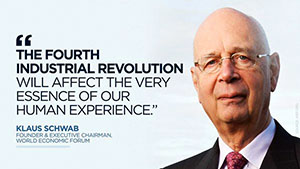
Klaus Schwab is the founder of the WEF and the one responsible for conceptualising and promoting this revolution, which was announced in his 2016 book The Fourth Industrial Revolution. Schwab (2017) describes the 4IR as a social re-setting (named the ‘Great Reset’) enabled by “a range of new technologies that are fusing the physical, digital and biological worlds, impacting all disciplines, economies and industries, and even challenging ideas about what it means to be human.” Analyses of the 4IR conclude that the rate of technological change is supposed to “accelerate” and be “exponential”, covering the Internet of Things (IoT), AI, automation, genetic engineering of humans and natural biology, nanomedicine, smart cities (where sensors are embedded all over the environment), a sci-fi enabled military, and algorithms with political agency (Trauth-Goik, 2021: 3).
Political scientist Klaus-Gerd Giesen convincingly argues that transhumanism is the “dominant ideology” of the 4IR, having become a “grand narrative” for politicians while “advancing the interests of multinational tech giants” (Geisen, 2018: 10). Giesen views this revolution as a “significant rupture in the evolution of capitalism” as well as the tradition of humanism, arguing that “transhumanist machinism” is “fundamentally anti-human—not least because the machine is by definition inhuman” (Geisen, 2018: 6). With global 5G networks, the Internet of Things and of Bodies, and the convergence of the NBIC technologies, the “body as market” (Geisen, 2018: 10), or what Céline Lafontaine defines as the corps-marché (Céline, 2014), is complete. The sheer mass of consumption will exponentially rise with marketable ‘smart’ products: “wearable tech, autonomous vehicles, biochips, bio sensors” and other new materials (Mahnkopf, 2019: 2). This is a materially focused future where consumer upgrades are baked into the system, so it’s no wonder that corporate monopolies such as Amazon, Apple, Facebook, Google, and Microsoft, the “new industrial kings” are actively promoting this revolution (Mahnkopf, 2019: 14).
In his book, Falter: Has the Human Game Begun to Play Itself Out?, the environmentalist Bill McKibben writes that, “the Silicon Valley tycoons are arguably the most powerful people on earth” (McKibben, 2019: 183). North American West Coast transhumanist visionaries are an avant-garde community of ultra-rich technologists, businesspeople and inventors who are idolised by the media and who collaborate extensively with the US State to advance their aims. Eric Schmidt illustrates the collaboration common between US State defence organs, academia, and giant technology corporations (Conger and Metz, 2020). With a net worth of $23 billion, Schmidt was the Executive Chairman of Google and is now the current Chairman of the National Security Commission on Artificial Intelligence (NSCAI) for the US Department of Defense, where he advised President Biden to reject a ban on AI-driven autonomous weapons (Shead, 2021). Schmidt believes that artificial intelligence will “govern society” and be “perfectly rational”, outdating and rendering useless human intuition and knowledge. As with most tech billionaires, Schmidt has set up a private charity, Schmidt Futures, and has so far donated a billion dollars towards his AI educational aims (Philanthropy News Digest, 2019). While he admits that he did not design Google to regulate ‘misinformation’ more effectively, censorship is increasing with the accelerated abilities of AI (working with humans) to moderate and remove content on the Internet (Desai, 2021).
Many of our most influential technologies come from programmes at the US Defense Advanced Research Projects Agency (DARPA). DARPA funds ‘blue sky’ technology research and is credited with inventing the Internet, GPS, virtual reality, and drones. The agency is now set on advancing human augmentation both in and off the battlefield, with the goal of mastering brain-computer neural-interfaces (Krishnan, 2016). Arati Prabhakar is the former head of DARPA, and Chief Science Advisor to President Biden. Prabhakar, like the prior head of DARPA, Regina Dugan, moves between working with technology companies in Silicon Valley and the US Department of Defense. Like most, she is enthusiastic about a transhumanist future of augmentation, and advocates for this as a matter of national security. And yet, she also admits that this “will bring surprises that we may not like. For generations we have thought about technologies that change our tools – but this is about technology that changes us.” We already have ample evidence that our current technologies, particularly wireless devices and chemicals, are physically changing our human (and planetary) biology, but the aims of DARPA and the DoD are more ambitious and revolve around the complete mastery of evolution (including the human genome) and natural systems (including the human population) using technology (Carr, 2020). This is exemplified in the recent, far-reaching US Executive Order for Advancing Biotechnology, which states that “we need to develop genetic engineering technologies” to “write circuitry for cells and predictably program biology in the same way in which we write software and program computers.” The order states that this is to “help us achieve our societal goals.” These societal goals are central to what the White House identifies as the “bioeconomy” where “computing tools and artificial intelligence” will help us “unlock the power of biological data”, scale up production, and reduce “obstacles for commercialization” (Biden, 2022).
In March 2022 at the World Government Summit, Elon Musk, a self-identified transhumanist, and the world’s wealthiest individual, spoke bluntly from the podium. He announced that he sees the upcoming AI apocalypse as a human-extinction event. What is the solution? “We must all become cyborgs if we are to survive the inevitable robot uprising.” This may be marketing, since Musk’s Neuralink is poised to start human trials of brain implantable chips” (Neate, 2022). Radically enhanced human cognition should, Musk predicts, counterbalance the dangers posed by super-intelligent machines. If the richest man on earth prophesied a mass AI extermination event and an inevitable posthuman future from the platform of the World Government Summit, should we dismiss it as just another tech business strategy?
In her analysis of the 4IR, Birgit Mahnkopf (2019:2) writes that a “system of physical-to-digital technologies embodied in machines and equipment…would enable sensing, monitoring, and control of the entire economy.” This is occurring against a backdrop of increasing global inequality and centralisation of wealth. It is estimated that eight men own as much as half the monetary wealth of the other eight billion humans (The New York Times, 2017). Schwab and other elites understand the social and political implications of their technological ideology and the rules of the ‘winner-takes-all’ market economy that will continue to consolidate gains from disruptive technologies. Universal basic income and social credit systems (with a resource-based economy and central bank digital currencies, or CBDCs) are presented as solutions to managing popular resistance and social unrest.
The WEF represents the fusion of transhumanist goals within global governance. As Schwab notes, the organisation has been very effective at ‘penetrating the cabinets’ of national governments. As Harvard scholar Kasper Schiølin (2020:549) astutely observes, the “4IR is justified as kings and emperors once justified their authority as divine and natural in uncertain times.” Hence, it may be that the potential problems from transhumanist ideologies come, not so much from the prospect of an AI take-over, but from the elites’ use of the culture and technologies of transhumanism. It may be that these risks overwhelm liberal democracies long before sentient AI does.
Few intellectuals note the opposition to transhumanism better than the transhumanists themselves. Nick Bostrom writes that resistance comes from:
“Ancient notions of taboo; the Greek concept of hubris; the Romanticist view of nature; certain religious interpretations of the concept of human dignity and of a God-given natural order; Karl Marx’s analysis of technology under capitalism; various Continental philosophers’ critique of technology, technocracy, and the rationalistic mindset that accompanies modern technoscience; foes to the military industrial complex and multinational corporation; and objectors to the consumerist rat-race.”BOSTROM, 2005:18
Bostrom’s summary is a panorama of human expression, literature, thousands of years of culture, religion, philosophy and human meaning-making. Modern literature on philosophy, culture and technology, from Jacques Ellul, Jerry Mander, Neil Postman and Wendell Berry to Jürgan Habermas and Martin Heidegger, offer poignant critiques that are relevant to opposing transhumanist visions of the future, and remind us of the value of community, embodied wisdom, and traditions, and the effects of technological systems. The difference in writing styles is noteworthy: while pro-transhumanist writing tends to be utilitarian and have a tone of scientific authority, ‘bioconservatives’ will often use narrative, symbols, and a writing style considered traditionally beautiful in human culture.
What is noticeable is that the opposition to transhumanism is broad, ill-defined and diverse. Nick Bostrom notes that “right-wing conservatives, left wing environmentalists and anti-globalists” are all pushing back against central transhumanist aims (Bostrom, 2005: 18). Firstly, there are the well-published intellectual and academic opponents that engage in a forceful scholarly debate with transhumanism over issues such as biotechnology, threats to liberal democracy, and scientific materialism (Leon Kass, 2000 and Francis Fukyama, 2003), and the environmental and social costs of transhumanism (Bill McKibbin, 2019). Also noteworthy are the bioethicists, George Annas, Lori Andrews and Rosario Isasi, who have advised making “inheritable genetic modification in humans a ‘crime against humanity’” (Annas, et al., 2002: 154-155). These scholars fear the posthuman potential for inequality and war, warning that, “the new species, or ‘posthuman’, will likely view the old ‘normal’ humans as inferior, even savages, and fit for slavery or slaughter…it is the predictable potential for genocide” (Annas, et al., 2002: 162). The common factor amongst these academics is that they believe biological engineering (of humans) would be disruptive to values, rights, and equality, and would threaten liberal democracy itself. These men have been labelled bio-conservatives or, more dismissively, Neo-Luddites, for rejecting the legitimacy of a posthuman future (Agar, 2007:12).
The second group that is emerging as anti-transhumanist are the environmentalists, non-conformists, primitivists, and anarchists committed to Wild Nature with forceful anti-industrial sentiments. In North America, this includes elements of the Deep Green Movement (Bilek, 2021), represented by various writers, artists, activists, ecologists, organic farmers, herbalists and healers, forest-dwellers and hunter/gatherers, spiritualists, and various alternative people, off-grid or nomadic, who refuse to live within a mechanised, industrial system, and may intentionally attempt to sabotage it. As an eclectic group, they have significant influence over specific geographical areas, tend to identify with traditional local indigenous values, and deeply resent Western consumerist culture, war, global corporations, pollution, and industrial infrastructure (Tsolkas, 2015). Notably, some ecofeminists have written that biotechnology is a dangerous “extension of traditional patriarchal exploitation of women” in promoting the reshaping of natural human bodies (Bostrom, 2005: 18).
The third group that has rapidly developed increasing opposition to transhumanism is religious groups. Besides the Mennonite and Amish communities, who maintain ‘old world’ lifestyles across significant sections of the United States, there is a rising anti-transhumanist sentiment and increasing religious fervour amongst some Evangelical Christians across North America. The New York Times reported on the increasing politicisation of evangelical congregations, with defiant unifying songs that repeated, “We will not comply” in the chorus (Dias and Graham, 2022). The language these groups use to describe transhumanism is often symbolic, archetypal and apocalyptic, and understood as an epic battle between light and darkness. For example, speaker and writer, Thomas Horn, has been preaching about the dangers of transhumanism to Christian congregations for over a decade. His books have titles such as Pandemonium’s Engine: How the End of the Church Age, the Rise of Transhumanism, and the Coming of the Ubermensch (Overman) Herald Satan’s Imminent and Final Assault on the Creation of God. Suspicions of ‘Satanic technology’, and anti-transhumanist sentiments may have been a part of the reason why Evangelical Christians were the demographic most unlikely to cooperate with Covid vaccination mandates in the United States (Lovett, 2021; Porter, 2021).
The tragic situation in Ukraine suggests that ideologically-driven wars may increase with the growing animosity between religious and transhumanist world views, or this may be used in war propaganda. The Russian Orthodox Church, with well over one hundred million members, considers the invasion of Ukraine as a battle of light and darkness, with ‘Holy Russia’ fighting against an unholy NATO alliance (Klip and Pankhurst, 2022). The Church Patriarch, Kirill of Moscow, has taken a strong position against biotechnology—including “gene therapy”, “cloning” and “artificial life extension”—and views the Russian Orthodox Church as defending the traditional family against the liberalism of the West (Stepanova, 2022: 8). Addressing the leaders of Russia at the recent 24th World Russian People’s Council, the orthodox believer and philosopher Alexander Dugin proclaimed, “this war is not only a war of armies, of men…it is a war of Heaven against Hell…the Archangel Michael against the devil…the enemy came to us…in the face of LGBT, Transhumanism—that openly Satanic, anti-human civilization with which we are at war with today.” It may be that an influential number of religious Russians believe that they are not fighting against Ukraine at all, but rather rescuing it from the Satanic hold of the Transhumanist West (Siewers, 2020).
The fourth major group that is exhibiting overwhelming anti-establishment sentiments towards what is perceived as the ‘elites’ and their ‘transhumanist agenda’ are the politically and economically disenfranchised working classes and displaced farmers. Known in academic circles as ‘populists’ (Mazarella, 2019: 50), this group has recently displayed significant anger over extended ‘lockdowns’; losing the freedom to travel and to access decent healthcare (in the US); and experiencing unemployment and poverty. Their physically non-compliant behaviour, seen in mass demonstrations, notably across Europe and with the Canadian truckers, has been met with discursive and physical violence from increasingly irritated political leaders and media corporations. These ‘populists’ often reject transhumanism as an elitist ideology that they fear will lead to further loss of bodily autonomy, increased surveillance, political disempowerment, and a reduction of dignified employment to robots and automation (Mazarella, 2019: 130-134). These fears are not altogether unfounded since, according to the WEF, the 4IR is proposed to lead to significant worldwide job losses, perhaps up to 70% (Mahnkopf, 2019: 7). Steven Bannon, the instrumental ‘populist’ of Trump’s 2016 election force, uses religious polemics to rally resistance against what he sees as a rising transhuman globalist agenda. His popular show, the War Room, features broadcasts such as Descent into Hell: Transhumansim and the New Human Race. The outrage this group has towards 4IR transformations and transhumanism cannot be underestimated: within the US many working class families, though not all, also hold values of egalitarian weapons ownership, and their discourse exudes a willingness to engage in violent confrontation over threats to bodily autonomy (Sturm and Albretch, 2021: 130).
The United States’ most infamous anti-transhumanist/anti-technologist came, not from religious circles, but from within the radical environmental movement and academia. Theodore Kazcynski, a mathematical genius and professor at UC Berkeley, conducted an anti-technology terrorist campaign that spanned 17 years, killing three people and injuring 23 (Fleming, 2022). He blackmailed the FBI into publishing his 35,000-word thesis titled Industrial Society and its Future in the Washington Post and New York Times, which led to his capture. Since spending 25 years in solitary confinement, he has published volumes about how to conduct a revolution against the scientific elite. In one volume, The Anti-Tech Revolution: Why and How, he writes,
“The techies themselves insist that machines will soon surpass human intelligence and natural selection will favour systems that eliminate them (humans)—if not abruptly, then in a series of stages so that the risk of rebellion will be eliminated.”KAZCYNSKI, 2016: 79
Kazcynski reacted with terrorism to what he considered an existential threat posed by technology to humans and his greatest love, Wild Nature. His fear was a loss of freedom and masculine human nature, as well as the transformation of society into a controlled Brave New World, something he viewed as inevitable without a revolution (Moen, 2019: 3). In fact, it is arguable that the United States was already too similar to the Brave New World for Kazcynski, since he depicts “fighting industrial society” as “structurally similar to escaping a concentration camp” (Moen, 2019: 3).
Bill Joy, founder of Sun Technologies, authored an influential essay at the dawn of the 21st century, Why the Future Doesn’t Need Us, advocating for the relinquishment of developing “AI, nanotechnology and genetics because of the risks” (Joy, 2000). Interestingly, Joy argues for the legitimacy of Kazcynski’s logic about the threats of advanced technologies, despite Kazcynski having “gravely injured” one of his friends, a computer scientist, with a bomb. Parts of Kazcynski’s writing that shifted Joy’s views included the following:
“The human race might easily permit itself to drift into a position of such dependence on machines that it would have no practical choice but to accept all of the machines’ decisions. As society and problems that face it become more and more complex and machines become more and more intelligent, people will let machines make more of their decisions for them…eventually a stage may be reached in which the decisions necessary to keep the system running will be so complex that human beings will be incapable of making them intelligently. At that stage, the machines will effectively be in control. People won’t be able to just turn the machines off, because they will be so dependent on them that turning them off would amount to suicide.”JOY, 2000: 48-49
This scenario is not too hard to imagine since it is quickly becoming our modern predicament. There is an implicit and explicit consensus in much transhumanist and anti-transhumanist thought, by Musk, Kazcynski, Joy and many others, that this phenomenon is leading, and will continue, to this logical end. The other scenario that Bill Joy quoted in his essay, again from Kazcynski, was:
“On the other hand, it is possible that human control over machines may be retained. In that case the average man may have control over certain private machines of his own…but control over large systems of machines will be in the hands of a tiny elite—just as it is today, but with two differences. Due to improved techniques the elite will have greater control over the masses; and because human work will no longer be necessary the masses will be ‘superfluous’, a useless burden on the system. If the elite is ruthless they may simply decide to exterminate the mass of humanity. Or if they are humane they may use propaganda or other psychological or biological techniques to reduce the birth rate until the mass of humanity becomes extinct, leaving the world to the elites.”JOY, 2000: 48-49
Interestingly, the scenarios do not seem mutually exclusive, at least for a time.
Scholar Ole Martin Moen has noted similarities between Kazycinski, Nick Bostrom and Julian Savulescu in their projections of a future crisis (Moen, 2018: 5). Like Kazcinski, Bostrom has argued that transhumanist technologies expose humanity to a significant risk of eradication (Bostrom, 2019). Savulescu, also like Kazcyinski, argues in Unfit for the Future: The need for moral enhancement, that evolved human nature combined with transhumanist technologies will lead to catastrophic consequences (Persson and Savulescu, 2012). Kazcinski, who believed these outcomes were logical, reacted with violence because his highest ethic was one of authentic, uncontrolled freedom (Moen, 2018:5-6). His life is a warning that some human natures may be entirely incompatible with a techno-scientific future. In fact, the transhumanist vision of human extinction and a ‘posthuman’ future may actually promote anxiety and violence in some humans.
Martin Heidegger has warned that those who seek to use technology’s influence without realising the immense power that the technology has over them, are trapped into becoming extensions of machines rather than free actors. They are “framed like men with advanced computational devices into seeing all of reality as computational information” (Doede, 2009:49). For thousands of years, human existence and meaning-making has accumulated from “birth and death, flood and fire, sleep and waking, the motions of the winds, the cycles of the stars, the budding and falling of the leaves, the ebbing and flowing of the tides” (Powys, 1930: 73), and it seems fitting to question if our highly evolved human tissues and ‘natures’ are strengthened or undermined by advanced technology. Is it possible that human flourishing is encouraged by the ancient struggle with the limitations of our own animal natures, rather than by conforming to the constructs of complex technology? With transhumanism, who is in control and who benefits?
It may be fair to say that transhumanism is a bio-social engineering project that ultimately concentrates power in machines, and humans who behave with machine-like characteristics. Large sections of the earth’s population, such as various religious groups, the working class, indigenous peoples, and other nature-based humans, may resent undemocratic announcements from forums like the WEF that, with the 4IR, industrialization is accelerating towards genetic engineering, robotic automation and virtual living. Furthermore, we may risk promoting an existential crisis and extreme reactions in those who dislike being told that the future belongs to the posthuman rather than to themselves and their offspring. It is a contested future and one that is entirely unwritten.
Agar, N. (2007). Whereto transhumanism?: the literature reaches a critical mass. The Hastings Center Report, 37(3), 12-17.
Akhtar, R. (2022). Protests, neoliberalism and right-wing populism amongst farmers in India. The Journal of Peasant Studies, 1-21.
Annas, G. J., Andrews, L. B., & Isasi, R. M. (2002). Protecting the endangered human: toward an international treaty prohibiting cloning and inheritable alterations. American Journal of Law & Medicine, 28(2-3), 151-178.
Baumann, F. (2010). Humanism and transhumanism. The New Atlantis, 68-84.
BBC (2016) Yuval Noah Harari: “We are probably one of the last generations of Homo sapiens.” Available: https://www.bbc.com/news/av/uk-37171171
Bilek, J. (2021). The Gender Identity Industry, Transhumanism and Posthumanism. Deep Green Resistance News Service. Available: https://dgrnewsservice.org/resistance-culture/radical-feminism/the-gender-identity-industry-transhumanism-and-posthumanism/
Bohan, E. (2019). A history of transhumanism. Doctoral dissertation, Ph.D. thesis submitted for examination November 2018. Macquarie University.
Bostrom, N. (2005). A history of transhumanist thought. Journal of Evolution and Technology, 14(1).
Bostrom, N. (2005). Transhumanist values. Journal of Philosophical Research, 30 (Supplement), 3-14.
Bostrom, N. (2019). The vulnerable world hypothesis. Global Policy, 10(4), 455-476.
Broudy, D., & Arakaki, M. (2020). Who wants to be a slave? The technocratic convergence of humans and data. Frontiers in Communication, 37.
Byk, C. (2021). Transhumanism: from Julian Huxley to UNESCO. Jahr: Europski časopis za bioetiku, 12(1), 141-162.
Carr, N. (2020). The shallows: What the Internet is doing to our brains. WW Norton & Company.
Céline, L. (2014). Le corps-marché. La marchandisation de la vie humaine à l’ère de la bioéconomie.
Conger, K., & Metz, C. (2020). ‘I Could Solve Most of Your Problems’: Eric Schmidt’s Pentagon Offensive. New York Times. Available: https://www.nytimes.com/2020/05/02/technology/eric-schmidt-pentagon-google.html
DeFranco, J., DiEuliis, D., & Giordano, J. (2019). Redefining neuroweapons. Prism, 8(3), 48-63.
Desai, S. (2021). Misinformation is about to get so much worse. The Atlantic. Available: https://www.theatlantic.com/technology/archive/2021/09/eric-schmidt-artificial-intelligence-misinformation/620218/
deGrey, A., Bauman, W. A., Cannon, L., Checketts, L., Cole-Turner, R., Deane-Drummond, C., et al. (2022). Religious transhumanism and its critics. Rowman & Littlefield.
Dias, E., & Graham, R. (2022). The growing religious fervor in the American right: ‘This is a Jesus movement’. The New York Times. Available: https://www.nytimes.com/2022/04/06/us/christian-right-wing-politics.html
Doede, B. (2009). Transhumanism, technology, and the future: Posthumanity emerging or sub-humanity descending?. Appraisal, 7(3).
Fleming, S. (2022). The Unabomber and the origins of anti-tech radicalism. Journal of Political Ideologies, 27(2), 207-225.
Fukuyama, F. (2003). Our posthuman future: Consequences of the biotechnology revolution. Farrar, Straus and Giroux.
Fukuyama, F. (2004). Transhumanism. Foreign policy, (144), 42-43.
Gibney, E. (2015). Injectable brain implant spies on individual neurons. Nature, 522(7555), 137-138.
Giesen, K. G. (2018). Transhumanism as the Dominant Ideology of the Fourth Industrial Revolution. Journal international de bioethique et d’ethique des sciences, (3), 189-203.
Hubback, D. (1989). Julian Huxley and eugenics. In Evolutionary Studies (pp. 194-206). Palgrave Macmillan, London.
Hughes, J. J. (2012). The politics of transhumanism and the techno‐millennial imagination, 1626–2030. Zygon®, 47(4), 757-776.
Huxley, A. (1960). Brave new world and brave new world revisited. Harper & Row, Publisher, Inc.
Huxley, J. (1933). What I Dare Think. Chatto & Windus.
Huxley, J. (1957). Religion Without Revelation.(New and Revised Edition.). Max Parrish.
Huxley, J. (2015). Transhumanism. Ethics in Progress, 6(1), 12-16.
Joy, B. (2000). Why the future doesn’t need us (Vol. 8, No. 4, pp. 47-75). San Francisco, CA: Wired.
Kaczynski, T. J. (2016). Anti-tech Revolution: Why and how. Fitch & Madison Publishers.
Karpukhin, S. (2017) Putin: Leader in artificial intelligence will rule the world. CNBC. Available: https://www.cnbc.com/2017/09/04/putin-leader-in-artificial-intelligence-will-rule-world.html
Kass, L. R. (2000). Triumph or tragedy? The moral meaning of genetic technology. The American Journal of Jurisprudence, 45(1), 1-16.
Kass, L. R., & Kass, R. (2002). Human cloning and human dignity: the report of the president’s Council on Bioethics. Public Affairs.
Kardaras, N. (2016). Glow kids: How screen addiction is hijacking our kids—and how to break the trance. St. Martin’s Press.
Kilp, A., & Pankhurst, J. G. (2022). Soft, Sharp, and Evil Power: The Russian Orthodox Church in the Russian Invasion of Ukraine. Occasional Papers on Religion in Eastern Europe, 42(5), 2.
Kissinger, H. A., Schmidt, E., & Huttenlocher, D. (2021). The age of AI: and our human future. Hachette UK.
Krishnan, A. (2016). Military neuroscience and the coming age of neurowarfare. Taylor & Francis.
Kurzweil, Ray. (2005). The Singularity is Near. Penguin Books Ltd.
Levin, S. B. (2018). Creating a Higher Breed: Transhumanism and the Prophecy of Anglo-American Eugenics. In Reproductive Ethics II (pp. 37-58). Springer, Cham.
Levin, S. B. (2020). Posthuman Bliss?: The Failed Promise of Transhumanism. Oxford University Press.
Levy, N. (2013). There may be costs to failing to enhance, as well as to enhancing. The American Journal of Bioethics, 13(7), 38-39.
Lovett, I. (2021). White Evangelicals Resist COVID-19 Vaccine Most among Religious Groups. The Wall Street Journal. Available: https://www. wsj. com/articles/white-evangelicals-resist-COVID-19-vaccine-most-among-religious-groups-11627464, 601.
Mahnkopf, B. (2019). The ‘4th wave of industrial revolution’—a promise blind to social consequences, power and ecological impact in the era of ‘digital capitalism’. EuroMemo Group.
Mayor, S. (2018). Transhumanism: five minutes with… Mark O’Connell. British Medical Journal. (361:k2327).
Mazocco, R. (2019). Transhumanism—Engineering the Human Condition. Springer Praxis Books.
Mazzarella, W. (2019). The anthropology of populism: beyond the liberal settlement. Annual Review of Anthropology, 48(1), 45-60.
McKibben, B. (2019). Falter. Black Inc..
McNamee, M. J., & Edwards, S. D. (2006). Transhumanism, medical technology and slippery slopes. Journal of Medical Ethics, 32(9), 513-518.
Moen, O. M. (2018). The Unabomber’s ethics. Bioethics, 33(2), 223-229.
More, M. (2010). The overhuman in the transhuman. Journal of Evolution and Technology, 21(1), 1-4.
Neate, R. (2022) Elon Musk’s brain chip firm Neuralink lines up clinical trials in humans. The Guardian. Available: https://www.theguardian.com/technology/2022/jan/20/elon-musk-brain-chip-firm-neuralink-lines-up-clinical-trials-in-humans
Northcott, M. S. (2022). God and Gaia: Science, Religion and Ethics on a Living Planet. Taylor & Francis.
O’Gieblyn, M. (2017) God in the Machine: My strange journey into transhumanism. The Guardian. Available: https://www.theguardian.com/technology/2017/apr/18/god-in-the-machine-my-strange-journey-into-transhumanism
Persson, I., & Savulescu, J. (2012). Unfit for the future: The need for moral enhancement. OUP Oxford.
Persson, I., & Savulescu, J. (2008). The perils of cognitive enhancement and the urgent imperative to enhance the moral character of humanity. Journal of Applied Philosophy, 25(3), 162-177.
Philbeck, T., & Davis, N. (2018). The fourth industrial revolution. Journal of International Affairs, 72(1), 17-22.
Philanthropy News Digest (2019). Schmidts Commit $1 Billion to Develop Talent for the Public Good. Available: https://philanthropynewsdigest.org/news/schmidts-commit-1-billion-to-develop-talent-for-the-public-good
Porter, T. (2021) How the evangelical Christian right seeded the false, yet surprisingly resilient, theory that vaccines contain microchips. Business Insider. Available: https://www.businessinsider.com/how-evangelical-right-pushed-microchip-vaccine-conspiracy-theory-2021-9
Powys, J.C. (1930). The Meaning of Culture. Jonathan Cape.
Roco, M. C., & Bainbridge, W. S. (2002). Converging technologies for improving human performance: Integrating from the nanoscale. Journal of Nanoparticle Research, 4(4), 281-295.
Schmeink, L. (2016). Dystopia, Science Fiction, Posthumanism, and Liquid Modernity. Biopunk Dystopias. Genetic Engineering, Society and Science Fiction. Liverpool: Liverpool University Press, 18-70.
Schiølin, K. (2020). Revolutionary dreams: Future essentialism and the sociotechnical imaginary of the fourth industrial revolution in Denmark. Social Studies of Science, 50(4), 542-566.
Shead, S. (2021) U.S. is ‘not prepared to defend or compete in the A.I. era,’ says expert group chaired by Eric Schmidt. CNBC. Available: https://www.cnbc.com/2021/03/02/us-not-prepared-to-defend-or-compete-in-ai-era-says-eric-schmidt-group.html
Schwab, K. (2017). The fourth industrial revolution. Currency.
Siewers, A. K. (2020). Totalitarian transhumanism versus Christian theosis: From Russian Orthodoxy with love. Christian Bioethics: Non-Ecumenical Studies in Medical Morality, 26(3), 325-344.
Silver, A. (2022). What Charles Lieber’s conviction means for science. Nature, 601(7894), 493-494.
Sluga, G. (2010). UNESCO and the (one) world of Julian Huxley. Journal of World History, 393-418.
Stepanova, E. A. (2022). “Everything good against everything bad”: traditional values in the search for new Russian national idea. Zeitschrift für Religion, Gesellschaft und Politik, 1-22.
Sturm, T., & Albrecht, T. (2021). Constituent Covid-19 apocalypses: contagious conspiracism, 5G, and viral vaccinations. Anthropology & Medicine, 28(1), 122-139.
The New York Times (2017) World’s 8 Richest Men have as much Wealth as Bottom Half, Oxfam says. The New York Times. Available: https://www.nytimes.com/2017/01/16/world/eight-richest-wealth-oxfam.html
Tirosh‐Samuelson, H. (2012). Transhumanism as a secularist faith. Zygon®, 47(4), 710-734.
Tolstoy, A., & McCaffray, E. (2015). Mind games: Alexander Dugin and Russia’s war of ideas. World Affairs, 25-30.
Trauth-Goik, A. (2021). Repudiating the fourth industrial revolution discourse: a new episteme of technological progress. World Futures, 77(1), 55-78.
Tsolkas, P. (2015). No system but the ecosystem: Earth first! and Anarchism. Available: https://anarchiststudies.org/no-system-but-the-ecosystem-earth-first-and-anarchism-by-panagioti-tsolkas-1/.
Vicente, P. N., & Dias-Trindade, S. (2021). Reframing sociotechnical imaginaries: The case of the Fourth Industrial Revolution. Public Understanding of Science, 30(6), 708-723.
Weindling, P. (2012). Julian Huxley and the continuity of eugenics in twentieth-century Britain. Journal of Modern European History, 10(4), 480-499.
Wells, H. G. (1940). The New World Order—Whether it is Attainable, How it can be Attained, and What Sort of World a World at Peace Will Have to Be. London: Seeker and Warburg.

“Whether in actual fact the policy of the boot-on-the-face can go on indefinitely seems doubtful. My own belief is that the ruling oligarchy will find less arduous and wasteful ways of governing and of satisfying its lust for power, and these ways will resemble those which I described in Brave New World. Within the next generation I believe that the world’s rulers will discover that infant conditioning and narco-hypnosis are more efficient, as instruments of government, than clubs and prisons, and that the lust for power can be just as completely satisfied by suggesting people into loving their servitude as by flogging and kicking them into obedience.” – Aldous Huxley – Letter to George Orwell about 1984 in 1949
“There will be, in the next generation or so, a pharmacological method of making people love their servitude, and producing dictatorship without tears, so to speak, producing a kind of painless concentration camp for entire societies, so that people will in fact have their liberties taken away from them, but will rather enjoy it, because they will be distracted from any desire to rebel by propaganda or brainwashing, or brainwashing enhanced by pharmacological methods. And this seems to be the final revolution” ― Aldous Huxley
When I step back from the day-to-day minutia and trivialities flooding my senses from all directions and media devices, it almost appears as if I’m living in a highly scripted reality TV program where the characters and plots are designed to create passions and reactions to support whatever narrative is being weaved by those directing the show. Huxley really did foresee the future as clearly and concisely as anyone could, decades before his dystopian vision came to fruition.
Orwell’s boot on the face vision is only now being initiated because a few too many critical thinkers have awoken from their pharmaceutically induced stupor and begun to question the plotline of this spectacle masquerading as our reality. The mass formation psychosis infecting the weak-minded masses; relentless mass propaganda designed to mislead, misinform, and brainwash a dumbed down and government indoctrinated populace; and complete control of the story line through media manipulation, regulation, and censorship of the truth; has run its course. As Charles Mackay stated 180 years ago, the masses go mad as a herd, but only regain their senses slowly, and one by one.
My recognition that the world seems to be scripted and directed by Machiavellian managers, working behind a dark shroud, representing an invisible governing authority, molding our minds, suggesting our ideas, dictating our tastes, and creating fear, triggered a recollection of the 1998 Jim Carrey movie – The Truman Show. The movie, directed by Peter Weir (Gallipoli, Witness, Dead Poet’s Society), had the surreal feel of Forest Gump, while beckoning the horrendous introduction of reality TV (Big Brother, Survivor), which poisons our shallow unserious society to this day. The plot of the movie focuses on individuality versus conformity, consumerism, voyeurism, reality versus manipulation, false narratives, the truth about the American Dream, and the dangers of surveillance in a technologically advanced society.
Truman Burbank is the unsuspecting star of The Truman Show, a reality television program filmed 24/7 through thousands of hidden cameras and broadcast to a worldwide audience. Christof, the show’s creator seeks to capture Truman’s authentic emotions and give audiences a relatable every man. Truman has been the unsuspecting star of the show since he was born 30 years prior. Truman’s hometown of Seahaven Island is a complete set built within an enormous dome, populated by crew members and actors who highlight the product placements that generate revenue for the show. The elaborate set allows Christof to control almost every aspect of Truman’s life, including the weather. The picture-perfect home, with picket fence and plastic people, is an attempt to convince Truman he is living the American Dream rather than in an inescapable dystopian techno-prison.
To prevent Truman from discovering his false reality, Christof manufactures scenarios that dissuade Truman’s desire for exploration, such as the “death” of his father in a sea storm to instill aquaphobia, and by constantly broadcasting and printing messages of the dangers of traveling and the virtues of staying home. One cannot but acknowledge the plotline to keep Truman under control, obedient, and locked down in his controlled environment, with no escape hatch visible, as exactly the plotline used by our overlords during the Covid scam. Using fear to regulate your subjects is a familiar theme used by those controlling the narrative and pulling the strings behind the scenes of our glorious democracy of dystopia.
The first task was to instill fear into the masses through fake videos, fake medical experts spewing fake “facts”, denying the reality masks, social distancing, and locking down the world did not stop a microscopic virus, while suppressing treatments which were clearly safe and effective (ivermectin, hydroxychloroquine) and forcing Fauci’s remdesivir and ventilators on patients – insuring their deaths. Truman’s life was built upon lies, deception, and fake narratives, controlled by a tyrannical director putting on a show to please his bosses and maximize profits. We are experiencing the same reality today.
Since March 2020 we have been trapped in a dystopian reality show based on lies, deception, and fake narratives about a weaponized virus created in a lab funded by Anthony Fauci and utilized to further the totalitarian Great Reset agenda of Schwab, Gates and their ilk, while maximizing the profits of Pfizer, TV networks and filling the pockets of politicians, shills, and apparatchiks willing to sellout the people of our country for thirty pieces of silver.
As the Truman Show approached its 30th anniversary, Truman began discovering unusual elements, such as a spotlight falling out of the sky in front of his house and a radio channel that precisely described his movements. He began to awaken to the fact he was nothing but a peculiarity trapped in a cage and constantly deterred from escaping at every turn, for the good of the show. He lived in a scripted world of conformity, where questioning the plot was not allowed, and the masses just played their parts.
This is exactly how a dictatorship without tears uses technology, pharmaceuticals, and psychological manipulation to convince the masses to love their servitude. This is the reality show we have been living in during this 21st Century dictatorship dystopia of dunces. But this psychological phenomenon is not new to mankind, as Plato described an ancient Truman Show analog in the 4th Century BC with his Allegory of the Cave. The nature of human beings has not changed across the trials and tribulations of history.
In the allegory, Plato describes a group of people who have lived chained in a cave all their lives, facing a blank wall. The people watch shadows projected on the wall from objects passing in front of a fire behind them and give names to these shadows. The shadows are the prisoners’ reality but are not an accurate representation of the real world. An enlightened man is like a prisoner who is freed from the cave and comes to understand the shadows on the wall are not reality.
The ignorant inmates do not desire to leave their prison/cave, for it is the only life they know, and they fear reality. The fire and the puppets, used to create shadows, are controlled by artists. Plato indicates the fire is also the political doctrine taught by a nation state. The artists use light and shadows to indoctrinate the masses with the dominant doctrines of the times. Few humans ever escape the cave. Most humans will remain at the bottom of the cave, with a small few elevated as major artists, to project the shadows keeping the masses disoriented, confused and fearful.
“Whereas the truth is that the State in which the rulers are most reluctant to govern is always the best and most quietly governed, and the State in which they are most eager, the worst.” ― Plato, The Allegory of the Cave
“Most people are not just comfortable in their ignorance, but hostile to anyone who points it out.” ― Plato, The Allegory of the Cave
The State is run by an eager group of psychopaths who are hell bent on destroying our civil society and common culture on behalf of globalists attempting to implement their Great Reset agenda, and enforcing it through technological surveillance, mind control through propaganda messaging, and strict management of the daily plot via mainstream media and social media censorship of the truth. As Plato contemplated twenty four centuries ago, most men will remain in their cave, believing shadows presented by their overlords is reality, never questioning their servitude or seeking the truth.
Never has this fact been truer than during this covid pandemic reality show directed by our Christof – mass murderer Anthony Fauci. The willful ignorance of the masses was assumed by the covid controllers who cast shadows of fear and death on the cave walls of the locked down extras in this well-orchestrated reality show. Using a purposefully misleading PCR test to vastly overestimate “cases”, paying hospitals to classify all deaths as covid, and having the propaganda professionals at CNN, MSNBC and Fox showing Covid Death Counters on their screens 24/7 to terrify the masses into compliance was the Covid Show.
Once the fear level was ramped to eleven on the control dial, the producers of this show introduced the miraculous Big Pharma vaccine antidote to save the day. Their script was so believable they were able to convince over 5 billion members of their captive audience to inject themselves with an untested, unproven genetic therapy, that didn’t prevent you from catching, transmitting, getting sick, being hospitalized, or dying from the Fauci funded Wuhan lab produced virus. But, as a dramatic twist to the tale, it seems the “vaccine” causes myocarditis, blood clots, infertility, miscarriages, heart attacks, cancer, and sudden death.
Despite the obvious dangers and failures of these “vaccines”, those bullied into getting jabbed became so comfortable in their ignorance, they were easily persuaded to hate the unjabbed and wish for their deaths. Orwell’s “Two Minutes of Hate” was extended for over a year and continues to this day. Rather than think critically and question why annual flu cases averaged 35 million per year prior to 2020 but dropped to near ZERO during the covid “emergency”, the cave dwellers lashed out in anger at anyone questioning the plot, because to admit they were duped would destroy their self-esteem and decrease their virtue signal credits.
The annual flu didn’t disappear. Covid was the annual flu, with a multi-billion-dollar marketing campaign. This wasn’t a pandemic, but an IQ test, and most people failed miserably. But the critical thinking unvaxxed are still considered the enemy of the state, especially since they have been proven right.
Whether we are trapped in an artificial world produced in a dome, cave, or our current technologically advanced surveillance propaganda state, the goal of those controlling our false reality is to take away our freedoms, crush dissent, keep us ignorant of the truth, and treat us as plebs to be taxed and molded. Christof, whose name is supposed to invoke him being a god-like figure ruling over Truman’s world, declares Truman could discover the truth and leave at any time, while using every diabolical trick to keep that from ever happening, because his show generated revenues exceeding the GDP of a small country.
Truman and ourselves are essentially prisoners in a vast production, and our overlords believe it is their duty to convince us to love our servitude and prefer our cells, because it is financially beneficial to the overlords and their crew.
Our world is not fake, but it is tightly controlled by those running the show. Seemingly random events, plots, and subplots are manipulated to generate specific emotions and reactions by the public in order to achieve the objectives of those benefiting from the various storylines. They are molding our minds and forming our tastes through psychological and technological manipulation of our daily existence. Christof explained why most rarely discover the truth or question the world they live in – “We accept the reality of the world with which we’re presented. It’s as simple as that.”
We have allowed men we have never seen to dictate how we live our lives, the choices we make, and which politicians and “experts” to believe, without ever putting in the effort to understand why we are being prodded to do so. We are locked in a self-imposed prison of desires, emotions, and needs through mass media messaging and a constant barrage of advertisements. Conformity and obedience are the desired traits sought by the ruling class, while individuality and skepticism are frowned upon and punished through social ostracism.
We are conditioned from birth to believe what they tell us to believe. Government school indoctrination and mass media misinformation does the trick. Distracted by our techno-gadgets and ignorant of truth is how the globalist oligarchs methodically implement their Great Reset agenda. They are so convinced of the ignorance of the masses they openly proclaim their depopulation and techno-prison schemes with no fear of push back or retribution.
The ending of the Truman Show is a lesson in resistance, persistence, and the strength of the individual, even in the face of a technologically advanced Big Brother state. It offers a message of hope, no matter how powerful our overlords appear to be. Refusing to obey or conform by one individual can inspire others to do likewise. Once Truman ‘awoke’ to his plight as a lab rat in a scripted show, he began to plot his escape. Using a makeshift tunnel in his basement, out of view of Christof’s cameras, he disappeared and forced the suspension of the broadcast for the first time in thirty years.
Christof discovers Truman sailing away from Seahaven in a small boat, as he has overcome the fake conditioning of fear instilled in him by the man who supposedly loves him but traumatized him about the sea by faking his father’s death while at sea. Christof chooses to almost drown Truman by creating a violent storm to deter him from discovering the truth. Ultimately the storm ceases and his boat strikes the wall of the dome.
This is exactly how our controllers treat the ignorant masses. They feed us stories designed to make us fearful and compliant to the exhortations of their paid experts. Paid to lie. Paid to misinform. Paid to persuade people a dangerous concoction is “safe and effective”. The evilness of using Sesame Street characters to convince four-year-old children they need this Big Pharma gene altering toxic brew, even though essentially ZERO children on earth died from covid, is a testament to the greed and malevolent impulses of those in power. Vast amounts of ever-increasing advertising revenue are what kept The Truman Show on the air for thirty years.
The covid advertising campaign will never be topped, as Hollywood stars, top athletes, famous writers, rock legends, supposedly impartial journalists, and all the major networks said SHOW ME THE MONEY!!!! Everyone was for sale, and all they had to do was lie and say the jabs were “safe and effective”. Product placement was the money-making formula for the Truman Show, while hard selling a Big Pharma phony cure over the airwaves 24/7 using the tax dollars of the victims was the final solution of the Great Reset Cabal.
The grand finale is a clash of the philosophies of reality versus false reality, as Truman discovers a staircase leading to an exit door. Christof speaks to Truman, claiming there was no more truth in the real world than in his artificial world, and he would be safe, with nothing to fear, in a world controlled by men invisible to him assuring him they have his best interests at heart. Truman chooses individuality, truth, risk, living a real meaningful life, and seeking honest relationships over a safe existence in a bubble where all decisions were made by others. Truman bows to the audience and exits, leaving Chistof to mourn the loss of his star and the revenue he generated. The ignorant masses watching the show cheer his escape and then ask, “what’s on next?” Plato captured the uncertainty and bewilderment Truman must have felt as he walked into the light.
The covid advertising campaign will never be topped, as Hollywood stars, top athletes, famous writers, rock legends, supposedly impartial journalists, and all the major networks said SHOW ME THE MONEY!!!! Everyone was for sale, and all they had to do was lie and say the jabs were “safe and effective”. Product placement was the money-making formula for the Truman Show, while hard selling a Big Pharma phony cure over the airwaves 24/7 using the tax dollars of the victims was the final solution of the Great Reset Cabal.
The grand finale is a clash of the philosophies of reality versus false reality, as Truman discovers a staircase leading to an exit door. Christof speaks to Truman, claiming there was no more truth in the real world than in his artificial world, and he would be safe, with nothing to fear, in a world controlled by men invisible to him assuring him they have his best interests at heart. Truman chooses individuality, truth, risk, living a real meaningful life, and seeking honest relationships over a safe existence in a bubble where all decisions were made by others. Truman bows to the audience and exits, leaving Chistof to mourn the loss of his star and the revenue he generated. The ignorant masses watching the show cheer his escape and then ask, “what’s on next?” Plato captured the uncertainty and bewilderment Truman must have felt as he walked into the light.
“Anyone who has common sense will remember that the bewilderments of the eyes are of two kinds, and arise from two causes, either from coming out of the light or from going into the light” ― Plato, The Allegory of the Cave
This world of manufactured dystopian pleasure harkens more towards Huxley’s Brave New World, where pharmaceuticals and conditioning would keep the public seeking pleasure, pre-occupied with trivialities, distracted by materialism, unable to think critically, and reduced to passivity and egoism through the control of messaging by their controllers. Our efficient totalitarian state has gained complete control by convincing the masses to love their servitude and beg for more rules, restrictions, and reduction of liberties in the name of safety and security.
Smart phones, smart cities, and smart streets are nothing more than code for spying on you and controlling you. Truman finally understood his liberty was his to choose and not Christof’s to give. There is a small minority of Americans who are realizing the same thing after two years of totalitarian measures designed to take away our freedoms and liberty. The question is whether enough will exit this tyrannical government produced show to make a difference. The future of mankind literally depends on the answer to this question.

By Dr. Tim Coles
Source: Waking Times
In Brave New World, author Aldous Huxley wrote that the slaves of the future are happy. Drugged and genetically modified, their personalities are blunted and their bodies and minds configured by a technocracy whose scientists design humans to maximise their outputs for the benefit of the ruling classes.
Outside the world of fiction, the World Economic Forum (WEF) is an umbrella of multibillion-dollar, mostly US-based corporations and billionaires; a think tank in which the rulers of the world meet to discuss and try to shape the general direction of the global order. With permanent strikers in the US, for instance, refusing to work in what the late anthropologist David Graeber eloquently called “bullshit jobs,” the WEF’s academics and researchers understand that they could lose their grip on power. Global financial inequalities are widening as anti-democratic sentiments grow within “democratic” societies, whose populations realise that they have no control over their lives.
Rather than risk revolutions in numerous countries from strikers – now called The Great Resignation – the WEF seeks to ideologically capture potential revolutionary leaders and re-programme them to favour the WEF system (e.g., Greta Thunberg’s platform at the annual conference). The businesses that fund and join WEF’s Davos meetings recognise that real estate remains the physical basis on which profitable assets are constructed. Under slogans like the Great Reset, the Fourth Industrial Revolution, and Build Back Better, WEF elites want to cement their new world order.
But what will that new order look like for non-elites? Unlike the present global malaise, the “new normal” – or “next normal” as WEF elites are calling it – aims to use hi-technology and data collection to tailor environments to the needs and wishes of the public who will be expected to participate in “sustainable” infrastructure and be data points for constant public health monitoring.
Like the hapless victims of Huxley’s dystopia, tomorrow’s society will be happily enslaved, at least in the minds of WEF planners. Workspaces will blur the lines between personalisation and professionalism, feelings of being cheated by the system will be reconceived as consuming less to help the environment, and the pains of reality will be soothed with immersion into joyous, incessant virtual reality like Facebook’s new Meta concepts.
Mega-wealth in the global economy is a house of cards: it consists of digits on bank account computer screens that increase when the rich buy and sell repackaged debts to each other. When the gravy train derails every decade or so, the public bails out the perpetrators. Yet, the three main bases on which the intangible economy is constructed are tangible: precious metals, hydrocarbons, and real estate.
The new rulers of the world are the asset managers who hold the stocks, shares, bonds, and portfolios of the banks, hedge funds, insurers, pension companies, and real estate holdings. They include BlackRock, State Street, UBS, and Vanguard. Their fake wealth would not exist without the physical ownership of land. Real estate is the skin of the balloon in which they blow the hot air of money markets.
The WEF corporations understand the importance of real estate in relation to wealth inequality and uber-profits. They also understand that the younger generations are getting more and more desperate. In terms of size, housing quality is leading to mental health issues as younger people live and work in increasingly crowded and expensive cities. Not only is property ownership a dream for the majority of young westerners, renting is becoming harder as owners are reluctant to let their property to people in the insecure work of the expanding gig economy.
WEF corporations fear a brain and labour drain from cities as work-from-home youngsters flee to the countryside where dwellings are bigger and cheaper. The WEF notes that cities generate 80 per cent of global GDP, yet their revenues (e.g., from local taxes and property sales) are expected to fall as fewer people use public transport and reduced council budgets lead to disinvestment from public services. Asset companies want to keep workers locked into cities and are looking to redesign urban hellholes to make them more appealing: eco-friendly, health conscious, and tailored to the psychology of the individual.1
WEF authors say that the new agenda will take place via “an increase in public-private cooperation,” meaning the taxpayer foots the bill, as usual. New urban slums will be greenwashed and prettied via the harnessing of personalised big tech data collection for “customisation.” While the rich continue to plunder, the working classes will have to get used to “adaptive reuse”; an eco-friendly normalisation of second-hand products; or “pre-loved” as they now call them. The WEF says that, “The private sector can also play an instrumental role in helping the public sector craft legislation that is viable for business.” What could possibly go wrong?
WEF emphasises that a whole tenth of global GDP is concentrated in a single sector: real estate. Commenting on the above, Christian Ulbrich, Global Chief Executive Officer and President of the real estate services company JLL, confirms: “The world will look different in the coming years; our cities and urban centres especially so.”2
On greenwashing in response to public pressure, Ahmed Galal Ismail, Chief Executive Officer of the holding company Majid Al Futtaim Properties, says “global investors, pension funds and financial institutions are demanding that their investee companies incorporate, track and report ESG [environmental, social and governance] performance into the risk-adjusted returns that they deliver.”3
As we shall examine in more detail, artificial intelligence and the instantaneous advertising and automated services markets are exploding. In so-called smart homes, the wishes and intentions of the occupant will be sales opportunities for programmed machines, from fridges to heating systems, as the very biology of the tenant is tracked and analysed under the PR-friendly cover of public health monitoring.
Under counter-Covid biosurveillance, prospective AI in smart homes might also be tailored to provide commercial services. AI could, for instance, offer to adjust the solar-controlled room temperature if in-home cameras sense that the occupant might be too hot or cold. “Autonomous buildings autotune, adapting to dynamic indoor and outdoor conditions, create optimal working conditions.” Through bastardised communitarianism designed by WEF to prevent the poor from ever attaining wealth under the slogan of “equity,” the buildings will be designed with “cost-sharing mechanisms.”
Existing examples, not yet fully authoritarian like the above, include the hub at Causeway, Boston, Massachusetts: a mixed-use revitalisation project that includes heat-regulating glass, airflow-supported balconies, and local food production. Another is Hong Kong’s Taikoo Place: an interconnected business hub. Citing patents per head of population, the WEF notes that increased population density – i.e., big cities – is linked to increased creativity and productivity. But the people who do the hard work don’t share in the patent wealth. Taxpayers, for instance, funded the vaccines that low-paid nurses administer, yet big pharma reaps the rewards.
In other words, they want people crammed into cities to boost innovation, but they also want to polish the turd of urbanisation by making dystopian dives look like efficient, modern pockets of eco-friendly mingling.
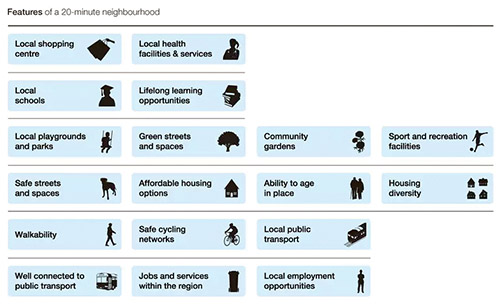
For instance, knowing that most people prefer the more relaxed atmosphere of villages to crowded and impersonal cities, the government of Victoria, Australia supports the 20 Minute City concept in which the village – grocer, butcher, baker, pharmacy, health clinic, bus stop – is integrated into the city.4
“Sustainable McDonald’s” is an oxymoron, yet Australia once again serves as a testbed for the Fourth Industrial Revolution (4IR) with “sustainable” fast-food outlets that allegedly cut CO2 emissions by a third. The solar-powered “smartly” ventilated takeaway/restaurant in Melton South is a prototype for other sites. Through Podium, Australia is also pioneering the end-to-end digitisation of real estate: from design, purchase, lease, and construction, to repurchase, letting, contract, and the new age of tailored living. This will create a new blockchain for real estate markets.
In this part of the new world order, constant labour is normalised. “From focus zones to work cafes, the space integrates ‘external’ elements such as coworking and the home office.” Happy slaves must also be healthy slaves. Design concepts include an “ergonomically supportive home office with limited distractions.” There will be a “blend of social spaces with productivity enablers,” such as colleagues who give unconscious prompts to others to work harder. This will be achieved through the design of the building itself. For instance, computers on which people work might be strategically placed near the coffee machine so that the idler sees their colleagues labouring and is prompted to return to work. Exercise machines might be placed near the snack bar so that workers tempted by candy are also guilted into doing a few minutes’ exercise before returning to their toil.
Covid has given WEF corporations the chance to integrate public health concepts via constant social biosurveillance in their existing 4IR agenda. Over the last few decades, the phrase “new normal” became normal as politicians, intellectuals, and the media sought to brainwash us into believing that terrorism would make total surveillance and travel restrictions a new normal, as would limitations on freedom and growth caused by anthropogenic climate change.
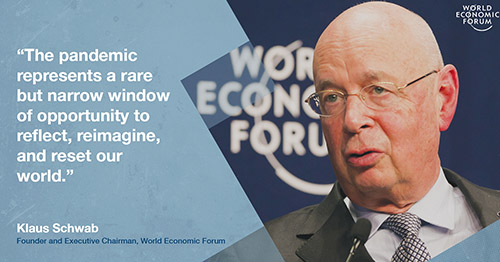
Since Covid, the WEF asks: “What will the ‘next normal’ look like?” (Emphasis added). WEF’s message is confused. On the one hand, its authors lessen mental health concerns by promoting community, but on the other, they note that the structure of the socioeconomic order will increase isolation. Facebook is notorious for keeping people isolated in echo chambers, but the new Meta rebranding, as we shall see, will blend isolation and community in augmented, virtual reality (VR) settings. The happy slave will be alone in their tiny, greenwashed hovel but feel emotionally connected with friends in a VR universe.
When it comes to online shopping, there will be less “face-to-face interaction.” The last-minute deliveries spurred by Covid “will persist beyond the pandemic”5 and be delivered by the kinds of people whom the WEF envisages occupying the above properties. Jab mandates for working people are part of the “next normal,” and patents on the vaccines are of primary interest to the mega-rich. But the WEF is less interested in ensuring the safety and efficacy of Covid vaccines and more concerned with bolstering “vaccine confidence.” Even though the jab appears to be effective only in reducing hospitalisations, the WEF was quick to ask how its thought leaders could work to promote “trust” in big pharma’s rushed products.6
It is important to distinguish between words and actions. Sometimes, WEF founder and chairman Klaus Schwab speaks truth and horrifies those familiar with his words. Examples include references to microchipping the population and replacing humans with robots.7 At other times, Schwab seems to say the opposite, acknowledging that what is erroneously called “capitalism” – which actually means state-backed monopoly corporatism – has damaged the younger generations, stagnated the middle classes, and fuelled the climate crisis. In order to look good and paint the global elite’s WEF as some kind of progressive or “woke” (as the right-wing say) face of “capitalism,” Schwab points out that which is wrong with the “capitalist” order.
The reality is that pretty words and agreement with those injured by profit-driven corporatism is a cover. It is as if an abuser consoles their victim while continuing to abuse them. In his introduction to the WEF’s report on youth, Schwab plays this game, writing things many of us would agree with: that long-term planning is better than short-term profit and that intergenerational parity is better than growing inequality.8
As part of its pyramid structure, the WEF claims that its global reach on this issue was over two million people, the vast majority of whom were journalists, intellectuals, businesspeople, and community leaders; in other words, rungs on the ladder of hierarchy, not ordinary people. These so-called cultural leaders will shape the doctrines for those below them through entertainment, education, media, and the workplace.
The report pays lip service to getting corporations to disinvest from fossil fuels and working with Generation Z’s thought leaders to create a new agenda for sustainability. In reality, it is the same old monopoly corporatism in which ordinary people are the flotsam and jetsam in the plans of those higher than them in the social order. For example, one Lab held in Luxembourg concluded that the WEF should decide what is or is not ethical consumption: “It would be unfair and naïve to put all the burden on consumers having to educate themselves in order to avoid greenwashing.”9
If, for instance, someone decides not to buy the latest Apple gadget because ‘child mining’ in Congo extracted the device’s coltan, ‘forced labour’ in China created the product, ‘air miles’ brought the item to the West, and ‘tax avoidance’ enables the company to be a monopoly, a WEF messaging campaign might greenwash and claim that the gadget’s production was ethical and its carbon footprint neutral.
Another event in Australia concluded that the WEF should harness the wisdom of indigenous people when promoting the new agenda so that people resonate with ancient ways of living whilst continuing to work for corporate overlords.
This is a form of mind control in which the labouring masses have internal freedom and believe they participate in a spiritual society, when in fact the limits of their reality are set by superiors who pretend to consult with and gain the approval of those they are controlling. The Davos Lab’s Millennium Manifesto is jam-packed with empty verbiage such as, “We will ask big questions to advance bold solutions.”10
Another aspect of the WEF agenda is what Schwab calls the Great Reset: a professed plan to promote economic and social equity while cementing the structures that guarantee worsening inequality. In addition to trapping working people in properties designed to enhance their productivity and monetise their idiosyncrasies (like the AI temperature control example above), the revolutionary potential of the exploited classes as well as their dissatisfaction will, if the WEF planners get their way, be quelled by the promotion of transhumanism and virtual reality, in which humanity is “reset” to begin anew with biological and digital enhancements.
One of the methods of control is trapping people in social media bubbles. After US President Donald Trump came to power (2017–21) and threatened the neoliberal agenda, ideological managers such as mainstream media, think tanks, and political unions, took action against what they call “fake news.” Fact-check organisations have morphed into the guardians of neoliberal elites. Often “populists” like Trump and his supporters lie, misreport, and publish fake news. Fact-checkers expose those lies, but they have a deeper agenda.
In most cases, so-called fact-checkers simply argue over interpretations of truth, which the fact-checkers then use to delegitimise real populism. The ideological basis from which they operate promotes the agenda of the World Economic Forum and others. But who fact checks the fact-checkers? Researchers have uncovered their connections to the political, corporate, and media establishment. In this revolving door system, former mainstream corporate media editors and journalists take up new roles as self-professed fact-checkers whose targets are those opposed to the neoliberal order.
In addition, social media have, for years, been on a deplatforming crusade as part of “woke washing” (while keeping oppressive and prejudicial structures in place) and under the influence of the intelligence services. In their evidence to US Congress after the 6 January Capitol insurrection, both Facebook co-founder Mark Zuckerberg and Twitter co-founder Jack Dorsey confirmed that because of “security” concerns, domestic US intelligence agencies advised (i.e., leaned on) them to deplatform accounts, including the President’s.
All of the above serves to blandify social media content and constrain users to the boundaries of what is acceptable within neoliberal culture. Anything too progressive (e.g., the World Socialist Web Site) or regressive (e.g., Breitbart News) is censored, pushing the entire user base of hundreds of millions of people into a giant corporate-approved echo chamber (e.g., CNN, New York Times).
This process is called “digital literacy” by the WEF and others. Without “digital literacy,” people might fall for dangerous “fake news” (i.e., news not approved by WEF corporations). But people might also create and share real news and real information that does not fall within the bounds of accepted neoliberal ideology, such as questioning the efficacy of big pharma-produced vaccines or pointing out the serious problems with the corporate-political elite. In making the world “digitally literate,” the WEF employs doublethink: “Steps must be taken to prevent abuse and harm while maintaining the freedom to openly exchange ideas.”11
Slaving for the ultra-rich in personally-tailored smart cities, the younger generations censored into the neoliberal sheep pen by social media will, according to the WEF model, augment their capacities with technology. The transhumanist agenda is specifically harnessed for the older, infirm generations who have gone from being useless eaters – from the WEF perspective – to potential data points for augmentative technologies. As part of the WEF propaganda campaign, the organisation is preparing to “Articulate the potential benefits of artificial intelligence,” particularly for the older generations.12
For “older” people, which we assume means the over-60s, WEF suggests placing representatives in the design process, the reasoning being that over-60s tend to have different aesthetic tastes, practical preferences, and physical and cognitive requirements to young people. The young are born into the new technological changes, and those changes become part of their environment. In contrast, the over-60s must adapt. Pursuing profit, companies are using the WEF as a vehicle to help turn the over-60s into transhumanist augmentation technology consumers: home-help robots, implants for better eyesight, time-released painkillers, etc. The WEF does not seek solutions for ending the collection and selling of personal data but rather for more transparency. This way companies can cheat consumers whilst being honest that they are cheating them. The aim is to make consumers feel less angry because they appreciate the honesty.
WEF suggests that companies “Disclose the data being collected.” They hope that older people will thus be more willing to have their information sold. The WEF also wants to “Obtain meaningful consent.” The clue is in the word “meaningful,” suggesting that up until now, consent has not been meaningful. One of the more insidious agendas is to “Design for appropriate trust.” Just as they seek to make the younger generations “digitally literate,” i.e., keep them in a mental prison, WEF corporations aim to protect the elderly from “deception,”13 but not the deceptions on which their system is built.
The WEF is aware that the general public might, if left on their own, form groups, communities, parties, and movements that spread an anti-“capitalist” message and develop new social models. If such a long-term grassroots revolution succeeded, it would not only hurt the profits of the owner-classes but threaten the system they spent so long developing. Repackaging profit-driven agendas as some form of third position between capitalism and socialism is achieved, in part, by rhetorically emphasising “corporate responsibility.”14
The WEF also seeks to capture potential revolutionaries by appealing to “social justice.” The WEF intellectuals are aware that young people tend to be driven more than old people by outrage. The right-wing dismisses these young, conscious activists as “social justice warriors.” Instead of encouraging people to change the system in their own image, WEF intellectuals want to make people feel like they have – without actually having – input into their conditions. “[R]ecognising, co-designing, partnering and learning with impacted stakeholders… must be at the centre of any corporate action on equity and social justice in our unequal world.”15
Another factor profitable to the corporate class is social impact bonds. Historically, the underclasses – those below the working classes – were a financial negative. They claimed benefits, needed free healthcare, public housing, etc. The working classes laboured, the middle classes paid the most relative taxes, and the rich lived off the labour of the poor, profits generated by the consuming middle classes, and hording through tax avoidance.
But over the last decades, banks figured out ways of profiting from the underclasses: social impact bonds. Under such systems, government cuts back on social welfare and relies instead on charities to keep offenders out of prison and reach homelessness reduction targets, etc. The banks that fund the charities are then reimbursed by government, and the loans of the banks are serviced by taxpayers. This social impact bond system creates an incentive to have a permanent underclass and champion the alleged virtues of “charity” instead of systemic change that brings genuine inclusivity and democratic empowerment.16 Gerbrand Haverkamp, Executive Director of the World Benchmarking Alliance, is quoted as saying: “[W]e need businesses that can profitably solve societal problems, without profiting from societal harms.”17 This model incentivises the creation of a permanent underclass.
There is a sinister, occultic element to the WEF’s agenda. Certain members who currently practice what they believe to be online “meme magic(k)” are also involved in the development of Facebook’s VR world: the Metaverse.
A near-billionaire developer and Trump supporter, Palmer Luckey, used social media to boost Trump’s profile and deflate his rival Hillary Clinton in the run-up to the 2016 US presidential election. Luckey made his fortune selling the Oculus VR headset to Zuckerberg. Luckey’s benefactor, a lobby called Nimble America, believed that “meme magic is real.” The Millennial generation started to use images with text circulated online to boost their agendas and attack their enemies (memes). One famous meme was Pepe the Frog, an innocent cartoon hijacked by racists and right-wingers (usually both) to signal their political allegiances. The cultists behind the spread of such memes believed that they could invoke spiritual power (“meme magic(k)” to vanquish enemies. Pepe, to give one of many examples, is drawn with light reflecting in both eyes in the shape of a Freemasonic dot-triangle.
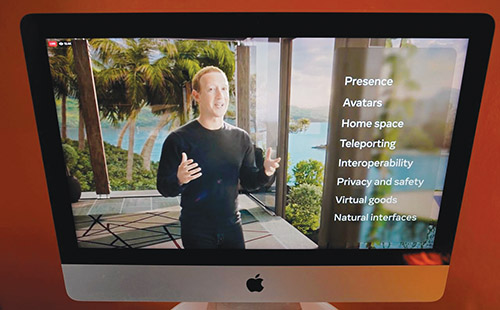
Regardless of his involvement or lack of involvement in such practices, the executive director of Oculus, Jason Rubin, sent his 50-page report on the Metaverse to Zuckerberg. Just as US military planners devised a “shock and awe” terror campaign to inflict on the Iraqi people in 2003, Rubin said that “shock and awe” tactics would condition the user to accept their new digital life in the Metaverse. CNBC has seen leaked policy documents: “It imagined users floating through a digital universe of virtual ads, filled with virtual goods that people buy.”18
Chillingly (no pun intended), FB Oculus’s Michael Abrash says: “It all started with Snow Crash,” the futuristic ‘90s novel written by Neal Stephenson. The Guardian, which picked up the Abrash quote, conveniently omits a crucial detail about the novel: that the fictional online world on which the new scheme is based contains a mind virus that can infect users as they merely look at the screen. Likening it to Snow Crash, though providing no evidence, certain individuals claim that the Pepe meme that evolved into something else has, for many years, contained a hidden mind virus.
Whether the mind virus is real or not is beside the point. Certain online occultists, including Luckey, are using the fear of mind control, coupled with what Rubin calls “shock and awe,” to get users to submit to the dialectic: a “progressive” Zuckerberg world order of Joe “Build Back Better” Biden in a virtual reality, or a more overtly fascistic world order of “meme magic(k)” and mind warfare using Trump as a frontman.
Part of the Trump meme war and the fake news hysteria surrounding the President had the effect of making ‘truth’ a vague and flexible concept. As the concept of truth becomes fuzzy, that which is real is set to become fuzzier. WEF says of Meta: “This could manifest itself in several ways, but many experts believe that ‘extended reality’ (XR) – the combination of augmented, virtual and mixed reality – will play an important role.”19 The WEF hopes that once we have been bombarded into the new system, we will all be Huxleyan happy slaves in their Brave New World, playing with intangible VR toys and mingling with avatars of our loved ones.
Dr T.J. Coles is an associate researcher at the Organisation for Propaganda Studies, a columnist with Axis of Logic, a contributor to numerous publications (including CounterPunch and Truthout) and the author of several books including Manufacturing Terrorism (Clairview Books), Human Wrongs (iff Books) and Privatized Planet (New Internationalist).
By Robert J. Burrowes
When is the last time you were outside in the morning to experience a glorious dawn? Or sat watching the sun set across the ocean horizon?
How do you feel when you touch the skin of someone you love? A grandparent, parent, lover or child?
Have you ever seen a spider’s web full of morning dew, or after the rain, when the sun is shining through the droplets in the web to reveal the flashing diamonds, sapphires, rubies and emeralds hidden within?
Have you ever stood in a natural environment – a beach, desert, rainforest… – far from a city and noticed that strange and subtle feeling of freedom tremor through your body?
Have you ever marveled at the breath of wind that cools your face on a hot Summer’s day? Or been intoxicated by the smell of blossom in Spring?
Have you gaped in wonder at the birth of new life: a chick pecking out of its shell, a seed germinating or a baby being born?
Or paused to ponder the sheer magic of being alive yourself?
Or do you find life in the real physical world too constricting, painful, frightening and demanding: something from which you seek to escape, with some distraction or another (work, television, sport, a novel, a drug…), as often as you can?
Well, very soon now, we are promised, you will be able to escape reality far more effectively than those primitive means of distraction made possible previously. And far more effectively than even the outcomes promised in those dystopian novels.
So the fundamental questions we must ask ourselves are simple: Do you want real life, with all of the pains, sorrows, fear and fury that go along with beauty, freedom and love? Or do you believe what they tell us and want everything unpleasant to go away? Permanently. And to live in delusion thereafter, given synthetic versions of all of the pleasant feelings and experiences described above?
Remember the dialogue between the Savage and Mustapha Mond during the closing stages of Aldous Huxley’s dystopian novel Brave New World?
‘But I don’t want comfort. I want God, I want poetry, I want real danger, I want freedom, I want goodness. I want sin.’
‘In fact,’ said Mustapha Mond, ‘you’re claiming the right to be unhappy.’
‘All right then,’ said the Savage defiantly, ‘I’m claiming the right to be unhappy.’
‘Not to mention the right to grow old and ugly and impotent; the right to have syphilis and cancer; the right to have too little to eat; the right to be lousy; the right to live in constant apprehension of what may
happen to-morrow; the right to catch typhoid; the right to be tortured by unspeakable pains of every kind.’
There was a long silence.
‘I claim them all,’ said the Savage at last.
Well, after nearly one hundred years, the dystopian future described by Huxley is almost upon us and, if we are to defeat it, we need a lot more ‘savages’ willing to forego the promised ‘comforts’.
Because if those who see themselves as our global masters get their way, we are about to enter a virtual world that will become more complete by the day and from which there will be no escape.
The Metaverse
Based on many years of effort, the World Economic Forum (WEF) has recently launched its plan to create our new all-digital world, called the ‘metaverse’. See ‘Defining and Building the Metaverse’.
So if you find natural phenomena – ranging from rainforests, beaches and weather variations to ill-health, danger and unhappiness – annoying, you will soon be able to escape them, compliments of the metaverse. Or so we are promised. And you won’t be troubled by anything resembling what might be called ‘free will’ either. You will be content to do as you are told, even more than you are content to do already. See ‘Terrified of Freedom: Why Most Human Beings are Embracing the Global Elite’s Technotyranny’.
After all, your mind will no longer be your own. And while the usual descriptions, written by elite agents, fail to mention it, a quick flash of metaverse-induced fear will make sure that you comply, whatever you are required to do. The point is this: You won’t be escaping all of those unpleasant feelings after all. They can just be used to control you more directly, to fulfill an elite-determined purpose. But that is a fact they are not advertising.
In their iconic hit song ‘In the Year 2525’, written in 1964 by Rick Evans and later recorded by he and Denny Zager to become a No.1. hit around the world in 1969, Evans captured key elements of what is already upon us somewhat ahead of the schedule mapped out in the song.
[Chorus 2]
In the year 3535
Ain’t gonna need to tell the truth, tell no lies
Everything you think, do, and say
Is in the pills you took today
[Chorus 3]
In the year 4545
Ain’t gonna need your teeth, won’t need your eyes
You won’t find a thing to chew
Nobody’s gonna look at you
[Chorus 4]
In the year 5555
Your arms are hanging limp at your sides
Your legs got nothing to do
Some machine’s doing that for you
[Chorus 5]
In the year 6565
Ain’t gonna need no husband, won’t need no wife
You’ll pick your sons, pick your daughters too
From the bottom of a long glass tube
Whoa-oh-oh
So what is the Metaverse?
According to the WEF: ‘The metaverse is a future persistent and interconnected virtual environment where social and economic elements mirror reality. Users can interact with it and each other simultaneously across devices and immersive technologies while engaging with digital assets and property.’ See ‘Defining and Building the Metaverse’.
Moreover, ‘if technologists are right that 2022 will separate thinkers from builders, then last years’ technical advances will produce this year’s first steps towards making the metaverse a reality….
‘But from the perspective of the human experience, one development stands out above all others: extended reality (XR) technologies. These include virtual reality (VR), augmented reality (AR), and brain-computer interfaces (BCI), which together position themselves as the next computing platforms in their own right.’
Nevertheless, it is clear that a precise definition of the term ‘metaverse’ (for a start: is it a product, service, place or moment in time?), upon which there is broad agreement even among those who routinely use the term, is yet to emerge. See ‘3 technologies that will shape the future of the metaverse – and the human experience’.
Having written that, here is one definition elaborated in the article above that reveals just how far some of those heavily involved in this work have become disconnected from any sense of themselves and, hence, reality: ‘Specifically, the metaverse is the moment at which our digital lives – our online identities, experiences, relationships, and assets – become more meaningful to us than our physical lives.’ The original quotation can be read here: ‘Spheres of Self: Performativity and Parasociality in the Metaverse’.
And, as Cathy Li describes it, the metaverse is ‘most useful as a lens through which to view ongoing digital transformation. The belief is that virtual worlds, incorporating connected devices, blockchain and other tech, will be so commonplace that the metaverse will become an extension of reality itself.’ See ‘Who will govern the metaverse?’
Let me reiterate two points from the paragraphs immediately above: ‘our digital lives… become more meaningful to us than our physical lives.’ And ‘the metaverse will become an extension of reality itself.’
Really?
While statements such as these reveal the breathtaking level of insanity that underpins this entire enterprise – see ‘The Global Elite is Insane Revisited’ – it does not mean that we are not under enormous threat. Just as vast arsenals of nuclear weapons, by some insane ‘logic’, are supposed to provide us with ‘security’ while actually threatening the existence of all life on Earth, the metaverse is part of a substantial package of measures that will reduce human life to one not worth living.
Why? Well, as noted by authors such as Tom Valovic: The metaverse is one element in the path to implementing technocratic governance over all of humanity.
‘As Planet Earth and our physical world continue to experience massive biospheric degradation and disruption, the elites that are now in many cases pulling the strings of governance at the country level are heading for the exit doors. Elon Musk and Jeff Bezos are exploring the realm of space and Musk has a Mars mission planned. Globally oriented elites… looked out for themselves which is what they do best….
‘Paralleling the notion of space flight as a form of existential escapism is the metaverse. So what if our cities are crumbling, infrastructures falling apart, and the biosphere is seriously degrading? So what if our wasteful consumer-driven lifestyle has created unprecedented levels of pollution so extensive that it’s now the number one cause of health problems globally? No problem… we’ll just kick back and don our Meta headsets (or worse get a brain implant) and escape into an artificially fabricated world that lets us turn our back on the massive ecological and environmental problems we now face.’ See ‘Why We Should Reject Mark Zuckerberg’s Dehumanizing Vision of a “Metaverse”’.
‘Education’ in the Metaverse
Of course, the metaverse is deeply interwoven with other components of their plan, such as those in relation to what they call ‘education’, which is more accurately described as the process by which young transhuman slaves are programmed to perform their function in the technocratic economy that is being imposed upon us. Of course, ‘education’ sounds better than ‘virtual programming of young transhuman slaves’ so, in the interests of not raising obvious concerns, the word ‘education’ has been used.
As noted by Dr. Michael Nevradakis, discussions on this subject at the recent gathering of the World Economic Forum emphasized the importance of virtual reality (VR) and artificial intelligence (AI) technologies with participants touting the purported educational and economic benefits that would derive from use of these technologies in the classroom by helping, according to Dr. Ali Saeed Bin Harmal Al Dhaheri & Dr. Mohamad Ali Hamade, to ‘increase accessibility, enhance quality and improve the affordability of education globally’. See ‘Experiential learning and VR will reshape the future of education’.
However, as Nevradakis also noted, these discussions had ‘little to say about the need to protect children’s data or digital identities – or, for that matter, providing the types of early-life experiences children require as part of their socialization.’ See ‘Future of Education? WEF’s Vision – Heavy on Virtual Reality and AI Technologies, Light on Privacy Concerns’.
Of course, there is no need for concern about the ‘early-life experiences’ of those young transhumans who are being programmed for decades of servitude prior to being terminated when they are no longer functional.
Beyond claimed educational and economic benefits, however, some authors argue that digitalizing education can play a role in easing pressures on the environment and climate. How so? Nevradakis again: ‘Indeed, the WEF said the use of “textbooks, notebooks and pencils as critical learning tools” is on the way out, due to “environmental pressures and COP26 goals (from the 2021 United Nations Climate Change Conference),” which “will drive the digitalizing of education streams.”’ See ‘Future of Education? WEF’s Vision – Heavy on Virtual Reality and AI Technologies, Light on Privacy Concerns’
But it is clearly delusional to suggest that the use of textbooks, notebooks and pencils has greater adverse impact on the environment and climate than the environmental cost and climate impact of producing sophisticated technology for each student. And despite claims of ‘improved affordability’ it is equally delusional to ignore the economic and social cost, for example, to the child ‘laborers’ in the Congo working in appalling conditions to extract strategic minerals to produce this technology. See ‘Humanity’s “Dirty Little Secret”: Starving, Enslaving, Raping, Torturing and Killing our Children’.
Besides, as touched on below, education is already a monstrous experience, destroying the Selfhood of the child so that they become submissively obedient. Removing the bulk of education’s remaining social component by technologizing it can only make it even worse.
Babies in the Metaverse
Then again, maybe ‘children’ will no longer be put through school. It simply won’t be necessary because children, for transhuman slaves at least, will no longer exist.
By 2070, the metaverse will offer you virtual babies, ‘environmentally-friendly digital children’, according to UK artificial intelligence (AI) expert Catriona Campbell. ‘Parents will see and interact with their offspring through next-generation AR [augmented reality] glasses and haptic gloves.’ The latter devices enable users to experience ‘a realistic sense of touch when handling virtual or holographic objects’. As a bonus, these children take up no space, cost nothing to feed and remain healthy, if that is what you want, for as long as they are programmed to ‘live’. A subscription might cost as little as $25 each month.
And if this seems like a monumental leap out of reality to you, Campbell also believes that ‘within 50 years technology will have advanced to such an extent that babies which exist in the metaverse are indistinct from those in the real world…. As the metaverse evolves, I can see virtual children becoming an accepted and fully embraced part of society in much of the developed world.’ See ‘“Virtual babies” who grow up in real time will be commonplace by 2070, expert predicts’.
That’s right, Campbell is claiming that ‘within 50 years… babies which exist in the metaverse are indistinct from those in the real world’! Pause a moment. How does that sound to you?
Just in case you cannot wait, you are welcome to start using early versions now. See, for example, Virtual Baby, Adopt a Virtual Baby and My Virtual Child.
Oh, and by the way, you won’t be having sex either, whether for reproductive purposes or otherwise. You will prefer virtual sex. See ‘Sex And Pornography Aim To Strike Gold In The Metaverse’.
Critiquing the Metaverse
Beyond the criticisms already noted above, there are a great many other criticisms of the metaverse and the role it will play in the overall elite program being implemented under what the WEF calls its ‘Great Reset’. This comprehensive program will transform human society and human life for those people left alive after the eugenics component has been fully implemented. See ‘The Final Battle for Humanity: It is “Now or Never” in the Long War Against Homo Sapiens’.
If you like, you can read a little more about what the masters of this metaverse intend for us, as well as critiques of it, by authors such as these.
Derrick Broze: While some people ‘may not intend for The Metaverse to become an all encompassing reality that supersedes physical reality, for the Zuckerbergs, Microsofts, and WEFs of the world, that is exactly what they intend for The Metaverse…. For the billionaire class and their puppet organizations, such as the WEF and the United Nations, the Metaverse offers up the potential to commandeer all life into digital prisons where the people can be charged for services and products in the digital realm…. With the people of the world safely tucked into their digital beds, the Technocrats could complete their total takeover of natural resources, the economy, and humanity itself.’ See ‘The Great Narrative And The Metaverse, Part 2: Will The Metaverse End Human Freedom?’
Dr. Michael Nevradakis: ‘Who will govern the “metaverse”?… According to the WEF, “real-world governance models” represent one possible option for metaverse governance. However, far from referring to constitutionally defined institutions of governance, with checks and balances, the WEF cites Facebook’s “Oversight Board” as an example of such a “real-world governance model.”’ See ‘WEF Launches “Metaverse” Initiative, Predicts Digital Lives Will Become “More Meaningful to Us Than Our Physical Lives”’.
But an earlier World Economic Forum report from its Global Redesign Initiative was more blunt: ‘The report postulates that a globalized world is best managed by a coalition of multinational corporations, governments (including through the UN system) and select civil society organizations (CSOs).’ See Sustainable Development Goals and Human Rights p. 209, citing ‘Everybody’s Business: Strengthening International Cooperation in a More Interdependent World’.
So if you believe that you and I are destined to have a say in the metaverse that is unfolding, you would be wise to keep investigating. Elite proposals are invariably very distant from the type of governance models usually considered by ‘ordinary’ people in a multiplicity of contexts, where the emphasis is on facilitating widespread grassroots participation, not rule by technocrats.
You can read considerably more about what our technocratic overlords have in mind – including the existing trade in such things as virtual real estate, virtual clothing and virtual art – and what is wrong with it, in the articles on the metaverse published by Patrick Wood on ‘Technocracy News & Trends’: ‘Metaverse’. And there is more in articles such as these: ‘The Top 10 Creepiest and Most Dystopian Things Pushed by the World Economic Forum (WEF)’ and ‘How Our Lives Could Soon Look”: The World Economic Forum Posts An Insane Dystopian Video’.
And here’s another simple issue to ponder. Remember how I mentioned above that a quick flash of metaverse-induced fear would ensure that you complied with an elite-determined directive, how does the idea of eating bugs, processed sewage and human flesh appeal? Well, given that your mind will no longer be your own, what appeals now, or doesn’t, will be irrelevant once the metaverse is determining how you perceive things. See ‘Canadian Company Pledges To Produce TWO BILLION BUGS Per Year For Human Consumption’ and ‘Will You Eat Cultured Meat Grown From Human Cells?’
You will eat ‘Soylent Green’ because that is what the program tells you.
So why are people embracing the Metaverse?
In a recent article in which he described taking his son to watch a film through 3D glasses, Charles Eisenstein noted ‘The on-screen reality was so vivid, stimulating and intense that it made the real world seem boring by comparison.’ See ‘Transhumanism and the Metaverse’.
How can this happen?
Because we terrorize our children into submissive obedience, devoid of the unique and powerful individual Self they were gifted by evolution at birth. See ‘Why Violence?’,‘Fearless Psychology and Fearful Psychology: Principles and Practice’and ‘Do We Want School or Education?’ Why? Essentially to keep them performing tasks that bore them senseless throughout their school and working life.
Fundamentally, this terrorization works because it compels our children into suppressing awareness of how they feel. As a result, only the most intense experiences register emotionally: The capacity to experience a subtle feeling has been lost. And without this capacity, they cannot develop into the powerful, courageous Self-willed individuals that evolution intended. They are human relics. Ready and willing to be turned into a transhuman slave in the unconscious hope they will be finally able to experience, in the metaverse, what was taken from them in the real world as a child.
But they won’t get that experience, even in the metaverse. It is not what the elite has in mind for us.
Resisting the Metaverse
Of course, the metaverse is just one feature of the Global Elite agenda that is being imposed upon us. And it is not enough to resist individual features of the ‘Great Reset’ program. We must strategically resist its most fundamental elements so that the entire agenda is defeated.
If you are inclined to join those strategically resisting the ‘Great Reset’ and its related agendas, you are welcome to participate in the ‘We Are Human, We Are Free’ campaign which identifies a list of 30 strategic goals for doing so.
In addition and more simply, you can download a one-page flyer that identifies a short series of crucial nonviolent actions that anyone can take. This flyer, now available in 17 languages (Czech, Danish, Dutch, English, Finnish, French, German, Greek, Hebrew, Hungarian, Italian, Polish, Romanian, Russian, Serbian, Spanish & Slovak) with more languages in the pipeline, can be downloaded from here: ‘The 7 Days Campaign to Resist the Great Reset’.
If strategically resisting the ‘Great Reset’ (and related agendas) appeals to you, consider joining the ‘We Are Human, We Are Free’ Telegram group (with a link accessible from the website).
And if you want a child who is powerfully able to perceive the dysfunctional lure of the metaverse, and is able to join you in resisting it, consider making ‘My Promise to Children’.
CONCLUSION
So, for just a little longer, the choice is yours.
You can live your life with all its challenges and problems, joys and achievements. Or you can live the virtual life that someone else programmed for you, including whatever comes with it that they didn’t tell you about.
In short, like Neo in the film ‘The Matrix’, you have a choice. You can choose the Blue Pill and proceed to live in a synthesized, fictional, computer-generated world. Or you take the Red Pill and, in this case, join the fight with those of us determined to defend the real world and avert descent into the metaverse.
But you must make that choice while you still have free will.
So you must make that choice soon.
Biodata: Robert J. Burrowes has a lifetime commitment to understanding and ending human violence. He has done extensive research since 1966 in an effort to understand why human beings are violent and has been a nonviolent activist since 1981. He is the author of ‘Why Violence?’ His email address is flametree@riseup.net and his website is here.
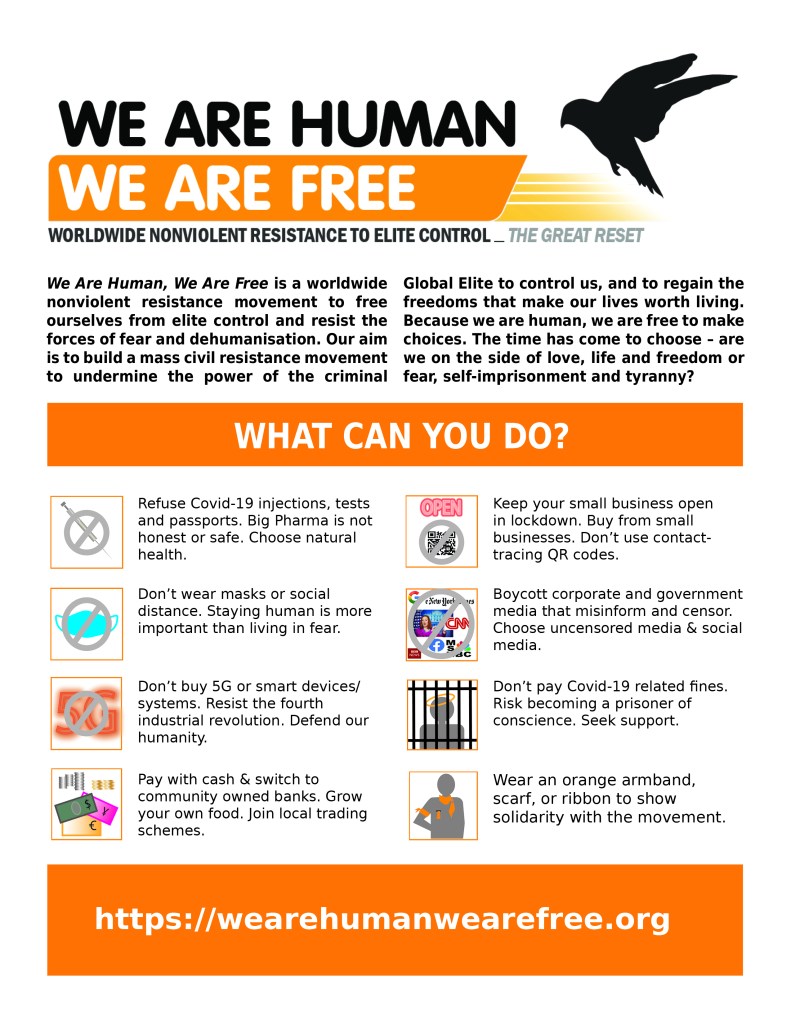
By Phil Butler
Source: New Eastern Outlook
The world of analysts has missed something critical, something fundamental for explaining what’s going on. We’re so focused on the symptoms of the great reset that’s been going on, that we’ve overlooked that which will reveal the end game. The techniques, the strategies being used, their breadth, and the essence of the psychological warfare being waged – let us know dangerous these days are. The Russians are not simply fighting to preserve Russia, they’re the footsoldiers standing against the beast. The real beast in the hearts of evil men.
“One believes things because one has been conditioned to believe them.” ― Aldous Huxley, Brave New World
Mask, or no mask. Vaccine, or no vaccine. The pandemic awakened the suspicions of millions that something other than a serious influenza epidemic is going on. But the conspiracy that was too big to be a genuine conspiracy, was meant to be unbelievable. The bug itself, likely manufactured in a Biolab by our own government, seems to have been engineered to be contagious enough, just deadly enough, to erase our principles. This bug, the manipulation of the pandemic, it set the world at odds with itself. And what about climate change? Do you think that the elites running this shit show would pass up yet another chance to befuddle us? Climate science, or climate hoax – we’re at odds even over fundamental physics. Are you sensing it, the dastardly strategies at work, I mean? I am sure many of you do. But, I am also sure most people have no conception of the depth of the mind games being played today.
We’re undergoing a morality and mind wipe no psychothriller novelist ever imagined. The idea came to me like a bolt, snapping me from a deep sleep last night. Something about all that’s been going on has gnawed at me, as I am sure it has you, for months now. And now I know what it is. We’re being prepared for those artificial wombs that Aldous Huxley conjured up for his post-dystopian Utopia in the novel Brave New World. We must have been totally blinded, not to have seen and felt it before. Trangenderism, the United States creating gender-free passports, and Walt Disney’s company being boycotted over what American moms are calling “grooming” their kids to be victims of pedophiles. A Supreme Court nominee the other day, said in her confirmation hearings the other day, that she could not define what a woman is. Think about this for a moment. Supreme court justices are the most powerful and influential officials in the U.S. government. They are justices for life, appointed to interpret the law!
Mind cleansing. The great erasure of our morality is what is happening right now. The elites in North America and in Europe have joined hands in some kind of ritual, with plans for the final takeover of Earth. And Russia is the biggest hurdle in the way of this. But also, another facet of the overall wipe – Putin bad, or Putin good, that kind of ideological dilemma. But the reader should not simply take my word here. Read the sort of academic papers the Rothschild advisors and the Queen Mother’s men would be reading. Start with “Wiping the Slate Clean: Psychological Consequences of Physical Cleansing,” which discusses how cleaning your hands with disinfectants helps absolve you morally, of past transgressions. No, I am not joking. Those billions of hand sanitizer bottles at every store, restaurant, and office have a secondary effect. I know, more to think about. But while you are thinking, here is a direct quote from this research. See if you can deduce any correlations or benefits for this Bold New World being built:
“These findings show that the psychological impact of cleansing goes beyond the conceptual metaphor of moral cleanliness (Lakoff & Johnson, 1980). The metaphoric notion of washing away one’s sins seems to have generalized to a broader conceptualization of “wiping the slate clean” (Lee & Schwarz, 2010b). This allows people to remove unwanted residues of the past, from threats to a moral self-view (Zhong & Liljenquist, 2006) to doubts about recent decisions (Lee & Schwarz, 2010b) and worries about bad luck (Xu et al., 2011).”
The ‘clean slate,” is the point I am driving at here. In order for the elites waging total war on the Russians to succeed in their ultimate plan, western societies (first) must be under total control, in harmony, willingly compliant to whatever the technocrats and their benefactors dictate. Think of this as the indoctrination young children get when they first go to a religious school. Everything is being broken down and eradicated so that something else can take the place of former reality, morality, and faith. I told you, it’s diabolical what’s going on. And I think Putin and his people know this, but hesitate to reveal the inconceivable nature of it all.
What’s taking place in the world right now is the start of the final battle for the planet, which begins with the warring within our own hearts and minds. What we see happening is an overriding strategy based on what the ancient philosophers called tabula rasa, or clean slate. This is the idea that we are born without built-in mental content, and that experience and learning imprint our desires, fears, love, hate, morality, etc. The reader might ask now, “How can these elites wipe our slate clean to imprint their orders into us now, after years or decades of experiences?” It’s a logical question, but an easy one to answer.
While these theories of the soul and the self have been bounced back and forth for centuries in the works of philosophers like Thomas Hobbes and John Locke, the concept of the “inconceivable” iterated by Diogenes Laërtius (3rd Century AD) weighs on the mind-wiping taking place in the media, in society, and with the individual right now. Our perception is what is being wiped clean so that it can be rewritten. The philosopher writes:
“Perception, again, is an impression produced on the mind, its name being appropriately borrowed from impressions on wax made by a seal; and perception they divide into, comprehensible and incomprehensible: Comprehensible, which they call the criterion of facts, and which is produced by a real object, and is, therefore, at the same time conformable to that object; Incomprehensible, which has no relation to any real object, or else, if it has any such relation, does not correspond to it, being but a vague and indistinct representation.”
The strategy, as it were, is all focused on where the source of knowledge is. First, all sources must be called into question. This is where the term “Fake News’ came in. First, anybody who did not talk nicely about Donald Trump became a fake news outlet. We all thought this was both funny, and correct, and we adopted the idea and the term wholeheartedly. But, as we see with the Ukraine crisis, news and information from Russia is totally banned, censored, and non-existent in the western psyche. And here’s where the real evil genius part comes in.
“Words can be like X-rays if you use them properly – they’ll go through anything. You read and you’re pierced.”― Aldous Huxley, Brave New World
Russia sympathetic sources of information, or those input channels, are not “good sources,” this is being established. Meanwhile, in America, people are getting the final touch of mind mopping via contrived incidents like the recent Academy Awards circus involving actor Will Smith and comedian Chris Rock. And, many other moral crises are being interjected before the final mind fuck. Half and half, like masks versus no masks, and climate change over climate hoax, Americans’ morality is being rubbed raw by the big rubber, gummy eraser of the controlling elites. And this, my friends, will lead to the powerful world order to literally dictate good and evil, right and wrong through the worldly version of what 11th-century philosopher Avicenna called the “perfect source of knowledge.” Their aim is to become, our source, our gods, our everything.
Look at how it rolls out. Western theorists and analysts, cringing because Vladimir Putin cites historical facts, or insists on legal precedent. The new generation ignorant of even 9/11 or the so-called “war on terror” is being indoctrinated. At the same time those who have experienced things like Vietnam or the Cold War, we’re being reprogrammed. Our principles are being wiped off of our cerebrums, like the spilled milk of belief in God, country, or the long-lost quest for peace. Mickey Mouse is a transvestite. Arnold Schwarzenegger does not vanquish torturing Nazis, he becomes one. And anyone who cannot be reprogrammed must be obliterated.
Finally, at the core of this wiping our slates clean strategy the original position (OP), often referred to as the veil of ignorance experiment seems to be in motion. On the one side, the elites seem convinced that humanity is capable of being totally alienated from past knowledge. And on the other, this veil cannot be applied because it is impossible for us to forget things like gender, ethnicity, the past, our complexion, or fact, as it were. Perhaps the ruling elites who have conjured up with gigantic brainwashing scheme, truly do feel like gods. Maybe their power to market and sell products and war has deluded them. At least I pray they are deluded. I pray the Russians and the other two-thirds of the world abstaining from the game, win out in the long run. I, for one, am not ready for a Brave New World of artificial wombs.
By John W. Whitehead & Nisha Whitehead
Source: Waking Times
“ ‘Science?’….’Yes,’ Mustapha Mond was saying, ‘that’s another item in the cost of stability. It isn’t only art that’s incompatible with happiness; it’s also science. Science is dangerous; we have to keep it most carefully chained and muzzled…I’m interested in truth, I like science. But truth’s a menace, science is a public danger. As dangerous as it’s been beneficent. It has given us the stablest equilibrium in history…But we can’t allow science to undo its own good work. That’s why we so carefully limit the scope of its researchers…We don’t allow it to deal with any but the most immediate problems of the moment. All other enquiries are most sedulously discouraged…Our Ford himself did a great deal to shift the emphasis from truth and beauty to comfort and happiness…[but] People still went on talking about truth and beauty as though they were the sovereign goods. Right up to the time of the Nine Years’ War. That made them change their tune all right. What’s the point of truth or beauty or knowledge when the anthrax bombs are popping all around you? That was when science first began to be controlled – after the Nine Years’ War. People were ready to have even their appetites controlled then. Anything for a quiet life. We’ve gone on controlling ever since. It hasn’t been very good for truth, of course. But it’s been very good for happiness. One can’t have something for nothing. Happiness has got to be paid for. You’re paying for it, Mr. Watson – paying because you happen to be too much interested in beauty. I was too much interested in truth; I paid too.’ “ ~Aldous Huxley’s Brave New World
Where does one start in discussing the famed fiction novel of Huxley? Although most agree that there is a definite brilliance to the piece, most are also confused as to what was Huxley’s intention in writing the extremely influential dystopic vision. Was it meant to be taken as an exhortation? An inevitable prophecy? Or rather…was it meant as an Open Conspiracy?
What do I mean by an Open Conspiracy?
If we are going to talk about such things our story starts with H.G. Wells, whom Aldous acknowledged he was most certainly influenced by, particularly by Wells’ novels “A Modern Utopia,” “The Sleeper Awakes,” and “Men Like Gods,” when writing his “Brave New World.”
Although Aldous is quoted as referring to Wells as a “horrid, vulgar little man,” (Wells was indeed not a very likeable individual) it was not for reasons one might first assume. Aldous did share a Wellsian perspective in that society should be organised based on a caste system. Perhaps this was one of the reasons Aldous was so fascinated with learning about India’s Hindu religious beliefs and practices, which had coexisted for centuries with a deeply ingrained caste system to which India is still struggling to remove itself from to this day. This is not to say that one caused the other, or that Hinduism has not offered a plethora of great works and insights, but that it had become corrupted and thoroughly intertwined with upholding India’s caste system at some point one cannot deny; that it was used to justify a system of hierarchy from slave to the god-like state of a Brahmin and that British imperialists had always been greatly fascinated by this form of social organization one cannot deny.
Aldous was always interested in the subject of religion, but more so for its uses in behaviourism and mental conditioning achieved through such techniques as entering states of trance where an individual’s suggestibility could be manipulated. Hypnopædia was not just some quirky sci-fi concoction. It is also why Aldous was so interested in the work of Dr. William Sargant, whom Aldous repeatedly refers to in his writings and lectures and who was involved with the Tavistock Institute and MKUltra. More on this in Part two.
These spiritual/religious studies are what shaped the core thesis of Aldous’ book “Doors of Perception” which is considered the instruction manual for what started the counterculture movement. The title is influenced by the poet William Blake who wrote in 1790 in his book “The Marriage of Heaven and Hell,”:
“if the doors of perception were cleansed then everything would appear to man as it is, Infinite. For man has closed himself up, till he sees all things through narrow chinks of his cavern“
Another major influence for “Doors of Perception” was again H.G. Wells, from his book “The Door in the Wall,” which examines the contrast between aesthetics and science and the difficulty in choosing between them. The protagonist Lionel Wallace is unable to bridge the gap between his imagination and his rational, scientific side which leads to his death.
Aldous writes in his “Doors of Perception,”:
“That humanity at large will ever be able to dispense with Artificial Paradises seems very unlikely…Art and religion, carnivals and saturnalia [ancient Roman pagan festival], dancing and listening to oratory – all these have served, in H.G. Wells’s phrase, as Doors in the Wall…Under a more realistic, a less exclusively verbal system of education than ours, every Angel (in Blake’s sense of that word) would be permitted as a sabbatical treat, would be urged and even, if necessary, compelled to take an occasional trip through some chemical Door in the Wall into the world of transcendental experience. If it terrified him, it would be unfortunate but probably salutary. If it brought him a brief but timeless illumination, so much the better. In either case the Angel might lose a little of the confident insolence sprouting from systematic reasoning and the consciousness of having read all the books…But the man who comes back through the Door in the Wall will never be quite the same as the man who went out…”
Aldous was always chasing the perfect drug that would be minimal in its physically destructive effects but would allow an individual to tap into an almost consumer state of a religious/spiritual out-of-body experience, a transcendence that promised a connection with the Infinite, inner peace and enlightenment.
Enlightenment and inner peace in a pill, ready for whenever one needed a short holiday from the “illusion” of reality.
The name Soma, which Aldous used to name his fantasy ideal drug in “Brave New World,” was based off a plant whose juices were used to create the spiritual drink which was described in both the ancient religious practices of the Vedic tradition and Zoroastrianism, which called the plant and spiritual drink by the same name, Soma. Today, it is a mystery as to what plant they were referring to in these texts. Huxley no doubt chased after this dragon the entire latter half of his life, and indeed, psilocybin mushrooms are theorised as one of the potential candidates for what could have been named Soma centuries ago.
It is perhaps here that people are the most confused about the character of Huxley. After all, he was obviously walking the walk so to speak, thus didn’t he truly believe that psychedelics were the path to freedom through enlightenment?
Well, the argument has been made that Huxley’s approach to LSD [and other psychedelics] was essentially oligarchic, that it was to be regarded as a dangerous substance to be sampled only by such fine and visionary minds as his own. That is, those who had the mental strength, the mental stamina to reach enlightenment; those who were too weak to sustain such mental rigours would become the very opposite, and risked falling into the dark pit of complete madness, although this in of itself was perceived by many to be a form of clairvoyance. After all, what is it to be mad in a world that is sickeningly and inhumanely “normal”? This is most certainly how Ken Kesey thought when writing his “One Flew Over the Cuckoo’s Nest,” that madness itself was a form of liberation from the shackles of capitalist societal constraints.
Perhaps madness was the goal, it was after all, much more attainable that the promised enlightenment…
As William Sargant noted in his book “Battle for the Mind: A Physiology of Conversion and Brain-Washing” J.F.C. Hecker was studying the dancing mania phenomenon that occurred during the Black Death, which was a social phenomenon that arose in Europe between the 14th and 17th centuries. It involved groups of people who would begin to dance erratically during the Plague, sometimes thousands at a time until they would fall from exhaustion or from injuries. It was thought to have arisen in Aachen, Germany in 1374 and quickly spread throughout Europe with one of the last observations of it occurring in 1518 in Alsace, France.
Hecker observed in his research on the dancing mania that heightened suggestibility had the capability to cause a person to “embrace with equal force, reason and folly, good and evil, diminish the praise of virtue as well as the criminality of vice.”
Such a state of mind was likened to the first efforts of the infant mind, Sargant writes “this instinct of imitation when it exists in its highest degree, is also united a loss of all power over the will, which occurs as soon as the impression on the senses has become firmly established, producing a condition like that of small animals when they are fascinated by the look of a serpent.”
I wonder if Sargant imagined himself the serpent…
It is no wonder that the Tavistock Institute and the CIA became involved in looking at the effects of LSD and how to influence and control the mind. And perhaps it is no coincidence that Aldous Huxley was in close correspondence with William Sargant to which Sargant even refers to Aldous’ “insights” multiple times in his book “Battle for the Mind.”
Aldous is also quoted in a lecture he delivered to the Tavistock Group, California Medical School in 1961:
“There will be, in the next generation or so, a pharmacological method of making people love their servitude, and producing dictatorship without tears, so to speak, producing a kind of painless concentration camp for entire societies, so that people will in fact have their liberties taken away from them, but will rather enjoy it, because they will be distracted from any desire to rebel by propaganda or brainwashing, or brainwashing enhanced by pharmacological methods. And this seems to be the final revolution.”
Aldous goes on to state a year later in a lecture titled “The Ultimate Revolution” at UC Berkeley Language Center 1962:
“Today we are faced, I think, with the approach of what may be called the ultimate revolution, the final revolution, where man can act directly on the mind-body of his fellows…we are in process of developing a whole series of techniques which will enable the controlling oligarchy who have always existed and presumably will always exist to get people to love their servitude. This is the, it seems to me, the ultimate in malevolent revolutions shall we say, and this is a problem which has interested me many years and about which I wrote thirty years ago, a fable, Brave New World, which is an account of society making use of all the devices available and some of the devices which I imagined to be possible making use of them in order to, first of all, to standardize the population, to iron out inconvenient human differences, to create, to say, mass produced models of human beings arranged in some sort of scientific caste system.”
Yes, yes we get it. This is all to be taken as “warnings” to the public, a terrible necessity that will come about if over-population is not addressed (as he makes clear in his Brave New World Revisited). With over-population comes over-organization which in turn leads to the scientific advances in technology which we are told by Aldous can only lead to totalitarianism. Thus, population growth and advances in the sciences are the greatest threat to humankind. Wait, that sounds oddly very much like the reasonings of Mustapha Mond, have we come around full circle, what exactly does Aldous agree and disagree with here? Are we to have a scientific dictatorship in order to avoid a totalitarian system in the form of a scientific dictatorship?
In H.G. Wells’ “Open Conspiracy: Blueprints for a World Revolution,” he describes his vision for a Modern Religion:
‘…if religion is to develop unifying and directive power in the present confusion of human affairs it must adapt itself to this forward-looking, individuality-analyzing turn of mind; it must divest itself of its sacred histories…The desire for service, for subordination, for permanent effect, for an escape from the distressful pettiness and mortality of the individual life, is the undying element in every religious system.
The time has come to strip religion right down to that [service and subordination is all Wells wants to keep of the old relic of religion]…The explanation of why things are is an unnecessary effort…The essential fact…is the desire for religion and not how it came about…The first sentence in the modern creed must be, not “I believe,” but “I give myself.” ‘
Hmm, is this the same Revolution as Aldous is speaking about? After all, there is a lot of similarity between H.G. Wells’ description of his “Modern Religion” and what Aldous is preaching in his “Doors of Perception,” to which Wells is undoubtedly a large influence. The desire to escape from the distressful pettiness and mortality of the individual life, that the explanation for why one does something is not important, only to be motivated by the desire for release, for a complete catharsis that only the fervour of a “religious,” a “spiritual” experience can bring about.
It is the desire for, not the care for why. To believe is not even acceptable, because to believe pertains to thought, it is merely a matter of surrender, that you give yourself. It is not to act with reason but to be possessed by its very opposite; to be in a state of existence where there are no words, and thus there are no thoughts, just direct sensory feeling.
The ultimate achievement is to completely surrender oneself to the external world, perhaps to a dictatorship without tears…
The reader should be aware that Wells wrote a book titled “The New World Order” in 1940, and is the first that I am aware of to pioneer this now-infamous term. The reader should also be aware that Julian Huxley (Aldous Huxley’s brother) was a co-author of “The Science of Life,” a part of Wells’ trilogy “The Outline of History” (1919), “The Science of Life” (1929), and “The Work, Wealth, and Happiness of Mankind” (1932) to which Wells made no qualms should be regarded as the new Bible. Julian was also a prominent member of the British Eugenics Society, serving as its Vice-President from 1937-1944 and its President from 1959-1962. Interesting life choices from the authors of the “new Bible.”
In addition, Aldous’ grandfather Thomas Huxley (“Charles Darwin’s bulldog”) was the biology teacher of H.G. Wells and was one of the largest influences in Wells’ life, promoting the works of Charles Darwin and Thomas Malthus, for more on this refer to my paper. Although Thomas Huxley lived before the time of the “science” of Eugenics, he was a stout Malthusian and thus one can rather safely say would have been a eugenicist if offered the chance.
Thus, we should regard Aldous’ mention of the stylish ‘Malthusian belt’ in his “Brave New World,” under a more somber light perhaps…
And now we are ready to walk through the doors of perception on Aldous himself, the true Huxley behind the projected illusion. We may not find Infinity at the end of this excursion, but we will most certainly be better equipped to tell the difference between Huxley’s self and non-self, between what is real and what is false.
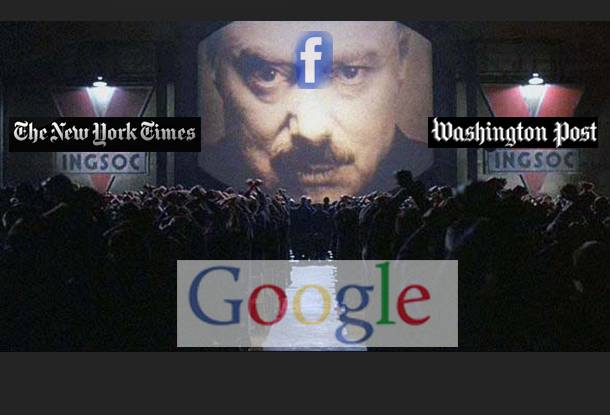
By John W. Whitehead & Nisha Whitehead
Source: The Rutherford Institute
“If you want a picture of the future, imagine a boot stamping on a human face—for ever.”— George Orwell, 1984
Tread cautiously: the fiction of George Orwell (Jun. 25, 1903-Jan. 21, 1950) has become an operation manual for the omnipresent, modern-day surveillance state.
It’s been more than 70 years since Orwell—dying, beset by fever and bloody coughing fits, and driven to warn against the rise of a society in which rampant abuse of power and mass manipulation are the norm—depicted the ominous rise of ubiquitous technology, fascism and totalitarianism in 1984.
Who could have predicted that so many years after Orwell typed the final words to his dystopian novel, “He loved Big Brother,” we would come to love Big Brother.
“To the future or to the past, to a time when thought is free, when men are different from one another and do not live alone— to a time when truth exists and what is done cannot be undone: From the age of uniformity, from the age of solitude, from the age of Big Brother, from the age of doublethink — greetings!”—George Orwell
1984 portrays a global society of total control in which people are not allowed to have thoughts that in any way disagree with the corporate state. There is no personal freedom, and advanced technology has become the driving force behind a surveillance-driven society. Snitches and cameras are everywhere. People are subject to the Thought Police, who deal with anyone guilty of thought crimes. The government, or “Party,” is headed by Big Brother who appears on posters everywhere with the words: “Big Brother is watching you.”
We have arrived, way ahead of schedule, into the dystopian future dreamed up by not only Orwell but also such fiction writers as Aldous Huxley, Margaret Atwood and Philip K. Dick.
“If liberty means anything at all, it means the right to tell people what they do not want to hear.”―George Orwell
Much like Orwell’s Big Brother in 1984, the government and its corporate spies now watch our every move. Much like Huxley’s A Brave New World, we are churning out a society of watchers who “have their liberties taken away from them, but … rather enjoy it, because they [are] distracted from any desire to rebel by propaganda or brainwashing.” Much like Atwood’s The Handmaid’s Tale, the populace is now taught to “know their place and their duties, to understand that they have no real rights but will be protected up to a point if they conform, and to think so poorly of themselves that they will accept their assigned fate and not rebel or run away.”
And in keeping with Philip K. Dick’s darkly prophetic vision of a dystopian police state—which became the basis for Steven Spielberg’s futuristic thriller Minority Report—we are now trapped in a world in which the government is all-seeing, all-knowing and all-powerful, and if you dare to step out of line, dark-clad police SWAT teams and pre-crime units will crack a few skulls to bring the populace under control.
What once seemed futuristic no longer occupies the realm of science fiction.
Incredibly, as the various nascent technologies employed and shared by the government and corporations alike—facial recognition, iris scanners, massive databases, behavior prediction software, and so on—are incorporated into a complex, interwoven cyber network aimed at tracking our movements, predicting our thoughts and controlling our behavior, the dystopian visions of past writers is fast becoming our reality.
Our world is characterized by widespread surveillance, behavior prediction technologies, data mining, fusion centers, driverless cars, voice-controlled homes, facial recognition systems, cybugs and drones, and predictive policing (pre-crime) aimed at capturing would-be criminals before they can do any damage.
Surveillance cameras are everywhere. Government agents listen in on our telephone calls and read our emails. Political correctness—a philosophy that discourages diversity—has become a guiding principle of modern society.
“People sleep peaceably in their beds at night only because rough men stand ready to do violence on their behalf.”―George Orwell
The courts have shredded the Fourth Amendment’s protections against unreasonable searches and seizures. In fact, SWAT teams battering down doors without search warrants and FBI agents acting as a secret police that investigate dissenting citizens are common occurrences in contemporary America. And bodily privacy and integrity have been utterly eviscerated by a prevailing view that Americans have no rights over what happens to their bodies during an encounter with government officials, who are allowed to search, seize, strip, scan, spy on, probe, pat down, taser, and arrest any individual at any time and for the slightest provocation.
“The creatures outside looked from pig to man, and from man to pig, and from pig to man again; but already it was impossible to say which was which.”―George Orwell, Animal Farm
We are increasingly ruled by multi-corporations wedded to the police state.
What many fail to realize is that the government is not operating alone. It cannot. The government requires an accomplice. Thus, the increasingly complex security needs of the massive federal government, especially in the areas of defense, surveillance and data management, have been met within the corporate sector, which has shown itself to be a powerful ally that both depends on and feeds the growth of governmental overreach.
In fact, Big Tech wedded to Big Government has become Big Brother, and we are now ruled by the Corporate Elite whose tentacles have spread worldwide. The government now has at its disposal technological arsenals so sophisticated and invasive as to render any constitutional protections null and void. Spearheaded by the NSA, which has shown itself to care little to nothing for constitutional limits or privacy, the “security/industrial complex”—a marriage of government, military and corporate interests aimed at keeping Americans under constant surveillance—has come to dominate the government and our lives.
Money, power, control. There is no shortage of motives fueling the convergence of mega-corporations and government. But who is paying the price? The American people, of course.
Orwell understood what many Americans are still struggling to come to terms with: that there is no such thing as a government organized for the good of the people. Even the best intentions among those in government inevitably give way to the desire to maintain power and control over the citizenry at all costs.
“The further a society drifts from truth the more it will hate those who speak it.” ― George Orwell
Even our ability to speak and think freely is being regulated.
In totalitarian regimes—a.k.a. police states—where conformity and compliance are enforced at the end of a loaded gun, the government dictates what words can and cannot be used. In countries where the police state hides behind a benevolent mask and disguises itself as tolerance, the citizens censor themselves, policing their words and thoughts to conform to the dictates of the mass mind.
Dystopian literature shows what happens when the populace is transformed into mindless automatons.
In Ray Bradbury’s Fahrenheit 451, reading is banned and books are burned in order to suppress dissenting ideas, while televised entertainment is used to anesthetize the populace and render them easily pacified, distracted and controlled.
In Huxley’s Brave New World, serious literature, scientific thinking and experimentation are banned as subversive, while critical thinking is discouraged through the use of conditioning, social taboos and inferior education. Likewise, expressions of individuality, independence and morality are viewed as vulgar and abnormal.
In my debut novel The Erik Blair Diaries, the dystopian future that George Orwell predicted for 1984 has finally arrived, 100 years late and ten times as brutal. In this post-apocalyptic world where everyone marches to the beat of the same drummer and words like “freedom” are taboo, Erik Blair—Orwell’s descendant and unwitting heir to his legacy—isn’t volunteering to be anyone’s hero. Unfortunately, life doesn’t always go according to plan. To save all that he loves, Orwell will have to travel between his future self and the past.
And in Orwell’s 1984, Big Brother does away with all undesirable and unnecessary words and meanings, even going so far as to routinely rewrite history and punish “thoughtcrimes.” Orwell’s Big Brother relies on Newspeak to eliminate undesirable words, strip such words as remained of unorthodox meanings and make independent, non-government-approved thought altogether unnecessary.
Where we stand now is at the juncture of OldSpeak (where words have meanings, and ideas can be dangerous) and Newspeak (where only that which is “safe” and “accepted” by the majority is permitted). The power elite has made their intentions clear: they will pursue and prosecute any and all words, thoughts and expressions that challenge their authority.
This is the final link in the police state chain.
“Until they became conscious they will never rebel, and until after they have rebelled they cannot become conscious.”—George Orwell
Having been reduced to a cowering citizenry—mute in the face of elected officials who refuse to represent us, helpless in the face of police brutality, powerless in the face of militarized tactics and technology that treat us like enemy combatants on a battlefield, and naked in the face of government surveillance that sees and hears all—we have nowhere left to go.
We have, so to speak, gone from being a nation where privacy is king to one where nothing is safe from the prying eyes of government.
“Big Brother is Watching You.”―George Orwell
Wherever you go and whatever you do, you are now being watched, especially if you leave behind an electronic footprint. When you use your cell phone, you leave a record of when the call was placed, who you called, how long it lasted and even where you were at the time. When you use your ATM card, you leave a record of where and when you used the card. There is even a video camera at most locations equipped with facial recognition software. When you use a cell phone or drive a car enabled with GPS, you can be tracked by satellite. Such information is shared with government agents, including local police. And all of this once-private information about your consumer habits, your whereabouts and your activities is now being fed to the government.
The government has nearly inexhaustible resources when it comes to tracking our movements, from electronic wiretapping devices, traffic cameras and biometrics to radio-frequency identification cards, satellites and Internet surveillance.
In such a climate, everyone is a suspect. And you’re guilty until you can prove yourself innocent. To underscore this shift in how the government now views its citizens, the FBI uses its wide-ranging authority to investigate individuals or groups, regardless of whether they are suspected of criminal activity.
“Nothing was your own except the few cubic centimetres inside your skull.” ― George Orwell
Here’s what a lot of people fail to understand, however: it’s not just what you say or do that is being monitored, but how you think that is being tracked and targeted. We’ve already seen this play out on the state and federal level with hate crime legislation that cracks down on so-called “hateful” thoughts and expression, encourages self-censoring and reduces free debate on various subject matter.
Say hello to the new Thought Police.
Total Internet surveillance by the Corporate State, as omnipresent as God, is used by the government to predict and, more importantly, control the populace, and it’s not as far-fetched as you might think. For example, the NSA has been working on an artificial intelligence system designed to anticipate your every move. Aquaint (the acronym stands for Advanced QUestion Answering for INTelligence) has been designed to detect patterns and predict behavior.
No information is sacred or spared.
Everything from cell phone recordings and logs, to emails, to text messages, to personal information posted on social networking sites, to credit card statements, to library circulation records, to credit card histories, etc., is collected by the NSA and shared freely with its agents in crime: the CIA, FBI and DHS.
What we are witnessing, in the so-called name of security and efficiency, is the creation of a new class system comprised of the watched (average Americans such as you and me) and the watchers (government bureaucrats, technicians and private corporations).
Clearly, the age of privacy in America is at an end.
So where does that leave us?
We now find ourselves in the unenviable position of being monitored, managed and controlled by our technology, which answers not to us but to our government and corporate rulers. This is the fact-is-stranger-than-fiction lesson that is being pounded into us on a daily basis.
It won’t be long before we find ourselves looking back on the past with longing, back to an age where we could speak to whom we wanted, buy what we wanted, think what we wanted without those thoughts, words and activities being tracked, processed and stored by corporate giants such as Google, sold to government agencies such as the NSA and CIA, and used against us by militarized police with their army of futuristic technologies.
To be an individual today, to not conform, to have even a shred of privacy, and to live beyond the reach of the government’s roaming eyes and technological spies, one must not only be a rebel but rebel.
Even when you rebel and take your stand, there is rarely a happy ending awaiting you. You are rendered an outlaw. Just look at what happened to Julian Assange.
So how do you survive in the American surveillance state?
We’re running out of options.
Whether you’re dealing with fact or fiction, as I make clear in Battlefield America: The War on the American People and in my new novel The Erik Blair Diaries, we’ll soon have to choose between self-indulgence (the bread-and-circus distractions offered up by the news media, politicians, sports conglomerates, entertainment industry, etc.) and self-preservation in the form of renewed vigilance about threats to our freedoms and active engagement in self-governance.
INDIAN COUNTRY NEWS
"It is the duty of every man, as far as his ability extends, to detect and expose delusion and error"..Thomas Paine
Human in Algorithms
From the Roof Top
I See This
blog of the post capitalist transition.. Read or download the novel here + latest relevant posts
अध्ययन-अनुसन्धानको सार
 After the Crash