The Dystopian Future of Facebook

By Mark Kernan

Source: CounterPunch

This year Facebook filed two very interesting patents in the US. One was a patent for emotion recognition technology; which recognises human emotions through facial expressions and so can therefore assess what mood we are in at any given time-happy or anxious for example. This can be done either by a webcam or through a phone cam. The technology is relatively straight forward. Artificially intelligent driven algorithms analyses and then deciphers facial expressions, it then matches the duration and intensity of the expression with a corresponding emotion. Take contempt for example. Measured by a range of values from 0 to 100, an expression of contempt could be measured by a smirking smile, a furrowed brow and a wrinkled nose. An emotion can then be extrapolated from the data linking it to your dominant personality traits: openness, introverted, neurotic, say.

The accuracy of the match may not be perfect, its always good to be sceptical about what is being claimed, but as AI (Artificial Intelligence) learns exponentially and the technology gets much better; it is already much, much quicker than human intelligence.

Recently at Columbia University a competition was set up between human lawyers and their AI counterparts. Both read a series of non-disclosure agreements with loopholes in them. AI found 95% compared to 88% by humans. The human lawyers took 90 minutes to read them; AI took 22 seconds. More incredibly still, last year Google’s AlphaZero beat Stockfish 8 in chess. Stockfish 8 is an open-sourced chess engine with access to centuries of human chess experience. Yet AlphaZero taught itself using machine learning principles, free of human instruction, beating Stockfish 8 28 times and drawing 72 out of 100. It took AlphaZero four hours to independently teach itself chess. Four hours from blank slate to genius.

A common misconception about algorithms is that they can be easily controlled, rather they can learn, change and run themselves-a process known as deep “neural” learning. In other words, they run on self-improving feed back loops. Much of this is positive of course, unthought of solutions by humans to collective problems like climate change are more possible in the future. The social payoffs could be huge too. But what of the use of AI for other means more nefarious. What if, as Yuval Noah Hariri says, AI becomes just another tool to be used by elites to consolidate their power even further in the 21stcentury. History teaches us that it isn’t luddite to ask this question, nor is it merely indulging in catastrophic thinking about the future. Rapidly evolving technology ending up in the hands of just a few mega companies, unregulated and uncontrolled, should seriously concern us all.

Algorithms, as Jamie Bartlett the author of The People Vs Tech puts it, are “the keys to the magic kingdom” of understanding deep seated human psychology: they filter, predict, correlate, target & learn. They also manipulate. We would be naive in the extreme to think they already don’t, and even more naive to think the manipulation is done only by commercial entities. After all, it’s not as if there aren’t lots of online tribes, some manufactured and some not, to be manipulated into and out of political viewpoints, our fleeced of their money.

In 2017 Facebook said they could detect teenagers’ moods and emotions such as feeling nervous and insecure by their entries, a claim they denied later, adding we do not, “offer tools to target people based on their emotional state”. The internal report was written by two Australian executives-Andy Sinn and David Fernandez. The report according to The Guardian was written for a large bank and said that, “the company has a database of its young users – 1.9 million high schoolers, 1.5 million tertiary students and 3 million young workers”.

Going one better still, Affectiva, a Boston company, claims to be able to detect and decode complex emotional and cognitive data from your face, voice and physiological state using emotion recognition technology (ECT)-amassing 12 billion “emotion data points” across gender, age & ethnicity.  Its founder has declared that Affectiva’s ECT can read your heart rate from a webcam without the you wearing any sensors, simply by using the reflection of your face which highlights blood flow-a reflection of your blood pressure. Next time you’re listening to Newstalk’s breakfast show, think of that.

Affectiva’s ultimate goal of course, when you get past all the feel-good optimistic guff about “social connectivity”, “awesome innovation”, and worst of all “empowering” is, to use their own words, to “enable media creators to optimize their content”. Profiting from decoding our emotional states in other words.

Maybe Facebook (and Google) would use this technology wisely for our benefit, then again maybe not. It isn’t such a stretch to imagine how it could be used unethically too. To microtarget customised ads and messages at us depending on our state of mind at given time, say, and allowing Cambridge Analytica to harvest the personal data of 87 million Facebook users to subvert democracy with Brexit & Trump. Facebook claims they weren’t aware of this though.  Well, maybe, maybe not, and in spite of their protests in recent years they are still not especially transparent or accountable given their enormous cultural and social power in our lives. Curiouser and Curiouser you might think, and you’d be right.

The second Facebook patent is even more interesting, if that’s the right word, or dystopian if you prefer. Patented this June, published under the code US20180167677 (with the abstract title of Broadcast Content View Analysis Based on Ambient Audio Recording, application no: 15/376,515) illustrates a process by which secret messages- ‘ambient audio fingerprints’ in the jargon-embedded in TV ads, would trigger your smart technology (phone or TV) to record you while the ad was playing. Presumably to gauge your reaction to the product being advertised at you through, perhaps, voice biometrics (i.e. the identification and recognition of the pitch and tone of your voice).

As the patent explains in near impenetrable but just about understandable jargon this is done by first, detecting one or more broadcasting signals (the advertisement) of a content item. Second, ambient audio of the content item is recorded, and then the audio feature is extracted “from the recorded ambient audio to generate an ambient fingerprint” and finally, wait for it, “ the ambient audio fingerprint, time information of the recorded ambient audio, and an identifier of an individual associated with a client device (you and your phone or smart TV) recording the ambient audio” is sent, “to an online system for determining whether there was an impression of the content by the individual.” It goes on to say that “the impression of the identified content item by the identified individual” is logged in a “data store of the online system”.

It goes on to state that “content providers have a vested interest in knowing who have listened and/or viewed their content” and that the feature described in the patent are not exhaustive, and that “many additional features and advantages will be apparent to one of ordinary skill in the art…”.

It is already obvious we don’t know how much Facebook and other big tech platforms monitor us, neither do we know how much data they hold on us individually and collectively and, critically, who has access to that data and how they could use it.

If you can sell consumer goods by such manipulation why not whole ideologies, chipping away at our human agency one dystopian tech innovation at a time, paving the way for the morphing of late stage capitalism into authoritarian capitalism; one efficiency gain at a time.

If put into place such “innovations” are designed to monitor our emotional states for monetary gain. In essence, it is a type of online mood tracking where we are the digital lab rats.  Facebook is already valued at half a trillion US dollars giving it huge economic and cultural power.

According to Private Eye magazine, Facebook’s legal team say the patent was filed “to prevent aggression from other companies”, and that “patents tend to focus on future-looking technology that is often speculative in nature and could be commercialised by other companies”. As Private Eye pointed out though, it’s not as if Facebook has been completely transparent about such secretive issues in the past or present. The fact that Facebook generates billions by manipulating our emotions is not a surprise us, their business model is based on it, but how they intend to do it in the future should surprise, and alert us. We are after all the product. Over 90% of their revenues comes from selling adverts. They have the market incentive.

How will all this play out in the future? It isn’t difficult to build a picture of a commercialised and rapacious big tech dystopia, the very opposite of the freedoms and civil liberties envisaged by the original pioneers of the internet, and the opposite of how they currently perceive themselves.

Verint, a leading multinational analytics & biometric corporation, with an office in Ireland, has been known to install and sell, “intrusive mass surveillance systems worldwide including to authoritarian governments”, according to Privacy International. Governments that routinely commit human rights abuses on their own citizens.

China, a world leader in surveillance capitalism, recently declared that by 2020 a national video surveillance network, Xueliang, will be fully operationable, Sharp Eyes in English-Kafka and Orwell must be smirking knowingly somewhere. The term sharp eyes harks back to the post war slogan in communist China of “The people have sharp eyes”, when neighbours were encouraged to spy and tell on other neighbours of counter revolutionary or defeatist gossip about the 1949 revolution.

Democracies too have built overarching systems of surveillance. Edward Snowden told us in 2013 that the NSA was given secret direct access to the servers of big tech companies (Facebook, YouTube, Google and others) to collect private communications. As Glenn Greenwald said, the NSA’s unofficial “motto of omniscience” is: Know it all, Collect it all, Process it all.

Jaron Lanier, pioneer of virtual reality technology and a tech renegade, and an apostate to some, recently called the likes of Facebook and Google “behaviour manipulation empires”. Their pervasive surveillance and subtle manipulation through “weaponised advertising” he argues debases democracy by polarising debate at a scale unthinkable even just five or ten years ago, and it’s not only advertising that can be weaponised. Facebook, Google, Twitter and Instagram all have “manipulation engines” (algorithms we know little about) running in the background Lanier says, designed specifically by thousands of psychological & “emotional engineers” (“choice architects” or “product philosophers” to use the inane corporate gobbledygook). Their job is to keep you addicted to what’s now known as the “attention economy”-and attention equals profit. A better description still might be the attention/anxiety economy. Twitter has for instance a 3 second time delay between the page loading and notification loading, Facebook something similar-and always red for urgent. They are known in psychology as intermittent variable rewards, negative reinforcement in this context which keep behaviour going by the hope of maybe being rewarded, with a like or a follower. This builds anticipation and releases feel good neurotransmitters, and taps into your need to belong, and to be heard-we’re intensely social creatures. The downside is the opposite of course,where we can be thrown into an emotional rollercoaster if the expected dopamine hit doesn’t come.

The goal is addiction into a consumption frenzy of socially approved validation. Big Tech’s social media universe is, as one reformed “choice architect” put it, “an attention seeking gravitational wormhole” that sucks you into their profit seeking universe. If you don’t think so, check how many times you look at your phone every day. The average person checks 150 times. Most of that is social media. We’re all in an attention arms race now.

There is a great German word: Zukunftsangst. It means translated, roughly, future-anxiety. Maybe it should be renamed Zuckerbergangst instead.

FACEBOOK’S PURGE OF POLITICAL PAGES FUELS DELUSION OF INSURGENT THREATS TO DEMOCRACY

By Kevin Gosztola

Source: ShadowProof

Facebook’s purge of more than 500 pages and 250 accounts ahead of midterm elections in the United States represents a massive trend to police social media activity in ways that put freedom of expression at risk.

This trend effectively discourages users from engaging in radical politics. It may be viewed as part of a counterinsurgency effort by a powerful social media company to assure a passive majority of Americans that they are properly guarding a widely used platform from alleged threats to democracy.

On October 11, Nathaniel Gleicher, Facebook’s head of cybersecurity policy, and Oscar Rodriguez, the company’s product manager, published a press release about the purge.

“We’re removing 559 pages and 251 accounts that have consistently broken our rules against spam and coordinated inauthentic behavior,” Gleicher and Rodriguez stated. “Many were using fake accounts or multiple accounts with the same names and posted massive amounts of content across a network of groups and pages to drive traffic to their websites.”

According to Gleicher and Rodriguez, these techniques were used by groups and pages to make content “appear more popular” than it truly was on Facebook.

Both suggested some of the pages and accounts were “ad farms” that misled users into believing they were “forums for legitimate political debate.”

Unfortunately, Facebook offered minimal transparency on the action. Administrators with removed pages or accounts were apparently given no specifics other than a notice that they were shut down.

Several of the pages and accounts removed were right-wing and known for boosting President Donald Trump and his administration’s agenda. There were also dozens of progressive or left-wing pages, which were taken down.

Anti-Media, an anti-establishment independent media site with two million followers, had its page removed. Carey Wedler, editor at Anti-Media, did not lose her personal Facebook page with over 100,000 followers, but almost simultaneously, Twitter sent a notice that Wedler’s account was suspended.

The Free Thought Project, Reverb Press, Press For Truth, and Rachel Blevins, an RT America correspondent, had their pages taken down.

Pages that document abuse by police were removed—Police the Police, Filming Cops, Cop Block, and Cop Logic. Both Police the Police and Filming Cops each had over a million followers.

“There are legitimate reasons that accounts and pages coordinate with each other—it’s the bedrock of fundraising campaigns and grassroots organizations,” Gleicher and Rodriguez stated. “But the difference is that these groups are upfront about who they are, and what they’re up to.”

Yet, none of the aforementioned pages, which have protested their removal, hid their missions from followers. They were very upfront about their political motives or agendas for social justice.

Gleicher and Rodriguez concluded, “As we get better at uncovering this kind of abuse, the people behind it—whether economically or politically motivated—will change their tactics to evade detection. It’s why we continue to invest heavily, including in better technology, to prevent this kind of misuse. Because people will only share on Facebook if they feel safe and trust the connections they make here.”

The last sentences of Facebook’s press release make it clear that the company took this action to protect their brand. They were concerned about how these pages or accounts were impacting the experience of more passive, or even apathetic, users.

Administrators also recognize that politicians on Capitol Hill are watching. As Senator Dianne Feinstein told executives during a recent Senate hearing, “You’ve created these platforms, and now they are being misused. And you have to be the ones to do something about it or we will.”

On October 17, Twitter also acknowledged pressure from upcoming midterm elections to guard against alleged “influence operations.” It released a dataset it said was linked to operations during the 2016 election.

“We will continue to proactively combat nefarious attempts to undermine the integrity of Twitter, while partnering with civil society, government, our industry peers, and researchers to improve our collective understanding of coordinated attempts to interfere in the public conversation,” the social media company pledged.”

No executives at any Silicon Valley tech corporation want the government to introduce regulations. With parts of the public, especially those in the liberal establishment clamoring for action, Facebook and other companies are taking steps to supposedly fix the problem.

Cracking Down On “Influence Campaigns”

Facebook’s mass removal of pages and accounts was the company’s most extensive crackdown on “influence campaigns” since it started policing its platform. Most U.S. media outlets described the offending pages and accounts as purveyors of “political spam.”

The New York Times reported on Facebook’s purge with an article that was headlined, “Facebook Tackles Rising Threat: Americans Aping Russian Schemes to Deceive.”

Ironically, this was misinformation. At no point did the Times demonstrate that the removed pages or accounts were inspired or influenced by “Russian schemes,” which may or may not have been employed during the 2016 presidential election.

What the Times did do is conflate Russia-based activity with the operation of these accounts because those users may have wielded similar tactics to extend their reach. This is as disingenuous as suggesting someone who relies on Internet privacy tools is using terrorist tactics because terrorists want to hide their location, too.

The push to impose more control over the exchange of information on Facebook stems from a widespread belief that the Russia-based Internet Research Agency conducted a campaign through more than 400 accounts and pages that relied on ads and false information to “create discord and harm” Hillary Clinton’s presidential campaign. The content was supposedly viewed by as many as 126 million Americans.

But in a paper on the 2016 presidential election by Thomas Ferguson, Paul Jorgensen, and Jie Chen from the Institute for New Economic Thinking, they show that this number is rather paltry. Americans saw at least 33 trillion posts in their news feeds between 2015 and 2017. Facebook even said a quarter of ads may have never been viewed by anyone.

The Senate intelligence committee reported minuscule ad numbers in key battleground states. In Wisconsin, $1,979 was spent. All but $54 were spent during the primary. Pennsylvania absorbed $823 and Michigan $300. “Unless Facebook discloses some vast new trove, the conclusion has to be that this was no full court press,” the report stated.

As the authors note, a few studies labeled sites as “Russian” or “Russian-influenced” simply because they have “politically distasteful” views that perhaps align with the agenda of Russia or run counter to U.S. foreign policy. This inappropriately counted non-mainstream or so-called fringe websites as part of an alleged Russian influence operation.

A far more extensive influence operation was likely perpetrated by networks highly capable of spreading right-wing messages in sophisticated manners.

“Our clearest and most significant observation is that the American political system has seen not a symmetrical polarization of the two sides of the political map, but rather the emergence of a discrete and relatively insular right-wing media ecosystem whose shape and communications practices differ sharply from the rest of the media ecosystem, ranging from the center-right to the left,” a Harvard study [PDF] on the 2016 election concluded.

The infiltrators sowing discord were aligned with Republicans and based in the United States. Like Ferguson, Jorgensen, and Chen contend, “By 2016, the Republican right had developed internet outreach and political advertising into a fine art and on a massive scale quite on its own.”

“Large numbers of conservative websites, including many that tolerated or actively encouraged white supremacy and contempt for immigrants, African-Americans, Hispanics, Jews, or the aspirations of women had been hard at work for years stoking up ‘tensions between groups already wary of one another.’ Breitbart and other organizations were in fact going global, opening offices abroad and establishing contacts with like-minded groups elsewhere.”

“Whatever the Russians were up to, they could hardly hope to add much value to the vast Made in America bombardment already underway. Nobody sows chaos like Breitbart or the Drudge Report, as the New York Times documented in one Idaho town,” the paper added.

Recognizing the influence of right-wing messaging networks during the 2016 election is critical. In fact, a list of removed pages posted by Western Journal suggests the vast majority of pages and accounts removed were right-wing. A minority were cop watch pages or libertarian pages against government abuses. An even smaller minority were liberal or Democratic pages.

Therefore, journalists are wrong to suggest there is some kind of balance between the left-wing and right-wing when it comes to spreading “fake news” or misinformation on social media platforms.

Part Of The Counterrevolution

It is difficult to discern whether police accountability or alternative media pages, which protested their removal, were targeted for the dissenting perspectives on their pages. What is more likely is that these pages were flagged by a Facebook algorithm.

“Bad content” to Facebook includes “false news,” “hate speech,” “spam,” “graphic violence,” “clickbait,” and “links to low quality web experiences (ad farms).” Given the company’s description of an “ad farm,” a page that linked to a website cluttered with ads, which were embedded to ensure server bills were paid, could be construed as an “ad farm.”

As Emma Llansó, the director of the Free Expression Project for the Center for Democracy and Technology, told the Guardian, there are a  “lot of people who fervently believe their political views and are trying to drive traffic to their posts and ideas. They’re probably also running ads on their sites to make money off doing so. The line between spammer activity with a financial motive and spammy-looking political advocacy is incredibly hard to draw.”

Facebook’s press release demonstrated indifference to the administrators of political pages, who use “backup” or fake accounts in order defend themselves from political opponents who may campaign to have their real accounts suspended.

Reverb’s page was verified by Facebook. As the Guardian reported, Reverb editor-in-chief Edward Lynn was never contacted by anyone with the company about any violations of standards.

Similarly, Brian Kolfage, who administered the Right Wing News page, which was shut down with three other pages, emailed back and forth with a Facebook executive. There were plans for a meeting so he could better understand how to comply with policies. The company chose not to work with Kolfage.

On October 17, Facebook deleted a video featuring journalist George Monbiot on the brutal colonial legacy of Christopher Columbus. It was up more than a week and had 900,000 views before it was taken down.

Again, the social media company was completely opaque in its decision. It may have been flagged as a result of graphic images in the video, but Facebook did not bother to offer an explanation.

Facebook announced a partnership in May with an influential think tank known as the Atlantic Council to help the company detect “emerging threats” and “disinformation campaigns.”  The organization formed after the North Atlantic Treaty was signed in 1949, and it is committed to maintaining America’s global dominance.

When Facebook removed 32 “suspicious pages” that were run by activists in August, it relied on the think tank’s Digital Forensic Research Lab to “point out similarities to fake Russian pages from 2016.” However, one of the pages removed was an event page for a counter-protest against a Unite the Right rally in Washington, D.C.

In Bernard Harcourt’s book, The Counterrevolution: How Our Government Went To War Against Its Own Citizens, he outlines his theory of the current paradigm citizens live under in the United States. Counterinsurgency has been systematically domesticated, even though there is “no real insurgency or active minority.”

“The Counterrevolution” creates this illusion of an “active minority.” When it comes to social media, the “active minority” is fringe political pages that are sowing discord by spreading “fake news” or misinformation. It is remarkable that part of the crackdown involved police accountability pages because law enforcement, which perpetuates this paradigm, benefits greatly from passive Americans believing cop watch pages on Facebook are “political spam.”

Or, more sinisterly, the pages and accounts are seen as employing tactics similar to Russian influence operations, which increases the fear of doing nothing to shut them down and justifies dramatic action—even if wholly innocent pages or users are censored.

Facebook may not be silencing dissenting perspectives deliberately, but in “The Counterrevolution,” it does not have to bother with restoring pages and accounts wrongfully taken down. Those pages and accounts are collateral damage. They were not specifically targeted. The social media company can claim it never intended to crack down on political speech and defend an action that is designed to give consumers and political elites the illusion that they are guarding the internet from perceived threats.

That is not to say there are no threats to democracy in the United States. A few weeks before Election Day, there are countless reports of voter suppression. But these threats do not manifest themselves in one’s news feed on Facebook. Rather, they come from Republican officials who use state apparatuses to make it harder for citizens to challenge their destructive and discriminatory agendas.

Amazon and Apple: Wall Street’s Trillion Dollar Babies

By Dean Baker

Source: CounterPunch

Last month Amazon joined Apple, becoming the second company in the world to have a $1 trillion market capitalization. Amazon’s accomplishment didn’t cause quite as much celebration as Apple’s – it pays to be number one – nonetheless this was treated as a milestone that all of us should view as good news.

Actually, the celebratory coverage of both events demonstrated the incredibly ill-informed nature of much economic reporting in the United States. A big run-up in share prices is good news for the people who own lots of stock in the company; it is not especially good news for anyone else.

In principle, the value of a stock is supposed to represent the expected future earnings of the company. I said “supposed” because stock prices fluctuate wildly in response to all sorts of things that are not obviously connected to future earnings, but in the textbook definition, it is the discounted value of future earnings that determine stock prices. To be clear, this is not the socialist textbook, this is the capitalist textbook that is taught in business schools.

What does it mean that Amazon and Apple have market valuations of more $1 trillion? Presumably, it means that investors are now more optimistic about the companies’ future profit potential. It’s difficult to see why the rest of us should celebrate this outcome.

Apple obviously makes products that consumers value, and in that sense, it is contributing to the economy and generating wealth. But, suppose instead of one huge company we had 10 little (or littler) Apples that sold iPhones, computers, and the other items that comprise Apple’s product line? Would we be any poorer as a society in that case, even if the market cap of our leading tech company was just $100 billion?

Or, even with Apple as our dominant tech company, suppose the surge over the $1 trillion barrier was due to a victory in an antitrust case, which would allow Apple to charge higher prices going forward. That’s great for Apple’s stockholders, but what exactly would the rest of us be celebrating? Paying more money for our iPhones?

In the same vein, in the past, Apple has been caught conspiring with other Silicon Valley companies, agreeing not to compete for workers. Apple, along with its co-conspirators, ended up paying a substantial settlement as a result.

Suppose Apple found a legal way to fix wages or bought a judge to make it legal. The prospect of a lower wage bill would also be good for Apple’s stock price, but not especially good news for those of us who are more likely to make our living from working than owning Apple stock. Again, there is not much in this story for most of us to celebrate.

The celebration for Amazon is even more peculiar. Amazon is clearly an innovative company that has sped the development of Internet retailing. It also has specialized in tax avoidance, eliciting investment incentives from state and local governments, and abusive labor practices.

Perhaps the crossing of the $1 trillion threshold was associated with investors’ confidence that Amazon’s CEO had developed a new and more effective tax avoidance scheme. Again, great news for Amazon stockholders, but pretty bad news for the folks who will have to make up the revenue shortfall.

What is notably different about Amazon is that, unlike Apple, the company does not have huge profits. While Apple earned $48.4 billion in after-tax profits in 2017, Amazon’s profit was just over $3 billion. That gives the company an incredible price-to-earnings ratio of more than 300-to-1.

There are two stories we can tell here. One is that investors expect Amazon’s profits to increase enormously. This would be a case where it takes advantage of its market power to increase its profit margins hugely. Ordinarily, this would be the basis for antitrust action, but given the corruption of the political system, it is certainly possible the company could get away with it. Again, is a future of higher prices something the rest of us should really be celebrating?

The other possibility is that Amazon’s stock price is driven by fantasy, like the Internet stocks of the late 1990s or Bitcoin today. Presumably, at some point reality will reassert itself, but should the rest of us celebrate ill-informed investors being taken for ride?

It is striking that so many would see economic or social progress as being in some way captured by stock valuations. In 1953 Jonas Salk developed the polio vaccine. This eventually led to the near eradication of a disease that had killed or crippled tens of millions of people.

Salk didn’t try to patent his invention. A private charity funded the research. But, what if there had been a Salk Inc. that had the patent on a vaccine that could save tens of millions of lives? Surely the market cap would be an order of magnitude larger than either Apple’s or Amazon’s. Was it a loss to society that the vaccine was made available for pennies rather than tens of thousands of dollars a shot?

If we want to talk about value to society, the anti-smoking crusaders of the last four decades have saved tens of thousands of lives and improved the health of millions more by reducing smoking in the United States and around the world. The people who led this fight, most of whom were women, won’t be featured on the covers of business magazines, but they did much more to enhance society’s wealth than Jeff Bezos.

Anyhow, congratulations to Apple and Amazon’s stockholders on their stock gains. They have been fortunate. The rest of us, not so much.

That Facebook Will Turn to Censoring the Left Isn’t a Worry—It’s a Reality

By Alan Macloud

Source: FAIR

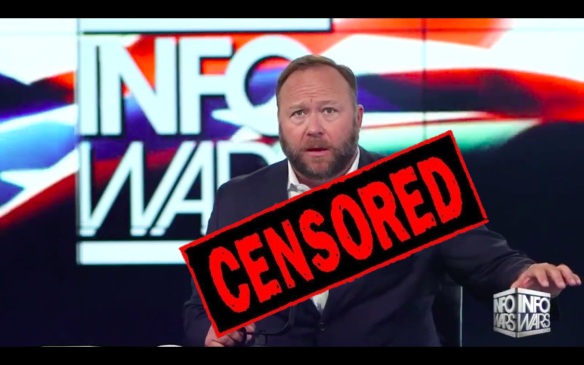
On August 6, a number of giant online media companies, including FacebookYouTubeAppleSpotify and Pinterest, took the seemingly coordinated decision to remove all content from Alex Jones and his media outlet Infowars from their platforms.

Jones, perhaps the internet’s most notorious far-right conspiracy theorist, has claimed that the Sandy Hook shooting was a hoax, the Democratic Party is running a child sex ring inside a DC pizzeria and that the Las Vegas shooting was perpetrated by Antifa. Despite or perhaps because of such claims, his website Infowars has built up an enormous following: 3 million Americans, almost 1 percent of the population, visited the site in July 2018, according to Alexa.

The reaction from the media to the decision to ban Jones and Infowarswas largely celebratory. On the Late Show (8/7/18), Stephen Colbert joked that it looked like “Infowars just lost their war on info.” The Daily Beast(8/9/18) urged readers to “shed absolutely no tears for Alex Jones,” while Salon (8/9/18) and CNN (8/9/18) put pressure on Twitter to follow suit, with the former asking, “Why is Alex Jones still allowed on Twitter?”

Some worried about a slippery slope of corporate censorship. Writing in Rolling Stone  8/2/18), Matt Taibbi warned: “The endgame here couldn’t be clearer. This is how authoritarian marriages begin, and people should be very worried.”

Yet this appeared to be a minority opinion. Media critic and news presenter David Doel shared his message to progressives via Twitter (8/6/18):

Lefties defending Alex Jones right now: I hear you, on the surface it appears to set bad precedent to give massive corporations control over who’s silenced. But if you aren’t performing hate speech, libel or slander on a regular basis, then I don’t know what you’re worried about.

Unfortunately, Facebook immediately used this new precedent to switch its sights on the left, temporarily shutting down the Occupy London page and deleting the anti-fascist No Unite the Right account (Tech Crunch8/1/18). Furthermore, on August 9, the independent, reader-supported news website Venezuelanalysis had its page suspended without warning.

The site does not feign neutrality, offering news and views about Venezuela from a strongly left-wing perspective. But it’s not uncritical of the Venezuelan government, either, and provides a crucial English-language resource for academics and interested parties on all sides wishing to understand events inside Venezuela from a leftist perspective, something almost completely absent in corporate media, which has been actively undermining elections (FAIR.org,5/23/18) and openly calling for military intervention or a coup in the country (FAIR.org5/16/18).

My latest book, Bad News From Venezuela: Twenty Years of Fake News and Misreporting, detailed the complete lack of diversity, and the strict adherence to an anti-Chavista editorial line, across corporate media. Venezuelanalysispraised by the likes of Noam Chomsky, Tariq Ali and John Pilger, offers an alternative perspective.

The abrupt nature of its de-platforming is a worrying development for alternative media. Following an appeal and a public outcry on social media, Venezuelanalysis was reinstated on Facebook. However, the social media site offered no explanation for what happened.

Facebook recently announced it had partnered with the Atlantic Council in an effort to combat “fake news” on its platform (FAIR.org5/21/18). An offshoot of NATO, the Council’s board of directors is a who’s who of neo-conservative hawks, including Condoleezza Rice, Colin Powell, Henry Kissinger and James Baker; CIA directors like Robert Gates, Leon Panetta and Michael Hayden; retired generals like Wesley Clark and David Petraeus; as well as senior tech executives.

Forty-five percent of Americans get their news from Facebook. When an organization like the Atlantic Council decides what news we see and do not see, that is tantamount to state censorship.

Venezuelanalysis (12/13/17) exposed that the Council was working closely with the Venezuelan opposition, donating over $1 million to it, part of a wide-ranging effort at regime change against multiple progressive governments in the region (Brasilwire12/28/17). That Facebook censored a news site responsible for investigating its partner is a worrying development in journalism.

Venezuelanalysis’ statement (8/9/18) on its removal noted that “Facebookappears to be targeting independent or left-wing sites in the wake of Russiagate.” As I previously argued (FAIR.org7/27/18), the utility of the Russian “fake news” scandal is that it allows corporate media to tighten their grip over the means of communication. Under the guise of combating fake news, media organizations like Google, Bing, Facebook and YouTube have changed their algorithms. The effect has been to hammer progressive media outlets. AlterNet’s Google traffic fell by 63 percent, Media Matters by 42 percent, TruthOut by 25 percent and The Intercept by 19 percent (WSWS8/2/17). Sites like these that challenge corporate perspectives are being starved of traffic and advertising revenue.

On August 13, the situation escalated as Facebookciting a clause in its terms of service barring “hateful, threatening or obscene” media,  deplatformed TeleSUR English, an English-language Latin American news network. TeleSUR is funded by a number of Latin American states, including Venezuela, and offers news and opinion from a progressive viewpoint. It was set up precisely to provide an alternative to Western corporate-dominated media. In its statement on its censorship, TeleSUR English (8/13/18) noted, “This is an alarming development in light of the recent shutting down of pages that don’t fit a mainstream narrative.”

That Facebook’s stated concern about stopping the spread of hate speech is genuine is challenged by the fact that the far-right Alternative fur Deutschland (AfD) party went to Facebook headquarters in Berlin in 2017 to discuss how it could use the platform for recruitment and for micro-targeting in the German elections, as Bloomberg Businessweek (9/29/17) reported. Through Facebook and with the help of American companies, AfD nearly tripled its previous vote share, becoming the third-largest party in Germany, the far right’s best showing since World War II.

The Russian fake news scandal has provided enormous media monopolies an avenue to try to reassert control over the means of communication. This latest action by Facebook is part of a worrying trend towards greater censorship of media. It is unlikely it will end here. Progressives should not necessarily shed tears for Jones, but they should be aware that their media is next in line, and that Jones’ deplatforming sets a dangerous precedent that is already being used against them.

Following an appeal and a public outcry on social media, both Venezuelanalysis and TeleSUR English were reinstated on Facebook, with the latter being told its suspension was due to “instability” and “suspicious activity,” though it had earlier gotten a message accusing it of “violating our Terms of Use.” As Venezuelanalysis (8/9/18) noted, “the whole thing is extremely mysterious, to say the least.”

Facebook escalates censorship of left-wing, anti-war organizations

By Andre Damon

Source: WSWS.org

One year ago this week, the World Socialist Web Site published an open letter to search monopoly Google demanding that it end its censorship of the internet.

The letter documented that a change in Google’s search algorithms that the company claimed was aimed at promoting “authoritative” news sources had led to a substantial decline in search traffic to left-wing, socialist and anti-war sites. Google, the letter from WSWS International Editorial Board Chairperson David North stated, was “engaged in political censorship of the Internet.”

One year later, it is clear that the allegations against Google were both correct and extremely prescient. The measures taken by Google initiated a sweeping system of corporate-state censorship adopted by all the US technology monopolies, including Facebook and Twitter. A campaign that began under the pretext of combatting “Russian meddling” and “fake news” is ever more openly targeting left-wing views.

The latest and most extreme attack on democratic rights came Tuesday, when Facebook announced that it has removed hundreds of user accounts and pages, many opposing the crimes of the American, Saudi, and Israeli governments in the Middle East, claiming they were the result of “influence campaigns” by Iran and Russia.

Some of the accounts purported to be “American liberals supportive of US Senator Bernie Sanders,” who expressed “support for Palestinians and opposition to Israel,” according to FireEye, the cybersecurity firm, heavily staffed by former intelligence operatives, with whom Facebook coordinated the deletions.

The press went even further in linking left-wing viewpoints with “foreign influence” operations. The Financial Times declared, “In the US, FireEye found accounts purporting to support Bernie Sanders, the US senator, and a fake organisation called Rise Against the Right. In the UK, the company discovered fabricated organisations called British Left and the British Progressive Front posting in support of Jeremy Corbyn, leader of the Labour Party.”

Virginia Democrat Mark Warner, who is leading the campaign for censorship, made clear that the internet giants’ moves to censor the internet are far broader than the original pretext of Russian “meddling” in the 2016 election. “There’s no way the problem of social media manipulation is limited to a single troll farm in St. Petersburg, and that fact is now beyond a doubt.” He added, “Iranians are now following the Kremlin’s playbook from 2016.”

Tellingly, FireEye said that it had only “moderate confidence that this activity originates from Iranian actors.” The company added that the possibility exists that “the activity could originate from elsewhere” or includes “authentic online behavior.”

Wherever the accounts originate, it is not up to Facebook to determine whether they are “authentic” or not. Tellingly, Facebook CEO Mark Zuckerberg, in a conference call with reporters, added that some of the accounts removed came from “a set of people the U.S. government and others have linked to Russia.” Given that dominant sections of the US state have sought to brand anyone who opposes US foreign policy as an agent of the Kremlin, such a broad definition could extend to any public critic of the US political establishment.

On the same day that Facebook removed pages and accounts it said were “linked to Iran,” it terminated the longstanding Facebook account of a WSWS contributor writing under a pseudonym, declaring that it would only reinstate the account if he provided government identification proving his identity.

Were such a standard to apply across the board, social media posts by contemporary authors Richard Bachman (who writes as Stephen King), Anne Rampling (who writes as Anne Rice) and countless others would be “inauthentic” if they were to use the names by which are known to by millions of people. Some of the most famous figures in the revolutionary movement, including Vladimir Lenin and Leon Trotsky, were known exclusively by their pen names. And of course, the American Federalist Papers and Anti-Federalist papers were all drafted by writers using pseudonyms.

Facebook, acting in coordination with government entities, serves as judge, jury and executioner in deciding who is granted the freedom of expression guaranteed under the First Amendment and international civil rights laws. It claims the right, with no trial, no appeal, and providing no information, to declare statements to be “inauthentic” and remove accounts making them.

Last month, Facebook deleted the official page of the left-wing counter-protest to this month’s fascist “Unite the Right 2” demonstration in Washington, which was endorsed by prominent left-wing political activists, including Whistleblower Chelsea Manning. Its rationale was that one account connected to the event page displayed “coordinated inauthentic behavior.”

This week, the Washington Post reported that Facebook operates an internal ranking system to determine “the trustworthiness of its users on a scale from zero to 1.” Those labeled “untrustworthy” will evidently be liable or deletion.

What is being introduced, piece by piece, is the mechanism for US technology monopolies to silence anyone, at any time, for any reason, by claiming their statements and views are “inauthentic” and “divisive.”

Such a mechanism, tested and implemented in the privately-controlled social media ecosystems, will then, with the ending of net neutrality, be used by internet service providers to block access to sites on the public internet and through email, claiming the “responsibility” to police their privately-owned networks.

In other words, one year after the WSWS published its open letter, all the mechanism have been created for Google, Facebook, Twitter and leading internet service providers to ban and silence anyone, with no legal recourse, oversight or public knowledge.

But in the year since the publication of the open letter, another process has emerged. The working class all over the world has entered into struggle, beginning with a wave of teachers’ strikes in the US earlier this year, and continuing with strikes by heavy industry workers in Germany, airline pilots throughout Europe at Ryanair, and a growing opposition and anger among UPS workers, autoworkers, Amazon workers and other sections of the working class.

The moves to intensify censorship are aimed above all at blocking the intersection of this growing movement of the working class with a socialist program.

But this movement of the working class also creates the political basis for the struggle against censorship. As workers clash with their employers and their union collaborators, they must inscribe on their banners opposition to political censorship and must fight for the expropriation of the social media monopolies under public control as a key component of the fight for socialism.

In January of this year, the World Socialist Web Site issued an open letter calling for “socialist, anti-war, left-wing and progressive websites, organizations and activists” to join “an international coalition to fight Internet censorship.” This appeal is more relevant than ever. We urge everyone seeking to fight the grip of the technology monopolies and intelligence agencies over the internet to contact us and join the fight against censorship!


Loneliness

By Yogi Prateado

Source: Adbusters

The Silicon Valley in which I live, a culture infused with the cocaine high of technological breakthroughs, grates against my earthly sensibilities.

Riding on the crest of adrenalin, discovery, and money, what many in the fair Bay Area know, is not in fact what is. This temporary party atmosphere, around until catastrophe hits, is the last hurrah of capitalism. Whether technology will trap us in a surveillance state, or liberate us from mediating political, economic, and social predators, dangles in the hands of deliberate planning and meta-organizing on the part of those developers.

As users and citizens, we are all developers.

Not knowing the implications of one’s discoveries is very different from saying that there aren’t any. The neoteny of tech bros and gals is part of the enforced juvenilization of tech “campuses” and a society that values brain plasticity over wisdom.

After all, wisdom doesn’t sell. You can’t fake wisdom; there’s no wise way to put lipstick on a pig’s face, but there is money to be made from exploiting our mammalian dispositions.

Thus, tech people are predisposed to think, act, and do as children do. They are rewarded for doing so. But this has consequences for where we are going as a culture, and as a planet.

Enforced childhood and adolescence—having other people clean your clothes, make your food, and take you to work—creates “first world problems”, obsessions with gourmet food, and infantile competition. By disconnecting life from work and work from life, millenials are entranced by expensive eating out, Instagramming meals, and living off rich meat, sugar, and dairy (internal parasite-cultivating, climate change-causing) indulgences. Meanwhile, the products you make hand the keys of ultimate social control over to the highest bidder.

Thus, to work in the tech industry becomes a self-fulfilling prophecy. Young minds are inculcated into believing what they are doing is indeed a good thing, a helpful thing for society, rewarded by their superiors with a glamorous job which treats them like a kid, pays well, and provides a roulette wheel of opportunity.

At the same time, those highest on the food chain realize their techno optimism must be tempered with social intelligence. Zuckerberg’s Harvard Address talks about the need for universal health care (duh) and Universal Basic Income, simple solutions needed before we can begin to talk about truth, fairness, justice, diversity, or intelligence. Here, the boy billionaire unfortunately does have a point, one he’s cynically selling to the masses as he consolidates money and power.

It’s now a given that there are multiple intelligences, but in the West (particularly the self-interested, individualistic US), this is still some sort of revelation. It has yet to be integrated into schools, politics, commerce, or tech, let alone science, as many conveniently believe in one scale of intelligence (usually the one they excel at).

As Maslow knew, until we have basic welfare (food, water, shelter), the people have no hope of participating in democracy. Since 1970, Rawls and every reasonable political theorist agreed with this theory, yet we still expect a polity without a society. “Society” is fragmented, violent, scared, and unequal; millionaire 20-year-olds dodging and ignoring homeless 60-year-olds in the street.

The illusion of progress is one of the most pernicious veils currently enthralling our eyes.

The high of “being part of the solution” or “doing well while doing good,” is a strong opiate indeed. Since Marx, drug metaphors have been used to compare capitalism’s co-opting and metabolizing any opposition, novelty, or expression of freedom. Like an out-of-control nanobot army, capitalism turns color into grey goo, turns freedom into products, and commodifies all authentic expression. To quote Wright, we are in a technology trap, where every problem demands a technofix.

But the will-to-power techno-optimism concept doesn’t pan out. What cosmology could support the absurd conclusion that a problem’s old template can be used to “innovate” a new solution? The notion that there is a template—the homogenization of the mind globally through damaging the climate, spreading uniform media, and the colonialism of language and culture—is the problem.

We’re talking out of both sides of our mouths, saying we value diversity then quenching it, saying we’re open to difference then suppressing it. When it does pop up, diversity is first a novelty then a perversion, objectified and commodified as it fights to exist in a white capitalist heteropatriarchy. As Erica Wohldmann says, “Complete control is merely an illusion so we might as well be comfortable.” Comfort requires being pushed back, eating and being eaten, giving and taking. Symbiosis—sharing.

We have been stingy with sharing, forgetting our knowledge is limited.
It’s time to come home to fallibility, responsibility, and the truth about our poor state of affairs. Delaying the operation makes the sickness worse and decreases the chance for a resilient recovery.

Our ancestors only owned as much as they could carry. Live simply so that others may simply live. But what of this simplicity at the societal, political, legal, medical, global level?

Decentralization is the first priority; no more anonymous policy-making. If a decision doesn’t directly affect you, you have no right to legislate over it. No more long arms of the government, no more far-reaching corporations preying on the people thousands of miles from their headquarters.

How does the internet and digital technology play into this? Well, we need a localized technology. Can we still have global epistemic cultures with a non-commercial and non-domination clause?

A moratorium on new technologies will allow us room to assess, democratize, and redistribute the existing technologies. We need to remove oil drilling and gas mining from our technological arsenal. Prioritize technologies that clean up social, economic, racial, and gender-centred wounds. The precious resources—human and natural—that we command should be distributed to the most urgent problems with an interdisciplinary, cross-cultural plan of attack, not one made to make money. Then we collectively apply solutions, not with the bull-in-a-China-shop attitude of big tech, but with care and empathy.

We need to shut the 10,000 Pandora’s boxes opened by technology, and doing that will require technologies. But those technologies must be different form the single, aggressive one we have. An indigenous science, a feminist science, a postcolonial science—all are needed for any hope of change.

We need to go where scares us to know our courage. May we be humbled by the sublime, overwhelmed before the creations which created us. May we work in inner and outer service only towards the true liberation of all beings.

Share more, use less.
Evolve ourselves.

Alex Jones and the Rise of Corporate Censorship

By Brendan O’Neill

Source: Strategic Culture Foundation

So we’re now trusting the capitalist class, massive, unaccountable corporations, to decide on our behalf what we may listen to and talk about? This is the take-home message, the terrible take-home message, of the expulsion of Alex Jones’ Infowars network from Apple, Facebook and Spotify and of the wild whoops of delight that this summary banning generated among so-called liberals: that people are now okay with allowing global capitalism to govern the public sphere and to decree what is sayable and what is unsayable. Corporate censorship, liberals’ new favourite thing – how bizarre.

We live in strange times. On one hand it is fashionable to hate capitalism these days. No middle-class home is complete without a Naomi Klein tome; making memes of Marx is every twentysomething Corbynistas’ favourite pastime. But on the other hand we seem content to trust Silicon Valley, the new frontier in corporate power, to make moral judgements about what kind of content people should be able to see online. Radicals and liberals declared themselves ‘very glad’ that these business elites enforced censorship against Jones and Infowars. We should be ‘celebrating the move’, said Vox, because ‘it represents a crucial step forward in the fight against fake news’. Liberals for capitalist censorship! The world just got that bit odder, and less free.

Over the past 24 hours, Jones and much of his Infowars channel has been ‘summarily banned’ – in the excitable words of Vox – from Apple, Facebook, Spotify and YouTube. Initially, Facebook and YouTube had taken only selective measures against Jones. In response to a Twitterstorm about his presence on these platforms, they took down some of his videos. But then Apple decided to ban Jones entirely – removing all episodes of his podcast from its platform – and the other online giants followed suit. Or as the thrilled liberal commentary put it: ‘The dominoes started to fall.’ Despite having millions of subscribers, despite there being a public interest in what he has to say, Jones has been cast out of the world of social media, which is essentially the public square of the 21st century, on the basis that what he says is wicked.

This is censorship. There will of course be apologists for the corporate control of speech, on both the left and right, who will say, ‘It’s only censorship when the government does it!’. They are so wrong. When enormous companies that have arguably become the facilitators of public debate expel someone and his ideas because they find them morally repugnant, that is censorship. Powerful people have deprived an individual and his network of a key space in which they might propagate their beliefs. Aka censorship.

It doesn’t matter what you think of Jones. It doesn’t matter if you think he is mad, eccentric, and given to embracing crackpot theories about school shootings being faked. You should still be worried about what has happened to him because it confirms we have moved into a new era of outsourced censorship. It shows that what was once done by the state is now done by corporations. The illiberal, intolerant cleansing from public life of ideas judged to be offensive or dangerous has shifted from being the state’s thing to being the business elite’s thing. Witness how many campaigners for censorship now seek to marshal capitalist power to the end of erasing voices they don’t like – from the Dump Farage campaign that wants corporations to withdraw their advertising from LBC until it dumps Nigel Farage as a presenter to the calling on Silicon Valley to deprive the oxygen of publicity to offensive broadcasters.

In essence, so-called liberals and sections of the political class now want corporations to do their dirty work for them. They want the capitalist elites to do what it has become somewhat unfashionable for the state to do: ban controversial political speech. What an extraordinary folly this is. To empower global capitalism to act as judge, jury and executioner on what may be said on social-media platforms, in the new public square, is to sign the death warrant of freedom of speech. What if these bosses decide next that Marxist speech is unacceptable? Or that Zionist speech is dangerous? In green-lighting the censorship of Jones, we grant corporate suits the moral authority to censor pretty much anything else, too.

People on both the liberal left and the libertarian right argue that what has been done to Jones is acceptable because this is simply a case of businesses deciding freely who they should associate with or provide platforms to. This is disingenuous. This was not a clean, independent business decision – it was a rash act of silencing carried out under pressure from a moralised mob that insisted Jones’ words are too wicked for public life. This isn’t the free market in action – it’s the bending of capitalist power to the end of enforcing moral controls on speech. There is one very interesting thing that will spring from this incident: we will witness the severe limitations of right-wing libertarianism. Libertarians’ obsession with the state, their belief that things are only bad if the state does them, means they are incapable of arguing against capitalist authoritarianism, and in fact even support it on the basis that this is the free market being the free market (even though it isn’t). Libertarianism is devastatingly ill-prepared for the new authoritarianism, for tackling the rise of outsourced censorship and informal intolerance.

For good or ill, the social-media sphere is the new public sphere. The expulsion of people from these platforms is to 2018 what a state ban on the publication or sale of certain books was to 1618. How can we convince the owners of social media to permit the freest speech possible and to trust their users to negotiate the world of ideas for themselves? This is the question we should be asking ourselves, rather than concocting more ways to encourage these corporate overlords to censor and blacklist.

In A Corporatist System Of Government, Corporate Censorship Is State Censorship

By Caitlin Johnstone

Source: CaitlinJohnstone.com

Last year, representatives of Facebook, Twitter, and Google were instructed on the US Senate floor that it is their responsibility to “quell information rebellions” and adopt a “mission statement” expressing their commitment to “prevent the fomenting of discord.”

“Civil wars don’t start with gunshots, they start with words,” the representatives were told. “America’s war with itself has already begun. We all must act now on the social media battlefield to quell information rebellions that can quickly lead to violent confrontations and easily transform us into the Divided States of America.”

Yes, this really happened.

Today [8/7] Twitter has silenced three important anti-war voices on its platform: it has suspended Daniel McAdams, the executive director of the Ron Paul Institute, suspended Scott Horton of the Scott Horton Show, and completely removed the account of prominent Antiwar.com writer Peter Van Buren.

I’m about to talk about the censorship of Alex Jones and Infowars now, so let me get the “blah blah I don’t like Alex Jones” thing out of the way so that my social media notifications aren’t inundated with people saying “Caitlin didn’t say the ‘blah blah I don’t like Alex Jones’ thing!” I shouldn’t have to, because this isn’t actually about Alex Jones, but here it is:

I don’t like Alex Jones. He’s made millions saying the things disgruntled right-wingers want to hear instead of telling the truth; he throws in disinfo with his info, which is the same as lying all the time. He’s made countless false predictions and his sudden sycophantic support for a US president has helped lull the populist right into complacency when they should be holding Trump to his non-interventionist campaign pledges, making him even more worthless than he was prior to 2016.

But this isn’t about defending Alex Jones. He just happens to be the thinnest edge of the wedge.

As of this writing, Infowars has been censored from Facebook, Youtube (which is part of Google), Apple, Spotify, and now even Pinterest, all within hours of each other. This happens to have occurred at the same time Infowars was circulating a petition with tens of thousands of signatures calling on President Trump to pardon WikiLeaks editor-in-chief Julian Assange, who poses a much greater threat to establishment narratives than Alex Jones ever has. Assange’s mother also reports that this mass removal of Infowars’ audience occurred less than 48 hours after she was approached to do an interview by an Infowars producer.

In a corporatist system of government, wherein there is no meaningful separation between corporate power and state power, corporate censorship is state censorship. Because legalized bribery in the form of corporate lobbying and campaign donations has given wealthy Americans the ability to control the US government’s policy and behavior while ordinary Americans have no effective influence whatsoever, the US unquestionably has a corporatist system of government. Large, influential corporations are inseparable from the state, so their use of censorship is inseparable from state censorship.

This is especially true of the vast megacorporations of Silicon Valley, whose extensive ties to US intelligence agencies are well-documented. Once you’re assisting with the construction of the US military’s drone program, receiving grants from the CIA and NSA for mass surveillance, or having your site’s content regulated by NATO’s propaganda arm, you don’t get to pretend you’re a private, independent corporation that is separate from government power. It is possible in the current system to have a normal business worth a few million dollars, but if you want to get to billions of dollars in wealth control in a system where money translates directly to political power, you need to work with existing power structures like the CIA and the Pentagon, or else they’ll work with your competitors instead of you.

And yet every time I point to the dangers of a few Silicon Valley plutocrats controlling all new media political discourse with an iron fist, Democratic Party loyalists all turn into a bunch of hardline free market Ayn Rands. “It’s not censorship!” they exclaim. “It’s a private company and can do whatever it wants with its property!”

They do this because they know their mainstream, plutocrat-friendly “centrist” views will never be censored. Everyone else is on the chopping block, however. Leftist sites have already had their views slashed by a manipulation of Google’s algorithms, and it won’t be long before movements like BDS and Antifa and skeptics of the establishment Syria and Russia narratives can be made to face mass de-platforming on the same exact pretext as Infowars.

This is a setup. Hit the soft target so your oligarch-friendly censorship doesn’t look like what it is, then once you’ve manufactured consent, go on to shut down the rest of dissenting media bit by bit.

Don’t believe that’s the plan? Let’s ask sitting US Senator Chris Murphy:

“Infowars is the tip of a giant iceberg of hate and lies that uses sites like Facebook and YouTube to tear our nation apart,” Murphy tweeted in response to the news. “These companies must do more than take down one website. The survival of our democracy depends on it.”

That sure sounds an awful lot like the warnings issued to the Silicon Valley representatives on the Senate floor at the beginning of this article, no? This is headed somewhere dark.

We’re going to have to find a way to keep the oligarchs from having their cake and eating it too. Either (A) corporations are indeed private organizations separate from the government, in which case the people need to get money out of politics and government agencies out of Silicon Valley so they can start acting like it, and insist that their owners can’t be dragged out on to the Senate floor and instructed on what they can and can’t do with their business, or (B) these new media platforms get treated like the government agencies they function as, and the people get all the First Amendment protection that comes with it. Right now the social engineers are double-dipping in a way that will eventually give the alliance of corporate plutocrats and secretive government agencies the ability to fully control the public’s access to ideas and information.

If they accomplish that, it’s game over for humanity. Any hope of the public empowering itself over the will of a few sociopathic, ecocidal, omnicidal oligarchs will have been successfully quashed. We are playing for all the chips right now. We have to fight this. We have no choice.