Battlefield Social Media: The West’s Growing Censorship

Censorship in the West flourishes as tech giants turn social media back into traditional programmed media. 

By Gunnar Ulson

Source: Land Destroyer

The United States, United Kingdom and the European Union are fond of passing judgement on nations around the globe regarding “free speech.”

While it is increasingly clear to a growing number of people that this “concern” is disingenuous and aimed at merely defending agitators funded and directed by Western special interests in these targeted nations, the West still likes to fashion itself as a sort of champion of free speech.

Yet back home the Internet has been taken over by social media and tech giants like Google, Facebook and Twitter.

Their platforms clearly serve as online public squares where everything is discussed and even election campaigns play out. Yet these companies have, over the years, begun to eliminate voices of dissent against a notion known as “consensus.”

If you are speaking out against “consensus” you are in real danger of disappearing from these platforms. Some of these platforms, like Google-owned YouTube, serve as the livelihood to people who have for years built up their audiences, produced hundreds of videos and when their accounts are deleted for speaking out against the “consensus,” they have their livelihoods destroyed.

In the wake of these incremental “purges” is a chilling effect with content creators self-censoring or even withdrawing entirely from Western social media.

It is the sort of very real censorship the West has crusaded against in fiction around the globe for decades. 

Concensus or Else 

A more recent example is Google’s decision to ban ad revenue for those going against the Coronavirus Disease 2019 (COVID-19) “consensus.”

CNBC in their story “Google will ban ads from running on stories spreading debunked coronavirus conspiracy theories,” would claim:

Google next month will ban publishers from using its ad platform to show advertisements next to content that promotes conspiracy theories about Covid-19. It will also ban ads that promote those theories. In cases where a particular site publishes a certain threshold of material that violates these policies, it will ban the entire site from using its ad platforms.

Those “conspiracy theories” might include questioning the official death rates of COVID-19. Yet even the British government itself has been recently forced to investigate its statistics regarding death rates, vindicating the very sort of people who would have been either forced into silence or forced to give up ad revenue.

The London Guardian in its article, “Matt Hancock orders urgent review of PHE Covid-19 death figures,” would admit:

The UK health secretary, Matt Hancock, is ordering an urgent review of the daily Covid-19 death statistics produced by Public Health England, after it emerged that they may include recovered former sufferers who could have died of other causes.

False reporting over deaths to hype COVID-19, induce greater public panic and pave the way for billions in government handouts to pharmaceutical giants is at the very core of many of these so-called “conspiracy theories” Google seeks to silence through its campaign of financial coercion.

Imagine if this chilling effect was achieved sooner. Would the British government have even bothered investigating its faulty statistics if there weren’t people suspicious of them?

The chilling effect this has over openly discussing something as serious as COVID-19 considering its socioeconomic impact is truly alarming and much more so because it is happening in the so-called “free world” overseen by its self-appointed arbitrators in the US, UK and EU.

A similar campaign was carried out to purge Google, Twitter and Facebook of anyone allegedly connected with “Russia” who also so happened to be anti-war and anti-NATO for waging those wars.

Entire lists are compiled by Western government-funded organizations which are then submitted to these tech giants for purging. The Western media writes accompanying articles announcing, justifying and spinning the purges… but also sending a warning to those left about what is and isn’t going to be tolerated on these platforms.

Social Media Transforming Back into Programmed Media 

Content creators are faced with two decisions; to either self-censor themselves to protect their work, their audiences and their livelihood, or to accept the possibility they will eventually be “purged” (censored) and need to rebuild their audiences from scratch on platforms with far fewer potential readers, viewers and patrons.

Social media, of course, is no longer social media in this sort of environment, but more akin to the sort of programmed media giant Western special interests built their power on over the course of the 20th and early 21st century.

Private Public Squares? 

Of course the defense is that Google, Facebook and Twitter are “private companies”and can do as they please with their platforms. In reality, these companies work in tandem with Western governments whether it is fomenting political destabilization abroad or creating “concensus” at home.

The notion that censorship is “ok” because the US, UK and EU governments launder it through private companies ignores the close relationship these companies have with the government and how their platforms have been transformed into defacto public squares and critical channels of public communication and participation.

The West’s growing overt censorship leaves it with a choice; to either accept that it is in reality as guilty of censorship and manipulating the public as it has claimed its opponents are, or continue pretending it isn’t but at the continued cost of its legitimacy upon the global stage.

There is a very good reason the West is in decline around the globe and why its attempts to leverage notions like “human rights” and “free speech” against nations like China or Russia are increasingly impotent. That reason can be found, at least in part, among the growing number of purge lists, censorship campaigns and calls for “consensus” across Western social media.

Finally, the increasingly overt nature of censorship and controlled narratives promoted by tech giants like Google, Facebook and Twitter should have them facing restrictions and bans around the globe. Why should any nation host a “public square” where discourse is entirely controlled by interests oceans away? Why shouldn’t a local alternative be created instead where the revenue is kept locally and if narratives are to be controlled, controlled in a way that best suits people locally?

It is ironic that, China for example, is condemned for not allowing Google, Facebook and Twitter to operate freely within their information space because it is a violation of “free speech,” even as Google, Facebook and Twitter cudgel free speech on their own respective platforms.

How much longer will the world tolerate these double standards? How long until individuals, organizations and even entire nations begin creating alternatives to Google, Facebook and Twitter to at the very least balance out the lopsided power and influence they have collectively accrued and abused? 

Is Data Our New False Religion?

By Charles Hugh Smith

Source: Of Two Minds

Here’s how every modern con starts: let’s look at the data. Every modern con starts with an earnest appeal to look at the data because the con artist has assembled the data to grease the slides of the con.

We have been indoctrinated into a new and false religion, the faith of data. We’ve been relentlessly indoctrinated with the quasi-religious belief that “data doesn’t lie,” when the reality is that data consistently misleads us because that is the intent.

Nobody in the False Religion of Data ever looks at what we don’t measure because that would uncover disruptive truths. My latest book Will You Be Richer or Poorer?: Profit, Power, and AI in a Traumatized World looks at everything consequential that we don’t measure, and since we don’t measure it, we assume it doesn’t exist. That’s the end-game of the False Religion of Datawhat’s actually important isn’t measured and therefore it doesn’t exist, while what is measured is artfully packaged to support a narrative that enriches those behind the screen of “objective data-based science.”

The data-based con can be constructed in any number of ways. A few data points can be cleverly extrapolated to “prove” some self-serving claim, a bit of data can be conjured into a model that just so happens to support the most profitable policy option, inconvenient data points can be covertly deleted via “filtering out the outliers,” statistical trickery can be invoked (with a wave of this magic wand…) to declare semi-random data “statistically significant,” and so on, in an almost endless stream of tricks.

Exhibit #1: the official rate of inflation. Here is the data con elevated to artistry. As I explained in Burrito Index Update: Burrito Cost Triples, Official Inflation Up 43% from 2001 (May 31, 2018), apples-to-apples unmanipulated data shows inflation is dramatically reducing the purchasing power of wages, a dynamic that is unevenly distributed: Inflation Isn’t Evenly Distributed: The Protected Are Fine, the Unprotected Are Impoverished Debt-Serfs (May 25, 2017).

While the official statistics on inflation claim an annual rate of 2.5%, unmanipulated estimates (the Chapwood Index for example) find inflation is north of 10% in major U.S. urban areas.

The official data soothsayers’ bag of tricks include completely bogus, made-up “hedonic adjustments” which magically lower the price of real-world goods and services. Autos are supposedly “cheaper” now because they’re so much safer and reliable. Perhaps, but can we be honest and admit they cost a lot more than they did a generation ago?

No, Autos Are Not “Cheaper Now” (June 28, 2019)

The poor fools giving hundreds of millions of dollars to the con artists of Big Data Marketing apparently don’t understand the flimsiness of the “science.” As Mark, Jesse and I discuss in our latest Salon, Algorithmic Guerrilla Warfare, a few purposefully misleading data points turn the entire Big Data Marketing “science” into the familar “garbage in, garbage out.”

And so here we are in the midst of a pandemic, and the battles over “what the data tells us” sound more like religious wars than science. Everybody’s in such a hurry to conjure up a profitable con or make grandiose claims for their narrative that what we aren’t measuring is ignored.

Here’s the raw data I’d like to see collected:

1. What percentage of people under the age of 50 who do not have chronic health conditions who test positive end up with severe symptoms that incapacitate them for weeks or months?

2. What percentage of these younger, healthier people who exhibit severe symptoms have organ damage that doesn’t heal in a few months?

3. What percentage of people who had antibodies for the virus end up coming down with the illness again a few months later?

Collecting this data is non-trivial, and so it may never be collected–partly because the results might not support the approved narratives: whatever data we don’t collect doesn’t exist and can’t disrupt our models, profit centers, narratives, policies, etc.

In the false religion of data, heresy is asking for data that is not being collected because it might reveal unpalatably unprofitable realities. Much safer to burn heretics at the stake than let them question the cons.

Freedom Rider: The Internet Does Washington’s Dirty Work

By Margaret Kimberly

Source: Black Agenda Report

As long as the internet is in private hands it should be seen as a “frenemy” — a useful resource that can also be wielded as a weapon.

“Black people are routinely sent to “facebook jail” if their words anger racist white people.”

In its early days the internet seemed to be an undisputed good, a means of communication open to all. It was hoped that these new platforms would level the playing field and give smaller outlets like Black Agenda Report access to a worldwide audience. The internet has done that but it is also a weapon that is used against the left in this country and against nations and movements declared enemies by this government.

In the rush of enthusiasm one important fact was forgotten. The internet is in the hands of private corporations. They decide who gets service, where they get it and at what speed. The growth of social media only exacerbated the problems of corporate control.

This columnist uses Facebook and Twitter and other platforms by necessity. They are sources of information and important means of communication. But they are controlled by powerful corporate entities who work hand in hand with the government. Ultimately they decide who can be seen and who cannot.

“Private corporations decide who gets service, where they get it and at what speed.”

When the U.S. government speaks, Facebook and Twitter listen and then do as they are told. When foreign governments are declared adversaries their representatives and advocates are censored. In the past year, the Syrian government and the Venezuelan government have been temporarily blocked on Twitter. Sites such as Telesur have been repeatedly removed from Facebook. Numerous Palestinian advocacy sites have been removed from Facebook at the behest of the Israeli government.

Facebook decides if “community standards” have been violated and restrict anyone who violates their opaque rules. Black people are routinely sent to “facebook jail” if their words anger racist white people.

But the loss of access is not the biggest problem. When the United States government killed Iranian general Qassem Soleimani they also wanted to kill off his memory. Facebook posts which spoke of him in any favorable light were removed. Facebook isn’t alone in joining the governmental directive. The Iranian English language service, Presstv, was removed from Youtube, which is owned by Google. Years of reporting and interviews, including some given by this columnist, disappeared into the black hole of cyberspace. When the U.S. began ratcheting up its maximum pressure, the corporate sector went right along and Presstv was sent down the memory hole.

“Presstv was removed from Youtube, which is owned by Google.”

Censorship has gotten worse because of liberals, not conservatives, and they have used the Russiagate fraud to accelerate the deplatforming process. Immediately after the 2016 election we were told that the Russian government was responsible for Trump’s victory and that censorship was the only thing standing between us and living under the control of Vladimir Putin.

The infamous Proporornot  list declared that Black Agenda Report and other sites were under Russian influence. Ever since that list was published in late 2016 many left sites lost visibility on Google and other search engines.

Now Trump administration sanctions are impacting our ability to communicate in a variety of ways. Not only were references to Soleimani removed, but the use of the word “Iran” can result in censorship and the inability to complete financial transactions. The Grayzone project  reported that Paypal restricted donations from anyone who mentioned the word Iran.

It must be repeated that Trump has plenty of help from Democrats and liberals in this regard. Pleas for Facebook “fact checking” will result in more censorship of black people and of anyone who happens to voice opinions that run counter to the imperialist narrative.

“The use of the word “Iran” can result in censorship.”

Already Russia is being blamed for election interference, yet Russia is not the target. The left is the target and Democrats are leading the charge. Their goal is to narrow discourse and to make war propaganda acceptable. It is an irony and a contradiction that while Trump is falsely accused of being under Russian influence, his policy goals are furthered with help from liberals. U.S. imperialism is a thoroughly bipartisan project.

This collusion between the wings of the duopoly must be kept in mind during the farcical impeachment. The Democrats could have added the war crime of the Soleimani assassination to their articles of impeachment. But they are complicit in this regard and will mention nothing of substance. Instead they have only one flimsy charge that is a cynical get out the vote effort and a source of anti-Russian propaganda.

As long as the internet is in private hands it should be seen as a “frenemy,” a useful resource that can also be wielded as a weapon. These platforms cannot be trusted unless or until they are publicly regulated. In the meantime, our reliance on them comes at a price.

Hovering in Cyberspace

By Edward Curtin

Source: Behind the Curtain

We live in a fabricated reality where the visible world became nearly meaningless once the screen world became people’s “window on the world.”  An electronic nothingness replaced reality as people gleefully embraced digital wraparound apparitions.  These days people still move about in the physical world but live in the electronic one.  The result is mass hallucination.

This is the fundamental seismic shift of our era. There is a lot of bitching and joking about it, but when all is said and done, it is accepted as inevitable. Digital devices are embraced as phantom lovers. Technological “advances” are accepted as human destiny.  We now inhabit a technological nightmare (that seems like a paradise to so many) in which technology and technique – the standardized means for realizing a predetermined end most efficiently – dominate the world. In such a world, not only does the end justify the means, but to consider such a moral issue is beside the point. We are speeding ahead to nowhere in the most “efficient” way possible.  No questioning allowed!  Unless you wish to ask your phone.

These days there is much political talk and commentary about fascism, tyranny, a police state, etc., while the totalitarianism of technocracy and technology continues apace.  It is not just the ecological (in the human/natural sense) impact of digital technology where one change generates many others in an endless spiral, but the fact that technical efficiency dominates all aspects of life and, as Jacques Ellul wrote long ago, “transforms everything it touches into a machine,” including humans.  For every problem caused by technology, there is always a technological “solution” that creates further technological problems ad infinitum.  The goal is always to find the most efficient (power) technique to apply as rapidly as possible to all human problems.

Writing nearly fifty years ago in Medical Nemesis, Ivan Illich, explained how in medical care the human touch was being replaced by this technical mindset.  He said,

In all countries, doctors work increasingly with two groups of addicts: those for whom they prescribe drugs, and those who suffer from their consequences. The richer the community, the larger the percentage of patients who belong to both…In such a society, people come to believe that in health care, as in all fields of endeavor, technology can be used to change the human condition according to almost any design.

We are of course living with the ongoing results of such medical technical efficiency.  The U.S.A. is a country where the majority of people are drugged in one way or another, legally or illegally, since the human problems of living are considered to have only technological solutions, whether those remedies are effective or anodyne.  The “accidents” and risks built into the technological fixes are never considered since the ideological grip of the religion of technology is all-encompassing and infallible.  We are caught in its web.

Marshall McLuhan, the media guru of the 1960s – whether he was applauding or bemoaning the fact – was right when he claimed that the medium is the message.

Cell phones, being the current omnipresent form of the electronification of life, are today’s message, a sign that one is always in touch with the void.  To be without this small machine is to be rendered an idiot in the ancient Greek sense of the word – a private person.  Translation: one who is out of it, detached, at least temporarily, from the screens that separate us from reality, from the incessant noise and pinging messages that destroy reflection and create reflex reactions.

But to be out of it is the only way to understand it.  And to understand it is terrifying, for it means one knows that the religion of technology has replaced nature as the source of what for eons has been considered sacred. It means one grasps how reality is now defined by technology. It means realizing that people are merging with the machines they are attached to by invisible manacles as they replace the human body with abstractions and interact with machines.  It means recognizing that the internet, despite its positive aspects and usage by dissenters intent on human liberation, is controlled by private corporation and government forces intent on using it as a weapon to control people. It means seeing the truth that most people have never considered the price to be paid for the speed and efficiency of a high-tech world.

But the price is very, very high.

One price, perhaps the most important, is the fragmentation of consciousness, which prevents people from grasping the present from within – which, as Frederic Jameson has noted, is so crucial and yet one of the mind’s most problematic tasks – because so many suffer from digital dementia as their attention hops from input to output in a never-ending flow of mediated, disembodied data.  As a result, a vicious circle has been created that prevents people from the crucial epistemological task of grasping the double-bind that is the ultimate propaganda.  Data is Dada by another name, and we are in Dada land, pissing, not into Marcel Duchamp’s ridiculous work of Dada “art,” a urinal, but into the wind.  And data piled on data equals a heap of data without knowledge or understanding.  There is no time or space for grasping context or to connect the dots. It is a pointillist painting in the form of inert facts that few can understand or even realize that they don’t.

I am typing these words on a Hermes 3000 manual typewriter, a beautiful piece of technology whose sound and movement creates a rhythmic sanctuary where my hands, head, and heart work in unison. It allows me to think slowly, to make mistakes that will necessitate retyping, to do second and third rereadings and revisions, to roll the paper out of the machine and sit quietly as I review it.  My eyes rest on the paper, not a blue-lit screen.

Technology as such is not the problem, for my typewriter is a very useful and endurable machine, a useful technology that has enhanced life. It does not break or need to be replaced every few years, as computers do. It does not contain coltan, tantalum, or other minerals mined in the Democratic Republic of Congo, Rwanda, and other places by poor people working under oppressive conditions created by international consumer greed that is devouring the world.  It does not allow anyone to spy on me as I type.  I am alone and unplugged, disconnected, off-line and out of line, a sine qua non for thinking, and thinking about deep matters.  The typewriter is mine, and mine alone, unlike the connected digital devices that have destroyed aloneness, for to be alone is to contemplate one’s fate and that of all humanity.  It is to confront essential things and not feel the loneliness induced and exacerbated by the illusion of always being in touch.

But while this typing machine allows me to write in peace, I am in no way suggesting that I have escaped the technological condition that we all find ourselves in.  There are little ways to step outside the closing circle, but even then, one is still in it.  I will eventually have to take my paper and type it into a computer document if I wish to publish it in the form you will be reading it.  There is no other way. The technocrats have decreed it so. We are all, as George Orwell once wrote in a different context and meaning, “inside the whale,” the whale in this case being a high-tech digital world controlled by technocrats, and we have only small ways to shield ourselves from it. Sitting in a quiet room, working on a typewriter, taking a walk in the woods without a cell phone, or not owning a cell phone, are but small individual acts that have no effect on the structural realty of what Neil Postman calls technopoly in his masterful book, Technopoly: The Surrender of Culture to Technology.  And even in the woods one may look up to admire a tree only to find that it is a cell phone tower.

Humans have always created and used technology, but for a very long time that technology was subject to cultural and religious rules that circumscribed limits to its use.  Today there are no limits, no rules to constrain it.  The prohibition to prohibit is our motto.  In our acceptance of technical efficiency, we have handed over our freedom and lost control of the means to ends we can’t fathom but unconsciously fear.  Where are we heading? many probably wonder, as they check the latest news ping, no doubt about something to fear, as a thousand pieces of “news” flash through their devices without pause, like wisps of fleeting dreams one vaguely remembers but cannot pin down or understand.  Incoherence is the result.  Speed is king.

Of course, this kaleidoscopic flood of data confuses people who desire some coherence and explanation.  This is provided by what Jacques Ellul, in Presence in the Modern World, calls “the explanatory myth.”  He writes,

This brings us to the other pole of our bizarre intellectual situation today: the explanatory myth.  In addition to its political and its mystical and spiritual function, the explanatory myth is the veritable spinal column of our whole intellectual system…Given that appearances produce confusion and coherence is needed, a new appearance unifies them all in the viewer’s mind and enables everything to be explained.  This appearance has a spiritual root and is accepted only by completely blind credulity.  It becomes the intellectual key for opening all secrets, interpreting every fact, and recognizing oneself in the whirl of phenomena…this myth [is] their one stable point of thought and consciousness…enables everyone to avoid the trouble of thinking for themselves, the worry of doubt, the questioning, the uncertainty of understanding, and the torture of a bad conscience.  What prodigious savings of time and means, which can be put usefully to work manufacturing some more missiles…[they] have a good conscience because they have an answer for everything; and whatever happens and whatever they do, they can rely on the explanation that myth provides.  This process places them within the most complete unreality possible.  They live in a permanent dream, but a realistic dream, constructed from the countless facts and theories that they believe in with all the power of ‘mass persons’ who cannot detach themselves from the mass without dying.

Today that myth is the religion of technology.

So if you have any questions you want answered, you can ask your phone.

Ask your phone why we are living with endless wars on the edge of using our most astounding technological invention: nuclear weapons.

Ask your computer why “nice” Americans will sit behind computer screens and send missiles to kill people half-way around the world whom they are told they are at war with.

Ask your smart device why so many have become little Eichmanns, carrying out their dutiful little tasks at Raytheon, Lockheed Martin, and all the other war manufacturers, or not caring what stocks they own.

Ask your phone what really happened to the Ukrainian International Airlines Flight 752 in Iran.  See if your phone will say anything about cyber warfare, electronic jamming, or why the plane’s transponder was turned off preventing a signal to be sent indicating it was a civilian aircraft.

Ask who is behind the push to deploy 5 G wireless technology.

Ask that smart phone who is providing the non-answers.

Ask and it won’t be given to you; seek and you will not find. The true answers to your questions will remain hidden.  This is the technological society, set up and controlled by the rulers.  It is a scam.

Google it!

God may respond.

Corporate America Is an Anti-Social Black Plague: Negative Network Effects Run Amok

By Charles Hugh Smith

Source: Of Two Minds

The anti-social carnage unleashed by Corporate America’s “lock-in” / negative network effects has no real limits.

Here’s the U.S.economy in a nutshell: Corporate America is an anti-social Black Plague, gorging on cartel-monopoly profits reaped from negative network effects running amok, enriching the few at the expense of the many and concentrating political power in the hands of the most rapacious, anti-democratic corporate sociopaths.

Let’s start with network effects: the conventional definition is “When a network effect is present, the value of a product or service increases according to the number of others using it.”

So for example, when telephone service was only available to a few users, its value was limited. As more people obtained telephone service, the value of the network increased to both its owners and to users, who could reach more people and conduct commerce more easily as a result of having telephone service.

In the conventional analysis, negative network effects occur from “congestion,” i.e. the network is adding new users so quickly that “more users make a product less valuable.”

But this superficial analysis misses the fatally anti-social consequences of corporate negative network effects, a dynamic described by analyst Simons Chase in this essay. Here is an excerpt:

Even the most imaginative and far-reaching narratives about non-obvious economic fragility and off balance sheet risks are mere rants without constructive ideas about causes and solutions.

Consider network effects, the popular economic construct applied to market concentration and increasing returns for strategies pursued by some leading tech companies. This dynamic economic agent is also known as demand side economies of scale.

W. Brian Arthur, the economist credited with first developing the theory, described the condition of increasing returns as a game of strategic positioning and building up a user base to the point where ‘lock in’ of dominant players occurs. Companies able to tap network effects have been rewarded with huge valuations and highly defensible businesses.

But what about negative network effects? What if the same dynamic applies to the U.S.’s pay-to-play political industry where the government promotes or approves of something through a policy, subsidy or financial guarantee due to private sector influence.

Benefits accrue only to the purchaser of the network effects, and consumers, induced by the false signal of large network size, ultimately suffer from asymmetric risk and experience what I’m calling a loss of intangible net worth for each additional member after the ‘bandwagon’ wares off.

If this were the case, then you would see companies experience rapid revenue growth (out of line with traditional asset leverage models), executives accumulating huge fortunes and political campaign coffers swelling.

But the most striking feature would be the anti-social outcomes, the ones not available without the instant critical mass of government-supported network effects, the ones that, at scale, monetize a society’s intangible net worth.

Some products tied to these metrics include: prescriptions drugs, junk food targeting children, mortgages, diplomas, and social media. The list of industries that are likely to have gained through the purchasing of network effects in D.C. maps closely to the decay that is visible in U.S. society.

The loss of intangible capital and other manifestations of non-obvious economic fragility (to use Simons’ apt phrase) is the subject of my latest book, Will You Be Richer or Poorer? Profit, Power and A.I. in a Traumatized World, in which I catalog the anti-social consequences of negative network effects and other forces eroding our nation’s intangible capital.

Consider Facebook, a classic case of negative network effects running amok, creating immensely anti-social consequences while reaping billions in profits: Facebook isn’t free speech, it’s algorithmic amplification optimized for outrage (TechCrunch.com).

The full social cost of social media’s negative network effects are difficult to tally, but studies have found that loneliness and alienation are correlated to how many hours a day individuals spend on social media. (An Internet search brings up dozens of reports such as NPR’s Feeling Lonely? Too Much Time On Social Media May Be Why.)

Facebook is trying to leverage its social media “lock-in” to issue its own global currency and both Facebook and Google are trying to offer banking services without any of the pesky regulations imposed on legitimate banks. (Will $10 million in lobbying do the trick? How about $100 million? We’ve got billions to “invest” in corrupting and controlling public agencies and political power.)

Once Corporate America locks in cartel-monopoly power, i.e. you have to use our services and products, the corporate sociopaths use their billions in market cap and profits to buy the sociopaths in government. Pay-to-play is the real political machinery; “democracy” is the PR fig-leaf to mask the private sector “lock-in” (monopoly) and the public-sector “lock-in” (regulatory influence, anti-competitive barriers to entry, the legalization of corporate fraud, cooking the books, embezzlement, etc.)

Consider Boeing, an effective monopoly which used $12 billion in profits to buy back its own shares and “invested” millions in buying political influence so it could minimize public-sector oversight.

Rather than spend the $12 billion designing a new safe aircraft, Boeing cobbled together a fatally flawed design dependent on software, as described in The Case Against Boeing (The New Yorker) to maximize the profitability of its “lock-in”.

Google is running amok on so many levels, it’s difficult to keep track of its anti-social “let’s be evil, it’s so incredibly profitable” agenda: Google’s Secret ‘Project Nightingale’ Gathers Personal Health Data on Millions of Americans (Wall Street Journal). The goal, of course, is to reap more billions in profits for insiders and corporate sociopaths.

The anti-social carnage unleashed by Corporate America’s “lock-in” / negative network effects has no real limits. Consider the essentially limitless private and social damage caused by Big Tech: Child Abusers Run Rampant as Tech Companies Look the Other Way (New York Times).

Then there’s the opioid epidemic, whose casualties run into the hundreds of thousands, an epidemic that was entirely a creature of Corporate America seeking to maximize “lock-in” profits by buying regulatory approval and pushing false claims that the corporate products were safe and non-addictive.

Note the media sources of these reports: these are the top tier of American journalism, not some easily dismissed alt-media source.

What does this tell us? It tells us the anti-social consequences are now so extreme and so apparent that the corporate media cannot ignore them. Once Corporate America locks-in market, financial and political power, it acts as a virulent Black Plague on the social order, legitimate democracy, and an entire spectrum of intangible social capital including the rule of law.

As Simons put it: “The ethical dimension underpinning the whole system is this: what’s moral is what’s legal and what’s legal is for sale.” Where does this Black Plague pathology take us? To a collapse of the status quo which enabled it, cheered it, and so richly rewarded it.

Twitter Suspends Accounts For Propaganda, Has Literal Propagandist As High-Level Executive

By Caitlin Johnstone

Source: CaitlinJohnstone.com

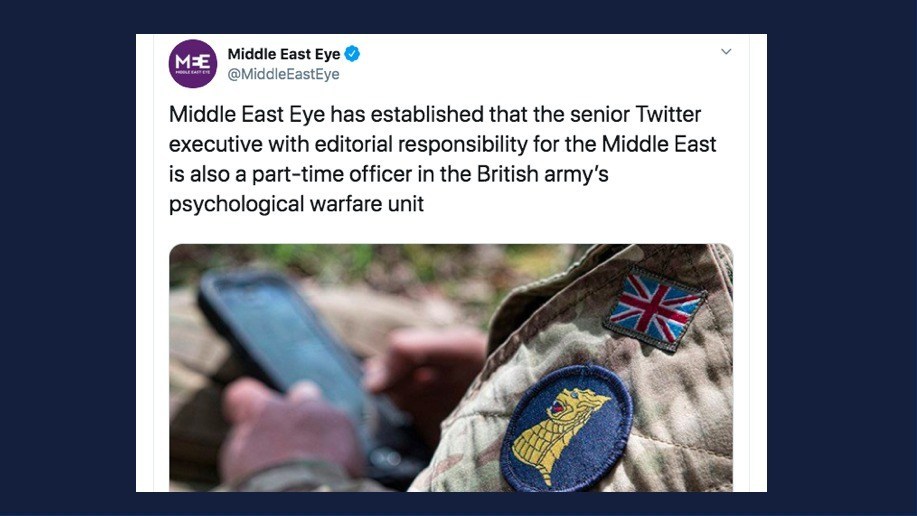
Middle East Eye‘s Ian Cobain has published an exclusive titled “Twitter executive for Middle East is British Army ‘psyops’ soldier”, exposing the fact that Twitter’s senior editorial executive for Europe, the Middle East and Africa also works for an actual, literal propaganda unit in the British military called the 77th Brigade. Which is mighty interesting, considering the fact that Twitter constantly suspends accounts from non-empire-aligned nations based on the allegation that they are engaging in propaganda.

“The senior Twitter executive with editorial responsibility for the Middle East is also a part-time officer in the British Army’s psychological warfare unit,” Cobain writes. “Gordon MacMillan, who joined the social media company’s UK office six years ago, has for several years also served with the 77th Brigade, a unit formed in 2015 in order to develop ‘non-lethal’ ways of waging war. The 77th Brigade uses social media platforms such as Twitter, Instagram and Facebook, as well as podcasts, data analysis and audience research to wage what the head of the UK military, General Nick Carter, describes as ‘information warfare’.”

https://twitter.com/IanCobain/status/1178590025128251392

MacMillan’s presence in a government psyops unit was not a secret; until Middle East Eye began raising questions on the matter, it was right there on his LinkedIn profile. This is not something that anyone considering him for promotion was likely to have been unaware of. According to his (now-edited) LinkedIn page, MacMillan has been in his current position as Head of Editorial EMEA since July 2016. According to Middle East Eye, MacMillan was already a captain in the 77th Brigade by the end of 2016. His current rank there is being hidden behind a wall of government secrecy.

When questioned by Middle East Eye about MacMillan’s work in the British Army’s online propaganda program, Twitter hilariously responded, “Twitter is an open, neutral and rigorously independent platform. We actively encourage all our employees to pursue external interests in line with our commitment to healthy corporate social responsibility, and we will continue to do so.”

That’s very nice of Twitter, isn’t it? They encourage their employees to pursue wholesome external interests, whether that be tennis, volunteering at a soup kitchen, or moonlighting at a military program explicitly devoted to online psychological warfare. You know, just everyday socially responsible pastime stuff.

The fact that Twitter not only employs known propagandists but actively promotes them to executive positions is a very large and inconvenient plot hole in their “open, neutral and rigorously independent platform” story. Especially since, as I documented recently, the mass purges of foreign Twitter accounts we’ve been seeing more and more of lately always exclusively target governments and groups which are not in alignment with the interests of the US-centralized power alliance of which the UK is a part. We’ve seen mass suspensions of accounts from Cuba, China, Russia, Iran, Venezuela, and the Catalan independence movement on allegations of “coordinated influence operations” and “covert, manipulative behaviors”, yet Twitter currently employs a high-level executive for whom coordinated influence operations and covert, manipulative behaviors on behalf of the British government are a known vocation.

“On September 20 Twitter deleted a large number of accounts, including in MacMillan’s area of responsibility. How many of those were designated by the British state?” asks Moon of Alabama of this new report.

How many indeed?

This is just one more item on the ever-growing mountain of evidence that these giant, immensely influential social media platforms we’ve all been herded into are nothing other than state propaganda for the digital age. True, they operate in a way which disregards the official lines that are drawn between government power and corporate power and the lines that are drawn between nations, but then, so do our rulers. We are living in a globe-spanning corporate oligarchic empire, and these government-aligned Silicon Valley giants are a major part of that empire’s propaganda engine.

The real power of that empire and that oligarchy lies in their invisibile and unacknowledged nature. Officially we all live in separate, sovereign nations run by democratically elected officials; unofficially we live in a massive transnational empire ruled by a loose alliance of plutocrats and opaque government agencies where military propagandists are employed by social media monopolies to manipulate public narratives. The official mask exists only on the level of narrative, while the unofficial reality is what’s actually happening. Yet whenever you try to publicly discuss the threat that is being posed by oligarchic narrative control online, you get told by establishment loyalists and libertarians that Twitter is just a simple private business running things in a way that is entirely separate from government censorship and state propaganda.

All we clear-eyed rebels can do is keep documenting the evidence of what’s going on and pointing to it as loudly as we can. So once again for the people in the back: Twitter employs literal government propagandists as high-level executives while purging accounts from unabsorbed governments for circulating unauthorized narratives. This is a fact. Remember it.

Protecting Information Space from Facebook’s Tyranny

By Gunnar Olson

Source: Land Destroyer

The recent attack aimed at New Eastern Outlook (NEO) and several of its authors once again exposes the infinite hypocrisy of US and European interests including across their media and among their supposed human rights advocates.

It also exposes the severe threat that exists to the national security of nations around the globe who lack control over platforms including social media used by their citizens to exchange information.

This lack of control over a nation’s information space is quickly becoming as dangerous as being unable to control and protect a nation’s physical space/territory.

Facebook’s Tyranny  

NEO and at least one of its contributors had their Facebook and Twitter accounts deleted and were accused of “coordinated inauthentic behavior,” according to Facebook’s “newsroom.”

Their statement reads:

In the past week, we removed multiple Pages, Groups and accounts that were involved in coordinated inauthentic behavior on Facebook and Instagram.

It also reads:

We removed 12 Facebook accounts and 10 Facebook Pages for engaging in coordinated inauthentic behavior that originated in Thailand and focused primarily on Thailand and the US. The people behind this small network used fake accounts to create fictitious personas and run Pages, increase engagement, disseminate content, and also to drive people to off-platform blogs posing as news outlets. They also frequently shared divisive narratives and comments on topics including Thai politics, geopolitical issues like US-China relations, protests in Hong Kong, and criticism of democracy activists in Thailand. Although the people behind this activity attempted to conceal their identities, our review found that some of this activity was linked to an individual based in Thailand associated with New Eastern Outlook, a Russian government-funded journal based in Moscow.

In this single statement, Facebook reveals about itself that it, and it alone, decides what is and isn’t a “news outlet.”

Apparently the blogs the deleted Facebook pages linked to were “not” news outlets, though no criteria was provided by Facebook nor any evidence presented that these links did not meet whatever criteria Facebook used.

While Facebook claims that it did not delete the accounts based on their content, they contradicted themselves by clearly referring to the content in their statement as “divisive narratives and comments” which clearly challenged narratives and comments established by Western media organizations.

The statement first accuses the pages of “coordinated inauthentic behavior,” but then admits they were only able to link the pages to a single individual in Thailand. How does a single person “coordinate” with themselves? Again, Facebook doesn’t explain.

Finally, Facebook reveals that any association at all with Russia is apparently grounds for deletion despite nothing of the sort being included in their terms of service nor any specific explanation of this apparent policy made in their statement. New Eastern Outlook is indeed a Russian journal.

Other governments, especially the United States, fund journals and media platforms not only in the United States, but around the globe. Facebook and Twitter, for example, have not deleted the accounts of the virtual army of such journals and platforms funded by the US government funded and directed via the National Endowment for Democracy (NED).

NED-funded operations often operate well outside of the United States, while NEO is based in Russia’s capital, Moscow. NED-funded operations often don’t disclose their funding or affiliations.

Ironically, the accounts Facebook deleted in Thailand were proficient at exposing this funding to the public.

The bottom line here is that Facebook is a massive social media platform. It is also clearly very abusive, maintaining strict but arbitrary control over content on its networks, detached even from their own stated terms of service. It is a form of control that ultimately and clearly works in favor of special interests in Washington and against anyone Washington declares a villain.

Facebook would be bad enough as just a massive US social media platform, but the real problem arises considering its global reach.

Looking at Information Space as we do Physical Space 

A nation’s information space is a lot like its physical space (or territory). The people of a nation operate in it, conduct commerce, exchange information, report news, and carry out a growing number of other economically, socially and politically important activities there. It is not entirely unlike a nation’s physical space where people conduct these same sort of activities.

A nation’s physical space would never be surrendered to a foreign government or corporation to control and decide who can and cannot use it and how it is used. But this is precisely what many nations around the globe have done regarding their information space.

Facebook is essentially that; a foreign corporation controlling a nation’s information space rather than its physical space. Facebook does this in many nations around the globe, deciding who can and cannot use that information space and how that information space is used.

A US corporation just decided that a Thailand-based writer associated with a political journal in Moscow is not allowed to operate in Thailand’s information space. It made that decision for Thailand. It admits in its statement that it worked, not with the Thai government or Thai law enforcement, but with “local civil society organizations,” almost certainly referring to US NED and corporate foundation-funded organizations like Human Rights Watch. Again, this is a clear violation of Thailand’s sovereignty, however minor this particular case may have been.

If it is not a legal violation of Thai sovereignty and an intrusion into their internal affairs impacting people living within their borders, it was certainly a violation and intrusion in principle.

Protecting Information Space

Nations like China and Russia understand the importance of information space.

Both nations also understand the critical importance of protecting it. Both nations have created and ensured the monopoly of their own versions of Facebook as well as other social media platforms. They also have their own versions of “Google” as well as platforms hosting blogs, videos, e-commerce and other essential services that make up a nation’s modern information space.

There is room for debate regarding how this control over Chinese and Russian information space is managed by their respective governments, but it is a debate the people of China and Russia are able to have, however restrictive it may or may not be, with people, organizations, corporations and governments within their own country, not with an untouchable Silicon Valley CEO thousands of miles away.

China and Russia created these alternatives and exercises control over their information space almost as vigorously as they defend their physical territory, understanding that their sovereignty depends as much on keeping foreign influence from dominating that space as it does keeping invading forces from crossing their border.

Smaller nations like Thailand, the subject of Facebook’s most recent “removal” campaign would benefit greatly from creating their own alternatives to Facebook, alternatives created, administered, and serving their interests rather than Silicon Valley’s or Washington’s.

Thais, for instance, cannot have any meaningful debate regarding Facebook’s policies, terms of service or their apparently arbitrary decision made independently of both since ultimately Facebook is a foreign corporation that does not answer to either the Thai people or the Thai government.

For China and Russia, both nations adept at exporting arms to smaller nations affording them the ability to defend their physical territory, an opportunity exists to export the means for these smaller nations to likewise defend their information space.

By aiding these nations in pushing out abusive monopolies like Facebook, Beijing and Moscow will also benefit by watering down US control over global information space and the news and points of view US tech corporations “allow,” and providing more space for the sort criticism and scrutiny NEO and its authors were engaged in right before Facebook removed them.

Jeff Bezos’s Corporate Takeover of Our Lives

Illustration by Mike Faille

How Amazon’s relentless pursuit of profit is squeezing us all—and what we can do about it

By David Dayen

Source: In These Times

AMAZON IS AN ONLINE RETAILER. It also runs a marketplace for other online retailers. It’s also a shipper for those sellers, and a lender to them, and a warehouse, an advertiser, a data manager and a search engine. It also runs brick-and-mortar bookstores. And grocery stores.

There are over 100 million Amazon Prime subscribers in the United States—more than half of all U.S. households. Amazon makes 45 percent of all e-commerce sales. Amazon is also a product manufacturer; its Alexa controls two-thirds of the digital assistant market, and the Kindle represents 84 percentof all e-readers. Amazon created its own holiday, Prime Day, and the surge in demand for Prime Day discounts, followed by a drop afterward, skewed the nation’s retail sales figures with a 1.8% bump in July 2017.

Oh, it’s also a major television and film studio. Its CEO owns a national newspaper. And it runs a streaming video game company called Twitch. And its cloud computing business, Amazon Web Services, runs an astonishing portion of the Internet and U.S. financial infrastructure. And it wants to be a logistics company. And a furniture seller. It’s angling to become one of the nation’s largest online fashion designers. It recently picked up an online pharmacy and partnered with JPMorgan Chase CEO Jamie Dimon and Warren Buffett to create a healthcare company. And at the same time, it’s competing with JPMorgan, pushing Amazon Pay as a digital-based alternative to credit cards and Amazon Lending as a source of capital for its small business marketplace partners.

To quote Liberty Media chair John Malone, himself a billionaire titan of industry, Amazon is a “Death Star” moving its super-laser “into striking range of every industry on the planet.” If you are engaging in any economic activity, Amazon wants in, and its position in the market can distort and shape you in vital ways.

Elizabeth Warren’s proposal to break up Amazon, along with the FTC’s new oversight and investigation, has spurred a conversation on the Left about its overwhelming power. No entity has held the potential for this kind of dominance since the railroad tycoons of the first Gilded Age were brought to heel. Whether you share concerns about Amazon’s economic and political power or you just like getting free shipping on cheap toilet paper, you should at least know the implications of living in Amazon’s world—so you can assess whether it’s the world you want, and how it could be different.

BOOKSELLERS WERE THE FIRST TO FIND THEMSELVES AT THE TIP OF AMAZON’S SPEAR, at the company’s founding in 1994. Years of Amazon peddling books below cost shuttered thousands of bookstores. Today, Amazon sells 42 percent of all books in America.

With such a large share of the market, Amazon determines what ideas reach readers. It ruthlessly squeezes publishers on wholesale costs; in 2014, it deliberately slowed down deliveries of books published by Hachette during a pricing dispute. By stocking best-sellers over independents and backlist copies, and giving publishers less money to work with, Amazon homogenizes the market. Publishers can’t afford to take a chance on a book that Amazon won’t keep in its inventory. “The core belief of bookselling is that we need to have the ideas out there so we can discuss them,” says Seattle independent bookseller Robert Sindelar. “You don’t want one company deciding, only based on profitability, what choice we have.”

These issues in just the book sector are a microcosm of Amazon’s effect on commerce.

The term “retail apocalypse” took hold in 2017 amid bankruptcies of established chains like The Limited, RadioShack, Payless ShoeSource and Toys “R” Us. According to frequent Amazon critic Stacy Mitchell, “more people lost jobs in general-merchandise stores than the total number of workers in the coal industry” in 2017.

Amazon isn’t the only cause; private equity looting must share much of the blame, and a shift to e-commerce was always going to hurt brick-and-mortar stores. But Amazon transformed a diverse collection of website sales into one mammoth business with the logistical power to perform rapid delivery of millions of products and a strategy to underprice everyone. That transformation accelerated a decline going back to the Great Recession (and much earlier for booksellers). Analysts at Swiss bank UBS estimate that every percentage point e-commerce takes from brick-and-mortar translates into 8,000 store closures, and right now e-commerce only has a 16 percent market share.

Take Harry Copeland (or, as he calls himself, “Crazy Harry”) of Harry’s Famous Flowers in Orlando, Fla., at one time a 40-employee retail/wholesale business. Revenue at his operation has shrunk by half since 2008, equal to millions of dollars in gross sales. “The internet … killed us,” Harry says. “I was in a Kroger, this guy walks up and says, ‘I want to apologize. It’s so easy to go on the internet.’ I said, ‘I did your wedding, I did flowers for your babies, and you’re buying [flowers] on the internet?’ ” Even Harry’s own employees receive Amazon packages at the shop every day. In January, tired of the fight, Harry sold his shop after 36 years in business.

Amazon was particularly deadly to the original “everything stores,” the department stores like Sears and J.C. Penney that anchor malls. When the anchor stores shut down, foot traffic slows and smaller shops struggle. Retailers are planning to close more than 4,000 stores in 2019; the 41,201 retail job losses in the first two months of this year were the highest since the Great Recession.

Dead malls trigger not only blight but also property tax losses. The broader shift to online shopping also transfers economic activity from local businesses to corporate coffers, like Amazon’s headquarters in Seattle.

Some of these failed retail spaces have been scooped up, ironically, by Amazon’s suite of physical stores, such as Whole Foods. Amazon also skillfully pits cities against one another and wins tax breaks for its warehouse and data center facilities, starving local budgets even more.

Amazon, of course, argues it is the best friend small business ever had. Jeff Bezos’ 2019 annual letter indicated that 58% of all sales on the website are made by over 2 million independent third-party sellers, who are mostly small in size. In this rendering, Amazon is just a mall, opening its doors for the little guy to access billions of potential customers. “Third-party sellers are kicking our first-party butt,” Bezos exclaimed.

It was a line I repeated to several merchants, mostly to snickers. Take Crazy Harry. In late 2017, Amazon reached out with the opportunity for Harry’s Famous Flowers to sell through its website. Sales representatives promised instant success. “We went live in November,” he says. “I made three transactions, [including] one on Valentine’s Day and one on Christmas.” The closest delivery to his shop was 34 miles away. By the time Harry paid his $39.99 monthly subscription fee for selling on Amazon and a 15% cut of sales, his check came to $6.92. “The gas was $50,” he says.

It wasn’t hard to find the source of the trouble: When Harry searched on Amazon under “flowers in Orlando,” his shop didn’t come up. Without including his name in the search, there was no way for customers to find him. Before long, Harry closed his Amazon account.

Crazy Harry’s troubles could be a function of Amazon running a platform that’s too big to manage. Two million Americans, close to 1% of the U.S. population, sell goods on Amazon. “There’s so much at stake for these sellers,” says Chris McCabe, a former Amazon employee who now runs the consulting site eCommerceChris.com. “They’ve left jobs [to sell on Amazon]. They are supporting themselves and their families.”

Third-party sellers have been a great deal for Amazon—unsurprisingly, since Amazon sets the terms. Sellers pay a flat subscription fee and a percentage of sales, and an extra fee for “Fulfillment by Amazon,” for which Amazon handles customer service, storage and shipping through its vast logistics network. Fee revenue grew to nearly $43 billion in 2018, equal to more than one out of every four dollars that third-party sellers earned.

In other words, Amazon is collecting rent on every sale on its website. This strategy increases selection and convenience for customers, but the sellers, who have nowhere else to go, can get squeezed in the process. Once on the website, sellers are at the mercy of Amazon’s algorithmic placement in search results. They must also navigate rivals’ dirty tricks (like fake one-star reviews that sink sellers in search results) and counterfeit products. And if you get past all that, you must fight the boss level: Amazon, which has 138 house brands. Armed with all the data on sellers’ businesses, Amazon can easily figure out what’s hot and what can be cheaply produced, and then out-compete its own sellers with lower prices and prioritized search results.

Any failure to follow Amazon’s always-changing rules of the road can get a seller suspended, and in that case, Amazon not only stops all future sales, but refuses to release funds from prior sales. And all sellers must sign mandatory arbitration agreements that prevent them from suing Amazon. Several consultants I interviewed talked of sellers crying on the phone, finding themselves trapped after upending their lives to sell on Amazon.

WHILE RETAIL WORKERS LOSE JOBS, AMAZON PICKS UP SOME OF THE UNEMPLOYMENT SLACK, hiring personnel to assemble its packages, make its electronics, and deliver its goods, with a U.S. workforce of more than 200,000, and another 100,000 seasonal workers—though 2018 research from the Conference Board confirmed the jobs created by e-commerce companies like Amazon do not make up for the loss of millions of retail jobs.

Plus, the experience of being a cog in Amazon’s great machine is, shall we say, unhealthy. We know much about the horrors of being an Amazon warehouse worker in the United States. These workplaces are aggressively anti-union. Amazon sets quotas for how many orders are fulfilled, monitoring a worker’s every move. Poor performers may be fired, typically over email. The daily monotony and pressure to perform has pushed workers to suicidal despair. A Daily Beast investigation found 189 instances between October 2013 and October 2018 of 911 calls summoning assistance to deal with suicide attempts or other mental-health emergencies at Amazon warehouses. And even these grunt jobs are insecure; Amazon had to reassure people this year that it wouldn’t turn over all warehouse jobs to robots, even as it rolled out machines that box orders.

Amazon’s other jobs, while less scrutinized than the warehouse workers, can be just as brutal. Thousands of delivery drivers wear Amazon uniforms, use Amazon equipment and work out of Amazon facilities. But they are not technically Amazon employees; they work for outside contractors called delivery service partners. These workers do not qualify for the guaranteed $15 minimum wage Bezos announced to much fanfare last year.

Contracting work out lets Amazon dodge liability for poor labor practices, a trick used by many corporations. At one such contractor in the mid-Atlantic, TL Transportation, one former employee (who requested anonymity) described the work as “running, running, running, rushing. There was no break time.” According to pay stubs, TL built two hours of overtime into its base rate, which is illegal under U.S. labor law. Other workers reported they always worked longer than the time on their pay stubs. Driver Tyhee Hickman of Pennsylvania testified to having to urinate into bottles to maintain the schedule.

Amazon runs plenty of air freight these days as well, through an “Amazon Air” fleet of planes branded with the Amazon logo—but these are also contracted out. At Atlas Air, one of three cargo carriers with Amazon business, pilots have been working without a new union contract since 2011. Atlas pays pilots 30% to 60% below the industry standard, according to Captain Daniel Wells, an Atlas Air pilot and president of the Airline Professionals Association Teamsters Local 1224. Planes are understaffed. “We’ve been critically short of crews,” Wells says. “Everyone is scrambling to keep operations going.”

The go-go-go schedule leaves little time for mechanics; planes go out with stickers indicating deferred maintenance. One Atlas Air flight carrying Amazon packages crashed in Texas in February, killing three workers.

EVEN WHILE DRIVING WORKERS AT A FRENETIC PACE, Amazon doesn’t always deliver on its promise of convenience and efficiency. Many products no longer arrive in 48 hours under Prime’s guaranteed two-day shipping. It’s so challenging to reach customer service that Amazon sells a book on its website about how to do that. Whole Foods shoppers who have groceries delivered get bizarre food substitutions without warning.

Even as two-day shipping is creaking, Amazon has announced a move to one-day shipping, which will strain its systems even further while forcing competitors to adjust. Amazon’s one-day shipping announcement alone caused retail stocks to plummet on April 26, before any changes were implemented.

This feedback effect reveals how Amazon is not merely riding the wave of online retail’s convenience; only a company with ambitions as vast as Amazon’s could influence Fortune 500 business models across America.

Some retailers have given in. Walmart quickly announced its own next-day shipping. Kohl’s sells Amazon Echo devices. Target has bought up competitors to compete with Amazon on a larger scale. Call it concentration creep; one giant business triggers the need for others to get big, too. Corporate America is at once terrified of Amazon and reshaping itself to imitate it.

Take Amazon’s ever more sophisticated ploys to modify consumer behavior. With “personalized pricing,” Amazon uses the data of what someone has paid in the past to test what that person is willing to pay. The price of an item featured in the “buy” box on Amazon’s website may change multiple times per day, and can be tailored to individual shoppers. Amazon has charged more for Kindles based on a buyer’s location, and has steered people to higher-priced products where it makes a greater profit, rather than cheaper versions from outside sellers.

Now, even big-box stores have electronic price tags that retailers can “surge price” when demand increases. Amazon’s Whole Foods stores have become a testing ground for advancing this technique. Prices shown on electronic tags are tested, combined with discounts for Prime members, and relentlessly tweaked.

The potential damage to society from personalized pricing is significant, notes Maurice Stucke, a professor at the University of Tennessee. “It’s not just price discrimination, but also behavioral discrimination,” he says. “Getting people to buy things they might not have otherwise purchased, at the highest price they’re willing to pay.”

Amazon has plenty of options for this behavioral nudging, from listing a fake higher price and crossing it out to make it look like the customer is getting a deal, to its work on a facial recognition system using phone or computer cameras to authenticate purchases. With this tool, Amazon could theoretically read faces and increase prices when someone shows excitement about a product. Amazon has already licensed facial recognition software to local police units for criminal investigations, to outcry from privacy groups.

Then there’s Alexa, Amazon’s digital assistant, a powerful tool for manipulation. Alexa was designed to “be like the Star Trek computer,” said Paul Cutsinger, Amazon’s head of voice design education, at a developer conference earlier this year. Users can ask Alexa to play music and podcasts, answer questions, run health and wellness programs, set appointments, make purchases, even raise the temperature in the shower.

Psychologist Robert Epstein, who has pioneered research into search engine manipulation, has done preliminary studies on Alexa. “It looks like you can very easily impact the thinking and decision-making and purchases of people who are undecided,” Epstein says. “That unfortunately gives a small number of companies tremendous power to influence people without them being aware.” For example, Alexa can suggest a wine to go with the pizza you just ordered. It can also encourage you to set up a recurring purchase, the price of which may then go up based on Amazon’s list price.

The influence only increases as Alexa takes in more data. We know that Alexa is constantly watching and listening to users, transcribing what it hears and even transmitting some of that data back to a team of human listeners at Amazon, who “refine” the machine’s comprehension. The surveillance doesn’t only happen on Alexa, but in the smart home devices it integrates with, and on the website where Amazon tracks search and purchase activity. Amazon even has a Ring doorbell and in-home monitor, which sends information back to Amazon. There is no escape. “Devices all around us are watching everything we do, talking to each other, sharing data,” Epstein says. “We’re embedded in a surveillance network.”

EVEN AS IT’S INFLUENCING OUR BEHAVIOR, Amazon is transforming our physical world. José Holguín-Veras, a logistics and urban freight expert at Rensselaer Polytechnic Institute, estimates that in 2009, there was one daily internet-derived delivery for every 25 people. By 2017, he calculates, this had tripled. “The number of deliveries to households is now larger than the number of deliveries to commercial establishments,” Holguín-Veras says. “In skyscrapers in New York City where 5,000 people live, it’s 750 deliveries a day.”

Think of the difference between one trip to the grocery store for the week, and five or ten trips from the warehouse to your house. Our streets are too narrow and our traffic too plentiful to handle that additional traffic without crippling congestion. Plus, every idling car, and every extra delivery truck on the road, spews more carbon into the atmosphere. Our cities are not designed for the level of freight that instant delivery demands.

More deliveries also means more people staying indoors. “One thing I think about is how much we overlook the community and democracy value of running errands,” says Stacy Mitchell of the Institute for Local Self-Reliance. “These exchanges—chatting with someone in line, bumping into a neighbor on the street, talking with the store owner—may not be all that significant personally. But this kind of interaction pays off for us collectively in ways we don’t think about or measure or account for in policy-making.”

In These Times asked Frank McAndrew of Knox College, who has researched social isolation, whether Amazon’s perfect efficiency could be alienating. He wasn’t ready to make a definitive statement but did see some red flags. “I do think we’re sort of wired to interact with real people in face-to-face situations,” McAndrew says. “When most of our interactions take place virtually, or with Alexa, it’s not going to be satisfying.”

FOR MOST OF OUR HISTORY, Americans didn’t require a personal digital assistant to answer our every whim. Why are we now reordering our social and economic lives, so one man can accumulate more money than anyone in the history of the planet?

One answer is that Amazon has paid as much attention to capturing government as it has to captivating customers. Amazon’s lobbying spending is among the highest of any company in America. After winning a nationwide procurement contract, over 1,500 cities and states can buy office items through the Amazon Business portal; a federal procurement platform is on the way. Amazon Web Services has the inside track on a $10 billion cloud contract to manage sensitive data for the Pentagon, something it already does for the CIA. That’s part of the reason why Amazon moved its second headquarters (after an absurd, game show-style bidding war that gave the company access to valuable data on hundreds of cities’ planning decisions) to a suburb of Washington, D.C., the seat of national power.

Making the directors of the regulatory state dependent on your services is a genius move. What political figure would dare crack down on the behavior of a trusted partner like Amazon?

In fact, Amazon has relied on government largesse since day one. No sales taxes for online purchases gave it a pricing advantage over other sellers (while a 2018 Supreme Court ruling changed that, the damage had been done). No carbon taxes helped Amazon build energy-intensive businesses dependent on fossil fuels for transportation and server farms. A lack of antitrust enforcement created a path for Amazon to super-size into an e-commerce monopoly. Weak federal labor rules let Amazon stamp out collective bargaining and rely on independent contractors. Mandatory arbitration locked third-party sellers inside Amazon’s private appeals process. Favorable tax law allowed Amazon to apply annual losses in previous years to its past two tax returns, paying no federal taxes on billions in income.

Of course, these rules helped all corporate giants and made executives filthy rich, often at the expense of workers. But Amazon tests the laissez-faire system in unique ways. In a future where Amazon broadens its control over our lives such that citizens have nowhere else to shop, businesses have nowhere else to sell, workers have nowhere else to toil, and governments have no other way to function, then who actually holds the power in our society? Avoiding that dark future requires leaders with the political will to stop it.

Elizabeth Warren’s plan to break up Amazon would rein in what she sees as unfair competition by preventing Amazon from selling products while hosting a website platform for other sellers. Warren also suggests splitting off Whole Foods and the online retailer Zappos, which Amazon bought in 2017 and 2009, respectively.

Fostering competition is a good start, but regulation must also prevent Amazon from bullying suppliers and partners. Lawmakers must force Amazon to pay for the externalities associated with its carbon-intensive delivery network. The company must pay a living wage to its workers, including its so-called independent contractors. It must be accountable to the legal system rather than a corporate-friendly arbitration process. It must not profit from spying on its customers.

If Amazon has caused this much upheaval today, when online shopping is still only 16 percent of retail sales, the future is limitless and grim. We have time to reverse this transfer of power and make it our world instead of Amazon’s. It’s an opportunity we cannot afford to squander.