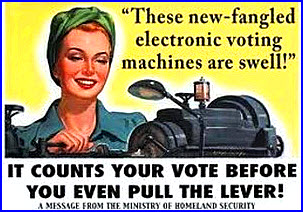
Welcome to 1984

1984

By Chris Hedges

Source: truthdig

The artifice of corporate totalitarianism has been exposed. The citizens, disgusted by the lies and manipulation, have turned on the political establishment. But the game is not over. Corporate power has within its arsenal potent forms of control. It will use them. As the pretense of democracy is unmasked, the naked fist of state repression takes its place. America is about—unless we act quickly—to get ugly.

“Our political system is decaying,” said Ralph Nader when I reached him by phone in Washington, D.C. “It’s on the way to gangrene. It’s reaching a critical mass of citizen revolt.”

This moment in American history is what Antonio Gramsci called the “interregnum”—the period when a discredited regime is collapsing but a new one has yet to take its place. There is no guarantee that what comes next will be better. But this space, which will close soon, offers citizens the final chance to embrace a new vision and a new direction.

This vision will only be obtained through mass acts of civic mobilization and civil disobedience across the country. Nader, who sees this period in American history as crucial, perhaps the last opportunity to save us from tyranny, is planning to rally the left for three days, from May 23 to May 26 at Constitution Hall in Washington, D.C., in what he is calling “Breaking Through Power” or “Citizen’s Revolutionary Week.” He is bringing to the capital scores of activists and community leaders to speak, organize and attempt to mobilize to halt our slide into despotism.

“The two parties can implode politically,” Nader said. “They can be divided by different candidates and super PACs. But this doesn’t implode their paymasters.”

“Elections have become off-limits to democracy,” he went on. “They have become off-limits to democracy’s fundamental civil community or civil society. When that happens, the very roots shrivel and dry up. Politics is now a sideshow. Politics does not bother corporate power. Whoever wins, they win. Both parties represent Wall Street over Main Street. Wall Street is embedded in the federal government.”

Donald Trump, like Hillary Clinton, has no plans to disrupt the corporate machinery, although Wall Street has rallied around Clinton because of her predictability and long service to the financial and military elites. What Trump has done, Nader points out, is channel “the racist, right-wing militants” within the electorate, embodied in large part by the white working poor, into the election process, perhaps for one last time.

Much of the left, Nader argues, especially with the Democratic Party’s blatant rigging of the primaries to deny Bernie Sanders the nomination, grasps that change will come only by building mass movements. This gives the left, at least until these protofascist forces also give up on the political process, a window of opportunity. If we do not seize it, he warns, we may be doomed.

He despairs over the collapse of the commercial media, now governed by the primacy of corporate profit.

“Trump’s campaign has enormous appeal to the commercial mass media,” Nader said. “He brought huge ratings during the debates. He taunted the networks. He said, ‘I’m boycotting this debate. It’s going to cost you profit.’ Has this ever happened before in American history? It shows you the decay, the commercialization of public elections.”

The impoverished national discourse, fostered by a commercial mass media that does not see serious political debate as profitable and focuses on the trivial, the salacious and the inane, has empowered showmen and con artists such as Trump.

“Trump speaks in a very plain language, at the third-grade level, according to some linguists,” Nader said. “He speaks like a father figure. He says, ‘I’ll get you jobs. I’ll bring back industry. I’ll bring back manufacturing. I’ll protect you from immigrants.’ The media never challenges him. He is not asked, ‘How are we going do all of this? What is step one? Step two? Is the White House going to ignore the Congress and the courts?’ He astonishes his audience. He amazes them with his bullying, his lying, his insults, like ‘Little Marco,’ the wall Mexico is going to pay for, no more entry in the country by Muslims—a quarter of the human race—until we figure it out. The media never catches up with him. He is always on the offensive. He is always news. The commercial media wants the circus. It gives them high ratings and high profit.”

The focus on info-entertainment has left not only left the public uninformed and easily manipulated but has locked out the voices that advocate genuine reform and change.

“The commercial media does not have time for citizen groups and citizen leaders who are really trying to make America great, whether by advancing health safety or economic well-being,” Nader bemoaned. “These groups are overwhelmed. They’re marginalized. They’re kept from nourishing the contents of national, state and local elections. Look at the Sunday news shows. No one can get on to demonstrate that the majority of the people want full Medicare for all with the free choice of doctors and hospitals, not only more efficient but more life-saving. There was a major press conference a few days ago at the National Press Club. The leading advocates of full Medicare for all, or single-payer, were there, Dr. Steffie Woolhandler and Dr. Sidney Wolfe, the heads of Physicians for a National Health Program. This is a group with about 15,000 physicians on board. Nobody came. There was a stringer for an indie media outlet and the corporate crime reporter. There are all kinds of major demonstrations, 1,300 arrests outside the Congress protesting the corruption of money in politics. Again no coverage, except a little on NPR and on ‘Democracy Now!’ ”

“The system is gamed,” he said. “The only way out of it is to mobilize the civil society.

“We are organizing the greatest gathering of accomplished citizen advocacy groups on the greatest number of redirections and reforms ever brought together in American history under one roof,” he said of his upcoming event. “The first day is called Breaking Through Power, How it Happens. We have 18 groups who have demonstrated it with tiny budgets for over three decades on issues such as road safety, removing hundreds of hazardous or ineffective pharmaceuticals from the market, changing food habits from junk food to nutrition and rescuing people from death row who were falsely convicted of homicides. What if we tripled the budgets and the staffs of these groups? Eighteen of these groups have a total budget that is less than what one of dozens of CEOs make in a year.”

Nader called on Sanders to join in the building of a nationwide civic mobilization. He said that while Clinton may borrow some of his rhetoric, she and the Democratic Party establishment would not incorporate Sander’s populist appeals against Wall Street into the party platform. If Sanders does not join a civic mobilization, Nader warned, there would be “a complete disintegration of his movement.”

Nader also said he was worried that Clinton’s high negativity ratings, along with potential scandals, including the possible release of her highly paid speeches to corporations such as Goldman Sachs, could see Trump win the presidency.

“I have her lecture contract with the Harry Walker lecture agency,” he said. “She had a clause in the contract with these business sponsors, which basically said the doors will be closed. There will be no press. You will pay $1,000 for a stenographer to give me, for my exclusive use, a stenographic record of what I said. You will pay me $5,000 a minute. She has it all. She can’t say, ‘We will look into it or we’ll see if we can find it.’ She has been dissembling. And her latest rant is, ‘I’ll release the transcripts if everyone else does.’ ‘Who is everybody else?’ as Bernie Sanders rebutted. He doesn’t give highly paid speeches behind closed doors to Wall Street firms, business executives or business trade groups. Trump doesn’t give quarter-of-a-million-dollar speeches behind closed doors to business. So by saying ‘I will release all of my transcripts if everyone else does,’ she makes a null and void assertion. This is characteristic of the Clintons’ dissembling and slipperiness. It’s transcripts for Hillary. It’s tax returns for Trump.”

While Nader supports the building of third parties, he cautions that these parties—he singles out the Green Party and the Libertarian Party—will go nowhere without mass mobilization to pressure the centers of power. He called on the left to reach out to the right in a joint campaign to dismantle the corporate state. Sanders could play a large role in this mobilization, Nader said, because “he is in the eye of the mass media. He is building this rumble from the people.”

“What does he have to lose?” Nader asked of Sanders. “He’s 74. He can lead this massive movement. I don’t think he wants to let go. His campaign has exceeded his expectations. He is enormously energized. If he leads the civic mobilization before the election, whom is he going to help? He’s going to help the Democratic Party, without having to go around being a one-line toady expressing his loyalty to Hillary. He is going to be undermining the Republican Party. He is going to be saying to the Democratic Party, ‘You better face up to the majoritarian crowds and their agenda, or you’re going to continue losing in these gerrymandered districts to the Republicans in Congress.’ These gerrymandered districts can be overcome with a shift of 10 percent of the vote. Once the rumble from the people gets underway, nothing can stop it. No one person can, of course, lead this. There has to be a groundswell, although Sanders can provide a focal point”

Nader said that a Clinton presidency would further enflame the right wing and push larger segments of the country toward extremism.

“We will get more quagmires abroad, more blowback, more slaughter around the world and more training of fighters against us who will be more skilled to bring their fight here,” he said of a Clinton presidency. “Budgets will be more screwed against civilian necessities. There will be more Wall Street speculation. She will be a handmaiden of the corporatists and the military industrial complex. There comes a time, in any society, where the rubber band snaps, where society can’t take it anymore.”

Is the US Economy Heading for Recession?

Thomas Frank on How Democrats Went From Being the ‘Party of the People’ to the Party of Rich Elites

download

Democrats have gone from the party of the New Deal to a party that is defending mass inequality.

By Tobita Chow

Source: In These Times

The Democratic Party was once the party of the New Deal and the ally of organized labor. But by the time of Bill Clinton’s presidency, it had become the enemy of New Deal programs like welfare and Social Security and the champion of free trade deals. What explains this apparent reversal? Thomas Frank—best known for his analysis of the Republican Party base in What’s the Matter with Kansas?attempts to answer this question in his latest book, Listen Liberal: Or, What Ever Happened to the Party of the People?

According to Frank, popular explanations which blame corporate lobby groups and the growing power of money in politics are insufficient. Frank instead points to a decision by Democratic Party elites in the 1970s to marginalize labor unions and transform from the party of the working class to the party of the professional class. In so doing, the Democratic Party radically changed the way it understood social problems and how to solve them, trading in the principle of solidarity for the principle of competitive individualism and meritocracy. The end result is that the party which created the New Deal and helped create the middle class has now become “the party of mass inequality.” In These Times spoke with Frank recently about the book via telephone.

The book is about how the Democratic Party turned its back on working people and now pursues policies that actually increase inequality. What are the policies or ideological commitments in the Democratic Party that make you think this?

The first piece of evidence is what’s happened since the financial crisis. This is the great story of our time. Inequality has actually gotten worse since then, which is a remarkable thing. This is under a Democratic president who we were assured (or warned) was the most liberal or radical president we would ever see.  Yet inequality has gotten worse, and the gains since the financial crisis, since the recovery began, have gone entirely to the top 10 percent of the income distribution.

This is not only because of those evil Republicans, but because Obama played it the way he wanted to. Even when he had a majority in both houses of Congress and could choose whoever he wanted to be in his administration, he consistently made policies that favored the top 10 percent over everybody else. He helped out Wall Street in an enormous way when they were entirely at his mercy.

He could have done anything he wanted with them, in the way that Franklin Roosevelt did in the ‘30s. But he chose not to.

Why is that? This is supposed to be the Democratic Party, the party that’s interested in working people, average Americans. Why would they react to a financial crisis in this way? Once you start digging into this story, it goes very deep. You find that there was a transition in the Democratic Party in the ‘70s, 80’s and ‘90s where they convinced themselves that they needed to abandon working people in order to serve a different constituency: a constituency essentially of white-collar professionals.

That’s the most important group in their coalition. That’s who they won over in the ’70s, ’80s and ’90s. That’s who they serve, and that’s where they draw from. The leaders of the Democratic Party are always from this particular stratum of society.

A lot of progressives that I talk to are pretty familiar with the idea that the Democratic Party is no longer protecting the interests of workers, but it’s pretty common for us to blame it on mainly the power of money in politics. But you start the book in chapter one by arguing there’s actually something much deeper going on. Can you say something about that?

Money in politics is a big part of the story, but social class goes deeper than that. The Democrats have basically made their commitment [to white-collar professionals] already before money and politics became such a big deal. It worked out well for them because of money in politics. So when they chose essentially the top 10 percent of the income distribution as their most important constituents, that is the story of money.

It wasn’t apparent at the time in the ‘70s and ‘80s when they made that choice. But over the years, it has become clear that that was a smart choice in terms of their ability to raise money. Organized labor, of course, is no slouch in terms of money. They have a lot of clout in dollar terms. However, they contribute and contribute to the Democrats and they almost never get their way—they don’t get, say, the Employee Free Choice Act, or Bill Clinton passes NAFTA. They do have a lot of money, but their money doesn’t count.

All of this happened because of the civil war within the Democratic Party. They fought with each other all the time in the ‘70s and the ‘80s. One side hadn’t completely captured the party until Bill Clinton came along in the ‘90s. That was a moment of victory for them.

Bill Clinton’s presidency is what progressives usually cite as the time when things went bad. But there’s a trend that goes back to the ’70s, right?

Historians always cite the ’68 election as the turning point. The party was torn apart by the controversy over the Vietnam war, protesters were in the streets in Chicago and the Democratic candidate Hubert Humphrey went on to lose. Democrats thought this was terrible, and it was. So they set up a commission to reorganize the party, the McGovern Commission.

The McGovern Commission basically set up our modern system of primaries. Before the commission, we didn’t have these long primary contests in state after state after state. Primaries are a good thing, as were most things the McGovern Commission did.

But they also removed organized labor from its structural position of power in the Democratic Party. There was a lot of resentment towards labor during the Vietnam War. A lot of unions took President Johnson’s side on Vietnam. There was also this sense—which I think was correct at the time—that labor was a dinosaur, that it was out of touch and undemocratic and very white.

There were a lot of reasonable objections to organized labor at the time. The problem is, when you get rid of labor in your party, you also get rid of issues that matter to working people. That’s the basic mistake that Democrats made in the ’70s. Of course, labor still is a big part of the Democratic coalition—it gives them their money, it helps out at election time in a huge way. But unions no longer have the presence in party councils that they used to. That disappeared.

One of the most shocking quotes in the book is from Alfred Kahn, an advisor to Jimmy Carter, who said, “I’d love the Teamsters to be worse off. I’d love the automobile workers to be worse off.” He then basically says that unionized workers are exploiting other workers.

Isn’t that amazing? He’s describing a situation in the 1970s. There was all this controversy in the 1970s about labor versus management—this was the last decade where those fights were front and center in our national politics. And he’s coming down squarely on the side of management in those fights.

And remember, Kahn was a very important figure in the Carter administration. The way that he describes unions is incorrect—he’s actually describing professionals. Professionals are a protected class that you can’t do anything about—they’re protected by the laws of every state that dictate who can practice in these fields. It’s funny that he projects that onto organized labor and holds them responsible for the sins of another group.

This is a Democrat in an administration that is actually not very liberal. This is the administration that carried out the first of the big deregulations. This is the administration that had the great big capital gains tax cuts, that carried out the austerity plan that saw the Federal Reserve jack its interest rates sky high. They clubbed the economy to the ground in order to stop “wage inflation,” in which workers, if they have enough power, can keep demanding higher wages. It was incredible.

What’s the content of the ideology of the professional class and how does it hurt working people? What are their guiding principles?

The first commandment of the professional class is the idea of meritocracy, which allows people to think that those on top are there because they deserve to be. With the professional class, it’s always associated with education. They deserve to be there because they worked really hard and went to a good college and to a good graduate school. They’re high achievers. Democrats are really given to credentialism in a way that Republicans aren’t.

If you look at the last few Democratic presidents, Bill Clinton and Obama, and Hillary Clinton as well, their lives are a tale of educational achievement. This is what opened up the doors of the world to them. It’s a party of who people who have gotten where they are by dint of educational accomplishment.

This produces a set of related ideas. When the Democrats, the party of the professionals, look at the economic problems of working-class people, they always see an educational problem, because they look at working class people and say, “Those people didn’t do what I did”: go and get advanced degrees, go to the right college, get the high SAT scores and study STEM or whatever.

There’s another interesting part of this ideology: this endless search for consensus. Washington is a city of professionals with advanced degrees, and Democrats look around them there and say, “We’re all intelligent people. We all went to good schools. We know what the problems are and we know what the answers are, and politics just get in the way.”

This is a very typical way of thinking for the professional class: reaching for consensus, because politics is this ugly thing that you don’t really need. You see this in Obama’s endless efforts to negotiate a grand bargain with Republicans because everybody in Washington knows the answers to the problems—we just have to get together, sit down and make an agreement. The same with Obamacare: He spent so many months trying to get Republicans to sign on, even just one or two, so that he could say it was bipartisan. It was an act of consensus. And the Republicans really played him, because they knew that’s what he’d do.

To go back to your point about education: At one point you quote Arne Duncan, who was Obama’s secretary of education, saying that the only way to end poverty is through education. Why can’t that work?

The big overarching problem of our time is inequality. If you look at historical charts of productivity and wage growth, these two things went hand in hand for decades after World War II, which we think of as a prosperous, middle-class time when even people with a high school degree, blue-collar workers, could lead a middle class life. And then everything went wrong in the 1970s. Productivity continued to go up and wage growth stopped. Wage growth has basically been flat ever since then. But productivity goes up by leaps and bounds all the time. We have all of these wonderful technological advances. Workers are more productive than ever but they haven’t benefited from it. That’s the core problem of inequality.

Now, if the problem was that workers weren’t educated enough, weren’t smart enough, productivity would not be going up. But that productivity line is still going up. So we can see that education is not the issue.

It’s important that people get an education, of course. I spent 25 years of my life getting an education. It’s basic to me. It’s a fundamental human right that people should have the right to pursue whatever they want to the maximum extent of their individual potential. But the idea that this is what is holding them back is simply incorrect as a matter of fact. What’s holding them back is that they don’t have the power to demand higher wages.

If we talk about the problem as one of education rather than power, then the blame goes back to these workers. They just didn’t go out and work hard and do their homework and get a gold star from their teacher. If you take the education explanation for inequality, ultimately you’re blaming the victims themselves.

Unfortunately, that is the Democratic view. That’s why Democrats have essentially become the party of mass inequality. They don’t really have a problem with it.

So really, the solution would have to be solidarity and organized power.

That was an essential point that I try to make in Listen Liberal: that there is no solidarity in a meritocracy. A meritocracy really is every man for himself.

Don’t get me wrong. People at the top of the meritocracy, professionals, obviously have enormous respect for one another. That is the nature of professional meritocracy. They have enormous respect for the people at the top, but they feel very little solidarity for people beneath them who don’t rise in the meritocracy.

Look at the white-collar workplace. If some professional gets fired, the other professionals don’t rally around and go on strike or protest or something like that. They just don’t do that. They feel no solidarity because everything goes back to you and whether or not you’ve made the grade. If somebody gets fired, they must’ve deserved it somehow.

I have my own personal experience. Look at academia over the last 20 years. They’re cranking out these Ph.D.s in the humanities who can’t get jobs on tenure track and instead have to work as adjuncts for very low pay, no benefits. One of the fascinating parts about this is that, with a few exceptions, the people who do have tenure-track jobs and are at the top of their fields, do very little about what’s happened to their colleagues who work as adjuncts. Essentially this is the Uberizing of higher education. The professionals who are in a position of authority have done almost nothing about it. There are academics here and there who feel bad about what’s happened to adjuncts and do say things about it, but by and large, overall, there is no solidarity in that meritocracy. They just don’t care.

Do you think there’s a connection between the fact that the Democratic Party has turned against workers and the rise of Donald Trump?

Yes. Because if you look at the polling, Trump is winning the votes of a lot of people who used to be Democrats. These white, working-class people are his main base of support. As a group, these people were once Democrats all over the country. These are Franklin Roosevelt’s people. These are the people that the Democrats essentially decided to turn their backs on back in the 1970s. They call them the legatees of the New Deal. They were done with these guys, and now look what’s happened—they’ve gone with Donald Trump. That’s frightening and horrifying.

But Trump talks about their issues in a way that they find compelling, especially the trade issue. When he talks about trade, they believe him. Ironically, he’s saying the same things that Hillary Clinton and Bernie Sanders are saying about trade, but for whatever reason people find him more believable on this subject than they do Hillary Clinton.

Do you think that the rise of the Bernie campaign could herald a new era in the history of the Democratic Party?

I hope so. Both Trump and Bernie are turning their respective parties upside down. What Bernie is doing is very impressive. I interviewed him a few years ago and have always admired him. I think he’s a great man. To think that he could beat a Clinton in a Democratic primary anywhere in this country, let alone many primaries, was unthinkable a short time ago. And he’s done it without any Wall Street or big-business backing. That is extraordinary. It shows the kind of desperation that’s out there.

He has shown the way, and whether he gets the nomination or not (he probably won’t), there’ll be another Bernie four years from now. And there’ll also be another Trump. The Republican Party is being turned on its head much more violently than the Democrats. Hillary will probably get the nomination. I live in Washington, D.C., and I spend time around Hillary-style Democrats. They really think that they’ve got this thing in the bag. And I don’t just mean her versus Bernie. I mean the Democratic Party winning the presidency for the rest of our lives. From here to eternity. They can choose whoever they want. They could nominate anybody and they would win. They think they’re in charge.

One of your villains from the ’70s is Frederick Dutton, who wrote a book about how the Democratic Party needed to realign itself. You have a quote from him saying, “Every major realignment in U.S. political history has been accompanied by the coming of a large new group into the electorate.” You’re very critical of how he uses that idea in the ‘70s. But if you look at the newer voters attached to the Bernie campaign, it looks like the Democratic Party is experiencing something like that now.

Yes, in both cases you’re talking about a generational shift. That’s what he meant in 1971. He was talking about the counterculture and the “Now Generation” and the idea that they would come into the electorate and demand a different kind of politics—specifically his kind of politics.

Everybody always sees this new group that’s coming in as supporting what they want. That’s what he thought. I have a certain amount of contempt for that. Many years ago I wrote a book about the counterculture and how it was used for this purpose—specifically by the advertising industry. But Bernie’s doing the same thing. He’s using it for his own purposes.

Millenials’ take on the world is fascinating. Just a few years ago, people thought of them as very different. But now they’re coming out of college with enormous student debt, and they’re discovering that the job market is casualized and Uberized. The work that they do is completely casual. The idea of having a middle-class lifestyle in that situation is completely off the table for them.

Every time I think about these people, it burns me up. It makes me so angry what we’ve done to them as a society. It really gives the lie to Democratic Party platitudes about the world an education will open up for you. That path just doesn’t work anymore. Millenials can see that in their own lives very plainly.

So I’m very excited that they’re pro-Bernie. They really are the future.


Tobita Chow is chair of The People’s Lobby, an independent political organization based in Chicago, and co-author of “The Movement We Need,” a pamphlet on analysis and strategy for the progressive movement. He has been involved in faith-based community organizing on the South Side of Chicago since 2009, and is a leader in the “Moral Mondays Illinois” campaign against state budget cuts. He is an MDiv student at the Lutheran School of Theology at Chicago.

Why Can’t The Nation and the Left Deal With Election Theft?

jf-7

By Bob Fitrakis & Harvey Wasserman

Source: Reader Supported News

here are two things we all need to know about the upcoming 2016 election:

    1. Millions of likely Democratic voters have already been stripped from the voter rolls in critical states like Ohio. The key reporting on this has been done by the great Greg Palast, who has shown that a computer program coordinated by the Republican secretary of state of Kansas is being used in some two dozen states to steal from a substantial percentage of the citizenry their right to vote. The raw numbers are high enough that they could have a significant impact on the presidential, US Senate, House and many other elections this fall. The ACLU has now sued Jon Husted, Ohio’s secretary of state, over the stripping of two million citizens from Ohio’s voter rolls.
    1. There is no way to verify the official tally on the electronic machines on which the majority of Americans will vote this fall. Nearly all the machines are a decade old, most are controlled by a single company (ES&S, owned by Warren Buffett) and the courts have ruled that the software is proprietary, making the vote counts beyond public scrutiny. In fact, they are beyond all independent monitoring altogether. In many key swing states (including Ohio, Michigan, Iowa and Arizona) GOP governors and secretaries of state will have a free hand to flip the vote count to whatever they want it to be without detection or accountability. This could turn control of our government over to the GOP come November, as it did in 2000 and 2004.

These two critical markers of the upcoming national election are at center stage in our compendium The Flip & Strip Selection of 2016: Five Jim Crows and Electronic Election Theft (www.freepress.org / www.solartopia.org), which we’ll be publishing at the end of April.

For some reason many on the left have had a hard time accepting these realities. But they’re in fact far more critical than the question of who will make the better Democratic candidate.

In the interim, the usually solid Josh Holland has published a piece at The Nation with which we must take issue. It challenges writings that have put forward the idea that Hillary Clinton might be stealing the primaries from Bernie Sanders.

To avoid the circular firing squad in which the left indulges every election year, we should make it clear that we are both members of the Green Party. We prefer Bernie to Hillary, but like Jill Stein most of all. We hope Bernie at some point will establish a substantial string of grassroots training camps so the thousands of highly active young people who are supporting him will convert those energies to great long-term community organizing.

We are most concerned about the possibility of a GOP president come November. (For what it’s worth, we currently lay the highest odds of that nominee being the absolutely terrifying Paul Ryan. Ryan has said he won’t campaign for the nomination, but he has NOT said he’ll refuse it at a convention where he’ll be holding the gavel. His pockets will be stuffed with Koch cash. Enough said.)

We plead guilty to writing a piece at Reader Supported News pointing out that the exit polls show Bernie doing far better than the official vote count. Josh dismisses the reliability of exit polls, along with our mention of those in Germany. Suffice it to say that exit polling is the most reliable way we have of monitoring the vote count. In Germany they are usually within 1% of the official tally.

Here they are corrupted after the original compilations. They’re generally post-rigged to conform to the final official vote count, which is often pre-rigged. What matters is the original raw data, which we feel after much study is the gold standard for knowing how the public actually voted.

Of course that data can be messed with along the way. But at this point it’s the best we’ve got. And the original data can be hard to get. When statistician Ron Baiman requested original data from big-time pollster Warren Mitofsky (since deceased) Mitofsky told to him to “go fuck yourself.”

For some reason Josh drags “conspiracy theory” into the mix, with a lengthy soliloquy on 9/11. Neither of us writes about 9/11, though we know plenty of people who do. We find much of the official story not credible, but that’s about it at this point.

However, history warns us to be discerning about so-called conspiracy theories. Josh paints them all with a broad brush when he says they “tend to fall apart under the weight of their own internal illogic.”

But at the risk of rolling some eyeballs, here are (briefly) five that have proved indisputably true: Spain did NOT torpedo the battleship Maine in 1898, a false charge the led to a terrible war (the US Navy has confirmed the Maine blew up from the inside); the Lusitania WAS carrying munitions in 1915, as Germany argued; the Gulf of Tonkin incident NEVER happened, as confirmed by former Defense Secretary Robert McNamara; Richard Nixon DID treasonably subvert Vietnam peace talks in 1968; and there were NO WMDs in Iraq.

Maybe we can leave the Mexican War; Pearl Harbor; the assassinations of JFK, MLK and RFK; and the “October Surprise” timing of the release of hostages from Iran in 1980-1981, etc., for another discussion.

About the elections of 2000 and 2004, we are way beyond conspiracy theory. That the voter rolls were stripped in numbers exceeding 90,000 throughout Florida 2000, and the vote count electronically flipped in Volusia County at the key moment, are simply beyond dispute. So is the reality that had the Supreme Court not stopped the recount, Gore would have won.

In Ohio 2004, it’s also beyond dispute that more than 300,000 voters were stripped from the registration rolls from mostly Democratic urban areas, and that the vote count was flipped by 6.7% from Kerry to Bush between 12:20 and 2 a.m. on machines in a basement in Chattanooga where the servers for Karl Rove and the Republican National Committee also resided. Thousands of Ohioans were deliberately robbed of their vote with the stripping of precincts and denial of voting machines and back-up paper ballots in African-American and student strongholds. In an election with an official victory margin of 118,775, more than 250,000 votes remain uncounted to this day. Thousands of provisional ballots were also pitched in the trash, as they already have been in this primary season, and will be again in November.

Imagine a world in which, instead of George W. Bush, Al Gore had been inaugurated as the rightfully elected president in 2001, or John Kerry in 2005. It’s easy if you open your eyes to what actually happened in those elections, and terrifying if you think about what could happen this year.

For some reason, Josh also takes us into the purported mind of a Hillary operative who would never think of rigging a primary election because she was winning anyway.

This a bit hard to follow. But let’s just say that the exit polls have indicated Bernie doing better than the official vote count, that (according to Richard Charnin) Bernie won all the hand-counted precincts in Massachusetts but lost all the machine-counted ones, and that all the caucuses have been extremely messy and open to all sorts of manipulation by both sides.

Far more important to say is that the voting machines this fall will be significantly more vulnerable to being flipped than ever before, because they are now nearly all at least ten years old. Some are decrepit enough to have been used to play PacMan or the University of Michigan fight song in public displays.

For us, the most significant event of the primary season has been the 5-hour lines in Arizona and the one-hour lines in Wisconsin. We are less concerned about whether Hillary did this to Bernie than we are worried that these will become the defining moments on the rigged path to a GOP victory in November.

Josh, if you’re reading this, we repeat our invitation to come on our radio shows (http://prn.fm/hosts-harvey-wasserman/ and http://www.talktainmentradio.com/shows/fightback.html).

Meantime, how about a piece on the “strip and flip” realities both the Democrats and the Greens will face come November? Whether it’s Hillary, Bernie, or Jill, as things stand now we are certain to see deliberately engineered long lines that will disenfranchise countless young, African-American. and Hispanic voters. We also know that in certain key swing states, the electronic vote count will come out however the hell the governor wants it to.

To you this may be conspiracy theory. But remember the Maine.


Bob Fitrakis & Harvey Wasserman have co-authored six books on election integrity, including the upcoming Strip & Flip Selection of 2016: Five Jim Crows and Electronic Election Theft (www.freepress.org / www.solartopia.org). Bob’s Fitrakis Files are at www.freepress.org. Harvey’s America at the Brink of Rebirth: The Organic Spiral of US History will be out soon at www.solartopia.org.

MEET HILLARY’S CAMPAIGN CHAIR: “Moneyman” John Podesta and his Revolving Door

By Gustav Wynn

Source: OpEdNews.com

If you haven’t heard yet about John Podesta, don’t be surprised – the major media’s radio silence belies his power and influence, working both inside and outside the US government to bundle campaign money and influence policy. Outside the US, his family’s lobbying firm is a magnet for gobs of cash coming from Saudi Arabia, Russia, Iraq, Azerbaijan, Qatar and many others hoping to curry favor on the inside track.

The above video demonstrates the bluntness of Mr. Podesta, one time chief of staff to Bill Clinton, as he lay out his ill-fated scheme for public education, raining aggressive standardized testing policies, Common Core and charter schools onto the states through an avalanche of money. Buddied up with Jeb Bush, this 42 minute conference unpacked in 2012 how the Race to the Top initiative would transform every 3rd-8th grade public school into testing factories built on unproven, secret logarithmic formulas to rank students, teachers and schools.

PEARSON PAYDAY: The clip shows Bush and Podesta laughing about how strongly they agreed that billionaire philanthropists, corporations, hedge fund managers and political action committees should pump money into “infrastructure” for education reform. The plot would succeed, farming out major education functions to testing firms and consultants as schools lost student funding, precious learning time, arts, sports and counseling services.

Part of the plan was to generate PR and “communications” through advocacy organizations, but the heavy lifting came as hedge funders flooded statehouses with campaign cash. Once elected, Podesta’s revolving door came into use, dispatching staffers to write the policy for busy politicians. He founded Center for American Progress, the think tank Politico calls Hillary’s “policy shop” and hired a slew of former Dept of Education officials to write articles.

The implementation of Common Core has been roundly panned, with Hillary Clinton herself deeming it a botch-job after it led to explosive test refusals across the states, led in striking fashion by New York. Podesta noted in the video that education “reform” would go through ups and downs, insisting the donors anticipate fierce, sustained resistance.

He accurately described how teachers would reject his corporatization, but he left out how parents and students would opt-out of exams en masse, turning the resultant data into “swiss cheese” and thereby, making expectations of standardization pointless. Yet Hillary doubled down just last week, saying she would encourage her granddaughter to take the Common Core exams. This signals to education reformers to keep funding candidates and keep promoting the “valuable data” claim.

DEEDS, NOT WORDS: Hillary promised last month to end the revolving door onstage in televised debates, but her closest advisers took funding from the Gates, Waltons and Wall Street to promote privatization. Her current staff includes lobbyists for Keystone XL, private prisons and big finance firms.

The idea that she takes Wall Street money yet would still be tough on them defies common sense, as did the claim Obama was tough on banks after he took their millions. Like David Dayen, those following the issue know Obama went exceedingly soft on banks, failing to prosecute securities fraud, robosigning and granting backdoor immunity deals that only cut in the government on the heist.

Hillary says she needs corporate cash to compete with Republicans, but this was proven wrong by Bernie, raising record-breaking amounts at the same time making PAC money a liability. Hillary’s lack of vision shows how little faith she had in working class Americans.

podesta---king-png_3098_20160417-66

THE ESTABLISHMENT HELPS IT’S OWN: But it also shows how entrenched Hillary is in the money-fueled status quo. Podesta has been running SuperPACs since the Obama years, but was also given powerful advisory positions in the White House, picking Obama’s cabinet members and advising on education and environmental issues.

Podesta’s family lobbies for a variety of corporate interests, foreign governments and fossil fuel producers, including Sberbank, the biggest state-influenced bank in Russia, who was looking to avoid sanctions following the occupation of Crimea. The same bank was just found to have shell corporations in the Panama Papers.

The major media won’t report this, but here, Salon exposes how foreign entities ply The Podesta Group with rich lobbying fees, notably Saudi royalty, the governments of Iraq and Kuwait, Qatari liquid natural gas producers and many US corporations including Walmart, Monsanto and Lockheed Martin.

The Podesta Group was founded by John Podesta but is now run by Tony Podesta, also a large bundler for Hillary. The firm was instrumental in brokering unconscionable deals as Clinton administration officials like Madeline Albright and Wesley Clark actually acquired major telecoms in Kosovo, capitalizing on their diplomatic contacts. The revolving door is still in full swing today. Dubbing John Podesta the “Hillary moneyman”, reporter Michael Isikoff listed a number of foreign lobbyists who also bundle big bucks for Hillary including some who served with her at the State Dept.

ABOVE REPROACH: The Podestas maintain that the millions the firm receives do not affect John’s work on policy matters. John also told Politico that speeches the Clintons gave to Wall Street and overseas conglomerates don’t affect their decisions. Podesta himself advised Bill Clinton to repeal Glass-Steagall, in a hasty 3-day decision that is today seen as a contributing cause of the 2008 fiscal crisis, only to lobby for Bank of America and others after leaving office.

Writing for The Nation in 2013, Ken Silverstein described CAP as an uncommonly secretive revolving door to the Obama White House, basically an unregistered lobby shop promising access to important officials for large contributions. CAP took exception, yet refused to disclose donors or basic financial statements.

Time and again, the Podesta’s controversial deeds never seem to reflect back on Hillary. For example, John co-hosted this recent fundraiser with an NRA lobbyist, another with a big pharma lobbyist, and nuclear power producers. Tony’s wife Heather, also a major bundler, lobbies for the health insurance industry.

PRO-UNION, THIS WEEK: In NY, Hillary visited the picket line of striking Verizon workers but she has taken major campaign cash from Verizon. She also took over $330k from the Waltons, the largest anti-union employer in the US. But Hillary’s union support is decidedly top-down. Here the NY Post, Fox News, Jacobin, the LA Times, Slate, and union teachers themselves disapprove of the extremely early endorsement of Clinton by the AFT, followed later by the NEA.

MEDIA MALPRACTICE: The fix will not be televised. CNN’s parent corp is a top donor to Hillary’s campaign which is hard to ignore seeing their “Bernie Blackout”. Here a CNN anchor actually tells Amy Goodman that Bernie’s speech was censored because he didn’t win more states than Hillary.

In order to paint Hillary’s win as a foregone conclusion, media regularly reports delegate totals including superdelegates which are subject to change. But the media didn’t cover Bernie at all for 2-3 months until Rachel Maddow and Chris Hayes started reporting his large crowds. The NY Times was caught stealth-editing a positive Bernie article after it was shared widely. The WaPo’s bias was evident as they publushed 16 anti-Bernie articles right before Super Tuesday.

THANKS HILLARY: Since the first Citizens United ruling in January 2012, media firms have enjoyed over $5 billion per year in expanded ad spending. Ironically, the case began as a lawsuit pitting Citiens United, a right wing organization against Hillary Clinton who wanted to block them from distributing DVDs called Hillary The Movie. The Supreme Court however greatly expanded the scope of the case to categorize almost all political spending in national races as “free speech”.

Later that year, a second Citizens United ruling made unlimited, anonymous spending legal in all political races, including state and local contests. So what started as a bitter vendetta against Hillary became a key ruling greenlighting uncontrollable money orgies during elections, particularly encouraging negative ads as “independent” expenditures are less controversial. The prohibition against coordination between PACs and campaigns has become something of an open joke, but the greater irony is the way Hillary now harnesses the PAC money and unlimited spending as the frontrunner.

THE SUPERDELEGATE FIX: Leaving little to chance, Hillary “bought” hundreds of superdelegates in 2015 before Bernie was even running. The Hillary Victory Fund is a PAC run by her campaign and the DNC which uses the campaign finance loophole created by the awful McKutcheon SCOTUS decision.

Hillary’s wealthy supporters max out contributions to 33 different state parties who then transfer the money to Hillary. It’s legal but this is money laundering. Then, the fund distributes less than a third of the donations to local candidates, securing the votes of superdelegates long before a single primary vote was cast.

They double the money by maxing out spouses, and then double it again by doing it in calendar years 2015 and 2016. So even though we have limits, Hillary found a way to get $25 million from her core contributors and hundred of superdelegates committed. This is how the game was rigged before votes were cast. Wyoming showed us that people’s votes don’t matter, Bernie won by 12% but got 7 delegates to Hillary’s 11.

As the primary progresses, many voters are realizing how byzantine and unfair party primaries are, with many controls on the idea of one person-one vote, not the least of which has been voting improprieties such as the hours-long lines in Arizona, reports of unrequested party affiliation switching in NY, PA and elsewhere.

The bottom line here is class war, with the 1% doing their all to secure a win for the most corporatist candidate they can. An anti-establishment Republican voter backlash has led to unimaginable success by Donald Trump, but so too have Democratic voters flocked to Bernie Sanders as 2016 increasingly becomes an election about rejecting money-in-politics. We can only hope the truth somehow gets out to the largest voting block in the country – the non-voter – to motivate them to get active and defend the middle class.


About the Author:

(OpEdNews Contributing Editor since October 2006) Inner city schoolteacher from New York, mostly covering media manipulation. I put election/finance reform ahead of all issues but also advocate for fiscal conservatism, ethics in journalism and curbing overpopulation. I enjoy open debate, history, the arts and hope to adopt a third child. Gustav Wynn is a pseudonym, but you knew that.

Related Video:

2016: The Year the Americans Found out Our Elections Are Rigged

march_of_tyranny

“Now it’s just an oligarchy, with unlimited political bribery being the essence of getting the nominations for president or to elect the president. And the same thing applies to governors, and U.S. senators and congress members.” – Former President Jimmy Carter

By Nick Bernabe

Source: AntiMedia

The 2016 election has been a wild ride, with two insurgent grassroots campaigns literally giving the political establishment a run for its money. But as the events of this presidential primary season play out, it’s becoming clear the U.S. election — and even more so, the presidential race — is a big scam being perpetrated on the American people.

Events from the last week have exposed the system as an illusion of choice and a farce. They have reinforced at least one study showing the U.S. is an oligarchy rather than a democratic republic.

The Wyoming democratic caucus took place on Saturday, purportedly to allow voters to have their voices heard in the race between Bernie Sanders and Hillary Clinton. Sanders lost the Wyoming caucus by winning it with a 12 percent margin.

Wait, what?

How does one lose by winning 56 percent of the votes? This happens when the political process is, according to the New York Post, “rigged” by superdelegates. The Post summed up this “strange” phenomenon:

“[U]nder the Democratic Party’s oddball delegate system, Sanders’ winning streak — he has won seven out of the past eight contests — counts for little.

“In fact, despite his win, he splits Wyoming’s 14 pledged delegates 7 to 7 under the caucus calculus.

“Clinton, meanwhile, also gets the state’s four superdelegates — who had already pledged their allegiance to her in January. So despite ‘losing,’ she triumphs 11-7 in the delegate tally.”

Even media pundits on MSNBC openly called the process rigged:

The superdelegate process is complicated, as we’ve noted before, but they have one essential function: to prevent candidates like Bernie Sanders from winning the Democratic nomination.

Don’t believe me? Here’s a video of Democratic National Committee chairwoman Debbie Wasserman Schultz explaining superdelegates:

Adding insult to injury, even when Sanders does win states (despite Hillary’s advantage in superdelegates), the media can be reliably counted on to discount Sanders’s wins as nothing more than prolonging the electoral process, which will inevitably elect the presumptive nominee, Hillary Clinton. This pervasive commentary continues despite the fact Sanders only trails her by several hundred pledged delegates.

Meanwhile, according to the same media, the non-establishment Trump campaign is threatened every time Ted Cruz beats him — even though Trump leads by a larger percentage of pledged delegates than Clinton does. When Clinton loses, it doesn’t matter because she already has the nomination locked up. When Trump loses, his campaign is in big trouble. Starting to see the problem with the media coverage?

When you examine these media narratives, a troubling pattern emerges that goes beyond the political establishment’s self-interest. You begin to see that American corporate media also functions as an arm of the political machine, protecting establishment candidates while attacking — or dismissing — candidates who seem non-establishment.

This brings us to the events that transpired during the Republican nomination process in Colorado on Saturday. The Republican Party of Colorado didn’t even bother letting people vote before using arcane rules to strip the democratic process of its democracy. According to the Denver Post:

“Colorado GOP leaders canceled the party’s presidential straw poll in August to avoid binding its delegates to a candidate who may not survive until the Republican National Convention in July.

“Instead, Republicans selected national delegates through the caucus process, a move that put the election of national delegates in the hands of party insiders and activists — leaving roughly 90 percent of the more than 1 million Republican voters on the sidelines.”

Unsurprisingly, Trump’s non-establishment campaign walked away with zero delegates. They were all “awarded” to Ted Cruz.

“How is it possible that the people of the great State of Colorado never got to vote in the Republican Primary? Great anger — totally unfair!” Trump said on Twitter. “The people of Colorado had their vote taken away from them by the phony politicians. Biggest story in politics. This will not be allowed!”

In an interview on Monday, Trump was even more frank. “The system is rigged, it’s crooked,” he said.

The Colorado GOP didn’t even bother hiding its intentions, tweeting — then quickly removing — what was possibly the most honest insight into the back-door dealing so far this election season:

colorado-gop

The Republican party chooses the nominee, not the voting public. Still in disbelief? Watch a Republican National Committee member explain it better than I can:

What we are witnessing — for the first time on a large scale — is the political establishment’s true role in selecting the president of the United States. The illusion of choice has become apparent. The establishment anoints their two picks for president, and the country proceeds to argue vehemently over the two candidates they are spoon-fed. This dynamic is reminiscent of a prophetic 1998 quote from philosopher Noam Chomsky:

“The smart way to keep people passive and obedient is to strictly limit the spectrum of acceptable opinion, but allow very lively debate within that spectrum.”

Ahh, the illusion of choice. Sure, in reality there are third party candidates who should be given a fair shake, but in our mainstream media-augmented reality, third parties do not exist. They aren’t mentioned. They aren’t even included in presidential debates. This is another way the media stifles healthy debate, stamps out dissenting opinions, and preserves the status-quo.

We The People don’t choose our presidents; they are hand-picked by a powerful group of political party insiders — parties that have long since sold out to the highest bidders. What we have on our hands in America is a rigged oligarchy, and that’s not a conspiracy theory — it’s fact. Now, however, millions of Americans are becoming aware of it thanks to the populist campaigns of Bernie Sanders and Donald Trump. America’s elections are controlled by a big club, but unfortunately, “you ain’t in it!”

Sports Bar Politics and Corporate Duopolies

GLEN_JackAssaPhant

You don’t have to feel “The Bern” to root for Sanders in the primaries, nor must you be a white supremacist to hope that Trump wins the GOP contest. Both campaigns have the potential to fracture the duopoly electoral system that “ensnares the whole U.S. electoral apparatus and ensures that one of the rich men’s parties will triumph at the end of each electoral cycle.” So, cheers for whatever brings chaos and fracture to the duopoly.

By Glen Ford

Source: Black Agenda Report

“Those who seek fundamental change in U.S. political alignments and structures should root for whatever primary election results that contribute to the dissolution of the Democratic-Republican duopoly system.”

From the perspective of a sports bar, Bernie Sanders’ 57% – 43% victory over Hillary Clinton’s Corporate Demo Crusaders, in Wisconsin, keeps his Leftish Upstarts in the playoffs, although their chances of grabbing the brass ring in Philadelphia this summer are slim to none. Donald Trump’s White Knights stumbled, but may still rally to shut out the Corporate GOP Avengers, in Cleveland, in July.

The problem with sports bar elections is that the Black and progressive teams aren’t playing, and may not even exist. As in professional sports, the “home team” isn’t really from your city: it is comprised of high-paid mercenary athletes beholden to multi-millionaire owners who are bound together in a cabal that manipulates the whole spectacle for their own mega-profits.

The corporate duopoly electoral system is the equivalent of the sports league cabal: whatever the score, the owners win. The best possible outcome of their quadrennial games would be a breakup of the duopoly, through a split in one or both of the corporate parties. For the first time in at least a century, such an earth-shaking fracture is possible, and even likely. Therefore, those who seek fundamental change in U.S. political alignments and structures should root for whatever primary election results that contribute to the dissolution of the Democratic-Republican duopoly system.

“Trump reckoned that the Republican masses wanted a real White Man’s Party – so he’s trying to give them one.”

Donald Trump has done a great service by pushing the Republican Party to the brink of disintegration. For 40 years the GOP has provided its section of the tiny capitalist class with a popular base by acting as the White Man’s Party within the duopoly structure. (Throughout U.S. history, one of the two parties has always been the White Man’s Party, whose organizing principle is white supremacy. This position is permanent, although it may be occupied by different parties at different times.) Until now, racial dog whistles sufficed to inform the white supremacist masses where to caste their ballots. Donald Trump has pumped up the volume to a (Queens-accented) rebel yell, stripping away the GOP “establishment’s” pretenses to civilized bigotry. Trump reckoned that the Republican masses wanted a real White Man’s Party – so he’s trying to give them one.

Such overt misbehavior threatens the post-civil rights ruling class consensus on race and the maintenance of political hegemony in the United States. Far worse, however, are Trump’s heresies regarding U.S. Empire. The billionaire believes he can wheel-and-deal America to continued supremacy in the world, while discarding much of global U.S. military infrastructure, halting wars of “humanitarian” intervention, and confronting China and Russia economically, rather than at the point of a missile. As we wrote in these pages, last week, “If the Trump candidacy can continue to thrive while rejecting the holiest shibboleths of the bipartisan War Party, then we must conclude that the whole U.S. foreign policy debate is a construct of the corporate media and the corporate-bought duopoly political establishments.”

“Two Republican Parties, splitting roughly the same voting constituency, are weaker than one.”

The GOP “establishment” – meaning, the Republican wing of the corporate/financial ruling class – has loudly signaled that it will abandon the Republican emblem if it cannot be retrieved from Trump’s overtly racist and “isolationist” clutches. Trump, for his part, says his followers might “riot” if he is unfairly denied the nomination – and most observers seem to believe them.

Two Republican Parties, splitting roughly the same voting constituency, are weaker than one. Therefore, anti-duopoly “fans” at the political sports bar ought to be cheering for whatever primary election outcomes bring the GOP closer to the breaking point – especially if one of the fractured parts is militarily less bellicose than the current party, while indistinguishable from it on actual racial policy. That’s not cheering for Trump; it’s rooting for a fracturing of the duopoly that ensnares the whole U.S. electoral apparatus and ensures that one of the rich men’s parties will triumph at the end of each electoral cycle.

A similar logic applies to the Democrats that bookend the Republicans. Bernie Sanders eagerly agreed to be a “sheep dog” for Hillary Clinton if she won the nomination. However, polls show that many of his supporters do not feel bound by Sanders’ promise. (And, who knows, at the end of the process, he might not feel honor-bound either, especially if Clinton keeps questioning whether he is a “real” Democrat). By far the greatest contribution the Sanders campaign could make to history would be if it resulted in a genuine and lasting split in the Democratic Party, which is the duopoly holding pen for all but the most radical elements of the U.S. polity. The Democratic Party cannot be transformed from below – and the question will be rendered moot by Clinton’s victory, which is mathematically all but certain. However, with every primary victory won by the Sandernistas, their righteous anger at the corporate stranglehold on the party and their estrangement from its structures, will increase. If Hillary loses discipline and insults them once too often, a real break from the party by a critical mass of Sanders’ left-most followers is possible – whether he swears fealty to Clinton or not.

“By far the greatest contribution the Sanders campaign could make to history would be if it resulted in a genuine and lasting split in the Democratic Party.”

There is no hope that the electoral system can play any positive role as long as the Democrats monopolize all the political terrain to the left of the White Man’s Party(s). The fracturing of the Republican Party – which seems inevitable – is a good thing under any circumstances. However, Hillary will use the crisis in the GOP to create a “big tent” Democratic campaign to absorb millions of disaffected Republicans. No matter what the Democratic Party platform says, Clinton will wage a ferociously “centrist” campaign designed to accommodate refugees from Republican chaos, and she will govern from even further to the right. The Sandernistas historical duty – if they are to have any lasting relevance at all – is to refocus their energies outside the Democratic Party. This is more likely to occur if they do as well as possible in the remaining primary contests, and emerge from the experience with an intense sense of anti-corporate mission – one that is incompatible with the Clinton agenda.

The seats on the left side of the political sports bar should, therefore, be cheering for Bernie in the primaries – and hoping that Hillary behaves like the cackling witch she is, and totally alienates them before, and at, the Philadelphia convention.


BAR executive editor Glen Ford can be contacted at Glen.Ford@BlackAgendaReport.com.

The Media and the Corporate State

THINK_for_yourself_Question_Everything_Anonymous_raising_awareness__113654

By Kevin Carson

Source: Center for a Stateless Society

In an interview with Cenk Uygur March 23, Bernie Sanders noted, “The media is an arm of the ruling class of this country,” going on to point out its concentrated corporate ownership (for example, Disney’s ownership of ABC, Comcast’s of NBC, etc). This corporate media has a vested interest in not covering real news in a way that examines the root causes of problems. Such coverage might lead to radical threats to the power structure. Of course he’s quite right. And it’s not a situation that came about by accident; the state played a central role in bringing it about.

The mainstream media — network news shows, cable news networks, major newspapers and wire services — is part of an interlocking set of governing institutions that also includes government agencies, large corporations, and universities, think tanks and charitable foundations. These institutions share a common organizational style — top-down hierarchies and enormous managerial bureaucracies, Weberian rules, million-dollar executives — and tend to shuffle their personnel back and forth from one such institution to the other.

This whole interlocking complex of institutions goes back to the rise of such institutions in the late 19th century as the dominant organizational form — a top-down transformation of the American economy and society that the state and the plutocratic interests controlling it imposed on the country.

From the beginning of radio, the state’s regulatory approach fostered a cartelized system of nationwide media networks. The FCC licensing system permitted a limited number of radio stations compared to what the spectrum permitted. Had the full spectrum been opened up on a first-come first-served basis, with something like the common law of riparian rights preventing new stations from broadcasting on frequencies that might disrupt broadcasts of existing stations, there would have been many more stations. And had the spectrum been open to all homesteaders, there would have been a variety of participants including amateurs and hobbyists, and community and labor groups. For that matter the FCC itself might have awarded its licenses to such a variety of groups; but instead it awarded them almost entirely to commercial interests. And given a limited number of salable licenses, they inevitably appreciated in value just like taxicab medallions, so that only plutocratic interests could afford them.

But before the mass broadcast media ever came into existence, there was already a nationwide advertising market in place fostered by the corporate centralization of the economy, and a complex of corporate and government institutions to influence the content of media.

The existence of a nationwide advertising market, coupled with “intellectual property” in content and rebroadcast rights, further reinforced the concentration of broadcast media into nationwide networks.

And the pre-existence of an interlocking system of corporate, state and civil society institutions into which the media could be assimilated, created the systemic pressures and filters behind what Noam Chomsky and Edward Herman called the media’s “Propaganda Model.” This doesn’t just mean the cruder forms of influence like direct advertiser vetoes of stories, or even editorial fear of offending advertisers — although that obviously plays a real part in filtering content. More important is the common class background and affinity, and common social ties of those in charge of the media and governing institutions, and the symbiotic organizational structures of the institutions themselves.

Network executives, talk show hosts, and newspaper publishers and editors travel in the same social circle as the powerful state and corporate figures whom they’re theoretically supposed to serve as watchdogs over. So you have “responsible” and “patriotic” news organizations refusing to report on government war crimes, and people like publisher Katherine Graham of the Washington Post telling an appreciative audience of CIA spooks that “there are some things the public doesn’t need to know.”

You have a “professional” journalistic culture, since Walter Lippmann’s time, dominated by the same managerial ethos as other governing institutions, seeing their job as simply reporting “objectively” what “both sides” say without regard to facts. And given the limited (and dwindling) resources for actual reporting, you have the majority of TV news anchor scripts and newspaper column inches taken up either by quotes from public figures or the output of public spokespersons and corporate and state PR departments. You have wire service correspondents in countries where the U.S. is backing local death squads or military coups, sitting in hotel rooms writing their copy directly from U.S. embassy handouts.

The cumulative effect of all these filters, without much central direction, is a sort of “invisible hand” mechanism with exactly the result Chomsky and Herman described:  a corporate media that reports news from the perspective of the state and the corporations in control of it almost the same as if they were officially censoring it.

So Sanders is right: the media is an arm of the ruling class — and the state is at the heart of it.