“This is direct evidence of knowing falsity” exclaimed RonNell Anderson Jones, Professor of Law at the University of Utah, in a February 2023 interview with Jon Stewart. Jones noted that in most defamation cases “the likelihood that you will find evidence of them [news outlets] saying, ‘We know this is a lie and we would like to move forward with it anyway is deeply unlikely.’” However, in the case of Dominion Voting Systems v. Fox News, “the filing contains just this trove of evidence of emails and text messages and internal memos that are ‘rare’ both in terms of the ‘volume of the evidence and as to the directness of the evidence.’” This sentiment was echoed by Harvard law professor Laurence Tribe who noted, “I have never seen a defamation case with such overwhelming proof that the defendant admitted in writing that it was making up fake information in order to increase its viewership and its revenues.”
In the $1.6 billion defamation lawsuit, Dominion Voting Systems accuses Fox News Channel of falsely reporting that Dominion’s voting machines fraudulently delivered victory to Joe Biden in the 2020 U.S. Presidential Election. Court documents attained by other media outlets reveal that hosts and other high-ranking Fox News Channel officials – including the Chairman and CEO of Fox’s parent company News Corporation, Rupert Murdoch – knew these reports were false, but aired them because they were more concerned with confirming their audience’s belief that Donald Trump won the election.
The evidence presented in the court documents speaks to the journalistic malpractice that plagues the cable news industry. Journalistic malpractice refers to professional journalists who privilege ideological bias and profits over truth in their reporting. Fox News Channel is patient zero for the plague of journalistic malpractice. It was created in 1996 by Rupert Murdoch and the late Roger Ailes, a media consultant for several Republican presidents, as a political project to sell conservative culture and policy to the American public with pro-conservative propaganda disguised as journalism. For example, Fox News Channel has
falsely claimed that other media outlets did not cover the conservative Tea Party rallies;
utilized videos out of context to inflate the perceived size of conservative protests;
perpetuated discredited reports on the existence of Weapons of Mass Destruction in Iraq;
introduced digitally altered photos to fabricate Black Lives Matter violence and make New York Timesreporters appear to be revolting.
Liberals were right to assert that such chicanery was propaganda, not journalism. But before liberal readers scold Fox News viewers, they should remind themselves that the plague of journalistic malpractice has also infected the liberal leaning cable networks such as CNN and MSNBC. Researchers and scholars have noted that the advent of cable and then the internet saw news media outlets shift from attaining the largest audience possible to focusing on a more specific or narrow demographic of the audience. While Fox News Channel sought to cater to Republican Party voting viewers, CNN and MSNBC did the same for Democratic Party voters. This gave the Democratic Party influence over programming that was tantamount to what the Republican Party long enjoyed at Fox.
When Senator U.S. Bernie Sanders’ 2016 Presidential bid posed a threat to their desired candidate Hillary Clinton in 2016, leaders from the Democratic Party admitted they worked to undermine his campaign. Pro-Democratic party outlets like MSNBC and CNN aided in this effort by
the Democratic Party-leaning news outlets misled the public about Sanders’ polling numbers;
CNN’s Abby Phillips drew gasps for ignoring Sanders’ claim that he never said a “woman could not be president;”
James Carville on MSNBC made the baseless claim that Russia was supporting Sanders;
MSNBC’s Chris Matthews compared Sander’s primary victories to the Nazi’s defeat of the French, an unfortunate comparison as Sanders’ family was murdered in the holocaust.
Journalistic malpractice also plagued Covid-19 coverage. Starting in 2020, CNN’s Chris Cuomo utilized his platform – with the approval of CNN leadership – to host his brother, then New York Governor Andrew Cuomo. The jovial segments seemed like campaign advertisements as Chris treated Andrew as the anti-thesis to then President Trump: a competent executive who took decisive action to address the Covid-19 pandemic. Although, the Democratic versus Republican framing attracted partisan audiences, in reality, Andrew Cuomo and Trump were all too similar: bothconcealed the actual number of Covid-19 deaths in their jurisdiction, both put patients at risk with kickbacks to industry partners, and both utilized media contacts to stifle press reports about their alleged sexual crimes.
The partisan falsehoods in cable news includes the production of powerful, long- running false stories designed to convince their audiences that the other party is wrong and crazy. For years now, conservatives and Fox News Channel perpetuated the baseless Qanon conspiracy, which alleges that a cabal of Satan-worshiping pedophiles – mainly in the Democratic Party – runs global affairs but Trump will break up the conspiracy. The absurdity of this conspiracy is tantamount to liberal leaning news media’s reporting on Russiagate, which sought to discredit Republicans. Since 2016, Russiagate – the story that Russia meddled in and influenced the outcome of the U.S. election in 2016, had direct connections to Donald Trump and his associates, and worked to help defeat Hillary Clinton for the presidency – was perpetuated by a series of false stories from Democratic Party-friendly media including
labeling the Hunter Biden laptop story as fake news.
Conservatives rightly see this reporting and believe liberals are insane.
Both factions need to look in a mirror. While audiences can clearly see the insanity in other networks’ viewers, they rarely seem to see it in themselves. Indeed, in the same week that CNN and others were having a schadenfreude moment over the Dominion v. Fox case, they hosted a commentator on the train derailment in East Palestine, Ohio without disclosing that he had lobbied for the train company Norfolk Southern. This example of hypocrisy and journalistic malpractice is not only costly to CNN’s credibility, but our democracy as well.
Without a robust media system that privileges truth over preaching to the choir, the public will have endless debates devoid of facts on key issues such as critical race theory, vaccine efficacy, the origins of the COVID-19 virus, climate change, transgender issues, Ukraine, mysterious balloons, and more. Democratic discourse will be reduced to seeing Republicans as MAGA-hat wearing, blue lives matter-flag waving, gun nuts, and Democrats as medical mask wearing, “this house cares about everything” front-lawn sign adorning, professional victims and virtue signalers. These caricatures have never really been accurate, but as long as the nation is infected with the plague of journalist malpractice they will surely be perpetuated.
While the courts are unlikely to deliver solace from political party propaganda disguised as journalism, they have provided some wisdom. Both Rachel Maddow and Tucker Carlson of MSNBC and Fox News Channel respectively, have been brought to court for spreading false information and were exonerated because the judges concluded that no reasonable person would believe either of them were telling the truth. That is good advice, and viewers would be wise to remember it every time they consider watching cable news.
Amid this resounding silence, Matt Duss, a foreign policy adviser to Sen. Bernie Sanders, has stepped in to fill the void. In a New Republic article titled “Why Ukraine Matters for the Left,” Duss attempts to convince fellow progressives that the “provision of military aid” to Ukraine “can advance a more just and humanitarian global order.” Duss has only praise for a Biden administration that, in his view, “should be applauded for its judicious reaction to the Ukraine crisis.” By contrast, Duss opts to launch an attack on dissident journalists, myself included, who don’t share his enthusiasm.
To make his case, Duss omits an abundance of inconvenient facts, betraying either considerable ignorance of the Ukraine-Russia conflict or a deliberate effort to distort it.
While apologia for US hegemonic projects is normal in DC foreign policy circles, Duss’ contribution is particularly noteworthy given his painstaking attempt to cast himself as an outsider. “Our political class,” Duss states, “advocates military violence with a regularity and ease that is psychopathic.” Duss’ comment is both accurate and wildly ironic, given his choice to advocate our political class’s military violence in Ukraine — with the remarkable ease that he identifies in others as psychopathic.
When it comes to how the Biden administration has handled the Ukraine crisis, Duss cannot identify a single fault. “The Biden team clearly did not seek this war,” Duss claims, and “in fact… made a strenuous, and very public, diplomatic effort to avert it.”
Duss does not explain what the administration’s “strenuous” diplomacy entailed, perhaps because even its top officials now openly admit that none existed.
In an interview with War on the Rocks, State Department counsellor Derek Chollet was asked if NATO expansion into Ukraine was “on the table” in pre-invasion contacts with Russia. “It wasn’t,” Chollet replied. The White House, Chollet explained, “made clear to the Russians that we were willing to talk to them on issues that we thought were genuine concerns they have that were legitimate in some way,” including “arms control.” (emphasis added) But when it comes to “the future of Ukraine” and its potential NATO membership, Chollet said, this was deemed a “non-issue.”
To Duss, the Biden administration’s (openly admitted) refusal to even discuss Russia’s core demands – and to only entertain issues that it deemed to be “legitimate” on Russia’s behalf – is apparently a “strenuous diplomatic effort.” If “diplomacy” amounts to enforcing US hegemony, as many in DC seem to believe, then Duss would have a case. But in the rest of the world, where diplomacy entails constructive dialogue with a semblance of parity, he does not.
Duss also takes aim at the argument, advanced by prominent leftists including former Brazilian President Lula da Silva, that a US-European pledge that Ukraine won’t join NATO “would have solved the problem” with Russia.
To refute Lula, Duss stresses that “in the weeks leading up to the war, U.S. allies, specifically German Chancellor Olaf Scholz and French President Emmanuel Macron, signaled clearly” that Ukraine’s NATO ascension “was not going to happen.” According to Duss, it is Putin who sabotaged their efforts by invading, and who “has now made that discussion moot.”
Duss omits what also happened in the weeks leading up to the war. While Germany and France did indeed float a proposal to keep Ukraine out of NATO, it was Ukraine – with US backing – that rejected it. According to an account in the Wall Street Journal, Scholtz proposed to Volodymyr Zelensky on Feb. 19 – five days before Russia’s invasion — that Ukraine “renounce its NATO aspirations and declare neutrality as part of a wider European security deal,” signed by both Putin and Biden. But Zelensky rejected Schultz’s plan, a response that “left German officials worried that the chances of peace were fading.” In dismissing the Germans’ NATO proposal, Zelensky joined the Biden White House, as State’s Derek Chollet acknowledged and other Biden officials made clear in public.
Ignoring US-Ukrainian rejectionism, Duss then declares that “it seems absurd to suggest that even an ironclad public pledge from President Biden that Ukraine would never be accepted into NATO would have convinced Putin to draw back the 180,000 troops he had placed on Ukraine’s borders.” Perhaps, but that very public pledge happened to be the centerpiece of Germany’s last-minute diplomatic effort – one that Duss himself invoked, and that Zelensky (along with Biden) chose to reject.
Duss’ whitewashing of the Biden administration’s rejection of diplomacy before the Russian invasion carries over to the period since.
Since Russia’s invasion, Duss says, the White House has “acted with restraint and care not to get drawn into a wider war with Russia.” While it is true that Biden has opted not to start World War III – in other words, has opted not to trigger a global suicide pact — he has done anything but act with “restraint.” One day before Duss’ article was published, Biden authorized the delivery of medium-range advanced rocket systems to Ukraine. These rockets have the capacity to strike inside of Russia; the US is acting on Ukraine’s assurance that it won’t.
Duss may support undermining diplomacy in Ukraine and shipping off billions of dollars worth of heavy weaponry instead, but this can only be described as “restraint” if the sole measure is an immediate — rather than merely prospective — nuclear holocaust.
Duss is so impressed with Biden’s handling of the war that he cannot even detect a tangible path that could end it. “As of this writing,” Duss declares, “I have seen no evidence of a settlement in the offing—as in, a deal that Putin would actually entertain, let alone accept—that we’re refusing to ‘push for.'”
If Duss cannot see evidence of a realistic settlement that Russia could accept, then he is being willfully blind. Russia’s explicit proposals, issued before the war and after, including two weeks into the invasion, called on Ukraine to “cease military action, change its constitution to enshrine neutrality, acknowledge Crimea as Russian territory, and recognise the separatist republics of Donetsk and Lugansk as independent states.”
It is worth noting that the latter is Russia’s only new condition: for the eight years before the February invasion, Russia formally accepted the Minsk accords, which, to end the Donbas war, would have kept the Donetsk and Lugansk regions inside Ukraine’s borders, with limited autonomy.
Duss is free to argue that Russia’s terms for ending the war are unacceptable. But to pretend that Russia has not even laid out those terms, is to essentially advocate that the war never end.
By omitting Russia’s stated terms for a settlement, Duss also allows himself to erase one of the invasion’s key causes: the 2014 Maidan coup, and the ensuing eight-year Donbas war that had left more than 14,000 people dead by the time Russian forces crossed the border on February 24th.
After ignoring Russia’s stated grounds for a peace settlement, Duss goes on to disingenuously claim that the Ukrainian government has been pushing for one.
“Ukraine presented Russia with a far-reaching set of proposals over a month ago, including a commitment to ‘permanent neutrality,’” Duss claims. “Volodomyr Zelenskiy continues to offer to negotiate directly with Putin to end the war.”
It is true that Ukraine presented Russia with a 10-point plan in late March. But Duss omits what happened immediately after: while Russia “signaled its preliminary support,” (RAND analyst Samuel Charap) Ukraine’s Western backers sabotaged it, and Zelensky acquiesced. In early April, Ukrainian and Russian officials were finalizing details for a Zelensky-Putin summit. But UK Prime Minister Boris Johnson traveled to Kiev and ordered him to halt diplomacy. Citing sources close to Zelensky, Ukrayinska Pravda reports that Johnson informed his Ukrainian counterpart that Putin “should be pressured, not negotiated with.” Johnson also relayed that even if Russia and Ukraine chose to sign security guarantees, the UK and its allies would not take part – rendering any such agreement worthless.
Zelensky clearly received the message, as Duss’s own source makes clear. When Duss claims that Zelensky “continues to offer to negotiate directly with Putin to end the war,” he links to a Reuters article that reveals such an “offer” to be hollow. Zelensky, Reuters reports, said he would only negotiate with Putin if Russia first withdrew entirely from Ukraine – an obvious non-starter. “Get out of this territory that you have occupied since February 24,” Zelensky said. “This is the first clear step to talking about anything.” Zelensky also “ruled out suggestions… that Ukraine should make concessions for the sake of securing a peace agreement that would allow Putin to save face.”
Thus, returning to Duss’ rendering, Zelensky’s “far-reaching proposals” were immediately rescinded under Western orders, and Zelensky’s “offer to negotiate” was premised on a condition that would have made negotiations impossible.
None of this is to suggest that Russia was justified in launching an invasion of Ukraine. To defend the use of force, which has been so catastrophic, Russia has to meet a high burden of evidence that, in my view, it has not. But one does not need to defend Russia’s invasion to see through Duss’ attempt to whitewash the US role in provoking and prolonging it.
Tellingly, Duss is openly hostile to journalists who have reported on the context that he has omitted. Out of nowhere, Duss introduces an attack on The Grayzone, the Max Blumenthal-founded news outlet that I work for. While Duss has nothing but praise for Biden, he has nothing but ad hominems for us (“pernicious authoritarian agitprop,” “atrocity-denying grifters” “click-baiting provocateurs”). After sharing this vitriol, he then immediately declares that engaging with us is “wasting time.”
I feel the same way about his juvenile name-calling, but interested readers can judge for themselves whether his insults are supported by facts. (He links to two “sources,” one a Medium blog post that, true to the neo-McCarthyite norm, peddles innuendo that The Grayzone is funded by Russia, among other smears).
If Duss is genuinely concerned about wasting time, he also might reflect on why he devotes ample space to paying lip service to progressive principles, only to ultimately endorse policies that flagrantly violate them. “Centering opposition to U.S. imperialism and militarism is an entirely appropriate starting point,” Duss states. Yet Duss’ desired end point would see leftists center U.S. imperialism and militarism, with disastrous results: among them, prolonging a proxy war against a nuclear armed power, threatening a worsening global food crisis, and sentencing more Ukrainians to death.
Even putting aside US complicity in the Ukraine proxy war and its dangers for the planet, progressives like Duss might wish to consider the likely political consequences. One obvious guide is the election of 2016, when Donald Trump won over a significant portion of voters by claiming to oppose the military interventionism that Duss is now urging progressives to embrace. Having seemingly learned nothing from 2016, Democrats in 2022 are again ceding anti-war sentiment to Republicans, 68 of whom voted against the $40 billion Ukraine bill in the House and Senate (versus zero Democrats).
As at least some Republicans vote against the proxy war, Biden has defended the domestic pain caused by his Ukraine proxy war by blaming “Putin’s Price Hike” and trying to argue that “defending freedom is going to cost.” Biden’s defense of “freedom” in Ukraine is now costing him a transatlantic flight to grovel at the feet of the Saudi autocracy, in the hopes of staving off a humiliating cost in the November midterms.
Continuing his mealy mouthed approach, Duss both claims to support diplomacy while simultaneously declaring it to be unattainable. The US, he says, “should certainly be actively engaged in finding a diplomatic path to end the war, and avoid committing to maximalist aims that could foreclose one.” But yet, according to Duss, “for the moment that path is unclear.”
If the path toward peace for Ukraine is unclear to Duss, then that can only be because he has chosen to erase the factual background and the diplomatic solutions on offer, thereby reinforcing the “maximalist aims” that he claims to oppose. Duss’s proxy war apologia will certainly win him a warm reception in establishment DC circles. For the US progressive movement, Ukraine, and the rest of the planet, it only spells disaster.
In the Soviet Union, everybody was aware that the media was controlled by the state. But in a corporate state like the U.S., a veneer of independence is still maintained, although trust in the media has been plummeting for years.
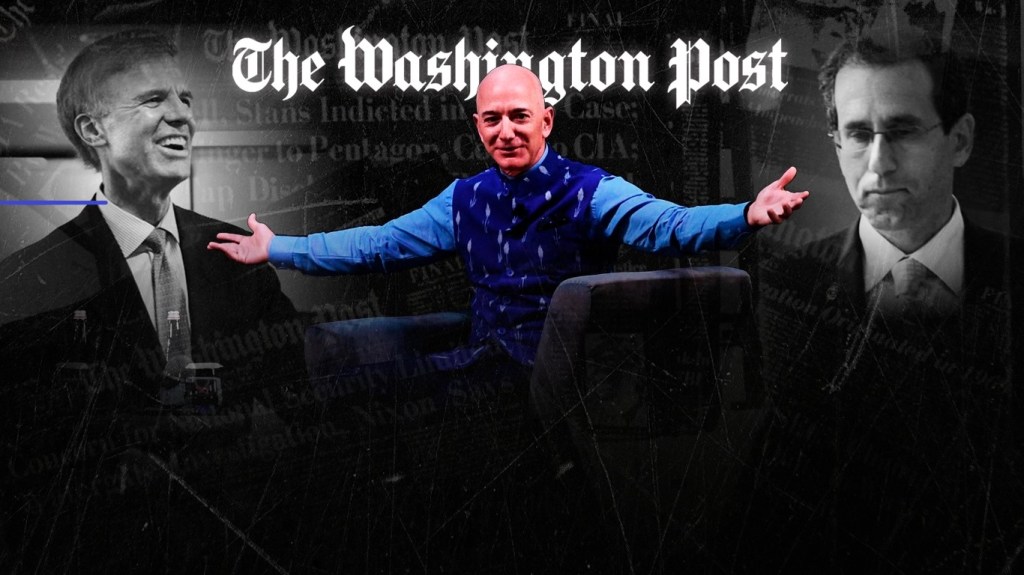
The Washington Post’s glaring conflicts of interest have of late once again been the subject of scrutiny online, thanks to a new article denouncing a supposed attempt to “soak” billionaires in taxes. Written by star columnist Megan McArdle — who previously argued that Walmart’s wages are too high, that there is nothing wrong with Google’s monopoly, and that the Grenfell Fire was a price worth paying for cheaper buildings — the article claimed that Americans have such class envy that the government would “destroy [billionaires’] fortunes so that the rest of us don’t have to look at them.” Notably, the Post chose to illustrate it with a picture of its owner, Jeff Bezos, making it seem as if it was directly defending his power and wealth, something they have been accusedof onmorethanoneoccasion.
There was considerable speculation online as to whether Bezos himself wrote the piece, so blatantly in his interest it was. Unfortunately, this sort of speculation has raged ever since the Amazon CEO bought the newspaper in 2013 for $250 million.
Being owned by the world’s richest individual does not mean that TheWashington Post and its employees are rolling in dough themselves. Far from it: Bezos’ revolution at the newspaper, which has led to both increased pageviews and company value, has been largely based on simply squeezing workers harder than before. In an interview with the Columbia Journalism Review, management acknowledged that Post reporters are pushed to produce almost four times as many stories as their peers at The New York Times. Furthermore, the Post writes and rewrites the same story but from slightly different angles and with different headlines in order to generate more clicks, and thus more revenue. Thanks to new technology, reporters’ every keystroke is monitored and they are under constant pressure from management not to fall behind. The technique of constant surveillance is not unlike what hyper-exploited Amazon warehouse workers who wear GPS devices or Fitbit watches have to endure.
Bezos is currently worth a shade under $200 billion, with his wealth nearly doubling since the beginning of the coronavirus pandemic in 2020. With such a fortune to protect, the obvious solution is to acquire media outlets to control the narrative in the face of rising public disenchantment with rampaging inequality. Omar Ocampo, a researcher for the Program on Inequality and the Common Good at the Institute for Policy Studies, said that this is a common tactic among the super wealthy. “Billionaire ownership of major news outlets is but another tool the billionaire class deploys for the purpose of wealth defense. It gives them the power to set the terms of the agenda and influence public opinion in their favor,” Ocampo told MintPress.
But Bezos is far from the only senior figure with questionable connections. The company’s CEO, Frederick Ryan, was a senior member of the Reagan White House, rising to become the 40th president’s assistant and later the chairman of the Ronald Reagan Presidential Foundation. He later became CEO of Politico. In the Post’s announcement of the hiring move, they themselves noted that among Ryan’s biggest achievements at their rival outlet was “helping the news organization win a lucrative advertising deal with Goldman Sachs and host presidential debates before the 2008 and 2012 Republican primaries.”
Another neoconservative in a key position is Editorial Page Editor Fred Hiatt. Under Hiatt’s tenure, anti-establishment columnists like Dan Froomkin were let go and warmongers like the late Charles Krauthammer, Paul Wolfowitz, and David Ignatius moved in. “After being so wrong on such a huge story as the invasion of Iraq, hawkish ideologue Fred Hiatt should have been terminated as editorial page editor,” Jeff Cohen, former Professor of Journalism at Ithaca College and founder of media watchdog group Fairness and Accuracy in Reporting, told MintPress, adding:
In a decent media system, someone who has been so inaccurate on so many issues as Hiatt would not be in a powerful media position two decades later. Powerful voices in U.S. media often argue that society should be a ‘meritocracy’ — with advancement based on ability or achievement. Hiatt proves that the U.S. corporate media system is just the opposite — a ‘kakistocracy’ — where the unqualified and unprincipled rise to the top.”
Other highly questionable hires include Jerusalem correspondent Ruth Eglash, who spent seven years putting out content that was often indistinguishable from Israeli government propaganda. At the time of her hire, activists highlighted the conflicts of interest she had, given her husband’s job as a PR rep for the country. In November 2020, Eglash quit the Post to become chief of communications for the Israeli ambassador to the United States and United Nations. “My experiences as a journalist have afforded me a great instinct of how to better tell Israel’s unique story,” she said, adding “a strong U.S.-Israel relationship and showcasing Israel’s successes to the world has [sic] always been a passion of mine.”
At the center of the news cosmos
The Washington Post is among the most powerful, influential, and widely-read media outlets in the United States. Its position as the dominant newspaper in the nation’s capital reinforces its place as a thought-leading, agenda-setting publication. Whatever appears in the Post will likely be in the rest of the nation’s media, so authoritative is its reputation.
There are no more important pages than its editorial section, where its board comes together to lay out the collective wisdom of its most senior journalists and editors. Through its editorial page, the senior staff lay out the newspaper’s line to others and broadcast what they see as the correct position on the most pressing issues of the day. Hence, editorials are essentially instructions to their well-heeled and influential readers in D.C. and around the country on what to think about any given subject.
This is particularly troublesome as, despite the fact the newspaper presents itself as a defender of liberty and a champion of the people (its tagline is “Democracy Dies in Darkness”), the editorial board has represented the interests of the powerful over ordinary Americans on issue after issue. The following editorials are examples of this in action.
Could we be any more pro-war?
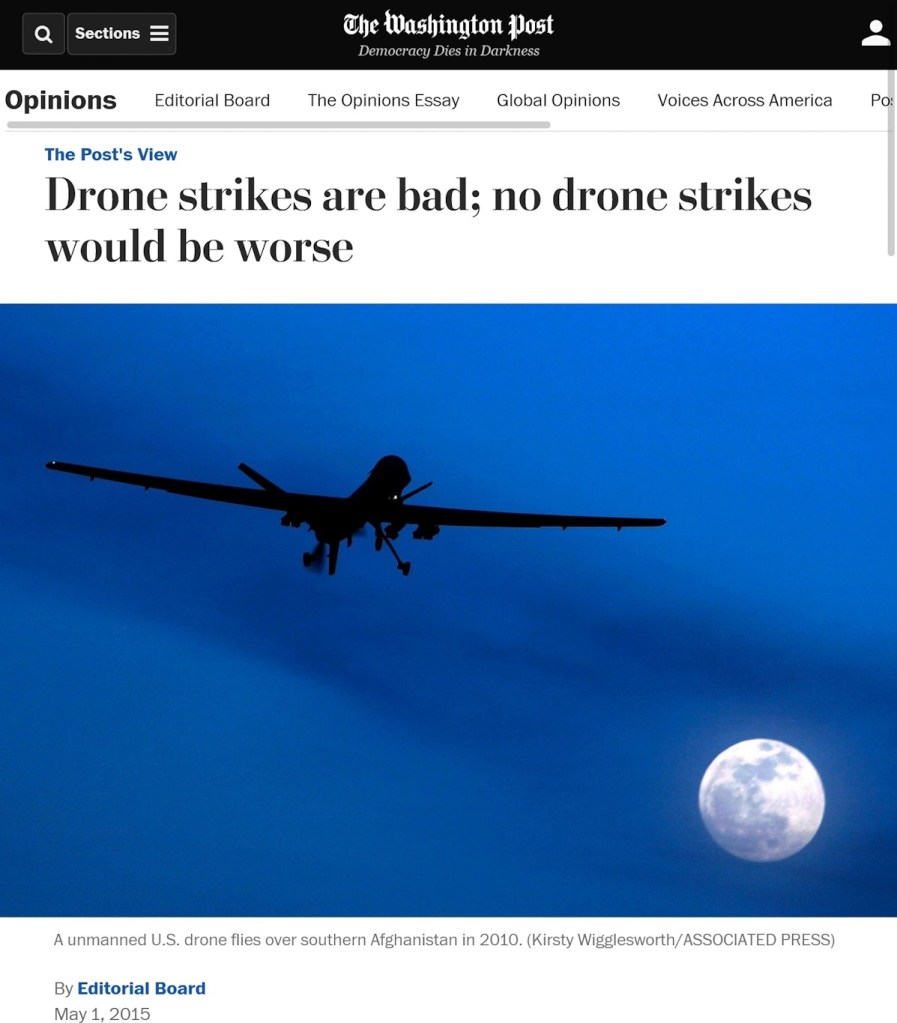
The Post’s editorial board has generally been extremely supportive of whatever conflicts the U.S. has started, and has consistently warned against ending the violence. In a 2015 editorial entitled “Drone strikes are bad; no drone strikes would be worse,” it balked at the idea of stopping the highly controversial bombing campaigns throughout the Middle East and North Africa. By that time, President Barack Obama was bombing seven countries simultaneously. Nevertheless, the Post argued that drones had successfully defeated Al-Qaeda and that the use of drone strikes “shouldn’t be up for review.”
In recent times, the rising newspaper of record has also been a driver of increased hostilities with China, describing Beijing’s military’s moves in the South China Sea as “provocations” against the U.S., spreadingrumors about the COVID-19 virus’s origin, and demanding American companies like Apple “resist China’s tyranny” and begin to relocate their production facilities elsewhere to punish the Chinese government.
On Latin America too, the editorial board has proven to be extremely hawkish. It immediately endorsed a U.S.-backed far-right coup in Bolivia in 2019, insisting that “there could be little doubt who was ultimately responsible for the chaos: newly resigned President Evo Morales.” The Post condemned him for refusing to “cooperate” with “Bolivia’s more responsible leaders,” who were organizing his overthrow, and chastised him for using the word “coup” for what was going on. Morales, they concluded, was a victim of his own “insatiable appetite for power” and his inability to “accept that a majority of Bolivians wanted him to leave office.”
In 2002, the paper also supported a coup against Hugo Chavez, falsely claiming the Venezuelan president had ordered the shooting of thousands of demonstrators and absurdly asserting that “there’s been no suggestion that the United States had anything to do with [it].
The WaPo editorial board’s less than subtle take on drone warfare
In more recent times, it has demanded more action to unseat Chavez’s successor, Nicolas Maduro, including supporting U.S. sanctions that have now killed over 100,000 people, according to a United Nations rapporteur. The Post’s justification in 2017 was that Maduro was on the verge of carrying out his own “coup,” “abolish[ing] the opposition-controlled legislature, cancel[ing] future elections and establish[ing] a regime resembling that of Cuba’s” — none of which has happened. In its efforts to oust the democratically-elected leader, the Post even aligned itself with Donald Trump and endorsed far-right coup leader Juan Guaidó as “Venezuela’s legitimate president,” a position some polls have suggested as little as 3% of Venezuelans hold.
The editorial board has expressed its desire to see regime change in leftist-controlled Nicaragua, too. President Daniel Ortega, it claims, is “taking a sledgehammer” to opposition against him, while it also demands that the U.S., which has done nothing but offer “mild verbal opposition” to his rule, do more. What happened to the U.S. of the 1980s, “which spent so much money and political capital to promote democracy in Nicaragua?” they ask sadly.
In reality, of course, the U.S. is currently trying to strangle Nicaragua’s economy through sanctions. And in the 1980s, Washington’s “democracy promotion” agenda included the funding, training and arming of fascist death squads who wrought havoc across Central America, killing hundreds of thousands in genocides from which the area may never recover. The architects of the violence were found guilty in U.S. courts, while the Reagan administration was tried and convicted by the International Court of Justice on 15 counts that amount to international terrorism. That the Post’s editorial board remembers that history as “promoting democracy” is particularly worrisome.
Fake news, fake newspapers
The Washington Post was the key supporter of fake news detection system “PropOrNot,” which was almostimmediatelyexposed as a fake operation itself, forcing the newspaper to publicly distance itself from its own reporting. Yet it was the Post itself that perpetuated the most notorious and damaging fake news story of the 21st century: the Iraqi weapons of mass destruction hoax and Saddam Hussein’s fictional links to al-Qaeda.
In a highly influential editorial entitled “Irrefutable” the Post wrote that, after watching Secretary of State Colin Powell’s speech at the United Nations, “it is hard to imagine how anyone could doubt that Iraq possesses weapons of mass destruction… And [Powell] offered a powerful new case that Saddam Hussein’s regime is cooperating with a branch of the al-Qaeda organization that is trying to acquire chemical weapons and stage attacks in Europe.”
“No page was more crucial in propelling the disastrous U.S. invasion of Iraq than the Post‘s editorial page — which beat the drums for war in a couple dozen editorials in the six months leading up to the invasion,” Cohen told MintPress, adding:
The Post’s op-ed page was almost as cartoonishly wrong on Iraq, offering little dissent or corrective to the editorial page’s jingoism — especially in that pivotal media moment following Colin Powell’s error-filled U.N. speech. While the editorial page offered up its ‘Irrefutable’ verdict, the op-ed page’s liberal voice offered an embarrassing column, headlined ‘I’m Persuaded’.”
The Post played a major role in manufacturing consent for the deadliest war since Vietnam, publishing 27 editorials in support of an invasion. As with PropOrNot, it backtracked long after the dust had settled, apologizing for its role in amping the public up to accept that war. Yet to this day it continues to push for others.
Surveillance state champion
Despite telling its readers that “Democracy Dies in Darkness,” The Washington Post certainly has a negative opinion about those individuals who work to shine a light on illegal government activities. In 2016, its editorial board demanded “no pardon for Edward Snowden,” condemning his backers like filmmaker Oliver Stone and expressing outrage that Snowden had revealed that the U.S. was spying on Russia and carrying out cyberattacks against China. In its long denunciation, it insisted that the NSA’s massive surveillance operation against the American public resulted in “no specific harm, actual or attempted.” As such, the editorial board made history by becoming the first newspaper ever to call for the imprisonment of its own source, on whose back and information it won a Pulitzer Prize.
If Snowden was not worthy of defending, then it is no surprise that the Post’s editorial team expressed their delight when Julian Assange was dragged out of the Ecuadorian Embassy in London, declaring it a “victory for the rule of law.” “Julian Assange is not a free-press hero. And he is long overdue for personal accountability,” they wrote, spreading baseless conspiracy theories that the Australian publisher worked with Russia to hack American democracy.
The Ecuadorian government of Rafael Correa, which offered asylum to the Western dissidents, also came under fire. In 2013, the Post (falsely) labeled Correa an “autocrat” and “the hemisphere’s preeminent anti-U.S. demagogue.” They also directly threatened him, writing that, “If Mr. Correa welcomes Mr. Snowden, there will be an easy way to demonstrate that Yanqui-baiting has its price.”
Of course, the Post is now intimately linked with the national security state after Amazon signed a number of deals to provide intelligence and computing services to several three-letter agencies. In 2020, the Bezos-owned Amazon Web Services signed a new deal with the CIA worth tens of billions of dollars.
The editorial board has also gone up to bat for Immigration and Customs Enforcement (ICE) multiple times, insisting that it is “the wrong target for outrage,” presenting the agency as key in the battle against art theft and nuclear proliferation. “Abolishing ICE is not a serious policy proposal,” the board wrote in 2018, despite the fact that the U.S. survived without the agency perfectly well until its creation in 2003.
Attacking any pro-people policy
The Washington Post has aggressively attempted to beat back any new political movements challenging the establishment. Chief among them has been the one around Bernie Sanders, for whom the newspaper has reserved a special ire. In 2016, it famously ran 16 negative stories on Sanders in the space of 16 hours and has used its fact-checking page to relentlessly undermine him, sometimes to bizarre effect.
“Bernie Sanders keeps saying his average donation is $27, but his own numbers contradict that,” read the headline of one article, which detailed how his average donation was actually $27.89, not $27. It also gave his statement that six men (one of whom is Bezos) hold as much wealth as the bottom half of the world’s population “three Pinocchios” — the designation just below the most egregious lie. This was because, they argued, billionaires’ wealth is tied up in stocks, not money itself, and most people own essentially nothing. Why this disproved his assertion they did not explain. Going undisclosed is that both Bezos and the Post’s chief fact-checker Glen Kessler, who is the scion of a fossil fuel baron, would stand to lose a fortune if Sanders were elected.
In 2020, the Post was no less hostile to Sanders, publishing an editorial headlined “We should pay more attention to the Democrats who pay attention to reality,” which stated that “Mr. Sanders promises unlimited free stuff to everyone; other candidates propose smarter, more targeted approaches.”
The Post’s higher-ups have been careful to oppose virtually every piece of progressive or pro-people policy proposals. Chief among them has been healthcare. The United States is alone in the developed world in not offering some kind of universal healthcare to its population. Its privatized system is multiple times more expensive than that of comparable countries and has the worst outcomes in the West. Yet the board has consistently scare-mongered its readers, claiming “Single-payer health care would have an astonishingly high price tag,” and attacking Medicare-For-All proponents running for office. “Why go to the trouble of running for president to promote ideas that can’t work?” it asked rhetorically, before going on to insist that moving towards a healthcare system like that of Canada, Japan or Western Europe does not meet a “baseline degree of factual plausibility.”
On education, it has been just as regressive. “There are consequences to making college free,” it warned readers. Chief among these would be that private universities would make less money, which, apparently should be a major concern. “Forgiving student loans the wrong way will only worsen inequality,” ran the headline of another editorial, in which the board pretended to be ultra-left elite-hating radicals, arguing that we should not make college free because Ivy League graduates would benefit the most (around one-third of the Post’s editorial team attended an Ivy League school). It also feigned a far-left position on charter schools, pretending that essentially privatizing schools and handing them over to businesses to run would solve racial inequality in America, and that anyone who opposed them (like teachers’ unions) was no progressive.
Perhaps the most blatant conflict of interest the Post has displayed is in their committed opposition to a wealth tax. “Elizabeth Warren wants a ‘wealth tax.’ It might backfire,” they wrote, making a series of bizarre and illogical arguments against the plan, such as immigrants will stop wanting to come to the U.S. if such a tax is imposed (the threshold for paying a wealth tax is $50 million). Five months later, the board reaffirmed their position: “A wealth tax isn’t the best way to tax the rich,” they wrote, claiming that rich people “can afford the best accountants and lawyers,” and so taxing them is presumably impossible.
Of course, the Post’s owner, Jeff Bezos, has every reason to go all out to prevent a wealth tax gaining traction. A CNBCstudy calculated that Bezos would be forced to pay $5.7 billion annually if Warren’s tax plans came to fruition.
The Post has also taken a firm stand against serious regulation of monopolies, decrying a supposed “antitrust onslaught” against Google, spearheaded by simplistic “break-them-up” rhetoric from dishonest actors. In 2016, it also lambasted Sanders for his “oversimplified,” “crowd-pleasing” demagoguery on Wall Street regulation, insisting that there has actually been widespread reform of the financial sector since 2008, making another crash unlikely.
Unsurprisingly for an outlet owned by a poverty-wage employer, the Post has also consistently opposed a national $15 minimum wage. In March, it categorically stated that “[a] $15 minimum wage won’t happen” and Democrats should stop trying to make it happen. Instead, they advised, they should “practice the art of the possible.” This, the board explained, meant falling in line behind Arkansas arch-Republican Senator Tom Cotton to support his proposals for a creeping state-by-state rise to $10.
On the climate, too, the Post has pushed extremely regressive positions, opposing a Green New Deal outright and suggesting the atmosphere be turned into a giant free market where polluters can trade credits and speculate. “The left’s opposition to a carbon tax shows there’s something deeply wrong with the left,” they wrote. They also endorsed the highly controversial process of fracking. Seeing as the Post’s editorial board is littered with former employees of the notorious climate-change denyingWall Street Journal, its stance is perhaps not surprising.
On COVID, the Post has consistentlyopposedteachers’ unions calls to keep schools closed, as well as standing against $2,000 checks. A universal payout is a “bad idea” they stated, but one “whose time has come because of politics, not economics.” So committed was the editorial team’s opposition to the idea of helping the poor that it presented Republican Majority Leader Mitch McConnell as a voice of sanity in Washington.
This does not mean that the Post was against direct payments to all people. In fact, all Post employees received a $2,021 bonus from management in January as a gesture of appreciation for their work during the pandemic. Two grand for me, not for thee.
Junk-food news
The point of a fourth estate is that it is supposed to shine a light on the powerful and hold them to account. But when corporate media are largely owned and sponsored by the super wealthy themselves, the claim that this is what they do is increasingly hard to maintain. In the Soviet Union, everybody was aware that the media was controlled by the state. But in a corporate state like the U.S., a veneer of independence is still maintained, although trust in the media has been plummeting for years.
While The Washington Post presents itself as an adversarial publication standing up to power, the fact that its senior staff constantly comes to such a hardline neoliberal elitist consensus on so many issues shows how little ideological diversity there is among its staff. Democracy dies at The Washington Post editorial board.
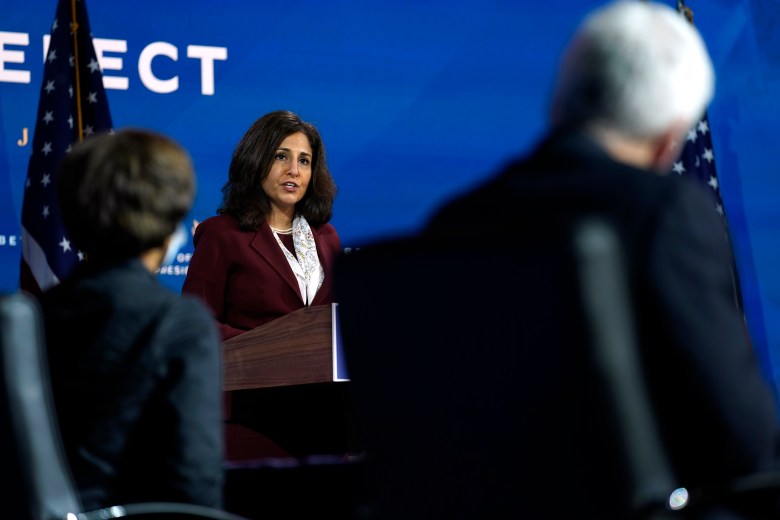
Neera Tanden, who President-elect Joe Biden nominated to serve as Director of the Office of Management and Budget, speaks at The Queen theater, Tuesday, Dec. 1, 2020, in Wilmington, Del. (AP Photo/Andrew Harnik)
How can Democrats oppose unhinged conspiracy theories while empowering its worst purveyors?
The announcement that Joe Biden intends to nominate Neera Tanden as his Director of the Office of Management and Budget — a critical position overseeing U.S. economic and regulatory policy — triggered a wide range of mockery, indignation and disgust from both the left and the right. That should not be surprising: though a thoroughly mediocre and ordinary D.C. swamp creature from the perspective of both ideology and competence, Tanden’s uniquely unhinged, venomous, corrupt and pathologically dishonest conduct as a Clinton Family and DNC apparatchik and President of the corporatist-and-despot-funded Center for American Progress (CAP) has earned her a list of enemies far longer and more impressive than her accomplishments.
When news of her appointment broke, many of the journalists and activists she has spent years abusing, slandering, and lying about instantly stepped forward to compile just some of her worst political and behavioral lowlights. And some preliminary signs emerged that she might encounter difficulty in obtaining the Senate confirmation needed for her to assume this position. The Communications Director for GOP Senator John Cornyn of Texas announced that “Tanden stands zero chance of being confirmed” by the Senate.
Former Sanders campaign aide David Sirota hypothesized that “it is not a coincidence that they are putting Neera Tanden — the single biggest, most aggressive Bernie Sanders critic in the United States of America — specifically at OMB while Sanders is Senate Budget Committee ranking/chair.” Sirota’s statement suggests Biden’s nomination of Tanden was intended as yet more humiliation doled out to the Democratic-loyal Sanders left by cucking the Vermont Senator even further by forcing him to shepherd the confirmation of one of his most vicious and amoral attackers (who Sanders himself in 2019 vehemently denounced). But Sirota’s point also raises the prospect that Tanden’s nomination could even encounter trouble from that side of the aisle as well (given Sanders’ compliant and disciplined conduct over the last six months, it’s more likely we will see him roll out a literal red carpet for Tanden to walk on, gently toss red roses on it before she passes, and then serve her a glass of Chardonnay rather than meaningfully obstruct her confirmation).
The list of sociopathic and even monstrous acts from Tanden is too long to list comprehensively. She punched one of her own employees, a reporter for CAP’s now-abolished blog ThinkProgress, after he had the temerity to ask Hillary Clinton in 2008 about her support for the Iraq War (Tanden claimed she “merely” had “pushed,” not punched, her undeferential reporter). In 2011, as the Obama administration was participating in the NATO bombing of Libya, Tanden suggested in internal CAP discussions that the U.S. steal Libya’s oil as a way of reducing the U.S. deficit (a story I was able to report only because Tanden had abused and alienated so many of her employees that they worked together to leak her incriminating emails to me).
During her tenure as CAP’s President, Tanden accepted millions of dollars from the regime of the United Arab Emirates, which built Dubai and Abu Dhabi using slave labor, along with massive donations from Facebook, Google, Microsoft, J.P. Morgan, the Walton Family and Michael Bloomberg, while hiding the identity of some of her think tank’s largest donors. A huge chapter on the NYPD’s abusive policies toward Muslims under Mayor Michael Bloomberg was removed from a CAP report after Boomberg donated more than $1 million to Tanden’s organization, and he continued to donate even more after that courteous gesture.
She ordered the supposedly independent journalists of the ThinkProgress blog, including Muslim writers, to stop writing critically about Israel after key CAP donors, including Barney Frank’s sister Ann Lewis and long-time Clinton advisor Howard Wolfson, complained. She and Wolfson plotted in 2016 how to weaponize female journalists and people of color against Hillary’s critics as well to use their identity to stigmatize and thus stop undesirable coverage from The New York Times. In 2018, she outed a CAP employee at a staff-wide meeting who had filed an anonymous complaint of sexual harassment and retaliation against one of Tanden’s male allies. Secure with her UAE-and-corporate-funded large salary, she haslong urged cuts to Social Security. The list goes on and on.
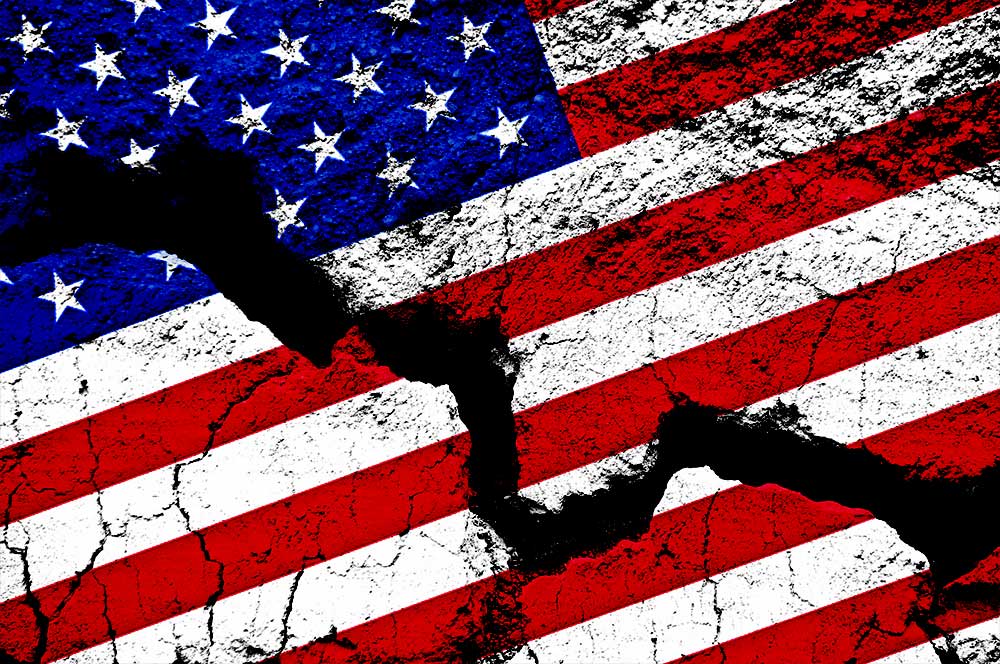
In January 2017, the Economist Intelligence Unit’s Democracy Index downgraded the state of democracy in the United States from “full democracy” to “flawed democracy.”
The demotion of a country that has constantly prided itself, not only on being democratic but also on championing democracy throughout the world, took many by surprise. Some U.S. pundits challenged the findings altogether.
However, judging by events that have transpired since, the accuracy of the EIU Index continues to demonstrate itself in the everyday reality of American politics: extreme political and cultural polarization; growing influence of armed militias and police violence; the mistreatment of undocumented immigrants, including children; the marginalization of the country’s minorities in mainstream politics, and so on.
The EIU’s Democracy Index has, finally, exposed the deteriorating state of democracy in the U.S. because it is based on 60 different indicators which, aside from traditional categories — i.e., the function of government — also include other indicators such as gender equality, civil liberties and political culture.
Judging by the number, diversity and depth of the above indicators, it is safe to assume that the outcome of the U.S. general elections this month will not have an immediate bearing on the state of American democracy. On the contrary, the outcome is likely to further fragment an already divided society and continue to turn the country’s state-run institutions — including the U.S. Supreme Court — into battlegrounds for political and ideological alliances.
While the buzzword throughout the election campaigns has been “saving American democracy,” the state of democracy in the U.S. is likely to worsen in the foreseeable future. This is because America’s ruling elites, whether Republicans or Democrats, refuse to acknowledge the actual ailments that have afflicted American political culture for many years.
Sadly, when the campaign of Sen. Bernie Sanders, former Democratic presidential candidate, insisted that massive structural adjustments were necessary at every level of government, he was dismissed by the Democratic establishment as unrealistic, and altogether “unelectable.”
Sanders was, of course, right, because the crisis in American democracy was not initiated by the election of Donald Trump in 2016. The latter event was a mere symptom of a larger, protracted problem.
These are some of the major issues that are unlikely to be effortlessly resolved by the outcome of the elections, and thus will continue to downgrade the state of democracy in the U.S.
The inequality gap: Income inequality, which is the source of socio-political strife, is one of the United States’ major challenges, spanning over 50 years. Inequality, now compounded with the COVID-19 pandemic, is worsening, affecting certain racial groups — African Americans, in particular — and women, more than others.
According to a study conducted by the Pew Research Center in February 2020, “income inequality in the US is the highest of all the G7 nations,” a major concern for 78 percent of Democrats and 41 percent of Republicans.
Political polarization: The large gap between the wealthy few and the impoverished many is not the only schism creating a wedge in American society. Political polarization — although, interestingly, it does not always express itself based on rational class demarcation — is a major problem in the U.S.
Both Republicans and Democrats have succeeded in making their case to enlist the support of certain strata of American society, while doing very little to fulfill the many promises the ruling establishments of these two camps often make during election campaigns.
For example, Republicans use a populist political discourse to reach out to working-class white Americans, promising them economic prosperity. Yet there is no evidence that the lot of working-class white American families has improved under the Trump Administration.
The same is true with Democrats, who have, falsely, long situated themselves as the champions of racial justice and fairer treatment of undocumented immigrants.
Militarization of society: With socio-economic inequality and political polarization at their worst, trust in democracy and the role of the state to fix a deeply flawed system is waning. This lack of trust in the central government spans hundreds of years, thus, the constant emphasis on the Second Amendment of the U.S. Constitution regarding “the right of the people to keep and bear arms.”
Indeed, U.S. society is one of the most militarized in the world. According to the FBI, two-thirds of all local terrorism in the US is carried out by right-wing militias, who are now more emboldened and angrier than ever before. According to an October Southern Poverty Law Center report, there are about 180 active anti-government paramilitary groups in the U.S.
For the first time in many years, talks of another “American Civil War” have become a daily discussion point in mainstream media.
It would be entirely unrealistic to imagine that democracy in the U.S. will be restored as a result of any given election. Without a fundamental shift in U.S. politics that confronts the underlying problems behind the socio-economic inequality and political polarization, the future carries yet more fragmentation and, quite possibly, worsening violence.
The coming weeks and months are critical in determining the future direction of American society. Alas, the current indicators are hardly promising.
The US Election is still a burning issue almost two weeks after the people went to the polls, and though the race has been called for Biden by every mainstream media outlet in the world, the recounts are ongoing and irregularities manifest.
Trump’s legal team, and many in the alternate media, are claiming the election was rigged. With one voice the mainstream media – and the entire political establishment – denounce these claims as “baseless”, and scream there is “no evidence”.
This is incorrect. There is plenty of evidence, both circumstantial and direct, which breaks down into six basic categories:
Precedent – It has happened before.
Motive – Deep State/Military dislike of Trump’s policies is widely known.
Foreknowledge – Establishment voices predicted this exact situation.
Opportunity – The voting system is highly susceptible to fraud.
Voting Irregularities – Known software “glitches” & irregularities in the reporting of the results.
Cover-up – Dishonesty in the reporting of the situation.
1. Precedent
There is plenty of evidence that US elections have been rigged before.
Nobody is talking about it much, but US elections have been rigged before. Everyone is more than familiar with the 2000 election, which was called for Al Gore before Florida flipped to Bush and swung the election. The controversy over “hanging chads” and misplaced votes was all people talked about for weeks.
One noteworthy “error” with electronic voting machines, switched over 10000 votes from Gore to an obscure third-party candidate.
After weeks of legal battles, Gore eventually conceded. Within a year the “attacks” of 9/11 had happened, and the US was at war in Afghanistan and planning six more wars within 3 years.
More recently, it was revealed the DNC had gone out of its way to hand Hillary the presidential nomination over Sanders in 2016. Then in the 2020 primaries, despite embarrassingly losses in the first few primaries, Biden’s presidential campaign had a “miraculous turnaround”, thanks largely to irregularities in postal ballots in Ohio, Wisconsin and New Jersey.
This is evidence of precedent.
2. Motive
The US Deep State has clear and publicly known motives for wanting to remove Trump from office.
It is no secret that many members of the US’s political establishment oppose Trump and Trump’s policies. This includes neo-con warmongers and chiefs of the military and intelligence agencies.
“The Resistance”, billed as some voice of the progressive alternative, boasted former members of George Bush’s cabinet as members.
The most strident opposition to Trump was on foreign policy – most specifically in the Middle East. Trump was committed to withdrawing from Syria, in direct opposition to the “Assad Must Go” crowd at the Pentagon and State Dept.
Conversely, Biden has always been firmly in the establishment camp on Syria, and many warmongers are already predicting that Biden will want to “restore some dignity” to the Syrian people.
The US Deep State has carried out coups all around the world, many of them bloody and violent, in order to maintain Imperial ambitions and keep wars-for-profit going. They have every motive to want to remove Trump and put Biden in his place.
This is evidence of motive.
3. Foreknowledge
Establishment voices have been predicting, and planning for, this exact situation for almost a year.
In January of this year – well before anyone could have predicted the effect the “pandemic” would have on the world – legal scholars were Wargaming the outcome of a disputed Presidential election based on postal ballots in Pennsylvania.
In August a group naming themselves the Transition Integrity Project published a document predicting a “disputed” election, that the counting would take much longer than usual and that it would not be certain who was President until January.
More generally, the outcome of the election was widely “predicted”, with multiple press outlets claiming there would be a “red mirage” and a “blue shift”. Meaning it would look like Trump would win, and then suddenly Biden would win at the last minute.
This is evidence of foreknowledge.
4. Opportunity
There is plenty of evidence that the US voting system is open to potential corruption.
Voting machines, for example, are owned and distributed by private companies. Many of which have political ties. An article in the Guardian, of all places, went into great detail about this just last year, when they were suggesting that Trump may have stolen the 2016 election.
Likewise, postal ballots are known to be susceptible to fraud. William Barr, the Attorney General, summed it up in a television interview in September, and written reports in 2007 and earlier this year, have gone into great detail about historical cases of postal vote fraud and possibilities of future occurrences.
This is evidence of opportunity.
5. Voting Irregularities
There are plenty of irregularities in the results which suggest the possibility of something strange going on.
The story of the election by the numbers doesn’t really make logical sense. The turnout is said to be 72%, the highest in 120 years, and the first over 60% for over 50 years.
In the process Joe Biden, we are told, shattered Barack Obama’s popular vote record by almost 10 million votes.
Joe Biden?
This Joe Biden?
…got more votes than Barack Obama or Hillary Clinton?
Meanwhile Donald Trump increased his own popular vote by over 10 million, whilst increasing his vote share in almost every ethnic demographic, as well as with women and LGBT voters.
Making him the first incumbent president to increase his popular vote but still lose in over a century, and the only one since all 50 states were part of the union.
Even if you believe that narrative is possible, there’s more than enough evidence of voting irregularities to warrant at least questioning the result and investigating further.
This error was only spotted because of the historically republican record of the county. In a more hotly disputed seat, this error could potentially never have been picked up.
The software used in this county is used in 30 other states – including Wisconsin, Georgia, Arizona and Pennsylvania, all of which were decided by less than 1% of the vote, and any two of which could swing the election to Trump.
In fact Dominion, the company which supplied the questionable voting software, was denied a contract by the state of Texas in 2019 when judges found there were “concerns” about “whether [it] is safe from fraudulent or unauthorized manipulation”.
A subsidiary of Dominion was kicked out of the Philippines for being too easy to hack.
This video clip appears to show CNN’s coverage switching over 19,000 votes from Trump to Biden in Pennsylvania.
The graphed results of both Michigan and Wisconsin show decidedly odd jumps in Biden’s vote.
The counting itself was also deeply suspect, with several states taking almost a week to count the last few percent of the vote, whilst managing to count over 90% of the vote on the first evening. In Wisconsin the National Guard were brought in to “transcribe” damaged ballots, whilst in Pennsylvania they were allowed to count postal votes with “no clear post mark”.
To state there is “no evidence” of election rigging is a lie. There is plenty of evidence. Every news outlet, channel and website is singing from the same hymn sheet on this – even Fox News, so often Trump’s supposed favourite channel.
Even before the election, as discussed above, all the mainstream media were running articles defending mail-in ballots, and claiming that they are not historically weak to voter fraud. This is totally untrue, as anyone who cared to research the topic would tell you.
So, why are all the media telling the same lies? Why are people being denied a platform?
This is evidence of a cover-up.
*
Ask yourself:
If, in 2016, some voting software used in 30 states had flipped 5500 from Hillary to Trump, and later been revealed to be financial tied to the Republican party, would that have been “just a glitch”, or evidence of cheating?
If the Brexit referendum had swung violently to Leave after dumps of suspect postal ballots were permitted into the count by a judge who was a known Brexit supporter, would the media have kept quiet?
If, in Russia, the media denied a platform to the opposition to accuse Putin of voter fraud, would that be “responsible media practice”, or evidence of bias and censorship?
We don’t know exactly what happened, or how the election was result was controlled, but as of right now the specifics do not matter.
The point is there is plenty of evidence suggesting something happened, more than enough to warrant asking rational questions and expecting reasonable answers.
Every time the media ignores the evidence, or censors those seeking it, they only display further that there must be some fire behind all of this smoke.
Coronavirus and globalism will teach us vital lessons. The question is whether we can learn vital lessons that do not serve the ruling interest groups and ideologies.
Coronavirus will teach us that a country without free national health care is severely handicapped. Millions of Americans live paycheck to paycheck. They cannot afford health care premiums, deductions, and copays. Millions have no insurance. This means millions of people infected with coronavirus who cannot get medical help. The morbidity from this is intolerable in any society.
Shutdowns associated with efforts to contain the spread of coronavirus will deny income to millions of Americans who live paycheck to paycheck. What do they do for food, shelter, transportation? You don’t have to think very long along these lines to see a very frightening scenario.
Globalism has taken down the ladders of upward mobility by exporting American middle class jobs to Asia. A population once able to save now lives on debt, the service of which is interrupted by recession/depression and by debt service absorbing all net disposable income.
Globalism has also reduced the survivability of our society by making it dependent on externally produced goods, the supply of which can be cut off by disruptions in other societies, by policy disagreements leading to sanctions, and by an inability to export enough to pay for imports, which is what the offshored production of US firms is.
The United States has an unprotected population and an economy in trouble. For years, corporate executives have run the companies for the benefit of their bonuses, which are largely dependent on rises in their company’s share price. Consequently, profits and borrowings have been invested in buying back the companies’ shares and not in new investment in the businesses. Corporate indebtedness is extreme and will threaten many corporations and many jobs in a downturn. Boeing is a case in point.
Economist Michael Hudson has for many decades studied the use of debt-forgiveness to restart economies killed by debt burdens. Debt forgiveness for corporations has a different implication than debt forgiveness for individuals. For corporations, forgiving debts lets those who financialized and indebted the economy and the population off the hook. To avoid rewarding them for the catastrophe they produced and to prevent widespread public outcry and distrust, nationalization is implied for insolvent companies and banks.
Nationalization would be limited to insolvent companies and financial institutions and doesn’t mean that there would be no private companies or businesses. Additional nationalization could be used to prevent strategic companies from substituting their interests for national interests, which they do when they move American jobs and factories offshore. Pharmaceuticals could be nationalized along with health care. Energy which often sacrifices the environment to its profits could be considered for nationalization. A successful society has to have more driving it than private profit.
For most Americans nationalization is a dirty word, but it has many benefits. For example, a national health care system reduces costs tremendously by taking profits out of the system. Additionally, nationalized pharmaceutical companies could be made more focused on research and cures than on profit avenues. Everyone knows how Big Pharma influences medical schools and medical practice in line with Big Pharma’s approach. A more open-minded approach to medicine would be beneficial.
Socialist is another American dirty word, one that is being used against Bernie Sanders. I have not turned into a socialist overnight. I am simply thinking outloud. How can the economy recover when the population and corporations are smothered by debt? Debt forgiveness is the only way out of this debt suffocation. Can debts be forgiven without nationalization? Not without a huge giveaway to financial mangers and Wall Street. It is the members of the “one percent” who have received 95% of the increase in us income and wealth since 2008. Do we want to reward them for smothering the economy with debt by bailing them out without nationalizing them?
The combination of an economy covered in debt and an unprotected population is clearly revolutionary. Do we have leadership capable of breaking out of interest group politics and ruling ideologies in order to save our society and put it on a more sustainable basis?
Or will the economic hardships be blamed on the virus, the catalyst that ignited the debt timebomb?
Health insurance industry stocks surged Wednesday morning in the wake of former Vice President Joe Biden’s strong showing in the Democratic presidential primary’s Super Tuesday contests, opening up 600 points after traders appeared to bet the candidate’s resurgence would box out any chance of single-payer universal healthcare.
“What more do you need to know,” tweeted journalist Jack Mirkinson of the market’s spike.
Sanders has made Medicare for All a centerpiece of his campaign. The healthcare industry has poured millions in ad buys against Sanders after the Vermont senator won primaries in Iowa, New Hampshire, and Nevada.
“The industry has long seen Biden as their white knight,” said Dr. Adam Gaffney, the president of Physicians for a National Health Program and an outspoken Medicare for All advocate.
Biden on Tuesday won at least nine of the 14 states up for grabs to Sanders’ four. At press time, Maine was yet to be called, with Sanders and Biden locked in a razor-thin contest.
The market surge came after a rough week for the stock market, which at the end of February saw its biggest decline since the 2008 financial crisis after fears of the economic cost of a worldwide coronvirus pandemic increased.
Highlight: Joe Biden won nine states on Super Tuesday. "What this is really showing now for the markets is that some of the more moderate candidates like Joe Biden are picking up support, and that could be a good sign for stocks going forward," @emily_mcck says. pic.twitter.com/YbOWzKWmWc
Business commentators also made the connection between Sanders’ victories in the early primary states, particularly in Nevada, and the market’s poor performance last week.
On Fox Business February 28, billionaire Steve Forbes remarked that the weeklong drop was not only about fears of the coronavirus.
“There’s the political side,” Forbes said of the reason for the poor performance. “In the last week, week-and-a-half, the possibility of Bernie Sanders becoming president of the United States has increased, exponentially.”
Stocks of healthcare companies roared in response to Biden’s performance. Cigna was up more than 10 percent in morning trading, while UnitedHealth Group rose nearly 12 percent. Humana jumped 1.25 percent and Anthem soared nearly 14 percent.
Investor Ed Yardeni told the Post that Wednesday’s spike was a correction to earlier fears of what he called “Bernie Sanders’ socialist program.”
“The market’s sell-off last week on Sanders’ primary victories and rebound on Monday after Biden’s big win in South Carolina and this morning after Super Tuesday suggest that domestic U.S. politics may matter as much as the global health crisis on investors,” said Yardeni.
As Common Dreamsreported, the results—which saw billionaire Michael Bloomberg and Sen. Elizabeth Warren (D-Mass.) coming in far behind the two frontrunners—transformed a once-crowded primary into a two-man race. Though Biden put up a good showing, exit polls from the contests showed a majority of Democratic voters backing the elimination of private insurance in favor of a government-run system guaranteeing healthcare for all.






 After the Crash