An Open Letter to the People of the United States: Election or Revolution?

votefornobody

(Editor’s note: While we do believe positive change is possible on a local level through grass-roots campaigns and voter initiatives, until major systemic changes are forced into existence we have no reason to expect anything from presidential politics other than what we’ve been subjected to for the past few decades.)

By Robert J. Burrowes

As citizens of the USA with a presidential election approaching you have a wonderful opportunity to ponder whether to participate in this election or to participate in the ongoing American Revolution.

Your first revolution might have overthrown the authority of the British monarchy and aristocracy but the one in progress must remove the US elite which has executed a political coup against your government. And you cannot remove elite coupmakers in a fraudulently conducted election in which the ‘choice’ is essentially between two violently insane individuals, each of whom represents the violently insane US elite. See ‘The Global Elite is Insane‘ and ‘Why Violence?

The real value of this second revolution, which moves along steadily with routine outbreaks over a multitude of peace, environmental and social justice issues and occasional ‘uprisings’, such as the Occupy Movement in 2011 which spawned a range of new and visionary initiatives, is that it could give citizens of your country the chance to finally reclaim the Republic for those people who genuinely care about ‘life, liberty and the pursuit of happiness’. And, just as importantly, have sufficient vision to regard these aspirations as something to be shared with the entire US population, starting with Native Americans, and even those of us in the rest of the world including those countries that are currently victims of US elite violence, whether it be wars, drone strikes, coups, economic exploitation or ecological destruction.

Such a revolution might rewrite your constitution and replace the second amendment ‘right of the people to keep and bear arms’ with the right to live free of the fear of gun violence. It might result in a form of social organization that distributes wealth equitably (perhaps by actually taxing the wealthy and outlawing the use of offshore tax havens) while reallocating the annual military (killing) budget to life-enhancing projects such as poverty alleviation, affordable housing, free education, free healthcare, clean water, renewable energy technologies, and a substantial budget for compensation to those countries that the US elite has systematically exploited or simply destroyed during the past 200 years. This would allow the 50 million US citizens who live in poverty, and another billion people around the world who also live in poverty, the chance to live a decent life.

Now, you might ask, ‘How are we, the ordinary citizens of the United States, even with our handguns, rifles and assault weapons, going to take on the US military and police to remove elite control of our government?’ Well, the answer is that you do not need even one weapon for this ongoing revolution and, in fact, you are vastly better off without them. Weapons have only one use – to kill people – and any revolution worth the name has a more profoundly ambitious aim than this.

What you need is intelligence, commitment, courage and a sound nonviolent strategy. The US elite controls your government and has crippled your republic because, over successive generations, you have let them. Every time you cooperate with the elite, because you are scared, by paying your taxes (more than 50% of which finances US wars and other military violence), putting your money into their corporate banks, shopping at their corporate shopping malls, buying and consuming the ‘news’ presented by their corporate media, rationalizing their policies as reasonable, participating in their unjust and violent legal system, fighting (as an enlisted person or as a mercenary) in their military forces, working in their prison system, accepting exploited employment of any kind, eating their poisoned and genetically mutilated foods (GMOs), going along with their endless attempts to divide you along racial, class, religious and other lines, you simply consent to their control. Why?

You have a simple alternative. Consciously and systematically participate in the ongoing nonviolent revolution that is already taking place and give it added life by your presence. Remake the US republic as you want it by withdrawing your cooperation with elite structures and processes while creating alternatives that meet your needs and the needs of those around you.

Join those US visionaries who are creating cooperatives where people are both managers and valued workers, take your money out of elite banks and put it into financial organizations that exist or which you create to serve the interests of their members (or, if you prefer, use LETSystems), refuse to participate in or pay for (with your taxes) US imperialism (and win friends all over the world), grow or buy healthy locally-grown organic/biodynamic (and, if you are concerned about the climate catastrophe as well, vegetarian) food, read progressive news outlets so that you know what is really going on in the USA and the world, read literature that deepens your understanding and concern for humanity and doesn’t just offer you a distraction from the horror in which you live, and support or even become one of those many fine nonviolent activists in your country who take personal risks in the struggle to create a better world.

If you want more of what you have, then you should vote and/or buy a gun. They have an equivalent outcome: they both legitimize elite violence and exploitation directed at you and those you love.

If you want to participate in this second and ongoing American revolution, then spend your time participating in the wholesome activities that many grassroots organizations already offer and in creating its next manifestations in your own neighborhood. It is the powerful conscience-based choices that you make as an individual that define your Self. And it is these choices that will have most impact on your family, neighborhood, community organization, trade union, religious organization and elsewhere and that will help decide the future of the USA and its role in the world.

Now you might say, I do some or even all of the sorts of things you mentioned above, so why not vote too? My answer is simply this: Voting is an act of disempowerment. It’s essential message is ‘I appoint you to govern for me’. I prefer to govern myself (both meanings intended). And you?

So what of those who present the ‘lesser evil’ argument: one candidate is so bad that it is better to have the other. This ‘argument’ is not worthy of scrutiny. If you are deceived by this argument, you will vote forever in the delusional hope that you will one day get a choice to vote for someone genuinely decent. In 2008, Barack Obama was supposed to be the candidate of hope and change. Did you get that hope and change? Are you going to get it with Clinton or Trump? Of course not. Elites simply ensure that change via the electoral system cannot happen; its function is to absorb and dissipate our dissent.

If you vote you are saying that you endorse this system of electoral exploitation. The tragedy is that even third-party candidates, who may be people of genuine principle, have no chance. Even worse, they add a veneer of legitimacy to your corrupt electoral system.

In essence, if you vote for the ‘lesser evil’ you are still voting for an ‘evil’ and, more importantly, you have participated in and endorsed an ‘evil’ system: one which denies you a genuine ‘free and fair’ choice to vote for a candidate who actually represents your interests and views and has a reasonable chance of winning. And, having won, is then able to actually implement their policies (rather than be stymied by a power structure that has no intention of letting this happen). Given your circumstances, ‘the only winning move is not to play’ their corrupt game and to put your energy into a genuinely winning move: working for the regeneration of American society.

Look at it this way. If there are two rotten eggs, would you choose the one that is less rotten and eat it? Presumably you would seek another option and only after you have identified and fixed what is causing the problem in the first place. The point is this: Unless you spend your time deeply contemplating the nature of the society in which you want to live and then devoting your time and energy into creating that society, you will never have it. And you have betrayed yourself.

The reality is that either Clinton or Trump is going to be president of the USA for the next four years and a lot of people (both in the US but particularly in foreign countries) are going to die because of it (through US military violence and corporate exploitation). What we can do is to invest our political energy into creating a United States in which, at some point in the future, the likes of Clinton and Trump, and those they represent, no longer drive outcomes in our world.

To reiterate: I am not saying ‘Don’t vote and do nothing’ (as so many people do already). I am suggesting that you ponder the dysfunctionality of your society, do some research into the secretive ‘deep state’ (or military-industrial complex or power elite or the 1% or however you wish to describe it) that controls your ‘republic’ with its electoral system designed to delude you into believing that you have a say in governing your nation, and then consider how you want to engage politically and act in accord with your conscience in doing so. It is only by doing this that we will have any chance of getting the society and the world that we want, even if it is beyond our lifetimes (and assuming we can avert extinction at our own hand in the meantime).

In summary, profound change only occurs from the ‘bottom up’ when enough ordinary people take the initiative to remake their own society. And if you are really interested in doing this, one important place to start is by reviewing the way in which you nurture children. See ‘My Promise to Children‘.

Other straightforward options, in addition to those mentioned above, include participation in ‘The Flame Tree Project to Save Life on Earth‘ and signing the online pledge of ‘The People’s Charter to Create a Nonviolent World‘.

But for those of you who are serious strategic thinkers, I have outlined a strategy for removing coupmakers on the website Nonviolent Defense/Liberation Strategy which is a straightforward presentation of the more detailed explanation offered in the book
The Strategy of Nonviolent Defense: A Gandhian Approach‘.

Is our destiny in our own hands? Only if we have enough people of courage to accept responsibility for it. Are you one of them?


Biodata: Robert J. Burrowes has a lifetime commitment to understanding
and ending human violence. He has done extensive research since 1966 in
an effort to understand why human beings are violent and has been a
nonviolent activist since 1981. He is the author of ‘Why Violence?
His email address is flametree@riseup.net
and his website is at http://robertjburrowes.wordpress.com


Robert J. Burrowes
P.O. Box 68
Daylesford
Victoria 3460
Australia
Email: flametree@riseup.net

Websites:
Nonviolence Charter
Flame Tree Project to Save Life on Earth
‘Why Violence?’
Nonviolent Campaign Strategy
Nonviolent Defense/Liberation Strategy
Anita: Songs of Nonviolence
Robert Burrowes
Global Nonviolence Network

Saturday Matinee: O Lucky Man!

o-lucky-man-movie-poster-11-x-17_1834417

O Lucky Man! (1973) is anarchist director Lindsay Anderson’s epic follow-up to his film if…(1968). It’s at times a surreal and darkly humorous allegory for survival in capitalist society. Like if…, it stars Malcolm McDowell as Mick Travis but in a less rebellious mode selling coffee for a multinational corporation. Through hard experience (not unlike the trials of his character Alex in A Clockwork Orange), Mick learns the consequences of abandoning his principles and the true nature of the ruling class he aspires to join. Serving as the film’s “Greek chorus” are excellent songs from Alan Price interspersed through the film.

The Mechanics Of A Free Society

anarchism_defined_by_ztk2006-d3j3ga4

By Colin Turner

Source: Freeworlder

Most people who have given any consideration to a moneyless, ‘free world’ society are already aware that we have the technology today to create a world of abundance without the constraints and inequality of the traditional market system, owing to how much human labour can now be efficiently automated.

Without scarcity, and a massive reduction in the need for labour, money effectively becomes obsolete. That’s the theory. But it’s not the full story, nor does it convince everybody who comes into contact with the theory. In fact, it convinces surprisingly few indeed.

In my opinion, this kind of super-advanced “Star Trek” moneyless society is still quite a distance away – not because we lack the technology – but because we humans lack the openness and understanding required to make it work.

A truly free society should be just that – unlimited, self-determining and self-organising for the optimum benefit of all. Today it appears that, left to our own devices, humanity just can’t wait to blow itself to pieces. How can you de-regulate society and hope to achieve equilibrium against that backdrop?

Let us remind ourselves that today we share our world with people separated by walls to stop them killing each other, giant corporate agencies detached from the social and ecological effects of their business, people who kill animals for pleasure, and, worst of all, a population that has somehow programmed itself to consume recklessly to compensate for its own imagined insecurity.

To my mind, celebrity/brand worship, religious fervour, and xenophobic flag-waving are all here to remind us that – irrespective of our technological advances – we still have a long way to go before humanity can unite in the common purpose of sharing our world and its bounty equitably and sustainably for all.

As someone who has considered these ideas perhaps more than most, I have had plenty of time to critique and refine my own philosophy along the way. As a result of these self-inquiries, I have come up with a number of ideas that I believe can help us paint a fuller picture of what to expect in a free society, and some ways that we can enact it today.

Social Gravity

This is the glue that keeps society together. We are a social species. By and large, we prefer to do things together. We naturally gravitate into groups, teams, villages and cities.

This all stems from one basic human need –  the urge of individuals to belong to something greater. Everything from our cities, our cultures, our religions, even our great unwritten social contract of be-good-to-others – stems from this need.

Social Gravity is the force that naturally binds us – even keeping our unfair, outdated system together, with all its flaws. This is because most people prefer to accept the broader consensus rather than apply radical new thinking. The fact that it keeps our system together, in plain view of its injustices and suffering, tells you just how powerful a force Social Gravity is.

Now imagine how much more powerful this force could be in a society that positively promotes life, health, diversity and happiness for all. Social Gravity is the primary force that will bond a free society and make it work.

Currently, most free world advocates are fighting against Social Gravity as they meet peoples’ resistance to radically new ideas and change. But we know this is changing ever more by the day as these people are beginning to question the logic and injustice of the prevailing system themselves.

As more change their viewpoint, the more they ‘normalise’ the environment for others to do so too. This is why it’s important to let people know how you are thinking. Even if they disagree now, you will probably become a point of reference for them later as they too begin to change.

This natural social pressure is what will maintain order, balance and efficiency in a free society. The more people benefit from it, the stronger that force becomes.

Self-Determination

Most people do not understand the true meaning of anarchy – to the point that I’ve almost given up using the term. Over the years, the media and prevailing thought have suffused its meaning with disorder, chaos and violence. But this is not anarchy – this is usually just the collapse of oppression.

Our screens are often filled with views of young people rioting, throwing missiles or looting shops, with the strong suggestion that they have become ‘lawless’, or that ‘law and order’ need to be restored – but this is a deep and dangerous misunderstanding.

Scenes like this are, in fact, the backlash of oppression. Whatever happened before is what creates those scenes. This is anger, not anarchy.

The best way to describe anarchy is to look to the animal kingdom. By and large, animals are peaceful creatures and will happily co-exist with each other in a steady-state* environment. The only time an animal is ever violent is when it must kill to eat, or when threatened, and – crucially – no animal ever kills more than it needs.

This is self-determination – the default behaviour of all beings. When survival is not threatened, peaceful coexistence is the default state of all animals, including humans. It’s simply easier than violence.

History books and media are full of references to aggressive culture, heinous acts of violence and torture – man pitted against fellow man. This gives an abiding impression of a bloodthirsty homo sapiens, indiscriminately bludgeoning all in his path to get what he wants. But this is a false impression, and yet another dangerous misunderstanding of the world and of ourselves.

The reason for this is simple. Wars, conflict and aggression make for more interesting stories so are always reported on and read about in our history books and media. Whereas, peace and non-conflict is essentially boring and does not get written about – yet it probably accounts for 99.999% of all human behaviour.

For every lunatic who takes up a gun and starts killing people, there are millions and millions of other people who don’t, but we never hear about them. The reality is, our human experience, from a statistical point of view, is almost entirely peaceful.

A self-determining society doesn’t use or require laws. Laws were invented primarily to protect private interests and enforce the payment of taxes. In a world of abundance, open access and greater understanding of ourselves, these laws would become redundant.

Nor do we need laws to protect ourselves from each other, as that basic morality is already hard-wired into us. We are a social species. We want to get along. We all experience this spirit of humanity every day in the help we get from our work or student colleagues, our friends and families, and from strangers – even in times of crisis. When financial stress is gone, people are good to each other.

The ideological boundaries between us – culture, religion, nationality, etc – are purely superficial, and friction between differing views – much of which is inequality-based – can only diminish as the common ideals and benefits of a free society become apparent.

As long as we each have our survival needs met by society, there is nothing to compete for – at least nothing that is worth killing or dying for.

Of course, we cannot expect self-determination to automatically rule out all acts of senseless violence or anti-social behaviour, but once scarcity is not an object to peoples’ existence, we can certainly expect to reduce such incidences to a minimum.† (See Anti-Aggression Strategies)

* A steady state environment is an environment where scarcity and territories are not an issue. Technically, we humans have long since solved the problem of scarcity through the application of technology. We just have to work on our own ‘software’ to create a fair distribution system for it. Also, by doing so, we will regain sufficient trust between each other to render our territorial and cultural boundaries as meaningless as county lines.

† It’s worth pointing out that senseless violence and anti-social behaviour are already common daily occurences under our current law system – most of which can be related directly to scarcity and inequality. It seems wholly unreasonable to assume such behaviour would increase in a self-determining, abundant society.

Life Education Program

To give a free society any chance of succeeding or surviving, a radical overhaul of our current education system is essential. By and large, our current system prioritises reading, writing and arithmetic as core learning, but, in my opinion, these are far from the most important skills we need to acquire.

Children from the earliest age (even from 0) must have access to the most important information that can help them live a rich and fulfilling life, with all the skills for building great self, inter-personal and community relationships. This information can easily be compiled for children of all levels of cognisance.

Here are some examples of topic headings (though I’m sure many more could be extrapolated here):

  • Nature
    Introduction to our planet, our ecosystem, death and the cycle of life, appreciation of all life.
  • Environment
    Ecology, the food chain, water, weather, city and bio-systems, energy, sustainability, regeneration.
  • Community
    The mechanics of community, the purpose and benefits of sharing, respect, trust, empathy, being responsible, leadership, team-work, resolving disputes,  appreciating unfamiliar races and cultures.
  • Self
    Anatomy of self, basic hygiene, health, nutrition, hydration, oxygenation, meditation, massage, self-awareness, self-acceptance, self-respect.
  • Life Skills
    Interpersonal relationships, effective communication, empathy, understanding and coping with negative emotions, problem solving, critical thinking, creative expression, food growing and preparation, sex, parenting and family.

Of course, traditional learning still has enormous value and will continue to be taught in a free society, but relevant and practical lessons on life and life skills must have precedence in order to create better, happier communities.

By building Life Education as a modular program, we could even start introducing this vital new education in stages today.

Community Service

While many necessary jobs in the community will naturally be filled by those passionate and motivated enough to devote their time unconditionally to it, there will invariably be a shortfall in volunteers to participate in some of the less glamorous functions of modern society – like sweeping the roads, etc.

Community service is a concept that most of us are already familiar with – though we usually associate it with punishment for petty criminals. But the fact is, organised community service is undoubtedly the most efficient way to deliver essential services equitably within a large population.

In the enactment of a free society, every member of the community should be encouraged to contribute a reasonable minimum number of hours community service a month. Remember, for a society without conventional employment, this would be a trivial commitment for most people.

A monthly schedule of required services and tasks in the community could be published, where members would opt to participate in whichever tasks best suited their skills and availability at the time.

The number of recommended hours per month would obviously depend on local factors, ie. what needed to be done, population number, availability of skills, complexity of tasks, etc, but the idea is to keep peoples’ commitment to a minimum by spreading the community workload as widely as possible.

Children should also be actively encouraged to engage in their community’s projects from as young as possible – and in as many diverse tasks as possible. This would help them discover their own aptitude, engage with the community, and gain valuable life experience in the process.

Each service task would have a strong social aspect, where people are encouraged to work in teams, during the same hours, and towards common goals. There’s no reason why community work in a free world should ever be onerous, or could not even be carried out in entertaining ways.

For example, with a little imagination, some tasks could even be turned into sports events where teams compete to fulfil tasks, or see who can come up with the most innovative solutions. The overriding goal is that community service, while providing essential services, would be entirely opt-in, and a fulfilling and engaging experience that people would enjoy.

The Project Pledge Scheme

In any community, large projects always need to be undertaken – like building a new bridge, road, school or hospital. The current market system works quite well in this regard, as it monetarily ‘locks in’ the required personnel to complete large scale tasks uninterrupted for many months or years at a time.

In a moneyless world, rotating volunteer personnel from within local communities to help with long, complex projects may prove inefficient, or, in some cases unworkable.

A solution might be to create a Project Pledge scheme, where willing workers publicly pledge to see the project through until completion. It’s reasonable to assume that any large scale community project would find it easy to enlist local volunteers who would benefit directly from the project.

A project launch ceremony could be held where they each undertake their pledges. What’s important is that the project managers would seek the full commitment and pledge from participants at the outset, while the volunteers themselves become personally invested in the project’s success too.

As with all community service, large projects would also have a strong emphasis on creating an enjoyable social experience for the participants.

As technology gets better and more widely available, large intensive projects would obviously require fewer and fewer personnel, but a Project Pledge Scheme could be a viable interim solution.

Central Resources & Skills Database

A free society needs an effective information network to maintain its efficiency.  We can have a central information database relating to resource location and inventory, and a comprehensive directory of people and skills. Such a database would be maintained and moderated by users.

The resources section would be a map-based inventory and requisition facility for users to list, find and request the resources they require. By resources, I mean anything from raw iron ore to a wooden dining table. Whatever physical resources people have available for sharing, they can list it on the database.

Anyone looking for those resources would simply run a search on the database, find the nearest match, and place a requisition order. If necessary, resource requisitions could be weighted according to urgency and depth of benefit to the community. For example, a community urgently requiring concrete for re-construction of a well would have greater priority than an individual requiring concrete to build a garage.

Like the inventory, the requisition system would be entirely transparent, and a user making the request would be able to see where his request was positioned in the queue and read the other requests. A fully transparent system is the only way to avoid needless misunderstandings and conflicts.

Items that need to be delivered from one area to another could then come under the Community Service system in the despatching area to source a driver and truck to carry the requested goods – if possible on an already existing despatch route.

The skills section would be a map-based directory of people who wish to offer their labour or specialist skills to others. Users looking for those skills would be able to make contact with them directly.

It would seem logical for a company like Google who already have the established infrastructure and reputation to incorporate such a facility into their current portfolio, but of course, it could be any provider.

The HonorPay System

Obviously the notion of giving for reward is firmly embedded in our culture. It’s not entirely clear to me if we can ever fully transcend this essentially ego-based reward paradigm – or even if transcending this would be a good idea.

Many supporters of a free society believe we can surpass ego. I’m not so sure, since at its most base level, ego is part of our survival mechanism, and, in its highest form, embodies our individuality. Certainly in the interim period, moving from a market-based system to a free society, I believe it will be useful to maintain a symbolic reward or Honor system.

The HonorPay system, or something like it, may offer just such a symbolic payment system. It’s a free web utility that provides a means to award limited ‘Honors’ to any person you wish, aggregating their public reputation score.

The Honor awards have no useable value, and are simply tokens of appreciation. In a world powered purely by volunteerism, appreciation will be a valuable incentive.

The HonorPay system is already live (honorpay.org), and something that can be used today, providing people with a means of incentive and reward beyond physical or monetary tokens.

Open Proposals Platform

In matters relating to large numbers of people, it would make sense to have a an open platform where each person can vote on decisions that affect everybody, voice their own opinions, and propose motions of their own.

Relatively simple to implement, such a platform would seem to be a basic requisite for an open society. Though surprisingly, it may end up seeing little use, since a more conscious, abundant and creative society will likely have moved beyond reducing everything to binary choices and leaving an endless trail of disgruntled minorities! However, while still useful, there may be a far more interesting and potentially beneficial purpose for building such a system.

Today, even in supposedly democratic countries, most important decisions relating to things like budgets, laws, jobs or foreign conflict are never put to a public referendum. Most referenda are nothing more than democratic window-dressing that only address political ‘hot potatoes’ or moral hazards that politicians would rather avoid, and which usually have almost no relevance to how the country is actually run.

Implementing a public polling platform today would give people the opportunity to ‘vote’ on every issue that affects their lives. Even though their vote would not officially count, it would still give them a means for their collective voice to be heard. For example, it would be much more difficult for a country’s government to follow through on its own internal policy when the open polling platform is clearly showing a large majority of the population that don’t agree with it.

Such a platform could play a very important role in bringing about change, while also bringing the required technology for post-change society.

Organic Leadership

Just because a self-determining society doesn’t use governance doesn’t mean that we don’t need leaders and role models. Leaders are people who see further, who can envision greater possibilities, who can solve problems, or who have the courage and enthusiasm to inspire people during uncertain times.

In a free society, people will still seek leaders to inspire and help them. However this does not mean that we need rulers. Rulers do not necessarily help, they merely rule – and usually only when there is something to protect.

A truly free society does not require protection, as it is based on the understanding of nature and community first, not on private property. However, some kind of leadership structure is undoubtedly an efficient way of accomplishing complex tasks. (Think film director, for instance)

In Organic Leadership, leaders are nominated for specific tasks based on their ability through the common wishes of the group. Selection can happen in any way, but should be an organic process where the natural choice of the group is obvious.

A leader’s true role is merely to administrate the desires of others, or to adjudicate on which suggested course of action is the best one. Leadership in this form will only exist as and for when it is necessary, and based on the common understanding that, once chosen, the leader has final say on matters for which they are appointed.

Creative Arbitration

No matter how well we design and create the kind of world we want to see, there will always be disputes among people, whether over relationships, personal beliefs, or claims on land or property. That is just part of the deal with being human. We aren’t perfect – so it’s best to begin by accepting that fact!

By far the most crucial instrument in resolving disputes is speed. Unresolved problems create stress, animosity and compound fear. These are the explosive ingredients of aggression and war, so the sooner a solution is found, the better.

Where people are unable to find solutions themselves, it would seem reasonable for both parties to nominate an independent arbitrator whom they both trust to help them reach a solution. (The arbitrator can be anyone from the community who is willing to help)

But let’s define what we mean by ‘solution’. In today’s world, resolutions are usually reached using the law or courts to decide. It almost always come down to a binary choice where one side wins and the other loses. There’s nothing wrong with this in theory, but to create a lasting, stable society, no-one should ever need to be the loser.

For example, if two parties A and B are arguing over property rights, and an arbitrator – acting in the interest of the community – decides that A is the more deserving claimant, it may please A and the community, but still leaves B the loser. Even though B may accept that resolution, they are left with a sense of personal injustice and/or embarrassment that can ferment into one of the previously mentioned ingredients of aggression. This is unnecessary.

In a free society, we should never settle for a resolution that leaves even one person marginalised. This is a limited view. There is always a creative solution that brings an optimal – and preferably superior – outcome for everyone, and nothing should be considered solved until such a solution is found.

Once the limits of traditional society are lifted, much more solutions become available. For example, why would someone want to claim your house if they could readily organise an even better one for themselves elsewhere?

Creative Arbitration is about finding an amazing solution that makes all parties happier than before. We shouldn’t settle for less. The best persons to be elected to assist in dispute resolution ought not necessarily to be those most wise, but those most flexible and creative in problem-solving.

Anti-Aggression Strategies

Implementing a free and abundant society is undoubtedly the best way to reduce incidences and reasons-to-exist of socially aberrant behaviour, but, of course, we are not perfect and some incidences of violence and anti-social behaiour will still arise – albeit many times less than before.

Having a system of prescribed laws and measures to tackle ‘crime’ will not be possible nor desirable in a self-determining society, so what is the solution? How do we stop people perpetrating violence on others? How do we stop people who take unfair advantage? How do we punish people? Should we punish people at all?

The answer is simple: common sense.

Every situation is unique and should be handled using local information, with respect to the people involved, and the application of common sense. Creative Arbitration can be applied to resolve disputes and find an optimal outcome, but if it’s not possible and someone is continually making life miserable for others or being violent, then they need to be restrained. It’s that simple.

Common sense dictates that you don’t allow a gunman to continue his killing spree uninterrupted. He will obviously be restrained. How and in what measure would be determined by the situation. Drastic force may be required.

In the event that anyone does need to be restrained to prevent harming others, then every effort should be made to rehabilitate that person during that time, and to integrate them back to the community as early as possible.

In today’s world, a prison is merely a place to lock people up out of harm’s way, but it should be viewed more as a ‘timeout’ opportunity for someone with social or emotional problems to get the intensive help they need.

There are plenty of effective rehabilitation strategies and techniques available today that can be employed, but which are usually too expensive and labour intensive to be successfully implemented. A free society would have no such restrictions, and plenty of good councillers passionate enough about their work to put in the time.

Community Lighthouse

In order to prevent social decay, or regression back to our former imperial ways, a free society requires an early warning protection system. This could perhaps be incorporated into the Open Proposals platform and act like an immune system for the community at large.

If there are problems in some areas with resources or people where quality of life is becoming less than optimal, then members of that community should be able to raise alerts – anonymously if desired – to warn the greater community of the problem.

As previously stated, speed is the key to finding effective solutions, and applying a creative problem-solving approach. For example, say a remote village is being denied some vital resource due to the actions of a local farmer. A problem like this, if ignored, could end in some violent confrontation, which in turn could lead to repercussions, which in turn could become a larger tribal or familial conflict, etc.

A Community Lighthouse system could alert a neighbouring community who may be able to intervene quickly, impartially, and creatively arbitrate a solution, or, failing that, find an alternative means of providing that resource to the community.  It may even just suffice for the farmer himself to be alerted to how unpopular he is becoming.

All major problems spring from unresolved small problems. By resolving small problems early, we can avoid the larger ones. A Community Lighthouse system would be crucial to the ongoing stability and security of a free society.

Insurrection and Utopia, Part 1: “We are Eating From a Trashcan; This Trashcan is Ideology.”

AsoskW4CMAAPEf9

By Dr. Bones

Source: Gods and Radicals

It all started innocently enough. A friend asked me a question on facebook:

“How can you advocate anarchic revolution when your political vision is so far in the minority?”

The underlying premise was a good one: In a country of 300+ million, how can you call for the upheaval of society, the breaking of societal and political bonds, when so few would readily identify as Anarchists/Socialists/Communists/Leftists/Anti-Capitalists/What-have-you? It’s a question often thrown at the Left and unfortunately many haven’t fully wrapped their heads around it.

In a way it’s a watermark. For an ideology or political vision to go from outright dismissal and laughter to being asked to provide real world examples of what would be done if it came to pass is a sign of growth; it is a signal, an omen, that the winds are beginning to blow in our favor and many want to know what might lie ahead. It’s one thing to talk about “from each according to their ability, to each according to their need” but it’s quite another to discuss how restaurants would be run democratically and without profit or what exactly people might “do” on a day to day level in a classless, stateless society.

Still, the question is not an easy one. We could argue that it is the one question that has always plagued and nagged the Left: “Well that’s all good and well, but how do you plan to achieve this? How does such a world become born?” Staunch Marxists rely on a religious belief in the inevitable procession of history, Syndicalists will rail about the need for increased unionization, firebrand Neo-Bolsheviks plot to simply take power and liquidate class enemies, while the newly minted faux-left “Democratic Socialists” will hem-and-haw about passing enough laws to magically change the balance of power.

All of these options present difficult problems. History has been shown to be anything but inevitable (every year since 1914 has been “Late Capitalism”), a worker-owned McDonalds is still a site of exploitation, nobody ever bothers to explain just where all these people ready to kill for the Revolution are to come from, and the ludicrous doctrine of the Sandernistas that the wealthy and powerful will simply submit to higher taxes and the rule of law is so preposterous it’s only response should be derisive laughter.

So, where are we? Where do we go from here? How are we to change the world?

I start first with a question: Whose world?

You Can’t Teach an Old Carrion-Eater New Tricks

Society, technology, language, and culture all bear the birth marks and forms of the ideological underpinnings of the system they emerged from. Marx notes:

The ideas of the ruling class are in every epoch the ruling ideas, i.e. the class which is the ruling material force of society, is at the same time its ruling intellectual force. The class which has the means of material production at its disposal, has control at the same time over the means of mental production, so that thereby, generally speaking, the ideas of those who lack the means of mental production are subject to it. The ruling ideas are nothing more than the ideal expression of the dominant material relationships, the dominant material relationships grasped as ideas; hence of the relationships which make the one class the ruling one, therefore, the ideas of its dominance.

The Ruling Class, whether Capitalist or State Socialist, informs and projects its will and vision onto the rest of society by the sheer nature of being the dominant force in that society. Of course we can see this politically, but Marx notes this extends also into ideas, culture, anything that could be identified as a byproduct of human interaction and thinking.

The iron steel resolve and blatant disregard of human life so typical of the fearsome Bolshevik Commissar was not so much traits born as traits cultivated; ideals taken within the individual and digested. These cultivated traits came directly from the ideological call for early revolutionary Bolsheviks to identify themselves as “hards,” to be tough, to be ruthless and uncompromising in their goals; when they took state power it become propagated on a cultural level. This meme, this political trait, spiraled out and became a creature, a position, a symbolic figure to be adored/feared all onto its own. It transcended its existence as a mere “idea” or feeling about how party members should behave.

Uber, the trendy internet-based taxi service, could have just as easily manifested into the world as a collectively owned, worker-managed co-op. The internet platform itself is not that revolutionary, the people and tools to create the business were there all along and yet….it did not. Instead Uber emerged and was formed through an ideological lens that made sense to the Ruling Class and by a CEO who’s practically a poster boy for modern capitalism:

“Let’s consider how Kalanick treated his Uber taxi drivers in New York. When he was trying to convince them to break the law to boost Uber’s footprint in the city, Kalanick offered yellow cab drivers free iPhones and promised to “take care of” any legal problems they encountered with the TLC. A few short months later, when the service was forced to close, those same drivers received a message to come to Uber HQ. Reports the Verge ‘Multiple drivers said Uber called them into headquarters, claiming they needed to come by in order to get paid and would get a cash bonus for showing up. When the cabbies came in, Uber surprised them by asking for the device back, informing them that taxi service was no longer available in New York.’”

This is how Uber is evolving, this is how the entire concept other companies will build off is evolving: through actions committed under the dictate and logic of a particular ideology. Taken as gospel or rejected as too harsh new companies will only differ themselves in shades from this first “business plan” and mold their own social and economic arrangements within this ideological parameter. Even the technologies, once thought to be “pure” of politics develop along political lines.

“In an even stronger sense, many technologies can be said to possess inherent political qualities, whereby a given technical system by itself requires or at least strongly encourages specific patterns of human relationships. Winner (1985, 29–37) suggests that a nuclear weapon by its very existence demands the introduction of a centralized, rigidly hierarchical chain of command to regulate who may come anywhere near it, under what conditions, and for what purposes. It would simply be insane to do otherwise. More mundanely, in the daily infrastructures of our large-scale economies — from railroads and oil refineries to cash crops and microchips — centralization and hierarchical management are vastly more efficient for operation, production, and maintenance. Thus the creation and maintenance of certain social conditions can happen in the technological system’s immediate operating environment as well as in society at large.”

What’s interesting is the feedback loop this creates: technology is warped and shaped by the society(and thus dominant ideology), while at the same time the society becomes molded by the technology.

“As technologies are being built and put into use, significant alterations in patterns of human activity and human institutions are already taking place … the construction of a technical system that involves human beings as operating parts brings a reconstruction of social roles and relationships. Often this is a result of the new system’s own operating requirements: it simply will not work unless human behavior changes to suit its form and process. Hence, the very act of using the kinds of machines, techniques and systems available to us generates patterns of activities and expectations that soon become “second nature.”…

Winner gives several examples of technologies employed with intention to dominate, including post-1848 Parisian thoroughfares built to disable urban guerrillas, pneumatic iron molders introduced to break skilled workers’ unions in Chicago, and a segregationist policy of low highway overpasses in 1950s Long Island, which deliberately made rich, white Jones Beach inaccessible by bus, effectively closing it off to the poor. In all these cases, although the design was politically intentional, we can see that the technical arrangements determine social results in a way that logically and temporally precedes their actual deployment. There are predictable social consequences to deploying a given technology or set of technologies.”

In effect we our trapped in a web: We exist in a world not only molded and shaped by a Hierarchical and Capitalist mentality, but the very tools we use including our social selves maintain and reinforce this artifice. The ideology molds the world which molds the people which molds the technology which molds the world which molds the people, etc, etc, etc. As Slajov Zizek points out even those who wish to rebel against the system seem doomed(as if by design?) to remain within it:

“If, today, one follows a direct call to act, this act will not be performed in an empty space — it will be an act WITHIN the hegemonic ideological coordinates: those who ‘really want to do something to help people’ get involved in (undoubtedly honorable) exploits like Medecins sans frontiere, Greenpeace, feminist and anti-racist campaigns, which are all not only tolerated, but even supported by the media, even if they seemingly enter the economic territory (say, denouncing and boycotting companies which do not respect ecological conditions or which use child labor) — they are tolerated and supported as long as they do not get too close to a certain limit. This kind of activity provides the perfect example of interpassivity: of doing things not to achieve something, but to PREVENT from something really happening, really changing.”

Even if State power is seized, if the old masters are cast out, the very throne itself acts like a cursed object and corrupts those that sought to destroy it. People who fought for the worker’s emancipation end up crushing strikes, Greens end up debating just how much depleted uranium to bury underground and how much to fire out of tanks, anti-austerity Leftists end up dispatching riot police to break up protests, the list goes on and on throughout history. The simple truth is you can take the most noble pauper and make him a king, and he may be a great king, but he must still maintain certain conditions(however unjust) by simply being king. The more he becomes attached to this position the more “pragmatism” takes over, excusing acts once thought unthinkable in the name keeping the current conditions going if only to “continue to do good things.” Hugo Chavez and Castro can speak all day of “people’s liberation” but the fact is people aren’t liberated if simply holding a different opinion is so threatening to your revolution they have to be jailed. And thus the throne lives on. While the Kings may change shape or party color the throne of the State and Capital continue to exist, continue to propagate exploitative and domineering cultural memes, social conditions, and technological apparatus.

But there is hope, even on the hinterlands of the oh-so-popular activism of today, in that seemingly bizarre behavior the State displays when people, protests, and organizations are met with overwhelming force.  Why can millions march up and down streets freely “as long as they do not get close to a certain limit” of behavior? What is this Hedge, this boundary we must cross? What is this line so jealously guarded?

Push it to the Limit

Remember the Cuban Missile crises? Where the big bad Soviet Union brought us within an inch to war, ready to point nuclear warheads stationed in Cuba right at us? And how it was only through tough diplomacy and American bravado that we got them to turn around? No? Good, because it didn’t happen like that at all. The Soviets, arming an ally after a recent American-backed invasion, made the deal, not us: Remove the missiles stationed in Turkey(a country that shared a border with the USSR) pointed at Moscow and they would do the same. Kennedy liked the deal and took it. This brought horror to the Military-Industrial establishment; they saw it as backing down to the Soviets. Remember that ideology bit? They didn’t see it as two individuals avoiding nuclear war; their ideological lens would not permit them to. They instead saw it in a hierarchical, dominating dialectic: we had been submissive towards another power. But the Soviets didn’t see it that way, and neither did much of the world, and therein lay the true danger: a new way of thinking, a shift in vision had been displayed and put into practice. And this would not stand.

Others have covered just how against the grain Kennedy went, and how often those who went against him howled for war. I leave the fact that one of those two combatants is dead under your feet for you to play with and ponder. I could mention that right when Nobel Laureate Martin Luther King started talking about “economic justice” and planned on occupying DC until the Vietnam war was ended he too ended up dead. Interestingly enough his family won a wrongful death suit(full court transcripts available) alleging the government killed him. But I’ll instead stick with “accepted” facts like the long history of COINTELPRO, an FBI program specializing in infiltrating, discrediting, and disrupting domestic political organizations. And this wasn’t a kids games either.

“Infiltration: Agents and informers did not merely spy on political activists. Their main purpose was to discredit and disrupt. Their very presence served to undermine trust and scare off potential supporters. The FBI and police exploited this fear to smear genuine activists as agents.

Psychological warfare: The FBI and police used myriad “dirty tricks” to undermine progressive movements. They planted false media stories and published bogus leaflets and other publications in the name of targeted groups. They forged correspondence, sent anonymous letters, and made anonymous telephone calls. They spread misinformation about meetings and events, set up pseudo movement groups run by government agents, and manipulated or strong-armed parents, employers, landlords, school officials and others to cause trouble for activists. They used bad-jacketing to create suspicion about targeted activists, sometimes with lethal consequences.

Legal harassment: The FBI and police abused the legal system to harass dissidents and make them appear to be criminals. Officers of the law gave perjured testimony and presented fabricated evidence as a pretext for false arrests and wrongful imprisonment. They discriminatorily enforced tax laws and other government regulations and used conspicuous surveillance, “investigative” interviews, and grand jury subpoenas in an effort to intimidate activists and silence their supporters.

Illegal force: The FBI conspired with local police departments to threaten dissidents; to conduct illegal break-ins in order to search dissident homes; and to commit vandalism, assaults, beatings and assassinations. The object was to frighten or eliminate dissidents and disrupt their movements….

The FBI also conspired with the police departments of many U.S. cities (San Diego, Los Angeles, San Francisco, Oakland, Philadelphia, Chicago) to encourage repeated raids on Black Panther homes—often with little or no evidence of violations of federal, state, or local laws—which resulted directly in the police killing many members of the Black Panther Party…In order to eliminate black militant leaders whom they considered dangerous, the FBI is believed to have worked with local police departments to target specific individuals, accuse them of crimes they did not commit, suppress exculpatory evidence and falsely incarcerate them.”

Anyone who thinks this has ended is sorely mistaken. Really, really mistaken.

“Participants were tasked to “identify those who were ‘problem-solvers’ and those who were ‘problem-causers,’ and the rest of the population whom would be the target of the information operations to move their Center of Gravity toward that set of viewpoints and values which was the ‘desired end-state’ of the military’s strategy.”

Let me translate that for you: “We are actively studying political movements, identifying people whom might actually change things and are using propaganda techniques to change the conversations they have as well as they views they hold to better suit the military’s domestic strategy.” Let that one sink in.

Truth be told we may never fully know how deep the rabbit hole goes. But there is a unifying factor here: the State clamps down hard whenever the ongoing narrative, the ideology itself is shown not to be the only one. They’re afraid of ideas, because these things are what sparks action. The greatest threat to the system isn’t just learning things aren’t what they appear to be, but beginning to imagine a world where things are different. If something is outside the “parameters of acceptance” for the dominant ideology it presupposes that there are limitations to the system; if there are limitations to the system it can become old, worn out, made useless, and ultimately replaced.

So the Ruling Class will violently defend it’s doctrines at all costs. Can we beat such an invincible enemy, an enemy whose literally shaped us all our lives?  How can we achieve that? Can we ever free ourselves and stop eating out of the trashcan of Capitalist Ideology?

Follow me down a rabbit hole of our own making, lets…article6


Dr. Bones is an 8 year practitioner of the Southern occult tradition known as Conjure, Rootwork, and Hoodoo. A skilled card reader and Spiritworker, Dr. Bones has undertaken all aspects of the work, both benevolent and malefic. Politically he holds the Anarchist line that “Individuality can only flourish where equality of access to the conditions of existence is the social reality. This equality of access is Communism.” He resides in the insane State of Florida with his loving wife, a herd of cats, and a house full of spirits.
He can be reached through facebook and at drbones@gmail.com

Cult Movie Inspires Global Protest Against Internet Censorship

anonymous_telecomix_2012_5_31

Anonymous to Commemorate Guy Fawkes Day with Hundreds of Events

By Klaus Marre

Source: WhoWhatWhy.org

Here’s something sure to raise “hackles” in corporate boardrooms everywhere: The hacker collective Anonymous is marching in cities around the world today in the name of a free Internet.

The more than 600 events scheduled coincide with Guy Fawkes Day, an English holiday that animates the plot of the popular anti-tyranny movie V for Vendetta. Guy Fawkes was a notorious rebel who tried to blow up the English Parliament in 1605.

The Free Flow of Information: Unstoppable

“This year you are invited to stand against censorship and tyranny, corruption, war, poverty,” Anonymous said in a video on the Million Mask March website. “Millions will unite around the globe on the 5th of November to make their voices heard and let the various governments of the world know that they’ll never stop the free flow of information.”

Most of the events will be held in the US and Europe. In London protesters will gather outside the Ecuadorian embassy, where Wikileaks founder Julian Assange has found temporary refuge from prosecution. Hacktivists see his prosecution as payback for his making public vast numbers of top-secret files. Another major demonstration is planned for Washington, DC.

Others actions are scheduled for remote areas like Greenland and even, purportedly, scientific stations in Antarctica.

Only a handful of events are planned in countries like Russia and China, which have a history of dealing harshly with protesters.

The Million Mask March website warns marchers to be prepared for government counter-measures.

“Don’t risk your safety. Depending upon your country, if you believe you must go with superhero costumes, flowers, peace signs and pink sunglasses, do it,” the site states. “Go with a buddy. Keep your cameras on, and never surrender your camera.”

“Governments Don’t Work for the Interest of the People”

While advising caution, Anonymous frames the rationale for the Million Mask March in the starkest terms.

“It must be clear by now that governments don’t work for the interest of the people, but for big banks and corporations,” the hacker collective says in the video. “Do you or your children really want to live in a world where the government spies on its own citizens and sees you as a potential terrorist or criminal?”

Anonymous also announced that it would release today the names of KKK members that it gathered from hacked websites and databases. This would be the group’s latest high-profile action.

Anonymous is credited with dozens of “hacktivist” activities — against a wide range of government and private entities that rouse its ire. Previous targets have included the governments of the US and Israel, the Church of Scientology, child pornography sites, major corporations and the rabidly anti-gay Westboro Baptist Church.

The hacker collective sees the Internet as “one of the last truly free vessels that we the citizens have access to” and it has come out against what they view as harmful to that freedom. This includes government initiatives such as the Stop Online Privacy Act, the Cyber Intelligence Sharing and Protection Act, and the Trans-Pacific Partnership.

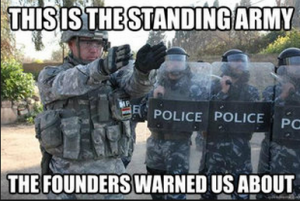
#ACAB: Why the Institution of Policing Makes All Cops Bastards

police-state-founders-warning

By PM Beers

Source: AntiMedia

All cops are bastards because all cops, if ordered to, will enforce laws that oppress poor people.

Many people would like to believe that there are good cops and bad cops. I’m going to explain why this is simply not true. When we are children, we are ingrained with the belief that police officers are good people who want to help us. Children are taught that if they need help, they should ask a police officer. These early beliefs are so deeply ingrained that it is very hard to shake them off. For me, it took over two years to finally understand the concept of ACAB—all cops really ARE bastards, even if they believe themselves to be good people.

When you learn the history of policing, you will better understand the need to dismantle the inherently racist institution. When we were new to the anti-police brutality movement, we all thought there were good cops and bad cops. As with most binary thinking, this is incorrect. All cops are indeed bastards as they blindly enforce laws which were written to oppress poor people, such as laws against feeding the homeless. The primary role of the first police departments was to catch runaway slaves. Racism is ingrained in policing. Racism is the root cause of police brutality.

There are no good cops. Laws and ethics are not the same thing. Laws don’t prevent crime from happening—people having their needs met does. One cannot be a good person and enforce unjust laws.

Someone once asked me, “But how is the statement ‘ALL cops are bastards’ any different from ‘ALL priests are pedophiles,’ or ‘All women are lousy drivers?’“ Another friend replied,  “Nobody is born a cop. Joining that institution is a choice. It’s more akin to saying ‘all KKK are bastards.” Priests are not required to molest children, but cops are required to follow orders which oppress poor people and target people of color.

Every cop must obey orders without question. They are required to enforce unethical laws or risk losing a job that provides them with a comfortable income if they refuse. In the rare occasion that a cop does blow the whistle on an injustice, the thin blue line is immediately invoked and the seemingly well-intentioned cops are ostracized by their peers, almost always neutralizing their intentions.

Some cops think they are actually good people. Of course, they have to think they are good to rationalize what they are doing since in our society, one’s occupation is one’s identity.

We all know that many cops have done horrible things. They have abused their power, murdered people, and attempted to cover up those murders with lies. I’m not going to talk about those obvious injustices that we are already so aware of. I’m going to talk about more subtle ways that cops do unethical things under the color of law. The job of the police is not to protect people but to protect corporate assets.

When a person becomes a police officer, their job is to enforce the laws. Not all laws are good. Police are unthinking, unquestioning robots protecting a corrupt, unjust state. They simply do as they are told without question. The institution of policing is inherently corrupt because they enforce laws which have nothing to do with ethics and everything to do with serving corporate interests.

If your job requires you to do unethical things and you continue to do that job for a paycheck, you have sold out and can no longer consider yourself an ethical person.  Every cop has sold their soul for a middle class income. Their price is low.

But wait…what about that one cop who bought groceries for a mom who stole food for her kids?

Yes, that cop did a good thing. That doesn’t erase the unethical things the cop does or would do if given the order. I like to call these types of news stories #copaganda because they are often played by mainstream media to try to get us to think that cops are good people, when in reality, the news stations want to appease police departments so that they can keep access to information for their news stories. TV news folks do unethical things for money, as well, and that’s a whole other rant for another day. If cops did these kinds of things on a daily basis, they wouldn’t be newsworthy. Cops are not as lovely as the TV would have us think they are.

When protests are held, police say they are there to make sure no one gets hurt. Yet on most occasions, they are the ones hurting protesters with batons, “less lethal” bullets, and tear gas.  Sometimes, undercover cops are placed into crowds and are sometimes suspected by protesters of being the ones agitating the police. They use actions, such as throwing bottles, in order to give the police an excuse to become violent with the protesters.

Police have to enforce other unjust laws, like the criminalization of the medical use a cannabis. Smoking cannabis harms no one and is a victimless crime. Is it even a crime at all? Filling up jails with pot smokers only has negative consequences on society, as taxpayers are burdened and people prosecuted for drug offenses often have a difficult time finding employment after being released from prison. Children also suffer under the burden of having one less parent to care for them. This lack of need fulfillment leads to more crime as children mature.

Further, according to the LAPD, all cars are now under investigation. License plate scanners mounted on police cars and on light poles track drivers all over Los Angeles. The ACLU and the Electronic Frontier Foundation are currently suing the LAPD to find out how the technology is being used.  There is no probable cause to collect such data, making this practice a violation of our civil rights.

Police enforce unjust laws that harass and criminalize people who have no home. Sleep is a primary human need like air, food, and water. Is it ethically permissible to wake someone up at six AM because the only place they can afford to sleep is the sidewalk? Would a good cop do that?

In the summer of 2012, I participated in a sleepful protest in downtown Los Angeles in support of rights for people who didn’t have homes. Every morning, Officer Massey would come honk his horn to wake us up at 6 AM.  He was baffled at why I would scream at him every morning. He thought he was a good cop. He had no clue that waking up unhoused people at 6 AM is an unethical thing to do. In his mind, he was just doing his job—just following orders. Officer Massey tried his best to be polite, but what he was doing was still wrong. Is he going to quit his job?  What other job is he even qualified to do that can  still provide him such a comfortable middle-class income?  He is not going to quit his job. Instead, he will rationalize in his mind that he is a good cop. He never once kicked an unhoused person, so isn’t he lovely?

The police are an inherently violent institution where force is used to extort money from poor people and property is stolen. The racism and bias against the oppressed and poor is pervasive. The entire institution is so corrupt and violent that participating in it makes one corrupt and violent by silent consent. It is impossible to be a good person and participate in violence and oppression.

For example, a person unable to pay $150 for a car registration will have that car stolen from them with the assistance of the police. The car will then be held for ransom. If the person who was too poor to pay the $150 can’t pay the ransom, then the car, which has a value of thousands of dollars, will be sold and the state will profit off of the backs of the poor. Anyone willingly accepting money from such an institution that extorts poor people is by default not a good person.

People want to believe they are good without challenging their false beliefs. There are no good cops. Ethical and legal are completely separate things—therefore, there are no good cops as they are required to enforce unethical laws.

Are there decent individuals that become cops? Of course. However, the institution of policing means police officers, by default, are oppressors by occupation—meaning there truly are no good active-duty cops.

What is the alternative to policing? Community policing by the people who live in the community is a viable solution. Further, the situation will be improved by legalizing victimless crimes, making sure everyone’s needs are met, and reducing income inequality.

A conscious cop would think about quitting, realize they are not qualified for any other job that pays anything even close to what they currently get, and would quickly adjust their thinking back into justifying what they are doing.

All cops oppress poor people and are therefore evil. All cops make threats of death and are therefore evil.

Dismantling the institution of policing does not mean anarchy in the context of chaos. The word “anarchy” is a beautiful thing when used in certain contexts where people understand what the word actually means.  For me, anarchy means equality, horizontalism, and no false authority. Communities can and should police themselves.


This article (#ACAB: Why the Institution of Policing Makes All Cops Bastards) is free and open source. You have permission to republish this article under a Creative Commons license with attribution to the author and theAntiMedia.org. Tune in! Anti-Media Radio airs Monday through Friday @ 11pm Eastern/8pm Pacific. Help us fix our typos:edits@theantimedia.org.

PM Beers joined Anti-Media as an independent journalist in April of 2014. Her topics of interest include mental illness, neurology, quantum physics, Tourette’s, Autism, compassionate parenting, horizontal democracy, activism, and art. Born in Long Beach, California, she currently resides in Los Angeles, California. Learn more about Beers here!

Indulge . . . & Undermine

Crimethinc._boat_logo

Source: CrimethInc.

Have you noticed—exhortations to indulge yourself are always followed by suggestions? Adherents of doctrines seek footholds to claim territory within you, salesmen grasp for handles to jerk you around . . . from new-age prophets to advertisers, from pornographers to radicals, everyone exhorts you to “pursue your desires,” but the question remains: which ones? The “real” ones? Who decides which those are?

This just makes it clear what’s going on: a war for your soul on every front. And those much talked-about desires are all constructed, anyway—they change, they’re dependent on external factors, culture, the whole context and history of our society. We “like” fast food because we have to hurry back to work, because processed supermarket food doesn’t taste much better, because the nuclear family—for those who still have even that—is too small and stressed to sustain much festivity in cooking and eating. We “have to” check our email because the dissolution of community has taken our friends and kindred far away, because our bosses would rather not have to talk to us, because “time-saving” technology has claimed the hours once used to write letters—and killed all the passenger pigeons, besides. We “want” to go to work because in this society no one looks out for those who don’t, because it’s hard to imagine more pleasurable ways to spend our time when everything around us is designed for commerce and consumption. Every craving we feel, every conception we form, is framed in the language of the civilization that creates us.

Does this mean we would want differently in a different world? Yes, but not because we would be free to feel our “natural” desires—no such things exist. Beyond the life you live, you have no “true” self—you are precisely what you do and think and feel. That’s the real tragedy about the life of the man who spends it talking on his cell phone and attending business seminars and fidgeting with the remote control: it’s not that he denies himself his dreams, necessarily, but that he makes them answer to reality rather than attempting the opposite. The accountant regarded with such pity by runaway teenage lovers may in fact be “happy”—but it is a different happiness than the one they experience on the lam.

If our desires are constructs, if we are indeed the products of our environment, then our freedom is measured by how much control of these environments we have. It’s nonsense to say a woman is free to feel however she wants about her body when she grows up surrounded by diet advertisements and posters of anorexic models. It’s nonsense to say a man is free when everything he needs to do to get food, shelter, success, and companionship is already established by his society, and all that remains is for him to choose between established options (bureaucrat or technician? bourgeois or bohemian? Democrat or Republican?). We must make our freedom by cutting holes in the fabric of this reality, by forging new realities which will, in turn, fashion us. Putting yourself in new situations constantly is the only way to ensure that you make your decisions unencumbered by the inertia of habit, custom, law, or prejudice—and it is up to you to create these situations. Freedom only exists in the moment of revolution.

And those moments are not as rare as you think. Change, revolutionary change, is going on constantly and everywhere—and everyone plays a part in it, consciously or not. “To be radical is simply to keep abreast of reality,” in the words of the old expatriate. The question is simply whether you take responsibility for your part in the ongoing transformation of the cosmos, acting deliberately and with a sense of your own power—or frame your actions as reactions, participating in unfolding events accidentally, randomly, involuntarily, as if you were purely a victim of circumstance.

If, as idealists like us insist, we can indeed create whatever world we want, then perhaps it’s true that we can adapt to any world, too. But the former is infinitely preferable. Choosing to spend your life in reaction and adaptation, hurrying to catch up to whatever is already happening, means being perpetually at the mercy of everything. That’s no way to go about pursuing your desires, whichever ones you choose.

So forget about whether “the” revolution will ever happen—the best reason to be a revolutionary is simply that it is a better way to live. It offers you a chance to lead a life that matters, gives you a relationship to injustice so you don’t have to deny your own grief and outrage, keeps you conscious of the give and take always going on between individual and institution, self and community, one and all. No institution can offer you freedom—but you can experience it in challenging and reinventing institutions. When school children make up their own words to the songs they are taught, when people show up by the tens of thousands to interfere with a closed-door meeting of expert economists discussing their lives, that’s what they’re up to: rediscovering that self-determination, like power, belongs only to the ones who exercise it.


Shout it over the rooftops: Culture can belong to us. We can make our own music, mythology, science, technology, tradition, psychology, literature, history, ethics, political power. Until we do, we’re stuck buying mass-produced movies and compact discs made by corporate mercenaries, sitting faceless and immobilized at arena rock performances and sports events, struggling with other people’s inventions and programs and theories that make less sense to us than sorcery did to our ancestors, shamefacedly accepting the judgments of priests and agony columnists and radio talk show hosts, berating ourselves for not living up to the standards set by college entrance exams and glamour magazines, listening to parents and counselors and psychiatrists and managers tell us we are the ones with the problems, buying our whole lives from the same specialists and entrepreneurs we sell them to—and gnashing our teeth in secret fury as they cut down the last trees and heroes with the cash and authority we give them. These things aren’t inevitable, inescapable tragedies—they’re consequences of the passivity to which we have relegated ourselves. In the checkout lines of supermarkets, on the dialing and receiving ends of 900 numbers, in the locker rooms before gym classes and cafeteria shifts, we long to be protagonists in our own epics, masters of our own fate.

If we are to transform ourselves, we must transform the world—but to begin reconstructing the world, we must reconstruct ourselves. Today all of us are occupied territory. Our appetites and attitudes and roles have all been molded by this world that turns us against ourselves and each other. How can we take and share control of our lives, and neither fear nor falter, when we’ve spent those lives being conditioned to do the opposite?

Whatever you do, don’t blame yourself for the fragments of the old order that remain within you. You can’t sever yourself from the chain of cause and effect that produced you—not with any amount of willpower. The trick is to find ways to indulge your programming that simultaneously subvert it—that create, in the process of satisfying those desires, conditions which foster new ones. If you need to follow leaders, find leaders who will depose themselves from the thrones in your head; if you need to “lead” others, find equals who will help you dethrone yourself; if you have to fight against others, find wars you can wage for everyone’s benefit. When it comes to dodging the imperatives of your conditioning, you’ll find that indulge and undermine is a far more effective program than the old heritage of “renounce and struggle” passed down from a humorless Christianity.

To return, finally, to the original question—yes, we too are making suggestions about which desires you pursue. We would be scoundrels to deny that! But we would be scoundrels not to make these suggestions, not to extol freedom and self-determination in a world that discourages them. Exhorting others to “think for themselves” is ironic—but today, refusing to oppose the propaganda of the missionaries and entrepreneurs and politicians simply means abandoning our society and species to their control. There’s no purity in silence. And liberty does not simply exist in the absence of control—it is something we have to make together. Taking responsibility for our part in the ongoing metamorphoses of the world means not being afraid to take part in the making of our society, influencing and being influenced as we do.

We make suggestions, we spread this propaganda of desire, because we hope by doing so to indulge our own programmed passion for propaganda in a way that undermines an order that discourages all of us from playing with our passions—and so to enter a world of total liberty and diversity, where propaganda and power struggles alike are obsolete. See you on the other side.

Related Video:

Don’t Worry – Everything is Not Under Control

dailyroutine

By Zen Gardner

Source: ZenGardner.com

What a farce. Telling everyone “everything is under control” is perhaps the most dulling and disempowering phrase ever uttered.

My fascination with language just keeps expanding. I love looking at expressions, words, colloquialisms, so-called “sayings” and the like with fresh awakened eyes. I can’t help it. The supposed, accepted and unconscious meanings of these imposed “expressions” are what direct our minds and turn our attention.

So much of what we’ve been handed down is contorted, manipulated and eventually nestled in the collective mindset to twist our hearts away from simple truth.

How many times has this expression been used to bring seeming comfort to someone; “Don’t worry, everything’s under control.” Really? What control? Who’s controlling what? And why?

So often this is used to imply some powerful force is behind everything directing what’s going on. Remind you of anything? Yes – religion, hierarchy, and social, political and economic so-called “controllers”. How debilitating can you get when it comes right down to it, playing on people’s insecurity and lack of conscious awareness?

“It’s under control” is comforting to people? It’s the picture of personal disempowerment!

External Control? Or Creative Freedom!

Sure, there is a wonderful creative Source we are all intrinsically part of, but it’s not “controlling” anything in a living, expanding Universe with beings of all sorts with free will and self determination in an alive multidimensional environment. If anything, this Creative impetus is tearing down control systems that attempt to foist themselves on its process, put there either by conscious intent or the manifestation of hardening mindsets in the social fabric.

Earth processes attest to this, as well as our spectacular expanding and ever changing Universe. Nature itself is alive with new sprouts of life in the animal, plant and mineral worlds, never mind other realms of existence.

Look at earthquakes and volcanoes, or the sun and astral influences. As much as some try to analyze or predict major events that affect earth that still brings no control, only a measure of preparedness on rare occasion. And that type of insecurity is good for us. It’s humbling and keeps us in check.

This process is what the awakening is all about!

While some earth changes may be exacerbated by human activity, the big stuff is way out of our control. Thankfully. That’s what makes life life, and also why the insane would-be captivators of humanity and its planet work so feverishly in their mad pursuits to try to control natural processes. Control is their yardstick and without it they have no temporal security or power, which to them equates some weird form of normalcy or equilibrium.

How upside down can you get.

Be it geoengineering our climate, genetically modifying the natural progression of life forms, or attempting to install artificial intelligence to run their soulless programs, these maniacs are desperate for control in every shape and form. Why? They cannot meld or harmonize with what’s natural since their psychopathic, demonic intentions have nothing to gain, all while the rest of us thrive on being part of the fantastic empowering natural processes of Creation Itself.

Therein lies the rub. Quite apparently we’re in a world of conflicts of interest. That’s our current playing field, if you will. Or won’t. It’s just the way it is.

Let Go Into Conscious Anarchy

I like the anarchy approach. Anarchy is an example of another twisted word. It’s doesn’t mean putting a society into deliberate chaotic destruction, it means living without hierarchical control mechanisms. Something most groomed humans are scared spitless of thanks to generations of social programming.

You mean to tell me if we didn’t have so-called “government” that everything would fall apart? Baloney. People are resourceful and essentially responsible, at least their inner nature is, that hasn’t been perverted by all of this programming to the contrary. That very dependence on external control systems is what the hierarchy is literally banking on which is why the repeated memes of fear of scarcity or personal security.

There’s plenty for everybody. All we need to do is work together locally and share with other communities in a range of sizes and distances. Real commerce in loving cooperation, not the regulated systems that have been foisted upon us. We’ve been weaned from personal responsibility into a system of statist dependence, like someone who’s stopped using their muscles and is dependent on some mass produced contraption for their mobility when there’s nothing wrong with them at all.

They just need to exercise their innate capabilities.

Just because people have become spiritually atrophied in large numbers doesn’t mean that’s the way it’s supposed to be. Exactly like waking up, it’s time to arise and use the magnificent body of capabilities we’ve all been given, and let go of these false crutches and systems of hierarchy and walk into life and live!

Epilogue

That false assurance that everything’s under control by external forces as if we individually have virtually none has got to go. Being comforting in times of stress and turmoil is one thing, but propping people up with some external dependence reinforcement is fundamentally wrong.

It’s time to be conscious – in our words, our thoughts and our actions.

It’s really not that difficult. The main thing you’ll confront is ignorant, unenlightened opposition from those who’ve grown deeply accustomed to this dependency programming, as if it’s some form of respect for the “great ones” who rule them.

It’s very deep and will take time to overcome for most. But remaining in that conscious space, no matter what ridicule or obstacles assail you, is the very solution we each are longing for.

It begins with each of us. Standing our ground and then moving forward in conscious, loving action.

Do it. Bravely. The time for humanity to arise is now.

Much love, be well, and fully empowered,

Zen

ZenGardner.com