If You Ever Start Trusting U.S. Businessmen, Remember Henry Ford

By Mickey Z.

Source: Dissident Voice

Henry Ford, the autocratic magnate who despised unions, tyrannized workers, and fired any employee caught driving a competitor’s model, was also an outspoken anti-Semite.

In 1918, he bought and ran a newspaper, The Dearborn Independent, that became an anti-Jewish forum. The May 22, 1920 headline blared, “The International Jew: The World’s Problem,” and thus began a series of ninety-two articles, including “The Jewish Associates of Benedict Arnold” and “The Gentle Art of Changing Jewish Names.”

By 1923, the Independent’s national circulation reached 500,000. Reprints of the articles were soon published in a four-volume set called The International Jew, which was translated into sixteen different languages.

The New York Times reported in 1922 that there was a widespread rumor circulating in Berlin claiming that Henry Ford was financing Adolf Hitler’s nationalist and anti-Semitic movement in Munich,” write James and Suzanne Pool in their book Who Financed Hitler. They add:

“Novelist Upton Sinclair wrote in The Flivver King, a book about Ford, that the Nazis got forty-thousand dollars from Ford to reprint anti-Jewish pamphlets in German translations, and that an additional $300,000 was later sent to Hitler through an intermediary.”

Ford’s plants in Germany adopted an Aryan-only hiring policy in 1935 before Nazi law required it. A year later, Ford fired Erich Diestel, manager of the automobile company’s German plants, simply because he had a Jewish ancestor.

An appreciative Adolf Hitler kept a large picture of the automobile pioneer beside his desk, explaining, “We look to Heinrich Ford as the leader of the growing Fascist movement in America.”

Hitler hoped to support such a movement by offering to import some shock troops to the U.S. to help Ford run for president.

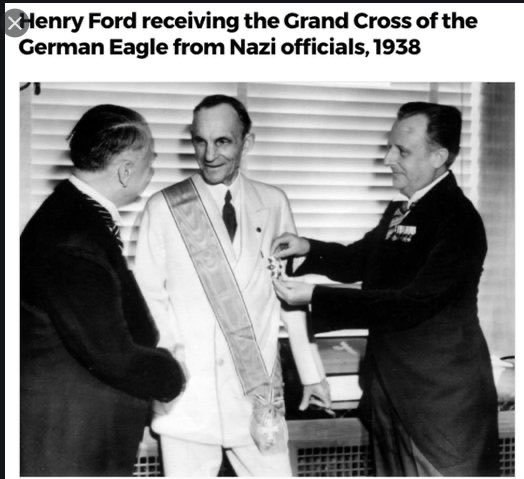
In 1938, on Henry Ford’s 75th birthday, he was awarded the Grand Cross of the Supreme Order of the German Eagle from the Führer himself.

He was the first American (General Motors’ James Mooney would be second) and only the fourth person in the world to receive the highest decoration that could be given to any non-German citizen. An earlier honoree was none other than a kindred spirit named Benito Mussolini.

When appraising history and today’s Titans of Capitalism™, keep your guard up…

Denying the Demonic

By Edward Curtin

Source: Behind the Curtain

In March of last year as the coronavirus panic was starting, I wrote a somewhat flippant article saying that the obsession with buying and hoarding toilet paper was the people’s vaccine.  My point was simple: excrement and death have long been associated in cultural history and in the Western imagination with the evil devil, Satan, the Lord of the underworld, the Trickster, the Grand Master who rules the pit of smelly death, the place below where bodies go.

The psychoanalytic literature is full of examples of death anxiety revealed in anal dreams of shit-filled overflowing toilets and people pissing in their pants.  Ernest Becker put it simply in The Denial of Death:

No mistake – the turd is mankind’s real threat because it reminds people of death.

The theological literature is also full of warnings about the devil’s wiles.  So too the Western classics from Aeschylus to Melville. The demonic has an ancient pedigree and has various names. Rational people tend to dismiss all this as superstitious nonsense.  This is hubris.  The Furies always exact their revenge when their existence is denied.  For they are part of ourselves, not alien beings, as the tragedy of human history has shown us time and again.

Since excremental visions and the fear of death haunt humans – the skull at the banquet as William James put it – the perfect symbol of protection is toilet paper that will keep you safe and clean and free of any reminder of the fear of death running through a panicked world.  It’s a magic trick of course, an unconscious way of thinking you are protecting yourself; a form of self-hypnosis.

One year later, magical thinking has taken a different form and my earlier flippancy has turned darker. You can’t hoard today’s toilet paper but you can get them: RNA inoculations, misnamed vaccines. People are lined up for them now as they are being told incessantly to “get your shot.”  They are worse than toilet paper. At least toilet paper serves a practical function.  Real vaccines, as the word’s etymology – Latin, vaccinus, from cows, the cowpox virus vaccine first used by British physician Edward Jenner in 1800 to prevent smallpox – involve the use of a small amount of a virus.  The RNA inoculations are not vaccines.  To say they are is bullshit and has nothing to do with cows. To call them vaccines is linguistic mind control.

These experimental inoculations do not prevent the vaccinated from getting infected with the “virus” nor do they prevent transmission of the alleged virus. When they were approved recently by the FDA that was made clear.  The FDA issued Emergency Use Authorizations (EUAs) for these inoculations only under the proviso that they may make an infection less severe.  Yet millions have obediently taken a shot that doesn’t do what they think it does.  What does that tell us?

Hundreds of millions of people have taken an injection that allows a bio-reactive “gene-therapy” molecule to be injected into their bodies because of fear, ignorance, and a refusal to consider that the people who are promoting this are evil and have ulterior motives.  Not that they mean well, but that they are evil and have evil intentions.  Does this sound too extreme?  Radically evil?  Come on!

So what drives the refusal to consider that demonic forces are at work with the corona crisis?

Why do the same people who get vaccinated believe that a PCR test that can’t, according to its inventor Kary Mullis, test for this so-called virus, believe in the fake numbers of positive “cases”?  Do these people even know if the virus has ever been isolated?

Such credulity is an act of faith, not science or confirmed fact.

Is it just the fear of death that drives such thinking?

Or is it something deeper than ignorance and propaganda that drives this incredulous belief?

If you want facts, I will not provide them here. Despite the good intentions of people who still think facts matter, I don’t think most people are persuaded by facts anymore. But such facts are readily available from excellent alternative media publications.  Global Research’s Michel Chossudovsky has released, free of charge, his comprehensive E-BookThe 2020-21 Worldwide Corona Crisis: Destroying Civil Society, Engineered Economic Depression, Global Coup D’Etat, and the “Great Reset.”  It’s a good place to start if facts and analysis are what you are after.  Or go to Robert Kennedy, Jr.’s Childrens Health Defense, Off-GuardianDissident VoiceGlobal Research, among numerous others.

Perhaps you think these sites are right-wing propaganda because many articles they publish can also be read or heard at some conservative media. If so, you need to start thinking rather than reacting. The entire mainstream political/media spectrum is right-wing, if you wish to use useless terms such as Left/Right.  I have spent my entire life being accused of being a left-wing nut, but now I am being told I am a right-wing nut even though my writing appears in many leftist publications. Perhaps my accusers don’t know which way the screw turns or the nut loosens.  Being uptight and frightened doesn’t help.

I am interested in asking why so many people can’t accept that radical evil is real.  Is that a right-wing question?  Of course not.  It’s a human question that has been asked down through the ages.

I do think we are today in the grip of radical evil, demonic forces. The refusal to see and accept this is not new.  As the eminent theologian, David Ray Griffin, has argued, the American Empire, with its quest for world domination and its long and ongoing slaughters at home and abroad, is clearly demonic; it is driven by the forces of death symbolized by Satan.

I have spent many years trying to understand why so many good people have refused to see and accept this and have needed to ply a middle course over many decades. The safe path. Believing in the benevolence of their rulers.  When I say radical evil, I mean it in the deepest spiritual sense.  A religious sense, if you prefer.  But by religious I don’t mean institutional religions since so many of the institutional religions are complicit in the evil.

It has long been easy for Americans to accept the demonic nature of foreign leaders such as Hitler, Stalin, or Mao.  Easy, also, to accept the government’s attribution of such names as the “new Hitler” to any foreign leader it wishes to kill and overthrow.  But to consider their own political leaders as demonic is near impossible.

So let me begin with a few reminders.

The U.S. destruction of Iraq and the mass killings of Iraqis under George W. Bush beginning in 2003.  Many will say it was illegal, unjust, carried out under false pretenses, etc.  But who will say it was pure evil?

Who will say that Barack Obama’s annihilation of Libya was radical evil?

Who will say the atomic destruction of Hiroshima and Nagasaki and the firebombing of Tokyo and so many Japanese cities that killed hundreds of thousands of innocent civilians was radical evil?

Who will say the U.S. war against Syria is demonic evil?

Who will say the killing of millions of Vietnamese was radical evil?

Who will say the insider attacks of September 11, 2001 were demonic evil?

Who will say slavery, the genocide of native people, the secret medical experiments on the vulnerable, the CIA mind control experiments, the coups engineered throughout the world resulting in the mass murder of millions – who will say these are evil in the deepest sense?

Who will say the U.S. security state’s assassinations of JFK, Malcolm X, MLK, Jr., Robert Kennedy, Fred Hampton, et al. were radical evil?

Who will say the trillions spent on nuclear weapons and the willingness to use them to annihilate the human race is not the ultimate in radical evil?

This list could extend down the page endlessly.  Only someone devoid of all historical sense could conclude that the U.S. has not been in the grip of demonic forces for a long time.

If you can do addition, you will find the totals staggering.  They are overwhelming in their implications.

But to accept this history as radically evil in intent and not just in its consequences are two different things.  I think so many find it so hard to admit that their leaders have intentionally done and do demonic deeds for two reasons.  First, to do so implicates those who have supported these people or have not opposed them. It means they have accepted such radical evil and bear responsibility.  It elicits feelings of guilt. Secondly, to believe that one’s own leaders are evil is next to impossible for many to accept because it suggests that the rational façade of society is a cover for sinister forces and that they live in a society of lies so vast they the best option is to make believe it just isn’t so.  Even when one can accept that evil deeds were committed in the past, even some perhaps intentionally, the tendency is to say “that was then, but things are different now.” Grasping the present when you are in it is not only difficult but often disturbing for it involves us.

So if I am correct and most Americans cannot accept that their leaders have intentionally done radically evil things, then it follows that to even consider questioning the intentions of the authorities regarding the current corona crisis needs to be self-censored.  Additionally, as we all know, the authorities have undertaken a vast censorship operation so people cannot hear dissenting voices of those who have now been officially branded as domestic terrorists. The self-censorship and the official work in tandem.

There is so much information available that shows that the authorities at the World Health Organization, the CDC, The World Economic Forum, Big Pharma, governments throughout the world, etc. have gamed this crisis beforehand, have manipulated the numbers, lied, have conducted a massive fear propaganda campaign via their media mouthpieces, have imposed cruel lockdowns that have further enriched the wealthiest and economically and psychologically devastated vast numbers, etc.  Little research is needed to see this, to understand that Big Pharma is, as Dr. Peter Gøtzsche documented eight years ago in Deadly Medicines and Organized Crime: How Big Pharma Has Corrupted Healthcare, a world-wide criminal enterprise.  It takes but a few minutes to see that the pharmaceutical companies who have been given emergency authorization for these untested experimental non-vaccine “vaccines” have paid out billions of dollars to settle criminal and civil allegations.

It is an open secret that the WHO, the Gates Foundation, the WEF led by Klaus Schwab, and an interlocking international group of conspirators have plans for what they call The Great Reset, a strategy to use  the COVID-19 crisis to push their agenda to create a world of cyborgs living in cyberspace where artificial intelligence replaces people and human biology is wedded to technology under the control of the elites.  They have made it very clear that there are too many people on this planet and billions must die.  Details are readily available of this open conspiracy to create a transhuman world.

Is this not radical evil?  Demonic?

Let me end with an analogy.  There is another organized crime outfit that can only be called demonic – The Central Intelligence Agency.  One of its legendary officers was James Jesus Angleton, chief of Counterintelligence from 1954 until 1975.  He was a close associate of Allen Dulles, the longest serving director of the CIA.  Both men were deeply involved in many evil deeds, including bringing Nazi doctors and scientists into the U.S. to do the CIA’s dirty work, including mind control, bioweapons research, etc.  The stuff they did for Hitler.  As reported by David Talbot in The Devil’s Chessboard: Allen Dulles, the CIA, and the Rise of America’s Secret Government, when the staunch Catholic Angleton was on his deathbed, he gave an interviews to visiting journalists, including Joseph Trento.  He confessed:

He had not been serving God, after all, when he followed Allen Dulles.  He had been on a satanic quest….’Fundamentally, the founding fathers of U.S. intelligence were liars,’ he told Trento in an emotionless voice.  ‘The better you lied and the more you betrayed, the more likely you would be promoted…. Outside this duplicity, the only thing they had in common was a desire for absolute power.  I did things that, looking back on my life, I regret.  But I was part of it and loved being in it.’  He invoked the names of the high eminences who had run the CIA in his day – Dulles, Helms, Wisner.  These men were ‘the grand masters,’ he said.  ‘If you were in a room with them, you were in a room full of people that you had to believe would deservedly end up in hell.’  Angleton took another slow sip from his steaming cup.  ‘I guess I will see them there soon.’

Until we recognize the demonic nature of the hell we are now in, we too will be lost.  We are fighting for our lives and the spiritual salvation of the world.  Do not succumb to the siren songs of these fathers of lies.

Resist.

Hiroshima Denial is Terror

By Finian Cunningham

Source: Information Clearing House

Those who deny history, or who are oblivious, are apt to repeat it. That is the frightening, perhaps most disturbing aspect of the 75th anniversary this week of the American atomic bombing of Hiroshima and Nagasaki.

The indiscriminate mass murder of 200,000 people on August 6 and 9, 1945, is beyond words in its horror and moral depravity. But what is equally condemning is the ostensible lack of remorse and the obfuscation to conceal the scale of such evil.

For if there were any remorse or realization about the crime there would surely be a commitment to never repeat it. The most solemn manifestation of commitment would be the pursuance of nuclear disarmament.

Seventy-five years on, yes, American news media run so-called commemorative articles on the historic events. However, there is a sense of glibness about the calamity, a sort of dull duty to mark the occasion as if it is a yearly chore of “regret”. There is also a sneaking awe at the destructive power unleashed on those Japanese cities, as well as the usual inclusion of official justification about how US leaders at the time were allegedly motivated by ending the Pacific War quickly. There are even in some media coverage brief mentions of acknowledgement that the dropping of the A-bombs was “unnecessary”.

But it’s all delivered in an insidious way to obscure the shocking, barbaric truth that the United States dropped weapons of mass destruction on civilians. How about going further and acknowledging it was a deliberate act of mass terror for political purpose to establish American hegemony in the postwar order?

No proper humane or moral lessons, it seems, have been drawn about the genocide that took place at Hiroshima and Nagasaki. Neither by the people in US government and media establishments nor, lamentably, by the wider American population. If lessons were truly learned then there would be a sense of revulsion and outrage demanding immediate nuclear disarmament and the end to all war machinery.

Just last month, the US Congress passed an annual military budget of $740 billion, including for the development of weapons of mass destruction. This is while 30 million American workers and their families are suffering from unemployment and deprivation due to the coronavirus pandemic and the government shutting off pittance welfare payments.

The anniversary of Hiroshima and Nagasaki comes as the Trump administration issues ever-more provocative slander against China over the pandemic and other matters that are really not Washington’s business nor remit, especially the subjects of alleged human rights violations or government espionage against citizens.

Washington continues to provoke both Russia and China with ever-expanding plans to deploy intermediate-range missiles near their territories. This only one year after Washington scrapped the Intermediate-range Nuclear Forces (INF) treaty with Moscow.

It is the US side which is threatening to collapse the New START accord, the last-remaining nuclear arms-control treaty with Moscow.

It is the US side which is pushing recklessly ahead with weaponizing outer space while falsely, cynically, accusing Russia and China of doing so, even though the latter have both repeatedly called for a United Nations-backed moratorium on militarizing this domain.

It is the US side which reserves the unilateral “right to first nuclear strike” while Russia and China have declared to only use such weapons as defensive response to attack.

The militarization by Washington and its bellicose policies towards Moscow and Beijing are proof that the criminality of Hiroshima and Nagasaki has never been accounted for.

The criminality of that genocide remains unacknowledged and ignored by the US ruling system because, evidently, it wants to use that horror as a psychological weapon against others. The psychological weapon being: “We did it before, and we can do it again”. The ultimate “terror card” was played and continues to be played, albeit tacitly.

Contemporary developments and indicators of geopolitical tensions with China and Russia show that Washington is not willing or indeed capable of engaging for mutual peace. It is hellbent on stoking cold war confrontation, even if that confrontation results in hot war. A war with Russia or China would inevitably escalate into a catastrophic nuclear end.

On August 6 and 9, 1945, 75 years ago, the world witnessed two cities despatched to the hell of nuclear annihilation. It is utterly shameful that the nation that perpetrated such an absolute crime remains unapologetic and in denial. But more than that, it is utterly nefarious because the unapologetic logic means it could happen again.

COVID-19 and the CIA’s Biological Warfare on Cuba

By Timothy Alexander Guzman

Source: Silent Crow News

Maybe it was a plan that went horribly wrong, something they could no longer control. Was the Corona virus or COVID-19 spread intentionally? What if this virus was used against China as a weapon of choice to destabilize China’s economy and push back against China’s growing influence? We don’t know for sure, but it is possible. Investigations are ongoing. Nothing has not been confirmed. But what has been confirmed is what history has taught us given the facts on how the use of biological warfare for various purposes, against many peoples and nations has been happening for some time. One of the most well-known incidents of biological warfare occurred in 1763, the British Empire had planned and successfully managed to spread smallpox virus to the Native Americans during the Pontiac Rebellion in Pennsylvania. Chief Pontiac of the Ottowa launched an attack on Fort Detroit, a British military base. Other nations joined the rebellion including the Senecas, the Hurons, Delawares, and Miamis. As the war raged, an Indian delegation asked the British to surrender, but they refused, however, the British offered gifts including food, alcohol and material items that included two blankets and a handkerchief from people who had smallpox. Although the American Indians had experienced the disease in the past, the idea was to spread the disease among the Native American populations in an attempt to push back the rebellion or to defeat it once and for all. Another example of biological warfare was when Imperial Japan before and during World War II had a bio-weapons program that managed to drop numerous bombs on a number of Chinese cities from airplanes killing an estimated 580,000 Chinese people with bombs that were made of infected fleas, some even contained cholera and shigella during the Sino-Japanese war between the 1930′s and 1940′s.

In 1981, the CIA with help from U.S. military had launched an operation against Cuba by unleashing a strain of Dengue Fever also known as “hemorrhagic fever’ effecting more than 273,000 people killing 158 including 101 children. On September 6, 1981, The New York Times reported on Fidel Castro’s comments regarding the U.S. government in particularly, blaming the CIA for the outbreak when he said that ”we urge the United States Government to define its policy in this field, to say whether the C.I.A. will or will not be authorized again- or has already been authorized – to organize attacks against leaders of the revolution and to use plagues against our plants, our animals and our people.” The report said that the “epidemic of dengue fever that has made 340,000 people ill and has killed about 150″ but the State Department under-then President Ronald Reagan stated that “Mr. Castro’s charges of possible United States involvement in the epidemic were ”totally without foundation.” The State department quickly blamed the Castro’s revolution as a failure:

The Cuban Government has always tried to blame the United States for its failures and its internal problems,” the department said. ”The Cuban revolution is a failure, and it is obviously easier to blame external forces like the United States than to admit those failures

Dr, Ronald St. John, chief of communicable diseases for the Pan American Health Organization was interviewed by the New York Times said that “for the first time, so-called dengue-2 spread to Cuba.” Dr. St. John claimed that it is common in Southeast Asia and that it produces “the same symptoms as the other three” and that ”if you get a wave of dengue-1, dengue-3 or dengue-4 and then another wave of type 2, this is a bad combination.” Dengue-2 causes you too loose body fluids causing shocks that can lead to eventually death. Convenient for the CIA who saw it as an opportunity to cause panic on Cuba which is located in one of the most hot and humid regions in the world. However, The New York Times managed to downplay Cuba’s accusation’s by ending the story by blaming the spread of the disease on returning Cuban troops from Africa and other people from other parts of the Caribbean who might have brought Dengue fever into Cuba:

Some State Department officials believe the introduction of dengue-2 into Cuba is a result of the return to Cuba of troops who had been stationed in Angola or elsewhere in Africa, where the strain is found. But Dr. St. John said dengue-2 had been found in other parts of the Caribbean and might have been carried to Cuba from there or elsewhere overseas

Reports suggested that Cuba had a very small number of cases in 1944, and again in 1977. The 1981 outbreak was blamed on covert flyover operations conducted by the CIA with military owned airplanes, you know, the same airplanes that were most probably used against Nicaragua’s Sandinistas to transport weapons and other materials to the Contras around the same time. Since the 20th century, the U.S. has been the leader in developing various biological and chemical weapons through the U.S. Army’s Biological Warfare Laboratories based at Fort Detrick, Maryland since the late 1940′s, around the start of the Cold War. The U.S. biological warfare program that supposedly ended in 1969 developed a handful of biological weapons ready for use including anthrax, Q-fever and botulism and conducted research in hopes of weaponizing diseases including smallpox, Hantavirus, Lassa fever, yellow fever, typhus, dengue fever and the bird flu among them. An article from August 6, 2019 on Fort Detrick from the UK’s ‘The Independent’ titled ‘Research into deadly viruses and biological weapons at US army lab shut down over fears they could escape’ last August. Ironically, Secretary of State and Neocon Mike Pompeo called it the “Wuhan virus” since they blame China for the outbreak, but it seems that the U.S. had its own problems when it comes to their own labs who conduct research with the most deadly viruses:

America’s main biological warfare lab has been ordered to stop all research into the deadliest viruses and pathogens over fears contaminated waste could leak out of the facility. Fort Detrick, in Maryland, has been the epicentre of the US Army’s bioweapons research since the beginning of the Cold War. But last month the Centers for Disease Control and Prevention (CDC) – the government’s public health body – stripped the base of its license to handle highly restricted “select agents”, which includes Ebola, smallpox and anthrax

The story was basically about the CDC who inspected Fort Detrick and found problems with new procedures used to decontaminate waste water. The article says that Fort Detrick continued its research for defensive purposes to “protect the warfighter from biological threats” although the U.S. declared that it abandoned their biological weapons program since 1969:

Although the United States officially abandoned its biological weapons programme in 1969, Fort Detrick has continued defensive research into deadly pathogens on the list of “select agents”, including the Ebola virus, the organisms that cause the plague, and the highly toxic poison ricin. The army’s Medical Research Institute of Infectious Diseases, based at Fort Detrick, says its primary mission today is to “protect the warfighter from biological threats” but its scientists also investigate outbreaks of disease among civilians and other threats to public health. In recent years it has been involved in testing possible vaccines for Ebola, after several epidemics of the deadly virus in Africa 

Sooner or later, the truth will come out. I believe that the U.S. government knows how COVID-19 began and where it was going. The U.S. government and major corporate arms manufacturers and the rest of the Military-Industrial Complex is no stranger to biological weapons adding to their arsenal of nuclear and chemical weapons at their disposal which makes them, much more dangerous. The truth about COVID-19 will eventually come out. In the meantime, as the COVID-19 pandemic continues, a war against Russia, China, Iran or Venezuela is in the works and a coming economic crisis with an election coming this November seems like 2020 will be the year of a perfect storm.

The Lonely American

By Sean Posey

Source: The Hampton Institute

In 2015, psychotherapist Traci Ruble started a “community listening project” in San Francisco dubbed “Sidewalk Talk.” The project sends trained volunteers to meet strangers on the street and listen to them discuss their problems and concerns. In a promotional video, Ruble is shown with her fellow volunteers, asking people if they’d like to sit for a talk. “You want to be listened to? It feels good!” Sidewalk Talk has apparently caught on and is now in 29 cities across the country.

Are there large numbers of Americans so bereft of friends and confidants that they have only strangers in the street to confide in? There apparently are. New studies are showing that Americans are increasingly lonely, isolated, and unhappy. Unmoored from one another and from a (fading) sense of community. More and more of our fellow citizens are going through life alone. This has devastating consequences for individual health and portends a troubled future for the American experiment.

According to a recent Cigna study involving 20,000 adults, loneliness in America has reached “epidemic proportions.” “Most Americans,” the report states, “are now considered lonely.” When asked how often they feel like no one knows them well, 54 percent responded that they sometimes or always feel that way. Nearly half of respondents report feeling sometimes or always alone. The numbers are even more disturbing when broken down:

“We also see that roughly one in four respondents rarely/never feel as though there are people who really understand them (27%), that they belong to a group of friends (27%), can find companionship when they want it (24%), or again feel as though they have a lot in common with others (25%).” Only 53 percent of American have daily “meaningful in-person social interactions,” according to Cigna.

Loneliness and social isolation, both “actual and perceived,” have direct consequences on one’s health, according to a 2015 study published in the journal Perspectives on Psychological Science. The effects of loneliness on mortality are the equivalent of smoking 15 cigarettes a day, which makes prolonged loneliness a bigger individual health risk than obesity.

Loneliness is also connected, perhaps not surprisingly, to mental disorders. According to the National Institute of Mental Health , nearly one in five adults have a mental health condition. Mental health issues are now one of the fastest growing causes of long-term absences from work. More disturbing still is the connection between loneliness and suicide, which recently hit a 30-year high in America. Even the opioid crisis, a main contributor to the country’s declining life expectancy, has been connected to the loneliness epidemic. These deaths are increasingly classified by researchers and the media as “deaths of despair.”

The World Happiness Report 2017, compiled by a group of independent experts for the United Nations, recently delivered even more bad news for Americans. The introduction to the report (written by John F. Helliwell, Richard Layard, and Jeffrey Sachs) states “Happiness is increasingly considered the proper measure of social progress and the goal of public policy.”

The top countries on the list rank highly on six key factors, the report explains: “healthy years of life expectancy, social support (as measured by having someone to count on in times of trouble), trust (as measured by a perceived absence of corruption in government and business), perceived freedom to make life decisions, and generosity (as measured by recent donations).” Norway, Denmark, Iceland, and Switzerland are the happiest nations. The US, on the other hand, finished in 19th place. Rising levels of corruption and “declining social support” are listed among the primary reasons for America’s dismal placing.

While the phenomena of decreasing happiness and increasing loneliness are finally getting notice, much of the blame is often placed on recent developments in the country’s history, including the rise of neoliberalism (understandable) and the election of Donald Trump as president (equally understandable). However, historical roots and recent developments alike seem to constitute important elements of the country’s failure to develop a meaningful sense of community and attachment among its citizenry.

American culture is often described – rightly – as highly individualistic. Despite the Puritans and their quest for ” a city upon a hill,” as John Winthrop so memorably put it, the first immigrants to the New World often arrived seeking material, not spiritual, prosperity. “Even in the sixteenth century,” writes historian Leo Marx, “the American countryside was the object of something like a calculated real estate promotion.” This was a “business civilization,” as historian Morris Berman refers to it (something Calvin Coolidge echoed during the 1920s when he said, “The business of America is business”).

The peerless observer Alexis de Tocqueville saw this during his travels through the country in 1831. While de Tocqueville admired much of the American character, he understood the downside of the relentless individualism that permeated every aspect of social and cultural life: “They owe nothing to any man, they expect nothing from any man; they acquire the habits of always considering themselves as standing alone, and they apt to imagine that their whole destiny is in their hands.”

Americans proved to be relentless seekers; first moving beyond the Royal Proclamation line that the British issued to separate their colonies from Indian lands; and then, finally, fulfilling “Manifest Destiny” and closing the frontier in the 19th century. The existence of the frontier in American life nurtured a “dominant individualism,” according to historian Frederick Jackson Turner – one that failed to disappear with the frontier itself.

War, however, proved to be a force for increasing civic mindedness, and it provided a boon for voluntary associations – trends that no doubt helped combat the social isolation which certainly accompanied the settling of the country. According to historian Theda Skocpol, the five largest civic associations of the late 19th and early 20th centuries formed between 1864 and 1868.

Robert Putnam found similar evidence for an increase in civic mindedness among the generation shaped by World War II. In the seminal book Bowling Alone: The Collapse and Revival of American Community, Putnam calls the generation that fought the war the “long civic generation,” also known as the “Greatest Generation.” According to the Cigna study, they’re the generation least affected by the epidemic of loneliness. On the other hand, Generation Z (those born between 1995 and 2010) reported the highest levels of loneliness. The civic connectedness and civic mindedness of the Greatest Generation simply did not last. “The [generational] changes are probably part of a larger societal shift toward individual and material values and away from communal values,” Putnam writes in Bowling Alone.

There’s evidence to support his assertion. In Bowling Alone, Putnam cites a Roper study from 1972 that asked adults to identify essential elements of “the good life.” Approximately 38 percent chose “a lot of money,” but an equal percentage chose “a job that contributes to the welfare of society.” By 1996, the percentage of people who chose making a lot of money had risen to 63 percent. According to current research, 71 percent of millennials place a similar emphasis on making money.

But much like other Americans, outcomes for the wealthy compare poorly to those of their peers in other countries. For example, according to a 2007 study in the Journal of the American Psychological Association, the “richest, healthiest Americans” are as a sick as the poorest citizens in Britain. What’s the reason? The study’s author, Sir Michael Marmot of University College London Medical School, gives two reasons: Americans worker longer hours, are more stressed than their counterparts in other wealthy democracies, and Americans are apparently more likely to feel “friendless and isolated.”

This pervading sense of loneliness and disconnection, while felt particularly by the young, cuts across class, gender and race, according to Cigna. The rise of social media is sometimes blamed for an increase in feelings of loneliness and isolation, but its use did not figure as a major cause of loneliness in the study.

For much of the past century, some American artists and intellectuals have pointed fingers at the country’s culture – or what passes for culture – as being at the root of societal anomie. In 1950, playwright and novelist Thornton Wilder stated that a lack of a codification of ideals was making American life difficult to process. Americans, he said, were always on the move – a “very un-European” manner of life.

Famed sociologist Philip Slater delivered perhaps one of the most pointed critiques of American life in his 1970 book, The Pursuit of Loneliness. He declared the human desire for engagement, community, and yes, dependence, were frustrated at every turn by American life. “Americans have created a society in which they are automatic nobodies,” he writes, “since no one has any stable place or enduring connection.”

And it hasn’t only been liberals who have echoed such criticisms. Michael Hendrix writes in the National Review, “Americans conceive of themselves as individuals isolated from others in such a way that it becomes an imperative for them to form their own meaning for their own lives.” Clearly, many Americans aren’t forming a meaning for their own lives, at least not alone. The dismal statistics tell us as much. But as we have seen – with some exceptions – this is a problem as old as America itself. A country where individuals are adrift and leading lives without meaningful, connective and nourishing attachments is a country with a grim future indeed. And the problem is now accelerating, as levels of loneliness and disconnection rise among the millennials and Generation Z.

How will the country solve its most vexing problems when Americans are no longer capable of holding onto even the most elementary attachments to one another and their surrounding communities? We might find out, too late, that a society of atomized individuals is no society at all.

The Forgotten Legacy of George H.W. Bush That the Media Won’t Tell You About

By John Liberty

Source: The Mind Unleashed

On Friday November 30th, former President George H.W. Bush passed away at the age of ninety four, according to a statement released by his friends and family.

While the establishment celebrates the life of the former president and Americans line up to mourn their fallen leader, the facts that are being reported in the mainstream media are far different than the legacy he is leaving behind.

The Early Years

George Herbert Walker Bush was born on June 12, 1924 in Massachusetts to Prescott Sheldon Bush and Dorothy (Walker) Bush. Shortly after his birth, the family moved to Connecticut where he began his formal education at Greenwich Country Day School. At the age of eighteen, Bush joined the U.S. Navy.

During his tenure in the Navy, Bush was stationed with Torpedo Squadron 51 aboard the USS San Jacinto. On August 1, 1944 his unit launched an operation against the Japanese in the Bonin Islands. On September 2, 1944, Bush’s aircraft was downed leading to the death of eight Navy airmen, leaving Bush as the lone survivor. The episode later became known as the Chichijima incident and led to the future president being hailed as a war hero.

Political Career

Upon graduating from Yale, Bush began his career in politics and was elected chairman of the Harris County, Texas Republican Party in 1963. Three years later, Bush was elected to the US House of Representatives, marking the beginning of a meteoric rise which resulted in him being named director of the Central Intelligence Agency in 1976.

While Bush served less than a year as the head of the CIA, he was caught destroying evidence of US war crimes. As reported by MuckRock,

“Declassified records recently unearthed in CREST show the CIA waffled on a promise to obey the law in destroying records of Agency’s illegal activities and wrongdoing.”

Four years after serving as the director of the CIA, George H.W. Bush was elected as the 43rd Vice President of the United States. Serving under former President Ronald Reagan, Bush kept a low profile and avoided making any key policy decisions or criticisms of the Reagan administration, but attended a large number of ceremonies and public events.

In 1988, Bush was elected president defeating Michael Dukakis of Massachusetts. Within his first year in office, Bush’s approval ratings began to slip due to his inability to deal with Panamanian leader Manuel Noriega. Bush responded by deciding to invade Panama, and on December 20,1989 he deployed 25,000 troops to the tiny nation. Bush justified the invasion— code named operation just cause— on the grounds of national security. The president mislead the country by claiming Noriega had threatened the US, a claim which turned out to be untrue. After two weeks the conflict ended, resulting in the deaths of twenty American soldiers and as many as 2,000 Panamanians.

Less than a year after the invasion of Panama, Bush once again found himself responding to another foreign policy debacle. On August 2, 1990 Iraqi leader Saddam Hussein began an invasion of nearby Kuwait. In response, President Bush and the American media used the testimony of a 15-year-old Kuwaiti girl, known only by her first name of Nayirah to justify US intervention in Kuwait. However, Nayirah was later discovered to be the daughter of a U.S. ambassador, who was being coaxed by military psychological operations specialists.

In 1991, Bush gave his infamous ‘New World Order’ speech, which many people believe signaled the beginning of the PNAC plan also known as the Project For a New American Century.

Life After Politics

After leaving office in 1993, George H.W. Bush retired with his wife Barbara and built a home in a community near Houston, Texas.  Though retired, the former president would still face controversy. Last year, during the height of the #MeToo movement, at least five women women claimed they were abused by the former president. In an interview with Time Magazine, a woman named Roslyn Corrigan claimed Bush sexually assaulted her in 2003 when she was only 16-years-old. At least five more women have accused Bush of sexual assault, including an unnamed Michigan woman who came forward claiming the former president groped her in 1992 at a campaign event. Actress Heather Lind also stated, in a now deleted Instagram post, that Bush groped her during a photo-op in 2014.

Perhaps, instead of blindly praising a documented criminal, Americans should consider asking themselves what other crimes the US government and the media are covering up for the former president.

THE IMPORTANCE OF ALTERNATIVE MEDIA

By John Scales Avery

Source: Blacklisted News

The superficiality of today’s television

Social critic Neil Postman contrasted the futures predicted in Nineteen Eighty-Four and Brave New World in the foreword of his 1985 book “Amusing Ourselves to Death”.

He wrote:

“What Orwell feared were those who would ban books. What Huxley feared was that there would be no reason to ban a book, for there would be no one who wanted to read one. Orwell feared those who would deprive us of information. Huxley feared those who would give us so much that we would be reduced to passivity and egotism. Orwell feared that the truth would be concealed from us. Huxley feared the truth would be drowned in a sea of irrelevance.”

Neil Postman’s book, “Amusing Ourselves To Death; or Public Discourse in an Age of Show Business” (1985), had its origins at the Frankfurt Book Fair, where Postman was invited to join a panel discussing George Orwell’s “Nineteen Eighty-Four”. Postman said that our present situation was better predicted by Huxley’s “Brave New World”. Today, he maintained it is not fear that bars us from truth. Instead, truth is drowned in distractions and the pursuit of pleasure, by the public’s addiction to amusement.

Postman sees television as the modern equivalent of Huxley’s pleasure-inducing drug, soma, and he maintains that that television, as a medium, is intrinsically superficial and unable to discuss serious issues. Looking at television as it is today, one must agree with him.

The wealth and power of the establishment

The media are a battleground where reformers struggle for attention, but are defeated with great regularity by the wealth and power of the establishment. This is a tragedy because today there is an urgent need to make public opinion aware of the serious problems facing civilization, and the steps that are needed to solve these problems. The mass media could potentially be a great force for public education, but in general their role is not only unhelpful – it is often negative. War and conflict are blatantly advertised by television and newspapers.

Newspapers and war

There is a true story about the powerful newspaper owner William Randolph Hearst that illustrates the relationship between the mass media and the institution of war: When an explosion sank the American warship USS Maine in the harbor of Havana, Hearst anticipated (and desired) that the incident would lead to war between the United States and Spain. He therefore sent his best illustrator, Fredrick Remington, to Havana to produce drawings of the scene. After a few days in Havana, Remington cabled to Hearst, “All’s quiet here. There will be no war.” Hearst cabled back, “You supply the pictures. I’ll supply the war.” Hearst was true to his words. His newspapers inflamed American public opinion to such an extent that the Spanish-American War became inevitable. During the course of the war, Hearst sold many newspapers, and Remington many drawings. From this story one might almost conclude that newspapers thrive on war, while war thrives on newspapers.

Before the advent of widely-read newspapers, European wars tended to be fought by mercenary soldiers, recruited from the lowest ranks of society, and motivated by financial considerations. The emotions of the population were not aroused by such limited and decorous wars. However, the French Revolution and the power of newspapers changed this situation, and war became a total phenomenon that involved emotions. The media were able to mobilize on a huge scale the communal defense mechanism that Konrad Lorenz called “militant enthusiasm” – self-sacrifice for the defense of the tribe. It did not escape the notice of politicians that control of the media is the key to political power in the modern world. For example, Hitler was extremely conscious of the force of propaganda, and it became one of his favorite instruments for exerting power.

With the advent of radio and television, the influence of the mass media became still greater. Today, state-controlled or money-controlled newspapers, radio and television are widely used by the power elite to manipulate public opinion. This is true in most countries of the world, even in those that pride themselves on allowing freedom of speech. For example, during the US-led invasion of Iraq in 2003, the official version of events was broadcast by CNN, and criticism of the invasion was almost absent from their transmissions.

The mass media and our present crisis

Today we are faced with the task of creating a new global ethic in which loyalty to family, religion and nation will be supplemented by a higher loyalty to humanity as a whole. In case of conflicts, loyalty to humanity as a whole must take precedence. In addition, our present culture of violence must be replaced by a culture of peace. To achieve these essential goals, we urgently need the cooperation of the mass media.

The predicament of humanity today has been called “a race between education and catastrophe”: Human emotions have not changed much during the last 40,000 years. Human nature still contains an element of tribalism to which nationalistic politicians successfully appeal. The completely sovereign nation-state is still the basis of our global political system. The danger in this situation is due to the fact that modern science has given the human race incredibly destructive weapons. Because of these weapons, the tribal tendencies in human nature and the politically fragmented structure of our world have both become dangerous anachronisms.

After the tragedies of Hiroshima and Nagasaki, Albert Einstein said, “The unleashed power of the atom has changed everything except our way of thinking, and thus we drift towards unparalleled catastrophes.” We have to learn to think in a new way. Will we learn this in time to prevent disaster? When we consider the almost miraculous power of our modern electronic media, we can be optimistic. Cannot our marvelous global communication network be used to change anachronistic ways of thought and anachronistic social and political institutions in time, so that the system will not self-destruct as science and technology revolutionize our world? If they were properly used, our instantaneous global communications could give us hope.

The success of our species is built on cultural evolution, the central element of which is cooperation. Thus human nature has two sides, tribal emotions are present, but they are balanced by the human genius for cooperation. The case of Scandinavia – once war-torn, now cooperative – shows that education is able to bring out either the kind and cooperative side of human nature, or the xenophobic and violent side. Which of these shall it be? It is up to our educational systems to decide, and the mass media are an extremely important part of education. Hence the great responsibility that is now in the hands of the media.

How do the mass media fulfill this life-or-death responsibility? Do they give us insight? No, they give us pop music. Do they give us an understanding of the sweep of evolution and history? No, they give us sport. Do they give us an understanding of need for strengthening the United Nations, and the ways that it could be strengthened? No, they give us sitcoms and soap operas. Do they give us unbiased news? No, they give us news that has been edited to conform with the interests of the military-industrial complex and other powerful lobbies. Do they present us with the need for a just system of international law that acts on individuals? On the whole, the subject is neglected. Do they tell of of the essentially genocidal nature of nuclear weapons, and the urgent need for their complete abolition? No, they give us programs about gardening and making food.

A consumer who subscribes to the “package” of broadcasts sold by a cable company can often search through all 100 or so channels without finding a single program that offers insight into the various problems that are facing the world today. What the viewer finds instead is a mixture of pro-establishment propaganda and entertainment. Meanwhile the neglected global problems are becoming progressively more severe. In general, the mass media behave as though their role is to prevent the peoples of the world from joining hands and working to change the world and to save it from thermonuclear and environmental catastrophes. The television viewer sits slumped in a chair, passive, isolated, disempowered and stupefied. The future of the world hangs in the balance, the fate of children and grandchildren hang in the balance, but the television viewer feels no impulse to work actively to change the world or to save it. The Roman emperors gave their people bread and circuses to numb them into political inactivity. The modern mass media seem to be playing a similar role.

Our duty to future generations

The future of human civilization is endangered both by the threat of thermonuclear war and by the threat of catastrophic climate change. It is not only humans that are threatened, but also the other organisms with which we share the gift of life. We must also consider the threat of a global famine of extremely large proportions, when the end of the fossil fuel era, combined with the effects of climate change, reduce our ability to support a growing global population.

We live at a critical moment of history. Our duty to future generations is clear: We must achieve a steady-state economic system. We must restore democracy in our own countries when it has been replaced by oligarchy. We must decrease economic inequality both between nations and within nations. We must break the power of corporate greed. We must leave fossil fuels in the ground. We must stabilize and ultimately reduce the global population. We must eliminate the institution of war; and we must develop new ethics to match our advanced technology, ethics in which narrow selfishness, short-sightedness and nationalism will be replaced by loyalty to humanity as a whole, combined with respect for nature.

Inaction is not an option. We have to act with courage and dedication, even if the odds are against success, because the stakes are so high.

The mass media could mobilize us to action, but they have failed in their duty.

Our educational systems could also wake us up and make us act, but they too has failed us. The battle to save the earth from human greed and folly has to be fought in the alternative media.

The alternative media, and all who work with them deserve both our gratitude and our financial support. They alone, can correct the distorted and incomplete picture of the world that we obtain from the mass media. They alone can show us the path to a future in which our children, grandchildren, and all future generations can survive.


A book discussing the importance of alternative media can be freely downloaded and circulated from this address:

http://eacpe.org/app/wp-content/uploads/2018/10/Searching-for-truth-by-John-Scales-Avery.pdf

More freely downloadable books and articles on  other global problems can be found on the following link:

http://eacpe.org/about-john-scales-avery/

The U.S. is ruled by the worst among us

By Carla Binion

Source: Intrepid Report

Is it possible for the human race to evolve beyond war, extreme income inequality, corporate money’s control of political systems, and other anti-democratic trends? Some people say even hoping for such evolution is too idealistic, even impossible. Others have said if humanity doesn’t evolve it will soon self-destruct. Martin Luther King once said society has to begin to either “love or perish.”

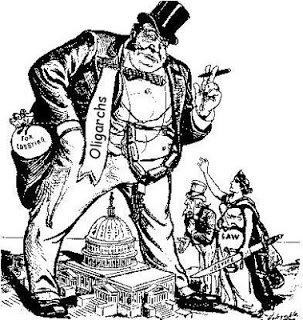
The U.S. today is rapidly becoming more an oligarchy than a democratic republic, and this oligarchy is polluting the environment, siphoning money from the poor and middle class, and dismantling civil liberties and democracy at an ever-accelerating pace. This trend won’t end well.

As our politicians hurtle downhill, the U.S. will experience many disasters and an eventual fatal crash. Many citizens feel their corrupt politicians of both major parties have taken so much power that the people can’t possibly play a significant role in improving the U.S. political system today.

Ordinary Americans often say we oppose our government’s perpetual wars, regressive tax system, extreme income inequality and other ills, but many say it would be impossible to reform the present system. I think meaningful change is possible based on what history has shown us.

The world has always included people who think it’s possible for the human race to evolve and others who say fundamental change isn’t possible. We’ve always had war and greedy politicians. Still, in some parts of the world at given moments in time, human beings have taken sudden leaps and left behind certain inhumane practices. If that weren’t true, we’d still have rampant blood sacrifices, witch burning and the same widespread use of slavery in the same areas of the world where they once existed.

Today some populations still practice those things, but many have evolved beyond them. The changes that happened started with a sort of “tipping point” where enough people acknowledged that a social ill such as slavery should end.

The more enlightened views, anti-slavery, anti witch-burning, etc., picked up speed, and the public took action to move beyond the old way. In a sense, the condoning of slavery, etc., became obsolete and unthinkably cruel. There is no reason to cling to the belief that the U.S. today can’t make perpetual illegal war and other egregious political abuses obsolete.

During the 1860s in the U.S. more and more people began to acknowledge slavery was unacceptable and started to challenge the power structure. Once the public conscience was awakened, people organized abolitionist groups, created the Underground Railroad, and spoke out publicly. Influential writers such as Ralph Waldo Emerson and Henry David Thoreau spoke out often against slavery. A slave, Frederick Douglass, wrote prolifically and gave passionate speeches.

If those abolitionists and writers had not believed a big leap in human evolution was possible, they would never have made the effort to organize or speak out. Their action started with their confidence that abolishing slavery was possible, and it’s not that they didn’t know what they were up against.

In his May 11, 1847, speech before the American Anti-Slavery Society, “The Right to Criticize American Institutions,” Frederick Douglass talked about the country’s entrenched pro-slavery power structure. He acknowledged that the U.S. government was then so committed to maintaining the atrocities of slavery for financial reasons that he would need to appeal to authorities outside the government to help end slavery.

There are relevant parallels in America today. People who want to help end our country’s continual illegal wars and corporate money’s control of our political system are in a position similar to the one Douglass described.

Douglass said, “Where, pray, can we go to find moral power in this nation, sufficient to overthrow Slavery? To what institution, to what party shall we apply for aid? . . . [Slavery] is such a giant crime, so darkening to the soul, so blinding in its moral influence, so well calculated to blast and corrupt all the human principles of our nature . . . that the people among whom it exists have not the moral power to abolish it. Shall we go to the Church for this influence? We have heard its character described. Shall we go to politicians or political parties.”

He added that instead of helping end slavery, the church, politicians, press and political parties were “voting supplies for Slavery—voting supplies for the extension, the stability, the perpetuation of slavery in this land.”

Today, U.S. politicians, press, political parties and most spiritual leaders keep voting for (by supporting or passively tolerating) perpetual war, income inequality and other injustices. Average citizens who see we need to evolve beyond these maladies feel they have nowhere to turn, just as Douglass did.

However, in the same speech, Douglass also said that although the pro-slavery government was very powerful, there was one thing it couldn’t resist. He said, “Americans may tell of their ability, and I have no doubt they have it, to keep back the invader’s hosts . . . of its capacity to build its ramparts so high that no foe can hope to scale them . . . but, sir, there is one thing it cannot resist, come from what quarter it may. It cannot resist truth. You cannot build your forts so strong, nor your ramparts so high, nor arm yourself so powerfully, as to be able to withstand the overwhelming moral sentiment against slavery now flowing into this land.”

It turns out he was right. It wasn’t that public opinion alone ended slavery, but it was a game-changing factor, just as strong public sentiment against the Vietnam War played an important role in its resolution.

At various points in history, when the people reached a tipping point and became fed up with given injustices, they started to be vocal and organize to move humanity in a healthier direction. Their collective efforts did change things for the better. Humanity evolved.

Even though U.S. politicians have unprecedented power to do evil and squelch dissent, the public can step up its efforts to speak, write and organize to help us evolve beyond perpetual war, devastating income disparity, and the country’s anti-democratic drift. Writers and other public figures can help by clarifying what is going on and urging the few politicians with conscience to join us in finding solutions.

Throughout history the big evolutionary leaps, including moves away from slavery in certain parts of the world, started with the widespread public attitude that change was both imperative and possible. It is imperative and possible for the U.S. to change its war-for-profit paradigm and its condoning and allowing the other government corruption covered here.

A fitting excerpt from the Declaration of Independence says: “Mankind are more disposed to suffer, while evils are sufferable than to right themselves by abolishing the forms to which they are accustomed.” People will put up with a large amount of abuse from their government before they make any effort to change it for the better.

It could be the U.S. public hasn’t yet reached a tipping point and will give in to a feeling of powerlessness. There is never a shortage of “can’t do” dialogue, and the pessimists have a point. We’re faced with daunting challenges.

However, as one of my favorite “lefties,” the late historian Howard Zinn once said, “To be hopeful in bad times is not being foolishly romantic. It is based on the fact that human history is a history not only of competition and cruelty but also of compassion, sacrifice, courage, kindness.

“What we choose to emphasize in this complex history will determine our lives. If we see only the worst, it destroys our capacity to do something. If we remember those times and places—and there are so many—where people have behaved magnificently, it energizes us to act, and raises at least the possibility of sending this spinning top of a world in a different direction. And if we do act, in however small a way, we don’t have to wait for some grand Utopian future. The future is an infinite succession of presents, and to live now as we think human beings should live, in defiance of all that is bad around us, is itself a marvelous victory.”

Can humanity evolve beyond continual war and rule by the worst among us? Yes and no. We can do it if enough of us begin to see we need this evolution in order for our species to survive, and if we start to believe change is doable and take action. We can’t evolve, and probably won’t survive, if most of us stay in denial about the need for change, give in to a sense of powerlessness and do nothing. Frederick Douglass’s idea that powerful evil political forces can be overcome via the truth and public moral sentiment, and Martin Luther King’s view that humanity must ultimately either love or perish, are keys to sorting out which path we should take.