
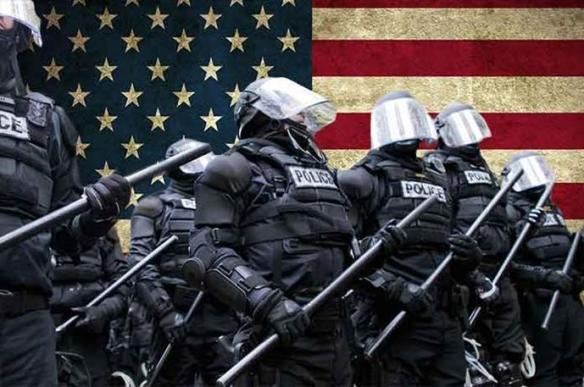
The Long Arm of the Law

On the rise of the global “good cop”

By Lyle Jeremy Rubin

Source: The Baffler

Badges without Borders: How Global Counterinsurgency Transformed American Policing by Stuart Schrader. University of California Press, 416 pages.

Always beware what everyone is saying but no one is talking about. It is often in these spaces of euphemism that the black magic of ideology casts its spell. George Orwell famously warned of how such language, what he called “question-begging” and “sheer cloudy vagueness,” becomes necessary “if one wants to name things without calling up mental pictures of them.” Every now or then a cliché bears some real wisdom and staying power, and Orwell’s counsel happens to be one. Take, for example, what has been said by various Democrats in the wake of the Trump administration’s assassination of Qassim Soleimani. Much of it has been encouraging for anyone interested in avoiding another full-scale bloodbath, but much has also begged additional questions or further clouded the semiotic landscape.

Consider the words of Senator Tammy Duckworth, who told MSNBC’s Andrea Mitchell that the fallout from the assassination is “what the Iranians wanted. They want this. They want Americans pushed out of Iraq. They want greater influence in the Middle East. And they got exactly what they wanted.” The interview began with Duckworth insisting that the American people are not safer now—that, in fact, we’re in more danger. The senator would go on to plead an identical case on The Rachel Maddow Show, and her Democratic colleagues hit similar notes about the cost of “security” and “stability” elsewhere.

I would be the last to deny that the assassination has encouraged more needless violence and tragedy, as we’ve already seen with the accidental downing of a Ukrainian airliner carrying 176 people, or the fatal stampeding of at least fifty people at Soleimani’s funeral. But it is worth asking what U.S. involvement in Iraq Duckworth and her fellows are implicitly supporting, never mind what broader vision of U.S. influence in the region they’re defending. What mental pictures are being obscured by their language?

A short answer to these questions can be found in a January 9 posting on Foreign Policy’s website, co-written by two senior fellows at the Middle East Institute, a reputable think tank known for producing bien pensant foreign policy opinion on the Chevron or United Arab Emirates dime, among others. The authors urge more “defense institution-building,” specifically a 60 percent increase in funding for programs like the Ministry of Defense Advisors and Defense Institute of International Legal Studies, venues where U.S. troops would continue to “actively mentor, advise, and train” Iraqi soldiers. The article focuses on military support, but it is likely these upgrades would be accompanied by a U.S. civilian police presence. Advisors to the bipartisan Task Force on Extremism in Fragile States have long pushed for increased police mentorship in countries like Iraq or Afghanistan, including the repeal of Section 660, an obscure law that constricts the ability of the U.S. government to train police forces abroad.

Section 660, as it happens, was introduced in 1975, and was designed to prevent the kinds of human rights abuses that plagued mentorship programs in Latin America throughout the Cold War. This brings us to the longer answer to the question about what mental pictures are hidden by Duckworth’s verbiage. It is an answer that Stuart Schrader explores in his recent work of scholarship, Badges Without Borders: How Global Counterinsurgency Transformed American Policing.

Badges Without Borders tells the story of America’s post-WWII “global transit of police ideas and personnel.” Its critical framework is indebted to a rich legacy of thought centering on the racist underbelly of the international economic order, what Cedric Robinson called “racial capitalism.” It’s a legacy that can be traced from the oratory and writings of the Black Panther Party to the contemporary investigations of social theorists like abolitionist Ruth Wilson Gilmore—one that continues to expose the connections between the military-industrial complex and the carceral state.

Throughout Badges Without Borders, Schrader seeks to combine this critical tradition with concrete, bureaucratic, fact. Joining a small but formidable band of painstaking researchers like Naomi Murakawa and Elizabeth Hinton, Schrader has dug up or parsed an imposing sum of transcripts, recordings, videos, correspondences, and other ephemera on modern policing within and without the United States. His chief task has been untangling a congeries of alphabet-soup agencies invested in the surveillance, disciplining, and all-too-frequent termination of nonwhite subversives, guerillas, or “criminals” across national borders, the most central being the Office of Public Safety (OPS). Along the way, a crucial leitmotif comes to the fore.

In the course of demonstrating why postwar anticommunist counterinsurgency efforts against postcolonial populations in the global South coincided with the suppression of black and brown communities and protestors across the United States, Schrader advances a theory of an “imperialism without imperialists” and a “racism without racists.” It is not that Bull “Look at ‘em run” Connors or Donald “We’re keeping the oil” Trumps haven’t existed. It’s that, until recently, they’ve been demoted to junior partners in a still shared (if publicly disavowed) project of maintaining fundamental—and fundamentally racialized—power relations across the globe. Their more refined associates, adept at communicating in the tongue of a race-blind, value-neutral social science, a procedural legalism, or even a soft but shallow humanitarianism and anti-racism, have taken the reins of the imperialist enterprise. It is the story of these more outwardly sympathetic but insidious figures, these good cops, that distinguishes Badges Without Borders.

Understanding the rise of the “good cops” requires understanding their origins. The “grandfather” of police professionalization in the United States, August Vollmer, served as a soldier in the Philippine-American war at the turn of the century. The notion that anything worthwhile about law enforcement could be learned from a brutal war of occupation that claimed hundreds of thousands of indigenous lives is itself dark foreshadowing. But what’s notable about Vollmer is his liberal pretensions: he envisioned a modern police officer who functioned as a key agent in the social uplift and economic development of downtrodden communities. Police would be responsible for keeping the peace, of course, but much of that chore could be achieved by introducing newfangled accessories like the bicycle-based patrol or the teletype. That these seemingly benign novelties were intended to ensure an environment compatible with the most stringent of regimes—Vollmer advised the Cuban dictator Gerardo Machado y Morales, for example—came as an afterthought.

Vollmer’s most influential protégé, Orlando W. Wilson, spent more time emphasizing this latter part of his policing theory. As police chief of Wichita, Kansas and Fullerton, California and, later, police commissioner of Chicago, Wilson pushed for a militarized chain of command, code of conduct, division of labor, and demeanor, attributes he saw as solutions to the corruption and ethnic patronage of local precincts. Like Vollmer, he supported technical innovations such as the police car patrol, two-way radio, and crime laboratory. It was a commitment to scaling up his model of policing to the international arena, however, that would leave its most lasting mark. “It looks like the name of Wilson will go down in Arabic annals with the name of Lawrence,” his fellow reformer Theo E. Hall quipped after an Arabic translation of Wilson’s textbook, Police Administration, was disseminated in Iraq and Saudi Arabia.

But if there was one man most responsible for globalizing American policing, it was Kansas City wunderkind and architect of President Kennedy’s Office of Public Safety, Byron Engle. Vollmer was no doubt inspired by his grunt work in the occupied Philippines, and the same could be said for Wilson’s military stint in occupied Germany, but it was Engle, a veteran of occupied Japan, who thought the hardest about forging a world occupied by U.S.-minted police. If Vollmer saw the occupation of the Philippines as a humane improvement on the brutishness of the Spanish empire, and Wilson saw the occupation of Germany as a vindication of liberal governance over illiberal tyranny, Engle saw the occupation of Japan as a blueprint for an internationally integrated future—one defined by a combination of centralized, Washington-derived funding and training, and decentralized discretion.

Schrader describes Engle’s program as “locally grounded, because police had to patrol a beat.” But it was also

forever expansionary, ever seeking the next nation in need of development and modernization, the next imperiled by radicalism. It sought the nooks and crannies of villages or growing metropolises where subversion and crime, or some novel configuration in combination of the two rooted, germinated, and blossomed.

As Schrader reminds his reader, this project ignored the hellscapes lurking behind this kind of “development” and “modernization,” which guaranteed not only a chronically unemployed or underemployed criminal class but a constant stream of radical reactions. Engle, a Democrat for most of his career (he rounded out his life an NRA-affiliated Republican) whose worldview was nevertheless shaped by a slew of affiliations with the FBI and CIA, could never bring himself to consider, in Schrader’s words, “the decentralized despotism of policing that for African Americans in particular amounted to thousands of everyday micro-fascisms.”

Lest one think the phrase “everyday micro-fascisms” is overblown, consider that numerous ex-Nazi policeman and soldiers became not only intelligence assets for the United States, but public safety trainers in places like South Vietnam and Nicaragua. Prior collaborators with the Japanese empire remained in the U.S.-administered Korean police force, while the Korean police were encouraged to retain the same anti-left posture they had assumed under the Japanese. This posture was encouraged worldwide, and not just by supposedly forward-minded, post-racial, police-intellectuals. Many liberal Cold Warriors tolerated right-wing authoritarians while opposing their leftist oppositions, whom they saw as a graver threat to liberal capitalist stability. This Faustian bargain helped lay the ideological and material groundwork for the mass disappearances and murders of leftists throughout Latin America, specifically in Guatemala, where Engle’s OPS was directly implicated. It was this very implication that led, after considerable leftist agitation at home, to Section 660 in 1975.

Whether WASPy mavericks like Vollmer, Wilson, and Engle, or progressive Jewish outsiders like Robert Komer—the man behind the pacification campaign in Vietnam—or Arnold Sagalyn—the counterinsurgency expert who established the blueprint for Lyndon Johnson’s War on Crime—the personalities chronicled in Badges Without Borders appear sincere in their devotion to what they saw as a post-racial politics of universal freedom and prosperity. This devotion manifested itself in myriad ways, from the promotion of “nonlethal weapons” to the championing of Title IX of the Foreign Assistance Act, the stipulation that demands democratic participation in the development and poverty reduction of all assisted nations. But given the men’s refusal to see that the institutions to which they had pledged their allegiance were responsible for perpetuating systemic modes of domination, they couldn’t predict where their favored reforms would lead—that CS (or CN and CR) gas, for instance, embraced by Lyndon Johnson in case “the Negroes started moving in [on] the White House,” would mark a mere addition to the extant repertoire of racist violence. The excessive use of such gas against peaceful protestors drove dissidents underground, only exacerbating racial turmoil. Police ended up killing more civilians after gas was introduced on American streets, since rather than using gas as replacement for violence, they deployed it as a supplement, mimicking tactics used in Vietnam.

The pattern moved in both directions. The first major implementation of CS in South Vietnam happened in 1966, and in a deliberate nod to anti-black subjugation, its perpetrators named it Operation Birmingham. As Schrader recounts, by 1969,

13,736,000 pounds of CS had been dropped on South Vietnam, an amount equivalent to a blanketing layer 80,000 square miles in size: 14,000 square miles more than the country’s total territory. Additionally, CS would have been used repeatedly in some areas and combined with defoliants. It leached into soil and ground water. The United States effectively tear-gassed the entire country, and then some.

As for Title IX, its developmentalist fruits were often consumed by the very national security state intended to protect them. The U.S. Agency for International Development (USAID), for example, trained local Guatemalans, many of them schoolteachers, in leadership programs. According to a study of this period, up to two-thirds of its trainees were murdered by the Guatemalan security apparatus. “They were killed because they were agitators in terms of the powers that be,” the study concluded. “In terms of development, they were the ideal change agent . . . but that was the kiss of death for them.”

Mission creep, threat inflation, profit incentives, preexisting cultures of bigotry and cruelty, and the perceived need to manage the increasingly tumultuous blowback produced by decades of capitalist exploitation and neo-colonialist dispossession—all of these factors have conspired to build the monstrous infrastructures of surveillance and social control the United States exports across the world today. But so has modern liberalism’s failure to anticipate the natural trajectory of its own initiatives—that is to say, its failure to acknowledge the all-encompassing power relations of racial capital in which it has always been embedded. As Schrader writes, the “order police on American streets have created, the order OPS would propagate by proxy abroad, the order the War on Crime facilitated is the order of capital, the order of white supremacy, the order of empire.”

It is also, by its nature, an escalatory order. In the past twenty years alone, America’s wars in the Greater Middle East have claimed 800,000 lives or more directly through violence, and several times that number (at least another 1.6 million) indirectly, through disease, homelessness, forced migration, and the countless other fates borne from armed conflict. Those who have survived in the half-dozen or so countries reshaped by imperial American war, countries like Somalia, Pakistan, Yemen, and Syria, now trudge on inside transnational police states, amid killer robots buzzing from above, paid skeins of unaccountable mercenaries, secret prisons and detention camps, onerous and hazardous checkpoints, and other mundane but vicious routines. In Afghanistan, many must also count their blessings against CIA-trained death squads, a confirmed reality only a handful of journalists and politicians in the United States seem at all concerned about.

In Badges Without Borders, Schrader limns how this nightmare grew up alongside a parallel despotism stateside, one that has disproportionately targeted a not unrelated population of nonwhite disposables. He also shows how this ruthlessness within and without U.S. borders has been propelled forward by a need to oversee the expansion of U.S.-led capitalism while containing the unwanted secondary effects of its exploitation and violence. To be sure, the governments of countries like Russia, China, and yes, Iran, have oppressive workings of their own that are an affront to anyone dedicated to social justice and peace, and public officials like Senator Duckworth are right to be suspicious of their machinations. But to accept U.S. “influence” in the Middle East, or anywhere else for that matter, as a benign or preferable given, is to repeat the same fateful errors of the good cops profiled in Badges Without Borders.

Now, those good cops seem to be everywhere. Democrats have been fond of elevating prosecutors and district attorneys for some time now, and especially fond of rallying behind FBI and CIA figures in recent years. Many of the lawyers in Obama’s administration responsible for providing a thin legal or ethical veneer to its ugliest features, from the drone war to the surveillance leviathan, are now happy household names, former U.S. Attorney General Eric Holder foremost among them. (Holder, it should be noted, oversaw the implementation of “Operation Ceasefire” in the 1990s, which has been described as “basically stop-and-frisk of cars.”) Otherwise excellent broadcast journalists like Chris Hayes still feel a need to conduct softball interviews with unrepentant boosters of America’s imperialist footprint, like former soldier and Congressman Max Rose or Samantha Power, the latter of whom has barely been held to account for helping to turn Libya into a latter-day slave market.

On the other hand, there’s the launch of the well-funded anti-militarist think tank Quincy Institute, with one of the most eloquent critics of Pax Americana, Andrew Bacevich, at its helm. There’s Bernie Sanders and his millions of enthusiastic, anti-war supporters, many of whom are eager to start fighting for a more democratically organized world. There’s the Movement for Black Lives, which has not only widely publicized evils of police brutality and mass incarceration but connected these evils to America’s encroachments across the planet. And there’s the reemergence, in recent public discourse, of Congresswoman Barbara Lee, the only Congressperson to vote against the original Authorization for Use of Military Force Against Terrorists (AUMF) in 2001. These are all promising signs of an incipient anti-imperialist awakening, but as with the coming climate crisis, we are running out of time.
Freedom Rider: Hollywood Propaganda Attack on Venezuela

By Margaret Kimberly

Source: Black Agenda Report

The US is starving and killing Venezuelans in real life and, for your family’s viewing pleasure, on television screens.

“Imperialism is quite bipartisan and liberal Hollywood never saw propaganda it didn’t want to hype.”

“The military intervention of #Venezuela, put ‘on the table’ by @realDonaldTrump and his gang of fanatic supremacists, is supported by the gringo propaganda machine. Here is a fragment of their ‘cultural offerings.’”— Ernesto Villegas, Venezuela Minister of Culture

Americans are loathe to think of themselves as being propagandized.  The idea is inconsistent with notions of exceptional goodness and superiority that are constantly evoked in this country. But government propaganda does not work in a vacuum. It is bolstered by the corporate media and that includes the entertainment industry.

The latest in the story of fictitious CIA agent Jack Ryan is a case in point. The Ryan character appeared in five different feature films before moving to the small screen via Amazon Prime Video. The new season premieres in November and in this latest incarnation Ryan fights to prevent a nuclear armed Venezuela .

The upside down presentation is typical of the perversion of truth so prevalent in the United State. This country is the only one to have used nuclear weapons and still possesses more than any other. It is the United States that recently withdrew unilaterally from decades old nuclear agreements with Russia. Yet Hollywood has woven a tale of Russia, the country which wanted to keep the non-proliferation agreements, as a villain giving nuclear weapons to Venezuela.

“Government propaganda is bolstered by the entertainment industry.”

Venezuela is the victim of United States aggression in reality and now on the screen. The doctrine of “maximum pressure” has killed 40,000 Venezuelans through sanctions that have deprived that nation of food and medical care. That proof of U.S. aggression is known only to those who access independent media sources. The corporate media, even those who are allegedly liberal, parrot Donald Trump administration talking points, even if they otherwise deride the president and his team. Imperialism is quite bipartisan and liberal Hollywood never saw propaganda it didn’t want to hype.

Of course liberals who are usually overcome by Trump derangement syndrome are happy to go along with aggression schemes. Very few Democrats have expressed opposition to the anti-Venezuelan plots hatched by Trump. There is indeed foreign policy collusion but it doesn’t exist in a relationship with a foreign government. The determination to support American hegemony is an important part of the elite consensus.

That obvious truth is also disappeared and is not to be discussed in what passes for polite and “serious” company. According to myth, America is a classless, post-racial meritocracy and accepting of every political viewpoint. Of course it is anything but. The hierarchies are rigid and tenaciously defended.

“The corporate media, even those who are allegedly liberal, parrot Donald Trump administration talking points.”

Propaganda delivered via popular entertainment plays a particularly insidious role in this process. The goal is to change minds and ensure support for any act the government should choose to make. If this particular iteration of the Jack Ryan story isn’t challenged then no act or aggression will be challenged either.Media imagery is very powerful, that is why governments work so closely with corporate media to present their narratives.

Mace Neufeld  created the Jack Ryan film franchise. In 2014 he received a lifetime achievement award from the Israeli Film Festival. Curiously, the event wasn’t held in Israel at all. Instead Beverly Hills was the venue. Neufeld’s co-honoree was Arnon Milchan, a former Mossad operative who parlayed that career into producing hit films such as Twelve Years a Slave.

Israel isn’t alone in this regard. The CIA and the Pentagon both have film liaison offices . Movie credits often end with thanks to the department of defense. That always means that the plot line is approved by the military and the surveillance state.

“Movie credits often end with thanks to the department of defense.”

This grotesque lying on a mass scale cannot be ignored. The propagandists know that repetition plays a huge role in the process of indoctrination. For years Venezuela has been used as a bogeyman to convince people in this country to act against their own interests. “Socialism doesn’t work, just look at Venezuela,” is a statement made to end discussion of free health care or college education or housing or anything else that people need and want. After the 100th New York Times article which says nothing about the U.S. attack but points out that Venezuelans are hungry, the job has been done. Venezuela is now so thoroughly demonized that only a small number of people will come to its defense or even question their government’s policy against that nation.

“Venezuela is now so thoroughly demonized that only a small number of people will come to its defense.”

In 2002 and 2003 the president, the corporate media, and members of Congress all claimed that Iraq possessed chemical weapons. They wanted to make a case for war and they succeeded. Nearly 20 years later there has been no explanation or apology from the guilty parties. The same people claimed that Syria had chemical weapons and advocated for a larger war there. It isn’t hard to believe that a lie about chemicals or nukes in Venezuela could be used to do the same thing if that is what the establishment desired.

Entertainment isn’t harmless. That is why the ruling clique work together to ensure that they all stay on message. They haven’t spent millions of dollars honing the false message that Venezuela is a failed state with evil leadership for no reason. Venezuela’s culture minister, Ernesto Villegas, hits the nail squarely on the head when he describes this latest insult as “crass war propaganda masquerading as entertainment.”  If the U.S. should take military action or continue its regime change efforts, the plot will have succeeded. A few well informed people will speak out but the masses will either support an atrocity or ignore any horror that their leadership cares to visit upon the Venezuelan people. Washington and Hollywood are still working hand in hand.


Margaret Kimberley’s Freedom Rider column appears weekly in BAR, and is widely reprinted elsewhere. She maintains a frequently updated blog as well at http://freedomrider.blogspot.com . Ms. Kimberley lives in New York City, and can be reached via e-Mail at Margaret.Kimberley(at)BlackAgendaReport.com.

Bullet Points: How Forever War Will End

By

Source: Another Day in the Empire

Forget a popular movement to end the wars.

As George W. Bush said during his murder spree in Afghanistan and Iraq, the antiwar movement at that time (far larger than what we have today) was little more than a “focus group” ignored by the state (with the exception of sending out their operatives to spy on the movement and create disorder and factionalism).

Most Americans are numb to decades of expensive and debilitating wars. They prefer not to think about it. The corporate propaganda media provides plenty of fluff and chaff to distract them—spiked with hate screeds against the president—and the idea of a popular movement to end the wars is now nearly impossible.

Like former dirty trickster Karl Rove famously said, the American people really have no choice but to sit back and watch the creative destructionists “make history.” Any serious effort to mobilize an antiwar movement would be disrupted. The state has perfected the dark art of killing democratic action through subversion.

Economic Armageddon. It’s breathing down our necks, thanks to federal spending out of control for decades, at least half of it going to the “defense” department and associated death merchants.

“The United States recorded a government debt equivalent to 105.40 percent of the country’s Gross Domestic Product in 2017,” Trading Economics points out. “Government Debt to GDP in the United States averaged 61.70 percent from 1940 until 2017, reaching an all-time high of 118.90 percent in 1946 [after participating in the worst act of organized carnage in human history] and a record low of 31.70 percent in 1981.”

According to research conducted by William D. Harding and Mandy Smithberger, the “final annual tally for war, preparations for war, and the impact of war come to more than $1.25 trillion, more than double the Pentagon’s base budget [of the $750 billion Trump budget].”

Last year, the official tally for the national debt was $21,500 trillion. Some believe this is a lowball figure. John Williams of shadowstats.com has shown that with unfunded liabilities, the debt is actually closer to $222 trillion, a staggering number virtually unknown to the American people. Most don’t even realize the average public unfunded liability is $2 million per household (piled atop personal debt, which is at an all-time high).

Obviously, somewhere along the line, and I’d have to say soon, there will be a “reset,” an economic collapse and reordering of the game (on terms beneficial to the bankers). Empires typically fall when they become unsustainable.

Russia and China. Both nations have their own problems and are less than friendly to individual rights, although Russia is far better than totalitarian China. It is now obvious both are working to find an exit to the domination of Federal Reserve fiat funny money scheme that rules international economies and trade around the world. The US has weaponized this system by slapping sanctions on disfavored nations and those it has decided to invade and destroy (and with the current rhetoric from both sides of the one-sided war party, it is obvious the political class and its corporate directors are itching for a fight).

This is, of course, insane. I really do think the hubris—the indispensable nation, the exceptional nation—is so thick these fools can’t see how easily it would be to turn the world into a radioactive cauldron. On the other hand, I do believe, at least in regard to nuclear annihilation, somewhat saner heads will prevail.

News flash. If there is a non-nuclear (or limited nuclear) war with each or both (see the 2001 Sino-Russian Treaty of Friendship), it will not turn out good for the US, which has corrupted its defensive military capacity with a manufactured terror-asymmetrical posture.

This approach is effective in subversion operations to destabilize countries, particularly in the Middle East and South Asia. As we have seen since the end of the Second World War, the United States appears to be incapable of winning wars. This no mistake and primarily benefits Eisenhower’s military-industrial complex with a host of related new “national security” industries in addition to the war merchant stalwarts (Boeing, General Dynamics, General Electric, Lockheed-Martin, Raytheon, etc.), all feeding at the trough. Forever war is a forever profit stream for the ruling elite and its political class.

So, the conclusion is either economic collapse or defeat in a more or less conventional war will halt the trajectory the US is taking now as it is pulled along in a neocon spell with a president that has at best a sixth grade understanding of the world. Both probable outcomes are unthinkable.

Who knows. Maybe the American people will get off their duffs and demand the wars and provocations leading to war end. This was done in the 1960s and early 70s, primarily due to the Vietnam War protest that began in response to military servitude imposed on teenagers. The state ended a military draft, although it retained its “selective service” registration of potential future bullet-stoppers.

The moral aspect was secondary.

Corporate Media Target Gabbard for Her Anti-Interventionism—a Word They Can Barely Pronounce

Tulsi Gabbard being asked by CBS‘s Stephen Colbert (3/11/19) why she doesn’t see the US as a “force for good in the world.”

By Owen Marsh

Source: FAIR

Presidential hopeful Tulsi Gabbard has not garnered much press coverage since announcing her bid on February 2; she’s the 13th-most-mentioned Democratic candidate on TV news, according to FAIR’s most recent count (4/14/19).

But when corporate media do talk about the Hawaii congressmember, they tend to reveal more about themselves than about her.

A veteran of the Iraq War, Gabbard is centering her presidential campaign around anti-interventionism (2/3/19): the belief that US interference in foreign countries, especially in the form of regime-change wars, increases the suffering of the citizens in those countries.

When corporate outlets talk about this anti-interventionist position, they primarily use it to negatively characterize the candidates who espouse it. Few in establishment media seem interested in going any deeper or considering the veracity of arguments raised by anti-interventionists.

The Washington Post (1/15/19) listed Gabbard’s anti-interventionism as a factor that hurts her electability in a video titled, “Why Some See Tulsi Gabbard as a Controversial 2020 Candidate.” Part of the video’s explanation: “The congresswoman has raised concern among Democrats in the past when she criticized Obama’s strategy on Iran, ISIS and Syria.”

CBS News (2/4/19) briefly interviewed Honolulu Civil Beats reporter Nick Grube regarding Gabbard’s campaign announcement. The anchors had clearly never encountered the term anti-interventionism before, struggling to even pronounce the word, then laughing and saying it “doesn’t roll off the tongue.” When asked to define the candidate’s position, Grube equated it to President Trump’s foreign policy. But “America First” rallying cries aside, it hardly seems accurate to call Trump an anti-interventionist, given his administration’s regime change efforts in Venezuela, his unilateral reimposition of sanctions on Iran (FAIR.org5/2/19) and his escalation of the drone wars (Daily Beast11/25/18).

When Gabbard appears on talkshows, she is typically on the receiving end of baseless questions coated in assumptions of military altruism. Gabbard appeared on ABC’s The View (2/20/19) and articulated her argument that US intervention does more harm than good to the people purportedly being helped. Rather than respond to any of the points she raised, however, the hosts resorted to the kinds of shallow questions that have been supporting interventionism for decades.

Sunny Hostin asked, “So should we not get involved when we see atrocities abroad?” Fellow panelist Ana Navarro elaborated:

I’m very troubled by the tweets about Venezuela that you’ve put out…. [Maduro] is not allowing humanitarian aid, he is a thug, he is a dictator, he is corrupt. And I am very supportive of what the United States is doing right now…. Why are you so against intervention in Venezuela?

On CBS’s Late Show With Stephen Colbert (3/11/19), the host resorted to old-fashioned American exceptionalism and Cold War–style paranoia to counter the congressmember:

Nature abhors a vacuum. If we are not involved in international conflicts, or trying to quell international conflicts, certainly the Russians and the Chinese will fill that vacuum…. That might destabilize the world, because the United States, however flawed, is a force for good in the world, in my opinion.

Comments like these may seem harmless; why not, after all, fight “atrocities”? In fact, they contain the same language that media have used for decades to justify interventionism and quiet dissenters.

Colbert’s exceptionalism argument, in particular, is reminiscent of the centuries-old vision of the US as a “shining city upon a hill.” It’s also a frame historically employed by media to rationalize the country’s foreign policy. As communications scholar Andrew Rojecki wrote in his 2008 research article (Political Communication2/4/08) on elite commentary of George W. Bush’s military interventions in Afghanistan and Iraq, “Over the course of the two crises, American exceptionalist themes made up a constant background presence in elite commentary and opinion.”

In other words, the assurance that Colbert has that the US has been “a force for good in the world” has paved the way for some of the greatest disasters of the modern world, including the 17-year-old war in Afghanistan (or almost 40 years, if you date from the US deliberately provoking the 1979 Soviet intervention) and the half-million-plus killed in the Iraq War. Other difficult cases for proponents of intervention include Libya, where removing an authoritarian ruler devastated the nation and brought back slave markets, and Syria, where hawks evade responsibility for the hundreds of thousands killed in a US-backed effort to overthrow the government by pretending that the US has failed to intervene.

Currently, in Venezuela, where Navarro is “very supportive of what the United States is doing,” Washington has imposed sanctions that are blamed for killing 40,000 in the last two years (CEPR, 4/25/19). Meanwhile, the US offers as a publicity stunt a convoy with “humanitarian aid” valued at less than 1 percent of the assets it has blocked Venezuela from spending.

Another easy to way to discredit anti-war critics is to accuse them of siding with the enemy (FAIR.org4/1/06). So it’s not much of a surprise that when Gabbard gets mentioned in establishment news, a comment about her meeting with Syrian President Bashar al-Assad is usually soon to follow.

Gabbard traveled to Syria in 2017, on what her office called a “fact-finding mission.” During her trip, she met and spoke with al-Assad, prompting the media to question her loyalties ever since, equating her meeting to tacit support of his regime. (Gabbard calls Assad a “brutal dictator,” but says US efforts to overthrow his government are “illegal and counterproductive.”)

New York Times columnist Bari Weiss appeared on the popular Joe Rogan Experience podcast (1/21/19) and confidently called Gabbard an “Assad toadie.” When Rogan asked her what “toadie” meant, she couldn’t define the word, asking the show’s producer to look it up for her. (It means “sycophant”).

The New York Times (1/11/19) and Associated Press (Washington Post5/2/19) both identified Gabbard’s meeting with Assad as a factor that made her a controversial candidate. In an article about Gabbard’s apparent fall from grace within the Democratic party, Vox (1/17/19) characterized Gabbard’s opposition to the funding of Syrian rebels as “quasi-support for Syrian President Bashar al-Assad, the dictator responsible for the outbreak of the Syrian civil war and the conflict’s worst atrocities.”

Interviewers from MSNBC’s Morning JoeABC’s The ViewCBS’s Late Show and CNN’s Van Jones Show all asked Gabbard to justify her meeting with Assad, or pressured her to renounce him as an enemy. None were interested in asking even the most basic question of substance, “What did you and Assad talk about during your meeting?” The implication is clear: When it comes to those designated by the state as official enemies, communication is suspect.

So perhaps the simplest explanation for corporate media’s treatment of Gabbard is that she opposes the kind of intervention that they have historically been complicit in.

FAIR (e.g, 4/913/19/078/11) has documented mainstream media’s consistent support for US intervention across the globe. FAIR has also been documenting corporate media’s support for intervention in Venezuela, finding recently that zero percent of elite commentators opposed regime change in that country (4/30/19) and noting corporate media’s harsh admonishment of Bernie Sanders after he tepidly questioned US intervention in Venezuela (3/5/19).

Gabbard’s campaign is just one small piece of a larger phenomenon in the mainstream media: Space for dissenting opinions on the US’s neoliberal, interventionist foreign policies must not be allowed.

America is exceptional — in all the wrong ways

By Maj. Danny Sjursen

Source: Axis of Logic

I was born and raised in an America far more Orwellian than many now remember. Matters have gone so far off the rails since 9/11 that few seem to recall the madness of the 1980s. The U.S. had a celebrity actor for president, who railed about America’s ostensibly existential adversary—the Soviet “evil empire.” Back then, Ronald Reagan nearly started a nuclear war during the all-too-real Able Archer war game. He also secretly sold missiles to Iran, and then laundered the windfall to the Contras’ Central American hit squads, resulting in some 100,000 dead.

Looking back from 2019, at least as the contemporary media tell it, those were the good old days. Heck, even Barack Obama—faux liberal that he was—proudly and publicly admired Reagan. Oh, and one of Reagan’s favorite campaign slogans: “Make America Great Again.”

Today, matters seem to be coming farcically full circle, what with Elliott Abrams—convicted in the aforementioned Iran-Contra scandal—being appointed special envoy to Venezuela, and Uncle Sam again bullying a Latin American country. Welcome to America’s own grisly ’80s foreign affairs theme party! Which all got me thinking, again, about the whole notion of American exceptionalism. Only a country that truly, deeply believes in its own special mission could repeat the hideous policies of the 1980s and hardly notice.

Perhaps one expects this absurd messianism from the likes of The Donald, but the real proof is that America’s supposed progressives—like Obama—also obediently pray at the temple of exceptionalism. “Orwellian” is the only word for a nation whose leaders and commentariat were absolutely aghast when candidate Obama was seen without (gasp!) an American flag pin on his lapel. Even more disturbing was how quickly he folded and dutifully adorned his mandatory flair. This sort of nonsense is dangerous, folks: It’s hypernationalism—the very philosophy that brought us World War I.

So it was this week, while sitting on a plane reading my oh-so-bourgeois Economist, and getting infuriated about seeing Elliott Abrams’ war-criminal face, that my thoughts again turned to good old American exceptionalism. My opinions on the topic have waxed and waned over the course of a career spent waging illegal war. First, as a young cadet at West Point, I bought it hook, line and sinker; then, as an Iraq War vet and dissenter, I rejected the entire notion. Only now, observing the world as it is, have I begun to think that America really is exceptional after all—only in all the wrong ways.

Humor me, please, while I run through a brief laundry list of the ways the US of A is wildly and disconcertingly different from all the other “big-boy countries” in the developed world. Let’s start with domestic policy:

  • The U.S. has been the site of exponentially more mass shootings than any other nation. And unlike in New Zealand—where officials took immediate steps to tighten gun control in the wake of its recent tragedy—American politicians won’t do a thing about it. We also own more guns per capita than any other country in the world. In second place is Yemen.
  • The U.S. is essentially alone in the Western world in not guaranteeing health care as a basic human right. It spends much more cash, yet achieves worse health outcomes than its near-peer countries.
  • America is home to some of the starkest income inequality on the globe—right up there with Turkey and South Africa.
  • The U.S. keeps migrant kids in cages at the border, or did until recently. Even more exceptional is that Washington is largely responsible for the very unrest in Central America that generates the refugees, all while American conservatives proudly wear their “Christianity” as badge of honor—but wasn’t Jesus a refugee child? Maybe I read the wrong Bible.
  • America is alone among 41 Western nations in not guaranteeing paid family leave. How’s that for “family values?”
  • As for representative democracy, only the U.S. has an Electoral College. This fun 18th-century gimmick ensures that here in America—in 40 percent of its elections since 2000—the presidential candidate with fewer votes actually won. Furthermore, our peculiar system ensures that a rural Wyoming resident has—proportionally—several times more representative power in Washington than someone who lives in California.
  • Similarly, America counts several non-state “territories”—think Guam, Samoa, Puerto Rico—that don’t even get to vote for the president that it can legally send  to war. But hey, why should we grant them statehood? It’s not as though some of them have higher military enlistment rates than any U.S. state … oh, wait.
  • The U.S. is essentially solo in defining corporations as “people,” and thanks to the Citizens United Supreme Court ruling, has lifted limits on money in politics. Buying elections is officially as American as apple pie.
  • The USA locks up its own people at the highest rate in the world and is nearly alone among developed nations in maintaining the death penalty. Last year, the U.S. was the only country in the Americas to conduct executions and the only Western democracy to do so. But our friends the Saudis still execute folks, so it’s got to be OK. Dostoyevsky famously claimed that “the degree of civilization in a society can be judged by entering its prisons.” How are we doing there?

Then there’s the foreign policy of the great American empire:

  • The U.S. spends exponentially more on military defense than anyone else, and more than the next seven competitors (most of which are allies) combined.
  • America’s bloated military is all by itself in dotting the globe with hundreds of foreign military bases—by some estimates more than any country or empire in world history. As for our two biggest rivals,  Russia has 21 (mostly close to home); China has maybe three.
  • Benevolent, peaceful, freedom-loving America is also the world’s top arms dealer—even selling death-dealing weapons to famous human rights abusers.
  • After Syria signed on, the U.S. became the last nation on earth not party to the Paris Climate Accord. Heck, the occupant of the Oval Office doesn’t even believe in man-made climate change.
  • Then there’s the discomfiting fact that the U.S.—along with Russia—won’t even make a “no-first-use” pledge regarding nuclear weapons. And that’s reality, not “Dr. Strangelove.”
  • The U.S. was first and, until recently, alone in flying its drone fleet through sovereign national airspace and executing “terrorists” from the sky at will. I wonder how Washington will respond when other countries cite that American precedent and do the same?
  • Only the U.S. Navy patrols all the world’s oceans in force and expects to maintain superiority everywhere. And only the U.S. boasts near total control of the goings-on in two whole continents—unflinchingly asserting that North and South America fall in its “sphere of influence.” Crimea abuts Russia and the people speak Russian—still, the U.S. denies Moscow any sphere of influence there or anywhere else. Ah, consistency.

Of course there is so, so much more, but let’s end our tour of American “exceptionalism” there in the interest of time.

What’s so staggeringly unique about the United States is ultimately this: It stands alone among historical hegemons in denying the very existence of its empire. This, truly, is something new. Kids in 19th-century Great Britain knew they had an empire—they even colored their colonies red on school maps. Not so here in the land of the free and the home of the brave. No, Washington seems to believe its own lie—and has its people convinced—that the U.S. is no empire at all, but rather a benevolent “democratic” gentle giant.

American colonies were founded from the outset as mini-empires wrested from the natives. Next, the nascent U.S. grew up enough to take what was left of the continent from the Mexicans. Since then, Washington has been trolling the world’s oceans and spreading the gospel of its own hyper-late-stage capitalism and bullying others in order to get its way. Sure, there are countries where worse human-rights abusers and worse authoritarian regimes are in power. But do we really want to be competing for last place? Especially if we’re supposedly so exceptional and indispensable?

Me, I’m sick of patriotism, of exceptionalism, of nationalism. I’ve seen where all those ideologies inevitably lead: to aggressive war, military occupations and, ultimately, dead children. So count me as over hegemony—it’s so 20th-century, anyway—and bring on the inevitable decline of U.S. pretense and power. Britain had to give up most of an empire to gain a social safety net. That was the humane thing to do.

Two New Reports Point to Further US Decline & Higher Risk of War

By James ONeill

Source: New Eastern Outlook

Two recent reports from the United States strongly suggest the United States is planning a major war with Russia and China, but are far from certain that they could in fact succeed in such a war. The reports also provide insights into how the United States will meet the budgetary demands of such war preparations, but almost zero appreciation of the social and human costs of such policies.

The first of these reports is entitled “Providing for the Common Defence” (November 2018). It is the report prepared for the purpose of assessing the National Defence Strategy document released in early 2018.

It acknowledges that changes “at home and abroad are diminishing US military advantages,” and that this diminution of these “advantages” poses a threat to “vital United States interests.”

Geopolitical shifts in the regional power structures are “undermining deterrence of United States adversaries and confidence of United States allies, thus increasing the likelihood of military conflict”. Should such a conflict eventuate, the United States could “suffer unacceptably high casualties and a loss of major capital assets.”

The report says that “America is losing its advantage in key war fighting areas such as air and missile defence, cyber and space operations, anti-surface and anti- submarine warfare, long range ground-based fires, and electronic warfare”.

It further acknowledges that “America’s edge is diminishing or has disappeared in many key technologies that underpin US military superiority”.

Such frankness is not without precedent in US strategy papers and the implications of the above quotations are a probable reason why the report has received almost zero coverage in the western mainstream media.

Acknowledgements of technological deficiency and strategic disadvantage do not sit comfortably with the image of an all-powerful America willing and able to defeat any threat to its own global interests or those of its allies. The latter prefer the comfortable delusion of an omnipotent US “umbrella.”

The Commission’s strategy for addressing this perceived falling behind and consequent loss of military omnipotence is however itself fatally flawed. The proposed “solution” is to spend vastly greater sums of money at a rate of 3-5% above inflation.

That means that a significantly greater share of the federal budget would have to be devoted to military spending. The only way that could be achieved, given that the United States government already has a huge growing deficit ($22 trillion and counting) would have to come, the report acknowledges, by cuts to social spending such as pensions, Medicare and social security. The “trade-offs” the report acknowledges will be “difficult”, a statement that seriously under- estimates the social devastation that such cuts would bring about.

This argument is put forward in a society which already spends more on defence than that spent by the next eight national military budgets combined. United States national infrastructure, in everything from bridges to schools is already crumbling; and these proposals will only accelerate that downward trend.

It does not seem to occur to the report writers that the entire premise that the United States should maintain its attempt to control the world for the benefit of the United States is neither desirable nor wanted by the vast majority of the worlds nations as evidenced by multiple UN General Assembly resolutions.

The second report is issued by the United States Government Accountability Office (GAO) and is entitled: National Security: Long Range Emerging Threats Facing the United States as Identified by Federal Agencies (December 2018.) It has received even less publicity then the ‘Providing for the Common Defence’ document.

The probable reason for this mainstream media reticence is because the GAO report actually details where the United States is lagging in military capability viz a viz its two perceived principal rivals: Russia and China.

The fact of relative military weakness is not new. Andrei Martyanov in his book Losing Military Supremacy (2018) provided a detailed analysis of why Russian military technology was superior to the United States in several important fields. What Martyanov said about Russia applies with equal validity to Chinese technology.

Martyanov’s argument was dramatically illustrated by President Putin’s 1st March 2018 address to the Russian Parliament. The initial American reaction was to discount Putin’s claims, although within days the military industrial complex was demanding more funds to counteract the superiority of Russian weaponry outlined in Putin’s speech.

The GAO Report now provides an authoritative acknowledgement that Putin was not bluffing. Under the section of the report headed “Weapons” it has this to say:

Hypersonic weapons. China and Russia are pursuing hypersonic weapons because their speed, altitude, and maneuverability may defeat most missile defence systems, and they may be used to improve long range conventional and nuclear strike capabilities. There are no existing countermeasures.

Missiles. Adversaries are developing missile technology to attack the United States in novel ways and challenge US missile defence, including conventional and nuclear ICBMs, sea launched land attack missiles, and space based missiles that could orbit the earth.

Aircraft. China and Russia are developing new aircraft, including stealth aircraft, which could fly faster, carry advanced weapons, and achieve greater ranges. Such aircraft could force US aircraft to operate at further distances and put more US targets at risk.

There is more in the same vein. The only caveat to add to those points is the use of the conditional tense. The use of such words as “may” or “could” is redundant. That technology is already operational (www.thesaker.is 1 March 2018).

A number of commentators have argued that the technology gap between Russian and Chinese systems and that of United States is now measured in decades. There is no evidence to suggest this gap could be bridged in the foreseeable future. A more likely scenario is that the technological gap could widen.

Although there are powerful voices in the United States administration and ‘deep state’ generally sufficiently delusional and frankly crazy enough to believe that the United States could “win” a nuclear war with Russia and/or China, the GAO report should act as a constraint on their wilder ambitions.

History demonstrates that it is unwise to underestimate the extent to which the United States will go to maintain its self appointed role is the world’s dominant hegemon, (see Michael Pembroke’s Korea (2018). The reality is that the era of United States dominance is now well past.

Rather than risk a nuclear war that would wreak unimaginable losses upon all the world’s peoples, including for the first time the United States, the more likely scenario will be an intensification of what Andrei Korybko calls ‘hybrid warfare.’ A current illustration of this is the campaign being waged against Huawei, ostensibly because of the potential for Chinese cyber espionage but in reality to weaken and undermine China’s 2025 program for leadership in artificial intelligence, quantum information and other sophisticated technologies, and enforce America’s allies to buy their inferior products.

Proxy wars in the Middle East, Africa, Asia and Latin America are also likely to increase exponentially.

These two reports demonstrate that the United States has lost its previous technological and military superiority, but equally, that it is willing to go to extraordinary lengths to prevent any further erosion of its world wide role and its replacement by the two emerging countervailing superpowers, Russia and China. Whether or not that American determination will tip the world into a catastrophic nuclear exchange will be one of the major questions for 2019.

What We Threw Away

By Patrick Armstrong

Source: Strategic Culture Foundation

Forty years ago I was quite impressed by the books of Jean François Revel in which he argued that The West was pretty much doomed because it was messy and indecisive. On the other hand, the communist world was decisive, centrally controlled, had a goal in mind and was patient and cunning in achieving that goal (the communisation of the planet, of course). They pushed on all fronts, where the West woke up and pulled itself together enough to push back, the communists recoiled, but the advance continued elsewhere. And so, bit by bit, the world became redder. These were, as I recall, the principal arguments of The Totalitarian Temptation (1977) and How Democracies Perish (1983). And there were plenty of other people bemoaning the fact that the inchoate Western democracies were frittering away valuable time.

And then, suddenly, the Warsaw Pact and the USSR fall apart and essentially took communism into the grave with them. The West was left standing. Still argumentative, inchoate, indecisive and all the rest of it but – and this is my point – still existing when the other was dead. And come to think of it, we’d outlasted that other stainless-steel perfection of centrally directed will and power, Nazi Germany. And there had been plenty of people in the 1930s who thought that, between communism and nazism, the West was doomed. This set me to thinking that Revel and the others had missed something in their analysis.

We outlived them. We survived, they didn’t. And that what I wondered about – there must be something in the West’s way of doing things that led to survival and something in the nazi or communist systems that led to death. I thought some more and the analogy that occurred to me is that there are many kinds of trees. Big ones, little ones, in-between sized ones. Some live in the wet, others in the dry, others half drowned by the sea and so on. There is in fact, a tree, or several trees, for almost any conceivable environmental condition. And therefore, there will always be trees. Why? Because instead of one Perfect Tree, there is a multitude of different trees. And of fishes, beetles, birds and so on. Nature is pluralistic: many many solutions for every imaginable situation and the ability to change to meet new challenges. Arnold Toynbee called this “challenge and response”; a society responds to a challenge: a good response and it survives to meet the next challenge, a bad response and it fades away.

Could this be the clue? Nazism and communism had One Big Answer for every question. That answer worked for a time until it met some questions it couldn’t answer and down it went. To grossly oversimplify things: the nazis loved force and they went to war with everybody, but you can’t win against everybody else, although you may do well for a while; a hammer and a sickle do not really mentally equip you for life in the later twentieth century; “a road to a blind alley” as Putin called it. Grossly simplified to be sure. If you prefer, ideological societies can only function inside the ontological assumptions of that ideology. But no ideology is any more than a small subset of boundless reality.

So what do we (or, sadly I have to ask, did we) have in the West? I think the three fundamental freedoms in the West are free speech, free politics and free enterprise. Looking at these through the lens of pluralism, they are pluralism of thought, pluralism of power and pluralism of action. Remember that the question I was trying to answer was why did the West survive? I wasn’t asking who’s better, more ideal, more moral; just why is one still around and the other two not? To me the answer was the same thing that allows us to be certain there will still be trees and beetles around in the future – pluralism: lots of different trees and beetles.

Take free speech or pluralism of thought. Everybody’s different, everybody has different ideas, insights, points of view. Let’s assume that, for some issue, mine is the winning idea today. But tomorrow you may have a better solution for the problem that appears tomorrow. If I suppressed you (“no man no problem”, as Stalin used to say) or otherwise prohibited your irrelevant (today) but relevant (tomorrow) idea, we would be in trouble tomorrow and less likely to survive until the next day. So, since we don’t know what tomorrow’s problems are, it’s best to let everybody think his thoughts because who can say whose ideas will be winners tomorrow? The same argument can be made for the other two pluralisms/freedoms. And so, by practising pluralism of thought, power and action, a society improves its chances of survival. That’s all: survival. But that was the question I asked myself in the first place.

So, to my mind, that was the great secret that communism’s fall had revealed – social or national survivability is best assured by pluralism of thought, power and action. So, in all humility, we should have understood that and proclaimed it. And, of course, the essence of pluralism is that you are free to be, and should be, yourself. All nations should be themselves: Russians should be Russian, Hungarians Hungarian and so on. Who can say who will have the next good idea? Who is so wise that he can direct his neighbour’s life? That to me was what should have been done and, had that been the message the West had preached, I think we’d all be better off today.

What instead? We had the fatuous proclaiming of “values”: we had ’em and they didn’t. All over the West stuffed shirts got up in parliaments to boast of “our values”. How we got them no one knew. Did God hand them out to some people but not to others? Russians, too lazy or shiftless or something, having missed the ceremony? Had they mysteriously grown in some national soil over long time? A relict of ancient Saxon customs that only their descendants could inherit? The product of centuries of learning? And what is a “value” anyway? A practical guide to action or a virtue that you either have or don’t? Was it something innate or something learned? Could they get these values? Could they be taught? But, whatever, we had ’em and they didn’t; we were virtuous, they weren’t. And there was another tiresome thing about this, especially when, as it often was, the values were given the adjective “European”. Franco, Hitler, Marx, Engels, Mussolini, Robespierre, Napoleon, Quisling and all the rest of them were Europeans. Every single one of them based his ideas and political views on sources deeply rooted in European thought and experience. And, for certain, had it not been for the Soviets and the Anglosphere, the “European values” Eurocrats and their flunkeys would have been boasting about today would have involved a lot more leather, jackboots and stiff-armed salutes. The whole enterprise resembled something from the movie Idiocracy: “Brawndo has what plants crave because plants crave what Brawndo has“. It was weirdly fascinating to watch.

Our “values” and our “virtue” entitled us to rule the world. We were licensed to do just about anything because we had “what plants crave”. And so triumphalist arrogance and complacent ignorance combined with the West’s monopoly of exportable brutal power. And so it went. An unexamined conceit, frighteningly widespread, became the justification, and cover, for less noble actions.

But some responses to challenges are not so successful and we must ask what has become of our boasted “values” today? Well, we’re still free to speak our minds. Not of course if it’s hate speech or fake news; who could defend that? And not, certainly, to offend anyone’s safe space. And you’d probably better not say anything in Russian. Political freedom? Not entirely gone I suppose, in those little corners not already bought up by lobbyists. And it would certainly be wrong to question anything said or done by “those brave men and women who put their life on the line for our safety”. Free enterprise of course still flourishes. In whatever tiny spaces a few gigantic and well-connected corporations have not yet got to.

Altogether, we can’t be very happy with the state of pluralism in the West. And if I’m correct that pluralism is the key to survival, how much longer do we have?

So who did win the Cold War in the end?

Email Hacking Was ‘Pearl Harbor,’ Helsinki Presidency’s ‘New Low’: Welcome to the United States of Amnesia

By Jim Naureckas and Janine Jackson

Source: FAIR 

The media maelstrom around the Helsinki meeting between Donald Trump and Vladimir Putin obscures at least one point of view: that it’s possible to believe that Russia intervened in the 2016 election on behalf of Trump without thinking that this is remotely comparable to Pearl Harbor, as Politico (7/16/18) declared, or “the worst attack on America since 9/11,” as a Washington Postheadline (2/18/18) claimed earlier this year.

Not saying it doesn’t make it less true that both Russia and the United States frequently interfere in other countries’ elections—the US somewhat more frequently, according to a database of electoral interventions maintained by a political scientist at Carnegie Mellon. That’s a lot of Pearl Harbors.

In 1996, Time magazine published a cover story (7/15/96) headlined “Yanks to the Rescue: The Secret Story of How American Advisers Helped Yeltsin Win.” Russian President Boris Yeltsin, you may recall, embraced the idea pushed by Western advisors that what the Russian economy needed was “shock therapy,” a policy that resulted in the country losing about a third of its GDP. Yeltsin also created the model for the authoritarian post-Soviet Russia we have today, notably when he called out the military to shell the Russian parliament—just one of many examples that make clear that the difference between US and Russian electoral interference is not that “we” intervene on the side of democracy.

What justified concern there could be is undermined rather than served by airily ahistorical claims like that of a Washington Post op-ed by Garry Kasparov (7/17/18): “The Helsinki Summit Marks a New Low in the History of the US Presidency.” Suffice to say there are millions who disagree that Trump failing to acknowledge that he had Russian help in getting elected is worse than Bush Jr. invading Iraq, Reagan arming death squads in Central America, worse than Nixon bombing Cambodia, or Truman dropping atomic bombs on civilians, or FDR rounding up Japanese-Americans or, well,  worse than the deliberate separation of children from their families at the southern border. A conversation without that perspective is hardly worth having. Should we talk about electoral interference? Sure. But we don’t have to be led by media who are outraged at Moscow doing things that never bothered them when they were done by Washington—“It’s different cuz it’s us” is not really a moral principle—or whose concern about “foreign” interference in US elections is orders of magnitude greater than that around the interference represented by anti-black and anti-poor voter suppression, inaccessible polling places or partisan gerrymandering.