America Has Always Been a Dystopia

Too many of us just haven’t been paying attention

By Bryan Merchant

Source: OneZero

“Trump’s American dystopia has reached a new and ominous cliff,” warns a CNN opinion headline. “The last two and a half months in America have felt like the opening montage in a dystopian film about a nation come undone,” writes New York Times columnist Michele Goldberg, in describing the images of militarized police storming U.S. cities to put down protests in the days following George Floyd’s murder, which came on the heels of two months of pandemic, panic, and widespread economic collapse. A very popular post published elsewhere on Medium was titled, bluntly, “America is a Dystopia.”

There is a lot of dystopia talk getting tossed around right now, for reasons that probably seem obvious. Those images we’ve all spent hours staring at on Twitter and cable TV — the military vehicles patrolling suburban streets, the lines of tactical vested officers cordoned around the Lincoln Memorial, the scenes of tear gas blurring flames as masked protesters clash with armed police — match up reasonably well with the aesthetics and broad strokes of a genre that we’ve spent the last 10 years staring at on Netflix and the other channels on cable TV.

But this is not “Trump’s American dystopia.” It is the continued, if inflamed, dystopian state of play as it has laid for centuries. The montage of horrors did not begin only a few months ago or when a cohort of privileged observers suddenly became aghast at the SWAT howitzers and brutal policing tactics when they were seen on suburban streets.

Years of toothless and profitable pop culture dystopias have primed consumers to ignore race, helping to obscure the fact that the real dystopia arrived long ago.

If we wanted to get pithy about it, we might say that the 2010s were the dystopia decade, a period that saw both the rise of dystopia as a reliably profitable and uniform entertainment format in mass culture and what appeared to be the IRL manifestation of the images and tropes the genre broadcast by decade’s end. The Hunger Games rose to dominate box offices and spawned a follow-on flotilla of similarly shaped YA dystopian fare. Black Mirror mainstreamed a visual mode of bleak cynicism about technology, and critical darlings like Ex MachinaHer, and Mad Max: Fury Road made apocalypses brought about by artificial intelligence and climate change palatable for the intelligentsia. Meanwhile, Blade Runner, RoboCop, Starship Troopers, and Children of Men became frequent touchstones. Partly because they are good films that offered prescient cultural and political commentary, and partly because their visuals provide handy fodder for comparative screen-grabbing on social media while we’re watching high-tech police forces brutalize popular uprisings, climate change-fueled wildfires spread across cityscapes, and A.I. take on alarming new dimensions, like being racist.

As a result, comparing America to a dystopia has become something of a national pastime; a recurring op-ed framework, a subgenre of Twitter commentary — especially during crisis points and moments of mass upheaval.

But what are we actually talking about when we talk about “dystopia”? Gesturing towards a vague constellation of injustices set to the color palette of a “gritty” summer blockbuster and declaring it dystopian won’t cut it — for dystopia to be useful as a cautionary tool for avoiding bad futures, we need to understand exactly what the ingredients setting a society on the road to ruin are. As it stands, much of the modern dystopian discourse seems content to position dystopia as something that is bad, with an air of futurity. To quote Daniel Mallory Ortberg’s famous mocking of Black Mirror: “What if phones, but too much.” What if high-tech cops, what if sea level rise, etc.

“The adjective dystopian implies fearful futures where chaos and ruin prevail,” writes Gregory Claeys, a historian and professor at Royal Holloway, University of London, and author of Dystopia: A Natural History. Though in a historical and literary sense, he says, dystopia most commonly describes “a regime defined by extreme coercion, inequality, imprisonment, and slavery.”

Because its most popular touchstones are science fiction, modern dystopia discourse tends to fixate on profit- or warfare-accelerating technologies — digital surveillance, facial recognition, automation software, drones, technologized weapons — and their capacity to serve the wealthy and powerful in a time of ecological collapse, health crises, and/or widening inequality. Our current moment fits the bill. The coronavirus, mass unemployment, and police brutality against a racial justice uprising are unfolding to the backdrop of SpaceX rocket launches and tech billionaires like Amazon’s Jeff Bezos rapidly expanding their wealth.

When I noted on Twitter that the SpaceX launch was sending astronauts on a for-profit trip into space as a surge of protests swept the country, it struck a chord. Many responded by comparing the events to Elysium, the 2013 Neill Blomkamp film about a future where the poor toil and swelter on Earth while the wealthy live in luxury in a space station that orbits above the Terran rabble.

Others pointed to the great Gil Scott Heron song, “Whitey’s On the Moon.” The musician and poet released it in 1970, one year after the NASA moon landing, which was itself one year after Dr. Martin Luther King, Jr.’s assassination provoked a mass nationwide uprising, perhaps the last at a scale comparable to the one we’re seeing today.

Some of the lyrics:

A rat done bit my sister Nell.

(with Whitey on the moon)

Her face and arms began to swell.

(and Whitey’s on the moon)

I can’t pay no doctor bill.

(but Whitey’s on the moon)

Ten years from now I’ll be payin’ still.

(while Whitey’s on the moon)

That song was recorded a half-century ago, yet the plight remains the same. It was the same in 1993, when Octavia Butler, in her own magisterial dystopia, Parable of the Sower, set in a mostly Black community in Southern California in the apocalyptic 2020s, described the news of the death of a Mars explorer as eliciting the following reaction: “People here in the neighborhood are saying she had no business going to Mars, anyway. All that money wasted on another crazy space trip when so many people here on earth can’t afford water, food, or shelter.”

Billionaires can afford to send payloads into orbit, to explore space for science and for profit, but we cannot afford to provide health care to the poor or even basic racial equality. That’s what too many of us are missing when we talk about dystopia.

As comparatively radical as a dystopia like Elysium (or, say, Snowpiercer) is — in terms of summer blockbusters, anyway — its critique is limited to class. It glosses over race. It’s Matt Damon versus Sharlto Copley and Jodi Foster and the other white orbital techno-authoritarians. Take a scan through any of the most popular dystopian cinema products of the last decade or so, and you’ll find the same thing; matters of race are omitted almost entirely from the big screen eschatologies. Not only are the genre’s prime exports — Hunger Games, Divergent, Blade Runner, Elysium, RoboCop, the list goes on — written and directed by white people, the protagonists, actors, and even antagonists are nearly uniformly white. And despite many of these being imagined, written, and made in a nation whose founding arrangement was the most dystopian system conceivable, race is never even a component of the conversation in mainstream dystopian cinema, much less what the uprisings are predicated upon. Even the Handmaid’s Tale, which exploded in the wake of Trump’s misogyny-lined ascendency to the presidency, relegates any matter of racial politics deep into the background.

Angelica Jade Bastién points all this out in “Why Don’t Dystopias Know How to Talk About Race?”, where she explains how this in effect allows white viewers to cosplay as the oppressed, without actually interrogating in any meaningful way what oppression might actually entail or who gets oppressed and why.

“Race is relegated to inspiration, coloring the towering cityscapes of these worlds, while the white characters toil under the hardships that Brown and Black people experience acutely in real life,” Bastién writes. “In this way, dystopias become less fascinating thought experiments or vital warnings than escapades in which white people can take on the constraints of what it means to be the other.”

And in so doing, these popular dystopias appropriate the other’s struggles while conveniently ignoring the actual roots of said struggle. I do still think there’s utility in dystopias and trying to heed their warnings, but only if we recognize what’s being warned against, and only, especially, if we manage to understand that many of the looming “dystopias” perceived by more affluent entertainment consumers have been the realities of plenty of communities who have faced deep inequalities, technologized surveillance, and state oppression for generations already.

There’s a tweet that’s gone viral a number of times over the dystopian decade, each time in slightly different variation. Its most recent iteration came just this January, before the pandemic and the uprising came to dominate dystopia discourse:

https://twitter.com/ElleOnWords/status/1218693768339251200

White dystopia fanboys like me, pundits, columnists, and social media users need to get this through our skulls. To invert a notorious quote attributed to William Gibson, the dystopia has always been here; it just hasn’t been evenly distributed.

The “dystopia” lens too often fixes conditions like those — heavily policed communities, invasive surveillance, state oppression — in the future, and it glosses over the realities of the present and the long histories of oppression of Black communities and bodies, plenty of which was technologically abetted. The writer Anthony Walton noted in a 1999 Atlantic piece, “Technology Versus African Americans,” that from “the caravel to the cotton gin, technological innovation has made things worse for Blacks.” Western technologies, he writes, formed the infrastructure that gave rise to Black slavery:

Arab and African slave traders exchanged their human chattels for textiles, metals, and firearms, all products of Western technological wizardry, and those same slavers used guns, vastly superior to African weapons of the time, in wars of conquest against those tribes whose members they wished to capture… The slave wars and trade were only the first of many encounters with Western technology to prove disastrous for people of African descent. In the United States, as in South America and the Caribbean, the slaves were themselves the technology that allowed Europeans to master the wilderness.

What better fits Claeys description of dystopia — “a regime defined by extreme coercion, inequality, imprisonment, and slavery” — than actual chattel slavery? America was founded as a dystopia.

Yet for white and affluent consumers, the constant generation of novel and fantastic apocalyptic scenarios serves to extend the horizon for the arrival of the hellish conditions contained in dystopia — if oppression is a nebulous but ever-approaching threat, it’s perpetually obscured, lifted away into a sub-fictional ether. It needs not be interrogated, not now, anyway. Which is how power prefers it.

That’s the other thing about dystopia: In many of its guises, it’s a plainly conservative enterprise. The most influential dystopia of the 21st century, I would argue, is not 1984, but Atlas Shrugged, which alone is responsible for a generation of greed-is-good Republican policymaking. The 600,000-page book, which I have (regrettably) read, positions a handful of great white men and women as the only thing keeping society together and inveighs against the millions of working-class “moochers” with a barely veiled racist subtext. (Its author was also openly racist.) Many dystopias are less flagrant but similarly conservative: They highlight the fear that we might all end up like the poor unwashed masses if we are not careful to uphold the social order, not the fear that the poor might never be liberated. And that, in fact, includes the ur-dystopia.

“Visions of the apocalypse are at least as old as 1000 B.C.,” according to the dystopian historian Claeys. “The triumph of chaos over order defined the Egyptian ‘Prophecies of Neferti’ foretold the complete breakdown of society.” In it, the “great no longer rule the land,’ the ‘slaves will be exalted.’” The first dystopia, in other words, was a cautionary tale for the haves against sliding into the world of the have-nots. It’s hard not to shake that vibe from a lot of the Twitter commentariat, pointing at the protests from afar, going “man it’s so dystopian” and moving on to whatever the central animating conflict is in their own personal heroic narratives.

There are still useful deployments of dystopian language — it can certainly be effective shorthand for “this is fucked in a new way, pay attention.” A good example is this series of viral tweets that chronicle a day of peaceful protest where demonstrators were in turn greeted with the creepy electrified visage of Gov. Andrew Cuomo on a towering billboard, beaming down the newly instated curfew. A couple hours later, many protesters would be beaten.

And dystopias can still jolt the politically uninvolved to wake up — this podcaster even pointed to Elysium as an entry point into radical politics. But the surfeit of commentary that amounts to “wow, this is like Blade Runner send tweet” needs an upgrade. White viewers like me need to rethink and reevaluate what it means to watch and read popular dystopian fiction, how those products are shaping our perspectives and critiques of the futures and what they’re missing. And many more Black voices clearly need to be added to the mainstream canon and the broader discussion — there’s tons of great Black dystopian fiction; Dhalgren by Samuel Delany, Who Fears Death by Nnedi Okorafor, Zone One by Colson Whitehead, pretty much anything by Ishmael Reed. Who Fears Death is in development for a TV series, which is a start, but these voices need to be better foregrounded and made central to modern dystopia discourse.

A lack of diversity has been a problem in science fiction since the genre’s inception, and it persists. When I went to the Nebulas, a high-profile sci-fi awards conference last year, attendees were overwhelmingly white. The fact that Octavia Butler’s magisterial Parable of the Sower — a dystopia that actually and skillfully manages to interrogate climate change, total economic collapse, privatization, and racist oppression — is somehow not a film or a limited series yet is as scathing an indictment of Hollywood’s insistence on whitewashing dystopias as anything. The book absolutely rips.

This is not to disparage anyone who feels like they’re living in a certain kind of almost-future hell. The number of people who genuinely experience the world as an impending or current dystopia is almost certainly rising in tandem with trends of still-increasing inequality. A decade of jobless recovery ended in 2019 with the highest levels of income inequality in 50 years, and record numbers of people of all backgrounds, even whites, are sliding into poverty and despair, and our encounters with climate change, technological surveillance, conservatism’s hard drift toward authoritarianism, and all of the above being increasingly mediated through digital devices. Our current socioeconomic system is now ideally structured to be a dystopian protagonist generator. It is rewarding elites with unprecedented wealth and luxury, equipping the agents of the state with increasingly advanced weapons and technology, exacerbating ecological collapse, and positioning us all to experience the devastation alone, blinking into a screen, hoping for tiny units of validation from a pithy comment or two about the state of the morass on social media. It is us versus [gestures wildly] all of that, out there.

Which makes it all the more imperative that white fans, pundits, and observers stop ignoring what it has historically meant to experience actual dystopian conditions. It means acknowledging and working to improve the material conditions for those who are surviving the current iteration, and not glibly waving off dystopia as some always-approaching, faceless Empire without zeroing in on the nation’s institutional prejudices, its targets for violence, its specific hatreds. It means we have to stop LARPing in appropriated fictions. It means understanding that this has always been a dystopia — and that those who have always resisted it are at the center of the story.
The Coronavirus Is Not the Plague: The Plague Is US

By Edward Curtin

Source: Behind the Curtain

“Two categories of propaganda must be distinguished.  The first strives to create a permanent disposition in its objects and constantly needs to be reinforced.  Its goal is to make the masses ‘available,’ by working spells upon them and exercising a kind of fascination.  The second category involves the creation of a sort of temporary impulsiveness in its objects.  It operates by simple pressure and is often contradictory (since contradictory mass movement are sometimes necessary).”  – Jacques Ellul, The Technological Society

The French-Algerian writer Albert Camus’ great 1947 novel, The Plague, is a warning to us today, but a warning in disguise.  When he died sixty years ago at the young age of forty-six, he had already written The Stranger, The Fall, and The Plague, and had won the Nobel Prize for Literature.

The outward story of The Plague revolves around a malignant disease that breaks out in a town that is quarantined when the authorities issue a state of emergency.  After first denying that they have a problem, the people gradually panic and feel painfully isolated.  Death fear runs rampant, much like today with the coronavirus. The authorities declare martial law as they warn that the situation is dire, people must be careful of associating, especially in groups, and they better obey orders or very many will die.  So the town is cordoned off.

Before this happens and the first signs that something is amiss emerge, the citizens of the town of Oran, Algeria remain oblivious, for they “work hard, but solely with the object of getting rich.”  Bored by their habits, heavily drugging themselves with drink, and watching many movies to distract themselves, they failed to grasp the significance of “the squelchy roundness of a still-warm body” of the plague-bearing rats that emerge from their underworld to die in their streets.  “It was as if the earth on which our houses stood were being purged of their secret humors; thrusting up to the surface the abscesses and pus-clots that had been forming in its entrails.”  To them the plague is “unthinkable,” an abstraction, until all their denials are swept aside as the truth emerges from the sewers and their neighbors and families die from the disease.

“Stupidity has a way of getting its way;” the narrator, Dr. Rieux tells us, “as we should see if we were not always so wrapped up in ourselves …. plagues and wars take people equally by surprise.”

The American people are wrapped up in themselves.  Nor do they recognize the true rats.  They are easily surprised; fooled would be a better word.

Camus uses a physical plague to disguise his real subject, which is the way people react when they are physically trapped by human rats who demand they obey orders and stay physically and mentally compliant as their freedom is taken from them.

The Plague is an allegorical depiction of the German occupation of France during World War II.  Camus had lived through that experience as a member of the French Resistance.  He was a writer and editor of the underground Resistance newspaper Combat, and with his artist’s touch he later made The Plague a revelatory read for today, especially for citizens of the United States, the greatest purveyor of the plague of violence in the world.

We are all infected with the soul-destroying evil that our leaders have loosed upon the world, a plague of killing that is now hidden behind the coronavirus fear that is being used to institute tight government controls that many will come to rue in the months ahead, just as happened after the attacks of September 11, 2001.

Coronavirus is a perfect cover-story for the occupation of the public’s mind by a propaganda apparatus that has grown even more devious over the past 19 years.

Ask yourself: Where is the news about U.S. military operations in Syria, Afghanistan, Yemen, Iraq, eastern Europe, Africa, Latin America, Asia, etc.?  There is none in the corporate mainstream media, and little in the alternative media as well.  Have those operations ceased?  Of course not.  It’s just that the news about them, little that it was, has disappeared.

Now it is all about us and the coronavirus panic.  It is about how many of us might die. It is about stocking toilet paper.  For the rich, it is about getting to their second or third houses where they can isolate themselves in splendor. As I write, 150 or so Americans are said to have died of Covid-19, and by the time you will read this the number will have climbed, but the number will be minuscule compared to the number of people in the U.S.A. and those numbers will be full of contradictions that few comprehend unless, rather than reacting in fear, they did some comprehensive research.

But arguments are quite useless in a time of panic when people are consumed with fear and just react.

For we live in plague time, and the plague lives in us. But to most Americans, Covid-19 is the plague, because the government and media have said it is.  Like the inhabitants of Oran, the United States is “peopled with sleep walkers,” pseudo-innocents, who are “chiefly aware of what ruffled the normal tenor of their lives or affected their interests.”  That their own government, no matter what political party is in power (both working for “deep-state,” elite interests led by the organized criminals of the CIA), is the disseminator of a world-wide plague of virulent violence, must be denied and divorced from consensus reality.

That these same forces would use the fear of disease to cow the population should be no surprise for those who have come to realize the truth of the attacks of September 11, 2001 and the anthrax attacks that followed, both of which were used to justify the endless “wars on terror” that have killed so many around the world. It is a shock for so many people who can’t countenance the thought that their own government could possibly be implicated in the death of thousands of U.S. citizens and the release of the deadly anthrax, which we know came from a U.S. lab and was carried out by a group of inside government perpetrators.

When it comes to the plague-stricken deaths visited on millions around the world for decades by the American government, this must be denied by diverting attention to partisan presidential politics, and now the coronavirus that engenders fear, loathing, and a child-like tendency to believe Big Brother.  The true plague, the bedrock of a nation continually waging wars through various means – i.e. bombs and economic and medical sanctions, etc. – against the world, disappears from consciousness.  As U.S. Secretary of State Madeleine Albrecht said to 60 Minutes Lesley Stahl in 1996 when Stahl asked her if the U.S. sanctions on Iraq that had resulted in the death of 500,000 Iraqi children were worth it: “We think the price is worth it.”

For “decent folks must be allowed to sleep at night,” says the character Tarrou sarcastically; he is a man who has lost his ability to “sleep well” since he witnessed a man’s execution where the “bullets make a hole into which you could thrust your fist.”  He awakens to the realization that he “had an indirect hand in the deaths of thousands of people.”  He loses any peace he had and vows to resist the plague in every way he can.  “For many years I’ve been ashamed,” he says, “mortally ashamed, of having been, even with the best intentions, even at many removes, a murderer in my turn.”

The rats are dying in the streets. They are our rats, diseased by us. They have emerged from the underworld of a nation plagued by its denial.  Unconscious evil bubbles up.  We are an infected people. Worry and irritation – “these are not feelings with which to confront plague.” But we don’t seem ashamed of our complicity in our government’s crimes around the world.  For decades we have elected leaders who have killed millions, while business went on as usual. The killing didn’t touch us. As Camus said, “We fornicated and read the papers.”  He knew better. He warned us:

It’s a wearying business being plague-stricken.  But it’s still more wearying to refuse to be it. That’s why everybody in the world looks so tired; everyone is more or less sick of plague. But that is why some of us, those who want to get the plague out of their systems, feel such desperate weariness.

Yet the fight against the plague must go on.  Tarrou puts it thus:

All I maintain is that on this earth there are pestilences and there are victims, and it’s up to us, as far possible, not to join forces with the pestilences. That may sound simple to the point of childishness; I can’t judge if it’s simple, but I know it’s true. You see, I’d heard such quantities of arguments, which very nearly turned my head, and turned other people’s heads enough to make them approve of murder; and I’d come to realize that all our troubles spring from our failure to use plain, clear-cut language.  So I resolved always to speak – and to act – quite clearly, as this was the only way of setting myself on the right track.

These days, I keep thinking of an incident that occurred when I was a young investigator of sexually transmitted diseases, working for the U.S. Department of Health, Education, and Welfare through the Public Health Service as an epidemiologist.  My job was to track down sexually transmitted diseases by finding links of sexual contacts. One day I went to interview and take a blood sample from a poor woman who had been named as a sexual contact.  I knocked on her door on the third or fourth floor of a walkup apartment building.  She looked through the peep hole and asked who it was and I told her my name and what government agency I represented. I could tell she was very wary, but she opened the door. She stood there naked, a very heavy woman of perhaps 300 pounds. She nonchalantly welcomed me in and I followed her as she padded down the hall where she took a housecoat off a hook and put it on.

There is, as you know, an old tale by Hans Christian Anderson called “The Emperor’s New Clothes.” Although the emperor parades around naked, the adults make believe he is clothed.  Only a child sees the obvious. I was 23-years-old naïve young man at the time of this unforgettable incident, but it echoes in my mind as a reminder to myself that perhaps that woman was unconsciously teaching me a lesson in disguise.  The year was 1967, and when I went out to get into my government car with federal license plates, a white man in a white shirt in a white car in a poor black neighborhood, a hail of bricks rained down toward me and the car from the roof opposite.  I quickly jumped in and fled as the ghettos were exploding. Soon the National Guard would be called out to occupy them.

Intuition tells me that although the emperor has no clothes and a vast PSYOPS occupation is now underway, too many are too grown-up to see it.

It’s an old story continually updated.  Like The Plague.

Is the U.S. Becoming a Third World Nation?

By Charles Hugh Smith

Source: Of Two Minds

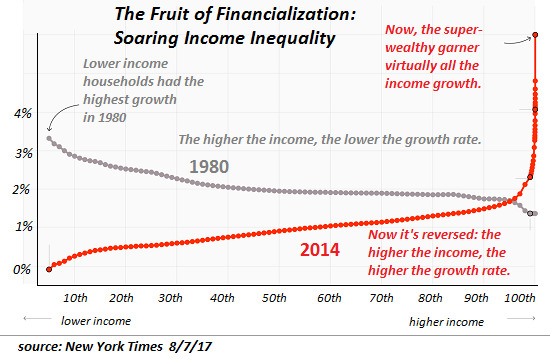
This is a chart of an informal kleptocracy which cloaks itself in the faux finery of democracy and a (rigged) “market” economy.

Back in the day, nations that didn’t qualify as either developed (First World) or developing (Second World) were by default Third World, impoverished, corrupt and what we now refer to as failed states–governments that were incapable of improving the lives of their people and the machinery of governance, generally as a result of corruption and self-serving elites, i.e. kleptocracies.

Is the U.S. slipping into Third World status? While many scoff at the very question, others citing the rise of homelessness, entrenched pockets of abject poverty and the decaying state of infrastructure might nod “yes.”

These are not uniquely Third World problems, they’re symptoms of a status quo that’s fast losing First World capabilities. What characterizes Third World/Failing States isn’t just poverty, crumbling infrastructure and endemic corruption; at a systems level these are the key dynamics in Third World/Failing States:

1. The status quo protects insiders at the expense of everyone else.

2. There is no real accountability; failure has no consequences, bureaucrats are never fired for incompetence, reforms are watered down or neutered by institutional sclerosis.

3. Pay-to-play is the most cost-effective way to influence policy or evade consequences.

4. The status quo is incapable of differentiating between complexity that serves the legitimate purposes of transparency and accountability and complexity that serves no purpose beyond guaranteeing insiders’ paper-shuffling jobs. As a consequence, complexity that adds no value chokes the economy and the government.

5. There are two sets of laws: one for insiders and the super-wealthy, and another harsher set for everyone else.

6. The super-wealthy fear nothing because the system functions to serve their interests.

7. The super-wealthy and state insiders control the media’s narratives and the machinery of governance to serve their interests. Reforms are in name only; the faces of elected officials change but nothing changes structurally.

8. Insiders, well-paid pundits and the technocrats serving the corporate and state elites believe the status quo is just fine because they’re doing fine; they are blind to the soaring inequality, systemic corruption, stupendous waste and the impossibility of real reform.

Does America’s status quo protect insiders at the expense of everyone else? Yes. As for the other seven characteristics: yes, yes, yes, yes, yes, yes and yes.

And lets’ not forget #9: the vast majority of the economic gains flow to the elite at the very top of the wealth-power pyramid: is this true in the U.S.? Definitively yes. Just look at this chart: this is a chart of an informal kleptocracy which cloaks itself in the faux finery of democracy and a (rigged) “market” economy.

That’s the very definition of a Third World failed state.

Related Video:

‘Deaths of despair’ soaring among Gen Z & millennials: ‘It’s the economy, stupid’

By Helen Buyniski

Source: RT.com

Young Americans are killing themselves in record numbers, the victims of a confluence of economic and sociological factors that have singled them out – even above a nationwide surge in so-called “deaths of despair.”

Suicide rates among teens and young adults aged 15 to 24 – the older end of “Generation Z” – spiked in 2017, reaching their highest point since 2000, according to a study published Tuesday in the Journal of the American Medical Association (JAMA). They’ve risen 51 percent in the past 10 years, buoyed by rising rates of anxiety and depression along with social media and drug use, and the figures may be even higher, since some intentional overdoses are not counted as suicides.

Young men saw the steepest rise in deaths, according to the JAMA study, though women are catching up to them at an alarming pace. Teens and young adults report higher rates of anxiety and depression than previous generations, and multiple studies in recent years have shown that social media use exacerbates both conditions, creating a self-perpetuating feedback loop that can have tragic consequences.

But Generation Z is simply following in the footsteps of its predecessors. The much-maligned millennial generation, defined by the Census Bureau as those born between 1982 and 2000 (meaning some are included in the JAMA study), are also killing themselves in record numbers. Drug-related deaths among ages 18 to 34 have increased 108 percent since 2007, while alcohol-related deaths are up 69 percent and suicides are up 35 percent, according to a report published last week by Trust for America’s Health. While millennials have long been written off as entitled, spoiled snowflakes, the media and society are belatedly realizing that they aren’t just layabouts unmotivated to exit their parents’ basement – this “despair” has a cause, and it’s primarily economic.

The rise of millennial and Gen Z “deaths of despair” can be traced to the yawning gap between reality and expectations. Raised on the myths of the American Dream, these are the first Americans to experience a markedly lower standard of living than their parents, the Baby Boomers who grew prosperous on the fruits of the postwar economic boom. The national debt has ballooned, driven by two decades of an unwinnable war whose cost is poised to top $6 trillion, and the Pentagon’s budget has swollen to an unprecedented size even as cuts to social services have decimated what little social safety net Americans could once count on. Multiple rounds of tax cuts for the wealthy and corporations destroyed the government’s revenue base, and perhaps unsurprisingly, economic inequality has grown to exceed even the rates seen during the Great Depression.

And even these concerns are beside the point for a generation that left college already shackled with student loan debt that can run into the hundreds of thousands of dollars and cannot be canceled even by declaring bankruptcy. Millennials who graduated in the aftermath of the 2008 crash entered the “real world” to find no jobs waiting for them. Lucky if they could find an unpaid internship or a waitressing gig, they were forced to retreat back into their parents’ basements, a crushing blow for anyone but particularly for a generation told since birth that they were special, that they could do anything they wanted, that the world was their oyster.

The US, perhaps uniquely in the developed world, views poverty as a sin, and many millennials suffer in silence, believing they are the only ones in their peer group to “flunk out” of the “real world.” Instead of finding support from friends and family, they take advantage of the ready availability of alcohol and opioids, a factor that has caused the number of “deaths of despair” to skyrocket. Some economically-depressed states, like West Virginia, have seen drug overdoses increase more than fivefold in the last 12 years, according to a report published earlier this month by the Commonwealth Fund, and many more have seen their number double and triple. That pharmaceutical companies flooded the market with opioids at the same time the rise of social media devastated the quality and complexity of human relationships is a particularly deadly coincidence.

Since 1996, the average net worth of “consumers” under 35 has declined 35 percent, according to management consultancy Deloitte. Advertisers are starting to realize that targeting this group, while it may seem like a savvy marketing decision – they constitute a quarter of the US population, after all – doesn’t make sense, since they can’t afford to buy anything. Student debt is up 160 percent since 2004 for the under-30 population, and the home-ownership rate for millennials is only 37 percent – fully eight percentage points lower than their parents. Fully 89 percent would like to own a home, according to a survey conducted last year, but nearly half have zero dollars in savings – let alone the 20 percent most mortgages require for a down payment.

Young people aren’t the only ones afflicted by the “deaths of despair” phenomenon. Life expectancy nationwide is down for the third year in a row, and a report from Trust for America’s Health published last year projects that this “epidemic” – which they define as drug and alcohol deaths plus suicide – is on track to kill more than 1.6 million people by 2025 if it continues to grow at its current rate. As the Baby Boomers start to retire only to find they cannot live on their meager savings – assuming they still have any – they, too, are killing themselves more often, with suicide rates up 40 percent from 2007 to 2015.

This is not only a young people’s problem, nor is it an easy one to solve, but acknowledging the systemic poverty afflicting the “richest country in the world” – where two-thirds of the population doesn’t have enough saved to cover a $500 crisis – is a good place to start.

More Than a Threat, America’s Criminal Ways

By Gordon Duff

Source: New Eastern Outlook

It is one thing watching the news, such as it is, a mix of conspiracy theories, flummery and distraction but quite something else watching the United States under its current regime wage war and politics. We haven’t seen this kind of theatre since Goebbels, Himmler and Von Ribbentrop.

How does one describe Secretary of State Pompeo’s trip to Iraq in early May 2019? Do remember that the United States already murdered two million Iraqi civilians, that was done openly and many of those who planned that fake war backed by fake intelligence now advise Trump, names like “John Bolton” for instance.

The blubbering monstrosity Pompeo, reeling from a failed coup attempt in Venezuela, lands in Baghdad to threaten the Iraqis with 4 nuclear armed B 52s and an American aircraft carrier “racing to the scene.”

Why? The answer is simple, and Trump openly admits it, the Israelis told them to do it. Ouch!

How about Israel? Problems there? Didn’t several hundred rockets just land somewhere inside Israel? Didn’t their US financed “Iron Dome” missile defense system utterly fail? More than that, something else far more serious was exposed.

Not one social media post, not one photo, no interviews, not even a phone call to relatives in the United States was made from Israel regarding these attacks. To be clear, the attacks were in retaliation for the killing of Palestinian protesters by not just IDF forces but armed Israeli civilians.

As an aside, the real threat isn’t from inside Israel, a proven total surveillance state capable of unprecedented tyranny, but that Israel’s model is being sold to nations around the world, particularly the United States, where Facebook and Google, two companies controlled by Israeli passport holders, are leading the way to a draconian society with few nations holding the line.

That those nations are either bombed or sanctioned or both by the United States is telling.

Tyranny as Patriotism

The assumptions aren’t just wrong, they are ignorance in its purest form. Hiding behind patriotic songs, pompous rhetoric and always “hugging the flag,” America is a nation run by gangsters. Was it always that way? To an extent, that answer would be yes, but even the criminal elites, the slave traders, opium shippers, land speculators and robber barons of American history would never have imagined what today has brought.

The world is terrified of America. It is one thing for a nuclear superpower to bully the world on behalf of the wealthy elites that own America’s government. When those elites run every government, not just the US, but Europe as well, Africa and Latin America, much of Asia too, and stage fake wars, quite probably fake terror attacks, mass murders, and many suspect so-called “natural disasters,” we are in uncharted waters here.

Every advancement in science and technology is placed into the waiting hands of, well who? We can thank the controlled media, another equally theatrical organization dominated by fake opposing sides tasked with polarizing the public on issues like abortion rights, vaccinations, racial hatred and class envy, with making a Frankensteinian world possible.

The Threat of Science and Technology

Many are aware that, during World War II, science was pushed to new depths. In America it was the Manhattan Project, creating a capability of incinerating entire cities and making much of the earth’s surface uninhabitable.

In Japan, among their efforts was a biological weapons program under “Unit 731.” Headquartered in China, the Japanese developed weaponized forms of the most virulent diseases known to man, tested them on the Chinese along with American prisoners of war, and unleashed them on the world with limited success. Japan even tried spreading the Black Plague to the United States by attaching infected rats to balloons.

Japan also had a nuclear program and built several very large submarines capable of delivering aircraft off the US coast in order to do to America exactly what it did to Japan. There are records, still classified, that show both Japan and Germany exploding nuclear devices during the closing days of World War II.

Anecdotally, uranium oxide from Germany, destined for Japan by submarine in April 1945, to be used against the United States, was diverted to the Manhattan project with the vessel carrying it, the U234, docked at Portsmouth, New Hampshire. There are many such untold stories from World War II, and here is why some of them matter so much.

Let’s look at Unit 731. What happened to the scientists, the war criminals, who unleashed the plague on China’s cities? They came to the US under “Operation Paperclip,” under the auspices of CIA founder Allen Dulles and his assistant, a young Naval officer, Richard Millhouse Nixon. This was the origin of the American biological warfare program that now runs allegedly “peaceful” labs around the world in places like Tbilisi, Georgia.

These facilities are part of the reason so many fear the US. Information on the real research is more than rumors. We know the US has been collecting DNA samples from specific “target” populations, particularly in the Russian Federation, collected and collated by the same organizations that are capable of creating “designer disease.” In fact, this capability comes up in publications, demonstrating the frightening capability of tying genetically modified diseases to racial and/or ethnic markers in human DNA.

An Ethnically Cleansed Planet

Real or not, there are wide perceptions at government level, across Africa for certain but elsewhere as well, that “weaponized medical science” is misusing research into vaccines and studies of genetics to create a world as envisioned by eugenicists in the late 19th and early 20th century.

A movement funded by the wealthiest American families, America began sterilizing its “unfit,” based on race, religion or even social gossip. From Indy Week:

“In Britain, eugenic thought was more of an abstract concept of a utopian society that would prove difficult to put into practice. However, eugenic ideology found fertile ground across the Atlantic in the United States. With the rising influx of immigrants after 1890, increased urbanization and related social ills, people needed a promise of stability and a better future. Eugenics seemed to have the answers. During its heyday, it enjoyed broad support across a variety of social and political spectrums: from social reformers and humanitarians to staunch racists, from strict conservatives to progressives, and from academic and medical communities to religious circles. And it had the financial backing of some of the wealthiest capitalists in the country, including the Kellogg, Carnegie, and Harriman family fortunes.

A national Eugenics Record Office was established in 1910 to collect pedigrees of families suspected of carrying defective genes, and several organizations were formed to promote the study and practice of eugenics. These organizations would sponsor “Better Babies” and “Fitter Families” contests at state fairs across the country. Eugenics exhibits proclaimed “Some people are born to be a burden on the rest, ” with a flashing light going off every 16 seconds to signal the birth of another possibly defective human. Eugenic sermon contests were held across the nation, and biblical passages were quickly reinterpreted to show how eugenics was perfectly compatible with Christian thought. Indeed, advocates claimed, Jesus himself was a eugenicist, according to Christine Rosen’s book, Preaching Eugenics. Scary stories about degenerate family lines sometimes completely fabricated were widely disseminated.

Although eugenics may have started out as a serious science, and elements of it would later shift to the valuable studies of genetics and heredity, the ideology was hijacked by people who knew little about the science and needed a reason to justify their own prejudices. The national Eugenics Record Office would spend years amassing volumes of data on individuals and families, combining “equal portions of gossip, race prejudice, sloppy methods and leaps of logic, all caulked together by elements of actual genetic knowledge to create the glitter of a genuine science,” Edwin Black writes in War Against the Weak.

The goal of the eugenics movement in the United States was to get rid of the “bottom tenth” of society. This, eugenicists hoped to accomplish through restrictive immigration laws, miscegenation laws and forced sterilizations of the unfit. The “fit” of society were imagined as healthy, white, middle-class or higher, educated, English-speaking Protestants bearing a remarkable resemblance to the eugenicists who defined the word “fit.’”

Still the Same Game?

Were one to delve into a darker view of geopolitics than is normally publicly espoused, one where governments, perhaps themselves controlled by what is now termed the Deep State, act in a broadly criminal manner, a pattern emerges. Not all patterns are viable, some if not most are agenda driven and data is always subjective, with fakery and propaganda working its way into the accepted narrative.

One might even go further, that the “accepted narrative” is, in itself, only fakery and propaganda. In fact, stringently focused analytical models reveal exactly this truth.

What is clear is that policies are being enacted that favor lower birth rates in developing nations due to poverty, disease and war.

Moreover, there is a wealth of evidence that scientific research and technological development doesn’t stop at social engineering or even “thought control.” Modeling reveals a broad agenda of capabilities that mirrors the values of those oligarchical elites that so long ago decided a “custom bred” humanity of mindless drones controlled by elites is the only desirable future for mankind.

Thus, when the CIA or USAID builds mysterious laboratories in the dark recesses of the world, Romania, Tbilisi, Georgia, Southern Libya yet no research is published and the only “output” is occasional outbreaks of genetically engineered experimental diseases, fears and suspicions become reality.

One must remember, and this is fact, not conjecture, that the origin of Hitler’s Germany traces to Americans. Hitler’s race laws originated in America and Hitler was long a student of America’s “Black Stork” laws that mandated killing unfit children. From the Guardian:

“Various methods of eugenic euthanasia – including gassing the unwanted in lethal chambers – were a part of everyday American parlance and ethical debate some two decades before Nevada approved the first such chamber for criminal executions in 1921.

Hitler proudly told his comrades how closely he followed American eugenic legislation. ‘Now that we know the laws of heredity,’ he told a fellow Nazi, ‘it is possible to a large extent to prevent unhealthy and severely handicapped beings from coming into the world. I have studied with interest the laws of several American states concerning prevention of reproduction by people whose progeny would, in all probability, be of no value or be injurious to the racial stock.’”

Conclusion

Looking at who overtly rules America today, giving no credence to claims of a Deep State or secret societies, we are still faced with overwhelming proof that the “American democracy” is controlled by oligarchical hereditary elites that favor ethnic cleansing and elimination of those they deem unfit.

Though the seats of government may be held by those with different names, the money behind them, the think tanks, the fake institutes, are all under control by these forces.

The policies? Open ethnic cleansing for sure, overtly through sanctions and war, less openly through supporting clearly fascistic regimes around the world, a policy America adopted long ago. When the reins of control in Washington fall into the hands of right-wing extremists, these policies which are always present go a step further, as is now being seen under the Trump regime.

As Trump will be attending the 75th anniversary of the D Day landings in France, a real examination of that war and Hitler’s truncated rule of Europe, would reveal how not only did Hitler follow policies learned from America but how he was funded by Americans as well, from his earliest career to continued full partnership in war industries right up until the end of the war.

It would not be inaccurate to call Hitler a failed American experiment, one like so many others, Diem in Vietnam, the repressive regimes in South Korea, Chaing in China and ten dozen “tin pot” dictators placed in power by the CIA, with that list growing each day.

The goal? Technology and science wielded to create a world envisioned long ago, one with few people, endless power for the debauched few where the self-anointed “high born” could look down from their lofty heights on humanity as though it were a giant ant farm.


Gordon Duff is a Marine combat veteran of the Vietnam War that has worked on veterans and POW issues for decades and consulted with governments challenged by security issues. He’s a senior editor and chairman of the board of  Veterans Today and the online magazine “New Eastern Outlook.”

It’s Time to Declare Your Independence from Tyranny, America

Photo by Alla Sokolova

By John W. Whitehead

Source: The Rutherford Institute

“These are the times that try men’s souls. The summer soldier and the sunshine patriot will, in this crisis, shrink from the service of their country; but he that stands it now deserves the love and thanks of man and woman. Tyranny, like hell, is not easily conquered; yet we have this consolation with us, that the harder the conflict, the more glorious the triumph.”—Thomas Paine, December 1776

It’s time to declare your independence from tyranny, America.

For too long now, we have suffered the injustices of a government that has no regard for our rights or our humanity.

Too easily pacified and placated by the pomp and pageantry of manufactured spectacles (fireworks on the Fourth of July, military parades, ritualized elections, etc.) that are a poor substitute for a representative government that respects the rights of its people, the American people have opted, time and again, to overlook the government’s excesses, abuses and power grabs that fly in the face of every principle for which America’s founders risked their lives.

We have done this to ourselves.

Indeed, it is painfully fitting that mere days before the nation prepared to celebrate its freedoms on the anniversary of the Declaration of Independence, the City Council for Charlottesville, Virginia—the home of Thomas Jefferson, author of the Declaration—voted to do away with a holiday to honor Jefferson’s birthday, because Jefferson, like many of his contemporaries, owned slaves. City councilors have opted instead to celebrate “Liberation and Freedom Day” in honor of slaves who were emancipated after the Civil War.

This is what we have been reduced to: bureaucrats dithering over meaningless trivialities while the government goosesteps all over our freedoms.

Too often, we pay lip service to those freedoms, yet they did not come about by happenstance. They were hard won through sheer determination, suffering and sacrifice by thousands of patriotic Americans who not only believed in the cause of freedom but also had the intestinal fortitude to act on that belief. The success of the American revolution owes much to these men and women.

In standing up to the British Empire and speaking out against an oppressive regime, they exemplified courage in the face of what seemed like an overwhelming foe.

Indeed, imagine living in a country where armed soldiers crash through doors to arrest and imprison citizens merely for criticizing government officials.

Imagine that in this very same country, you’re watched all the time, and if you look even a little bit suspicious, the police stop and frisk you or pull you over to search you on the off chance you’re doing something illegal.

Keep in mind that if you have a firearm of any kind (or anything that resembled a firearm) while in this country, it may get you arrested and, in some circumstances, shot by police.

If you’re thinking this sounds like America today, you wouldn’t be far wrong.

However, the scenario described above took place more than 200 years ago, when American colonists suffered under Great Britain’s version of an early police state. It was only when the colonists finally got fed up with being silenced, censored, searched, frisked, threatened, and arrested that they finally revolted against the tyrant’s fetters.

No document better states their grievances than the Declaration of Independence, drafted by Thomas Jefferson.

A document seething with outrage over a government which had betrayed its citizens, the Declaration of Independence was signed on July 4, 1776, by 56 men who laid everything on the line, pledged it all—“our Lives, our Fortunes, and our sacred Honor”—because they believed in a radical idea: that all people are created to be free.

Labeled traitors, these men were charged with treason, a crime punishable by death. For some, their acts of rebellion would cost them their homes and their fortunes. For others, it would be the ultimate price—their lives.

Yet even knowing the heavy price they might have to pay, these men dared to speak up when silence could not be tolerated. Even after they had won their independence from Great Britain, these new Americans worked to ensure that the rights they had risked their lives to secure would remain secure for future generations.

The result: our Bill of Rights, the first ten amendments to the Constitution.

Imagine the shock and outrage these 56 men would feel were they to discover that 243 years later, the government they had risked their lives to create has been transformed into a militaristic police state in which exercising one’s freedoms—at a minimum, merely questioning a government agent—is often viewed as a flagrant act of defiance.

In fact, had the Declaration of Independence been written today, it would have rendered its signers extremists or terrorists, resulting in them being placed on a government watch list, targeted for surveillance of their activities and correspondence, and potentially arrested, held indefinitely, stripped of their rights and labeled enemy combatants.

The danger is real.

We could certainly use some of that revolutionary outrage today.

Certainly, we would do well to reclaim the revolutionary spirit of our ancestors and remember what drove them to such drastic measures in the first place.

Then again, perhaps what we need to do is declare our independence from the tyranny of the American police state.

It’s not a radical idea.

It has been done before.

The Declaration of Independence speaks volumes about the abuses suffered by early Americans at the hands of the British police state.

Read the Declaration of Independence again, and ask yourself if the list of complaints tallied by Jefferson don’t bear a startling resemblance to the abuses “we the people” are suffering at the hands of the American police state.

If you find the purple prose used by the Founders hard to decipher, here’s my translation of what the Declaration of Independence would look and sound like if it were written in the modern vernacular:

There comes a time when a populace must stand united and say “enough is enough” to the government’s abuses, even if it means getting rid of the political parties in power.

Believing that “we the people” have a natural and divine right to direct our own lives, here are truths about the power of the people and how we arrived at the decision to sever our ties to the government:

All people are created equal.

All people possess certain innate rights that no government or agency or individual can take away from them. Among these are the right to Life, Liberty and the pursuit of Happiness.

The government’s job is to protect the people’s innate rights to Life, Liberty and the pursuit of Happiness. The government’s power comes from the will of the people.

Whenever any government abuses its power, it is the right of the people to alter or abolish that government and replace it with a new government that will respect and protect the rights of the people.

It is not wise to get rid of a government for minor transgressions. In fact, as history has shown, people resist change and are inclined to suffer all manner of abuses to which they have become accustomed.

However, when the people have been subjected to repeated abuses and power grabs, carried out with the purpose of establishing a tyrannical government, people have a right and duty to do away with that tyrannical Government and to replace it with a new government that will protect and preserve their innate rights for their future wellbeing.

This is exactly the state of affairs we are under suffering under right now, which is why it is necessary that we change this imperial system of government.

The history of the present Imperial Government is a history of repeated abuses and power grabs, carried out with the intention of establishing absolute Tyranny over the country.

To prove this, consider the following:

The government has, through its own negligence and arrogance, refused to adopt urgent and necessary laws for the good of the people.

The government has threatened to hold up critical laws unless the people agree to relinquish their right to be fully represented in the Legislature.

In order to expand its power and bring about compliance with its dictates, the government has made it nearly impossible for the people to make their views and needs heard by their representatives.

The government has repeatedly suppressed protests arising in response to its actions.

The government has obstructed justice by refusing to appoint judges who respect the Constitution and has instead made the Courts march in lockstep with the government’s dictates.

The government has allowed its agents to harass the people, steal from them, jail them and even execute them.

The government has directed militarized government agents—a.k.a., a standing army—to police domestic affairs in peacetime.

The government has turned the country into a militarized police state.

The government has conspired to undermine the rule of law and the constitution in order to expand its own powers.

The government has allowed its militarized police to invade our homes and inflict violence on homeowners.

The government has failed to hold its agents accountable for wrongdoing and murder under the guise of “qualified immunity.”

The government has jeopardized our international trade agreements.

The government has overtaxed us without our permission.

The government has denied us due process and the right to a fair trial.

The government has engaged in extraordinary rendition.

The government has continued to expand its military empire in collusion with its corporate partners-in-crime and occupy foreign nations.

The government has eroded fundamental legal protections and destabilized the structure of government.

The government has not only declared its federal powers superior to those of the states but has also asserted its sovereign power over the rights of “we the people.”

The government has ceased to protect the people and instead waged domestic war against the people.

The government has plundered our seas, ravaged our Coasts, and destroyed the lives of the people.

The government has employed private contractors and mercenaries to carry out acts of death, desolation and tyranny, totally unworthy of a civilized nation.

The government through its political propaganda has pitted its citizens against each other.

The government has stirred up civil unrest and laid the groundwork for martial law.

Repeatedly, we have asked the government to cease its abuses. Each time, the government has responded with more abuse.

An Imperial Ruler who acts like a tyrant is not fit to govern a free people.

We have repeatedly sounded the alarm to our fellow citizens about the government’s abuses. We have warned them about the government’s power grabs. We have appealed to their sense of justice. We have reminded them of our common bonds.

They have rejected our plea for justice and brotherhood. They are equally at fault for the injustices being carried out by the government.

Thus, for the reasons mentioned above, we the people of the united States of America declare ourselves free from the chains of an abusive government. Relying on God’s protection, we pledge to stand by this Declaration of Independence with our lives, our fortunes and our honor.

That was 243 years ago.

In the years since early Americans first declared and eventually won their independence from Great Britain, we—the descendants of those revolutionary patriots—have through our inaction and complacency somehow managed to work ourselves right back under the tyrant’s thumb.

Only this time, the tyrant is one of our own making: the American Police State.

The abuses meted out by an imperial government and endured by the American people have not ended. They have merely evolved.

“We the people” are still being robbed blind by a government of thieves.

We are still being taken advantage of by a government of scoundrels, idiots and monsters.

We are still being locked up by a government of greedy jailers.

We are still being spied on by a government of Peeping Toms.

We are still being ravaged by a government of ruffians, rapists and killers.

We are still being forced to surrender our freedoms—and those of our children—to a government of extortionists, money launderers and corporate pirates.

And we are still being held at gunpoint by a government of soldiers: a standing army in the form of a militarized police.

Given the fact that we are a relatively young nation, it hasn’t taken very long for an authoritarian regime to creep into power.

Unfortunately, the bipartisan coup that laid siege to our nation did not happen overnight.

It snuck in under our radar, hiding behind the guise of national security, the war on drugs, the war on terror, the war on immigration, political correctness, hate crimes and a host of other official-sounding programs aimed at expanding the government’s power at the expense of individual freedoms.

The building blocks for the bleak future we’re just now getting a foretaste of—police shootings of unarmed citizens, profit-driven prisons, weapons of compliance, a wall-to-wall surveillance state, pre-crime programs, a suspect society, school-to-prison pipelines, militarized police, overcriminalization, SWAT team raids, endless wars, etc.—were put in place by government officials we trusted to look out for our best interests and by American citizens who failed to heed James Madison’s warning to “take alarm at the first experiment on our liberties.”

In so doing, we compromised our principles, negotiated away our rights, and allowed the rule of law to be rendered irrelevant.

There is no knowing how long it will take to undo the damage wrought by government corruption, corporate greed, militarization, and a nation of apathetic, gullible sheep.

The problems we are facing will not be fixed overnight: that is the grim reality with which we must contend.

Frankly, as I make clear in my book Battlefield America: The War on the American People, we may see no relief from the police state in my lifetime or for several generations to come.

That does not mean we should give up or give in or tune out.

Remember, there is always a price to be paid for remaining silent in the face of injustice.

That price is tyranny.

As Edmund Burke, the eighteenth-century British statesman and author who supported the American colonists warned, “The only thing necessary for the triumph of evil is for good men to do nothing.”

The Great Unraveling Begins: Distraction, Lies, Infighting, Betrayal

By Charles Hugh Smith

Source: Of Two Minds

The good news is renewal becomes possible when the entire rotten status quo collapses in a putrid heap.

There are two basic pathways to systemic collapse: external shocks or internal decay. The two are not mutually exclusive, of course; it can be argued that the most common path is internal decay weakens the empire/state and an external shock pushes the rotted structure off the cliff.

As Dave of the X22 Report and I discuss in The World Is About To Change & It’s Going To Be Glorious, we are in the early stages of terminal internal decay.There are a number of dynamics shared by decaying empires/states:

1. The ruling elites lose the moral imperative to sacrifice for the good of the empire/state. Instead they use the power of the state to further their own private interests and agendas.

2. The ruling elites start “fudging” reports (i.e. lies are presented as truths) and promoting narratives to mask their self-aggrandizement and the erosion of the nation/empire under their self-interested rule.

In other words, the elites know the public would resist their leadership if the truth were widely known, so the ruling elites devote tremendous resources to massaging the news to distract the public from reality and reflect positively on their self-serving leadership.

Since the weaknesses of the empire are being hidden, they cannot be addressed, and so rot that could have been fixed early becomes widespread and fatal.

3. Flush with the state’s wealth and power, the ruling elite splinters into warring camps which squander the empire’s remaining wealth on private battles over which camp will rule what appears solid and eternal–the empire.

4. As the elites battle it out, the nation/empire falls apart as the leadership’s focus is on internecine conflicts over the spoils of the empire, rather than on preserving the foundations of the empire’s wealth and security.

5. As the truth inevitably leaks out, the public grasps the enormity of the elites’ betrayal of the nation and the public interest. Faith in the elites and the institutions they control plummets, and the Great Unraveling becomes unstoppable.

6. In a last-ditch effort to save their wealth and power, the elites distract the public with Bread and Circuses– “free money” in various guises (Universal Basic Income, Modern Monetary Theory, etc.)–and the distracting Circus of political theater and a surfeit of entertainment.

Whether the elites or the public are aware of it or not, America is well down the path to terminal internal decay: Distraction, Lies, Infighting, Betrayal.

The good news is renewal becomes possible when the entire rotten status quo collapses in a putrid heap of broken promises, dysfunctional institutions, blatant lies, unpayable debts and cascading defaults.

Poor Folks

By Peter Van Buren

Source: We Meant Well

A guy on Facebook I don’t know wrote a version of what has become a kind of set-piece article in today’s America. Here’s a portion:

Losing The War of Attrition or How To Turn Any Normal Person Into A Broken, Angry Radical

You are one of the millions who are employed at minimum wage. Or you are one of the millions who are euphemistically called underemployed, or you are one of the millions with no job and no prospects. You are retired- how did that happen?- or disabled- why did that happen?- and trying to survive on Social Security.

You reach a point when you realize that getting ahead is no longer possible. After that you reach a point when you realize that holding on to what you have is no longer possible. Then you reach a point when you realize that replacing what has been lost or depleted is no longer possible.

I wrote a book about this five years ago called The Ghosts of Tom Joad. No one read it. Publishers in the process of turning me down mocked me for writing about “poor people” and seemed surprised there were poor people in America who weren’t black and living in ghettos. Well, hell, then Trump happened. Because people watching a way of life — a middle class existence where the rich have more but we had some — fall away are easy targets for demagogues. Always have been. Because before we dismissed things as whataboutism we used to study them as lessons from history. Other people’s’ mistakes. History shows very clearly this economic game we’re playing ends with everyone but a small handful at the top losing badly.

I concluded five years ago the game was already decided. Our society was already then like those photos of railroad tracks, where in the distance it seems like the two rails come together in a single point. That point is essentially feudalism, where a tiny minority owns almost everything and everyone else lives off whatever scraps they let us have. Like in the Middle Ages, where everyone farmed for the king as serfs. It’s worse than slavery, because slaves at least know they’re slaves and have the possibility, however small, of freedom. Maybe for their kids if not for themselves.

We are not at the singularity, but we are inexorably headed toward it. Five additional years of data has only made that clearer; five years ago we spoke of the 1%. That number no longer matters. The new figure is .1%, an even smaller group who owns even more.

And no, none of this is new Because Trump. Since 1980, the incomes of the very rich (the .1%) have grown faster than the economy, for about a 400% cumulative increase in wealth. The upper middle class (the 9.9%) has kept pace with the economy, while the other 90% of us, the middle class and the poor have fallen behind.

By the way, it is these numbers which sent Barack Obama and Hillary Clinton during the 2008 campaign to both use $250,000 as the upper limit of the middle class. They sounded misguided, but it was sort of true. They just were still lumping what we’re calling here the “Upper Middle Class” and the “Middle Class” together. Just words. At present in the U.S. we have three-and-a-half classes: The .1%%, the 9.9%, everyone else hanging on, plus some people way at the bottom with basically nothing.

But bad news for the 9.9% Since the they the most (the most the .1% does not yet have) they have the most to lose. At their peak, in the mid-1980s, people in this group held 35% of the nation’s wealth. Three decades later that had fallen 12%, exactly as much as the wealth of the 0.1% rose. And do understand the people at the top are constructing walls and throwing nails off the back of the truck to make sure no one can catch up with them. The goal of .1% is to eliminate the competition, the 9.9% below them. They’ll only effectively have it all when the ratio is down to two classes, the .1% and the 99.9%

We are kept in place via shiny objects (500 channels, more movies and Apple watches and drugs!) and curated divisions. The ever-increasingly sharp lines between say blacks and whites are a perfect tool. Keep the groups fighting left and right and they’ll never notice the real discrimination is up and down. Some groups just found down earlier and harder, but as long as a poor white man in south Kentucky thinks he has nothing in common with a poor black man in the South Bronx they will never work together, never even see the massive economic forces consuming both equally. Forces are even now hard at work to tell us the Republican party is for whites, POC head Democrat, and any third party is a Russian shill in place to hurt the candidate you favor.

Whether your housing is subsidized via a mortgage and that tax deduction or Section 8, you’re still on the spectrum of depending on the people really in charge to allow you a place to live. I do not see a way out of this, only maybe steps that can slow it down or cause it to speed up.

Very short version summary: People like you and I fell through the cracks; we weren’t supposed to end up here but the .1% hadn’t worked out the details so they got as much as they do now and we basically ended up with bigger crumbs than we should have, especially me lucking into a “career” with no real skills.

Our own kids may do OK with what we leave for them, but only if your son is a medical doctor will he have a decent shot at our lifestyle and only because of the “cartelization” of the profession by the AMA. The rest of our kids are unlikely to have any shot at what we ended up with.

Sorry, I’m not a more cheerful guy but these conclusions are based on a fair amount of honest study.