Clinging Bitterly to Guns and Religion

The End Stage of American Empire
By William J. Astore

Source: TomDispatch.com

All around us things are falling apart. Collectively, Americans are experiencing national and imperial decline. Can America save itself? Is this country, as presently constituted, even worth saving?

For me, that last question is radical indeed. From my early years, I believed deeply in the idea of America. I knew this country wasn’t perfect, of course, not even close. Long before the 1619 Project, I was aware of the “original sin” of slavery and how central it was to our history. I also knew about the genocide of Native Americans. (As a teenager, my favorite movie — and so it remains — was Little Big Man, which pulled no punches when it came to the white man and his insatiably murderous greed.)

Nevertheless, America still promised much, or so I believed in the 1970s and 1980s. Life here was simply better, hands down, than in places like the Soviet Union and Mao Zedong’s China. That’s why we had to “contain” communism — to keep them over there, so they could never invade our country and extinguish our lamp of liberty. And that’s why I joined America’s Cold War military, serving in the Air Force from the presidency of Ronald Reagan to that of George W. Bush and Dick Cheney. And believe me, it proved quite a ride. It taught this retired lieutenant colonel that the sky’s anything but the limit.

In the end, 20 years in the Air Force led me to turn away from empire, militarism, and nationalism. I found myself seeking instead some antidote to the mainstream media’s celebrations of American exceptionalism and the exaggerated version of victory culture that went with it (long after victory itself was in short supply). I started writing against the empire and its disastrous wars and found likeminded people at TomDispatch — former imperial operatives turned incisive critics like Chalmers Johnson and Andrew Bacevich, along with sharp-eyed journalist Nick Turse and, of course, the irreplaceable Tom Engelhardt, the founder of those “tomgrams” meant to alert America and the world to the dangerous folly of repeated U.S. global military interventions.

But this isn’t a plug for TomDispatch. It’s a plug for freeing your mind as much as possible from the thoroughly militarized matrix that pervades America. That matrix drives imperialism, waste, war, and global instability to the point where, in the context of the conflict in Ukraine, the risk of nuclear Armageddon could imaginably approach that of the 1962 Cuban Missile Crisis. As wars — proxy or otherwise — continue, America’s global network of 750-odd military bases never seems to decline. Despite upcoming cuts to domestic spending, just about no one in Washington imagines Pentagon budgets doing anything but growing, even soaring toward the trillion-dollar level, with militarized programs accounting for 62% of federal discretionary spending in 2023.

Indeed, an engorged Pentagon — its budget for 2024 is expected to rise to $886 billion in the bipartisan debt-ceiling deal reached by President Joe Biden and House Speaker Kevin McCarthy — guarantees one thing: a speedier fall for the American empire. Chalmers Johnson predicted it; Andrew Bacevich analyzed it. The biggest reason is simple enough: incessant, repetitive, disastrous wars and costly preparations for more of the same have been sapping America’s physical and mental reserves, as past wars did the reserves of previous empires throughout history. (Think of the short-lived Napoleonic empire, for example.)

Known as “the arsenal of democracy” during World War II, America has now simply become an arsenal, with a military-industrial-congressional complex intent on forging and feeding wars rather than seeking to starve and stop them. The result: a precipitous decline in the country’s standing globally, while at home Americans pay a steep price of accelerating violence (2023 will easily set a record for mass shootings) and “carnage” (Donald Trump’s word) in a once proud but now much-bloodied “homeland.”

Lessons from History on Imperial Decline

I’m a historian, so please allow me to share a few basic lessons I’ve learned. When I taught World War I to cadets at the Air Force Academy, I would explain how the horrific costs of that war contributed to the collapse of four empires: Czarist Russia, the German Second Reich, the Ottoman empire, and the Austro-Hungarian empire of the Habsburgs. Yet even the “winners,” like the French and British empires, were also weakened by the enormity of what was, above all, a brutal European civil war, even if it spilled over into Africa, Asia, and indeed the Americas.

And yet after that war ended in 1918, peace proved elusive indeed, despite the Treaty of Versailles, among other abortive agreements. There was too much unfinished business, too much belief in the power of militarism, especially in an emergent Third Reich in Germany and in Japan, which had embraced ruthless European military methods to create its own Asiatic sphere of dominance. Scores needed to be settled, so the Germans and Japanese believed, and military offensives were the way to do it.

As a result, civil war in Europe continued with World War II, even as Japan showed that Asiatic powers could similarly embrace and deploy the unwisdom of unchecked militarism and war. The result: 75 million dead and more empires shattered, including Mussolini’s “New Rome,” a “thousand-year” German Reich that barely lasted 12 of them before being utterly destroyed, and an Imperial Japan that was starved, burnt out, and finally nuked. China, devastated by war with Japan, also found itself ripped apart by internal struggles between nationalists and communists.

As with its prequel, even most of the “winners” of World War II emerged in a weakened state. In defeating Nazi Germany, the Soviet Union had lost 25 to 30 million people. Its response was to erect, in Winston Churchill’s phrase, an “Iron Curtain” behind which it could exploit the peoples of Eastern Europe in a militarized empire that ultimately collapsed due to its wars and its own internal divisions. Yet the USSR lasted longer than the post-war French and British empires. France, humiliated by its rapid capitulation to the Germans in 1940, fought to reclaim wealth and glory in “French” Indochina, only to be severely humbled at Dien Bien Phu. Great Britain, exhausted from its victory, quickly lost India, that “jewel” in its imperial crown, and then Egypt in the Suez debacle.

There was, in fact, only one country, one empire, that truly “won” World War II: the United States, which had been the least touched (Pearl Harbor aside) by war and all its horrors. That seemingly never-ending European civil war from 1914 to 1945, along with Japan’s immolation and China’s implosion, left the U.S. virtually unchallenged globally. America emerged from those wars as a superpower precisely because its government had astutely backed the winning side twice, tipping the scales in the process, while paying a relatively low price in blood and treasure compared to allies like the Soviet Union, France, and Britain.

History’s lesson for America’s leaders should have been all too clear: when you wage war long, especially when you devote significant parts of your resources — financial, material, and especially personal — to it, you wage it wrong. Not for nothing is war depicted in the Bible as one of the four horsemen of the apocalypse. France had lost its empire in World War II; it just took later military catastrophes in Algeria and Indochina to make it obvious. That was similarly true of Britain’s humiliations in India, Egypt, and elsewhere, while the Soviet Union, which had lost much of its imperial vigor in that war, would take decades of slow rot and overstretch in places like Afghanistan to implode.

Meanwhile, the United States hummed along, denying it was an empire at all, even as it adopted so many of the trappings of one. In fact, in the wake of the implosion of the Soviet Union in 1991, Washington’s leaders would declare America the exceptional “superpower,” a new and far more enlightened Rome and “the indispensable nation” on planet Earth. In the wake of the 9/11 attacks, its leaders would confidently launch what they termed a Global War on Terror and begin waging wars in Afghanistan, Iraq, and elsewhere, as in the previous century they had in Vietnam. (No learning curve there, it seems.) In the process, its leaders imagined a country that would remain untouched by war’s ravages, which was we now know — or do we? — the height of imperial hubris and folly.

For whether you call it fascism, as with Nazi Germany, communism, as with Stalin’s Soviet Union, or democracy, as with the United States, empires built on dominance achieved through a powerful, expansionist military necessarily become ever more authoritarian, corrupt, and dysfunctional. Ultimately, they are fated to fail. No surprise there, since whatever else such empires may serve, they don’t serve their own people. Their operatives protect themselves at any cost, while attacking efforts at retrenchment or demilitarization as dangerously misguided, if not seditiously disloyal.

That’s why those like Chelsea ManningEdward Snowden, and Daniel Hale, who shined a light on the empire’s militarized crimes and corruption, found themselves imprisoned, forced into exile, or otherwise silenced. Even foreign journalists like Julian Assange can be caught up in the empire’s dragnet and imprisoned if they dare expose its war crimes. The empire knows how to strike back and will readily betray its own justice system (most notably in the case of Assange), including the hallowed principles of free speech and the press, to do so.

Perhaps he will eventually be freed, likely as not when the empire judges he’s approaching death’s door. His jailing and torture have already served their purpose. Journalists know that to expose America’s bloodied tools of empire brings only harsh punishment, not plush rewards. Best to look away or mince one’s words rather than risk prison — or worse.

Yet you can’t fully hide the reality that this country’s failed wars have added trillions of dollars to its national debt, even as military spending continues to explode in the most wasteful ways imaginable, while the social infrastructure crumbles.

Clinging Bitterly to Guns and Religion

Today, America clings ever more bitterly to guns and religion. If that phrase sounds familiar, it might be because Barack Obama used it in the 2008 presidential campaign to describe the reactionary conservatism of mostly rural voters in Pennsylvania. Disillusioned by politics, betrayed by their putative betters, those voters, claimed the then-presidential candidate, clung to their guns and religion for solace. I lived in rural Pennsylvania at the time and recall a response from a fellow resident who basically agreed with Obama, for what else was there left to cling to in an empire that had abandoned its own rural working-class citizens?

Something similar is true of America writ large today. As an imperial power, we cling bitterly to guns and religion. By “guns,” I mean all the weaponry America’s merchants of death sell to the Pentagon and across the world. Indeed, weaponry is perhaps this country’s most influential global export, devastatingly so. From 2018 to 2022, the U.S. alone accounted for 40% of global arms exports, a figure that’s only risen dramatically with military aid to Ukraine. And by “religion,” I mean a persistent belief in American exceptionalism (despite all evidence to the contrary), which increasingly draws sustenance from a militant Christianity that denies the very spirit of Christ and His teachings.

Yet history appears to confirm that empires, in their dying stages, do exactly that: they exalt violence, continue to pursue war, and insist on their own greatness until their fall can neither be denied nor reversed. It’s a tragic reality that the journalist Chris Hedges has written about with considerable urgency.

The problem suggests its own solution (not that any powerful figure in Washington is likely to pursue it). America must stop clinging bitterly to its guns — and here I don’t even mean the nearly 400 million weapons in private hands in this country, including all those AR-15 semi-automatic rifles. By “guns,” I mean all the militarized trappings of empire, including America’s vast structure of overseas military bases and its staggering commitments to weaponry of all sorts, including world-ending nuclear ones. As for clinging bitterly to religion — and by “religion” I mean the belief in America’s own righteousness, regardless of the millions of people it’s killed globally from the Vietnam era to the present moment — that, too, would have to stop.

History’s lessons can be brutal. Empires rarely die well. After it became an empire, Rome never returned to being a republic and eventually fell to barbarian invasions. The collapse of Germany’s Second Reich bred a third one of greater virulence, even if it was of shorter duration. Only its utter defeat in 1945 finally convinced Germans that God didn’t march with their soldiers into battle.

What will it take to convince Americans to turn their backs on empire and war before it’s too late? When will we conclude that Christ wasn’t joking when He blessed the peacemakers rather than the warmongers?

As an iron curtain descends on a failing American imperial state, one thing we won’t be able to say is that we weren’t warned.


A Glance Ahead

By James Howard Kunstler

Source: Kunstler.com

Satan is the father of lies and we have become Satanic, being and doing evil, most especially to ourselves….

hat’s ahead — like a few months down the road? Hysteria and chaos, if the “Joe Biden” regime can help it… and they’re helping it all they can. Twice vaxxed, twice boosted, and twice recent Covid-19 patient Dr. Anthony Fauci warned this week that the unvaxxed would “get into trouble” as the seasons turn this year. The part he left out is: the unvaxxed will be in trouble trying to keep up with helping their sick and dying vaccinated relatives whose immune systems have been damaged by their multiple vaxxes.

The boldness of Dr. Fauci’s lying is really something to behold. Who in the entire HHS-NIH-CDC bureaucracy has failed to notice that the mRNA “vaccines” have no efficacy whatever against Covid-19? The vaccinated are by far those still getting sick and increasingly disabled from the disease and even more from the vaxxes themselves. The emperor’s new clothes hang in shreds. Rumor is that many upper-level employees in these public health agencies are increasingly freaked out by their now-obvious complicity in a momentous crime. They know they will have to answer for allowing the mRNA fiasco to get this far, for going along to get along, and they’re preparing to mutiny to save their own asses. Wait for it.

The regime’s back-up plan is the comical monkeypox, transmitted to date mainly via all-male orgies. HHS Secretary Xavier Becerra declared a national monkeypox emergency this week, saying he’d “explore every option on the table” (except an official advisory against homosexual orgies). There is, of course, reasonable suspicion that monkeypox is but one device for shutting down the November mid-term election, or, more deviously, closing polling places and allowing only mail-in ballots — the easiest way to rig elections.

That will lead naturally to several state’s attorneys general seeking relief in the Supreme Court against the federal government’s unconstitutional takeover of the states’ duty to conduct their elections. The “Joe Biden” regime will lose that one, but not before royally pissing off at least half the adults in the land, leading to even greater-than-anticipated election losses for the Party of Chaos.

Meanwhile, the Party of Chaos is about to unleash its “Inflation Reduction Act,” which proposes to spend three quarters of a trillion dollars created from thin air into an economy already hyperventilating on three years of multi-trillion-dollar injections derived from no productive activity. At the same time, the act will raise taxes especially for low-end wage earners and small businesses, completing the regime’s destruction of the middle-class. The cherry-on-top is the provision to double the size of the Internal Revenue Service by hiring 87,000 new employees to harass ordinary American taxpayers. Is that what you voted for in 2020? I  thought not.

None of that is going to work as intended. More likely, passage of the act will trigger destruction of the dollar as the world’s reserve currency, and a stampede out of dollar-denominated investments, which is to say, a very severe financial crisis. Credit will freeze, the distribution and sales of goods will cease, interest will stop being paid on virtually all outstanding debt, the bond market will implode, few will have anything identifiable as money, and there will be little in the way of everyday goods like food and gasoline to buy anyway.

You realize, of course, that this is a description of economic collapse. If things roll that way, there will be absolutely no trust left in the US government. It will be either ignored or opposed. And in places like my own New York, under the tyrannical and titanically incompetent accidental Governor Kathy Hochul, there will be no trust in state government either. Meaning, we’re on our own, community-by-community. This will be a very interesting experiment in the dynamics of emergence — the self-organizing properties of systems in chaos. I doubt that it will resolve in the direction of the globalists’ dreams of transhuman technocracy. Every macro trend now runs against centralization.

But the process could conceivably invite an attempted Chinese takeover of the USA, if not militarily, then in a way similar to America’s asset-stripping operations in the collapsed Soviet Union of the 1990s, a looting spree — as seen many other times in history when empires founder. Or else, the rest of the world will just kick back and witness the spectacle of our struggle as the lights of Western Civ flicker out. (Europe will be right in it with us, by the way.) The other nations of the world are tired of us trying to push them around, with increasingly evil intentions. They will enjoy watching our tribulations. They will be convinced we deserve it.

This is what comes from a culture of immersive and pervasive dishonesty. Satan is the father of lies and we have become Satanic, being and doing evil, most especially to ourselves, whether you believe in a literal Satan or not. So, do you think now that being transgressive is… fun? You’ll be changing what’s left of your mind about that soon. Along with the threat of literal starvation will also arise a terrible hunger for truth: How did this happen? How did we come to do this?  Who was behind it? It won’t be hard to find out, once we’re motivated to look.

The American Third World: We’ll Soon Be Living in It

By Fabian Ommar

Source: Activist Post

It’s that time of the year, and instead of following tradition and making new predictions and forecasts (which we preppers do all the time anyways), I usually look back into the recent past, review my (and other’s) work and previous analyses, what transpired (or not), where my perspectives need adjustment and where, and so forth.

I decided to review and expand on a few topics addressed previously here and see where we are on those. In April, I wrote about the thirdworldization of the United States, as both it, and the rest of the First World, is gradually shifting towards the Third World.

It’s not only happening, but accelerating. And the entire world is going that way, too – or soon it will, judging by the signs. These things have a delay and don’t happen linearly, but in waves.

Thirdworldization 2.0 – When the First World becomes the Third World

Let’s see some more about how life can be in places constantly suffering with economic crises, political upheavals, moral degeneracy, authority demoralization, institutional failure and social decadence.

For anyone who’s never lived in such a context, understanding the dynamics of the system and societies in the Third World (or any place in which the order has changed drastically, yet not totally evaporated), can be a good way to prepare for what’s already underway.

The current crisis is global and unlike others seen in recent times

Notwithstanding the crap lining up just waiting to hit the fan – a pandemic, a debt time-bomb, geopolitical tensions, and lots more – the capacity to deal with all that is at an all-time low. Even wealthy nations look exhausted, depleted and lost like never before.

There’s zero willingness to cooperate and coordinate a solution, despite authorities’ constant and oddly similar declarations to the contrary. Speaking of the leadership currently in charge, it’s as mediocre, misguided, and uninspiring as it can possibly be.

And this is everywhere. We’re screwed.

It’s impossible to say for sure whether or not all that will end up in a full-blown SHTF of some kind, much less when. It can take a year, or ten. What’s certain is this: until things reach that catalyst point, degradation will force large swaths of populations worldwide, in most if not all countries, to take a few steps back in many fronts.

As I said before, it’s already happening.

The Third World will get much worse, and the First World will become a lot like the Third.

This is not SHTF as some might see it, but a middle-of-the-road-yet-still-gloomy scenario. Many in Preppersphere can’t conceive of anything less than the Apocalypse. Fine, to each their own. Besides, preparing for the worst means covering for everything less, so in principle it’s not a bad strategy, right?

I live in Brazil, but have visited the US, EU, and a few other countries and continents, even having lived abroad for a period during the 1990s. I’ve experienced both realities under different circumstances and gained some perspective on the contrasts between advanced societies, and ones with broken, inefficient, and corrupt institutions, and with weak social contracts.

That’s what I’m here to share. I’ll continue to raise awareness to what society converts into long before TEOTWAWKI happens, and try to help others prepare and deal with that. I do this not only because this is where I have some degree of knowledge, but also because that is what I see happening.

It’s hard to make progress in a ‘quicksand environment.’

In developed countries, people frame their decisions and take action based on reasonable probabilities, and the assumption that certain basic conditions of the social contract won’t change radically or suddenly, depending on who’s in charge or some other spurious reason.

A functional checks-and-balances system warrants the stability of laws, regulations, the tax regime, while the political rules and institutions create a favorable environment for investment and risk taking by people, families, and businesses. That’s what promotes the development and advancement of a country.

That’s perhaps the most important thing to understand about (and consequently prepare for) thirdworldization: it’s not just that things change, but how they change. Thirdworldization is the present and constant possibility that things can get done, undone, and again, at any moment, in unpredictable ways, without debate or warning.

How do you make plans for the future in such context?

Instability and uncertainty make life in general much harder to navigate in the Third World.

If the goalposts are constantly moving, everyone will act short or near term as a way to adapt and survive. The harder and more unstable the context, the faster you must both adapt and act (what is SHTF if not chaos?). So, there’s a silver lining to living like this, but also a price: it’s riskier, more stressful, tiresome, and frustrating.

I won’t say it’s hell, because it’s not.

Most people don’t live 24/7 in fear or under serious risk, not even in severely hit places. It’s not a full-scale SHTF. Life’s just more fluid, more challenging, and not as predictable and calm as in more civilized nations. Actions and consequences don’t follow a linear, predictable path.

Look around and see the sweeping anxiety and depression everywhere. I’d argue it’s not being caused by the pandemic, or even the economy going kaput, but by the appetite of governments everywhere to change basic rules and destroy freedom and individual liberty in the name of an emergency. When you combine this with people’s willingness to forfeit their rights, privacy and liberties in the name of illusory safety you end up with our current world.

That’s what I mean by the world going the way of the Third World.

Observing and understanding the real nature of fluidity in everyday life of a dysfunctional society can be critical, because dysfunctional is exactly what the world is fast becoming.

I’ll give some examples to illustrate what I’m talking about…

What does the path to authoritarianism look like?

The executive, legislative, and judiciary overstepping each other is common in banana republics. Every country can have a bill of rights, but it’s the separation of powers that make the constitution effective. Without a checks-and-balances system, rights are just words on a piece of paper.

This creates both confusion and infighting while simultaneously eroding confidence in the government’s institutions. People lose reference, politicians tend to abuse this strategy more and more, and from there it’s only downhill. It’s the exact script dictators and populists everywhere follow every single time to not only take power but to try to keep it forever.

For a long time this was something unacceptable and unseen in advanced nations. Despite this, though, it’s still been happening for some time now only having escalated in the last couple decades. Since 2020 it’s exploded, and it’s now eroding political and social stability in various developed countries.

And this is not only about inflated presidents declaring wars and contracting treaties and other actions without congressional approval, but also the government ceding increasing powers to agencies – NGOs and others organizations of unprepared, unelected tyrants aligned with the elites, eager to interfere and micromanage both society and people’s lives, as they steal people’s inherent rights and freedoms.

We now have moral ambiguity from top to bottom.

As we go lower down the scale into a full-fledged Third World nation, everyday life begins to border on the bizarre. In developing countries, the public administration is a cesspool of incompetence, poor planning, lack of vision, populism and corruption which drains precious resources and wealth from what would otherwise be a productive population.

The bureaucracy can reach paralyzing levels. The tax regime is so complex and illogical that it’s almost impossible to comply, even if you want to. The regulations are unstable and mutating. Besides punishing the population, these regulations lower the appetite of people and businesses to invest and take risk. The economy becomes less dynamic, less competitive and, eventually, it crawls.

Finally, when the government, institutions, and other authorities begin to become ambiguous with their defining the rules they create and enforce, people start thinking “why should I follow any of that?”

And once this happens, then it’s only a matter of time for disorder to increase and morality to collapse. That’s what a slow-burning SHTF means, after all: a  semi-functional system where everything is fluid and the laws have little practical effect.

There’s little guns can do to solve bigger issues.

But let’s switch gears a little to explain something related: guns are important and can save us in some specific situations. But they can’t help with any of the stuff I’m talking about.

Who are we gonna shoot? The politicians? The corrupt cops? The lazy public workers? The stupid laws? That would solve nothing. All it would mean would be civil war, which only makes everything worse.

Things might get to that point, but it’s a completely different dynamic. When the system is up, shooting someone can land you in jail – even in the Third World.

“How’s that any different from anywhere else?” you might ask. In many ways, this starts with an ineffective investigation apparatus: here only about 6% of intentional homicides are solved, in comparison to an average of 65% in US, 80% in France, and 90% in UK.

Translating, it’s a lot more discouraging to commit a crime in the First World than in the Third. But then other distortions and inequalities come into play. The rich and/or connected almost never go to jail, no matter the crime.

And this leads to the second big difference: the slow and utterly unfair justice system that punishes the entire society, by not punishing the deserving, as it should.

And then there’s the infamous Third World penitentiary system…

These are true SHTF microcosms. No prison anywhere is paradise, obviously. But do you have any idea how bad and dangerous a Third World jail is? If having forty dangerous inmates in a small cubicle originally designed to hold four gives you chills, you understand why honest citizens (especially preppers) are so reluctant to brag about firearms and shooting others in developing countries.

In there, one can get raped, beat up, killed. Or co-opted by one of the many factions that command organized crime, to whom you’ll belong for protection, for the right to live, or even to keep your relatives from being abused, tortured, or killed outside.

Instead of rehabilitating prisoners, this system turns them into even better (that is, worse) criminals.

Mass escapes are also commonplace in Third World prisons. So are violent riots and rebellions in which enemy factions fight, torture, kill and literally rip apart their rivals, as a way to display ruthlessness and inflict fear into opponents. Sure, these things also happen in First World prisons, but not with nearly the same frequency, brutality, or impunity.

There are many ways to get unwillingly involved in this mess of a system, too.

As the situation worsens, so does the entire system. If you do everything right, lay low and get lucky, you may be well. It’s not guaranteed though. Something crazy can happen by pure chance or opportunity, and you’re suddenly involved in something you didn’t ask for, but can’t avoid or escape anymore.

For instance, one day the cops or some government agent – inspection, fiscal, whatever – pay a visit to your small shop or business and ask for a “collaboration”, for… reasons. You pay, of course. It’s extortion, but you don’t want to upset the “law” – and the system can’t protect you from itself.

Now you’re a cash cow.

You go for a jog in the streets and 99% of the time nothing happens. One day you get mugged, or your wife or daughter get groped while riding a bicycle, and there’s little you can do (if you thought “guns!”, go back a couple paragraphs and read what I said about those again).

And then, there’s the organized crime…

I could talk about organized crime for forever, discussing how it grows and spreads based on the same principles and practices that high-profile corporations use to grow and spread. How it infiltrates all levels of society, by corruption, intimidation, lobbying, or even by financing people to occupy strategic positions. How it gets involved with politicians, legitimate businesses, the media – until it’s just one big thing with tentacles everywhere.

Instead, I’ll do you all a big favor and just point to a couple of movies that not only show in true, raw, vivid colors how this whole mechanism works, but do it in a very entertaining and thrilling way. Elite Squad (1997) and its sequel, The Enemy Within (2010) are two of most brilliant and well-made Brazilian movies ever (both rated 8.0 on IMDB).

Apart from superb action flicks, they’re blunt, brutal, realistic portraits of crime, drug fighting/trafficking, institutional corruption, and overall social and moral decadence. They explain how crime evolves and takes over the system – how it gets “institutionalized”. It’s shocking, revealing, and educational.

There’s a reason I keep returning to the topic of crime.

Crime and violence are insidious and pervasive – the first evidence of collapse – while at the same time both the cause and consequence of deeper issues. Crime is the antecedent to (serious) shortages, and skyrockets when the grid goes down. It becomes both a collective and an individual problem. It affects us directly, and indirectly, physically and mentally – an itch no one can scratch.

Look how fast crime has grown in the US and around the world just in the past few months. I’m not talking about a 2% increment, but something in the two or even three figures in some places – and again, in months. For many, especially the part of society living in safe and civilized regions, crime may seem like something distant, numbers and statistics presented in the news.

That all changes when it comes to our door, and then the cat is definitely out of the bag.

To conclude, there’s been a lot of talk about the possibility of civil war in the United States. I think that it can happen, but not necessarily like 1871. It could be a mix of guerrilla warfare and crime, for instance. Or we could witness a steep, sudden, and widespread rise in crime and violence. In Haiti, gangs rule the country and casualties are high. It affects everyday life and impacts the whole population, the economy, everything. It may not be declared, but its de facto a civil war.

Abandoning innocence

When everything is good and there’s a surplus, collaboration happens easily and even spontaneously. With all the challenges and hardships we’re facing, people are entering survival mode everywhere. Becoming more knowledgeable about the dynamics of living in a dysfunctional society can build psychological preparations to live in a fluid and unstable world.

I acknowledge none of what I talked about here is prerogative of Third World or collapsed countries. Disorder, corruption and malfeasance are part of human nature and exist everywhere. But again, it’s certainly more widespread and violent where it’s not contained, and – this is critical – not punished.

And that’s precisely in proportion to the level of institutional efficiency, solidity and civil cohesion. Once these decay, the doors to social maladies are held wide open. And wherever this happens, a similar scenario unfolds.

It’s happening everywhere.

You Don’t Have To Wait For Halloween To See Monsters, Because They Are Already All Around Us

By Michael Snyder

Source: End of the American Dream

A lot of Americans will dress up like monsters this Halloween, but there is no way that they could ever be as frightening as the actual monsters that walk our halls of power on a daily basis.  Some of the things that I am going to share with you in this article are deeply disturbing, but they need to be revealed because the people that have been doing these things need to be held accountable.  Real life horror movies play out in secret facilities all across America day after day, and much of the time the incredibly sick things that are being done to animals are being funded by our tax dollars.  But because the corporate media keeps very quiet about these “experiments”, most Americans never hear about what is really going on behind closed doors.

The good news is that some brave investigators are starting to pull back the veil and reveal the truth about the horrific animal abuse that is taking place.

Here is one example of what I am talking about…

“Our investigators show that Fauci’s NIH division shipped part of a $375,800 grant to a lab in Tunisia to drug beagles and lock their heads in mesh cages filled with hungry sand flies so that the insects could eat them alive,” White Coat Waste told Changing America. “They also locked beagles alone in cages in the desert overnight for nine consecutive nights to use them as bait to attract infectious sand flies.”

How sick do you have to be to do something like that to innocent little puppies?

Dr. Anthony Fauci and the others that were involved in funding this research are monsters.

And it turns out that this wasn’t the first time that they funded this sort of “experimentation”.

Back in 2016, they spent more than 18 million dollars to torture beagles “for 22 months” before finally killing and dissecting them…

Fauci’s team had previously, in 2016, strapped the infectious sand flies to beagles at the NIAID lab in Bethesda, Maryland, allowing them to feed on the dogs for 22 months.

The White Coat Waste Project alleges that the dogs developed infectious legions before researchers killed and dissected them.

This procedure cost $18,430,917.

Fauci and everyone else involved in such “experiments” aren’t just criminals.

They are monsters in the worst sense of the word.

If you are sickened by what you have read already, you may want to stop, because there is more.

What Fauci and his minions did to 44 beagle puppies at a facility in Menlo Park, California has no place in a civilized society

Another procedure – which the NIH funded to the tune of $1.8m – saw 44 beagle puppies undergo a ‘cordectomy,’ which saw their vocal cords cut to stop them barking.

That experiment, which took place in Menlo Park, California, saw the dogs then pumped full of drugs, before being killed and dissected.

What would “justice” look like for crimes of this magnitude?

The next time someone in the corporate media tries to call Fauci a “hero”, it should make you want to vomit.

Of course Fauci and his minions have moved on from just experimenting on animals.

Today, innocent people all over the globe are the guinea pigs.

And it turns out that Fauci’s NIH is now publicly admitting to funding incredibly twisted research on “a bat coronavirus” at the Wuhan Insitute of Virology just before the pandemic hit…

White House coronavirus adviser Dr. Anthony Fauci and National Institutes of Health Director Francis Collins have declared under oath that they did not fund the dangerous gain-of-function virus research in China that now is believed be the origin of the COVID-19 pandemic.

But now the NIH has admitted in a letter to the leading Republican on the House Oversight Committee that the U.S. funded an experiment at the Wuhan Insitute of Virology in which a bat coronavirus was modified, creating a virus that made mice “sicker” than the original virus.

We all know the rest of the story.

But after everything that has transpired, Fauci and his minions are still treated like heroes, and that is because we have a national love affair with evil.

If you doubt this, just consider the “holiday” that is coming up.  It is a festival of evil, darkness and death, and yet Americans will spend more than 1o billion dollars celebrating it this year…

The 2021 Halloween season is breaking the bank this year.

According to the National Retail Federation’s annual survey, Americans are expected to spend $10.14 billion this year on Halloween-related items. The price tag grew by $2 billion in comparison to last year’s numbers.

Unless you are already sold out to evil, why in the world would anyone want to celebrate such a “holiday”?

By now, pretty much everyone understands that our modern “Halloween” comes directly from a very wicked ancient pagan festival known as “Samhain”.

Over the years, many have told me that they just celebrate Halloween for some “innocent fun” and that the holiday doesn’t mean anything evil to them.

But what if you celebrated a Satanic black mass and put a bunch of “positive” labels on all of the various elements of that ritual?

Would that make it okay?

Of course not.

Giving evil an “alternative” name does not transform it into something good.

So stop pretending.

Fauci and his minions call the evil they are committing “scientific research”, and millions upon millions of Americans are willing to go along with their torture of animals “for the greater good”.

Of course “the greater good” is now being used to justify all sorts of nightmarish crimes against humanity.

We live at a time when the level of evil on this planet is reaching a great crescendo, and it is truly sickening to watch.

But when things are at their darkest, that is when light is needed the most, and so let us all endeavor to be the greatest lights to this world that we possibly can.

The State of Our Nation: Still Divided, Enslaved & Locked Down

By John W. Whitehead & Nisha Whitehead

Source: The Rutherford Institute

A house divided against itself cannot stand. I believe this government cannot endure, permanently, half slave and half free. I do not expect the Union to be dissolved—I do not expect the house to fall—but I do expect it will cease to be divided. It will become all one thing or all the other.”—Abraham Lincoln

History has a funny way of circling back on itself.

The facts, figures, faces and technology may change from era to era, but the dangers remain the same.

This year is no different, whatever the politicians and talking heads may say to the contrary.

Sure, there’s a new guy in charge, but for the most part, we’re still recycling the same news stories that have kept us with one eye warily glued to the news for the past 100-odd years: War. Corruption. Brutality. Economic instability. Partisan politics. Militarism. Disease. Hunger. Greed. Violence. Poverty. Ignorance. Hatred.

The more things change, the more they stay the same.

Brush up on your history, and you’ll find that we’ve been stuck on repeat for some time now.

Take the United States of America in the year 2021, which is not so far different from the United States of America during the Civil Rights era, or the Cold War era, or even the Depression era.

Go far enough afield, and you’ll find aspects of our troubled history mirrored in the totalitarianism of Nazi Germany, in the fascism of Mussolini’s Italy, and further back in the militarism of the Roman Empire.

We’re like TV weatherman Phil Connors in Harold Ramis’ classic 1993 comedy Groundhog Day, forced to live the same day over and over again.

Here in the American police state, however, we continue to wake up, hoping each new day, new president and new year will somehow be different from what has come before.

Unfortunately, no matter how we change the narrative, change the characters, change the plot lines, we seem to keep ending up in the same place that we started: enslaved, divided and repeating the mistakes of the past.

You want to know about the true State of our Nation? Listen up.

The State of the Union: The state of our nation is politically polarized, controlled by forces beyond the purview of the average American, and rapidly moving the nation away from its freedom foundation. Over the past year, due in part to the COVID-19 pandemic, Americans have found themselves repeatedly subjected to egregious civil liberties violations, invasive surveillance, martial law, lockdowns, political correctness, erosions of free speech, strip searches, police shootings of unarmed citizens, government spying, the criminalization of lawful activities, warmongering, etc.

The predators of the police state have wreaked havoc on our freedoms, our communities, and our lives. The government does not listen to the citizenry, refuses to abide by the Constitution, and treats taxpayers as a source of funding and little else. Police officers shoot unarmed citizens and their household pets. Government agents—including local police—remain armed to the teeth and act like soldiers on a battlefield. Bloated government agencies continue to fleece taxpayers. Government technicians spy on our emails and phone calls. And government contractors make a killing by waging endless wars abroad.

Consequently, the state of our nation remains bureaucratic, debt-ridden, violent, militarized, fascist, lawless, invasive, corrupt, untrustworthy, mired in war, and unresponsive to the wishes and needs of the electorate.

The policies of the American police state continue unabated.

The Executive Branch: All of the imperial powers amassed by Donald Trump, Barack Obama and George W. Bush—to kill American citizens without due process, to detain suspects indefinitely, to strip Americans of their citizenship rights, to carry out mass surveillance on Americans without probable cause, to suspend laws during wartime, to disregard laws with which he might disagree, to conduct secret wars and convene secret courts, to sanction torture, to sidestep the legislatures and courts with executive orders and signing statements, to direct the military to operate beyond the reach of the law, to act as a dictator and a tyrant, above the law and beyond any real accountability—were inherited by Joe Biden.

Biden has these powers because every successive occupant of the Oval Office has been allowed to expand the reach and power of the presidency through the use of executive orders, decrees, memorandums, proclamations, national security directives and legislative signing statements that can be activated by any sitting president. Those of us who saw this eventuality coming have been warning for years about the growing danger of the Executive Branch with its presidential toolbox of terror that could be used—and abused—by future presidents. The groundwork, we warned, was being laid for a new kind of government where it won’t matter if you’re innocent or guilty, whether you’re a threat to the nation or even if you’re a citizen. What will matter is what the president—or whoever happens to be occupying the Oval Office at the time—thinks. And if he or she thinks you’re a threat to the nation and should be locked up, then you’ll be locked up with no access to the protections our Constitution provides. In effect, you will disappear.

Our warnings continue to go unheeded.

The Legislative Branch:  Congress may well be the most self-serving, semi-corrupt institution in America. Abuses of office runs the gamut from elected representatives neglecting their constituencies to engaging in self-serving practices, including the misuse of eminent domain, earmarking hundreds of millions of dollars in federal contracting in return for personal gain and campaign contributions, having inappropriate ties to lobbyist groups and incorrectly or incompletely disclosing financial information. Pork barrel spending, hastily passed legislation, partisan bickering, a skewed work ethic, graft and moral turpitude have all contributed to the public’s increasing dissatisfaction with congressional leadership. No wonder only 31 percent of Americans approve of the job Congress is doing.

The Judicial Branch: The Supreme Court was intended to be an institution established to intervene and protect the people against the government and its agents when they overstep their bounds. Yet through their deference to police power, preference for security over freedom, and evisceration of our most basic rights for the sake of order and expediency, the justices of the United States Supreme Court have become the guardians of the American police state in which we now live. As a result, sound judgment and justice have largely taken a back seat to legalism, statism and elitism, while preserving the rights of the people has been deprioritized and made to play second fiddle to both governmental and corporate interests. The courts have empowered the government to wreak havoc on our liberties. Protections for private property continue to be undermined. And Americans can no longer rely on the courts to mete out justice.

Shadow Government: Joe Biden inherited more than a bitterly divided nation teetering on the brink of financial catastrophe when he assumed office. He also inherited a shadow government, one that is fully operational and staffed by unelected officials who are, in essence, running the country. Referred to as the Deep State, this shadow government is comprised of unelected government bureaucrats, corporations, contractors, paper-pushers, and button-pushers who are actually calling the shots behind the scenes right now.

Law Enforcement: By and large the term “law enforcement” encompasses all agents within a militarized police state, including the military, local police, and the various agencies such as the Secret Service, FBI, CIA, NSA, etc. Having been given the green light to probe, poke, pinch, taser, search, seize, strip and generally manhandle anyone they see fit in almost any circumstance, all with the general blessing of the courts, America’s law enforcement officials, no longer mere servants of the people entrusted with keeping the peace but now extensions of the military, are part of an elite ruling class dependent on keeping the masses corralled, under control, and treated like suspects and enemies rather than citizens. As a result, police are becoming even more militarized and weaponized, and police shootings of unarmed individuals continue to increase.

A Suspect Surveillance Society: Every dystopian sci-fi film we’ve ever seen is suddenly converging into this present moment in a dangerous trifecta between science, technology and a government that wants to be all-seeing, all-knowing and all-powerful. By tapping into your phone lines and cell phone communications, the government knows what you say. By uploading all of your emails, opening your mail, and reading your Facebook posts and text messages, the government knows what you write. By monitoring your movements with the use of license plate readers, surveillance cameras and other tracking devices, the government knows where you go. By churning through all of the detritus of your life—what you read, where you go, what you say—the government can predict what you will do. By mapping the synapses in your brain, scientists—and in turn, the government—will soon know what you remember. And by accessing your DNA, the government will soon know everything else about you that they don’t already know: your family chart, your ancestry, what you look like, your health history, your inclination to follow orders or chart your own course, etc. Consequently, in the face of DNA evidence that places us at the scene of a crimebehavior sensing technology that interprets our body temperature and facial tics as suspicious, and government surveillance devices that cross-check our biometricslicense plates and DNA against a growing database of unsolved crimes and potential criminals, we are no longer “innocent until proven guilty.”

Military Empire: America’s endless global wars and burgeoning military empire—funded by taxpayer dollars—have depleted our resources, over-extended our military and increased our similarities to the Roman Empire and its eventual demise. Black budget spending has completely undermined any hope of fiscal transparency, with government contractors padding their pockets at the expense of taxpayers and the nation’s infrastructure—railroads, water pipelines, ports, dams, bridges, airports and roads—taking the hit. The U.S. now operates approximately 800 military bases in foreign countries around the globe at an annual cost of at least $156 billion. The consequences of financing a global military presence are dire. In fact, David Walker, former comptroller general of the U.S., believes there are “striking similarities” between America’s current situation and the factors that contributed to the fall of Rome, including “declining moral values and political civility at home, an over-confident and over-extended military in foreign lands and fiscal irresponsibility by the central government.”

I haven’t even touched on the corporate state, the military industrial complex, SWAT team raids, invasive surveillance technology, zero tolerance policies in the schools, overcriminalization, or privatized prisons, to name just a few. However, what I have touched on should be enough to show that the landscape of our freedoms has already changed dramatically from what it once was and will no doubt continue to deteriorate unless Americans can find a way to wrest back control of their government and reclaim their freedoms.

So how do we go about reclaiming our freedoms and reining in our runaway government?

Essentially, there are four camps of thought among the citizenry when it comes to holding the government accountable. Which camp you fall into says a lot about your view of government—or, at least, your view of whichever administration happens to be in power at the time.

In the first camp are those who trust the government to do the right thing, despite the government’s repeated failures in this department.

In the second camp are those who not only don’t trust the government but think the government is out to get them.

In the third camp are those who see government neither as an angel nor a devil, but merely as an entity that needs to be controlled, or as Thomas Jefferson phrased it, bound “down from mischief with the chains of the Constitution.”

Then there’s the fourth camp, comprised of individuals who pay little to no attention to the workings of government. Easily entertained, easily distracted, easily led, these are the ones who make the government’s job far easier than it should be.

It is easy to be diverted, distracted and amused by the antics of politicians, the pomp and circumstance of awards shows, athletic events, and entertainment news, and the feel-good evangelism that passes for religion today.

What is far more difficult to face up to is the reality of life in America, where unemployment, poverty, inequality, injustice and violence by government agents are increasingly norms.

The powers-that-be want us to remain divided, alienated from each other based on our politics, our bank accounts, our religion, our race and our value systems. Yet as George Orwell observed, “The real division is not between conservatives and revolutionaries but between authoritarians and libertarians.”

The only distinction that matters anymore is where you stand in the American police state.

In other words, you’re either part of the problem or part of the solution.

America is at a crossroads.

History may show that from this point forward, we will have left behind any semblance of constitutional government and entered into a militaristic state where all citizens are suspects and security trumps freedom.

Certainly, we have moved beyond the era of representative government and entered a new age: the age of authoritarianism. Even with its constantly shifting terrain, this topsy-turvy travesty of law and government has become America’s new normal.

As long as we continue to put our politics ahead of our principles—moral, legal and constitutional—“we the people” will lose.

And you know who will keep winning by playing on our prejudices, capitalizing on our fears, deepening our distrust of our fellow citizens, and dividing us into polarized, warring camps incapable of finding consensus on the one true menace that is an immediate threat to all of our freedoms? The government.

As I make clear in my book Battlefield America: The War on the American People and its fictional counterpart The Erik Blair Diaries, when we lose sight of the true purpose of government—to protect our rights—and fail to keep the government in its place as our servant, we allow the government to overstep its bounds and become a tyrant that rules by brute force.

The Systemic Risk No One Sees

The unraveling of social cohesion has consequences. Once social cohesion unravels, the nation unravels.

By Charles Hugh Smith

Source: Of Two Minds

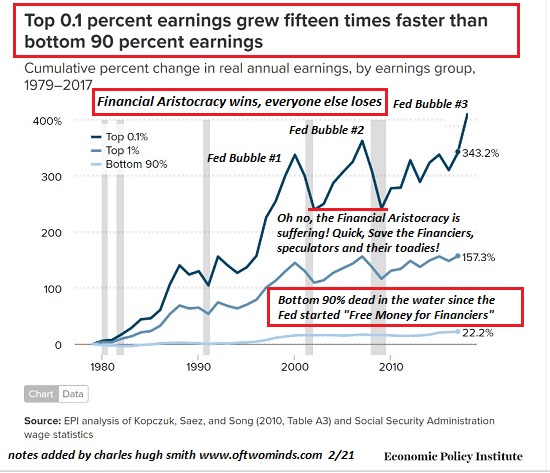
My recent posts have focused on the systemic financial risks created by Federal Reserve policies that have elevated moral hazard (risks can be taken without consequence) and speculation to levels so extreme that they threaten the stability of the entire financial system.

These risks are well known, though largely ignored in the current speculative frenzy.

But there is another systemic risk which few if any see: the collapse of social cohesion.

President Carter was prescient in his understanding that a nation’s greatest strength is its social cohesion, a cohesion that America’s unprecedented wealth / income / power inequalities has undermined. Consider this excerpt from his 1981 Farewell Address:

“Our common vision of a free and just society is our greatest source of cohesion at home and strength abroad, greater even than the bounty of our material blessings.”

In other words, a nation’s strength flows not just from its material wealth but from its social cohesion–a term for something that is intangible but very real, something that doesn’t lend itself to quantification or tidy definitions.

Here is my definition: Social cohesion is the glue binding the social order; it is the willingness of the citizenry to sacrifice individual gains for the common good.

Social cohesion is the result of the citizenry sharing a common purpose and identity and working toward the common good even at personal cost. Social cohesion arises from a national identity based on shared values and sacrifices.

To maintain social cohesion, opportunities to better their circumstances must be open to all (the social contract of social mobility) and sacrifices must be shared by the entire citizenry. If the privileged elites evade their share of sacrifice, social cohesion is lost and the entire social order unravels.

The glue binding the privileged elites to shared sacrifice is civic virtue, a moral code that demands elites devote a greater share of their own resources to the public good in exchange for their political and financial power.

Though no one dares confess this publicly, America is now a moral cesspool. As a result, the moral legitimacy of the nation’s leadership has been lost. Every nook and cranny of institutionalized America is dominated by self-interest, and much of the economy is controlled by profiteering monopolies and cartels which wield far more political power than the citizenry.

Civic virtue has been lost. What remains is elite self-interest masquerading as civic virtue.

In his Farewell Address, President Carter explained that “The national interest is not always the sum of all our single or special interests. We are all Americans together, and we must not forget that the common good is our common interest and our individual responsibility.”

Social cohesion, civic virtue and moral legitimacy are the foundation of every society, but they are especially important in composite states.

America is a composite state
, composed of individuals holding a wide range of regional, ethnic, religious and class-based identities. The national identity is only one ingredient in a bubbling stew of local, state and regional identities, ethnic, cultural and religious identities, educational/alumni, professional and tradecraft identities, and elusive but consequential class-based identities.

Composite states are intrinsically trickier to rule, as there is no ethnic or cultural identity that unifies the populace. Lacking a national identity that supersedes all other identities, composite states must tread carefully to avoid fracturing into competing regional, ethnic or cultural identities.

Composite states must establish a purpose-based identity that is understood to demand shared sacrifice, especially in crisis. In the U.S., the national purpose has been redefined by the needs of the era, but never straying too far from these core unifying goals: defending the civil liberties of the citizenry from state interference, defending the nation from external aggressors, and serving the common good by limiting the power of special interests and privileged elites.

We’ve failed to limit the power of privileged elites, failed to demand greater sacrifices of the wealthy in exchange for power, and so the moral legitimacy of the regime has been lost. And with the ascendance of self-interest and the elite’s abandonment of sacrifice, social cohesion has been lost.

This loss is reflected in the bitter partisanship, the increasingly Orwellian attempts to control the mainstream and social media narratives, the debauchery of “expertise” as dueling “experts” vie for control, the fraying of social discourse, the substitution of virtue-signaling for actual civic virtue, the institutionalization of white-collar crime (collusion, fraud, embezzlement, etc.), the increasing reliance on Bread and Circuses (stimulus, Universal Basic Income) as real opportunity dissipates, and the troubling rise in shootings, crime, random violence and plummeting marriage and birth rates.

The unraveling of social cohesion has consequences. Once social cohesion unravels, the nation unravels.

What’s the solution?
 At the national level, all that has been lost will have to be restored: civic virtue, moral legitimacy, the social contract of opportunity, shared sacrifice that falls most heavily on the wealthiest and most powerful, and a renewed national purpose centered on serving the common good.

Is such a restoration of moral legitimacy and shared purpose even possible? No one knows. If history is any guide, such a renewal is only possible after the empire of rampant self-interest implodes.

So what do we do in the meantime? Nurture our own social cohesion by living purposefully and sharing sacrifices and bounties with those we trust and admire–those in the lifeboat we chose to join.

When America Became The Roman Empire: Wars, Social turmoil and Economic Decline

America has never been an empire. We may be the only great power in history that had the chance, and refused – preferring greatness to power and justice to glory

George W. Bush

By Timothy Alexander Guzman

Source: Silent Crow News

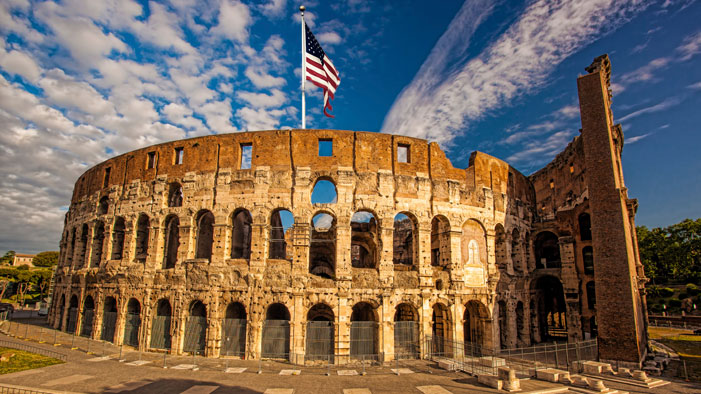
America is the modern-day Rome.  There are many lessons from the collapse of the Roman empire that America can learn from.  The fiasco of Trump supporters and various agitators from the Democratic Party who charged into the US capital building to prevent Joe Biden’s stolen election win from getting certified is the latest sign of America’s societal collapse.  The comparisons between the Roman Republic that became an empire, to America’s rise as a global super power is uncanny.  On various levels from its endless wars for world domination to the creation of a domestic police state, in many ways, America fits the criteria of being an empire.  Historical research suggests that Rome’s rise and their eventual downfall is the most accurate scenario that America is following.

Rome’s downfall was caused by a long chain of events.  It had severe financial problems that was caused by their ongoing wars so they overtaxed its citizenry causing inflation, thus allowing many to escape tax authorities into the countryside.  Then in the second century, there was a labor deficit when Rome’s expansion slowed down due to a shortage of imported slave labor they usually brought back from the lands they conquered resulting in the decline of agriculture and essential commercial production which had an impact on trade.  Rome had rampant corruption and political instability with internal coups of sitting emperors carried out by the Praetorian Guard who were the bodyguards to the sitting emperor as they used their power to decide who would be emperor and who would be removed and sometimes even murdered for political reasons.  All sounds similar to the Military-Industrial Complex and its power it holds within the American establishment.  There was even a civil war within Rome around the third century when the emperor at the time, Alexander Severus had been assassinated by his own troops while at a meeting with his military cabinet so that Maximus Thrax can become the next Roman emperor.  On a global scale, Rome had launched many wars  against Britannia (England/Wales), Gaul (France), Hispania (Spain), Achaea (Greece), Judea (Middle East) and others as its army eventually faltered in the face of its perceived enemies which were many.  Rome eventually collapsed under its own weight.  After the fall of Rome, several major empires throughout history were born including Great Britain, France, Spain, Portugal, the Ottomans and others that followed the same path and all of them eventually collapsed.

Wars for Empire

Washington has committed numerous actions around the world to spread it’s form of democracy through wars of aggression, regime change, covert operations to interfere in foreign elections and economic warfare by using its dollar reserve status to impose sanctions on nations to maintain its global empire.  The US military has troops stationed in more than 80 countries with proactive wars in Afghanistan, Syria and Iraq.  Now they have their sights on the oil-rich country of Venezuela and Iran.  For sure, Washington is getting ready to re-adjust its sights on Syria and Russia if Biden is successfully inaugurated on January 20th.  Today, the American empire has one of the largest military budgets in the world that has surpassed the next 10 countries combined.  Trump’s signed a defense bill worth more than $738 billion for 2020.  Rome also had an expensive military budget where emperors raised taxes that lead to inflation which put a strain on its economy.

Since World War II, the American citizenry became more patriotic especially during the Cold War against communism.  Like America, Rome’s citizenry was also patriotic but it came with a price of high-taxation to fund Rome’s military adventures around the world.  An interesting article from Smithsonian magazine Lessons in the Decline of Democracy From the Ruined Roman Republic’ by Jason Daley explained how Rome became a hegemonic power, but it came with their share of consequences.  Daley said that “the Roman people’s strong sense of patriotism was unique in the Mediterranean world. Like the United States after World War II, Rome, after winning the Second Punic War in 201 B.C. (the one with Hannibal and the elephants), became the world’s hegemon” and that “it lead to a massive increase in their military spending, a baby boom, and gave rise to a class of super-wealthy elites that were able to use their money to influence politics and push their own agendas”  which sounds like what’s happening in Washington D.C. today.  Wars of conquest and maintaining an army to defend its borders due to barbarian attacks put pressure on the Roman bureaucracy so it increased taxes on the people.

Washington always manages to find enough funds to support its Military-Industrial Complex and its continuous wars of destruction.  They manage to bail out the billionaires, its American corporations and institutions through the Federal Reserve bank’s printing press who basically creates money out of thin air.  The Federal Reserve and the government then puts the burden on the American people by raising taxes and creating inflation to support America’s wars abroad while poverty is increasing at home.  Military spending was a priority for Rome who disregarded public housing for its citizens or abandoned the maintenance and upkeep of its crumbling roads and aqueducts as the ‘super-wealthy elites’ became more influential in politics. In America, there is crumbling infrastructure problem where airports, bridges, roads and subways such as the New York City mass transit system is practically falling apart.

As time went by, the citizens of Rome had lost faith in their government as the social and economic impact of being a hegemonic power became problematic so many chose not to defend the empire due to government mismanagement of resources.  What is interesting is that Rome recruited solders from what was called “unemployed city mobs” or even foreigners who were looking for ways to earn money even if it meant going to war and risking their lives.  Similarly, in America, there has been a “poverty draft”,  meaning the military either drafted people up to the time of the Vietnam war or they recruited people from mostly impoverished neighborhoods while promising them a world of benefits and bonuses which most never do receive.  The wealthy elites almost never join the US military as they recruit men from poor or middle class backgrounds and newly arrived immigrants with promises of citizenship and other benefits for them and their families if of course they come back home in one piece.  There have been cases of immigrants who fought in U.S. wars abroad were still deported back to their countries of origin.

The Economics of Empire

During Rome’s last days, farming was literally done with forced slave labor on large estates called latifundia’s owned by ultra rich landowners.  The average farmer in Rome had to pay workers, so they could not compete.  Farmers could not produce the goods as cheaply and more efficiently as the rich landowners so they had to sell their farms and lay-off their workers creating massive unemployment levels because there were no jobs left.  High levels of crime and corruption also took hold in Rome.  Rome had depended on humans and animals for labor intensive purposes, but failed to find or even create new technologies to produce new goods efficiently.

In America, the automotive industry was once competitive, but today they cannot compete with Germany, Japan, South Korea and others who produce better quality cars.  The closure of manufacturing companies that produced goods and services have been shipped to other countries including China, Indonesia and others has impacted the middle class who depended on those jobs have joined the ranks of the unemployed.  With Washington’s thirst for war, high levels of unemployment and poverty are increasing across the nation where cities and towns are going bankrupt and breadlines are becoming the norm.  Investments in crucial industries and reducing government taxes on small businesses and manufacturers will give American companies an opportunity to produce better products, to create jobs and to compete economically.  But like Rome, America is interested in war and conquest, not in producing quality products such as televisions, appliances and cars it needs to compete internationally with the exception of its high tech companies such as Apple, Microsoft and others.

As the Federal Reserve Bank continues to print money to support the powers that be and give peanuts to the masses, they will cause inflation.  The dollar will lose its value.  Rome famously clipped coins adding less value to its purchasing power for its population causing inflationary prices in food and other necessities.

History Is Repeating Itself

Past empires usually destroyed themselves from within followed by fighting endless wars and imposing economic policies that impoverished its people leading to social and moral decay.  In Rome, alcoholism was a major problem, America has an opioid problem killing tens of thousands of people annually since the problem began.  Before the opioids crisis, they (America) had a heroin and crack epidemics that destroyed many communities.

Empires past and present should be thrown into the dustbins of history.  Peace and prosperity with respect to cultural and political differences should be the norm between all nations, but the global elites or the world order is the problem.  Rome collapsed due to its foreign and domestic wars that eventually lead to its social and moral decline while it slowly destroyed its own economy are the same policies that are pursued by Washington today.

The social turmoil between Democrat and Republican cultists in America will lead to some form of civil war coupled with a fragile economy followed by the consequences of the of Covid-19 lockdowns that will have a guaranteed policy of endless money printing no matter who sits at the White House.  All will have a devastating impact on the American people for decades to come.  There will also be a coming war on any of the following countries including Syria, Lebanon (Hezbollah) that will set the stage for a possible devastating wider war with Iran, Russia and China reflects on the reality that America resembles the Roman empire who chose the same path of self-destruction.

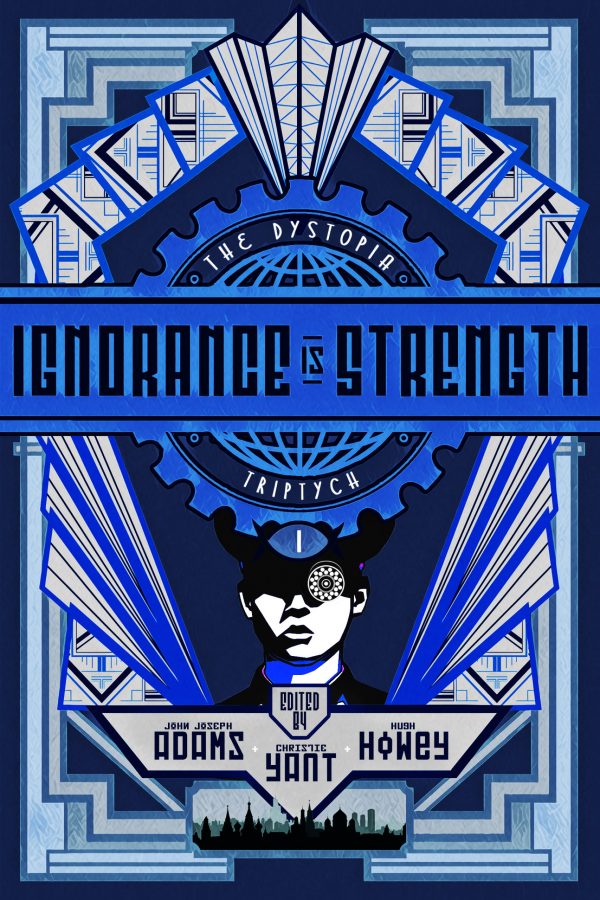
Dystopia Isn’t Sci-Fi—for Me, It’s the American Reality

Cadwell Turnbull is a contributing author of The Dystopia Triptych. Photograph: Broad Reach Publishing

By Cadwell Turnbull

Source: Wired

Imagine a city where a group of people have managed against all odds to carve out prosperity for themselves, at least for a little while. These people used to be owned by other people. Now, they are permitted freedom, but only so much, subject to the whims of the once-masters.

Prosperity is a dangerous thing for the oppressed. It is a dry hot day in a forest bound to catch fire. And so, eventually, there is spark. A teenage boy assaults a teenage girl of the once-master class in an elevator, or so the story is told. Truth doesn’t matter here. A story is enough. The once-masters want justice, which means all the once-slaves must be punished. Men, women, and children are dragged from their homes and shot, their stores and houses bombed or burned. The exact number of dead will remain uncertain, the story buried for so long that people will watch it in a television show almost a century later and mistake the dramatization of the event for pure fiction.

Imagine another city where the once-slaves are told they are getting treatment for a devastating illness, when they are in fact receiving a placebo. Imagine four decades of this lie, the originally infected passing on this disease to their spouses, their children, so that the once-masters can study the long-term effects of the disease on people they don’t consider fully human.

Imagine these cities are part of a great nation. The once-slaves are tired of their second-class citizenship so they begin a movement for justice and equity. This movement is met with a violent backlash. The once-slaves are attacked by dogs, blasted by hoses. Their churches are burned, their institutions subject to random acts of retaliation by the once-masters. Their activists are monitored. Their leaders are jailed or assassinated. There are victories, but even after the successes, once-slaves are shot down in the street for minor offenses or looking “suspicious.” Their neighborhoods are over-policed. Their children are denied quality education. Many of them are sent to prison, where they work for pennies or for nothing. But it isn’t called slavery. It is treated as coincidence that this forced labor disproportionately affects the oppressed class, the once-slaves.

These are the makings of dystopian fictions, and yet many in America don’t need to imagine them. It is their reality. However, most Americans would not call America a dystopia.

If the edges are filed off, the names of places and events changed, a few injustices amplified, Americans can pretend the sorts of things that happen in dystopias don’t happen in their backyards. They can call it fiction, create enough distance to make themselves comfortable with their country’s own sins. But this doesn’t change the fact that the American experience is dystopian for many marginalized people. And like in any dystopia, real or imagined, it is up to all Americans to recognize this storyline, imagine a better society outside of the current reality, and then work toward it. Otherwise, America consents to a normal that is grotesque.

I read my first dystopia in high school. As a teenager, 1984 terrified the hell out of me. I didn’t read it as a warning, but as a mirror to my own experience. I identified with the protagonist Winston Smith’s feeling that something was deeply wrong with his society and the overwhelming sense of helplessness that followed. In college, I read my first utopia. The Dispossessed, by Ursula K. Le Guin, in every sense, was an antidote to that despair I felt when reading 1984.

And then, many years later, I read “The Day Before the Revolution,” the prequel short story to The Dispossessed, and found in it the practical application of the novel’s revolutionary ideas. The story is beautifully quiet. It follows Odo, the founder of the radical movement at the heart of The Dispossessed, as she goes through her day and remembers important moments in her political and personal journey. Le Guin prefaced “The Day Before the Revolution” with a brief definition of the Odonian belief system: “Odonianism is anarchism … its principal and moral-practical theme is cooperation (solidarity, mutual aid). It is the most idealistic, and to me the most interesting, of all political theories.”

To be clear, the Odonians are not perfect. They are resistant to change and have allowed other forms of institutional privilege to develop and calcify in their society. But, because they believe in their utopia and have lived their lives in accordance with that belief, they’ve managed to build a reasonably just and equitable society

And this is where, in life just as in science fiction, a distinction must be made. A just and equitable society is not the same as a perfect one. I’d argue that everyone would benefit if we defined utopia as a move toward justice and equity, and not just the state of perfection. But in America, especially in discussions about social justice, “just” and “perfect” are treated as synonymous objectives. And because perfect is never attainable, justice, too, becomes out of reach. Under this framing, injustice becomes normal, oppression is realistic, and any move towards justice and equity must come from struggle. A disturbing unspoken belief is born from this framing, that marginalized people will never receive full humanity because a just society is not possible. By failing to recognize the dystopia, and dismissing the possibility of a utopia, America has resigned itself to its current, dark narrative.

As a result, in America, universal social welfare is too costly and politically unfeasible, while trillion-dollar corporate bailouts and endless wars go unquestioned. Police and prison reform are aimed towards harm reduction for marginalized communities, instead of daring to imagine a society where these institutions are mostly unnecessary. In American discourse, a society can’t take care of all its citizens or remedy the causes of crime.

In a society where injustice is normalized, justice becomes a goal that can only be achieved through sacrifice—tragedy becomes currency, a thing to be used, not prevented. It takes decades of confirmed police brutality before America considers even the most minor reforms. This is not by accident. Black and brown bodies have been the fuel used to drive this society towards slightly lesser states of injustice since the very beginning. The oppressed have always paid the price for progress.

And yet, Americans have never shown this kind of defeatism when it comes to technological advancements. When this nation decided to go to the moon, it was framed in terms of “How do we get there?” not “Is this possible?” And no one ever said, “This rocket may only get half-way to the moon, but first many must die.”

Americans once oblivious to the dystopia are waking up. That’s good. But the price of waking up should be considered, and the lives sacrificed to incrementalism must be mourned. It is easy for a pragmatist to ask for incremental change when the current reality favors them. But pragmatism hits differently when it is forced at gunpoint. Every loss on the way to justice is a collective sin, because it was decided that the road must be long and the oppressed must struggle for every inch.

Do not normalize the losses happening right now because of the gains. Assume where America has always been is a tragedy. What is done in hell isn’t romantic; sacrificing bodies to dystopia isn’t beautiful. As I write this, people protesting brutality are dying at the hands of law enforcement. No one should pay for progress with their life. And it isn’t naive to believe every member of society should have a healthy, empowering, and fulfilling time on earth. The ones that have suffered deserve nothing less than faith in that possibility. This moment may provide a way out of dystopia, but there has to be a collective reckoning with the dystopian aspects of American society as well as the cruel price of progress repeatedly placed on the backs of the oppressed. Through solidarity there is a way out of these bitter realities, but the way there must be just if the destination is to be just.

In science fiction there is a notion that the universe is filled with possible worlds just waiting for humanity to come settle. It has some of its more troubling roots in manifest destiny, but also in hope, and the idea that better worlds are possible. But what if this corner of Earth could be that imagined place? Imagine a better world right here, instead of elsewhere. The price is in going all the way, doing all the work, believing all the work can be done. That’s the only way to get to the moon. Human beings have to believe it exists.