Humanity doesn’t just need to escape from the mental prison of imperial indoctrination. It needs to escape from the heart prison as well.
I’m always talking here about the need to fight empire propaganda to help the public awaken to the fact that everything we’ve been trained to believe about the world is a lie, because that insight taking root in sufficient numbers would be the first step toward the revolutionary changes our world so desperately needs.
But large numbers of people opening their eyes to the reality of mass-scale psychological manipulation by the powerful would by itself be insufficient, because people need not only to see the truth — they also need to care.
Realizing the depravity and immense human suffering the US-centralized empire is responsible for creates an opportunity to respond to this insight with horror and begin resisting it — but it is only an opportunity. At that juncture it’s still possible for someone to realize that we’re not being told the truth about what’s happening in the world, but decide to play along with the lies anyway, either because the existing world order has made them wealthy, or because they are too indoctrinated with support for western power structures, or because they ideologically support Israel, or because they’re afraid of the changes and upheaval that would come with an overturning of the status quo, or because they are intellectually and morally lazy, or some other selfish reason.
Realizing that you’ve been indoctrinated into accepting a pernicious status quo unlocks an important door within yourself, but just because that door is opened doesn’t mean you have to walk through it. Walking through it requires another kind of awakening — an awakening of the heart.
Really no amount of knowledge or intellectual insight will ever set us free as a species in and of itself. You could upload the sum total of human knowledge into the brain of everyone on earth — including even government secrets that aren’t public knowledge — but unless this is accompanied by a collective opening of the heart, it wouldn’t make any difference. Unless people can find it within themselves to care deeply about the horrific things our rulers have been doing to our fellow human beings, no amount of knowledge about those things will catalyze real change.
And there are plenty of people who know but don’t care. The most powerful government agencies in the world are run by people who know terrible secrets about our ruling power structures that we ordinary members of the public are not allowed to know, but because their loyalty is to the empire and not to humanity, they don’t care about the moral implications of what they know or the human suffering the empire is responsible for.
So the demand of this moment in history is not just to understand, but to care. Not just to know what’s wrong with the world, but to feel it. Not just to awaken on the level of the head, but to awaken on the level of the heart as well. Not just to value our own personal understanding, but to value humanity as a whole.
Knowledge of the truth can lead to a profound compassion for the victims of the globe-spanning power structure which rules over us and a determination to oppose its cruelty — that’s why said power structure pours so much energy into keeping everyone propagandized. But it doesn’t necessarily need to lead to such compassion. The light of truth can stop its expansion at the gates of the heart, unless there’s some willingness from somewhere deep inside us to throw those gates open.
Ultimately humanity just needs to wake up, on every level. We need to liberate ourselves from the shackles of propaganda. We need to liberate ourselves from the shackles on our hearts. We need to liberate ourselves from the shackles of the ego. We need to liberate ourselves from the shackles of the dualistic perspective which obfuscates the oneness of all of reality from our vision.
That’s what’s being asked of us at this juncture. To wake all the way up and become a conscious species. That’s the only way we’ll ever be able to move about on this planet in a healthy and harmonious way.
And we’ll either rise to the occasion or we won’t. We’ll either wake up, or we’ll destroy ourselves. I believe we have the freedom as a species to go either way.
When exposing a crime is treated as committing a crime, you are being ruled by criminals.
In the current governmental climate, obeying one’s conscience and speaking truth to the power of the police state can easily render you an “enemy of the state.”
The government’s list of so-called “enemies of the state” is growing by the day.
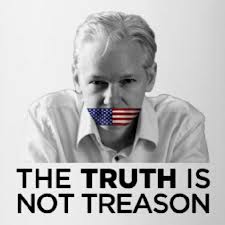
Wikileaks founder Julian Assange is merely one of the most visible victims of the police state’s war on dissidents and whistleblowers.
Five years ago, on April 11, 2019, police arrested Assange for daring to access and disclose military documents that portray the U.S. government and its endless wars abroad as reckless, irresponsible, immoral and responsible for thousands of civilian deaths.
Included among the leaked materials was gunsight video footage from two U.S. AH-64 Apache helicopters engaged in a series of air-to-ground attacks while American air crew laughed at some of the casualties. Among the casualties were two Reuters correspondents who were gunned down after their cameras were mistaken for weapons and a driver who stopped to help one of the journalists. The driver’s two children, who happened to be in the van at the time it was fired upon by U.S. forces, suffered serious injuries.
There is nothing defensible about crimes such as these perpetrated by the government.
When any government becomes almost indistinguishable from the evil it claims to be fighting—whether that evil takes the form of war, terrorism, torture, drug trafficking, sex trafficking, murder, violence, theft, pornography, scientific experimentations or some other diabolical means of inflicting pain, suffering and servitude on humanity—that government has lost its claim to legitimacy.
These are hard words, but hard times require straight-talking.
It is easy to remain silent in the face of evil.
What is harder—what we lack today and so desperately need—are those with moral courage who will risk their freedoms and lives in order to speak out against evil in its many forms.
Throughout history, individuals or groups of individuals have risen up to challenge the injustices of their age. Nazi Germany had its Dietrich Bonhoeffer. The gulags of the Soviet Union were challenged by Aleksandr Solzhenitsyn. America had its color-coded system of racial segregation and warmongering called out for what it was, blatant discrimination and profiteering, by Martin Luther King Jr.
And then there was Jesus Christ, an itinerant preacher and revolutionary activist, who not only died challenging the police state of his day—namely, the Roman Empire—but provided a blueprint for civil disobedience that would be followed by those, religious and otherwise, who came after him.
Indeed, it is fitting that we remember that Jesus Christ—the religious figure worshipped by Christians for his death on the cross and subsequent resurrection—paid the ultimate price for speaking out against the police state of his day.
A radical nonconformist who challenged authority at every turn, Jesus was a far cry from the watered-down, corporatized, simplified, gentrified, sissified vision of a meek creature holding a lamb that most modern churches peddle. In fact, he spent his adult life speaking truth to power, challenging the status quo of his day, and pushing back against the abuses of the Roman Empire.
Much like the American Empire today, the Roman Empire of Jesus’ day had all of the characteristics of a police state: secrecy, surveillance, a widespread police presence, a citizenry treated like suspects with little recourse against the police state, perpetual wars, a military empire, martial law, and political retribution against those who dared to challenge the power of the state.
For all the accolades poured out upon Jesus, little is said about the harsh realities of the police state in which he lived and its similarities to modern-day America, and yet they are striking.
Secrecy, surveillance and rule by the elite. As the chasm between the wealthy and poor grew wider in the Roman Empire, the ruling class and the wealthy class became synonymous, while the lower classes, increasingly deprived of their political freedoms, grew disinterested in the government and easily distracted by “bread and circuses.” Much like America today, with its lack of government transparency, overt domestic surveillance, and rule by the rich, the inner workings of the Roman Empire were shrouded in secrecy, while its leaders were constantly on the watch for any potential threats to its power. The resulting state-wide surveillance was primarily carried out by the military, which acted as investigators, enforcers, torturers, policemen, executioners and jailers. Today that role is fulfilled by the NSA, the FBI, the Department of Homeland Security and the increasingly militarized police forces across the country.
Widespread police presence. The Roman Empire used its military forces to maintain the “peace,” thereby establishing a police state that reached into all aspects of a citizen’s life. In this way, these military officers, used to address a broad range of routine problems and conflicts, enforced the will of the state. Today SWAT teams, comprised of local police and federal agents, are employed to carry out routine search warrants for minor crimes such as marijuana possession and credit card fraud.
Citizenry with little recourse against the police state. As the Roman Empire expanded, personal freedom and independence nearly vanished, as did any real sense of local governance and national consciousness. Similarly, in America today, citizens largely feel powerless, voiceless and unrepresented in the face of a power-hungry federal government. As states and localities are brought under direct control by federal agencies and regulations, a sense of learned helplessness grips the nation.
Martial law. Eventually, Rome established a permanent military dictatorship that left the citizens at the mercy of an unreachable and oppressive totalitarian regime. In the absence of resources to establish civic police forces, the Romans relied increasingly on the military to intervene in all matters of conflict or upheaval in provinces, from small-scale scuffles to large-scale revolts. Not unlike police forces today, with their martial law training drills on American soil, militarized weapons and “shoot first, ask questions later” mindset, the Roman soldier had “the exercise of lethal force at his fingertips” with the potential of wreaking havoc on normal citizens’ lives.
Acts of civil disobedience by insurrectionists. Much like the Roman Empire, the American Empire has exhibited zero tolerance for dissidents such as Julian Assange, Edward Snowden and Chelsea Manning who exposed the police state’s seedy underbelly. Jesus was also branded a political revolutionary starting with his attack on the money chargers and traders at the Jewish temple, an act of civil disobedience at the site of the administrative headquarters of the Sanhedrin, the supreme Jewish council.
Military-style arrests in the dead of night. Jesus’ arrest account testifies to the fact that the Romans perceived Him as a revolutionary. Eerily similar to today’s SWAT team raids, Jesus was arrested in the middle of the night, in secret, by a large, heavily armed fleet of soldiers. Rather than merely asking for Jesus when they came to arrest him, his pursuers collaborated beforehand with Judas. Acting as a government informant, Judas concocted a kiss as a secret identification marker, hinting that a level of deception and trickery must be used to obtain this seemingly “dangerous revolutionist’s” cooperation.
Torture and capital punishment. In Jesus’ day, religious preachers, self-proclaimed prophets and nonviolent protesters were not summarily arrested and executed. Indeed, the high priests and Roman governors normally allowed a protest, particularly a small-scale one, to run its course. However, government authorities were quick to dispose of leaders and movements that appeared to threaten the Roman Empire. The charges leveled against Jesus—that he was a threat to the stability of the nation, opposed paying Roman taxes and claimed to be the rightful King—were purely political, not religious. To the Romans, any one of these charges was enough to merit death by crucifixion, which was usually reserved for slaves, non-Romans, radicals, revolutionaries and the worst criminals.
Jesus was presented to Pontius Pilate “as a disturber of the political peace,” a leader of a rebellion, a political threat, and most gravely—a claimant to kingship, a “king of the revolutionary type.” After Jesus is formally condemned by Pilate, he is sentenced to death by crucifixion, “the Roman means of executing criminals convicted of high treason.” The purpose of crucifixion was not so much to kill the criminal, as it was an immensely public statement intended to visually warn all those who would challenge the power of the Roman Empire. Hence, it was reserved solely for the most extreme political crimes: treason, rebellion, sedition, and banditry. After being ruthlessly whipped and mocked, Jesus was nailed to a cross.
Jesus—the revolutionary, the political dissident, and the nonviolent activist—lived and died in a police state. Any reflection on Jesus’ life and death within a police state must take into account several factors: Jesus spoke out strongly against such things as empires, controlling people, state violence and power politics. Jesus challenged the political and religious belief systems of his day. And worldly powers feared Jesus, not because he challenged them for control of thrones or government but because he undercut their claims of supremacy, and he dared to speak truth to power in a time when doing so could—and often did—cost a person his life.
Unfortunately, the radical Jesus, the political dissident who took aim at injustice and oppression, has been largely forgotten today, replaced by a congenial, smiling Jesus trotted out for religious holidays but otherwise rendered mute when it comes to matters of war, power and politics.
Yet for those who truly study the life and teachings of Jesus, the resounding theme is one of outright resistance to war, materialism and empire.
What a marked contrast to the advice being given to Americans by church leaders to “submit to your leaders and those in authority,” which in the American police state translates to complying, conforming, submitting, obeying orders, deferring to authority and generally doing whatever a government official tells you to do.
Will we follow the path of least resistance—turning a blind eye to the evils of our age and marching in lockstep with the police state—or will we be transformed nonconformists “dedicated to justice, peace, and brotherhood”?
As Martin Luther King Jr. reminds us in a powerful sermon delivered 70 years ago, “This command not to conform comes … [from] Jesus Christ, the world’s most dedicated nonconformist, whose ethical nonconformity still challenges the conscience of mankind.”
Ultimately, as I make clear in my book Battlefield America: The War on the American People and in its fictional counterpart The Erik Blair Diaries, this is the contradiction that must be resolved if the radical Jesus—the one who stood up to the Roman Empire and was crucified as a warning to others not to challenge the powers-that-be—is to be an example for our modern age.
At this point in history the most effective way for westerners to fight the empire and build support for revolutionary change is to undermine public support for western status quo systems and institutions. One does this by using every means at their disposal to help people see that the power structures which rule over us don’t serve our interests, and that they are in fact profoundly evil and destructive.
It takes a flash of insight for a westerner to be able to really see the perniciousness of the US-centralized empire in all its blood-soaked glory. This is because westerners spend their entire lives marinating in empire propaganda from childhood, which has normalized and manufactured their consent for the murderous, exploitative and oppressive power structure we live under. The current status quo is all they’ve ever known, and the idea that something better might be possible is alien to them.
Teachers of spiritual enlightenment point students to the truth of their being in as many ways as possible in an effort to facilitate a flash of insight into reality. The reason they do that rather than saying the same words over and over again from day to day is because everyone’s mind is unique and ever-changing, and what knocks things home for one student one day will just be useless noise to another student who will later pop open at something completely different. The receptivity to insight varies from person to person.
Similarly, a westerner who’s been swimming in empire propaganda their whole life won’t have their moment of insight into the depraved nature of the empire until something lands for them that they are personally receptive to. Someone who isn’t receptive to words about the exploitative and ecocidal nature of global capitalism may be receptive to the threat of rapidly expanding censorship, surveillance, police militarization and other authoritarian measures. Someone who is unbothered by the empire’s nuclear brinkmanship with Russia and looming war with China may have their heart broken and their worldview changed when shown what is happening in Gaza.
What triggers the opening of one pair of eyes may not be what triggers another. A kickboxer doesn’t throw only overhand rights because that happened to be what scored a knockout in his last bout, he throws a diverse array of strikes in varied combinations at all levels to overwhelm the defenses of his opponent and land a fight-ending blow. When fighting the empire, one needs to bring the same approach.
Look for fresh opportunities to show westerners that the mass media are deceiving and propagandizing them to get them questioning their assumptions about what they’ve been told about the world. Look for fresh opportunities to show them evidence that the US war machine is the most murderous and destructive force on this planet. Look for fresh opportunities to show them how status quo systems create a far less beneficial society and a far less healthy world than what we could have under different systems. You never know what could be the one thing that snaps somebody’s eyes open.
Nothing you do on this front is wasted effort. All positive changes in human behavior at any level are always preceded by an expansion of awareness, so anything you can do to help bring awareness to the reality of our situation is energy well spent. Any effort you make to shove human consciousness toward the light of truth in even the tiniest way has a beneficial effect on our species.
So use whatever tools you can to make that happen. Have conversations, attend demonstrations, put up signs and stickers, write, tweet, make podcasts, make videos — whatever you find effective for you. Just make sure you’re coming at this thing from as many angles as possible, because diversifying your attacks on the mind control machine is the best way to get through its defenses.
In our current technocratic society, it’s incredibly rare to meet someone who is genuinely free. The erosion of the Consent Decrees of 1948—which allowed media conglomerates to own and control movie theaters—drastically altered the landscape of film and video production, further destabilizing an already unlevel playing field between corporate interests, content creators, and consumers. The trickle-down economics Reagan touted in his 1981 tax act proved only to favor the affluent, further alienating independent creators who were frozen out of a livelihood through economic blacklisting, a perpetual attack that continues to this day. Bill Clinton’s elimination of the fin-syn rules that required television networks to source 35% of their content from independent producers only helped to continue this trend into the new millennium, and soon the mainstream movie and TV-consuming public was offered a slate of hegemonic programming supplied by a monopoly rule.
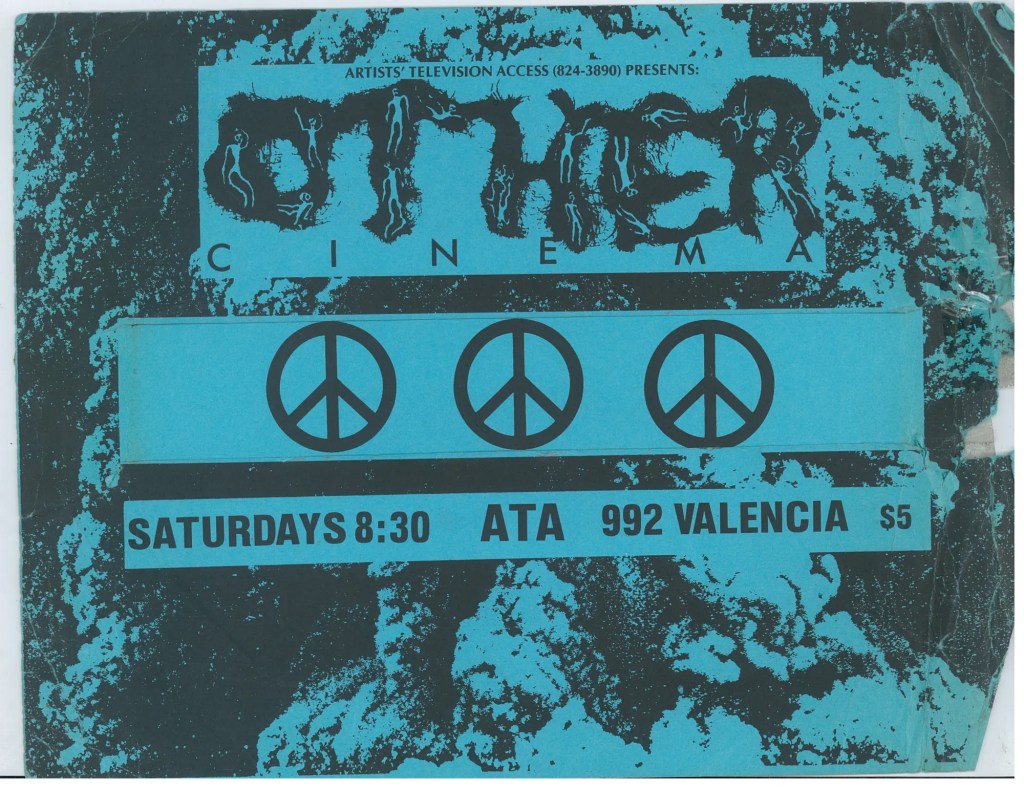
With traditional avenues of information exchange becoming more restricted, pockets of transgressive media resistance—inspired by the countercultural film and video collectives of the ‘60s and ‘70s—gained 501(c)(3) non-profit status in 1980s America. These artist-run community organizations championed alternative educational perspectives on media literacy and performance, such as Artists’ Television Access in the Mission District of San Francisco, California. Operating under the umbrella of this community space exists a cinematic collective with a subversive trajectory: a film screening series and analog archive curated from the margins of mainstream media and acceptable art practice. Under the stewardship of underground filmmaker and curator Craig Baldwin, Other Cinema stands as the vanguard of Baldwin’s personal artistic conviction—what he calls “cinema povera,” an anti-capitalist filmmaking creed where artists only use the materials at their disposal to create art. Combine this practice with an ethos of media archeology and mixed-media collage that predates our current remix culture activities and what’s generated is an exhibition calendar of the modern avant-garde—a thirty-six week screening schedule projecting experimental film and video to the masses. Every Saturday night, cartoons, B movies, and commercials hold equal ground with industrial, educational, documentary, personal essay, and public domain/orphan films, bringing together numerous artists and filmmakers from around the world under one cinematic ceiling for close to 40 years.
Specific details surrounding the origins of Other Cinema are hard to quantify, partially due to the vastly prolific yet oddly cryptic career of founder Craig Baldwin. Born into a self-admitted 1950s middle-class existence in the Sacramento suburb of Carmichael, California, Baldwin spent his teenage years nurturing a ravenous curiosity for subversive cultures and media. During high school, he was often at the local Towne Theater enjoying the latest midnight show of underground programming, absorbing the cinematic combustion of the ‘60s experimental scene led by filmmakers like George Kuchar and Bruce Conner, who as a teacher would later kick Baldwin out of his film class while attending San Francisco State University. In college Baldwin also indulged in subterranean films such as Peter Watkins’s 1966 pseudo-doc The War Game and exploitation flicks like Paul Bartel’s 1975 sci-fi dystopian romp Death Race 2000. Forming a fascination with film exhibition, Baldwin worked as a projectionist at several movie houses throughout the city, navigating the film worlds through an eclecticism of arthouse, exploitation, pornography, and political activism—including contributing programming and film services to El Salvador Film and Video Projects for the Salvadoran solidarity movement of northern California. His early activism with the artistic political action collective the Urban Rats saw him and his cohorts reclaim San Francisco’s urban landscape through adverse possession or “squatter’s rights,” which allowed Baldwin to experiment with expanded cinema performance, such as projecting film in abandoned buildings and other derelict dwellings.
This direct approach towards genre and social action speaks to Baldwin’s personal opposition towards the status quo, an attitude that not only informs Other Cinema’s motion picture programming but also Baldwin’s own filmmaking forays. His early experiments with Super 8 film—such as the prototypical culture jam/situationist prank Stolen Movie—bled into his 16mm attacks on advertising, consumerism, and colonialism in Wild Gunmanand RocketKitKongoKit before gaining maximum velocity with his Dexedrine-driven, countermyth conspiracy report Tribulation 99. Making up the pure found footage/collage aesthetic of his filmography until introducing live-action performance into the mix with his films !O No Coronado!, Spectres of the Spectrum, and Mock Up on Mu, these early works draw heavily from Baldwin’s now massive archive of analog film. Housed beneath the Artists’ Television Access property, this subterranean scroll of marginalized media is continuously rescued from the bowels of civilization’s ever evolving technological burden and given new purpose. The shift from film in the 1970s to magnetic tape in the 1980s saw major institutions overhaul their audio/visual collections in favor of more economical video formats, sending reels of celluloid to the dumpsters and landfills. Much like the Dadaists of the early 20th century avant-garde, whose use of appropriation and photomontage expressed anti-bourgeois protest through their art, Baldwin and company salvaged these bastardized works from material obscurity and celebrated their ephemeral nature through collage and remix. These hybrid works of the late 20th century serve as precursor to many of our current 21st century new media innovations, resulting in the continued radicalization of modern artistic folklore, such as the mashups and supercuts of Everything Is Terrible! and the radical anti-authoritarian statements of the sister collective Soda Jerk.
Baldwin and Other Cinema’s defense of the diminished and discarded extends not only to the physical media he interacts with but to the audience he exhibits for. Maintaining a dialectical attitude, Baldwin expresses both respect and disrespect towards film genre and classification by spinning one off the other and forming new categories. Each screening is meant to give equal weight to diverse voices and provoke participation amongst attendees—an ethos Baldwin codified with his underground screening series The RAD, The MAD & The BAD while programming film events for Artists’ Television Access during the organization’s formative years. A protean yet practical film genre grouping system sorted through three major categories stripped of pretense and soaked in punk rock colloquialism, each selection was designated its own time slot on Wednesdays and Saturdays with those represented creating a continuity across each section:
The RAD: showcasing political and social action films
The MAD: mad genius or auteur cinema
The BAD: psychotronic themes of horror/sci-fi/exploitation
Defying the unspoken restraint behind many traditional classification systems that favor a false high-brow aesthetic to an honest low-brow sensibility, The RAD, The MAD & The BAD crossed the cultural demarcation line with an egalitarian stance towards genre representation, allowing for serious discussion about what constitutes a film’s importance and its commodification within society. More importantly, it displayed through example that poor production doesn’t always mean poor quality, and films created on the margins of capital contain a certain cultural influence and accessibility that corporate-backed productions can only hope to afford or inspire.
The authentic response audiences gave towards the weekly film schedule at Artists’ Television Access saw the prestigious San Francisco Cinematheque approach Baldwin to bring his street sensibility to their precocious crowd with Sub-Cinema, a RAD, MAD & BAD-inspired program that ran over the course of 1985. The creation of other pop-up programs like Anti-Films and Eyes of Hell inspired Baldwin to consolidate his film selections under his own programming umbrella, and soon the ethos that fueled The RAD, The MAD & The BAD manifested itself into the physical embodiment of Baldwin’s own psyche and practice with the foundation of Other Cinema.
If the RAD, MAD & BAD helped bring acceptance to the concept of marginalization in film selection and exhibition during the 1980s, the programming behind Other Cinema built upon this provocation by introducing new alternative voices from the microcinema scene of the 1990s. One of the forefronts of this new cinematic experience, Other Cinema became a home for a subculture of film using and reusing old and new technologies to create future underground works, with filmmakers and exhibitors from across the country like Sam Green, Martha Colburn, Greta Snider, Bill Daniel, Orgone Cinema, 3Ton Cinema, and “others” coalescing to this space like the children of Hamelin to the Pied Piper’s whimsical flute. Many of these groups and individuals appear in Baldwin’s upcoming career monograph Avant to Live!, a 500-page treatise detailing his cinematic trajectory in the media arts.
The decline of physical media coupled with our perpetual progression towards a digital state continues to divide us, with some championing the virtual realm and its democratization of new technologies and others questioning its effect on the human experience and how we interact with each other. The popularity of streaming services continues to challenge the economic longevity of physical media, forcing film formats into a wave of obsolescence. Despite this, Craig Baldwin and Other Cinema rise against the tide with an analog assault of expanded cinema every Saturday night. Filmmakers on the fringe and maverick media archeologists with an overwhelming responsibility to film history, yet hamstrung by a lack of resources, congregate at Other Cinema to embrace the struggle in an ever evolving motion picture renaissance. It’s a form of masochism one needs to make it on this side of the art world—the “masochism of the margins,” as Baldwin often says. It takes pain and sacrifice to live here, yet the psychic rewards far outweigh the material loss.
Andy Prisbylla is an underground filmmaker and exhibitor from the rust belt apocalypse of Steel City, PA. His screening series SUBCINEMA showcases subterranean movies and art through digital programming and live pop-up events. Find out more through Letterboxd and Mastodon.
For nearly three months, Israel has enjoyed virtual impunity for its atrocious crimes against the Palestinian people. That changed on December 29 when South Africa, a state party to the Genocide Convention, filed an 84-page application in the International Court of Justice (ICJ, or World Court) alleging that Israel is committing genocide in Gaza.
South Africa’s well-documented application alleges that “acts and omissions by Israel … are genocidal in character, as they are committed with the requisite specific intent … to destroy Palestinians in Gaza as a part of the broader Palestinian national, racial and ethnical group” and that “the conduct of Israel — through its State organs, State agents, and other persons and entities acting on its instructions or under its direction, control or influence — in relation to Palestinians in Gaza, is in violation of its obligations under the Genocide Convention.”
Israel is mounting a full-court press to prevent an ICJ finding that it’s committing genocide in Gaza. On January 4, the Israeli Foreign Ministry instructed its embassies to pressure politicians and diplomats in their host countries to make statements opposing South Africa’s case at the ICJ.
In its application, South Africa cited eight allegations to support its contention that Israel is perpetrating genocide in Gaza. They include:
(1) Killing Palestinians in Gaza, including a large proportion of women and children (approximately 70 percent) of the more than 21,110 fatalities and some appear to have been subjected to summary execution;
(2) Causing serious mental and bodily harm to Palestinians in Gaza, including maiming, psychological trauma, and inhuman and degrading treatment;
(3) Causing the forced evacuation and displacement of about 85 percent of Palestinians in Gaza — including children, the elderly and infirm, and the sick and wounded. Israel is also causing the massive destruction of Palestinian homes, villages, towns, refugee camps and entire areas, which precludes the return of a significant proportion of the Palestinian people to their homes;
(4) Causing widespread hunger, starvation and dehydration to the besieged Palestinians in Gaza by impeding sufficient humanitarian assistance, cutting off sufficient food, water, fuel and electricity, and destroying bakeries, mills, agricultural lands and other means of production and sustenance;
(5) Failing to provide and restricting the provision of adequate clothing, shelter, hygiene and sanitation to Palestinians in Gaza, including 1.9 million internally displaced persons. This has compelled them to live in dangerous situations of squalor, in conjunction with routine targeting and destruction of places of shelter and killing and wounding of persons who are sheltering, including women, children, the elderly and the disabled;
(6) Failing to provide for or ensure the provision of medical care to Palestinians in Gaza, including those medical needs created by other genocidal acts that are causing serious bodily harm. This is occurring by direct attacks on Palestinian hospitals, ambulances and other healthcare facilities, the killing of Palestinian doctors, medics and nurses (including the most qualified medics in Gaza) and the destruction and disabling of Gaza’s medical system;
(7) Destroying Palestinian life in Gaza, by destroying its infrastructure, schools, universities, courts, public buildings, public records, libraries, stores, churches, mosques, roads, utilities and other facilities necessary to sustain the lives of Palestinians as a group. Israel is killing whole families, erasing entire oral histories and killing prominent and distinguished members of society;
(8) Imposing measures intended to prevent Palestinian births in Gaza, including through reproductive violence inflicted on Palestinian women, newborns, infants and children.
South Africa cited myriad statements by Israeli officials that constitute direct evidence of an intent to commit genocide:
“Gaza won’t return to what it was before. We will eliminate everything,” Israel’s Defense Minister Yoav Gallant said. “If it doesn’t take one day, it will take a week. It will take weeks or even months, we will reach all places.”
Avi Dichter, Israel’s Minister of Agriculture, declared, “We are now actually rolling out the Gaza Nakba,” a reference to the 1948 ethnic cleansing of Palestinians to create the state of Israel.
“Now we all have one common goal — erasing the Gaza Strip from the face of the earth,” Nissim Vaturi, the Deputy Speaker of the Knesset and Member of the Foreign Affairs and Security Committee proclaimed.
Israel’s Strategy to Defeat South Africa’s Case at the ICJ
Israel and its chief patron, the United States, understand the magnitude of South Africa’s ICJ application, and they are livid. Israel usually thumbs its nose at international institutions, but it is taking South Africa’s case seriously. In 2021, when the International Criminal Court launched an investigation into Israel’s alleged war crimes in Gaza, Israel firmly rejected the legitimacy of the probe.
“Israel generally doesn’t participate in such proceedings,” Prof. Eliav Lieblich, an international law expert at Tel Aviv University, told Haaretz. “But this isn’t a UN inquiry commission or the International Criminal Court in the Hague, whose authority Israel rejects. It’s the International Court of Justice, which derives its powers from a treaty Israel joined, so it can’t reject it on the usual grounds of lack of authority. It’s also a body with international prestige.”
A January 4 cable from the Israeli Foreign Ministry says that Israel’s “strategic goal” is that the ICJ reject South Africa’s request for an injunction to suspend Israel’s military action in Gaza, refuse to find that Israel is committing genocide in Gaza and rule that Israel is complying with international law.
“A ruling by the court could have significant potential implications that are not only in the legal world but have practical bilateral, multilateral, economic, security ramifications,” the cable states. “We ask for an immediate and unequivocal public statement along the following lines: To publicly and clearly state that YOUR COUNTRY rejects the outragest [sic], absurd and baseless allegations made against Israel.”
The cable instructs Israeli embassies to urge diplomats and politicians at the highest levels “to publicly acknowledge that Israel is working [together with international actors] to increase the humanitarian aid to Gaza, as well as to minimize damage to civilians, while acting in self defense after the horrible October 7th attack by a genocidal terrorist organization.”
“The State of Israel will appear before the ICJ at The Hague to dispel South Africa’s absurd blood libel,” Prime Minister Benjamin Netanyahu spokesperson Eylon Levy declared. South Africa’s application is “without legal merit and constitutes a base exploitation and contempt of court,” he said.
Israel is pulling out all the stops, including disingenuous accusations of “blood libel,” an anti-Semitic trope that erroneously accuses Jews of the ritual sacrifice of Christian children.
“How tragic that the rainbow nation that prides itself on fighting racism will be fighting pro-bono for anti-Jewish racists,” Levy added ironically. He made the astonishing claim that Israel’s military campaign to destroy Hamas in Gaza is designed to prevent the genocide of the Jews.
As the old adage goes, when you’re being run out of town, get in front of the crowd and act like you’re leading the parade.
The Biden regime rose to defend its staunch ally Israel. U.S. National Security Council spokesman John Kirby lambasted South Africa’s ICJ application as “meritless, counterproductive and completely without any basis in fact whatsoever.” Kirby claimed, “Israel is not trying to wipe the Palestinian people off the map. Israel is not trying to wipe Gaza off the map. Israel is trying to defend itself against a genocidal terrorist threat,” echoing Israel’s preposterous assertion.
Kirby’s contention that Israel is trying to prevent genocide is particularly absurd, given the fact that since Hamas killed 1,200 Israelis on October 7, Israeli forces have killed at least 22,100 Gazans, about 9,100 of whom are children. At least 57,000 persons have been wounded and at least 7,000 are reported missing. Untold numbers of people are trapped beneath the rubble.
Provisional Measures Against Israel Can Have Immediate Impact
South Africa is requesting that the ICJ order provisional measures (interim injunction) in order to “protect against further, severe and irreparable harm to the rights of the Palestinian people under the Genocide Convention.” South Africa is also asking the court “to ensure Israel’s compliance with its obligations under the Genocide Convention not to engage in genocide, and to prevent and to punish genocide.”
The provisional measures South Africa seeks include ordering Israel to “immediately suspend its military operations in and against Gaza” and to cease and desist from killing and causing serious bodily or mental harm to Palestinians, inflicting on them conditions of life intended to destroy them in whole or in part, and imposing measures to prevent Palestinian births. South Africa wants the ICJ to order that Israel stop expelling and forcibly displacing Palestinians and depriving them of food, water, fuel, and medical supplies and assistance.
The judicial arm of the United Nations, the ICJ is composed of 15 judges elected for a nine-year term by the UN General Assembly and the Security Council. It is not a criminal tribunal like the International Criminal Court; rather it resolves disputes between countries.
If a party to the Genocide Convention believes that another party has failed to comply with its obligations, it can take that country to the ICJ to determine its responsibility. This was done in the case of Bosnia v. Serbia, in which the Court found that Serbia violated its duties to prevent and punish genocide under the Convention.
The obligations in the Genocide Convention are erga omnes partes, that is, obligations owed by a state towards all the states parties to the Convention. The ICJ has stated, “In such a convention the contracting States do not have any interests of their own; they merely have, one and all, a common interest, namely, the accomplishment of those high purposes which are the raison d’être of the Convention.”
Article 94 of the UN Charter says that all parties to a dispute must comply with the decisions of the ICJ and if a party fails to do so, the other party may go to the UN Security Council for the enforcement of the decision.
An average ICJ case from start to finish can last several years (it was nearly 15 years from the time that Bosnia first filed its case against Serbia in 1993 to the issuance of the final judgment on the merits in 2007). However, a case can have an immediate impact. The filing of a case in the ICJ sends a strong message to Israel that the international community will not tolerate its actions and seeks to hold it accountable.
Provisional measures can be issued quickly. For example, the ICJ ordered measures 19 days after the Bosnian case was initiated. Provisional measures are binding on the party against whom they are ordered, and compliance with them can be monitored by both the ICJ and the Security Council.
Judgments on the merits rendered by the ICJ in disputes between parties are binding on the parties involved. Article 94 of the United Nations Charter provides that “each Member of the United Nations undertakes to comply with the decision of [the Court] in any case to which it is a party.” The judgments of the court are final; there is no appeal.
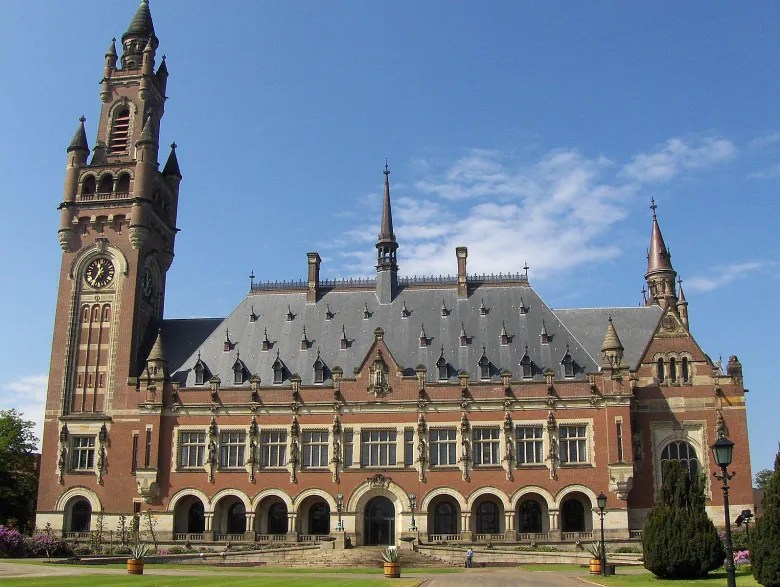
Public hearings on South Africa’s request for provisional measures will take place on January 11 and 12 at the ICJ which is located in the Peace Palace in The Hague, Netherlands. The hearings will be livestreamed from 4:00-6:00 a.m. Eastern/1:00-3:00 a.m. Pacific on the Court’s website and on UN Web TV. The court could order provisional measures within a week after the hearings.
Other States Parties to the Genocide Convention Can Join South Africa’s Case
Other states parties to the Genocide Convention can either request permission to intervene in the case filed by South Africa or file their own applications against Israel in the ICJ. South Africa’s application identifies several countries that have referred to Israel’s genocide in Gaza. They include Algeria, Bolivia, Brazil, Colombia, Cuba, Iran, Palestine, Türkiye, Venezuela, Bangladesh, Egypt, Honduras, Iraq, Jordan, Libya, Malaysia, Namibia, Pakistan and Syria.
On January 5, Quds News Network tweeted, “Jordan’s minister of Foreign Affairs, Ayman Safadi, announces that his country backs South Africa’s genocide case against Israel in the ICJ. He added that the Jordanian government is working on a legal file to follow up on the case. Turkey, Malaysia, and the Organization of Islamic Cooperation (OIC) had announced that they back the case too.”
The coalition contends, “Declarations of Intervention in support of South Africa’s invocation of the Genocide Convention against Israel will increase the likelihood that a positive finding of the crime of genocide will be enforced by the United Nations such that actions will be taken to end all acts of genocide and those who are responsible for the acts will be held accountable.”
During the first week of January, delegations of “grassroots diplomats,” spearheaded by CODEPINK, World Beyond War and RootsAction, mounted a campaign across the United States urging nations to submit Declarations of Intervention in South Africa’s case against Israel in the ICJ. Activists traveled to 12 cities, visiting UN missions, embassies and consulates from Colombia, Pakistan, Bolivia, Bangladesh, the African Union, Ghana, Chile, Ethiopia, Turkey, Belize, Brazil, Denmark, France, Honduras, Ireland, Spain, Greece, Mexico, Italy, Haiti, Belgium, Kuwait, Malaysia and Slovakia.
“This is the rare case where collective social pressure urging governments to support the South African case can be a sharp turning point for Palestine,” said Lamis Deek, a Palestinian attorney based in New York, whose firm convened the Palestinian Assembly for Liberation’s Commission on War Crimes Justice, Reparations, and Return. “We need more states to file supporting interventions — and we need the court to feel the watchful eye of the masses so as to withstand what will be extreme U.S. political pressure on the Court.”
Suzanne Adely, president of the National Lawyers Guild, noted, “The increasing global isolation of Israel and the U.S. and their European allies is an indicator that this is a key moment for popular movements to move their governments in the direction of taking these steps and being on the right side of history.” Indeed, since October 7, millions of people throughout the world have marched, protested and demonstrated in support of Palestinian liberation.
RootsAction and World Beyond War have created a template that organizations and individuals can use to urge other states parties to the Genocide Convention to file a Declaration of Intervention in South Africa’s genocide case against Israel in the ICJ.
“When the song of the angels is stilled, when the star in the sky is gone, when the kings and princes are home, when the shepherds are back with their flocks, the work of Christmas begins: to find the lost, to heal the broken, to feed the hungry, to release the prisoner, to rebuild the nations, to bring peace among the people, to make music in the heart.”—Howard Thurman, theologian and civil rights activist
The Christmas story of a baby born in a manger is a familiar one.
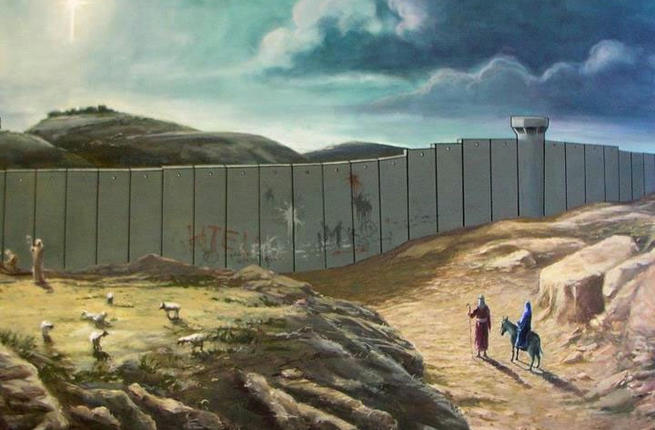
The Roman Empire, a police state in its own right, had ordered that a census be conducted. Joseph and his pregnant wife Mary traveled to the little town of Bethlehem so that they could be counted. There being no room for the couple at any of the inns, they stayed in a stable (a barn), where Mary gave birth to a baby boy, Jesus. Warned that the government planned to kill the baby, Jesus’ family fled with him to Egypt until it was safe to return to their native land.
Yet what if Jesus had been born 2,000 years later?
What if, instead of being born into the Roman police state, Jesus had been born at this moment in time? What kind of reception would Jesus and his family be given? Would we recognize the Christ child’s humanity, let alone his divinity? Would we treat him any differently than he was treated by the Roman Empire? If his family were forced to flee violence in their native country and sought refuge and asylum within our borders, what sanctuary would we offer them?
Those nativity scenes were a pointed attempt to remind the modern world that the narrative about the birth of Jesus is one that speaks on multiple fronts to a world that has allowed the life, teachings and crucifixion of Jesus to be drowned out by partisan politics, secularism, materialism and war, all driven by a manipulative shadow government called the Deep State.
The modern-day church has largely shied away from applying Jesus’ teachings to modern problems such as war, poverty, immigration, etc., but thankfully there have been individuals throughout history who ask themselves and the world: what would Jesus do?
What would Jesus—the baby born in Bethlehem who grew into an itinerant preacher and revolutionary activist, who not only died challenging the police state of his day (namely, the Roman Empire) but spent his adult life speaking truth to power, challenging the status quo of his day, and pushing back against the abuses of the Roman Empire—do about the injustices of our modern age?
Dietrich Bonhoeffer asked himself what Jesus would have done about the horrors perpetrated by Hitler and his assassins. The answer: Bonhoeffer was executed by Hitler for attempting to undermine the tyranny at the heart of Nazi Germany.
Martin Luther King Jr. asked himself what Jesus would have done about America’s warmongering. The answer: declaring “my conscience leaves me no other choice,” King risked widespread condemnation as well as his life when he publicly opposed the Vietnam War on moral and economic grounds.
Even now, despite the popularity of the phrase “What Would Jesus Do?” (WWJD) in Christian circles, there remains a disconnect in the modern church between the teachings of Christ and the suffering of what Jesus in Matthew 25 refers to as the “least of these.”
Yet this is not a theological gray area: Jesus was unequivocal about his views on many things, not the least of which was charity, compassion, war, tyranny and love.
After all, Jesus—the revered preacher, teacher, radical and prophet—was born into a police state not unlike the growing menace of the American police state. When he grew up, he had powerful, profound things to say, things that would change how we view people, alter government policies and change the world. “Blessed are the merciful,” “Blessed are the peacemakers,” and “Love your enemies” are just a few examples of his most profound and revolutionary teachings.
When confronted by those in authority, Jesus did not shy away from speaking truth to power. Indeed, his teachings undermined the political and religious establishment of his day. It cost him his life. He was eventually crucified as a warning to others not to challenge the powers-that-be.
Can you imagine what Jesus’ life would have been like if, instead of being born into the Roman police state, he had been born and raised in the American police state?
Consider the following if you will.
Had Jesus been born in the era of the America police state, rather than traveling to Bethlehem for a census, Jesus’ parents would have been mailed a 28-page American Community Survey, a mandatory government questionnaire documenting their habits, household inhabitants, work schedule, how many toilets are in your home, etc. The penalty for not responding to this invasive survey can go as high as $5,000.
Instead of being born in a manger, Jesus might have been born at home. Rather than wise men and shepherds bringing gifts, however, the baby’s parents might have been forced to ward off visits from state social workers intent on prosecuting them for the home birth. One couple in Washington had all three of their children removed after social services objected to the two youngest being birthed in an unassisted home delivery.
Then again, had Jesus’ parents been undocumented immigrants, they and the newborn baby might have been shuffled to a profit-driven, private prison for illegals where they first would have been separated from each other, the children detained in make-shift cages, and the parents eventually turned into cheap, forced laborers for corporations such as Starbucks, Microsoft, Walmart, and Victoria’s Secret. There’s quite a lot of money to be made from imprisoning immigrants, especially when taxpayers are footing the bill.
From the time he was old enough to attend school, Jesus would have been drilled in lessons of compliance and obedience to government authorities, while learning little about his own rights. Had he been daring enough to speak out against injustice while still in school, he might have found himself tasered or beaten by a school resource officer, or at the very least suspended under a school zero tolerance policy that punishes minor infractions as harshly as more serious offenses.
Had Jesus disappeared for a few hours let alone days as a 12-year-old, his parents would have been handcuffed, arrested and jailed for parental negligence. Parents across the country have been arrested for far less “offenses” such as allowing their children to walk to the park unaccompanied and play in their front yard alone.
Rather than disappearing from the history books from his early teenaged years to adulthood, Jesus’ movements and personal data—including his biometrics—would have been documented, tracked, monitored and filed by governmental agencies and corporations such as Google and Microsoft. Incredibly, 95 percent of school districts share their student records with outside companies that are contracted to manage data, which they then use to market products to us.
Jesus’ anti-government views would certainly have resulted in him being labeled a domestic extremist. Law enforcement agencies are being trained to recognize signs of anti-government extremism during interactions with potential extremists who share a “belief in the approaching collapse of government and the economy.”
While traveling from community to community, Jesus might have been reported to government officials as “suspicious” under the Department of Homeland Security’s “See Something, Say Something” programs. Many states, including New York, are providing individuals with phone apps that allow them to take photos of suspicious activity and report them to their state Intelligence Center, where they are reviewed and forwarded to law-enforcement agencies.
Viewed by the government as a dissident and a potential threat to its power, Jesus might have had government spies planted among his followers to monitor his activities, report on his movements, and entrap him into breaking the law. Such Judases today—called informants—often receive hefty paychecks from the government for their treachery.
Had Jesus used the internet to spread his radical message of peace and love, he might have found his blog posts infiltrated by government spies attempting to undermine his integrity, discredit him or plant incriminating information online about him. At the very least, he would have had his website hacked and his email monitored.
Had Jesus attempted to feed large crowds of people, he would have been threatened with arrest for violating various ordinances prohibiting the distribution of food without a permit. Florida officials arrested a 90-year-old man for feeding the homeless on a public beach.
Had Jesus spoken publicly about his 40 days in the desert and his conversations with the devil, he might have been labeled mentally ill and detained in a psych ward against his will for a mandatory involuntary psychiatric hold with no access to family or friends. One Virginia man was arrested, strip searched, handcuffed to a table, diagnosed as having “mental health issues,” and locked up for five days in a mental health facility against his will apparently because of his slurred speech and unsteady gait.
Without a doubt, had Jesus attempted to overturn tables in a Jewish temple and rage against the materialism of religious institutions, he would have been charged with a hate crime. More than 45 states and the federal government have hate crime laws on the books.
Had anyone reported Jesus to the police as being potentially dangerous, he might have found himself confronted—and killed—by police officers for whom any perceived act of non-compliance (a twitch, a question, a frown) can result in them shooting first and asking questions later.
Rather than having armed guards capture Jesus in a public place, government officials would have ordered that a SWAT team carry out a raid on Jesus and his followers, complete with flash-bang grenades and military equipment. There are upwards of 80,000 such SWAT team raids carried out every year, many on unsuspecting Americans who have no defense against such government invaders, even when such raids are done in error.
Instead of being detained by Roman guards, Jesus might have been made to “disappear” into a secret government detention center where he would have been interrogated, tortured and subjected to all manner of abuses. Chicago police have “disappeared” more than 7,000 people into a secret, off-the-books interrogation warehouse at Homan Square.
Indeed, as I make clear in my book Battlefield America: The War on the American People and in its fictional counterpart The Erik Blair Diaries, given the nature of government then and now, it is painfully evident that whether Jesus had been born in our modern age or his own, he still would have died at the hands of a police state.
Thus, as we draw near to Christmas with its celebration of miracles and promise of salvation, we would do well to remember that what happened in that manger on that starry night in Bethlehem is only the beginning of the story. That baby born in a police state grew up to be a man who did not turn away from the evils of his age but rather spoke out against it.
My title is redundant for a reason, since the root of the word radical is the Latin word, radix, meaning root. For I mean to show how the use and misuse of language, its history or etymology, and ours as etymological animals as the Spanish philosopher José Ortega y Gassett called us, is crucial for understanding our world, a world once again teetering on the edge of a world war that will almost inexorably turn nuclear as events are proceeding. If our language is corrupted, as it surely is, and political propaganda flourishes as a result, the correct use of our language and the meaning of words becomes an obligation of anyone who uses them – that is, everyone, especially writers.
The United States government exists to wage war. In its present form, it would crumble without it; and in its present form, it will crumble with it. Only a radical structural change will prevent this. For war-making is at the core of its budget, its raison d’être – 816.7 billion for the Fiscal 2023 National Defense Authorization Act alone – a deficit-financed sum that tells only part of the story. This amount that finances the military-industrial complex and its blood money is for a country that has never been invaded, is bordered by friendly neighbors, and is oceans away from the multitude of countries its leaders attack and call our enemies. The U.S. wages wars around the world because killing is its lifeblood, its structural essence.
In writing of the misuse of language, George Orwell wrote, “It becomes ugly and inaccurate because our thoughts are foolish, but the slovenliness of our language makes it easier for us to have foolish thoughts.” So with these words Orwell slyly places us within the enigma of the chicken and the egg, a conundrum or paradox that relates to my theme in a weird way, but which I will directly ignore.
By radical I do not mean the widespread political usage as in radical-right or radical-left or radical meaning one who plays the role through dress or demeanor. I am using the word in its primary meaning – a radical is one who is rooted in the earth, which means everyone. Everyone therefore is mortal, human not a god, and comes from the earth and returns to it. Everyone is radical in this sense, although they may try to deny it. And the more one feels alive the more one senses one will die and doesn’t like the thought, therefore many tamp down their aliveness in order to reduce their fear of death. The best way to do this is to disappear into the crowd, to become a conventional person. To act as if one didn’t know that one’s political leaders were in love with death and killing and were not obedient cogs in a vast systemic killing machine. Maybe the unconscious assumption is that these “leaders” can kill death for you by killing vast numbers of people and make you feel someone has control of this thing called death.
Rabbi Abraham Joshua Heschel, who stood strongly against the Vietnam War and marched with Dr. Martin Luther King, Jr., put the basic sense of radical well when he said:
Our goal should be to live life in radical amazement. . . . get up in the morning and look at the world in a way that takes nothing for granted. Everything is phenomenal; everything is incredible; never treat life casually. To be spiritual is to be amazed.
To be radically amazed that we exist is to be equally amazed that we will die. And there’s the rub.
Yesterday I got in our car and drove away to meet a journalist friend. It was evening and my wife had previously used the car. I had just spent time following all the dreadful news about the massive slaughter by Israel of Palestinians in Gaza, including the death of more than 3,000 children whose numbers are climbing fast. Visions of those children and babies played havoc with my spirits, and I kept thinking of my own children and the love and tenderness that comes with being a parent. A musical cd that my wife had been listening to started playing. The case was on the console. It was Sacred Arias by Andrea Bocelli. He of the majestic voice was singing Silent Night. I was overwhelmed with tears by his passionate words:
Silent night! Holy night! All is calm, all is bright round yon Virgin Mother and Child, Holy infant so tender and mild, sleep in Heavenly peace! sleep in Heavenly peace!
I saw nights in Gaza as Israeli bombs burst and shattered everyone and everything to bits, all the holy infants, the children and adults.
I felt beside myself with grief, a U.S. citizen driving down a safe country road contemplating the savagery of my nation and its support for the Israeli government’s brutality and mass killings of Palestinians for all the world to see on screens everywhere.
I felt ashamed to live in a land where justice is a game reserved for rhetoric alone as it joins in the massacre of the innocent, as it always has, now together with the apartheid Israeli regime.
I thought of all the compromised politicians who pledge their allegiance to the killers, Biden and all his presidential predecessors, now including the aspirant Robert F. Kennedy, Jr., a man with a conscience on many important issues whom I have supported in his quest for the presidency, but a man whose conscience has abandoned him when it comes to the Palestinians, as Scott Ritter has recently documented. I have privately urged Kennedy to reconsider his “unwavering, resolute, and practical” support for the Israeli government following the Gaza breakout of October 7, but to no avail. In fact, I have been trying to get him to withdraw his unconditional support for Israel since the summer when he withdrew his support for Roger Waters, marched with Rabbi Shmuley Boteach in the Israel parade in NYC, and allowed Boteach to say that Sirhan Sirhan had killed his father without correcting him since he knew it was an egregious lie. My failure in this regard deeply saddens me.
I felt betrayed again – perhaps you will call me naïve – as when I was young and last put my trust in voting for a US presidential candidate in 1972. I thought I had learned to radically grasp the systematically corrupt nature of the U.S. warfare state. Now more than three weeks have passed and Bobby Kennedy has remained silent, only to ask for our prayers for the victims of the mass shooting in Maine. For the Palestinians, not a word. Although he considers the Israeli-Palestinian situation complicated, there is nothing complicated about genocide; it doesn’t necessitate long analyses and discussions with advisers. The facts of the Israeli slaughter of Palestinians in Gaza are evident for all to see, if they wish. Bobby Kennedy has turned away. And I have now sadly turned away from him.
I remembered the Gospel words I heard long ago about the fulfillment of the words of the prophet Jeremiah: “A voice was heard in Ramah, sobbing and loudly lamenting: it was Rachel weeping for her children, refusing to be comforted because they were no more.” But this time it is not the Jewish Rachel, for Herod has assumed the name Netanyahu and his U.S. allies, and the weeping ones are Palestinian mothers and fathers. Nothing can justify such slaughter, not the terrible killings of innocent Israelis on October 7 that I denounce; not the fear that the birth of messengers of peace might strike into Herod/Netanyahu’s heart – nothing! Seventy-five years of ethnic cleansing of Palestinians continues apace. The Jewish child Jesus, the radical preacher of love and peace for all people, didn’t die on a private cross, nor do the Palestinians. So it goes.
I thought of the indescribable sweet wonder of holding your baby in your arms while realizing how many Palestinian parents have been holding their dead children in theirs. Rage welled up in me at the obscenity of those who support this and those who shut their eyes to it and those who remain silent.
I realized that as a Christian I am baptized into the human family, not some special in-group, which is the opposite of Jesus’s message. Every child is holy and innocent and to massacre them is evil. And to remain silent as it happens is to be complicit in evil.
I remembered how these many ongoing weeks of terror started and thought of a poem that is succinctly apposite: Harlem by Langston Hughes:
What happens to a dream deferred?
Does it dry up like a raisin in the sun? Or fester like a sore- and then run? Does it stink like rotten meat? Or crust and sugar over- like a syrupy sweet?
Maybe it just sags like a heavy load.
Or does it explode?
And I thought that he could have omitted that final question mark because we have our answer, then and now.
Then the music stopped and I arrived at my destination to meet my friend.
Yes, to be radical is to be rooted in the earth and to realize all people are part of the human family, each of us made of flesh and blood and therefore sisters and brothers deserving of justice, peace, and dignity. But this is just a first step in the grasping of the full dimension of the radical vision. It can end in fluff if a second step is not taken: to use our freedom to uproot ourselves from the conventional government and mass media propaganda and mind control that clouds our understanding of how the world works. This takes study and work and an understanding of the historical and systemic roots of all the alleged “unprovoked” violence that ravages our world.
Thus the existential and socio-historical merge in the radical vision that allows us to grasp the structures of evil and our personal responsibility.
Today that obligation is clear: To oppose the Israeli genocide of the Palestinians.
The U.S. Mainstream Media Is Almost Always Pro-War
In the “liberal” New York Times today, I saw an article on “Putin’s forever war” that has the following short synopsis: “Vladimir Putin wants to lead Russians into a civilizational conflict with the West far larger than Ukraine. Will they follow him?”
Is this true? Does Putin truly seek a “civilizational conflict” with the West? One that’s “far larger” than the Ukraine war? It doesn’t seem likely. Russian forces have struggled in Ukraine. Already embroiled in a destructive regional war that’s become somewhat of a quagmire, why would Putin seek to widen it? Is Putin always the aggressor, the bad guy, and the West always the aggrieved party, the good guys, holding back a “red storm rising”? I thought the West won the Cold War more than 30 years ago.
It’s remarkable how easy it is to get alarmist articles about Russia or China published in the U.S. mainstream media (MSM). Wars and rumors of war dominate. The West is always portrayed as the defender of democracy; other countries such as China and Russia are portrayed as threats to civilization and its “rules-based order.” Strictly speaking, this is simplistic, one-sided, propaganda.
Back in 2017, I wrote about how difficult it is in the MSM to read honest accounts of war. In the runup to the Iraq War in 2003, critical voices were actively suppressed and punished. Back then, I focused my article on MSNBC, which like the New York Times is allegedly “liberal.” At “liberal” newspapers and networks, shouldn’t America expect at least a few critical critiques of war narratives? The answer here is “no,” as I wrote here:
Jesse Ventura, former governor of Minnesota (1999-2003), was a hot media commodity as the Bush/Cheney administration was preparing for its invasion of Iraq in 2003. Ventura, a U.S. Navy veteran who gained notoriety as a professional wrestler before he entered politics, was both popular and outspoken. MSNBC won the bidding war for his services in 2003, signing him to a lucrative three-year contract to create his own show – until, that is, the network learned he was against the Iraq war. Ventura’s show quickly went away, even as the network paid him for three years to do nothing.
I heard this revealing story from a new podcast, the TARFU Report, hosted by Matt Taibbi and Alex Pareene. By his own account, Jesse Ventura was bought off by the network, which back then was owned by General Electric, a major defense contractor that was due to make billions of dollars off the war.
Of course, Ventura was hardly the only war critic to run afoul of GE/NBC. Phil Donahue, the famous talk show host, saw his highly rated show cancelled when he gave dissenters and anti-war voices a fair hearing. Ashleigh Banfield, a reporter who covered the Iraq war, gave a speech in late April 2003 that criticized the antiseptic coverage of the war (extracts to follow below). For her perceptiveness and her honesty, she was reassigned and marginalized, demoted and silenced.
So much for freedom of speech, as well as the press.
As Phil Donahue said, his show “wasn’t good for business.” NBC didn’t want to lose ratings by being associated with “unpatriotic” elements when the other networks were waving the flag in support of the Iraq war. In sidelining Ventura and Donahue, NBC acted to squelch any serious dissent from the push for war, and punished Ashleigh Banfield in the immediate aftermath of the war for her honesty in criticizing the coverage shown (and constructed) by the mainstream media, coverage that was facilitated by the U.S. military and rubber-stamped by corporate ownership.
Speaking of Banfield’s critique, here are some excerpts from her speech on Iraq war coverage in April 2003. Note that her critique remains telling for all U.S. media war coverage since then:
That said, what didn’t you see [in U.S. media coverage of the Iraq war]? You didn’t see where those bullets landed. You didn’t see what happened when the mortar landed. A puff of smoke is not what a mortar looks like when it explodes, believe me. There are horrors that were completely left out of this war. So was this journalism or was this coverage? There is a grand difference between journalism and coverage, and getting access does not mean you’re getting the story, it just means you’re getting one more arm or leg of the story. And that’s what we got, and it was a glorious, wonderful picture that had a lot of people watching and a lot of advertisers excited about cable news. But it wasn’t journalism, because I’m not so sure that we in America are hesitant to do this again, to fight another war, because it looked like a glorious and courageous and so successful terrific endeavor, and we got rid of a horrible leader: We got rid of a dictator, we got rid of a monster, but we didn’t see what it took to do that.
With admirable honesty, Banfield spoke of the horrific face of war at Kansas State Univ. in 2003. Soon after her speech, she was demoted (Image courtesy of KSU)
I can’t tell you how bad the civilian casualties were. I saw a couple of pictures. I saw French television pictures, I saw a few things here and there, but to truly understand what war is all about you’ve got to be on both sides…
Some of the soldiers, according to our embeds had never seen a dead body throughout the entire three-week campaign. It was like Game Boy. I think that’s amazing in two different ways. It makes you a far more successful warrior because you can just barrel right along but it takes away a lot of what war is all about, which is what I mentioned earlier. The TV technology took that away too. We couldn’t see where the bullets landed. Nobody could see the horrors of this so that we seriously revisit the concept of warfare the next time we have to deal with it.
I think there were a lot of dissenting voices before this war about the horrors of war, but I’m very concerned about this three-week TV show and how it may have changed people’s opinions. It was very sanitized.
This TV show [Iraq invasion coverage] that we just gave you was extraordinarily entertaining, and I really hope that the legacy that it leaves behind is not one that shows war as glorious, because there’s nothing more dangerous than a democracy that thinks this is a glorious thing to do.
War is ugly and it’s dangerous, and in this world the way we are discussed on the Arab street, it feeds and fuels their hatred and their desire to kill themselves to take out Americans. It’s a dangerous thing to propagate…
I’m hoping that I will have a future in news in cable, but not the way some cable news operators wrap themselves in the American flag and patriotism and go after a certain target demographic, which is very lucrative. You can already see the effects, you can already see the big hires on other networks, right wing hires to chase after this effect, and you can already see that flag waving in the corners of those cable news stations where they have exciting American music to go along with their war coverage.
Nothing has changed since Banfield’s powerful critique. Indeed, the networks have only hired more retired generals and admirals to give “unbiased” coverage of America’s military actions. And reporters and “journalists” like Brian Williams have learned too. Recall how Williams cheered the “beautiful” U.S. Tomahawk cruise missiles as they were launched against Syria earlier this year [2017].
It’s not just that U.S. media coverage actively suppresses dissent of America’s wars: it passively does so as well, which is arguably more insidious. Any young journalist with smarts recognizes the way to get ahead is to be a cheerleader for U.S. military action, a stenographer to the powerful. Being a critic leads to getting fired (like Donahue); demoted and exiled (like Banfield); and, in Ventura’s case, if you can’t be fired or demoted or otherwise punished, you can simply be denied air time.
When you consider that billions and billions of dollars are at stake, whether in weapons sales or in advertising revenue tied to ratings, none of this is that surprising. What’s surprising is that so few Americans know about how pro-authority and uncritical U.S. media coverage of war and its makers is. If anything, the narrative is often that the U.S. media is too critical of the military to the detriment of the generals. Talk about false narratives and alternative facts!
America’s greed-wars persist for many reasons, but certainly a big one is the lack of critical voices in the mainstream media. Today’s journalists, thinking about their career prospects and their salaries (and who is ultimately their boss at corporate HQ), learn to censor themselves, assuming they have any radical thoughts to begin with. Some, like Brian Williams, even learn how to stop worrying and love the beautiful bombs.
[After I wrote this in 2017, I added this comment at the site.]
One thing that troubles me is the mindset that criticism of America’s wars undermines the troops. That it could even be a form of betrayal. This mindset is very dangerous. It not only protects the decisions and actions of those at the highest levels of the military and government. It acts to prolong wars and to endanger the lives of the troops (and of their “enemies” as well).
During the Iraq war, I recall instances of U.S. troops speaking clearly and frankly against the war. Their voices were heard, yet their advice was not taken. Instead, generals like David Petraeus were trotted out to assure the American people that the war was being won, even if the gains were characterized by weasel words like “fragile” and “reversible.” And so those gains have proved — even so, Petraeus remains in demand, and is still trotted out, now in mufti, to explain how we must stay the course and continue to defer to the military.
There’s a powerful book to be written here, and it should focus in part on the silencing or marginalization of anti-war voices (even those that wear or wore the uniform), even as pro-war elements are given the main stage as the voices of probity and sanity.


 After the Crash