
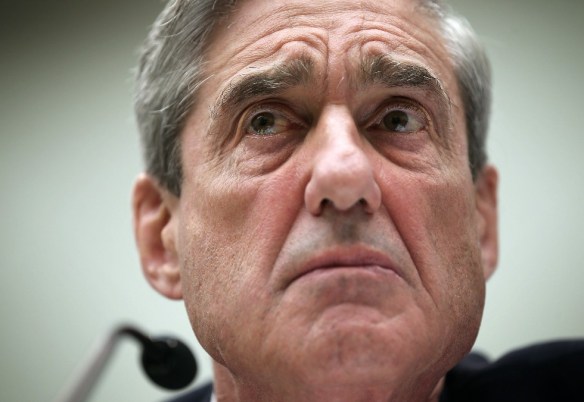
Mueller’s End Game

By Peter Van Buren

Source: We Meant Well

A baby born when Robert Mueller started his investigation would be talking by now. But would she have anything to say?

We last looked at what Mueller had publicly, and what he didn’t have, some ten months ago, and cautioned skepticism that he would prove “collusion.” It’s worth another look now, but we’ll give away the ending: there is still no real evidence of, well, much of anything significant about Russiagate. One thing clear is the investigation seems to be ending. Mueller’s office reportedly even told various defense lawyers it is “tying up loose ends.” The moment to wrap things up is politically right as well; the Democrats will soon take control of the House and it is time to hand this all off to them.

Ten months ago the big news was Paul Manafort flipped; that seems to have turned out to be mostly a bust, as we know now he lied like a rug to the Feds and cooperated with the Trump defense team as some sort of mole inside Mueller’s investigation (a heavily-redacted memo about Manafort’s lies, released by Mueller on Friday, adds no significant new details to the Russiagate narrative.) George Papadopoulos has already been in and out of jail — all of two weeks — for his sideshow role, Michael Avenatti is now a woman beater who is just figuring out he’s washed up, Stormy Daniels owes Trump over $300k in fees after losing to him in court, there is no pee tape, and if you don’t recall how unimportant Carter Page and Richard Gates turned out to be (or even remember who they are), well, there is your assessment of all the hysterical commentary that accompanied them a few headlines ago.

The big reveal of the Michael Flynn sentencing memo on Tuesday was he will likely do no prison time. Everything of substance in the memo was redacted, so there is little insight available. If you insist on speculation, try this: it’s hard to believe something really big and bad happened such that Flynn knew about it but still wasn’t worth punishing for it, and now, a year after he started cooperating with the government, nobody has heard anything about whatever the big deal is. So chances are the redactions focus on foreign lobbying in the U.S.

This week’s Key to Everything is Michael Cohen, the guy who lied out of self-interest for Trump until last week when we learned he is also willing to lie, er, testify against Trump out of self-interest. If you take Cohen’s most recent statements at face value the sum is failed negotiations we all knew about already to build a Trump hotel in Moscow went on a few months longer than originally stated. Meanwhile, the U.S. Attorney’s Office for the Southern District of New York submitted a sentencing memo Friday for Cohen recommending 42 months in jail. In a separate filing, Mueller made no term recommendation but praised Cohen for his “significant efforts to assist the special counsel’s office.” The memos reveal no new information.

Call it as sleazy as you want, but looking into a real estate deal is neither a high crime nor a misdemeanor, even if it’s in Russia. Conspiracy law requires an agreement to commit a crime, not just the media declaiming “Cohen was communicating directly with the Kremlin!” Talking about meeting Russian persons is not a crime, nor is meeting with them. The takeaway this was all about influence buying by the Russkies falls flat. If Putin sought to ensnare Trump, why didn’t he find a way for the deal to actually go through? Mueller has to be able to prove actual crimes by the president, not just twist our underclothes into a weekly conspiratorial knot. For fun, look here at the creative writing needed to even suggest anything illegal. Doesn’t sound like Trump’s on thin ice with hot shoes.

Sigh. It is useful at this point of binge-watching the Mueller mini-series to go back to the beginning.

The origin story for all things Russiagate is a less-than-complete intelligence finding hackers, linked to the Russian government, stole emails from the Democratic National Committee (DNC) in 2016. The details have never been released, no U.S. law enforcement agency has ever seen the server/scene of the crime, and Mueller’s dramatic indictments of said hackers, released as Trump met with Putin in Helsinki, will never be heard of again, or challenged, as none of his defendants will ever leave Russia. Meanwhile, despite contemporaneous denials of the same, it is now somehow accepted knowledge the emails (and Facebook ads!) had some unproven major affect on the election.

The origin story for everything else, that Trump is beholden to Putin for favors granted or via blackmail, is opposition research purchased by the Democrats and carried out by an MI6 operative with complex connectionsinto American intelligence, the salacious Steele Dossier. The FBI, under a Democratic-controlled Justice Department, then sought warrants to spy on the nominated GOP candidate for president, based on evidence paid for by his opponent.

Yet the real origin story for all things Russiagate is the media, inflamed by Democrats, searching for why Trump won (because it can’t be anything to do with Hillary, and “all white people and the Electoral College are racists” just doesn’t hold up.) Their position is Trump must have done something wrong, and Robert Mueller, despitehelping squash a Bush-era money-laundering probe, lying about the Iraq War, and flubbing the post-9/11 anthrax investigation, has been resurrected with Jedi superpowers to find it. It might be collusion with Russia or Wikileaks, or a pee tape, or taxes, all packaged as hard news but reading like Game of Thrones plot speculation. None of that is journalism to be proud of, and it underlies everything Mueller.

As the NYT said in a rare moment of candor, “From the day the Mueller investigation began, opponents of the president have hungered for that report, or an indictment waiting just around the corner, as the source text for an incantation to whisk Mr. Trump out of office and set everything back to normal again.”

The core problem is Mueller just hasn’t found a crime connected with Russiagate someone working for Trump might have committed. His investigation to date hasn’t been a search for the guilty party, Colonel Mustard in the library, but a search for an actual underlying crime, some crime, any crime. All Mueller has uncovered are some old financial misdealing by Manafort and chums that took place before and outside of the Trump campaign, payoffs to Trump’s mistresses which are not in themselves inherently illegal (despite what prosecutors simply assert in the Cohen sentencing report, someone will have to prove to a jury the money was from campaign funds and the transactions were “for the purpose of influencing” federal elections, not say simply “protecting his family from shame.” Cohen’s guilty pleas cannot legally be considered evidence of someone else’s guilt), and a bunch of people lying about unrelated matters.

And that’s the give away to Muller’s final report. There was no base crime as the starting point of the investigation. With Watergate there was the break-in at Democratic National Headquarters. With Russiagate you had… Trump winning the election (remembering the FBI concluded the DNC hack was done by the Russians forever ago, no Mueller needed.)

Almost everything Mueller has, the perjury and lying cases, are crimes he created through the process of investigating. He’s Schroeder’s Box; the crimes only exist when he tries to look at them. Mueller created most of his booked charges by asking questions he already knew the answers to, hoping his witness would lie and commit a new crime literally in front of him. Nobody should be proud of lying, but it seems a helluva way to contest a completed election as Trump enters the third year of his term.

Mueller’s end product, his report, will most likely claim a lot of unsavory things went on. But it seems increasingly unlikely he’ll have evidence Trump worked with Russia to win the election, and even less likely that Trump is now under Putin’s control. If Mueller had a smoking gun we’d be watching impeachment hearings by now.

Instead Mueller will end up concluding some people may have sort of maybe tried to interfere with an investigation into what turned out to be nothing, another “crime” that exists only because there was an investigation to trigger it. He’ll dump that steaming pile of legal ambiguity into the lap of the Democratic House to hold hearings on from now until global warming claims the city of Benghazi and returns it to the sea. Or the 2020 election, whichever comes first.


BONUS:

The uber-point of all this Ocean’s Nineteen-level conspiracy is supposedly so Putin can, whatever, sow dissent in America. Because if he wanted a puppet in the Oval Office it has been a damn poor return on investment — sanctions are still in place, NATO is still on Russia’s border, Montenegro joined NATO, Trump approved arms sales to the Ukraine, RT and Sputnik are sidelined as registered foreign agents, Cold Warrior-like hardliners Bolton and Pompeo are in power, the U.S. just delivered Russia an ultimatum on an arms control treaty that could return some American missiles to Europe, and more. On the plus side, there were those friendly Tweets.

Along the way new journalistic “norms” were created: Trump is too stupid to have made his money, so it must be ill-gotten. Trump did real estate deals in NYC and so is mobbed up. Trump’s taxes (albeit available to the IRS and Treasury for decades, the FBI and Mueller via warrant for years) hide secrets. Meanwhile, everyone in Russia with a few bucks is an oligarch, and everyone who anyone from the Trump side spoke with is “connected to Putin.” Trump doesn’t have lawyers, he has fixers and consigliere.

These tropes allow journalists to communicate in a kind of shorthand with the rubes who still imagine something will happen to annul the 2016 election. They allow each mini-development to appear to be a major event, as in the mind of the media everything is related, and everything accumulative. So a lie about a real estate deal in Russia is HUGE because it has something to do with Russia and see that connects all the dots!

None of that is journalism to be proud of, and it underlies everything Mueller. It is almost sad looking back at the old articles and TV tales to see how excited everyone got — Flynn was indicated! Sessions recused himself! Comey will save us! The Nunes Memo! They all used to matter sooooo much. Outlets like the NYT and WaPo rolled out a “source close to the White House” to comment whatever just happened means Mueller is getting close to nailing Trump. The nutters who took over once cogent places like HuffPo and Salon run “reporting” that reads like Game of Thrones plot speculation. Everybody runs the same headlines: BREAKING: Reports: Sources: Trump Fixer to Flip; Avenatti Says “Orange is the New Black, Buttercup!”

As one writer puts it, “For the last two years the mass media machine has been behaving very, very strangely, and it isn’t getting better, it’s getting worse. Not since the lead-up to the invasion of Iraq have we seen mainstream media outlets trying to shove narratives down our throats so desperately and aggressively.”

How the West eats its children

By Thierry Meyssan

Source: VoltaireNet.org

The cause of Western recession

International relations experienced a profound change with the paralysis of the Soviet Union in 1986, when the State was unable to control the civilian nuclear incident in Tchernobyl [1], then with the revocation of the Warsaw Pact in 1989, when the East German Communist Party [2] destroyed the Berlin Wall, and finally, with the dissolution of the USSR in 1991.

At that time, the President of the United States, George Bush Sr., decided to demobilise one million soldiers and devote the efforts of his country to its own prosperity. He wanted to transform US hegemony within its zone of influence, and expand it into that of the leader of the world, the guarantor of world stability. With that, he laid the foundations for a « New World Order », first of all in the speech he gave side by side with British Prime Minister Margaret Thatcher, at the Aspen Institute (2 August 1990), then during his speech to Congress (11 September 1990), announcing operation « Desert Storm » [3].

The world of the après-Soviet Union is one of free circulation, not only of merchandise, but also world capital, under the unique control of the United States. In other words, the passage from capitalism to financialisation – not the triumphant culmination of free exchange, but an exacerbated form of colonial exploitation of the whole world, including the West. Within the space of a quarter of a century, the major US fortunes have multiplied many times, and the global wealth of the world has increased considerably.

By allowing capitalism to run wild, President Bush Sr. hoped to extend prosperity to the world. But capitalism is not a political project, it is simply a system of logic designed for creating profit. The logic of the US multinationals was to increase their profits by delocalising production to China, where it is now possible, and where workers are the lowest paid in the world.

Those who were prepared to measure the cost of this advance for the West were few and far between. New middle classes began to appear in the third world, and although they were, of course, far less wealthy than those in the West, they enabled new, mainly Asian states, to play a rôle on the world stage. But simultaneously, Western middle classes began to disappear [4], meaning that it became impossible for the democratic institutions they built to survive. Above all, the populations of entire regions were to be entirely crushed, starting with those of the African Great Lakes. This first regional war caused 6 million deaths, in Angola, Burundi, Namibia, Uganda, the Democratic Republic of Congo, Rwanda and Zimbabwe, and was met with general incomprehension and indifference. The aim was to continue to seize the natural resources of these countries, but to pay less and less for them, which meant dealing with gangs rather than with the States who had to feed their populations.

The sociological transformation of the world is happening very fast and is clearly without precedent, although we do not have the statistical tools available today to evaluate it with precision. However, everyone can witness the increase in power of Eurasia, (not in the Gaullist sense of « Brest to Vladivostok », but that of Russia and Asia without Western and Central Europe), which seeks liberty and prosperity, while the Western powers, including the United States, are slowly and progressively declining, limiting individual freedom and ejecting half of their population into zones of poverty.

Today, the percentage of imprisonment in China is four times inferior to that of the United States,while their purchasing power is slightly higher. Objectively therefore, with all its faults, Chine has become a freer and more prosperous country than the United States.

This process was predictable from the beginning. Its application was studied for a long time. So, on 1 September 1987, a US forty-year-old published a page of counter-current publicity in the New York Times, the Washington Post and the Boston Globe. He warned his compatriots about the rôle that President Bush Sr. was planning to allocate to the United States – to assume and finance out of their own pockets the responsibility for the developing « New World Order ». People read it and laughed. The author of these texts was real estate promoter, Donald Trump.

The application of the economic model to international relations

One month after the attacks of 11 September 2001, US Secretary of Defense Donald Rumsfeld nominated his friend Admiral Arthur Cebrowski as Director of the new Office of Force Transformation. He was tasked with changing the culture of the entire US military in order to enable it to respond to a complete change in its mission

There was no longer question of using US armies to defend principles or interests, but to use them for a reorganisation of the world by dividing it into two parts – one one side the states integrated into the globalised economy, and on the other, the others [5]. The Pentagon would no longer fight wars in order to steal natural resources, but to control access to those resources by the globalised nations. A division directly inspired by the process of globalisation which had already trashed half of the Western populations. This time, it was half of the world’s population which was to be excluded [6].

The reorganisation of the world began in the political zone known as the « Greater Middle East », that is to say stretching from Afghanistan to Morocco, with the exception of Israël, Lebanon and Jordan. This brought about the alleged epidemic of civil wars in Afghanistan, Iraq, Sudan, Libya, Syria and Yemen, which has already caused several million deaths.

Like a monster eating its own children, the global financial system based in the United States faced its first crisis in 2008, when the subprime bubble burst. Contrary to a commonly-held belief, this was absolutely not a global crisis, but a Western problem. For the first time, the NATO states experienced the first consequences of the policy they were supporting. Yet the upper Western classes changed nothing in their behaviour, as they witnessed with compassion the wreck of the middle classes. The only notable modification was the adoption of the « Volcker rule » [7], which forbade banks from profiting from information obtained from their clients in order to speculate against their interests. But while conflicts of interest enabled a number of crooks to get rich fast, they are not the root of the problem, which is far more wide-reaching.

The revolt of the Western populations

The revolt of the Western middle and working classes against the globalised upper class began two years ago.

Aware of the Western recession as compared with Asia, the people of the United Kingdom were the first to attempt to save its life-style by leaving the European Union and turning to China and the Commonwealth (referendum of 23 June 2016) [8]. Unfortunately, the leaders of the United Kingdom were unable to conclude the agreement they hoped for with China and experienced great difficulty in reactivating their links with the Commonwealth.

Then, witnessing the collapse of their civil industries, a part of the United States voted, on 8 November 2016, for the only Presidential candidate who was opposed to the New World Order, Donald Trump. He spoke of a return to the « American dream ». Unfortunately for his voters, although Donald Trump began to question the rules of globalised commerce, he had no team with him apart from his family, and was only able to modify, but not change, the military strategy of his country. Almost all of the general officers had adopted the Rumsfeld-Cebrowski ideology, and could no longer imagine themselves in any other role than defenders of financial globalisation.

Aware of the collapse of their national industry, and certain that they would be betrayed by their upper class, the Italians voted, on 4 March 2018, for an anti-system party composed of the Ligue and the 5-star Movement. These parties built an alliance in order to implement social policies. Unfortunately, they were rejected by the European Union [9]. In France, tens of thousands of SME’s (small and medium-sized enterprises), subcontractors of industry, had gone bankrupt over the last ten years, but their compulsory tax deductions, already among the highest in the world, increased by 30 % over the same period.

Several hundreds of thousands of French people suddenly took to the streets to demonstrate against abusive financial measures. Unfortunately for them, the French upper classes have been contaminated by the very idea that was rejected by the United States, and therefore did their best to adapt their policies to the popular revolt, but not to change its basic causes.

If we look at each of these four countries separately, we will find four different explanations for what is happening there. But if we analyse the situation as a single phenomenon affecting different cultures, we will discover the same mechanisms across the board. In these four countries, consecutive with the end of capitalism, the middle classes disappeared more or less rapidly, and with them the political system that they incarnated – Democracy.

So either the Western leaders abandon the financial system they have developed and return to the productive capitalism of the Cold War, or they will have to invent a different organisation that no-one has so far been able imagine. Failing that, the West, which has directed the world for five centuries, will sink into a long period of internal chaos.

The Syrians were the first non-globalised People capable of surviving and resisting the destruction of Rumsfeld-Cebrowski’s infra-world. The French were the first globalised people to rise up against the destruction of the West, even if they are not aware that they are fighting the same unique enemy of all of humanity. President Emmanuel Macron is not the man for the situation, not because he has any responsibility for the system that preceded him, but because he is pure product of that system. In response to the riots in his country, he spoke from the G20 in Buenos-Aires, declaring that the meeting was a success in his eyes, (which it was not), and that he intended to advance more efficiently than his predecessors – in the wrong direction.

How to save privilege

It appears that the British ruling class has its solution – if London in particular and the Western nations in general are no longer capable of ruling the world, it will be necessary to cut one’s losses and divide the world into two distinct zones. This is the policy implemented by Obama in the final months of his presidency [10], then by Theresa May, and now by Donald Trump, with their refusal to cooperate and their ready-made accusations, first of all against Russia and now against China.

It also seems that Russia and China, despite their historical rivalry, are aware that they will never be able to ally themselves with these Westerners who have never ceased trying to carve them up. This is the source of their project, the « Eurasian Economic Union » – if the world must be split in two, each participant will have to organise its own. In concrete terms, for Beijing, this means abandoning half of its « Silk Road » project and its redeployment with Moscow only in Greater Eurasia.

How to determine the line of demarcation

For the West and Greater Eurasia, it will be necessary to determine the split line as fast as possible. For example, what side will Ukraine choose? The construction by Russia of the Kertch bridge was aimed at separating the country, absorbing the Donbass and the Azov Sea basin, then Odessa and Transnistria. On the contrary, the incident at Kertch, organised by the Western powers, is aimed at enrolling all of Ukraine into NATO before the country fractures.

Since the ship of financial globalisation is sinking, many people are beginning to save their personal interests without any care for others. For example this is the source of the tension between the European Union and the United States. As far as this game is concerned, the Zionist movement has always had a length’s lead, which explains the mutation of Israëli strategy, which has abandoned Syria to Russia, and turned to both the Gulf States and East Africa.

Perspectives

Taking into account what is at play here, it is obvious that the insurrection in France is only the beginning of a much wider process which is going to spread to other Western countries.

It would be absurd to believe that at a time of financial globalisation, a government, whatever it might be, could resolve the problems of its country without first of all questioning international relations and at the same time regaining its capacity for action. But precisely, foreign policy has been kept on the sidelines of the democratic field since the dissolution of the Soviet Union. It is both necessary and urgent to resign from almost all of the treaties and engagements of the last thirty years. Only the states which are able to re-affirm their sovereignty can hope to recover.

Translation
Pete Kimberley

[1] According to Michaïl Gorbatchev, this was the event that made possible the dissolution of the Warsaw Pact and the Soviet Union in so far as it delegitimised the State.

[2] Contrary to a commonly-held belief in the West, it was the nationalists from the East-German Communist Party (and the Lutheran churches), and not the anti-Communists (and pro-US movements), who broke down the symbol of Soviet domination, the Wall.

[3] The main purpose of the invasion of Iraq was not to liberate Kuwaït, but to use this affair to build the strongest coalition possible under US command, including the USSR.

[4] Global Inequality. A New Approach for the Age of Globalization, Branko Milanovic, Harvard University Press, 2016.

[5] “The US military project for the world”, by Thierry Meyssan, Translation Pete Kimberley, Voltaire Network, 22 August 2017.

[6] It is obvious that the wars of Bush Jr. and Obama were never intended to expand the Empire. First of all because by definition, democracy can only come from the People, not imposed by bombs. And then because the United States was already a plutocracy.

[7] The ex-president of the US Federal Reserve, Paul Volcker, is on the other hand, one of the architects of global financialisation. It is Volcker who took legal action on behalf of the UNO against the people and entities who had helped Iraq to bypass the UN embargo (the « oil for food » affair). Volcker is one of the principal personalities of the Pilgrim’s Society, the trans-Atlantic club presided by Queen Elizabeth II. As such, he became the main economic advisor to President Barack Obama, and organised part of his cabinet.

[8] “The new British Foreign Policy”, by Thierry Meyssan, Translation Pete Kimberley, Voltaire Network, 4 July 2016.

[9] Replacing the European Common Market, which was originally a system for cooperation between states, the European Union, as defined by the Treaty of Maastricht, is a supranational

[10] “Two separate worlds”, by Thierry Meyssan, Translation Pete Kimberley, Al-Watan (Syria) , Voltaire Network, 8 November 2016.

The Largest Conspiracy Theory Peddlers Are MSM And The US State Department

By Caitlin Johnstone

Source: CaitlinJohnstone.com

The US State Department has issued a statement accusing the Syrian government of having carried out a false flag chemical weapons attack in northwestern Aleppo with the intent to blame it on the jihadist factions in the region, citing “credible info” that the public has not been permitted to see. Never mind the known fact that there are actual, literal Al Qaeda affiliates who have admitted to using chemical weapons in Aleppo, and who are known to have used chemical weapons throughout Syria even by the State Department’s own admission: the Official Narrative is that only the Syrian government uses chemical weapons, so the chemical weapons usage must necessarily be a false flag staged by Syrian president Bashar al-Assad.

Except they didn’t use the words “false flag”. Despite the accusation being the exact definition of the thing that a false flag attack is, you won’t see the US government using that term, nor will you ever see it used in this instance by any of the authorized mainstream narrative-framing institutions like CNN or Fox News. This is because the term “false flag” is reserved solely for mention when referring to crazy, kooky Kremlin propaganda, as in the insane, unhinged, tinfoil hat belief that terrorists in Syria might possibly have some kind of motive to stage a false flag chemical attack in order to get the US, UK and France to act as their air force in a retaliatory strike against the Syrian government. That kind of false flag would be completely inconceivable to any right-minded empire loyalist, and is forbidden to even think about.

At the same time we are seeing a push from the mass media to advance a narrative that the Yellow Vests protests in France are due to Russian influence, with Iraq-raping neocon Max Boot publishing a column today in the Washington Post that is based entirely around the talking point that two trending Russian topics on social media have been “giletsjaune” and “France,” and Bloomberg putting out an article blatantly titled “Pro-Russia Social Media Takes Aim at Macron as Yellow Vests Rage”. Their entire theory is that since there are people in Russia talking about a major event that everyone else in the world is also talking about, the protests against Macron’s unpopular centrist policies are therefore the result of a conspiracy seeded by Russia.

But you’ll never hear this theory about a Russian conspiracy referred to as a “conspiracy theory” by the mainstream press. The theory that Russian elites have conspired to infiltrate the highest levels of the US government has been given serious treatment at the top echelons of media and political influence, despite its lacking any discernible evidence whatsoever, but when they talk about these alleged conspiracies they always make a point of using the word “collusion” instead. There is no actual difference between the words collude and conspire when used in this way, but the former is used because a deliberate effort has been made to stigmatize the word “conspiracy” while the word “collude” remains effectively neutral in the public eye.

But the fact of the matter is that conspiracy theories have gone mainstream, and there is no legitimate reason to call the authorized, power-manufactured conspiracy theories by a different name than the grassroots narratives like those about 9/11 or the JFK assassination. Indeed, due to the nature of populist folk narratives there is a lot more publicly available evidence contradicting the official 9/11 and JFK assassination stories than there is for the establishment Russia conspiracy theories, because those narratives often boil down to nothing more than secretive intelligence agencies saying “This is true because we said so.” Since grassroots conspiracy theories are unable to rely on empty assertions from authority, they tend to be built upon information that is publicly available.

Some people get annoyed with me for using the term conspiracy theory at all, but I insist that the phrase is itself intrinsically neutral: a theory about a conspiracy. The problem is not the phrase, it is the stigma that has been attached to that phrase by establishment media and establishment politicians; shifting to a different phrase to describe theories about conspiracies would only ensure that that phrase becomes stigmatized in the exact same way by the same sort of campaign. This would only ensure the survival of the tactic of regurgitating a pre-stigmatized label in the war of ideas instead of advancing actual arguments. The fact of the matter is that powerful people do indeed conspire, those conspiracies do indeed need to be talked about, and the largest promulgators of conspiracy theories are not Infowars or RT, but mainstream media and the US State Department.

Those who dismiss an idea by calling it a “conspiracy theory” without providing further argumentation are simply admitting to you that they have no argument, and it is right to point this out when they do it, because something being a conspiracy theory doesn’t mean it’s not grounded in facts. Some conspiracy theories are good and are backed by solid evidence, some are stupid and are circulated for intellectually dishonest reasons. Once upon a time you would be called a conspiracy theorist for saying the west is arming terrorists in Syria or the DNC is conspiring to ensure the primary victory of Hillary Clinton; those things are now conspiracy facts, as history has vindicated the solid theories which predicted them. Other conspiracy theories are promulgated by dim-witted partisan loyalists for no other reason than dim-witted partisan loyalty, like the aforementioned Russiagate conspiracy theory, or the QAnon conspiracy theory which claims Donald Trump is leading a rebellion against the Deep State as cryptically reported by an anonymous user on 8chan.

Other conspiracy theories are subscribed to simply because they help people escape the cognitive dissonance of conflicting beliefs. For example, a strong believer in capitalism who sees the undeniable signs that a plutocratic class has control of their government, but who cannot accept that this plutocratic takeover was facilitated by a rampant capitalist system which ensures that the greediest sociopaths rise to the top, may avoid cognitive dissonance by explaining the existence of the corrupt dominator class with conspiracy theories about Jews or pedovore cults. A liberal who cannot accept that neoliberal empire loyalists like Macron have failed to “make centrism cool” as Max Boot predicted will avoid cognitive dissonance by explaining the failures of the Church of the Status Quo with conspiracy theories about Russian social media campaigns.

Conspiracy theories, in reality, are nothing more than people’s attempts to explain what is going on in their world. Why Trump got elected. Why things stay shitty despite our perfectly rational attempts to change them. Why voting doesn’t seem to make much difference in the actual behaviors of one’s government. Why we keep marching into stupid wars, Orwellian dystopia and climate collapse despite having every incentive not to. Why the wealthiest of the wealthy keep getting wealthier while everyone else gets poorer and poorer. Some attempts to explain these things will come from a well-informed and intellectually honest place, and some will come from a myopic and intellectually dishonest place. Their individual merits can only be assessed on a case-by-case basis.

And in my opinion the conspiracy theories coming from the world’s most powerful institutions are the most dishonest by far. I saw a recent post by the WikiLeaks Twitter account which referred to the corporate media as “the narrative business pretending to be in the news business,” which is in my opinion a perfect way to phrase it. The real currency of the world is not gold, nor is it bureaucratic fiat, nor even raw military force; it’s narrative control. The ability to control the stories people tell about what’s going on in their world means the ability to control how they think, how they vote, how they behave, and how they all agree money and power itself operates within our society. Since society is made of narrative, controlling the narrative is controlling that society.

Conspiracy theories are a way for those in power to manipulate the narrative without actually giving the public any hard facts and evidence, and the world’s most powerful institutions are increasingly relying on conspiracy theories because they don’t have facts and evidence on their side. And why would they? The same power establishment which deceived the world into destroying Iraq is obviously far too depraved to be able to justify its global hegemony with factual evidence. All they have is narrative control, and they’re starting to lose even that.

The Pentagon’s Massive Accounting Fraud Exposed

How US military spending keeps rising even as the Pentagon flunks its audit.

By Dave Lindorff

Source: Information Clearing House

On November 15, Ernst & Young and other private firms that were hired to audit the Pentagon announced that they could not complete the job. Congress had ordered an independent audit of the Department of Defense, the government’s largest discretionary cost center—the Pentagon receives 54 cents out of every dollar in federal appropriations—after the Pentagon failed for decades to audit itself. The firms concluded, however, that the DoD’s financial records were riddled with so many bookkeeping deficiencies, irregularities, and errors that a reliable audit was simply impossible.

Deputy Secretary of Defense Patrick Shanahan tried to put the best face on things, telling reporters, “We failed the audit, but we never expected to pass it.” Shanahan suggested that the DoD should get credit for attempting an audit, saying, “It was an audit on a $2.7 trillion organization, so the fact that we did the audit is substantial.” The truth, though, is that the DoD was dragged kicking and screaming to this audit by bipartisan frustration in Congress, and the result, had this been a major corporation, likely would have been a crashed stock.

As Republican Senator Charles Grassley of Iowa, a frequent critic of the DoD’s financial practices, said on the Senate floor in September 2017, the Pentagon’s long-standing failure to conduct a proper audit reflects “twenty-six years of hard-core foot-dragging” on the part of the DoD, where “internal resistance to auditing the books runs deep.” In 1990, Congress passed the Chief Financial Officers Act, which required all departments and agencies of the federal government to develop auditable accounting systems and submit to annual audits. Since then, every department and agency has come into compliance—except the Pentagon.

Now, a Nation investigation has uncovered an explanation for the Pentagon’s foot-dragging: For decades, the DoD’s leaders and accountants have been perpetrating a gigantic, unconstitutional accounting fraud, deliberately cooking the books to mislead the Congress and drive the DoD’s budgets ever higher, regardless of military necessity. DoD has literally been making up numbers in its annual financial reports to Congress—representing trillions of dollars’ worth of seemingly nonexistent transactions—knowing that Congress would rely on those misleading reports when deciding how much money to give the DoD the following year, according to government records and interviews with current and former DoD officials, congressional sources, and independent experts.

“If the DOD were being honest, they would go to Congress and say, ‘All these proposed budgets we’ve been presenting to you are a bunch of garbage,’ ” said Jack Armstrong, who spent more than five years in the Defense Department’s Office of Inspector General as a supervisory director of audits before retiring in 2011.

The fraud works like this. When the DoD submits its annual budget requests to Congress, it sends along the prior year’s financial reports, which contain fabricated numbers. The fabricated numbers disguise the fact that the DoD does not always spend all of the money Congress allocates in a given year. However, instead of returning such unspent funds to the US Treasury, as the law requires, the Pentagon sometimes launders and shifts such moneys to other parts of the DoD’s budget.

Veteran Pentagon staffers say that this practice violates Article I Section 9 of the US Constitution, which stipulates that

No Money shall be drawn from the Treasury, but in Consequence of Appropriations made by Law; and a regular Statement and Account of the Receipts and Expenditures of all public Money shall be published from time to time.

Among the laundering tactics the Pentagon uses: So-called “one-year money”—funds that Congress intends to be spent in a single fiscal year—gets shifted into a pool of five-year money. This maneuver exploits the fact that federal law does not require the return of unspent “five-year money” during that five-year allocation period.

The phony numbers are referred to inside the Pentagon as “plugs,” as in plugging a hole, said current and former officials. “Nippering,” a reference to a sharp-nosed tool used to snip off bits of wire or metal, is Pentagon slang for shifting money from its congressionally authorized purpose to a different purpose. Such nippering can be repeated multiple times “until the funds become virtually untraceable,” says one Pentagon-budgeting veteran who insisted on anonymity in order to keep his job as a lobbyist at the Pentagon.

The plugs can be staggering in size. In fiscal year 2015, for example, Congress appropriated $122 billion for the US Army. Yet DoD financial records for the Army’s 2015 budget included a whopping $6.5 trillion (yes, trillion) in plugs. Most of these plugs “lack[ed] supporting documentation,” in the bland phrasing of the department’s internal watchdog, the Office of Inspector General. In other words, there were no ledger entries or receipts to back up how that $6.5 trillion supposedly was spent. Indeed, more than 16,000 records that might reveal either the source or the destination of some of that $6.5 trillion had been “removed,” the inspector general’s office reported.

In this way, the DoD propels US military spending higher year after year, even when the country is not fighting any major wars, says Franklin “Chuck” Spinney, a former Pentagon whistle-blower. Spinney’s revelations to Congress and the news media about wildly inflated Pentagon spending helped spark public outrage in the 1980s. “They’re making up the numbers and then just asking for more money each year,” Spinney told The Nation. The funds the Pentagon has been amassing over the years through its bogus bookkeeping maneuvers “could easily be as much as $100 billion,” Spinney estimated.

Indeed, Congress appropriated a record amount—$716 billion—for the DoD in the current fiscal year of 2019. That was up $24 billion from fiscal year 2018’s $692 billion, which itself was up $6 billion from fiscal year 2017’s $686 billion. Such largesse is what drives US military spending higher than the next ten highest-spending countries combined, added Spinney. Meanwhile, the closest thing to a full-scale war the United States is currently fighting is in Afghanistan, where approximately 15,000 US troops are deployed—only 2.8 percent as many as were in Vietnam at the height of that war.

The DoD’s accounting practices appear to be an intentional effort to avoid accountability, says Armstrong. “A lot of the plugs—not all, but a substantial portion—are used to force general-ledger receipts to agree with the general budget reports, so what’s in the budget reports is basically left up to people’s imagination,” Armstrong says, adding, “Did the DoD improperly spend funds from one appropriated purpose on another? Who can tell?”

“The United States government collects trillions of dollars each year for the purpose of funding essential functions, including national-security efforts at the Defense Department,” Senator Grassley told The Nation. “When unelected bureaucrats misuse, mismanage and misallocate taxpayer funds, it not only takes resources away from vital government functions, it weakens citizens’ faith and trust in their government.”

This Pentagon accounting fraud is déjà vu all over again for Spinney. Back in the 1980s, he and a handful of other reform-minded colleagues exposed how the DoD used a similar accounting trick to inflate Pentagon spending—and to accumulate money for “off-the-books” programs. “DoD routinely over-estimated inflation rates for weapons systems,” Spinney recalled. “When actual inflation turned out to be lower than the estimates, they did not return the excess funds to the Treasury, as required by law, but slipped them into something called a ‘Merged Surplus Account,’” he said.

“In that way, the Pentagon was able to build up a slush fund of almost $50 billion” (about $120 billion in today’s money), Spinney added. He believes that similar tricks are being used today to fund secret programs, possibly including US Special Forces activity in Niger. That program appears to have been undertaken without Congress’s knowledge of its true nature, which only came to light when a Special Forces unit was ambushed there last year, resulting in the deaths of four US soldiers.

“Because of the plugs, there is no auditable way to track Pentagon funding and spending,” explains Asif Khan of the Government Accountability Office, the Congress’s watchdog on the federal bureaucracy. “It’s crucial in auditing to have a reliable financial record for prior years in order to audit the books for a current year,” notes Khan, the head of the National Security Asset Management unit at GAO. Plugs and other irregularities help explain why the Pentagon has long been at or near the top of the GAO’s list of “high risk” agencies prone to significant fraud, waste, and abuse, he adds.

The Nation submitted detailed written questions and requested interviews with senior officials in the Defense Department before publishing this article. Only public-affairs staff would speak on the record. In an e-mailed response, Christopher Sherwood of the DoD’s Public Affairs office denied any accounting impropriety. Any transfer of funds between one budgetary account and another “requires a reprogramming action” by Congress, Sherwood wrote, adding that any such transfers amounting to more than 1 percent of the official DoD budget would require approval by “all four defense congressional committees.”

The scale and workings of the Pentagon’s accounting fraud began to be ferreted out last year by a dogged research team led by Mark Skidmore, a professor of economics specializing in state and local government finance at Michigan State University. Skidmore and two graduate students spent months poring over DoD financial statement reviews done by the department’s Office of Inspector General. Digging deep into the OIG’s report on the Army’s 2015 financial statement, the researchers found some peculiar information. Appendix C, page 27, reported that Congress had appropriated $122 billion for the US Army that year. But the appendix also seems to report that the Army had received a cash deposit from the US Treasury of $794.8 billion. That sum was more than six times larger than Congress had appropriated—indeed, it was larger than the entire Pentagon budget for the year. The same appendix showed that the Army had accounts payable (accounting lingo for bills due) totaling $929.3 billion.

“I wondered how you could possibly get those kinds of adjustments out of a $122 billion budget,” Skidmore recalled. “I thought, initially, ‘This is absurd!’ And yet all the [Office of Inspector General] seemed to do was say, ‘Here are these plugs.’ Then, nothing. Even though this kind of thing should be a red flag, it just died. So we decided to look further into it.”

To make sure that fiscal year 2015 was not an anomaly, Skidmore and his graduate students expanded their inquiry, examining OIG reports on Pentagon financial records stretching back to 1998. Time and again, they found that the amounts of money reported as having flowed into and out of the Defense Department were gargantuan, often dwarfing the amounts Congress had appropriated: $1.7 trillion in 1998, $2.3 trillion in 1999, $1.1 trillion in 2000, $1.1 trillion in 2007, $875 billion in 2010, and $1.7 trillion in 2012, plus amounts in the hundreds of billions in other years.

In all, at least a mind-boggling $21 trillion of Pentagon financial transactions between 1998 and 2015 could not be traced, documented, or explained, concluded Skidmore. To convey the vastness of that sum, $21 trillion is roughly five times more than the entire federal government spends in a year. It is greater than the US Gross National Product, the world’s largest at an estimated $18.8 trillion. And that $21 trillion includes only plugs that were disclosed in reports by the Office of Inspector General, which does not review all of the Pentagon’s spending.

To be clear, Skidmore, in a report coauthored with Catherine Austin Fitts, a former assistant secretary of the Department of Housing and Urban Development who complained about similar plugs in HUD financial statements, does not contend that all of this $21 trillion was secret or misused funding. And indeed, the plugs are found on both the positive and the negative sides of the ledger, thus potentially netting each other out. But the Pentagon’s bookkeeping is so obtuse, Skidmore and Fitts added, that it is impossible to trace the actual sources and destinations of the $21 trillion. The disappearance of thousands of records adds further uncertainty. The upshot is that no one can know for sure how much of that $21 trillion was, or was not, being spent legitimately.

That may even apply to the Pentagon’s senior leadership. A good example of this was Donald Rumsfeld, the notorious micromanaging secretary of defense during the Bush/Cheney administration. On September 10, 2001 Rumsfeld called a dramatic press conference at the Pentagon to make a startling announcement. Referring to the huge military budget that was his official responsibility, he said, “According to some estimates we cannot track $2.3 trillion in transactions.” This shocking news that an amount more than five times as large as the Pentagon’s FY 2001 budget of an estimated $313 billion was lost or even just “untrackable” was—at least for one 24-hour news cycle—a big national story, as was Secretary Rumsfeld’s comment that America’s adversary was not China or Russia, but rather was “closer to home: It’s the Pentagon bureaucracy.” Equally stunning was Rumsfeld’s warning that the tracking down of those missing transactions “could be…a matter of life and death.” No Pentagon leader had ever before said such a thing, nor has anyone done so since then. But Rumsfeld’s exposé died quickly as, the following morning on September 11, four hijacked commercial jet planes plowed full speed into the two World Trade Center towers, the Pentagon, and a field in Pennsylvania. Since that time, there has been no follow-up and no effort made to find the missing money, either.

Recalling his decades inside the Pentagon, Spinney emphasized that the slippery bookkeeping and resulting fraudulent financial statements are not a result of lazy DoD accountants. “You can’t look at this as an aberration,” he said. “It’s business as usual. The goal is to paralyze Congress.”

That has certainly been the effect. As one congressional staffer with long experience investigating Pentagon budgets, speaking on background because of the need to continue working with DoD officials, told The Nation, “We don’t know how the Pentagon’s money is being spent. We know what the total appropriated funding is for each year, but we don’t know how much of that funding gets spent on the intended programs, what things actually cost, whether payments are going to the proper accounts. If this kind of stuff were happening in the private sector, people would be fired and prosecuted.”

DoD officials have long insisted that their accounting and financial practices are proper. For example, the Office of Inspector General has attempted to explain away the absurdly huge plugs in DoD’s financial statements as being a common, widely accepted accounting practice in the private sector.

When this reporter asked Bridget Serchak, at the time a press spokesperson for the inspector general’s office, about the Army’s $6.5 trillion in plugs for fiscal year 2015, she replied, “Adjustments are made to the Army General Fund financial statement data…for various reasons such as correcting errors, reclassifying amounts and reconciling balances between systems…. For example, there was a net unsupported adjustment of $99.8 billion made to the $0.2 billion balance reported for Accounts Receivable.”

There is a grain of truth in Serchak’s explanation, but only a grain.

As an expert in government budgeting, Skidmore confirmed that it is accepted practice to insert adjustments into budget reports to make both sides of a ledger agree. Such adjustments can be deployed in cases where receipts have been lost—in a fire, for example—or where funds were incorrectly classified as belonging to one division within a company rather than another. “But those kinds of adjustments should be the exception, not the rule, and should amount to only a small percentage of the overall budget,” Skidmore said.

For its part, the inspector general’s office has blamed the fake numbers found in many DoD financial statements on the Defense Finance and Accounting Service (DFAS), a huge DoD accounting operation based in Indianapolis, Indiana. In review after review, the inspector general’s office has charged that DFAS has been making up “unsupported” figures to plug into DoD’s financial statements, inventing ledger entries to back up those invented numbers, and sometimes even “removing” transaction records that could document such entries. Nevertheless, the inspector general has never advocated punitive steps against DFAS officials—a failure that suggests DoD higher-ups tacitly approve of the deceptions.

Skidmore repeatedly requested explanations for these bookkeeping practices, he says, but the Pentagon response was stonewalling and concealment. Even the inspector general’s office, whose publicly available reports had been criticizing these practices for years, refused to answer the professor’s questions. Instead, that office began removing archived reports from its website. (Skidmore and his grad students, anticipating that possibility, had already downloaded the documents, which were eventually were restored to public access under different URLs.)

Nation inquiries have met with similar resistance. Case in point: A recent DoD OIG report on a US Navy financial statement for FY 2017. Although OIG audit reports in previous years were always made available online without restriction or censorship, this particular report suddenly appeared in heavily redacted form—not just the numbers it contained, but even its title! Only bureaucratic sloppiness enabled one to see that the report concerned Navy finances: Censors missed some of the references to the Navy in the body of the report, as shown in the passages reproduced here.

A request to the Office of Inspector General to have the document uncensored was met with the response: “It was the Navy’s decision to censor it, and we can’t do anything about that.” At The Nation’s request, Senator Grassley’s office also asked the OIG to uncensor the report. Again, the OIG refused. A Freedom Of Information Act request by The Nation to obtain the uncensored document awaits a response.

The GAO’s Khan was not surprised by the failure of this year’s independent audit of the Pentagon. Success, he points out, would have required “a good-faith effort from DoD officials, but to date that has not been forthcoming.” He added, “As a result of partial audits that were done in 2016, the Army, Navy, Air Force, and Marines have over 1,000 findings from auditors about things requiring remediation. The partial audits of the 2017 budget were pretty much a repeat. So far, hardly anything has been fixed.”

Let that sink in for a moment: As things stand, no one knows for sure how the biggest single-line item in the US federal budget is actually being spent. What’s more, Congress as a whole has shown little interest in investigating this epic scandal. The absurdly huge plugs never even get asked about at Armed Services and Budget Committee hearings.

One interested party has taken action—but it is action that’s likely to perpetuate the fraud. The normally obscure Federal Accounting Standards Advisory Board sets the accounting standards for all federal agencies. Earlier this year, the board proposed a new guideline saying that agencies that operate classified programs should be permitted to falsify figures in financial statements and shift the accounting of funds to conceal the agency’s classified operations. (No government agency operates more classified programs than the Department of Defense, which includes the National Security Agency.) The new guideline became effective on October 4, just in time for this year’s end-of-year financial statements.

So here’s the situation: We have a Pentagon budget that a former DOD internal-audit supervisor, Jack Armstrong, bluntly labels “garbage.” We have a Congress unable to evaluate each new fiscal year’s proposed Pentagon budget because it cannot know how much money was actually spent during prior years. And we have a Department of Defense that gives only lip service to fixing any of this. Why should it? The status quo has been generating ever-higher DoD budgets for decades, not to mention bigger profits for Boeing, Lockheed, and other military contractors.

The losers in this situation are everyone else. The Pentagon’s accounting fraud diverts many billions of dollars that could be devoted to other national needs: health care, education, job creation, climate action, infrastructure modernization, and more. Indeed, the Pentagon’s accounting fraud amounts to theft on a grand scale—theft not only from America’s taxpayers, but also from the nation’s well-being and its future.

As President Dwight D. Eisenhower, who retired from the military as a five-star general after leading Allied forces to victory in World War II, said in a 1953 speech, “Every gun that is made, every warship launched, every rocket fired signifies, in the final sense, a theft from those who hunger and are not fed, those who are cold and are not clothed.” What would Eisenhower say today about a Pentagon that deliberately misleads the people’s representatives in Congress in order to grab more money for itself while hunger, want, climate breakdown, and other ills increasingly afflict the nation?


GHW Bush: Honoring a War Criminal

By Stephen Lendman

Source: StephenLendman.org

America honors its worst. Throughout his career as a House member, UN envoy, GOP National Committee chairman, ambassador to China, CIA director, vice president and president, GHW Bush was an unapologetic imperial spear carrier.

He supported all US wars of aggression and launched his own – against nations threatening no one. His actions showed profound indifference to rule of law principles and human suffering.

Countless millions were grievously harmed by an agenda he backed and led as president. Major media shamefully praised what demands condemnation and accountability, even posthumously.

Praising “his leadership and choices on the global stage,” the NYT claimed “historians will almost certainly treat him more kindly than the voters did in 1992” – establishment ones only, not honorable truth-tellers.

A Jeb Bush/James Baker op-ed shamefully said they “never met a man as remarkable as George HW Bush” – a profound perversion of truth.

Wall Street Journal editors praised his war on Iraq, ignoring his naked aggression and genocidal sanctions, the latter responsible for the deaths of around 5,000 Iraqi children under age-five monthly while in force.

He was involved in Washington’s Contra war in Nicaragua. It followed the Sandinista National Liberation Front’s (FSLN) overthrow of US-supported tyrannical Anastasio Somoza’s fascist regime.

As president, he ordered the invasion of Panama on December 20, 1989, aiming to prove his toughness against a defenseless nation no match against America’s military might.

Manuel Noriega was Washington’s man in Panama from December 1983 until yearend 1989, a valued CIA asset until forgetting who’s boss.

No longer being convenient stooge enough for his imperial master led to his downfall.

Bush’s machismo and imperial arrogance bore full responsibility for thousands of Panamanian civilian deaths and injuries, many more thousands displaced.

Residential neighborhoods were destroyed in poorest parts of the country, including by incendiary devices used to torch structures.

Tanks crushed victims. Panamanian defense force members, civilians, journalists, and others were executed in cold blood.

Bush proved his cajones by mass slaughter and destruction. In the aftermath, he shamefully said it was “worth it” – smashing nations a US specialty before and after the rape of Panama.

William Blum earlier called (fantasy) “democracy” America’s deadliest export. Its agenda makes the world safe for Wall Street and other corporate favorites at the expense of ordinary people everywhere.

Commenting on carnage in Panama, Blum said “(t)he invasion and ensuing occupation produced gruesome scenes: People burning to death in the incinerated dwellings, leaping from windows, running in panic through the streets, cut down in cross fire, crushed by tanks, human fragments everywhere.”

Accountability never follows the highest of US high crimes, victims blamed for US wrongdoing every time.

Most Americans know nothing about the so-called 1989 Christmas invasion, why it was launched, the devastation caused, or human toll.

Raping Panama, deposing and arresting Noriega, along with Bush’s Gulf War walkover of Iraq let him crow that “we’ve kicked the Vietnam syndrome once and for all.”

Horrendous Nuremberg-level crimes don’t matter. Noriega fell out of favor for not cooperating with Washington’s contra war on Nicaragua.

Media hysteria vilified him, citing things that didn’t matter when he was Washington’s man in Panama.

When no longer wanted, his fate was sealed, how Washington treats other foreign leaders no longer useful, notably Saddam Hussein.

The January 1991 Gulf War followed imposition of sanctions in August 1990. Enforced for over a dozen years, they were genocidal. A Kuwait-funded PR campaign whipped up public support for naked aggression – ending on February 28.

US forces committed high crimes of war and against humanity, including mass slaughter and destruction of essential to life facilities.

Terror-bombing blasted power plants, dams, water purification facilities, sewage treatment and disposal systems, telephone and other communications, hospitals, schools, residential areas, mosques, irrigation sites, food processing, storage and distribution facilities, hotels and retail establishments.

Transportation infrastructure, oil wells, pipelines, refineries and storage tanks, chemical plants, factories and other commercial operation, civilian shelters, government buildings, and historical sites were also destroyed.

The Panama and Gulf War were two of history’s great crimes. In Iraq, virtually everything needed for normal life was destroyed or heavily damaged.

Genocidal sanctions killed up to two millions Iraqis, two-thirds of them children under age-five. Bush II’s 2003 “shock and awe” blitzkrieg through 2007 took up to 2.0 million more lives, mostly young children.

Two imperial wars of aggression and genocidal sanctions destroyed the cradle of civilization. War and related violence in Iraq continues to this day, the nation occupied as a US colony.

Bush I’s new world order agenda, continued by his successors, including Bush II, features endless wars of aggression, state terror on a global scale, along with growing homeland tyranny, heading toward becoming full-blown.

A special place in hell awaits GHW Bush, Bush II when he passes, and all other US war criminals.

They include everyone supporting Washington’s imperial agenda, including congressional  members authorizing funds without which wars can’t be waged.

An earlier article said the Bush I, II, and entire family dynasty speaks for itself – a crime family for over a century.


Related Articles:

The Amazing GWHB Hagiography

If There’s A Hell Below, That’s Where He’ll Go: The BAR Obituary on George H.W. Bush


The Forgotten Legacy of George H.W. Bush That the Media Won’t Tell You About

By John Liberty

Source: The Mind Unleashed

On Friday November 30th, former President George H.W. Bush passed away at the age of ninety four, according to a statement released by his friends and family.

While the establishment celebrates the life of the former president and Americans line up to mourn their fallen leader, the facts that are being reported in the mainstream media are far different than the legacy he is leaving behind.

The Early Years

George Herbert Walker Bush was born on June 12, 1924 in Massachusetts to Prescott Sheldon Bush and Dorothy (Walker) Bush. Shortly after his birth, the family moved to Connecticut where he began his formal education at Greenwich Country Day School. At the age of eighteen, Bush joined the U.S. Navy.

During his tenure in the Navy, Bush was stationed with Torpedo Squadron 51 aboard the USS San Jacinto. On August 1, 1944 his unit launched an operation against the Japanese in the Bonin Islands. On September 2, 1944, Bush’s aircraft was downed leading to the death of eight Navy airmen, leaving Bush as the lone survivor. The episode later became known as the Chichijima incident and led to the future president being hailed as a war hero.

Political Career

Upon graduating from Yale, Bush began his career in politics and was elected chairman of the Harris County, Texas Republican Party in 1963. Three years later, Bush was elected to the US House of Representatives, marking the beginning of a meteoric rise which resulted in him being named director of the Central Intelligence Agency in 1976.

While Bush served less than a year as the head of the CIA, he was caught destroying evidence of US war crimes. As reported by MuckRock,

“Declassified records recently unearthed in CREST show the CIA waffled on a promise to obey the law in destroying records of Agency’s illegal activities and wrongdoing.”

Four years after serving as the director of the CIA, George H.W. Bush was elected as the 43rd Vice President of the United States. Serving under former President Ronald Reagan, Bush kept a low profile and avoided making any key policy decisions or criticisms of the Reagan administration, but attended a large number of ceremonies and public events.

In 1988, Bush was elected president defeating Michael Dukakis of Massachusetts. Within his first year in office, Bush’s approval ratings began to slip due to his inability to deal with Panamanian leader Manuel Noriega. Bush responded by deciding to invade Panama, and on December 20,1989 he deployed 25,000 troops to the tiny nation. Bush justified the invasion— code named operation just cause— on the grounds of national security. The president mislead the country by claiming Noriega had threatened the US, a claim which turned out to be untrue. After two weeks the conflict ended, resulting in the deaths of twenty American soldiers and as many as 2,000 Panamanians.

Less than a year after the invasion of Panama, Bush once again found himself responding to another foreign policy debacle. On August 2, 1990 Iraqi leader Saddam Hussein began an invasion of nearby Kuwait. In response, President Bush and the American media used the testimony of a 15-year-old Kuwaiti girl, known only by her first name of Nayirah to justify US intervention in Kuwait. However, Nayirah was later discovered to be the daughter of a U.S. ambassador, who was being coaxed by military psychological operations specialists.

In 1991, Bush gave his infamous ‘New World Order’ speech, which many people believe signaled the beginning of the PNAC plan also known as the Project For a New American Century.

Life After Politics

After leaving office in 1993, George H.W. Bush retired with his wife Barbara and built a home in a community near Houston, Texas.  Though retired, the former president would still face controversy. Last year, during the height of the #MeToo movement, at least five women women claimed they were abused by the former president. In an interview with Time Magazine, a woman named Roslyn Corrigan claimed Bush sexually assaulted her in 2003 when she was only 16-years-old. At least five more women have accused Bush of sexual assault, including an unnamed Michigan woman who came forward claiming the former president groped her in 1992 at a campaign event. Actress Heather Lind also stated, in a now deleted Instagram post, that Bush groped her during a photo-op in 2014.

Perhaps, instead of blindly praising a documented criminal, Americans should consider asking themselves what other crimes the US government and the media are covering up for the former president.

Written in History: The Death of America’s Hyper-Power Fantasy

By Martin Sieff

Source: Strategic Culture Foundation

In 1987, Paul Kennedy, a British professor of history at Yale University, unleashed a political and intellectual firestorm with the publication of his great (677-page) book, “The Rise and Fall of the Great Powers.” Kennedy produced a magisterial overview of the competition for global power over the past 500 years from 1500 AD to the present.

Kennedy proposed the thesis that any power that achieved, imagined it had achieved or sought to achieve and maintain a dominant hyper-power role of global dominance was doomed to lose it and then rapidly decline in overall power, wealth, prosperity and influence.

Kennedy argued – with a wealth of detail drawn from different nations over his vast period of half a millennium – that the very attempt to achieve and maintain such power forced every nation that attempted it into a ruinous pattern of strategic overstretch.

This demanded every major global empire in their turn to devote ruinously far too many economic resources to unproductive military power and ever more costly global commitments and conflicts.

The more ambitious the commitments, the quicker came military defeat, economic ruin and national collapse, Kennedy documented.

Kennedy published his book however at exactly the wrong moment for its abundantly documented conclusions and arguments to be taken seriously in the United States. The Cold War was just ending. The heroic actions of the Russian people in rejecting communism and leading in the dismantling of the Soviet Union were being misinterpreted as an eternal and lasting victory for the United States and for the forces of free market capitalism and minimum government regulation.

Kennedy was therefore subjected to a furious firestorm of abuse, especially from the emerging neoconservatives who under President George W Bush succeeded in imposing their reckless policies on nations across the Middle East and Eurasia. Kennedy, unlike his enraged critics was a gracious and tolerant gentleman as well as great scholar and took the firestorm in his stride.

Now more than 30 years after Kennedy published his great work, we can see how prescient, wise and visionary it truly was.

In 2016 President Donald Trump was elected on a platform of dealing with domestic crises raging from economic ruin and impoverishment to an out of control drug and opioid abuse epidemic and the collapse of law and order across the long US land border with Mexico.

That outcome provided telling testimony to the previous US policies of wasting at least $2 trillion on entirely unsuccessful nation-building and government-toppling projects ranging from Iraq to Afghanistan and since extended into such nations as Ukraine, Syria, and Libya

All the national pathologies of bankruptcy, exhaustion, decline and ever spreading human misery that Kennedy in his book traced in previous empires can now be clearly delineated in the policies of the post-Cold War United States.

The bottom line lesson to be drawn from Kennedy’s great book that so outraged neoconservatives at the time was a simple and stunning clear one: Unipolar Moments are just that and nothing more. They last for moments not ages.

Instead, the very attempt to maintain a unipolar moment of apparent global supremacy by any power automatically instead will raise up a host of challenges to that power that will rapidly exhaust and then doom it.

Kennedy traced this process of inexorable over – commitment and decline in 17th century Habsburg Spain. He followed it again in 18th century Bourbon France. He documented it once more in the rise, pride and inevitable fall of the British Empire and in the rash German attempts to create dominant global empires in both world wars of the 20th century.

A generation before Kennedy published his great work, British historian Correlli Barnett, focusing only on the British Empire, published in 1972 his own classic “The Collapse of British Power.” Barnett focused on a one, single unipolar moment – the 1920s and 1930s when the British ruling class, like their American successors today imagined that they were the divinely-appointed global policeman charged by Providence with maintaining their own conceptions of right and wrong over the whole world.

The British at least were reluctantly forced to cede independence to their vast global territories. It is doubtful whether the American people will be so lucky: The US Deep State establishment and their tame, unthinking media puppets remain blindly committed to inflexible expansion, conflict and strategic gambling with the peace and even survival of the world.

Thirty years after his magnum opus was published, Paul Kennedy’s message of warning remains unheeded. America’s Unipolar Moment is long since dead and gone. America’s pretensions to rule supreme as the world’s unchallenged hyper-power have become a dangerous and unsustainable fantasy.

A wakening to sanity is long overdue and the hour is late: National catastrophe can be the only other outcome.

Why you might consider the Buddha’s proposal

By Jack Balkwill

Source: Intrepid Report

The Buddha was said to have predicted the day he would die. When that day approached, his followers, weeping, asked him to stay with them. “I’ve told you that life is about suffering,” he reminded them, “would you have me continue suffering?” With that, his followers let go and allowed their beloved teacher to die in peace.

A thousand years after the Buddha’s death, a monk known as Bodhidharma is said to have brought a version of the Buddha’s philosophy from India to China, where it became known as Ch-an. There is no scientific evidence that Bodhidharma ever existed, but I believe he did, the evidence being the existence of Ch-an, which spread to Korea as Sen, and later to Japan as Zen.

Bodhidharma emphasized the Buddhist opposition to what they call the three poisons—hatred, greed and delusion—defining in three words everything which holds mankind back from constructing a heaven on earth. Understanding this enables adherents to define the causes of suffering and address them.

The Buddha had set out as a young man to discover the cause of suffering, and how to end it. Decades of failed attempts did not deter him. He tried to bring about suffering on himself, but told followers this did not work. Finally, he discovered that intense meditation was the answer to that which he was seeking.

Buddhism is said to have a hundred-thousand sects, but Bodhidharma’s philosophy is one of “Northern School” Buddhism, or “Mahayana” Buddhism, and is about living one’s life to make a better world by opposing hatred, greed and delusion with the goal of ending the suffering of others.

The Buddha was said to have laughed when a follower asked him if he were a god or prophet come to teach them, admitting only that “I am awake.” His Mahayana followers believe he was an enlightened person, with no supernatural powers. The Buddha said that anyone may become so enlightened, primarily through deep meditation, in which one comes in contact with the inherent wisdom of the universe.

Within this philosophy of opposing hatred, greed and delusion to perfect one’s world, there is a teaching that all of us have a role to play should we become aware (the first spark of enlightenment). The belief is that if one meditates long enough, one will discover that role. There is no perfect purpose, nor one better than another, so one person realizes a need to feed the hungry, another furthering the cause of world peace—there are countless ways to relieve suffering in the world.

In this philosophy one recognizes that we are here to make a better world in some way, not to accumulate wealth, or power, or fame, which are seen as delusions by Buddhists.

And so it is that we live in a world where there are thousands of heroes who go unrecognized, driven by a need to make this world a better place. Many may be unaware that they are practicing this engaged form of Zen. They are in the shadows, away from the spotlight of mainstream media. Much of what they do is anathema to the teachings of the establishment.

War, for example, is glorified by the establishment’s mainstream media, because the powers behind mainstream media—its owners, board members and advertisers—make a lot of money from war (through their expanded financial portfolios), and wealth is all that concerns our ruling plutocrats. Guests invited on the cable news networks to discuss wars are often retired generals, many of them on the boards of “defense” companies which profit from war. One does not see peace activists giving the other side, only one side is allowed on all of the TV networks, the side promoting war, guiding the beliefs of the masses.

Watching cable news channels for months one is not likely to see a story about world hunger, a daily problem around the globe. The hungry do not buy products, so are of no interest to the TV “news” networks, existing as they do to profit from the sale of products.

There is a massive amount of work to do in easing suffering that lies outside of mainstream media’s viewpoint.

In my meditation classes I finish my basic course with a discussion about “engaged meditation,” said by many meditation masters of the East to be the highest form of meditation. One meditates on one’s chosen role, sometimes for months, until one discovers one’s chosen role in contributing toward making a better world—free of hatred, greed and delusion.

One student asked me if her work at a battered women’s shelter was a good choice. I replied, of course, if that is what you need to do. Another asked if working at an animal shelter was worthwhile, it seemed to her that it might somehow be a lesser cause than working to end human rights [abuses] or some of the other causes. I replied that of course it is a worthy cause—anything that eases suffering in the world.

We live in a laissez faire capitalist empire in which hatred, greed and delusion are emphasized as ideals. One is told by one’s TV news to hate the Russians, Chinese, Iranians, Venezuelans and North Koreans. One is told that to be successful, all that matters is that one acquires large sums of money at any cost to the public interest. One is told that one’s taxes should go to supporting a worldwide empire which serves the plutocrats against the interests of the masses.

The Buddha would have laughed at all of this, pointing out that following the messages of the mainstream press is delusional. Instead, he would tell you that you have a purpose, and you can find it by meditating deeply on what your role should be in making a better world. Imagine the world we could have if more people did this, united in making a civilization dedicated to ending suffering.