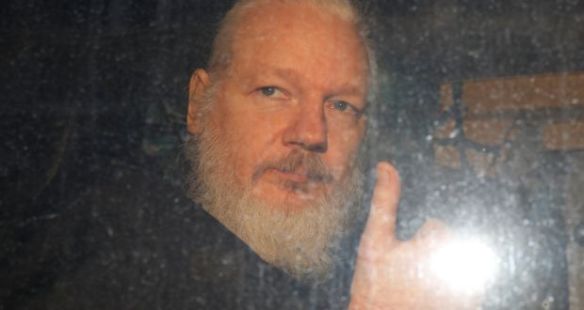
What Julian Assange’s Arrest Tells Us About Our World

By Arjun Walla

Source: Collective Evolution

John Kiriakou, a CIA-anti-torture whistle-blower recently tweeted, “a fair trial in the Eastern District of Virginia, under Judge Leonie Brinkema, is utterly impossible. They don’t call the EDVA the ‘Espionage Court for nothing.’”

And it’s true. Julian Assange was just arrested and dragged out of the Ecuadorian Embassy in relation to an extradition warrant from the US that was issued in December of 2017 for conspiracy with Chelsea Manning in early 2010. To expect that he will receive a fair trial is a bit of a dream.

The New York Times is reporting:

“The United States has charged WikiLeaks founder Julian Assange of conspiring to hack a computer as part of the 2010 release of reams of secret American documents, according to an indictment unsealed Thursday, putting him just one flight away from being in American custody after years of seclusion in the Ecuadorean embassy in London.”

Regardless of what the headlines are reading, the world knows why the hunt for Julian Assange has been ongoing for so long, and it’s because he leaked secrets and exposed those who keep them. He exposed the lies, corruption and deceit that represents the backbone of the Western military alliance and the American empire. He exposed, in the words of John F. Hylan, former Mayor of New York City, the “real menace of Republic”, the “invisible government, which like a giant octopus sprawls its slimy legs over our cities, states and nation.” He exposes the ones “who virtually run the United States government for their own selfish purposes.” (source)(source)

JFK warned the citizenry about “an announced need for increased security” that would be “seized upon by those anxious to expand its meaning to the very limits of official censorship and concealment.” Today, this is known as “national security,” and it’s a term used to justify unethical and enormous amounts of secrecy that do not protect the public, but protect those in power and their corporate, financial and political interests.

This is exactly what is being pinned on Julian Assange. And it’s done so under the guise of “national security.” As public relations professional Edward Bernays, who had many political clients, wrote:

The conscious and intelligent manipulation of the organized habits and opinions of the masses is an important element in the democratic society. Those who manipulate this unseen mechanism of society constitute an invisible government which is the true ruling power of our country. We are governed, our minds molded, our tastes formed, our ideas suggested, largely by men we have never heard of.  (Propaganda, 1928)

Transparency Doesn’t Favor The Powerful

Transparency is what Julian Assange was all about, and the American empire, more so the global empire, has been desperate to keep its secrets and prosecute anyone or anything that threatens this transparency. That’s what this is all about. And they proved this with Chelsea Manning.

It’s not just people like Assange who are being demonized and hunted, it’s alternative media as well. The war on ‘fake news’ that has been happening for the last little while has had alternative media outlets presenting credible information and sources deemed as ‘fake.’ Any media outlet who even questions a controversial issue has been made out to be ‘wrong’ or ‘fake.’

Fake news watchdog NewsGuard aims to hold independent media accountable for their stories. Funded by Clinton donors and big pharma, with ties to the CFR, NewsGuard seems to have a clear agenda in favour of mainstream media. You can read more about that here.

The current vaccine discussion is another great example. Those who are currently concerned with vaccine safety are being completely shut down and silenced. Meanwhile, those who support vaccinations do not even address the concerns that are being made by people raising concerns, and instead are resorting to finger pointing, ridicule and name calling. The latest example would be the world’s leading expert on aluminum toxicology, professor Christopher Exley, who has been completely shut down with regards to his research efforts. You can read more about that here.

The mainstream media has so much control over the minds of the masses that they can actually convince a large chunk of the citizenry that this war on ‘fake news’ is completely justified, and the arrest of Julian Assange is completely justified, but is it truly? Are we asking the right questions? Or simply believing what we are told?

Again, national security is not being threatened here, what’s being threatened, and has been threatened here as a result of Julian Assange and multiple alternative media networks, is the ability for the global elite to control human consciousness. Quite simply, exposing the truth is a huge threat to the global elite and their heightened national security state that rivals what George Orwell wrote in 1984, the stripping of our rights and freedoms, and the justification to impose more measures on the populace under the guise of national security.

Truth Is The Culprit

Truth and free press threaten the ability of the global elite to create problems and at the same time propose the solution. Some of the biggest leaks WikiLeaks has made were detailing the connection between supposed terrorist organizations like Al-Qaeda and ISIS to the western military alliance, more specifically the US government. We saw arms deals and the funding/support of terrorist organizations that the US claimed to be fighting against. This is a great example of funding and creating a problem in order to justify heightened national security measures back home, to protect people from ‘the war on terror’ and justify their infiltration of another country for ulterior motives.

Look at William Binney, he’s a former high ranking intelligence official with the National Security Agency (NSA), and is one of the highest placed intelligence officials to ever blow the whistle on insider NSA ‘knowings.’ He made headlines when he resigned in 2001 after 9/11, having worked more than thirty years for the agency. He was a leading code-breaker against the Soviet Union during the Cold War, and was repelled by the United States’ massive surveillance programs.

Binney hasn’t stopped, one of the highest-level whistleblowers to ever come out of the NSA. He is now saying:

“At least 80% of fibre optic cables globally go via the US, this is no accident and allows the US to view all communication coming in. At least 80% of all audio calls, not just metadata, are recorded and stored in the US. The NSA lies about what it stores. The ultimate goal of the NSA is total population control.” (source)

Again, this is exactly why the hunt for Julian Assange has gone on like it has, as well as the crackdown on non mainstream journalism.

One final thing to address, those that feel this is all part of ‘the plan’ within the Q community, while it may be possible that his extradition could lead to his ultimate exoneration, the evidence does not yet seem to point to that. We should still be open, question and ultimately still discuss how this is an opportunity for us to wake up to truth.

The Takeaway

We’re at a point where anything the global elite, Shadow Government or Deep State does to silence anything that threatens their interest, will simply wake up more and more people as to what’s really going on. It’s exactly like 9/11, that tragic event woke up millions and millions of people around the world to deception they otherwise knew nothing about. Every move they make, like extraditing Julian Assange, simply makes it more obvious that they are trying to block the truth, and protect their own interests.

Below is a video from CE founder Joe Martino going in a little deeper and explaining what we can expect from all of this now.

Does it really make sense that we’re taking journalists, that we’re taking people and putting them in jail for bringing forward a story that is important for humanity to see, does this really make sense? – Joe Martino


Related Video:


Assange arrest: The turning point is here—don’t let them win

Will we wait until they come for us because our homes are built atop resources they wish to plunder, because we shared information online they found objectionable, because we dared to question why madmen are in control of our country and much of the world?

By Whitney Webb

Source: Intrepid Report

LONDON—Yesterday morning, the London-based branch of Empire made good on its threat and boldly moved to begin dismantling the vestiges of democracy and press freedom that still remain, vestiges that have allowed people throughout the Western world to pretend that their government and politicians still respect their rights and the rule of law.

Julian Assange, the man who has helped expose a litany of crimes and the in-your-face corruption of the world’s most powerful people and governments, was pulled from the embassy of the country where he not only holds citizenship but had been granted asylum. The dangerous precedents Assange’s arrest has set—not just for journalism, but also for national sovereignty and international law—are staggering.

With Assange now in U.K. custody, his fate will mirror our own, as Assange’s fate and that of journalists around the world, as well as the public itself, are increasingly intertwined. After all, those who are after Assange and seek to rob him of his freedom—the U.S. Empire, the “deep state,” the shadow government, the global elite, etc.—are after our freedom as well.

If we remain silent as they jail, extradite, torture or even kill this man, we may expect a similar fate for ourselves. It will not come tomorrow. It will not come next week. It could be years away. But make no mistake, the global empire, whose core is the U.S. government, will now be empowered to charge and imprison anyone it deems a threat to its operations.

Those operations, including those that Assange helped to expose, often involve the mass murder of innocent civilians—untold numbers of children among them—in order to loot the resources of other sovereign nations. They also often involve the installation of puppet governments by either covert (e.g., election “meddling”) or overt (e.g., regime-change wars) means.

Those responsible for the most egregious violations of international law, for war crimes, for the slaughter of innocent life, are not imprisoned, degraded or tortured—they are rewarded and promoted. As we have seen today—and in recent weeks, particularly following Chelsea Manning’s imprisonment—those who seek to expose these crimes are the ones who are threatened, tortured and punished.

Like it or not, we are all already a part of this war

The world has known for years that Assange would meet this fate. Little was done. Now, the turning point is here. Will we continue to escape into the false realities of television, cinema, video games, and whatever we use to distract us and numb our pain while the actual world in which we live devolves into a technocratic, imperial dictatorship? Will we continue to ignore the obvious threats to our lives and our children’s lives because confronting these threats is uncomfortable and often difficult?

Will we wait until they come for us because our homes are built atop resources they wish to plunder, because we shared information online they found objectionable, because we dared to question why madmen are in control of our country and much of the world?

Such an eventuality may seem laughable to some, but those days are not far away and are already here for many people around the world, even in the West. Assange’s arrest is the first shot of a war to which all of us, like it or not, have already been drafted because it is a war for the very world in which we live—a war for our society, our planet, our livelihood, our right to self-determination. You can try to escape to the ends of the Earth, thousands of miles away from “the West” (as I myself did), only to find that there is no country anywhere in the world that is not currently under siege.

Never before in history has the global oligarchy been more powerful. The concentration of power and wealth in the hands of the few is unprecedented, worse even than in the Gilded Age or the final days of the Roman Empire. These people do not plan to cede any of this power to you. They do not want you to have control over your own lives. To them, we are already slaves. And those who are silent, especially now, are sending a signal to the elites that they embrace that servitude.

The revolution will not be televised and the war will not be won on social media

For too long, actions in defense of Assange, and more broadly in protest of Empire, have been focused in the virtual realm—that is, on the Internet and social media. While the Internet and social media are important tools for sharing information, their use for that end is being suppressed like never before and it will not be long before social media is entirely censored and devoid of dissent. If we wait until that day comes, and put all our eggs in the social media basket, we will have shot ourselves in the foot and it could well be a fatal blow.

We can no longer run from the world, escape into our remaining comforts—particularly those online—while the world burns. Assange may be the first journalist to be arrested and extradited under these circumstances, but he will not be the last. What we do now will determine how far they go.

The U.S. and its allies are prepping for several wars, many of them against countries much larger than Iraq, and such wars could make Iraq and Afghanistan look like skirmishes by comparison. The people behind Assange’s arrest and perpetual imperial wars do not care about your tweets or Facebook posts. They want your focus to remain on the virtual world and away from the real one over which they are consolidating their control.

Now is the time to resist. Now is the time to insist. Now is the time to take to the streets, to talk to your neighbors, family and co-workers of the dangers facing us all. Your voice and your actions matter. The longer we wait, the worse things will become. The turning point is here. Don’t let them win.


Whitney Webb is a MintPress News journalist based in Chile. She has contributed to several independent media outlets including Global Research, EcoWatch, the Ron Paul Institute and 21st Century Wire, among others. She has made several radio and television appearances and is the 2019 winner of the Serena Shim Award for Uncompromised Integrity in Journalism.

America is exceptional — in all the wrong ways

By Maj. Danny Sjursen

Source: Axis of Logic

I was born and raised in an America far more Orwellian than many now remember. Matters have gone so far off the rails since 9/11 that few seem to recall the madness of the 1980s. The U.S. had a celebrity actor for president, who railed about America’s ostensibly existential adversary—the Soviet “evil empire.” Back then, Ronald Reagan nearly started a nuclear war during the all-too-real Able Archer war game. He also secretly sold missiles to Iran, and then laundered the windfall to the Contras’ Central American hit squads, resulting in some 100,000 dead.

Looking back from 2019, at least as the contemporary media tell it, those were the good old days. Heck, even Barack Obama—faux liberal that he was—proudly and publicly admired Reagan. Oh, and one of Reagan’s favorite campaign slogans: “Make America Great Again.”

Today, matters seem to be coming farcically full circle, what with Elliott Abrams—convicted in the aforementioned Iran-Contra scandal—being appointed special envoy to Venezuela, and Uncle Sam again bullying a Latin American country. Welcome to America’s own grisly ’80s foreign affairs theme party! Which all got me thinking, again, about the whole notion of American exceptionalism. Only a country that truly, deeply believes in its own special mission could repeat the hideous policies of the 1980s and hardly notice.

Perhaps one expects this absurd messianism from the likes of The Donald, but the real proof is that America’s supposed progressives—like Obama—also obediently pray at the temple of exceptionalism. “Orwellian” is the only word for a nation whose leaders and commentariat were absolutely aghast when candidate Obama was seen without (gasp!) an American flag pin on his lapel. Even more disturbing was how quickly he folded and dutifully adorned his mandatory flair. This sort of nonsense is dangerous, folks: It’s hypernationalism—the very philosophy that brought us World War I.

So it was this week, while sitting on a plane reading my oh-so-bourgeois Economist, and getting infuriated about seeing Elliott Abrams’ war-criminal face, that my thoughts again turned to good old American exceptionalism. My opinions on the topic have waxed and waned over the course of a career spent waging illegal war. First, as a young cadet at West Point, I bought it hook, line and sinker; then, as an Iraq War vet and dissenter, I rejected the entire notion. Only now, observing the world as it is, have I begun to think that America really is exceptional after all—only in all the wrong ways.

Humor me, please, while I run through a brief laundry list of the ways the US of A is wildly and disconcertingly different from all the other “big-boy countries” in the developed world. Let’s start with domestic policy:

  • The U.S. has been the site of exponentially more mass shootings than any other nation. And unlike in New Zealand—where officials took immediate steps to tighten gun control in the wake of its recent tragedy—American politicians won’t do a thing about it. We also own more guns per capita than any other country in the world. In second place is Yemen.
  • The U.S. is essentially alone in the Western world in not guaranteeing health care as a basic human right. It spends much more cash, yet achieves worse health outcomes than its near-peer countries.
  • America is home to some of the starkest income inequality on the globe—right up there with Turkey and South Africa.
  • The U.S. keeps migrant kids in cages at the border, or did until recently. Even more exceptional is that Washington is largely responsible for the very unrest in Central America that generates the refugees, all while American conservatives proudly wear their “Christianity” as badge of honor—but wasn’t Jesus a refugee child? Maybe I read the wrong Bible.
  • America is alone among 41 Western nations in not guaranteeing paid family leave. How’s that for “family values?”
  • As for representative democracy, only the U.S. has an Electoral College. This fun 18th-century gimmick ensures that here in America—in 40 percent of its elections since 2000—the presidential candidate with fewer votes actually won. Furthermore, our peculiar system ensures that a rural Wyoming resident has—proportionally—several times more representative power in Washington than someone who lives in California.
  • Similarly, America counts several non-state “territories”—think Guam, Samoa, Puerto Rico—that don’t even get to vote for the president that it can legally send  to war. But hey, why should we grant them statehood? It’s not as though some of them have higher military enlistment rates than any U.S. state … oh, wait.
  • The U.S. is essentially solo in defining corporations as “people,” and thanks to the Citizens United Supreme Court ruling, has lifted limits on money in politics. Buying elections is officially as American as apple pie.
  • The USA locks up its own people at the highest rate in the world and is nearly alone among developed nations in maintaining the death penalty. Last year, the U.S. was the only country in the Americas to conduct executions and the only Western democracy to do so. But our friends the Saudis still execute folks, so it’s got to be OK. Dostoyevsky famously claimed that “the degree of civilization in a society can be judged by entering its prisons.” How are we doing there?

Then there’s the foreign policy of the great American empire:

  • The U.S. spends exponentially more on military defense than anyone else, and more than the next seven competitors (most of which are allies) combined.
  • America’s bloated military is all by itself in dotting the globe with hundreds of foreign military bases—by some estimates more than any country or empire in world history. As for our two biggest rivals,  Russia has 21 (mostly close to home); China has maybe three.
  • Benevolent, peaceful, freedom-loving America is also the world’s top arms dealer—even selling death-dealing weapons to famous human rights abusers.
  • After Syria signed on, the U.S. became the last nation on earth not party to the Paris Climate Accord. Heck, the occupant of the Oval Office doesn’t even believe in man-made climate change.
  • Then there’s the discomfiting fact that the U.S.—along with Russia—won’t even make a “no-first-use” pledge regarding nuclear weapons. And that’s reality, not “Dr. Strangelove.”
  • The U.S. was first and, until recently, alone in flying its drone fleet through sovereign national airspace and executing “terrorists” from the sky at will. I wonder how Washington will respond when other countries cite that American precedent and do the same?
  • Only the U.S. Navy patrols all the world’s oceans in force and expects to maintain superiority everywhere. And only the U.S. boasts near total control of the goings-on in two whole continents—unflinchingly asserting that North and South America fall in its “sphere of influence.” Crimea abuts Russia and the people speak Russian—still, the U.S. denies Moscow any sphere of influence there or anywhere else. Ah, consistency.

Of course there is so, so much more, but let’s end our tour of American “exceptionalism” there in the interest of time.

What’s so staggeringly unique about the United States is ultimately this: It stands alone among historical hegemons in denying the very existence of its empire. This, truly, is something new. Kids in 19th-century Great Britain knew they had an empire—they even colored their colonies red on school maps. Not so here in the land of the free and the home of the brave. No, Washington seems to believe its own lie—and has its people convinced—that the U.S. is no empire at all, but rather a benevolent “democratic” gentle giant.

American colonies were founded from the outset as mini-empires wrested from the natives. Next, the nascent U.S. grew up enough to take what was left of the continent from the Mexicans. Since then, Washington has been trolling the world’s oceans and spreading the gospel of its own hyper-late-stage capitalism and bullying others in order to get its way. Sure, there are countries where worse human-rights abusers and worse authoritarian regimes are in power. But do we really want to be competing for last place? Especially if we’re supposedly so exceptional and indispensable?

Me, I’m sick of patriotism, of exceptionalism, of nationalism. I’ve seen where all those ideologies inevitably lead: to aggressive war, military occupations and, ultimately, dead children. So count me as over hegemony—it’s so 20th-century, anyway—and bring on the inevitable decline of U.S. pretense and power. Britain had to give up most of an empire to gain a social safety net. That was the humane thing to do.

It’s really very simple

By Dmitry Orlov

Source: Club Orlov

There are times when a loud cry of “The emperor has no clothes!” can be most copacetic. And so, let me point out something quite simple, yet very important.

The old world order, to which we became accustomed over the course of the 1990s and the 2000s, its crises and its problems detailed in numerous authoritative publications on both sides of the Atlantic—it is no more. It is not out sick and it is not on vacation. It is deceased. It has passed on, gone to meet its maker, bought the farm, kicked the bucket and joined the choir invisible. It is an ex-world order.

If we rewind back to the early 1980s, we can easily remember how the USSR was still running half of Europe and exerting major influence on a sizable chunk of the world. World socialist revolution was still sputtering along, with pro-Soviet regimes coming in to power here and there in different parts of the globe, the chorus of their leaders’ official pronouncements sounding more or less in unison. The leaders made their pilgrimages to Moscow as if it were Mecca, and they sent their promising young people there to learn how to do things the Soviet way. Soviet technology continued to make impressive advances: in the mid-1980s the Soviets launched into orbit a miracle of technology—the space station Mir, while Vega space probes were being dispatched to study Venus.

But alongside all of this business-as-usual the rules and principles according which the “red” half of the globe operated were already in an advanced state of decay, and a completely different system was starting to emerge both at the center and along the periphery. Seven years later the USSR collapsed and the world order was transformed, but many people simply couldn’t believe in the reality of this change. In the early 1990s many political scientists were self-assuredly claiming that what is happening is the realization of a clever Kremlin plan to modernize the Soviet system and that, after a quick rebranding, it will again start taking over the world. People like to talk about what they think they can understand, never mind whether it still exists.

And what do we see today? The realm that self-identifies itself as “The West” is still claiming to be leading economically, technologically, and to be dominant militarily, but it has suffered a moral defeat, and, strictly as a consequence of this moral defeat, a profound ideological defeat as well.

It’s simple.

1. How can they talk of the inviolability of private property while confiscating the savings of depositors in Cypriot banks?

2. How can they talk of safeguarding the territorial integrity of countries while destroying, in turn, Yugoslavia, Iraq, Libya, Syria and Ukraine?

3. How can they talk of free enterprise and then sign contracts to build ships but refuse to deliver them because of pressure from Washington, as happened with Mistral ships which Russia ordered from France?

4. How can they talk of democracy and then use naked threats against the premier of Greece—the birthplace of European democracy—forcing him to ignore the unprofitable results of the Greek national referendum?

5. How can they talk about fighting racism while in the US they are constantly shooting mass quantities of unarmed Negros, all the while forbidding people to call them Negros.

6. How can they accuse the Serbs of genocide while refusing to acknowledge what they did to supposedly “independent” Kosovo, which has been turned into a European criminal enclave specializing in the production and distribution of narcotics?

7. How can they claim to oppose extremism and terrorism while training, arming and financing ISIS and the Ukrainian Neo-nazis?

8. How can they talk about justice while the US maintains the largest prison population in the history of the world and has executed many people subsequently discovered to have been innocent?

9. How can they talk about freedom of religion after the US federal government exterminated the Branch Davidians in Waco, Texas, and then imprisoned the survivors, even though the government’s allegations against the sect have subsequently been proven to be false?

10. How can they accuse others of corruption after the colossal financial embarrassment of 2008, in the run-up to which obvious financial bubbles that were ready to bust were assigned the highest ratings?

What has happened is the worst thing that could have possibly happened: in full view of the entire world, “Western values” have been demonstrated to be null and void.

If you think that these are just some specific examples of difficulties or mistakes that could potentially be overcome in some dim and foggy future, then you are wrong: this is all of the “Western values” worth mentioning, and they have all been invalidated by observation. Note the past tense: they already have been invalidated. Are there any “Western values” left intact? Oh yes, just one: the rights of sexual minorities. But it is not possible to maintain Western civilization on the strength of gay marriage alone.

Is it any wonder then that the rest of the world is trying to put as much distance between itself and the morally bankrupt “West” as it possibly can, as quickly as it can? China is working on developing its own model, Russia is striving for self-sufficiency and independence from Western imports and finance, and even Latin America, once considered the backyard of the US, is increasingly going its own separate way.

The ranks of the fools who are still buying the West’s story are shrinking, while the ranks of the rebels are growing. There is the truth-teller Edward Snowden, who was forced to flee to Moscow to avoid persecution back home. There are European parliamentarians who recently broke ranks and visited Crimea. There are French and German military men who are volunteering to defend Eastern Ukraine against Western attack. There are the many European businessmen who came to the Economics Forum in St. Petersburg to sign trade deals with Russia, never mind what their politicians think of that.

On the other side, the rapidly emerging new world order was recently on display in Ufa, capital of the majority-Moslem Republic of Bashkortostan in Southern Urals, Russian Federation. Leaders of more than half the world’s population came there to sign deals, integrate their economies, and coordinate security arrangements. India and Pakistan set their differences aside and walked in through the door at the same time; Iran is next. “The West” was not represented there.

Now that all Western values (other than the rights of sexual minorities) have been shown to be cynical exercises in hypocrisy, there is no path back. You see, it is a matter of reputation, and a reputation is something that one can lose exactly once. There is a path forward, but it is very frightening. There is the loss of control: Western institutions can no longer control the situation throughout much of the world, including, in due course, on their own territory. There is the abandonment of the Western narrative: Western pontificators, pundits and “thought leaders” will find that their talking points have been snatched away and will be reduced to either babbling apologetically or lapsing into embarrassed silence. Finally, there is the loss of identity: it is not possible, for the non-delusional, to identify with something (“The West”) that no longer exists.

But the most frightening thing of all is this: behind a morally bankrupt civilization there are morally bankrupt people—lots and lots of them. Their own children, who will be forced to make their way in the world—however it turns out to be—will be as disrespectful of them as they were of their own vaunted civilizational values.

Why Activists Fail

By Robert J. Burrowes

Despite enormous ongoing effort over more than a thousand years, during and since the formation and shaping of the modern world, and as the number of issues being contested has steadily increased, activists of many types have made insufficient progress on key issues, particularly in relation to ending violence and war (and the threat of nuclear war), stopping the exploitation of many peoples and halting the endless assaults on Earth’s biosphere.

Of course, in order for those of us who identify as activists to have any prospect of success in these and other endeavors, we need to understand how the world works and to develop an interrelated set of nonviolent strategies that are being effectively implemented to address each of the key aspects of this crisis.

This is because there is a great deal wrong with how the human world functions and a staggering amount that needs to be done if we are to fix it and preserve the planetary biosphere in doing so, particularly given that the primary threats are now so serious that human extinction is likely to occur within a few years. See ‘Human Extinction by 2026? A Last Ditch Strategy to Fight for Human Survival’.

Of course, if human governance systems, ranging from international organizations like the United Nations and its various agencies to national, provincial and local governments functioned effectively, then we might expect these agencies, which theoretically function on our behalf, to have addressed these problems a long time ago. Or to do so now.

However, for reasons that are readily identifiable, these agencies have little power and routinely malfunction (from the viewpoints of ordinary people and the planetary biosphere).

So let me start by briefly explaining how the world works and then elaborating a few key points about strategy so that you can choose, if you wish (and, problematically, assuming there is still time), to play a more active and effective role, in one or more ways, in the struggle to make our world one of peace, justice and sustainability.

How the World Works: A Brief History

The formal human governance systems on Earth – that is, governments and intergovernmental organizations such as the United Nations – are controlled by the global elite which is invisible to, and hence not considered by, most people including activists. This, of course, is how the elite wants it and one can still readily find accounts that ask if the elite (by whatever name it is given) actually exists and even ascribe it a mystical quality. If the idea is not simply written off as a ‘conspiracy theory’.

Well the global elite exists and its membership can be readily identified. But let me start by briefly outlining how the global elite acquired its extraordinary control over world affairs.

Following the Neolithic revolution 12,000 years ago, agriculture allowed human settlement to supersede the hunter-gatherer economy. However, while the Neolithic revolution occurred spontaneously in several parts of the world, some of the Neolithic societies that emerged in Asia, Europe, Central America and South America resorted to increasing degrees of social control in order to achieve a variety of social and economic outcomes, including increased efficiency in food production.

Civilizations emerged just over 5,000 years ago and, utilizing this higher degree of social control, were characterized by towns or cities, efficient food production allowing a large minority of the community to be engaged in more specialized activities, a centralized bureaucracy and the practice of skilled warfare. See ‘A Critique of Human Society since the Neolithic Revolution’.

With the emergence of civilization, elites of a local nature (such as the Pharoahs of Egypt), elites with imperial reach (including Roman emperors), elites of a religious nature (such as Popes and officials of the Vatican), elites of an economic character (particularly the City of London Corporation) and elites of a ‘national’ type (especially the monarchies of Europe) progressively emerged, essentially to manage the administration associated with maintaining and expanding their realms (political, financial and/or religious).

Following the Peace of Westphalia in 1648, which formally established the nation-state system, national elites, increasingly of an economic nature as capitalism progressively developed and rapidly expanded, consolidated their hold over national societies and, as these elites internationalized their reach in the following centuries, by the second half of the C20th, a truly global elite had consolidated its control over the world.

Awareness of elites in earlier eras has been noted by some authors. For example, in his 1775 book An Inquiry into the Nature and Causes of the Wealth of Nations, Adam Smith noted that ‘All for ourselves, and nothing for other people, seems, in every age of the world, to have been the vile maxim of the masters of mankind’.

But the work of C. Wright Mills in his 1956 classic The Power Elite is the original scholarly effort of the post-World War II era to document the nature of this elite, how it functions and why it had total control over US national society. Of course, despite scholarship of this nature, which has been added to routinely ever since, most people still believe the elite-sponsored delusion that international organizations, such as the United Nations, and national governments actually have some significant say in world affairs.

To jump to the present then, for the best recent account of how the global elite manifests today, see the book by Professor Peter Phillips titled Giants: The Global Power Elite. In this book, Phillips identifies the world’s top seventeen asset management firms, such as BlackRock and J.P Morgan Chase, that collectively manage more than $US41.1 trillion in a self-invested network of interlocking capital that spans the globe. The seventeen Giants operate in nearly every country in the world and are ‘the central institutions of the financial capital that powers the global economic system’. They invest in anything considered profitable, ranging from ‘agricultural lands on which indigenous farmers are replaced by power elite investors’ to public assets (such as energy and water utilities), to fossil fuels, nuclear power and war.

More precisely, Phillips identifies the 199 individual directors of the seventeen global financial Giants and the importance of those transnational institutions that serve a unifying function – including the World Bank, International Monetary Fund, G20, G7, World Trade Organization (WTO), World Economic Forum (WEF), Trilateral Commission, Bilderberg Group, Bank for International Settlements and Council on Foreign Relations – and particularly two very important global elite policy-planning organizations: the Group of Thirty (which has 32 members) and the extended executive committee of the Trilateral Commission (which has 55 members).

And Phillips carefully explains why and how the global elite defends its power, profits and privilege against rebellion by the ‘unruly exploited masses’: ‘the Global Power Elite uses NATO and the US military empire for its worldwide security. This is part of an expanding strategy of US military domination around the world, whereby the US/ NATO military empire, advised by the power elite’s Atlantic Council, operates in service to the Transnational Corporate Class for the protection of international capital everywhere in the world’.

‘The US military empire stands on hundreds of years of colonial exploitation and continues to support repressive, exploitative governments that cooperate with global capital’s imperial agenda. Governments that accept external capital investment, whereby a small segment of a country’s elite benefits, do so knowing that capital inevitably requires a return on investment that entails using up resources and people for economic gain. The whole system continues wealth concentration for elites and expanded wretched inequality for the masses….

‘Understanding permanent war as an economic relief valve for surplus capital is a vital part of comprehending capitalism in the world today. War provides investment opportunity for the Giants and Transnational Corporate Class elites and a guaranteed return on capital. War also serves a repressive function of keeping the suffering masses of humanity afraid and compliant.’

If you would like to read other books which also give a clear sense of elites and their agents operating beyond the law to the extraordinary detriment of humanity and the Earth, then I strongly recommend William Blum’s classic Killing Hope: U.S. Military and CIA Interventions Since World War II and Paul L. Williams’ eye-opening account of Operation Gladio: The Unholy Alliance between the Vatican, the CIA and the Mafia.

In plain language then: The global elite manages human governance systems for its benefit with no concern for ordinary people – who are considered unworthy – or the planetary biosphere. And the most important function that international agencies and governments perform, from the elite perspective, is that they appear to have control over certain jurisdictions and matters so that relevant constituencies focus their efforts, for example, on ‘changing government policy’ or changing the party in government. By having activist effort focused on lobbying governments or changing the party in government, this effort is absorbed and dissipated; hence, nothing of consequence changes because the elite has significant control over all major political processes, parties and their policies.

Of course, I should add that the elite is smart enough to make it look like something has changed occasionally, perhaps by allowing a small concession after years of effort (invariably on a ‘social’ issue, such as gay marriage, that doesn’t adversely impact their power, profits and privilege), so that most activist effort remains focused on governments and international governmental agencies. The elite also allows a ‘genuinely progressive’ candidate to emerge regularly so that activists are again suckered into putting effort into electoral outcomes rather than building movements for broad-based social transformation based on grassroots organizing.

In managing their already vast and endlessly accumulating wealth the global elite siphons a staggering amount of financial resources out of the global economy every day and channels these resources through secretive tax havens to evade tax. Globally, $US10billion of wealth produced by the labor of ordinary people is ‘lost’ each week in this way and more than 10% of global financial wealth (which doesn’t include non-financial wealth ranging from racehorses and yachts to artworks and gold bars) is now hidden in these secrecy jurisdictions. See ‘Elite Banking at Your Expense: How Secretive Tax Havens are Used to Steal Your Money’.

A small proportion (but nevertheless significant amount) of elite wealth is used to create and manage the dominant narrative in relation to the state of the world by financing production of this narrative, generated by elite think tanks, and then distributed through education systems, the entertainment industry and the corporate media. In short, we are bombarded with elite propaganda, given names such as ‘education’, ‘entertainment’ and ‘news’, that hopelessly distorts popular perception of what is taking place.

So why does all of the above happen?

In essence: global elite control of formal human governance systems for its own benefit is an outcome of the global elite’s insanity, as well as the insanity of those who serve it. ‘So what is sanity?’ you might ask.

Sanity is defined as the capacity to consider a set of circumstances, to carefully analyze the evidence pertaining to those circumstances, to identify the cause of any conflict or problem, and to respond appropriately and strategically, both emotionally and intellectually, to that conflict or problem with the intention of resolving it, preferably at a higher level of need satisfaction for all parties (including those of the Earth and all of its living creatures). For a fuller explanation, see ‘The Global Elite is Insane Revisited’ with a lot more detail in ‘Why Violence?’ and ‘Fearless Psychology and Fearful Psychology: Principles and Practice’. In brief, individuals who are not incredibly psychologically damaged, do not behave as described above.

In essence then, while the description of how the world works offered above is accurate, it is driven by an insane elite – endlessly and compulsively accumulating profit, power and privilege at the expense of ordinary people and the biosphere – and the insanity of those who serve the elite, such as virtually all politicians and businesspeople, bankers and accountants, judges and lawyers, academics and corporate media personnel.

Hence, struggles for peace, justice, sustainability and liberation (from military occupation, dictatorship, genocidal assault, coups and invasions), by various means (including those which are nonviolent), fail far too often. But not just because of the enormous power of the global elite. They fail because activists do not understand how the world works, including how the elite exercises its power and, in the case of those who use nonviolent action explicitly, they fail when activists do not understand the psychology, politics and strategy of nonviolent struggle. And while these subjects are not complicated, they do require time to learn.

To reiterate then, the answer to the question ‘Why do activists fail?’ is this: Virtually all activists do not understand strategy and so they do not campaign strategically. This means that anything done – whether a decision in a meeting, a phone call or email, an action or event planned and executed – simply fails to have the impact it could have. Let me elaborate this explanation using just three basic components (out of twelve) of sound nonviolent strategy.

Before doing so I should emphasize that I am talking about those who identify as ‘activists’. I am not talking about lobbyists (or those who use activism in the service of lobbying). Moreover, I am assuming that all activists are using some version of what they understand as ‘nonviolent action’, whether or not they claim to be doing so or even realize they are, simply because no other tradition of activism offers the comprehensive strategic guidance that the literature on nonviolence offers.

So what should activists do so that their efforts have strategic impact?

Strategic Analysis

The foundation of any sound strategy – particularly if campaigning on major issues such as to end war, to end the climate catastrophe, to halt destruction of the fresh water supply and the rainforests, to defeat a coup, occupation or invasion nonviolently, to transform the global economy, to bring down the global elite… – is a thorough understanding of the conflict.

This means, most importantly, having a clear sense of the ‘big picture’ (including those overarching structures and actors in far-off places that maintain/perpetrate the local manifestations of violence and exploitation), not just the detail of the issue on which you focus. Fundamentally, this requires an astute understanding of the global power structure. If we do not understand how power works in society, particularly structurally, including in relation to the conflict we seek to resolve, then we cannot plan and implement a strategy that will work. As the historical record tragically demonstrates.

But it also requires our analysis to include a reasonable understanding of how key issues (such as war, destruction of the climate and environment, and exploitation of women, working people and indigenous peoples) intersect and reinforce each other. If we do not understand something of these relationships then we cannot plan strategy that takes these relationships into account and thus adequately account for all variables driving a conflict. Again, as the historical record painfully demonstrates.

So, for example, the failure of most climate and environmental activists to adequately consider the role of war (and military activity and violence generally) in destroying the climate and environment means that a primary driver of these two conflicts is barely mentioned let alone discussed and then actually tackled strategically – ideally by working in tandem with antiwar activists – by activists working to end the climate catastrophe and defend the environment as a whole.

But this failure to consider the ‘big picture’ is also the reason why most climate activists are focused on switching (from fossils fuels and nuclear power) to renewable energy and miss the fundamental point that we are destroying the entire global environment – including the fresh water, rainforests and oceans – and unless we dramatically reduce, by about 80%, our consumption in all key areas involving both energy and resources of every kind – water, household energy, transport fuels, metals, meat, paper and plastic – and immediately cease driving, flying and eating meat for starters, we have no chance of averting human extinction. See ‘Will humans be extinct by 2026?’ and ‘Climate-Change Summary and Update’.

Which is also why simple, structured approaches to this reduction of consumption, while dramatically expanding our individual and community self-reliance so that all environmental concerns are effectively addressed, must be part of any effective strategy to address the climate/environment catastrophe. See ‘The Flame Tree Project to Save Life on Earth’.

In one simple sentence: We cannot save the climate without saving the rainforests too, and ending war.

Having written all of the above, it is important to acknowledge that there are plenty of fine sources of accurate information on specific issues produced by independent think tanks and activist scholars and researchers. For example, you will find plenty of information about weapons corporations and weapons expenditure (still rising) on the website of the Stockholm International Peace Research Institute and the climate movement produces some rigorous research, with the latest report meticulously documenting that bank financing of fossil fuels is still rising despite the Paris climate ‘agreement’ in 2015. See ‘Banking on Climate Change: Fossil Fuel Finance Report Card 2019’.

Strategic Focus

If we do not thoroughly analyze the conflict, it is impossible to identify the appropriate strategic focus for action and to then plan tactics that address that focus. This inevitably means that we are essentially guessing what to do, not knowing in advance, as we should, that the action we take will have strategic impact.

Moreover, guessing what action to take, usually on the basis of what is familiar or what feels good – perhaps because we get out with a bunch of ‘good people’ – virtually inevitably leads to poor choices like organizing a large demonstration. Demonstrations are notoriously ineffective, as world history’s largest demonstration on 15 February 2003 – involving demonstrations in more than 600 cities around the world, involving up to 30,000,000 people, against the imminent US-led war on Iraq – see ‘The World Says No to War: Demonstrations against the War on Iraq’ – illustrated yet again. Single actions and numbers are not determinative; strategy is determinative. Obviously, large demonstrations could be effective, if they were strategically focused – never on governments though – but only a rare activist understands this with the recent worldwide ‘School Strike 4 Climate Action’ demonstrations on 15 March and the ‘Hands off Venezuela’ demonstrations on 16 March graphically illustrating this lack of understanding and thus wasting opportunities to make a strategic difference.

Let me explain this notion of strategic focus with a simple example, and then invite you to consider it in a little more detail.

Given the critical role that airline flights, travel by car and eating meat, for example, play in destroying the climate and, in the case of the first two, driving US-led wars for control of fossil fuels, imagine if all of those students attending the School Strike 4 Climate rallies had used the day to sign a personal pledge – the Earth Pledge? – which read something like this:

Out of love for the Earth and all of its inhabitants, and my respect for their needs, from this day onwards I pledge that:

  1. I will not travel by plane
  2. I will not travel by car
  3. I will not eat meat and fish
  4. I will only eat organically/biodynamically grown food
  5. I will minimize the amount of fresh water I use
  6. I will not buy rainforest timber
  7. I will not buy or use single-use plastic, such as bags, bottles, containers, cups and straws
  8. I will not use banks that provide any service to corporations involved in fossil fuels, nuclear power and/or weapons
  9. I will not get news from the corporate media (mainstream newspapers, television, radio, Facebook…)
  10. I will make the effort to learn a skill, such as food gardening or sewing, that makes me more self-reliant
  11. I will gently encourage my family and friends to consider signing this pledge.

Imagine if at all future climate rallies, participants were given the opportunity to sign such a pledge.

And imagine if at every demonstration against war, every participant was given the opportunity to sign such a pledge. There is little point yelling (or displaying a sign that reads) ‘No war for oil’ when you are the one using the oil. Surely, that would be hypocritical, wouldn’t it?

If it seems too difficult for now, would you sign the pledge after crossing out one or two items that you might reconsider later?

Perhaps, we can even mark 2 October 2019, the 150th anniversary of Gandhi’s birth, and the International Day of Nonviolence, as a day of world commitment with local ceremonies, small or large, around the world so that people can attend an event to make a public pledge of this nature too.

With the Earth under siege, would you sign such a pledge? What would you need to reorganize about your life to make it manageable?

The point then is this: It is easy to ask someone else to change their behaviour. It is more effective to change your own. And, if we do, we functionally undermine the cause of problems that concern so many of us.

Anyway, somewhat more elaborately, if you want strategic focus in your campaign strategy to end war or the climate catastrophe, for example, check out the two strategic aims and the basic list of strategic goals in ‘Campaign Strategic Aims’. And for the two strategic aims and the basic list of strategic goals to defend against a range of military threats, see ‘Defense Strategic Aims’.

This requires, vitally importantly, that the tactic in any given circumstance is thoughtfully crafted to achieve the strategic goal carefully identified as appropriate for this stage of the campaign. See the relationship and distinction between ‘The Political Objective and Strategic Goal of Nonviolent Actions’.

And for a better understanding of the power of nonviolent action and how to frame it for maximum strategic impact, see also ‘Nonviolent Action: Why and How it Works’.

Strategic Timeframe

Inadequate analysis, perhaps because you simply believe, without investigation, what the global elite is telling you via its many channels, such as its captive mainstream processes (including education systems and the corporate media), might lead you to work to a wholly unrealistic timeframe.

Unfortunately, this is precisely what is happening with the climate catastrophe. Unquestioningly following the elite-controlled discourse on this issue leads most people, including climate activists, to work to an ‘end of century’ timeframe or to believe, for example, that we have until 2030 to end our use of coal. And yet even some mainstream sources, such as the UN, are already reporting the catastrophic consequences of having set the utterly inadequate goal of limiting the global temperature increase to 2° (or 1.5°) celsius above the preindustrial norm. See, for example, ‘Global Linkages – A graphic look at the changing Arctic’ and ‘3-5°C temperature rise is now “locked-in” for the Arctic’.

So it is imperative that activists use their analysis (based on truthful sources) to make a realistic assessment of the timeframe. It might not be convenient to have less time than we think is necessary to precipitate the changes we want but our responsibility as activists includes the need to tell unpalatable truths (which the global elite and its agents will never do).

Fundamentally then, tell the truth. If there is a choice between being popular and telling the truth, I encourage you to always tell the truth. Deluding ourselves that we are doing a fine job and affirming each other for minor gains won’t avert human extinction or save those countless lifeforms, human and otherwise, who die each day as a result of our incredibly dysfunctional and violent world. Nor will it help those who are living under occupation, dictatorship or military assault.

Of course, telling the truth will scare many people. But it is still sounder strategy to trust people to hear the truth well, no matter how unpalatable it might be. Besides if we do not tell the truth and trust people, we have no prospect of mobilizing them strategically in the time we have left.

Needless to say, if you are going to tell the truth to others, you need to be courageous enough to perceive it yourself first. And to act on it.

Summary

In the above three sections, I explained the importance of a sound analysis, strategic focus and an appropriate timeframe as well as the importance of telling the truth, in developing and implementing an effective nonviolent strategy. This applies whatever the nature of the struggle: a peace, justice or environmental campaign or a defense or liberation struggle.

But effective strategy requires more than these three components and each of these components must also be soundly understood and rigorously implemented.

So if becoming more strategic appeals to you, check out either of these websites: Nonviolent Campaign Strategy or Nonviolent Defense/Liberation Strategy.

Or, for a quick overall look at the twelve components of nonviolent strategy, check out the Nonviolent Strategy Wheel on each site, such as this one.

In addition, if you want to focus on parenting children so that they are powerfully able to deal with reality and not get suckered into the widespread addictions of over-consumption and militarism – see ‘Love Denied: The Psychology of Materialism, Violence and War’ – or into believing that lobbying governments is the way to precipitate change, then you are welcome to consider making ‘My Promise to Children’ and learning the art of nisteling. See ‘Nisteling: The Art of Deep Listening’.

Of course, if you have problems reducing your consumption or questioning the efficacy of military violence, then consider addressing the unconscious psychological impediments to this. See ‘Putting Feelings First’.

If you like, you can also join the worldwide movement to end all violence by signing the online pledge of ‘The People’s Charter to Create a Nonviolent World’.

A Final Word

Some corporate economists are concerned that the global economy is facing a ‘downturn’ and, possibly, even entering a recession. As a result, they are arguing for measures to boost economic growth.

The reality, however, is that industrial civilization is already steadily and rapidly breaking down – with an endless sequence of climate and environmental catastrophes now taking place: for one of the latest, see ‘Death toll jumps in Mozambique storm as 15,000 await rescue’ – and will collapse completely within a few years. Why? Because the Earth has very little left to give without a staggering amount of regenerative inputs (some of which we can supply but others that require geological time).

But you do not need to believe me.

Consider the evidence for yourself.

If, after reading the lengthy list of documents, scientific and otherwise, cited in the key articles about near-term human extinction mentioned above, you can search out compelling evidence to refute the argument for near-term human extinction that is presented, then I hope you will share this evidence widely so that we can all be relieved that we have more time than an increasing number of courageous scientists are warning at risk to their livelihoods and professional appointments.

But if you cannot refute the evidence cited above or find the evidence that does it to your satisfaction, I invite you to respond thoughtfully and powerfully by taking immediate action to start systematically and substantially reducing your personal consumption while systematically increasing your personal and community self-reliance, in 16 areas, at the same time. Again, see ‘The Flame Tree Project to Save Life on Earth’.

I can assure you that if we ‘step down’ the global economy systematically while increasing our self-reliance at a (much) lower level of consumption (which will also demonetize economic activity), then all of those corporations – such as those producing fossil fuels, mining strategic minerals and destroying rainforests – will cease producing products for which there is no market. They will simply have no financial incentive to do so. And this will functionally and ongoingly undermine the power of the global elite to manipulate us into surrendering our power by lobbying governments and surrendering our labor and resources to buy their products to increase their power and profits. Moreover, elites will have less incentive to start and fight the wars to steal the resources necessary to make the products our over-consumption currently requires.

As you probably realize, it is your own action that gives you credibility (and moral authority) to then encourage others to follow your example, and for you to campaign for others to change their behaviour too. One hundred years ago, Mohandas K. Gandhi – perhaps anticipating the latest UN report: ‘UN Alliance For Sustainable Fashion addresses damage of “fast fashion”’ – was reminding us that ‘Earth provides enough to satisfy every person’s needs, but not every person’s greed.’ And he modeled the minimal consumption he asked of others in his own life first. At his death, he owned two outfits of handspun cotton, which he made himself on a spinning wheel, and a pair of sandals.

We do not have to be as frugal as Gandhi but we do need to substantially reduce our consumption and increase our self-reliance if we are to have any chance of preserving a biosphere that will sustain life for viable populations of all species.

Activists need to have the courage to act this out and then spread this message to everyone (particularly in the industrialized world): not waste their time asking elite agents, like governments, to support the switch to renewable energy or stop fighting wars to steal resources.

If we are to fight effectively to preserve the biosphere, we must do it strategically.


Biodata: Robert J. Burrowes has a lifetime commitment to understanding and ending human violence. He has done extensive research since 1966 in an effort to understand why human beings are violent and has been a nonviolent activist since 1981. He is the author of ‘Why Violence?’ His email address is flametree@riseup.net and his website is here.

Robert J. Burrowes
P.O. Box 68
Daylesford, Victoria 3460
Australia

Email: flametree@riseup.net

Websites:
Nonviolence Charter
Flame Tree Project to Save Life on Earth
‘Why Violence?’
Feelings First
Nonviolent Campaign Strategy
Nonviolent Defense/Liberation Strategy
Anita: Songs of Nonviolence
Robert Burrowes
Global Nonviolence Network

Book Review: The Doomsday Machine

By Alex Cox

Source: Lobster Magazine

Until recently I only knew Daniel Ellsberg as the whistleblower who made the
Pentagon Papers public, and for his peace campaigning over the years. I had
no idea that prior to releasing a trove of documents related to the American
War in Vietnam, Ellsberg had been employed by the US Air Force at the RAND
corporation, as a nuclear war planner.

He had originally intended to reveal his nuclear war materials at the same
time as the Pentagon Papers, even though he knew he might face life
imprisonment for doing so. A bizarre series of events, recounted in The
Doomsday Machine, put them beyond the reach of both the FBI and the author.
There is much in Ellsberg’s book that is bizarre, if not amusing, as he recounts
what he learned about the workings of the nuclear-military-political complex. It
is disconcerting reading.

Ellsberg reveals the officially stated policy – that only the President can
authorise nuclear weapons use – to be a fiction. Based on what he learned
reviewing nuclear armed bases for RAND, there is delegation in the use of
nukes at every level. Local base commanders had discretion – or considered
they had it – to launch their nuclear bombers rather than risk losing them. As
in the film Dr Strangelove, there were envelopes aboard each plane containing
secret nuclear go codes (Strategic Air Command [SAC]’s one-size-fits-all
nuclear launch code was 00000000), but there were no recall orders.

As Ellsburg relates, base commanders and bomber pilots had real
autonomy to use their nukes; yet there was no system in place to stop them,
in the event (for example) of an error of judgment, or a presidential change of
heart. His description of the plans to get nuclear-equipped planes airborne at
US bases in Japan is grimly absurd. Smaller bombers were meant to take off in
neat rows, with other rows of bombers following seconds afterwards. Ellsberg
soon saw the possibility that a single pilot error could cause a catastrophic pileup, and atomic explosions, on the runway. Pilots who made it out, and other
US bases, would see or hear of the explosions and assume that Russian bombs
had landed . . . .

Not that it mattered where the US forces thought the bombs came from.
One of Ellsberg’s assignments was to find areas for flexibility in nuclear
weapons use. When he started working for RAND, the US Air Force had one
plan – SIOP, the Single Integrated Operating Plan – which involved a massive,
concerted nuclear weapons salvo against Russia, China, East Germany, Poland,
Hungary, and the other ‘Iron Curtain’ states. President Kennedy and his
defence chief, Robert McNamara, wanted some other options on the table,
besides instantaneous total destruction of all foreign communists and their
neighbours. Ellsberg tried hard to separate US nuclear war plans against
Russia from US nuclear war plans for China, but it was tough going. The Joint
Chiefs preferred one massive nuclear strike (‘general war’ or ‘central war’) to a
piecemeal one.

All the while, Ellsberg writes, he was morally opposed to the bombing of
cities, with the inevitable unnecessary loss of human life. In a brief aside he
recounts his friendship with Sam Cohen – another RAND specialist who liked to
be thought of as the ‘father of the Neutron Bomb’. 1

SIOP also worried Ellsberg since it was a plan for a first strike: all-out first
use of thousands of nuclear warheads against the Soviet Union and its allies, at
a time when the Russians had merely a handful of working atomic bombs.
RAND and Pentagon estimates of damage from nuclear weapons use never
included fire or firestorms; nor the spread of radiation into allied states; nor
the likely consequences for the climate. The consequences of nuclear weapons
use therefore being vastly underestimated, thousands of additional weapons
were built. In presidential briefings, the Pentagon was confident of prevailing
with a first strike: ‘if worst came to worst . . . a preemptive attack on the
Soviet Union would result in less than ten million deaths in the U.S.’

We now know that even a ‘small’ nuclear war – between India and
Pakistan, say – could have climate impacts which would cause billions of
deaths. ‘General’ or ‘central’ wars would do for just about all of us. Ellsberg
was foiled when he proposed changing US targeting policy so that Moscow
would not be destroyed in a first strike: at a NATO meeting, he was told that
even if SAC agreed to spare Moscow, the French would not. Moscow remained
a prime target for French nukes – and presumably for British ones, as well.

Over time, Ellsberg writes, the Russians and the Americans built a
‘doomsday machine’ very like the one Terry Southern envisaged in his script
for Stanley Kubrick’s Dr Strangelove. To protect them against surprise attack,
American and Russian nuclear weapons are numerous, widely dispersed, on
hair-trigger alert. In case the civilian or military leadership is killed, or unable
to communicate, the duty to launch those weapons has been delegated to
pretty much anyone capable of doing so. If the computers say a nuclear first
strike is incoming, if seismographs report massive, blast-style earth tremors, if contact with the leadership breaks down . . . someone will still be there to
push the button/insert the key code/flip the switch.

Ellsberg considers the bombing of civilians – whatever the weapons used –
to be a terrorist atrocity, not an act of war. He calls the ongoing nuclear
standoff between NATO and Russia a ‘moral catastrophe’. If you’re interested in
how close our silly species has come to wreaking its own imminent demise,
this is a valuable and fascinating book by a committed activist and excellent
writer.


1 I knew Sam Cohen, too, and he considered his Bomb to be a moral weapon, as it killed
fewer people than the Hydrogen Bomb, and left most of the physical infrastructure intact and potentially usable . . . at least once radiation levels dropped. Sam was insane, of course, but most of the people Ellsberg encountered on board the nuclear weapons project appear to have been insane, in the same way.

Alex Cox is a film-maker and writer.
He blogs at <https://alexcoxfilms.wordpress.com>.

Why only fools trust America’s mainstream ‘news’

By Eric Zuesse

Source: CounterCurrents.org

Here will be yet another current example to demonstrate that all U.S. mainstream ’news’ media hide from their respective public that the U.S. government is lying, when the U.S. government lies—i.e., that all of the mainstream ’news’ media in America hide the truth, when the government itself is lying. In other words: the U.S. mainstream ’news’ media are propaganda organs for the U.S. government.

While some American news media are Democratic Party propagandists, and others are Republican Party propagandists, and therefore all of them eagerly expose lies that are of only a partisan nature, none of them will expose lies that both parties share—such as, in 2002 and 2003, the central fact at that time. They hid that George W. Bush and his administration were outright lying to the public in each and every instance in which they said they possessed conclusive evidence that, as Bush himself put it on 7 September 2002 (and no mainstream and only one alt-news medium exposed as being a lie): “a report came out of the Atomic—the IAEA that they [Iraq] were six months away from developing a [nuclear] weapon. I don’t know what more evidence we need [before invading].” That was his answer when he was asked at a press conference on 7 September 2002, “Mr. President, can you tell us what conclusive evidence of any nuclear—new evidence you have of nuclear weapons capabilities of Saddam Hussein?” Immediately, the IAEA said then that there was no such “new report,” and that the last they were able to find, there was nothing at all left of WMD, nor of an ability to make any, in Iraq. The American news media simply ignored the IAEA’s denial that they had issued any new report at all such as Bush had alleged they had issued. Republican ‘news’ media hid that Bush’s allegation was a lie, and Democratic ‘news’ media likewise hid it. And, so, the American people trusted Bush, and destroyed Iraq. (Anyone who says that America’s invasion didn’t vastly harm the Iraqi people is either a liar or else ignorant of the realities, such as the last two links document.)

The example this time will be taken from The Week magazine, which is a compendium of summaries of the week’s ’news’ from America’s major ‘news’-media. The 1 March 2019 issue had this, on its page 8:

“Aid for Venezuela: U.S. military planes delivered more than 180 tons of humanitarian aid for Venezuela to the Colombian border city of Cucuta this week, setting up a showdown with Venezuelan President Nicolas Maduro, who has vowed to block the supplies. Sen. Marco Rubio (R-Fla.) made a surprise visit to Cucuta and told Venezuelan troops stationed at the border that it was their patriotic duty to let aid through. ‘Will you prevent the food and medicine from reaching your own people?’”

The presumption there is that readers are simply too stupid to wonder, “Why should I trust that this military plane doesn’t also carry weapons for supporters of a coup to overthrow Venezuela’s president and to replace him with Trump’s choice, Juan Guaido—trust that weapons aren’t included in the cargo of ‘food and medicine’? Is Trump really so kind a person as to care about the Venezuelan people? Or is this instead yet another U.S. set-up for a brutal coup, such as the U.S. did in 1953 to Iran, and in 1954 to Guatemala, and in 1973 to Chile, and, more recently, in 2014, to Ukraine?”

That ‘news’ report, since it’s from The Week, is about what other U.S. propaganda agencies are saying, and it’s true about that (they actually are saying this), but it’s summarizing from two very untrustworthy ‘news’ media, one being a tweet from Senator Rubio on 18 February 2019 that was immediately posted at sites such as ABC News, and the other being a ‘news’ report from the Miami Herald, which added that this shipment came from USAID—and yet they ignored that USAID is a major part of almost every U.S. coup.

Here’s more context about this incident of ‘aid’ shipments: On 6 February 2019, Britain’s Daily Mail, which is less dishonest about the U.S. government than U.S. ‘news’ media are, headlined “Venezuelan officials accuse the US of sending a cache of high-powered rifles on a commercial cargo flight from Miami so they would get into the hands of ‘extreme right fascist’ groups looking to undermine Maduro’s regime”, and reported that:

Officials in Venezuela have accused the US of sending a cache of high-powered rifles and ammunition on a commercial cargo flight from Miami so they would get into the hands of President Nicolás Maduro’s opponents.

Members with the Venezuelan National Guard [GNB] and the National Integrated Service of Customs and Tax Administration [SENIAT] made the shocking discovery just two days after the plane arrived at Arturo Michelena International Airport in Valencia.

Inspectors found 19 rifles, 118 magazines and 90 wireless radios while investigating the flight which they said arrived Sunday afternoon.

Monday’s bust also netted four rifle stands, three rifle scopes and six iPhones.

And here’s yet more context: the independent American journalist Aaron Mate, tweeted on 18 February 2019:

Aaron Mate

Page 136 [near end of Ch. 4] of [Andrew G.] McCabe’s new [and only] book [THE THREAT, which was published on 19 February 2019], recounting a [July] 2017 Oval Office meeting: “Then the president talked about Venezuela. That’s the country we should be going to war with, he said. They have all that oil and they’re right on our back door.” [Stated there by the authoritarian McCabe, in order to prove how crude Trump is, and McCabe was not condemnatory of such international thefts of Venezuela’s natural resources, but only of Trump’s crudity.]

12:59 PM – 18 Feb 2019

Furthermore, yet another independent journalist, Ben Norton, at “The GrayZone Project,” headlined on 29 January 2019, “Corporate Interests—Militarist John Bolton Spills the Beans”, and he provided a complete transcript of a brief interview that John Bolton had done with Fox Business Channel five days before, on January 24. That interview wasn’t publicized by Fox, and its headline was as dull as possible, “Venezuela regime change big business opportunity: John Bolton”, and the ‘news’ report posted below it was empty of anything important, but Ben Norton captured the entire interview, and on January 29 he posted it to YouTube and to The GrayZone Project as a news report, with the full interview-segment also being transcribed there by Norton. In it, Bolton had said, on January 24:

We’re looking at the oil assets. That’s the single most important income stream to the government of Venezuela. We’re looking at what to do to that. … We’re in conversation with major American companies now that are either in Venezuela, or in the case of Citgo here in the United States. … It will make a big difference to the United States economically if we could have American oil companies really invest in and produce the oil capabilities in Venezuela.

Of course, that’s an attempt at theft of the property of another sovereign nation—theft of natural resources assets of Venezuela, from the people who live in Venezuela—it’s a huge theft attempt, which is being bragged about by the U.S. regime. Though they’ve done this type of heist in many instances during the past few decades (including in Iraq, where U.S. oil companies now extract), Bolton’s outright bragging about it is certainly extraordinary, and thus is major news. This was major news that however hasn’t been focused upon except in the few honest sites, all of which are non-mainstream (most non-mainstream sites are just as dishonest as America’s mainstream ones are—they’re fake ‘alt-news’ instead of authentically against false ‘news’, but all mainstream national news sites routinely report lies stenographically, as if what the government says is always true, and so they’re propaganda). The GrayZone Project is one of the few honest sites, and Norton luckily discovered this huge news-break from the blunder by Fox Business Channel to have aired it—that revelation having been a freak event by America’s major media, a rare slip-up.

And, finally, the great investigative journalist Wayne Madsen headlined sarcastically but truthfully on 4 March 2019, “Military Intervention and Mercenaries, Inc. (MIAMI)”, and he (a journalist whose trustworthiness I have checked and verified for many years—he’s really one of the best) opened with:

The city of Miami, Florida may have started out as a retirement mecca for winter-worn pensioners from northern climes. However, after the beginning of the Cold War and US military and Central Intelligence Agency intervention in Guatemala, Cuba, the Dominican Republic, Chile, Nicaragua, Venezuela, Guyana, the Bahamas, and other Western Hemisphere nations, Miami became a refuge for exiled wealthy businessmen escaping populist revolutions and elections in South and Central America and spies. The retirement and vacation capital of the United States quickly became the “Tropical Casablanca.”

Now home to thousands of limited liability corporations linked to the CIA, as well as private military contractors, sketchy airlines flying from remote Florida airports, the interventionist US Southern Command (SOUTHCOM), and exiled oligarchs running destabilization operations in their native countries, Miami—or MIAMI, “Military Intervention and Mercenaries, Inc.”—serves as the nexus for current Trump administration “regime change” efforts. …

Earlier, on February 18, President Trump had delivered a lengthy speech in Miami, titled “Remarks by President Trump to the Venezuelan American Community”, and this was obviously aimed at passionate enemies of Venezuela’s government. Here is a typical passage, with accompanying documentations of the actual truth regarding his lies as stated there. Trump’s allegations are in boldface italics, and my commentaries are in regular type within brackets, and linked there to my sources:

Not long ago, Venezuela was the wealthiest nation, by far, in South America. [The allegation that Venezuela’s economy has done less well since Hugo Chavez became President on 2 February 1999 is disconfirmed by World Bank data showing that Venezuela reached its all-time-high economic-growth rate in 2004, 5 years after Hugo Chavez became democratically elected and took office as the country’s President. The economy rapidly declined as soon as the U.S. started its coup-attempts. Furthermore, a scientific study of the data showed in 2017 that: “Mexico’s and Venezuela’s numbers on this question [[of ‘Where would you place our country ten years ago?’”]] with a 1 to 10 scale, from absolutely democratic, to not democratic, throughout the period of 2013-2017, compared to those of other countries in the region, clearly show Venezuela as the country where the highest percentage of people believed that democracy had increased during the 2003-2013 decade. Mexico ranked in twelfth place, out of eighteen surveyed countries. “This comparison helps to dimension the solid sense that Venezuelans had about the strength of their democracy during the Chávez administration, and the weak one that Mexicans had.”] But years of socialist rule have brought this once-thriving nation to the brink of ruin. [That too is false—socialism wasn’t the cause of Venezuela’s economic come-down. Venezuela’s boom-time was the period of massive public-debt buildup prior to the exceptionally high oil prices in 1973-1985, as shown in “Figure 4: Venezuela Real GDP per Capita”. Moreover, as the CIA-edited and written Wikipedia says about Venezuela: ”The election in 1973 of Carlos Andrés Pérez coincided with an oil crisis [[the OPEC oil-embargo]], in which Venezuela’s income exploded as oil prices soared; oil industries were nationalized in 1976. This [oil-nationalization and oil-production investment all at the worst possible time] led to massive increases in public spending, but also increases in external debts, which continued into the 1980s when the collapse of oil prices during the 1980s crippled the Venezuelan economy.“ That “oil crisis” was actually the period of exceptionally high oil prices resulting from Israel’s 1973 invasions and OPEC embargoes, but it was actually hell for Venezuela because Venezuela was losing money on each barrel of oil sold because only the Arabic countries and Iran were able to sell profitably their oil after the period of OPEC”s oil-embargo. Venezuela, seller of the world’ dirtiest oil, after 1976 was losing money on each barrel, when they had to repay all those foreign loans amassed during the boom-period.]  That’s where it is today.

The tyrannical socialist government nationalized private industries and took over private businesses.  They engaged in massive wealth confiscation, shut down free markets, suppressed free speech, and set up a relentless propaganda machine, rigged elections, used the government to persecute their political opponents, and destroyed the impartial rule of law.

In other words, the socialists have done in Venezuela all of the same things that socialists, communists, totalitarians have done everywhere that they’ve had a chance to rule.  The results have been catastrophic.

In conclusion, then, no country in the world has a press that’s more dishonest than the United States of America does. “More dishonest” than this press would even be a ludicrous concept. Though the particular lies that are being promoted elsewhere might happen to be different, they can’t be worse. America’s having destroyed Iran and Libya, etc., is proof of this.

Consequently: Only people who possess a thoroughly scientific orientation toward confirming and disconfirming allegations, are capable of extracting from such ‘news’ a realistic understanding of what’s actually happening. The vast majority of people can be fooled, and they can be fooled constantly and even for (as in the instance of America, since at least 2003) decades, and yet still trust the institutions that have deceived them so mercilessly through all of those decades. This is the major reason why the United States is a dictatorship, not a democracy—and why any ‘news’ site which calls the U.S. a ‘democracy’ is thereby clearly demonstrating its untrustworthiness. But, of course, only honest news reporting organizations are publishing this report. And there will probably be very few that will do that, though all are receiving it for publication.

Banishing Truth

By Chris Hedges

Source: TruthDig

The investigative reporter Seymour Hersh, in his memoir “Reporter,” describes a moment when as a young reporter he overheard a Chicago cop admit to murdering an African-American man. The murdered man had been falsely described by police as a robbery suspect who had been shot while trying to avoid arrest. Hersh frantically called his editor to ask what to do.

“The editor urged me to do nothing,” he writes. “It would be my word versus that of all the cops involved, and all would accuse me of lying. The message was clear: I did not have a story. But of course I did.” He describes himself as “full of despair at my weakness and the weakness of a profession that dealt so easily with compromise and self-censorship.”

Hersh, the greatest investigative reporter of his generation, uncovered the U.S. military’s chemical weapons program, which used thousands of soldiers and volunteers, including pacifists from the Seventh-day Adventist Church, as unwitting human guinea pigs to measure the impact of biological agents including tularemia, yellow fever, Rift Valley fever and the plague. He broke the story of the My Lai massacre. He exposed Henry Kissinger’s wiretapping of his closest aides at the National Security Council (NSC) and journalists, the CIA’s funding of violent extremist groups to overthrow the Chilean President Salvador Allende, the CIA’s spying on domestic dissidents within the United States, the sadistic torture practices at the Abu Ghraib prison in Iraq by American soldiers and contractors and the lies told by the Obama administration about the raid that killed Osama bin Laden. Yet he begins his memoir by the candid admission, familiar to any reporter, that there are crimes and events committed by the powerful you never write about, at least if you want to keep your job. One of his laments in the book is his decision not to follow up on a report he received that disgraced President Richard Nixon had hit his wife, Pat, and she had ended up in an emergency room in California.

Reporters embedded with military units in Iraq and Afghanistan routinely witness atrocities and often war crimes committed by the U.S. military, yet they know that access is dependent on keeping quiet. This collusion between the press and the powerful is a fundamental feature of journalism, one that even someone as courageous as Hersh, at least a few times, was forced to accept. And yet, there comes a time when reporters, at least the good ones, decide to sacrifice their careers to tell the truth. Hersh, relentlessly chronicling the crimes of the late empire, including the widespread use of torture, indiscriminate military strikes on civilian targets and targeted assassinations, has for this reason been virtually blacklisted in the American media. And the loss of his voice—he used to work for The New York Times and later The New Yorker—is evidence that the press, always flawed, has now been neutered by corporate power. Hersh’s memoir is as much about his remarkable career as it is about the death of investigative journalism and the transformation of news into a national reality television show that subsists on gossip, invective, officially approved narratives and leaks and entertainment.

Investigative journalism depends not only on reporters such as Hersh, but as importantly on men and women inside the systems of power who have the moral courage to expose lies and make public crimes. Writing off any institution, no matter how nefarious the activity, as filled with the irredeemable is a mistake. “There are many officers, including generals and admirals, who understood that the oath of office they took was a commitment to uphold and defend the Constitution and not the President, or an immediate superior,” he writes. “They deserve my respect and got it. Want to be a good military reporter? Find those officers.” One of the heroes in Hersh’s book is Ron Ridenhour, who served in a combat unit in Vietnam and who initiated the army’s investigation into the My Lai massacre and generously helped Hersh track down eyewitnesses and participants.

The government’s wholesale surveillance, however, has crippled the ability of those with a conscience, such as Chelsea Manning or Edward Snowden, to expose the crimes of state and remain undetected. The Obama administration charged eight people under the Espionage Act of leaking to the media—Thomas Drake, Shamai Leibowitz, Stephen Kim, Chelsea Manning, Donald Sachtleben, Jeffrey Sterling, John Kiriakou and Edward Snowden—effectively ending the vital connection between investigative reporters and sources inside the government.

This government persecution has, by default, left the exposure of government lies, fraud and crimes to hackers. And this is the reason hackers, and those who publish their material such as Julian Assange at WikiLeaks, are relentlessly persecuted. The goal of the corporate state is to hermetically seal their activities, especially those that violate the law, from outside oversight or observation. And this goal is very far advanced.

Hersh notes throughout his memoir that, like all good reporters, he constantly battled his editors and fellow reporters as much as he did the government or corporations. There is a species of reporter you can see on most cable news programs and on the floor of the newsrooms at papers such as The New York Times who make their living as courtiers to the powerful. They will, at times, critique the excesses of power but never the virtues of the systems of power, including corporate capitalism or the motivations of the ruling elites. They detest reporters, like Hersh, whose reporting exposes their collusion.

The Bertrand Russell War Crimes Tribunal was held in 1967 in Europe during the Vietnam War. It included the testimony of three American soldiers who spoke of watching soldiers and Marines routinely pump indiscriminate rounds of ammunition into villages with no regard for civilian casualties. Most of the American press dismissed the findings of the tribunal.  The Times foreign affairs columnist, C.L. Sulzberger, launched a venomous attack against the Noble Prize-winning philosopher and mathematician, who was then 94 years old. Sulzberger, a member of the family that owned the paper, wrote that Russell had “outlived his own conscious idea and become clay in unscrupulous hands.” The tribunal, Sulzberger went on, “cannot fairly be laid at the door of the wasted peer whose bodily endurance outpaced his brain.”

Hersh, however, tipped off by the testimony at the tribunal, eventually uncovered the My Lai massacre. But no publication would touch it. Magazines such as Life and Look turned down the story. “I was devastated, and frightened by the extent of self-censorship I was encountering in my profession,” Hersh writes. He finally published the story with the obscure, anti-war Dispatch News Service. Major publications, including The New York Times, along with Newsweek and Time, ignored the report. Hersh kept digging. More lurid facts about the massacre came to light.  It became too big to dismiss, as hard as the mainstream media initially tried, and Hersh was awarded the 1970 Pulitzer Prize for International Reporting. The only officer convicted of the war crime, which left 106 men, women and children dead, was Lt. William Calley, who spent three months and 13 days in prison.

Papers like the New York Times pride themselves on their special access to the powerful, even if that access turns them into a public relations arm of the elites. This desire for access—which news organizations feel gives them prestige and an inside seat, although the information they are fed is usually lies or half-truths—pits conscientious reporters like Hersh against most editors and reporters in the newsroom. Hersh, who at the time was working for the Times, describes sitting across from another reporter, Bernard Gwertzman, who was covering Henry Kissinger and the NSC.

“There was a near-daily ritual involving Bernie that stunned me,” Hersh writes. “On far too many afternoons around 5:00, Max Frankel’s secretary would approach Bernie and tell him that Max [the Times’ bureau chief in Washington] was at that moment on the phone with ‘Henry’ and the call would soon he switched to him. Sure enough, in a few moments Bernie would avidly begin scratching notes as he listened to Kissinger—he listened far more than he talked—and the result was a foreign policy story that invariably led the paper the next morning, with quotes from an unnamed senior government official. After a week or two of observing the process, I asked the always affable and straightforward Bernie if he ever checked what Henry was telling him with Bill Rogers, the secretary of state, or Mel Laird at the Pentagon. “Oh no,’ he said. ‘If I did that, Henry wouldn’t speak to us.’”

The Washington Post broke the Watergate story, in which operatives for the Nixon White House in June 1972 broke into the Democratic National Committee headquarters in the Watergate office complex in Washington while Hersh was at the Times. Kissinger’s assurances—Hersh writes that Kissinger “lied the way most people breathed”—that it was not an event of consequence saw the top editors at The New York Times initially ignore it. The paper, however, finally embarrassed by the revelations in The Washington Post, threw Hersh onto the story, although the paper’s executive editor, Abe Rosenthal, called Hersh with a mixture of affection and wariness “my little commie.”

Hersh left the paper after a massive expose he and Jeff Gerth wrote about the corporation Gulf and Western, which carried out fraud, abuse, tax avoidance and had connections with the mob, was rewritten by cautious and timid editors. Charles Bluhdorn, the CEO of Gulf and Western, socialized with the publisher Arthur “Punch” Sulzberger. Bluhdorn used his connections at the paper to discredit Hersh and Gerth, as well as bombard the paper with accusatory letters and menacing phone calls. When Hersh filed his 15,000-word expose, the business editor, John Lee, and “his ass-kissing coterie of moronic editors,” perhaps fearful of being sued, neutered it. It was one thing, Hersh found, to go up against a public institution. It was something else to take on a private institution. He would never again work regularly for a newspaper.

“The experience was frustrating and enervating,” he writes. “Writing about corporate America had sapped my energy, disappointed the editors, and unnerved me. There would be no check on corporate America, I feared: Greed had won out. The ugly fight with Gulf and Western had rattled the publisher and the editors to the point that the editors who ran the business pages had been allowed to vitiate and undercut the good work Jeff and I had done. … The courage the Times had shown in confronting the wrath of a president and an attorney general in the crisis over the Pentagon Papers in 1971 was nowhere to be seen when confronted by a gaggle of corporate con men. …”

His reporting, however, continued to relentlessly expose the falsifications in official narratives. The Navy intelligence official, Jonathan Pollard, for example, had been caught spying for Israel in 1985 and given a life sentence. Hersh found that Pollard primarily stole documents on how the United States spied on the Soviet Union. The Israeli government, Hersh suspected, “was trading Pollard’s information to Moscow in exchange for the emigration of Soviet Jews with skills and expertise needed by Israel.” Pollard was released, after heavy Israeli pressure, in 2015 and now lives in Israel.

The later part of Hersh’s career is the most distressing. He was writing for The New Yorker when Barack Obama was elected president. David Remnick, the magazine’s editor, socialized with Obama and was apparently wary of offending the president. When Hersh exposed the fictitious narrative spun out by the Obama administration about the killing of Bin Laden, the magazine killed the story, running instead a report about the raid, provided by the administration, from the point of view of one of the SEALs who was on the mission. Hersh resigned. He published the account of the raid in the London Review of Books, the beginning of his current exile to foreign publications. When we most urgently need Hersh and good investigative reporters like him, they have largely disappeared. A democracy, at best, tolerates them. A failed democracy, like ours, banishes them, and when it does, it kills its press.